“For Hell’s Sake”—Slip of the Tongue or Prophecy?

Standard

With their three votes the Box Elder County Commission, in Utah, defied the protests to give Canadian billionaire Kevin O’Leary what he wanted: A transfer of jurisdiction to this state entity called Utah’s Military Installation Development Authority (MIDA) so he could bypass local zoning laws and get a massive tax break to build a 40,000-acre, 100 billion dollar, AI data center. They voted in private because the crowd had grown too raucous to continue their proceedings.

However, the truly eyebrow raising moment which jumped out, and the title of this blog, is when a commissioner Boyd Bingham—in a response to the upset locals—exclaimed, “Oh, for hell’s sake, grow up!”

Interesting choice of words, right?

I’ve heard ‘for goodness sake” and even “for heaven’s sake” as idioms. But Bingham did not invoke the spiritual entity linked to good or God. By slip of the tongue or a bad habit, he appealed to the domain of darkness and human torment and ultimate destruction. It is reason by itself to take pause.

But why are taxpayers supposed to give a billionaire and his investors a tax break, for a technology that will replace jobs? O’Leary sells as necessary for our national defense against China and yet shouldn’t we at least think of the possibility that this weapon he is forming can be turned on us? If we’re to subsidize the development costs and waive the normal local reviews, shouldn’t we have equal say in how AI infrastructure is utilized and share the profits?

Oh, Shut Up, Dig Your Own Grave!

Forcing someone to dig their own grave is one of the cruelest acts imaginable. Many will comply with this order out of desire for just one more moment of life. And that is the predicament those who build the data center infrastructure face. Those poised to benefit the most, like O’Leary, will often tout the job creation while neglecting to mention the jobs are mostly temporarily and that the AI they facilitate will soon leave many more people unemployed.

Wealth gap is already a growing concern as big corporations sent jobs overseas only to pocket the savings. The rich and powerful have always needed to have that modicum of respect for those who enabled them. An employee had to be compensated fairly or they might leave for a better opportunity. It is a slight balance to a game stacked in the favor of those who control the resources. A billionaire, other than that symbolic turn of a shovel to claim credit, isn’t out digging the foundation themselves. But what happens when they no longer need us?

In the past century technological advances have replaced many jobs. While this was a disruptive change, it increased our standard of living and allowed us to move beyond our subsistence farming roots. Industrialization, combined with labor protections, boosted production and resulted in the burgeoning middle class. This—the “American Dream”—has come under increasing pressure from factors such as outsourcing, rising costs, and wage stagnation. But the AI revolution, unlike prior inventions that freed men up to do other productive things, is a precipice for human labor.

We face a new technology that can replace all jobs. Machines or automation in the industrial revolution typically eliminated undesirable jobs or freed people to do more fulfilling tasks. White collar jobs were always beyond reach. But that has changed.  Already, even without AI, there’s the trend of Mom-and-Pop being swallowed up by massive corporations which answer to only wealthy stockholders—not employees—will AI reverse consolidation or accelerate the trend?

I believe the answer is obvious.

Unless there are serious structural changes to the economy, capital will end up in fewer and fewer hands, as wages crater and dual purpose AI infrastructure is used to police away all dissent. If they don’t declare most of us to be “useless eaters” or call us “eco terrorists” for exhaling carbon, they’ll keep us virtually fenced in and unable to resist their control regime. And that’s assuming we will be dealing with human masters in any form. If Artificial General Intelligence (AGI) is to eventually emerge we might all, rich or poor, end up being a memory in the cloud. If humans are largely indifferent to the suffering of their own kind, what need will an intelligence far superior to our own do do with us once power is concentrated?

This all may come off as alarmist. But it is one of those things even creators of AI themselves are warning against. Even without AGI, we face an unprecedented concentration of power into the hands of a few elites who already escape justice for their crimes. And this is not to mention the environmental impacts or other economic costs of data centers. In that AI data centers consume huge amounts of water—often left contaminated—and are driving up the price of electricity. The same government that had wanted more political power to fight climate change suddenly has no issues with these polluting power hogs that can be used to watch us 24-7.

So, before we dig our own graves or invite an AI hell on earth, we should consider the trajectory we are on, what we know about humans when they finally do have power to erase those who are a problem, and make a few adjustments while we still can?

Bounds of Corporate Power and Property Rights

American individualism is both a strength and weakness. Generally I believe people should be free to do what they want or at least so long as they aren’t harming other people. And taking personal responsibility is also a reasonable expectation for adults. But morality goes beyond rights for citizens or land owners only, it includes provision for the needs of the community and nation (the people) as well. Eminent domain exists as a check to private rights superceding public good. We understand, for example, that our commerce needs connection and therefore occasionally uses the power of the state to open corridors of road or rail.

Corporations shouldn’t have human rights. They are entities entirely created by law and must remain subject to public interest. This is exponentially more important in this age of data centers and AI. The current level of collusion between billionaire capital and the political elites is dangerous. Government is using corporations to circumvent privacy law and corporations using government to enrich themselves. The relationship of the people with their official representatives is secondary to the lobbyists who fund their campaigns for kickbacks. This is why the wealth gap continues to grow, money and power work hand in hand, the economy is a rigged game. Elites don’t need to consider the common man.

This is why there were limits that were put in place, even in Biblical law, compelling the wealthy to leave the corners of fields as a provision for the poor:

For there will never cease to be poor in the land. Therefore I command you, ‘You shall open wide your hand to your brother, to the needy and to the poor, in your land.’

Deuteronomy 15:11 ESV

When you reap the harvest of your land, you shall not reap your field right up to its edge, neither shall you gather the gleanings after your harvest… You shall leave them for the poor and for the sojourner.

Leviticus 19:9-10 ESV

When you reap your harvest in your field and forget a sheaf in the field, you shall not go back to get it. It shall be for the sojourner, the fatherless, and the widow.

Deuteronomy 24:19 ESV

The above is as important as “thou shall not steal” and the protection of property rights. There have always been people who, by no fault of their own, end up without means to provide for themselves. And those who do have the capital or the means of production are compelled to leave a little for them. It is okay to do well. But those given much are required to supply the needs of others from their excess so that equality is the outcome—explicitly stated in 2 Corinthians 8:13-15—and yet neglected in ‘Christian’ America where the attitude is that effort explains all difference. Yes, sloth is a sin, and yet it is the sin of shirking our own responsibility to care for others as we ought to care.

All of this to say that these deficiencies and gaps in our current cultural values will only be further exacerbated by the AI economy we are building. Without a moral check to the power or mandated provision for those who fall through the cracks this technology that could create enormous benefits will be hell on Earth. We need to consider the huge structural inequalities that already exist and take enormous effort to overcome. We love the Ben Carson stories—a person who had chosen right and was rewarded for it. But what do we do when robots do surgery far better than any human hands?

This isn’t just a difference in effort.

Contrary to popular opinion, an economic system is not sacrosanct—whether our current version of Capitalism or something called Socialism—the systems must adapt with economic conditions. In the very near future there will probably be many people unable to find gainful employment. When AI outcompetes you for every job, when all of the means of production are finally consolidated into even fewer hands, what alternative mechanisms exist to ensure you are able to continue and feed yourself or your family?

Do you trust that AI billionaires will leave the corners of their fields as your provision without being compelled to care?

We’re already managed

Even if AI could be made to serve us those who own the tool will not. Competition was good for human advancement, but we have neglected cooperation, and have created an economic system that rewards efficiency at the cost of compassion. The ruthless have found their way to the top and, enhanced by AI, may give your neighborhood the Gaza treatment—or at least if you resist their rule over you like their cattle. We have a window now to decide how this plays out, we can wait—do too little too late when the systems of control are locked in.

Meet the Billionaires Behind AI

OpenAI began with a noble-sounding mission: to develop artificial intelligence for the benefit of all humanity as a nonprofit. Yet under Sam Altman, who rose to a position of CEO then strong-armed the non-profit board (which had tried to fire him) to take control, OpenAI betrayed their founding vision for profit. The once open-source promised collaboration became closed, proprietary tech being funneled through massive silicon valley partnerships and other for-profit structures. The people who once championed “open” AI shifted to guarding their models jealously as the potential for money and power became real. This betrayal reveals the pattern: our lofty ideals give way to our greed when the stakes rise.

Adding to the unease about Altman is the unfortunate case of Suchir Balaji, a OpenAI researcher who became a whistleblower and had publicly accusing the company of copyright violations in training its models. He was found dead from a gunshot wound just a month later, his death was officially ruled a suicide. Yet the circumstances have left many unconvinced—the timing (just one month after his public whistleblowing), the lack of any clear motive for suicide, blood spatter patterns that private investigators claim are inconsistent with suicide, and a half-eaten takeout meal left at the table have all raised questions about the official ruling. Given the high stakes of challenging a powerful company like OpenAI, this has raised serious questions about the police investigation.

Next up, Peter Thiel, the billionaire co-founder of Palantir Technologies—the same who discovered, mentored, employed, funded, and helped launch vice-president JD Vance’s political career—has repeatedly lectured on apocalyptic themes and the Antichrist, disturbingly framing technology, politics, and global control through the biblical end-times imagery.  And, through Palantir, he has built some of the world’s most powerful mass surveillance and data-driven targeting tools—systems now deeply embedded in government and military operations. Palantir’s platforms have been scaled up by the Israeli military for operations in Gaza, enabling their AI-assisted targeting, pattern analysis, and “kill lists” that integrate vast amounts of surveillance data with minimal human oversight. This is being brought to the U.S. through ICE and in the name of immigration enforcement.

When human oversight is neglected

Thiel’s commentary, literal or metaphorical, a fusion of theological speculation and the unchecked technological power is currently being released on captive populations, does raise disturbing questions about the kind of deceptive authority which is warned about in end-times prophecy. The real concern lies in the centralized surveillance apparatus these elites are rapidly constructing—one built on humanity’s collective data taken from us without our consent (let alone our compensation) and has already been turned against vulnerable populations that are  deemed inconvenient.  When do we get a vote on how our own collectively produced information is used?  Who is watching the watchmen?

AI does not create from nothing. It devours vast quantities of human source material—our writings, art, ideas, conversations, and collective human knowledge scraped from the internet. This technology is built on the fruits of humanity’s shared intellectual labor and creativity. It should therefore serve the good of all rather than becoming a tool to enrich and empower a tiny few. We face a fundamental choice: We deliberately steer AI toward a path of abundance, equity, and human flourishing—a digital “heaven” where technology lifts every person. Or will allow it to accelerate hell on earth, where power concentrates further, dissent is monitored and crushed, jobs evaporate without safety nets, and the masses of our species soon become “useless eaters” in the eyes of the forever unaccountable overlords?

We can’t hope people in power will do what is right. Even (or especially) at a local level. It is easy to buy off a few county officials—there are many willing sell out humanity for the 30 pieces of silver. Or, if not traitors outright, those whom we elect as representatives to play Pilate’s game of pass the buck. But the corrupted by their personal gain or simply for political expediency sake won’t be able to wash their hands of the eventual consequences. The trajectory is clear without intervention. Data centers subsidized by taxpayers will enable wealthy political elites to consolidate their control. Corporate-government collusion will deepen surveillance. And without moral boundaries, structural reforms, or special provisions for the common good—which would echo biblical calls to leave gleanings for the poor—this revolution will absolutely exacerbate every existing inequality.

We still have a window to demand better. AI infrastructure must include public oversight, profit-sharing mechanisms, and safeguards that prioritize people over pure capital gain. Property rights and corporate power cannot be absolute when the technology reshapes society itself. AI infrastructure is built upon our collective human efforts and, therefore, should be for the benefit of all people. The alternative to digging own graves while the elite build their fortresses is to assert some moral authority and write the laws to ensure that this technological revolution builds the future of humanity for goodness sake.

The Choice Is Ours: Heaven Or Hell

Power is a sort of tumor that ends by killing the victim’s sympathies, and leaves him at last a mere active mass of hardness and self-affection.

Henry Adams

O’Leary claims that we need his massive AI data center to compete with China. With it he admits this is a weapon, a tool to use for dominance or control, and that all begs the question: When will the billionaires and their obedient politicians turn this power against us?

We can’t trust our elected government to protect us when their own allegiance goes to the highest bidder. Even if AI is not the end of all humanity or life as we know it, we are paying the cost in terms of tax breaks, reckless use of limited water resources and energy price hikes—which is not mention jobs currently disappearing and will leave many without a source of income.

This is why humanity must unite. We must put aside past divisions, rethink the policies crafted for a different century, and treat this as a potential extinction event. AI could be the best thing that ever happened to us—as a species—if correctly managed or morally applied. This could be a source of creative answers and abundance for all. Sadly when people get unchecked power they will tend forget compassion. When we can’t identify with our fellow man—because we have the means to escape consequences—we become indifferent and cruel towards them. The power of AI cannot be left in the hands of a few people currently at the top. There needs to be an application of this:

Our desire is not that others might be relieved while you are hard pressed, but that there might be equality. At the present time your plenty will supply what they need, so that in turn their plenty will supply what you need. The goal is equality, as it is written: “The one who gathered much did not have too much, and the one who gathered little did not have too little.”

2 Corinthians 8:13-15 NIV

We need new checks and balances built for the current time and simply to ensure our survival. AI is built on human information, uses volumes of knowledge gathered over eons, infrastructure built by many hands—it must be made to serve us all or dealt with as the existential threat to humanity it represents.

There was a time—and not long ago—when horses outnumbered humans. In a decade the automobile replaced them. And we face a very similar predicament as machines can replace many tasks that make us useful to elites.

So what will be our fate when we go from being an asset to liability in the eyes of elites?

Will there be a pasture built or a glue factory?

For heaven’s sake—or for hell’s—we must act wisely before the slip of tongue of that commissioner become prophecy.

JD Vance’s Theological Take: Directionally Right, Semantically Shaky

Standard

Great theology is not something I expect out of our politicians.  Or at least not in the manner of a Western theologian.  Theology, in the Protestant West, where Christianity is more about the mental exercise than about practical application.  Unfortunately there are many great moral thinkers who are not good people.  For example, John Howard Yoder, once the go-to Anabaptist pacifism explainer later disgraced by the many credible allegations of sexual abuse.  Our theology is what we practice, not what we preach.

Needless to say, we won’t be reviewing “The Politics of Jesus” any time soon (although it may be fun at some point) and what we will do instead is parse a curious statement that was made by Vice-president JD Vance:

There is a Christian concept that you love your family and then you love your neighbour, and then you love your community, and then you love your fellow citizens, and then after that, prioritise the rest of the world.

My first impression is mixed.  Vance should probably stick to politics rather than delving into theology.  I’m not sure he has a perfect understanding of what “neighbor” actually means in the Gospel sense.  But his point that love starts local has merit.  It is also important to note that the context of this is a moment of history where the second term of Trump administration, his America-first doctrine, and the dismantling of USAID and other arms of US imperialism.

Rather than disagree or agree with Vance, it is my intention to go through his statement line by line and, after that determine if he’s directionally right even if a bit wrong about semantic details.  Where does Christianity (or the Gospel) teach us to love first?

“There is a Christian concept that you love your family…”

Objection, your honor!  Jesus specifically taught us to hate our family (Luke 14:26) and, therefore, this JD Vance guy is just another Christian nationalist.  Crucify him, crucify him!  Oh, wait, you mean Jesus, on the cross no less, was assigning care for his mother (John 19:25-29) and had bashed the religious elites who neglected their own parents (Mark 7:11-12) claiming that their money was being set aside for God?

If there is any uncertainty left, the Epistle makes clear:

Anyone who does not provide for their relatives, and especially for their own household, has denied the faith and is worse than an unbeliever. (1 Timothy 5:8 NIV)

Care for our families is a first and foremost priority and should be.  What Vance did not make clear is what my high school coaches summarized better, in regards to priorities as, “Faith, family and then football.”  Jesus, in saying to “hate” our family was employing a bit of hyperbole, his point was that we first follow him and after that put everything else in our lives.  It is not one or the other, but it is getting the correct order.

“…and then you love your neighbour…”

This probably is the weakest part, in terms of rhetoric, that the Vice-president said and it is because of how Jesus so radically had reframed the Jewish discussion of his day and broadened the term “neighbor” to pretty much mean anyone we cross paths with.  I am talking about his story which involved a good Samaritan and an immediate need.

When asked by a religious law expert, “And who is my neighbor?” Jesus, sensing the man was trying to justify himself (or his lack of compassion for those outside the Jewish tradition) changes the question.  Instead of asking who to love, Jesus reframed to make it about how to love.  The punch of using a Samaritan as the good guy of the account would be similar to telling a story, in Israel today, about a good Palestinian or going to the DNC and using an example of a good MAGA hat wearing redneck.

Vance appears to be using “neighbor” in the more conventional sense.  He’s not talking about the stranger, in need of help, that we meet along the road.  Nor how to be a good neighbor, as Jesus did in response to a man trying to justify his own narrow exclusionary take on who is a neighbor, which is actually reflective of the Jewish law:

“‘Do not hate a fellow Israelite in your heart. Rebuke your neighbor frankly so you will not share in their guilt. “ ‘Do not seek revenge or bear a grudge against anyone among your people, but love your neighbor as yourself. I am the Lord. (Leviticus 19:17-18 NIV)

Neighbor is clearly qualified, by context, as a “fellow Israelite” or “your people” and not the broader use.  Nevertheless, what Jesus does is turn the question around on the one asking for sake of an exemption.  The true message is that we correct our own heart and fix our attitude towards those we hold in low regard.  Americans should learn to love their neighbors no matter who they’ve voted for last election.  Love starts local, it isn’t about ethnicity, race or politics, and is all about what we personally are doing for those whom we meet along the way.

“…and then you love your community…”

Community, in the Biblical sense, would be the community of believers.  A Christian is supposed to be devoted to fellowship (Acts 2:42, 1 John 1:7) carry each other’s burdens (Gal 6:2), maintain unity (Eph 4:3) and love one another so that the world knows that you follow after Christ (John 13:5), which is local and also not ahead of obligation to our own families.  Charity is a provision for both Godly widows and orphans.  It doesn’t make mention of free condoms for foreigners nor giving to those outside the Church:

Give proper recognition to those widows who are really in need. But if a widow has children or grandchildren, these should learn first of all to put their religion into practice by caring for their own family and so repaying their parents and grandparents, for this is pleasing to God.

[…]

No widow may be put on the list of widows unless she is over sixty, has been faithful to her husband, and is well known for her good deeds, such as bringing up children, showing hospitality, washing the feet of the Lord’s people, helping those in trouble and devoting herself to all kinds of good deeds. (1 Timothy 5:3-4;9-10 NIV)

As we see above, Christian community aid is conditional.  No, this does not mean we cannot extend compassion to the broader community beyond the Church—only that it is an obligation within the body of believers first—starts with our brothers and sisters in Christ (James 2:15-16) before it goes out to the community beyond.  As St Paul told the church in Galatia, we should “do good for all people,” but “especially to those who belong to the family of believers.” (Gal 6:10)

So, God, family, church community, and then…

“…and then you love your fellow citizens…”

This is probably the concept that is most difficult to find.  On one hand the Church did send missionaries from Judea throughout the Roman Empire.  But, probably drawing on my Anabaptist roots (where there is this tendency to over-literalize everything but the body and blood of Christ), we are told we’re “citizens of heaven” and so loving citizens is not necessarily about the country, state or nation.  However, we are told to submit to our human authorities and institutions:

Submit yourselves for the Lord’s sake to every human authority: whether to the emperor, as the supreme authority, or to governors, who are sent by him to punish those who do wrong and to commend those who do right. For it is God’s will that by doing good you should silence the ignorant talk of foolish people. Live as free people, but do not use your freedom as a cover-up for evil; live as God’s slaves. Show proper respect to everyone, love the family of believers, fear God, honor the emperor. (1 Peter 2:13-17 NIV)

Where many from my religious background go wrong is by putting worldly government and citizenship at odds with the heavenly kingdom.  This is wrong.  No early Christian renounced their citizenship.  St Paul did not and there are many places where they tell us to respect even secular government as being ordained by God.  A Christian should not opposed to the punishment of evil (Rom 13:17) and should be a model citizen.

So it does make sense that this expanding bubble of love, from God to family to church to community would continue to growing to also include our fellow citizens.  No, nation should never come before obedience to our moral conscience.  But it is important that we respect institutions and the people they represent.  It is appropriate to show a little respect to the flag, to remember those who died to fighting for an ideal, and to love the people of our own nation—like Jesus who spent his entire ministry amongst his own people that he loved first and foremost.

…and then after that, prioritise the rest of the world.”

So now we’ve come to the final part of the expanding arc Vance described.  Once we have fulfilled our commitment to our other priorities, then we should go beyond these borders to save the world.

The Great Commission is probably better described as the great omission the way it is used by those who fail to read carefully and miss the “wait, then” at heart of this—they rush forward, so full of answers, full of themselves and feelings of being superior to their peers.  They can be Evangelicals or they can be young Marxists, but they have been indoctrinated and do not realize what they’ve missed while running out to prove their phony virtue has no bounds.

On one occasion, while he was eating with them, he gave them this command: “Do not leave Jerusalem, but wait for the gift my Father promised, which you have heard me speak about. 

[…]

But you will receive power when the Holy Spirit comes on you; and you will be my witnesses in Jerusalem, and in all Judea and Samaria, and to the ends of the earth.” (Acts 1:4-8 NIV)

First in Jerusalem, their own city or people, then to Judea their state and neighbors—then on to Samaria, a region inhabitated by their enemies and then, finally they were to go to the whole world.  That order is not a mistake.  And those who ignore it are going on their own power, their own authority, and often contribute to hell more than they ever do salvation.  Grandiose visions are so nice, such a comfort for the delusional, we want to believe we are better for our having more stamps on our passports and these global ambitions.  

So, maybe Vance didn’t articulate it well or use terms in the same exact manner of as a doctor of theology, but lets not nitpick him or play semantic games, his concept of our help starting local (the need along our path or a Lazarus lying literally at our front gate), before going out from there, has very solid basis in Biblical texts.  That is the pattern we see in the disciples Jesus taught.  They didn’t travel the world trying to find greater needs—they started with their own people and worked out from there.  

Jesus, the ultimate Christian example, never went beyond Judea, Samaria and Galilee. 

Telescopic Philanthropy and Liberal Elites

Charles Dickens describes a phenomenon of globally-minded do-gooders who missed the needs right in front of their noses.  This is a way the modern elites try to distinguish themselves from common people.  And the same thing that religious elites did and was rebuked very severely by Jesus (Matt 23) as hypocrisy.  Running an NGO certainly gets more attention than helping your neighbor across the street, but the latter better fits with a “do not let your left hand know what your right hand is doing” (Matt 6:3) ethic of the Gospel.  Telescopic philanthropy is the opposite of what a Christian does.

Rory Stewart, attacking Vance’s perspective as being tribal pagan, decrying a million in additional funding being cut off from his wife’s NGO is a prime example of disconnect between the globalist elites and those forced to support their efforts.  They’re good people, in their own minds, for using piles of our tax dollars to teach modern art to Afghani villagers.  To them Vance is a rube.  But I seriously doubt their massive virtue-signals are of much or any practical long-term value.  Charity does not take from one to give to another.  It truly makes no sense that British socialites get a dime of our money for their pet projects.  It makes even less sense that any professing Christians would defend USAID.

Not a theologian.

JD Vance’s commentary, for all its semantic stumbles, offers a grounded counterpoint to this telescopic philanthropy. His emphasis on starting with family, neighbors, and citizens before tackling the world’s woes challenges the elite obsession with grand, distant causes that often serve more as status symbols than solutions. While the globalist set may scoff at his provincial framing, they’d do well to heed the Gospel’s call to tend first to the needs at hand—quietly, humbly, and without fanfare. Vance may not be a theologian, but his instinct to root love in the local cuts through the hypocrisy of those who’d rather save the world on someone else’s dime than lift a finger for the suffering next door. In a culture dazzled by far-off heroics, his words remind us that genuine charity begins where our feet are planted.

Truth Be Told—Who Really Cares About Waitresses?

Standard

Early on in this site, I spent significant time trying to explain the power of description and how bias works.   The underdogs are the ones who are assailed by less favorable language by those who have power in the group.  A good quality can be twisted into something bad or propagandists can cast the exact same actions in a very different light—which is what these two examples capture:

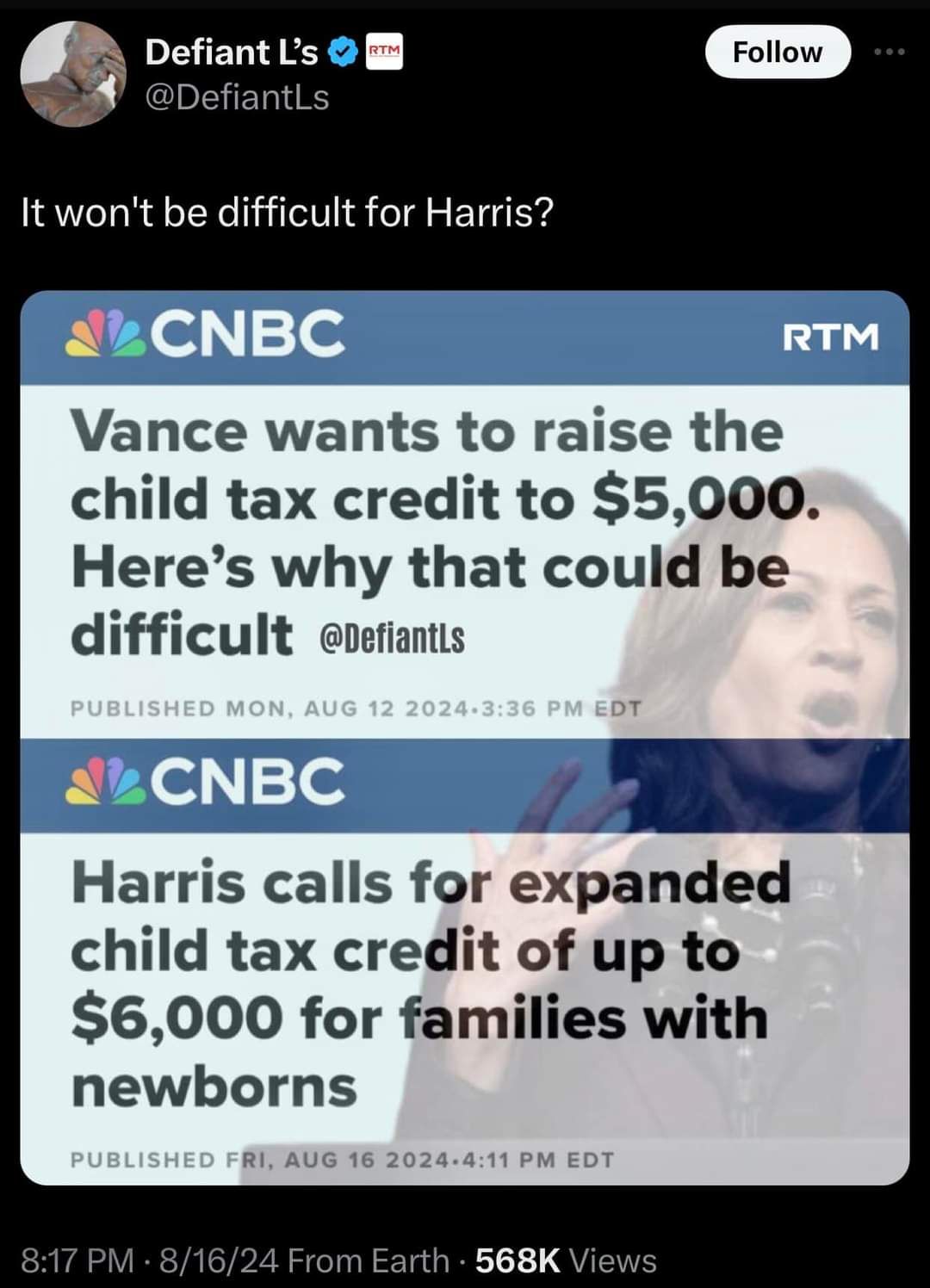
Only difficult when Vance suggests it?

When Trump proposed an end to taxes on tips the focus was on the ‘cost’ of allowing servers to keep more of what they earn.  But when Harris copied the idea, suddenly there is no concern for revenues lost and it is all about her “fight” for the little guy.  Likewise, when JD Vance offered a $5000 tax credit for children it was “difficult” and yet when the Harris campaign did the same it was all about newborn cuteness.  I mean, think of the children!

I suppose we should just be happy that the Democrats are finally coming around to the conservative idea of letting us keep more of our hard-earned wages.  It makes so much more sense than minimum wage hikes and giving everyone food stamps.  Of course, this means less power in the hands of the politicians, who love to run campaigns that scare their constituents about the potential loss of benefits.  

Trump had previously made the mistake of enacting an across-the-board income tax cut. This gave the media propagandists opportunity to claim it was a “tax cut for the rich” since those who pay more get a bigger cut proportional to the amount they paid.  That’s fair.  If you pay more how are you not entitled to more?  But everyone who paid in got a cut and the middle class a higher percentage, as outlined here:

According to IRS statistics of income data analyzed by Americans for Tax Reform, families earning between $50,000 and $100,000 saw their average tax liability drop by over 13% between 2017 and 2018. By comparison, those with income over $1 million saw a far smaller tax cut averaging just 5.8%.This pattern of middle-class tax reduction was also seen in key swing states.

For instance, taxpayers in Pennsylvania earning between $50,000 and $100,000 saw their tax liability drop by over 14%, while households with incomes over $1 million saw their tax liability drop by just 3.1%.Taxpayers in

Colorado earning between $50,000 and $100,000 saw their tax liability drop by over 13%, while households with income over $1 million saw their tax liability drop by just 4.5%.

Clearly everyone was getting a cut, and the middle-class got a higher percentage back than the rich, but the media coverage obsessed with the dollar amount people kept—rather than the percentage being cut—to distort the public perception.

The Trump-Vance ticket has learned and is now outmaneuvering the left.  Most people know that keeping more of their own money is efficient and much better than a new government program.  It is just that the Republicans didn’t sell it. 

But this time, with an idea to end taxes on tips and another to help all young families, the typical deceptive spin doesn’t work.

Harris had no choice but to try to outbid her opponent. 

The problem with this? 

Harris was the tiebreaking vote on a bill that sends IRS agents after waitresses.  Now, yes, the Democrats will claim that they need the 80,000 agents to go after ‘the rich’ since they know CNN, MSNBC, and NY Times would never run a story linking a poor minority woman being audited to DNC policies, yet it in this case is too hard to deny who the true beneficiaries are.

We should question the sincerity of those who only introduced their policies after the other side did.  At best, they’re like the kid who cheats on the test by copying off the smart student in their class.  At worst, they are simply saying whatever it takes to get elected and have no intention to do what are now proposing.  We can’t trust the ‘journalists’ to set the record straight or give unbiased presentation of facts.

Go listen to the interview and see if the headlines match with the reality.

The most frustrating kind of misinformation is factually based. 

They lie by structure or omission, by presenting the costs and not the benefits, and sadly it works because people aren’t able to read through it. 

They did this with Trump’s tariffs, stories zooming in on the few who were inconvenienced and ignoring the many long-term benefits.  But the criticism ended when Joe Biden took over the policy, suddenly it was silence—just necessary to push back against China and finally rebuild some of our deteriorated manufacturing strength.  Nothing changed about the actual policy or benefits, only the presentation.

Now the choice is yours, do you go with the side that originated these steps in the right direction or with those who lied about Joe Biden’s declining mental health, saying he was “sharp as a tack” until the debate made the truth undeniable and now would have us believe they’re telling the truth?

Add that Harris is trying to introduce disastrous price controls and could end up creating food shortages as happens when central planning replaces free markets. If you think inflation is bad, then wait until more food-production businesses start to close, like this fruit farm and market, due to the increased compliance costs and lack of profit. We can’t afford four more years of economic mismanagement.