The Art of Denial

Standard

Back in my school days, I got caught trying to make a weapon in shop class.  Being a boy, I was fascinated by those Nightsticks used by police and thought I could get away with this flagrant violation of rules.  But very early into this project the teacher, who had been around the block, confronted me and gave the cease and desist order.  However, rather than owning up to it, I went the route of plausible deniability and claimed that I was actually building a stool.

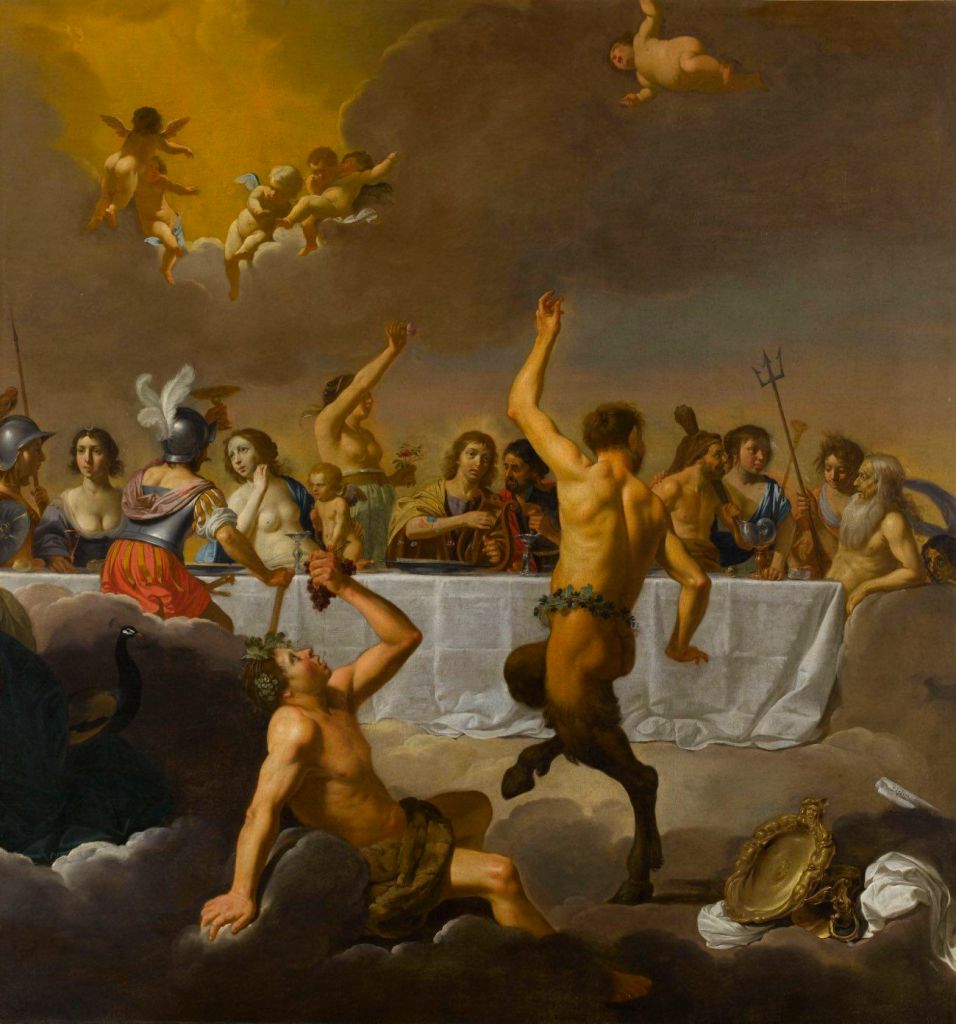
Likewise, some people when seeing many not happy with sacred Christian tradition being mocked tried to play off the display as a depiction of a Greek Bacchal Banquet. Whether you believe that explanation or not is up to you.  However, in either case, this was an obscene celebration of debauchery that had absolutely nothing to do with the Olympics.  And, no, that’s not coming from a prudish angle, rather Bacchus (not on Mt Olympus) was never a part of the Ancient Olympics.  So this clever response by apologists, like “Rev Cassie Rapko” (dutifully quoted in the Daily Mail), falls flat.

This new official explanation repeated over and over again in headlines, that “nothing to see here” denial of the Christian imagery in this depiction, also contradicts what these performers themselves had said before the damage control effort, as reported in their own words, “took inspiration from Leonardo da Vinci’s famous painting to create the setting.”  One of them even doubled down on the insult in a post that was later deleted after the narrative shifted.  The back peddling and gaslighting is incredible and it just goes to how unreliable our sources of information really have become.  This is an example of revisionist history in real-time:

But you’re crazy to think this has anything to do with Christianity!

The irony of the bizarre “It’s not the Last Supper, but The Feast of the Gods,” cover story is first that the explanation before the fury (above) is still online, and second that this painting by Dutch artist Jan van Bijlert was itself inspired by da Vinci’s The Last Supper:

And it is not so much about this one act as it is the meanspirited pattern of ridicule (and very deliberate misrepresentation) of Christianity by the left in part of a campaign of debasement and demoralization.  It is cultural vandalism, not art, and should be identified as such.  The left regularly betrays the love and tolerance it claims to stand for—only to greet with a Judas kiss acting as if they’ve done nothing wrong to deserve rebuke.  

“It’s just art!”

Try that excuse for spinning out on one of those rainbow flags painted on a roadway, see how it turns out.

Relax, don’t get so butthurt!  This is just art!

At the end of it all, the hypocrisy on the part of the fake tolerant “kindness is everything” left is expected. They are the civilizational equivalent of a plague of locusts, destroying all in their path and lacking any actual moral direction.  Sure, they’ll appropriate Christian morality, most especially when it is useful for bludgeoning others, but principles are for those trying to build.  The left lacks any creative power, which is why they parody and mock what is beautiful, what is meaningful, and truly life-giving in the world.  This isn’t even speaking from a Christian perspective, what truly awe-inspiring comes from these clowns other than their stupidity?

Until it comes to respecting your sacred traditions and symbols.

The need to recognize a bunch of talentless slobs, in the name of their false diversity, equity, and inclusion, only shows a lack of culture on the part of the French organizers.  This isn’t edgy or original, and it certainly isn’t going to help those who claim to be marginalized gain acceptance, it is simply sacrilege and a lame attempt to denigrate the faith of those who make up a 1/3 of the world population in an event that is supposed to welcome all people.  The only art on display was that of deception when they got called out.

Derision isn’t love. 

Ridicule isn’t tolerance. 

They lie to our faces and expect us to deny reality like they do, but you’re certainly not crazy for believing your own eyes.  I guess I should have told my shop teacher to squint harder and see the stool rather than the weapon.  But I was not that practiced in the art of deception.

A Trip Down Memory Lane

Standard

I suppose it is a bit impolite, especially in the age of the telephone, to drop in unannounced?

Oh well, I had already made my way down the long drive flanked by soybeans, to the old farmhouse behind the barn, entered through the little gate of the white picket fence, and was currently deciding what to do after ringing the doorbell twice with no response.

Earlier, this bright sunny September day, on my way from Sunday liturgy to coffee hour, I had received a text message from Lilian, my younger sister, inviting me to a fellowship meal at my old church. She told me about a special service to honor two elderly couples, both ordained leaders from my youth, and this presented a bit of a dilemma—do I go or not?

Since becoming an Orthodox Christian I had made as clean a break as I could from my conservative Mennonite past. In fact, the last regular service I’ve attended was several years ago. The circumstances of my leaving were not the most pleasant and I’ve avoided returning for various reasons. But, in this case, my loyalties overruled my trepidation, I had been invited and wanted to show my appreciation.

However, by the time I had arrived only one of the two couples remained. Pastor Sam and his wife Donna had already left for home.

I had missed the opportunity to wish them well.

Or, perhaps not?

My mother suggested what I was already thinking: I could go visit them at their home a few miles away from the church, take a couple of minutes to chat, express my gratitude and then be on my way again. So, after making my rounds, greeting the other couple, I headed down the road.

Anyhow, I’m at the door of the house, waiting, nobody answered the doorbell. So, while being bold, I decided to continue on with boldness. The door was unlocked (not unusual for rural Pennsylvania), I poked my head into the entry, cautiously ventured down the hall, “hello?”

They must’ve heard the doorbell. I was just inside the door when Donna came out from the back of the house and greeted me with a warm smile.

She told me she would get Sam and left me in the living room. I looked around. I debated where to sit. The old wingback chairs or antique couch? The furniture and decor remained largely unchanged from my last visit a few years ago, by appearances, which is comforting for someone like me who is oftentimes overwhelmed by the pace of change.

But one thing was different, that being the whirring sound of a compressor, which was plugged in near the door of the room, with an oxygen tank on top and various air tubes radiating out from the device.

Sam’s health, according to my mother, had declined precipitously since our last interaction.

He has had an ongoing heart issue and, more recently, Chronic Obstructive Pulmonary Disease (COPD), a lung ailment that does not come with a good prognosis. I had last seen him a few months earlier in his barbershop of sixty years, “Masters Style Shop,” (where his son and a grandson worked beside him for many years) and didn’t know what to expect.

He was out of breath and labored to talk.

But, despite his difficulties, his good humor and the mischievous smile remained.

I had to think of those times, decades before, where he would turn on the overhead projector, slap down the transparency with lyrics, and confidently, in his distinctive baritone voice, lead the congregation in a familiar song, “I’m so glad to be part of the family of God!” It was a sad day when he had retired. The character of the church, those founding couples, was fading into my childhood.

Sam had a way of speaking, a charisma, that captivated me and reminded me of the late Billy Graham.

Sam had always taken a special interest in everyone, including me. We would always talk about the high school football score in the fall. He knew that I had played, we would chat a little, and something of his demeanor always left me feeling cared about.

He had been born in the very room that we were sitting in. The farm had been in the family that long. Sam, and his wife Donna, are fixtures in the community, the kind of people who can be relied upon. They were Lutheran before finding a place in the Mennonite church, people of devout and sincere faith. Sam also served in the military as a young man.

The short visit Sunday turned into a couple of hours, their home a very hospitable place and there was little doubt that this may be my last chance to spend time with this venerable man. I would have probably stayed later, but could no longer keep Charlotte waiting and knew that it would be selfish to stay much longer. So, after introducing Charlotte (on the other side of the world) through video call, we said our goodbyes.

Wilbur S. “Reds” Corderman, 81, born April 3, 1939, passed into eternity on Monday, September 14, 2020.

What Is True Distinction? (Matthew 23:5-12)

Standard

The world loves distinctive dress and titles.

If I wear an expensive suit and fancy tie to an event, that will probably result in my being treated differently than if I show up in street clothes.  Having “PhD” behind my name would earn me more respect in some circles.

The world judges by outward appearance.

People rank and categorize other people based on what clothing they wear and what positions they hold.  Wear the wrong dress to an occasion and expect to be shamed in the gossip columns.  The climb up the social ladder can be brutal.

The church, unfortunately, is not much different.  The expectations and dress standards might vary, but the harmful focus on distinction of title or outward appearance is the same.

What did Jesus say about obsession with dress and titles?

Jesus, continuing his rebuke of unhelpful religious elites, said…

Everything they do is done for people to see: They make their phylacteries wide and the tassels on their garments long; they love the place of honor at banquets and the most important seats in the synagogues; they love to be greeted with respect in the marketplaces and to be called “Rabbi” by others. ‘But you are not to be called “Rabbi,” for you have one Teacher, and you are all brothers.  And do not call anyone on earth “father,” for you have one Father, and he is in heaven.  Nor are you to be called instructors, for you have one Instructor, the Messiah.  The greatest among you will be your servant.  For those who exalt themselves will be humbled, and those who humble themselves will be exalted. (Matthew 23:5‭-‬12)

The religious elites were obsessed with what other people thought and how they appeared.

Jesus mentions the “phylacteries” and “tassels” they wore, meant as symbolic reminders of their devotion to God, became about drawing attention to themselves.  They pranced to the front benches, loved to be noticed when out in public, and sought titles to impress their religious peers.

Jesus was unimpressed.  It is apparent that their religious devotion was not about God’s glory and honor as they would claim, it was all to draw attention to themselves and prideful.  Jesus again alludes to the tables being turned and roles being reversed—a time when the first shall be last and last shall be first.

But how is this applicable today?

Nobody I know wears phylacteries or tassels.

However, I believe the warnings against obsession with appearance still apply as much to religious people today as it did then.  We have different versions of the same prideful behavior in our churches today.

Here’s what we are doing:

1) Seeking the important seats:  I sit anywhere in the church because it does not matter.  There is nothing wrong with sitting in the back benches in an age of microphones and amplifiers.  Socially awkward people do not enjoy parading up to the front of the church; they don’t want the attention.  And so what if the rebels sit in the back, at least they are at church, right?

Funny how some Mennonite leaders have apparently not gotten the memo about those who love the “place of honor” and “most important seats” in a religious setting.  From the way they commend people who sit in the front benches you might be led to think that Jesus said that makes a person special or better.

Yes, there is something to be said for accommodating visitors and mothers with young children.  There’s also something to be said for not creating a distraction by yukking it up with your buddies.  We should always be considerate of others.

That said, seating position is no indication of spiritual condition.

2) Loving important titles: There are some people who use the letter of what Jesus said as a means to bash Catholics for their use of “father” in reference to church leaders past and present.

Unfortunately they entirely miss the point being made and in their arrogance are potentially slandering those who appropriately use these terms.  The admonition against calling anyone “teacher” or “father” is not about the specific words used, but about how and why they are used.

How do I know this?

Well, the Apostle Paul refers to himself as “father” (1 Corinthians 4:15, Philippians 2:22) and I’m doubtful he did it in ignorance of or contradiction to what Jesus said.  I believe he used it as a description of his true fatherly love and affection for the children of the faith and not vainly as a means to secure unearned respect from others—which is what Jesus was speaking about.

Sadly, those who turn the words of Jesus into a legal code miss the spirit of what he is saying.  Sure, they might never use the words he mentioned to describe themselves, but they do use words like “reverend” or “evangelist” in the same way as a Pharisee.  With different words they embody the same self-seeking spirit of the religious elites condemned by Jesus.

And we do this too.  We may not seek fancy titles outright.  However, I was turned down by a young woman who wanted someone who used “missionary” or “pastor” to flaunt their ambitions and I was uncomfortable describing my calling in those terms.  Love of religious importance is not unusual amongst Mennonites even if not as openly stated.

There is nothing new under the sun when it comes to spiritual pitfalls.  As my sister would say: Same manure, different piles.  Except she doesn’t use the word “manure” when she says it…

3) Dressing distinctly: It blows my mind how far off the mark people can be when it comes to matters of dress.  There are some churches where people will frown on those who do not wear a suit and tie (while some conservative Mennonites will frown on those who do) and for some reason carrying a big leather-bound Bible is important too.

It makes me wonder what these proper religious people would do if a man like John the Baptist showed up in camel’s hair.  They might be suffering from the same ailment as Saul’s daughter; Michal, when she saw David dancing in a “linen ephod” and called him a “vulgar person” for it (2 Samuel 6:14-23).  Apparently God was not impressed with her judgment of propriety according to what I read.

That is not to say we should intentionally draw attention to ourselves and dress in a provocative or ostentatious manner.

Which leads to my next point…

Many conservative Mennonites look to distinctive dress as a means to be a witness.  They claim this is an act of “non-conformity” and taking a stand against “worldly” fad and fashion.  And I do appreciate the idea of not being jerked around by every whim and fancy of the mainstream culture.

Unfortunately, this non-conformity of outward appearance does not always reflect change at a heart level.  We might not look like our “worldly” neighbors in the way we dress and yet many of us are even more obsessed with fashion than they are.  The smallest differences (the number of pleats in a dress or the collar of a suit coat) can lead to venomous accusations and division.

Distinctive dress has become a stumbling block for conservative Mennonites.  We judge each other based on our differences, we shut people out for not meeting our own dress standards, and forget to love each other as Christ commanded.  We have taken Scripture that instructs Christians to be focused on inner change rather than outward adoring (1 Peter 3-4, 1 Timothy 2:9-10) and turned it into a fixation about outward appearance.

Perhaps we forget what Scripture tells us about pride and clothing?

Peter describes the true distinctiveness of being “clothed” with sincere faith:

All of you, clothe yourself with humility toward one another, because, “God opposes the proud but shows favor to the humble.” Humble yourself, therefore, under God’s mighty hand, that he may lift you up in due time. (1 Peter 5:5-6)

We are told to be distinctively dressed.  However, that distinction of dress means to “clothe yourself with humility” and to “clothe yourselves with the Lord Jesus Christ” (Galatians 3:27, Romans 13:14) rather than with our own religious works–that is a far deeper distinction than mere outward appearance.  Our distinctiveness should be less about what we wear on the outside and more about being a manifestation of this:

A new command I give you: Love one another.  As I have loved you, so you must love one another.  By this everyone will know that you are my disciples, if you love one another. (John 13:34,35)

Distinguished titles and distinctive outward appearance is vanity when it causes strife or leads to a pecking order.  We must embody the character of Christ by loving each other as he commanded.  It is not about looking different or having a fancy title, it is about being different in heart.

If a person professes faith in Jesus, then accept them as a brother or sister and don’t be a religiously pretentious snob.  Jesus, as far as I know, did not dress like a Mennonite, Amish man or Baptist.  I’m doubtful he was much concerned about solids or stripes and the size of floral prints.