The Three Different Kinds Of Mechanics

Standard

We tend to lump things together that shouldn’t be. In other words, there is plenty of diversity within categories and this is something true of those whom we call mechanics. And the significant difference in mechanics is analogous to other professions, which is where this essay will end up.

The other week my old reliable Ford Focus began to act up. I had traveled, with my family, to a company picnic and everything was fine on the way out. However, on the trip home there was something that was not right. The power delivery was rough when trying to accelerate but smooth enough while cruising and immediately my mind went to the trick this 2.0 L had up its sleeve.

The ‘Duratec 20‘ has Mazda DNA. It uses direct injection and variable valve timing (or Ti-VCT) to make 160 hp while still delivering decent fuel mileage. With a 12.1:1 compression ratio, it has a decent torquey feel for a 4-banger, and—paired up with a five-speed—it is fast enough to be fun.

And to the point that a week prior to this, on the way to church, a late 90s Honda Civic with a loud pipe did the customary flyby, and we just so happened to line up at the next red light. So, as was necessary, to the slight embarrassment of my wife and great amusement of my son, I do the hard launch. It bogged a bit, despite my loading up a bit prior to releasing the clutch, so I dumped it down completely, the tires chirped, I hit second hard and I was grinning a couple of car lengths ahead before they knew what had happened. Not an actual race, but I’m pretty sure I had the edge even if they were ready for me.

The engine light would eventually come on in the next day or two. And, sure enough, checking the code at AutoZone, it came up as a camshaft sensor. That was something I could handle. I swapped in the new part. But it didn’t fix the problem. I noticed that the negative battery terminal had some corrosion and, with the help of a cousin, we cleaned that. Still, no dice. The issue persisted.

Shop #1: The Inspection Garage

With the help of a mechanic friend of mine, who sent me the applicable page of the diagnostics manual, I determined that the problem was now beyond my shadetree abilities. It was potentially a crank sensor fault (that for some reason shows up as being the cam sensor) or involved some sort of wiring issue. I took it to the garage, within walking distance, which had given me a better deal for vehicle inspection than the dealer could offer.

I left them with the page of the manual. I returned to a vehicle with a drained battery and still acting up despite their efforts. They had cleaned the throttle body, changed the air filter, and not overcharged me for that service. However, the problem was not fixed, and the explanation he gave—that the car (with over 230,000 miles) was old and probably down on compression—did not satisfy me.

I had assumed that they had run down the diagnostics checklist, as I had basically told them to do, and that weekend decided to take a look again with the aid of a mechanically inclined brother-in-law at our family summer get-together. My sister has a 2016 Focus, which had corrected the wiring harness issue, and immediately, while looking at her engine bay, I noticed how the Ford had moved these wires from where they were on my own 2014.

So I took another look at that, I lifted the harness on my car where it was against the engine and, sure enough, I could see the cover was worn through and a little copper was shining. Uh-oh. With a small piece of electrical tape and a spirited tested drive, the diagnosis was clear—that was the problem and I would need to take it to a shop that was capable of following my instructions.

Shop #2: The Technician

After pricing my options, I decided on a garage that had helped me with another mystery issue years ago with my Jaguar XJR. Jake, the owner, was an expert at diagnostics and, in a conversation with Jason who he trained as his replacement, it was clear that this guy knew his stuff. Now, granted, in this case, I had already provided the diagnosis. However, I could tell that he understood the systems of the vehicle far better than the guy at the inspection garage.

This is the kind of mechanic you need when the issue is more than an alternator or something obvious that only needs to be removed and replaced. Anyone can turn a wrench. Quite a few can go down the diagnostics checklist and eventually find the solution. But the actual technician type is a different breed, he is the guy who writes the manual and can even feel what is going on after a short test drive. These are the Ken Miles, can-improve-what-already-is kind, who in different circumstances may have become an engineer or even a doctor.

The technicians are professionals. They have a high IQ and a wealth of knowledge. And it is about much more than having the correct certifications or a toolbox full of Snap-On tools. Some simply do not have the aptitude even if they went through years of training and others do. The technician could be working in the back alley of Manila or at the dealership down the road. There are different levels even within this group, but what sets them apart is their intuitions and ability to model the complex systems of a vehicle in their heads. He’s as smart as your cardiologist.

Shop #3: The Scam Artist

Years ago my brother took his Ford Tempo in for a routine inspection. This was his first car and basic transportation for a teenager. And only cost a few thousand dollars, which was basically all he could afford at the time. The tire shop is in the middle of town and looks decently professional. I think of this incident each time I see their advertising two decades later.

The bill he got was more than the value of the car. Apparently, they decided that every suspension part was out of tolerance and maybe they were technically correct, who knows?

What I do know is that my dad took severe issue with this and helped my brother negotiate a slightly better price for the work. Still, they soaked him for a huge amount of money and have lost our business since then. They were at the level of the inspection shop, or your local Walmart Auto Care Center, as far as their abilities and yet telling us with absolute conviction that the car was not safe to drive without the laundry list of parts with labor they installed without so much as a phone call to my brother.

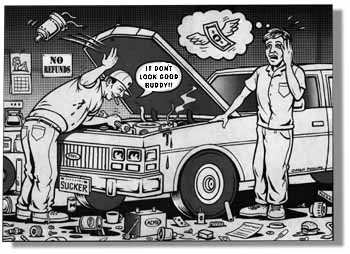
Dealerships can overcharge. But usually, they are more reputable and not just replacing parts because they have you over the barrel and have a bonus to make. These are the types who would convince your grandma she needs the blinker fluid filled and muffler bearings replaced. They aren’t technicians (they would too be ashamed of themselves if they were) and are basically just swindlers with a wretch to use as part of the scheme. Their diagnosis is always something expensive.
What Kind Of ‘Mechanic’ Is Your Doctor?

This understanding of different types of mechanics applies to all professions. Not every college graduate with the right credentials is equally qualified. Some engineers are really good at the classroom stuff, they know the code and can be completely anal about largely irrelevant or unimportant details. Others really get what makes structure work, it is intuitive to them, and what they build is likely safer than the variety that dots all of the I’s and crosses all the T’s according to the IBC 2021.

Doctors come in many varieties as well. There are those types who get into things like cosmetics or reconstructive surgeries, chasing after the big bucks, and then there are the others who want to run a clinic or set up a family practice to help as many people as possible. The country ‘doc’ driving the F-150 is a different breed than the one with a BMW or Porsche. One is practicing medicine, and the other has a profitable business that requires some medical skills. And, in both cases, competency is not strictly a matter of gathering the right diploma or getting through the board requirements.

My own hunch is that most doctors are more like the inspection shop mechanic. They’re not out to screw you over and they also do good work for the most part. However, they got where they did because they were at least of slightly average intelligence and good at navigating the system. This doesn’t mean that they are actually doing the real number crunching of the diagnostics themselves. No, it means that they can match a list of symptoms with what they can find in the Merck manual and write a (barely legible) prescription. This could mean that they miss things, over-prescribe, or basically share in the same failures as the entire medical establishment.

So, how reliable is the system?

Well, I’m not sure.

When I read things like, Why Most Published Research Findings Are False, and how the Lancet published (then later retracted) studies that cautioned against the use of Hydroxychloroquine or how Ivermectin was skewered as being “horse dewormer” despite being an effective anti-viral medication, it seems that politics may be dictating the science. And we all know that politics is heavily influenced by cold hard cash. So, let’s think, who benefits from keeping these kinds of cheap widely available therapeutics from the market? There was an industry that made $90 billion from the pandemic and also has connections to the corporate media apparatus. Who knows how far this big money penetrates government agencies and impacts regulations or policies.

But I do know this has been said…

“It is simply no longer possible to believe much of the clinical research that is published, or to rely on the judgment of trusted physicians or authoritative medical guidelines. I take no pleasure in this conclusion, which I reached slowly and reluctantly over my two decades as editor of The New England Journal of Medicine”

Marcia Angell, MD

And this…

“The case against science is straightforward: much of the scientific literature, perhaps half, may simply be untrue. Afflicted by studies with small sample sizes, tiny effects, invalid exploratory analyses, and flagrant conflicts of interest, together with an obsession for pursuing fashionable trends of dubious importance, science has taken a turn towards darkness”

Richard Horton, editor of The Lancet

I’m assuming these two would know a little about the current state of science and medicine.

So how does a doctor separate the wheat from the chaff?

It is not right that some see the failures of some as a reason to dismiss it all. Getting taken advantage of by one repair shop doesn’t make all mechanics crooks. Still, how does a patient know if their doctor is doing a high-level analysis of the evidence, is capable of critical thinking and going beyond the book, or if he’s just following the pack without doing any truly independent diagnostics? It really takes someone a bit removed from the profession, who doesn’t share their biases or bad remedies, to give the corrective treatment. Maybe a car mechanic turned doctor (the guy in the featured picture) would have some useful perspective on the topic?

Whatever the case, if we can’t trust everyone who is licensed by the state to inspect vehicles, we should be even more skeptical of those who want to put things into our bodies. They don’t even have to be bad or intend harm, it could simply be that they are asleep at the wheel, putting trust in institutions that have been compromised and corrupted. At the very least, the body is extremely complicated and even our most advanced methods are crude. We may not know that our modern versions of bloodletting are of negligible value or even harmful for another century or two. This is why we customers, the patients, should never be pressured one way or another even if the science is supposedly settled.

Yes, even those at the top of the profession today may be tomorrow’s quacks…
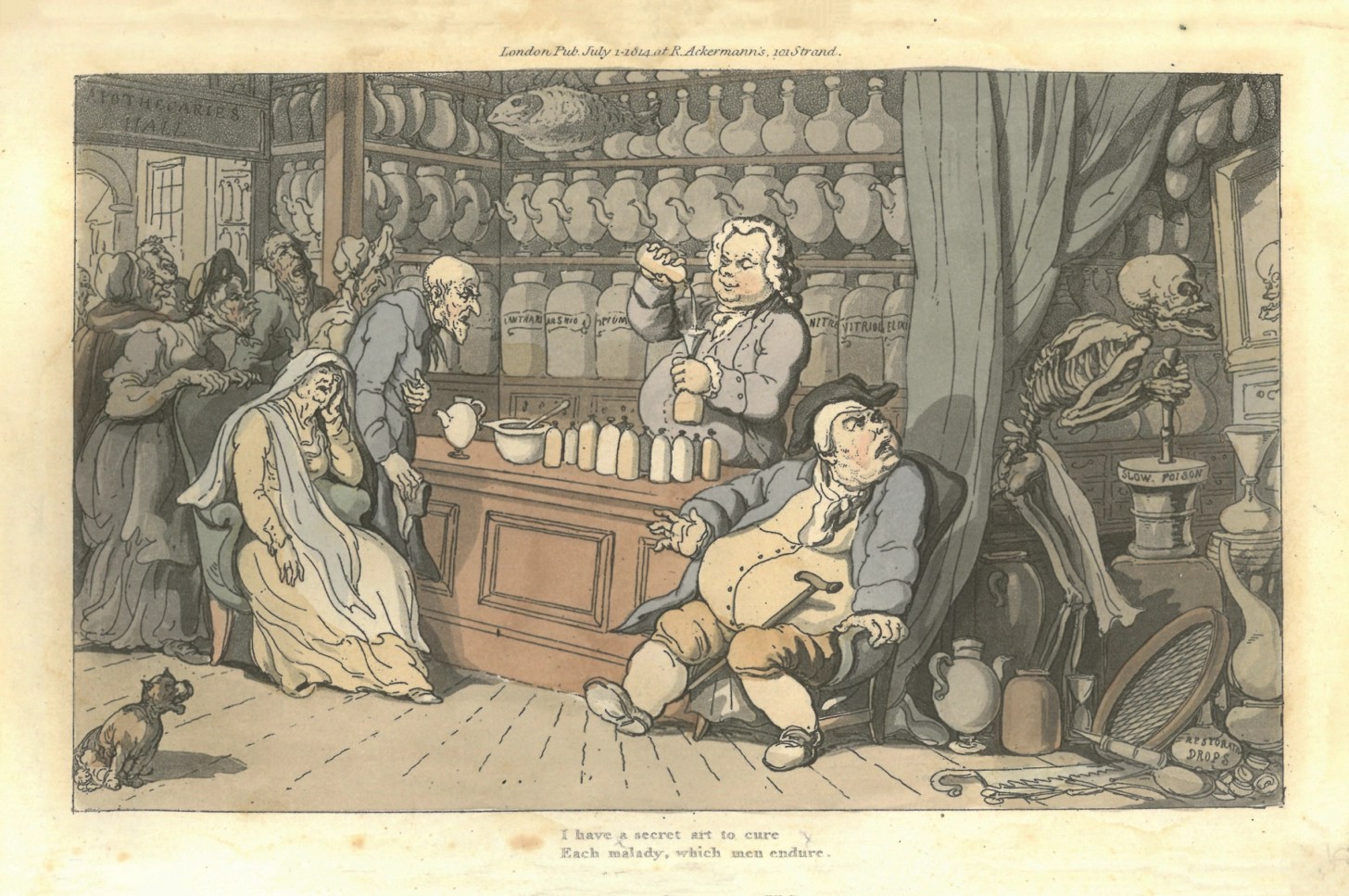
Note the “slow poison” written on the mixing device.
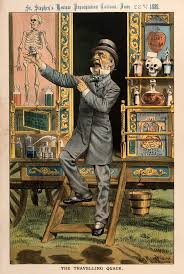
Will the Real Quacks Please Stand Up!

Standard

I’ve never been much of a fan of alternative medicine and those peddling their cure-all treatments.  For one, their typical pitch being an attack an the profits of conventional medicine is actually a red flag about their own motives. 

And, secondly, testimonials (or anecdotes) are fabulously awful evidence.  A person can say anything they want or attribute their current positive feelings to whatever, but it doesn’t mean their A led to B assessment is actually correct. 

Unless there is concrete evidence, I dismiss the alternative quacks.  Sorry, I simply do not want to take or sell your mystery juice.  It is disturbing that so many can’t see through this kind of nonsense.

But what is far more disturbing?  

When the mainstream starts to resemble these frauds.  

Yes, it is obvious that modern medicine works.  My successful neck surgery as proof of this.  There were measurable results nearly overnight, almost immediate relief to pain and the numbness.  The whole process was very straightforward.  However, that was a cut and dried form of treatment.  In that they took the old broken stuff out, put some new hardware in, and gave my pinched nerves a chance to heal.  

And yet, while it is amazing what can be done, not everything in our human biology is as simple as disks and vertebrae. 

Indeed, there is a murkier side to modern medicine, things that aren’t 100% clear even after many years of study, having to do with the more complex parts of our physiology and how these systems interact, and this is something that must be explored.  More than that, however, our own psychology, tendencies towards bias, could be leading the collective enterprise in the wrong direction.

#1) Money Money Everywhere 

The first stop is profit motive.  If I don’t mention this then someone else will.  It is the low hanging fruit in this discussion and certainly a factor.  People need paid, and medical professionals get paid for treating disease.  Healthcare is a 4.1 trillion dollar industry in the US and pharmaceuticals are a significant part of that overall cost.  Does this mean that the medical establishment wants to keep us sick and dependent?

Public health officials and regulatory bodies are, indeed, potentially compromised by this opportunity to cash in.  Top US physician, Dr. Anthony Fauci had received undisclosed royalties, part of the $350 million paid by third-parties to NIH and scientists employed by this agency.  No, this isn’t itself proof of corruption, people should get paid for their contributions and lobbyists may very well believe in what they’re promoting.  But there is the reality that money can overrule ethics and potentially cause people to turn a blind eye to problems.

Still, this is not my go-to explanation and for the simple reason that this accusation could be made against any for-profit enterprise.  I work for a truss manufacturing company and we do profit off of fire jobs and wind damage.  Does that mean we intentionally set fires or build an inferior product so it fails every ten years?  Absolutely not!  To make such a claim is, again, more an indication of the heart of the person making it and not proof of anything unless there’s clear evidence.

#2) Testing 1, 2…Good Enough…

Testing and peer-review is also one of those areas of concern as well.  And not because there is nefarious intent either.  But more a matter of scope or methodologies. 

My neck surgeon, for example, opted out of being a participant in a study involving a new line of disk replacement hardware because it was comparing it to a far inferior older product rather than newer better products already available.  In other words, it was a stacked deck or research that is designed to lead to a particular conclusion.

That’s the big problem I have with these broad often unqualified “safe and effective” claims.  It begs the question: Compared to what?  Bungee jumping?  A placebo? 

Most people, including physicians and scientists, simply do not have the time to be experts at everything.  The body is incredibly complex and nobody can actually do their own scientific research for every issue.  For that reason those in the medical field must, as a matter of practicality, rely on diagnostic manuals for treatment and various journals to stay on top of things.  Coloring outside the lines, challenging powerful government agencies, doing unproven or experimental treatments, is a risk of their license or a malpractice lawsuit and ill-advised.  There is an inherent need for those employed in these fields to trust the system and accept what other professionals do. 

If not this, if  their training and education, what else are they going to rely on?

I don’t expect those employed in the medical industry to doubt the very foundation that they stand on. 

Unfortunately, this reality is what makes their consensus useless.  Sure, they might know much more than the average person about the science.  Still, are they up all night, in the laboratory, carefully repeating the results of the latest studies themselves?  No, when other experts in related fields endorse what another expert is saying it is merely a sign of statement of their faith—that being their faith in the overall system.  

But it seems every other week a study comes out that seems to contradict prior findings.  Most of this is due to how limited the focus of research actually is.  They can’t possibly test every variable and especially not in a very short amount of time.  This reality, of finite resources, is a legitimate cause for healthy skepticism and abundance of caution.  The problem is that most people, including those well-educated, don’t have great critical thinking skills or even the ability to know the right questions to ask—it is far easier to “trust the experts” and go with the program.

#3) Confirmation Bias Is Always a Problem 

The problem with research is that we often go in looking for a particular result.  Sure, a double blind study is designed to reduce this as a factor.  However, the underlying bias can show up as far as what gets tested and what does not.  It can also be a factor in how we interpret the data available.  Group think and echo chambers, things like functional fixedness, are as much (or more) a problem with those very knowledgeable as it is with anyone else.

One example of this is how “effective” kept getting redefined down.  What once was supposed to prevent the disease and stop the spread would shift, overnight, to being a way to merely lessen the severity of the symptoms.  Which is a foundation so subjective and shaky that it is basically in the same category of the testimonials used by snake oil salesmen.  It is another area where the studies aren’t as conclusive as many would assume.  And, at the very least, correlation does not equal causation.  In other words, the vaccines could simply be acting as a placebo for those who believe that they are effective. 

What is not taken into proper account is how these perceived benefits, that are shrinking day by day, weigh against both short and long-term risks. 

For example, someone very dear to me, fully vaccinated, boosted, is currently suffering from a persistent respiratory illness, starting a month or so ago, and now is having flu-like symptoms again.  Could this be this is a result of an immunosuppressant effect of the injection?  It sure does appear that way and would be worthy of a study of the things presumed to be unrelated to the vaccines that very well may be related.  There is only a trickle of information coming out, discussion of side-effects buried in the search results and censored on social media.

What is most unsettling is the reality that our mainstream medical establishment is as prone to confirmation bias as those pushing alternatives.  They see what they want to see in the evidence and dismiss or downplay anything that contradicts what they were expecting to see.  The biggest difference is that it is more convoluted than it is with the obvious quacks, whole institutions get on board with a solution and too often it just gets cycled through, reinforced in each cycle, without enough awareness of the potential failure due to the blinders we all wear.

#4) Political Bias Is Endemic

One of the most troubling revelations of the past few years was how awfully politicized the coverage of a pandemic was. Anyone who thought that partisan differences would disappear in times of a national crisis was dead wrong.  If anything it is what likely drove much of the response.  At first leading to charges of racism (for travel restrictions from the virus epicenter) and accusations of over-hyping the threat of Covid—before swinging wildly in the other direction with onerous state-level mandates that destroyed great economy on the eve of a national election.

But one of the most disturbing episodes (and disgusting) is how proven medications, like hydroxychloroquine and Ivermectin, were treated as if they were especially dangerous and controversial simply because the ‘wrong’ person mentioned their potential as being a treatment option.  It is truly a great way of explaining how propaganda works.  The partisan media would pick the most extreme case of an overdose, ridicule a proven multi-use medicine as “horse dewormer” despite the many uses, and then misleadingly ‘fact-check’ the technicalities of language.

I mean, sure, these proven medications do not “cure” the disease.  But they are most certainly treatments that are effective for preventing severe symptoms if taken prior to the infection taking hold.  This is why several older doctors that I know (whom I will not mention by name for their protection) were quietly stockpiling these much maligned substances.  They didn’t dare speak too loudly either or they would be risk their own medical licenses for promoting unproven cures or some other nonsense.  Bullying and peer-pressure is as real for a professional as it is for anyone else.

This, along with other much more expensive (and profitable) treatments being pushed, is fodder for the conspiracy theory crowd and for good reason.  For me it disproves any notion that the system we rely on, including the medical establishment, is impartial or fair.  Sure, I’m glad that The Lancet, a trusted medical journal, eventually retracted a study that falsely claimed that hydroxychloroquine led to death for some Covid patients (as they have with another study linking vaccines to autism) and yet the damage was already done.

#5) Lost in Oversimplification 

One of the harder or more difficult problems to explain is how the common models of are often too dumbed down to be accurate.  

Up until recently depression was explained as being “chemical imbalances in the brain” and selective serotonin reuptake inhibitors (SSRIs) the solution.  This overly simplistic explanation has been called into question and this is a cause of alarm for those told to “trust the science” when it comes to the professionally prescribed answers.

I love metaphor and analogy to explain things less visible or intuitive.  However, if these tools are misunderstood as being exactly the same as the thing being described this can lead to very wrong conclusions. 

Just like a ball and stick model of atoms is useful yet doesn’t truly explain the reality (an electron is more cloud of probabilities), the various illusions used to sell parts of the pandemic response are as flawed.

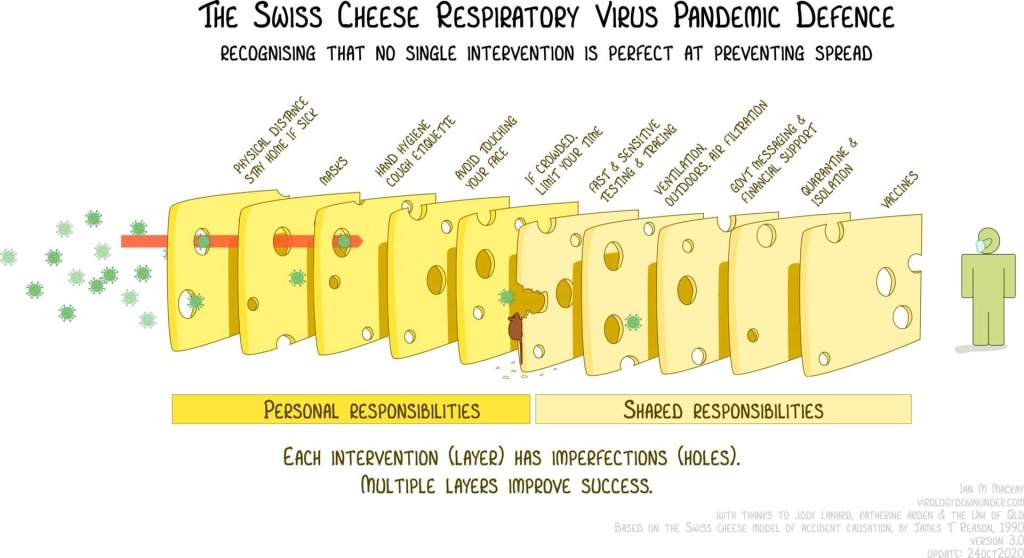
Sure, the theory of “flattening the curve” is great on a graph, and swiss cheese makes a very compelling illustration of how a multi-faceted approach could work, in theory, but both give a false impression of being complete or unquestionable. 

But is this theory working in reality?

Of course, how diseases spread in the real world is different from the even the best models and it is quite possible that slowing the spread only makes things worse, as is the case with attempts to manage forest fires. In that effort to control can eventually lead to much more devastating fires. Slowing down the process could result in a scenario where the burn is thorough, everything gets consumed, rather than the alternative of a fire that moves quickly and skips over areas.  The point being that analogies don’t account for the nuances and could lead to the wrong ideas taking hold in the public imagination.

No, this is not to claim that I have a better grasp of virology than those who have studied these things their entire lives.  It is only to say that these illustrations give too many undue confidence.  There are many factors that these crude analogies gloss over and factors that could vastly change the final outcomes.  The problem is that many are unable to see the more complex picture as a result of these elementary level descriptions that are used to sell a particular approach.

It makes us unbalanced.

In Conclusion…

There is no individual that can provide an opinion that is completely infallible nor any agency that is able to offer a perspective free blindspots or bias. 

Our “settled science” today make seem as bloodletting in a generation or two.  And the same kind of thinking that leads crackpots to their ‘alternatives’ is also all too present in the mainstream.  There is always the money motive, with the lack of adequate testing, the confirmation bias, the influence political agenda and faulty or misleading explanation, all tainting both the perception of the general public and professional opinion.  The biggest difference between those who believe the quacks and those who insist that the vaccine is effective is the level of funding behind their perspectives.

This doesn’t put the outliers and mainstream on equal footing, there is such thing as strength in numbers, yet what is popular is sometimes only a product of propaganda and common ignorance. 

Don’t be so sure that the things being ridiculed in the current paradigm are any different from what is being promoted.  We know less than many think we know.  There may be future studies or new discoveries that will completely upended the too hasty conclusions of our time. 

No matter how confident we are in our own position or settled we believe a topic is, it is always best to stay humble.