The Blessings Of Not Being Married As Planned

Standard

This was not the blog I had planned.  I have two finished blogs and had told a friend I may flip a coin to choose between them.  However, I was thrown a major curve ball which has caused me to wish to delay release of those blogs to go with a third option: Write this blog and share it first.

Enjoy…

When life does not go according to plan and you end up single, like me.

My plan was to be married by twenty-one.  I’m the relationship kind of guy.  I wanted to share my life with someone special more than anything else, wanted children, and therefore had planned to be married as soon as possible.  However, my plans to marry that high school crush passed along with my twenties and, despite my heroic efforts, I remain single to this day.

Anyhow, I decided to write this blog so my single (and wanting) friends can have a reason to smile.  I’m single, it was not entirely my choice, it has been extremely painful at times, profound loneliness stinks, and yet God has been faithful.  There have been many moments of deep despair and hopelessness, but I am here to tell you that there’s reason to hope and be happy.

I’ve decided to write about the things I would have missed out on and what I would not be today had I married when I planned.  It is hard to imagine what I would be for certain today had I married young and we have no way to know that counterfactual reality of might have been, yet there are some things that I am fairly certain about.

Six things I would not be had I as a married planned:

I would not be a blogger.  You are reading this blog because I have time to write it as a single person.  Writing is something I do not completely enjoy, but it is something that seems to be a gift I have and I do it mostly as an act of faith.  This blog was started a couple years ago as a response to the questions in my mind about my purpose in life that came after a “no” from a girl who was the embodiment of a the Mennonite ideal for a wife.

I would not own an awesome car.  Earlier this year it was my privilege to buy something most married men can only dream about and that being a brand new Shelby GT350 Mustang.  Sure, we should not live our lives for such material things, but it was nice to see my hard work and diligent saving pay off in a tangible (very thrilling) way.  So, while I would trade this mechanical beast for a wife and family in a heart beat, I still enjoy the memories of many grins and the experience.

I would not know the pain of rejection.  Pain is bad, right?  Well, not entirely actually, pain is temporary and with pain comes empathy and the ability to appreciate pleasure all the more.  Sure, we avoid pain, we probably should avoid unnecessary pain, and yet pain helps me to identify with those who suffer.  More significantly, it has allowed me the privilege of a deeper appreciation and understanding of my Lord and Savior who suffered for our sins.

I would not have the unique perspective that I do.  My experience as a single person with unfulfilled desires and social needs often unmet gives me a special vision for the church.  I say unfulfilled needs thinking about Maslow’s hierarchy of needs and the idea that people need deeper connection to thrive.  I can recall the many times I felt spiritually deficient, isolate from human touch and longed for a church that was more than superficially concerned.  The fact is, we were made for meaningful human connection and without it we become unhealthy.

I would have missed out on many wonderful friendships.  As part of my dealing with my own disappointment I became more open to being the answer for the needs of other people.  Because of what I had gone through it was my desire to help others in similar circumstances.  I have stepped out in faith and as a result have been very blessed.  The friendships gained would likely be impossible had I been a married man.  Investments made in Christian love for other people always seem to pay back in surprising ways.

I would not have been asked on a date.  There is a first time for everything and I had a first over the weekend.  When I wrote my last blog it was not with a clear personal agenda or self-pity.  There are some unanswered questions right now that keep me from being ready to make a serious romantic commitment.  My blog was to create awareness of an issue that is not being adequately addressed in the conservative Mennonite church that I know.  One thing for certain, I had not planned on being asked out on a coffee date by a very intriguing young woman.

But I do like my unplanned blessings and especially when they come because of faithful actions.

I have much to be thankful for as one blessed more than he deserves.

My next blog will be on the topic of marriage as martyrdom.  But before that I wanted to encourage my single friends to see the bigger perspective.  Those who remain single (because they were rejected by the world’s standard and not for prideful selfish reasons) may obtain the bigger crown because they are most like our Lord and Savior. 

So, to my single friends, remain faithful.  God may have some unplanned surprises in your future of a very pleasant variety.  Trust God, the one who holds the future, and not your own human perspective or a worldly understanding.  Live in true faith today and may God soon grant you the desires of your heart.

Smile too, it’s attractive.

Does One Voice Make A Difference?

Standard

“‘Meaningless! Meaningless!’ says the Teacher. ‘Utterly meaningless! Everything is meaningless.'”

The book of Ecclesiastes paints a bleak picture of life.  It describes how cycles of nature repeat and nothing really changes from before.  We labor yet we are soon to be forgotten along with our labor.

If that is how he felt then, then how should one feel today?  Meaning can be further lost in our current understanding of the vastness of time and space.  We rush with an ever quickening pace into a sea of nothingness.

“Then I applied myself to the understanding of wisdom, and also of madness and folly, but I learned that this, too, is a chasing after the wind. For with much wisdom comes much sorrow; the more knowledge, the more grief.” (Ecclesiastes 1:17-18)

Wisdom goes hand and hand with sorrow because the unwise do not realize they are unwise.  So a wise person is often stuck watching the foolishness of others unfold before their eyes without being able to do anything to stop it.  Knowledge of the patterns of people and history is often a source of painful helplessness.

What can a compassionate and intelligent person do but mourn the world then bury themselves in pleasurable indulgences so they can forget?  

The excesses of king Solomon, the writer of Ecclesiastes, were not a product of foolishness, they were an attempt to escape a maddening reality where all men (wise or foolish) would eventually perish.  His knowledge and wisdom made all of his pursuits become empty.

“The wise have eyes in their heads, while the fool walks in the darkness; but I came to realize that the same fate overtakes them both.  Then I said to myself, ‘The fate of the fool will overtake me also. What then do I gain by being wise?’  I said to myself, ‘This too is meaningless.’  For the wise, like the fool, will not be long remembered; the days have already come when both have been forgotten. Like the fool, the wise too must die!” (Ecclesiastes 2:14-16)

It is a reality that is inescapable, watching people make the same mistakes over and over again, seeing where the patterns of today will lead, being treated as a fool by those whom you are trying to warn, unable to convince them until it is too late and the die is already cast.  It is enough to make a wise person stop wasting their efforts.

This is the battle a writer who wishes to make a difference in the world must face.  There is no point in writing if there’s nobody to read or comprehend.  We wish to be understood so that others might gain from our experience and insights.  But in a world of over seven billion voices who has time to listen?  How can true wisdom seperate itself from the inane chatter?

Even my triumphs, even when a blog I write hits a chord and is viewed a thousand times, there is often a feeling of morose that follows.  My writing is never good enough and even if it was who’s actually listening?  I feel compelled to speak my mind yet then wonder if it is meaningful that I do say a word.  I fight off discouragement until it is time to write again.

However, what matters to me ultimately is not the thousands of anonymous visitors here.  No, it is the people, small and unimportant to the world, whom I’ve been able to encourage.  Whatever lofty ideas I share here matter very little in the end.  What matters is those who have found my love to be genuine and will remember someone cared about them.

The meaning in my life doesn’t come from being important to the world.  My meaning comes from being remembered and appreciated by those unnoticed and forgotten by the world.  If our efforts make a positive difference for one person then it is enough.  

My voice might not make much difference in the world.  But if I can change the world for one person and give them hope or answers then I have made a world of difference to them.  

I find the most meaning in life when I narrow my focus to loving one person.

A Tempest in a Coffee Cup?

Standard

One may think from the news coverage that Christians are out, torches and pitchforks in hand, looking for coffee shops to burn.  The story is that Starbucks isn’t exploiting Christmas enough and this lack of proper capitalization for a profit of holiday has offended the sentiments of the unwashed religionist hoards.

This fury seems to have originated with a humorous poke at a bland Starbucks holiday cup design.  It was escalated by a fuddy-duddy blowhard extraordinaire (aka Joshua Feuerstein) who, apparently not seeing the joke, posted a video that urged a movement to trick hapless minions of secularism (aka Starbucks employees) into saying Merry Christmas.

And, since then—like that bar fight where nobody knows which drunken idiot started it or why they are fighting to begin with—the story of angry Christians has exploded into a media fiasco.  But strangely the two main characters in this brawl do not seem to exist as much more than mythological creatures and that has led some to wonder if the whole ordeal is a fabrication.

Where are these offended Christians?

In my cadre of conservative Christian social media commentating friends, I have yet to see one who is offended by the Starbucks design.  In fact, of my coreligionist friends voicing an opinion, I have observed two main camps:

1) The Apologists, or those annoyed by other Christians who are offended by Starbucks cups and have taken to social media to scold these theoretical entitlement-minded embarrassments to the Christian cause.

2) The Sanctimonious, or those who are suspicious that this controversy is created by the liberal irreligious media and take their high horse to condemn those annoyed as being pawns in this imagined nefarious plot.

Then there’s one last group made of non-religious friends:

3) The Amused, or those who watch with a little gleefulness, are not overly suspicious of the media and have little trouble imagining Christians that feel they are entitled to special treatment or would become outraged over something as silly as Starbucks cup.

My own opinion is that the whole thing has gotten blown out of proportion.  It has likely only gained traction because we are already accustomed to the cultural wars that take place over issues similar to this.  There is usually a skirmish or two this time of year (whether arguing for and against nativity scenes or some other cultural expressions of Christianity) and this has primed our pumps to expect it.

I also do contend, again, that Joshua Feuerstein represents a small segment of the general Christian population.  There’s always those who are perpetually offended on behalf of their own tribe (look at the Halloween costume controversy at Yale and the chaos at Mizzou as examples) and yet whether or not these outspoken activists represent much more than themselves is an open question.  My own anecdotal evidence suggests that those outraged by the cups are, at the most, a fringe element even amongst fundamentalists.

What’s with the media coverage, anyhow?

If one wants to study the interplay of the media echo chamber and social media viral phenomena they should start here.  There seems to be a positive feedback loop at work in this where a one-man movement on YouTube, picked up by the mainstream media, was then sifted through the amplifier of social media and each step promoting more to add their own opinions.  This has gone through several cycles of growing in magnitude.  Even Donald Trump weighed in suggesting a boycott of the mermaid logo brand.

I do not think this is a media reporting this ‘controversy’ is a coordinated attempt to discredit Christians.  Professional journalists are not any different from the rest of us and will report on what is the latest buzz as we do.  In the age of social media the feedback loop is faster and the amplification quicker than ever.  By the time people start breathing again, we all feel a bit duped and start to wonder how the insanity got started.

Newsflash: All news is manufactured!

And, furthermore, we all participate in manufacturing news when we share about events that interest us.  We present a product of our own perspective whenever we tell other people about anything.  As a professional news reporter, we also select the facts we believe are relevant and omit those that seem inconsequential.  We carefully craft our words to reach our target audience and create a narrative based in our own worldview.

The adage “if it bleeds it leads” holds generally true.  We are drawn to controversy and this latest fracas over Starbucks cups has struck a cord or we wouldn’t be talking about it.  There are evidently enough perpetually outraged Christians like Feuerstein to make a premise of widespread butthurt believable.  He may be a crude caricature of us, but there’s a reason that he’s not taken as parody and that’s likely because he’s representative of a type of person we know does exist.

My decaffeinated analysis of the issue…

Yet, the bigger story is that most people (Christian and secular alike) are seemingly more offended by the controversy itself than the plain red cups that started it.  So maybe we should be careful not to get too carried away in our own outrage over the outrage that may or may not be an outrage at all.  There are plenty of people sharing dumb opinions (Bill Nye on abortion for example) and this is probably a good reason to reserve judgment until the facts are spoken.

Anyhow, for the record, the only problem I have with Starbucks is the inferior quality of their brackish liquid.  I prefer my coffee with milk, sugar, in a Dunkin Donuts cup and agnostic.  If that offends you, then please, by all means, do complain and start a movement or something—I will sip away amused as my blog views climb.

“…whoever wants to become great among you must be your servant,  and whoever wants to be first must be your slave—just as the Son of Man did not come to be served, but to serve, and to give his life as a ransom for many.” (Matthew 20:26-28)

A Community Perspective of Mass Murder

Standard

Another well-armed angry young man goes on a murderous spree and again political ambulance chasers jockey to take advantage to win points for their pet projects.

President Obama used the recent massacre at an Oregon college as an opportunity to campaign for gun control measures that would not have prevented it.  Militant 2nd Amendment gun rights advocates responded with the tired ‘good guys with guns’ arguments and arming teachers as the solution.  Others ranted about correlations between pharmaceuticals and deranged minds.  (Well, duh?) 

Those using the issue for their various (political) causes seem to be vastly misunderstanding the actual issue.  Their response is a knee-jerk reaction rather than a careful analysis of fact and their canned solutions show the functional fixedness in their thinking.  There are too many assumptions that steer the current conversation and could be distracting us from addressing the real problem.

Many seem to assume that killers are simply incurable killers and we simply need to better secure ourselves (with more guns or gun control laws) against this inevitability of angry men.  But could a killer be stopped before they stockpile weapons and act out their violent fantasies against those who they blame for their unhappiness? 

Perhaps more guns, curbs of liberty and drugs (more or less) are not the solution to the real problem?

The root issue is that a young man made a choice to act violently.  He had reasons, rational or irrational, for the choice that should be understood.  (Note, I am not saying that the choice was justified, I believe murder is always immoral and a sin.)  We should acknowledge the choice as a choice and at least explore the possibility we can help those who are tempted by violence to choose rightly.

#1) Understand the Problem is a Person

I think often there is an urge to sanctimoniously distance ourselves from the bad actors of society.  Simply labelling the perpetrator of violence as a “thug” or “monster” or “animal” allows us to build emotional wall of separation between ourselves and evil deeds.  If we were to acknowledge the humanity of the person doing the evil act we would be tying our own humanity to the evil and in a sense making ourselves responsible.

image

Fundamental attribution error or correspondence bias is an assumption that another person’s behavior is all a product of their defective character.  (And, again, I do absolutely believe in personal accountability and responsibility for choices.)  But then, what it comes to our own bad choices we always have an external excuse or justification and blame circumstance for our choices.

Killers do what we do.  Killers often feel justified in what they do like we do because they were cheated or mistreated.  They take out their jealous rage against those who they blame for their unhappiness.  It is actually their humanity, the fact that they have emotions or just desire for significance—like we all do—that they act.  The difference is that they choose to turn to acts of violence rather than grace.

The answer to the perceived offenses we endure is not hate or vengeance and love for our enemies needs to be encouraged.  We need to fight against our own urge to be consumed totally by securing our own rights and love others as we would like to be loved.  We should distance ourselves from using their evil choices to justify our own.  We must love the hurting person behind the choice before they make it.

#2) Recognizing that Social Needs are Real

The elephant in the room is the vast changes in American culture and lifestyle that correlate with the trend of mass murder.  We are linked with more and more technology, but are actually less connected (in flesh) than generations prior.  Community has been replaced with increasing individualism and isolation.  It is not a change without consequence.

image

People are not good in isolation, people have social needs and can be damaged by lack of adequate human interaction.  Just a bit of research into solitary confinement or extreme cases of child neglect quickly show the psychological consequences are profound when social needs are not fully met for extended periods.

Perhaps the ideal of suburbia is not so ideal after all?  Suburban life is not extreme isolation.  But, in many cases, it is an environment deficient of social interaction—and especially in the case of single child homes.  A child without brothers or sisters and separated from regular intimate interaction with other people is probably going to feel a deficit.

The problem is exacerbated for those who are socially awkward or shy.  Some people are able to make friends everywhere, they are outgoing, easily put others at ease and popular.  Other people struggle getting past that initial barrier of first contact, they watch frustrated as others interact with ease and feel ignored.  Nobody wants to be marginalized.

We need to start recognizing that society and lifestyle do have a part to play in the choices of individuals.  We need fewer fenced in yards, fewer spiritually empty McMansions and more opportunity for inclusion for those who would otherwise be marginalized by their natural dispositions or disabilities.  We need less individualism and more community spirit.

#3 Bringing Outliers into our Community

There are some people who are probably gone beyond hope unreachable.  There are some who have a defect that makes them almost impossible to relate to and interact positively with. 

However, I do not believe that is the case in all cases or even most cases and we could do better at finding a place for those who need a place to belong.  There is no amount of entertainment or material wealth that can fill the void of purpose caused by social isolation.  We should not underestimate the role of community in shaping individual attitudes and mental health.

I see a solution in intentional community.  A friend recently posted a story about a preschool in a nursing home.  It was a beautiful example of the social needs of elderly being met by their inclusion with children.  That is the type of mindset that could be applied more broadly. 

image

But intentional community doesn’t need to start with a collective managed structural change like melding elderly and child care.  It can start with how we as individuals interact with the outliers among us.  It starts with our being aware that there are those who are marginalized and suffering from social isolation.  If we look for it we can be a help.

It takes a change in perspective.  Perhaps the weirdo is weird only because they have no friends to help them assimilate?  Are you willing to be that weird person’s friend and bring them into your circle of friends?  Forget mass killers even, what if we could prevent one suicide by being more proactive and inclusive?  What if we could make one person’s day better?

#4 Know the Individual Power You Wield

I believe many of us underestimate our own influence.  We turn to solutions like guns and laws because we feel too small to fight the demons of our culture without them.  We look for ‘silver bullet’ solutions (pardon the expression) and forget that people are complex social creatures.  One-size-fits-all solutions are not the best answer.

We need to fight back against evil, but not with superior firepower which is often misused or increased enablement of governments that often ends in abuse.  We need to overcome evil with good.  We need to fight isolation with inclusion, beat social awkwardness with understanding and prevent the seeds that lead to violence from ever taking root.

It takes a community of willing individuals to solve community problems.  Violence against the community is intended as an attack on the community and must therefore be addressed as a community.  But the community is not those we elect to represent us, the community is us and the problems of community require us as individuals to take part in being the solution.

Stop looking side to side or over your shoulder waiting for someone else to save society from its own destruction.  Instead use your own unique talents and abilities, search out the needs in your own community and fill them.  As the saying goes, an ounce of prevention is worth a pound of cure, and maybe even just a hug or smile can make a life changing difference.

#5 The Example of a Social Physician

Jesus was an advocate for unpopular people.  The religious people of his day criticized him for what they perceived as his lack of judgment for his inappropriate mingling with women and men who they saw as inferior.  Jesus turned the tables, he condemned the socially powerful and popular, he spoke for those marginalized by society.

There are many Gospel accounts like this…

“While Jesus was having dinner at Matthew’s house, many tax collectors and sinners came and ate with him and his disciples.  When the Pharisees saw this, they asked his disciples, “Why does your teacher eat with tax collectors and sinners?”  On hearing this, Jesus said, “It is not the healthy who need a doctor, but the sick.  But go and learn what this means: ‘I desire mercy, not sacrifice.’  For I have not come to call the righteous, but sinners.”  (Matthew 9:10-13)

We don’t like the IRS today, but tax collectors in Jesus day were traitors who had sided with the Roman occupation of Palestine and were hated by the Jews.  In the eyes of his accusers he was guilty by association.  How could a great man find company with traitors, prostitutes and other sinners?  But what is greatness without mercy to those who need it most? 

Jesus was greater because he was merciful to all people, even the least of society and we should follow the lead he offers.  We should be doctors of social ailments.  We do not excuse or offer justification for sin anymore than a doctor is an advocate for disease.  No, we, like a doctor, need to diagnose the true problem and provide the right cure.

We can exercise the same power to heal as Jesus did.  We have a choice to create a better society.  We can choose to respond to problems with love and not fear.  We need to be the solution in the same way as Jesus, by overcoming prejudice through self-sacrificial love and love for the enemies we face every day.

God bless.  Be strong.  Be a solution not a spectator.

Love: Feeling or Choice?

Standard

This blog is about ideas and the idea that ideas matter.  I believe the ideas people have can dramatically influence the direction of their lives.  Our choices, based in our ideas, could actually help shape reality in a ways not previously understood.

The view that seems popular today makes people simply products of the universe.  We emphasize the role of genetics and the influence of environmental factors in shaping what a person is, which is an idea that is certainly not without merit.  We bear a close resemblance to our parents for a reason and had no choice in determining that.  There’s also a good explanation of why I am writing this in English rather than Chinese. 

Obviously we have a given nature and are influenced by the nurture we received, which could lead to a ‘it is what it is’ fatalistic view that we have no choice or free will and ability to determine the future.  But could there be more than that?  Is it possible that the universe is only an influence and not a dictator of our consciousness?  Could it be that our own consciousness acts as a co-creator of the future universe?

Advances in physics have opened a whole new realm of possibilities.  The wave-particle duality of quantum mechanics is a paradox that suggests there is a bigger picture of the universe and one that could put our own consciousness in a far more important role than previously understood.  If our observation actually shapes reality at a quantum level (collapsing the wave function) then the future may not actually be determined outside of our own mind and will as is a common assumption.

If the future is not a destiny and is in fact something we co-create, then that could change many things including our ideas on love, which leads to the question…

Is love an existent feeling or a willful choice?

Both religious and secular people have seemed to have embraced a fatalistic view of love.  We could be scientific and point to natural explanations like pheromones, cultural expectations, chance opportunity, etc.  It is basically to conclude that love is something pressed out of a myriad of factors that all combine at the right time—which is a view that makes love seem sort of like sausage.  The religious, on the other hand, may turn to a meant-to-be (or God-did-it) rational to explain love and downplay choice.

Our culture, religious or otherwise, tends to emphasize the feelings of attraction above all else.  Love is something we are told we should ‘fall’ into and that there is a ‘right’ person out there for everyone. The idea is that attraction produces a feeling that produces a choice that produces commitment and ends with happily ever after. 

Unfortunately, I believe this is a view of love that has produced a great deal of disappointment and disillusionment in our day. It doesn’t work for many people. For some the problem is that they never find someone who produces that feeling of attraction enough to make them commit and they remain single or go from one relationship to the next in search of it.  The problem for others is that they marry based in superficial feelings, eventually those feelings fade away and they want out of the commitment. 

In both cases (above) the idea of love centers around feelings of attraction and presents love as a product of circumstances outside of our own control.

But what if there is an alternative view? What if we flip the order of things and put commitment first? Or, rather than love being a fate produced by an initial attraction that eventually ends in commitment and happily ever after, could love be a commitment to love that lead to a continual choice that produces a deepening relationship that produces a feeling of love and marital bliss? 

It is my view that love is less of an ‘it is what it is’ fate and more an ‘it is what we make it’ choice.  I believe the idea of love as a choice would produce healthier more sustainable relationships than the current popular view.  We believe we would see a reversal in trends towards non-commitment if we stopped waiting for the ‘right’ feeling to come and started to be more actively loving to others even when the feelings do not exist.

What is the (proper) Christian view of love?

In the American church there is a heavy emphasis on experience and emotion in worship.  We want music, we want excitement and entertainment, because the more feeling we have in the moment the more we love God, right? 

Wrong.

Christian faith is not supposed to be primarily about feelings or ‘spiritual’ experience.  Christian faith should be about obedience to the Spirit of love and that is the true evidence of faith according to Jesus:

“A new command I give you: Love one another.  As I have loved you, so you must love one another.  By this everyone will know that you are my disciples, if you love one another.”  (John 13:34-35)

Many Christians have confused positive emotions for spiritual depth.  A person who proclaims the loudest how great God is and puts on the biggest public display of praise is not necessarily the one who loves God the most.  The Gospel presents a different view of love that doesn’t resonate as well with our feelings based culture.  Jesus says, “if you love me, keep my commandments,” (John 14:15) and equates love with obedience.  

To obey Jesus means to love others as we wish to be loved (Luke 6:31) and to love perfectly like God does:

“You have heard that it was said, ‘Love your neighbor and hate your enemy.’  But I tell you, love your enemies and pray for those who persecute you, that you may be children of your Father in heaven.  He causes his sun to rise on the evil and the good, and sends rain on the righteous and the unrighteous.  If you love those who love you, what reward will you get?  Are not even the tax collectors doing that?  And if you greet only your own people, what are you doing more than others?  Do not even pagans do that?  Be perfect, therefore, as your heavenly Father is perfect.”  (Matthew 5:43-48)

If Christian love were a feeling and emotion how would it be possible to love our enemies?  Enemies are, by common definition, the people we do not love because they have in some way offended us or they are out to destroy us.  But, perfect love is not a feeling.  Perfect love is a choice to obey and love in action even when the feelings aren’t there.  Perfect love is a choice rather than a feeling, perfect love is the kind that sacrifices our own selfish ambitions for the good of others, and without that kind of love we are not actually true disciples of Jesus:

“Dear friends, let us love one another, for love comes from God. Everyone who loves has been born of God and knows God.  Whoever does not love does not know God, because God is love.  This is how God showed his love among us: He sent his one and only Son into the world that we might live through him.  This is love: not that we loved God, but that he loved us and sent his Son as an atoning sacrifice for our sins.  Dear friends, since God so loved us, we also ought to love one another.  No one has ever seen God; but if we love one another, God lives in us and his love is made complete in us. 

This is how we know that we live in him and he in us: He has given us of his Spirit.  And we have seen and testify that the Father has sent his Son to be the Savior of the world.  If anyone acknowledges that Jesus is the Son of God, God lives in them and they in God.  And so we know and rely on the love God has for us.  God is love. Whoever lives in love lives in God, and God in them.  This is how love is made complete among us so that we will have confidence on the day of judgment: In this world we are like Jesus.  There is no fear in love. But perfect love drives out fear, because fear has to do with punishment. The one who fears is not made perfect in love.

We love because he first loved us.  Whoever claims to love God yet hates a brother or sister is a liar. For whoever does not love their brother and sister, whom they have seen, cannot love God, whom they have not seen.  And he has given us this command: Anyone who loves God must also love their brother and sister.”  (1 John 4:7-21)

Christian love is preemptive.  Christian love follows the example of Jesus who loved us BEFORE we loved him.  True love is not based in initial attraction nor does it wait in fear of not being reciprocated.  True love steps out in faith.  Perfect love is not a pursuit of an immediate feeling or instant gratification. 

Love is a choice to invest in the good of another person even when we do not feel like they are worth our investment.  Love means a choice to obey and the choice to obey is a choice to follow the example of Jesus.

So, if love is a choice, then feelings do not matter?

No, not exactly.  I do believe feelings do matter.  But, a love based primarily in initial superficial attraction is a shallow love and deep love is only possible with deep (and self-sacrificial) commitment.  Deeper love is a continual choice to love more than a fleeting feeling of love.  For that reason we should be emphasizing the choice to love over the feeling of love and not the other way around.

This is not to say that those who started with a feeling of superficial attraction never develop depth of relationship—some do and some do not.  But I will say that love that is a choice and a commitment in faith is starting at a deeper level.  The better love is not a feeling.  The better love is a choice to put aside fear (or hate) and invest in the betterment of another person.  It is a love that is based in faith rather than feeling.

If love is a matter of will rather than a determined or predestined fate, then when a person says that they cannot love a person what they are really saying is that they unwilling to love that person.  The feelings can never develop in a person who is not willing to step out in faith.  Therefore, if you want to find love, be willing to bring love into the world and give it away in faith.

Love first.  Plant seeds of love in the world.  Do not wait on feelings to arrive before investing in the good of others.  Do not expect the Spirit of God to come to you (or the world) unless you live in obedience to the command to follow Jesus and love self-sacrificially by his example.  Love before you expect love to arrive.  Yes, this is absolutely a paradox, a causality dilemma, but that is the nature of our reality in a quantum universe.

Do not be resigned to an idea that we are haplessly tossed about without a will of our own.  Instead, consider the last lines of Invictus, “I am the master of my fate: I am the captain of my soul.”  Choose to love supernaturally.  Be a co-creator of a higher and deeper love rather than a mere consumer of the feelings produced by base human nature.

I prefer open racism…

Standard

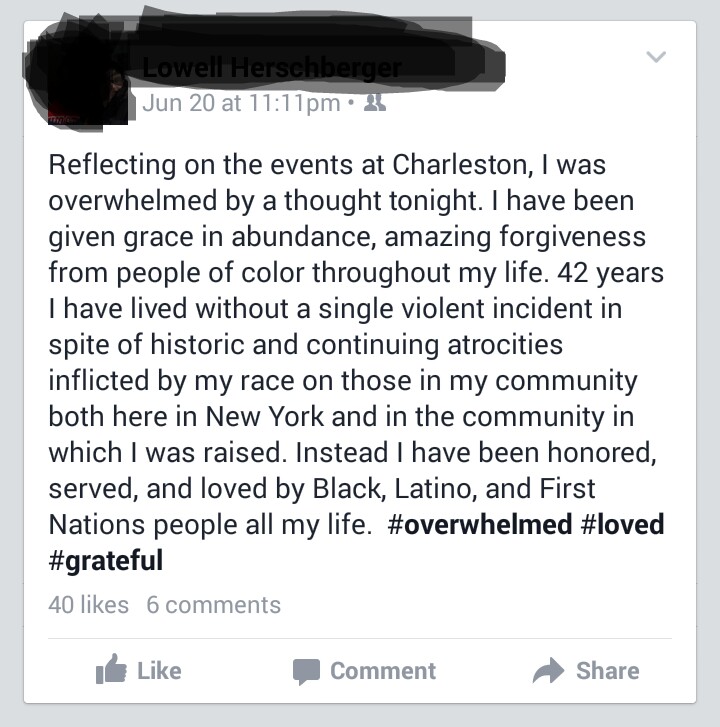
I shook my head as I read a social media post from a well-meaning white friend thanking various “people of color” for not doing him harm because of historical and current injustices.

Many of his friends liked the post—a vast majority of the affirmation, despite his diverse mix of friends, came from his white friends. On the surface his post is contrite or considerate and praise-worthy.  What could be wrong about a man owning up to the sins of his own kind?

But under the surface of his post lurks something insidious.  It uncovers a secret expectation that “people of color” should be irrationally violent and thus are deserving of his praise when they are not.  It is a demeaning and belittling message cloaked in empathy.  It actually reinforces an awful stereotype.

Think about it: Would it be praise to thank a white man for being civilized or would it be patronization and a backhanded insult?

What is more disturbing is this persistent idea that a whole race should be held accountable for the sins of one of their own.  Apparently I should be judged by the depraved acts of Dylann Roof (and every white man in history) because I share his skin color and gender.  But isn’t that exactly the logic of every racist in history and the way of thinking we are trying to escape? 

I believe ‘white guilt’ is a symptom of racist thinking rather than a solution.  When we thank “people of color” for not harming us as white people we are perpetuating the idea that people should be judged as a race rather than as unique individuals.  It is a tribalist suggestion that violence against a whole race is justified therefore we need forgiven as individual members of a racial tribe.

But this thinking is racist to the core.  It keeps “people of color” as something separate from us.  It treats them as something to be pandered to in a way that we would never do to another white man.  (My thanking a white man for not killing me today would be taken as foolishness or sarcasm.)  It is also saying that we expect irrationality and violence from them—which is exactly the same reasoning of a racist killer.

We cannot help but see people as white or black.  We should not be ignorant of historical injustice or continuing racism either.  But we can stop believing that people are fundamentally different because of their skin color.  Part of that is not apologizing in a grandstanding fashion for our own skin color.  Part of that is not treating “people of color” as inferior by thanking them for things we would not even thank a small child for.

We recognize calling a black man “boy” may be insulting.  We also see the battle flag of the Confederacy (the “rebel flag”) as symbolic of racism.  However, do we see subtle racism of those who’s words betray an expectation that black people should be irrational and violent?

I myself prefer those who display their true colors openly, because then we know what we are dealing with and don’t need to dig through the layers of carefully hidden prejudices to find the truth.

What’s in a word?

Standard

Words are interesting things.  The word “gay” for example.  According to my grandpa it once just meant happy and excited.  In Webster’s 1828 edition dictionary it carries the same basic idea.  However, compare that definition to those found in modern dictionary and the change is significant.

Words change in meaning.  Words like “retarded” to describe a person have been replaced with terms like “special needs” by those trying to soften the label.  But as a result, now saying “he’s ‘special’…” takes a whole new meaning and doesn’t imply greater or better.  Changing the labeling word has not removed the stigma associated with mental handicap.

Are Black Men Thugs?

The word “thug” is another word that has seemed to have evolved in meaning.  It once meant “ruffian” or a murderous criminal and yet lately it is often used for a much more specific group of people.  Thug seems the new favorite word to describe a young black person involved in a violent confrontation and that has raised the hackles of numerous social commentators who say it is a racist code word.

Richard Sherman, the ever so outspoken Seattle Seahawks cornerback, put it plainly when he suggested that the word “thug” is the new N-word. 

I do not go as far as some do, I do not believe it is a word used exclusively for young black men, and I do not believe all who use it intend it with a racial connotation.  I am doubtful President Obama or Stephanie Rawlings-Blake, the mayor of Baltimore, meant their usage of “thug” as racist and believe we should give all people the same benefit of doubt regardless of skin color.

That said, that doesn’t mean those who are describing “thug” as a new racist code word are totally wrong either.  I myself began to suspect something amiss with the word before it became a topic of widespread outrage and media hand wringing.  It was because of overzealous spam posts of conservative (white) friends that I began to wonder about the usage.

Will the Real Thug Please Stand Up!

A story, “INSTANT JUSTICE: Black Thug Tries to Bully ‘Little’ White Teen…BAD IDEA,” links a video showing a white teen mercilessly beating a black teen.  I can hardly see the justice in it.  Furthermore, if “thug” is just a general term for a violent person, why is the more violent of the two in the video only a “white teen” and not also a thug?  Hitting a dazed opponent seems thuggish behavior to me.

Another story, “High School Thug Bullies Classmate for ‘Talking White’ — Doesn’t End Well for Him,” shows one black teen harassing another and things turn violent.  Again race is the topic.  Again the one delivering the beating is the “classmate” and not labeled as a “thug” like the other guy.  It is a bit murkier because both involved are black.  But nevertheless you have “thug” versus “white” in the title and a curiously sympathetic accompanying article.

A third video, “NY Thug Picks Fight With Wrong Trucker, Gets Beating Of A Lifetime,” also starts after the fight has already began (removing context) and again the word “thug” is only used to describe the black participant.  Again the suggestion seems to be that the beating was a justified response.

Why is a young man described as “black thug” or “thug” and not just as a bully, harasser, instigator, etc?

I can’t read the minds of those who posted the videos.  But the framing of these stories does cause me to wonder about the intent in sharing them.  It would be as strange as a title, “Offended Young People Provoked by Thug Police,” to a story about the Baltimore rioters pummeling officers with rocks.  There would seem to be an intent to bias the reader at very least.

The (Thuggish) Hypocrisy on Both Sides…

Not every use of “thug” carries an extra racial overtone.  I believe it would not be fair to characterize it as a racist term or all those who use it as racists.  It is unfair to assume every person who uses a certain word has loaded it up the same as you do.

The word “racist” itself can be used in a prejudicial and unjust way.  The usage of the term “racist” to describe an offending white person is probably as damaging to them as any other contemptuous and derisive term.  Words like “privilege” and “redneck” are also questionable.  They are words used to categorize people and often unfairly.  Sure, many people use those terms as descriptive or even as terms of endearment, but the same is also true of “thug” and the N-word. 

In fact, the popularity of the word “thug” used to describe young black urbanites could have come in part to use of the word as a self-description: 

image

image

image

Understandably is is different when a word is used as derogatory and not as a term of endearment.  But it should also not be a surprise when descriptions we use for ourselves are picked up in popular dialog and become a nucleus for stereotypes.

Making ‘Thug’ a Taboo Word Is NOT the Answer.

I am reminded of the wise words of W.E.B. DuBois in reply to Roland A. Barton in 1928 about the topic of names (please take the time to read the whole letter) and his solution:

“Your real work, my dear young man, does not lie with names. It is not a matter of changing them, losing them, or forgetting them. Names are nothing but little guideposts along the Way. The Way would be there and just as hard and just as long if there were no guideposts, but not quite as easily followed! Your real work as a Negro lies in two directions: First, to let the world know what there is fine and genuine about the Negro race. And secondly, to see that there is nothing about that race which is worth contempt; your contempt, my contempt; or the contempt of the wide, wide world.”

As an alternative to abolishing words (that will soon replaced by new words to fill the vacuum) and being offended at every turn: Be the solution.  The solution, of course, is to live outside of the labels used to box us in and beyond identities built around race.  The solution ultimately is for everyone to do unto others what they want others to do to them (Luke 6:31) and abandoning their right to retaliation.  Be what you want others to be.

Words come and go, so don’t let them define you!

Disturbing the Status Quo: “And who is my neighbor?”

Standard

The one thing I did not cover in my recent post on the Good Samaritan story (and came up in a discussion with a friend afterwards) is that Jesus never did answer the question of who.  The man asked who his neighbor was, but Jesus answered the question of how to be a good neighbor and told him to “go and do likewise.”

Not my neighbor, not my problem…

I was reminded of that again when discussing my frustration with social media.  I’ve noticed how cute pictures and funny stories get dozens of likes or shares.   However, when I posted a link to a woman with a real need and asked people who couldn’t give to like or share it the response was astonishing.  It was zilch, nada, nothing…

image

I was lamenting that lack of response to another friend.  They defended it saying that people get many requests for help and that I could sympathize with.  But what was said next disturbed me coming from a person familiar with the story Jesus told about how to be a good neighbor.  They suggested the “Biblical method” is that this woman’s family or local church should provide.

“If you love those who love you, what reward will you get? Are not even the tax collectors doing that?  And if you greet only your own people, what are you doing more than others? Do not even pagans do that?  Be perfect, therefore, as your heavenly Father is perfect.”  (Matthew 5:46-48 NIV)

That doesn’t seem like the ethic Jesus was describing.  I don’t think the Samaritan cared much about jurisdiction or if it was his turn to give.  I believe he saw a need, saw a person who needed help and simply gave it.  That’s what it means to love your neighbor.  That’s the example Jesus told the legal expert to follow.

On the other hand, I assume those men who passed by the battered man along the road were in good standing in their own communities, provided for their own families and gave tithe.  But doesn’t everyone do that?  We take care of our own because it is natural to do so, it is reciprocal altruism and a way to ensure our own survive. 

Loving beyond the tribe of race, gender or denomination…

Yet Jesus was describing something far more radical.  Jesus went as far as to tell his followers to hate their own families (Luke 14:26) and give all they had to the needy.  This goes beyond the normal religious obligation of his day.  This goes beyond defending our own biological progeny.  It is a love bigger than nation, denomination and tribe.

Jesus preached (and those who continued to carry his message) against tribalism.  They forsook their own wealth and families to preach a revolutionary message about a kingdom made up of all tribes and nations.  They spoke of a kingdom where allegiances didn’t fall around race, gender or economic status.  A kingdom of good neighbors.

Disturbed by visions too superficial, self-interested and small…

“Disturb us, Lord, when
We are too pleased with ourselves,
When our dreams have come true
Because we dreamed too little,
When we arrived safely
Because we sailed too close to the shore.

Disturb us, Lord, when
with the abundance of things we possess
We have lost our thirst
For the waters of life;
Having fallen in love with life,
We have ceased to dream of eternity
And in our efforts to build a new earth,
We have allowed our vision
Of the new Heaven to dim.

Disturb us, Lord, to dare more boldly,
To venture on wilder seas
Where storms will show Your mastery;
Where losing sight of land,
We shall find the stars.

We ask you to push back
The horizons of our hopes;
And to push back the future
In strength, courage, hope, and love.”
(Francis Drake)

Anyhow, it does disturb me when social media prefers a political cause (showers attention both for and against a pizza shop owner caught in an artificial controversy) and then ignores a real need.  Our priorities are messed up when we are more concerned with scoring political points and fighting culture wars.

It disturbs me when millions will be poured into political campaigns rather than used to meet real needs. Frankly, if you conservatives don’t think we need socialized medicine or if you liberals truly have a heart of compassion, then prove it with more than talk.  Help somebody you can help rather than wait for others to take the lead for you.

It disturbs me when churches spend thousands on missions of questionable value to give young people an experience.  If you are truly zealous and motivated by love (not self-interested like a kid on spring break trip justified by a thin veneer of religion) then be a good neighbor.

It disturbs me when our love is superficial.  Our love is only superficial when we like cute pictures, comment on funny stories, advocate for political ideologies, seek donations so we can go on an adventure around the world and then aren’t disturbed by unfilled needs well within our reach.

As it stands, the account for this nurse and young mother with severe neck issues stands at $360 and only a fraction of the need.  Does that disturb you?

Sharia Law: I read it on the internet…, part 3

Standard

I have quite a number of friends who like or repost stories with shouting headlines and containing claims apparently designed to feed fears.  What amounts to fear-mongering propaganda is wrapped in the trappings of legitimate “conservative” news sources.  Unfortunately, most of it, while at some level based in a true story, is so badly blown out of proportion and hyperbolic that it is a dishonest representation.

Now, these purveyors of hysterics and half-truths may or may not be intentionally distorting the reality.  But I suspect there could be a bit of an ‘ends justify the means’ mentality and an idea that their twisted versions of a story represent a greater truth or reality.  I think every journalist does pick and choose what facts are relevant and how they present a story does reveal their personal bias.  However, to me,  there is a level of this that is unintentional or within reason and a level that is inexcusable.

Woman Has Opinion; Sparks Controversy

One of these specters repeatedly raised is that of Sharia law and the suggestion it will be imposed on Americans.  A particular story about a sign advertising bacon in a Vermont town caught my eye today after a friend commented.  Here is the screenshot of my news feed:

image

As one could imagine, the response in comments was one of the outrage of thousands of freedom (and bacon) loving Americans who don’t want religion imposed on them.  I realize there is reason to be aware of religious extremism, but what is the reason for this particular furor and do the actual facts support such a dramatic response?  According to the conservativetribune.com story this is the issue:

“Should a restaurant that serves bacon be allowed to display signs and/or advertisements that mention bacon? The U.S. Constitution says that it should, but Muslims in Vermont apparently disagree.”

From that opening paragraph one could assume there is a direct threat to freedom of speech posed by a group of people.  The article goes on to discuss a solitary example of a business owner who took down a sign because “an outraged Muslim woman” complained about it.  There are no further examples given and no evidence that this woman speaks for a plurality of Muslims.

The complaint of one woman does not seem to match the “Muslims in Vermont” description above it and that is quite an over-statement.  What’s the problem?  Well, if one woman can speak for “Muslims in Vermont,” then I suppose Westboro Baptist speaks for Christians in Kansas, right?

Concern for Safety or Fear of Violence?

Anyhow, there’s an article on the Washington Post website that takes a more detailed look and provides the full text of the woman’s complaint.  She describes herself as “a vegan and a member of a Muslim household” then goes on to say the sign is both insensitive to those who don’t eat pork and this:

“Second, it clutters an already dangerous crosswalk. This signage for a business’ food distracts from the purpose of that area: for pedestrians to safely cross and for drivers to safely enter the circle. What is the additive safety factor of this sign being there? I fail to see what benefit it affords people in that intersection and why the city put it up. The only appropriate signage would be standardized official road signs pertaining to the crosswalk and circle.”

I would guess that is why the restaurant owner mentions safety in his response.  However that apparently isn’t as obvious to everyone as it seems to me and leads to this speculation in the conservativetribune.com article about the owners response:

“Notice how he mentioned “safety” concerns. This made it sound as if he feared the Muslims in Winooski would have taken violent action had he not removed the sign”

I cannot fathom how one could make that leap based in the known facts.  It doesn’t “make it sound” as if he feared violence from Muslims to me.  No, it makes it sound as if the restaurant owner read the woman’s letter and was responding to the excerpt of her letter I posted above.  The concern for safety she mentioned was having a business sign creating a distraction.

Right to Free Speech and Threats Thereof

So basically we have a woman with an opinion and a business owner willing to accommodate her preferences.  It hardly seems like a crisis of Constitutional freedom when a woman exercises that her right to express a controversial opinion.  But it does seem a case of journalistic malpractice to make one woman into a representative of Muslims or categorize her as an “acolyte of Shariah law” because she expressed a concern. 

The real threat to liberty is those who abuse it.  I am more concerned over reckless surmises and the feeding of irrational fears than I am of one woman exercising her freedom of speech.  Her opinion, while I disagreed with it, was reasonably explained and it is her right to express it.  The response was a distortion at best, slanderous at worse and one of many similar stories.

Unfortunately I cannot respond to every internet hoax or propaganda piece and even if I did the chances of my words reaching through the mess and changing minds already made up seems slim.  Still I do try to make a difference.

Keeping Things In Perspective

Standard

The problem with writing about a complex topic is that anything I write often feels incomplete. 

Good writing is succinct.  However, some ideas are hard to reduce to a few words.  The difficulty of writing for me is often knowing what to include in an explanation and what to leave out.  A writer can simultaneously say too little and too much.

When I finished my post last night I felt I had rambled a bit.  Part of the problem is that I’m writing on a smart phone.  I write between distractions and editing is not my forte.  I know I have more I could say, but that post was already long and I could probably have left stuff out of it without losing much.

Besides that, I worried about alienating parts of my audience by speaking about a political figure and would rather not lose one of the handful of readers.  I was dissatisfied with the result and enough that I nearly removed the post, but then I do not want to be a coward who only says what will win him the approval of peers or takes positions where he is most comfortable.

One of those things I did leave out was context.  The history I mentioned of Christian and Biblical violence needs to be understood in the context of the times it took place.  For example, the Crusades were not inexplicable or unusually brutal for the time, they were a response to the rapid expansion of another religion.  Likewise, in Bible times, things like child sacrifice, slavery and exploitation of women were the norm—even more than today.  Lest we forget, crucification was used by the ‘civilized’ Romans to punish crimes like theft. Torture was not a crime for much of human history.

I do believe, in context, the treatment of women, slaves and children was improved vastly by the teachings of Jesus.  I believe Christian thought, despite the corrupted use of the religion, is a large part of why we in the west are experiencing the long peace that we are.  That’s how movements work, results aren’t instant, there are relapses, counter movements and yet it is the long term trajectory that matters.

The more I study history the more I feel privileged to live in the world I do.  In times past, even many places in the world today, I would have little time to fret about my writing skills or lack thereof.  If it wasn’t shortage of food to worry about it would be the constant threat of being killed by the rival tribe or clan across the river.

Progress, like my writing, is always incomplete, but hopefully it is headed in the right direction and there are some things in the world worth celebrating.  That these words could potentially reach someone on the other side of the world one of them.

God bless!