A Community Perspective of Mass Murder

Standard

Another well-armed angry young man goes on a murderous spree and again political ambulance chasers jockey to take advantage to win points for their pet projects.

President Obama used the recent massacre at an Oregon college as an opportunity to campaign for gun control measures that would not have prevented it.  Militant 2nd Amendment gun rights advocates responded with the tired ‘good guys with guns’ arguments and arming teachers as the solution.  Others ranted about correlations between pharmaceuticals and deranged minds.  (Well, duh?) 

Those using the issue for their various (political) causes seem to be vastly misunderstanding the actual issue.  Their response is a knee-jerk reaction rather than a careful analysis of fact and their canned solutions show the functional fixedness in their thinking.  There are too many assumptions that steer the current conversation and could be distracting us from addressing the real problem.

Many seem to assume that killers are simply incurable killers and we simply need to better secure ourselves (with more guns or gun control laws) against this inevitability of angry men.  But could a killer be stopped before they stockpile weapons and act out their violent fantasies against those who they blame for their unhappiness? 

Perhaps more guns, curbs of liberty and drugs (more or less) are not the solution to the real problem?

The root issue is that a young man made a choice to act violently.  He had reasons, rational or irrational, for the choice that should be understood.  (Note, I am not saying that the choice was justified, I believe murder is always immoral and a sin.)  We should acknowledge the choice as a choice and at least explore the possibility we can help those who are tempted by violence to choose rightly.

#1) Understand the Problem is a Person

I think often there is an urge to sanctimoniously distance ourselves from the bad actors of society.  Simply labelling the perpetrator of violence as a “thug” or “monster” or “animal” allows us to build emotional wall of separation between ourselves and evil deeds.  If we were to acknowledge the humanity of the person doing the evil act we would be tying our own humanity to the evil and in a sense making ourselves responsible.

image

Fundamental attribution error or correspondence bias is an assumption that another person’s behavior is all a product of their defective character.  (And, again, I do absolutely believe in personal accountability and responsibility for choices.)  But then, what it comes to our own bad choices we always have an external excuse or justification and blame circumstance for our choices.

Killers do what we do.  Killers often feel justified in what they do like we do because they were cheated or mistreated.  They take out their jealous rage against those who they blame for their unhappiness.  It is actually their humanity, the fact that they have emotions or just desire for significance—like we all do—that they act.  The difference is that they choose to turn to acts of violence rather than grace.

The answer to the perceived offenses we endure is not hate or vengeance and love for our enemies needs to be encouraged.  We need to fight against our own urge to be consumed totally by securing our own rights and love others as we would like to be loved.  We should distance ourselves from using their evil choices to justify our own.  We must love the hurting person behind the choice before they make it.

#2) Recognizing that Social Needs are Real

The elephant in the room is the vast changes in American culture and lifestyle that correlate with the trend of mass murder.  We are linked with more and more technology, but are actually less connected (in flesh) than generations prior.  Community has been replaced with increasing individualism and isolation.  It is not a change without consequence.

image

People are not good in isolation, people have social needs and can be damaged by lack of adequate human interaction.  Just a bit of research into solitary confinement or extreme cases of child neglect quickly show the psychological consequences are profound when social needs are not fully met for extended periods.

Perhaps the ideal of suburbia is not so ideal after all?  Suburban life is not extreme isolation.  But, in many cases, it is an environment deficient of social interaction—and especially in the case of single child homes.  A child without brothers or sisters and separated from regular intimate interaction with other people is probably going to feel a deficit.

The problem is exacerbated for those who are socially awkward or shy.  Some people are able to make friends everywhere, they are outgoing, easily put others at ease and popular.  Other people struggle getting past that initial barrier of first contact, they watch frustrated as others interact with ease and feel ignored.  Nobody wants to be marginalized.

We need to start recognizing that society and lifestyle do have a part to play in the choices of individuals.  We need fewer fenced in yards, fewer spiritually empty McMansions and more opportunity for inclusion for those who would otherwise be marginalized by their natural dispositions or disabilities.  We need less individualism and more community spirit.

#3 Bringing Outliers into our Community

There are some people who are probably gone beyond hope unreachable.  There are some who have a defect that makes them almost impossible to relate to and interact positively with. 

However, I do not believe that is the case in all cases or even most cases and we could do better at finding a place for those who need a place to belong.  There is no amount of entertainment or material wealth that can fill the void of purpose caused by social isolation.  We should not underestimate the role of community in shaping individual attitudes and mental health.

I see a solution in intentional community.  A friend recently posted a story about a preschool in a nursing home.  It was a beautiful example of the social needs of elderly being met by their inclusion with children.  That is the type of mindset that could be applied more broadly. 

image

But intentional community doesn’t need to start with a collective managed structural change like melding elderly and child care.  It can start with how we as individuals interact with the outliers among us.  It starts with our being aware that there are those who are marginalized and suffering from social isolation.  If we look for it we can be a help.

It takes a change in perspective.  Perhaps the weirdo is weird only because they have no friends to help them assimilate?  Are you willing to be that weird person’s friend and bring them into your circle of friends?  Forget mass killers even, what if we could prevent one suicide by being more proactive and inclusive?  What if we could make one person’s day better?

#4 Know the Individual Power You Wield

I believe many of us underestimate our own influence.  We turn to solutions like guns and laws because we feel too small to fight the demons of our culture without them.  We look for ‘silver bullet’ solutions (pardon the expression) and forget that people are complex social creatures.  One-size-fits-all solutions are not the best answer.

We need to fight back against evil, but not with superior firepower which is often misused or increased enablement of governments that often ends in abuse.  We need to overcome evil with good.  We need to fight isolation with inclusion, beat social awkwardness with understanding and prevent the seeds that lead to violence from ever taking root.

It takes a community of willing individuals to solve community problems.  Violence against the community is intended as an attack on the community and must therefore be addressed as a community.  But the community is not those we elect to represent us, the community is us and the problems of community require us as individuals to take part in being the solution.

Stop looking side to side or over your shoulder waiting for someone else to save society from its own destruction.  Instead use your own unique talents and abilities, search out the needs in your own community and fill them.  As the saying goes, an ounce of prevention is worth a pound of cure, and maybe even just a hug or smile can make a life changing difference.

#5 The Example of a Social Physician

Jesus was an advocate for unpopular people.  The religious people of his day criticized him for what they perceived as his lack of judgment for his inappropriate mingling with women and men who they saw as inferior.  Jesus turned the tables, he condemned the socially powerful and popular, he spoke for those marginalized by society.

There are many Gospel accounts like this…

“While Jesus was having dinner at Matthew’s house, many tax collectors and sinners came and ate with him and his disciples.  When the Pharisees saw this, they asked his disciples, “Why does your teacher eat with tax collectors and sinners?”  On hearing this, Jesus said, “It is not the healthy who need a doctor, but the sick.  But go and learn what this means: ‘I desire mercy, not sacrifice.’  For I have not come to call the righteous, but sinners.”  (Matthew 9:10-13)

We don’t like the IRS today, but tax collectors in Jesus day were traitors who had sided with the Roman occupation of Palestine and were hated by the Jews.  In the eyes of his accusers he was guilty by association.  How could a great man find company with traitors, prostitutes and other sinners?  But what is greatness without mercy to those who need it most? 

Jesus was greater because he was merciful to all people, even the least of society and we should follow the lead he offers.  We should be doctors of social ailments.  We do not excuse or offer justification for sin anymore than a doctor is an advocate for disease.  No, we, like a doctor, need to diagnose the true problem and provide the right cure.

We can exercise the same power to heal as Jesus did.  We have a choice to create a better society.  We can choose to respond to problems with love and not fear.  We need to be the solution in the same way as Jesus, by overcoming prejudice through self-sacrificial love and love for the enemies we face every day.

God bless.  Be strong.  Be a solution not a spectator.

Love: Feeling or Choice?

Standard

This blog is about ideas and the idea that ideas matter.  I believe the ideas people have can dramatically influence the direction of their lives.  Our choices, based in our ideas, could actually help shape reality in a ways not previously understood.

The view that seems popular today makes people simply products of the universe.  We emphasize the role of genetics and the influence of environmental factors in shaping what a person is, which is an idea that is certainly not without merit.  We bear a close resemblance to our parents for a reason and had no choice in determining that.  There’s also a good explanation of why I am writing this in English rather than Chinese. 

Obviously we have a given nature and are influenced by the nurture we received, which could lead to a ‘it is what it is’ fatalistic view that we have no choice or free will and ability to determine the future.  But could there be more than that?  Is it possible that the universe is only an influence and not a dictator of our consciousness?  Could it be that our own consciousness acts as a co-creator of the future universe?

Advances in physics have opened a whole new realm of possibilities.  The wave-particle duality of quantum mechanics is a paradox that suggests there is a bigger picture of the universe and one that could put our own consciousness in a far more important role than previously understood.  If our observation actually shapes reality at a quantum level (collapsing the wave function) then the future may not actually be determined outside of our own mind and will as is a common assumption.

If the future is not a destiny and is in fact something we co-create, then that could change many things including our ideas on love, which leads to the question…

Is love an existent feeling or a willful choice?

Both religious and secular people have seemed to have embraced a fatalistic view of love.  We could be scientific and point to natural explanations like pheromones, cultural expectations, chance opportunity, etc.  It is basically to conclude that love is something pressed out of a myriad of factors that all combine at the right time—which is a view that makes love seem sort of like sausage.  The religious, on the other hand, may turn to a meant-to-be (or God-did-it) rational to explain love and downplay choice.

Our culture, religious or otherwise, tends to emphasize the feelings of attraction above all else.  Love is something we are told we should ‘fall’ into and that there is a ‘right’ person out there for everyone. The idea is that attraction produces a feeling that produces a choice that produces commitment and ends with happily ever after. 

Unfortunately, I believe this is a view of love that has produced a great deal of disappointment and disillusionment in our day. It doesn’t work for many people. For some the problem is that they never find someone who produces that feeling of attraction enough to make them commit and they remain single or go from one relationship to the next in search of it.  The problem for others is that they marry based in superficial feelings, eventually those feelings fade away and they want out of the commitment. 

In both cases (above) the idea of love centers around feelings of attraction and presents love as a product of circumstances outside of our own control.

But what if there is an alternative view? What if we flip the order of things and put commitment first? Or, rather than love being a fate produced by an initial attraction that eventually ends in commitment and happily ever after, could love be a commitment to love that lead to a continual choice that produces a deepening relationship that produces a feeling of love and marital bliss? 

It is my view that love is less of an ‘it is what it is’ fate and more an ‘it is what we make it’ choice.  I believe the idea of love as a choice would produce healthier more sustainable relationships than the current popular view.  We believe we would see a reversal in trends towards non-commitment if we stopped waiting for the ‘right’ feeling to come and started to be more actively loving to others even when the feelings do not exist.

What is the (proper) Christian view of love?

In the American church there is a heavy emphasis on experience and emotion in worship.  We want music, we want excitement and entertainment, because the more feeling we have in the moment the more we love God, right? 

Wrong.

Christian faith is not supposed to be primarily about feelings or ‘spiritual’ experience.  Christian faith should be about obedience to the Spirit of love and that is the true evidence of faith according to Jesus:

“A new command I give you: Love one another.  As I have loved you, so you must love one another.  By this everyone will know that you are my disciples, if you love one another.”  (John 13:34-35)

Many Christians have confused positive emotions for spiritual depth.  A person who proclaims the loudest how great God is and puts on the biggest public display of praise is not necessarily the one who loves God the most.  The Gospel presents a different view of love that doesn’t resonate as well with our feelings based culture.  Jesus says, “if you love me, keep my commandments,” (John 14:15) and equates love with obedience.  

To obey Jesus means to love others as we wish to be loved (Luke 6:31) and to love perfectly like God does:

“You have heard that it was said, ‘Love your neighbor and hate your enemy.’  But I tell you, love your enemies and pray for those who persecute you, that you may be children of your Father in heaven.  He causes his sun to rise on the evil and the good, and sends rain on the righteous and the unrighteous.  If you love those who love you, what reward will you get?  Are not even the tax collectors doing that?  And if you greet only your own people, what are you doing more than others?  Do not even pagans do that?  Be perfect, therefore, as your heavenly Father is perfect.”  (Matthew 5:43-48)

If Christian love were a feeling and emotion how would it be possible to love our enemies?  Enemies are, by common definition, the people we do not love because they have in some way offended us or they are out to destroy us.  But, perfect love is not a feeling.  Perfect love is a choice to obey and love in action even when the feelings aren’t there.  Perfect love is a choice rather than a feeling, perfect love is the kind that sacrifices our own selfish ambitions for the good of others, and without that kind of love we are not actually true disciples of Jesus:

“Dear friends, let us love one another, for love comes from God. Everyone who loves has been born of God and knows God.  Whoever does not love does not know God, because God is love.  This is how God showed his love among us: He sent his one and only Son into the world that we might live through him.  This is love: not that we loved God, but that he loved us and sent his Son as an atoning sacrifice for our sins.  Dear friends, since God so loved us, we also ought to love one another.  No one has ever seen God; but if we love one another, God lives in us and his love is made complete in us. 

This is how we know that we live in him and he in us: He has given us of his Spirit.  And we have seen and testify that the Father has sent his Son to be the Savior of the world.  If anyone acknowledges that Jesus is the Son of God, God lives in them and they in God.  And so we know and rely on the love God has for us.  God is love. Whoever lives in love lives in God, and God in them.  This is how love is made complete among us so that we will have confidence on the day of judgment: In this world we are like Jesus.  There is no fear in love. But perfect love drives out fear, because fear has to do with punishment. The one who fears is not made perfect in love.

We love because he first loved us.  Whoever claims to love God yet hates a brother or sister is a liar. For whoever does not love their brother and sister, whom they have seen, cannot love God, whom they have not seen.  And he has given us this command: Anyone who loves God must also love their brother and sister.”  (1 John 4:7-21)

Christian love is preemptive.  Christian love follows the example of Jesus who loved us BEFORE we loved him.  True love is not based in initial attraction nor does it wait in fear of not being reciprocated.  True love steps out in faith.  Perfect love is not a pursuit of an immediate feeling or instant gratification. 

Love is a choice to invest in the good of another person even when we do not feel like they are worth our investment.  Love means a choice to obey and the choice to obey is a choice to follow the example of Jesus.

So, if love is a choice, then feelings do not matter?

No, not exactly.  I do believe feelings do matter.  But, a love based primarily in initial superficial attraction is a shallow love and deep love is only possible with deep (and self-sacrificial) commitment.  Deeper love is a continual choice to love more than a fleeting feeling of love.  For that reason we should be emphasizing the choice to love over the feeling of love and not the other way around.

This is not to say that those who started with a feeling of superficial attraction never develop depth of relationship—some do and some do not.  But I will say that love that is a choice and a commitment in faith is starting at a deeper level.  The better love is not a feeling.  The better love is a choice to put aside fear (or hate) and invest in the betterment of another person.  It is a love that is based in faith rather than feeling.

If love is a matter of will rather than a determined or predestined fate, then when a person says that they cannot love a person what they are really saying is that they unwilling to love that person.  The feelings can never develop in a person who is not willing to step out in faith.  Therefore, if you want to find love, be willing to bring love into the world and give it away in faith.

Love first.  Plant seeds of love in the world.  Do not wait on feelings to arrive before investing in the good of others.  Do not expect the Spirit of God to come to you (or the world) unless you live in obedience to the command to follow Jesus and love self-sacrificially by his example.  Love before you expect love to arrive.  Yes, this is absolutely a paradox, a causality dilemma, but that is the nature of our reality in a quantum universe.

Do not be resigned to an idea that we are haplessly tossed about without a will of our own.  Instead, consider the last lines of Invictus, “I am the master of my fate: I am the captain of my soul.”  Choose to love supernaturally.  Be a co-creator of a higher and deeper love rather than a mere consumer of the feelings produced by base human nature.

For Sale: 2001 Jaguar XJR and a duty to impress…

Standard

Little brothers must be impressed.  It is a rule of being a big brother.

Several years ago my brother Brent, still in school, had a fixation with jaguars.  He was both a fan of the NFL franchise of that name and also the automobiles of that same denomination.

Brent had mentioned a Jaguar for sale and wanted me to check it out.  But I really had no need of another vehicle, I had two already and felt that was plenty.  However, one day I was in town with some spare time and then spotted this beautiful machine at a used car lot.

“Hmm, that must be the Jaguar Brent has been talking about…”

I decided to inquire about it.  The salesman ended up tossing me the keys just in time for me to pick up my little brother at the school bus platform.  The look on his face was priceless and enough to convince me to do my big brotherly duty to impress him. 

I purchased that Jaguar XJR a few weeks later.  The “Grace, Pace, Space” slogan of the brand fit this car.  Classic lines, the power of a muscle car and luxury combined perfectly.  It is a supercharged 370hp beast that beat out the Beemers, Benzes and Porsches of It’s day—it is still faster than most.

It has served me well.  It has been the source of many grins.  It possess every bit of the charm and sophistication of Daniel Craig playing James Bond.  It is an impressive machine.  I have not regretted my decision to do my big brotherly duty.

Seasons have come and gone.  I have decided it is time to part with the XJR in order to free up garage space.  It is in excellent condition and I will probably regret selling it. 

But Brent is now married and away, so maybe it is time?

image

image

image

A Shameless Arrival — Mission Accomplished!

Standard

I arrived at Lock Haven’s Piper William T. Piper Memorial Airport at precisely 9:59 a.m.  The plan was to meet at 10:00 and fly to the Ponderosa cabin north of the airport.

I parked my little Ford next to a handsome Porsche.  I stepped out of the car, a twelve year old again, and full of anticipation as I took in my surroundings.  I scanned the tarmac through the security fence for the Cessna 150 or my brother.  I could not identify machine or man, so I headed to the office adjacent to the parking lot.

Inside I struck up a conversation with the natives.  They had not seen my brother, but they did share my enthusiasm for flying and soon I found out the man I was speaking to was an instructor.  I got the full sales pitch for flight lessons from an instructor.  I probably could’ve been signed up on the spot.

“Lock Haven traffic, Cessna 11479 is 4 to the north, inbound for landing 27 right. Full stop landing. Lock Haven.”

The words over the radio sounded.  “That’s your brother?”  I quickly opened the email that told me what Cessna I was to expect and indeed, it was!  I quickly stepped outside looking and listening for that distinct buzz of a boxer-type engine. 

It took a minute or two until I spotted the small aircraft on approach.  He came in over the trees and levee as I cringed as if trying to help him fly, but he nailed the landing with a chirp of the tires and was soon taxing towards me. 

image

I suppose I am allowed some brotherly pride, right?   

The Cessna 150L was remarkably small inside, only two seats, and was a bit hot without air movement, but was comfortable enough.  I put my headset on as Kyle switched on the intercom and yelled “clear prop” as a precaution before turning the engine over…

image

Life!  The four cylinders sputtered to a relatively smooth idle…  

image

We continued through the pre-flight rituals designed to identify those things that could end a sunny day with a violent death and before long we were looking down the length of the runway with the intent to defy gravity. 

The engine revved, the brakes released and we were rolling.  The little Cessna still had what it took!

Soon the ground slipped away and the town of Lock Haven turned into the world’s most wonderfully detailed model train set.  We gained altitude, then turned north towards the sea of trees and swells of mountains north of the town below.  We flew over a baseball game between people who looked like flees.  We passed a gas drilling rig in the wilderness…

image

It didn’t take long before we spotted the small airstrip cut out of the trees.

We were later than the initial plan.  But as we swooped in for a high speed pass we could see the crowd of spectators gathered.  Our siblings, cousins, aunts, uncles, parents and grandparents wanted to witness this historical event and also to prevent anyone from crossing the driveway that bisected the small strip while we were on approach. 

image

We circled around for a practice run and were too high.  Kyle corrected for the final approach.  The runway sloped upward at a slightly awkward angle and I made sure my brother was aware of that tall tree nearly blocking the trajectory we were on. 

Kyle wagged the wings ever so slightly to avoid the obstruction as we dropped through the trees and set down on terra firma again.  We survived!  No violent death or unexpected drama either…

image

(Click here for a video of our departure and other pictures.)

Sunny with a chance of violent death…

Standard

It has been a serious few weeks for me.  I had been cruising along until then ran smack into a brick wall of reality and have been sorting the damage for what I can salvage since.

But, still, amid disappointments and deliberations, I have found enjoyment in various things, from meeting new and interesting people to learning more about quantum mechanics.  I have things to look forward to in the coming months, one right around the corner and that the chance to fly with my little brother.

My little brother actually isn’t too little.  He outgrew me to about 6′-2″ and is a (mostly) responsible adult.  He also followed through on a childhood dream a few years ago by earning a pilot’s license.  However, sad as it is considering he was my first ever wingman, I have not yet taken the opportunity to fly with him.

Well, weather cooperating, I will get my chance to fly with him and I thought those of you with a morbid sense of humor may enjoy are little email exchange.  The plan is for me to join him in flying into a family cabin or rather landing on a small airstrip cut in the woods beside the cabin. 

Here is my request:

I have a proposal that could maximize your use of a small aircraft and increase my risk of dying a terrible death at the hands of my own brother.  My idea is that I meet you in Lock Haven, fly with you to the Moyer cabin and then fly back with you later.  I don’t know how that fits in with your plans, but I put it out there as a proposal and under the condition that you agree to ditch only into trees or rocks rather than water.  Crashing would be terrifying enough without the prospect of drowning with a broken femur while trapped in the crushed confines of a small aircraft.  Burned alive has a far more romantic appeal.  So anyhow, bring a contact with correct legal language and I shall consent.

Joel

His response:

Oh fun! Violent death! Yes, it’ll be way more romantic to share those last, lingering moments with someone instead of slipping away unnoticed.

Lock Haven airport was part of the plan. I was going to stop by to refuel on the way back to Franklin (airport of origin). However, it doesn’t add much to stop there on the way to the Moyer cabin as well. It’ll be nice to have someone along to mutter to while I figure out if it’s possible to get the craft down at the cabin. Worst case, we’ll abort the whole thing and go back to Lock Haven. Or, in a shame-induced delirium at a failure to land, we could take it into the pond. There, amidst a flaming slick of avgas, we’d slip beneath the ripples before the horrified paddle-boaters.

Piper Memorial airport (Lock Haven) has public parking at the end of Proctor Street. Time of meeting TBD.

My response:

The benefit to you is having a backup plan for reaching the cabin.  We already know the Focus can get stopped on that runway…

We could try to cartwheel across the pond wing tip over wing tip, the visuals would be stunning for all observers.  Maybe someone would get our parting moments on video and we’d be a YouTube sensation postmortem?  I could try to flash a peace sign out the window or something…

His response:

Good point. It’ll be nice to have a backup plan. 

You’ll be the perfect right-seat man. We’ll fly over the place at altitude, do a low pass on the airstrip (to scare away forest critters), and then shoot an approach. If the approach is stable, we land. If not, it’s a go-around. Practice landings yesterday ranged from 800-1200 feet. The strip at Ponderosa is 2400, so we should be ok.

Hopefully, enough glory will be won by a successful landing to make a grandstanding exit unnecessary.


Wouldn’t it be great if all business could be handled that way?

Despite appearances and the risk inherent in flying, I am quite confident that we will arrive safely at our destination.  I trust my brother’s hands are capable.  But if they and our plans fail, then may our death be glorious!  So, if you are somewhere in the vicinity of Lock Haven and the mountains just north this weekend, keep an eye on the sky and be ready for anything.

Anyhow, pictures to follow…

(That, assuming the camera survives two crazy brothers in an airplane. — If things are looking down while we are up I shall attempt one last parting Instagram post before we become one with nature, intimate with the terrain, a flaming mess of twisted metal and broken bones, etc.)

I prefer open racism…

Standard

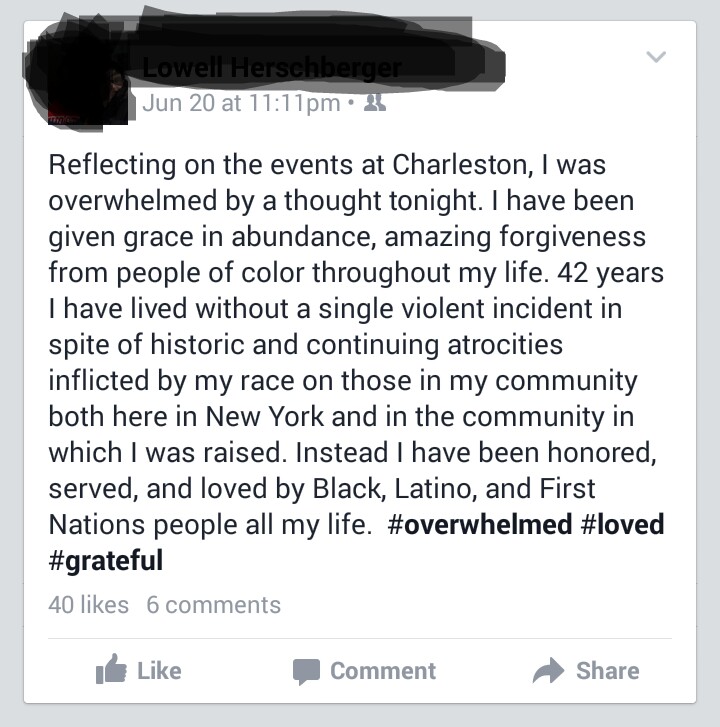
I shook my head as I read a social media post from a well-meaning white friend thanking various “people of color” for not doing him harm because of historical and current injustices.

Many of his friends liked the post—a vast majority of the affirmation, despite his diverse mix of friends, came from his white friends. On the surface his post is contrite or considerate and praise-worthy.  What could be wrong about a man owning up to the sins of his own kind?

But under the surface of his post lurks something insidious.  It uncovers a secret expectation that “people of color” should be irrationally violent and thus are deserving of his praise when they are not.  It is a demeaning and belittling message cloaked in empathy.  It actually reinforces an awful stereotype.

Think about it: Would it be praise to thank a white man for being civilized or would it be patronization and a backhanded insult?

What is more disturbing is this persistent idea that a whole race should be held accountable for the sins of one of their own.  Apparently I should be judged by the depraved acts of Dylann Roof (and every white man in history) because I share his skin color and gender.  But isn’t that exactly the logic of every racist in history and the way of thinking we are trying to escape? 

I believe ‘white guilt’ is a symptom of racist thinking rather than a solution.  When we thank “people of color” for not harming us as white people we are perpetuating the idea that people should be judged as a race rather than as unique individuals.  It is a tribalist suggestion that violence against a whole race is justified therefore we need forgiven as individual members of a racial tribe.

But this thinking is racist to the core.  It keeps “people of color” as something separate from us.  It treats them as something to be pandered to in a way that we would never do to another white man.  (My thanking a white man for not killing me today would be taken as foolishness or sarcasm.)  It is also saying that we expect irrationality and violence from them—which is exactly the same reasoning of a racist killer.

We cannot help but see people as white or black.  We should not be ignorant of historical injustice or continuing racism either.  But we can stop believing that people are fundamentally different because of their skin color.  Part of that is not apologizing in a grandstanding fashion for our own skin color.  Part of that is not treating “people of color” as inferior by thanking them for things we would not even thank a small child for.

We recognize calling a black man “boy” may be insulting.  We also see the battle flag of the Confederacy (the “rebel flag”) as symbolic of racism.  However, do we see subtle racism of those who’s words betray an expectation that black people should be irrational and violent?

I myself prefer those who display their true colors openly, because then we know what we are dealing with and don’t need to dig through the layers of carefully hidden prejudices to find the truth.

The People Want a King…, Part 1

Standard

I felt like the dog who finally caught the car.  I was perplexed with a question: Now what?

My goal in blogging is to make a difference with the ideas that I share.  I know ideas are powerful.  I want to share good ideas and debunk or discourage destructive ideas.  It has been my goal from the beginning to write things worthwhile in hope of creating dialogue.

It was exciting when Good Men Do Not Blame Women quickly surpassed my previously most viewed blog in a matter of hours.  It was also terrifying that my words were being read by hundreds of people rather than just the usual handful of friends and followers.

But, amid worries about if I had proofread enough and given fair treatment to a complex topic, I enjoyed my new found popularity.  I enjoyed it so much that I worried that I enjoyed it too much.

I worried that maybe I was ‘going negative’ instead of sharing something helpful and constructive.  Just a week or so prior I had remarked to a friend that people who criticize other people (not like them) seemed to build a fan club quicker than those who shared good ideas.

I had to think there’s a danger of becoming a different version of what we preach most passionately against.  I do not want to contribute in an overreaction in the opposite direction and abandon what is good in proper order or at the right priority level.

I had a taste of power that I both liked and that I did not like.  It provoked many questions in my mind about what would happen if I gained a following.  Would I be an example of the ideals in my mind of leadership?  Or would I insulate myself from criticism and become arrogant?

“Power tends to corrupt, and absolute power corrupts absolutely.  Great men are almost always bad men.”  (Lord Action)

The good news is that my blogger stardom was very short lived and—besides a few new friends—I’m back to blogging to my usual small audience.  It means less pressure.  I feel I can share again without worrying as much about my imperfections being amplified over a large audience.

The people want a king to lead them…

In the beginning God was sufficient to lead his people.  The patriarchy of Abraham gave way to tribal elders and officers.  Later Moses acted as a prophet and arbitrator in disputes. However, eventually it was too much for Moses, the task was taking all of his time from “morning to evening,” which led to his visiting father-in-law to ask him why:

“Moses answered him, “Because the people come to me to seek God’s will. Whenever they have a dispute, it is brought to me, and I decide between the parties and inform them of God’s decrees and instructions.”  Moses’ father-in-law replied, “What you are doing is not good. You and these people who come to you will only wear yourselves out.  The work is too heavy for you; you cannot handle it alone.  Listen now to me and I will give you some advice, and may God be with you. You must be the people’s representative before God and bring their disputes to him.  Teach them his decrees and instructions, and show them the way they are to live and how they are to behave.  But select capable men from all the people—men who fear God, trustworthy men who hate dishonest gain—and appoint them as officials over thousands, hundreds, fifties and tens.  Have them serve as judges for the people at all times, but have them bring every difficult case to you; the simple cases they can decide themselves.  That will make your load lighter, because they will share it with you.  If you do this and God so commands, you will be able to stand the strain, and all these people will go home satisfied.”  (Exodus 18:15-23)

Moses took the advice, he delegated the task of settling disputes to other capable men and that became the system for hundreds of years. 

It was a sort of anarcho-theocracy.  The prophet was the liaison between God and the people, the messenger of God, but not a ruler per se.  The laws handed down by Moses were the standard for judgment.  Enforcement of the law was carried out by the people rather than delegated to a few people and judges a final arbitrator between parties as needed…

“At that time the Israelites left that place and went home to their tribes and clans, each to his own inheritance.  In those days Israel had no king; everyone did as they saw fit.”  (Judges 21:24-25)

There was a time after the Exodus of freedom from oppression and obligation.  Judges came and went as heroes who did God’s work to save the people from captivity.  Judges were representatives and deliverers of the people, but not rulers like a king.  However, eventually, when a worthy successor could not be found for Samuel amongst his sons, the elders of the people made a fateful demand:

“So all the elders of Israel gathered together and came to Samuel at Ramah. They said to him, “You are old, and your sons do not follow your ways; now appoint a king to lead us, such as all the other nations have.”  But when they said, “Give us a king to lead us,” this displeased Samuel; so he prayed to the Lord . And the Lord told him: “Listen to all that the people are saying to you; it is not you they have rejected, but they have rejected me as their king. As they have done from the day I brought them up out of Egypt until this day, forsaking me and serving other gods, so they are doing to you. Now listen to them; but warn them solemnly and let them know what the king who will reign over them will claim as his rights.”  (1 Samuel 8:4-9)

Samuel went on to warn how kings would take their sons for wars and daughters as workers.  He spoke of how the future kings would take the best of their possessions for themselves and for their own purposes.  Still, despite the warning, he did not persuade them, the chapter continues:

“But the people refused to listen to Samuel. “No!” they said.  “We want a king over us.  Then we will be like all the other nations, with a king to lead us and to go out before us and fight our battles.”  (1 Samuel 8-19-20)

The people were delusional just like their forefathers who begged Moses for a return to slavery and Egypt.  Despite Samuel’s warning of conscription, they apparently had an idea a king could miraculously do all the fighting for them and they ignored all rational concern.

A couple of the kings were good, David and Solomon notable examples, but a majority were more concerned with themselves, they all took special privileges for themselves and loaded the people down with increased burdens.  The prophecy of Samuel became reality—the people traded their greater freedom for a false security and eventual rule of tyrants.  Instead of protecting against oppression the kings became oppressors themselves.

Consequence #1: Increased Burden

“A government big enough to give you everything you want is a government big enough to take from you everything you have.”  (Gerald R. Ford)

Kings and government leaders promise big things to their people.  But what often is forgotten by the enthusiastic crowds is that nothing is free.  When a Pharaoh promised a pyramid for the glory of Egypt Pharaoh, he wasn’t planning to build it on his own time with godlike powers.  No, the people paid the price of a king’s grandeur with their own backs and we still bear the weight of the audacious promises of our leaders. 

The burdens never seems to be lightened either. Consider when Rehoboam took over after his father Solomon and was confronted by the people:

“Your father put a heavy yoke on us, but now lighten the harsh labor and the heavy yoke he put on us, and we will serve you.” … The king answered the people harshly. Rejecting the advice given him by the elders, he followed the advice of the young men and said, “My father made your yoke heavy; I will make it even heavier.  My father scourged you with whips; I will scourge you with scorpions.”  (1 King 12:4-14)

King Reheboam was more concerned with pleasing his young peers than he was in listening to the people or the elders.  As a result some did not accept his rule over them and the nation was divided.  It is interesting to see this same pattern play out today.  Leaders pursue their own vision, they increase the burden on the people without ever easing up, which leads to division and eventual rebellion.

Consequence # 2: Increased Corruption

“Our country is now taking so steady a course as to show by what road it will pass to destruction, to wit: by consolidation [of power] first, and then corruption, its necessary consequence.”  (Thomas Jefferson)

Kings and government leaders represent a consolidation of power and with consolidation of power comes increased opportunity for corruption.  Many leaders rise to power on their idealistic vision, but once they have power the vision fades and the desire to hold or increase power becomes the bigger priority.  We may call it “special interests” and political pandering today, but here’s how the Bible describes it:

“See how the faithful city has become a prostitute!  She once was full of justice; righteousness used to dwell in her—but now murderers!   Your silver has become dross, your choice wine is diluted with water.  Your rulers are rebels, partners with thieves; they all love bribes and chase after gifts.  They do not defend the cause of the fatherless; the widow’s case does not come before them.”  (Isaiah 1:21-23)

Described above is the chipping away of principles.  Many institutions of men are founded with good intentions but become corrupted over time.  Corruption is a natural product of consolidation of power.  When power is given to one person (or a small body of people) they seem to inevitably try to use that power to secure more power for themselves.  There is no system of external controls that seems to be able to keep it in check.  Those in power have the tools to manipulate the rules for their own gain.

Consequence #3 Loss Without Gain

“If the people cannot trust their government to do the job for which it exists – to protect them and to promote their common welfare – all else is lost.”  (Barack Obama)

Kings and government leaders are established to protect the people against harm.  But, not only do they fail to be able to protect a people from harm, they themselves often another source of harm.

The strength of a king is not in themselves as much as it is in the strength of their people.  As Samuel had warned, a king takes and can only give back what is taken and thus a corrupted people produce corrupt leaders:

“You are destroyed, Israel, because you are against me, against your helper.  Where is your king, that he may save you?  Where are your rulers in all your towns, of whom you said, ‘Give me a king and princes’?  So in my anger I gave you a king, and in my wrath I took him away.”  (Hosea 13:9-11)

Installing a king ultimately did not solve anything.  The people still ended up taken captive by other nations as they had before, they also endured the abuses of power hungry and corrupt leaders when not in captivity.  They gave away freedom for security and got captivity because they were corrupted themselves.

People want a king to blame…

The paradox of kings is that kings need strong people to maintain power—but strong people don’t need kings.  Weak people turn to leaders to do their work for them, but a man wearing a fancy crown and holding a scepter is only empowered by those who do his bidding.

It feeds a vicious cycle.  When things go wrong people blame the king.  As a result the king is driven to take more power upon themselves or risk losing power they already have.  Of course, since their power is derived from other people this means taking more from the people who are able to give.  It can only last so long as their are enough strong people to take from—when the weight of dependents comes closer to outweighing those able (or willing) to provide there is nothing a king can do but manage the decline.

Only, it is worse than that, because as already mentioned, consolidation of power is like a petri dish for corruption.  So, not only do these kings give a convenient scapegoat, they also are too often the goats among the sheep and motivated by their own gain rather the good of all in the herd.  In other words, if a couple sheep get thrown to the wolves and it saves a goat from an undesirable outcome and nobody notices, what sheep, right?

It is exactly what king David did to Uriah.  David goofed, he got Uriah’s wife (Bathsheba) pregnant.  He evidently didn’t want to suffer the political repercussions and attempted to hide the adultery.  So plan ‘A’ was urge Uriah to spend some quality time with Bathsheba and thus disguise the origin of the pregnancy.  Unfortunately Uriah, a true warrior, would not go home to his wife while his comrades were still fighting and David needed another plan.  Plan ‘B’ was to deliberately set Uriah up to be killed in battle.  It worked, except the prophet Nathan knew and he confronted the king with a story about a wealthy man who killed a neighbor’s pet sheep.

And David was one of the good kings and probably mostly because he could admit his sins…

This post is about faith, not kings…

My point here is not purely political or just historical.  I am using kings and government leaders as a metaphor for anything (be it an institution, a system of philosophy or theology, a man, etc) that replaces our own obedience to God. 

We cannot expect the world to be good if we continually delegate the tasks of our own conscience to others.  Faith is about being the solution ourselves and not sending others (who we can conveniently blame for the eventual failure) to do what is impossible for them to do alone.  We cannot expect the fullness of God’s blessing when we look to men to lead us.  If God is alive in us then we must be the agents of good in the world with our own abilities and be faithful to our calling.

This is not a call for a return to anarcho-theocracy and judges either.  Kings and governments rise in prominence because the people aren’t doing their jobs.  Therefore, the solution is not to reform government, the solution is to reform people and make government irrelevant.  If we were taking care of the widows and fatherless as we ought, for example, what need would there be for corrupt welfare programs?  If fathers weren’t leaving their sons to be raised by the brutal streets, what need would their be for police as brutal?

“Every country has the government it deserves.”  (Joseph de Maistre)

It is a collective problem when the people demand a king.  It becomes an individual problem when the people finally empower a man to do their dirty work.  There is always someone all too willing to seize power—those with an appetite for power—who will take the glory for themselves and then delegate responsibility for failure to others, exploits position, etc. 

It is a spiritual problem.  It is often only our own sloth, envy, pride, mistrust, fears, poor judgments and overreactions that are reflected back to us in the immoral whims of our leaders.  We delude ourselves when we abandon accountability to God for kings that are no better than us.

Now, enough said for now, back to chasing cars for me…

What’s in a word?

Standard

Words are interesting things.  The word “gay” for example.  According to my grandpa it once just meant happy and excited.  In Webster’s 1828 edition dictionary it carries the same basic idea.  However, compare that definition to those found in modern dictionary and the change is significant.

Words change in meaning.  Words like “retarded” to describe a person have been replaced with terms like “special needs” by those trying to soften the label.  But as a result, now saying “he’s ‘special’…” takes a whole new meaning and doesn’t imply greater or better.  Changing the labeling word has not removed the stigma associated with mental handicap.

Are Black Men Thugs?

The word “thug” is another word that has seemed to have evolved in meaning.  It once meant “ruffian” or a murderous criminal and yet lately it is often used for a much more specific group of people.  Thug seems the new favorite word to describe a young black person involved in a violent confrontation and that has raised the hackles of numerous social commentators who say it is a racist code word.

Richard Sherman, the ever so outspoken Seattle Seahawks cornerback, put it plainly when he suggested that the word “thug” is the new N-word. 

I do not go as far as some do, I do not believe it is a word used exclusively for young black men, and I do not believe all who use it intend it with a racial connotation.  I am doubtful President Obama or Stephanie Rawlings-Blake, the mayor of Baltimore, meant their usage of “thug” as racist and believe we should give all people the same benefit of doubt regardless of skin color.

That said, that doesn’t mean those who are describing “thug” as a new racist code word are totally wrong either.  I myself began to suspect something amiss with the word before it became a topic of widespread outrage and media hand wringing.  It was because of overzealous spam posts of conservative (white) friends that I began to wonder about the usage.

Will the Real Thug Please Stand Up!

A story, “INSTANT JUSTICE: Black Thug Tries to Bully ‘Little’ White Teen…BAD IDEA,” links a video showing a white teen mercilessly beating a black teen.  I can hardly see the justice in it.  Furthermore, if “thug” is just a general term for a violent person, why is the more violent of the two in the video only a “white teen” and not also a thug?  Hitting a dazed opponent seems thuggish behavior to me.

Another story, “High School Thug Bullies Classmate for ‘Talking White’ — Doesn’t End Well for Him,” shows one black teen harassing another and things turn violent.  Again race is the topic.  Again the one delivering the beating is the “classmate” and not labeled as a “thug” like the other guy.  It is a bit murkier because both involved are black.  But nevertheless you have “thug” versus “white” in the title and a curiously sympathetic accompanying article.

A third video, “NY Thug Picks Fight With Wrong Trucker, Gets Beating Of A Lifetime,” also starts after the fight has already began (removing context) and again the word “thug” is only used to describe the black participant.  Again the suggestion seems to be that the beating was a justified response.

Why is a young man described as “black thug” or “thug” and not just as a bully, harasser, instigator, etc?

I can’t read the minds of those who posted the videos.  But the framing of these stories does cause me to wonder about the intent in sharing them.  It would be as strange as a title, “Offended Young People Provoked by Thug Police,” to a story about the Baltimore rioters pummeling officers with rocks.  There would seem to be an intent to bias the reader at very least.

The (Thuggish) Hypocrisy on Both Sides…

Not every use of “thug” carries an extra racial overtone.  I believe it would not be fair to characterize it as a racist term or all those who use it as racists.  It is unfair to assume every person who uses a certain word has loaded it up the same as you do.

The word “racist” itself can be used in a prejudicial and unjust way.  The usage of the term “racist” to describe an offending white person is probably as damaging to them as any other contemptuous and derisive term.  Words like “privilege” and “redneck” are also questionable.  They are words used to categorize people and often unfairly.  Sure, many people use those terms as descriptive or even as terms of endearment, but the same is also true of “thug” and the N-word. 

In fact, the popularity of the word “thug” used to describe young black urbanites could have come in part to use of the word as a self-description: 

image

image

image

Understandably is is different when a word is used as derogatory and not as a term of endearment.  But it should also not be a surprise when descriptions we use for ourselves are picked up in popular dialog and become a nucleus for stereotypes.

Making ‘Thug’ a Taboo Word Is NOT the Answer.

I am reminded of the wise words of W.E.B. DuBois in reply to Roland A. Barton in 1928 about the topic of names (please take the time to read the whole letter) and his solution:

“Your real work, my dear young man, does not lie with names. It is not a matter of changing them, losing them, or forgetting them. Names are nothing but little guideposts along the Way. The Way would be there and just as hard and just as long if there were no guideposts, but not quite as easily followed! Your real work as a Negro lies in two directions: First, to let the world know what there is fine and genuine about the Negro race. And secondly, to see that there is nothing about that race which is worth contempt; your contempt, my contempt; or the contempt of the wide, wide world.”

As an alternative to abolishing words (that will soon replaced by new words to fill the vacuum) and being offended at every turn: Be the solution.  The solution, of course, is to live outside of the labels used to box us in and beyond identities built around race.  The solution ultimately is for everyone to do unto others what they want others to do to them (Luke 6:31) and abandoning their right to retaliation.  Be what you want others to be.

Words come and go, so don’t let them define you!

Faith: I Believe, So Help Me To Believe!

Standard

The Pharisees were content because they were successful and could afford to believe they were righteous.  They were people who studied the law carefully and followed it diligently.  They had no lack of missionary zeal and devotion, they had titles, love of families and other wealth.

But these religious people with all the answers lacked one thing and it seems something that is still missing in religious traditions.  Everything they did they had accomplished on their own strength.  There was no room in their life for radical faith that believes the impossible.  No, they were content with only what they could understand and rejected anything more.

As I look around the Christian religious landscape today I could ask the same question Jesus did at the end of this story in Luke 18:1-8:

“Then Jesus told his disciples a parable to show them that they should always pray and not give up. He said: “In a certain town there was a judge who neither feared God nor cared what people thought.  And there was a widow in that town who kept coming to him with the plea, ‘Grant me justice against my adversary.’  “For some time he refused. But finally he said to himself, ‘Even though I don’t fear God or care what people think,  yet because this widow keeps bothering me, I will see that she gets justice, so that she won’t eventually come and attack me!’”  And the Lord said, “Listen to what the unjust judge says.  And will not God bring about justice for his chosen ones, who cry out to him day and night? Will he keep putting them off?  I tell you, he will see that they get justice, and quickly. However, when the Son of Man comes, will he find faith on the earth?

I am certain Jesus would find many religiously devoted today.  I sure he would find those confident in their theology, their ‘Biblical’ standards and dogmas.  There are plenty of self-proclaimed experts with all of the right answers who pound pulpits and fill pews.  But would Jesus find faith real and unadulterated?

What is faith?

I believe this account in Mark 9:14-29 describes it:

“When they came to the other disciples, they saw a large crowd around them and the teachers of the law arguing with them. As soon as all the people saw Jesus, they were overwhelmed with wonder and ran to greet him.  “What are you arguing with them about?” he asked.  A man in the crowd answered, “Teacher, I brought you my son, who is possessed by a spirit that has robbed him of speech. Whenever it seizes him, it throws him to the ground. He foams at the mouth, gnashes his teeth and becomes rigid. I asked your disciples to drive out the spirit, but they could not.”   “You unbelieving generation,” Jesus replied, “how long shall I stay with you? How long shall I put up with you? Bring the boy to me.”  So they brought him. When the spirit saw Jesus, it immediately threw the boy into a convulsion. He fell to the ground and rolled around, foaming at the mouth.  Jesus asked the boy’s father, “How long has he been like this?”  “From childhood,” he answered. “It has often thrown him into fire or water to kill him. But if you can do anything, take pity on us and help us.”   “‘If you can’?” said Jesus. “Everything is possible for one who believes.”    Immediately the boy’s father exclaimed, “I do believe; help me overcome my unbelief!”  When Jesus saw that a crowd was running to the scene, he rebuked the impure spirit. “You deaf and mute spirit,” he said, “I command you, come out of him and never enter him again.”  The spirit shrieked, convulsed him violently and came out. The boy looked so much like a corpse that many said, “He’s dead.”  But Jesus took him by the hand and lifted him to his feet, and he stood up.  After Jesus had gone indoors, his disciples asked him privately, “Why couldn’t we drive it out?”   He replied, “This kind can come out only by prayer.”

I am not certain if the ailment of the boy would be considered a medical condition today.  But Jesus does seem to indicate that it was an incurable condition by any means other than prayer (or prayer and fasting) and therefore the healing was a miracle.

This is not a case for “faith healing” as a prescription for all illness.  It was a special circumstance where there was a condition that was impossible to cure by any other means.  So to turn this story into a reason to shun modern medicine is to vastly miss the point. 

If the light bulb burns out at church it only requires a budget or funds to replace it and not necessarily faith.  Faith is not about forcing God to do what is clearly within our own power to do.  Faith is doing all we can, investing our everything in something unseen, and having the outcome uncertain.

Faith is More than Reasonably Committed

There was the widow at Zarephath (1 Kings 17: 7-24) who used the last of her supplies to make bread for the prophet Elijah and had her needs supplied miraculously for her faithfulness.  The poor woman mentioned in Mark 12:41-44 is also an example of radical faith in action:

“Jesus sat down opposite the place where the offerings were put and watched the crowd putting their money into the temple treasury. Many rich people threw in large amounts. But a poor widow came and put in two very small copper coins, worth only a few cents.  Calling his disciples to him, Jesus said, “Truly I tell you, this poor widow has put more into the treasury than all the others.  They all gave out of their wealth; but she, out of her poverty, put in everything—all she had to live on.”

It requires very little faith for a wealthy business person to give of his millions when their needs are already supplied abundantly.  But faith, radical faith, is when a person is able to commit their all to an unbelievable promise.  Most would only contribute their all to a sure thing and not gamble it all on something unseen.

However, faith, according to Hebrews 11:5-6, is an essentially component, even the backbone of the message of the Gospel:

“By faith Enoch was taken from this life, so that he did not experience death: “He could not be found, because God had taken him away.” For before he was taken, he was commended as one who pleased God. And without faith it is impossible to please God, because anyone who comes to him must believe that he exists and that he rewards those who earnestly seek him.

A religiously devoted person could go their entire life without need of faith.  If they only ever ask or achieve what is readily within their reach they have proven their dedication.  For some they put in their duty, but they don’t truly believe in a God of the impossible and live solely in their own understanding.

I am not content with religious devotion.  There is no sensible middle ground of belief without faith or it is falsehood.  For me, and according to the Bible, true faith is all or nothing proposition: It is radical faith or none at all. 

And yet, because we can never have enough faith to save our own selves, faith is a paradoxical product of grace.

Do you have faith?