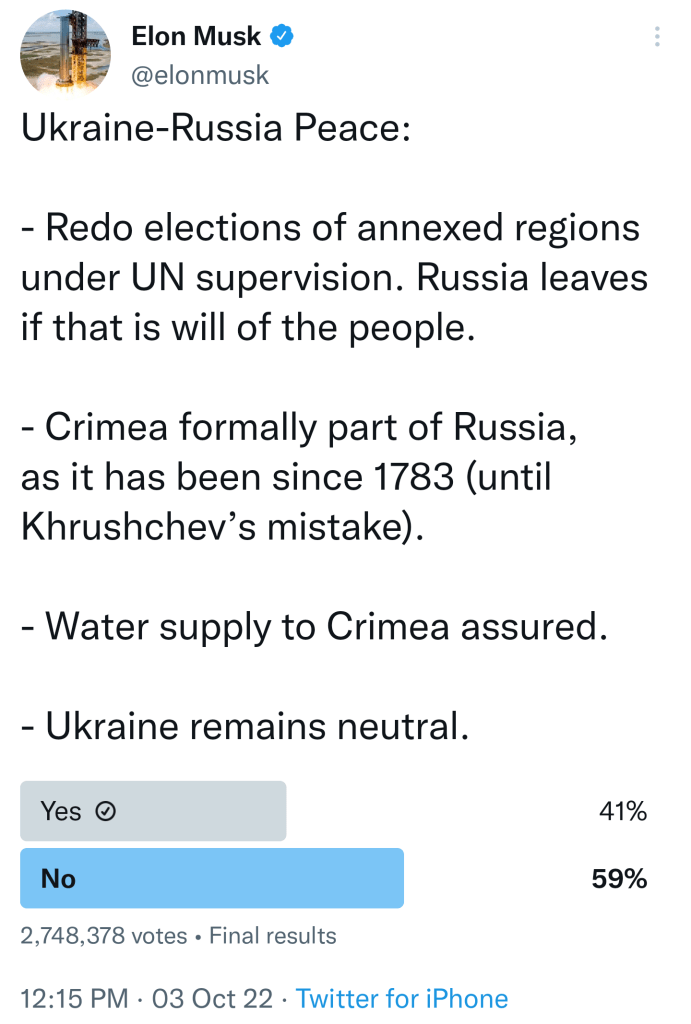
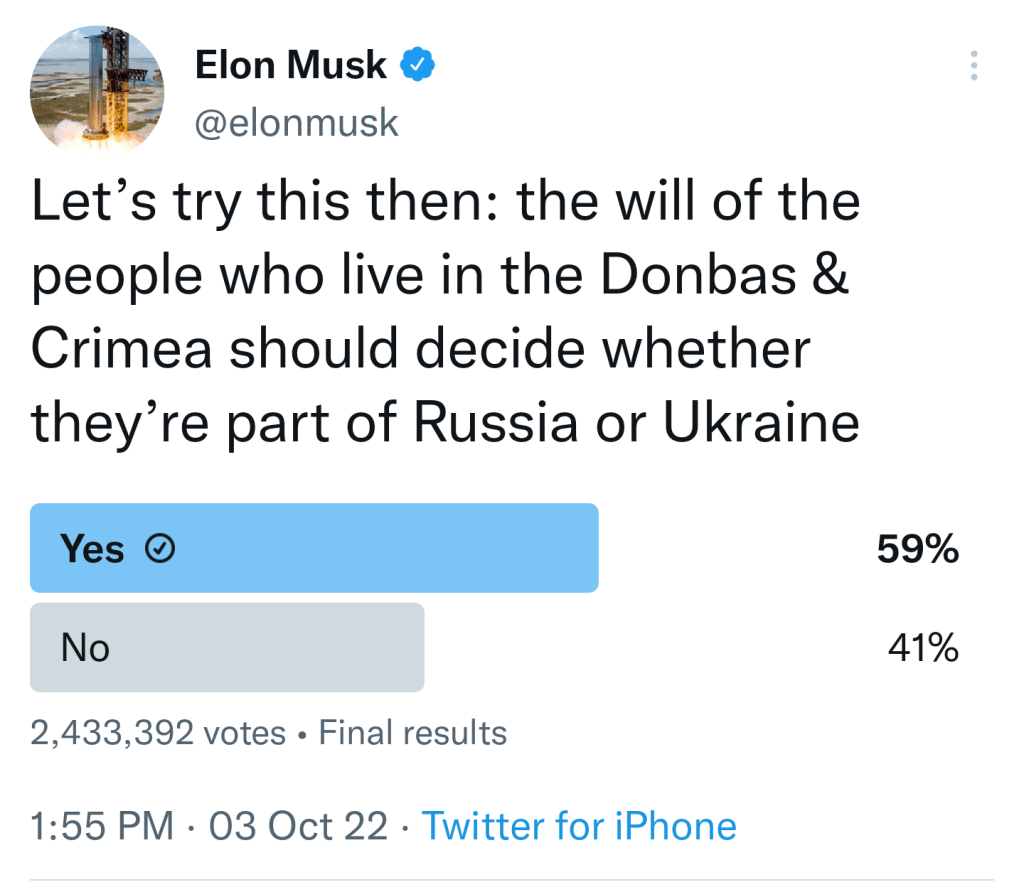
Elon Musk did what he does best and that is he disrupted the status quo. This time he took on the conventional argument that the war over Donbas must be fought to the very last Ukrainian.
His Tweets:
If you thought Trump was a mean Tweeter, you should see some of the nastiness in response to these polls.
Of course, social media midwits everywhere, full of sanctimony and rage, took to their usual easy explanation of any perspective that challenges their own: Musk is an idiot or Putin’s puppet and certainly doesn’t have the credentials to comment on geopolitics!
And yet Musk’s own call for resolution very closely mirrors that of Henry Kissinger from months ago who called for the government of Ukraine to come to the negotiating table and be willing to cede territory for sake of peace.
This is from an editorial written back in 2014:
The West must understand that, to Russia, Ukraine can never be just a foreign country. Russian history began in what was called Kievan-Rus. The Russian religion spread from there. Ukraine has been part of Russia for centuries, and their histories were intertwined before then. Some of the most important battles for Russian freedom, starting with the Battle of Poltava in 1709, were fought on Ukrainian soil.
Kissinger, a diplomat of diplomats, former Secretary of State, and a renowned foreign policy expert, is no slouch when it comes to geopolitics, and that his sage advice was so quickly dismissed says more about the true lack of understanding and blind fanaticism of the hardliners.
It seems that some are plain vengeance driven and would rather punish Russia than find a way to peace that would end the destruction and save countless lives.
The Boomer warmongers, the hawks like neocon Lindsey Graham or imperial-lib Joe Biden, are still very much stuck in the Cold War and would not think twice about sacrificing your sons or daughters for their latest power trip.
The United States has meddled in all parts of the world, both in form of covert CIA destabilization efforts to the too numerous to list overt brutal military invasions and occupations. The political establishment and military leaders of the West have never thought twice about bombing those who do not submit back to the Stone Age:
The racial dehumanization of the Vietnamese found its classic expression in the words of General Curtis LeMay, head of the Strategic Air Command, who said that America’s aim must be to “bomb the Vietnamese back to the stone age.” And Washington tried to do just that: From 1965 to 1969, the U.S. military dropped 70 tons of bombs for every square mile of North and South Vietnam — or 500 pounds for each man, woman, and child.
Of course, this was done in the name of “democracy” and “freedom,” which justifies all violence, right?
Anything said about Putin is a projection. The war in Ukraine is not completely unprovoked, as our own propaganda says. No, it is the direct result of the US and NATO interfering in Ukrainian’s domestic politics. Back in 2014, the late Senator John “bomb bomb Iran” McCain, along with our current Under Secretary of State, Victoria Nuland, planned who would replace Ukraine’s President *before* he was overthrown in a coup.
The US only like democracy so much as the votes are counted our way and freedom so long as it benefits our current political establishment or their sponsoring banks and big corporations—that’s just the truth.
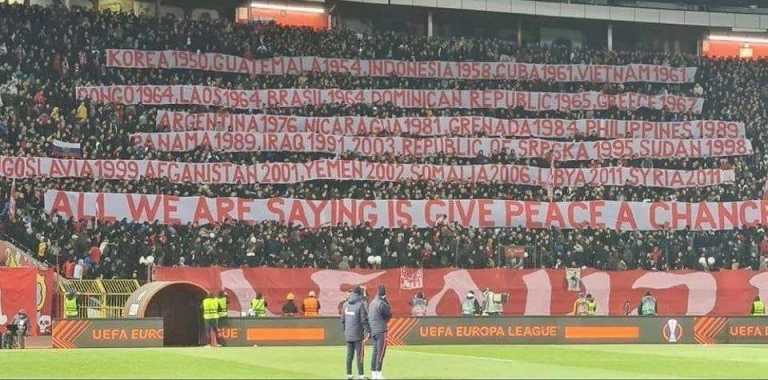
Like the jeering of our American hypocrisy by Serbian soccer fans—who saw their own country partitioned after NATO took the other side of the conflict, that of the separatists—holding a banner listing the dozens of places the US has attacked, invaded and occupied since the 1950s: “All we’re saying is give peace a chance.“
It is hard to feel unique in a world of 7.75 billion people. Due to mass media we are also more aware of this and also now have all of the best in the world there to compare ourselves to. We see the best athletes, the most beautiful bodies, those with wealth and power day in and day out.
I am insignificant
At the same time, many young people did not have siblings to share the attention of their parents, only were given affirmation in their formative years, a participation trophy for showing up and—special as they are—don’t need to follow rules or ever answer to anyone.
In other words, we have a generation with deep insecurities, worried about their place in the vast sea of humanity, and then also raised to be self-absorbed narcissists.
Unlike the past generations, where you could be a big fish in a small pond, yet also needed to learn respect for boundaries and how to share or negotiate with others.
Unlike the meritocracy of the past, where you needed real accomplishments to earn privileges or praise, we have conditioned young people to believe that their satisfaction should come without sacrifice or effort.
It is very little wonder why so many of them are unfulfilled, dissatisfied with life, and out there seeking cheap distinction.
Distinction—Cheap or Valuable
We all know names like Elon Musk, Serena Williams, or Ron DeSantis. They are leaders in their realms of popular culture and sport, business or politics. And we can probably agree that some of their success is an inheritance of genetics, good fortune or the opportunities granted them.
However, what they are doing, like them or not, is producing results and with this are being rewarded for the things they do. They have outcompeted many, they distinguished themselves by showing up for work and by putting the time in. It is for that reason their recognition is earned. They do the things we care about and we make them famous for this unique resume.
Earlier this week I saw a story about Rose Namajunas, a diminutive female UFC fighter with a very big attitude that earned her the nickname “Thug Rose” in school, and how she’s being featured in a Victoria’s Secret ad campaign. The message “all expressions, no definitions,” with the word “undefinable,” do certainly fit her outsized personality and the mean head kicks she can deliver, all the while being very emotional.
The point a marketing strategy is cynical, it is to tickle ears and encourage more consumption of a particular good or service. Those who produced this advertising campaign did it trying to target a certain demographic in the hope of profit. And that target is probably not those who will ever have the same work ethic and skills as Rose, but is those who crave the same notoriety and ‘undefinable’ uniqueness.
We all wish to be significant, to distinguish ourselves from the pack, to be appreciated and loved. There are many who are looking for a shortcut or feel entitled to these things, they want the same acceptance, recognition and rewards as those at the top. They buy expensive clothes, the latest smart phones or cars beyond their budget, all trying to gain attention through their appearance rather than actual character.
There is hard-earned distinction and there is the cheap kind. There is the content creator who shares of their substance and then the one who destroys things for clicks. There is the pleasing gift of Abel and that unworthy offering of Cain. There is that real fulfillment which comes from making contribution and then the imitation that is outwardly prideful, expresses itself loudly, while truly being an envious, bitter and impoverished soul.
Personal Pronouns and No-name Jerseys
Penn State football has a long tradition of not putting the names of players on jerseys and this is to reinforce the notion of selfless team effort over a bunch of individuals only in it for themselves.
No name, all game
Success on the field and in life depends on our plugging in and sometimes putting aside our own preferences for the good of others. We can get more done by working together, respecting the established system, rather than demand that everyone makes special accomodations for us.
Yes, there is a time for grievances. We also should be a reasonable give and take so far as how individuals and the members of the group interact with each other.
And yet this idea that we should rewrite cultural conventions, negotiated over many centuries, simply so some ‘woke’ Karens can have power over others, is not a grievance I can ever honor. It is not reasonable for a person to decide the pronouns that apply to them or force us to go along with their newly invented categories.
We don’t need to be Amish, severely limiting individual expression to maintain community cohesion, but we also don’t want to keep on this path of total atomization either. There’s a reason why the barn raising religion is able to flourish while the rest of us are headed for Babal, confusion and collapse.
Rose By Any Other Name
This morning, pondering how the categories of mental illness are a bit arbitrary and how much I dislike how these labels pigeonhole people, there was the thought that my given name was the best possible diagnosis of me. I mean, I’m Joel. I don’t need a personal pronoun when I already have my own name and identity completely my own.
Ironically, the same people who want to have new pronouns for themselves also seem to revel in their mental illness as well. Anything to be different. It is a sort of humble-brag, a title of distinction of our era, to talk about your PTSD or bi-polar disorder. If you are the right person, if you can make yourself a part of the right identity group, then your self-declared victimhood will be treated as a virtue.
It goes beyond moral inversion. People think that you can slap the right label on a person and it will make up for their deficiencies. If only they were described right, if we would see their pink hair as an accomplishment, then they would love themselves. Of course, this is a lie, people so into themselves are always a black hole and no amount of love given will fill their deep void.
It is the spirit of those who are content to remain nameless, who get their numbers called for what they do for the whole, that actually matters. People will know what is great and what is not no matter what label is applied. I can never forget what W.E.B Du Bois wrote to a student:
Do not at the outset of your career make the all too common error of mistaking names for things. Names are only conventional signs for identifying things. Things are the reality that counts. If a thing is despised, either because of ignorance or because it is despicable, you will not alter matters by changing its name.
We can manipulate and massage language all we want, give people all the fancy titles they wish for, but in the end none of this word play can take away or lend to their value. If you want recognition contribute to the whole and your name will be known. Not to the whole world, but to those helped by your deeds. A rose called by any other name is still a rose.
It’s been my thought for some time now and has become even more cemented in place over the past few years. People will believe anything, especially if it fills their desire for meaning and purpose, even if it is ridiculous at face value. But don’t mistake the for a shot at tradition. Karl Marx said that religion is “the opiate of the masses” and yet his alternative drug produces delusion, rage and violence. I’ll take Jesus and love over that any day of the week.
Sure, this quote could have some truth to it:
“Organized religion is a sham and a crutch for weak-minded people who need strength in numbers. It tells people to go out and stick their noses in other people’s business.”
E. J. Dionne Jr
But that same statement could be applied to almost every popular secular movement or established consensus. Certainly not all, not even many, who believe in various narratives or theories are qualified experts. Most have simply bought into a system and are riding the ideological bandwagon. Good science is religious and organized, scientism is a cult and a way of silencing critical thinkers who are outside of the political mainstream. I would certainly take Gospel tracts shoved in my face over social media censorship of my ‘wrongthink’ and higher taxes that won’t do anything to save the planet.
Call me a skeptic of everything, I just find it difficult subscribing to anything anymore, to me it is all easy-believism. I mean, does it seriously change anything about my day-to-day life to believe in climate change or go to church? Probably not. People might make a symbolic sacrifice here and there. However, for the most part the commitment doesn’t ever match the rhetoric. The faithful aren’t walking on water nor are those who loudly proclaim their extreme consternation about the climate giving up their private jets or beach homes.
But it is much more basic than this, go ask people about who is the best president ever (or worst) and you’ll get completely opposite answers. To some Trump was the guy who spoke to their own concerns and delivered, to others Biden is the guy who has restored the normalcy they craved. Both sides can support their own perspective if given the chance. Can they all be right? Okay, so it is subjective, an opinion which man is better or worse, and yet we don’t agree on what is objective either.
I love talking to the most sincere people, the true believers, because they are so confident about what they say and it is enviable. If you have had a bad experience with those who espouse their ideology, then that’s the rare exception, an anomaly, and is not the real version that is represented by them. I’m just not like them. I can’t help my skepticism of their beliefs. I’m not very easily sold on their the basis of their sureness and claims alone, show me the undeniable evidence. I do not fall for their conviction or consensus.
People do not seem to know where reality ends and their imagination begins. Basically every narrative we create is a sort of fiction we create for ourselves. We take the bits of data, very often distorted by our own flawed perception, and interpret it into a story that makes sense to us. Systemic heightism, for example, describes something very real, is even quantifiable, and yet is also an overlay that doesn’t truly describe the truly complex picture. What we accept or deny is often a product of our conditioning, social status and base desires.
The primitive communism that Marx used to fashion his ideas were as much a fabrication as any religious mythos. Idealistic children likely subscribe to his theories for the same reason they love Disney fairy tales or Marvel comic book heroes. Utopia ahead is a very strong motivator, in that we are very willing to make huge personal sacrifices when we believe that heaven awaits us. And yet, as much as see the ‘faithful’ fall for obvious con-men, it makes every testimony questionable.
The problem with my own unbelief is that I also believe this too. I trust myself enough to mistrust. Maybe my own ambivalence, and sometimes agnosticism, will make me miss the one truth in the sea of lies? Still, I’m convinced my only ability to be sure of anything will have to be direct revelation from God, because I know too well that I’m a blind man in a world of full of blindness. I’ll admit, this isn’t the most comforting or easy answer, but people believe many things that simply are not true.
What do I believe?
I believe what is most beneficial. Maybe all of religious narrative is a fabrication and yet the real question is it useful, will it produce results that make the world better?
The Christ I believe teaches me the value of delayed gratification. In other words, when we invest in others, in faith, there is a chance that we make a friend and split the dividend of our peace. In doing unto others, in love, there is a chance of solving our conflicts and ending hostilities. Christianity, unlike various popular political systems, makes no utopian promise in this life, and yet it does help to push behavior in the right direction.
We had one of the best running backs in the state and had successfully run many toss sweeps during the year—probably a dozen times every game.
It was the first round of the playoffs, and up against a rival that we had beaten handily earlier in the season. The O-line dropped into their stance, the quarterback took the snap as our star took his step right, and—oh no!
A linebacker, who had timed the cadence, anticipated the toss, plucks the ball out of the air, and a few seconds later turned this defensive prowess into six points. And we never recovered. We lost.
This is where the expression, “going to the well one too many times,” comes from. A play can work hundreds of times, it can be the go-to option—until that one time when it becomes too predictable and the other team takes advantage.
Click here for a very similar play, not my own team, but close enough to trigger the bad memories.
Yes, Poles Can Shift
One of the big misunderstandings of current trends there is that they will go on forever. If one is part of the cult of progress, change is seen as a march forward. To the traditional there are endless cycles and seasons, the sun goes up and down. To the cynical, humanity is on a downward trajectory, this slippery slope of social decay and spiral to the collapse of civilization.
In almost every case people expect that the current rules (or roles) can’t be flipped. The winners today will keep on winning or what worked yesterday will keep on working as it always did—ad infinitum.
But long-term trajectories do change, cycles can be broken, powerful empires faded away into nothing and there have also been those massive breakthrough-type events that have completely changed expectations. North is North, the compass is true as it always has been, and yet there is evidence that even this magnetic reference can flip.
Things can go one way for a long time and feel very predictable and unchangeable. But in one moment some threshold is crossed that upends the well-worn expectations. The end of the epoch. A critical mass is reached, the dam is finally breached, and the established paradigm blows up, and is washed away, like the linebacker running with the ball after picking off the toss.
Of course, in retrospect, we all claim to have seen it coming, that the signs were there, but few actually do. If we did we would have invested better, acted differently, and taken full advantage.
Please Capitulate, Charlie!
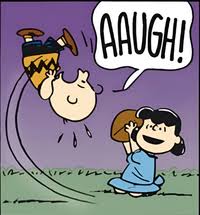
In the Peanuts cartoon, there is the infamous football gag. Lucy tells Charlie that she’ll hold the ball for him to kick and, despite her having tricked him many times before—by pulling the ball away right as he is wound up to kick, he is always fooled again.
Retail investors capitulating to short sellers.
This is how institutions have treated retail investors in the stock market. In the past, when the market would downturn, the ‘smart money’ would short popular stocks, then spread FUD through hired shills to scare their ignorant counterparts who would then sell at a loss and move on. When this retail capitulation would finally happen the market would finally be ready for the next cycle.
But now, in the meme stock era, the ‘Apes’ or those who learned from the 2008 crash, now hold, buy the dip, and refuse to sell. This is not what the hedge funds and big banks had planned when they started to short AMC and GameStop. They had planned to drive these companies into bankruptcy, and collect on their bets. Instead, after over a year and a half of price manipulation (FTDs, dark pool abuse, naked shorts) and bashing, the selling has not happened. This means they need to continue to pay the interest to maintain their short positions.
He’s hoping to wish this into reality…
It is a battle of wills, one retail rallying call being “I can be retarded longer than they can remain solvent,” and retail does control all of the exits in some heavily shorted stocks. If retail does not throw in the towel, eventually the institutions will run out of new ways to kick the can down the road, they will get margin called and will have to cover.
At this point, retail investors have figured out the game. They know how bashers are paid to scare them, they know how the price is manipulated, and they’re angry and not going to do what they’re ‘supposed’ to do. Apes are not leaving. And, at this point, this is a movement to expose the corruption in the market rather than simply an investment in a company we like.
If you want to be part of this history AMC and the new preferred equity called APE are trading for mere dollars. You can even get free stocks by opening an account following this link. This blog is not financial advice and investment is a risk, but we would love to have you as part of the Ape fam.
Maybe the pole shift won’t happen. Maybe Lucy has another trick up her sleeve. The future can’t be predicted. But we can be certain that trends almost always come to an end. Retail investors are no longer as easily fooled. This time Charlie Brown isn’t playing the game as expected.
I’ve had so many people tell me that I’m a great writer and should be getting paid to do it. But, thus far, I’ve had no real ideas how to monetize this talent and it can be frustrating at times. Anyhow, right now, due to some medical bills, it would be nice to be able to earn some extra income and that’s why I’m making this request to share this post. If enough people do, maybe the right person will find this blog and give me an idea of where to put my abilities to use. Note, most of what I do here is completely unedited and written on my phone in my spare time. If I was doing this as a professional I would do more to get the grammar right. My interests are history, current events, politics, theology, psychology and any practical application of such things. Maybe I could be someone’s speech writer or do a column?
Your suggestions are welcomed! I would really love to hear the personal experiences of writers who get paid.
And, of course, likes and reshares are certainly appreciated!
It is very common for the the very wealthy and politicians to start foundations for a charity or cause. This is both a publicity coup and also an opportunity to raise cash under the auspices of a greater good. But very often it is more cynical than sincere and probably for the tax breaks or as a money laundering scheme more than anything else, in some cases these organizations spend all of their donations on administrative salaries and not the stated mission.
Virtue signaling is a social phenomenon where a person, with a very small actual personal investment or self-sacrifice, can gain a great benefit or standing amongst their peers. This can include social media activism, yard signs declaring virtue, and any other low effort high reward way that people try to distinguish themselves as better than their neighbors. It is more often token giving or symbolic compassion, lacking substance, and is something that Jesus encountered and condemned.
Good Samaritan and Poor Widow Versus the Rich Boastful Givers
Most of us are a mixed bag of motivation, we can intend good and yet too often our self-interests corrupt the effort. The greater problem being that we’re not even ourselves fully aware of our hidden ambitions. We can easily and do often delude ourselves about our own righteousness compared to others, especially our ideological enemies and truly be more exploitative than those who we would condemn. The teachings of Jesus are an opportunity for self-reflection, a chance to grow in self-awareness and learn about how true compassion compares to the phony variety and counterfeit virtue.
First, consider the example of a boastful virtue signaler:
“Be careful not to practice your righteousness in front of others to be seen by them. If you do, you will have no reward from your Father in heaven. “So when you give to the needy, do not announce it with trumpets, as the hypocrites do in the synagogues and on the streets, to be honored by others. Truly I tell you, they have received their reward in full. But when you give to the needy, do not let your left hand know what your right hand is doing, so that your giving may be in secret. Then your Father, who sees what is done in secret, will reward you.
(Matthew 6:1-4 NIV)
It is fairly obvious, in this extreme to make the point, that this hypocritical giver is in it for themselves. They want the attention and good publicity, they desire the honor of their peers, and it isn’t truly about the needy who are receiving the help.
Here’s the genuine article:
Jesus sat down opposite the place where the offerings were put and watched the crowd putting their money into the temple treasury. Many rich people threw in large amounts. But a poor widow came and put in two very small copper coins, worth only a few cents. Calling his disciples to him, Jesus said, “Truly I tell you, this poor widow has put more into the treasury than all the others. They all gave out of their wealth; but she, out of her poverty, put in everything—all she had to live on.”
(Mark 12:41-44 NIV)
It is nothing for a billionaire to write a million dollar check. It is nothing for a politician to promise billions from the public treasury as a ‘sacrifice’ for a supposedly just cause. But, in both cases there is often a big political or social reward for this ‘charitable’ act, it can mean reelection or personal access to even more resources. But, in this example above, this poor widow put in 100% and got nothing in return—at least not in the short-term. Her sacrifice is more condemnable and true than those dumping a fraction of their excess.
And then there is the classic case of the good Samaritan:
On one occasion an expert in the law stood up to test Jesus. “Teacher,” he asked, “what must I do to inherit eternal life?” “What is written in the Law?” he replied. “How do you read it?” He answered, “ ‘Love the Lord your God with all your heart and with all your soul and with all your strength and with all your mind’; and, ‘Love your neighbor as yourself.’” “You have answered correctly,” Jesus replied. “Do this and you will live.” But he wanted to justify himself, so he asked Jesus, “And who is my neighbor?” In reply Jesus said: “A man was going down from Jerusalem to Jericho, when he was attacked by robbers. They stripped him of his clothes, beat him and went away, leaving him half dead. A priest happened to be going down the same road, and when he saw the man, he passed by on the other side. So too, a Levite, when he came to the place and saw him, passed by on the other side. But a Samaritan, as he traveled, came where the man was; and when he saw him, he took pity on him. He went to him and bandaged his wounds, pouring on oil and wine. Then he put the man on his own donkey, brought him to an inn and took care of him. The next day he took out two denarii and gave them to the innkeeper. ‘Look after him,’ he said, ‘and when I return, I will reimburse you for any extra expense you may have.’ “Which of these three do you think was a neighbor to the man who fell into the hands of robbers?” The expert in the law replied, “The one who had mercy on him.” Jesus told him, “Go and do likewise.”
(Luke 10:25-37 NIV)
Not only was this a great answer to a trap question, but the Samaritans were the low class and looked down ‘deplorables’ of their day who lacked the right pedigree to be the social elites. The priest and Levite, on the other hand, were the important and looked up to. They would be the religious bloggers of their day, preaching about the equivalent to social justice or other popular ‘righteous’ things, but made excuses for themselves and looked the other way when their love was tested.
The good Samaritan’s love was genuine. It was not announced to the world. It was not only a gesture or incomplete aid. And, more importantly, he gave completely of his own resources. There was no GoFundMe or calls for others to see the need and help him to distribute the cost. Nope. He saw the need, he dug into his own meager resources, and finished the job without any need of the help, attention or affirmation of others. Only this poor beaten man knew of his goodness.
The teachings of Jesus are always always about changing us, as individuals, and not the systems of the world. The priest and Levite, like the unnamed rich man of Luke 16 (who stepped over a poor very sick man on his doorstep, named Lazarus), all had their important things to do. They were the social elites and responsible people. In their own minds they had justified their response to the need directly in their paths.
Giving Self-sacrificially Is Christian Love, Forcing Others Give Is Not
Modern Western ‘democracy’ is full of virtue signaling and a favorite thing to do is decry the ‘racism’ of denying entry to the unvetted masses driven to our borders. It is the one issue where those who call out the “Christian nationalism” of their neighbors suddenly will find Jesus—albeit only to distort and use His words to bludgeon others, like Judas.
Now, before I get too far in, I do believe there are many who do have genuine compassion and care for refugees. Indeed, it is Christian duty to welcome the stranger and even invite them into our homes. My grandma was one of these open-handed people. No, they did not have that much themselves and yet her table was always open to those who needed a warm meal. This is the charity Jesus was talking about, not a social program.
Politicians will routinely make a display of the vulnerable as a cynical ploy to promote agenda. It is not out of love, it is simply a way to exploit our pity and silence objections to what is often a cover for a power grab. It is always “think of the children” when they are the true beneficiaries. They call for the “rich” to “pay their fair share” while having an abundance themselves. They may want to change the world and yet should start by changing themselves.
Again, I’m not saying that social activists are not well-intentioned. And yet I will say that they might not comprehend the costs that they incur on others (some who have less than them) nor fully consider the complexity and consequences. It is one thing to want to fix climate change or have a world free of borders, but quite another to pay the price for these ambitions. Many want to ride the compassion bandwagon, few want to be in the mud pushing this load of crocodile tear crying virtue signaling fools.
We have an inversion of Christian morality in the West where now the ‘first’ are demanding the ‘last’ pay for their virtuous acts. It is our most powerful, wealthy and privileged, who hold the money bag like Judas, demanding that common folk sell all to give to the poor while they keep their private jets, mansions and lavish lifestyle. The poor now subsidize the ‘compassion’ of the rich and many seem not to see how perverse this really is.
It is bad enough to give only for the attention of others. But, to guilt, shame or force those with less to subsidize your own altruism and compassion? That is a whole new level of self-serving, psychopathic and evil. It was always those confronting Jesus, and His followers, tithing even their spices, going to these extremes impress and try to establish a themselves as better than. Today it is the same, it is those who proudly preen their love and tolerance who are oftentimes most selfish and cruel under their costumes of righteous.
The Cruelty and Compassion of Martha’s Vineyard
Border states are being overwhelmed by the flow of unvetted migrants. But, for the most part, this growing humanitarian crisis has been ignored. Out of sight is out of mind for most people and this has been the case on our Southern border. I’m not a big fan of political stunts and yet sometimes to make others aware of an issue does require a little creativity or some coloring outside of the lines to illustrate the point to those in denial or oblivious.
And there was outrage, wild accusations of cruelty, even human trafficking, when Florida governor, Ron DeSantis, provided free airfare for fifty migrants from a nasty red state to a very blue Martha’s Vineyard.
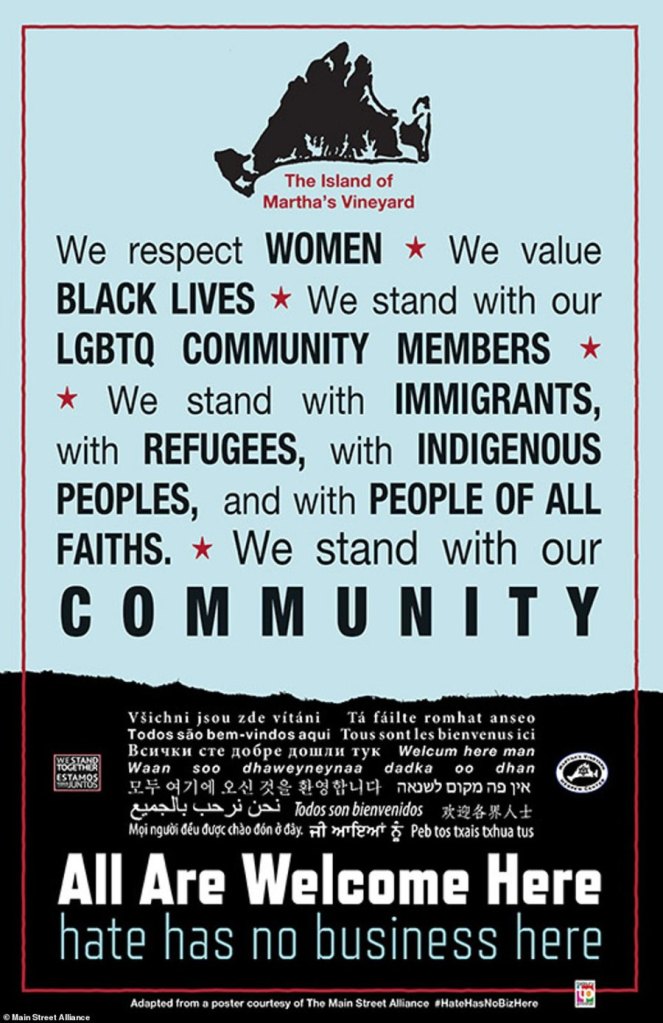
For those who do not know, Martha’s Vineyard is a popular hangout for the very wealthy and most privileged—an exclusive enclave where these social elites have their summer homes. And, yes, ironically, while most of us could only ever get on there real estate as the help, they do have those virtue screaming “all are welcomed” signs. How this free ride to this liberal “sanctuary city” is cruelty, I’ll never know, but how quickly the new arrivals were deported tells a bit of the true depth of the compassion under their righteous bluster.
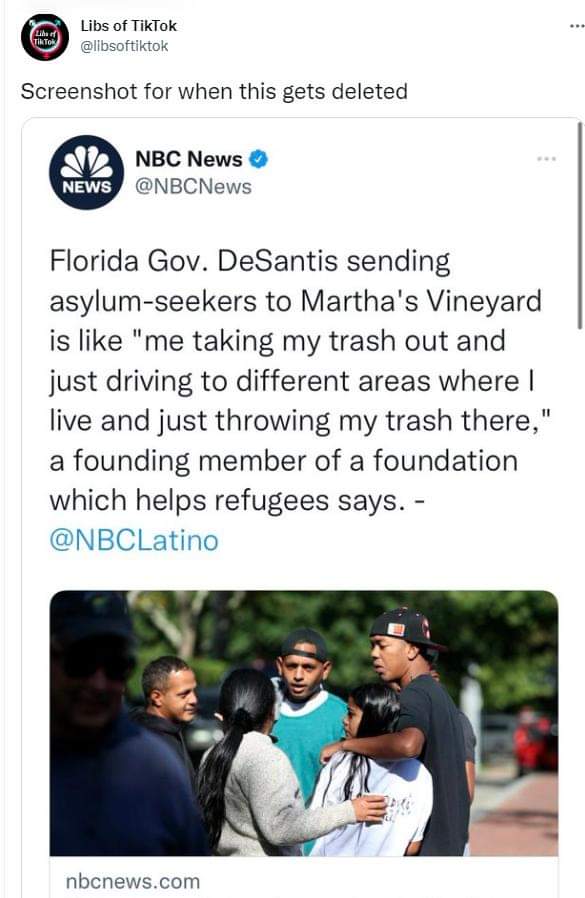
Interestingly, the Biden administration has also sent new arrivals to interior cities, less resource rich, and never had been accused of human trafficking or cruelty for this. But apparently, when you send these people to one of the wealthiest and most privileged enclaves in America, that claims to be a sanctuary city and welcoming of all, it is a terrible crime. Or, in the eloquent parlance of a “founding member” of an organization to help refugees, this is throwing your “trash” in someone else’s neighborhood:
Cognitive dissonance anyone?
I mean this blurb takes the cake. The lack of self-awareness to say, let alone publish, such a statement is astounding. The media has glowed at how these resource rich people fed these asylum seekers for a day, but has yet to speak of the cruelty of these new arrivals being deported from the exclusive island within 24-hours. Apparently nobody had room in their mansion or second home to provide long-term shelter?
But the whole ordeal is a classic example of what virtue signaling is and how it is vastly different from true compassion. A virtue signal is all about a person trying to glean the social benefits of holding the correct beliefs or the good deed and requires very little actual sacrifice. While the cameras rolled, the hot food trays came out and the picture looked very virtuous. And yet, rather than keep on caring, they literally called up the National Guard and almost immediately offloaded the expense to the taxpayers.
The people who could afford to build brand new houses for all fifty sent, who could have easily created a place for them in their own community and made real on the “all are welcomed” sign, only had a minor day long inconvenience. They’ll probably spend more on litigation, against the state of Florida, than they did on this fortunate handful of the thousands pouring into this country every day and overwhelming the resources of border states. So the compassion is fake, they claim the moral high ground while others shoulder the costs.
Compassion Claimed, Costs Diffused
Costs don’t matter to the privileged and social elites. They have never had to pay for anything themselves. As trust-fund babies or politically connected, they could always snap their fingers and someone else would clean up the mess behind them. So, yes, of course they will support open borders for us, proclaiming the virtue, and the Levites (story of the good Samaritan) will simply follow their example. Others bear the cost.
What are the costs?
Wage suppression. Old Socialists, in contrast to the wealthy factory owners and industrialists, always wanted strict border controls. Why? Well, because a never ending flow of low skill labor takes the feet out from under those trying to bargain for better compensation. And this is a real problem in the South. Why hire from the local population, with the legitimate process paperwork, when you could pay half the money to an illegal immigrant, under the table, and they dare not complain?
Another cost is to the local government resources. A flow of unvetted immigrants, even if most are very good people, is a huge burden and much more than some catered trays brought out for the eyes of the media in New England. There’s the need for ESL teachers and more classrooms, additional policing, the welfare benefits, and the tab for this is not distributed evenly despite some Federal aid. And that’s not to even mention the quality of life issues. No, immigrants aren’t trash and yet they do bring problems with them. The states in the South are overwhelmed.
But the real cruelty and inhumanity of all this is how much work it is for some to enter this country while others can just jump line and be treated as victims. While political elites talked about family separations, a necessary precaution to establish the identities of the adults and prevent human trafficking, I could not even travel to be with the child who calls me “daddy” and my love. As one of those going through this expensive and completely frustrating process, with the trash websites, poor communication and the many tons of requirements, I know.
If you do not have equal love for the MAGA hat wearing ‘deplorable’ that American, living in the rust belt, having to bear the cost of your ideal, then maybe your love isn’t all that real. True love shoulders the entire cost, it never tells others to make a sacrifice for sake of our own compassion. We should welcome the stranger, yes, but we must also love our actual neighbors and give our all before asking anything of others. It is not love to virtue signal, it is just another form of ignorance.
We hear it all of the time, from the political far-left, that Jesus was a Socialist. While I believe it is mostly a schoolyard taunt, from those who are basically irreligious, the claim itself is worthy to be examined. Was Jesus, through his focus on the poor, downtrodden and marginalized, basically in agreement with the politics of Karl Marx and the Socialist far-left?
Was Jesus a Socialist?
There is a valid critique of American love of money and consumerism. This obsession with material gain is repackaged as the false “health and wealth” Gospel, that is preached by some who could be classified as being Evangelicals, and should be rebuked. It is also very disturbing when those who profess Christ seem to care more about the bottom line than the welfare of those whom they employ. All of this goes against the true Gospel of Jesus Christ.
So, in seeing the sins of those who enjoy the prosperity of Capitalism and how there is a lack of care for the poor, as is clearly a part of what Jesus taught, some see Socialism as the solution. Socialism, using the most basic definition, is redistribution of wealth and could sound a lot like Christian charity to those who only have a few Biblical proof-texts or nominal understanding of the Gospel.
But there are key differences that make it impossible to reconcile true Christianity and Socialism. Yes, some of the practical ends may be similar, but the means and driving philosophy are entirely opposed. Here’s an outline of some of the differences:
1) Jesus Yields Power, Socialists Demand It
Jesus, during his temptation, was offered the kingdoms of the world. He could have taken over all world governments and then installed a redistributive regime, so all the poor had their needs provided and there would finally be justice. And yet He rejected the offer, and instead Jesus picked the way of the cross and lived the example of self-sacrificial love. This is a very stark contrast to Socialism, where promoters of this leftist ideology feel entitled to power and will take to the streets to protest and demand what they think they should have.
Jesus was meek, and this is what He told his followers about those seeking to control others:
Jesus called them together and said, “You know that the rulers of the Gentiles Lord it over them, and their high officials exercise authority over them. Not so with you. Instead, whoever wants to become great among you must be your servant, and whoever wants to be first must be your slave— just as the Son of Man did not come to be served, but to serve, and to give his life as a ransom for many.”
(Matthew 20:25-28 NIV)
Socialists seek political power, and the ability to bend others to their will, but Jesus taught that empowerment comes by giving up our rights and serving others.
2) Jesus Taught Personal Responsibility, Not Collective Action
Every verse quoted in support of Socialism is directed at the individual. In other words, when Jesus said “sell all and give to the poor” he was speaking to specific individuals and not endorsing a collective movement to take from others to provide for the poor. His words are not about creating a system or using state power to compel others. Socialism, by contrast, is all about coercion and using the power of the collective to force others into compliance.
Everything Jesus taught is for his followers to do personally, for our own salvation, not so we can go around Lording over and guilt-tripping others:
“Then the King will say to those on his right, ‘Come, you who are blessed by my Father; take your inheritance, the kingdom prepared for you since the creation of the world. For I was hungry and you gave me something to eat, I was thirsty and you gave me something to drink, I was a stranger and you invited me in, I needed clothes and you clothed me, I was sick and you looked after me, I was in prison and you came to visit me.’ “Then the righteous will answer him, ‘Lord, when did we see you hungry and feed you, or thirsty and give you something to drink? When did we see you a stranger and invite you in, or needing clothes and clothe you? When did we see you sick or in prison and go to visit you?’ “The King will reply, ‘Truly I tell you, whatever you did for one of the least of these brothers and sisters of mine, you did for me.’
(Matthew 25:34-40 NIV)
In the passage above there is no mention of what is done on our behalf, instead, it is all about who we invited in, and who we personally provided for and visited. In Socialism, these tasks are delegated, turned into systems or state programs, and established by force of law. But in Christianity giving to others is always for us to do voluntarily, as willing individuals, and coordinated by the Church never the secular state.
3) Christianity Is About Community, Not Mandates
Christianity is Communal, a community of faith. Socialism is about forcing people to give of themselves through taxation and threats. A community is voluntary, never forced, and the Christian community is centered on the Church rather than the government. Yes, early Christians gave to help each other, some even had “all things in common,” as we read in Acts. But this was never a requirement. The real point is not about money either. No, according to Jesus, are supposed to leave everything behind in pursuit of Him:
And everyone who has left houses or brothers or sisters or father or mother or wife or children or fields for my sake will receive a hundred times as much and will inherit eternal life. But many who are first will be last, and many who are last will be first.
(Matthew 19:29-30 NIV)
Christianity means giving up everything, not just our wealth, to follow after Christ and build His kingdom. Christianity is about a family of faith, a community centered on Christ. The welfare state, by contrast, has destroyed families and made many dependent rather than free. As with the passage above, Christianity is about being ready for eternity, whereas Socialism is all about what we can gain for ourselves in the here and now.
4) Kingdom Focus, Not Utopian Idealism
The first to distort the point of the Gospel message were the disciples themselves, they had pictured a Messiah that would overthrow their Roman rulers and give them power over their abusers. They wanted a worldly kingdom and thought they would soon rule over their enemies. But Jesus subverted all of these national socialist ambitions. He wasn’t there to eliminate poverty, or to challenge the political and economic regime, but rather there to point people toward true worship:
While Jesus was in Bethany in the home of Simon the Leper, a woman came to him with an alabaster jar of very expensive perfume, which she poured on his head as he was reclining at the table. When the disciples [led by Judas according to the Gospel of John] saw this, they were indignant. “Why this waste?” they asked. “This perfume could have been sold at a high price and the money given to the poor.” Aware of this, Jesus said to them, “Why are you bothering this woman? She has done a beautiful thing to me. The poor you will always have with you, but you will not always have me. When she poured this perfume on my body, she did it to prepare me for burial. Truly I tell you, wherever this gospel is preached throughout the world, what she has done will also be told, in memory of her.”
(Matthew 26:6-13 NIV)
Socialism is humanist. It is motivated by this desire to create a perfect world through the use of political power. But Jesus said that poverty can’t be eliminated and he rejected the utilitarian impulses of the disciples (led by the thief named Judas) who had twisted the teachings of Jesus about giving to the poor. Jesus answered their indignation over waste by recentering on worship. Our giving is to point people to God. Socialists, on the other hand, worship the state.
5) Socialism Is Motivated by Envy, Christianity by Love
The most valid claim against Capitalism is that it is all about money and greed. People present Socialism as being an alternative and yet it really is only a different form of the same thing. Socialism is about power and envy, as much as Capitalism is about self-interest. But, unlike Capitalism, where the means of production are attained by work or negotiation, Socialism is always maintained through the use of coercion and force. So, although the rich Capitalist may be guilty of many sins, it is a corruption of the free market to take from others by deception or fraud, whereas you can’t have Socialism without manipulations and violence.
A person can own Capital and be Christian, but they can’t be full of jealousy, envy, or judgment towards others:
The acts of the flesh are obvious: sexual immorality, impurity and debauchery; idolatry and witchcraft; hatred, discord, jealousy, fits of rage, selfish ambition, dissensions, factions and envy; drunkenness, orgies, and the like. I warn you, as I did before, that those who live like this will not inherit the kingdom of God.
(Galatians 5:19-21 NIV)
Sure, like Judas who hid his true motivation under concern for the poor, Socialists are very skilled at selling their own desire for the things others have as a virtue. But the reality is that it is not our job to decide who else is greedy or has too much, as St Paul asks his readers, “who are we to judge another man’s servant?” Judgment is for God. Which is what was so terribly wrong with how Judas had used the words of Jesus as a way to condemn and he used them to condemn a woman more righteous than he was.
Capitalism isn’t Christian. However, property rights are, as is workers keeping the wages they’ve earned and this protection of private wealth is what the commandment against theft is about. Sure, it is the job of a Christian to give to the poor and needy, but profit for labor is not greed nor is it a sin for one person to have more than others do. Socialism, on the other hand, is incompatible. Yes, a Christian can live as a slave to the secular state, but it is not Christian to use government power to compel people to give their property to you to redistribute.
The Difference Is Direction
The left confuses Christian compassion for the poor with a political system. This could be cynical, simply to persuade the nominal Christians to their side or it could be entirely genuine. Either way, despite this similar starting point as Christianity, Socialism is headed in a completely opposite direction and is all about worldly power rather than the love of Jesus that transcends.
Jesus was not Capitalist or Socialist, he was none of the above, apolitical, and all about building a kingdom that is not of this world. Trying to pigeonhole Jesus as a Socialist entirely misses the point of the Gospel. Jesus, while tempted to overthrow the oppressor, did not choose to do this. He picked love instead, to love even the Romans, and this was to reject the Zealots, like Judas, who were motivated by the dream of having political power in their own hands.
It is the direction or orientation of Socialism that is wrong. Christianity teaches us to care for the poor, yes, but Jesus also said we must love our enemies and pray for those who persecute us. That is revolutionary, but in a completely different way from the divisive power and social order-obsessed philosophy of Marx and Engles. Christianity is about bridging gaps through voluntary self-sacrifice and forgiveness, Socialism widens gaps and always stirs conflict for the gain of some over others.
Christianity is about pointing people to a heavenly kingdom, where money and power don’t matter anymore, therefore we give voluntarily to show people this alternative. Socialism is completely focused on this world only and fighting over who should rule who. But Christianity is about laying down our lives and investing in something greater than politics, power, or privilege. One is heading towards the lowest common denominator, taking what we can, while the other is giving all and aiming to transcend all.
The US Constitution is a prime example of how the same words can be interpreted in many different ways. Sometimes this is just a way to get around the clear meaning and other times it is simply a problem with language. There are many cases, with this founding document of a nation, that it would be nice if we could have some further explanation. Sure, you can read some of what the writers and signers said elsewhere in order to try to fill in the blanks. But, in the end, without them here, we don’t truly know how they would respond to the demands of our modern economy, technology, and needs.
This only gets murkier when dealing with Scriptures written two millennia ago. Yes, every Bible-thumper and their brother thinks they have a clear understanding while everyone else is just making things more difficult than they really should be. I mean, “The Bible Says It, I Believe It, That Settles It,” right? And yet, if I were to answer that with, “do you bury your poo outside of your property, in a hole you dug with a trowel, as instructed in Deuteronomy?” I’m guessing that suddenly what the Bible says would become a bit less settled as those using this phrase made some sort of theological exemption and that’s okay, there are things in Scripture that aren’t perfectly clear without some further explanation.
But what is more intriguing to me is what is completely left out that would be so obvious to early Christians that it wouldn’t even be worth mentioning in the letters. As the saying goes, more is caught than taught, and sometimes the most important things never do get written out. In other words, if we were writing instructions on how to drive a car, we would probably assume that the person knows how to get into the vehicle or sit facing forward. However, from the Bible, do we know how the early church structured their services or generally lived? Would they even recognize us as Christians? The reality is that there are gaps that many today just fill in with assumptions and it is usually these different extra-Biblical assumptions that lead to many divisions.
In the Protestant world “extra-Biblical” is practically a curse word. How dare you ever have a rule, custom, or tradition that goes beyond the written text! That’s false religion or something! This is why Orthodoxy is often dismissed by those seeking to strip down Christianity to the Biblical bare bones. It is a special kind of ignorance.
A good illustration? In World War II there was a study of returning aircraft and the damage that they had to determine how to better prevent future losses. The Center for Naval Analyses concluded from this that the aircraft needed more protection in these most heavily damaged areas. However, Abraham Wald, a Hungarian mathematician, begged to differ. He reasoned that the aircraft returning had survived and those that had been hit in more critical areas did not. In other words, what needed to be done was the very opposite of what the others had concluded. They needed to better armor those areas that weren’t damaged in the returning aircraft. This tendency to misinterpret evidence, based on what we have rather than what is missing, is called “survivorship bias” and can lead to woefully incorrect ideas.
This is what the Bible says about what is written versus what is not:
So then, brothers and sisters, stand firm and hold fast to the teachings we passed on to you, whether by word of mouth or by letter.
(2 Thessalonians 2 NIV)
The “letter” is what we have received in Scripture. These are the books of the Bible, canonized by the Church and believed to be truly inspired writing for this reason. But the “word of mouth” is where things are more interesting. What of the Apostle’s teaching (or tradition according to the KJV) is not written in their letters and how do we know what is missing?
The Orthodox, of course, say that this is the tradition of the Church and tie their legitimacy to the fact that there is a line of secession going all the way back to the Apostles, by the laying of hands and ordinations, and this only makes sense. The Church (note, not an individual or even the institutions) is what keeps the spoken teachings of the Apostles preserved like it did the Bible, and also serves to provide the correct understanding of Scripture. Because we should know, as Peter warned, that the Bible does not provide its own interpretation: “[Paul’s] letters contain some things that are hard to understand, which ignorant and unstable people distort, as they do the other Scriptures, to their own destruction.” (2 Peter 3:16 NIV)
However, it isn’t just the non-Orthodox that fall victim to their own bias. There are parts of the Church tradition, whether spoken or written, that slip through the cracks. We all have blind spots. We all have our distortions of concepts and errant assumptions. The difference is, that the Orthodox, if they are truly seeking to be Orthodox, are at least making some effort to incorporate the sayings of the Fathers and have a grasp of those “word of mouth” traditions not necessarily ever expressed in Scripture. In doing this, in understanding how Christianity was practiced by the faithful throughout the centuries, it becomes that much harder to distort the words of the Bible.
In the end, Christianity is about Communion, not easy textbook answers, not following an instruction manual, not standing alone, but real relationships. The more important being that between ourselves and God. However, a relationship with God implies love for our brothers and sisters. It means we are rubbing elbows with other Christians and the Saints. As Fr. Anthony put it, in his fatherly council to me, “there are no Lone Rangers” in Christianity, we can’t put the words of Jesus to practice in solitude or isolation. It’s not in removing ourselves that we are purified, it is in our getting messy and involved in the life of the Church of imperfect people (like us) that we are changed. That is taking up our cross. That is the hard part of Christianity we would rather run from.
Learning never stops in relationships. Christ Jesus did not come so we could house church with the few other perfect people who have the proper understanding of a book according to us. Instead, the very act of Incarnation was God choosing to be around those undeserving and impure, to identify with them and their suffering, which should be the impulse of those filled with the Holy Spirit. It is the Spirit, St Paul tells us, that will bring “unity” and a “bond of peace” which should span centuries or the current divisions because: “There is one body and one Spirit, just as you were called to one hope when you were called; one Lord, one faith, one baptism; one God and Father of all, who is over all and through all and in all.” (Ephesians 4:4-6 NIV)
Thinking, as I’m sipping my coffee at Dunkin, a Saturday habit, we build civilization as part of the urge to reduce variables and the effort of living. The thought started during my pre-waking slumber: We work, build shelters and store resources, create complex networks, to try to decrease unpredictability and the end result is that I don’t need to worry about my source of caffeine.
This orderly environment we create is ideal for raising children. It is a nest. Or at least at some levels. Where we, like birds, weave a structure out of chaos in order to keep our offspring safe from predators and ourselves protected a world that can be unkind to the unprepared. Squirrels scurry around, in the fall, gathering up things to keep for food over the hard winter months. Our own species, likewise, is as instinctively forward thinking and creates systems to ease the strain.
The human endeavor, towards these ends of producing stability and abundance, has been so successful that many can go their entire lives not appreciating it.
We’re so well-off, in the developed world, that our impoverished are obese rather than hungry and many now think that healthcare (a service provided by others) is a right. we live in such unprecedented luxury and ease, even the poor can afford a lifestyle that many ancient kings would envy and yet feel so entitled to everything that we will shoot up the McDonald’s drive thru if we can’t get our bacon:
Evidently, being in civilization doesn’t make someone civilized.
Anyhow, other than entitlement and lack of appreciation, another product of civilization is boredom and fat. In the absence of wars we created sport and without hard work, to keep from physical deterioration, we go to the gym. It is truly bizarre, when you think about it, that we go out and seek the very anxieties that our ancestors built civilization to escape. We are adrenaline junkies, doing intentionally dangerous things for the fix, we want to have unpredictable outcomes.
All of this really does make everything about our existence a weird paradox. As soon we achieve a little bit of stability and peace we become restless. That’s what convinces me that we are as much nature, made for the world we are in, as we are not. That feeling that we somehow do not belong in this place with death and sorrow is what has motivated our progress. It is less about our own being otherworldly and more what has enabled us to survive this universe that would kill us the moment we grew complacent.
This, incidentally, is the one thing that many people do not grasp about entropy, we tend to see decay and deterioration as being only a bad thing. I mean, we fight it. If someone walks into the house with muddy boots it is upsetting and spurs action. But, without this tendency to disorder, without this repeated need to clean up on aisle five, would we even have a reason to live? As much as we hate disorder, it is this continual struggle against it that gives us meaning and purpose.
There is only one kind of love. Hate to break it to you. But, once the special categories, warm fuzzy feelings experienced and those pesky mystical overlays are removed, love is attraction. When we love something we will want more of it, to keep it for our selves, and to protect it. If we love ice cream, we will work for the opportunity to spend more time with it, there will be cravings and desire. If we love a fine piece of art we will take great care to preserve it, so we can continue to enjoy it long into the future.
We love other people in the same way—we are drawn to the people we love.
We perform complex rituals to make ourselves more attractive to the target of our affection and in hopes of gaining their attention, thier mutual affection, and possibly a longer commitment. It is like the pangs of hunger when this is denied. If only they could see past my shortcomings and see my heart. Of course, they never do. Had it been possible he/she would have already been digging into a conversation like a bowl of their favorite ice cream. I mean, no, that’s not to say that you couldn’t be an acquired taste, as in the asparagus and lard a la mode that just happens to be delicious. But generally if something looks disgusting most will avoid it.
We do not control what we love anymore than we do what we find revolting. Do you hate snakes? Did you choose that intense feeling of disgust and that initial recoiling reaction at the first sight of this beady eyed slithering creature? No, it’s just an instinct. A primal fear. And this reaction was probably to the advantage of many generations prior that had avoided the encounter with the deadly venom by their appropriate response to the stimulus. It is good, as in very beneficial, to be triggered by dangerous critters—having a little anxiety and fight or flight response to something that can and will kill you is a healthy response.
So, love is what triggers the feelings of love and what does this is those things we find to be delectable. Sure, we can love at different levels. We often start by loving the object of the person. Is he tall? Is she beautiful? Do they inspire our confidence, motivate us and give a reason to be a better version of ourselves? Most people, honest about it or not, start romantic pursuit by loving what is visible outwardly, on the surface, and only after that progress onwards to those things of spiritual substance. We love what gives us the most and despise what only takes from us.
We will donate our time and devote our energy—be completely okay with delayed gratification—if that final prize at the end of our commitment seems big enough.
Why does absence makes the heart grow fonder? It is because love is all about things we want to have more of and limited access to. This is why we crave sugar and salt (to our own peril) they were once hard to acquire in the quantities we needed. We don’t love oxygen until we are without it, gasping for breath, and a person who has whatever they want without any effort and sacrifice can’t truly cherish or love anything. I mean, the saying, “familiarly breeds contempt” points to the reality that availability deceases love and scarcity builds it. If you happen to be one of the last two humans on the planet there is more reason to spend time with the other one.
If people love you they want to spend more time with you. Love means willingness to sacrifice one thing for another. If someone claims to love another, yet avoids them completely or rejects a deeper relationship, then they are a liar. Sure, we might love people for their appearance, we might love them for their soul, but love is always about attraction and who we want to spend more time with. This is why I never care about the profession of love some make. I only ever care about the actuality of love. If a person loves us they will call us to make sure we made it home safe. And it is because they are attracted and want to see you again.
This is why “love your enemy” is really an oxymoron. If we truly love someone then they aren’t an enemy anymore. We can’t actually force love, it comes off as fake, all we get is that uncanny valley of niceness and people will see right through it. Having seen how vicious that the Christian ‘faithful’ can be, I would settle for loving our brothers and sisters. But I’m not sure we can, we love our own ideologies and sectarian divisions more than we do unity or seeing our own sin or faults as equal to their’s. If I could see the impossible love that bridges the divides that are within the Church, I might see loving our actual enemies as being possible.
What is more evident is that we’re in love with ourselves Opposites attract is more or less reserved for the world of sex, at least for those of urge to do what is needed to further the species, otherwise the rule is that birds of a feather flock together. And it is because we’re mostly in love with ourselves and thus love those who reflect our own base values and/or have things we see as being valuable to us. The reason why most Christian missions ultimately fail is because the people ‘evangelized’ are a mere tool to get to heaven and not truly loved.
When we love we are attracted. We want to spend time together, not as an obligation or a religious duty, but as a real impulse. The divisions of romantic versus familial, or that of crush as opposed to committed, are really not all that important. What matters is if our love is genuine or a counterfeit that we use in hope of scoring points. We can mimick loving actions, like a psychopath, but not actual love.
While there are certainly different ways to love each other, there are no different levels of love. Without exception we will always want more of what we love, more in quantity, closeness or intimacy, and less of what we do not. We’ll never say no to a visit with family, our beloved, or those things that we truly love. We have cravings and a need for the things that we love. If you don’t love someone like the food you eat, then you’re probably not really all thatloving of them. If we love someone we’ll fight for them, long to be with them and let nothing come between.















 Irregular Ideation