
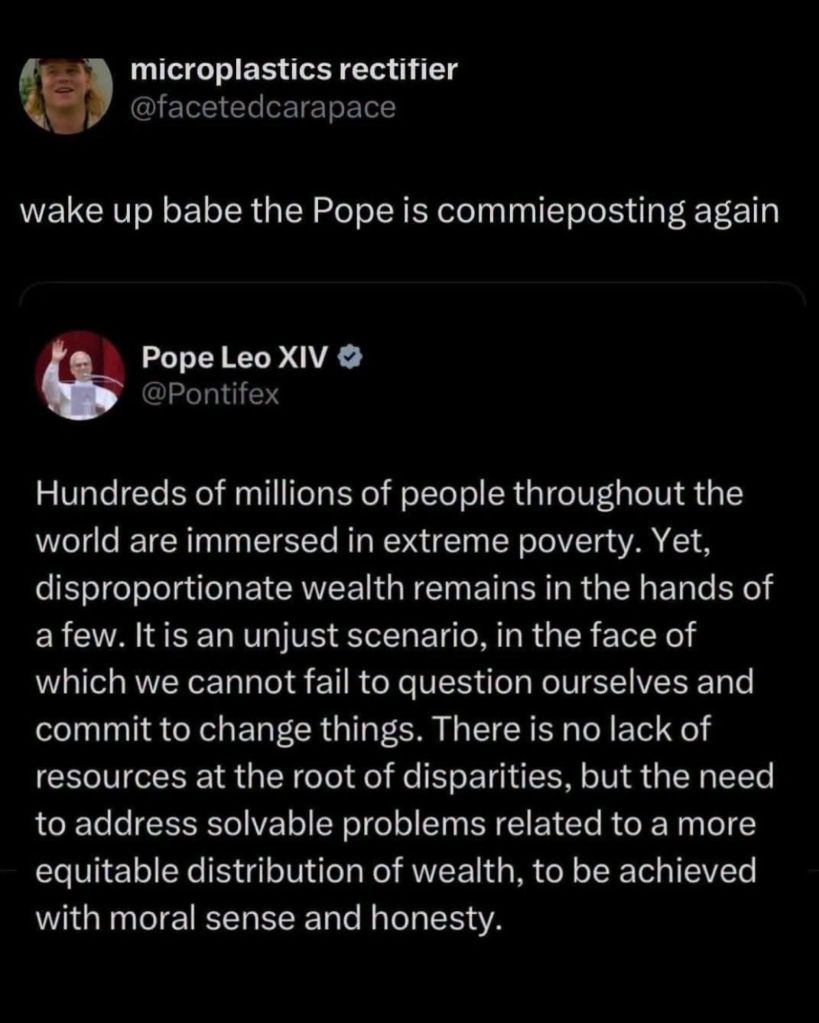
I’ve stumbled upon a social media post with an interesting accusation against Pope Leo XIV that raised some questions:
It does seem that the Republican mid-term strategy is to dig up the old fan favorite “red scare” playbook (last seen with the Democrat Russian collusion claims against Trump) and make it a referendum on a phantom threat of Communism. This rhetoric is from the top, with Trump now railing against Communism multiple times in the past month and prevalent amongst those social media voices who remain part of the MAGA coalition.
So perhaps this comment directed at the pontiff, for allegedly his “commieposting,” originates in a desperate effort to reframe the national conversation?
But read this again:
Hundreds of millions of people throughout the world are immersed in extreme poverty. Yet, disproportionate wealth remains in the hands of a few. It is an unjust scenario, in the face of which we cannot fail to question ourselves and commit to change things. There is no lack of resources at the root of disparities, but the need to address solvable problems related to a more equitable distribution of wealth, to be achieved with moral sense and honesty.
Pope Leo XIV says nothing about banning private ownership. He’s not saying we must establish a new government agency to force a new equal distribution of wealth. Instead he’s paraphrasing,—to the Christian faithful—exactly what St Paul is speaking to in the passage below:
Our desire is not that others might be relieved while you are hard pressed, but that there might be equality. At the present time your plenty will supply what they need, so that in turn their plenty will supply what you need. The goal is equality, as it is written: “The one who gathered much did not have too much, and the one who gathered little did not have too little.”
(2 Corinthians 8:13-15)
Communism, a term originating from the Latin ‘communis’ or common, universal), is a political ideology which was popularized by Karl Marx and Friedrich Engels who had published their pamphlet The Communist Manifesto in 1848. Communism aims for class warfare and state ownership of the means of production. It sought to create classless society where the workers can no longer exploited by wealthy elites who have traditionally controlled wages and write the laws in their own favor using influence they can buy from corrupt politicians.
I’m quite confident that St. Paul is not being an advocate for Communism in his letter to the Corinthians. Instead, what he is calling for is a voluntary participation in Christian community—where wealthy members who recognize that success is not their own but a gift from God are concerned with equality and, therefore, resolved to be open-handed. A believer is compelled fully by their Christian conscience, not force, to give freely to those who are in need rather than hoard while others go without. So maybe this is a type of Communism?
However, it is not what we commonly think of as Communism and the distinction being that one is looking for the government as a replacement for conscience and God. The Marxist compels with a threat of violence whereas a Christian should out of a moral obligation to show their love to those loved by God. It is part of our alignment with the Divine will that we want to act out for the good of others. And speaking of acts, the book of Acts describes this being a norm for the early Church:
All the believers were one in heart and mind. No one claimed that any of their possessions was their own, but they shared everything they had. With great power the apostles continued to testify to the resurrection of the Lord Jesus. And God’s grace was so powerfully at work in them all that there were no needy persons among them. For from time to time those who owned land or houses sold them, brought the money from the sales and put it at the apostles’ feet, and it was distributed to anyone who had need.
(Acts 4:32-35 NIV)
More commieposting?
The above sounds suspiciously like: “From each according to his ability, to each according to his needs.”
This wasn’t required. It certainly was not a demand of the proletariat to the bourgeoisie—yet this authentic early Christianity did seek to erase class division and abolish all favoritism. It was absolutely an expectation that the poor in the household of faith were provided for as part of an egalitarian ethic, the Church was a family and all members mattered. Charity was extended beyond as a way to testify to the transformative power of the Gospel, as means to actively expand the community of believers, and to manifest God’s indiscriminate love in a very stratified Roman society. So it was revolutionary, but with God’s grace rather than government as center of it all.

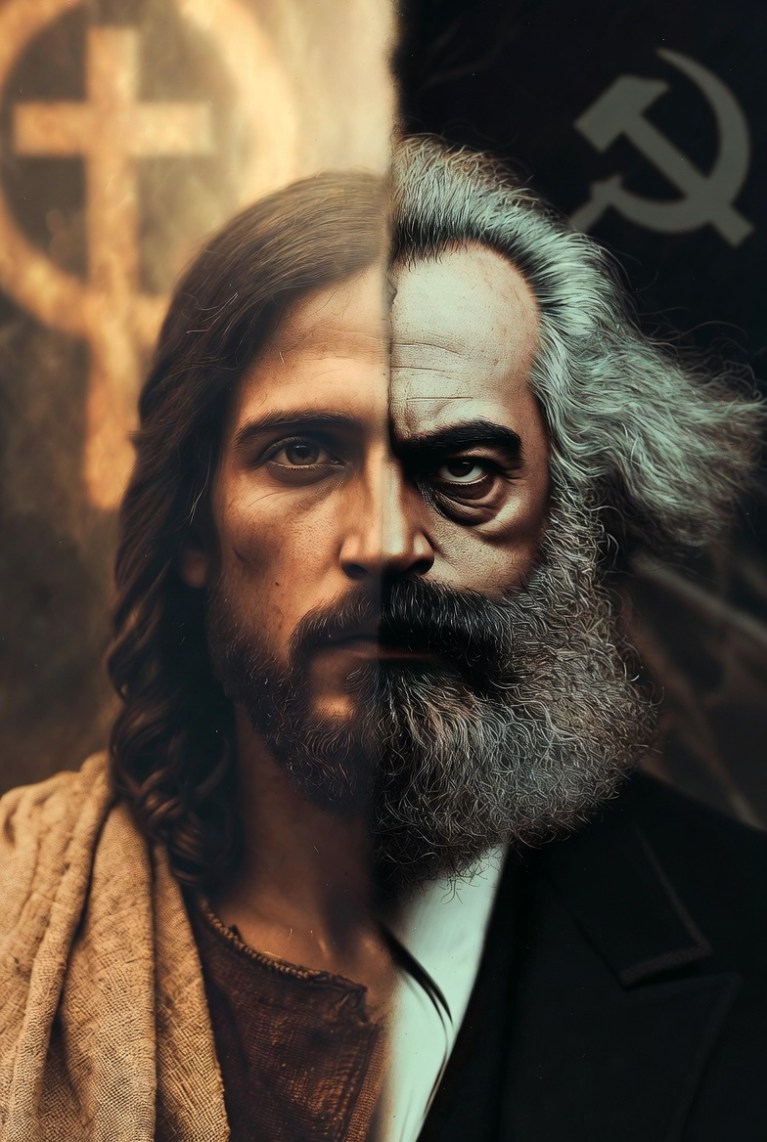
What’s ironic is how so many Evangeli-cons claim the U.S. should be a Christian nation and then call what is clearly communicated in the New Testament “Communist” when this ethic is articulated by the Vatican. No, I do not see Jesus as being a Communist. He didn’t say we should take by force. However, he also wasn’t teaching American individualism or our form of Social Darwinism either. Perhaps if more who claim Christ were living in compassion (rather than judgment or fear) the state would not be our competition anymore?
Loving your neighbors in need is not being a Commie—it’s just being a Christian.

