The Myth of an Indestructible Building

Standard

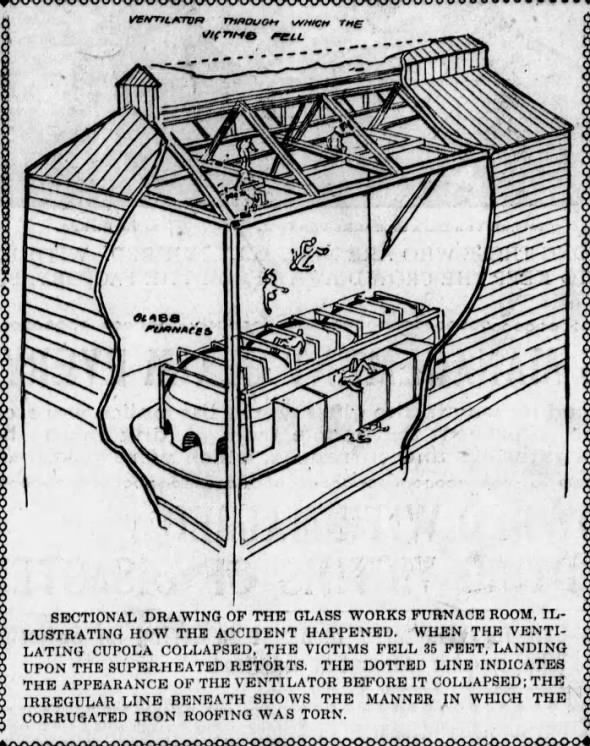
It was November 29, 1900, and fans filled the stadium in San Francisco for the annual Thanksgiving Day game between California Golden Bears and Stanford Cardinal. Some, not wanting to pay the entry fee (one dollar then, $40 in today’s money), climbed on a nearby glass factory roof to get their view of the action on the field.

The newly built factory roof collapsed about twenty minutes into the game. One hundred people fell as it gave way and plunged four stories down—many landing on the 500° F oven below. It was a horrific scene. Young people being cooked alive. What happened? The building roof wasn’t designed to hold a mass of spectators. It failed. Those who had climbed up were oblivious or did not have enough concern for the stress they were adding to the structure.
This tragedy wasn’t just a failure of design; it revealed a deeper misconception that buildings should be invincible, a myth that shapes our reactions to collapses even today. It goes further than engineering or physical buildings as well. Our models of reality are oversimplified at best and flat-out wrong in too many cases.

There is a common misconception and an unrealistic expectation about structures—many people seem to assume they are like blocks of granite. From those who believe that every building collapse is a conspiracy to those who think every failure demands stricter government regulations, the myth of an indestructible building continues due to a lack of understanding of engineering and the limitations.

Design Limits Are Not Defects

One key misunderstanding is design limits. Engineering is not about making a building too strong to ever fail. Unless we’re talking about the Great Pyramids, it’s all about trying to meet certain established parameters. An engineered building is designed to meet the expected conditions as defined by regional building codes. If the wind, snow, or loads exceed the designated standards, then there will likely be a collapse.

Earlier this year, after a heavy snowfall in upstate New York, many buildings had their roofs cave in (including this fire hall) because the weight of the snow was that much greater than the design weight. Sure, most engineers build an extra safety margin into their components, but eventually these limits are too far exceeded and you’ll end up with a tangled mess. This is why there are sideline roof shoveling businesses in these places where large snow accumulations are a regular occurrence.

Sure, code could force people to build to a much higher standard, making a collapse due to snow load virtually impossible. But this would increase the costs so much that it would price many people out of building a new house or barn. Engineering is all about compromise, more precisely about making the right compromises given the expected conditions. Yes, there is a case for making adjustments based on observation or after studies, but ultimately we build for what will work most of the time.

More Is Not Always Better

In the aftermath of the earthquake that had struck Myanmar and neighboring Thailand, there was a comment made to me in a chat hoping for more layers of regulation. This is a sentiment, in the specific context of rapid development of Bangkok, that seems more reflexive than reflective. It is a progressive impulse to believe that more interventions and rules are the answer.

The collapse of an unfinished tower in Bangkok, during the earthquake, sparks questions about building codes.  Was it missing sheer walls?  Did the contractor rush to ‘top it off’ quickly?  I want to know what the investigation finds.

But, for me, as someone who works in the construction industry and has occasionally needed to sift through these layers, I could not disagree more. Sure, better regulations may be needed. However, legalism doesn’t work in building standards any better than it does in churches. Sure, you need a code of some kind. And yet onerous regulation will add to the cost of construction, not necessarily improving the end results, and only making new housing less accessible.

It is, at best, the same trade-off discussion we can have about self-driving cars and the need for LIDAR. Sure, this expensive laser ranging system may marginally improve the results, but at what cost? Self-driving cars with cameras alone are already safer than human drivers. Keeping these systems at a price that is affordable will save more lives than pricing them out of reach for average people. It is, therefore, optimal to rollout the less expensive and safer tech even if it could be slightly improved.

At worst there is only more expense and no benefit to more layers of red tape. The real problem with rules is that they are written in language that needs interpretation. Unlike a classroom theoretical setting, in the real world you can’t just memorize the correct answers and pass the test. The ability to make a judgment call is far more important than adding to the pile of regulations. More rules can mean the more confusion and the truly critical matters get lost in the mess.

I see it over and over again, when different customers send the same job for a quote and all of them interpreting the engineering specifications their own way. It is the tire swing cartoon, a funny illustration of when the customer wants something simple and yet the whole process distorts the basic concept until it is unrecognizable. That is where my mind goes when we talk about adding layers. Is it increasing our safety or merely adding more points of failure?

This one stuck with me and should be standard equipment in every design department.  I first saw it as a child while visiting the engineering department of the construction company my dad worked for.

Some of it is just that some people are plain better at their jobs than others with the very same credentials. I am impressed by some engineers, architects, contractors, and code officers—not so much by others. I’m willing to bet the intuition of some Amish builders is probably more trustworthy than a team of engineering students’ textbook knowledge, full of theory, with no real or practical world experience. In the end any system is only ever as good as the users.

Theory Is Not Reality

My work relies on truss design software. I enter information and it does those boring calculations. When I started, I assumed that it was more sophisticated than it really is. I thought every load was accounted for and nothing assumed. But very soon the limits of this tool started to reveal themselves. It is only as accurate or true to reality as the engineers and developers behind it—and on the abilities of the user (me) understanding the gaps in the program.

When it comes to mental models—the kind of physics involved in engineering—only a few people seem able to conceptualize the force vectors. Things like triangulation, or compression and tension loads, are simply something I get. Maybe from my years of being around construction or that curiosity I had, as a child, that made me want to learn what holds a stone arch up or why there are those cables running through that concrete bridge deck. My model was built off of this childhood of building Lincoln Log towers (arranging them vertically) and occasionally making mini earthquakes.

I’m exasperated by this expectation that people have for skyscrapers to be indestructible or to topple over in the same manner of a tree—as if they’re a solid object. It also seems that the big difference between static and dynamic loads is lost on most people. They don’t understand why a building could start to pancake, one floor smashing the next, or how twisting due to extreme heat could undermine the structural integrity of a building without ever melting the steel. Of course this has to do with their beliefs or mistrusts that are not related to engineering—nevertheless it shows their completely deficient understanding of how the science works.

The concept in their head is off, their brain modeling is inaccurate, and their resolution may be so low they simply can’t grasp what the reality is. You try to explain basic things and their eyes glaze over—sort of like when Pvt. John Bowers tried to explain why the plants need water, and not the electrolytes in Brawndo, in the movie Idiocracy. Ignorant people will scoff before they accept a view different from their model of the world. The theory they believe rules over all evidence or better explanation.

On the other side are those who trust every established system without understanding it. They “believe science” and see more as an answer to every question. More rules, a larger enforcement apparatus, faith in their experts, without any feel for the problems encountered by the professionals or those in the field. If they had, they would question much more than they do. Human judgment is still at the base of it all. Or at least that is what the lead engineer told me while we discussed the limits of software and the need to be smarter than the tool.

Not even AI can give us the right balance of efficiency in design versus safety factor or what should be written in the code. It may be a better reflection of our own collective intelligence than any individual, but our own limits to see the world how it actually is are not erased by the machines we create. We are amplified, never eliminated, by the tools we create. So we’ll be stuck wrestling with our myths and theories until we take a final breath—only our flaws are indestructible.

Models of a Messy World

If truss software taught me anything, it’s that no model nails reality perfectly—not beams, not buildings, not life. We lean on these frameworks anyway, because the world’s too wild to face without a map. But just like those fans on that San Francisco roof in 1900, we often climb onto flimsy assumptions, mistaking them for solid ground. The myth of an indestructible building is just one piece of a bigger distortion: we think our mental models—of faith, of power, of people—are unshakable truths, when they’re really sketches, some sharper than others, of a reality we’ll never fully pin down.

Take religion. For some, it’s a cathedral of certainty, every verse a load-bearing beam explaining why the world spins. Others see it as a rickety scaffold, patched together to dodge hard questions. Both are models—ways to grapple with life’s big “why.” Politics is messier still. It’s like designing a city where everyone’s got their own codebook. One side swears by tight regulations, convinced they’ll keep the streets safe. Another group demands open plans, betting that freedom builds stronger foundations. Both sides act like their own ideological model is bulletproof, shouting past each other while the ground shifts—economies wobble, climates change, and people clash.

Then there’s prejudice, the shoddiest model of all. It’s like sizing up a beam by its color instead of its strength. Prejudice, always a shortcut to save us from the effort of real thought, fails because it’s static, blind to the dynamic load of human individuals. Good perception, like good engineering, adjusts to what’s real, not what’s assumed.

All these—religion, politics, prejudice—come down to how we see. Perception’s the lens we grind to make sense of the blur. Some folks polish it daily, questioning what they’re fed. Others let it cloud over, stuck on a picture that feels safe but warps the view. I think of those fans in 1900, not asking if the roof could hold them. They didn’t mean harm—they just saw what they wanted: a free seat, a clear view. We do the same, building lives on models we don’t test, whether it’s a god we trust, a vote we cast, or a snap judgment we make. The distortion isn’t just in thinking buildings won’t fall—it’s in believing our way of seeing the world is indestructible.

What makes a model reliable? Not that it’s right—none are. It’s that it bends without breaking, learns from cracks, holds up when life piles on the weight. In construction, we double-check measurements because we know plans lie. In life, we’d do well to double-check our certainties—about the divine, the ballot, the stranger next door. The San Francisco collapse wasn’t just about a roof giving way; it was about people trusting a picture that didn’t match the world. We’re still climbing those roofs, chasing clear views on shaky frames. Maybe the only thing we can build to last is a habit of asking: what’s holding this up? And what happens when it falls?


Your Own Personal Jesus

Standard

The title of this blog is a repeated line from a popular song, “Personal Jesus,” covered by Johnny Cash.  According to the writer, this song is “about being a Jesus for someone else” and more specifically the mentoring role Elvis Presley had played in the life of his wife Priscilla.  The power of these words is how they change meaning depending on the artist who sings them.  When it was covered by Marilyn Manson they came off as being mocking and derisive.

My own thoughts, hearing the song, always brings me to the popular Evangelical phrase “accept Jesus as your personal Lord and Savior” and the theological implications.  Unintentionally, it is a commentary on how the Christian religion has been reinvented in this consumerist and individualistic age.  It is all about you.  Jesus is now personal, like a boyfriend, and pretty much whatever you want him to be.  There is no obligation to others, no real need for self-sacrificial love, or becoming part of the body of believers, only to hold a kind of positive sentiment in your heart.

And this is what I encountered in the church of my youth.  Except for those few symbolic expressions of community and caring, carry-overs from those radical Anabaptist roots, it was pretty much everyone for themselves—which is how most of us preferred it to be.  I mean, sure, we would tell the other guy we would be praying for him after ritual foot washing, some would still call you brother as if simply saying it made it true, but that was generally the extent of it.  We all had our own families if there was ever a real need, the church projects were generally for the elderly and those few favorites.

Saved Together 

Orthodoxy has a more robust view of Holy Communion and could, in theory, answer the overly independent view of salvation.  At the very least, with our partaking of the body and blood together central to worship, this puts to rest this idea that the internet preacher is enough.  Life in Christ is about His body and His physical presence, not only something we hold in our minds as true.  It is not only our knowledge of Christ and mental assent but is also about making His example the basis of our actions—being an incarnation.

Faith is not about what we claim to believe, it is about how we act:

Carry each other’s burdens, and in this way you will fulfill the law of Christ. […] Do not be deceived: God cannot be mocked. A man reaps what he sows. Whoever sows to please their flesh, from the flesh will reap destruction; whoever sows to please the Spirit, from the Spirit will reap eternal life. Let us not become weary in doing good, for at the proper time we will reap a harvest if we do not give up. Therefore, as we have opportunity, let us do good to all people, especially to those who belong to the family of believers.

(Galatians 6:2‭, ‬7‭-‬10 NIV)

Carrying of burdens is about more than mere “thoughts and prayers” or those mostly empty expressions.  No, it is all about providing real relief to others, being that ‘neighbor’ like the good Samaritan or the true advocate like St. Paul was for Onesimus.  It is not enough to only say “Go in peace; keep warm and well fed,” without ever helping others with their actual needs as we read in James 2:16.  It is our job to be our brother’s keeper, that is to look after their needs like we would our own or that of a family member.  This is what a community of faith is supposed to be about and also key to our salvation.

“If anyone falls, he falls alone. But nobody is saved alone.”

—Alexei Khomiakov

For some, their salvation comes from the hand we offer.  For others, their salvation comes from offering that hand.  The early church had this saying, “unus Christianus, nullus Christianus.”  That is to say that one Christian is no Christian.  This is what it means to follow Christ, this is what being in Communion is really about.  Sure the ritual and religious practice matters.  But the true substance in the blood and the flesh we are to consume is in how we become the hands and feet of Jesus.  To do otherwise, to only partake without acting in genuine love is to drink unworthily and bring damnation upon ourselves:

In the first place, I hear that when you come together as a church, there are divisions among you, and to some extent I believe it. No doubt there have to be differences among you to show which of you have God’s approval. So then, when you come together, it is not the Lord’s Supper you eat, for when you are eating, some of you go ahead with your own private suppers. As a result, one person remains hungry and another gets drunk. […] So then, whoever eats the bread or drinks the cup of the Lord in an unworthy manner will be guilty of sinning against the body and blood of the Lord.

(1 Corinthians 11:18‭-‬21‭, ‬27 NIV)

Stay In Your Lane

Sadly, within Orthodoxy, for some, it is about lighting a candle, making a sign of the cross, paying their membership dues (tithes), and regular church attendance.  In other words, all about going through the motions.  They don’t want to be bothered by real relationships or overcoming differences—let alone be concerned with the salvation of their fellow parishioners.  

Sheesh, let the priest do his job!  Mind your own business!  Don’t you have enough sins of your own to attend to?  

I’ve even heard clergy give advice like “stay in your lane” as if there’s no difference between confrontation of lingering issues and petty fault-finding…

I’ll back up a second and agree fully that we should be “work[ing] out [our] salvation with fear and trembling” (Phil 2:13), which does imply some introspection and that we start first with the beam in our own eye.  But, that said, even this admonition is addressed to “my dear friends” or the church body and not as a personal note.  So even this could be used to further the view of salvation that is about collective effort and not some sort of personal experience we have while sitting in the pew deliberately not noticing elephants in the room as our penance.

There are some who do not seem to realize that their mother’s scold, “If you don’t have anything nice to say don’t say anything at all,” isn’t written in Scripture, but this is:

“‘Do not do anything that endangers your neighbor’s life. I am the Lord.“ ‘Do not hate a fellow Israelite in your heart. Rebuke your neighbor frankly so you will not share in their guilt. “ ‘Do not seek revenge or bear a grudge against anyone among your people, but love your neighbor as yourself. I am the Lord.

(Leviticus 19:16b‭-‬18 NIV)

Speaking the truth is not always pleasant to the ears of those hearing it and yet it is part of what love does.  It is not that we should never confront, rather it is the SPIRIT of how we approach these sins or shortcomings of others.  So, sure, staying in our lane is good, but that doesn’t mean we should never alert someone driving with their headlights off at night since we have also done the same in the past.  It may feel like ‘keeping the peace’ to sweep everything under the rug or let the ‘problem’ go away by ignoring it—but it’s also an unloving attitude.

“Church is not a social club…”

I’ve now encountered it in two very different religious traditions.  When that cry is made for real brotherhood, deeper connections or genuine relationships are met with the strong suggestion that you’re not spiritual enough and a reminder that church is for worshipping God and superficial interactions.  If you expect a little more then you’re turning it into a social club.  This is an inversion.  It is a psychological projection and a garbage excuse.  It’s telling a person seeking medical care that hospitals are about the awe of the building and reverence for the institution, that they should go to the dance club if they so desperately want to be touched by someone.  

These phony physicians only add insult to injury, they are exactly the type of religious authorities that Jesus rebuked: 

“The teachers of the law and the Pharisees sit in Moses’ seat. So you must be careful to do everything they tell you. But do not do what they do, for they do not practice what they preach. They tie up heavy, cumbersome loads and put them on other people’s shoulders, but they themselves are not willing to lift a finger to move them. 

(Matthew 23:2‭-‬4 NIV)

For them, it is all about the right image, the dress standards, and keeping their perfect attendance record.  Basically, they check all of the right boxes.  Performative religion.  And who knows?  Maybe their Bible study and prayers, ten hours a day, really does it for them?  Who am I to say that their mission to Uganda was entirely a self-indulgent display of privilege and a waste of resources?  But I’ll also say that those who travel the world while doing the bare minimum for those whom God put right at their own doorstep are condemned as hypocrites by Jesus.

The church is established by the same God who told us that it is not good for man to be alone.  Good for you if you need nobody in your life.  Jesus is your homeboy?  But most of us need those meaningful and sometimes messy interactions with other humans.  That is what family is.  That’s what hospitals are built to facilitate.  And that is what a church is literally supposed to be.  If you don’t need a doctor maybe you are the doctor and your salvation requires you to show up to attend to those sick and suffering?  Why call would we call each other brothers and sisters in Christ if this weren’t the case?  If the church isn’t at all about social interactions—why do we waste the gas?

Those who say that church isn’t a social club are right.  It is also not an art museum where pretentious people go to engage politely and then share a light snack.  It should be much more than that.  It should be a refuge we can flee, the juniper tree where God sends angels to comfort and attend to the physical needs of Elijah, a garden of Gethsemane where the disciples are not sleeping in hours of need, it should be intimate and practical, a hospital or home.  A place to be ministered to and minister to each other.  It’s both where we share our moments of happiness and also mourn with those who mourn.

Church is a family or it is just fake.  

Post Script: Those who personalize Jesus tend to depersonalize their religion. Protestant or Orthodox, it doesn’t matter, they want to claim their great devotion with their embrace of abstraction and their own prescribed practices, but seem to forget that pure religion is about the human touch (James 1:27) and what they do materially for others is how to show their love for Jesus. Our salvation does not come apart from the body of Christ. Communion isn’t only what we partake of on a Sunday morning, it is what we participate in as far as loving others and, in particular, the community of believers. You cannot stay in your lane, avoiding people in a pretense of righteousness, and also love God.

Bullying, Discrimination, and the Alternative

Standard

The book of Ezra is difficult to read.  It ends with God’s prophet breaking up marriages between Israelite men and foreign women, leaving these wives abandoned, with their children, without once considering their welfare.  Not only is it cold and callused, but all this talk of the impurity of these people is also disturbingly like that of the ethnonationalist rhetoric leading to genocide in modern times.

My own mixed family has encountered some difficulties with those who put their own tribe first recently at work and school.  

My son, a very friendly and outgoing kid, has had some issues with a few bullies.  One of these adversaries slapped him hard on the side of his head at the bus stop.  Eventually, my son and this attacker had an all-out brawl on the sidewalk and my son says he got the upper hand before an adult intervened.  But now my son is afraid of being the victim of another surprise attack and feels very much alone against the group.  Which is the worst part, the one who is instigating the violence, telling other kids that my son insulted them or otherwise provoked, is himself a newly arrived racial minority—albeit from a much less friendly urban culture.

My wife recently started a new job at a local meat packing facility, staffed primarily by those from Spanish-speaking countries, and faces a similar uphill battle.  They preferred their own for promotions and sabotaged the work of another Filipino who took one of these better-paid positions.  The upper management is seemingly unaware of this dynamic, perhaps seeing all ethnic minorities as the same, but it is very real to those who directly encounter it and see the discrimination first-hand.  It really is not ‘people of color’ versus white as is the binary often presented.  No, there are local majorities, and also many rivalries that are within racial minorities.

Something my wife observed early on is that you need to know someone to get a job.  As it turns out, that is true, she had applied at her current employer and never heard from them in weeks.  Finally, she found out that a fellow Filipino worked there, reached out, got a recommendation, and a few days after this she was interviewed.  Her ethnic contingent, within the company, has increased to three as they also have convinced another to join them against Hispanics.

My ideal solution to my son’s situation would be for him to have an older sibling or cousin to help him.  It is just automatic that family will look out for family and yet this dynamic does not contradict the sad reality of the rest of this post.  There is a fine line between this preference for our own blood and racial discrimination and bullying behavior.  In fact, it is basically the same thing.  We prefer our genetic division and general ethnic category to others.  And this may be why the older Asian girl on the bus takes a little more interest in my son?  Instincts may cause her to treat him like she may a little brother.  At the very least his polite and respectful behavior is common across most Asian cultures.

Discrimination is a survival mechanism.  An individual who truly treated everyone exactly the same would soon find themselves to be depleted of resources.  Without a tribe or a gang, nobody is strong enough to stand up to the bullies in the real world.  You’re either in the dominant (physically superior and better organized) group or you’ll be harassed into serving it.  Even the legendary heroes of ancient times tended to have an army to back them up.  And outward appearance is simply the easiest way to align ourselves given that this was always a natural division of people across time.

This all starts at a very young age.  At only three months old babies will start to prefer faces of their own race to others.  This idea that children need to be taught to be racists has no basis in science.   Yes, conditioning and socialization will come into play, but this is only a sharping of inborn tendencies.  We will trust those who look like us over those who are foreigners.  This can metastasize into racist ideologies and the hatred of those ‘impure’ others. But it is not unnatural.

Inhuman Nature and the Alternative

Defenders of Biblical ethno-nationalism will say that the problem was more about these people being idol worshippers.  And yet the people of Israel certainly weren’t free of this and they themselves would frequently follow after these false gods.  Why weren’t these impurities abandoned?  Ezra gave them an opportunity to repent and remain part of the group despite this disobedience.  They, as the seed of Abraham, were given preferential treatment simply for their bloodline and not only as a result of their different behavior.

Being truly human is about going beyond the primal and transcending even ourselves.  No, we may never convince all to find a common bond beyond the lowest hanging fruit that is skin color or facial features.  Still, those I’ve been able to identify with the most, at least other than siblings or biological cousins, do not belong to my own race.

My wife and I started as geographically far apart as two people could possibly be on this planet.  Her people, Igorots, were very tribal and primitive up until a half-century ago, my own Swiss-German heritage may seem the opposite.  But her rural agrarian roots make her more similar to me than one may assume.  Her people are stoic, with a strong work ethic, and are very much like my own grandparents.  Our son, to whom I am a step-father, is completely different than me in terms of his athleticism compared to my own clumsiness. Still, we do share many interests and are peas in a pod.

Unnatural love is that which is extended to those who do not look like us.  It is to try to be fair to all people, of all races, rather than show favoritism.  It starts with simply not mistreating those who are different from us and trying to find the humanity in others.  It is to put our common values and aims at a higher level of importance than appearance, which is to say seeing the heart rather than outward appearance.

This is not ‘diversity is our strength’ or some kind of woke BS either. 

The left is as divisive as the right or worse.  They hold everyone to a different standard, based on their outward appearance, and call this inclusion.  But all they really do is replace a meritocracy with a victim hierarchy and then use past injustice as an excuse to do the same thing to others today.  Actual virtue or contribution does not matter in this ideological dogma, it is always about outward appearance.  The bully is of another color and the discrimination goes in a new direction, but it is just more division by the lowest common denominator.

Common values are our strength.  Working towards the same cultural and civilizational goals, rather than only what is good for our own ethnic identity group, is where diversity of abilities is useful.  Bullies cost us resources, discrimination for reasons other than good or behavior is unjust, and being totally colorblind may be impossible.  However, we can work to correct our own prejudice and towards a common goal.  It will take some faith and leading by example, it will a change of heart from the current paradigm:

“There is neither Jew nor Gentile, neither slave nor free, nor is there male and female, for you are all one in Christ Jesus.” (Galatians 3:28 NIV)

It is that, unity in Christ, or we revert back to the ethnic wars, cleansings, disregard, and other abuses of the Old Testament. We can live in a world where it is tribe against tribe, man against woman, and soon every man for themselves, or we can find ways to overcome our differences and see our better potential realized. We’ll never be completely fair, favoritism is natural, but we can aim for it. We don’t need to slaughter each other over our shades of difference.

Evolution: From Genesis To the Gospels

Standard

If you read the Gospel narratives and get to the end of these books, you come across some very interesting passages.  It is after the resurrection and right before Jesus ascends that we read this:

Again Jesus said, “Peace be with you! As the Father has sent me, I am sending you.” And with that he breathed on them and said, “Receive the Holy Spirit. If you forgive anyone’s sins, their sins are forgiven; if you do not forgive them, they are not forgiven.” 

(John 20:21-23 NIV)

And according to St. Luke:

Then he opened their minds so they could understand the Scriptures. 

(Luke 24:45 NIV)

What strikes me, in both passages, is how this final transformative step took place after a long-drawn-out process of teaching and showing by example.  Why go through this protracted effort if ultimately their minds needed to be opened by the Holy Spirit?

Furthermore, why even go through the centuries, from the time of Abraham on, leading these stubborn Israelite people, if the real plan is to send Jesus and rely on the power of the Holy Spirit?  If all of this eighth day of creation could have been accomplished with God merely saying the word, why not skip steps A to Z or cut to the chase?

In the Beginning…

There are many who believe that anything other than a ‘literal’ interpretation of the word days in the first chapters of Genesis takes away from God’s power.  In their mind it must be twenty-four-hour, the earth spinning a full rotation on its axis, days and nothing else.

Of course, knowing the little I do about language, and how words like “gay” can evolve from happy to men who prefer men, it makes very little sense to die on the hill of one particular translation from archaic language.  It does not seem necessary to turn this into an either/or and especially considering that none of us were there to witness the events described.  There is a sort of poetic metre to the opening chapter of Genesis, it could certainly suggest we could see this as a summary rather than something exhaustive.

All that the long way around to saying that this opening act of Scripture culminates at this moment:

Then the Lord God formed a man from the dust of the ground and breathed into his nostrils the breath of life, and the man became a living being. 

(Genesis 2:7 NIV)
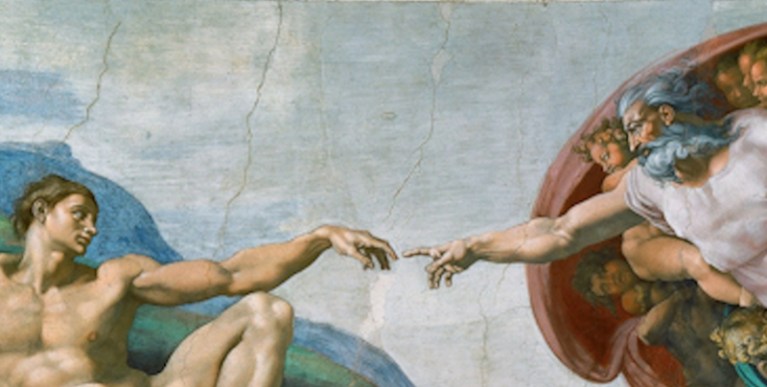
Creation of Adam, mosaic, 12th century. Monreale, Cathedral

The interesting part is that this is the second account of the creation of man, whereas this is the first version of this significant event:

Then God said, “Let us make mankind in our image, in our likeness, so that they may rule over the fish in the sea and the birds in the sky, over the livestock and all the wild animals, and over all the creatures that move along the ground.” So God created mankind in his own image, in the image of God he created them; male and female he created them. 

(Genesis 1:26‭-‬27 NIV)

In the above account we have both male and female, or mankind, being created simultaneously on the “sixth day” and yet in the very next chapter we have Adam naming all of the animals, not finding a suitable match for himself amongst all of the creation, and this *before* Eve being formed.  At best that was one heck of a long day, at worse the first two chapters of the Bible directly contradict each other.

Of course, then we get into what a “day” really is without a sun, as celestial bodies weren’t created until the fourth day according to the Genesis account.  Time is not some immutable thing, it passes faster and slower depending on the reference frame, the Palmist tells us that a thousand years is as a day from God’s perspective.  So I’m not sure what is gained by insisting on the one interpretation that most conflicts with the scientific evidence.

A Biblical Preference for Process

It does not take a deep dive into theology to realize the importance of ritual.  Whether Namaan’s seven dips in the river Jordan before being healed, the march seven times around the walls of Jericho before they fell, or Jesus spitting in mud and rubbing it into a blind man’s eyes before the miraculous, there’s a distinct pattern of the creation doing and the God coming through to complete the work.

Maybe the repeating record of Scripture is trying to tell us something?

First, the elongated process does not eliminate or even diminish God.  Sure, many of us want immediate results, we want everything to materialize, fully formed, rather than have to wait days, weeks, or years.  And many do conclude after a prayer is not immediately answered or according to their own timeline, that this does rule out the possibility of God.  But the clear Biblical pattern is that everything is always in the fullness of time:

So also, when we were underage, we were in slavery under the elemental spiritual forces of the world. But when the set time had fully come, God sent his Son, born of a woman, born under the law, to redeem those under the law, that we might receive adoption to sonship.

(Galatians 4:3‭-‬5 NIV)

St. Paul likens the spiritual transformation, made possible through Christ, to the two sons of Abraham—one of them the result of rushing the process and the other of truly Divine origin.  The law is a foundation and yet not the fullness or complete fulfillment.  Even now, even for the believer, we know we are not a completed work until that day we hear “well done, good and faithful servant!”

Cutting to the chase, the “formed a man from the dust” of Genesis doesn’t tell us much about the process behind that formation.  But the “breathed into his nostrils the breath of life” of Genesis does parallel with “he breathed on them”  in the Gospel of John.  The disciples, like Adam, had some kind of form prior to this transformation and enhanced spiritual life.  The time they had spent with Jesus prior to their mind being opened was not purposeless.

God could have created without a process.  Still, the overwhelming pattern appears to be that God catalyzes things that are already underway or set in motion.  It would therefore not be all that surprising if forming out of dust alludes to an evolutionary process, which was finalized in Adam and this special spiritual life breathed into him.

What Makes Us More Than Animals?  

Truly, in terms of biology, we aren’t different from animals, we have instincts that drive us, and can lose our humanity too.  Indeed, we can be degraded to an animalistic existence through our actions and lose that element of being created in the image of God:

But these people blaspheme in matters they do not understand. They are like unreasoning animals, creatures of instinct, born only to be caught and destroyed, and like animals they too will perish. 

(2 Peter 2:12 NIV)

So the Bible tells us about evolution (and de-evolution) from the perishable fleshly form or physical body to those are quickened in spirit and being transformed:

So will it be with the resurrection of the dead. The body that is sown is perishable, it is raised imperishable; it is sown in dishonor, it is raised in glory; it is sown in weakness, it is raised in power; it is sown a natural body, it is raised a spiritual body. If there is a natural body, there is also a spiritual body. So it is written: “The first man Adam became a living being”; the last Adam, a life-giving spirit. The spiritual did not come first, but the natural, and after that the spiritual. The first man was of the dust of the earth; the second man is of heaven. As was the earthly man, so are those who are of the earth; and as is the heavenly man, so also are those who are of heaven. And just as we have borne the image of the earthly man, so shall we bear the image of the heavenly man. I declare to you, brothers and sisters, that flesh and blood cannot inherit the kingdom of God, nor does the perishable inherit the imperishable. 

(1 Corinthians 15:42‭-‬50 NIV)

It is this spiritual component—this ‘breath’ of God both in Genesis and the end of the Gospels—that sets us apart from the animal.  We’re essentially on the same journey as Pinocchio, who wanted to be a real boy, in this pursuit of the Divine transformation.  We have evolved, even if not in the Darwinian sense, from that first cell in our mother’s womb to the learning of our childhood, and this is a creative process guided by the Holy Spirit from start to finish.

Icon of Jesus pulling Adam and Eve out of the grave on the mystical eighth day of creation, which is to say His victory over death and the resurrection of the dead.

The Patriarchal Protection Paradox

Standard

The order and protection of patriarchalism and purity culture could appear to be the alternative to the chaos, confusion, risk and hurt of sexual liberation.  We know that women are taken advantage of all the time by men who have no intentions of making a commitment, they do naturally bear the higher cost of sexual promiscuity and therefore it does make sense to offer them some special protection, right?

Men should be protectors.  This is a role that men are well suited for and, in correct form, actually enables women to thrive and be the best version of themselves.  Does this mean that women can’t do what men do?  No.  But it is simply optimal, in a trade relationship, that both parties specialize and do what they are better suited to do.  For the betterment of the whole and ultimately for themselves.  My grandma kept the books for the farm while my grandpa ran the equipment and did the field work.  Why?  Well, it’s simply what worked for them. 

The patriarch, the elder man of a household or a community, should indeed protect those who are under his care.  That’s what he is there for.  He can provide food, shelter, shepherding and defense for the vulnerable.  His age and experience, his humbly knowing his own place under God, can give him perspective valuable to his children and appreciated by the woman that he has committed to love.  This may be patriarchy, I’m not sure, but the good kind.

Unfortunately, patriarchalism, like that often found in religious purity cultures, tends to be the wrong kind of protection.  It elevates women while simultaneously not treating them as equals.  It protects some women, but not all.  And, while framed as a male advantage, because it does privilege some men, actually hurts men.  It may prevent some promiscuity, but it doesn’t protect people or truly show Christian mercy to anyone.  Worse, since it never gets to the heart of the matter, it often only covers for abuse.  That’s the paradoxical part: Below the surface it is not really any different from the degrading and demeaning alternative. 

1) Paradox: Both Elevates And Demeans Women

Patriarchalism is often framed in terms of dominant men who think women should follow two steps behind, which is certainly one part of it.  But it can also be much more subtle than those notions of women remaining barefoot in the kitchen, pregnant, submissively waiting on their husbands. 

In fact, many men who identify with feminism are very often unwittingly patriarchal in their overzealous protective and preferential treatment of women.  Coddling or patronizing women, assuming their motives are always pure, is ultimately another form of patriarchal protection.  This is, incidentally, the reason why some feminist women resent having the door held for them.  Is it a kind gesture or is it an assumption of her inferiority and need for male help?

What I’m talking about is this idea that a woman can do no wrong, that assumes that she is always a hapless victim of male abuses and basically lacking any agency or discerning capacity equal to a man.  

I know women like this, who look adoringly at their husband as he compliments her (patronizingly) for her being able to pick the drapes.  He gets to make all of the real decisions and she can live comfortably without the stresses of adulthood. 

And, not surprisingly, some women are completely fine with this arrangement.   Why not stay on the gravy train if you can?

However, many more women are uncomfortable with this protection.  They sense this treats them as if they’re not fully formed humans and, in the end, will stifle their God-given potential. 

Of these backhanded insults that intelligent and capable women face constantly in this current social paradigm is that they are either a) in need of some crusty politician to help them or b) they are some sort of faultless Mary Sue, with no need of character development, who only had to show up to dominate men.  Nobody truly wants to be treated as special simply because they have a certain type of genitals.  Putting women on a pedestal (even if called feminism) is patriarchalism.

The protection of patriarchalism is the wrong kind of protection.  It treats women sacred objects, idols, faultless and not real people with complexity or depth.  It protects the female body, at least in theory, yet neglects her soul.  It objectifies.

2) Paradox: Protects Some Women, But Not All

In purity cultures (both secular/political or traditional/religious) only those who meet a certain standard or subscribe to a particular ideological agenda are actually protected.  Those who do not conform the cultural expectation are not valued or respected.

In the religious culture which I was born into, the woman who follows the rules (kept up outward appearances and acted the part of innocent) is always treated as pure-minded and virtually incapable of evil.  A young woman, who outwardly obeys, is her daddy’s little angel, practically divinity, and subject to unceasing praise.  Women are protected, but not as equal to a man, and only so long as they represent the ideal.

Perhaps this ‘protection’ is motivated by guilt and a way to make up for the extra pressure put on women to conform and submit?  Or simply a way for some men to advantage themselves over other men by playing the hero?  Maybe it is just a bias of those in a culture where everything is judged by outward appearances and men can’t imagine their female counterparts as being anything but porcelain dolls, where it is unimaginable that a beautiful young woman, from a good home, wearing the prescribed attire, could be anything but sinless and a saint.  Whatever the case, it is real and is a privilege (albeit perverse) that women enjoy in patriarchal purity cultures.  

This privilege, and pedestal, of course, does not apply to ‘worldly’ women.  No, only the girl who meets the patriarchal religious standard is sort of viewed as some kind of unattainable perfection.  A woman is either a paradigm of virtue, a Madonna, or she is a Jezebel, a Potiphar’s wife and temptress, with very little room in between.  An too often, the woman who stands up for herself a bit or defies their cultural expectations, to the patriarchal men, are comparable to a prostitute and totally debased.  They need women to be weak so they can feel strong by comparison.

The patriarchal paradox is that it does elevate and protect women, but not in a way that humanizes or allows women to have the same fullness of character as a man. Patriarchalism doesn’t protect women as people, but rather as they represent an image of femininity and cultural ideal.  This is revealed or exposed, in the reality that patriarchal men do not protect all women.  No, they only protect their women and only so long as they fit the cultural prescription. 

Furthermore, the protection patriarchal purity culture is mostly focused on defending the physical body of a woman, managing her outward behavior, rather than her actual spiritual well-being.  She is the trophy on a man’s shelf, a conquest, but not recognized as a fully formed person.  Women are valued for their virginity and only protected if deemed pure by some cultural standard. A woman is only worthy of protection if his purity fantasies can be projected onto her feminine frame.

This ‘protection’ (or at least as it is combined with purity culture) labels those who fall short as “defiled” and treats them like damaged goods rather than broken people to be loved. The paradox is that patriarchalism protects a cultural ideal for women rather than protect women.  It offers condemnation, not care, for those who fall short.

3) Paradox: Hurts Rather Than Helps Most Men

Patriarchal treatment of women also leaves many men feeling inadequate amongst women who are truly their equals and not perfect as imagined.  In my own life, I’ve put Mennonite women so high on a pedestal that their rejection felt like a judgment from God.  That is unfair to the men, it is unfair to the women, and yet is very common in patriarchal religious purity cultures.

Again, in patriarchal purity culture, so long as a woman dressed and acted in a particular manner she was basically immune from criticism.  I’ve seen very patriarchal pastors side with a wife against her husband, when she was as much at fault, and suspect it was a matter of sexual preference.  And I do mean “sexual preference” in the crassest and literal manner, in that they were protecting women to preserve their own sexual status with her.  Somewhere, in their reptile brain, they needed to impress the woman, play savior to the damsel in distress, and did a terrible disservice to both sides with their prejudice.

Young conservative Mennonite men, unlike the females within the culture who are treated as blameless, are frequently called out for their more open expression of their lusts and pornography addictions.  It is as if it never registered to them that Jesus called out those who appeared to be righteous more harshly than those caught in their sin.  Mennonite women sin.  They have their vices, even if less obvious.  Anyhow, when some are left feeling dirty and irredeemable rather than sinners in need of God’s grace like anyone else, this is patriarchal purity culture and unChristian.

Men in patriarchal purity culture, rather than love other men, enjoy eliminating competition.  By highlighting and haranguing about the more visible weaknesses or inadequacies of other men they hope to increase their own social stature.  This is even more pronounced in purity cultures where polygamy allowed.  The “lost boys” of fundamentalist Mormonism, where young men are accused and run off, a clear example. 

Other men are a far bigger threat to abusive patriarchal men than women.  And this is why Biblical fundamentalist (Protestant) men demand submission to themselves and yet absolutely refuse to fall under any authority other than their own.  It is not so much about women or purity as it is about protecting the overblown ego of some men and comes at the expense of all.  It is actually about power not protection.

4) Paradox: Patriarchal Protection Often Covers For Abuse

The great irony of patriarchal purity cultures are that they are as focused on sex as the ‘worldly’ whom they condemn.  Even in their condemnations of promiscuity there is this “methinks thou dost protest too much” feeling and sense that this constant bluster is for their titillation or pleasure.

But, more than that, this display doesn’t mean these moralizers are free from sexual sin themselves. 

No, they are as obsessed with the physical bodies as anybody in the world outside their cults. 

And, while they consider themselves to be moral authorities, they often blame-shift responsibility for their own lust onto women.  From pulpit pounding sermons about “immodesty” (in front of an audience of women wearing  long dresses) to men who literally blame the young girls they molested for the abuse. 

However, the worst part is when those in these cultures are more concerned about the victims remaining silent than they are about the abuse.  This is probably not so much about keeping individual abusers from justice so much as it is about protecting the culture.  To feel good about themselves, to keep up the “holier than thou” show, they must conceal the impurities.  It is about protecting image not people.

Purity cultures are about preserving an outward image of purity and avoid looking inward at all costs.  They need to externalize blame, keep the focus on the sins of those outside of the group, or it would be impossible to sustain the system.  So deny the extent of their own problems, to try to keep their sins secret, is a means to protect their special identity and culture. 

The Wrong Kind Of Protection

In the end, patriarchalism protects the cultural ideal of purity rather than actually loving people.  It is concerned primarily with a woman’s body, or outward behavior, not her being.  It is centered on the physical rather than the spiritual.  It stifles women who don’t fit the cultural mold, does not protect their dreams or ambitions, and also gives cover to bad behavior that flies beneath the radar of dress standards and superficial obedience.  It protects the power of a few men at the top, but does not serve many (or most) of the males within the culture very well. 

It does not follow the example of Jesus, who did associate with prostitutes and others who did not keep up their righteous image according to the standards of the religious paradigm of that time.  He intervened on behalf of a woman accused of adultery and condemned the sanctimonious elites.  They Pharisees were obsessed with maintaining an outward image, creating physical separation between themselves and those deemed impure, yet knew nothing of spiritual transformation or even their own need of an inner change.  They loved status and outward image, they protected a religious ideal, but not real people.

The problem with the patriarchal purity culture protection is that it protects women like property, as sex objects, and not as people.  It is dehumanizing in the way that it puts women on a pedestal.  The problem is not male leadership.  The problem is any leadership that does not protect other than for it’s own benefit.  Despite what it claims, patriarchalism is about defending the status of some men, keeping their lust satiated, rather than Christian love.  It is ‘protection’ of the wrong spiritual source. 

And, thus unlike what popular mythology would suggest, this is not a problem that would be solved by replacing men in leadership with equally domineering women.  That is the one big absurdity of our time, we are told that women would be better more empathetic leaders than men and then given purple-haired Vice-Admiral Amilyn Holdo berating a subordinate man as an example.  That’s not an empowered woman, that’s a woman that is dangerously entitled or so uncertain of her own command that she needs to make an example of anyone who dares to question.

It is the spirit of patriarchalism that’s wrong and why it creates such resentment.  Most of us would fall willingly behind a fatherly figure that we trusted was not in it for himself and had our best interests in mind.  If we knew that our unique personhood was being protected rather than how we fit into their own cultural ideal and scheme then we would be less skeptical.  More would fall into place as God intended if we would all start here, with humility and a truly serving spirit:

In your relationships with one another, have the same mindset as Christ Jesus: Who, being in very nature God, did not consider equality with God something to be used to his own advantage; rather, he made himself nothing by taking the very nature of a servant, being made in human likeness.

Philippians 2:5‭-‬7 NIV)

Raped — But Not Devalued

Standard

I was on the elevator down from the psych ward, having visited a friend in a bit of a rough patch and struck up a conversation with one of the other riders.

As it turned out, she was a psychologist, visiting a friend (not her patient) who was not doing so well.  This young man, now catatonic, had once had it all together. He was a standout athlete, had a girlfriend who was gorgeous, and then something happened that turned his world upside down.

What would take the feet out from under a strong and healthy male?

He was raped.  

While in the military, the Navy as I recall, he was forced by another man and this started his downward spiral.  It is not possible to know, having never gone through anything similar myself, what happened in this young man’s mind.  But one can imagine, if he had an identity and self-worth built around his ability to protect, being overpowered in this way would have to be absolutely devastating to him.

How could he provide security for a woman if he couldn’t even defend himself from an assault?

His relationship, his life, his will to live, crumbled.  This one experience, possibly over in minutes, probably not doing him lasting physical harm, broke him mentally and turned him into a shell.  I have no idea of what became of him.  Did he find a way to bounce back, form a new identity, move on from the trauma and overcome?  Or has he withered away into nothing?

More Common Than Thought

One of my first encounters with a victim of sexual abuse was in school.  A friend of mine, from elementary school all the way through high school, told me that he had been molested by his stepbrothers while living in Texas with his biological dad.  I had always felt bad for Justin. He was socially awkward and bullied by classmates, had a domineering mother, and came out of the closet later on as a teenager.

I’m also had some very close female friends that have told me about being raped.  Their stories are very similar.  A trusted male, often a boyfriend, talks them into a place where they are unable to escape his sexual aggression.  In all of these cases, to head off any assumptions, there was no alcohol involved.  They were good morally upright girls who were too trusting of a male ‘friend’ who stole their innocence and left them feeling completely broken.

Then there’s Adam, the school friend who took his life a few years ago, victimized as a child by a predator college professor.  His alcoholism and failed relationship no doubt, in part, linked to this experience.  I mean he let me in on this secret, and many years after it happened, so it was obviously still part of his thought process.

At one point in my life all of this was unthinkable.  I was in a home that offered stability and protection, with two good parents.  I’m sure there were things that I did not know about, but my community seemed mostly healthy and safe.  There was simply no reason for me to assume this sort of violating behavior was common.  So statistics about 1 out of 5 women being victims of rape seemed impossible.

It is truly understandable that many who were raised in sheltered homes are in denial of the extent of this problem.  It makes sense that they would try to explain it away as the promiscuous putting themselves in a compromised position.  It is probably a good thing when the reaction is disbelief. Most men aren’t rapists and would be horrified, like I was, if they heard a story firsthand from someone they love.

Boundaries and Consent

As part of my culture, and also my lingering shyness, it is difficult for me to so much as give a woman a hug.  It’s actually very frustrating to me, that I’m so awkward in this regard and would almost need to ask permission rather than simply make the read.  Why is this?  Well, it only seems right to respect another person’s space.  Intimacy is supposed to be reserved for special people, right?

It actually makes me livid to see even a boy too grabby with a girl too early, even if she seems to be enjoying it, because he’s treating her as an object.  And yet this sort of ‘confidence’ is often rewarded.  The women who think that every man is a rapist may have simply spent way too much time with men who do not respect their or any boundaries. 

And, yes, men who pressure with “if you love me you will…” are evil. 

Period.

Rape is a product of an entitled mind, a psychopath, someone who sees other people as something to be exploited for their pleasure.  Sure, maybe they can turn on the charm and blend into normal society, but their true character is revealed when there is nothing to stop them.  Be it in a back alley or her bedroom that he talked himself into while her parents were away, rapists exploit the vulnerable.

Incidentally, this is why I’m still in favor of at least one aspect of traditional courtship.  If a man can’t keep his hands off of your body for a few dates, if there is any unwanted pressure whatsoever to be physically involved, then maybe find someone who is interested in you rather than merely sexually attracted to your physical form.  If a man can’t commit to a relationship without sex, he certainly isn’t the type to commit after sex.

Lust and Self-control

In the animal kingdom there is no such thing as consent.  Often the strongest, most competitive, male gets to mate and by simply overpowering the female.  He runs on instinct, male hormones, testosterone, and is basically acting out his natural programming.  We don’t generally describe a buck “in the rut” as being a rapist because we do not see the animal as capable of complex moral reasoning.

And humans do have these similar underpinnings too.  Men, for the most part, are more aggressive, and women tend to be more submissive, agreeable, etc.  It is simply the substance we’re made of in the same way it is for any other animal.  We’re instinctive creatures that seek out, and imagine, the things we want.  But we also have a layer beyond this, a large frontal lobe in our brain, which gives us an extra capability for self-control.

Lust is often confused with simple desire for something.  Many in a strict religious upbringing, like my own, are made to feel extremely guilty for looking upon a fair maiden and finding her desirable.  But that’s not lust, that’s healthy sexual attraction and not a sin.  What is lust is when we dwell on something that’s not ours to take. That is a path that can lead to rape, as in this Biblical account:

Amnon became so obsessed with his sister Tamar that he made himself ill. She was a virgin, and it seemed impossible for him to do anything to her. […]
So Amnon lay down and pretended to be ill. When the king came to see him, Amnon said to him, “I would like my sister Tamar to come and make some special bread in my sight, so I may eat from her hand.” David sent word to Tamar at the palace: “Go to the house of your brother Amnon and prepare some food for him.” […] 
But when she took it to him to eat, he grabbed her and said, “Come to bed with me, my sister.” “No, my brother!” she said to him. “Don’t force me! Such a thing should not be done in Israel! Don’t do this wicked thing. What about me? Where could I get rid of my disgrace? And what about you? You would be like one of the wicked fools in Israel. Please speak to the king; he will not keep me from being married to you.” But he refused to listen to her, and since he was stronger than she, he raped her.

(2 Samuel 13:2‭, ‬6‭-‬7‭, ‬11‭-‬14 NIV)

Awful!

The sad part is that when Amnon’s lust was satiated, he discarded his half-sister (not biologically related) as if his sin were somehow her fault.  Incidentally, this violence did not go unavenged. Amnon was eventually killed by the victim’s brother, Absalom.  But this lack of self-control seemed to plague David’s house.

Considering what king David did to have another man’s wife, we could say “like father like son” to explain what happened here. 

Rabid Dogs Are Put Down

In the end, we all have sexual desires. Attraction is natural and not something to be ashamed about.  But, when this crosses over into lust, when we choose to dwell on something unattainable and scheme to have it through immoral means, that’s a choice and what separates us from animals.  The reprobate tries to hide behind their urges and impulses. 

If a dog can’t keep from biting we’ll put it down. 

Should a person with no self-control, who harms others because of their unwillingness to rein in their lusts, be treated any differently?

I know Jesus said, pertaining to those who harm the “little ones” (referring to those young in the faith, not necessarily children), that it would be better that a millstone be hung around the neck of those who do these things and they be cast into the sea.  He may not have been talking specifically about sexual abuse and yet, knowing what this sin does to those who have fallen prey, I’m quite certain it’s included.

Jesus never said, “if she’s wearing a skimpy outfit, then she shares some of the blame,” but he did say, in the context of lust, If your right eye causes you to stumble, gouge it out…” (Matthew 5:29a NIV) 

Good people do not create scapegoats.

Godly men do not blame women.

Your Body Is Not Your Worth

The more important message of this blog, and my main reason for writing it, is to tell those who have been through this kind of trauma this: Your rape is not a reflection of you or your value.

As one who fully appreciates the human form, especially that of the female body, and completely desires physical intimacy, it could be easy to treat our bodies as being one and the same as our being.  We show preference based upon stature, beauty, shape and other matters of outward appearance.   So it can feel as if this form we reside in is of greatest importance and, therefore, what happens to it a reflection of ourselves.

Women, traditionally, put value in their cleanliness or purity, men in their strength and ability to protect.  Our identity is often wrapped up in this external image.  Rape is an attack on the physical manifestation of these things and causes the victim to question their identity or value at a deeper level.  This is why, in mere moments, someone can be shattered.  They now see themselves as dirty or defiled, inadequate or weak, and thus of less value.

But the truth is that our human value has nothing to do with what others have done to our bodies and everything to do with how we choose to live.  

I’ve encountered toxic and nasty people, bitter, who have used the abuse they’ve experienced as an excuse to mistreat others.  I have also met those who have not been defeated, who are able to put the unpleasantness behind them, and even become a better person in the end.  This idea that we’re damaged goods or have lost our worth because of something that happened, through no fault of our own, is choosing to put our own value in our bodies.

Do not be afraid of those who kill the body but cannot kill the soul.

(Matthew 10:28a NIV)

There is so much more to our being than our physical form.  We might convince ourselves, based on the world’s obsession with the external, that our worth is in only these physical things.  But what matters, the real value we have, is our soul and that thing that can’t be touched. 

Age will eventually destroy our bodies. The tall youth will some day be hunched over, the strong man’s muscles will atrophy, wrinkles will spread on that angelic face.  The world abuses us, we will all likely face trauma even if not rape, and yet—if we know that value is something other than the physical—our worth will increase.

At the very least, no matter what anyone has done to your body, whether you were abused as a child, raped or whatever, I do not look at you as damaged or inferior. 

No, you are strong to keep going. There is a special beauty to a survivor that is not found in those sheltered.  And I believe there are more who agree with me than do not. 

Your value is in who you are and not what was done to you!

Are not five sparrows sold for two pennies? Yet not one of them is forgotten by God.
(Luke 12:6 NIV)

Where To Go From Here?

Standard

The past few years have been monumental for me. This blog has followed my own personal journey from the initial ideation about love, faith and spiritual life to some major transitions. I’ve changed careers, departed from the denomination that had been the identity I most cherished, and basically had my life turned upside down.

This blog had started as a result of a prayer, as an act of faith, and was to chronicle a fight to overcome the odds. I had realized my own limitations. I was single, in my mid-thirties, working a job that didn’t suit me very well, and worried about being the unfaithful servant who buried his talents. Unfortunately, for myself, I didn’t know a way out of the predicament.

But, instead of wallow in my self-pity, I decided to actually believe what Jesus said, “everything is possible for one who believes,” and with complete reckless abandon, prayed to God asking that the impossible be made possible for me.

I had committed to believing beyond human reason or my own rationality, to believe without adding the qualifications so often used by the religious to excuse their own lack of faith and as a means of preserve their self-serving status quo. My aim was to overcome whatever, the bad luck, personal failures or cultural prejudices, that kept me from living out the potential that seemed to be locked away somewhere and yet was still unrealized.

Of course a big part of that prayer, given the importance of marriage in a conservative Mennonite setting, was in hope of finally getting beyond the invisible barrier to my romantic success and finding the “right one” who could love me despite my imperfection.

My deepest fear had always been that love is little more than a post hoc explanation of something determined at a far baser level. In other words, that love was decided by attributes mostly biologically predetermined or based in performance. If a person lacking the right inborn characteristics is essentially unlovable, then the whole mythology we build around love as something pristine or pure is a delusion and love itself becomes a justification of our selfish or carnal ambitions.

I was determined to disprove that hypothesis. I intentionally sought out a girl theoretically “out of my league” for a variety of those lesser reasons. Before this, I had always picked pragmatically based in who I thought would say “yes” (although they often didn’t) and not with any real faith. This time I picked on what I believed God wanted me to be and because she seemed to be the one who could get me past those limitations. She wasn’t someone who seemed frozen in indecision, she shared my own cultural ideal and would compliment my strengths and weaknesses.

Alas, her sanity won out over my irrational faith-fueled hopes.

However, in telling my story of faith and struggle this blog gained popularity. Over the time my hopes ran into the brick wall of her reasons she couldn’t love me (very much like those I had feared) this blog rose to prominence in the Mennonite blogosphere. Suddenly, in my moment of deep despair and disappointment with my Mennonite ideal, I had an audience of thousands. In a matter of hours a sardonic post assigning points for marriageability, something I wrote one morning while stewing over the reality of the depressing situation I found myself in, was a viral sensation and had obviously resonated with a great swath of people.

After that, I wrote a string of posts about some of those issues I’ve had with the church I was born into and previously didn’t know how to express. It was during this time that a blog post about fundamental flaws in the current conservative Mennonite thinking was picked up by Mennonite World Review. It later made rounds in a conservative email group posted by none other than Peter Hoover who had, by writing Secret of the Strength, inspired my Anabaptist perspective many years before and put me at odds with the creeping influence of fundamentalism.

The great irony in it all was that I reached the pinnacle of my own influence in the Mennonite world *after* I had attended my last service.

Since then, in a greater irony, I’ve seen a romance blossom that would’ve been impossible had I remained Mennonite and evidence of that kind of love of the faithful variety that I did not find where I had most expected to find it. There is a real story of the impossible being made possible developing, not the story of love triumphing over the odds that I had thought I would tell and yet every bit as powerful. However, too much is in limbo right now regarding that circumstance to write about it.

Beyond that, there is also my being immersed into Orthodoxy and the difficulty of putting that experience into words. I mean I could argue for Orthodox Christian practices and perspectives, I have written a couple blogs trying to explain such things to my Mennonite audience, yet Orthodoxy is something better to be experienced. Like Jesus said “follow me,” they make an appeal that is not strictly emotional nor intellectual, but experiential. Faith is something that must be walked to be understood. The Orthodox don’t proselytize in a Protestant manner. No, instead, they invite others to “come and see” like Philip did in urging Nathanael to join him and rely on the mysterious work of God:

The next day Jesus decided to leave for Galilee. Finding Philip, he said to him, “Follow me.”

Philip, like Andrew and Peter, was from the town of Bethsaida. Philip found Nathanael and told him, “We have found the one Moses wrote about in the Law, and about whom the prophets also wrote—Jesus of Nazareth, the son of Joseph.”

“Nazareth! Can anything good come from there?” Nathanael asked.

“Come and see,” said Philip.

When Jesus saw Nathanael approaching, he said of him, “Here truly is an Israelite in whom there is no deceit.”

“How do you know me?” Nathanael asked.

Jesus answered, “I saw you while you were still under the fig tree before Philip called you.”

Then Nathanael declared, “Rabbi, you are the Son of God; you are the king of Israel.”

Jesus said, “You believe because I told you I saw you under the fig tree. You will see greater things than that.” He then added, “Very truly I tell you, you will see ‘heaven open, and the angels of God ascending and descending on’ the Son of Man.” (John 1:43-50)

Can anyone rival that with eloquent words or elaborate arguments?

I know I can’t rival that sort of mysterious work in my own words and worry that my words will actually take away from the beauty of the ancient faith. I mean, what could I possibly add to something so wonderful and profound with my clumsy and simplistic explanations?

So this all leaves me with a dilemma as a writer. Am I more than a one-trick pony? Even as I’ve progressed over the past few months, I feel my blogs have started to become a bit repetitive, as if I only really have one story to tell, and that has bothered me. My area of expertise, at this point, is how to fail miserably trying to find love in the Mennonite context. My painful past is something that I would rather transition away from, something to be discarded along with “former delusions” that I renounced at my Chrismation, to make way for a brighter future.

But the question remains, what will be written in the next chapter?

Where to go from here?

The NEED For Loving Touch

Standard

A few years ago mom and sister, sensing my need for physical touch, made giving me a hug on Sunday evenings as I left for home and another week out on the road. It was a small gesture, a single suture on a gaping wound of loneliness and years of an unmet need for more intimate human relationship, but—nevertheless—it was something that kept me at least partially sane.

Not everyone is the same in regard to how they handle isolation. However, it is known that solitary confinement is extremely detrimental psychologically and is equivalent to torture for some. It is even worse for children deprived of healthy touch and, according to research, babies in orphanages with inadequate human interaction die at a rate of 30 to 40% and even survivors of the negligence often suffer terrible life-long consequences as a result.

We live in a culture that celebrates connectivity and social media. Unfortunately, those things, seeing words on a screen or having a “friends” list of thousands, do not fill the void or need for real physical interactions and touch. When my hopes of meaningful human connection faded away with another crushing rejection my mind slid back into solipsism—the ultimate aloneness, a disconnect from belief in anything outside of my own mind or imagination—the nightmarish hell put into words by Trent Reznor:

Yes I am alone
But then again I always was
As far back as I can tell
I think maybe it’s because
Because you were never really real
To begin with

I just made you up
To hurt myself
I just made you up
To hurt myself
I just made you up
To hurt myself
And it worked
Yes it did

The reality is that healthy people live for connection and survive periods of aloneness on their hopes of future intimacy and interactions. We were created for relationship, both with each other and with the one who walked with Adam in the garden. It is through relationships that we gain our personhood and purpose. The lack of real community, of physical touch and healthy interaction, has come at a great cost and, sadly, few seem ready to take the necessary action to change this for those most in need.

Some of the reason for this neglect is a misconception about the true meaning of the Gospel message…

“All you need is Jesus”

This is one of those religious clichés that is true in one sense, yet is completely untrue the way some people use it and is often nothing more than an excuse for their real indifference.

People need more than words to thrive.

Yes, we do not live by bread alone and we always depend wholly on God’s grace at all times. However, that doesn’t mean we do not have need of food, clothing, shelter or many other things that make our life complete.

Those who spiritualize and who dismiss the human needs of others should be locked for a week in a box naked, without food or sunlight, and then they can discuss what “all you need is Jesus” means to them as someone who was without anything else.

For those who think their offering mere words about an abstraction of Jesus are an indication of their faith and is doing enough, I will offer the words of James:

What good is it, my brothers and sisters, if someone claims to have faith but has no deeds? Can such faith save them? Suppose a brother or a sister is without clothes and daily food. If one of you says to them, “Go in peace; keep warm and well fed,” but does nothing about their physical needs, what good is it? In the same way, faith by itself, if it is not accompanied by action, is dead. (James 2:14-17)

If I could have a dollar for all the times that people expressed sympathy for my circumstances, and then assured me that things would magically work out for me without doing anything to help, I would probably be a millionaire. The whole book of James tells me that such people who do not offer anything in the form of concrete help, despite what they might profess, do not really know Jesus and are still in need of salvation themselves. Christian faith that does not express itself in meeting needs both spiritual AND PHYSICAL is not real Christian faith.

“The word became flesh…”

One of the deficiencies of the theological indoctrination that I received in the denomination of my birth was a lack of explanation for the full significance of incarnation. Incarnation tends to be explained as a historic event, that Jesus provided an example to follow, and yet very little is said about the what this says about the human condition and need for touch.

The incarnation, the word becoming flesh and dwelling among us, is the centerpiece of what John says at the start of his Gospel account and is something that has great significance as far as how it relates to church life. Jesus came so that the Spirit, something not physically defined and the same Spirit “hovering” over the waters in the Genesis creation narrative, could be made one with human flesh and so that through that we also (the church together as the “body of Christ”) could become the incarnation of Christ.

This idea that the Gospel is about an abstraction, some kind of spiritual experience or journey and theological/theoretical construct that has little to offer in physical substance, is wrong. It is part of the issue that early Anabaptists would’ve had with Luther and Protestantism. It is also something Orthodox Christians cannot accept. There is no salvation without incarnation. We cannot live the Chrisitan life alone or without real and tangible love for other Christians.

Christianity is something that must be communal, it must involve actual physical interaction with other members of the body and our partaking of the real flesh and blood of Christ together with other believers, or it is not real. Faith is, as James clearly says, something that changes how we interact with each other in the material world, it should remove barriers (like favoritism or separations within the body between higher and lower social/religious/economic tiers) and make us do something about the physical needs of other Christians.

Feeding people with platitudes does not make you Christ-like or spiritually-minded. No, it is only living in denial of the needs of others, profoundly unloving and disobedience. Yes, certainly, the point of Christianity goes well-beyond mere humanism or making the world a better place to live for others. The kingdom is something that cannot be defined in the material world. That said, Christianity without any fleshing out or being an incarnation of the Spirit ourselves, like Christ, in our Communion together and providing for the physical needs of others is truly not Christianity anymore.

Those who spiritualize physical needs really should consider the question of why Jesus came in the first place. Why didn’t God just send his good news message on tablets of gold from heaven?

The answer is that our body is not something bad or that God has given up on. We are not a mind with a body as many seem to perceive themselves. No, the body and mind are as interwoven as soul and spirit. Sure, you may be able to intellectually conceptualize things like love and theorize about salvation. But the reality is that we do have physical needs, what happens to our bodies does have an impact on our minds, and thus we should take care of our own bodies and also be concerned with the physical well-being of our fellow Christians. The incarnation is important because we are creatures of flesh and with real physical needs. We need other Christians to flesh out Christ today for the same reason Thomas needed to touch the wounds of Jesus to know that he had truly conquered death.

Not just talk, touch…

There is no shortage of advice in the world and much of it unsolicited. Tell a person about your needs and you are bound to get an earful of their opinions. They, like those who claimed faith without works, think that they can talk away your problems and/or need a way to dismiss your needs when you do not take their bad advice. They can say, “Well, he should just listen to me and then things might go better.”

Jesus condemns this sort of aloofness:

They tie up heavy, cumbersome loads and put them on other people’s shoulders, but they themselves are not willing to lift a finger to move them. (Matthew 23:4)

That is not to say that we should never give any weighty advice. However, when our advice is not accompanied by helpful action, then it will simply be adding another burden to someone already struggling under the weight of life. Having real faith, embodying Christ, means offering real substantive help to those who ask. Again, there might be a place for speaking against sin, there is also a good case to be made for teaching people how to help themselves, yet we also need to get our own hands dirty sometimes and help to dig people out of the mire they are in or at least lift their load until they can get their feet under them again.

Jesus said, “Give to those who ask” (Matthew 5:42) And, given that he does offer himself to anyone who asks, it is very likely meant those words take be taken literally. He didn’t say only to give what rationally makes sense to you at the time, he doesn’t say to give only money or time, he tells us to give and our willingness to give is the true measure of our faith. It is our job, as Christians, to give of ourselves for the salvation of others, that is what marriage is about and why we should attend church—and be all the more involved when those in the church need Jesus more than we do.

The point of Christianity is to be part of the body of Christ, to do what he did for others and the “greater things” he promised would come as a result of his leaving. We are to touch and heal the wounded like he did.

The need for non-sexual physical touch…

In many parts of the world, it is not unusual for men to hold hands with other men nor a scandal for men and women to exchange a familial kiss. But somehow here, in the United States, we have managed to sexualize everything and this is especially true fundamentalist Mennonite/Protestant sects. In fact, I have had a young woman from such a setting, in her early twenties as I recall, worried about somehow defiling herself just to be in my physical presence and unsupervised. And that, needless to say, made the conversation extremely awkward.

This aversion to touch does not seem to be found in Scripture. Jesus healed using physical touch, he allowed a woman to wash his feet with her hair and there is (at least according to less sanitized translations) a description of a disciple “leaning on Jesus’ bosom” (John 13:23) while they ate in a reclined posture. There is no indication in Paul’s letters that the “holy kiss” was a gendered practice, he mentions both men and women in his list of those to greet, nor that it was only for their time. It certainly doesn’t seem like physical touch was such a big deal for Jesus and early Christians.

Consider the following:

As Jesus went on from there, two blind men followed him, calling out, “Have mercy on us, Son of David!” When he had gone indoors, the blind men came to him, and he asked them, “Do you believe that I am able to do this?” “Yes, Lord,” they replied. Then he touched their eyes and said, “According to your faith let it be done to you”; and their sight was restored. (Matthew 9:27‭-‬30b NIV)

While Jesus was in one of the towns, a man came along who was covered with leprosy. When he saw Jesus, he fell with his face to the ground and begged him, “Lord, if you are willing, you can make me clean.” Jesus reached out his hand and touched the man. “I am willing,” he said. “Be clean!” And immediately the leprosy left him. (Luke 5:12‭-‬13 NIV)

People were also bringing babies to Jesus for him to place his hands on them. When the disciples saw this, they rebuked them. But Jesus called the children to him and said, “Let the little children come to me, and do not hinder them, for the kingdom of God belongs to such as these. (Luke 18:15‭-‬16 NIV)

While he was still speaking, a bright cloud covered them, and a voice from the cloud said, “This is my Son, whom I love; with him I am well pleased. Listen to him!” When the disciples heard this, they fell facedown to the ground, terrified. But Jesus came and touched them. “Get up,” he said. “Don’t be afraid.” When they looked up, they saw no one except Jesus. (Matthew 17:5‭-‬8 NIV)

And did I mention that Jesus touched?

That last passage, in particular, may give us some of the reason why the incarnation matters. We need more than an abstraction, more than a book or voice from heaven, we need touch. The church, as the hands and feet of Jesus, needs to be physically intimate in the same way that Jesus was to those he loved. There is healing in touch, it is healthy to touch, and Jesus touched.

Touch is good and right.

The need for good old-fashioned sex…

The person, responding to my prior blog about a failure in faith and relationship, had mentioned Maslow’s hierarchy of needs (something that I alluded to in an early blog) and how people, to reach their full potential, need food, water, shelter, clothes, and sex. They put special emphasis on sex because it is something that the spiritualizers (aka modern-day gnostics) would say sex doesn’t matter much and/or is something almost bad even in the context of marriage.

I recall being upset with a psychiatrist for describing my interest in a young woman as being sexual attraction. It was jarring to me at the time. How dare they describe my pure and lofty intentions in such a base manner? I’m not an animal! As obvious as sexual motives are now, looking back in retrospect, I truly was in complete denial then and still have difficulty now being honest about my strong desire for sex.

In fact, I had to be reminded recently that sex, within the marriage context, is something scared and thus my desire for that is not something to be ashamed of or hide.

So why did I hate and conceal this desire to the point that I didn’t even consciously recognize my motivations anymore?

Talk to anyone outside of a religious purity culture and they will be dead honest about their sexual desires. I too would never say that sex is a bad thing even while in denial of my own motivations. But, because sexuality is often discussed in negative terms, and because there was no healthy outlet for my sexual urges for all these years and also knowing that many conservative Mennonite girls share this same shameful view of sex, burying these desires seemed the only option. I mean what kind of God-fearing woman would marry a guy who openly admitted his mixed sexual and spiritual motives?

Unfortunately, this view of sex as being bad (or a shameful compromise) is completely unhealthy and needs to be addressed.

Scripture tells us “He who finds a wife finds what is good and receives favor from the LORD” (Proverbs 18:22) and, it is important to realize, marriage is a sexual union. The idea of “two will become one flesh” includes sex and part of that “good” a man finds in a wife. The apostle Paul, while encouraging celibacy for some, says (in 1 Corinthians 7) that those who “burn with passion” should marry rather than fall into sin. He also said that married couples should not deprive each other of sexual relations for an indefinite period of time. So maybe it is time for a more affirming and positive presentation of sexual desire?

Dividing sexual touch from the sacred is unhealthy and wrong. The marital bed is sacred. Sex, in the right context, is not shameful. Most people need this kind of physical intimacy to reach their full potential and thrive. It is not lustful or a sin to want sex. Sex is something we are made for, it is part of God’s original design and something good—we might as well be open and honest about it!

True connection is a human need…

Not everyone has the same need for intimacy and touch. However, a person doesn’t really know their need of something until it is taken away along with any hope of it. Those who minimize the importance or need for real physical connection with other people probably aren’t those who have been without it for long periods of time.

I believe, as a nearly forty-year-old virgin and one who has experienced years of physical isolation, that this is a big problem that is not being addressed. I believe it is especially a problem for men who have no healthy outlet for physical touch. It is not as culturally taboo for women to touch or at least it is not unusual to see teenage girls hanging all over each other. However unmarried men, who need touch to be healthy just like a woman does, are often left to their own devices—alone, unneeded and unappreciated.

But I digress, both men and women need physical touch and to feel loved.

For those with their own physical needs met, even just keeping singles/widows/widowers involved and regularly invited to dinner with your family is a good start. I know that this, even as a token gesture, helped me have a more positive outlook on life as much as it happened. In fact, my being welcomed into homes in this way by a Charity-ish church every time I visited was nearly enough for me to overlook my differences with their perspectives of theology and application. Something real and tangible is better than nothing at all. And love—genuine, self-sacrificial and materially real love—truly does cover a multitude of sins:

Above all, love each other deeply, because love covers over a multitude of sins. Offer hospitality to one another without grumbling. Each of you should use whatever gift you have received to serve others, as faithful stewards of God’s grace in its various forms. (1 Peter 4:8-10)

It is not enough to wish a brother or sister well who is starving or naked. Likewise, it is not enough to tell those who desire to be needed and appreciated that all they need is an abstraction of Jesus. Jesus came in the flesh so that he could physically interact with and touch people. We too need to incarnate the intimacy that we desire with God through our willingness to be physically connected and intimate with those whom God loves. We need to love others and not with empty words or in religious forms. We need to love them in a way that meets their real physical human needs and in the same way as we want our own spiritual needs to be met by God.

The real need is for meaningful connection. We need adequate relationships to keep our minds from falling into dark and dangerous places. Studies show a correlation between addiction and lack of adequate social connection. We are not self-sufficient, we are not mere minds in a body, we need each other, to be loved and to feel the love of others.

This is why the word became flesh and why we must flesh out the Gospel with healing and healthy touch. It is on us to be the hands and feet of Jesus—faithful love requires that we do more than talk about abstractions of love.

Mennonite Ordinances and Anabaptist Disregard for Sacraments

Standard

A good friend of mine, a Mennonite, was quite upset with a particular social media provocateur (who self-identifies as marginally Mennonite) and his attack on Holy Communion—which he described as being “basically symbolic cannibalism” and “a man-made ritual” that “can be left on the shelf with no deleterious consequences.”

Then he goes on to say:

“I urge all liberal-minded Mennonites to just stop eating Jesus’s flesh and drinking his blood. It holds no salvific power. There’s nothing magical or mystical about it. Nor does it earn brownie points with God. Further, it’s a major turn-off to people outside the church bubble (for those who care about how the church is perceived by outsiders).”

Most Mennonites, even the mainstream ‘liberal’ types, would reject this as profane and ignorant babble. It is an attack on the very foundation of Christian practice and makes me question if this individual is truly concerned with winning people “outside the church bubble” or the future of the church. His religious ideology, having myself sampled some of his writing, seems to be: Nothing is sacred.

What is interesting about this individual is their claim to be an Anabaptist radical. This claim might rankle conservative Mennonites (especially those who see themselves as the true owners of Anabaptist identity) and yet these words spoken against sacraments are truly quite consistent with the words of a feisty Dutch Anabaptist widow (recorded in Martyr’s Mirror) in response to a question about Holy Unction. This is what she said: “Oil is good for salad, or to oil your shoes with.”

I guess nobody told her “Christ” means anointed one?

Whatever the case, most modern Mennonites do not take such a cavalier attitude towards the sacred and are a bit more Orthodox than their radical roots. In fact, Mennonites more formally reintroduced sacraments (albeit in different description) by their acceptance of the “seven ordinances” listed by Daniel Kauffman 125 years ago: Baptism with water, Communion, Footwashing, Prayer Head-Veiling for the Women, greeting with the Holy Kiss, anointing with Oil for the Recovering of the Sick and Marriage.

Kauffman’s ordinances represent a reversal of the Anabaptist woman’s hubris. He obviously saw the use of oil beyond the application to shoes and salads. But, through his use of different language and by his additions and subtractions (Women’s Head-Veils, Holy Kiss, Footwashing gave in place of Chrismation, Confession, Ordination) from the original listing of seven sacraments, he still maintained a deliberate distance from the established tradition of the Church.

What are sacraments?

Sacraments, simply put, are the “sacred mysteries” of the church. It is also important to note that Orthodox Christians, while they do recognize the seven sacraments listed by Roman Catholic, do not believe the sacraments are limited to just the seven listed and see everything the church does as a sacramental, according to to the OCA website: “All of life becomes a sacrament in Christ who fills life itself with the Spirit of God.”

“Whoever eats my flesh and drinks my blood remains in me, and I in them.” (John 6:56 NIV)

Of the sacraments, Communion (called the “Holy Eucharist” (the word ‘eucharist” means thanksgiving) is the “sacrament of sacraments” for Orthodox Christians and the center of Church life.

Holy Eucharist is simply taking Jesus at his word:

And [Jesus] took bread, gave thanks and broke it, and gave it to them, saying, “This is my body given for you; do this in remembrance of me.” In the same way, after the supper he took the cup, saying, “This cup is the new covenant in my blood, which is poured out for you. (Luke 22:19-20 NIV)

Jesus clearly calls the bread his body and describes the cup as being the “new covenant” in his blood.

It is interesting that many Protestant fundamentalists—who pride themselves in being Biblical literalists, and modern self-identifying Anabaptists—who insist that they take Jesus at his word more than others do, come to passages like that above, then suddenly start to hem-and-haw and try to explain around what is plainly said.

Perhaps their discomfort is the same as is described in the following account:

Jesus said to them, “Very truly I tell you, it is not Moses who has given you the bread from heaven, but it is my Father who gives you the true bread from heaven. For the bread of God is the bread that comes down from heaven and gives life to the world.”

“Sir,” they said, “always give us this bread.”

Then Jesus declared, “I am the bread of life. Whoever comes to me will never go hungry, and whoever believes in me will never be thirsty. But as I told you, you have seen me and still you do not believe. All those the Father gives me will come to me, and whoever comes to me I will never drive away. For I have come down from heaven not to do my will but to do the will of him who sent me. And this is the will of him who sent me, that I shall lose none of all those he has given me, but raise them up at the last day. For my Father’s will is that everyone who looks to the Son and believes in him shall have eternal life, and I will raise them up at the last day.”

At this the Jews there began to grumble about him because he said, “I am the bread that came down from heaven.” They said, “Is this not Jesus, the son of Joseph, whose father and mother we know? How can he now say, ‘I came down from heaven’?”

“Stop grumbling among yourselves,” Jesus answered. “No one can come to me unless the Father who sent me draws them, and I will raise them up at the last day. It is written in the Prophets: ‘They will all be taught by God.’ Everyone who has heard the Father and learned from him comes to me. No one has seen the Father except the one who is from God; only he has seen the Father. Very truly I tell you, the one who believes has eternal life. I am the bread of life. Your ancestors ate the manna in the wilderness, yet they died. But here is the bread that comes down from heaven, which anyone may eat and not die. I am the living bread that came down from heaven. Whoever eats this bread will live forever. This bread is my flesh, which I will give for the life of the world.

Then the Jews began to argue sharply among themselves, “How can this man give us his flesh to eat?”

Jesus said to them, “Very truly I tell you, unless you eat the flesh of the Son of Man and drink his blood, you have no life in you. Whoever eats my flesh and drinks my blood has eternal life, and I will raise them up at the last day. For my flesh is real food and my blood is real drink. Whoever eats my flesh and drinks my blood remains in me, and I in them. Just as the living Father sent me and I live because of the Father, so the one who feeds on me will live because of me. This is the bread that came down from heaven. Your ancestors ate manna and died, but whoever feeds on this bread will live forever.” He said this while teaching in the synagogue in Capernaum.

On hearing it, many of his disciples said, “This is a hard teaching. Who can accept it?”

Aware that his disciples were grumbling about this, Jesus said to them, “Does this offend you? Then what if you see the Son of Man ascend to where he was before! The Spirit gives life; the flesh counts for nothing. The words I have spoken to you—they are full of the Spirit and life. Yet there are some of you who do not believe.” For Jesus had known from the beginning which of them did not believe and who would betray him. He went on to say, “This is why I told you that no one can come to me unless the Father has enabled them.”

From this time many of his disciples turned back and no longer followed him. (John 6:32-66)

With this, Jesus went from being an interesting teacher to being some kind of mystical weirdo and possible lunatic. It is also little wonder that pagans brought accusations of child sacrifice and cannibalism against early Christians. (Sorry, Charlie, it takes no creativity whatsoever to agree with sacrilege that dates the 2nd century AD and it is not a big surprise if this “hard teaching” continues to turn people back from outside the Christian bubble.) Not everyone can believe this claim then nor do all believe now. But that is what Jesus said and is what the faithful have taught for two millennia. The bread and wine encapsulate the sacred mystery of human relationship with the life-giving Spirit and this practice of Holy Communion is a necessary part of the Church together being the incarnation of Christ.

Human knowledge and personal ideals cloud spiritual discernment.

The presumption of absolute knowledge, which is the cardinal sin of the rational spirit, is therefore prima facie equivalent to rejection of the hero—to rejection of Christ, of the Word of God, of the (divine) process that mediates between order and chaos. (“Maps of Meaning,” Jordan B. Peterson)

Unbelief takes many forms. Not everyone leaves the fold when faced with something that seems irrational to them. We know Judas remained on the margins despite his disillusionment with Jesus and his doubts eventually led to betrayal. We also know Peter’s faith seemed primarily a delusion about an earthly kingdom where he would be at the side of an important political leader and the unwillingness of Peter to accept the ultimate sacrifice (and of his personal ideals) led to denial and a sharp rebuke from Jesus:

From that time on Jesus began to explain to his disciples that he must go to Jerusalem and suffer many things at the hands of the elders, the chief priests and the teachers of the law, and that he must be killed and on the third day be raised to life. Peter took him aside and began to rebuke him. “Never, Lord!” he said. “This shall never happen to you!” Jesus turned and said to Peter, “Get behind me, Satan! You are a stumbling block to me; you do not have in mind the concerns of God, but merely human concerns. (Matthew 16:21‭-‬23 NIV)

The suffering and death of Jesus was something Peter couldn’t reconcile with his own ideals. It was a horrible ending to his hopes that would need to be fiercely resisted. Peter treats Jesus like I would a friend who is depressed and needed a pep-talk. Unwittingly he used the same reasoning that had tempted Jesus in the wilderness. Jesus faced a hard choice, he needed to be courageous, focused on his mission, and face death head-on—but Peter was encouraging him to take the easy way out in the same way Satan did earlier.

Peter was guided by his personal ideals and Judas by his human rationality—both men failed to understand the divine mystery unfolding before them—both presumed incorrectly and neglected possibilities that went outside of their own established knowledge.

The whole Gospel narrative is centered on Jesus dying on the cross and conquering death. From a rational standpoint, why couldn’t God just have forgiven our sins and granted us eternal life without sending an icon of himself in the person of Jesus? Surely God can identify with his creation without having to go through a physical manifestation for himself, right?

Was it symbolic?

Was it necessary for our salvation?

Perhaps both and more.

But, whatever the case, we don’t know why there needed to be an “image of God” (Colossians 1:15) or why our salvation is tied to Jesus having the experience of a very literal physical death. All we know is that this going through the motions was important to Jesus and therefore we should not be surprised when our faith requires our participation in rituals that we do not understand. We go through the motions of Baptism and Communion, not because of anything we can prove through human logic and reasoning, but simply because we believe in Jesus and accept a reality bigger than ourselves.

Saying something is *only* symbolic undermines the reason for doing it. One way to rationalize around sacraments is to divide the sacred from the symbol. That is to say, some attack the idea of sacraments by declaring the ritual part of them to be “only symbolic” and deny any actual value in the going through the motions. If that were true, then we should take the advice of provocateur and cease all activities that might make outsiders feel uncomfortable. I mean, if a practice is only symbolic and our ultimate goal is to win converts, why not?

Everything in our life can be deconstructed or explained away as meaningless. Why go to work when everything we accomplish will eventually vanish into dust? Why stay faithful to marriage knowing that sooner or later the end will come and the commitment is forgotten? All of the joy and purpose a person finds in life, depending on perspective, can be reduced to electrochemical activity in the brain and lacking in any true substance beyond that. Reason and logic are useful in debates, but they do not provide an antidote for feelings about the futility of the human experience nor answer the question of why to live.

To say a sacrament is only a symbol is like saying a baby is only a colony of cells or math is just numbers and nothing more. Our lack of understanding the significance of something doesn’t make it any less necessary, valuable or sacred—it only makes us ignorant and unwilling to transcend our own knowledge. From a rational perspective, does being dunked or drizzled in water do anything besides make someone different degrees of wet? Why bother to Baptize, take Communion or do anything if it is only symbolic? If salvation is not at stake and if there is no spiritual healing or real benefit, why even bother to go through the motions?

In Scripture, healing is often tied to physical objects and absurd actions. It is one of those curious patterns throughout the books of the Bible. People are saved from ailments and forgiven by God through various rituals. Like that time when the Israelites were complaining about basically everything, then started to get bitten by venomous snakes, and begged for help:

The Lord said to Moses, “Make a snake and put it up on a pole; anyone who is bitten can look at it and live.” So Moses made a bronze snake and put it up on a pole. Then when anyone was bitten by a snake and looked at the bronze snake, they lived. (Numbers 21:8‭-‬9 NIV)

There is also the story of Namaan, in 2 Kings 5:1-19, who had leprosy and to be healed he was told to do something that makes no sense:

Elisha sent a messenger to say to him, “Go, wash yourself seven times in the Jordan, and your flesh will be restored and you will be cleansed.” But Naaman went away angry and said, “I thought that he would surely come out to me and stand and call on the name of the Lord his God, wave his hand over the spot and cure me of my leprosy. Are not Abana and Pharpar, the rivers of Damascus, better than all the waters of Israel? Couldn’t I wash in them and be cleansed?” So he turned and went off in a rage. Naaman’s servants went to him and said, “My father, if the prophet had told you to do some great thing, would you not have done it? How much more, then, when he tells you, ‘Wash and be cleansed’!” So he went down and dipped himself in the Jordan seven times, as the man of God had told him, and his flesh was restored and became clean like that of a young boy. (2 Kings 5:10‭-‬14 NIV)

Both of those Old Testament cases required “skin in the game” and tied an individual’s healing or salvation to their performing a specific act. There is no rational explanation as to why someone would be healed of leprosy by dipping in a particular river nor why looking at a brass object would cure a person of anything and yet that is what we read.

So what about the New Testament?

This same pattern of healing through odd and seemingly unrelated acts continues. We read how Jesus mixed spit with dirt to heal someone’s blindness (John 9) and how a woman’s touching of his garment healed her:

Just then a woman who had been subject to bleeding for twelve years came up behind him and touched the edge of his cloak. She said to herself, “If I only touch his cloak, I will be healed.” Jesus turned and saw her. “Take heart, daughter,” he said, “your faith has healed you.” And the woman was healed at that moment. (Matthew 9:20‭-‬22 NIV)

Note: Jesus didn’t tell her she was silly for believing that touching his clothes would heal her or otherwise correct her action. No, she is commended for her faith and immediately healed. And, this pattern of healing through actions—through laying on of hands and involvement of objects—did not end with Jesus either. We read about it in the book of Acts as well:

God did extraordinary miracles through Paul, so that even handkerchiefs and aprons that had touched him were taken to the sick, and their illnesses were cured and the evil spirits left them. (Acts 19:11‭-‬12 NIV)

Perhaps we are more sophisticated than they were and thus can dispense with this kind of sacramentalism?

Truly, if there is no spiritual value to it, why should we even bother going through the motions of Baptism, Communion, etc?

We can try to turn church life into a totally rational experience and do away with all the mystical nonsense. We can re-label sacred mysteries—call them symbols, ordinances, ceremonies, signs or whatever. We can minimalize the sacraments and continue to water down their significance, condition ourselves in a way that will make the keeping of these practices optional, downplay partaking of the body and blood, do it only twice a year—eventually stop attending services altogether because it is irrational.

A church without sacraments is not a church.

The complaint of Protestants and Anabaptists was not completely invalid. Roman Catholicism had blurred the lines between sacrament and their own institutions and systems. Unfortunately, this led to an overreaction that did not always distinguish well between what was corrupted and the sacred mysteries themselves. The end result of this “reformation” has been disastrous disunity and disintegration of the church—which is not a sign of spiritual life.

One thing I’ve noticed as I’ve entered into Orthodoxy is the strong emphasis on church unity and incarnation. The emphasis is on the special spiritual connection between all Christians (past, present, and future) through partaking of the sacred mysteries together. It is, in fact, through sacraments that the church becomes necessary in the life of the individual. Baptism, Communion, Chrismation, Confession, Ordination, anointing with oil and Marriage are things we do together as a church and underscore the need for God, the things he has instituted and each other.

If the only point of sacraments were only to push against our own human rationality (which is often faulty and is always finite) and seek what is greater, then there is great value in them.

Sacraments bring us together, they give us a common identity and point us to truth beyond our own understanding. In the various examples of miraculous healing in Scripture there was often no logical connection between the action taken (or required) and the result. They didn’t know how it worked, they simply had faith, obeyed and were healed. Perhaps the only way to gain spiritual understanding is to let go, to stop depending on our own limited knowledge and start to depend on something that is greater?

Perhaps it is to counter the heresy of Gnosticism, both ancient and modern?

Whatever the case, to try to rationally explain a sacred mystery entirely misses the point. Furthermore, there is no need to separate or distinguish the healing God does in our lives from the sacraments themselves. We know that the thief on the cross was saved just for saying “remember me” and his faith in Jesus. But that doesn’t mean our own faith won’t require us to sell all we have like the rich young ruler or dip in a muddy river like Naaman. It doesn’t mean we can replace sacraments with our mere mental assent to a proposition and be healed or saved from our sins either.

The words of Jesus are useless to those who do not have faith and, likewise, sacraments are of no benefit to those who do not believe in them. The church should welcome all who wish to repent of their sins and participate in the sacred mysteries. But it does not seem at all reasonable or rational for the church to cater to those who do not hope to transcend themselves, their own experience and knowledge.

In the end, one can call sacraments by any other name and still have a church—but a church without sacraments is really only a social club and not a church.