No Good Guys Here: The Line Between Good and Evil Runs Through Every Heart

Standard

Originally I had planned a blog on fostering unity between races based on mutual respect. Instead my attention was shifted to the war launched by Israel and the United States against Iran. 

I suppose that is how Satan works, he creates chaos, destroys our focus, and undermines the good we intend to do?  The hope of peaceful resolution and stability were wiped away by yet another ‘preemptive strike’ Pearl-Harbor-style surprise attack which this time has finally killed the elderly Shiite cleric.

Supreme Leader Ali Khamenei, along with several members of his family, including his daughter and granddaughter, were killed in this violent opening assault. President Trump and administration officials—along with many other Americans—celebrate this as a big triumph. They don’t seem to understand that martyrdom plays right into the narrative of the Islamic Republic. What better way to prove that the US is led by a totally violent and lawless regime than to kill an 86-year-old man who said this in a speech before his death:

My body holds little value, my life bears no significance. Even if they kill me, do not count it as our loss as long as you remain steadfast on the principles of Imam Hussain (AS). We are winning this war as long as we do not bow before dictators, before power and greed, as long as we uphold the ideals of Imam Hussain.

And if immortalizing Ali Khamenei was not enough, for good measure the US struck a girl’s school in their initial salvo.  Images of bloodied backpacks and those awful stories of scattered limbs of children—175 innocent lives in just one strike—are justified as “collateral damage” (or just denied) here.  But this will only serve as a rallying call similar to “never forget” after 9/11 (when Sunnis from Saudi Arabia attacked us) or “remember the Alamo” is in US folklore. And you really can’t get a starker contrast between the hubris of the Zionist regime—along with our own self-indulgent child raping Epstein-class—and a man who offered himself as a symbol of values bigger than his own life.

Iran has long had the technical capability to make a nuclear weapon. But Ali Khamenei had upheld the fatwa against the development calling it un-Islamic. The “imminent threat” claims are really no different from the false WMD excuse to invade Iraq in 2003. Iran posed no threat to the US even if nuclear armed.  They lack a delivery vehicle to even hit Europe—let alone strike a city in the US. But what is abundantly clear is that Iran does strongly oppose the ethnic cleansing of West Bank and the Gaza genocide—and is the one regime Israel could not buy off or intimidate into silence and inaction.


Precious Zahra Mohammadi Golpayegani with her grandfather.

Iran’s religious leaders have appointed Mojtaba Khamenei as their new Supreme Leader. This is the son of the late Ali, and a man who also lost his wife Zahra Haddad-Adel, his mother, son, sister, a niece and a nephew in the ‘successful’ opening strike. It isn’t hard to imagine that this makes it all very personal to him. The US/Israel have just removed the very man who prevented the final assembly of a nuclear weapon and Iran replaced him with a man who has every reason to get vengeance. There’s no sense in negotiation to bring a temporary end, like last time, when they know they will just face another attack?

There Are No Good Guys—All Are Bad

I have an Iranian friend, very liberal, hates the Islamic Republic for basically the same reason she hates Donald Trump—she is a “down with the patriarchy” feminist who sees ‘red’ America similar to what she does the regime back home. And I believe her when she claims that tens of thousands of people were killed. She prefers Iran to have a secular government—and couldn’t care less about non-Persian people being slaughtered in Gaza.

But it is funny when the exact same people who justified the killing of Renee Good and Alex Pretti, even make a joke of it, suddenly are showing solidarity with the far-leftists of another country who rose in defiance of the authorities there. Americans who would 100% be okay with BLM protesters being ran over for standing on public roads and love Trump’s no-mercy stance towards those who do not meet their standards would cheer if the blue haired leftists were gunned down here—and say they got what they deserved for defying the law and law enforcement.

That is why I do not buy into the narrative of it being about “freedom and democracy” for the Iranian people. No, this is about the US and Israel imposing their imperial will using any means possible. The CIA and Mossad have been plotting a counter-revolution for as long as the Islamic Republic has existed and at the cost of many lives. John McCain openly endorsed a terrorist organization in Iran, Mojahedin-e-Khalq (MEK), responsible for thousands of Iranian deaths, and even my leftist Iranian friend was horrified when the late war-monger said this group should rule over her country.

Imagine if a Chinese official gave a shout out to North Korean operatives “walking beside” a violent insurrection in the US?

The Zionists (Likud party terrorists and their Evangeli-con counterparts) do not care the slightest bit about democratic values. If they did they would be totally opposed to the Gulf State dictatorships and monarchies.  They would be speaking passionately about regime change in Saudi Arabia—where women have less rights than they do in Iran.  But they don’t.  So long as a brutal regime favors Zionist regional hegemony it can basically do anything to its own people—which is why I do not share the jubilation of my Iranian friend over the death of the man she views as an oppressor.

If the Islamic Republic falls it will be a “meet the new boss, same as the old boss” where maybe the progressives can wear less clothes or get to have a Pride parade in Tehran some day, while merely opposing genocide by Israel will get them yanked off the street and tortured. It will mean tens of thousands of children die in Gaza unopposed by world governments.

You do not free people by bombing them into oblivion. It’s insane how fast our ruling elites go from “I support the Iranian people” to days later announcing intent to “inflict punishment” when most in Iran choose to respect their own leaders instead of rebel on behalf of Israel and the US.

The reality is that this war is about who will control the region and resources of Iran, not a humanitarian mission. Will or consent of the Iranian people matters very little to our elites who make others die for them. The US and Israel have brutally bombed anyone who opposed their imperialism. The body count from the US wars post-1948 is somewhere between 8.25 to 11.8 million dead. For scale, this is enough killed to fill 77 to 110 of the largest college football stadiums. The vast majority of the war dead—from Korea to Gaza—the primary victims non-combatants and children.

We flattened North Korea, destroyed almost everything, and then wondered why they wouldn’t welcome us as liberators?!?

It is crazy we’re still talking about October 7th as if that excuses the devastation that the IDF inflicted on Gaza. We remember 9/11 (not remembering who called it “good” or that Iran had nothing to do with it) yet we forget the 290 killed by the US Navy in 1988, the dozens of scientists assassinated over the years the 436 confirmed civilian deaths from the Twelve-Day War. In the current US and Israel assault there have been 1,225—1,348 civilians slaughtered so far. For the sake of reference, approximately 828 of the victims of the October 7th attack were civilian and a significant portion of them were likely killed by panicked Israeli security forces.

The US—Israel have attacked 40 countries since 1948. Over the same period Iran has been defending itself from invasion, they’ve endured their key figures being murdered at home or abroad, and have only fired at the Gulf States who are hosting US-bases that aid the current assault on their sovereignty. It is unfathomable distortion that fighting back is being portrayed as aggression and surprise attack called defensive. Yes, Iran helps the axis of resistance, Hamas and Hezbollah, and yet Mossad and the CIA have operated inside Iran leading revolts.

Trump and war propagandists are claiming that Iran has been at war with us since 1979, and yet if you consider that it all started with the CIA removing a secular democratic leader in 1953 (for his daring to believe that Iran’s oil belonged to Iran) can we really say that? We were at war with Iran’s people at the behest of BP, installed the Shah who ran a brutal dictatorship, then we encouraged Iraq to invade after their revolution and even provided chemical weapons to Saddam Hussain to use against them.  Iran, in that war, suffered at least 200,000 combat deaths.  This all a direct result of US policies.

The US—Israeli foreign policy is blood-drenched and at least as evil as any other in the world. An honest person must be able to acknowledge this rather than pretend they are pure as wind-driven snow because they say so.

The Flaw of Good Versus Evil Narratives

People quickly fall into binary thinking. We want two simple categories. We prefer liberals versus conservatives, Republicans or Democrats, good guys and bad guys—and the falsely dichotomous framings of narratives. Why? Well, making it all black and white, ignoring the true color or stripes of reality, this simply requires far less effort and depth of knowledge. Why do good analysis when you can just believe they all need to be destroyed for peace to be possible?

But this is not a Gospel framework. Jesus frequently insulted his ethno-supremacist religious peers by sharing contrary stories about good Samaritans, and commending foreign enemies for having a faith that was beyond that of all Israel—specifically the Canaanite woman and Roman centurion. He also brought up the foreign widow who helped Elijah and the people of Nineveh as well, and all as part of a rebuke of an ethno-supremacist religious crowd that eventually killed him for his never letting them off the hook for their own evil pride and complete lack of repentance.

Fundamental attribution error is common—we make exemptions for ourselves or our own, while then assuming that negative actions of ‘others’ originate from an immutable character flaw only solved by their death.  There is this great quote of Aleksandr Solzhenitsyn to help explain a different perspective:

The line separating good and evil passes not through states, nor between classes, nor between political parties either — but right through every human heart — and through all human hearts. This line shifts. Inside us, it oscillates with the years. And even within hearts overwhelmed by evil, one small bridgehead of good is retained.

The thought isn’t original to Solzhenitsyn, he’s paraphrasing St Paul:

For our struggle is not against flesh and blood, but against the rulers, against the authorities, against the powers of this dark world and against the spiritual forces of evil in the heavenly realms.

(Ephesians 6:12 NIV)

In both cases it is reframing the problem as being spiritual and external to a dividing line within ourselves. Rather than seeing the world as being our absolutely righteous side versus a bunch of irredeemable demons, we should turn first to look inward and consider that beam in our own eyes. If our own heart is full of hate, and we are wanting to see others judged, are we truly being merciful as our Father is merciful? No, and we invite judgment without mercy because of our judgement without mercy:

Speak and act as those who are going to be judged by the law that gives freedom, because judgment without mercy will be shown to anyone who has not been merciful. Mercy triumphs over judgment.

(James 2:12-13 NIV)

So how does this apply to the current war against Iran?

It means we recognize the unmerciful attitudes of those who claim to be forgiven and yet do not forgive others as Christ commanded. It means we see when we’re being encouraged to box others into a corner over the group they belong to (or we put them in) and judge them wholesale—as we exempt ourselves or our own from the same moral standard we have applied.

The US/Israel is led by a haughty spirit, this idea of our moral superiority and right to impose by any means, which is opposite anything we see in Scripture.

Once we stop assuming that everyone who fights us is just evil and cease believing that the US is just a faultless defender of the planet, there will finally be a possibility of a rational conversation that leads to peaceful resolution. No, the Iranian regime isn’t the “good guys” and yet nor are we.

I realize that a blog like this will not sway the religiously indoctrinated excited that the US is holy war against “America’s mortal enemy” that has supposedly waged a “savage, one-sided war against America” (see: Israel) and yet there’s plenty of reason to reflect on the evil we have done.  It’s amazing how fast we forget the coup we orchestrated, the chemical weapons we provided, the airlines shot down, the Gaza genocide and other aggression against the Iranians and population of this region.

The real tragedy lies in the binary thinking that paints entire nations or regimes as irredeemable evil while simultaneously excusing our excesses. As Solzhenitsyn observed, the dividing line of good and evil slices through every human heart, not between borders or ideologies. And Scripture echoes this: our struggle isn’t against flesh and blood, but spiritual forces—and mercy triumphs over merciless judgment.

Until we confront the beam in our own eye, and reject the haughty notion of our exceptionalism, and demand accountability from all powers (our own included), these cycles of vengeance and “collateral” horror will persist, burying more innocents and any hope for genuine peace. The call isn’t to pick a team—it’s to choose humility, mercy, and truth over the easy comfort of demonizing the “other.”

Postscript: Terrorism or a Human Response?

One last thing to reflect on.  The Temple Israel synagogue was attacked by Ayman Mohamed Ghazali and will no doubt be used to promote this idea of Muslims being evil savages.  But then consider that last week his two brothers (Kassim and Ibrahim) along with a niece and nephew (Ali and Fatima) were killed in an Israeli air strike in Lebanon’s Beqaa Valley.  The synagogue he ran his vehicle into and opened fire on hosts Friends of the FIDF events and has raised funds for the benefit of the institution that slaughtered his loved ones.  When you understand ‘terrorism’ in that context, of a man wracked with grief and not having hope of justice—is he evil or just a human with the same feelings we would have if a foreign country killed our loved ones?

What do you really expect them to do?  Roll over and let us do whatever we want with impunity?

Abraham’s Righteousness vs. Caiaphas’s Calculus: Divergent Ethics in Modern Conflicts

Standard

Relating to a coworker about how hard it is for me to transmit certain values absent a cultural context, with how deeply ingrained they are as part of my religious upbringing, in pondering this reality it becomes easy to understand why so many people—myself included, at times—assume their own moral framework is universal, something everyone else must naturally share.

This moment of realization tied to a broader observation about value systems and how wildly different various religious traditions really are despite sharing some of the same foundational texts—they are fundamentally and irrevocably different. And yet because the texts overlap, some people mistakenly treat those systems as essentially similar—or even interchangeable—overlooking the profound divergences in interpretation, emphasis, or lived practice that centuries of distinct cultural evolution in these systems of thought have produced.

I plan to make three stops: one in the frame of contemporary Western thought, the next from the time of Jesus, and lastly with the patriarch Abraham. And with each of these stops explore how shared origin can mask strikingly divergent ethical worlds, and why recognizing those differences matters more than ever in our interconnected age.

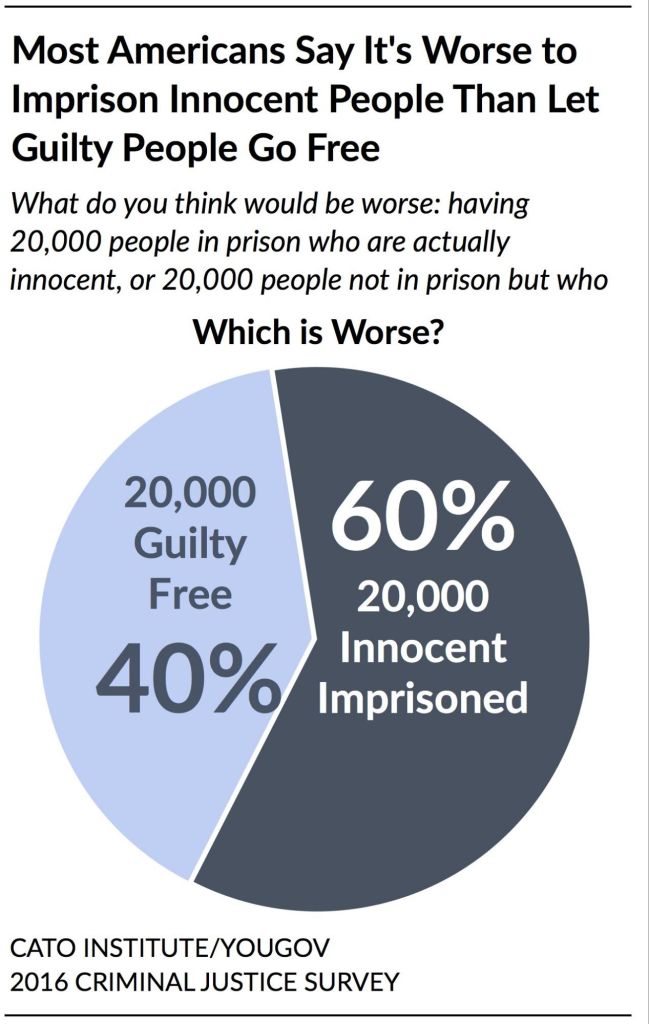
Innocent Until Proven Guilty and the Blackstone Ratio

Wrongful convictions happen. We often assume, since someone was charged, that they must be guilty of something. I mean, why else would they be wearing that orange jumpsuit? But this impulse goes contrary to reality where cops plant evidence, people lie, and prejudice plays a role in judgment. 

This was the case with Brian Banks—who had been accused of rape by a classmate who later, after his years in prison, confessed to fabricating the whole account. What a horrible predicament: your whole future blown up, a jury that only sees your guilt.

A jurist, Sir William Blackstone, understanding the imperfection of the justice system and that the ultimate goal of justice is to protect the innocent, proposed:

It is better that ten guilty persons escape than that one innocent suffer

This, the Blackstone ratio, is foundational to how things are at least supposed to work in the United States. Founding father Ben Franklin actually took the concept further by stating, “it is better 100 guilty Persons should escape than that one innocent Person should suffer.”  John Adams, while he defended the British soldiers charged with murder for their role in the Boston Massacre, argued the following:

We find, in the rules laid down by the greatest English Judges, who have been the brightest of mankind; We are to look upon it as more beneficial, that many guilty persons should escape unpunished, than one innocent person should suffer. The reason is, because it’s of more importance to community, that innocence should be protected, than it is, that guilt should be punished; for guilt and crimes are so frequent in the world, that all of them cannot be punished; and many times they happen in such a manner, that it is not of much consequence to the public, whether they are punished or not. But when innocence itself is brought to the bar and condemned, especially to die, the subject will exclaim, it is immaterial to me, whether I behave well or ill; for virtue itself is no security. And if such a sentiment as this should take place in the mind of the subject, there would be an end to all security whatsoever.

This commitment to the innocent reflects a strong emphasis on individual rights. It also seems rooted in the story most defining of Western religion, and that is the story of Jesus—falsely accused and put to death for the sake of political expediency. This has become the defining narrative and a reason to reflect on our judgment rather than react. It is why many principled conservatives are always uncomfortable with those trials in the court of public opinion where the state parades a prosecuted person and people assume this is proof of an airtight case.

You look guilty just for being in a courtroom defending from an accusation.

Tyler Robinson currently stands accused of murdering Charlie Kirk. Some have decided his guilt to the extent of forgiving him prior to his even standing trial or being given the chance to defend himself—as if there’s just no way that anyone other than him could be involved. That’s not justice; that’s denying him a presumption of innocence and might be enabling others to escape accountability for their involvement. It is better that he go free than chance a wrongful conviction—that is just Christian.

Caiaphas’s Expediency Math: Killing One to Save All

At the completely opposite end of the spectrum from the Christian West is the example of the high priest who claimed the murder of an innocent man was necessary to save Israel from destruction:

Then one of them, named Caiaphas, who was high priest that year, spoke up, “You know nothing at all! You do not realize that it is better for you that one man die for the people than that the whole nation perish.”

 (John 11:49-50 NIV)

This may very well be the origin point of trolley problem moral reasoning, where a hypothetical situation is proposed in which an intervention will cost fewer lives. If we just switch the track, this fictional trolley only kills one rather than multiple people. And it seems very reasonable. Isn’t it better when more people survive?

Caiaphas reasoned it was better to kill one Jesus to save Israel.  But it didn’t work out that way. The entire nation—along with their temple and sacrificial system—was forever destroyed in 70 AD. The high priest’s moral reasoning was compromised and wrong. It did not save Israel to kill one man and may well have been part of what eventually led to the destruction of Jerusalem. Those who did not accept the way of Jesus continued, after his ministry ended, to kill his followers and resist their civil authorities. Had they taken one moment to reflect and reconsider their plan to kill their way to peace, they may have survived intact rather than be spread to the corners of the empire.

The problem with killing one—without a just cause, to secure the future—is that it usually doesn’t end there. Kill one and you’ll kill ten; if you kill ten, you’ll kill 100, until soon it is millions upon millions. We see this in the campaign against Gaza. Tens of thousands of children are slaughtered and this is being justified as a war against terror. The reality is that it may very well create the backlash that will make the Zionist project untenable as people see this notion of blood guilt and collective punishment as repulsive. This is not compatible with the Christian values of the West and will lead to our destruction if the escalation of war is not rejected.

The world is better when we don’t play God and use the expediency math. If you’re okay killing one innocent person, you’re now an enemy of all humanity. And if you are willing to kill one, then the second and third come much easier. Innocent life should always be protected—whether it is the life of Jesus, be it the “enemies'” children, or the  unborn. Pro-life means no excuses for the IDF that don’t equally apply to Hamas. If it is okay for the Zionist regime to kill scores of civilians as “collateral damage” for every militant killed—where even the Israelis admit the victims of their onslaught are 83% civilians—why mourn when it is just a handful in Bondi?

The best protection of innocent people, like your own, is to oppose all killing of innocent people no matter the color of their skin or the clothes they wear. If the IDF can kill a journalist claiming they are “Hamas with a camera” or “Hamas-affiliated,” then why is it wrong for Eli Schlanger, who has materially aided a genocide, to be targeted along with his associates? We need to reject this math of expediency no matter who is using it, or we can’t be upset when what goes around finally comes around.

Abraham’s Plea for Mercy: Sparing the Many for the Few Righteous

Now we can go way back, to the book of Genesis, where the world’s most powerful monotheistic religions find their foundation, and this man of faith named Abraham. We join him prior to the destruction of Sodom and have this interesting exchange:

Then the Lord said, “Shall I hide from Abraham what I am about to do?  Abraham will surely become a great and powerful nation, and all nations on earth will be blessed through him.  For I have chosen him, so that he will direct his children and his household after him to keep the way of the Lord by doing what is right and just, so that the Lord will bring about for Abraham what he has promised him.”  Then the Lord said, “The outcry against Sodom and Gomorrah is so great and their sin so grievous that I will go down and see if what they have done is as bad as the outcry that has reached me. If not, I will know.”  The men turned away and went toward Sodom, but Abraham remained standing before the Lord. Then Abraham approached him and said: “Will you sweep away the righteous with the wicked? 

(Genesis 18:17-23 NIV)

Abraham’s opening question, in the passage above, tells you a whole lot about his moral reasoning. But before that you basically have the old covenant explained in brief: The blessing that was being bestowed on Abraham had to do with “doing what is right and just” or not simply being a blood relative of him, which is something that Jesus and the Apostles explained over and over to those who saw their genetic tie to the patriarch as a sort of entitlement and did not act justly or mercifully as he did.

Continuing in the text, take time to contrast the expediency math of Caiaphas with the following:

What if there are fifty righteous people in the city? Will you really sweep it away and not spare the place for the sake of the fifty righteous people in it?  Far be it from you to do such a thing—to kill the righteous with the wicked, treating the righteous and the wicked alike. Far be it from you! Will not the Judge of all the earth do right?” The Lord said, “If I find fifty righteous people in the city of Sodom, I will spare the whole place for their sake.” Then Abraham spoke up again: “Now that I have been so bold as to speak to the Lord, though I am nothing but dust and ashes, what if the number of the righteous is five less than fifty? Will you destroy the whole city for lack of five people?” “If I find forty-five there,” he said, “I will not destroy it.” Once again he spoke to him, “What if only forty are found there?” He said, “For the sake of forty, I will not do it.” Then he said, “May the Lord not be angry, but let me speak. What if only thirty can be found there?” He answered, “I will not do it if I find thirty there.”  Abraham said, “Now that I have been so bold as to speak to the Lord, what if only twenty can be found there?” He said, “For the sake of twenty, I will not destroy it.” Then he said, “May the Lord not be angry, but let me speak just once more. What if only ten can be found there?” He answered, “For the sake of ten, I will not destroy it.”  When the Lord had finished speaking with Abraham, he left, and Abraham returned home.

(Genesis 18:24-33 NIV)

Abraham, after expressing his concern for the innocent, offers an opening bid at fifty righteous. Will God spare the entire wicked city for just fifty? And the first thing that is obvious is his humility, pleading with “I am nothing but dust and ashes” and showing his attitude before God. Second is that his orientation is toward the sparing of innocent life even if it means the evil people of the city of Sodom escape deserved judgment. This is in line with Blackstone’s ratio and in total opposition to Caiaphas, who argued to sacrifice rather than to protect the righteous one. Eventually Abraham concedes, and it makes more sense just to evacuate those righteous—nevertheless the righteous are not destroyed with the wicked.

So why is this account in Genesis?

Why is God engaged in a negotiation with a mere man?

The answer is that this anecdote is here for a reason, and that is to be instructive. The author of Genesis isn’t just telling us that Abraham was righteous—they’re giving us instruction on how to be righteous. To have the same disposition as Abraham, that’s the way to be a child of Abraham, and the path of righteousness that leads to the blessings through God’s promise. Chosen means you believe and obey the Lord. You can’t claim to be children of God, or of Abraham, if you truly share nothing in common with them in terms of your behavior or spirit. Genesis is telling us what that looks like in practice.

Christian Orientation Towards Mercy and Humanity is Truly Abrahamic.

In traversing these three moments—from courtrooms shaped by Christian reflection on an innocent’s crucifixion, to the high priest’s fateful expediency that failed to save his nation, and back to Abraham’s humble plea for mercy amid judgment—we uncover a profound reality: The orientation of the Christian perspective, underpinning American rights, is directly the opposite of the ideological lineage of Caiaphas.

The commitment, in faith, to protecting that one innocent life in a crowd of evil is to be a son or daughter of Abraham.  Those who do the opposite, who are willing to sacrifice the innocent for sake of expediency, carry none of the character of Abraham and cannot be the heirs of anything promised to him.  They must first repent of their sin—then they can be blessed, with all nations, through the one singular seed of Abraham (Gal 3:16) which is Christ Jesus.

Going back to the start and those ethics ingrained in us through a religiously derived culture and our assumptions, those who have rejected Christ and are completely willing to kill innocent people to accomplish ends are also going to manifest the other evil traits of Proverbs 6:16-19:

There are six things the Lord hates, seven that are detestable to him: haughty eyes, a lying tongue, hands that shed innocent blood, a heart that devises wicked schemes, feet that are quick to rush into evil, a false witness who pours out lies and a person who stirs up conflict in the community.

Those of us raised in an Anabaptist church got a strong dose of the Gospel according to Matthew and were taught that speech should be simple and truthful.  Let your yea be yes, and nay be nay is about truly honest conversation and credibility without relying on oaths.  We were told to have a peaceable spirit and merciful approach with all people—to be humble.  

This is an orientation that many of Christian faith may believe is universal.  Except it is not.  Ethno-supremacist pride is okay with those of certain ideologies, deception for sake of gaining an upper hand is looked at like a virtue, they look at their ability to trick you as proof they are superior, and sow the seeds of division covertly not to be caught—like this example:

In a covert operation during 2007–2008, Israeli Mossad agents impersonated CIA officers—using forged U.S. passports, American currency, and CIA credentials—to recruit members of the Pakistan-based Sunni militant group Jundallah for attacks inside Iran, including bombings and assassinations targeting Iranian officials and civilians, as part of a broader effort to destabilize Tehran’s regime amid nuclear tensions. The deception, conducted openly in places like London, aimed to frame the United States as the sponsor, exploiting Jundallah’s sectarian and separatist motives while providing plausible deniability for Israel; U.S. officials uncovered the ruse through internal investigations debunking earlier media reports of CIA involvement, leading to outrage in the Bush White House (with President Bush reportedly “going ballistic”), strained intelligence cooperation under Obama, and the eventual U.S. terrorist designation of Jundallah in 2010, though no public repercussions were imposed on Israel.

 (Overview above by Grok, read: False Flag)

Imagine having a friend who deliberately set you up for a fight against another person by telling them that you said something about them.  My son had a bully do this to him on the bus and this is exactly what so-called ‘greatest ally’ tried to do to the US.  For the Zionist regime, and Mossad, conducting the terror operation via a Pakistani proxy simply was not enough.  They wanted Iran to think the attacks originated with the US in order to provoke a reaction.  And this is how the world becomes a cesspool, all because the Iranians won’t stand idle while Palestinians are deprived of land and human rights.

Deviousness is not exclusive to the children of Caiaphas.  But there’s no stops for those willing to kill innocent people for the sake of expediency.  And a partnership with them is only going to undermine the foundation of our civilization.  The US and ‘Christian’ West have already lost their moral reputation for this unholy alliance.  We need to repent and return to holding evil men accountable and protecting the innocent or all will be lost—we can’t exempt some from a standard of normal decency without also damaging all of Christendom.

The Greater Good Fallacy: Morality Without Excuses

Standard

Setting aside moral principle to serve a greater good means you have no moral principles.

Moral relativists love their hypotheticals: “What if you had a chance to travel back in time and kill baby Hitler?”

Once they can establish the answer as “yes” then pretty soon thereafter anyone who stands in their way is a Nazi. Or, in other words, the morality of “everyone I don’t like is literally Hitler” where you will basically become Hitler killing all of those baby Hitlers before they become Hitler—kill them all, you can’t be too careful!

It is ends justify the means morality that justifies, ultimately, the most heinous and horrible acts by one projecting a possible outcome as an excuse to violate another person—in some cases even before they drew a first breath.

For example, the Freakonomics case for abortion pointing to how inner-city crime rates dropped in correlation with black babies being killed—used as a moral justification.

Contrast this with Matthew 12:20, with Jesus: “He will not break a crushed blade of grass…”

This prejudice is behind every genocide or ethnic cleansing campaign. The excuse: “We don’t want to kill babies, but if we don’t ‘mow the grass‘ then they’ll grow up to kill us.” I mean, it’s not like that attitude will create a backlash or stir the anger of the population being cynically targeted for a trimming back, right?

Oh well, at least when you are starting at the very bottom, relying on self-defense by precrime judgment and a doctrine of preemption, there is no slippery slope to be concerned about: Morality becomes a race of who can eliminate their potential opponents most efficiently rather than a social contract between people trying to live peaceably with their neighbors.

(Im)Morality of the ‘God’s Plan’ Excuse…

One of the sidesteps of treating others with human decency is that it is all part of God’s plan. Biblical fundamentalists often use a similar kind of ends justify the means moral reasoning as the far-left—except they dress it up as faith and seeing the bigger perspective.

This is their excuse to be Biblical, but not Christian. The moment you raise a moral objection about anything they’ll find their loophole in Scripture: “Oh, yes, God said not to take innocent life, but He also told Israel to wipeout the Amalekites, so it is up to us to decide who gets slaughtered or saved.”

This is the God’s eye perspective Jesus addressed in Mark 7:10-12:

For Moses said, ‘Honor your father and mother,’ and, ‘Anyone who curses their father or mother is to be put to death.’ But you say that if anyone declares that what might have been used to help their father or mother is Corban (that is, devoted to God)—then you no longer let them do anything for their father or mother.

What the Biblical experts were doing was using one command to nullify another by a greater good moral reasoning. Of course they, in their own minds, were the more spiritual. They had convinced themselves that—by neglecting their duty to parents—they were seeing things from God’s eyes and just better than everyone else. But, in reality, this is rationalization and an excuse to be immoral.

Morality isn’t about taking the God’s eye view, it is about our practically applying the Golden Rule or the law of reciprocity described in the passages below:

For if you forgive other people when they sin against you, your heavenly Father will also forgive you. But if you do not forgive others their sins, your Father will not forgive your sins.

Matthew 6:14-15 NIV

“Do not judge, or you too will be judged. For in the same way you judge others, you will be judged, and with the measure you use, it will be measured to you. “Why do you look at the speck of sawdust in your brother’s eye and pay no attention to the plank in your own eye? How can you say to your brother, ‘Let me take the speck out of your eye,’ when all the time there is a plank in your own eye? You hypocrite, first take the plank out of your own eye, and then you will see clearly to remove the speck from your brother’s eye.

Matthew 7:1-5 NIV

Speak and act as those who are going to be judged by the law that gives freedom, because judgment without mercy will be shown to anyone who has not been merciful. Mercy triumphs over judgment.

James 2:12-13 NIV

See the pattern here?

What we put into the world is what we will receive back. If we do not show any mercy to those under our power, then we will not be shown mercy. And that’s the point behind the parable that Jesus told about a man forgiven a great debt—then goes out demanding repayment from the man who owed him.

Seeing things from God’s perspective—according to this—is to apply Micah 6:8:

He has shown you, O mortal, what is good. And what does the Lord require of you? To act justly and to love mercy and to walk humbly with your God.

There are no excuses to set aside normal morality for the sake of God’s plan.

There is no special exemption given for a chosen race of people either.

Throughout history the most evil of men have excused their atrocities using God’s will. It is the reasoning of the Crusader’s command, based on 2 Timothy 2:19, of “Kill them, for God knows his own.”

The ‘Christian’ West killed more innocent people in the Holy Lands than Islamists.

With that kind of thinking, everything will become justified as part of God’s plan if you zoom it out and, therefore, we can’t take a moral stand against anything. If it is God’s plan that babies are killed—then who are you to decry it as murder?

This is logic which can neutralize every moral stance or turn every evil deed into some kind of ultimate good—if you just see it from ‘God’s perspective’ it all becomes okay.  Of course, at that point, accepting this, there is no morality—once everything is relative to God’s will or the outcome that we call good.

It essentially replaces the Golden Rule with: “Do unto others as you would have them do unto you—except if you can explain away the abuse by some kind of greater good excuse.”

Act Justly, Love Mercy, That’s the Conclusion…

Moral relativism, whether cloaked in the guise of achieving a greater good or justified as part of God’s plan, erodes the foundation of true morality—the Golden Rule.

By excusing heinous acts through hypothetical necessities or our ‘divine’ rationalizations, we are becoming the very monsters we claim to oppose. True morality demands consistency: acting justly, loving mercy, and walking humbly, without excuses or every resorting to preemptive judgments or selective exemptions.

When we abandon moral principles for the sake of outcomes we desire or divine loopholes, we replace mutual respect or an opportunity for understanding with a race to eliminate every perceived threat, leaving no room for peace, forgiveness, or humanity.

The measure we use—whether it is mercy or judgment—will be measured back to us, and no appeal to a higher purpose can absolve us of that final reckoning.

Post script: Morality is staying in our lane and abiding by the rules. Playing God is running someone off the road for daring to cross into our lane. It is about our keeping the law—not our enforcing of it. And when we start to justify the abuse of others, as Biblical, then we turn into a violator. James 4:11 explains: “When you judge the law, you are not keeping it, but sitting in judgment on it.” The end result of exemption of ourselves using God’s plan as cover is a cycle of violence where all see themselves as righteous—even while doing incredible evil.

Lost in the Technicalities

Standard

There are many things in life that depend on a smell test or an intuitive sense.  When the religious hypocrites brought a woman before Jesus the legal prescription was simple, she was caught in sexual sin and deserved death according to the law of Moses.  They knew of his compassion for sinners and had hoped to trap him.  If Jesus spared her he would break the law, but if he condemned then he would be just like her judgmental accusers.

What happened next in that narrative totally upended their simplistic conception of the law and application.  To them, it was all very black and white.  They were very thorough in defining the limits, of their legalism, and this adulterous woman fell well outside the bounds of any gray area.  But Jesus defied them.  We don’t know what he wrote in the dust at their feet, but we do know that Jesus, in response to their demands for an answer, told them “let he who is without sin cast the first stone,” and that after this they left one by one.

Growing up in a fundamentalist sect, in the shadow of purity culture teachings, it was always about meeting expectations.  If only you could follow the rules, then you might be accepted, then her dad (or your own) would be pleased and no longer harbor those often unspoken negative opinions.  Sure, maybe those in this culture knew better than to be as open about their disapproval, like the men accusing the woman, but they still miss the point and will attempt to explain away the full significance of what Jesus did.  To them, the goal is to be undefiled enough to cast the first stone.

Those blinded by a legalistic mindset only comprehend the letter of the law without ever understanding the spirit or true purpose behind it.  When they are not onerously enforcing the technicalities of their own  (often errant) interpretations of Scripture then they are carving out special exceptions for themselves and in all circumstances are missing the spirit or intent of the law. (Romans 2:29, 2 Corinthians 2:4-18) They see the law as a means to gain God’s favor or as means to gain rank on their more sinful neighbors rather than what it truly is.

First of all, the law was not established for Pharisees past or present to play morality police.  Yes, we’re told to work out our own salvation.  We need to confess our sins and admit our falling short as often as we do.  But it is the role of the collective body of the Church to apply the law to others and not our own.  In other words, we should stay in our lane, and use the law for introspection rather than as a hammer to beat over the head of our neighbors.  Our obligation to others is to do as Jesus said and learn the meaning of the phrase, “I desire mercy not sacrifice.”

Second, the law isn’t just an arbitrary set of rules to prove our worthiness to God.  No, it is rather something established for our good and as a protection from harm.  As Jesus said, the Sabbath was “made for man” and not the other way around, which is why he let his disciples violate the rules.  In other words, the law is very practical, for our good, and can be bent when need be.  Sure, we may not always understand the reasons and thus we should obey even when we do not, but there is always room for exception.  This is what freedom in Christ entails—the ability to live by the underlying intent rather than only by the technicalities of written codes.

Those in the construction industry know about building inspectors who are ‘by the book’ to the point of being ridiculous.  It isn’t actually making anyone safer.  These types often lack hands-on experience, seemingly even basic comprehension of what makes a structure work, and they just make life harder for everyone.   They can be technically correct, according to line three of page 395 of the code book, while still being clueless and unhelpful.  This kind of expert has the letter of the law and lacks the spirit. This is to say that they have useless knowledge that makes them feel qualified when, in reality, those in the field know better.

And religious fundamentalists all end up like these building inspectors, hung up on details and never adding any real value to the project. They condemn everyone around them, in violation of the commandment of Christ, while they themselves have a beam in their own eyes. They think they are moral people because they can follow a list of “do’s” and “don’ts” and yet fail to comprehend the meaning of “man looks on the outward appearance, but the Lord looks on the heart.”

Indeed, we may not allow our children to cross the street without permission, it may also be jaywalking to cross in certain areas, and yet would the legal statute matter if there was an urgent need to cross?

Politicians and lawyers can find ways to be technically ‘legal’ while also immoral or violating the principle of the law. They can also point out when others do what is right when it is technically illegal or when others fail to dot an ‘I’ or cross a ‘T’ as is required. But they fail to apply the law correctly because they miss the actual intention or purpose behind the law. They do not know the Jesus who makes even our righteousness seem like filthy rags and are trying to earn God’s favor instead.

This is to be lost, like the rich young ruler, who was still trying to save himself through his own works. You can do everything right according to the Scripture (or at least your own understanding of the writing) and still be lost. You can do everything wrong and still be saved. This is because we always depend on the mercy of God rather than our ability to be perfect.

Divorce and the Purpose of the Law

Standard

Much of what we believe is inherited and that includes how we interpret certain passages of Scripture.  It is just the way things are, we do not independently arrive at our own conclusions and could very well have been taught wrong.  Those who believe that the ground they stand on is sacred simply because they’re standing on it have no potential for growth in understanding or perspective.

Many in a purity culture would squeal their displeasure at the term “legalism” being used to describe their ‘Biblical standards’ and hide behind mantras such as “God Said It, I Believe It, That Settles It!”  Unfortunately, while this kind of obstinate stance may be good as far as resisting temptation, it basically amounts to confirmation bias on steroids in a search for truth.

This is exactly the attitude of those who took issue with Jesus breaking the Sabbath and how they absolutely refuse to see their own application of Scripture as entirely missing the point:

At that time Jesus went through the grainfields on the Sabbath. His disciples were hungry and began to pick some heads of grain and eat them. When the Pharisees saw this, they said to him, “Look! Your disciples are doing what is unlawful on the Sabbath.” He answered, “Haven’t you read what David did when he and his companions were hungry? He entered the house of God, and he and his companions ate the consecrated bread—which was not lawful for them to do, but only for the priests. Or haven’t you read in the Law that the priests on Sabbath duty in the temple desecrate the Sabbath and yet are innocent? I tell you that something greater than the temple is here. If you had known what these words mean, ‘I desire mercy, not sacrifice,’ you would not have condemned the innocent. For the Son of Man is Lord of the Sabbath.” Going on from that place, he went into their synagogue, and a man with a shriveled hand was there. Looking for a reason to bring charges against Jesus, they asked him, “Is it lawful to heal on the Sabbath?” He said to them, “If any of you has a sheep and it falls into a pit on the Sabbath, will you not take hold of it and lift it out? How much more valuable is a person than a sheep! Therefore it is lawful to do good on the Sabbath.” Then he said to the man, “Stretch out your hand.” So he stretched it out and it was completely restored, just as sound as the other. But the Pharisees went out and plotted how they might kill Jesus.

(Matthew 12:1‭-‬14 NIV)

The Pharisees, like religious fundamentalists today, believed that they were the experts and examples of righteousness.  They would know that Moses, by order of the Lord according to Numbers 15:32-36, had a man put to death for picking up sticks on the Sabbath.  It is very likely that many of them were very sincere in their saying that Jesus was possessed by a demon.  How dare this teacher allow his followers to break the law and then defiantly double down in response to their concern!!!  Weren’t there six other days to heal?!?

Now some commentators may try to square this legalistically, by claiming that Jesus was not truly going against Scripture.  But I do not believe this is the case.  The Pharisees were obsessed with the letter of the law and technically right in their complaint against his breaking the Sabbath.  Jesus, by contrast, was focused on the reason behind the law, or spirit of the law, and pointed to Hosea 6:6, “I desire mercy, not sacrifice,” to establish the vast difference between the ritualistic devotion to a set of religious rules and genuine love for people.

Legalism, by this standard, is a use of the law that is negligent of the purpose.  What is the purpose of law?  The law is supposed to be for our own good, to protect us from harm, and thus the exceptions that Jesus mentioned in response to his critics.  A legalist, in their strict adherence to rules, loves their rules, and yet they lack love and mercy for people.  Thus, a legalist, in their no-compromise application of the law, defies the actual purpose for which the law was established and, therefore, are no longer under the law themselves:

Speak and act as those who are going to be judged by the law that gives freedom, because judgment without mercy will be shown to anyone who has not been merciful. Mercy triumphs over judgment.

(James 2:12‭-‬13 NIV)

Legalism: Divorced From the Issue

This blog is not meant to be a theological tome.  For a more exhaustive look at the divorce and remarriage topic, especially for those of an Anabaptist background, I would suggest reading Dwight Gingrich who has covered the issue exhaustively in a series of blogs.  I’ve already covered Biblical proof-texts in prior postings as well.  Instead, I’ll stick to a discussion of the hardness of hearts and economia (special exception) as it applies to divorce and remarriage.

First of all marriage, by original intent, is until death do they part and there’s no exception to this.  If men and women would live up to their vows, not make promises they not keep, this would solve the entire issue.  If people would act responsibly and remain faithful in relationships then there would be no broken homes.  That is certainly ideal, it was also the privilege of being born into conservative Mennonite culture for me—in that my parents were encouraged, through peer pressure, to overcome doubts and make it work.

However, this ideal simply is not available to many in the world.  Many do marry, or have children, with someone whom they intend as their soulmate and it doesn’t end in a happily ever after for them.  This failure of adults can have disastrous consequences for the next generation, the less desirable outcomes for children of single-parent homes are the evidence:

Children who live with only one of their parents do less well in school, obtain fewer years of education, and have trouble keeping a steady job as young adults. Children from single parent families are six times more likely to be poor.

“Single Parenthood and Children’s Well-being,” Wisconsin Family Impact Seminars

Now maybe this is genetic, that the children have the same commitment issues as their parents, and this strong correlation of single-parent homes with poor outcomes for children does not automatically equate to environmental causation.  Maybe we need an adopted twin study?  But it is pretty safe to say, without a complex analysis, that the insecurity and chaos of a home with one parent will have an impact on children that is undesirable.

So there’s a question: If the law is there for our good and single-parent homes are bad, what should happen after divorce or abandonment?

In the culture that I came from, there was a hardline stance on divorce and remarriage that even nullified the “exception clause” of Matthew 19:9.  This perspective, from my personal experience as one who defended it, is about the preservation of an ideal and even at the expense of people.  I could reason, like Moses having the man killed for picking up sticks, that allowing one exception would be a slippery slope and lead to far greater social disorder.

And yet this “greater good” logic is exactly why Jesus was put to death:

Then the chief priests and the Pharisees called a meeting of the Sanhedrin. “What are we accomplishing?” they asked. “Here is this man performing many signs. If we let him go on like this, everyone will believe in him, and then the Romans will come and take away both our temple and our nation.” Then one of them, named Caiaphas, who was high priest that year, spoke up, “You know nothing at all! You do not realize that it is better for you that one man die for the people than that the whole nation perish.” 

(John 11:47-50 NIV)

They both missed out on Jesus, their king, and also did not save temple worship. Also equally ironic is that the high priest unintentionally spoke the truth.

Anyhow, maybe, in the time of Moses, sacrifices of animals and the sons of Abraham were needed for the health of the nation.  But now, after the death and resurrection of Christ, we are clothed in his righteousness and thus free from the letter of the law that kills:

He has made us competent as ministers of a new covenant—not of the letter but of the Spirit; for the letter kills, but the Spirit gives life.

(2 Corinthians 3:6 NIV)

You’ll need to read further about the context of that statement to fully grasp what St Paul is saying in that letter.  But the short version is that he’s contrasting the understanding of the law prior to Christ with that which only comes with the Spirit and seeing the intent behind laws as being greater than the laws themselves.  This is different from the Pharisee men who carved out legalistic exceptions for themselves to divorce and were confronted by Jesus for their hardness of heart:

Some Pharisees came to him to test him. They asked, “Is it lawful for a man to divorce his wife for any and every reason?” “Haven’t you read,” he replied, “that at the beginning the Creator ‘made them male and female,’ and said, ‘For this reason a man will leave his father and mother and be united to his wife, and the two will become one flesh’? So they are no longer two, but one flesh. Therefore what God has joined together, let no one separate.” “Why then,” they asked, “did Moses command that a man give his wife a certificate of divorce and send her away?” Jesus replied, “Moses permitted you to divorce your wives because your hearts were hard. But it was not this way from the beginning. I tell you that anyone who divorces his wife, except for sexual immorality, and marries another woman commits adultery.”

(Matthew 19:3‭-‬9 NIV)

The audience is men.  The ideal is marriage until death do they part.  And the rebuke is against the hardness of hearts.  This is what makes it so egregiously wrong that men, in fundamentalist communities, will apply this passage (usually excluding the exception clause) to women who were abandoned by their husbands.  It is, at the very best, taking the words of Jesus out of context and it is too often used rather hard-hearted response to those who have no chance of restoring what is ideal.

Jesus was not answering the question of what a woman is supposed to do when left to raise her children alone.  And I’m also quite confident that he was not intending for his prescription to these men to be applied in the same dogmatic manner as they approached the Scriptures.  It was their lack of mercy and compassion, how these men would misuse of the law of Moses (which did allow divorce) to escape their own responsibilities, that is the focus of his words.

As was explained to me concerning the Orthodox position on divorce and remarriage in contrast to that of fundamentalists:

As to sticking with what is written, I think here you can see the difference in how the Orthodox view the Scriptures—as part and parcel—but never the entirely of the whole Tradition—all of which has been handed down to us. The Orthodox do not take divorce and re-marriage lightly—it’s a complicated process to get a bishop’s blessing to undertake second and third marriages and the blessing is not always given. But the primary issue here is that the Orthodox confess God to be a God of mercy, love, and forgiveness—not a law-obsessed judge who keeps a record of pluses and minuses in order to play “gotcha” with those who fail.

Father Anthony Roeber

That statement above, part of an email that so profoundly reframed my understanding of divorce and remarriage, cuts right to the heart of the issue.  Married or single, first marriage or second, what matters more than anything else is will if help us in the journey of faith or will it hinder.  And that’s the true intent behind the law, it was a tool to steer us in the direction of doing what is good and merciful, like our Father, and yet would never be sufficient to save us.

Be merciful, just as your Father is merciful.

Luke 6:36 NIV

Babel and the Upper Limits of Human Reasoning

Standard

Being raised in a fundamentalist sect meant taking the Genesis accounts as being a historical narrative.  I had been taught, and had for many years accepted without question, the idea that the veracity of the Gospel message hinged on the most ‘literal’ interpretation of the first book of the Biblical canon.

This understanding of this book had worked fine to get me through my school years.  I gave my high school biology teacher, Mr. Toohey, an atheist who had once considered the priesthood, a headache debating the textbook claims about mutations, millions of years, and Macro Evolution.  At this age, I thought this style of apologetics, debating science using the words of Scripture, was a key to securing the faithful against doubts and winning unbelievers.

Unfortunately, while this understanding may serve well those who do not venture too far from the Young-Earth Creationism intellectual ghetto, against what amounts to strawman versions of secularist arguments, it doesn’t hold up as nicely against a serious challenge and has left many religiously indoctrinated high and dry in their years in a university-level science program.  There is a reason why many in my former religious tradition are terrified of higher education. 

Even seminary was a synonym for cemetery to one of my childhood Bible-thumping pastors.  It should make one wonder.  If the foundation of faith is so flimsy that it can’t be tested, that it can only be sustained by ignorance, then what’s the point?

Sadly, it was a false choice, this dichotomy between science and religion, education and faith.

Getting the Cart Ahead of the Horse

The Biblical fundamentalists got everything exactly backward.  The truth of Christ does not depend on proving the Scripture, word for word, is completely 100% historically accurate and scientifically verifiable.  It is nice when those things do align, sure.  And yet, no matter how many mundane parts of the Biblical narrative are established this way, the fantastic claims are never proven.

If a politician lists off ten facts and nine of them turn up true according to the fact-checkers, does that make the final most grandiose claim true?

No, no it does not.

One of the most persuasive tricks of liars is to hide their one falsehood amongst a long list of facts and true statements.  And likewise, someone could prove 99.9% of Biblical claims and still not have touched anything of the miracles.  The Bible is true because it says it is true might work for idiots and the indoctrinated, but it is always circular reasoning and there being a town of Bethlehem doesn’t mean Jesus walked on water nor establish His divinity and conquering of death.

No rational person believes that a prophet flew from Jerusalem to Mecca, on a half woman half horse with a tail of a peacock, because they read it in a book.  I’m certainly not going to wear magical underwear because some dude, a few hundred years ago, claims he received golden tablets from the angel Gabriel.  So why would any reasonable person expect someone to believe a book written thousands of years ago?  Sorry, Ken Ham, I don’t care how many replica Arks you build, you’re not winning skeptical minds or hearts with this effort.

Human efforts fail. 

When Sarai reasoned with Abram to produce an heir through her maidservant, how did that go for them?

We know it didn’t go too well and have the commentary of St. Paul:

Tell me, you who want to be under the law, are you not aware of what the law says? For it is written that Abraham had two sons, one by the slave woman and the other by the free woman. His son by the slave woman was born according to the flesh, but his son by the free woman was born as the result of a divine promise.  These things are being taken figuratively: The women represent two covenants. One covenant is from Mount Sinai and bears children who are to be slaves: This is Hagar. Now Hagar stands for Mount Sinai in Arabia and corresponds to the present city of Jerusalem, because she is in slavery with her children. But the Jerusalem that is above is free, and she is our mother. For it is written: “Be glad, barren woman, you who never bore a child; shout for joy and cry aloud, you who were never in labor; because more are the children of the desolate woman than of her who has a husband.”  Now you, brothers and sisters, like Isaac, are children of promise. At that time the son born according to the flesh persecuted the son born by the power of the Spirit. It is the same now. But what does Scripture say? “Get rid of the slave woman and her son, for the slave woman’s son will never share in the inheritance with the free woman’s son.”  Therefore, brothers and sisters, we are not children of the slave woman, but of the free woman.

(Galatians 4:21‭-‬31 NIV)

Here we see the contrast of human efforts “according to the flesh” and those of a spiritual and Divine origin.  St. Paul emphasizes the “son” which is “born by the power of the Spirit” as an alternative to the “son” human reasoning that produced conflict and heartache.

It is amazing how many times St. Paul, and Jesus before him, encountered those who believed Scripture word for word and rejected Jesus as Lord.  They, in many ways, had a stricter interpretation of the text than many of us do and did not face the strong headwind of modern science and philosophy either.  And yet, even meeting Jesus in the flesh, seeing him with their own eyes, taking Scripture as literally as anyone, they saw Jesus as the imposter and rejected Him.  So, how then can we be saved?

Fortunately, that question is answered many times over and over again, by St. Paul, and has next to nothing to do with the book of Genesis.  The truth of Scripture is established on Christ, and His church, which established the canon of Scripture and does those “greater things” that Jesus promised would come through the power of the Spirit.  Yes, we preach and teach, but only God can bring the increase.  So, the apologetics industry starts us out on the wrong foot and doesn’t produce true faith in Christ. 

Our salvation does not depend on our own understanding of a book.  St. Paul, in Romans 9:16, states clearly, that our sonship depends on God’s mercy, not human desire or effort.  Scripture is the cart, not the horse.  We accept that the Bible is true because we believe in Christ, and His Church, not because we can establish it through our human reasoning or effort.  Faith is a work of the Spirit, a gift from God, not a product of our knowledge or works.  Those trying to ‘prove’ the Bible are on a fool’s errand. trying to save themselves, slaves to human reasoning, lost and confused.

What Does That Have to Do with Babel?

Hopefully, the Noah rode on a T-Rex crowd is too triggered with that intro, because now we shift to something they may find more agreeable and that being the even greater monument to human reasoning and effort. 

But, first, the tower of Babel narrative:

Now the whole world had one language and a common speech.  As people moved eastward, they found a plain in Shinar and settled there.  They said to each other, “Come, let’s make bricks and bake them thoroughly.” They used brick instead of stone, and tar for mortar.  Then they said, “Come, let us build ourselves a city, with a tower that reaches to the heavens, so that we may make a name for ourselves; otherwise we will be scattered over the face of the whole earth.”  But the Lord came down to see the city and the tower the people were building. The Lord said, “If as one people speaking the same language they have begun to do this, then nothing they plan to do will be impossible for them. Come, let us go down and confuse their language so they will not understand each other.”  So the Lord scattered them from there over all the earth, and they stopped building the city. That is why it was called Babel—because there the Lord confused the language of the whole world. From there the Lord scattered them over the face of the whole earth.

(Genesis 11:1-9 NIV)

This story is likely the origin of the phrase, “men plan, God laughs.”  Actual historical event, ancient myth or both, does not matter, the tower of Babel narrative is so much more.  The account speaks to human limits and hubris, a true story told over and over again in history and a lesson repeated in different ways with each passing generation.  The moment humans forget their place, begin to rely on their own cleverness and start to see themselves equal to their own Creator, the clock to destruction begins to tick.

These people, in the Biblical account, had somehow overcome the odds, they evidently were a resource-rich civilization, more powerful than external threats, and ready to cement their name in history.  But just when heaven seemed within their grasp, the very thing that they had sought to avoid, being scattered, brought the entire endeavor grinding to a halt.  Now Babel, the name a play on words that meant “to confuse,” is a synonym for colossal human failure.  Sure, maybe it is an origin story for the diversity of language.  But, undeniably, it is also a cautionary tale.

Other accounts tell us that this confusion of languages, by God, was to save humanity from the total destruction of another flood.  In other words, it was an act of mercy to prevent an even greater calamity to end this project and scatter the people.  But, more than that, it is a lesson about not leaving God out of the equation.  What does that mean?  Well, that means that we can’t see everything and, without humility to reign in our ambitions, we are an existential threat to ourselves.  The proud fall because they cannot imagine the factors that they, in their overblown confidence, have missed.

Our Modern Towers of Human Arrogance

“I will destroy the wisdom of the wise; the intelligence of the intelligent I will frustrate.”

(Isaiah 29:14 NIV)

History is replete with examples of bold declarations followed by catastrophe.  Neville Chamberlain’s quip of having secured “peace in our time,” through a treaty with Adolf Hitler, comes to mind.  Hillary Clinton was, according to the experts, most definitely going to win over Donald Trump.

But now it is time to tie all these threads together.  The same thing that brought about the Protestant schism, also led to the Enlightenment, spread of Democracy, and, ultimately, the rejection of God. 

This “age of reason” got off to a relatively good start, scientific discovery, development of technology, and representive government has enabled us to be more free and prosperous that many prior generations.  However, as the tower of our knowledge and independent spirit rose, as we have made leaps in medicine, even landed a man on the moon, when American exceptionalism (the ultimate expression of Protestantism) finally conquered all, and our hegemony was nearly unchallenged, suddenly a day of reckoning seems to be upon us and this colossus, this oversized imagine of human endeavor, seems in danger of collapse.

A couple of decades ago it felt as if we were on the cusp of a new epoch.  Racism vanquished, our old enemies irrelevant, the world connected as never before, the internet ready to put all knowledge at our fingertips and the stars seemingly within our reach.  Secularism and science had triumphed over superstition and myth, we imagined no religion, nothing to kill or die for, as Coca-cola taught the world to sing.  Former seminaries, our universities, forgetting God, became temples of human reason.   “We didn’t need church or religion to be good people,” the atheists cried, while standing on the shoulders of theologians whom they dismissed, “in fact, we’ll go further without it!”

However, my own optimism has unravelled over the past decade or two. 

Star Trek and the Jetsons still remains, firmly, in the realm of science fiction.  The internet is a cesspool, filled with crackpot opinions, censored by billionaires bullies who pretend to be gatekeepers of truth while they spread misinformation, and nothing like a child of the 90s would’ve imagined.  As church attendance slips, depression and drug usage has steadily increased—along with suicides and mass shootings.

Our universities, rather than continue to value free thought and expression, now have strict speech codes and safe spaces.  The minds that once sought to improve the human experience, now only deconstruct tradition and erode the very ground that their institutional ivory towers were constructed upon, too drunk with nihilism to care.  Even Coke brand, that once celebrated human diversity, has joined the graceless cult of woke in attacking “whiteness” and civilization itself—as if they have forgotten what has made their own comfortable ‘privileged’ life possible. 

The government, “for the people,” that at least gestured towards the needs of the citizenry, now only serves global corporations, the powerful elites and special interests. The US flag, once a symbol of hope, the American ideal, and our unity as diverse people, something black athletes proudly wrapped themselves in less than a generation ago, has now been reimagined as a representation of oppression and hate. Our faith in our institutions is failing, the left decrying systemic racism, the right suspecting election fraud, nearly everyone feeling unheard.

We’re a civilization consuming itself and maybe it is because we’ve forgotten this:

You, my brothers and sisters, were called to be free. But do not use your freedom to indulge the flesh; rather, serve one another humbly in love. For the entire law is fulfilled in keeping this one command: “Love your neighbor as yourself.” If you bite and devour each other, watch out or you will be destroyed by each other.

(Galatians 5:13‭-‬15 NIV)

We don’t go to church anymore, a trend that started before the pandemic and has only been accelerated, and “love your neighbor” is now used as a guilt trip rather than a reason to change our own toxic attitudes or be involved on behalf of others. John Kennedy’s call to service, “And so, my fellow Americans: ask not what your country can do for you – ask what you can do for your country.” Those words, spoken today, would likely be derided as some kind of dangerous “ism” in today’s me-first, my tribe, my way or the highway, divisive identity driven, you’re literally a Nazi if you disagree, political environment.

Have we reached new heights only to implode?

What is really going on here?

Pride Cometh Before the Fall

Satan, we’re told, was the very best of the angels. His magnificent greatness eventually led him to believe that he was a rival to God. Jesus warned his disciples, having returned exuberant from working miracles, that he had seen Satan “fall like lightening from heaven” (Luke 10:18) and reminded them of their place before the Almighty.

Hubris is the downfall of many and the idea that we can find all of the answers for ourselves is that. With each success, with every innovation and breakthrough, there is a danger and risk of overconfidence.

In the past few centuries have seen our knowledge and abilities increase like no other time in recorded human history. The West threw off the authority of Rome, with the reasoning that every man was able to comprehend Scripture outside of the tradition of the church. Not long after, the authority of Scripture itself was called into question. Why do we need a book of myths written by those who lack our sophistication and understanding of the world? God was erased from our institutions, prayers only a ceremonial and many imagine themselves to be self-made or little gods. It is the height of ignorance:

You turn things upside down, as if the potter were thought to be like the clay!  Shall what is formed say to the one who formed it, “You did not make me”  Can the pot say to the potter, “You know nothing”?

(Isaiah 29:16 NIV)

But it isn’t only the cultural elites, the atheists, the politicians who only pay lip service or liberal theologians whittling away at morality until there’s nothing left. This spirit of self-reliance, and arrogance, permeates through the whole civilization. We are blinded by information, buried in jargon, tangled in complexity, yet think we’re englightened.

We should be pumping the brakes, as technology advances faster than our ability to comprehend the consequences, I see it even (or especially) in those emerging from sheltered religious cloisters. Sure, the are the reactionaries, afraid of all change or improvement, but then there are those who have a little education and embrace it all nof realizing the potential. Our brightest minds are working on things much more dangerous than nuclear weapons, creating biological agents, developing artificial intelligence, considering climate altering measures, all potentially having the possibility of irreversible side-effects, and truly playing with fire.

Elon Musk—not a Luddite

We believe we are in control but are most definitely not and, with our new power, are one or two mistakes from an unmitigated disaster.

Like the tower of Babel, which likely took years of planning and building layer upon layer, our modern civilization was built. Our confidence has grown and exponentially along with our accomplishments. We’re clever, we found cures for disease, invented means to travel to the ends of the earth and beyond. But the higher we ascend the easier it is to forget what we are and where we came from. We didn’t create ourselves nor do we know as much as we think we know and this should always keep us humble.

Thinking we are God or next thing to God will, inevitability, lead to chaos, confusion and ultimate collapse into disorder. The bigger our collective endeavor gets, the more we live on our own reasoning and strength rather than depend on faith, the less able we are to cooperate, we erode the very foundations of civilization and the destruction will be swift. God, in His mercy, will scatter us before we become too foolish, with our great knowledge, to be saved. Human reasoning is a dead end, we cannot transcend ourselves outside of God’s help. If we reject that help we will fall.

Christian Answer to the Perfect Church Myth

Standard

One of the markers of Protestantism, from the start and especially in the current evolutionary stage, is the purity spiraling of those still seeking the perfect church on their own terms. In a sense, the protest of Protestantism never has ended and continues to fracture the Western church into oblivion.

As a product of that way of thinking, I had always sought after and argued for my own ideal for the church. It could very well, if I was slightly more ambitious, had eventually led to the formation of the Perfect Church of Joel. That is what many Protest-ants do when they become disillusioned with the tradition they were born into, they protest and start their own new and ‘perfect’ church.

Of course, the shine of these fresh attempts to reform or restore the ‘original’ church is soon burnished. The next generation comes along, or disagreement comes up between these idealistic individuals, and soon spawns the next Protestant group, and the next after that, and the next after that, ad infinitum.

The Seeker Versus Slanderer

The concluding end of Protestantism is only perfect disunity, with everyone staying at home on Sunday as to be away from those other hypocrites and to do church right their own way. And, yes, if you’re thinking of the retired Burger King “have it your way” slogan, that might as well be the banner over these endeavors. Protestantism is the church for the consumerist age. It is defined by individualism, marketing campaigns, and seeker-sensitivity, or alternatively, pride, perpetual discontentment, and perfectionism.

There is nothing new under the sun.

Like now, there was also self-aggrandizement in the early church:

I wrote to the church, but Diotrephes, who loves to be first, will not welcome us. So when I come, I will call attention to what he is doing, spreading malicious nonsense about us. Not satisfied with that, he even refuses to welcome other believers. He also stops those who want to do so and puts them out of the church.

(3 John 1:9,10 NIV)

There was plenty to criticize in the early church. There was sin overlooked or even celebrated locally, there were cliques of those of higher social status and those left out, arguments among leaders, and plenty for someone to be dissatisfied with. But Diotrephes took things a step further, he rejected church unity altogether, refused even the Apostles, and I’m sure, in his own eyes, his theology was impeccable. However, it is quite evident that Diotrephes had put himself first and, despite his inflated ego, was as sinful as those whom he arrogantly slandered or shut out.

There is no indication that Diotrephes ever wavered in his commitment to himself and his own understanding, it is quite possible that he remained inordinately impressed with himself until his last breath, but we certainly should not follow his example.

This is what we should seek after:

Be completely humble and gentle; be patient, bearing with one another in love. Make every effort to keep the unity of the Spirit through the bond of peace. There is one body and one Spirit, just as you were called to one hope when you were called; one Lord, one faith, one baptism; one God and Father of all, who is over all and through all and in all.

(Ephesians 4:1-6 NIV)

Casting Pearls Before Swine

Had I still been seeking a perfect church I would not have become Orthodox and I would not have joined your silly cult group either. I can pretty much rip anything to shreds with my critical spirit and, at the right point in my life, would’ve been one of those that Jesus advised his disciples about, saying:

Do not give dogs what is sacred; do not throw your pearls to pigs. If you do, they may trample them under their feet, and turn and tear you to pieces.

(Matthew 7:6 NIV)

It is likely not a coincidence that this quotation above follows Jesus saying “judge not, or you too will be judged” and recommends us taking the beam out of our own eyes first.

There is nothing to be gained by dialogue with a cynical and divisive skeptic. They aren’t there to learn, they are there to tear you apart as a means to prove their own superiority or justify themselves. Their goal is not to understand, it is to trip you up so that they can smear mud in your face. I think we all know the type. They live for controversy, for an opportunity to debate and disparage.

Do not engage these people. They are not seeking after the unity described by St Paul. They are proud, self-righteous, demanding, and never satisfied.

No, these contentious people are no more hopelessly lost than anyone else. They may be sincerely seeking and yet will not be argued or logically driven from their own position. However, despite their perpetual restlessness as a result of hidden uncertainty or insecurity, they cannot see the folly of their own way and are only engaging you to feel better about themselves.  They will ridicule and mock because it distracts from their own inner lack of peace.

It is not worth arguing with someone who is focused on the imperfections of everyone else. They will need to come to terms with their own imperfection first and by not arguing with them you give them that space they need to turn their inquiry inward. Jesus said to pray for those who persecute us, he did not say to try to argue and persuade those not truly interested in hearing or considering their own need for repentance.

I’ve spent years of my life trying to convince people. I believed that people were changed by means of the mind, that we were rational creatures, and could employ reason to drive people to a correct perspective. But there is more to than that and, as a wise uncle recited to me years ago, “A man convinced against his will is of the same opinion still.” The pigheaded, those blinded by their own bias, will stomp, snort and sneer at anything they don’t want to accept. Without a change of heart, without repentance, trying to engage with them is a waste of time.

Correcting Our Orientation

Looking back the problem is clear. The divisions in the denomination that I was born into, the conservative versus liberal, had to do with a horizontal rather than vertical focus. We were oriented wrong. We thought we should be unified by our shared standards, our understanding of theology, and purity on our own terms. But the reality is that this was an approach that led to quarrels and a form of religious pride disguised as righteousness. Had we been oriented towards Christ we would have been more understanding of our own continual need of salvation and thus been more forgiving of faults and differences.

Seeking perfection in the church brings division and self-centeredness.

Seeking perfection in Christ brings unity and healing to the imperfect church.

Many seek the perfect church at the expense of following Christ who spent his time with losers. They neglect to notice that the book of Acts and the letters of St. Paul are full of examples of failure. Even the leaders of the church, Peter himself, had to be “opposed to his face” (Galatians 2:11-13) and call him out for hypocrisy. So who are we that we think that we are somehow cut from a better cloth than the Apostle themselves and can create a better church better than the one that they left for us?

Sure, the history of the church is full of imperfection and failure. There were heresies that gained traction and even leaders that got out of line. But why are we seeking perfection in the church? Shouldn’t we be seeking after Christ, who loved us while we were still lost in sin, who forgives us as we forgive others?

This was what Jesus told the disciples:

A new command I give you: Love one another. As I have loved you, so you must love one another. By this everyone will know that you are my disciples, if you love one another.

(John 13:34,35 NIV)

This idea of a pristine church, free of failures, abuses, or problems, flies in the face of our need for salvation and a Savior. It is pride, the biggest sin there is, and people trying to save themselves, that divides the church. It is an orientation that looks across the aisle rather than inward and upward, eyes that see every sin but our own. It is preferring that others conform to our own will and understanding over loving each other (as commanded) and valuing our Communion together.

I became Orthodox once I stopped chasing after the fantasy creature of a perfect church. I gave up on the sufficiency of my own reasoning and started putting unity in Christ over having things my own way in theology and practice. There never was a perfect church, at least not one perfect according to my own hopes, perspectives, or personal standards. But there was a church that was brought together in their following after the teaching of the Apostles and in their seeking after unity in the Spirit.

The measure of true faith is how much we love those who do not deserve it, as Christ first loved us, and this starts with loving our brothers and sisters in the imperfect church:

Be merciful, just as your Father is merciful. Do not judge, and you will not be judged. Do not condemn, and you will not be condemned. Forgive, and you will be forgiven. Give, and it will be given to you. A good measure, pressed down, shaken together and running over, will be poured into your lap. For with the measure you use, it will be measured to you.

(Luke 6:36-38 NIV)

To be perfect, as our Father is perfect, is to be merciful as our Father is merciful.

No, Your Faith Will Not Spare You…But God Is Still Good!

Standard

There are many things largely forgotten in history, one of them a horrendous tragedy that took place on June 15th, 1904, near “Hell’s Gates” on the East River, which would forever change one ethnic community in New York City, and that being the General Slocum ferry disaster.

What had started as an annual church excursion of German-Americans, mostly women and children, from their community in the city’s East Village to Long Island, ended with terror and over 1000 deaths. The poorly maintained boat caught fire, while underway, fire fighting equipment failed and the wooden craft quickly became an inferno.

Helpless mothers, unable to swim themselves, especially not in the heavy clothing of the time, put life preservers on their children only to see them sink like rocks into the river as the cork in the flotation devices had degraded. The Captain, likely trying to avoid causing a more devastating fire on shore, decided to head for some islands, into the wind, which only made the wooden ferry into a blow torch before it fell apart.

The result of this hell on earth was the eventual dissolution of the German-American community in New York City and one can only imagine the personal torment this left for the survivors and the fathers and husbands left behind.

My worst nightmare is not being able to help those whom I love. I had, in casual conversation with a psychiatrist, been told that I showed symptoms of PTSD after the unexpected death of Saniyah and judging from my current awful feelings and tears right now, from writing this, I would guess that they were right in their analysis.

If only seeing someone I loved deeply wail the loss of their daughter could rip the fabric of my being to such an extent, I can’t even begin to imagine what seeing them roasted alive would do. Lord have mercy!

My Covid-19 Mini-Crisis

Being raised in an American culture that too often confuses health and prosperity with God’s favor, the idea that someone that I love could be felled by a virus seems obscene. But, faith, right? Shouldn’t faith prevent my family members and loved ones from dying prematurely from a virus?

But it seems that the truly Orthodox have no such delusion. True, Fr. Seraphim expressed his belief that one cannot become sick through their participation in the body of Christ. However, even still, that does not preclude the possibility of our becoming sick during the fellowship and interactions afterward, does it?

It was in the contemplation of father’s words that I ran across the story of early Christians who, unlike their pagan neighbors who fled, deliberately went into harm’s way to attend to their plague suffering neighbors. They attended to the sick, taking the illness upon themselves in many cases and succumbing in as much agony as anyone else.

How could this be?

Did their faith mean anything at all?

My own thoughts continued an ongoing internal discussion about the evidence (or lack thereof) for a God that actually cares. In my American-tinted perspective, they should have been protected from disease to prove God’s sovereignty over all of creation and show the truth of their Christian testimony, that’s only logical, right?

I can’t claim to understand. All I know is that many of them died, yet the stories of their extraordinary faith spread throughout the Roman world and you can still read of their testimony even in Foreign Policy articles published in our time. They died and yet they also demonstrated an example of love that has lived on to this very day and have defied my own logic in that.

We have but one life to live, all people die eventually, yet it is said that all people have two deaths: The first death being their physical death, when their body is put into the grave. Then a second ‘death’ at some point in the future when their name is said for the last time. And, I would argue that, in that light, those who, in faith, sacrificed their lives for their neighbor’s sake have actually outlived those who fled in fear.

It turns out that the Christ of Christianity only ever promised a life of suffering for others to those who would follow him. The ‘faith’ of those seeking health and wealth is shallow and will fall apart in times of crisis. But true faith lives for the good of others, despite uncertainty and fear, the proof is not in their own health so much as their faithful and lasting impact on the world.

No, your faith will not spare you, but if you live in love you will find God waiting on the other side of your suffering.

Crisis averted.

How I Have Seen God At Work

This may be a strange way to make an announcement of sorts, but I’ve never professed to be anything other than strange. I mean, I’ve tried to act normal, yet it never seems to work out for me. And so I guess I work with what I’m given, right?

Anyhow, I mentioned a bhest in past blogs, including my last blog, and haven’t really explained what bhest really means.

Right now, on the opposite side of the world from where I am currently writing, lives a beautiful flower, her name is Charlotte. I found her in a moment of great faith, when my life remained consumed in my Mennonite identity and struggle with the father of a young woman, and had agreed to participate in her life as only an encouragement. She had moved to Taiwan, from her mountain home in the Philippines, as a means to support her son and secure an annulment from the father of her son.

Given her marital situation (along with my Mennonite and purity culture priorities) and my continued faithful pursuit of the impossibility, I told her that our relationship would have to remain platonic (which is something she allowed without any protest) and offered to be her encouragement. My commitment was to show her that someone still cared about her life, despite her being separated from family and not having anyone else to turn to at the time. At the time I was also on the road, away from home, so I understood the loneliness that comes with separation from family and friends.

There was a bit of a pattern that developed. I would be her faithful wake up call, to wish her a wonderful day, but later (with the stress of a high-pressure work environment and conflicts with coworkers) she would come back online with the crying puppy emoticon, which was my signal to get to work, and I would make it my mission to cheer her up again. Soon, by whatever miracle, I would have her laughing and smiling again.

At some point, pretty early on, she asked me if it was okay if she would call me “Bhest” and (after a momentary hesitation to consider the potential damage of letting her use a term of endearment in our context) I decided to give her permission. It is a term that I had no idea what it meant really then and still am not entirely sure. But, eventually, it felt dumb to let her be alone in using that term, there was no term and thus she too became my Bhest.

Bhest, according to Charlotte, meant this: “the very best best person, who is my friend, who is always beside me, to pray for me, advise me, cheer me up and who really shows care for me.”

Bhest, best explained, is a word mystical in meaning, has become a sort of joint identity and not something my words can easily explain. But I do know that it stands for a commitment to care. And, when my own road reached an end in the Mennonite church, like hitting a brick wall, it was the hand of my bhest reaching through, telling me in a moment of suicidal darkness, “if you go, take me with you,” and demonstrated a level of commitment to me even greater than my mother. It was then that I decided to stay to serve this lost sheep that I had found and if only for her good.

Charlotte’s happiness, I decided, was worth my suffering through another day of this life. The seed of faith that I gave to her months before, in my pure concern for her, grew into a limb that I could hold onto until my own feet again. She was the one who told me to “be strong for her” and gave me the courage to walk through the doors of Holy Cross, in Williamsport, on the road to my Orthodox conversion. And it was Charlotte who finally gave me that reason to no longer be “thirty years old living in Milton” (as the faithless alternative explained) and compelled me, months later, to board a Boeing 747 headed for the other side of the world.

Bringing This to the Present

There is so much I could say about Charlotte and her son. So many moments, from profound moments of sadness together (after the murder of her uncle Roland) to those of our greatest joy and many others somewhere in between. Her family has embraced me, reposed uncle Roland especially, welcomed me with open arms, and made me feel right at home twelve timezones from my current residence. I honestly felt like I had experienced a taste of heaven in Baguio City and in our various excursions.

Now that country, like my own, is experiencing the same Covid-19 lockdown (albeit stricter than my own) and our hopes for the future are overshadowed with even greater uncertainty than before. But at least Charlotte is stranded, for once, with her son Ydran, whom she loves deeply despite being separated from him for years. He’s a real handful, a biter when I met him (who learned quickly that, unlike his grandma and aunts, I bite back), and has since matured to a bright (while still completely energetic) eight-year-old. His wide smile always welcomed me and I’ve missed him since our first meeting.

More recently, due to his history of illness, and a recent bout with pneumonia (he’s still coughing), along with the spread of Covid-19 worldwide, along with my own struggles due to some history of my own mentioned earlier, it has been exceedingly difficult for me to rest easy and trust God in this moment of chaos.

In one of my silly, more romantic moments, after Charlotte watched one of my favorite movie classics, “The Last of the Mohicans,” I recited to her the words of Hawkeye, “You be strong, you survive! You stay alive, no matter what occurs, I will find you! No matter how long it takes, no matter how far, I will find you!” Which was a promise said with a little smile and laughter, nevertheless pretty accurately represents the commitment that I’ve made to her. I’ve nearly had to make real on that once when she called me after almost being abducted by two men, while in Taiwan, and our current situation has left me wondering what extreme measures might be necessary to bring her here to my side, with her son, our son, Ydran?

As of today, upon the request of Ydran (a shortened version of his full name, pronounced Eee-drun) himself, that I will begin to call Ydran my son. I had worried a few months ago whether or not a young Igorot boy, with his own biological father, would ever accept this goofy overwrought religious refugee American. But we hardly even speak the same language yet (although he was actually using sign language today and will likely learn English far quicker than I learn Tagalog and his tribal tongue) and yet he has asked me if I could be his father. *gulp* I really didn’t know how to express all my excitement, he had completely preempted all of my preparations for the future where I would need to explain this, where I would have to walk gingerly to avoid undermining the man that is his biological father, and now I do not have to worry about that.

Prayer answered.

And, speaking of prayer, unprompted, Ydran, after all that, requested that I lead the prayers before he went to bed. So, being as Orthodox Christian as I know to be, I gathered myself and my phone, we went to the prayer corner of my house and led in the Lord’s prayer before praying for our future together, that it may come quickly and that he can remain healthy until then.

Dreams and Prayers

I have big dreams of what to do as a father with his son. But I also have a fear that hangs over me. My own life has been full of hopes ripped away from me right at the time when I thought things were in the clear. Now, before I can have my happy and simple life, with a little broken and repaired family, there is this monster called Covid-19 lurking in the darkness. I have full awareness of the terrible tragedies that have cut down the faithful and heathen alike, sometimes on a bright sunny day, like that day those German-Americans boarded General Slocum before their final hellish terror.

However, come hell or high water, I am determined, as determined as I am to pursue impossibility in faith, to not live my life in fear. I believe that God exists and that God is good because I have not alternative. I believe in God because without God there is no good. Logic and reason cannot explain away the feelings I have for my precious Bhest and her livewire son. Even if we are cruelly kept apart for many more years, due to legal nonsense or plague, I know we will be together again and someday soon.

May God have mercy on us!

Only will tell if my dreams for this life will ever come true. It is easier for me to predict a global pandemic than to know if my next few days, weeks, or years on this planet will be happy or harrowing. Maybe my battered faith will finally meet its match, in something awful yet to come, and my hopes finally drown in a sea of despair. Nevertheless, as long as I’m alive, let my hymn be this: “Let Thy mercy, O Lord, be upon us, as we have set our hope in Thee.” And, in the perilous days ahead, may I cling all the more to the words of St Paul:

“Who shall separate us from the love of Christ? Shall trouble or hardship or persecution or famine or nakedness or danger or sword? As it is written: “For your sake we face death all day long; we are considered as sheep to be slaughtered.” No, in all these things we are more than conquerors through him who loved us. For I am convinced that neither death nor life, neither angels nor demons, neither the present nor the future, nor any powers, neither height nor depth, nor anything else in all creation, will be able to separate us from the love of God that is in Christ Jesus our Lord.” (Romans 8:35‭-‬39 NIV)

P.s., Y-dran, like his father, is also a fan of Dunkin donuts, which they do have in the Philippines, so the apple really doesn’t fall far from the tree!

Confessions of the Prodigal’s Older Brother—the Rough Road To Be Free Of Resentment

Standard

I do not call for the judgment of anyone, but it seems only right that good behavior is rewarded. And yet it is often unruly people who get the loving attention when they do bad and then the accolades when they begin to do what the well-behaved have been doing quietly for years.

The conscientious person feels bound to their duty to righteousness. They are driven by loyalties to people, motivated by moral obligation and take responsibility for the welfare of others. It was not out of a desire to be recognized, it is a burden they’ve been carrying since birth, it is never a choice for them, but rather is something inescapable, a prison and hell.

I’ve been that tortured soul. I’ve always wanted to do everything right and for the right reasons. While definitely wanting to be my own person and entitled to my own thoughts, I had no desire to be a troublemaker or disruption. I tried to be cooperative and compliant, to make the lives of my teachers and authorities easier, because I knew the greater social good was dependent upon this and would not be served by my selfish outbursts.

I could never live this ideal out perfectly. I had a standard for myself, a part of the religious inheritance I received as a Mennonite, that was impossible to live out. My frustration with this reality of my own failure would sometimes come bubbling up. Something would set me off and, in the privacy of my parent’s home, I would rage against this awful predicament and the unfairness of it all.

The carefree (and careless) younger brother…

A week or two ago some resentment returned. This change in mood was likely triggered by two things (or rather two conversations) and one of them being an encounter with David Bercot on the topic of divorce and remarriage. The other thing? I had a run-in with my own Prodigal side.

We claim there are consequences for sin. This is how we convince ourselves that our righteous inclinations are correct and there is really no other way to justify depriving oneself of hedonistic pleasure. If it doesn’t matter what we do, no real score kept for right or wrong in the end, then we might as well just have some fun, right?

I’m friends with one of those “bad boys” who (despite his heart of gold) doesn’t care what other people think and has done things at his age that were unimaginable for me. He is a ladies’ man, he’s that guy the young women (yes, even the ‘good’ ones) feel comfortable playing around with, and is basically my antithesis.

I can’t help but love him. He was my true friend a few years ago, heard me spout venom at those who had hurt me with their self-righteous indifference, and never said a word of condemnation. That said, his recklessness and lack of my seriousness, while I was fighting for all I was worth to stay glued together after a devastating announcement, had also sparked my most violent and evil imaginations.

I can’t hold him accountable, though. I look at his freedom with a bit of envy in that at any moment he could decide to settle down, marry the perfect girl (drawn by his charm) and carry no stigma. Me, however, I was always outside looking in, I wasn’t allowed (by character or circumstance) to partake of that “wild” youth nor given the legitimacy that is his for the taking once he decides to settle down.

I’m not jealous of or bitter toward him. Why should I be? But what I do struggle with is anger towards the religious culture that made me, that fed me a steady stream of false promises and left me feeling completely betrayed in the end. Specifically, I’m still upset with the fathers who dismissed me with their cynical calculations and their daughters who continually rejected my sincerest efforts—while meanwhile crawling all over the reckless and indifferent guys.

It is bad enough to go unrecognized. But we seem to live in a world where no good deed goes unpunished, where caring (when others do not) is mischaracterized as creepiness and doing right for the right reasons is often stigmatized. It seems my obeying conscience doesn’t allow me the freedom of rebellion nor does it gain me the approval of those who told me that my conscientious is a good thing when I do what is right in spite of their opinions.

The daddy issues of the Prodigal’s older brother…

The problem with the older brother, in the parable Jesus told about the Prodigal son who returns home, was deeper than his resentment over the celebration for his wayward brother. His indignation was towards his father:

“The older brother became angry and refused to go in. So his father went out and pleaded with him. But he answered his father, ‘Look! All these years I’ve been slaving for you and never disobeyed your orders. Yet you never gave me even a young goat so I could celebrate with my friends. But when this son of yours who has squandered your property with prostitutes comes home, you kill the fattened calf for him!’ (Luke 15:28‭-‬30 NIV)

This anger is likely due to a misconception the older brother had about his father. He obeyed. However, he obeyed for fear of consequences rather than purely as a matter of conscience. His motivation, while in some respects a devotion to his father, was also a desperate effort to secure his place in the family and a mistrust of father’s love. He, like the servant who buried his talent for fear of punishment, couldn’t comprehend being loved for anything other than his performance and had lived in fear rather than faith.

Can you imagine having spent years trying to hold up your own end of the bargain, working hard to produce because that’s how your father’s love is earned, only to have the bubble burst?

In my own case, it was not entirely my own fault that I saw God, my heavenly Father, as this sort of vengeful tyrant. As one raised in a fundamentalist setting there is plenty of reason why I would assume that God’s love is based on my own performance rather than something freely shared to all who accept it and that’s because my earthly fathers often did keep me in limbo. Revivalistic preaching undermined any assurance of salvation, my life could never measure up to their purity standards, and their love for me was limited by what I was able to provide for them.

For years my hopes for love outpaced my resentments. I would tell myself that next time will be different, that my fears of always being on the margins of their paradise were unfounded, and eventually Christian love would triumph over my inadequacies. However that paradigm came crashing down in spectacular fashion when a young woman, someone to whom my hope against hopes (in respect for her professed devotion) were fully invested, said “I can’t love you like that,” which was to say that she really could not love me at all, and destroyed that last hope of a way to her or rather her father’s world.

Trying to please the lawyer’s God…

Over the past weeks, I’ve felt whipsawed. That is to say, I’ve felt pulled between two seemingly opposed views that together undermine my peace with God and the ability to live a victorious life. The first being how the Prodigal gets the embrace while I’ve often been ignored or, worse, had those whose love I had desired recoil as if I was some sort of monster. The second being the inescapable legalistic mindset that is at complete odds with true Christian love.

I have nothing against men like David Bercot personally. In fact, I see them as men very much like myself a few years ago, they diligently search Scripture trying to find their salvation, and yet they are far more capable than I’ll ever be. Their dedication and discipline would seem to be commendable and even something enviable. However, their standard is something I’ve found to be out of my own reach and their religious prescriptions often come at the expense of love.

Bercot, like so many others including myself, is law rather than love oriented. By this I mean we prioritize precise legal interpretation and application of law above the loving purpose behind it. In other words, we are like those religious experts Jesus encountered, who do things like tithe spices, are more concerned with the day someone is healed than the fact that they have been healed, remained as dogmatic even when entering the church and had to be put in their place:

It is for freedom that Christ has set us free. Stand firm, then, and do not let yourselves be burdened again by a yoke of slavery. Mark my words! I, Paul, tell you that if you let yourselves be circumcised, Christ will be of no value to you at all. Again I declare to every man who lets himself be circumcised that he is obligated to obey the whole law. You who are trying to be justified by the law have been alienated from Christ; you have fallen away from grace. For through the Spirit we eagerly await by faith the righteousness for which we hope. For in Christ Jesus neither circumcision nor uncircumcision has any value. The only thing that counts is faith expressing itself through love. You were running a good race. Who cut in on you to keep you from obeying the truth? That kind of persuasion does not come from the one who calls you. “A little yeast works through the whole batch of dough.” I am confident in the Lord that you will take no other view. The one who is throwing you into confusion, whoever that may be, will have to pay the penalty. Brothers and sisters, if I am still preaching circumcision, why am I still being persecuted? In that case the offense of the cross has been abolished. As for those agitators, I wish they would go the whole way and emasculate themselves! (Galatians 5:1‭-‬12 NIV)

Paul’s pun at the end does not take away from the serious warning in his words. Those trying to please God through their careful obedience to the law “have fallen away from grace” and are thus obligating themselves to an impossible standard. They will either end up deluded (like the Pharisee praying loudly about his own superiority to others) or desperately trying to cross all the T’s and dot all of the I’s and ending up in despair when his/her effort falls woefully short of God’s perfection.

Where I’ve found God’s love…

My goal is not to be the rebellious Prodigal son or the one whose careful dedication ended in bitter disappointment. Both of them have fallen short in love for their father or in understanding their father’s love for them and have suffered consequences as a result. The story isn’t intended so that we go out to sow our wild oats, enjoying the pleasures we are afforded us as a result of our inheritance, and then come back to our father’s house again. It isn’t just a warning against a superficial closeness either.

The true meaning of the story is for us to be more like our heavenly Father, who is perfect in mercy and loves even when His love is not reciprocated. Yes, there is a law, not the kind of law that pleases a sanctimonious religious lawyer, but a law summed up by Jesus:

“‘Love the Lord your God with all your heart and with all your soul and with all your mind.’ This is the first and greatest commandment. And the second is like it: ‘Love your neighbor as yourself.’ All the Law and the Prophets hang on these two commandments.” (Matthew 22:37‭-‬40 NIV)

When we love God we do not worry about being stigmatized like Jesus and his disciples were for breaking with the harsh and unloving application of the law. We stop trying to please those impossible to please, stop believing God is some tyrant finger over the “smite” key waiting for us to slip up, and start doing what is possible to do out of love for our neighbors. It is in remembering that Jesus came to save and not to condemn the world—that through his love even the vilest of sinners can find eternal life.

I still struggle with my hurts despite God’s grace towards me. I still find myself trying to please people who have made pretty much zero real investment in my well-being spiritual or otherwise—who absolutely refused to reciprocate my love for them. I could easily become unsettled again, reject the greater blessing I’ve received by pursuing the promises of those who attempt to live by a standard impossible to please.

But I choose to love those whom God has entrusted to me instead and even if it costs me what little remains of my Mennonite reputation. I would rather lose it all for sake of the kingdom than to return to the bondage of fundamentalist expectations. Jesus loved despite the disapproval of his religious peers and that’s the love that will overcome my feelings of resentment as one who followed the rules and got burnt. It is a rough road some days, but we are called to suffer rejection and carry our cross.

Binding, Loosing and the Authority Given to the Church

Standard

This is the third part of a four part series about law, legalism, church authority and economia.

It is quite clear, according to Scripture, that we have no right to judge anyone. The words “vengeance is mine” are found first in the Old Testament and Jesus left no doubt about what it means.

Our obligation, as individuals, is to love—to love even our enemies and even to do good to those who despitefully use and persecute us. This is what it means to be Christian. It means acknowledgment that we are as condemned by the law as anyone else and responding to that with the humility and mercy understanding that reality requires of us. If we forgive we will be forgiven. If we judge we will be judged.

Simple, right?

Well, yes, it is that simple as far as our own individual right to judge another person. In light of God’s goodness to us despite our being totally undeserving, what choice do we have besides that? Do we want to be as that foolish servant who was forgiven a debt impossible for him to pay then turns around and doesn’t forgive? No, we do not, we have no other choice, and we must forgive all who trespass against us or we are in danger of inviting God’s judgment upon ourselves.

However, it is not truly that simple. Because, while true that Christianity means giving up our individual right to judge, God will still judge sin harshly and has as clearly ordained the punishment of evildoers. It is something endorsed fully in Romans 13:1-7 as it applies to civil authorities and this does not contradict the teachings of Jesus in the least. It is vigilante justice, our taking matters into our own hands, that is forbidden—not properly administered and appropriate punishment of evil.

Jesus did not come so that evil men could abuse with impunity and he never protested against the punishment of evil. He actually spoke quite strongly about what should happen to those who harm the vulnerable:

“If anyone causes one of these little ones—those who believe in me—to stumble, it would be better for them to have a large millstone hung around their neck and to be drowned in the depths of the sea. Woe to the world because of the things that cause people to stumble! Such things must come, but woe to the person through whom they come! If your hand or your foot causes you to stumble, cut it off and throw it away. It is better for you to enter life maimed or crippled than to have two hands or two feet and be thrown into eternal fire. And if your eye causes you to stumble, gouge it out and throw it away. It is better for you to enter life with one eye than to have two eyes and be thrown into the fire of hell. (Matthew 18:6‭-‬9 NIV)

Those aren’t the words of an enabler telling us to sit on our hands and do nothing while the most innocent of us suffer abuse. And I would not assume that he is speaking only metaphorically either. If you are doing evil that might cause others to stumble there will be literal hell to pay when you face eternity and especially if you claim to be a Christian. Therefore do everything it takes to reign in your rebellious flesh, cut anything off that would cause you to harm others, and do what is pleasing to God.

But this goes beyond an individual obligation to ourselves. The church is a hospital for sinners, a place where everyone is welcome regardless of their sordid list of sins, but the church was not instituted to be a safe-haven for sin. In other words, grace is not given so that sin may abound, there is no excuse for sin in the church community and when dealing with unrepentant sin in our midst we must deal with it firmly as Paul commanded the Corinthian church: “Expel the wicked man from among you!”

How should we deal with sin in the Church?

Our individual judgment is often clouded by our loyalties. We tend to excuse the sins of those whom we love (including our own sins) and then harshly judge those who offend us or our friends. And this is another reason why we should, as individuals, defer judgment to God rather than demand our pound of flesh. We must realize that our own judgment is skewed and that all sins against us fade into nothingness when compared to the eternal reward that awaits the faithful. So, therefore, remember what Jesus said: “Be merciful, just as your Father is merciful.”

If God is able to forgive, for eternity, our infinite lacking in comparison to His boundless perfection, then a little grace towards others (who owe us for their few moments of weakness) is the least we can do to show our appreciation to God.

However, our personal withholding of judgment and forgiveness of those who trespass against us does not mean we should not confront the sin. No, quite the contrary—We have a moral obligation, as a loving brother or sister in Christ, to keep the church free from sin and this does require us to act as individuals to address sin in our circles. This is the beginning of a process Jesus himself outlined as the appropriate process for addressing sin in our midst. In the same context of millstones and maiming ourselves, he says this:

If your brother or sister sins, go and point out their fault, just between the two of you. If they listen to you, you have won them over. (Matthew 18:15 NIV)

That is our individual role.

Jesus does not tell us to ignore sin. No, to forgive sin means first confronting the sin. But this confrontation should not be to shame or punish the offending individual. Rather it is to give a chance for resolution of the matter in private when that is possible. This could mean repentance and forgiveness. It could also mean simply an opportunity to hear the other side and adjust our own perspective.

So what happens when the matter can’t be resolved in a private one-on-one exchange?

Jesus continued:

But if they will not listen, take one or two others along, so that ‘every matter may be established by the testimony of two or three witnesses.’ (Matthew 18:16 NIV)

This is after the private confrontation has failed and still in an effort to restore the offending person without making an unnecessary public spectacle of them.

Too often we skip that first step of private confrontation and move directly to the stage where we tell all of our friends about how we were mistreated and never do get around to the direct confrontation. We are wrong to do that and should love the offending person enough to go through a simple procedure to resolve the matter in the most gracious manner possible. Christ died for our sins so we can be forgiven and extend forgiveness to others—not so we could go on without mercy towards other sinners or demanding justice for ourselves.

So what happens when a sin problem cannot be resolved in private?

Jesus continued:

If they still refuse to listen, tell it to the church; and if they refuse to listen even to the church, treat them as you would a pagan or a tax collector. (Matthew 18:17 NIV)

Three strikes and you’re out. The matter moves up the chain, follows a procedure that helps prevent a mob spirit on the basis of an accusation, and helps to ensure a just outcome for all involved—including the accused. This process ensures that personal vendetta and a vengeful spirit does not get in the way of a just response. Both parties, both offender and offended, are ultimately accountable to the judgment of God and the authorities He has ordained for our benefit. All are subject to the civil authorities and the Christian is also to submit to each other and their elders.

I’ll note here that in cases involving criminal behavior, especially things like child molestation and sexual abuse, we have an obligation to go to the civil authorities or risk being complicit in a cover-up of the crime. The outline Jesus gave does not mean we should worry about following a tedious procedure before protecting the innocent. Sometimes we need to intervene aggressively on behalf of others and sort the details out later.

The extraordinary role of the Church in judgment and forgiveness sin.

In our individualistic age, it is easy to take things in Scripture out of context and apply them personally to ourselves. I believe this tendency to personalize everything is to blame for much of the confusion in the church. And, whether it is a situation of having too many Chiefs and not enough Indians or everyone doing what is right in their own eyes, this is not the church instituted by Jesus. The early church had elders, there were those ordained to act on behalf of Christ, and Christianity is not centered on the individual or their own personal opinion.

We individually should confront sin, but—as those subject to civil authorities and the church as originally instituted—can not unilaterally render judgment.

However, continuing with what Jesus said, there is a judgment to be made and on earth as in heaven:

Truly I tell you, whatever you bind on earth will be bound in heaven, and whatever you loose on earth will be loosed in heaven. Again, truly I tell you that if two of you on earth agree about anything they ask for, it will be done for them by my Father in heaven. For where two or three gather in my name, there am I with them. (Matthew 18:18‭-‬20 NIV)

Those words, spoken in a conclusion of how to deal with sin in the church, are extraordinary in the authority they give. It is easy to forget, in a time of easy forgive-ism, that forgiveness is something divine and not something we should treat lightly or as being without consequence. The religious authorities, in my own estimation, correctly deduced that Jesus was asserting his own divinity by offering forgiveness of sin:

Jesus stepped into a boat, crossed over and came to his own town. Some men brought to him a paralyzed man, lying on a mat. When Jesus saw their faith, he said to the man, “Take heart, son; your sins are forgiven.” At this, some of the teachers of the law said to themselves, “This fellow is blaspheming!” Which is easier: to say, ‘Your sins are forgiven,’ or to say, ‘Get up and walk’? But I want you to know that the Son of Man has authority on earth to forgive sins.” So he said to the paralyzed man, “Get up, take your mat and go home.” Then the man got up and went home. When the crowd saw this, they were filled with awe; and they praised God, who had given such authority to man. (Matthew 9:1‭-‬3‭, ‬5‭-‬8 NIV)

It is one thing for one sinner to show mercy to another sinner. It is quite another to declare “your sins are forgiven” and do something on behalf of God. Even when a person sins against us personally and we forgive then of what they have personally cost us, they still owe a debt to God that can only be forgiven by God. To forgive on behalf of God is to essentially declare oneself to be God and, unless you are in perfect unity with God, is truly blasphemous.

On an aside, it is terrifying how vainly the name of God is used. And, no, I’m not talking about those who are irreligious who merely utter it as an epithet or expression. What I’m referring to is when those who claim to reverence God, declare things on behalf of God that are not clearly expressed in Scripture or established by the Church. Whether it is words of condemnation against someone or any other bold proclamation of God’s will—we would be wise to consider our own fallibility and learn to speak for ourselves rather than bolster our own opinions by invoking God’s name.

That said, we read Jesus speaking with this divine authority in Scripture and bestowing this same authority to his disciples:

On the evening of that first day of the week, when the disciples were together, with the doors locked for fear of the Jewish leaders, Jesus came and stood among them and said, “Peace be with you!” After he said this, he showed them his hands and side. The disciples were overjoyed when they saw the Lord. Again Jesus said, “Peace be with you! As the Father has sent me, I am sending you.” And with that he breathed on them and said, “Receive the Holy Spirit. If you forgive anyone’s sins, their sins are forgiven; if you do not forgive them, they are not forgiven. (John 20:19‭-‬23 NIV)

Should everyone go out speaking on behalf of God?

No, not everyone.

Here’s why:

Some Jews who went around driving out evil spirits tried to invoke the name of the Lord Jesus over those who were demon-possessed. They would say, “In the name of the Jesus whom Paul preaches, I command you to come out.” Seven sons of Sceva, a Jewish chief priest, were doing this. One day the evil spirit answered them, “Jesus I know, and Paul I know about, but who are you?” Then the man who had the evil spirit jumped on them and overpowered them all. He gave them such a beating that they ran out of the house naked and bleeding. When this became known to the Jews and Greeks living in Ephesus, they were all seized with fear, and the name of the Lord Jesus was held in high honor. (Acts 19:13‭-‬17 NIV)

These men, sons of an actual Jewish priest, understood the power of Jesus name and arguably were doing the greater things Jesus has promised (John 14:12) would come as a result of his departure and the coming of the Holy Spirit. Evidently, it had been working out for them to use the name of Paul and Jesus without their direct authorization. That until the one day where an evil spirit called their bluff and gave them a beating that made them the talk of the town.

It is no small thing to invoke God’s power and is, in fact, a very dangerous thing to do.

Remember this:

The seventy-two returned with joy and said, “Lord, even the demons submit to us in your name.” He replied, “I saw Satan fall like lightning from heaven. I have given you authority to trample on snakes and scorpions and to overcome all the power of the enemy; nothing will harm you. However, do not rejoice that the spirits submit to you, but rejoice that your names are written in heaven.” (Luke 10:17‭-‬20 NIV)

Jesus specifically ordained these seventy-two to go out in his name and yet speaks a very serious warning to them. The original sin is pride and it is one small step between going out on behalf of God and declaring oneself to be God. For this reason, we should probably think twice before dabbling in the spiritual realm without a specific ordination to do so. There is plenty of good that can be done, many ministries in the church to be filled, that belong to those of us who struggle against arrogance and pride. It is better to be humble than to be out of place, out of our league and defeated.

We have every reason to be cautious if even those specifically ordained were warned by Jesus. The gift of salvation is for all who repent of their sin and believe. But that does not make the Church a free-for-all where everyone does what is right in their own eyes.

Christianity is not a schizophrenic delusion.

We are not individually Jesus.

No, rather it is the Church (collectively) that represents the body of Christ and we are just part of that work. And, like anybody, different parts are assigned to different tasks, each part must do the work that it is assigned to do, and in perfect cooperation with those who God has ordained as leaders.

Who is ordained to do the binding and loosing of the Church?

There has always been a hierarchy in the church, the head is always Jesus and, from the beginning, there where always those given special designation to administer on behalf of Jesus:

Jesus replied, “Blessed are you, Simon son of Jonah, for this was not revealed to you by flesh and blood, but by my Father in heaven. And I tell you that you are Peter, and on this rock I will build my church, and the gates of Hades will not overcome it. I will give you the keys of the kingdom of heaven; whatever you bind on earth will be bound in heaven, and whatever you loose on earth will be loosed in heaven. (Matthew 16:17‭-‬19 NIV)

There are many who teach this ordination of the Church has been overwhelmed somewhere in the time of Constantine. They apply the words of Scripture liberally to themselves and those who agree with their own particular interpretation. They deny apostolic succession and any kind of accountability to a historic Church. For them Church history is a smorgasbord, everyone has equal authority to choose for themselves, they pick and choose whatever suits them individually and do not really submit to anything besides their own personal understanding of things.

But that was not what the early Church taught. The church has leaders and we are to humbly submit to them:

In the same way, you who are younger, submit yourselves to your elders. All of you, clothe yourselves with humility toward one another, because, “God opposes the proud but shows favor to the humble.” Humble yourselves, therefore, under God’s mighty hand, that he may lift you up in due time. (1 Peter 5:5‭-‬6 NIV)

And again…

Have confidence in your leaders and submit to their authority, because they keep watch over you as those who must give an account. Do this so that their work will be a joy, not a burden, for that would be of no benefit to you. (Hebrews 13:17 NIV)

We all may have some authority as individual Christians. But the full authority of the Church is bestowed collectively and to those ordained to speak on behalf of the Church. We should be mindful of this and submit to each other and especially to those who are ordained by the Church—the Church that was established by Jesus.

The power of “binding and loosing” is something Jesus spoke to Peter and the disciples. In other words, it was something he gave to those whom would eventually become the leaders of the early Church. This is an authority given to the Church, which is not to all Christians individually, the collective body of the Church which is represented by those ordained as leaders from those early days until the present time. It is not a power of human origin or something to be wielded by those who are not fully prepared for the responsibility and is rather a duty reserved for our elders.

We should forgive those who personally offend us and ask for forgiveness. We should also judge our own hearts and motives and repent of our sins. But we are not individually given authority to judge others. Individual judgment often leads to vengeance and never justice. For judgments of others, we should defer to civil authorities (where it is necessary or required) and to the collective authority of the Church.