Seeing October 7th Through the Lens of January 6th

Standard

When dates like January 6th or October 7th become synonymous with events, it’s not just shorthand—it’s propaganda.

These dates are weaponized to anchor emotions, shape narratives, and erase inconvenient context. For MAGA supporters, understanding January 6th’s framing offers a lens to see through the manipulation surrounding October 7th.

What you see in this picture depends on whose branding and narrative you accept.

Both events, though different in scale, follow a similar playbook: start the story at a moment of crisis to paint one side as the ultimate victim and the other as irredeemable villains, sidelining the deeper grievances that led to the outburst.

January 6th: A Reaction, Not an Insurrection

The MAGA movement views January 6, 2021, not as an “insurrection” but as a response to perceived electoral theft. Years of distrust in institutions—fueled by media bias, dismissive labels like “deplorables,” and a sense of being marginalized—reached a boiling point after the 2020 election.

Supporters saw anomalies: Biden’s 81.3 million votes outpacing Obama’s 69.5 million (2008) despite a lackluster campaign; late-night vote “dumps” in states like Michigan (e.g., a 3:50 AM update with 54,497 votes for Biden vs. 4,718 for Trump); bellwether counties favoring Trump yet not predicting the outcome; and reports of poll watchers being denied access in key locations like Philadelphia and Detroit’s TCF Center.

Beware of accusations like “threat to our democracy” coming from elites and government officials.  More often than not this is just a propaganda technique.  Representatives aren’t the ‘demos’ and sometimes don’t represent the true vote, will or interests of the people.

For example, in Philadelphia, observers were kept 20–100 feet from counting tables, citing COVID-19 protocols, raising suspicions of unmonitored ballot handling. Stories of unsecured voting machines and trucks allegedly delivering ballots further stoked fears of fraud, especially given mail-in ballots’ known vulnerabilities (e.g., 43% of 2020 ballots were mail-in, per Pew Research, with historical cases of fraud like New York’s 1948 scandal).

Whether these concerns held up in court (over 60 lawsuits were dismissed for lack of evidence) is beside the point—what matters is the reality of widespread distrust. MAGA supporters felt their votes were at risk, and “Stop the Steal” was a peaceful rally that spiraled when a massive crowd moved to the Capitol. Some, like a Hill staffer I met, called it terrifying, advocating lethal force to stop it. But this ignores 2020’s context: months of “mostly peaceful” protests with burning buildings and broken glass were tolerated, even celebrated, by liberal elites.

All summer long—never called an insurrection.

Why was January 6 different?

Because the crowd—rust-belt workers, veterans, and ordinary Americans—challenged the establishment, not the usual activist class. The “insurrection” label was swiftly applied, despite no police officers dying that day (Officer Sicknick died January 7 from strokes, not direct injuries, per the D.C. Medical Examiner). The only immediate casualty was Ashli Babbitt, an Air Force veteran shot by Capitol Police while trespassing. Yet, the FBI hunted participants with unprecedented zeal, suggesting a need to brand the event as a threat to democracy. Questions linger: Were agitators like Ray Epps, seen inciting the crowd but lightly investigated, planted to escalate chaos? The lack of transparency fuels suspicion.

Remember this image of Capital Meemaw, supposedly an example of ‘white privilege’ as an alleged participant in the Capital Riot?  Turns out she wasn’t even there, she was in Kansas.

October 7th: A Culmination, Not a Random Attack

Similarly, October 7, 2023, was not an unprovoked act of “terrorism” but a desperate escalation after decades of Palestinian grievances. Since Israel’s 2007 blockade of Gaza, 2.3 million Palestinians have lived in what critics call an open-air prison. The IDF’s practice of administrative detention—holding Palestinians without trial, sometimes indefinitely—denies basic rights.

From 1948’s Nakba to ongoing settlement expansion, Palestinians face systemic displacement, with Gaza’s conditions (e.g., 50% unemployment, per UN data) fueling unrest. Hamas’s stated goal on October 7 was to capture hostages for prisoner swaps, a tactic rooted in this context, not mindless savagery.

Yet, the Zionist narrative, amplified by Western media, starts the clock at October 7, framing it as an attack on innocent Israelis. Embellished claims—like debunked reports of “beheaded babies” (retracted by outlets like CNN)—flooded headlines to evoke horror and justify Israel’s response, which killed over 40,000 Palestinians by mid-2025, per Gaza Health Ministry estimates.

Like January 6, where police allowed some protesters into the Capitol, reports suggest IDF guards were ordered to stand down or skip patrols before the attack, raising questions about foreknowledge or incompetence. Much of the October 7 death toll (1,200+) may stem from the IDF’s panicked response, with the ample evidence of these “friendly fire” incidents, per Haaretz investigations. This mirrors January 6’s selective outrage: Babbitt’s death was excused, just as Palestinian casualties are dismissed as collateral damage.

The Propaganda Playbook

Both events reveal a shared propaganda strategy:

  • Date Branding: Naming events by dates—January 6th, October 7th—creates emotional anchors. It’s no coincidence that “9/11” or “October 7th” evoke instant reactions, stripping away context like Gaza’s blockade or 2020’s electoral distrust. This glittering generality tactic makes the date a rallying cry, as seen in how “January 6th” became synonymous with “insurrection” despite no legal convictions for insurrection among over 1,200 charged.
  • Selective Starting Points: Propagandists begin the story at the moment of crisis to paint their side as blameless. January 6 ignores years of disenfranchisement; October 7 erases decades of Palestinian oppression. This cherry-picking ensures the narrative serves power—whether the U.S. establishment or Israel’s government.
  • Accuse the Other Side: Both cases accuse the aggrieved of the very crime they protest. MAGA supporters, rallying to “save democracy,” were branded anti-democratic. Palestinians, resisting occupation, are labeled terrorists. This mirrors the projection tactic, where the powerful deflect their own failures onto the powerless.
  • Amplify and Suppress: Media and political actors amplify selective details (e.g., Babbitt’s death downplayed, “beheaded babies” hyped) while suppressing context.  The FBI’s aggressive pursuit of January 6 participants, contrasted with leniency toward 2020 rioters, parallels Israel’s disproportionate response to Hamas versus settler violence.

Countering the Narrative

Critics might argue that January 6 was a clear attack on democracy, with 140 officers injured and $2.7 million in Capitol damage, or that October 7’s 1,200 deaths justify Israel’s retaliation.

But this misses the point: the issue isn’t the events’ severity but how they’re framed to obscure root causes. January 6’s crowd wasn’t plotting a coup; they were reacting to perceived fraud, fueled by denied access to vote counting and anomalies like Virginia’s consistent 55/45 vote splits.

October 7 wasn’t random terror but a response to Gaza’s strangulation, Palestinians tired of oppression—wanting self-determination. Both are distorted to vilify the disenfranchised and protect the powerful.

Conclusion

Dates as names aren’t neutral—they’re propaganda tools to erase history and rally emotions.

MAGA supporters see through January 6’s “insurrection” label because they know the context: a frustrated populace, denied transparency, reacting to a system they distrusted.

Apply that lens to October 7, and the parallels are stark: a people under siege, their grievances ignored, all inhabitants branded as terrorists to justify annihilation.

Question the narrative, seek primary sources (court records, UN reports, firsthand accounts), and use the ABCs of Propaganda Analysis (Ascertain, Behold, Concern, Doubt, Evaluate, Find, Guard) to uncover the truth.

The political establishment wants you to start the story on their date of choice, to dictate the terms of discussion—don’t let them.

The Displaced Aggression Of Ruby Hamad  

Standard

As someone who prefers getting news from non-Western sources, I occasionally read Al Jazeera for some perspective, and that is how I came across an article, “Imane Khelif and Western delusions of white innocence” and had to hit back.  For the remainder of this blog, I will identify as a minority woman to obtain maximum victim points, and so I don’t need to pull my punches.

Editorials are often wild swings, some are so off-balance and contrived that they invite a counterpunch.  I had no idea who Ruby Hamad was.  But her profile reveals a Syrian-Lebanese woman obsessed with ‘white’ European women and how they are loved more than her.  She has made her name through her racist and misogynistic attacks on ‘white’ feminists.  It’s a little bit weird given how white she is.  But hatred is not always rational—she only has a platform because she helps ‘woke’ white leftists with their self-loathing.

In response to the recent outcry, about the two Olympic boxers who had previously failed their gender eligibility test, Hamad politicizes.  She rides on her favorite hobby horse—that being ‘white’ women—and she tries to reframe the discussion as being about the protection of ‘white’ women rather than a matter of maintaining integrity and fairness in the competition.

Now typically I’m sympathetic to those trying to break free of US hegemony and who are tired of their national stability and desire to self-govern being constantly undermined by US-led Western powers.  European colonizers are responsible for the current disorder in many parts of the world.  And, I also believe the Palestinian voice should be heard and that their innocent population should be protected by international law like any other occupied nation, and the killing of children and non-combatants in Gaza is horrendous.

Victims aren’t just Israeli — nor are ‘people of color’ the only ones who suffer injustice.

However, Hamad does exactly what those on the Zionist side do to Palestinians—with a broad swipe she tries to make all people in a place share guilt for what governments have done.  In essence, she has exactly the same attitude as Israeli spokespeople who claim that all in Gaza share in the blame for the Hamas incursion and—outraged that we care that Palestinian babies die—then turn the attention back to the suffering of their own people on October 7th. 

It is a whataboutism.  A deflection.  And doesn’t deal with the actual issue.

This does highlight one aspect of the controversy, that being the solidarity with the two athletes centers on racial or religious identity rather than their gender.  Those who most vehemently deny the complexity of the gender question are Arabs (or Taiwanese, in the case of Lin Yu-ting), which suggests their political partisanship and that the racial motivation is a projection that is entirely their own  Hamad believes that it must be about white women because this is how she thinks.  But it is really about how gender is defined to keep competition fair.

I guess Istanbul is now white?

Hamad flails in her attack.  She makes the row about the Italian boxer crying—which totally reinvents the chronology and ignores the reality of where it all started.  People had already been talking about the disqualifications of Khelif and Yu-ting, by the International Boxing Association because of failed gender tests.  It had nothing to do with how they looked, where they came from, or the race of the women pounded by them.  It is, rather, everything to do with alleged XY chromosomes and higher testosterone levels, and fairness to female athletes.

Guess which one is a woman of color?

But the truth does not need to line up with her narrative.  An Italian woman, who has a darker complexion than Haman, is now made into the token example of “white woman tears” for being upset after a disappointing loss to a physically superior opponent.  Imagine that, someone who put an enormous amount of time into their sport, then forced to quit the fight after 46 seconds due to the strength of the blows that were landing, having very strong emotions…

Scandalous whiteness! 

Had silly Hamad spent 46 seconds thinking instead of trying to force the evidence to fit her own toxic ideology, you would have missed this rhetorical beat-down.

The biggest irony of this all is that Hamad is in complete alignment with the old imperial left—who, by far, are the most meddlesome of the political elements of the West both in the world and domestically with a constant barrage of moralizing emotive nonsense.  Like concern over ‘misgendering’ a trans ‘man’ who is competing as a woman and is born a woman at the same time they tell us we can’t question the gender on birth certificates or passports. 

The self-loathing face of white privilege.

It is truly only the privileged people who have the time to virtue signal and stir up division between people, the rest of us need to work and provide for our families—hoping these lunatics don’t start another war.

What makes this personal is I have a good friend who is Algerian and is one of the most beautifully feminine women I’ve ever met.  Had she not been a devout Muslim (who, unlike Khelif, wore the traditional dress which always included a Hajab) there may have been been good chance of a romantic relationship between us.  So this notion that European femininity is somehow different or more vulnerable is plain ridiculous.  Khelif is no more representative of Algerian or Arab femininity than I am Britney Spears.

Stunning and brave!

Ultimately this is all political.  Hamad does not care about boxing, certainly not things like safety or fairness.  She is just another myopic and mean-spirited partisan who only cares about injustice when it comes to her people.  She’ll never write an article about the Arab abuse of their foreign help (many of them vulnerable women of color) nor is she intellectually curious enough to know about the slave trade of Europeans (yes, many women) by Muslim Arabs who raided shipping and became enshrined in the anthem of the US Marine Corps: “To the shores of Tripoli.” 

Incidentally, the ‘Barbary’ pirates capturing US sailors for ransom led to the re-establishment of the Marines.  At the time, the US was not oriented towards global dominance and only started along that path of being a sea power because of this provocation.

Muslim Arabs, before they were conquered themselves, pillaged the Christian Middle East and subjugated all in their path.  No, this is to villainize them or say that ‘white’ is better.  What it is to say is that conquest is human and we’re all guilty of the best and the worst parts.  The only real difference between myself and the Hamad types is that I want to escape the tribalism of the past while she thrives on it.  I envision a world where everyone wins whereas she can only be happy when those who she declares “not white” rule.  She’s not truly anti-colonial, she is simply enraged that her own tribe lost the civilizational struggle to those she believes are inferiors.

In addition to this, she is like the angry PhD candidate, also from a Syrian background as I recall, and as vile as Hamad, who—despite a progressive feminist lean—was very racially prejudiced and to the point that she scorned me for my once having a black fiance—told me she would never go with a man who had been with a black woman.  This is what makes me amused when Hamad gestures towards the African American grievance.  Blacks may have been second class in the US, but they would be far worse off in the Arab world she represents.

The truth is that men beating women is as acceptable in Algeria as it is across Arab and Muslim regions.  I believe this is why intelligent women from these places have such cognitive dissonance.  They believe, on the one hand, this religious cultural identity makes them better.  But then, on the other hand, they’re also battered and afraid of the men in their own places.  They’re resentful.  They would love to be treated as a Western woman and protected.  This is why they want to see the women they envy to be hurt.  It is displaced aggression:

Displaced aggression is a statistically robust psychological phenomenon. It involves a specific form of attack prompted by rumination on anger-inducing experiences and/or revenge-related thoughts, which might lead to the expression of anger on innocent people. Often, victims of aggression will not seek to confront the actual source of aggression (the original provocateur), and instead bully subordinates in an effort to relieve themselves of the stress that they carry.

Incidentally, in a conversation with a black female neighbor, she described the toxic reality of the community she left and how much she loves to live amongst us ‘white’ rural people who encouraged her rather than trying to tear her down and ruthlessly compete.  Her mother, an alcoholic, used to deride her with the slur that she was ‘white’ for showing a little bit of ambition and self-respect.  This black woman wisely chose to bring her children to the safety of a community still governed by a culture of self-restraint and looking out for the vulnerable.

White women are targets of jealous rage.  Hamad would be better to acknowledge the true origin of her self-loathing and challenge the framing that makes her only care about the tears of those who look like her.

Hamad’s book “White Tears Brown Scars” is an attack on feminism and the West’s culture of protecting women.  She popularized the phrase “white women’s tears” as a way to downplay and dismiss the suffering and display of emotions by white women.  It is dehumanization.  Making her sexual rivals into manipulative animals that do not deserve our empathy or concern.  A license for calloused and cruel disregard in response to actual injustice.  What it really amounts to is an attempt to normalize the abuse of women who step out of line—which is allowed in the Islamic culture that produced Hamad. 

Ruby Hamad should clean up her own side of the street first before commenting on ours.

But I reject her, with her displaced aggression, because it is not okay for men to beat women—despite what her Syrian–Lebanese culture or the Quran says:

Men are in charge of women by [right of] what Allah has given one over the other and what they spend [for maintenance] from their wealth. So righteous women are devoutly obedient, guarding in [the husband’s] absence what Allah would have them guard. But those [wives] from whom you fear arrogance – [first] advise them; [then if they persist], forsake them in bed; and [finally], strike them. But if they obey you [once more], seek no means against them. Indeed, Allah is ever Exalted and Grand.

This is key to understanding the big difference in attitudes between Christian and Islamic traditions, I know the Old Testament treats women more as property of men—like the Quran—but the Gospel radically changed the conversation.  St Paul tells husbands to sacrifice themselves for their wives like Christ died for the Church. 

My wife tells me you couldn’t walk around in her home country like American women do, go out in revealing clothes, alone.  She claims men where she lives would take it as being an invitation for assault and they would likely find your body in the ditch.  If it is ‘white privilege’ or some form of imperialism for women to be able to stroll safely through their own community, then so be it.  I’m not going to apologize for valuing the tears of my wife, the woman I love, over Hamad’s bitterness about not being able to find a man like me.  I’m quite alright with a daughter who cries.

“All We’re Saying Is Give Peace A Chance”

Standard

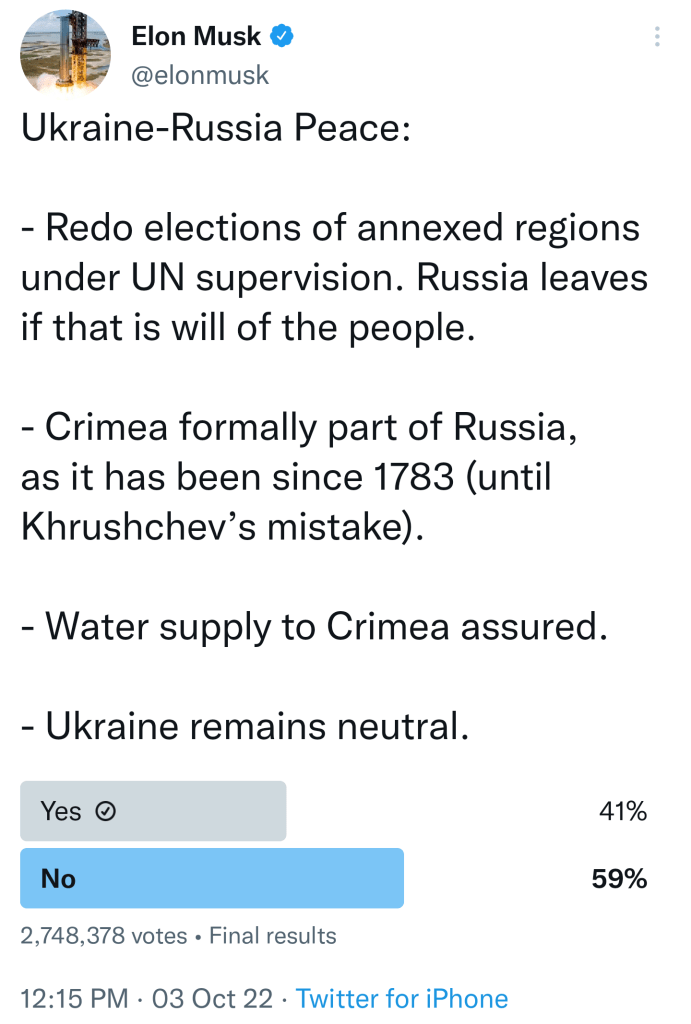
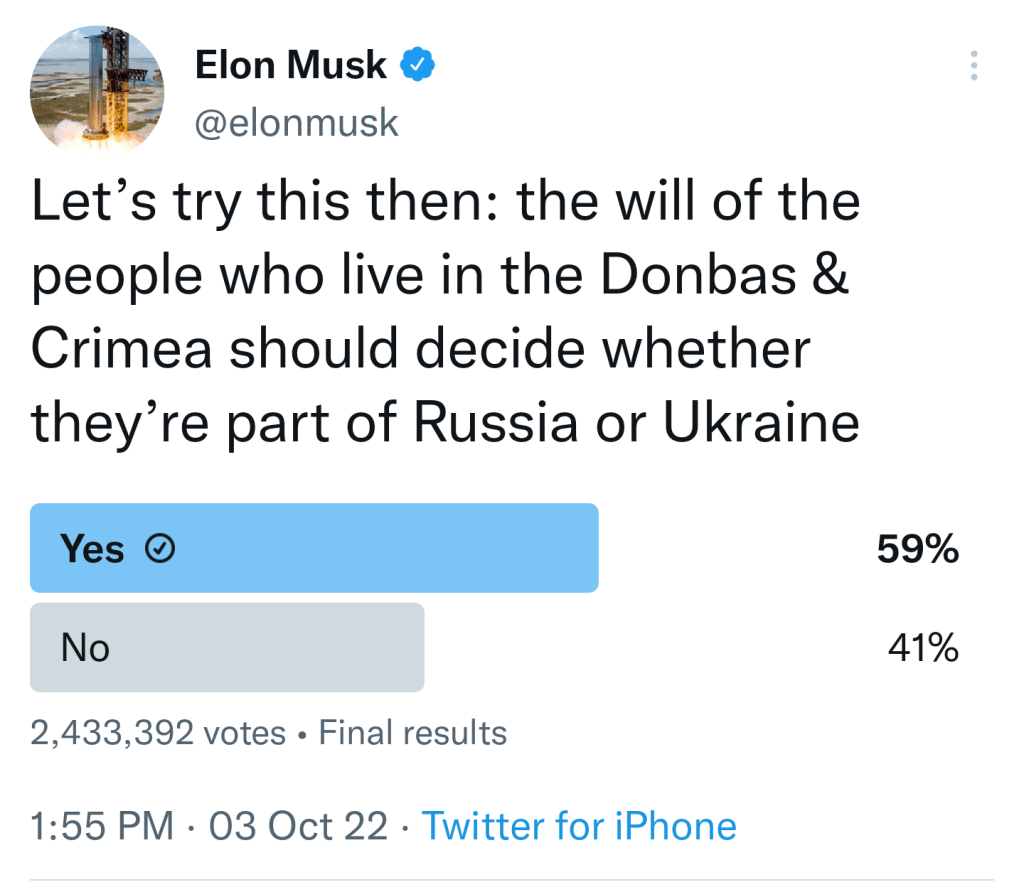
Elon Musk did what he does best and that is he disrupted the status quo.  This time he took on the conventional argument that the war over Donbas must be fought to the very last Ukrainian.  

His Tweets:

If you thought Trump was a mean Tweeter, you should see some of the nastiness in response to these polls.

Of course, social media midwits everywhere, full of sanctimony and rage, took to their usual easy explanation of any perspective that challenges their own: Musk is an idiot or Putin’s puppet and certainly doesn’t have the credentials to comment on geopolitics!  

And yet Musk’s own call for resolution very closely mirrors that of Henry Kissinger from months ago who called for the government of Ukraine to come to the negotiating table and be willing to cede territory for sake of peace.  

This is from an editorial written back in 2014:

The West must understand that, to Russia, Ukraine can never be just a foreign country. Russian history began in what was called Kievan-Rus. The Russian religion spread from there. Ukraine has been part of Russia for centuries, and their histories were intertwined before then. Some of the most important battles for Russian freedom, starting with the Battle of Poltava in 1709, were fought on Ukrainian soil.

(“Henry Kissinger: To settle the Ukraine crisis, start at the end,”Washington Post)

Kissinger, a diplomat of diplomats, former Secretary of State, and a renowned foreign policy expert, is no slouch when it comes to geopolitics, and that his sage advice was so quickly dismissed says more about the true lack of understanding and blind fanaticism of the hardliners.

It seems that some are plain vengeance driven and would rather punish Russia than find a way to peace that would end the destruction and save countless lives.  

They are either a) products of Western propaganda who knew next to nothing of the complex regional history and brutal shelling by Ukrainian partisans for eight years prior to the Russian intervention or b) Ukrainian nationalists who looked the other way when ethnic Russians were murdered in Odessa and then sought to impose their will on Donbas.

Musk and Kissinger, along with Emanuel Macron who warned not to humiliate Russia (as was done to Germany after WW1 and led to WW2), are only saying what an informed and responsible person should say when seeing an escalation that very well could lead to nuclear war.

The Boomer warmongers, the hawks like neocon Lindsey Graham or imperial-lib Joe Biden, are still very much stuck in the Cold War and would not think twice about sacrificing your sons or daughters for their latest power trip.  

They don’t tell you about how they personally profited from provoking a coup in 2014, like their predecessors did in pre-revolution Iran and all across South America.  

The United States has meddled in all parts of the world, both in form of covert CIA destabilization efforts to the too numerous to list overt brutal military invasions and occupations.  The political establishment and military leaders of the West have never thought twice about bombing those who do not submit back to the Stone Age:

The racial dehumanization of the Vietnamese found its classic expression in the words of General Curtis LeMay, head of the Strategic Air Command, who said that America’s aim must be to “bomb the Vietnamese back to the stone age.” And Washington tried to do just that: From 1965 to 1969, the U.S. military dropped 70 tons of bombs for every square mile of North and South Vietnam — or 500 pounds for each man, woman, and child.

(“Bomb them back to the stone age: Racism, genocide and denial at the heart of the American Way of War,” Milwaukee Independent)

Of course, this was done in the name of “democracy” and “freedom,” which justifies all violence, right?

Anything said about Putin is a projection. The war in Ukraine is not completely unprovoked, as our own propaganda says. No, it is the direct result of the US and NATO interfering in Ukrainian’s domestic politics. Back in 2014, the late Senator John “bomb bomb Iran” McCain, along with our current Under Secretary of State, Victoria Nuland, planned who would replace Ukraine’s President *before* he was overthrown in a coup.

The US only like democracy so much as the votes are counted our way and freedom so long as it benefits our current political establishment or their sponsoring banks and big corporations—that’s just the truth.

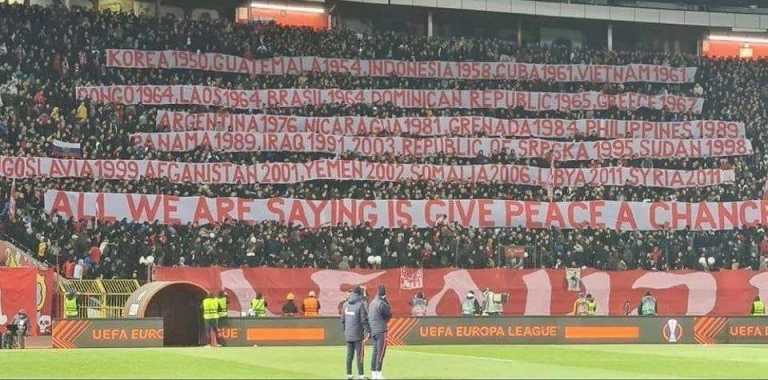
Like the jeering of our American hypocrisy by Serbian soccer fans—who saw their own country partitioned after NATO took the other side of the conflict, that of the separatists—holding a banner listing the dozens of places the US has attacked, invaded and occupied since the 1950s: All we’re saying is give peace a chance.

The world sees it, why don’t we?

Are Those Girls Laughing At Me?

Standard

There was a time, many years ago, when I had a particularly severe struggle with insecurities, it was likely related to a recent romantic rejection and this mess of anxieties being part of the aftermath.  I had walked into a youth volleyball event and, observed, a couple of girls across the room laughing. 

I had known how cruel young women could be about guys who didn’t meet their standards, overheard their giggles and comments related to that slightly awkward and unfashionable older guy who was the constant butt of their jokes.  So my fears of this sort of ridicule were not entirely unfounded.

But, after a quick self-assessment, making sure I wasn’t wearing my underwear on the outside or anything too obviously wrong, I did my best to ignore that nagging voice and find another explanation.  They could have been laughing about anything, there was absolutely no reason to conclude it related to me and yet the unpleasant knot remained in my stomach.

Had I run with this conclusion, based upon my hallucination of their reason for laughing and not reality, this incident added to my existing grievance with the female gender.  I was already aware that many girls have a 5′-10″ cutoff for guys they will date, the guy that did end up dating the one I had asked was a six-footer, it could be that they were laughing at my expense?

However, had I gone with that, even if I didn’t match across the room and command them, “Do better!”  Something that most definitely would have branded me as a weirdo even if they were guilty and did apologize.  Even if I had simply allowed my own explanation of their actions to metastasize, it would be the root of a very toxic attitude that would further marginalize me.

My initial interpretation, born of my anxieties, not their laughter across the room, was the real problem.  Even if we banned all laughter or every snickering teenager girl were reprimanded for their feeding of male insecurities, had a plan been devised to force all girls to date short men as reparations for discrimination and height privilege be excoriated by leaders, the actual issue would never be solved.

No, I’m not saying that genuine acceptance doesn’t go a long way towards healing old wounds.  Becoming part of the Orthodox world, where I didn’t have a reputation to proceed (and limit) me, where it was possible to talk to the opposite gender comfortably, did certainly help.  And there’s no denying that my being in a relationship has lowered the stakes and helped me to relax around other women.

Still, all that only happened once I stopped caring what other people thought and subsequently became comfortable in my own skin.  Today, unless it was a really bad day, I would be more likely to laugh with those laughing and then ask them what they were laughing about.  Slinking around, and making accusations, might gain you a following on social media and earn the meaningless sympathies of those only hearing one side.  But it will do nothing to improve self-image.

Painful as it was, I’m glad that things didn’t work out for me because someone swooped in for the rescue.  Had this happened I may never have found my internal spiritual footing and, after briefly appreciating the charitable effort, remained as lacking in confidence.  Pity the woman who marries a man looking for her to bolster his self-image and mend his brokenness, that relationship is probably going to be hell in a few years.

My physical stature hasn’t changed since my days of paralyzing approach anxieties and there remains plenty of reason that one may laugh in my direction.  But my life improved vastly when those voices of self-pity and doubt were muted.  At this point it would not matter if those girls had been truly laughing at me, I wouldn’t take them so seriously anymore. I’m a different man.

Legalism: Knowing the Letter of the Law but Missing the Spirit

Standard

This is part two of a four part series on law, legalism, church authority and economia.

Ever get angry after being cut off in traffic?

I know I do.

Instantly I’m making judgments about that person’s lack of driving skills. How dare they interrupt my text messaging and topple the donut that was perched precariously on my lap!

However, later that same day, I’m cruising along in bumper to bumper traffic, my exit is coming up, I see an opportunity and take it. The guy behind me blows the horn, he obviously cannot appreciate my superior skills and that I had no other choice.

That, of course, is a composite of many true events out on the road. When I do something wrong, there’s always a good reason for it and if there isn’t a good reason—Well, nobody is perfect, everyone makes mistakes, right?

People believe they see things as they are.

We feel we are a fairly good judge of ourselves and others.

This trust in our own abilities is what enables us to navigate life. If we couldn’t judge up from down or left from right we would have no means to make a decision or progress in a direction. We are aiming creatures. We have two eyes pointed frontward, stereoscopic or “binocular” vision, so we can judge distance and aim correctly at a target down range. That is what our mind does, it prioritizes one thing over another, it is a sorting machine, we are built to judge and—unless sleeping or in a vegetative state—we are always making judgments.

Unfortunately, this forward facing vision gives us big blind spots. We can only see in one direction at a time. When we are locked in on a particular subject we can lose grasp of the bigger picture and possibilities outside of our range of vision. We are creatures with a finite mind and ability to comprehend. We need our judgment to navigate through life and yet our judgment is not perfect, we are short-sighted, biased and often inconsistent. We project into our environment. We judge people based on our presumptions about them and their motives.

We tend to justify or rationalize our own bad behavior, see our mistakes or the mistakes of those whom we love as being the result of circumstances, then turn around and mercilessly judge the faults of others as being serious character defects. This tendency—called fundamental attribution error—leads us to judge ourselves only by our own intentions and others only by their actions. It is extremely common, if not completely universal, and shows up constantly in political and religious debates. The other side is evil, corrupt and inexcusable—our own side is righteous, well-intended and misunderstood.

We don’t see things as they are, we see them as we are.

Truth be told, many people are not good at judging others as they imagine themselves to be and are wrong more they realize. Our memory is selective. On one hand, we sort out examples that go against our fundamental assumptions about reality and, on the other, we can easily recall those things that confirm our existing ideas. This confirmation bias, combined with fundamental attribution error and our many other cognitive limitations, unless humbly considered, will make us a very poor judge.

Legalism is a misuse of the law by those who do not understand the intent of the law.

The basic intent of the law is to create order out of chaos and yet law itself can become a source of confusion and conflict. The problem with any law is that it requires interpretation and understanding of the intent. This is why we have lawyers, judges, juries, and courts—to safeguard the intent of the civil law from abuse.

Legalism abuses the intent of the law.

Legalists incorrectly use the technicalities of language to find loopholes and carve out special exemptions for themselves. Legalists also apply their own interpretation of the law to others in a way that is harsh and often hypocritical. For them, the law is a tool to help them achieve their own personal or political ends.

That is not to say legalists are lacking in sincerity either, they are often diligent students of law, they have zealously committed the letter to memory and know the words inside and out. But what legalists lack is the spirit of the law and their knowledge is a hindrance to them.

#1) The rich man who relies on his own abilities rather than live in faith. (Matt. 19:16-30, Mark 10:17-31 and Luke 18:18-30) In this story, we are told of a young man who is wealthy and also very religiously devoted. He comes to Jesus, whom he addresses as “good teacher” and asks “what must I do to inherit eternal life?” Jesus, upon hearing this man’s diligence, tells him to sell all he has, to give the proceeds to the poor and then to follow him.

Sadly, and ironically, this account is often used by modern legalists to make a new religious formula rather than understand. This man was a legalist who succeeded in following the law and still lacked one thing and that thing being faith. There are a few who are able to keep the letter of the law and miss the intent of the law because of this. The intent of the law is so we depend on God for our salvation rather than our own works:

For all who rely on the works of the law are under a curse, as it is written: “Cursed is everyone who does not continue to do everything written in the Book of the Law.” Clearly no one who relies on the law is justified before God, because “the righteous will live by faith.” The law is not based on faith; on the contrary, it says, “The person who does these things will live by them.” Christ redeemed us from the curse of the law by becoming a curse for us, for it is written: “Cursed is everyone who is hung on a pole.” He redeemed us in order that the blessing given to Abraham might come to the Gentiles through Christ Jesus, so that by faith we might receive the promise of the Spirit. (Galatians 3:10‭-‬14 NIV)

The law is not there so we can believe we will impress God with our careful obedience. No, the intention of the law was to do the opposite—it was to remind us that we do not measure up to the righteousness of God and that we are therefore condemned to death. This rich young man had achieved the letter of the law, he had done everything that could be done through his own abilities, yet lacked the most important thing and that being faith in God. Jesus gave the answer to how we are saved: “What is impossible for man is possible for God.”

#2) The religious hypocrites who use the law to accuse others and are guilty themselves. (John 8:1-11) In our day we don’t take some sins as seriously as we do others. Many, for example, are condemning of homosexuality and yet do not seem to realize that there are many things that we take rather lightly that are sin and that all sin comes with the penalty of death. Such was the case in the following extraordinary account:

The teachers of the law and the Pharisees brought in a woman caught in adultery. They made her stand before the group and said to Jesus, “Teacher, this woman was caught in the act of adultery. In the Law Moses commanded us to stone such women. Now what do you say?” (John 8:3‭-‬5 NIV )

We are told they did this was intended as a trap for Jesus. Evidently they knew the compassion Jesus had for sinners and wanted to present an impossible dilemma: a) He follows the law, condemns her to death as is required and proves to be no better than them or b) he contradicts Moses, can be accused of rebellion against the law and be himself condemned under their law.

He avoids their trap:

But Jesus bent down and started to write on the ground with his finger. When they kept on questioning him, he straightened up and said to them, “Let any one of you who is without sin be the first to throw a stone at her.” Again he stooped down and wrote on the ground. At this, those who heard began to go away one at a time, the older ones first, until only Jesus was left, with the woman still standing there. Jesus straightened up and asked her, “Woman, where are they? Has no one condemned you?” “No one, sir,” she said. “Then neither do I condemn you,” Jesus declared. “Go now and leave your life of sin.” (John 8:6‭-‬11 NIV)

We have no indication of what Jesus wrote in the dirt. However, it is fairly obvious, it takes two to tango and yet we only have a woman standing accused—What happened to the man involved in the adultery? Why was no man brought with this adulterous woman?

It is also interesting that the only tool these men seemed to have was condemnation. Perhaps this is psychological projection? Maybe deep down they felt guilty and the reason they needed to find fault with Jesus and this woman is so they could feel better about themselves?

Whatever the case, we know that Jesus did not condemn this woman. This could be interpreted as Jesus saying that what she did doesn’t matter. But, he doesn’t say her sin doesn’t matter—he tells her to go and sin no more.

#3) Judas betrays Jesus with his legalistic use of compassion. (John 12:1-8, Matt. 26:6-13) If you want to see the ultimate expression of legalism, it is Judas (and other disciples) interrupting a beautiful act of worship to criticize and, in the process, throwing the words of Jesus back in his face:

Then Mary took about a pint of pure nard, an expensive perfume; she poured it on Jesus’ feet and wiped his feet with her hair. And the house was filled with the fragrance of the perfume. But one of his disciples, Judas Iscariot, who was later to betray him, objected, “Why wasn’t this perfume sold and the money given to the poor? It was worth a year’s wages.” He did not say this because he cared about the poor but because he was a thief; as keeper of the money bag, he used to help himself to what was put into it. “Leave her alone,” Jesus replied. “It was intended that she should save this perfume for the day of my burial. You will always have the poor among you, but you will not always have me.” (John 12:3‭-‬8 NIV)

It is interesting there are many who use the words of Jesus the same way as Judas. They use them to support a socialist political agenda or as a means to condemn any extravagant form of worship. They rationalize their condemnation of others using the words of Jesus and, despite completely missing the spirit of the law, are correct according to the letter of the law—but they completely lack the joy and life of the Spirit. They might hide their legalism in compassion for the poor or in concern for the kingdom of God and yet themselves are no better in their attitudes than the legal experts who put Jesus to death.

What is the true intent of the Biblical law?

To save us from ourselves.

Those who use the law to parse away their own guilt or as a bludgeon to use against those who do not add up to their own standards, even standards that are based in the law itself, have missed the point—we don’t add up and by our own efforts we never will.

Any person, when held up to a perfect standard, will fail by comparison. How can we, as finite and limited creatures, ever compare favorably to an infinite and limitless good? This is a reality that should humble us and fundamentally change how we treat other people.

It is fitting that the first step in Christianity is repentance. If one considers the severity of the law and that everyone stands condemned before God—and that just might change our perspective about that guy who just cut us off in traffic.

The Christian answer to legalism: “Judge not lest ye be judged.”

Legalism is applying the law to others in a way we, as individuals, were never ordained to do. Yes, we must make judgments for ourselves and should always promote what is good even if it offends. Yes, there are some things that are under the jurisdiction of civil authorities (Romans 13:1-7) and sin is to be addressed by the church. However, we are not given license to go out on our own as individuals passing judgment on others, quite the opposite:

Brothers and sisters, do not slander one another. Anyone who speaks against a brother or sister or judges them speaks against the law and judges it. When you judge the law, you are not keeping it, but sitting in judgment on it. There is only one Lawgiver and Judge, the one who is able to save and destroy. But you—who are you to judge your neighbor? (James 4:11‭-‬12 NIV)

Some religious experts, who argue the false dichotomy of faith versus works, might see James (above) as contradicting Paul’s emphasis on grace, but they can’t on this point:

You, then, why do you judge your brother or sister? Or why do you treat them with contempt? For we will all stand before God’s judgment seat. It is written: “‘As surely as I live,’ says the Lord, ‘every knee will bow before me; every tongue will acknowledge God.’” So then, each of us will give an account of ourselves to God. Therefore let us stop passing judgment on one another. Instead, make up your mind not to put any stumbling block or obstacle in the way of a brother or sister. (Romans 14:10‭-‬13 NIV)

Our true obligation to others is not to bring them condemnation—it is to be like Jesus and show them the love and grace we want God to show us.

The truer law is not that of the letter. It is the law of reciprocation. What we do to others or demand be done to them will be the same standard that is applied to us. In other words, if you live by the sword you will likewise die by it (Matt. 26:52) and if you judge others by the law you are putting yourself back under the curse of the law and will be required to do the impossible without God’s help—as Paul warned the Galatian church.

Jesus, when asked by a lawyer, says the entire law hangs on two commandments: He says to love God with all your heart and love your neighbor as yourself (Matt. 22:35-40, Mark 12:28-32) and this is some practical application:

For if you forgive other people when they sin against you, your heavenly Father will also forgive you. But if you do not forgive others their sins, your Father will not forgive your sins. (Matthew 6:14‭-‬15 NIV)

That is black and white. So is this:

“Do not judge, or you too will be judged. For in the same way you judge others, you will be judged, and with the measure you use, it will be measured to you. (Matthew 7:1‭-‬2 NIV)

The law is a means to end, to point us to our need for Jesus, and not an end in itself as many religious folks attempt to make it. The law itself can only bring condemnation and death because nobody is able to match the righteousness of God. The law is given, ultimately, not to condemn anyone—but rather so we can all know our own need of a savior and be saved.

Be perfect, not in legalism, but in mercy…

One of the starkest warnings Jesus gave (Matt. 18:21-35) was a parable about a man forgiven a debt impossible to pay and is shown great mercy by the king whom he owed. This same forgiven man turns around and demands a small sum owed him—throwing the offending party in jail. The end result is the king revoking the mercy he had shown and doing what the unmerciful man had done to the one who owned him a little. That is the response Jesus gave to how much we should forgive.

James further expounds:

If you really keep the royal law found in Scripture, “Love your neighbor as yourself,” you are doing right. But if you show favoritism, you sin and are convicted by the law as lawbreakers. For whoever keeps the whole law and yet stumbles at just one point is guilty of breaking all of it. For he who said, “You shall not commit adultery,” also said, “You shall not murder.” If you do not commit adultery but do commit murder, you have become a lawbreaker. Speak and act as those who are going to be judged by the law that gives freedom, because judgment without mercy will be shown to anyone who has not been merciful. Mercy triumphs over judgment. (James 2:8‭-‬13 NIV)

Merely showing favoritism is mentioned in the same breath as murder and adultery!

Presumably, given we should be one in Christ according to Galatians 3:28, that would include any kind of favoritism. In other words, sexism, racism, ageism, xenophobia, social elitism, or anything else used to justify the favorable treatment of some and unfavorable treatment of others, makes you condemned as much as the evilest men of history under the law. James says that a person is guilty of breaking the entire law if they show favoritism…

Who then can be saved?

It is interesting, especially in a discussion of legalism, to consider some of the discrepancies of language in Scripture. For example, one Gospel calls out only Judas for his judgmental attitude towards the woman pouring perfume while another says it was disciples (plural) and not just Judas. One Gospel account of the rich man has him calling Jesus “good teacher” while another omits this entirely and says he started by asking “what good thing must I do” instead. Perhaps the writers were a bit less concerned than we are with the legalistic details and more with the message?

There is also an inconsistency between what the Gospels tell us Jesus said at the end of the Sermon on the Mount. I quoted Matthew’s version in my last blog: “Be perfect, therefore, as your Father in heaven is perfect.” Which seems sort of vague and open to some interpretation. I mean, how does one compete with the perfection of God? However, in Luke 6:36, in the same context of love for enemies, we read: “Be merciful, just as your Father is merciful.” Combining the two different tellings, it seems what is being asked of us is to be perfect in mercy towards others and not perfect in some onerous legalistic manner.

We should turn our natural tendency to fundamental attribution error around. In other words, rather than judge those outside our own social group and show mercy to our own, we should judge ourselves (our own people) more harshly and leave the others to God. Or, in more practical terms, if someone cuts us off in traffic, rather than attribute his or her annoying act to an irredeemable character flaw, we should assume the best. And, if we cut someone else off, we should not excuse our own poor driving habits and take full responsibility instead.

If we want to be judged by God’s perfect law (and condemned) we should be legalistic.

If we want God’s mercy we should be merciful.