Vaccine Safety and Skepticism: A Father’s Perspective

Standard

Up until a few years ago, I basically trusted the medical establishment. Sure, even then I would question—like I do with everything else—and then make my own analysis the risks, costs and benefits. My mom’s rule of thumb “everything in moderation” seems to be reasonable in most circumstances. But I’ve grown more skeptical and not because I believe there is a conspiracy to make us all unhealthy either. I just think hubris can be blinding and institutions compromised.

So when it came time to decide whether or not to vaccinate my newborn daughter, my feelings were mixed. She is too precious to gamble. It is my job to protect her. And for that reason I needed to take another look at the question of childhood vaccines. This is my analysis as someone who is not trained in biology, I’m not a medical professional or an expert in any way, shape or form. This is merely the thought process of a concerned father wanting to do what is right and didn’t like the answers he was getting from those ‘credible’ sources.

So join me in a critical look at the topic of childhood vaccines and some things that raised my eyebrows as far as the science, some ethical questions raised recently and the online testimonials versus professional advice. It would take a book to properly cover a topic of this magnitude, but this is an overview and give some reasons for the decision I’ve made. This is a reach into the barrel to examine a few apples and get a little better picture of what else we may find upon further review.

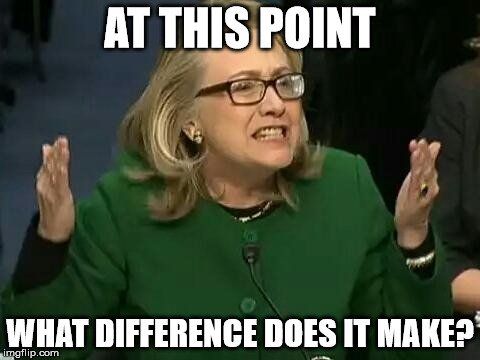
Science: Ingestion… Injection… What Difference Does It Make?

One of my “does their own research” friends reposted a chart posted by Physicians for Informed Consent (PIC) showing the safe amounts of aluminum versus the amount injected with the hepB vaccine—according to their post, 250mcg is an amount 75x more than what is considered safe to be in the bloodstream of a 7.3lb infant. That sounds bad. But this information does beg a few questions.

First, why is aluminum toxic over a certain amount?

Second, does an injection go into the bloodstream?

And, third, why is this in the shot?

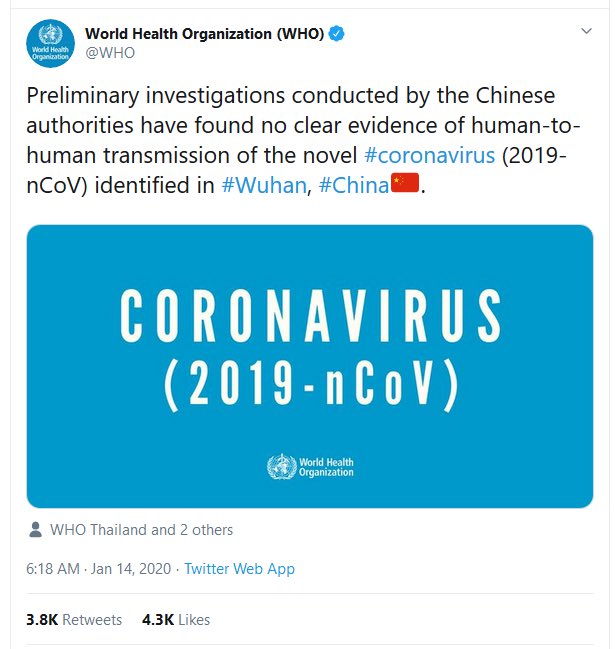
What was disconcerting is when I went CDC and WebMD sites and found that they were making an inaccurate comparison. In their defense of aluminum in vaccines they made a case based on the safe amounts to ingest and yet vaccines are injected. This is that kind of presentation that would leads fact-checkers to declare it misleading if it was in a Trump speech. Maybe my neighbor with the “believe science” placard in their yard isn’t going to notice this sleight of hand, but I certainly did. It certainly didn’t assure me much about their actual authority when they tried to pass to different means of entering the body as one and the same.
Oh, but it does…

However, the PIC information is equally as misleading. And they know it. The post is talking about safe amounts of aluminum in the bloodstream. And yet vaccines are not injected directly into blood vessels. No, the shot goes into soft tissue and the aluminum is slowly dissolved from there. So clearly it is not aiding a mission of informed consent anymore than the drug company sponsored content. It’s just propaganda. It is put out to feed the confirmation bias of anti-vaxxers and muddies the waters. The freaked out #protectyourkids mothers are not going to ask further questions.

The bigger question is what aluminum does in large amounts. Words like “toxic” can be tossed around in the same manner of Nazi or racist. But slapping a label of something does not make it accurate description nor is it equal to comprehension of the topic. The same authority establishing a “safe” versus “unsafe” levels of aluminum also tells us to get vaccinated. The whole point of adding aluminum is as an adjuvant, it is supposed to provoke an immune response and only is bad when it begins to build up—typically it is just expelled from the body without doing any damage.

Practically speaking one would need to be an expert on toxicology to truly know what ‘the science’ is and give informed consent, the rest of us are merely picking which side we want to trust. For me, I lean towards the consensus over the outliers, what it means is generally not ranking a relatively group—like PIC—over the larger group of physicians (who have children themselves) and believe that the benefits of vaccines outweigh the risks. Yes, professionals have blindspots, they are more married to the system too as bigger beneficiaries, but they’re also smart people trying to help and heal.

Ethics: Myth of the Abstaining Amish and Abortion Cells

One of those claims that come up over and over again online is that Amish are healthier because they don’t get the vaccines. Given what I know, working with Amish, I’ll put this somewhere between “96% of statistics are made up on the spot” and “Amish don’t pay taxes,” because it is just plain untrue. Back in 2011 my sister, a medical doctor, worked on a survey of 1000 Amish people and their attitudes towards vaccines. 85% of those surveyed had vaccinated at least some of their children. Sure, Amish lag behind the general population, and uptake varies as they’re not a monolith, and attitudes have likely shifted in the post-Covid era, but they aren’t totally abstinent—just hesitant.

To get into the complexity of the picture, in my brief survey of my office co-workers (I work for an Amish-owned company) there was an interesting anecdote. Apparently, his mother contracted measles while she was carrying one of his older sisters. The result were complications and his sister’s lifelong health issues. Needless to say, his mom became more in favor of vaccines after this and that has been the story for some time. The discomfort of subjecting our children to shots looms larger until we get a first-hand experience with the actual disease. A day or two of soreness and high temperatures is better than measles, polio, or other preventable diseases. The ethics shift towards the risk of intervention.

Speaking of ethics, another coworker—not Amish—piped up about how vaccines use aborted fetuses. This is technically true in the case of some vaccines, I’ll let Grok give a brief explanation:

Certain vaccines—like those for rubella, chickenpox, and some hepatitis strains—rely on cell lines originally derived from fetal tissue decades ago. These aren’t “aborted embryos” in the sense of fresh tissue being scooped up and tossed into a vat. Instead, we’re talking about two specific cell lines: WI-38 and MRC-5. WI-38 came from a fetus aborted in the 1960s in Sweden (elective, legal termination), and MRC-5 from a similar case in the UK. Scientists took lung cells from those fetuses, grew them in labs, and kept them replicating ever since. These cell lines are immortalized—meaning they’ve been dividing for generations, far removed from the original source.

Why use them? Viruses for vaccines (like rubella or varicella) often need human cells to grow, and these lines are stable, well-studied, and safe for producing big batches. The cells aren’t in the vaccine itself—they’re like a factory. The virus is grown in them, then harvested, purified, and processed so the final shot has no fetal cells, just the viral bits needed to trigger immunity. Think of it like using yeast to make beer—the yeast doesn’t end up in your bottle.

This longer explanation does not have the same punch as “they use aborted fetuses to make vaccines.” But, for me, it answers the ethical question. This use of these two cell lines to save lives is basically equivalent to planting of a flower garden over the grave of a murder victim. I’m no more guilty of that than I am for the land under my feet being soaked in the blood of conquered people. It is just what is. What was done is done and refusing to use vaccines derived from those cell lines is not going to restore the life that was taken. I have more of a problem with the characterization of this being too vague to give proper understanding.

The soil under our feet is soaked in blood, but not an ethical dilemma to put to good use.

In the end, both sides of this debate peddle their myths, misinformation and deception, calling those mRNA Covid jabs “safe and effective” one of those establishment lines that fell flat in the test of time. But, for me the ethics of putting my children at risk of preventable disease outweighs misgivings about something done over 50 years ago. We can’t bring back those killed, but we can make their lives worthwhile and honor the legacy they’ve created for us. My opinion would be vastly different if they were still harvesting fetal tissue to grow viruses.

It is more important that we are honest than we win a debate. There’s no excuse for the repeated and easily debunked claims about Amish or aborted cells to be shared. Those in the “do their own research” crowd need to do better. When I see people share videos made by a chiropractor, in a lab coat, going only by doctor, it makes me question their judgement more than anything else. Being an expert in doing bone adjustments is one thing, biology is completely another. People aren’t very good about picking their sources, let alone producing coherent ethics.

Tragedy Testimonials Versus Professional Recommendations

Another thing I’ve come across, on social media, is that case of a child that died very shortly after the vaccine was administered. The grieving parents, one of them a nurse, disagree with the autopsy report, that cited SIDS, and put blame on the shots. First off, the pain of losing a child is beyond anything else I’ve ever experienced (you can read my personal account, “The Day My Little Hope Died“) and always will leave many questions for those left behind. Second, in this case, it may feel better to externalize blame.

I’ll admit, I was a little put off by my medical provider (a Physician’s Assistant) who just brushed off my concerns about too much—too soon. This is my little darling, and it is my job to protect her, so at least entertain my anxieties a little. So that part where of her worry about her son’s sickness prior to getting a dose of vaccines being dismissed does resonate. That doctor should have shown a little more respect for a mother’s intuition and a nurse’s instincts. That said, we’re only getting one side of the story and from the perspective of someone not really in a good state of mind.

Just taking the testimonial at face value—not verifying any of the claims—they give a clue about what really happened with their own choice of words:

Melissa, who worked remotely, heard the baby fussing around 6:15 p.m. Her husband went in to check on him. He readjusted him, and rubbed his back as Fathers do. Baby Sawyer fell back to sleep.

When we were in the hospital for the birth of our daughter, before we took her home, they pounded it into our heads not to put loose items in her crib with her and never to allow her to sleep belly down. This is about SIDS (Sudden Infant Death Syndrome) when a perfectly healthy baby is put to bed, often laying on their belly, suffers from positional asphyxia and dies. Infants are completely helpless, they can’t readjust their position if their airway is somehow restricted and they could be gone in a matter of minutes.

So that particular paragraph really jumped out at me. I’m very sensitive to how people structure their thoughts, the phrases, and I have even identified a false accuser once only on the basis of the use of words that were conveyed through another person in a paraphrase. When I saw “as Fathers do” it came off as a slightly defensive posture—most especially next to “rubbed his back” in the context of a sleeping infant. One hand they’re being as honest as they are able to be in the circumstances. On the other hand they’ve just given corroborating evidence for the official autopsy report.

They can be forgiven for their blame game. It is hard enough to lose a child, but totally unthinkable to believe something you did may have contributed. When Sanyiah died I stopped speaking to two of my siblings (not that they noticed as busy as they were) for a year or two. Why? Well, they both were not at the funeral, in my mind they did not care enough about the little people in their lives (that meaning my ex-fiance who had personal ties to them) and were, in a round about way, part of the problem that caused the child’s death.

The real reason my anger was taken out on them, however, was that psychological need we have to find a scapegoat. And Melissa, rather than pile on her husband, which won’t help, has pointed somewhere else instead—which is better than their negative feelings being turned in on the marriage. It is a way of coping with tragedy. As far as testimonials go, three of my cousins had a seizure disorder, one of them died and two of them are severely disabled. After their issues with the first child, they decided not to vaccinate. But this made no difference in the end. The impulse to blame intervention is strong, yet correlation isn’t causation and often the truth is messier than those simple narratives we prefer.

In the case of baby Sawyer, it doesn’t have to be one thing or another. The risk factors for SIDS include both second hand smoke and overheating. It seems quite possible a bunch of vaccines, on top of being already sick, and then possibly being on their belly, all contributed to the end result. Medical professionals face big liabilities if they are at fault. There is a tendency to circle the wagons or become tight lipped rather than speculate when million dollar lawsuits can be the result. So maybe in a perfect world vaccines would be a bigger part of the SIDS discussion?

Still, aluminum in the bloodstream does not cause suffocation and 34 hours later is not description of a biological mechanism that links the injection to the outcome.

A Respectful Conclusion, My Final Risk Analysis…

No parent ever wants to be responsible for the suffering or death of their child. When I see my daughter’s eyes looking up at me it melts my heart. She already has me totally wrapped around her finger and I would not do anything that put her at an unnecessary risk. There is a temptation to take the “If it isn’t broke don’t fix it” approach to vaccines or basically do nothing. At least this way an intervention you signed off on didn’t directly cause the harm. Without the nudge of the doctor’s office I might fall off the schedule they have simply because it feels better.

But the body of evidence points to benefits that outweigh the risks. That is to say there are risks, vaccine injury is real, but there are risks to everything we do or don’t do. Would anyone have stepped on board the Titanic if they knew the icy ordeal that awaited them in the middle of the night? In 2022, motor vehicle accidents took the lives of 42,514 people. And yet we don’t see emotional testimonials online about the “mistake” it was to drive to Kansas or trying to caution us against this dangerous activity. This is because we have normalized the risk and tune it out—that and we think that only the bad drivers die when any of us could.

What could be improved is a little respect all around.

First off, this advice applies to the medical establishment. From Fauci on down there has been this attitude of near contempt for those who question their authority. A prime example is the statement of Dr Fauci when faced with scrutiny:

So it’s easy to criticize, but they’re really criticizing science because I represent science. That’s dangerous. To me, that’s more dangerous than the slings and the arrows that get thrown at me. I’m not going to be around here forever, but science is going to be here forever. And if you damage science, you are doing something very detrimental to society long after I leave. And that’s what I worry about.

Beyond hybris. Beyond martyr complex and a misdiagnosis of the situation. No, Fauci, you cannot say “I am the law” like a rouge police officer. That’s not science, that is just a delusion. Sure, it sucks to be questioned in your own area of expertise. I think this is why some physicians do sometimes gloss over concerns of patients. But this is what damages the credibility of the institutions of science more than anything else. When the top doctor confuses “the science” with his own position he’s dangerous.

Okay, you smug, and dangerous, SOB.

Second, those of us self-educated people, who have not gone through that rigorous process of medical school or taken any kind of advanced biology course should remain humble. No, my lack of proper terminology does not make me an idiot. Nor should a nurse and mother’s concerns about her sick baby getting shots be dismissed. But “did your own research,” while in the lobby of the chiropractor, does not make you an expert or unbiased.

In the end, no parent wants to gamble with their child’s life. Staring into my daughter’s trusting eyes, I feel the weight of that responsibility—and the pull to do nothing, to avoid any chance of harm through action. Yet, after sifting through the science, wrestling with ethical dilemmas, and listening to both heartbreaking stories and professional guidance, I’ve landed on this: the evidence tilts toward vaccines’ benefits outweighing their risks. It’s not a perfect system—vaccine injuries happen, and the medical establishment could stand to listen better—but the data holds up against the diseases they prevent. We all deserve more humility and respect in this conversation, from doctors to doubters like me. For my little girl, I’m choosing the path that keeps her safest, not just from needles, but from what they guard against.

Hit me up in the comments section below with your most powerful arguments for or against childhood vaccines.

Do you vaccinate your children, why or why not?

Sight, Sources, Statistics and Science

Standard

Social media provocateurs love to push popular controversies to generate clicks on their sites and get those heated comments sections.  The question about the gender of two boxers in the female category of the competition was that perfect story.  It was not straight up or settled, but generated a lot of strong opinions on both sides.

For myself, it is fairly evident that these two boxers do have a competitive advantage or they would not have won in their respective divisions.  I mean, that’s not even a matter of dispute.  An advantage is how anyone wins an athletic contest and it doesn’t mean they cheated.  However, when not only one but two people with the same extremely rare and potentially enhanced condition—both get the gold?  What are the odds?

Only one out of 500,000 people in the world go to the Olympics.  But, of course, nothing is ever that simple.  Those who live in small countries, like Algeria or Taiwan, have a far greater chance of representing their home countries simply because there are fewer people to fill the same spots.  And then not everyone in the world is competing to be in the Olympics.  Most of us don’t try out.  It is sort of like my being sixth while wrestling in the Eastern National AAUs—many superior to me simply didn’t make the trip.

But to go to Paris and beat everyone?  There is a reason why we give precious medals to those who do.  It is one thing to be that PhD who identified as a breakdancer and ended up scoring zero, it is quite another to get on the podium.  There were 124 boxers in the female category, divided into six different weight classes, and went through three qualification tournaments.  This is certainly not an easy road.  The champion is one out of every woman in the world who can make that weight and is into boxing.

There is speculation that those two boxers who had been disqualified from IBA fights due to failed gender tests—and masculine appearance—is they may have a disorder called Swyer syndrome.  This isn’t a fact, but it would explain why they would have been declared women at birth and always identified as women.  Those with this very rare condition have a male Y chromosome despite their female sexual hardware and offer no male advantage.  

However, it is also possible that the two have Androgen Insensitivity Syndrome, which impacts 2-5 out of 100,000 females, which means they would have characteristics of a female outwardly but also have male testes that are undescended.  Severe AIS wouldn’t confer an athletic advantage, according to the sources I’ve read, and yet that does not tell us anything about milder cases.  

Still, the conversation can’t end there, we have other possibilities:

Some press reports have mentioned 5alpha-reductase type 2 deficiency.  This rare syndrome is best reported in the Güevedoces in the Dominican Republic.  Affected XY individuals are apparently female at birth because they can’t activate sufficient testosterone to the much more potent dihydrotestosterone to masculine in utero and thus appear female (the default gender in the absence of masculinising hormones).  However, they have testes in what appear to be labia.  At puberty, the testes produce much more testosterone sufficient to activate receptors and masculinise the child.  Such subtleties are beyond the capacity of most regulatory bodies to accommodate.

The chances of two women with these rare chromosomal disorders somehow making it to the Olympics would be incredibly low.  For example, Swyer Syndrome is around 1 in 80,000 births.  So multiply those odds by the chances of getting to the Olympics and then take that times two.  The number is incredibly large.  There is a far greater chance of being struck by lightning.  If the XY chromosome is present in these two—along with higher testosterone levels—the fact they dominated the field, given what coaches have said, should be considered proof of a potential unfair advantage.

Sources Please Vs. What We See

Much of the smirking response of mid-wit “sources please” types—who simply went along with the ‘official’ International Olympic Committee (IOC) narrative—comes down to many of the slightly dimwitted “I see what I see” types misidentification of the issue as being about transgenderism.  When the real issue is whether or not these athletes have intersex characteristics and thus an unfair advantage in female competition.

Yes, the right is too reactionary.  However, not without cause, they know too well how the NCAA and corporate media denied that Lia Thomas had an unfair advantage as one born a man and still having a penis as well as the rest of a man’s hardware.  And they correctly see that these two Olympic boxing competitors have a masculine appearance.  They had incorrectly assumed that this was just another case of a man cheating his way to the top by pretending to be a woman.

However, that misunderstanding of some is being used as a strawman of the real issue, the real argument is source versus source.  Specifically, the fact that these two athletes were disqualified by the International Boxing Association (IBA) for having male XY chromosomes.  These laboratory tests took place in Turkey and India  So, despite the attempts, by bigots, to smear the IBA as being corrupt for ties to Russia.  But the reality is that no organization is totally without political ties and there’s a reason why the IOC has never banned the US for our military aggression around the world.

So it really comes down to who we want to believe.  The IOC rests its entire claim of gender, on legal documents, passports, and birth certificates, provided by the country of origin, and says this gender assignment makes the boxers women.  By contrast, the IBA cites biological science and test results and tells us these two ‘women’ have XY chromosomes.  Right off the bat, the criteria of the IBA are science and laboratories whereas the IOC is relying on political entities.  Should we follow the science or believe those appealing to non-scientific evidence?

At this point, the mid-wits completely lose the plot and rely on their confirmation bias rather than logical deduction.  They’ll simply refuse to acknowledge the obvious, that the official IOC criteria to determine eligibility is entirely inadequate for solving this riddle; that the IBA at least has what appears to be scientific evidence, and thus this is a question to be answered in the lab rather than the court of public opinion—so they double down on their insults trying to deflect from the real issue.

But, in the end, this isn’t about science, what we see, statistics, or sources.  No, it is about partisan politics that blind many somewhat intelligent adults to what even a child could see.  It exposes those “sources please” mid-wits as just another level of ignorance.  And social conservatives could help themselves a whole lot by not jumping the gun and not oversimplifying complex issues.  Both sides are guilty of false dichotomies and believing misinformation.  Lastly, those who are suggesting that I-man Khelif is representative of Algerian femininity are guilty of the bigotry of low expectations.

The Three Different Kinds Of Mechanics

Standard

We tend to lump things together that shouldn’t be. In other words, there is plenty of diversity within categories and this is something true of those whom we call mechanics. And the significant difference in mechanics is analogous to other professions, which is where this essay will end up.

The other week my old reliable Ford Focus began to act up. I had traveled, with my family, to a company picnic and everything was fine on the way out. However, on the trip home there was something that was not right. The power delivery was rough when trying to accelerate but smooth enough while cruising and immediately my mind went to the trick this 2.0 L had up its sleeve.

The ‘Duratec 20‘ has Mazda DNA. It uses direct injection and variable valve timing (or Ti-VCT) to make 160 hp while still delivering decent fuel mileage. With a 12.1:1 compression ratio, it has a decent torquey feel for a 4-banger, and—paired up with a five-speed—it is fast enough to be fun.

And to the point that a week prior to this, on the way to church, a late 90s Honda Civic with a loud pipe did the customary flyby, and we just so happened to line up at the next red light. So, as was necessary, to the slight embarrassment of my wife and great amusement of my son, I do the hard launch. It bogged a bit, despite my loading up a bit prior to releasing the clutch, so I dumped it down completely, the tires chirped, I hit second hard and I was grinning a couple of car lengths ahead before they knew what had happened. Not an actual race, but I’m pretty sure I had the edge even if they were ready for me.

The engine light would eventually come on in the next day or two. And, sure enough, checking the code at AutoZone, it came up as a camshaft sensor. That was something I could handle. I swapped in the new part. But it didn’t fix the problem. I noticed that the negative battery terminal had some corrosion and, with the help of a cousin, we cleaned that. Still, no dice. The issue persisted.

Shop #1: The Inspection Garage

With the help of a mechanic friend of mine, who sent me the applicable page of the diagnostics manual, I determined that the problem was now beyond my shadetree abilities. It was potentially a crank sensor fault (that for some reason shows up as being the cam sensor) or involved some sort of wiring issue. I took it to the garage, within walking distance, which had given me a better deal for vehicle inspection than the dealer could offer.

I left them with the page of the manual. I returned to a vehicle with a drained battery and still acting up despite their efforts. They had cleaned the throttle body, changed the air filter, and not overcharged me for that service. However, the problem was not fixed, and the explanation he gave—that the car (with over 230,000 miles) was old and probably down on compression—did not satisfy me.

I had assumed that they had run down the diagnostics checklist, as I had basically told them to do, and that weekend decided to take a look again with the aid of a mechanically inclined brother-in-law at our family summer get-together. My sister has a 2016 Focus, which had corrected the wiring harness issue, and immediately, while looking at her engine bay, I noticed how the Ford had moved these wires from where they were on my own 2014.

So I took another look at that, I lifted the harness on my car where it was against the engine and, sure enough, I could see the cover was worn through and a little copper was shining. Uh-oh. With a small piece of electrical tape and a spirited tested drive, the diagnosis was clear—that was the problem and I would need to take it to a shop that was capable of following my instructions.

Shop #2: The Technician

After pricing my options, I decided on a garage that had helped me with another mystery issue years ago with my Jaguar XJR. Jake, the owner, was an expert at diagnostics and, in a conversation with Jason who he trained as his replacement, it was clear that this guy knew his stuff. Now, granted, in this case, I had already provided the diagnosis. However, I could tell that he understood the systems of the vehicle far better than the guy at the inspection garage.

This is the kind of mechanic you need when the issue is more than an alternator or something obvious that only needs to be removed and replaced. Anyone can turn a wrench. Quite a few can go down the diagnostics checklist and eventually find the solution. But the actual technician type is a different breed, he is the guy who writes the manual and can even feel what is going on after a short test drive. These are the Ken Miles, can-improve-what-already-is kind, who in different circumstances may have become an engineer or even a doctor.

The technicians are professionals. They have a high IQ and a wealth of knowledge. And it is about much more than having the correct certifications or a toolbox full of Snap-On tools. Some simply do not have the aptitude even if they went through years of training and others do. The technician could be working in the back alley of Manila or at the dealership down the road. There are different levels even within this group, but what sets them apart is their intuitions and ability to model the complex systems of a vehicle in their heads. He’s as smart as your cardiologist.

Shop #3: The Scam Artist

Years ago my brother took his Ford Tempo in for a routine inspection. This was his first car and basic transportation for a teenager. And only cost a few thousand dollars, which was basically all he could afford at the time. The tire shop is in the middle of town and looks decently professional. I think of this incident each time I see their advertising two decades later.

The bill he got was more than the value of the car. Apparently, they decided that every suspension part was out of tolerance and maybe they were technically correct, who knows?

What I do know is that my dad took severe issue with this and helped my brother negotiate a slightly better price for the work. Still, they soaked him for a huge amount of money and have lost our business since then. They were at the level of the inspection shop, or your local Walmart Auto Care Center, as far as their abilities and yet telling us with absolute conviction that the car was not safe to drive without the laundry list of parts with labor they installed without so much as a phone call to my brother.

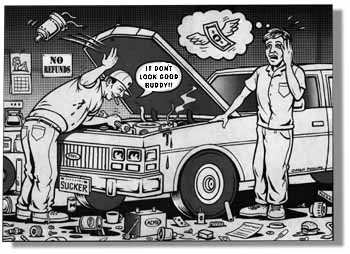
Dealerships can overcharge. But usually, they are more reputable and not just replacing parts because they have you over the barrel and have a bonus to make. These are the types who would convince your grandma she needs the blinker fluid filled and muffler bearings replaced. They aren’t technicians (they would too be ashamed of themselves if they were) and are basically just swindlers with a wretch to use as part of the scheme. Their diagnosis is always something expensive.

What Kind Of ‘Mechanic’ Is Your Doctor?

This understanding of different types of mechanics applies to all professions. Not every college graduate with the right credentials is equally qualified. Some engineers are really good at the classroom stuff, they know the code and can be completely anal about largely irrelevant or unimportant details. Others really get what makes structure work, it is intuitive to them, and what they build is likely safer than the variety that dots all of the I’s and crosses all the T’s according to the IBC 2021.

Doctors come in many varieties as well. There are those types who get into things like cosmetics or reconstructive surgeries, chasing after the big bucks, and then there are the others who want to run a clinic or set up a family practice to help as many people as possible. The country ‘doc’ driving the F-150 is a different breed than the one with a BMW or Porsche. One is practicing medicine, and the other has a profitable business that requires some medical skills. And, in both cases, competency is not strictly a matter of gathering the right diploma or getting through the board requirements.

My own hunch is that most doctors are more like the inspection shop mechanic. They’re not out to screw you over and they also do good work for the most part. However, they got where they did because they were at least of slightly average intelligence and good at navigating the system. This doesn’t mean that they are actually doing the real number crunching of the diagnostics themselves. No, it means that they can match a list of symptoms with what they can find in the Merck manual and write a (barely legible) prescription. This could mean that they miss things, over-prescribe, or basically share in the same failures as the entire medical establishment.

So, how reliable is the system?

Well, I’m not sure.

When I read things like, Why Most Published Research Findings Are False, and how the Lancet published (then later retracted) studies that cautioned against the use of Hydroxychloroquine or how Ivermectin was skewered as being “horse dewormer” despite being an effective anti-viral medication, it seems that politics may be dictating the science. And we all know that politics is heavily influenced by cold hard cash. So, let’s think, who benefits from keeping these kinds of cheap widely available therapeutics from the market? There was an industry that made $90 billion from the pandemic and also has connections to the corporate media apparatus. Who knows how far this big money penetrates government agencies and impacts regulations or policies.

But I do know this has been said…

“It is simply no longer possible to believe much of the clinical research that is published, or to rely on the judgment of trusted physicians or authoritative medical guidelines. I take no pleasure in this conclusion, which I reached slowly and reluctantly over my two decades as editor of The New England Journal of Medicine”

Marcia Angell, MD

And this…

“The case against science is straightforward: much of the scientific literature, perhaps half, may simply be untrue. Afflicted by studies with small sample sizes, tiny effects, invalid exploratory analyses, and flagrant conflicts of interest, together with an obsession for pursuing fashionable trends of dubious importance, science has taken a turn towards darkness”

Richard Horton, editor of The Lancet

I’m assuming these two would know a little about the current state of science and medicine.

So how does a doctor separate the wheat from the chaff?

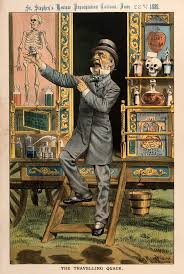
It is not right that some see the failures of some as a reason to dismiss it all. Getting taken advantage of by one repair shop doesn’t make all mechanics crooks. Still, how does a patient know if their doctor is doing a high-level analysis of the evidence, is capable of critical thinking and going beyond the book, or if he’s just following the pack without doing any truly independent diagnostics? It really takes someone a bit removed from the profession, who doesn’t share their biases or bad remedies, to give the corrective treatment. Maybe a car mechanic turned doctor (the guy in the featured picture) would have some useful perspective on the topic?

Whatever the case, if we can’t trust everyone who is licensed by the state to inspect vehicles, we should be even more skeptical of those who want to put things into our bodies. They don’t even have to be bad or intend harm, it could simply be that they are asleep at the wheel, putting trust in institutions that have been compromised and corrupted. At the very least, the body is extremely complicated and even our most advanced methods are crude. We may not know that our modern versions of bloodletting are of negligible value or even harmful for another century or two. This is why we customers, the patients, should never be pressured one way or another even if the science is supposedly settled.

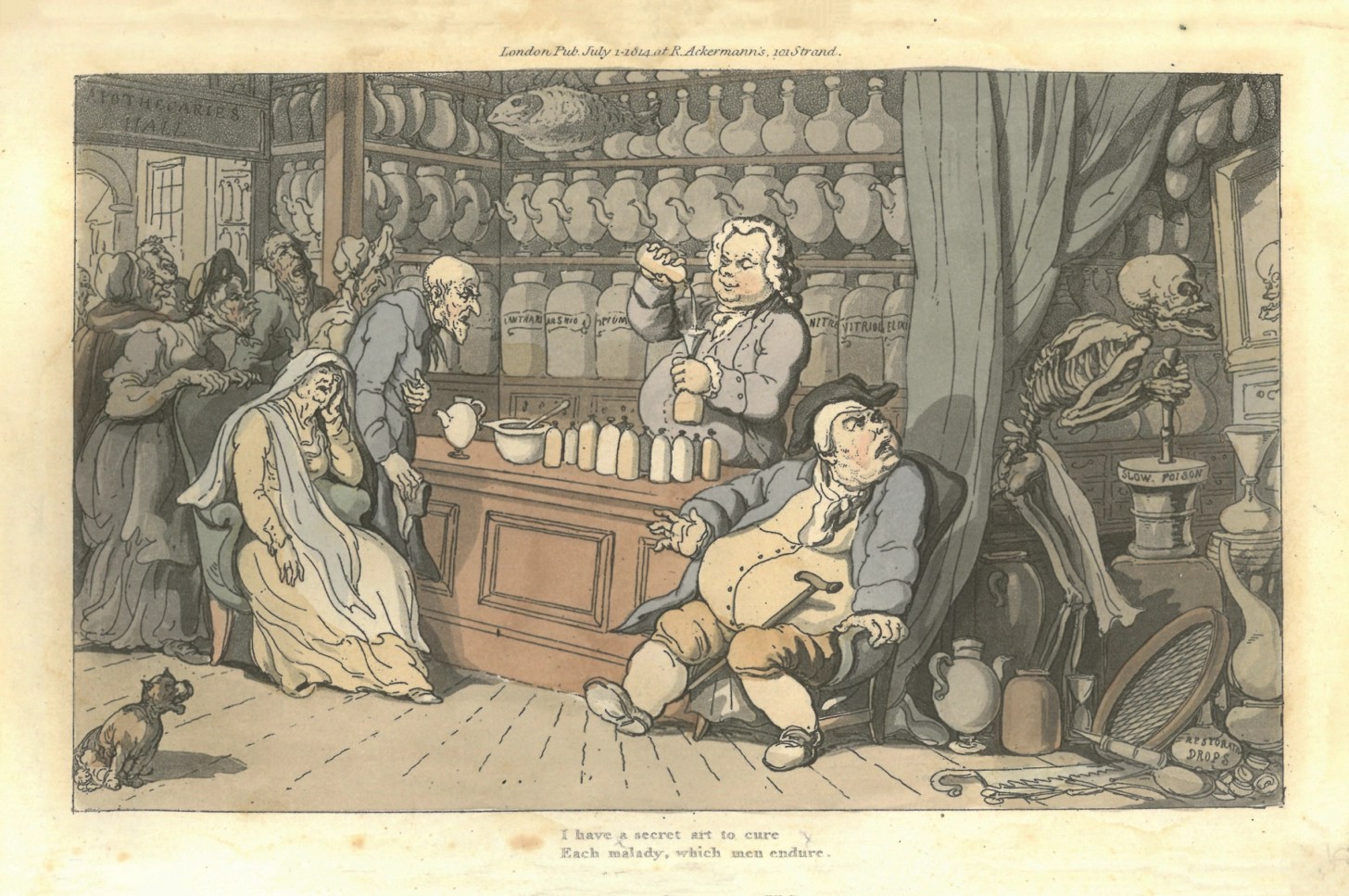
Yes, even those at the top of the profession today may be tomorrow’s quacks…

Note the “slow poison” written on the mixing device.

Forget Gas Stoves—Why Are Pets Legal?

Standard

The Biden administration has recently floated the idea of banning all gas stoves.  Richard Trumka Jr., son of the powerful union boss of the same name and nepotistic selection for Commissioner of the CPSC, has made this proposal and cited potential long-term health issues (due to using them in homes without proper ventilation) as the reason.  Very quickly, in the typical hive mind far-left fashion, various state governors have followed suit and very soon we can expect that Democrats will once again be limiting consumer choices.

When qualifications are more about favors to political cronies than expertise.

This move is more driven by the current climate change ideological cult than actual concern for people.  And the climate change hysteria is primarily driven by political propaganda rather than true science.  All of which has an underlying goal of giving more power and control to a few billionaires (who meet in Davos annually) and own many of our elected (or selected) leaders.

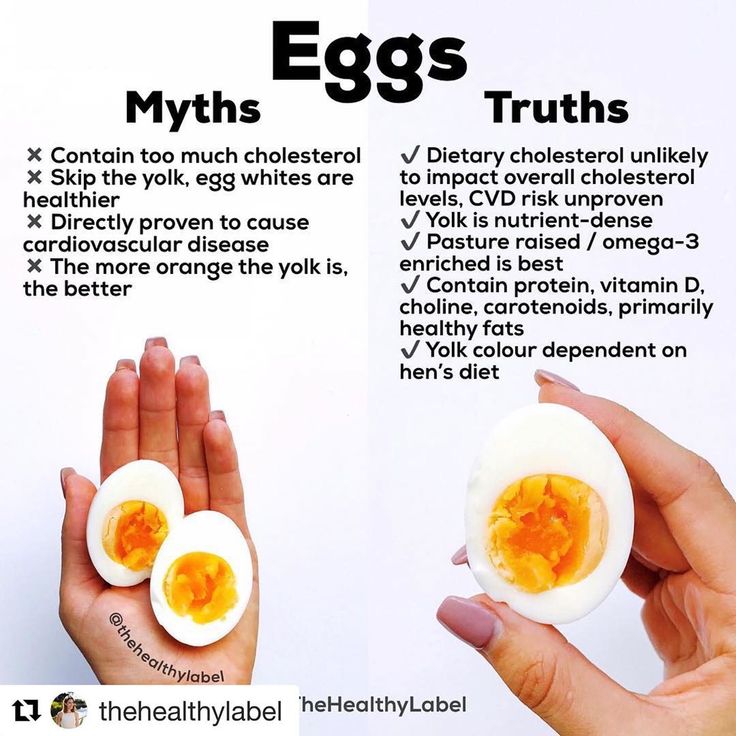
Another hidden reason for why now could be to lower gas prices to make exports to Europe viable.  Currently the billionaire owned world government, centered in the US and Western Europe, is at war with Russia and must keep gas dependent countries, like Germany, from total economic collapse due to untenable energy costs.  This would be manipulation similar to how the Lyndon B. Johnson administration deceptively used cholesterol warnings as an answer to an egg shortage and price inflation.

Eggs: Then and now

However, as a thought experiment: If we were to assume this is honestly about public health and climate change, not some cynical move motivated by geopolitics and commodities markets, why start with gas stoves?

Why not start with pets instead?

In this progressive age of believe science and consumer protection, can we really continue to ignore the well-established risks associated with pet ownership and especially the health risks to children?

Cull the Biological Menace: Save the Children!

Anyone who has had to clean cat poo deposited on the living room carpet has learned a hard lesson.  As cuddly and cute as these furballs seem to be, they are basically walking, sneezing, crapping, and puking biohazard containers. 

At risk of a fact-check claiming that cats also vomit on tile and linoleum.

The Chinese, during the Covid pandemic, knowing that pets were vectors of human disease, euthanized scores of dogs and cats as part of their pragmatic response to the pandemic.  And it just makes sense.  Pets are super-spreaders, next to impossible to mask properly, being exposed to their feces and urine can be dangerous, and that alone is a reason to ban these incubators of deadly disease.

A person who, as a result of exposure to cat excrement, has suffered from Toxoplasmosis, will think twice about having a pet in their home. 

Then there’s the issue of animals attacking humans.  It is terrifying to be out on a peaceful walk and suddenly be set upon by a snarling beast and knowing how many die from dog attacks.  The President’s own dog has bitten several people, and this is okay?  Dogs alone account for 4.5 million bites a year and many of the victims are our most vulnerable.  Think of the children! 

If we are to save grandma by wearing masks and getting mRNA injections, why allow these disease carrying clumps of cells (with claws and teeth) that serve no practical purpose and fit the definition of a parasite?

Add to all of that the unnecessary carbon footprint of Fido and Fifi.  Feeding and watering millions upon millions of animals used for human entertainment comes at an enormous environmental cost.  Many popular pets are fed with meats, which is especially burdensome, and will accelerate global cooling warming very scary climate change.  We must do the right thing for the planet!

And, more importantly, why are we allowing this obvious menace to continue when there are alternatives?

Pet Reform: The Green Answer

In the spirit of progressive politics and Democrat party paternalism, l propose that we introduce common sense pet reform and ban all emissions producing pets and replace them with purring and barking electronic animals.  There would be no need for kitty litter or toxic carpet cleaner after the transition.   The green alternatives could be programmed to only knock over household items at a safe predetermined rate and will attack only those who our wise and tolerant revolutionary leaders call Nazis.

Only shoots insurrections wearing MAGA hats, not a threat to humans.

Think of how many lives may be changed or improved by removing this pet-stilence!

It would protect children from pet allergies, dangerous infections, cat-induced insanity (could this impact female voting patterns?), and prevent spread of other serious diseases.  Just the elimination of bites leading to emergency room visits alone would justify this as a cost-saving measure.  During the Covid pandemic we were told that saving only one life justified every new mandate.  Has that ethical math changed?

If it antivaxx to oppose boosters that have only been tested on eight mice or dare to resist the products coming from a corporation staffed by those who make a very bold display of their questionable ethics to a date, then it is extremely anti-science to be in favor of pet ownership.  I mean, how many more studies do we need for these Neanderthals who think animal ownership is a right to understand, right? 

Is there a reasonable argument against banning pets?

Who Determines Acceptable Risk and How?

The point, of course, is that we accept the health risks of pets.  Why?  Well, many have decided that the intangible benefits of a living companion outweigh the risk to their own health and also that of the general public.  Sure, we do have leash laws and liabilities assessed when people who have pets do not take proper precautions. 

And no doubt pet ownership will be the next stop for the climate change alarmists, like the very privileged Greta Thunberg, when their handlers tell them this is the scientific consensus.   I mean, they’re already taking steps against farm animals and telling us to eat bugs as an alternative, do you think they’ll stop there?  Not a chance, if they get their way on gas stoves, soon pets will be only for elites.  These professional Karens, the petty administrative tyrants running this country, can’t be satisfied ever.  There’s no reasonable compromise with them.

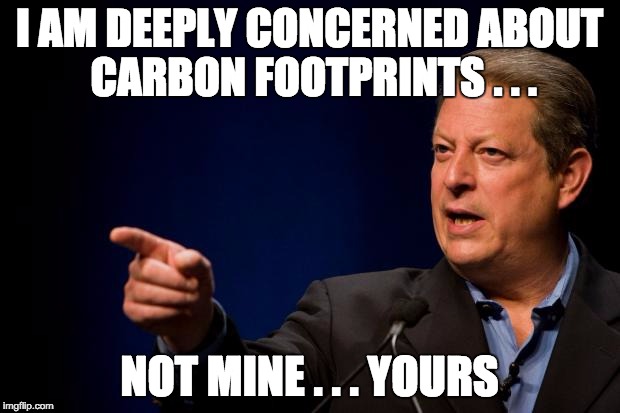
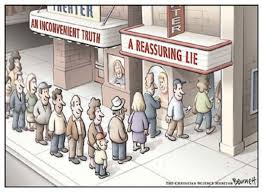
These bans in American politics stem from a Puritanical impulse.  It is the very same thing that was behind the Prohibition, this desire to control, often sold with some kind of apocalypse tied to it as justification.  Where it was once Johnathan Edwards preaching “Sinners in the Hands of an Angry God,” the early American sermon delivered in a monotone, it is Albert Gore’s “An Inconvenient Truth” for this new secular version of the same old cult religion.  We all must do our penance and pay the ministers of this new era—it is hard work to keep the population in line and in perpetual fear of destruction. 

Al Gore knows as much about science as a Televangelist knows about theology…

Banning gas stoves isn’t driven by science anymore than witch-hunts or eugenics. Sure, it is rationalized by their own beliefs about cherry-picked data and the purported implications. But water can be made to look awful if a person wants to make that case. It is the midwits, with rudimentary understanding of all things, that have this mistaken idea that life can be free of all risk, completely safe, and strive for perfect pure solutions. They accept the ‘experts’ opinion uncritically as if it is Gospel and become the “sources please” zealots which make truly intelligent conversation impossible.

Risk can’t be eliminated. Removing one risk only ever creates another. That is the real problem with complex systems. Poke in one place, to fix this problem, and the unintended consequences of a prescribed solution can vastly outweigh the benefits. The noxious invisible gas that is more a threat than nitrogen dioxide is the ceaseless and incurable arrogance of those who think it is their job to save the world or manage the lives of others. We cannot risk anymore of what remains of our freedom to please their whims, they will consume it all in the name of protection.

Of all tyrannies, a tyranny sincerely exercised for the good of its victims may be the most oppressive. It would be better to live under robber barons than under omnipotent moral busybodies. The robber baron’s cruelty may sometimes sleep, his cupidity may at some point be satiated; but those who torment us for our own good will torment us without end for they do so with the approval of their own conscience.

C. S. Lewis

Politicians have long abused science as a means to gain power for themselves. It is what had, a century ago, inspired notions of superior race and now is what arms a new generation of young activists—indoctrinated by leftist parents, mass media and their government funded schools. It is no different from any other moral panic where critical thinking made someone an enemy of the sanctimonious mob.

God, Suffering and Salvation

Standard

I have complete sympathy for atheists and agnostics.  I’ve wrestled with questions my entire life and whether or not there is a God is always one of them.  But the one thing that I can’t understand is being angry about human suffering, from a rational basis, if God does not exist.  If there is no ultimate good, no greater purpose or meaning to life, on what basis do we make a moral judgment about suffering?

Okay, let’s back up a second.  I’m here at my local establishment drinking another Long Island, one of many since the death of Uriah, and it hasn’t given me an answer as to why he would die of cancer at twenty-four.  The medical diagnosis is simple enough.  He had cancer.  The aggressive kind.  It started with the lump on his ankle during boot camp.  I still have the picture on my phone taken out of morbid curiosity and never dreaming it was a death sentence.

Uriah and I, despite our difference in age, got along in a way that only cousins do.  He was like me.  We didn’t simply accept those easy cliché answers.  He was someone who was both determined and also full of doubts.  He was also the six-foot tall and better version of everything I ever was.  The best part was that I could claim some of his success for myself given that I had encouraged him to continue his college education, telling him that it was better to keep going than to live a life of regrets.

Watching Uriah sacrifice a leg only to have the cancer be found in his lungs a year later. It was a gut punch.  I think I stopped praying, at some point, because I just knew what the prognosis was.  

The hardest part, however, is that Uriah was not the first of his family that I had to carry out of the church on a cold winter day.  His parents had already lost one of their children to a seizure disorder.  His two other siblings are severely disabled and will need constant care.  Judy, his mom, is an incredible woman and has extraordinary faith.  Ed too has great strength of character.  And neither of them wastes any time feeling sorry for themselves despite losing the one healthy child they had to this terrible disease.

Where was God?

When my little Saniyah died, unexpectedly, it was a really big struggle for me.  It took me years to get my feet back under me again, spiritually and emotionally speaking, and I had both doubted my own faith along with the existence of a loving God.  The death of Uriah, along with my disappointments with those whom I put my trust in, and my long wait for Charlotte, have really tested me the past few years.  But, I have those who need me to be strong this time around and, for this reason, have had to push back against falling into despair again.

Nevertheless, I totally get why someone who has encountered suffering in a personal way is angry and denies the existence of God on this basis.  I mean why would this kind of pain and loss be allowed if there is an all-powerful good in the universe, right?  Why would God not intervene and stop this all rather than let us go through such terrible experiences?  It doesn’t make much sense, does it, that we should be left so lonely and struggling if God is good.

However, if we eliminate totally God from the equation, then we dismiss religious morality and must acknowledge that there is nothing written in the fabric of the universe that says our existence entitles us to good feelings.  I mean, as far as evolution goes, pain is more or less a survival tool, a feedback system to tell us what to avoid.  Feeling sad about the death of a friend or family member is, by this logic, a malfunction. 

In this harsh environment, where everything is out to kill us, why would we ever expect anything more than suffering?

The moral reasoning that makes this bad, if you are truly an atheist, is nothing other than a construct.  In terms of pure biology, it is good that fire hurts or we might burn our arms off.  That is pain for a very practical and utilitarian purpose.  Undeniably good if there is such a thing.  But what reasonable good is there in mourning those already dead?  No point in crying over spilled milk, right?  A totally rational being would simply move on to the next social resource and not be so attached or sentimental.

Being upset over suffering and death, if there is no God, is irrational.  And, if there is a God, like that of Christianity, then suffering and death are exactly what we’re promised in this life.  Sheesh.  Did you read the story of Jesus and how he was betrayed, beaten, and then unjustly killed in the most brutal fashion all as part of a redemptive plan?  If you actually believe in eternity then why be angry about a few years living out this rich narrative we call life? 

At the very least, how can we judge anything, especially a fictional character, on the basis of a moral standard that doesn’t exist? 

If there is no God, then there is no basis for morality either.  That too, including the idea that suffering is bad or pleasure is good, is entirely a construct.  Pain is good in some circumstances, it protects us from injury and causes us to change behavior in ways that are beneficial.  In other words, without the discomfort of hunger or thirst, we would not correctly prioritize our life.  Pleasure can be bad when it makes us eat too many donuts and become diabetic.  So how does one truly know that their own interpretation of these signals is the correct one?

From what I’ve observed in myself and in others, unbelief stems from disappointment when things do not go as expected.  It is about who is in control.  We can cling, in our own arrogance, to this notion that the universe should bend to our will.  Or realize that our own perceptions, based on senses which are not very reliable and a brain prone to making mistakes in judgment, are not infallible or ever actual truth.

The thing is we only ever know if suffering is good or bad if it is properly contextualized if we understand the end.  For example, feeling the burn of exercise is good pain because it is what accompanies muscle development and so we embrace this.  So what is the real context of our life?  To what end, or for what reason, did we become conscious?  What is behind this ‘accident’ if it is one? 

How do we contextualize our existence enough to judge what is good or bad?

If there is such a thing as an eternal reward, that would change the calculus, right?  It would mean that all pain can be gain, and all suffering can draw us closer as much as it drives us away because defining the moral character of any experience depends on the end.  I am willing to subject myself to many hardships if the reward is big enough.  No, this doesn’t take away the question of why we must go through here to get there.  But seeing past our immediate feelings is pretty much the only way to make progress.

Angry is a feeling, not a guide for life…

I was at this time living, like so many Atheists or Antitheists, in a whirl of contradictions. I maintained that God did not exist. I was also very angry with God for not existing. I was equally angry with Him for creating a world.

C.S. Lewis

People don’t walk away from Christianity for rational or scientific reasons.  Sure, they may guard their emotion-based unbelief behind a wall of post hoc justification.  But the reality is that they’re upset about something.  They had expectations and are now disappointed and acting as wounded people do.  It’s just strange that anyone at all Biblically literate would suddenly lose faith over our suffering when that’s literally the only we’re promised in this life.

What really doesn’t make any sense is why anyone would rather suffer with no hope at all of eternity.  If God is dead, then nihilism is the logical next stop and that life has no real meaning or purpose.  But the suffering does not go away simply because we’re angry at the giver of life.  No, it will only intensify and become a spiral of despair.  Our salvation is in our understanding that, smart as we may think we are, we’re truly quite ignorant and even our most ‘concrete’ reality is not real:

The first gulp from the glass of natural sciences will turn you into an atheist, but at the bottom of the glass God is waiting for you. 

Werner Heisenberg

For those who don’t know who that is, Mr. Heisenberg was awarded the Nobel Prize in Physics, in 1932, for the creation of quantum mechanics.  Materialism, despite the zombie corpse of this thing staggering on, died with the discovery of things in defiance of this entirely too simplistic conception.  Sure, this kind of physics is well-beyond most, but it does support a notion of reality that requires a Universal Perceiver (as described in this article) and we could call that God.

So, if you’re actually serious about science, then the hard science of physics is the place to start and, with its mathematical origin and proofs, is much less likely to be clouded by emotion one way or another.  We can’t run from God.  But we may need to leave behind the baggage of our own misconceptions and learn the value of true repentance.  Maybe Uriah died, and went to his reward, so some of us would have our flawed thinking broken and seek our salvation in Him?

Maybe some of us are just too stubborn, or too needing of control being in our own hands, to admit we can’t save ourselves?

I’ll tell you this.  The universe, without God, is an infinitely dark and lonely place.  It is that starring abyss of which Friedrich Nietzsche warned, the existential horror H.P. Lovecraft describes.  Highly intelligent men, both of them, and understood the implications that come with true unbelief in God.  You will not escape your suffering simply by denying that the Divine all-powerful good exists.  No, rather you will just remain in that hell of your own creation.

Postscript: Questions Remain

I still grieve Uriah, as I do Saniyah, uncle Roland, and others that seem to have been taken before their time. I’ve long struggled against sources of trauma much more basic, the lack of unconditional love in the church that could make up for my shortcomings, and much of that is unresolved. At the time of my writing, the impossibility is something yet to be fulfilled. I do not have answers for any of this nor do I expect to. I’m not the arrogant kid who argued with his high school biology teacher, not a Bible-thumping fundamentalist at all, and yet must believe.

Will the Real Quacks Please Stand Up!

Standard

I’ve never been much of a fan of alternative medicine and those peddling their cure-all treatments.  For one, their typical pitch being an attack an the profits of conventional medicine is actually a red flag about their own motives. 

And, secondly, testimonials (or anecdotes) are fabulously awful evidence.  A person can say anything they want or attribute their current positive feelings to whatever, but it doesn’t mean their A led to B assessment is actually correct. 

Unless there is concrete evidence, I dismiss the alternative quacks.  Sorry, I simply do not want to take or sell your mystery juice.  It is disturbing that so many can’t see through this kind of nonsense.

But what is far more disturbing?  

When the mainstream starts to resemble these frauds.  

Yes, it is obvious that modern medicine works.  My successful neck surgery as proof of this.  There were measurable results nearly overnight, almost immediate relief to pain and the numbness.  The whole process was very straightforward.  However, that was a cut and dried form of treatment.  In that they took the old broken stuff out, put some new hardware in, and gave my pinched nerves a chance to heal.  

And yet, while it is amazing what can be done, not everything in our human biology is as simple as disks and vertebrae. 

Indeed, there is a murkier side to modern medicine, things that aren’t 100% clear even after many years of study, having to do with the more complex parts of our physiology and how these systems interact, and this is something that must be explored.  More than that, however, our own psychology, tendencies towards bias, could be leading the collective enterprise in the wrong direction.

#1) Money Money Everywhere 

The first stop is profit motive.  If I don’t mention this then someone else will.  It is the low hanging fruit in this discussion and certainly a factor.  People need paid, and medical professionals get paid for treating disease.  Healthcare is a 4.1 trillion dollar industry in the US and pharmaceuticals are a significant part of that overall cost.  Does this mean that the medical establishment wants to keep us sick and dependent?

Public health officials and regulatory bodies are, indeed, potentially compromised by this opportunity to cash in.  Top US physician, Dr. Anthony Fauci had received undisclosed royalties, part of the $350 million paid by third-parties to NIH and scientists employed by this agency.  No, this isn’t itself proof of corruption, people should get paid for their contributions and lobbyists may very well believe in what they’re promoting.  But there is the reality that money can overrule ethics and potentially cause people to turn a blind eye to problems.

Still, this is not my go-to explanation and for the simple reason that this accusation could be made against any for-profit enterprise.  I work for a truss manufacturing company and we do profit off of fire jobs and wind damage.  Does that mean we intentionally set fires or build an inferior product so it fails every ten years?  Absolutely not!  To make such a claim is, again, more an indication of the heart of the person making it and not proof of anything unless there’s clear evidence.

#2) Testing 1, 2…Good Enough…

Testing and peer-review is also one of those areas of concern as well.  And not because there is nefarious intent either.  But more a matter of scope or methodologies. 

My neck surgeon, for example, opted out of being a participant in a study involving a new line of disk replacement hardware because it was comparing it to a far inferior older product rather than newer better products already available.  In other words, it was a stacked deck or research that is designed to lead to a particular conclusion.

That’s the big problem I have with these broad often unqualified “safe and effective” claims.  It begs the question: Compared to what?  Bungee jumping?  A placebo? 

Most people, including physicians and scientists, simply do not have the time to be experts at everything.  The body is incredibly complex and nobody can actually do their own scientific research for every issue.  For that reason those in the medical field must, as a matter of practicality, rely on diagnostic manuals for treatment and various journals to stay on top of things.  Coloring outside the lines, challenging powerful government agencies, doing unproven or experimental treatments, is a risk of their license or a malpractice lawsuit and ill-advised.  There is an inherent need for those employed in these fields to trust the system and accept what other professionals do. 

If not this, if  their training and education, what else are they going to rely on?

I don’t expect those employed in the medical industry to doubt the very foundation that they stand on. 

Unfortunately, this reality is what makes their consensus useless.  Sure, they might know much more than the average person about the science.  Still, are they up all night, in the laboratory, carefully repeating the results of the latest studies themselves?  No, when other experts in related fields endorse what another expert is saying it is merely a sign of statement of their faith—that being their faith in the overall system.  

But it seems every other week a study comes out that seems to contradict prior findings.  Most of this is due to how limited the focus of research actually is.  They can’t possibly test every variable and especially not in a very short amount of time.  This reality, of finite resources, is a legitimate cause for healthy skepticism and abundance of caution.  The problem is that most people, including those well-educated, don’t have great critical thinking skills or even the ability to know the right questions to ask—it is far easier to “trust the experts” and go with the program.

#3) Confirmation Bias Is Always a Problem 

The problem with research is that we often go in looking for a particular result.  Sure, a double blind study is designed to reduce this as a factor.  However, the underlying bias can show up as far as what gets tested and what does not.  It can also be a factor in how we interpret the data available.  Group think and echo chambers, things like functional fixedness, are as much (or more) a problem with those very knowledgeable as it is with anyone else.

One example of this is how “effective” kept getting redefined down.  What once was supposed to prevent the disease and stop the spread would shift, overnight, to being a way to merely lessen the severity of the symptoms.  Which is a foundation so subjective and shaky that it is basically in the same category of the testimonials used by snake oil salesmen.  It is another area where the studies aren’t as conclusive as many would assume.  And, at the very least, correlation does not equal causation.  In other words, the vaccines could simply be acting as a placebo for those who believe that they are effective. 

What is not taken into proper account is how these perceived benefits, that are shrinking day by day, weigh against both short and long-term risks. 

For example, someone very dear to me, fully vaccinated, boosted, is currently suffering from a persistent respiratory illness, starting a month or so ago, and now is having flu-like symptoms again.  Could this be this is a result of an immunosuppressant effect of the injection?  It sure does appear that way and would be worthy of a study of the things presumed to be unrelated to the vaccines that very well may be related.  There is only a trickle of information coming out, discussion of side-effects buried in the search results and censored on social media.

What is most unsettling is the reality that our mainstream medical establishment is as prone to confirmation bias as those pushing alternatives.  They see what they want to see in the evidence and dismiss or downplay anything that contradicts what they were expecting to see.  The biggest difference is that it is more convoluted than it is with the obvious quacks, whole institutions get on board with a solution and too often it just gets cycled through, reinforced in each cycle, without enough awareness of the potential failure due to the blinders we all wear.

#4) Political Bias Is Endemic

One of the most troubling revelations of the past few years was how awfully politicized the coverage of a pandemic was. Anyone who thought that partisan differences would disappear in times of a national crisis was dead wrong.  If anything it is what likely drove much of the response.  At first leading to charges of racism (for travel restrictions from the virus epicenter) and accusations of over-hyping the threat of Covid—before swinging wildly in the other direction with onerous state-level mandates that destroyed great economy on the eve of a national election.

But one of the most disturbing episodes (and disgusting) is how proven medications, like hydroxychloroquine and Ivermectin, were treated as if they were especially dangerous and controversial simply because the ‘wrong’ person mentioned their potential as being a treatment option.  It is truly a great way of explaining how propaganda works.  The partisan media would pick the most extreme case of an overdose, ridicule a proven multi-use medicine as “horse dewormer” despite the many uses, and then misleadingly ‘fact-check’ the technicalities of language.

I mean, sure, these proven medications do not “cure” the disease.  But they are most certainly treatments that are effective for preventing severe symptoms if taken prior to the infection taking hold.  This is why several older doctors that I know (whom I will not mention by name for their protection) were quietly stockpiling these much maligned substances.  They didn’t dare speak too loudly either or they would be risk their own medical licenses for promoting unproven cures or some other nonsense.  Bullying and peer-pressure is as real for a professional as it is for anyone else.

This, along with other much more expensive (and profitable) treatments being pushed, is fodder for the conspiracy theory crowd and for good reason.  For me it disproves any notion that the system we rely on, including the medical establishment, is impartial or fair.  Sure, I’m glad that The Lancet, a trusted medical journal, eventually retracted a study that falsely claimed that hydroxychloroquine led to death for some Covid patients (as they have with another study linking vaccines to autism) and yet the damage was already done.

#5) Lost in Oversimplification 

One of the harder or more difficult problems to explain is how the common models of are often too dumbed down to be accurate.  

Up until recently depression was explained as being “chemical imbalances in the brain” and selective serotonin reuptake inhibitors (SSRIs) the solution.  This overly simplistic explanation has been called into question and this is a cause of alarm for those told to “trust the science” when it comes to the professionally prescribed answers.

I love metaphor and analogy to explain things less visible or intuitive.  However, if these tools are misunderstood as being exactly the same as the thing being described this can lead to very wrong conclusions. 

Just like a ball and stick model of atoms is useful yet doesn’t truly explain the reality (an electron is more cloud of probabilities), the various illusions used to sell parts of the pandemic response are as flawed.

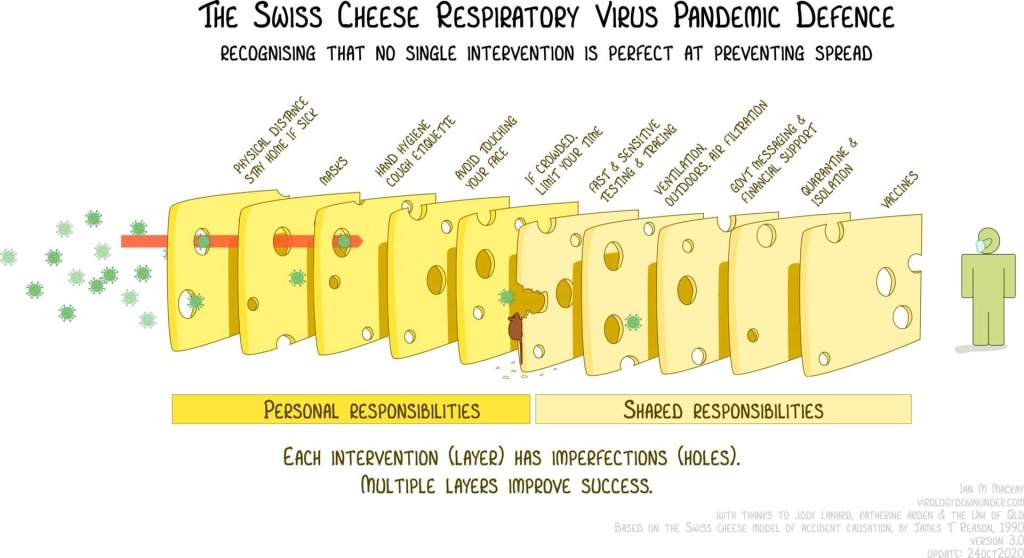
Sure, the theory of “flattening the curve” is great on a graph, and swiss cheese makes a very compelling illustration of how a multi-faceted approach could work, in theory, but both give a false impression of being complete or unquestionable. 

But is this theory working in reality?

Of course, how diseases spread in the real world is different from the even the best models and it is quite possible that slowing the spread only makes things worse, as is the case with attempts to manage forest fires. In that effort to control can eventually lead to much more devastating fires. Slowing down the process could result in a scenario where the burn is thorough, everything gets consumed, rather than the alternative of a fire that moves quickly and skips over areas.  The point being that analogies don’t account for the nuances and could lead to the wrong ideas taking hold in the public imagination.

No, this is not to claim that I have a better grasp of virology than those who have studied these things their entire lives.  It is only to say that these illustrations give too many undue confidence.  There are many factors that these crude analogies gloss over and factors that could vastly change the final outcomes.  The problem is that many are unable to see the more complex picture as a result of these elementary level descriptions that are used to sell a particular approach.

It makes us unbalanced.

In Conclusion…

There is no individual that can provide an opinion that is completely infallible nor any agency that is able to offer a perspective free blindspots or bias. 

Our “settled science” today make seem as bloodletting in a generation or two.  And the same kind of thinking that leads crackpots to their ‘alternatives’ is also all too present in the mainstream.  There is always the money motive, with the lack of adequate testing, the confirmation bias, the influence political agenda and faulty or misleading explanation, all tainting both the perception of the general public and professional opinion.  The biggest difference between those who believe the quacks and those who insist that the vaccine is effective is the level of funding behind their perspectives.

This doesn’t put the outliers and mainstream on equal footing, there is such thing as strength in numbers, yet what is popular is sometimes only a product of propaganda and common ignorance. 

Don’t be so sure that the things being ridiculed in the current paradigm are any different from what is being promoted.  We know less than many think we know.  There may be future studies or new discoveries that will completely upended the too hasty conclusions of our time. 

No matter how confident we are in our own position or settled we believe a topic is, it is always best to stay humble.

Evolution: From Genesis To the Gospels

Standard

If you read the Gospel narratives and get to the end of these books, you come across some very interesting passages.  It is after the resurrection and right before Jesus ascends that we read this:

Again Jesus said, “Peace be with you! As the Father has sent me, I am sending you.” And with that he breathed on them and said, “Receive the Holy Spirit. If you forgive anyone’s sins, their sins are forgiven; if you do not forgive them, they are not forgiven.” 

(John 20:21-23 NIV)

And according to St. Luke:

Then he opened their minds so they could understand the Scriptures. 

(Luke 24:45 NIV)

What strikes me, in both passages, is how this final transformative step took place after a long-drawn-out process of teaching and showing by example.  Why go through this protracted effort if ultimately their minds needed to be opened by the Holy Spirit?

Furthermore, why even go through the centuries, from the time of Abraham on, leading these stubborn Israelite people, if the real plan is to send Jesus and rely on the power of the Holy Spirit?  If all of this eighth day of creation could have been accomplished with God merely saying the word, why not skip steps A to Z or cut to the chase?

In the Beginning…

There are many who believe that anything other than a ‘literal’ interpretation of the word days in the first chapters of Genesis takes away from God’s power.  In their mind it must be twenty-four-hour, the earth spinning a full rotation on its axis, days and nothing else.

Of course, knowing the little I do about language, and how words like “gay” can evolve from happy to men who prefer men, it makes very little sense to die on the hill of one particular translation from archaic language.  It does not seem necessary to turn this into an either/or and especially considering that none of us were there to witness the events described.  There is a sort of poetic metre to the opening chapter of Genesis, it could certainly suggest we could see this as a summary rather than something exhaustive.

All that the long way around to saying that this opening act of Scripture culminates at this moment:

Then the Lord God formed a man from the dust of the ground and breathed into his nostrils the breath of life, and the man became a living being. 

(Genesis 2:7 NIV)
Creation of Adam, mosaic, 12th century. Monreale, Cathedral

The interesting part is that this is the second account of the creation of man, whereas this is the first version of this significant event:

Then God said, “Let us make mankind in our image, in our likeness, so that they may rule over the fish in the sea and the birds in the sky, over the livestock and all the wild animals, and over all the creatures that move along the ground.” So God created mankind in his own image, in the image of God he created them; male and female he created them. 

(Genesis 1:26‭-‬27 NIV)

In the above account we have both male and female, or mankind, being created simultaneously on the “sixth day” and yet in the very next chapter we have Adam naming all of the animals, not finding a suitable match for himself amongst all of the creation, and this *before* Eve being formed.  At best that was one heck of a long day, at worse the first two chapters of the Bible directly contradict each other.

Of course, then we get into what a “day” really is without a sun, as celestial bodies weren’t created until the fourth day according to the Genesis account.  Time is not some immutable thing, it passes faster and slower depending on the reference frame, the Palmist tells us that a thousand years is as a day from God’s perspective.  So I’m not sure what is gained by insisting on the one interpretation that most conflicts with the scientific evidence.

A Biblical Preference for Process

It does not take a deep dive into theology to realize the importance of ritual.  Whether Namaan’s seven dips in the river Jordan before being healed, the march seven times around the walls of Jericho before they fell, or Jesus spitting in mud and rubbing it into a blind man’s eyes before the miraculous, there’s a distinct pattern of the creation doing and the God coming through to complete the work.

Maybe the repeating record of Scripture is trying to tell us something?

First, the elongated process does not eliminate or even diminish God.  Sure, many of us want immediate results, we want everything to materialize, fully formed, rather than have to wait days, weeks, or years.  And many do conclude after a prayer is not immediately answered or according to their own timeline, that this does rule out the possibility of God.  But the clear Biblical pattern is that everything is always in the fullness of time:

So also, when we were underage, we were in slavery under the elemental spiritual forces of the world. But when the set time had fully come, God sent his Son, born of a woman, born under the law, to redeem those under the law, that we might receive adoption to sonship.

(Galatians 4:3‭-‬5 NIV)

St. Paul likens the spiritual transformation, made possible through Christ, to the two sons of Abraham—one of them the result of rushing the process and the other of truly Divine origin.  The law is a foundation and yet not the fullness or complete fulfillment.  Even now, even for the believer, we know we are not a completed work until that day we hear “well done, good and faithful servant!”

Cutting to the chase, the “formed a man from the dust” of Genesis doesn’t tell us much about the process behind that formation.  But the “breathed into his nostrils the breath of life” of Genesis does parallel with “he breathed on them”  in the Gospel of John.  The disciples, like Adam, had some kind of form prior to this transformation and enhanced spiritual life.  The time they had spent with Jesus prior to their mind being opened was not purposeless.

God could have created without a process.  Still, the overwhelming pattern appears to be that God catalyzes things that are already underway or set in motion.  It would therefore not be all that surprising if forming out of dust alludes to an evolutionary process, which was finalized in Adam and this special spiritual life breathed into him.

What Makes Us More Than Animals?  

Truly, in terms of biology, we aren’t different from animals, we have instincts that drive us, and can lose our humanity too.  Indeed, we can be degraded to an animalistic existence through our actions and lose that element of being created in the image of God:

But these people blaspheme in matters they do not understand. They are like unreasoning animals, creatures of instinct, born only to be caught and destroyed, and like animals they too will perish. 

(2 Peter 2:12 NIV)

So the Bible tells us about evolution (and de-evolution) from the perishable fleshly form or physical body to those are quickened in spirit and being transformed:

So will it be with the resurrection of the dead. The body that is sown is perishable, it is raised imperishable; it is sown in dishonor, it is raised in glory; it is sown in weakness, it is raised in power; it is sown a natural body, it is raised a spiritual body. If there is a natural body, there is also a spiritual body. So it is written: “The first man Adam became a living being”; the last Adam, a life-giving spirit. The spiritual did not come first, but the natural, and after that the spiritual. The first man was of the dust of the earth; the second man is of heaven. As was the earthly man, so are those who are of the earth; and as is the heavenly man, so also are those who are of heaven. And just as we have borne the image of the earthly man, so shall we bear the image of the heavenly man. I declare to you, brothers and sisters, that flesh and blood cannot inherit the kingdom of God, nor does the perishable inherit the imperishable. 

(1 Corinthians 15:42‭-‬50 NIV)

It is this spiritual component—this ‘breath’ of God both in Genesis and the end of the Gospels—that sets us apart from the animal.  We’re essentially on the same journey as Pinocchio, who wanted to be a real boy, in this pursuit of the Divine transformation.  We have evolved, even if not in the Darwinian sense, from that first cell in our mother’s womb to the learning of our childhood, and this is a creative process guided by the Holy Spirit from start to finish.

Icon of Jesus pulling Adam and Eve out of the grave on the mystical eighth day of creation, which is to say His victory over death and the resurrection of the dead.

[Don’t] Trust The Narrative

Standard

The truth of a story is not proportional to our investment in it.  The Marvel Cinematic Universe, for example, is a movie franchise worth nearly 23 billion dollars and has no basis reality other than locations.  And still, despite being complete fiction, people are obsessed.  We treat the characters as if they’re real, repeat their lines, cosplay to participate in the fantasy, and it does seem that many would rather be lost in this exciting world of make-believe than live their actual lives.

It is really interesting how outside observers of religions (other than their own) have no difficulty dismissing the beliefs and practices.  The claims of L. Ron Hubbard, or Joseph Smith, or Muhammad ibn Abdullah aren’t all that compelling to non-adherents.  I mean, come on, riding through the sky on a horse with a woman’s head and the tail of a peacock sounds more like a crazy acid trip than something to take seriously, right?  But for this raised in an Islamic country, this makes more sense than Trinity or resurrection.

I’m quite certain that the Biblical narrative, whether Genesis or the Gospels, would have been far less believable had I not been indoctrinated as a child.  I mean, it made sense to me then.  My parents and every other respectable adult that I knew held to this belief system.  It would actually be rather strange had I rejected this outright.  It was only later that the vast differences between even various Mennonite sects, and facing challenges to my assumptions, that I even knew how to question.

Of course, this doesn’t make those raised outside of organized religion any more rational.  Secular ideas, like Evolution and Global Warming, have taken on their own narrative framework, similar to religion, that far exceeds the actual evidence.  Not all of the gaps can be explained by Natural Selection.  And climate apocalypticism has strange similarities to the “end times” prophecies common with many caught up in Evangelicalism.  Al Gore is basically Harold Camping with corporate sponsorship.

Most of these narratives can’t be entirely falsified.  The decades and decades of dire predictions from climate alarmists haven’t come true, yet they keep moving the goal posts, even making claims in contradiction to those prior, and the next generation of conscientious young people are none the wiser.  Likewise, the doctrines and practices of traditional religions evolve and get twisted every which way, to the point that you can’t get people raised in the same denomination to agree.  

The strangest thing is how these various movements never die even when their claims are falsified.  For example, the Seventh-day Adventists arose from the false Millerite prophecy that Jesus would return on October 22, 1844.  The date came and went without event.  But, despite this Great Disappointment, some who saw their central claim proven false still regrouped and continued on their way again.  Perhaps the investment made was too much to simply give it up?  

It’s sort of like I don’t expect the “believe science” midwits to ever comprehend how many times the experts get it wrong or reconsider.  They’ll probably go on praising Dr. Fauci as a saint even after the puppy experimentation scandal, even after the NIH now admits to funding of gain-of-function research, and probably because it would cause too much discomfort to consider that their trust may have been misplaced.

It takes a boatload of evidence to overturn these narratives we have built up in our minds.  Bad ideas, like Marxism, even if they fail miserably in one place, are often recycled and reintroduced.  At the same time, credit for plain luck is given to whatever a person wants to have credit.  A boom economy, with the President you voted for, and it is obviously a product of wise leadership, right?  The sun came up right after you prayed?  Must be the grace of God.

All religion, all political ideologies, the trust we have in certain institutions or people, is part of our embracing narratives.  Whether you believe vaccines cause autism or ended Polio depends more on who (or what) you accept as an authority than the actual evidence.  Past narratives might seem irrational to you, like the idea that autism was caused by “refrigerator moms,” yet made complete sense to many influential and intelligent ‘scientific’ people at one time.  Those who go against the currently popular ‘expert’ consensus can expect persecution.

All this to say that we aren’t as good at discerning truth as we imagine.  In many cases what we believe is nearly as much fiction as Captain America fighting against Hydra.  It isn’t just the conspiracy theorist kooks buying into narratives despite evidence to the contrary, we all do, we all believe a blend of religious propaganda, political indoctrination, and out-of-context or unqualified facts stitched together, and much of it as absurd as the narratives we reject.

My Suspicions Confirmed

Standard

I’ll have to concede, I was wrong about face masks.  Early in the pandemic, in January of 2020 while the corporate media ‘experts’ were saying that we should be more concerned about the seasonal flu.  I was worried about this mystery virus in Wuhan and decided to get a box of N95 masks in case my fears were confirmed.  I was ridiculed, at the time, for my warnings and telling people to be prepared.

Months later, as the “no human-to-human transmission” claim of WHO became too obviously false to ignore and the glib urgings of politicians for their constituents to visit China were replaced with terror, that confirmed my warnings.  But now, with mask mandates and recommendations rolling out, many friends began to resist the idea.  They weren’t going to wear a “face diaper” and ridiculed the idea that a bit of cloth would be effective against a virus.

Of course, they were a little right, cloth masks aren’t at all effective against stopping the spread of the virus and now the corporate media is finally conceding this.  But still, based on laboratory experiments and filtration level, I believed my N95 masks were effective.  However, laboratory conditions are not the real world and, eventually, even that became a question mark for me.  Many countries also require facemasks with the masks because the masks are not adequate.

A few weeks ago, I may have overstated, I said that masks were completely ineffective at stopping the spread.  Technically correct since the virus spread as much (or even more) in states with strict requirements and yet I’ve also ran into some convincing data that suggests the good masks, the N95’s with a decent seal, may make an 10% difference overall.  So on this basis I’ll admit there could be marginal benefit.

The Wishy-washy Way To Truth

Many people, once they’ve made up their minds, never reconsider their stance.  If they believe masks are stupid then they will use every excuse in the book not to wear one.  I’ve heard them all.  The fear about being dehumanized.  That breathing carbon dioxide is dangerous.  But then they’ll contradict by calling people who disagree “sheeple” and claiming that something that can stop carbon dioxide from leaving can’t stop a virus from entering, hmm?

This is called confirmation bias.  People are emotionally invested in their ideas.  It is not easy to admit being wrong after making strong statements one way or another. So, rather than be on an unbending quest for the truth, most people (including your’s truly) will seek out the information that ‘confirms’ an established position and ignore what does not.  It takes much more effort to take an honest (and critical) look at the evidence and go wherever it leads.  Few actually do.

Confirmation (or my side) bias is powerful because it is hidden under layers of fact and explanation that sounds rational.  The position being guarded seems completely reasonable to the holder of the opinion, in their eyes they own the moral high ground, and those who disagree are simply ignorant, selfish or otherwise deficiencient.  It is often this moral stake in the ground that makes it so hard to back off from an established opinion, we would rather continue in the righteous delusion than deal with the possibility the other side was right.

As the saying goes, “a man convinced against his will is of the same opinion still.”  Even a mountain of evidence cannot uproot an established position.  It is the same as a fortification on a hill that can hold off waves of an assault with few defenders.  That hill being our ego, the banner flying our identity, and we cling to this ground because to lose it would cause us to question ourselves, ask the hard questions of if we are truly virtuous and good, if we are actually intelligent or fooled by our own desire to be right?

It is far easier to remain in the comfort of our own righteous delusion than to consider that the very foundation of our citadel of reason could be sand.  We fear changing our perspective will mean we’re wishy-washy or, worse, might require us to examine the underpinnings of other long held beliefs and leave us with no bedrock to build on.  Most of all, we fear the ridicule and abuse of our ideological enemies, we can’t let them win!

Powerful Propaganda to Innoculate the Masses

The point of propaganda is to build confirmation bias.  The propagandist tries to encourage an emotional bond to an idea, often through appeals to popular prejudice, and yet not overtly or in a way that the targets know they’re being used.  Almost every war is fought for the financial benefit of a few and yet sold as some righteous common cause.

For example, both sides of the American Civil War felt they were fighting for civil rights.  Both sides used labor that was either property outright or treated like a rented mule.  The Northern elites, for all their moralizing abolitionist hubris, depended on an industrial machine that exploited poor European immigrants, taking them right off the boat to send into dark mines, dangerous factory conditions or conscript them into the meat grinder of Lincoln’s war.  The South, obviously, was fighting for the privilege of the slaveholding elites and yet convinced they were depending themselves from Northern tyranny and aggression.

Propaganda is about framing an issue in terms favorable to a particular side without ever appearing to be biased to the target audience.  It is subversive by design, aims to overwhelm the true complexity of debatable mathers with simple sloganeering, refrains meant to be picked up by the midwits in media and then spread by the unsuspecting masses.  The point is to convince the enforcers of the order, the common folk, that they are doing God’s work, being patriots, on the side of irrefutable science or what have you, when in reality they’re serving some undisclosed agenda.

Hitler did not rise to power by being the caricature of evil that we see him as on the other side of the conflict.  No, rather, he had convinced enough of the German people that he was on the side of progress, that he would remove the causes of disease and suffering, then build their country back better than ever.  The Nazis dressed up in a magnificent authoritarian style, it might look bad in retrospect, knowing where it was leading, yet was hope for a nation emerging from years of crisis.

The Safe and Effective Deception

As part of the propaganda campaign, to convince people to inject the controversial new vaccines, news articles repeated the “safe and effective” mantra over and over again.  Both of those words are, of course, subjective.  However, they are assuring and have a sort of sophisticated ring.  Surely this sort of confident declaration is the result of rigorous science and more or less an unquestionable truth, right?

Those in support of vaccine mandates completely ignore the known risks, Big Tech monopolies literally removing groups of people who had encountered adverse effects, and seem to have no awareness of the great potential of unknown risks that come with any new technology hastily introduced.  I mean, somehow the 737 Max got through the approval process, was essentially declared safe and effective, despite a serious defect.  So, in short, we can’t possibly know that there are no long-term health consequences of these experimental vaccines and are only now starting to study that potential.  

But the thing most egregious propaganda is not the downplaying and dismissal of the documented deaths or reasonable concerns of those who have studied history enough to know how quickly narratives change.  They are simultaneously attacking treatment options, like Ivermectin, that are truly effective, cheap and present less of a risk than Tylenol.  It is actually this that makes me distrust them as far as the vaccines.  Why are they so adamantly against things that are actually safer than the vaccines and with a proven record?

Even as the new vaccines have proven to be ineffective as far as stopping the spread and preventing infection, despite the natural immunity of those who had the disease being up to thirteen times stronger than the vaccines, the current propaganda narrative continues that it is the unvaccinated are the real cause of the suffering.  Nevermind that Pfizer, Moderna and Johnson & Johnson all have financial ties to big media and make a windfall off of this new product.


Far Should Our Trust Go?

The real question is why should we trust the same political and media establishment that lied about where the virus originated, initially downplayed it as less a threat than the seasonal flu, parroted the Chinese regime that was no human-to-human transmission, and even had the audacity to encourage people to visit the crowded streets of Chinatown?

At what point do we start to question their bold declarations?

Can we really trust the same people who, in a complete panic after being wrong, first said “two weeks to stop the spread” and then somehow transitioned this into months of lockdowns?  Can we trust the people who, months ago, laughed off the concerns about vaccine cards being turned into a sort of passport and are now pushing for that very thing?  What can be for a President who is on record, before the election, saying he would not mandate vaccines and is now trying to impose that very policy?  

Supposedly they’re completely trustworthy this time around?

Anyhow, each day I hear stories, that man a friend knew who faithfully wore a mask, had two shots, and then died after becoming sick from the Covid virus.  We have the trickle of stories about vaccine related health complications, contaminated injections resulting in deaths and recalls of millions of doses, warnings from the very inventors of the mRNA technology, and yet told that we’re a conspiracy theorist to question.  Those blinded by confirmation bias will never see.

A Mixed Bag of Medical Results

Standard

Part of my personal myth is that I was a “miracle baby,” spared from a very early demise by the medical intervention of nurses and physicians, including my uncle Elam, a pediatrician, who hand pumped air into my lungs while being transported to Geisinger Medical Center.  

I had been born premature, suffered from a condition called Hyaline Membrane Disease due to my underdeveloped lungs, suffered a collapsed lung due to my hard breathing, and likely would have died without the advanced care that I received.  I was a fighter, for sure, but my survival would depend on the skilled intervention of medical professionals.

My mother would tell me that story and also use it to remind me that God had a special purpose for my life.  But what she didn’t tell me, until much later, is that my early trauma was actually caused by her doctor who induced labor. 

Oopsies.

My Medical Family

My mother had aspired to be a nurse.  Even worked in a nursing home prior to marrying my dad.  But life, including my sister and your’s truly, changed her plans. 

However, as often is the case, these dreams of parents are sometimes fulfilled by the next generation and sometimes double.  Both of my sisters are employed in the medical field and eventually even my mom found her way into a doctor’s office before eventually playing an instrumental role in the opening of Compassion Parochial Clinic.

My own role in all of this was to be my eldest sister Olivia’s first patient.  Using her Fisher Price Medical Bag, she would check and treat my various imaginary ailments, and had her mind set on being a pediatrician like her well-respected uncle.  And, after graduating high school, then acquiring a biology degree, she continued her education at Albert Einstein College of Medicine on Bronx, NY.

In fact, l feel that I may deserve a partial credit for having attended a lecture on the heart.  Although, I may have missed the second half due to a terrible bout of drowsiness and was not the only one sleeping.  Although, as a courtesy, I will not say whether or not my sister had succumbed.

Anyhow, my younger sister Lilian also picked a medical career, eventually became an RN, continued her education, and is now working on her licensing as a midwife.  Her passion is welcoming babies into the world and is someone with a personality well suited for the job.

All of that to say that this exposure causes me to have deep respect those in this profession.  One way to get on my bad list very quickly is to suggest that those in the medical field are only in it for the money and would deliberately keep people sick to cash in.  Sure, there are bad eggs in every profession, some terrible doctors, but my sisters (like many of their colleagues) are there to help people get well.

That said, having family in medicine also removes some of the aura.  My sisters are far more qualified to give opinions on medical issues than I am and yet they also are still human. 

Doctors make mistakes, they’re fallible like the rest of us, with blindspots and bias.  Plus they’re used to having totally ignorant people, who “did their own research,” challenge them on things they’ve spent years of their life studying, and can become tired of answering these inane statements—appear arrogant.

Physician: “Heal Thyself…”

People have very high expectations in regards to modern medicine.  We’re supposed to go to the doctor and be completely healed. 

But the reality is quite different from that.  Once you get past the buzzing technology and laboratory developed chemical cures, the sterile well lit halls of institutions, our actual abilities are still quite primitive.  Science may have given us better bandaid solutions than were available to our ancestors, yet there really aren’t that many miracles to be had.

My own expectations have lowered considerably after two injuries requiring expert examinations.  

The first, diagnosed as Degenerative Disc Disease, brought me to the office of the renowned neurosurgeon, Dr. Rajjoub.  I had terrible pain, loss of strength and feeling on my right side, my neck was really bad from what my family doctor saw on the MRI.  My parents, after we waited what seemed hours, finally were escorted into the examination room and were full of anticipation.

Having done our own research, knowing the seriousness of my injury, it was quite certain that I would be under the knife soon.  They would open things up, remove the bad, and fix me up better than new!  

The physician strode into the room.  He looked over the charts and images with intensity and then, without hesitation, “physical therapy” and started to turn towards the door.  Stunned, my mom, speaking for the three of us, our mouths agape, “Wait, what?!?”  It was as if he just told a blind man to rub mud in his eyes and was simply going to leave.  He explained further, telling us about the risks of the procedures, how my neck movement would be limited after, and restated his recommendation.

Dr. Rajjoub was right.  After weeks of therapy and further exercise at home, I was able to regain feeling and the use of my right arm.  Sure, I occasionally have painful flare ups and may need the surgery some day, but the doctor had given me the right answer even if it was not the one that I wanted to hear at the time.  Modern medicine has advanced, yet it is our body that still does most of the healing.

A Comical Contradiction

After tearing my ACL I met with an orthopedic surgeon to discuss the options available.  Still active, I expressed my desire to get back in the game and he responded by recommending surgery.  They grafted a part of my hamstring tendon in where the ACL had been and I spent the next few months becoming good friends with Rob and Bob at Keystone Care Physical Therapy and impressing the old folks there with my vertical leap.

Unfortunately, after a year of intense rehab, I was playing basketball and reinjured the repaired knee.  So I went back to the orthopedic surgeon for a consultation and his advice?  He suggested that maybe I slow down a bit, that I was no spring chicken anymore (a paraphrase) and should probably avoid strenuous activities.  Excuse me?!?  I had thought I went through the surgery and physical therapy so that I could actually use the limb, right???

But that’s typical of a doctor’s advice.  He was trying to minimize the risk of my reinjuring my knee, to cover his own butt, and could I really expect him to say anything otherwise?  To tell me to go full throttle again?  I can understand why he would urge my caution.  And still I can’t deny being disappointed.  My thought had been that this surgery would allow me to pick up where I had left off and instead I got a cease and desist notice.

The Undiagnosed Nightmare

I’ve reconnected with an old school friend.  I rode the bus with him for many years and we shared a first name. 

It is quite astounding, actually, how we got reconnected.  That being a story for another time.  But one thing memorable about this old classmate is how he was always complaining about pain in his feet.  At a younger age I had thought of him as being weak or a whiner.  He had been diagnosed as being flat-footed.  

However, it was a little clearer that there was something more seriously wrong when, in middle school, a fall, after a playful shove in the hall, resulted in a broken hip.

Anyhow, at our one-on-one reunion he would let me in on his the true source of his suffering and something that the medical professionals had missed.  Something that doctors had initially told him was all in his head, that the genetic department of an area research hospital refused to even test,  turned out to be Fabry’s Disease, a rare genetic disorder where the body is unable to produce a particular enzyme, which means the body is unable digest certain proteins, and is a death sentence if not properly treated.

He had gone through hell.  A breeze on his skin felt like torture.  They had treated him with addictive painkillers that basically turned him into a junkie.  And his proper diagnosis came from an uncle who read a story about someone with similar symptoms, a revelation that prompted my friend to demand the diagnostic tests for the genetic disorder and only then did he finally receive the necessary treatment.  The medical system had both failed and saved him.

The Miracle Hoped For…

Then there’s my cousin Uriah.  Nothing, not the most advanced treatment in the world, could save him.  The prognosis was never good, Synovial Sarcoma, but I held on to the hope that some new cure might come along, some miracle might happen, and he would survive.

It was hard to watch.  First after one round of him taking poison, called chemotherapy and the only thing that will keep the corrupted human cells called cancer from growing, they decided that he would need to sacrifice his leg.  This Uriah and his family did everything they could, he received top notch medical care at Walter Reed and elsewhere.  But there was not much that could be done for him.

The limitations of modern medicine is a bitter pill.  And those seeking ‘alternatives’ do not fare any better if diagnosed with an aggressive form of cancer.  I know many strong-willed individuals, in partial denial of the graveness of their condition, who traveled to places like Mexico for some kind of breakthrough treatment and suffered the same fate.  Better technology may come along soon and yet disease and death is as natural as health and life.

There is a myth, popular in some circles, that if a person eats right and exercises they will be rewarded with long life.  Uriah was one of the most fit and disciplined people I know, there was nothing he could have done better, he was dealt a bad card.

Having Correct Expectations

We see the headlines, “The third-leading cause of death most doctors don’t want you to know about,” discussing medical mistakes, like this one:

“In 2002 James lost his 19-year-old son after he collapsed while running. He had been diagnosed with a heart arrhythmia by a cardiologist a few weeks prior and was released from the hospital with instructions not to drive for 24 hours.

“His death certificate said he died of a heart arrhythmia,” he said, but my son really died as a result of “uninformed, careless, and unethical care by cardiologists.” He explained: “If you have a patient with heart arrhythmias of a certain level and low potassium, you need to replace the potassium, and they did not. And they didn’t tell him he shouldn’t go back to running.” Communication errors, he said, are “unfortunately very common.”

What is left out of this story is that a century ago he would have simply died from the arrhythmia. 

In fact, only half a century ago my great-grandfather died, a middle-aged man, of a heart attack because there were no surgeries widely available. 

So, truly, modern medicine is a victim of it’s own success, things have improved so much from the time when many people died of many diseases, even at a young age, that we now expect perfection.  Our ancestors, not too long ago, would have no treatment options, whereas we demand answers when the treatment fails.

Those who expect too much will be the most sorely disappointed.  Those who expect to be saved from suffering by science will some day be faced with a harsh reality and, likewise, those who believe that there’s a cure for cancer being withheld are equally delusional.  This idea that we have complete control, that there should somehow be a cure for everything, is a product of our success in medicine and also ignorance of what this success actually means.  

Sure, some of us, like my grandpa, may have died on multiple occasions had it not been for medical advancements like Penicillin, prostrate surgery and pacemakers.  But, even now, with the great progress we’ve made, we’re still all eventually going to wear out.  Our bodies have a shelf life and all the intervention in the world isn’t going to do much to change that.  Eat healthy, exercise enough, avoid getting hit by a truck, and you might see eighty years, maybe more if you have good genetics.  But we won’t live forever.

So, before we become too critical, rather than only dwell on the failures, we should look at the advancement and appreciate the success.  Results will always be a mixed bag, even those who have received the very best care, men like Steve Jobs, do not live forever nor will you.  Even Lazarus, brought back to life by Jesus, eventually died.  And my friend, the one with the missed diagnosis, would long ago have joined Lazarus had it not been for modern medicine.