Abraham’s Righteousness vs. Caiaphas’s Calculus: Divergent Ethics in Modern Conflicts

Standard

Relating to a coworker about how hard it is for me to transmit certain values absent a cultural context, with how deeply ingrained they are as part of my religious upbringing, in pondering this reality it becomes easy to understand why so many people—myself included, at times—assume their own moral framework is universal, something everyone else must naturally share.

This moment of realization tied to a broader observation about value systems and how wildly different various religious traditions really are despite sharing some of the same foundational texts—they are fundamentally and irrevocably different. And yet because the texts overlap, some people mistakenly treat those systems as essentially similar—or even interchangeable—overlooking the profound divergences in interpretation, emphasis, or lived practice that centuries of distinct cultural evolution in these systems of thought have produced.

I plan to make three stops: one in the frame of contemporary Western thought, the next from the time of Jesus, and lastly with the patriarch Abraham. And with each of these stops explore how shared origin can mask strikingly divergent ethical worlds, and why recognizing those differences matters more than ever in our interconnected age.

Innocent Until Proven Guilty and the Blackstone Ratio

Wrongful convictions happen. We often assume, since someone was charged, that they must be guilty of something. I mean, why else would they be wearing that orange jumpsuit? But this impulse goes contrary to reality where cops plant evidence, people lie, and prejudice plays a role in judgment. 

This was the case with Brian Banks—who had been accused of rape by a classmate who later, after his years in prison, confessed to fabricating the whole account. What a horrible predicament: your whole future blown up, a jury that only sees your guilt.

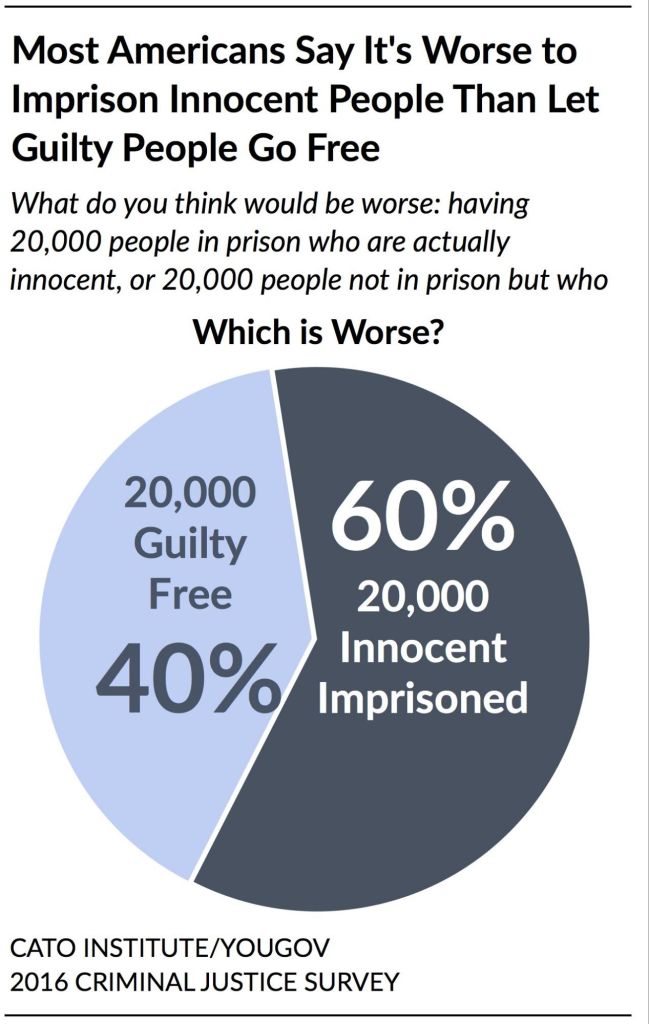
A jurist, Sir William Blackstone, understanding the imperfection of the justice system and that the ultimate goal of justice is to protect the innocent, proposed:

It is better that ten guilty persons escape than that one innocent suffer

This, the Blackstone ratio, is foundational to how things are at least supposed to work in the United States. Founding father Ben Franklin actually took the concept further by stating, “it is better 100 guilty Persons should escape than that one innocent Person should suffer.”  John Adams, while he defended the British soldiers charged with murder for their role in the Boston Massacre, argued the following:

We find, in the rules laid down by the greatest English Judges, who have been the brightest of mankind; We are to look upon it as more beneficial, that many guilty persons should escape unpunished, than one innocent person should suffer. The reason is, because it’s of more importance to community, that innocence should be protected, than it is, that guilt should be punished; for guilt and crimes are so frequent in the world, that all of them cannot be punished; and many times they happen in such a manner, that it is not of much consequence to the public, whether they are punished or not. But when innocence itself is brought to the bar and condemned, especially to die, the subject will exclaim, it is immaterial to me, whether I behave well or ill; for virtue itself is no security. And if such a sentiment as this should take place in the mind of the subject, there would be an end to all security whatsoever.

This commitment to the innocent reflects a strong emphasis on individual rights. It also seems rooted in the story most defining of Western religion, and that is the story of Jesus—falsely accused and put to death for the sake of political expediency. This has become the defining narrative and a reason to reflect on our judgment rather than react. It is why many principled conservatives are always uncomfortable with those trials in the court of public opinion where the state parades a prosecuted person and people assume this is proof of an airtight case.

You look guilty just for being in a courtroom defending from an accusation.

Tyler Robinson currently stands accused of murdering Charlie Kirk. Some have decided his guilt to the extent of forgiving him prior to his even standing trial or being given the chance to defend himself—as if there’s just no way that anyone other than him could be involved. That’s not justice; that’s denying him a presumption of innocence and might be enabling others to escape accountability for their involvement. It is better that he go free than chance a wrongful conviction—that is just Christian.

Caiaphas’s Expediency Math: Killing One to Save All

At the completely opposite end of the spectrum from the Christian West is the example of the high priest who claimed the murder of an innocent man was necessary to save Israel from destruction:

Then one of them, named Caiaphas, who was high priest that year, spoke up, “You know nothing at all! You do not realize that it is better for you that one man die for the people than that the whole nation perish.”

 (John 11:49-50 NIV)

This may very well be the origin point of trolley problem moral reasoning, where a hypothetical situation is proposed in which an intervention will cost fewer lives. If we just switch the track, this fictional trolley only kills one rather than multiple people. And it seems very reasonable. Isn’t it better when more people survive?

Caiaphas reasoned it was better to kill one Jesus to save Israel.  But it didn’t work out that way. The entire nation—along with their temple and sacrificial system—was forever destroyed in 70 AD. The high priest’s moral reasoning was compromised and wrong. It did not save Israel to kill one man and may well have been part of what eventually led to the destruction of Jerusalem. Those who did not accept the way of Jesus continued, after his ministry ended, to kill his followers and resist their civil authorities. Had they taken one moment to reflect and reconsider their plan to kill their way to peace, they may have survived intact rather than be spread to the corners of the empire.
The problem with killing one—without a just cause, to secure the future—is that it usually doesn’t end there. Kill one and you’ll kill ten; if you kill ten, you’ll kill 100, until soon it is millions upon millions. We see this in the campaign against Gaza. Tens of thousands of children are slaughtered and this is being justified as a war against terror. The reality is that it may very well create the backlash that will make the Zionist project untenable as people see this notion of blood guilt and collective punishment as repulsive. This is not compatible with the Christian values of the West and will lead to our destruction if the escalation of war is not rejected.

The world is better when we don’t play God and use the expediency math. If you’re okay killing one innocent person, you’re now an enemy of all humanity. And if you are willing to kill one, then the second and third come much easier. Innocent life should always be protected—whether it is the life of Jesus, be it the “enemies'” children, or the  unborn. Pro-life means no excuses for the IDF that don’t equally apply to Hamas. If it is okay for the Zionist regime to kill scores of civilians as “collateral damage” for every militant killed—where even the Israelis admit the victims of their onslaught are 83% civilians—why mourn when it is just a handful in Bondi?

The best protection of innocent people, like your own, is to oppose all killing of innocent people no matter the color of their skin or the clothes they wear. If the IDF can kill a journalist claiming they are “Hamas with a camera” or “Hamas-affiliated,” then why is it wrong for Eli Schlanger, who has materially aided a genocide, to be targeted along with his associates? We need to reject this math of expediency no matter who is using it, or we can’t be upset when what goes around finally comes around.

Abraham’s Plea for Mercy: Sparing the Many for the Few Righteous

Now we can go way back, to the book of Genesis, where the world’s most powerful monotheistic religions find their foundation, and this man of faith named Abraham. We join him prior to the destruction of Sodom and have this interesting exchange:

Then the Lord said, “Shall I hide from Abraham what I am about to do?  Abraham will surely become a great and powerful nation, and all nations on earth will be blessed through him.  For I have chosen him, so that he will direct his children and his household after him to keep the way of the Lord by doing what is right and just, so that the Lord will bring about for Abraham what he has promised him.”  Then the Lord said, “The outcry against Sodom and Gomorrah is so great and their sin so grievous that I will go down and see if what they have done is as bad as the outcry that has reached me. If not, I will know.”  The men turned away and went toward Sodom, but Abraham remained standing before the Lord. Then Abraham approached him and said: “Will you sweep away the righteous with the wicked? 

(Genesis 18:17-23 NIV)

Abraham’s opening question, in the passage above, tells you a whole lot about his moral reasoning. But before that you basically have the old covenant explained in brief: The blessing that was being bestowed on Abraham had to do with “doing what is right and just” or not simply being a blood relative of him, which is something that Jesus and the Apostles explained over and over to those who saw their genetic tie to the patriarch as a sort of entitlement and did not act justly or mercifully as he did.

Continuing in the text, take time to contrast the expediency math of Caiaphas with the following:

What if there are fifty righteous people in the city? Will you really sweep it away and not spare the place for the sake of the fifty righteous people in it?  Far be it from you to do such a thing—to kill the righteous with the wicked, treating the righteous and the wicked alike. Far be it from you! Will not the Judge of all the earth do right?” The Lord said, “If I find fifty righteous people in the city of Sodom, I will spare the whole place for their sake.” Then Abraham spoke up again: “Now that I have been so bold as to speak to the Lord, though I am nothing but dust and ashes, what if the number of the righteous is five less than fifty? Will you destroy the whole city for lack of five people?” “If I find forty-five there,” he said, “I will not destroy it.” Once again he spoke to him, “What if only forty are found there?” He said, “For the sake of forty, I will not do it.” Then he said, “May the Lord not be angry, but let me speak. What if only thirty can be found there?” He answered, “I will not do it if I find thirty there.”  Abraham said, “Now that I have been so bold as to speak to the Lord, what if only twenty can be found there?” He said, “For the sake of twenty, I will not destroy it.” Then he said, “May the Lord not be angry, but let me speak just once more. What if only ten can be found there?” He answered, “For the sake of ten, I will not destroy it.”  When the Lord had finished speaking with Abraham, he left, and Abraham returned home.

(Genesis 18:24-33 NIV)

Abraham, after expressing his concern for the innocent, offers an opening bid at fifty righteous. Will God spare the entire wicked city for just fifty? And the first thing that is obvious is his humility, pleading with “I am nothing but dust and ashes” and showing his attitude before God. Second is that his orientation is toward the sparing of innocent life even if it means the evil people of the city of Sodom escape deserved judgment. This is in line with Blackstone’s ratio and in total opposition to Caiaphas, who argued to sacrifice rather than to protect the righteous one. Eventually Abraham concedes, and it makes more sense just to evacuate those righteous—nevertheless the righteous are not destroyed with the wicked.

So why is this account in Genesis?

Why is God engaged in a negotiation with a mere man?

The answer is that this anecdote is here for a reason, and that is to be instructive. The author of Genesis isn’t just telling us that Abraham was righteous—they’re giving us instruction on how to be righteous. To have the same disposition as Abraham, that’s the way to be a child of Abraham, and the path of righteousness that leads to the blessings through God’s promise. Chosen means you believe and obey the Lord. You can’t claim to be children of God, or of Abraham, if you truly share nothing in common with them in terms of your behavior or spirit. Genesis is telling us what that looks like in practice.

Christian Orientation Towards Mercy and Humanity is Truly Abrahamic.

In traversing these three moments—from courtrooms shaped by Christian reflection on an innocent’s crucifixion, to the high priest’s fateful expediency that failed to save his nation, and back to Abraham’s humble plea for mercy amid judgment—we uncover a profound reality: The orientation of the Christian perspective, underpinning American rights, is directly the opposite of the ideological lineage of Caiaphas.

The commitment, in faith, to protecting that one innocent life in a crowd of evil is to be a son or daughter of Abraham.  Those who do the opposite, who are willing to sacrifice the innocent for sake of expediency, carry none of the character of Abraham and cannot be the heirs of anything promised to him.  They must first repent of their sin—then they can be blessed, with all nations, through the one singular seed of Abraham (Gal 3:16) which is Christ Jesus.

Going back to the start and those ethics ingrained in us through a religiously derived culture and our assumptions, those who have rejected Christ and are completely willing to kill innocent people to accomplish ends are also going to manifest the other evil traits of Proverbs 6:16-19:

There are six things the Lord hates, seven that are detestable to him: haughty eyes, a lying tongue, hands that shed innocent blood, a heart that devises wicked schemes, feet that are quick to rush into evil, a false witness who pours out lies and a person who stirs up conflict in the community.

Those of us raised in an Anabaptist church got a strong dose of the Gospel according to Matthew and were taught that speech should be simple and truthful.  Let your yea be yes, and nay be nay is about truly honest conversation and credibility without relying on oaths.  We were told to have a peaceable spirit and merciful approach with all people—to be humble.  

This is an orientation that many of Christian faith may believe is universal.  Except it is not.  Ethno-supremacist pride is okay with those of certain ideologies, deception for sake of gaining an upper hand is looked at like a virtue, they look at their ability to trick you as proof they are superior, and sow the seeds of division covertly not to be caught—like this example:

In a covert operation during 2007–2008, Israeli Mossad agents impersonated CIA officers—using forged U.S. passports, American currency, and CIA credentials—to recruit members of the Pakistan-based Sunni militant group Jundallah for attacks inside Iran, including bombings and assassinations targeting Iranian officials and civilians, as part of a broader effort to destabilize Tehran’s regime amid nuclear tensions. The deception, conducted openly in places like London, aimed to frame the United States as the sponsor, exploiting Jundallah’s sectarian and separatist motives while providing plausible deniability for Israel; U.S. officials uncovered the ruse through internal investigations debunking earlier media reports of CIA involvement, leading to outrage in the Bush White House (with President Bush reportedly “going ballistic”), strained intelligence cooperation under Obama, and the eventual U.S. terrorist designation of Jundallah in 2010, though no public repercussions were imposed on Israel.

 (Overview above by Grok, read: False Flag)

Imagine having a friend who deliberately set you up for a fight against another person by telling them that you said something about them.  My son had a bully do this to him on the bus and this is exactly what so-called ‘greatest ally’ tried to do to the US.  For the Zionist regime, and Mossad, conducting the terror operation via a Pakistani proxy simply was not enough.  They wanted Iran to think the attacks originated with the US in order to provoke a reaction.  And this is how the world becomes a cesspool, all because the Iranians won’t stand idle while Palestinians are deprived of land and human rights.

Deviousness is not exclusive to the children of Caiaphas.  But there’s no stops for those willing to kill innocent people for the sake of expediency.  And a partnership with them is only going to undermine the foundation of our civilization.  The US and ‘Christian’ West have already lost their moral reputation for this unholy alliance.  We need to repent and return to holding evil men accountable and protecting the innocent or all will be lost—we can’t exempt some from a standard of normal decency without also damaging all of Christendom.

One Nation or the Divide

Standard

“See, I will send the prophet Elijah to you before that great and dreadful day of the Lord comes. He will turn the hearts of the parents to their children, and the hearts of the children to their parents; or else I will come and strike the land with total destruction.”

(Malachi 4:5-6 NIV)

That end to the Old Testament has intrigued me.  It contains a very clear either/or option.  Either the people heed the message of Elijah or the land will be totally destroyed.  God desired all to be saved, to be united in love for each other, and yet also doesn’t force the relationship and eventually the opportunity for reconciliation will end.

This is how John the Baptist was introduced in the New Testament:

He will bring back many of the people of Israel to the Lord their God. And he will go on before the Lord, in the spirit and power of Elijah, to turn the hearts of the parents to their children and the disobedient to the wisdom of the righteous—to make ready a people prepared for the Lord.”

(Luke 1:16‭-‬17 NIV)

Very aspirational. 

Unfortunately, we see how this would eventually work out for the nation, as a whole, of those who didn’t repent or turn from their religious elitism.  We see it in the following pronouncement of Jesus:

“Do not suppose that I have come to bring peace to the earth. I did not come to bring peace, but a sword.  For I have come to turn “ ‘a man against his father, a daughter against her mother,  a daughter-in-law against her mother-in-law—a man’s enemies will be the members of his own household.’

(Matthew 10:34‭-‬36 NIV)

Many picked or else. 

They choose their own destruction rather than heed the message and accept the offer of repentance and life. 

I’m convinced it didn’t need to be that way, that had the people accepted their Lord and Savior, the city of Jerusalem would’ve stood and would not have been destroyed by the Romans.  It was political division, the insanity of the zealots (including Judas) pursuing their own version of social justice, the complacent ruling class unable to make up their minds, that ultimately doomed the city to destruction.

Jesus is uniting or divisive.  The choice is ours.  Like it or not, the Gospel lays out a choice between unity or division.  The truth will set you free or you’ll stay in bondage to your sin, to your preferences, your prejudices and perish.  If we would truly choose Jesus then we would let go of all of our other identities, grievances and special privileges, we would be united in love. 

Many who profess Christ today are more like those who rejected him.  They choose tribe over unity, they choose political gain over peace, they accuse others while being as guilty or more guilty themselves.  We would be wise to do as Jesus told his disciples regarding those who refuse to hear, to kick the dust from our sandals and move on to those more receptive.

Peace Through Separation 

This theme of peace through separation is throughout Scripture, one example being Abram and Lot:

“…quarreling arose between Abram’s herders and Lot’s. The Canaanites and Perizzites were also living in the land at that time.  So Abram said to Lot, “Let’s not have any quarreling between you and me, or between your herders and mine, for we are close relatives.  Is not the whole land before you? Let’s part company. If you go to the left, I’ll go to the right; if you go to the right, I’ll go to the left.”

(Genesis 13:7-13 NIV)

Lot picked the area close to the city, pitching his tent towards Sodom, Abram went the other way, and the strife between their clans ended.  Nobody was offended, there was no reason to be offended, seperation to avoid unnecessary conflict is a peaceable solution. 

We see the same happen in the New Testament:

Some time later Paul said to Barnabas, “Let us go back and visit the believers in all the towns where we preached the word of the Lord and see how they are doing.” Barnabas wanted to take John, also called Mark, with them, but Paul did not think it wise to take him, because he had deserted them in Pamphylia and had not continued with them in the work. They had such a sharp disagreement that they parted company. Barnabas took Mark and sailed for Cyprus, 40 but Paul chose Silas and left, commended by the believers to the grace of the Lord. He went through Syria and Cilicia, strengthening the churches.

(Acts 15:36-41 NIV)

Imagine that.  A sharp disagreement, even within the early church, leading to a parting of ways.  And it actually seemed to work for the best.  Sometimes the best solution to an irreconcilable difference is to go different ways.  It seems that actually enhanced rather than take way from their respective ministries.  At the very least, we see this affair being stated matter of factly and not a cause for additional drama.

There is, however, at least one case of separation gone awry and that’s when Pharoah refused to let the children of Isreal go.  He had refused after first bring asked nicely, relented only after a series of plagues that increased in severity, then changed his mind once again and pursued those seeking freedom from him.  Why?  Well, because he was exploiting their labor and knew letting them go would cost him.

That is also how an abusive spouse acts.  They simply can’t tolerate someone wanting to get away from them, they’re insecure, they need to have control, and would sooner murder the other person than allow them to go in peace.  They can’t stand that someone would dare to expose their own ugliness and will slander the other party rather than repent of creating the conditions that led to the other party being uncomfortable remaining with them.

A Christian is able to walk away in peace, without things ending on their own terms, but those who are exploiting others or trying to advantage themselves cannot.  Is it better that there is no seperation?  Sure.  Is separation wrong when remaining together becomes unbearable?  Absolutely not!  In short, seperation is a peaceable solution for peaceable people.  But tyrants, who must have their own way, will refuse to leave others be.

Two Groups, Presenting an A-B Option

About six months ago, in response to the increased promotion of tribalism, I started a group on social media “One Nation Under God…”  The point was to present an alternative to these divisive forces.  A place where people of all colors, creeds, genders, or orientations could celebrate our common humanity together.  The idea being that we could act “one nation” rather than allow our differences to divide us.  I featured a picture of a diverse group of American children and posted feel-good stories of people overcoming conflicts, Good Samaritan acts, and kindness. 

Love Thy Neighbor

That group, which is representative of my highest aspirations and my desire to be unified with all, only attracted a handful of friends and remains at only a few dozen members.  I would rather that we learn to get along, to hear each other’s perspectives, to find our common humanity, and respect our differences. 

That’s definitely my option A. 

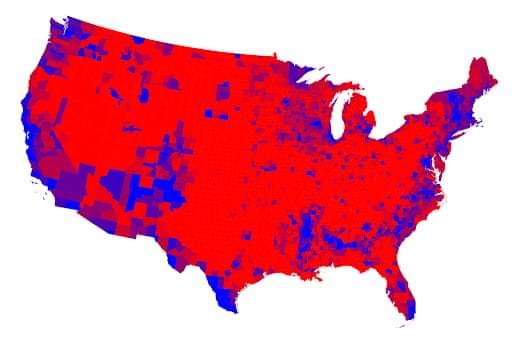
However, around the start of the new year, after a contentious election season and continuing strife, seeing some voices were not being represented, I decide (on a whim) to start a group where disenfranchised rural people could find a home.  My group description contrasted “two different Americans” and went on to note the differing cultural values between rural and urban people, with a lament of double standards, and a call for a peaceful resolution.  

The point? 

Well, on one level, it was option B, to advocate for an amicable divorce rather than continue the perpetual conflict and subjugation of one half of the country or the other every four years. 

But, on another level, it was still in hopes of option A, to make those on the ‘other side’ aware of this grievance, to hopefully find a listening ear, and then find an understanding together.  In other words, it was the same reason that any other peaceful advocacy group exists, to give some a voice in the conversation, to say our culture matters, to stop sweeping our issues under the rug, and have a dialogue.

First and foremost, the group was created as a haven for rural people, who tend to be more reserved and too often get dominated by their socially adept, politically powerful, urban counterparts.  There was no hate or contempt for those on the other side of the divide, only a listing of different cultural values, a lament of double-standards, and a call for a peaceful resolution to irreconcilable differences.  Rural people have the same desire to feel safe, to feel reasonably represented, and speak against the cultural imperialism of the truly privileged as anyone else.

Many people are fleeing urban areas to escape tyranny and violence.  And they are all welcome to live in rural areas.  But, that said, those bringing their problems with them, their tribalism and hate, are best staying where they are rather than have them bring their divisiveness to us.  Little old Asian women aren’t being physically assaulted by grown men in central Pennsylvania and some of us would rather keep it that way.  We believe in equal justice under the law, merit and not quotas, and no special treatment for some over others.

Respect our values or let us go our separate ways.  That’s all.  Option A and B.  Hear the grievance and maybe we can patch things up.  That’s always possible.  But, respond with more accusations and hate?  Yeah, that will only confirm my own reason to leave.

Pharaoh’s ‘Woke’ Army Is Outraged

I was blindsided by it.  A friend went me a private message to alert me.  The eye of Sauron had found The Rural Divide and the legions of far-left sympathizing, the hoards of apologists for wokeism and closed social justice warriors were on their way to overrun this resistance to their totalitarian agenda.  Behind the buttery smooth words, of well-trained passive-aggressive Mennonite-borns, there was seething rage—a sea of hatred, irrationality and nasty accusations

Murder in words.

Only one person reached out for an explanation.  A few others to heap condemnation and clearly unwilling to listen.  Even some old friends were unwittingly used as pawns.  But the truly disappointing part is that those who led this campaign know me enough to know that their characterization of the group was a lie.

For those who don’t know me, I was the religious odd ball at my school (as a conservative Mennonite) and found my place amongst the other misfits. One of my close friends, throughout my school years, came out of the closet in highschool and never once did I think of him as less a person than me. My cafeteria clique consisted of the only Roman Catholic and Mormon guys in the school, an ethnic Indian Hindu, a Filipino Seventh-day adventist. My other closest friend was an atheist fellow.

After school, I’ve only ever dated women categorized as “people of color” according to the current jargon. I’ve punched an openly racist Kansan (not my finest moment) and lost my job as a result. I was obsessed with the Civil Rights Era and fully embraced what Martin Luther King Jr said about content of character over color of skin. My assailants are mostly whites who grew up in ethically homogeneous enclaves, homeschooled, often privileged over me and extremely gullible too. They, like their forbearers, seem to believe that their own poop don’t stink.

So Woke.

Anyhow, back to the present drama, one particularly sanctimonious religious elite, likely trying to impress his peers with this virtue signaling display, suggested that those who joined the group were not even Christian. 

Imagine that, you get a random request for a group, decide to accept the invite to see what it is, and bam suddenly you’re out of the Kingdom.  Wow!  Yeah, I’m thinking this extremely judgmental elite confuses Christianity with cancel culture.  Or maybe it is that they are from a conservative Mennonite background where a marriage partner who separates from their abuser is often treated as the guilty party?  The apple doesn’t always fall far from the tree, does it?

I’m sure they are too ‘woke’ to carry on the prior generation’s opinions regarding abused women leaving their abusers.  And yet, under this new facade of social justice, they carry on the exact same attitude in regards to those who wish to be separated from those that routinely accuse, slander, and belittle them?

Reminds me of this:

“Woe to you, teachers of the law and Pharisees, you hypocrites! You build tombs for the prophets and decorate the graves of the righteous.  And you say, ‘If we had lived in the days of our ancestors, we would not have taken part with them in shedding the blood of the prophets.’  So you testify against yourselves that you are the descendants of those who murdered the prophets.  Go ahead, then, and complete what your ancestors started!  “You snakes! You brood of vipers! How will you escape being condemned to hell?  Therefore I am sending you prophets and sages and teachers. Some of them you will kill and crucify; others you will flog in your synagogues and pursue from town to town.  And so upon you will come all the righteous blood that has been shed on earth, from the blood of righteous Abel to the blood of Zechariah son of Berekiah, whom you murdered between the temple and the altar.  Truly I tell you, all this will come on this generation. “Jerusalem, Jerusalem, you who kill the prophets and stone those sent to you, how often I have longed to gather your children together, as a hen gathers her chicks under her wings, and you were not willing.  Look, your house is left to you desolate.  For I tell you, you will not see me again until you say, ‘Blessed is he who comes in the name of the Lord.’ ”

(Matthew 23:29‭-‬39 NIV)

It is interesting, first, that this passage above contains both a loving lament and harsh condemnation, both in the same thought.  This goes back to the either/or proposition of Malachi.  Second, those who killed Jesus, along with the other prophets, thought they were the enlightened and righteous ones.  Saul, who latter become St Paul, harassed, pursued and killed Christians thinking this was God’s work.  He found fault in others despite being murderous himself and it was only after repentance that he could see.

The very same people today, who are heroes in their own eyes for attacking peaceable people today, would likely be cheering loudly for Jim Crow laws a few generations ago, or aligned with Bolsheviks in Russia and Nazis in Germany before their atrocities were fully known.  It’s amazing the similarities between abusers, both then and now, rather than live and let live or leave when unwelcomed, they “pursue to town to town” and demand their piece of God’s people like the mob of degenerates in Sodom wanting a to ‘know’ Lot’s angelic visitors:

Before they had gone to bed, all the men from every part of the city of Sodom—both young and old—surrounded the house. They called to Lot, “Where are the men who came to you tonight? Bring them out to us so that we can have sex with them.”

(Genesis 19:4‭-‬5 NIV)

The far-left is equally aggressive today in pursuit of anyone who would rather not be with them.  If you’re putoff by their nastiness they’ll accuse you of an “ism” or being “phobic” and harass and lie in an effort to have their way with you.  To them you have no rights as an individual, you belong to them, and if you refuse their advances they will  break your door down…

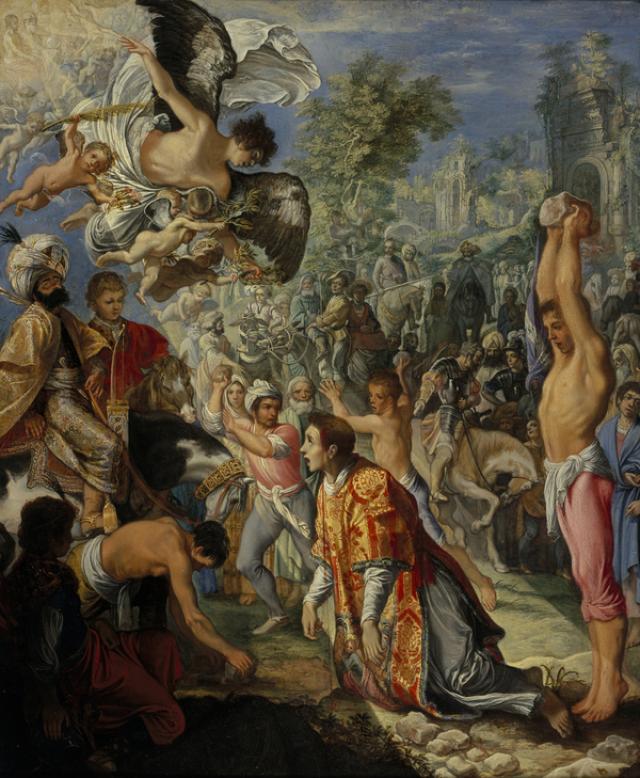
And those outraged about The Rural Divide acted in the same manner.  They attacked in a swarm, relentless, demanding to know why the group existed, trying to infiltrate, and were no different than that enraged mob picking up stones to murder St Stephen for his paraphrasing of what Jesus said:

“Was there ever a prophet your ancestors did not persecute? They even killed those who predicted the coming of the Righteous One.”

(Acts 7:52‭ NIV)

A Time To Reconcile, A Time To Choose A Side

If anyone in that cabal of hate and hysteria would like to approach me and apologize, I’m more than willing to forgive the slanderous attacks.  Unlike the far-left, I believe in repentance, that people should be forgiven of their faults and can change.  I’m willing to reconcile with any of those who participated in this spreading of malicious nonsense about me.  A simple apology admitting that they misunderstood or were misled into believing my group was something it was not would be sufficient enough.

There are those whom I blocked on social media for their racism or otherwise rude and elitist behavior that I would gladly welcome back into my life if there was a hint of repentance. That’s option A.

This is option B:

But now I am writing to you that you must not associate with anyone who claims to be a brother or sister but is sexually immoral or greedy, an idolater or slanderer, a drunkard or swindler. Do not even eat with such people.

(1 Corinthians 5:11 NIV)

St Paul prefaces this by saying that he’s not speaking against association with sinful non-Christians, who God will judge. But he’s talking about those who profess Christ and yet refuse to repent of their sin. This excommunication is necessary to maintain our own integrity and as not to confuse our non-believing neighbors. It applies, not in cases of different preferences, but in cases of clearly defined sin and lack of repentance. In case I’m unclear:

If anyone teaches otherwise and does not agree to the sound instruction of our Lord Jesus Christ and to godly teaching, they are conceited and understand nothing. They have an unhealthy interest in controversies and quarrels about words that result in envy, strife, malicious talk, evil suspicions.

(1 Timothy 6:3‭-‬4 NIV)

I’m sure this was just St Paul’s white cisgender male privilege speaking right?

More toxic masculinity, I suppose?

Whatever the case, if even Paul and Barnabas had to go their separate ways over a dispute, both early church missionaries and leaders, then why is it so offensive or wrong that some would rather peaceably divide rather than continue in a quarrel?  Isn’t that what happened with Abram and Lot when their groups were in conflict?  Abraham going the way of the country and Lot picking the life of the city?

In the end, it is laughable that any Protestant religious separatist, especially these proud social justice preaching types who still identify as “Anabaptist” and refuse to seek membership with the universal church, would be at all critical of those rural folks who wish to have a separate space for themselves.  Their hateful reaction confirmed every reason why The Rural Divide exists.

The Rural Divide is a group open to all shades of skin color, even those of other cultures, but only where there is mutual respect and not cultural imperialism. And, yes, the unrepentant ‘woke’ nationalists can stay out.

Relax, folks, it is just a Facebook group.

Everyone else has their safe space, wants their communities and values to be respected.

Why not the rural minorities?