Jesus Longs for His People (Matthew 23:37-39)

Standard

Jesus was not harsh out of hatred.

Behind his sharp rebuke in Matthew 23 was a deep love and longing for his people to hear his message, repent of their foolish pride, and live in faith.
The love of Jesus is evident in how he brings the sermon to a conclusion:

Jerusalem, Jerusalem, you who kill the prophets and stone those sent to you, how often I have longed to gather your children together, as a hen gathers her chicks under her wings, and you were not willing.  Look, your house is left to you desolate.  For I tell you, you will not see me again until you say, “Blessed is he who comes in the name of the Lord.” (Matthew 23:37‭-‬39)

Jesus uses the imagery of a hen to describe his own feelings toward those who rejected him.  It is significant that Jesus describes himself with feminine attributes—it is significant in that it shows a divine nature that transcends gender and also in the contrast it provides.  

Jesus finished a harsh message about coming destruction by describing his desire to nurture rather than judge.  His words express profound sadness and deep disappointment before ending with a promise: “For I tell you, you will not see me again until…”

Until what?

Before answering that, there are a couple​other points that can be extracted from the example of Jesus:

1) Criticism is more loving than indifference…

We live in a time when legitimate criticism is characterized as persecution or hateful.  Be too blunt or honest and pretty soon you’ll have the niceness police on your case.  Criticism feels unpleasant.  However, rebuke can be extremely beneficial to a person who is truly humble and open to correction.

The importance of receiving rebuke is mentioned in Proverbs:

My son, do not despise the Lord ’s discipline, and do not resent his rebuke, because the Lord disciplines those he loves, as a father the son he delights in. (Proverbs 3:11‭-‬12)

And expounded upon by the Apostle Paul:

Endure hardship as discipline; God is treating you as his children. For what children are not disciplined by their father? If you are not disciplined—and everyone undergoes discipline—then you are not legitimate, not true sons and daughters at all. Moreover, we have all had human fathers who disciplined us and we respected them for it. How much more should we submit to the Father of spirits and live! (Hebrews 12:7‭-‬9)

Paul says that if we are not disciplined by God then we are illegitimate and not true children of God.  Rebuke, according to Proverbs, shows love.  

Good parents discipline their children because they love and want the best for them.  They realize that uncorrected attitudes and behaviors will cause more future pain for their children than a rebuke.  Discipline, therefore, is a preventative medicine against a deeper more permanent harm.

It is easy to be nice to someone in order to avoid trouble.  In confrontation there is risk.  Many prophets lost their lives for speaking truth to power.  At very least criticism can come at the cost of loss of popularity and friendship.  As a result, people play nice for their own sake, to keep people off their case, and not out of love.

I personally do not waste my time trying to correct a person I do not love.  Why would I?

A good rebuke is not a hit-and-run attack.  No, rather it is part of a true concern for the well-being of another and a part of a longer term investment to help another person reach their better potential.  Sometimes, when an audience is especially stubborn and unreceptive, there is a need to ratchet up the rhetoric until there is a change.

2) The future is being created by us…

Many religious people are fatalistic.  Yes, they might claim to believe in “free will” or choice, but then revert to an “it is what it is” fatalism and using God’s sovereignty as an excuse.  

In Jesus we should be free—free to overcome our human limitations and able to create a better reality.  That’s what it means to created in the image of the Creator.  That’s what it means to partake of the divine nature.  And, therefore, with faith, there is agency and choice.

Those whom Jesus addressed also had a choice, and that choice is recorded in the last words of the Old Testament:

See, I will send the prophet Elijah to you before that great and dreadful day of the Lord comes. He will turn the hearts of the parents to their children, and the hearts of the children to their parents; or else I will come and strike the land with total destruction. (Malachi 4:5‭-‬6)

The “or else” in the passage above indicates two options.  Either their hearts will be turned or there will be total destruction.  History was dependent on their choice and the future depends on our choice—repent or die.

We know that many did not heed the warning and that Jerusalem was destroyed.  Many of those in the audience may have ended up in Gehenna (the literal “hell” Jesus spoke about) because they refused to hear and repent.  Many of us will follow them to our own destruction unless we choose the abundant life.

In the end, fatalism is simply another form of faithlessness.  Often when we say, “It is what it is,” the truth is that we are simply unwilling to put in the effort or step out in faith.  Life is what we make it.  The future we get is always a choice and we should choose Jesus.

3) When will we see Jesus again?

I don’t know.

That is your choice.

I believe Jesus will return in those who choose to turn, who acknowledge him as Lord, receive his Spirit and follow him. 

 Jesus gave this promise:

Whoever has my commands and keeps them is the one who loves me. The one who loves me will be loved by my Father, and I too will love them and show myself to them. (John 14:21)

Jesus longs to reveal himself to us today.

(Artwork: Stanley Spencer)

Are You Better Than A Pharisee? (Matthew 23:29-32)

Standard

Denial is our first line of defense.  Even the guiltiest person will plea “not guilty” in an effort to avoid judgment.  And when we read Matthew 23, it is easy to assume that the stinging words of Jesus apply to them but not us.

Denial is a natural response and therefore it was no surprise if we read Jesus’s words to the Pharisees and fail to make a connection between “us” and “them.”  Most of us prefer to think of ourselves as the good guys, you know, the ones with better understanding and more complete knowledge.  How could we be as wrong as those whom Jesus condemned?

And when we do have to admit our failures we tend to deflect and downplay them: Sure, we are imperfect, we make mistakes; but who doesn’t, right?

I should know.  I was once an ardent apologist for everything Mennonite.  I believed that by God’s grace, I was born into the church denomination that best applied the teachings of Jesus—which is a sentiment not uncommon among my Anabaptist peers who have not been sexually abused, the witness of a vicious church split, or excommunicated.

Unfortunately, this assumption of our having a corner on the truth is a position built on confirmation bias and arrogance.  Every religious zealot believes that the ground they stand on is sacred simply because they are standing on it.  But, unless you believe that all paths lead to God, they can’t all be right.  Likewise, our own assumption that we are right, and our ability to defend it, doesn’t make us any better than them.

Those who do not learn from history are bound to repeat it.

The Pharisees and religious experts believed that they were on the right path; they proudly considered themselves to be God’s chosen people and resisted his message.  It would be easy to try to distance ourselves from them, to think of them as extraordinarily bad people and deny our commonality with them.

However, if we do that, if we are too proud to consider that we could be on the wrong side of history, then we have the same exact mentality of those condemned by Jesus:

Woe to you, teachers of the law and Pharisees, you hypocrites! You build tombs for the prophets and decorate the graves of the righteous. And you say, “If we had lived in the days of our ancestors, we would not have taken part with them in shedding the blood of the prophets.” So you testify against yourselves that you are the descendants of those who murdered the prophets. Go ahead, then, and complete what your ancestors started! (Matthew 23:29‭-‬32)

The teachers of the law and Pharisees, like us, identified with the good characters in history and distanced themselves from the bad.  They thought they were different from their ancestors who killed the prophets.  But Jesus turns their attempt to disassociate themselves around and uses it to create a link.  He taunts them, telling them to finish what their ancestors started.

The sad reality is that the proud religious fundamentalists of Jesus’s time did not see themselves as repeating history.  They imagined themselves to be the preservers of a pure religion passed down from the prophets before them and heroes of their own story.  To them, Jesus was a dangerous and false teacher, so they wanted him silenced and conspired to have him killed.

What was so wrong with the Pharisees?

“Pharisee” has become a pejorative word in our time, and yet in the time of Jesus it was a proud distinction.  They were the devoutly religious people; they held themselves to a high standard and kept the law better than their neighbors.

Jesus once told his audience:

For I tell you that unless your righteousness surpasses that of the Pharisees and the teachers of the law, you will certainly not enter the kingdom of heaven. (Matthew 5:20)

It might seem odd that Jesus uses the Pharisees as a benchmark and then lambastes them later as hypocritical.  Was Jesus inconsistent and changeable?  Moody or bipolar?  I doubt it.

Actually, I believe the Pharisees were the “good people” of their time and trying their best to live righteously.  And, as people respected by their religious peers, they were not accustomed to being called out and condemned.  But, despite their diligent efforts, they were missing something and it was because of that that Jesus poked and prodded them.

The problem with the Pharisees was not that they were extraordinarily bad people.  The problem was that their success in surpassing others had made them into entitled brats who thought themselves superior to others.  Sure, they were pristine on the outside, did the right things to be regarded well, even thanked God for all their advantages, but were they living in faith?

Or were they content to simply do better than others?

The servant who knows the master’s will and does not get ready or does not do what the master wants will be beaten with many blows.  But the one who does not know and does things deserving punishment will be beaten with few blows. From everyone who has been given much, much will be demanded; and from the one who has been entrusted with much, much more will be asked. (Luke 12:47‭-‬48)

A faithful person is not content to simply do better than others; they realize that their advantages are a gift from God and not deserved.  There is no room for arrogance when this is understood.  The Pharisees may have feigned reverence for God, but a genuinely humble person does not try to create distance between themselves and people of a social lower order.

The Pharisees rejected faith.  They were so outwardly successful that they were able to delude themselves into thinking that they could actually impress God and save themselves.  In their zealous pursuit of knowledge and religious fundamentalism they forgot one thing, and that was faith.

Are we better than the Pharisees?

Probably not.

The Pharisees knew their Scripture extremely well and lived the law more carefully than most of us could even imagine.

That said, good Mennonites have much in common with the religiously educated and traditionally-focused Pharisees.  They were middle-class businessmen—not as political and compromising as the Sadducees, nor violent agitators like the Zealots… and not too different from us.

The disciples Jesus called to follow him were a motley crew by comparison: a mix of poor fishermen, a tax collector, and other losers of their time.  They would probably not even be second-tier Mennonites and certainly not the ones we would select to be missionaries and future leaders.

However, unlike the rich young ruler, who kept the law perfectly and placed his security in his wealth, the disciples put everything down to follow Jesus.

Perhaps it is because they had less to lose?

Whatever the case, nobody is beyond hope and that is why I write.  Many Pharisees did eventually come to faith in Jesus and many Mennonites do too, despite our religious and cultural baggage.  As long as we have breath in our lungs, I believe we can be saved.

But a journey of faith must start with repentance, and I’m not talking about the ritual repentance that wins the approval of parents and religious peers, either.  We need the true repentance of those who know that outside of God’s grace, we are no better than a Pharisee.

Too Focused To Be Faithful (Matthew 23:16-24)

Standard

A biblical fundamentalist reads Scripture as a lawyer does a legal code.  Rather than read like the Bereans, who were open-minded and therefore receptive to the message the Apostle Paul preached (Acts 17:11), many people read with an agenda to prove their current beliefs.

Religious fundamentalist scholars are often able to find what they go looking for, and at the expense of what is true.  Their diligent search, rather than being a quest for Truth, is an effort to find proof-texts for their own theological presuppositions (often inherited positions), and is not guided by the Holy Spirit.

Some are very knowledgeable and respected people in their respective circles.  They parse words looking for specific permissions and prohibitions, or only to justify their existing doctrinal stances.

They are scholars of conservative or liberal persuasion and dogmatists for any denomination.

They all have their loyal followers.

They all believe they are right.

But they are also no different from those whom Jesus confronted when he said:

…the Father who sent me has himself testified concerning me. You have never heard his voice nor seen his form, nor does his word dwell in you, for you do not believe the one he sent.  You study the Scriptures diligently because you think that in them you have eternal life. These are the very Scriptures that testify about me, yet you refuse to come to me to have life. (John 5:37‭-‬40)

Those who were addressed by Jesus in the passage above had Scripture (graphé) and studied it “diligently” according to Jesus.  But they were missing something.  Jesus told them they lacked the word (logos) of God dwelling in them, thus they would not come to him for life.  They were impoverished when it came to true faith and the indwelling word of God.

There are many who have only Scripture and not the Spirit to teach them.

We are told there will be tares sown in the wheat (Matthew 13:24-30).  This means that there will be those who appear righteous on the outside, but they reject the most foundational concepts of faith.  Despite their many good works, they are spiritually dead and lost.

I recall discussions with a man unable to conceptualize the idea of a triune God.  Time and time again he would come back to his own flawed understanding and insist that I was polytheistic for believing in one God… three persons.  He also could not accept that the sonship of Jesus made him divine like his Father in heaven.

Sadly there are many who reject Jesus in a much more subtle way and by this I mean they have not placed their faith in the Spirit he promised:

Anyone who loves me will obey my teaching. My Father will love them, and we will come to them and make our home with them.  Anyone who does not love me will not obey my teaching. These words you hear are not my own; they belong to the Father who sent me.  All this I have spoken while still with you. But the Advocate, the Holy Spirit, whom the Father will send in my name, will teach you all things and will remind you of everything I have said to you. (John 14:23‭-‬26)

They claim to have faith, but are agnostics when it comes to the idea of the Spirit teaching “all things” as promised.  And, despite their Biblical religion, they have the same “worldly” perspective that Jesus describes:

The world cannot accept [the Spirit of truth], because it neither sees him nor knows him. But you know him, for he lives with you and will be in you. (John 14:17)

They are as Paul describes:

The person without the Spirit does not accept the things that come from the Spirit of God but considers them foolishness, and cannot understand them because they are discerned only through the Spirit. The person with the Spirit makes judgments about all things, but such a person is not subject to merely human judgments, for, “Who has known the mind of the Lord so as to instruct him?”  But we have the mind of Christ. (1 Corinthians 2:14‭-‬16)

Many who profess to believe have recast the Spirit’s work as mere emotionalism and cling to circular reasoning and poor understanding of the text.  They have a form of godliness; but, despite their diligent study and careful religious devotion, they are spiritually impotent because they lack the “mind of Christ” or the indwelling word of God.

Jesus addresses those “blind guides” who love the letter of the law while rejecting the Spirit:

Woe to you, blind guides! You say, “If anyone swears by the temple, it means nothing; but anyone who swears by the gold of the temple is bound by that oath.” You blind fools! Which is greater: the gold, or the temple that makes the gold sacred? You also say, “If anyone swears by the altar, it means nothing; but anyone who swears by the gift on the altar is bound by that oath.” You blind men! Which is greater: the gift, or the altar that makes the gift sacred? Therefore, anyone who swears by the altar swears by it and by everything on it. And anyone who swears by the temple swears by it and by the one who dwells in it. And anyone who swears by heaven swears by God’s throne and by the one who sits on it. (Matthew 23:16-22)

Jesus started by ridiculing a legalistic controversy about what made an oath legitimate.  He dismissed the dispute as silly by taking a third position that supercedes the others and then continues:

Woe to you, teachers of the law and Pharisees, you hypocrites! You give a tenth of your spices—mint, dill and cumin. But you have neglected the more important matters of the law—justice, mercy and faithfulness. You should have practiced the latter, without neglecting the former.  You blind guides! You strain out a gnat but swallow a camel. (Matthew 23:13‭-‬24)

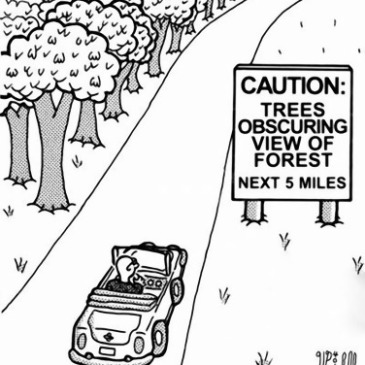
These religious scholars missed the forest for the trees.

They were so focused in on legalistic details of application that they “neglected the more important matters—justice, mercy and faithfulness.”  Jesus insults these religious authorities, he calls them “blind guides” and knocks them off their proverbial pedestal.

Paul expounds on the blindness of those who only have Scripture and the need for the Spirit as guide:

Therefore, since we have such a hope, we are very bold. We are not like Moses, who would put a veil over his face to prevent the Israelites from seeing the end of what was passing away. But their minds were made dull, for to this day the same veil remains when the old covenant is read. It has not been removed, because only in Christ is it taken away. Even to this day when Moses is read, a veil covers their hearts. But whenever anyone turns to the Lord, the veil is taken away. Now the Lord is the Spirit, and where the Spirit of the Lord is, there is freedom. And we all, who with unveiled faces contemplate the Lord’s glory, are being transformed into his image with ever-increasing glory, which comes from the Lord, who is the Spirit. (2 Corinthians 3:12‭-‬18)

Biblical fundamentalists get things in reverse, they say we need the Scripture to understand the Spirit.  The truth is opposite, we need the Spirit in order to understand Scripture or we will be no better than the “blind guides” who diligently studied Scripture and yet never embraced Jesus (and the promise of the Spirit) who brings life.

Are you a minister of the new covenant powered by the Spirit?

The new covenant is different from the old.  In the new covenant, God’s dwelling moved from a temple of stone and gold to the body of Christ (1 Corinthians 12), which is to say the individual bodies or collective mass of those who follow after Jesus and constitute the church.  The new covenant is a law written on hearts rather than on tablets of stone (Hebrews 8:7-13, 10:15,16) and that is the work of the Spirit:

Such confidence we have through Christ before God. Not that we are competent in ourselves to claim anything for ourselves, but our competence comes from God. He has made us competent as ministers of a new covenant—not of the letter but of the Spirit; for the letter kills, but the Spirit gives life. (2 Corinthians 3:4‭-‬6)

The silly controversies that divide the church are not caused by the word of God or the Spirit.  They are caused by those who have their own interpretation of Scripture, who believe their own opinion of the language is infallible, and yet do not have the indwelling word of God or life of the Spirit.

Without the Holy Spirit to guide our study, we will “strain out a gnat but swallow a camel” and be no different from those whom Jesus condemned: blind guides with veiled hearts and puffed up with biblical knowledge, yet unable to correctly understand…too focused in on the technical details to see the bigger concepts of faith.

The Church Brotherhood Lie

Standard

I once had a conversation with a Mennonite man who idolizes his wife and children.

I told him he was unloving towards me, and, as one careful to meet his religious duties, he was perplexed—what more could he do?

He remarked that he can’t love me with a romantic love (I never suggested to him that I wanted a card on Valentine’s Day) and then asked me how I wanted to be loved by him. 

So I asked him for brotherly love and quoted an example from Scripture:

I grieve for you, Jonathan my brother; you were very dear to me. Your love for me was wonderful, more wonderful than that of women. (2 Samuel 1:26)

He thought that was preposterous.

He loves his wife very much, he has made his own biological offspring his main mission in life, and for him to love me more would be impossible.

He did not truly love me as a brother and could not because he lacked authentic faith.

Why do Mennonites fail to deliver true brotherhood?

Mennonites take pride in their greater commitment to each other and the concept of a brotherhood of believers.  The comparison they like to make is between themselves and those whom they dismiss as being nominal Christians.

The assumption seems to be that church attendance equates to brotherhood.  And, since we compare favorably to those who only attend church on Christmas and Easter, we are doing well.  Besides that, we continue to go through the motions of servanthood (with a ceremonial foot-washing) and even do it twice a year.

But honestly, that is pathetic.

People only compare themselves to those downstream from them because they are making an excuse to be pathetic.

If you want to be more than pathetic you compare yourself to the perfect example and pursue that.  Mennonites fail to deliver on true brotherhood because their own pride blinds them from the possibility that they are falling short and could actually do better.

They lack the faith to break with their religious status quo and shoot for the impossible.

What is true brotherhood?

It is a shame conservative Mennonites shun competitive sports.  If they had learned to commit to others like high school athletes must dedicate themselves to a team then they might know something of the potential for brotherhood.

I have a cousin who just returned from his years of active duty in the military.  He says that while the challenges were tough, he will miss the comradery and brotherhood.

In practical terms, this means falling on a grenade to save your buddies (or just something as mundane as taking the time to run a lunch out to a brother in arms who forgot his) because in the military the good of the individual is sacrificed for the good of the team.  The individual dies when they enter the brotherhood.

The church I’ve been a part of for decades is a disappointment.  Many of the so-called leaders are apologists for complacency and promote faithless religious devotion.  Instead of being advocates for others (like Paul was for Onesimus) and helping them to carry their burdens as is Christian, these frauds teach that more Bible reading is the answer.

I’m sorry, but vacant promises to pray for each other twice a year while splashing water on each other’s feet is not brotherhood.  Telling me that a book is some kind of magic elixir cure for all needs is spiritual ignorance.  And the book that these phonies claim to revere says this is not the case very clearly.

What Christian brotherhood should be according to Jesus.

It does not take a high level of reading comprehension to find the central point of the New Testament.  The point is to have the kind of faith to live out the self-sacrificial example of Jesus.  What this means is following the command to love each other so the world can see clearly that we are his disciples:

A new command I give you: Love one another. As I have loved you, so you must love one another.  By this everyone will know that you are my disciples, if you love one another. (John 13:34‭-‬35)

Jesus defines this command to love further:

My command is this: Love each other as I have loved you.  Greater love has no one than this: to lay down one’s life for one’s friends.  You are my friends if you do what I command.  I no longer call you servants, because a servant does not know his master’s business. Instead, I have called you friends, for everything that I learned from my Father I have made known to you.  You did not choose me, but I chose you and appointed you so that you might go and bear fruit—fruit that will last—and so that whatever you ask in my name the Father will give you.  This is my command: Love each other. (John 15:12‭-‬17)

The idea of dying to self that is expressed in the teachings of Paul is often taught as if it is some kind of religious devotion devoid of a practical end.  As if we prove our love for God through emptying ourselves of any and all desire.

But the self-sacrificial love of Jesus is not aimless or vague, it is being “devoted to one another in love” to honor others above ourselves (Romans 12:10) and practicing brotherhood.

Be real or I’m not interested in your words.

The reason the church falls short is because it has compromised love for the brotherhood and made it secondary to family, business, or other personal ambition.  But Jesus did not teach individualism.  He did not promote patriarchalism either, and instead taught us to be a brotherhood.

The relationship of David and Jonathan is a picture of true brotherly love:

After David had finished talking with Saul, Jonathan became one in spirit with David, and he loved him as himself. From that day Saul kept David with him and did not let him return home to his family. And Jonathan made a covenant with David because he loved him as himself. Jonathan took off the robe he was wearing and gave it to David, along with his tunic, and even his sword, his bow and his belt. (1 Samuel 18:1‭-‬4)

Our devotion to brotherly love should not come second.  Unfortunately there are many in the church who are not willing to come to the aid of another the same as they would their own family.  There are many who put their religious agenda and protecting their own biological progeny above all else.

That is the case with the man I had the conversation with.  He is regarded by many as a model citizen; his children do all the ‘right’ Mennonite things and are treated with favoritism, but his family is a bunch of religious self-seekers—like their dad.

The language of brotherhood should not be used lightly.  Don’t call me a brother or sister unless you are actually willing to treat me as one.  I don’t like being lied to.

Caution: Mennonite In Transition

Standard

A couple years ago, upon realizing my life was going nowhere in a hurry and not wanting to settle for mediocrity, I called out for God’s help.  I wanted a truly abundant life, I knew that I was wholly inadequate to bring about the necessary changes to make that reality (God knows I’ve tried) so I begged for the impossible be done.

I have seen many dreams die in my life because of fear of failure, inexplicably poor timing, etc.  I was well-aware of the cliché definition of insanity (doing the same thing over and over again and expecting a different result) but could not seem to break from the patterns of life that limited my potential.  I was what I was and deeply dissatisfied with that.  

There was an undefined something that always seemed to crush my higher ambitions.

I could not beat an enemy that could not be defined.  So I told God in no uncertain terms that I would literally crawl on hands and knees across a wilderness of broken glass to be made right.  Throwing every bit of faith I could muster, like a gambler going all in with a desperate last gasp effort, I prayed “make the impossible possible for me” and then concluded my morning prayer.

It was an hour or two after that when I hopped out of my truck and went down writhing in pain.  My knee buckled under me.  In that moment what had been diagnosed as an MCL sprain became a full ACL tear and I knew that the implications were huge.  I would be unable to perform the duties of my job and with that was facing financial uncertainty.

Still, despite excruciating pain, I was serene and confident.

God had answered.

Or so I hoped.

“It is what it is…”

My faith crumbled against that awful reality.

“You are thirty years old living in Milton.”

It was true and the implications clear enough.

I was a stick in the mud, already past my prime by the standards of some, and certainly not the adventure her heart was set upon.  I simultaneously loved her brutal honesty and hated the harshness of judgment.  My worst fear realized.

I had no defense.

When we finally parted ways I was lost in a haze.  The rug yanked out from under me.  My sputtering attempts to articulate my own heart had no effect on her whatsoever.  Blissful hopes were mercilessly cut down by an otherwise nurturing soul.

My conversation with her end with my mouth involuntarily echoing her “it is what it is” plea and with that accepting the rationality of fatalism that had long dogged me.

A continuing cruel loneliness now seemed inevitable.  I had tried many times before, taken my hits, always got back up again by believing next time would be better—that something greater would come from my suffering rejection.  But this time I could not delude myself with hope.

My faith had lost the day—my hope against hope had failed—and now a terrible fate of a despairingly cold and isolated life was upon me.

My mind, a place normally full of noise and activity, went totally blank as if unable to comprehend any of it.  I was in shock about what had transpired and numb.  

I wandered off aimlessly.  

Into the wilderness of South Dakota.  

Into the dark of night.  

Into oblivion.

The storm brewing in overhead seemed to perfectly mirror the log-jam of conflicted thoughts and swirl of deep emotions.

My delusion of hope that a young ambitious woman might find me desirable enough to consider a romantic relationship was shattered into a million fragments.  My failure to achieve now clung to me like an unforgivable sin.  Very soon I awoke from my stupor into an inescapable nightmare of reality.

The uneasy calm broke when Johnny and Brian somehow found me.  The rain, which had coincidentally held to precisely the moment they carried me to the shelter of an awaiting truck cab, began to pour down in torrents and so did my tears.

Escaping reality was impossible.

Doing battle with the it…

Most people nowadays pursue career first and romance second.  But I had these things in reverse order.  I prioritized relationship and postponed all else.

My reasoning was that it would be better to form life ambitions and goals together as a couple rather than apart.  And I might have pulled it off had I been a bit less socially awkward.  Unfortunately I had this vexing tendency to freeze up as soon as my interest was piqued and thus my early romantic pursuits failed miserably.

Years were frittered away with unfulfilled dreams, chasing one false hope after another and waiting for opportunities that never came.

Not to say that I did nothing of value in that time either.  I gained life experience, slowly built confidence in my abilities, learned to live independently, and gained perspective.

However, it was hard not to feel a failure.

There seemed to be this mysterious “it” that always kept my best efforts from panning out and nobody had the answers for this that I craved.

I’ve heard all the cliché advice I could ever stomach.  One person says try harder and the next will say you’re trying too hard.  One tells you “you’re intimidating” and the next says you lack confidence.  You’re basically wrong no matter what you do.

The same one who says they want someone “mature” rejects your offer and then dates a teenager whom she later marries.  It is incredibly confusing when the same person who says you’ll make a “great husband” refuses to even consider a date.

It is impossible to define exactly what the “it” is.  It was a ball of anxieties, that inexplicably poor timing, a curse of a jealous enemy, the lack of true community and help.

It was many things and yet nothing at all.

It was an invisible monster that chased me throughout my life.  It was the glass wall that seperated me from those who were more able to conquer the obstacles in their way and achieve their goals.  It was my doing too little too late or too much too early.  It was my always being close to the mark and yet never hitting it.

The “it” is not something external to be vanquished.  It is everything from my formative years up until the present moment that I’ve experienced or thought.  It is my home, my genetic and cultural inheritance, the good and bad together intertwined and inseparable as part of my own character.

The “it” is a sum total of what defines me as a person.  

It was inescapable.

It is me.

It is what we make it…

Her certainty about her own direction was why she was so attractive to me.  It was never my plan to grow old in Milton.

However, she seemed to believe that her personal ambitions were something that made us incompatible.  To me our lack of similar résumé was not a disqualification, I saw our differences as an asset, considering her strengths as being complimentary rather than contradictory to mine, but she disagreed.

She was my last remaining escape plan.

I did not eat in the days after because I had no desire to continue as I had and seemingly had no escape.  I wanted to die and would rather starve than keep feeding myself with more false hopes.

I cried, “I have no vision!”

I so desperately wanted free of a mind seemingly incapable of focus.  I had seemed to do fine in a structure.  I was a diligent worker, a loyal friend, responsible and dedicated.  But leave me too free to choose my own path and I would dither indefinitely in indecision.

God provided just enough reason to get me out of bed.  I cleaned up, composed myself a bit, ate the cup of yogurt and glass of water mom provided.  I faced her again, my elusive hope against hope, and then in the weeks following I went under the knife to have the torn ligament replaced with a graft and after that began the months of rehabilitation.  My goal to come back stronger than before and physically I did.

What also happened in my time off of work was a book (written but shelved pending further review) and this blog.  I’ve found some answers in blogging.  Writing my experiences and recording some of my thoughts has seemed to help provide some direction.  The more vulnerable I’ve become the more friends and opportunities to serve I’ve seemed to gain.

Why am I Mennonite?

I have never been the Mennonite golden boy.

I’ve never had the swooning attention of the favorites who better represent the ideals of Mennonite culture.  I’ve always done things a little different.  I was who I was and gave up on being anything besides that.  But still, I longed to gain acceptance in the Mennonite culture.

In Mennonite culture marriage is acceptance and not all are.  Yes, sure, we’ll let most anyone be a member so long as they complete the required steps, but marriage is where the reality of a two tiered system becomes very evident.  There are the kids born in the right homes, the ones able to do all the things that make them popular within their cultural context and marriageable, and then there are those of us who don’t fit the mold.

She represents a direction that I thought my life should go in.  Her Mennonite idealism, her simplicity of role or purpose in life, represented something deep within my own heart and desirable.

However, many who have read my blogs question this and ask… “why are you still Mennonite?”

It is question that I dislike.

I’m Mennonite because I like being Mennonite.

We have such a neat and tidy cloistered existence.  We have beautiful families.  We are the happy Hobbits living in the Shire of Middle-earth.  Everything we do is safe.  Even our missionaries typically go out to all the corners of the world yet never leave the protection of their religious confines.

It has been suggested to me recently that I have “out grown” the tradition.  That is the question that I have wrestled with as of late.  

Can one actually out grow their home?  

I’m running out of arguments why to stay in a denomination that is more about conforming to cultural expectations than transformation of mind and living a life of true faith.

It is hard not to notice that most of the help on my journey came from those leaving the Mennonite tradition or outside of it.  The support I’ve gotten from those within has been grudgingly or something that needed extracted and done as mere religious duty.  I hear brotherly love spoke of by Mennonites, but it seems more relic or ritual than actually reality.  The real brotherhood I’ve experienced, the genuine Christian love, comes from beyond my own Mennonite tradition.

Does a man of faith belong with those who shrug “it is what it is” rather than risk a small step into unfamiliar territory?

Should I have any part with those who eagerly travel over land and sea to win a single convert and yet would never go in a direction they don’t understand?

Still there is a strong urge to remain a part.

I’ve always thought all voices were needed in the conversation and the including mine.  If everyone capable of challenging the cultural status quo leaves it would create even more tunnel vision and further imbalance.  My strengths, rejected or not, would be of benefit to those who think they have all the answers and are confident about the tradition they received.  

Composites make a stronger material than their component parts—shouldn’t the bond of love be able to do the same with two dissimilar people?

Decisions, decisions…

There is a time to wait and there is a time to take decisive action.  I have given up many opportunities for placing my hopes within the context of my Mennonite culture and gone many years without seriously considering the alternatives.

Mennonite is my cultural identity.  Despite my many idiosyncrasies, I’ve always been Mennonite at heart and somewhat proud of my ethnic and religious heritage.  How does one unbind and divorce themselves from their cherished past?

Impossible, right?

It is not like I haven’t ventured out before in search of what I might find only to return again as if drawn by an invisible force that grew stronger the further away I got from whoopie pies and covering strings.  But things do change and there could be a force stronger than that which always pulled me back.

When I asked God to make the impossible possible for me, I had a personal vision that included remaining Mennonite and the young woman that I knew was an impossibility as far as worldly logic is concerned.  But it now seems possible that my vision then was too narrow and that I should look beyond to the other options available.

Being Mennonite is not the be all end all.  God calls us to go beyond the limits we set for ourselves or those set for us by our cultures and that is my intention.  It doesn’t matter what my religious peers or even my blood relatives think—Jesus called us to follow Him and leave our fears, insecurities and inadequacies behind us.

Maybe impossibility made possible for me is something I never anticipated?

That is what have I learned since that day tearing my ACL, in recovery from yet another slap of rejection, and from the battle with the “it” which drove me to extremes in search of answers.  I learned that I do not have all the answers and don’t need all the answers before I am able to step out in faith.

Please pray…

There are many things that will soon come to a head for me and most I am unable to talk openly about at this time.  Many of these things being pivotal life changing decisions that must be made.  What happens in the next couple months will determine many things.

Your prayers to help me through this transitional time are very appreciated.  Pray that the impossible is made possible.

Are You Too Busy To Read This Blog?

Standard

I’ve been wanting to do a blog on Mary and Martha, but I’ve been…well…busy…

It seems appropriate, with the bustle of the holiday season soon to be upon us, to talk about distraction and keeping our focus on what actually matters.  There are two Biblical characters who are notable for being in the presence of Jesus and yet too caught up in the wrong way of thinking to care.

Jesus, in defense of impractical love, confronts Martha’s distraction and disillusionment of Judas.

There are several different Biblical accounts where we see a woman (not always identified as Mary) who pours out her adoration in a way that seems irresponsible.  She is rebuked by others for it, but defended by Jesus.

Here’s the first account:

“As Jesus and his disciples were on their way, he came to a village where a woman named Martha opened her home to him. She had a sister called Mary, who sat at the Lord’s feet listening to what he said. But Martha was distracted by all the preparations that had to be made. She came to him and asked, ‘Lord, don’t you care that my sister has left me to do the work by myself? Tell her to help me!’ ‘Martha, Martha,’ the Lord answered, ‘you are worried and upset about many things, but few things are needed—or indeed only one. Mary has chosen what is better, and it will not be taken away from her.'” (Luke 10:38-42)

Hosting a large group of people is not easy and it is completely understandable that Martha would be annoyed.  I can imagine her, hands on hips, showing her indignation and I can also see Jesus smile as he answers.  She was so wound tight that she was not enjoying life or appreciating the moment.  Martha was stumbling through her life blinded by distractions.  Jesus gently tries to redirect her attention from the multitude of tasks that cluttered her vision back to what was truly important.

Mary, in contrast to her sister Martha, was in the moment and focused on what mattered.  It is interesting that in another Gospel account Mary is also criticized by Judas Iscariot for her use of resources, he asks: “Why wasnʼt this perfume sold and the money given to the poor? It was worth a yearʼs wages.” (John 12:5)  And Jesus, seeming to prefer the impractical display of affection, rebukes Judas as he did Martha.  In both cases Jesus is endorsing the fanciful over what we would call good stewardship of time and resources.

The disillusionment of Judas leads to betrayal of Jesus.

The Gospel accounts captured a feeling of distain for this man, the writers making sure to inform us that Judas was a thief and stealing from the common purse he carried for the disciples.  He’s obviously a complex character, he was chosen as a disciple and evidently had some interest in what Jesus taught.

But we do know that Judas, whether a disenchanted social justice warrior unhappy with the lack of progress or plain greedy and in it for his own gain, was distracted by money.  He betrayed his relationships, he was stealing from his friends (hence thier distain) and ultimately died miserable, taking his own life, after betraying Jesus for a little silver.

Many men today are similarly distracted by money and betray family for business and trade true faith for some numbers in a bank account.

The judgment against men who make an idol of money or financial security at the expense of relationships will be severe.  They will lose the hearts of their children, love of their wife, and possibly forgo their only chance for salvation.

Martha was simply too busy to enjoy life and too distracted to fully appreciate Jesus.

Unlike Judas (who was serving himself despite his altruistic rationalizations) we see Martha was very busy serving others.  She seems to be an extremely duty bound person and was probably completely exhausted.  She takes out her frustration on those around her, including sister Martha and even Jesus.

We are not told how Martha responds to the correction offered by Jesus.  If she’s like some of the industrious Mennonite women I know she probably scoffed at the suggestion before scurrying away to do all those other things that couldn’t wait.  But I can also see her later contemplating what was said, learning to worry less and relax a little.

In Martha I see my own mother (sorry mom, yes I do appreciate all you do and I can’t wait for thanksgiving day) who tends to stress out about hosting people.  The house must be perfect.  She scrubs, scours, cleans, and frets, often to the perplexed amusement of other inhabitants of the household who don’t mind a little dirt so long as the food tastes good—and it always does.

In conclusion, be a Mary, do not be distracted by things that do not matter and focus on what does. 

We to live in a time packed full of activities and work more hours than generations before us so we can afford more stuff that doesn’t satisfy us in the end.  Those who aren’t successfully distracted in their business can become bitter when others seem oblivious to their own concerns.

Most of us have our heads spinning because of smart phones, work obligations and social commitments.  Even good things, things that are good in their proper place, can keep us preoccupied and spiritually disconnected.

Dutiful religious devotion, reading a few Bible verses or going Christmas carolling and volunteering at the local food bank, is not always connection with the giver of life.  To be in the presence of Jesus is to be rested fully in the Spirit of God.  It could mean quiet contemplation alone.  It could also mean putting aside that carefully arranged schedule and really listening to someone who needs a friend.

Our devotedness to God truly is not measured by the amount of tasks we complete ritualistically.  True devotion is to love as God loves—to love the sparrow that falls and love the poor child without a father even more.

The first Christmas started with an impromptu visit of a pregnant woman to a stable in Bethlehem and yet things seemed to turn out just fine.  Keep that in mind.

Show devotion by trusting God—trusting God both with the minutia of details that you can’t ever control and also with the ‘big’ things that we delude ourselves to believe are secure and really are not.  Science can’t even tell us what keeps the universe glued together, nobody is guaranteed tomorrow, so stop banking on your own abilities and…

“Humble yourselves, therefore, under Godʼs mighty hand, that he may lift you up in due time. Cast all your anxiety on him because he cares for you.” (1 Peter 5:6-7)

With the holiday season upon us, be sure to contemplate where real security is found, remember what is truly important to remember, and experience the real presence of Jesus!

Conscience or Compromise?  The Courage of Desmond Doss…

Standard

There is a movie out about an unlikely war hero.  The man, Desmond Doss, was a Christian conscientious objector (or a conscientious cooperator according to his own description) who joined the army to save lives rather than take them.

Doss refused to pick up a rifle in training and for disobedience to orders to do so he was court-martialed.  But he stood his ground, he was allowed to go into combat without a weapon, and went unarmed as a medic.  His courageous effort to save lives earned him presidential honor.

Doss, unlike many in the church today, was unwilling to compromise for sake of convenience.  Many have compromised valuing their own temporal comfort over full obedience to the one who has control over eternity.  Many have compromised, voting for ‘the lessor of two evils’ and political expedience rather than take a courageous stand against the evil of both sides.

#1) The Apostate Church Does Not Overcome Evil With Good.

Jesus said…

“You have heard that it was said, ‘Eye for eye, and tooth for tooth.’  But I tell you, do not resist an evil person.  If anyone slaps you on the right cheek, turn to them the other cheek also.   And if anyone wants to sue you and take your shirt, hand over your coat as well.  If anyone forces you to go one mile, go with them two miles. Give to the one who asks you, and do not turn away from the one who wants to borrow from you.  You have heard that it was said, ‘Love your neighbor and hate your enemy.’  But I tell you, love your enemies and pray for those who persecute you, that you may be children of your Father in heaven.  He causes his sun to rise on the evil and the good, and sends rain on the righteous and the unrighteous.  If you love those who love you, what reward will you get?  Are not even the tax collectors doing that?  And if you greet only your own people, what are you doing more than others?  Do not even pagans do that?  Be perfect, therefore, as your heavenly Father is perfect.” (Matthew 5:38-48)

It is amazing to me that many claim to love Jesus and yet find all kinds of ways to make the plain teachings above not apply to their own situation.  They misuse other parts of Scripture to water down the words of Jesus and faithless hypothetical “what if” reasoning to justify around what is clearly stated.  I guess for them Biblical literalism only applies when it has no real practical value or real life consequences—like the creation narrative in the book of Genesis?

But, when Paul echoes Jesus and says we should “overcome evil with good” (Romans 12:21) I am doubtful that he is saying that we should do the same things evil people are doing while slapping a religious justification on it.  He’s actually telling us to be radically different, that we should care for our enemies as we would our own, and trust God will do justice.

Those in the apostate church do not trust God and therefore take matters into their own hands that are not assigned to them.  This is the beginning of their road to compromise, it is negotiating a deal with Devil to secure a temporal gain and exactly the temptation Jesus resisted when offered worldly power.

#2) The Apostate Church Is Focused On Judgement of Others Rather Than Self-examination.

Jesus said…

Do not judge, and you will not be judged. Do not condemn, and you will not be condemned. Forgive, and you will be forgiven. Give, and it will be given to you. A good measure, pressed down, shaken together and running over, will be poured into your lap. For with the measure you use, it will be measured to you. Can the blind lead the blind? Will they not both fall into a pit? The student is not above the teacher, but everyone who is fully trained will be like their teacher. Why do you look at the speck of sawdust in your brotherʼs eye and pay no attention to the plank in your own eye? How can you say to your brother, ‘Brother, let me take the speck out of your eye,’ when you yourself fail to see the plank in your own eye? You hypocrite, first take the plank out of your eye, and then you will see clearly to remove the speck from your brotherʼs eye.” (Luke 6:37-42)

If we ever could fully comprehend God’s perfection (and our own unworthiness by comparison) we would likely never judge anyone again.  Instead we would spend our days prostrate in prayer and thanking God for the amazing grace that saved a wretch like us.  Unfortunately we do not understand God’s grace and therefore struggle with smugness, sanctimony and self-righteous feelings.

We also tend to judge ourselves differently than we do others.  There is a tendency to justify our own behavior based in circumstances while treating the sins of others as a character flaw and an inexcusable choice for evil.  This tendency is called fundamental attribution error and the very opposite of what Jesus taught us to do.

We should never excuse our own compromise and then simultaneously pray “Father forgive them for they know not what they do” as Jesus did.  It is our job to show grace and in our doing so we are living in obedience to God who will show us grace.  Those in the apostate church do opposite of this and are harsh to outsiders while forgiving their own or themselves. 

#3) The Apostate Church Demonizes Opposition Rather Than Love As Christ Loved.

The apostate church has compromised and have broke spiritually blind despite their arrogance.  They therefore cannot love as Jesus did and do not understand this:

“Put on the full armor of God, so that you can take your stand against the devilʼs schemes. For our struggle is not against flesh and blood, but against the rulers, against the authorities, against the powers of this dark world and against the spiritual forces of evil in the heavenly realms.” (Ephesians 6:11-12)

A Christian should not be involved in the politics of those who demonize their opposition.  Some of the claims from this past election remind me the blood libel used to slander the Jews and create an irrational hatred of that whole people group.  When we turn other people into demons we justify our own unthinkable acts and often become as terrible as those we demonize.

Our flight is in a spiritual realm “not against flesh and blood” but the apostate church spiritualizes their own worldly perspective and demonizes those whom they are commanded to love.  Furthermore, our judgement again should be turned inward and towards our own, as Paul explains:

“I wrote to you in my letter not to associate with sexually immoral people—not at all meaning the people of this world who are immoral, or the greedy and swindlers, or idolaters. In that case you would have to leave this world. But now I am writing to you that you must not associate with anyone who claims to be a brother or sister but is sexually immoral or greedy, an idolater or slanderer, a drunkard or swindler. Do not even eat with such people.  What business is it of mine to judge those outside the church? Are you not to judge those inside? God will judge those outside. ‘Expel the wicked person from among you.'” (1 Corinthians 5:9-13)

Even in churches where political involvement is discouraged Paul’s words (above) are ignored and the judgement focused on those outside.  But we are told it is not our job to judge those outside our group—those outside are for God to judge.  Instead we are not to be associated with those who claim to be Christian yet live unrepentant in their immorality.

This in–group favoritism is common in the world, it is expressed in various forms of tribalism where people only see the faults of those outside their tribe, it is also a common feature of the apostate church, but it is the antithesis of what Jesus taught.  We must not associate ourselves with those who claim to be Christian and yet live in unrepentant sin.

#4) The Apostate Church Is Focused On the Worldly Kingdom.

Jesus said…

“My kingdom is not of this world. If it were, my servants would fight to prevent my arrest by the Jewish leaders. But now my kingdom is from another place.” (John 18:36)

The idea that a person must vote as a Christian duty is absurd.  Certainly there is a case for using the means we have influence the world in a positive direction and voting could be a means for doing that.  However, there is also a case for abstaining from politics and following after the example of Jesus who refused worldly power offered to him by Satan:

“The devil led him up to a high place and showed him in an instant all the kingdoms of the world. And he said to him, ‘I will give you all their authority and splendor; it has been given to me, and I can give it to anyone I want to. If you worship me, it will all be yours.'” (Luke 4:5-7)

Many seem to be willing to make a deal with the devil for much less than what was promised to Jesus.  Offer them a few Supreme Court Justices with assurances of their religious freedom and they’ll turn out in droves.  Never mind whether or not the one promising the world to us will deliver on their end of the bargain.

Have we forgotten that true men of faith would rather be in prison or a martyr than make the smallest comprise for worldly gain?

How has the church become so blinded by worldly political ambition?

It is disturbing to me is how some who profess Christ are actually shamelessly celebrating the election of a vulgar and unrepentant man as if it is a spiritual triumph.  It makes a mockery of our faith when we compromise out of fear, it is a spiritual poverty and should be repented rather than celebrated.  

Our lack of trust in God will make us losers even when we think we have won.  The ends do not justify the means.  We need less cowardly people who compromise for sake of temporal worldly gain—and more who make a courageous stand like Desmond Doss.

Will the Real Anabaptists Please Stand Up…

Audio

We are all familiar with that guy—the high water mark of his life being his senior year of high school—who is always looking back on that one moment when he was actually relevant and longing for those glory days to return, right?

It is the tendency of some to romanticize the past and something very easy to do when things aren’t going as well as we’d like in the present.  Occasionally this sentimentalism about the past is useful reflection, but oftentimes it is no more than our fear of a future that seems uncertain and keeps us from the greater fulfillment of our potential as an individual or together as a group.

We read about those who rejected what would have brought them into the promised land who “in their hearts turned back to Egypt” and “worship the symbols of their former greatness rather than understand” (Acts 7:39) in Scripture.  Because of this idolatrous preference for things past-tense a generation of Israelites escaped the bondage of Egypt only to wander aimlessly in the wilderness because they did not trust God to overcome the giants of their time.

It is fashionable nowadays in some conservative Mennonite or somehow otherwise related circles to use the word “Anabaptist” as a means to distinguish themselves.  This resurrection of Anabaptist identity seems to both be a response to a perceived lukewarmness in the established tradition and also a rejection of what is often labeled Evangelicalism.  But what it often amounts to is no more than a change of window dressing and nothing more.

In many cases it seems these new Anabaptists are simply another hybrid/remix version of conservative Mennonite standards with Biblical fundamentalism, Revivalism, Pietism, along with many other more recent innovations and influences.  These self-proclaimed Anabaptists may actually be more at odds with their ancestors than their Old Order cousins whom they consider to be their spiritual inferiors.  There is no new life, only rewarmed leftovers of yesterday’s meals and a new distraction.

Early Anabaptists did not spend their days in obsessive omphaloskepsis or in preserving a religious cultural identity.  They were men emboldened by the Spirit to question the authority of their own human teachers and break from tradition passed to them.  They were rebels, branded as troublemakers and thought to be dangerous heretics. 

If your primary goal in life is raising your quiverful and maintaining a respectable image in church or society in general, then you, my friend, are no George Blaurock.

Are modern day Anabaptist wannabes doomed to wander a spiritual wilderness?

The short answer is, no.  

We all have choices to make in the present that will shape our future and the choice is still in front of us all. 

Here’s your choice: Will you be like those who stubbornly clung to the past for security and missed out on the promised land because of their lack of faith?  Or, will you this day choose to stop burying your talents in fear, invest fully in trust of God’s grace and rest completely in the Spirit’s ability to lead you as it did Jesus? 

Jesus, when his authority was questioned, pointed to John’s Baptism (Mathew 21:23-27, Mark 11:27-33, Luke 20:1-8) and a moment of special spiritual anointing recorded in all of the Gospels. 

We are told the sky was “torn open” (Mark 1:9-11) then the Spirit of God descended upon him “in bodily form like a dove” (Luke 3:21-23) “and alighted on him” (Matthew 3:13-17) and immediately after this: “Jesus, full of the Holy Spirit, left the Jordan and was led by the Spirit into the wilderness…” (Luke 4:1)  I believe those writers wanted us to know what gave Jesus authority and direction—what say you?

This is what I read: Jesus appealed to an authority greater than the experts on Scripture and theology back then could duplicate.  He points to something spiritually significant that accompanied his physical water Baptism.  An anointing by God that immediately leads him to the wilderness where he is tempted and then emerges to read from Isaiah “the Spirit of God is upon me” claiming it to be fulfilled that day in him to a stunned and incredulous audience.

But, besides that, there is another Biblical accounting of the Baptism of Jesus with an added detail of great importance, the testimony of John:

“I saw the Spirit come down from heaven as a dove and remain on him. And I myself did not know him, but the one who sent me to baptize with water told me, ‘The man on whom you see the Spirit come down and remain is the one who will baptize with the Holy Spirit.’ I have seen and I testify that this is Godʼs Chosen One.” (John 1:32-34)

Jesus did not only live as an example and die as a sacrifice for our sins.  No, according to the passage above, he came to deliver on a promise.  That promise was a spiritual anointing like his available to all who believe. 

That promise being “the Spirit of truth” that the world (including many who falsely claim to believe Jesus) cannot accept as real (John 14-17) and is only known to those who have been anointed or “clothed with power from on high” (Luke 24:49) and is what was experienced on the day of Pentecost in an event Peter claims was foretold by the prophet Joel before preaching a message of repentance:

“Repent and be baptized, every one of you, in the name of Jesus Christ for the forgiveness of your sins. And you will receive the gift of the Holy Spirit. The promise is for you and your children and for all who are far off—for all whom the Lord our God will call.” (Acts 2:38-39)

What is the first step out of the wilderness?

#1) “Repent, for the kingdom of heaven has come near.” (Matthew 3:2, 4:17, Mark 1:15) Which means turning away from our sinful attitudes and behaviors—be Baptized, then live in obedience to the teachings of Jesus as we know them.  The Baptism of repentance is something we do as both a symbolic gesture and also as part of sincere effort to put to practice the self-sacrificial love of Jesus.

This is the most difficult step for those raised in a Christian religious tradition.  We know how to follow the rules or behave ourselves and act right.  However, this is often a commitment without sacrifice and an occasion to stumble over our own pride.  We become like the prodigal son who never left home yet was far from repentance.

Keep repenting as need be.

#2) “Ye must be born again.” (John 3:1-21) This was something perplexing to Nicodemus and still mysterious to us.  Jesus says “no one can enter the kingdom of God unless they are born of water and the Spirit” then adds that only the Spirit gives birth to the spirit.  As surely as you didn’t give birth to yourself the first time you will not give birth to yourself spiritually.  For man this is impossible, but with God all things are possible.

There are many spiritual infants in the church today or those who rely on their own human reasoning and not the power of God.  There was recently a man, ordained in the Mennonite church, who confessed to his not being spiritually born when he started as a preacher.  We send missionaries out full of themselves or a religious indoctrination and youthful ambition rather than tell them to wait on the fullness of Spirit to come to them as Jesus urged his disciples.

#3) “But you have an anointing from the Holy One, and all of you know the truth.” (1 John 2:20)  Do you have that confidence?  Or are you like those Paul encountered who were Baptized in water of repentance and yet…

“While Apollos was at Corinth, Paul took the road through the interior and arrived at Ephesus. There he found some disciples and asked them, ‘Did you receive the Holy Spirit when you believed?’ They answered, ‘No, we have not even heard that there is a Holy Spirit.’ So Paul asked, ‘Then what baptism did you receive?’ ‘Johnʼs baptism,’ they replied.  Paul said, ‘Johnʼs baptism was a baptism of repentance. He told the people to believe in the one coming after him, that is, in Jesus.’ On hearing this, they were baptized in the name of the Lord Jesus. When Paul placed his hands on them, the Holy Spirit came on them, and they spoke in tongues and prophesied.” (Acts 19:1-6)

There are many who have been Baptized with water of repentance who are still not quickened in Spirit.  There are two Baptisms, one physical and the other spiritual, one is to show our repentance and another is of God clothing us.  I pray God sends the willing of this generation to lay hands on those who are Baptized yet still spiritual powerless and that through prayer they are anointed in the name of the Lord Jesus.

#4) “Where there is no revelation, people cast off restraint…” (Proverbs 29:18)  The word revelation (also translated as vision) is about spiritual foresight and leadership.  When there is no spiritual vision people cast off restraint, run wild, perish, etc.

Vision is not about looking backwards for answers.  This is not medieval Switzerland, you are not George Blaurock, I am not Conrad Grebel, and we can’t recreate the 1500’s today nor should we want to.  Tent meetings, Sunday schools, VBS (or any of the other innovations of a prior era) do not need to be preserved ad infinitum either.  We have work to do, work God has given us to do in this present moment using the advantages we are given.

Yes, the witness of faithfulness past-tense should not be forgotten and is a great encouragement.  Take these translated words of “Gott, dich will ich loben” (God, You I Will Praise) a hymn written by Blaurock before his martyrs death have great value:

“Lord God, how do I praise Thee
From hence and evermore,
That Thou real faith didst give me
By which I Thee may know.
Forget me not, O Father,
Be near me evermore;
Thy Spirit shield and teach me,
That in afflictions great
Thy comfort I may ever prove,
And valiantly may obtain
The victory in this fight.”

But putting those words to actual practice does not mean we should be consummate historians, full of knowledge of the past and light on vision for the future.  We should not be like those obsessed with their former glory, trying to be great again by looking backwards, rather we should be full of the Spirit and a vision for today.

The real Anabaptist is the one who does as they did and recklessly pursues the truth regardless of personal cost.  We need a radical faith, one that uses the technological means and media of today, that reaches the world with authentic self-sacrificial love.   We have tools at our disposal that give of us capabilities that our ancestors could hardly even imagine.

Ultimately, however, for any of our tools, technology and historical knowledge to be useful, we need a spiritual awakening.  Real Christian vision is not a product of human ability or effort, it comes from the Spirit of God—For any of our advantages to matter we must be born again.

Those who walk in the Spirit look forward with a positive vision and a great hope for the future.

Commitment Issues: Why Do We Baptize Younger, but Marry Older?

Standard

There was a Baptism service at my church this past weekend and not the usual indoctrinated from birth teenager either.  This was a married couple in their thirties come in from outside the Mennonite religious tradition.

We had Communion that night and the devotional was about how Jesus asked “take this cup from me” when considering the suffering he would soon endure.  The cup we drink at Communion is a voluntary commitment to “take up the cross” and suffer with Jesus.

Baptism is a serious commitment.  Jesus urged to “count the cost” before making a commitment to follow after him and his converts were adults.  This seems in stark contrast to the evangelical emotional appeals for a decision and child conversion of the current conservative Mennonite culture.

Mennonites, or rather our Anabaptist ancestors, suffered persecution because they (among other things) rejected infant Baptism in defiance of the established religious order of their day and tied the ritual back to profession of faith.  This is called “Believer’s Baptism” and a commitment made with keen awareness that it could come at a tremendous cost.

Baptism Age: Then Compared To Now…

We, as Mennonites, especially conservative Mennonites, take pride in our Anabaptist identity, we like to use it as something that makes us unique, special or separated and, put plainly, better than other Christian denominations.

But are we?

Are we much like early Anabaptists and Mennonites who came before us?

In my own church experience, as noted, the ‘conversion’ to Christianity often comes at a very young age and most are Baptized as teenagers.  This is probably a reflection of a departure from our Anabaptist roots and embrace of more recent Evangelical innovations.  We, unlike our predecessors, have pulpits to pound on, Sunday school hours aimed at children and Revival meetings with strong emotional appeals.

So, what about our Anabaptist heritage, how does *their* normal for conversion compare to our own?

When did *they* get Baptized?

According to a GAMEO article on age of Baptism this is the answer:

“The estimated average age of baptism for 10 representative Anabaptist men and women, 1525-1536, was 36.4, with none under the age of 20, two between the ages of 20 and 29, four between 30 and 39, and four between 40 and 49.”

Early Anabaptist converts were often adults who could likely more fully understand the commitment that they made and knew it could be a death sentence.  Mennonite converts today, by contrast, are often children, products of a careful indoctrination from a young age, taught to please parents and through ‘conversion’ gain access to the perks of cultural acceptance rather than lose it.

Which leaves a question of whether or not our child converts actually able to count the cost of being a disciple of Jesus or are they simply doing what is culturally expedient and trying to keep up with their religious peers?

Sure, we could say that our children (because of our great teaching and example) are more ready for a serious commitment than say, for example, a 16th century German peasant facing death, a safe assumption, right?

However, then we get to the topic of marriage commitment…

Marriage Age: Then Compared To Now…

As far as I can tell our Amish and Old Order cousins are doing just fine in regards to courtship and marriage—It seems to be business as usual for them.  However, in the conservative Mennonite subset I am a part of there also seems to have been a shift away from marriage commitment.

When compared to prior generations we are waiting longer and longer to tie the knot.  My great grandma, not uncommon in her day, married as a teenager, and my grandparents married just into their twenties like my parents did.  But in my own church today there’s nearly two pews of those twenty-five or older who never married and hardly even dated.

The subset of Mennonite I belong to came under the influence of fundamentalist voices, men like Bill Gothard (who remains single) and others, that taught a courtship model.  They have embraced an idea that basically turns a first date into an engagement.  Friendship, let alone development of a romance, has become nearly impossible and it is because there’s this fear instilled in both genders to prevent even healthy interaction.

These fundamentalist Mennonites have also come under the influence of worldly entertainment.  Despite our traditional dress and slightly more cloistered communities, we are exposed (through internet and other media) to secular millennial generation values.  Mennonite fundamentalists, like their worldly counterparts, are postponing a marriage commitment longer and more never do tie the knot.

Could it be possible that we value freedom from responsibility over commitment and our temporal pleasures (like freedom to travel or other self-satisfactory personal projects both religiously or otherwise justified) over the risk of a long-term relationship?

But, more importantly, what does this reluctance to show romantic love say about our faith?  Can we claim to be committed to God when we can’t even make a serious commitment to loving each other?

Why Do We Baptize Younger, but Marry Older?

I believe our practices betray our inconsistency of thought and departure from the identity we claim as our own.  It is cognitive dissonance, hypocrisy, etc.  We urge our children to commitment before they are able to count the cost as an adult, but then continue to mistrust that decision after they do so as if we do secretly know better. 

First we often urge them to wait to be Baptized.  We save that public confirmation for teenagers who went through a young believers class, which is nothing like the Baptism immediately upon profession of faith as was the case in the early church. 

But then, even after that, we continue to mistrust the commitment when it comes to courtship practice.  Mennonite suitors are not treated as an actual brother in Christ when it comes time to ask.  No, instead they are treated as if a hostile invader who must prove himself worthy by running a gauntlet and can be instantly disqualified if he dare be too honest about his own imperfection.

We might ridicule Catholics and Lutherans for doing the opposite of us (for Baptizing their infants and then confirming them as believers later on) but should probably be careful not to throw stones from our glass houses.  We should instead consider the beam in our own eye and ask why we are urging commitments that we don’t fully recognize or completely respect later on.

We tell tales of Constantine marching his troops through a river and calling them Baptized.  Yet could it be that we are really only manufacturing pre-programmed religious robots?  Sure, we produce children who recite back memory verses, spout out our dogmas on cue, and give all the right sounding answers with a smile on their face, but are as evil as the world at heart?

Adult Commitment Rather Than Premature Birth and Underdeveloped Faith

In Christian commitment (as in marriage) we should probably be encouraging our adults to commitment and telling our children to wait until ready.  If a person is too young to commit to marriage then they are also likely too young to comprehend the true cost of discipleship and make a commitment to God.

As one who was physically born early (my mother’s labor induced rather than natural) there is clear danger in going ahead of schedule like this.  I spent weeks in the hospital, in plastic box seperated from my mom because of a collapsed lung, and seemed to have developmental issues since as a result.

Likewise, encouraging premature spiritual birth could be to our detriment and leading our converts to struggles down the road.  Perhaps we have become like Abraham who tried to create a fulfilment of God’s plan through his own efforts?  Ultimately our children are not saved by our good parenting, frequent altar calls or courtship standards.

We need to return to a radical faith that emphasizes the cost of discipleship and encourages adult decision rather than urge premature commitments.  Perhaps the our young adults would be less fearful of lessor commitments and more ready to sacrifice all for love than cling forever to their childish fears?

Whatever the case, there is something very special about an adult Baptism and a decision made by one more fully aware of the cost of commitment.  May God bless Dan and Dina for their testimony of faith and their public commitment yesterday.

Rudolf Diesel: Thoughts about Idealism, Despair, Progress, Politics and Hope

Standard

Diesel powers the world economy.  I never considered the extent to which that is true until watching a documentary (click here to view it) about this type of internal combustion engine.  It is named after the inventor, a French-German mechanical engineer, Rudolf Diesel, and is the reason why global trade is possible to the extent it is.

Early Diesel design, circa 1897

In considering the story of Diesel, his brilliant invention and the results, I could not help but see the pattern all too common with innovators.  Diesel’s life turned tragic, he was found floating in the North Sea, dead of an apparent suicide, and likely a result of his despair over the unintended consequences of his own design.

According to biographical accounts, Diesel was a utopian idealist who had hopes that his invention would be a catalyst for social change, free the common man and break corporate monopolies.  Unfortunately, while a revolution for transportation, Diesel power did not achieve the lofty social vision. 

Worse, the Diesel engine found use as a part in an efficient killing machine, the German U-boat, and this no doubt grieved the pacifist inventor.

Here are some observations…

#1) What is intended for good can often be used for evil.

Diesel had never intended his invention be used as a means of terrorizing North Atlantic shipping lanes.  And, likewise, many scientists and inventors had regrets related to their greatest contribution to the world.

German U-boat, the original stealth weapon 

There are lists from K-cups to A-bombs online and many others.  For example, Henry Ford seemed to dislike the vast social changes and consumerist mindset made possible by his manufacturing revolution that helped automobiles become a fixture of American life.  Even this media, the internet, once thought to be the beginnings of an information age, has become a cesspool of pornography and ill-founded claims.

I worry about this as a blogger.  Once my thoughts are out there they cannot be contained again.  Will someone pick up my words and run with them in a direction I never intended?  It is a potential outcome that could scare a sensitive soul into silence and is at least a reason for me to be prayerful in what I post here.

I believe there are many people who do not thoroughly think through the potential unintended consequences of the ideas they promote.  There are many government programs and social movements intended for good that might actually be creating more problems than the one that they were intended to solve.

Which takes me to a second point…

#2) Yesterday’s revolution is today’s loathed source of inequality and evil.

It is ironic that the invention that did actually outcompete coal for market supremacy is now enemy #1 for many.  The internal combustion engine won in the marketplace because it was by far the cheapest most efficient means to power transportation and still remains. 

Given there are no steam powered cars, tractors, trains and ships anymore, it is clear that internal combustion is the best bang for the buck and remains to be rivaled.  Diesel powered locomotives and ocean going container ships are extremely powerful while being very economical.    

109,000-horsepower Wärtsilä-Sulzer RTA96-C

Diesel power still outperforms hybrid technology—A loaded Diesel powered class 8 truck is more efficient pound for pound than a Prius.

Think about it: It takes one gallon of fuel to move an 80,000lb truck five to seven miles.  A 2016 Prius, by comparison, carries a weight of around 4000lbs can go anywhere from 50 to 58 miles on a gallon of fuel.  It may seem the Toyota is greener until you consider that it is moving twenty times less weight.  Twenty Prius cars combined together, after dividing their individual consumption by twenty, would consume 2.5 to 2.9 gallons of fuel.  Now, obviously, combining Diesel and hybrid technology on the scale of class 8 truck would undoubtedly yield even greater results if fuel economy were the only concern, but the point remains that Diesel power is extremely efficient and effective—and only more so the larger the application.

So what’s the problem?

Well, the current popular perception is that the petroleum industry “big oil” is the enemy and conspires to hold back technology that would dramatically increase efficiency.  Worse than that, we are told that petroleum power is a source of global climate change and a threat to the global ecology.  Poor Diesel would be driven even further into despair if half this is true.  We fight over oil.

 #3) Progressive aims of our time are at odds with each other or self-contradictory.

Globalism, higher standard of living for more people and environmentalist ‘green’ movements are at odds with each other.  Pushing one direction will almost invariably come at the cost of the others. 

Progressive politicians may tout an idea of a ‘green economy’ as a jobs creator, but the reality has been that wind and solar energy can only remain competitive through heavy use of government subsidies.  Beyond that, even with the help, domestic ‘green’ manufacturing is unsustainable against foreign competition.  At best we will merely replace jobs lost by the heavy regulations placed on fossil fuels and raise costs of living across the board.

Furthermore, it was the progressive policies of the past century that have created the current conditions.  Government policies like the Rural Electrification Act, the Interstate highway system and trade agreements have actually moved us away from a more sustainable less polluting lifestyle.  Our cheap and easy movement from place to place has harmed community and local markets.

Rural Electrification Act propaganda poster.

It is hard to know how the current landscape would look had the progressives of yesterday had not literally paved the way for suburban sprawl, the trucking industry (that currently employs me) and driven us to embrace a coal powered grid.  But I do suspect more of our food would be locally grown, more of our products locally produced and solar energy far more the norm in places utilities would be to costly to maintain unless mandated by law.

In final analysis things might not be as dismal as they seem.

It is easy to focus on the negative without considering the good.  The means of today are likely as unsustainable as the means of yesterday and therefore the progress of the past century might not be the end of us after all.  The only consistent reality in the past two centuries has been that markets constantly change.

Canal boats an all the infrastructure to support them were soon replaced by steam power and railroads.  In Pennsylvania the lumber industry rose in prominence before a rapid decline after the states wooded mountains were reduced to stubble.  The coal industry once put food on the table for boat loads of immigrants before cheap efficient oil and a multitude other factors conspired against it.

Bay State Mills, Lawrence, built 1845.

Manufacturing, from the once mighty water powered textile mills of the New England states to the formerly unstoppable domestic steel industry, has also migrated following cheaper labor and energy.  Each time promoting deep consternation and fear.  But so far the Luddites have yet to have the last laugh and a new balance is eventually found that usually benefits everyone.

Certainly the overconfidence and optimism about today’s new solution may become the big disappointment of tomorrow.  Yet, do we really wish to go back to a time when a transatlantic voyage was only something a religious zealot or crazy Viking explorer would do?  Would we really rather spend most of our time scrounging for just enough to eat as to avoid the possibility of mechanized warfare?

Nobody knows for certain why Diesel died... 

However, what is certain is that his invention changed the world and provided a means for interstate commerce and global trade that never existed before.  The pacifying effect of global trade, economic benefits of an expanded market place and inexpensive power are largely unappreciated.  But we probably do have Diesel to thank for helping create the long peace and prosperity of our time.

Maersk, Triple-E design, Diesel powered, container ship

In an age of information overload, where we know about beheadings in the Middle East before the people the next town over would have heard a century ago, it is difficult for our finite minds to contextualize and easy to become overwhelmed.  This, with an accompanying loss of faith, could be why middle-aged American white males are committing suicide (supposedly the most privileged in the world) and at an alarmingly increasing rate. 

Diesel’s pessimism about the future in retrospect seems to have been premature and his nightmarish perception of reality overstated.  In like manner many of our modern fears and despair inducing thoughts about the future could be negativity bias and nothing more.  Every generation seems to believe that the world is falling apart and still here we are.

Whatever the case, ignore the fear-mongering propaganda of the punditry and politicians.  Embrace temperance, a spiritual quality developed through faith, over mindless reaction and fearful impulse.  Trust God to secure the future, we can only live one day at a time and never ever lose hope!  If you are depressed about events in the world today, I invite you to see the higher perspective:

“Therefore we do not lose heart. Though outwardly we are wasting away, yet inwardly we are being renewed day by day. For our light and momentary troubles are achieving for us an eternal glory that far outweighs them all. So we fix our eyes not on what is seen, but on what is unseen, since what is seen is temporary, but what is unseen is eternal.” (2 Corinthians 4:16-18)

Perhaps the greater of two evils will be elected come November and drive the nation to complete ruin.  

Who knows besides God?

We may all die tomorrow, we will all die eventually, our work blown away in the wind of time and forgotten.  Everything comes to pass, nothing will remain as we know it today, but there is hope beyond all hope found in an eternal perspective.  So look up, because the sun is still shining and the future remains bright!

Do you see the light and feel the warmth of hope eternal?

If not, my prayer is for the blind to see…