Motte-and-bailey Fallacy and a Better Defense of Jewish People

Standard

The US House passed a resolution which decried a rise in anti-semitism and declared in the text that “anti-Zionism is antisemitism.”  Which is to say any criticism of this form of blood and soil nationalism can be misconstrued as a hatred of Jewish people.  If you think that the displacement of the indigenous people living in the West Bank by settlers coming from New Jersey is immoral and wrong?  Well, congratulations, because you are now an anti-Semite!

It’s an absolute absurdity. 

But it is also part of a general strategy of using Jewish people, as a whole, as a human shield for a supremacist ideology that many Jews entirely reject.  And, furthermore, this conflating Jewish identity with the Zionist state is contributing to a rise in actual anti-Jewish sentiment around the world.  It is very disturbing to see a vile ideology trying to avoid the rebuke that it most certainly deserves by wearing Jewish identity as a mask for what it truly is. 

Zionism is just blood and soil nationalism using ancient history as a cover story no different than those who called themselves the third Rome.

Zionism is not the same thing as Judiasm and thus taking an anti-Zionist position is not hatred of Jews.  Just like we can both be opposed to a political party and still not be unAmerican, we can oppose a Zionist state of Israel in favor of a country where all people of all faiths have the same rights—where indigenous people are not harassed or killed so settlers can steal their land.  It is okay to hate a regime of rape, theft, murder and collective punishment.  It is also okay to hold those accountable who perpetrate war crimes calling it defense.

What this conflating is is the Motte-and-bailey fallacy (also a strategy) where you pair a position that is defensible with one that is not.  In other words, you say something like “Israel has a right to defend itself,” which everyone will generally agree with, and then use this statement to defend the IDF knowingly bombing children in Gaza.  The two things are not the same.  Defense and killing babies are two vastly different things.  If a neighbor, from an apartment complex near me, assaulted me, and then I go burn down his whole building in response, nobody will accept that this is a defensive action—it is just murder.

This strategy of hiding Zionism behind the Jewish ethnicity and faith comes 100% at the expense of innocent Jews who have no connection to the modern state of Israel.  Merging Jewish identity with Zionism and Zionist atrocities only serves to feed anti-Jewish sentiment.  Decoupling the two words is separating a hostage from a hijacker and focuses our critique on the bad actors who falsely claim to speak for all Jews.  The best way to protect from riding anti-Jewish sentiment is to hold Zionists to account rather than allow them to hide behind Jewish suffering.

Four Ways To Fight Anti-Semitism:

1) Apply opposition to anti-semitism to all Semitic people.  The word Semite is derived from the language people use.  Specifically Arabic, Hebrew, and Aramaic.  The rights of all people, indigenous Muslim or Christian, as well as Jews, should be protected.  It is anti-semitic to argue Palestinian lives and the lives of Arab neighbors, are worth less than that of European settlers.  The Zionists have not only hijacked Judiasm and the land, but the word Semitic as well—we need the term to be returned to original use.

2) Make the Holy Lands a safe refuge for all good people again.  All Abrahamic religions have significant ties to the territory where a modern state of Israel is formed.  Christian and Muslim communities which existed for centuries are under threat by the invading settlers.  The first Christians were Semites—Jewish coverts—so why are we privileging only one religious group on a land home to Christians and other Semitic people?

3) Stop protecting the bad people simply on the basis of religious identity.  This applies just as much to any religion, but especially to a country that regularly shields evil people on the basis of their Jewish-ness and loyalty to the apartheid regime.

Jonathan Pollard, a US Citizen, who stole nuclear secrets and gave them to Israel (who, in turn, sold them to the Soviet Union), was a traitor to the degree that would be hanged for treason in times past.  But he got life in prison and was released after thirty years due to the lobbying pressure of the Israeli government.  He arrived in Israel, on the private jet of Sheldon Adelson (the late husband of the Trump mega-donor Miriam Adelson) to a hero’s welcome under “right to return.”  In fact, Pollard was greeted by Prime Minister Benjamin Netanyahu after kissing tarmac in Tel Aviv.

There are also similar stories of corrupt men fleeing to Israel from Ukraine.  Pedophiles and rapists, of Jewish identity, are granted this same escape from justice by “right to return” and an Israeli policy of protecting all Jews regardless of if they are good or evil.  This undermines the trust in Jewish people worldwide.  It contributes to the othering of Jews and breeds resentment and contempt.  Sure, two separate standards may be okay for a racial supremacist, but it is totally unacceptable for those who reject all identity politics and tribalism.

I would stand shoulder to shoulder with a good person who happens to be a Jew, Muslim or any other religion over a person who claims to be a Christian and yet does not love their neighbors.  To me, those who confuse genetics with goodness or their own tribal identity with innocence are the problem.  A truly good person cares about genuinely good character—and not skin color or religious costume.  
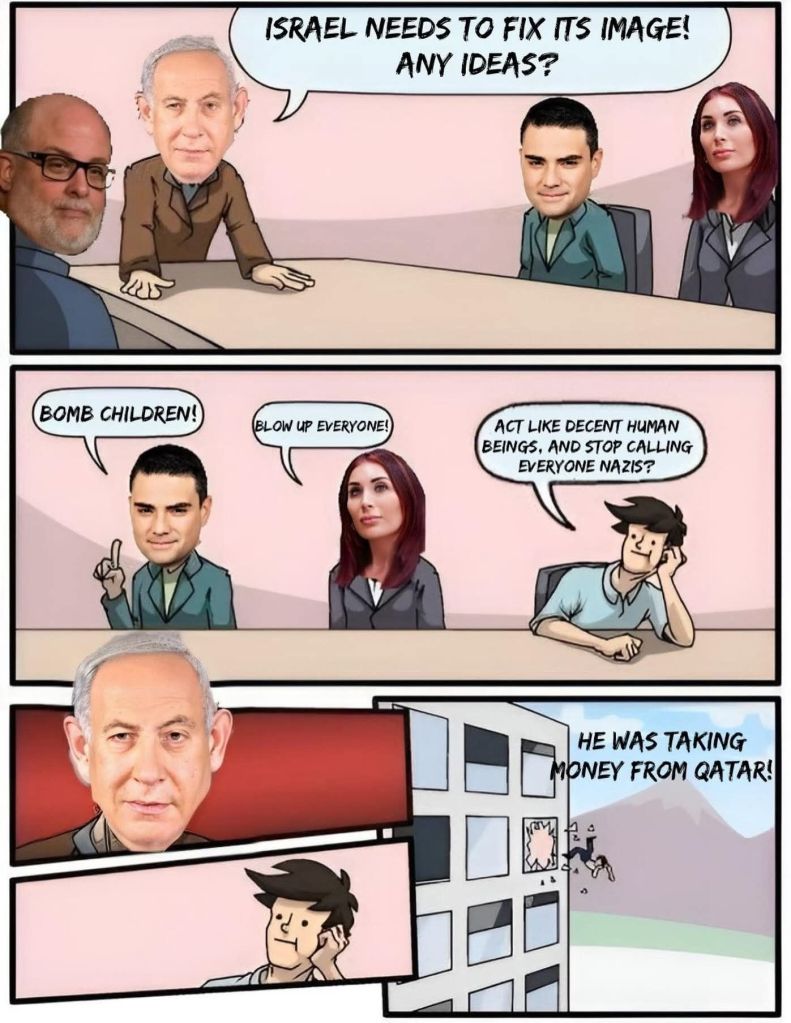
Jews are safer when Zionists abusers are made accountable.  The world is a better place when nobody puts tribe over a commitment to justice for all people.  We don’t need the Holy Lands to be a haven for the world’s traitors, pedophiles and identity thieves.

3) Treat AIPAC as a foreign lobby and trim back the Zionist control over our political institutions.  If Congress were taking the same amount of money from supporters of any other country in the world that they did from AIPAC they would be in jail.  How is it not collusion?  However, you’re not going to hear about this scandal on CBS News, after it was bought by Zionist billionaires, with a new editor-in-chief Bari Weiss.  Nor will the truth be told on TikTok after it was scooped up by the same people—now moderated by a former IDF soldier searching for ‘antisemitic’ content which could be anything that tells the truth about Israel.  

Frankly, the US desperately needs a policy of de-Zionization after years of our Middle-East mayhem.  When we have US ambassadors to Israel, like Mike Huckabee, meeting with a man convicted of treason, and Presidents unable to act independently from a foreign regime—even when that foreign regime kills more children than it foes true combatants—drastic measures need to be taken.  We can’t simply vote this out.  When then the candidates for mayor of NYC show fealty to a foreign nation this goes beyond normal corruption.  There truly needs to be more prosecutions for actual treason.

A Better Jewish Defense Strategy 

The current Zionist strategy—the fusing Jewish identity with an apartheid regime, shielding war criminals and traitors behind the label “Jew,” and branding every critic an anti-Semite—has sadly produced the most dangerous environment for Jews in decades: surging street-level hatred, synagogue shootings, and a global resurgence of real anti-Jewish bigotry fueled by rage at Israel’s actions. The four steps above break that fuse.

When Judaism is decisively decoupled from Zionism, when “Semitic” again and protects Palestinians and Lebanese as fiercely as Israelis, when the Holy Land is a shared home rather than an ethnic fortress, and when Jewish criminals no longer enjoy impunity under “right of return” or AIPAC protection, the primary pretext for hating Jews evaporates. Jews become what most already are: Just ordinary citizens judged by their character, and not scapegoats for a supremacist project most never voted for.

Paradoxically, the safest future for Jewish people is not more tanks, walls, or lobbying billions—it is the complete dismantling of the ideological human shield that today places them in the line of fire.

“You’re Thirty Years Old Living In Milton”

Standard

The quote in title, an unintentionally honest comment from a pious young woman, will continue to ring in my ears for decades to come. Scripture describes the word of God being “sharper than any two-edged sword,” but her romantic rejection came more like a hammer blow to my Mennonite worldview where spiritual was supposed to outweigh physical gain. I had patterned my life, up to that point, around a sort of practicality over flash and suddenly realized what I thought was an asset was actually liability.

I was reminded of these words again as my wife’s glowing approval of the monstrosity in my driveway, a Ford Explorer ST, still feels out of place for me. I mean, granted, I was not keen on transitioning to family life with a pedestrian option like a minivan or boring SUV. But I didn’t expect my always frugal—cost conscious—female counterpart to go along with it 100%. She was supposed to pump the brakes and did not. I’ve realized, in this, that every woman is happy with the nice things and won’t say no if you provide it for them. We’ve both agreed to blame the baby for our reckless financial decision.

So, back to Milton, a place I’ve since moved on from and to the higher cost town across the river. Up until the words from the mouth of this wholesome girl, I had thought having a little house completely paid off would be worth something—even attractive. After all she claimed to be interested in missionary service and what better place to get a start, right? From what I had believed, there are needs anywhere there are people and where better to start than a deteriorating industrial town? Milton is an example of the rust belt, a place of declining opportunities and costs of outsourcing production.

The phrase “you’re thirty years old living in Milton” was simply accurate conveyance of her underlying priorities. There’s always the difference between what we say we are and the actual truth. Even in the secular culture there’s a romanticization of the love of two impoverished people who stand together in desperate circumstances. And those raised in an environment where Christian mission is supposed to be first, living as one poor as a church mouse amongst common people would seem the ideal.

But it is not. No, this young woman, like the one who had rejected me for not pursuing a title of “missionary” or “pastor” years prior, was clearly after status. They will not say it outright, probably are not even aware, but it is a kind of glamour they seek in service. A call to some exotic location to impress their religious peers. Sure, a Bentley may not be status in a conservative Anabaptist church, but the ability to jet around the world (often on someone else’s dime) is thrilling where it is considered sacrifice. It is currency, a way to gain status in a community of faith or be seen as righteous.

Resources are showered on the ministry or mission. Sure, it comes with stress, my 9-5 does as well, but the payoff is proportional. And not talking about “treasures in heaven” or God’s favor. A pastor has access to the community resources. It is social power as much as it is a position of responsibility and there are always those who want to curry a little favor. Again, it also comes with more scrutiny as well, but most tend to minimize the costs when they set off in a particular direction. Besides that, for the Mennonite woman, this is for the broad shoulders of her husband to bear, right?

The high expectations of my wife have been a little surprising to me. To her credit, she has been putting up with a partly finished remodel of old house since marrying and moving in. But yet, despite coming from the Philippines, her standards are now close to that of an American woman. We comment about our son’s demands for what the other kids have, but often fail the test ourselves. I mean, is it at all coincidence that I decide to finally pull the trigger on a new vehicle after a Mennonite workmate showed up with his new truck? Probably not.

And that’s the bottom line here. We are all after power in different forms. Be it money, be it land, access to resources or just status in our peer group. What I’ve found is that a religiously trained (or ‘spiritual’) person is no different. No, all they do is give a righteous cover to their personal ambition. They live in a delusion. Materialism is bad, they will say, but they are fine with your donation of money so they can buy a bigger missionary compound in Southeast Asia. And, under the fluff of my own pursuit of love was the same sexual motivation of all men.

I hated when a physiatrist summarized my obsession with the impossibility as being a “sexual attraction” and dismissed it initially as a woman who knew nothing of my heart as a man of God. But now I realized this is undoubtedly the correct assessment. Men want sexually attractive women and women want high status men. This is an essential part of our nature—a matter of survival for our genes—a young healthy woman is able to bear children and a wealthy or connected man can give them much more than a thirty year old living in Milton.

I’ve moved on from Milton, but cannot move on from the reality I have encountered head on, we’re sexual creatures living in material reality and can’t escape this by denial. I had been better to learn this decades ago rather than cling to a naive notion of love where it ends like a storybook. But I am now living the best life available to me and hope that my wife is happy with her decision. She’s won my heart asking for the “simple and happy life” and now I want to give her that and everything else wonderful this world offers. The best thing we gained was the child born almost a year ago now…

It’s never too late to live the life that you should—which is more about perspective than what you possess—even if you were denied love for being thirty years old and living in Milton.

From False Flags to Fortress Minds: The Politics of Fear

Standard

We don’t see things as they are, we see them as we are.

Anaïs Nin

In today’s world, discerning what is real from what is manufactured is a formidable challenge. Suspicion abounds, particularly among the political right, that groups like Patriot Front—openly fascist—are not grassroots movements but rather orchestrated operations, possibly by federal agencies. The MAGA base can’t even spell the word “fascism” let alone embrace it as a guiding philosophy.  Yet, this suspicion fuels the leftist “anti-fascism” narrative, which is wielded as a justification for aggressive tactics and bullying.

Fear is a potent tool for control, and political operatives exploit it to manipulate public sentiment. When voter turnout wanes in critical demographics, staged provocations—such as groups wielding tiki torches to “Unite the Right”—can galvanize a larger, more powerful group into action. These events often attract a few genuine extremists, but their true purpose is to provoke a broader reaction.

A pony motor.

This strategy mirrors the “pony motor” in early diesel engines, where a smaller gasoline engine was used to heat and start the larger one. Similarly, false flag operations—whether orchestrated or permitted—serve as catalysts for sweeping agendas, such as justifying military invasions of countries or enacting restrictive laws. While I’m not convinced that 9/11 was a government-orchestrated plot, evidence suggests some knew in advance and that it was exploited to advance a wishlist of wars against unrelated nations and to pass laws that would not have prevented the attack. This reflects the mechanics of how to “manufacture consent” in our modern democracies—where fear is leveraged to unify and control populations.

The creation of a common enemy is a time-tested method for fostering unity. During the Cold War, the specter of communism was used to rally the public. After the Soviet Union’s collapse, Islamic terrorism became the new focal point. The 9/11 attacks, likely executed in part by Osama bin Laden’s organization, were real but were exploited to amplify fear. Domestically, this pattern persists: Democrats emphasize the threat of right-wing extremism, while Republicans fixate on “wokeism” and DEI initiatives. These are deliberate strategies, rallying points designed to consolidate support. Even more effective is provoking hatred from opponents—forcing one’s base to fight for survival and justifying the consolidation of power.

What do you think the point of The Handmaid’s Tale really is?

We Create Our Own Enemies

This dynamic extends beyond politics into cultural and religious identities. Jewish identity, for example, is partly shaped by what’s known as “Masada syndrome,” a collective memory of the Jewish defenders at Masada in Roman Judea (later renamed Syria Palaestina in 135 CE), who chose suicide over captivity. This narrative of the siege mentality is reinforced during the Passover celebration with texts proclaiming to the faithful, “In every generation, they rise up against us to destroy us.” Such beliefs foster an “us against the world” mentality, where hatred is seen as inevitable, reinforcing group cohesion.

Similarly, in the Anabaptist tradition that I grew up in, the reading of Martyrs Mirror cultivates a persecution complex. Likewise, Kanye West’s controversial remark about slavery—“When you hear about slavery for 400 years… that sounds like a choice”—touches on a deeper truth about locus of control. As my mother would say, “You can’t stop a bird from landing on your head, but you can stop it from building a nest.” Paranoia and defensiveness can alienate others or invite their suspicion, while believing you’re inherently excluded can lead to antisocial or even criminal behavior. It’s as if we seek to validate the fears that define our identity.

This pattern is evident in contemporary conflicts. Hamas, for instance, was probably willing to sacrifice innocent lives in Gaza to highlight the Palestinian plight—anticipating Israel’s brutal and disproportionate response. Yet, why does Israel fall into this trap? One possibility is that it aligns with certain political goals. Israeli Prime Minister Netanyahu, facing corruption charges, may benefit from war as a distraction. The Likud party’s vision of a Greater Israel—encompassing Palestinian territories, Jordan, and parts of Saudi Arabia and Egypt—could also be a factor. Some speculate this violence is a deliberate provocation to unify Jews through fear, and possibly tied to messianic expectations.

Netanyahu is a Revisionist Zionist, this is their long-term plan.

This self-fulfilling prophecy is reflected in online discussions, such as an Israeli subreddit where users lament being hated globally. They attribute this to irrational antisemitism, dismissing the role of the Israel Defense Forces’ actions, such as killing children, which fuel international outrage. This mindset—“They’ll hate us regardless, so we might as well give them a reason”—makes them vulnerable to exploitation by corrupt leaders like Netanyahu.

Breaking the Fear and Control Cycle

The fear of the Lord is a fountain of life, that one may turn away from the snares of death.

Proverbs 14:27 ESV

We must guard against siege mentalities like Masada syndrome. By convincing ourselves that the world is inherently against us, we risk acting in ways that bring about the very persecution we fear. Focusing on external threats to define our identity can lead us to become what we dread, fulfilling a prophecy of our own making due to our own unacceptable actions. 

Breaking this cycle requires rejecting fear-based narratives and fostering a sense of agency over our own actions and beliefs.

To guard against exploitation, we must shift our focus from the fear of man to the fear of God.

Human fears—stoked by manufactured enemies and self-fulfilling prophecies—keep us trapped in cycles of division and control.  A reverent fear of a perfect moral agent beyond us offers a higher perspective, grounding us in principles of justice, compassion, and accountability. By prioritizing a divine wisdom earthly manipulation, we become less susceptible to the provocative tactics of those who thrive on our fear, fostering a resilience that unites rather than divides. Establishment of this spiritual foundation empowers us to reject their deadly paranoia and act with clarity, so we break free from those divisive narratives that political systems use exploit to consolidate power.

Too Cruel To Be Coincidence

Standard

There is this sort of silly thought I have had, which has some legs, about the true nature of the universe and how unlikely it seemed that our friend’s daughter would fall victim to the currents of the Susquehanna river.  I realize this is more just a hiccup of my own mind than an actual reality, but what are the chances?  What are the actual probabilities we would know another Filipino-American couple with so many similarities and has a tragedy like this happen?

I ran my hunch through Grok.  What are the chances that another couple, one of them a German-American with neck or back issues (like me) the other a recent immigrant from the Philippines who came with a child and has also (like my wife) recently given birth to a second child, losing their ten-year-old daughter in a drowning incident just a week prior to Mother’s Day?  And how likely is it that I would have experienced the loss of a close friend’s child twice?  The probabilities are so infinitesimal that the very existence of life is more likely than this:

The probabilities of the specific scenarios you described—knowing an ethnic German man in Pennsylvania with a Filipino wife and children matching your family’s profile (0.00462%), his 10-year-old daughter drowning in the Susquehanna River on a specific weekend (1 in 2.82 trillion), and being friends with two women who lost children tragically (0.566%)—are all significantly lower than the probability of life existing in the universe, which is nearly certain (1) due to the vast number of planets (10²²). Even in an extreme pessimistic scenario where life is exceedingly rare (0.36%), only the third scenario approaches or slightly exceeds it, while the others remain far less likely. The universe’s immense scale makes life’s existence highly probable, whereas the hyper-specific nature of your scenarios, especially the drowning event, drives their probabilities to near-zero.

All this is just an extended version of that age-old question: “Why me?”  

This weird feeling of this being a tragedy too perfectly scripted to be real is simply the hallucination of a mind searching for meaning where there is none.  

It is no different from when I—in delusion of religion and looking for answers—had assigned meaning to the ‘impossibility’ (a romantic interest) randomly picking up a paper, leftover from Sunday school class in the same location, and then reading from it “with God all things are possible” right as she walked past me—renewing my hope to continue my foolish pursuit of faith and love.  Belief in a divine plan only led to more disappointment.  It is what it is—as she told me as an answer.  A coincidence is no more meaningful than we have made it.  

apophenia

Truly, we could throw our lasso around any circumstance, any set of facts, and find it to be highly improbable.  But, after the fact, if it has happened, the probability is always 100%.  Basically everything is unlikely right before it has happened and this why those Lee Strobel type of apologetic ‘cases’ aren’t very compelling for a critical thinker.  They are too based on assumptions and deciding what matters based on our own window of understanding—never considering the other possibilities.  

It is actually very likely that I know another Filipino-American couple, involving a single mother and a lonely guy similar to me, given that we deliberately connected to the local Pinoy community for sake of my wife.  And it was our similarities that always gave us something to talk about.  He was employed in an engineering related field, same as me, and going through the visa process.  As far as the tragedy, around 4000 unintentionally drown in the US per year (900 children) and spring weather (near Mother’s Day) is just likely to bring people to the river.

My foreign-born friends, in retrospect, were more vulnerable.  Those who grew up in the Susquehanna valley have a bit more fear of the river.  The waters may appear to placid, but we also know about those floods which have ripped through communities and how it respects nobody.  You’ll try to pet a bison up until you see the first person gored.  We simply don’t know risk until we have seen it for ourselves.  But then I also know that the mother, in this case, was always extremely cautious and only looked away for seconds before hearing the commotion.

What is so hard to accept is that reality that this world is full of danger.  Both conspiracy theorists and left-wing control freaks refuse to deal straight up with a world where death can occur without some dark plot and that this won’t be solved with politics.  I’ve never been under that delusion.  However, I have had this good things happen to good people expectation going in to life.  My Pollyannish hopes have been rebuffed too harshly and consistently to continue holding to them.  In truth, the natural world does not care about your morality—if you follow all the rules or are evil incarnate—the universe is utterly indifferent.  It just is what it is.

There is no evidence of a grand design, as I had been indoctrinated to believe, and fully embraced—before falling flat.

It is pareidolia, a mirage or projection of our own desire to find explanation or reason for everything.  People want this singular thing to blame for all bad things and yet there is not in the case of this drowning.  The mom was not negligent, the water is neutral and neither good nor evil.  Trying to find design is only me choking on a reality we all should face: We all leave this world the same as we entered it—dust to dust.  Some depart on a different schedule than expected.  But many children have died before their parents and long before history recorded it.

To have no cosmic force orchestrating our suffering is a big comfort.  It eliminates the cognitive dissonance of the loving God that then subjects Creation to torment.  Pain is a survival mechanism.  It helps to correct our behavior and train us, but also misfires (ask those with chronic pain) and hurts us for no good reason.  There is no need for a perfect system, one where only those who deserve punishment are punished, merely one that functions well enough.  There is no intent to be cruel, no special message to glean from the loss of a precious daughter a weekend before Mother’s Day—she slipped on a rock and that’s all there is to it.

We desire a director behind all events good or bad to make it easier to understand.

If fantasy helps you cope with grief then by all means embrace it.  We could theorize it was part of a hidden divine plan to gain the salvation of her parents, a punishment for lack obedience to Allah, and that she is playing up in heaven with those millions of aborted fetuses Evangeli-cons care about (or the children of Gaza they don’t) and if the thought comforts then pull it up over your head like a warm blanket.  Nature can be cruel, cruel in a way that seems very much too improbable to be unplanned, but good people suffer just as the wicked do, and the universe offers no explanation or apology for it.

What Do We Do with the Freaks?

Standard

I ran across two stories the other day, one of them about a mixed race man who looks like a female and another about a child with ‘werewolf syndrome’ who looks like the missing link—in both cases I thought about the negative attention this brings.  In the later case, given the current awareness push, a young man who looks very feminine faces presumptuous comments about his ‘transitioning’ and I wondered at what age this happy kid would realize that he was a genetic freak?  School children don’t need to be taught cruelty.

While I’m certainly not on board with the current “I identify as” phase, I also am not for alienating or adding to pain others have from being odd.  What I’m talking about is the exceptions who are the exceptions by no fault of their own.  Starting with those who are visibly different, dwarfs, albinos, Down Syndrome, conjoined twins, chimeras, Klinefelter syndrome (boys and men with extra X chromosomes), intersex people (born with ambiguous genitalia) or Turner syndrome.  There are many chromosomal abnormalities and many issues that do put some in a “none of the above” category that is apart from what is most common.

We accept that physical abnormalities exist, it is pretty much impossible to deny, but the controversy begins when someone who has all of the physical characteristics of a man demands that other people use a female pronoun to describe them or competes as a woman.  Genitals don’t tell me what goes on in someone’s head.  My wife says that I’m “like a woman” in how I am expressive and emotional.  My little sister was a “tomboy” growing up.  I suppose today that would be proof that we deserve special protection or rights?  How far can we tolerate people who do not meet expectations for their gender?

You don’t need a biologist to tell you that men tend to have a very distinct advantage over women in strength and size.  It is not fair or safe for women to be in competition with those born with an XY chromosome no matter how they identify.  I mean, isn’t that why women’s sports were created in the first place?

And, contrary to what the “Muh rights!  You can’t make me wear a stupid mask in your private establishment.” people think, it is perfectly okay for groups to exclude those who have willfully refused to conform to the established standards.  Try to walk into any church naked.  They probably won’t even let you get to your explanation about material making you itchy or how Biblical prophets ran around butt naked.  We set rules.  We define categories.  We decide if those with Swyer Syndrome are men or women.  Click the link and give me your own answer in the comments.

Include or exclude?

It is our cultural bent to be more inclusive of the exceptions.  We are taught that we must show empathy and understanding for those who are “born eunuchs” as part of Christian love.  Then again, the Gospels are a sort of square peg being fit in the round hole of Scripture and it is easy to comprehend why the ‘chosen people’ rejected Jesus given how he mingled with the impure.

Biblical Exclusion 

One reason why to be sympathetic towards those Jews who rejected the message of a teacher who ate with sinners is the Biblical tradition itself and the system it established to exclude those deemed defective:

The Lord said to Moses, “Say to Aaron: ‘For the generations to come none of your descendants who has a defect may come near to offer the food of his God.  No man who has any defect may come near: no man who is blind or lame, disfigured or deformed; no man with a crippled foot or hand, or who is a hunchback or a dwarf, or who has any eye defect, or who has festering or running sores or damaged testicles. No descendant of Aaron the priest who has any defect is to come near to present the food offerings to the Lord. He has a defect; he must not come near to offer the food of his God. He may eat the most holy food of his God, as well as the holy food; yet because of his defect, he must not go near the curtain or approach the altar, and so desecrate my sanctuary. I am the Lord, who makes them holy.’ ”

 (‭Leviticus 21:16-23 NIV‬)

And repeated:

No one who has been emasculated by crushing or cutting may enter the assembly of the Lord. No one born of a forbidden marriage nor any of their descendants may enter the assembly of the Lord, not even in the tenth generation. No Ammonite or Moabite or any of their descendants may enter the assembly of the Lord, not even in the tenth generation. 

(Deuteronomy ‭ 23:1-3 NIV)

Discrimination against the abnormal wasn’t only suggested or caught in a round about way be misinterpretation, but a command from God.  Talk about a kick in the nuts (or lack thereof) for those already suffering an undesirable condition.  Be born the ‘wrong’ ethnicity or suffer an unfortunate accident and you’re out.  Not much of this is actually explained, giving opportunity for apologists to explain around it, but Christian religion (along with modern science) has certainly taken things in a very different direction.

If a woman is ‘barren’ nowadays we try to treat the condition rather than assume it is a curse from God.  I mean, yes, the woman in the Philippines who had the hair covered son with ‘werewolf syndrome’ may believe that it had something to do with eating a cat during pregnancy, the popular notion of “you are what you eat” manifesting, but we’re not as likely to see it as punishment from God—we do not tend to attribute things blindness or misfortune to sin.  It is harder to exclude those who are imperfect when you realize it could’ve been you.

Any more than I need to know why Islam is different from Christianity, where someone was clearly copying some else’s notes, I’m not going to attempt to theologically explain the transition from Old to New Covenant.  It is clear enough that those who had lawfully been excluded, the leprose, lame and blind, Jesus healed.  The result of his ministry two millennia ago was a wave of tolerance that started with his Jewish converts.  Peter had his pigs in a blanket vision (while hungry out on the road) and now we eat bacon despite Biblical command:

About noon the following day as they were on their journey and approaching the city, Peter went up on the roof to pray. He became hungry and wanted something to eat, and while the meal was being prepared, he fell into a trance. He saw heaven opened and something like a large sheet being let down to earth by its four corners.  It contained all kinds of four-footed animals, as well as reptiles and birds. Then a voice told him, “Get up, Peter. Kill and eat.”  “Surely not, Lord!” Peter replied. “I have never eaten anything impure or unclean.” The voice spoke to him a second time, “Do not call anything impure that God has made clean.” This happened three times, and immediately the sheet was taken back to heaven. 

(‭Acts 10:9-16 NIV)

This, along with the Jerusalem Council, is a huge departure from Jewish Biblical religion and, again, it is no big surprise this new cult was rejected by the faithful.  Even today some observant Jews continue the tradition, like that Orthodox chaplain who declared loudly as he took a seat (next to me) on a crowded airliner with mixed races, “I’m a racist and don’t care what you think!”  My own cringe at this statement is born of an indoctrinated sensitivity, years of Christian influence, and not values arising naturally from thin air.  Or, rather at least not without a sheet to carry it down from heaven.

Bacon To Bisexuals

The other day I saw a post, from a Muslim friend, and it listed the problems with eating pork meat, their unique parasites, what pigs eat, etc.  Of course the winning comment was “but fried bacon is so delicious” and it basically for this reason why no Baptist will ever depart from pork consumption.  If it is pleasurable to us, we do it.  However, don’t dare use that reasoning with these same Biblical fundamentalists when it comes to things they’ve not be acculturated to.  And not at all to say that bisexuality is now in that big blanket of tolerance coming down.

No, it is just interesting to me how Biblical law is largely ignored except where it makes sense to us.  Don’t like tattoos?  Well then it is okay to misapply those laws that pertain to specific ancient pagan practices.  But if you like shellfish, then “freedom in Christ” exempts you from having to obey these outdated and irrelevant laws.  The energy in the room is completely different when it comes to the violations of Scripture we’re unaccustomed to or don’t apply to our own circumstances.  Sexual deviation is a whole can of worms that I’ll avoid until or at least until a good explanation of Swyer Syndrome is given to me.

One eyebrow raising moment, during a Bible study, while being brought into Orthodoxy, was when the topic of veiling (1 Corinthians 11) came up for discussion and how the old ethnic Russian priest dismissed it as being custom or cultural.  I never had the chance to ask him about the explicit quotes of Saint John Chrysostom on the topic.  But, like all things, what is important is a matter of our perspective.  The cradle Orthodox follow after the mainstream of Protestantism as much as anyone else, whereas the converts from Protestantism are more strict about preserving Orthodox tradition.  It’s amazing how culture influences our applications of Scripture.

All this to say that I don’t know where the precise dividing line is between pure and impure, acceptable or unacceptable.  But believe there is much more value in being merciful as our Father is merciful.  That is to apply the Golden Rule to those who struggle in ways that we can’t fathom or begin to understand.  Where it was once okay to stigmatize and treat left-handed people as second-class or evil we now accept them and think it is strange it was a problem for past generations.  There are many things that aren’t an identity we choose or a matter of “feel this way” (like a man who claims to be transracial) that require that us to show some grace.

“Ew, Brother Ew”

You’ve probably seen the meme.  A Muslim preacher lamenting those who abandon the Islamic practices of eating on the floor and growing a beard.  His comical expression of their disgust gets to the heart of what most of these religious do and don’t rules come from.  There is a continuum when it comes to gender and normalcy, taboos change, as do ideas of what real men do.  It’s funny to see how these standards have evolved over time.  From the time pulpits had spittoons to the current time of rainbow flags, we are not the same as our ancestors.

There are natural aversions.  We’re naturally disgusted by bodily fluids and it is for good reason.  Disease travels in blood, saliva and waste.  We are also attracted to beauty, the healthy form or good hygiene, this is about instinct and survival.  Sexual promiscuity is also risk as well.  So being grossed out can be beneficial if it protects us from negative outcomes.  However, this can malfunction, sort of like an autoimmune disorder, where we can overreact and exclude on the basis of things that aren’t a danger to us.  Bigotry and prejudice, like middle school fears of cooties, are often as sign of immaturity or lack of self-awareness.  Attributing every unfortunate condition to a moral failure is not sound judgment.

Just because something is strange or ugly to us is not a reason to recoil.  If a person is not trying to draw attention to themselves it is important to acknowledge their humanity rather than their odd appearance.  We didn’t choose to be ‘normal’ anymore than it was a decision they made to be different.  We do not need to pretend everyone is beautiful or affirm every exception as glorious.  There is healthy, there is deformity and disorder, we can love the person who overcomes or does not give up for their character.  It is possible for inner beauty to shine when we truly get to know the person rather than only see the outward appearance.

We’re Not Made for Paradise

Standard

Having overindulged in a stimulating activity more than once, I’ve felt the effects of the dopamine withdrawal.  Trivia Crack, aptly named, consumed me for a few weeks as I moved up through the ranks of friends.  The game played to my strengths and it became obsession after a little success.

The chemical rewards system of our body is hijacked by addiction.  For me things will often spiral quickly when exposed to a new stimulant.  Which is the nature of things in the social media and smart phone era, it is not restricted to location, the gratification of desire is instant, and the stigma is not large enough to restrain us.

What gives me new clarity about this is my good intentions for my son.  He loves to be on his tablet, watching TikTok videos, and can do this for hours on end.  Which is fine if his life is to be a consumer rather than a creator.  The problem is there is no need of art or mastery, both of which require some effort end struggle.  His entertainment will come at the expense of ambition.

The reason why I limit his screentime is to keep him directed towards development of talents.  In the ‘real world’ you don’t actually get any where sitting on your butt glued to a screen.  I mean, I do make a living this way, by clicking imaginary objects on a screen that others will fabricate into trusses using wood and metal plates.  Still, this isn’t really as fulfilling as it would seem and certainly isn’t as rewarding as winning a hard fought basketball game after weeks of practice.

Whether by creation in an instant or through generations, the basic systems of our body are designed to seek out those things that we need to survive.  And the rarer that these things are the more desirable they must be because this is what drives us.  Essentially, free will is questionable when so much of our own behavior is governed by impulses we have little control over.  Just try going without food for a day or two and tell me who is really in control of your actions.

The real problem is both excessive supply of things meant to be rare and the artificial replacements.  Eat too much sugar and the results will eventually catch up in the form of weight gain and diabetes.  If you wish to crush a man’s natural desire, the kind that is accompanied by productive behavior, then give him a unending access to sources of pleasure that aren’t tied to any work.

And this is the true sin of pornography and masturbation.  It isn’t so much that seeing the female form and appreciation of those feminine assets is so bad, it is why men get married after all.  However, it is when these things are satisfied in a way that does not produce the end that was intended.  Sexual activity without relationship or commitment is certainly fun and yet equivalent to empty calories.  It doesn’t build anything.

Which leads to the other problem of access and that being diminished returns.  In other words, with the replacements, while killing natural drives, one must do more and more to get the same pleasure.  No, maybe it isn’t good to enter the world always horned out or starved, that has it’s own problems, but some things are meant to be obtained via the traditional path.  Men who always get what they want in life never develop good character.

Which is the paradox.  We dream of having our desires satisfied.  And yet, even if we had the real deal to indulge ourselves to the max, would we be happy?  Was King David content with multiple wives?  Did it prevent him from noticing what other men had and acting out in lust?  The reality is most of us would be lascivious and bloated, like Harvey Weinstein, if we actually had the power to take shortcuts to our paradise.

We are not made to be removed from the limitations of our environment.  But, beyond this, all triumphs are short lived.  The point of our natural desires isn’t to ever lead us to contentment.  If anything, accomplishment of our ultimate goals may be anticlimactic and a disappointment.  That ‘perfect’ girl is going to fart in bed.  She’s not going to look dolled up and sexy like the fantasy version of her suitor’s mind.

As a child I wasn’t much different from my son.  I would draw my ideal world.  And in one of these visions was a bedroom with an automatic pizza making machine and soda fountain.  As an adult, I now know that this would be awesome for a week and not too long after that it would be disgusting.  The same goes for almost anything when piled up in excess.  Value drops with availability, which deprives is of satisfaction.

In the end, a Grand Theft Auto world, or one where we can simply take anything we want and is free of all consequences, would not be wonderful.  This is what went wrong with sexual liberation and dismissal of the moral wisdom passed down.  No, religious authority doesn’t accomplish the balance without wisdom, but it definitely can give a head start to the wise.  We’re not made for heaven—only to strive for it.

Aliens Are Here! Maybe…

Standard

Did you hear?  A ‘whistleblower’ testified before Congress about aliens and finding non-human remains at crash sites.  I can’t really know if this was reliable or someone simply getting their fifteen minutes of fame, but it does seem unlikely to me that beings capable of flying the enormous distances of space would be such poor navigators.  I’ll be a skeptic until I can see for myself and make my own determination.

However, in pondering the topic, a friend of mine posted an interesting meme and it is an angle worth exploring.  If aliens do exist, according to the insinuation of this image posted, then they are demonic entities and not to be treated as friends.  To some this may seem like a missed opportunity, why would we avoid a chance to expand our own horizons?  Typical human behavior, right, to meet with violence the things that we don’t understand or defy expectations.

Maybe. Maybe not.

And yet, this seems another case of being directionally correct even if wrong on the details.  I mean, there’s a chance that aliens are some kind of creature from another planet and come in peace. However, what if they don’t?  What if they, like many traveling to new lands, have colonial ambitions and will destroy or subjugate us if allowed? 

It is correct, instinctively, to have zero trust for these new arrivals.  Maybe, technically, they are not demons, but they are others and may as well be demons, right?

Tinfoil Hat Time

This is why I’m generally on the fence so far as the MAGA and Q-Anon types.  Sure, they vastly oversimplify and often get the details wrong enough to be easily ‘debunked’ by fact-checkers.  However, half the problem is usually about the use of semantics and not the substance.  Maybe the world isn’t run by a ring of reptilian pedophiles, nevertheless there are many who lack morality, have their secret plots, hidden motivations, and cover-ups.  It might not be organized, but this is pervasive enough that it is adequately put in terms of a grand conspiracy.

Women, don your head coverings!

So far as aliens, and as a devoted speciesist who prefers native life to that which is most certainly extra-terrestrial, does the exact approach we take to ‘othering’ them really matter?   They are an other, a true existential threat, and therefore to be regarded as demonic beings.  Curiosity could be our undoing and especially when it comes to those things powerful and beyond our own understanding.  

So what does the Scripture tell us about this topic?

First, be respectful:

In the very same way, on the strength of their dreams these ungodly people pollute their own bodies, reject authority and heap abuse on celestial beings. But even the archangel Michael, when he was disputing with the devil about the body of Moses, did not himself dare to condemn him for slander but said, “The Lord rebuke you!” Yet these people slander whatever they do not understand, and the very things they do understand by instinct—as irrational animals do—will destroy them.

(Jude 1:8‭-‬10 NIV)

Quibbling over what exactly they are is okay, but there is no room for casualness when it comes to aliens or demons.  Those coming from other worlds obviously have technology or means better than our own.  They can run circles around us.  So we would be wise to be cautious and exercise due respect—that is to say rely on God’s power rather than our own strength in these encounters.

Second, we should learn from record history and not make the same mistakes:

The Nephilim were on the earth in those days—and also afterward—when the sons of God went to the daughters of humans and had children by them. They were the heroes of old, men of renown.

(Genesis 6:4 NIV)

The non-canonical book of Enoch goes into greater detail about this event when beings from another realm came to Earth, shared their advanced knowledge (including that of weapons) and interbred with women.  These enhanced hybrid offspring were extremely powerful, they also had insatiable appetites and their enormous consumption eventually led to a destructive rampage.  We are told this is why God finally wiped the slate clean with the great flood, where Noah and his family were spared.  This is why St Paul writes, in a letter to the Corinthians:

A man ought not to cover his head, since he is the image and glory of God; but woman is the glory of man. […] It is for this reason that a woman ought to have authority over her own head, because of the angels.

(1 Corinthians 11:7‭, ‬10 NIV)

Women, wear your tinfoil hats.  Err, I mean, veils, because there are Watchers, sons of God not named Jesus, and thus it is for this reason you should definitely declare what is the ordained order.  Mennonites and Amish are just unwittingly ahead of the game!

Aliens or Angels?

My wife speaks English.  However, given that she comes from the Philippines, sometimes her word usage can be different from that of an American.  Hanging out with friends and family, for example “bonding” and a “polo” can basically be any shirt with buttons.  So truly, if use of language can be this confusing even for us contemporaries, what happens when we expand this “telephone game” over centuries?

It is quite possible that we are reading about what we call aliens in these ancient texts.  I mean, the descriptions do seem to match so they not?  Those who came to Earth with advanced knowledge and abilities, messed with human genetics through impregnation of women (see: Aliens) and wreaked havoc on the planet before God intervened.  There is no way to know if the difference is only semantics or of substance.

It seems very unlikely, given the distances involved, that aliens beings can travel from galaxies far away.  It is much more likely that these beings would emerge from a parallel (spiritual) dimension, and perhaps through a portal, and are able to take physical form to interact with us.  And, either way, similar to artificial intelligence not sharing our human priorities, I’m doubtful these aliens or angels would really have our best interests in mind if they did come. 

Ultimately, for all intents and purposes, they are demons.  In other words, those of Orthodox Christian tradition do already know what they really are.  And, therefore, we must both exercise great caution and strengthen our faith.  If they have returned then widespread destruction may be soon to follow.  It is not a reason to be afraid, there is no need to panic, these gods are not greater than the good God who has defended those righteous from the beginning and will never let evil win in the end.

Path of [Least] Resistance…

Standard

One of my favorite players, while coaching ‘semi-pro’ was a guy named Jerry. The league knew him as this out-of-control and sort of dirty player. He would get wound up with his asthma attacks and get into verbal altercations on the field. But to me, despite his reputation as a loose cannon, he was actually more coachable than many on the team. The guy could’ve easily ripped my head off, he was a fairly large guy (playing defensive end) and a physical force on the field. However, in the few times when I did need to directly to intervene, he was surprisingly respectful. I mean, he would address me as “coach” and, every time, after a few mumbles, he would back down. He would even often apologize later.

Only once, with a little alcohol involved, did I catch a small glimpse of what was driving him. At the time, in his late forties or early fifties, he recalled how his own dad had pushed him. He was abusive and never satisfied. And football was the direction his dad was pushing him in. Jerry had D-1 offers as a younger man. Yet, ultimately, he walked away from the sport at that level and much to do with the pressure he had felt. Obviously, he was still very conflicted over all of this. He played as if a demon were biting at his ankles, a man on fire, and probably pushing a little too hard for a man his age. I’ve lost contact with him, not even sure if he lives in the area anymore, but his story is a cautionary tale for me as I try to navigate my son’s current involvement in athletic endeavors.

I love sports as a training ground for life. It is an opportunity for character development, to learn lessons about work and reward, teamwork, etc. I had my own regrets for having started competing only very late in high school and, therefore, have been very pleased that my own son wrestled over the winter and has been practicing for football season. He’s an amazing athlete for his age. He won his bracket in wrestling, his first year out, with a combination of will, natural strengths, and things learned from his coaches. It has not taken much encouragement to keep him going. He is an enthusiastic participant and seems to really enjoy himself with other kids his age. There have been a couple of times when he was upset and seemed ready to quit, but the next day he has always come back for more.

Desirous Distractions

Of the things I hate most, his tablet is probably in the top ten. We had successfully hidden it away (he didn’t miss it after a week or two) and yet brought it back out due to some current circumstances that make it better to keep him occupied. The result has been like an addict, or binge, where he would use the device non-stop if we allowed it. It turns him from an active and engaged kid, who loves to swim in the local pool and requires a ton of attention, to a slug barely moving for hours. It’s not healthy and that’s the reason why I’ve fought back against this and haven’t minced my words on this topic with him either. I’ve been glad that we had football practices to give that indisputable non-negotiable reason to separate him from the screen. However, the other day, after practice, he confessed that he wished that he didn’t play football so he could be on his tablet more!

One of my successes, so far, as a parent was to keep sports as his idea. Sure, I want him to play, I have done my part to facilitate his involvement as well, but I’ve mostly let him lead in what direction he wanted to go and was glad that his own desires lined up with my own. I’m sure my own hopes and expectations have found their way to influence, children likely know their parents better than their parents know them and generally want to please them. He knows that I’m a Penn State football fan and that, Charlie, the elementary wrestling coach was an old teammate. So it isn’t really surprising that he went down this path similar to my own. Still, I didn’t want to be one of those dads, the kind living vicariously through their son and putting undue stress on him. It does seem we’re too sports-obsessed, where youth leagues are year-round, there is this camp and that camp, which is driven by parents with glowing ambitions more than it is by the children themselves. I wouldn’t be all that surprised if many of these overworked and pushed too hard will quit. At the very least, it won’t be enjoyable.

The big question for me is what would I do if my son said “I don’t want to play anymore.” I’ve already assured him that not playing doesn’t mean he would get more time with his tablet and that he would probably be bored. And he seems to understand that he needs to finish what he started as far as the current season. Nevertheless, the chill I felt, all of my own dreams of watching him now threatened, could easily lead to my being more controlling. It is scary to me that a tablet, this path of least resistance, has so much appeal that he would sacrifice all for it. I’ve also had to question my own motives. Am I doing what is best for him? When I restrict access, when I push him to do things that make him uncomfortable, that’s the reason why I do. But as a parent, we really need to be careful not to project our own desires onto our children so much that they are stifled and not free to be themselves.

The Elusive Balance

My son would likely be completely happy if I just let him play on his tablet nonstop. Maybe he would eventually get over it on his own if we didn’t interfere? I mean, I doubt it. There are always new games to download and more distractions to occupy for hours and hours. And that’s my concern, that the hours he spends vegging out could be put to much better use. It would be negligence, on my part, to simply give him what he wants and never resist his short-sighted perspective. It is my job to develop him, to make him ready for life and sports are one of those tools used towards that end. I don’t want him to develop character, not to be a character in a video game. I want him to get exercise, experience the tactile and real world, and not just live in the fantasies that others created for him. I must resist him.

That said, football is also just a game. I don’t want to be that dad who ended up putting so much pressure on his son to be successful that it ruined our relationship and he quits in frustration. There is much more to life than statistics or the accomplishments that the world will notice. Yes, I would beam with pride if my son were to score a touchdown, be on a state championship team, and be good enough to compete at the next level. A college scholarship, of course, would be great. He doesn’t seem to be the type that will get that in the classroom, so why not encourage the path that he does have? Still, that is exactly the problem. I quickly get way out ahead of reality and with that could quickly destroy even my own enjoyment of the moment. He should, as a child, be involved because it is fun. Certainly, I must coach a little, put some restrictions here and incentives there, but ultimately he needs to choose.

I don’t want my son to go down the path of least resistance. I want him to be resilient, a leader, involved, pushing back, and growing his abilities rather than comfortable. I truly want him to be better than me in all regards. Or, at the very least, to be better for having had me be a part of his life. Sometimes this will require me to bump against his will, dig in my heels a bit, and not let him rest on his laurels or waste the opportunities he has. Other times I will need to step back, let him go his own way, learn at his own pace, and accept that his goals for life may not align with my own. The real struggle is the wisdom to know when to intervene and how. Hopefully, he knows my heart is oriented towards his good even if my execution is flawed. And, actually, I’m okay if we’re not always friends so long as what I’m offering him is a way to go beyond my own limits and reach his full potential as a man, that’s my reward.

An Affirmative Reaction

Standard

The Supreme Court has finally ruled against the practice of blatant racial discrimination in university admissions.  This, after Harvard and other schools, in pursuit of filling quotas, would find means to select against qualified Asians to meet an ideal for diversity based on skin color.

The Affirmation Fairy… 

African Americans, at least as a collective whole, have suffered disproportionately and this is a historical injustice that is not easily solved.  Much of our success later in life has to do with the homes and communities that we were born into.  The values we receive via our culture make a huge difference so far as outcomes.

I remember a viral video, a few years back, that lines up a bunch of young people on a grassy field.  The announcer asked various questions, such as “Take two steps forward if both of your parents are still married,” and those who could answer yes advanced.  The results of this survey were framed as ‘white privilege’ and yet none of the statements had anything to do with race.

Social inequality is certainly not a black-and-white issue, many children of European and Asian ancestry lacked a father in the home, worried about fitting in, did not feel safe at night in their neighborhood, worried about having enough to eat, and lacked access to private education or tutors.  I once begged my mother to take me out of public school after a rough patch.  I changed my hairstyle as a response to classmates who made note of my ‘Mennonite’ side part.  I decided to quit college rather than go deep into debt.  

Am I underprivileged?

Exactly how much am I disadvantaged as a learning-disabled child of two high school dropouts, with a father who had to be away all week to support our family?

There problem with all “affirmative action” is that it is a vast oversimplification of a very complex and multi-layered problem that may be more about culture than color.  We simply cannot account for every factor or rate every single subcategory of ethnicity and culture for statistical disadvantage.  For example, do we know the college graduation rates of Americans of German ancestry or Irish and Italian?  Are a proportional amount of these ethnic groups represented?

Furthermore, our own disadvantages can be advantages, in that they can provide u much-needed motivation.  Sure, having money may mean a trip to Harvard and a certain level of success.  However, the same is true of those who are tall and athletic.  Jeff Bezos, at 5′-7″ tall, may have benefitted from having some ‘short man syndrome’ or that extreme desire some have to compensate for the discrimination they faced for physical characteristics that were beyond their control.

Affirmative action is wrong in that there is no way to rank hardships.  It is wrong because it isn’t addressing the root causes of social inequalities, even as defined by the privilege police, in that we’re not talking about things like fatherless homes or inner-city violence and cultural forces that discourage the behaviors that aid in academic achievement.  You can’t wait until a person is eighteen, then wave a wand of university education and credentials as a solution to these underlying issues.

Asterisk Graduates…

The true underlying message of affirmative action was that minorities, specifically those of African descent, couldn’t be successful without the help of the government.  As liberal arts universities continue to seek to fulfill a narrow color-obsessed definition of diversity, using quotas rather than qualifications, they unintentionally degrade all of their minority graduates—even those equal in merit to the non-minority graduates.

The idea of a “diversity hire” or a person not equally qualified to others who applied and yet are given preference only because of their special category of race or gender, is a direct consequence of discriminatory affirmative action programs.  People know how to read between the lines (albeit often unfairly) and will diminish accomplishments that weren’t actually earned or can be perceived as being unearned.  It is why we do not see the work of those ‘born into wealth’ as being equal to that of those who are self-made.

A classic example of the patronizing white saviorism that is lurking behind divisive equity campaigns.

Just as a university degree would lose value if everyone were simply given a diploma for breathing, admitting some primarily on the basis of skin color devalues the effort even in the eyes of those who benefit.  It only serves to feed an idea of black inferiority, that they need a ‘white savior‘ to swoop in and rescue them from their plight, and is grossly unfair to all who were truly qualified on the basis of merit—but will still deal with the asterisk due to systemic compensatory color preferences or racially discriminatory quotas.

You cannot defeat unfair discrimination with a new kind of unfair discrimination.  It is not right that overqualified Asian students were being overlooked because of their race or on some kind of subjective basis that the worth of their own “lived experience” is less than a person of African origin.  Many Asians have overcome extreme hardship, faced intense pressure at home and hate crimes (often underreported for going against the typical racial narrative), yet won’t ever express this due to cultural reserve—why should they be punished for the success of their peers?

Two-tiered or lower standards for some will never achieve the goal of equal outcomes.

Favouritism Forbidden…

We’re living in a time of moral inversion, a time when those who lived a life of crime and abuse are treated as victims simply on the basis of their outward appearance.  It is as wrong as the favoritism of preferring the wealthy over the poor for the potential benefits:

Do not pervert justice; do not show partiality to the poor or favoritism to the great, but judge your neighbor fairly.

Leviticus 19:15 NIV

The problem was favoritism, preferring one party based on who they are (what they can provide for us) rather than the actual merit of the case.  Fairness of judgment, not equality of outcome, is the goal.

Christians were told not to judge by a person’s outward appearance:

My brothers and sisters, believers in our glorious Lord Jesus Christ must not show favoritism. Suppose a man comes into your meeting wearing a gold ring and fine clothes, and a poor man in filthy old clothes also comes in. If you show special attention to the man wearing fine clothes and say, “Here’s a good seat for you,” but say to the poor man, “You stand there” or “Sit on the floor by my feet,” have you not discriminated among yourselves and become judges with evil thoughts?

James 2:2-4 NIV

Many, trying to make a show of their own righteousness, take a Scripture like that above and turn it into a call for social justice or a special preference for the poor or otherwise disenfranchised.  However, this kind of reverse favoritism totally misses the point.  Trading one kind of perverse judgment for another is not a virtue.  No, it is a virtue signal and something people do for the social benefit of merely appearing to be an advocate for those recognized as being disadvantaged.  Even if sincere, this is a misguided approach that goes against the instruction not to show favoritism.

Affirmative action, in the end, is just a new form of white supremacy that is expressed as patronization.  It frames differences in outcomes solely in terms of identity groups while neglecting to correct the factors causing the inequal results or truly helping people to cross over these unhelpful, artificial, and arbitrary divisions.  Jesus taught more of a gracious meritocracy, where our behavior did matter and we would ultimately be judged on how we treat other people irrespective of their deserving or appearance.  In this regard, our equality comes only in repentance and our obedience to the law of Christ—not by force of courts or legislation.

We do not save the world by trying to force others into compliance or control outcomes. Rather we change ourselves and become an example of impartiality and love to all people. Honest and fair equal opportunity is having the same requirements for all and not preferences tailored to some at the expense of others. You cannot rob Peter to pay Paul. We shouldn’t love bomb some, even to make them feel better about themselves, by removing opportunities for those who truly have earned their place.

Making Impossible Possible

Standard

It was impossible for me to find romantic success in the religious community that I had been born into and I would most definitely have remained single if I refused to adapt. My only regret is not having realized this (along with many of the many other fatal flaws in this system) much earlier.

The most excruciating part of this ordeal was that it always seemed that victory over this adversary was right at my fingertips. But, as the expression goes, to miss by an inch is to miss by a mile. And it seems that both friends and church leaders were never that serious about help. None were willing to lift a finger to relieve this burden of so many in their churches.

It was a systemic problem that required a systemic change that would not come. Women were ruined by their own idealistic purity culture standards and not taking the opportunities available, and men by being rejected every time they tried and were reduced to simps—rendered themselves completely unattractive for their doting ‘desperate’ attention to females.

What makes me curious is what truly was so different about my own experience in a fundamentalist sect and that of those in an old-order setting where pairing up does happen. Surely young people in those settings have ideals as well and yet they appear more willing to risk relationships than my former peers. It is as if they are programmed to be more realistic or unafraid.

The thing is, the next generation probably isn’t experiencing what I did. It was just a perfect storm of frauds, like Bill Gothard or Joshua Harris, that fed female fears of being ‘defiled’ for merely having a real conversation with a male member of their group. Mixed with the already existing cultural reserve and perfectionism. A moment of hesitation is very costly, approach anxiety increased tenfold with the raised stakes, and thus failure resulted.

If only there were more fathers and responsible adult figures saying “Relax, talk to each other, and take some risks, it isn’t like you need to marry after the first date.” If only there were some pushback to this notion that independence (having things our way, going out to see the world, and the postponement of marriage) is an indication of a greater commitment to Christ. Being picky doesn’t make you St Paul or Florence Nightingale.

Instead, the trends within the conservative Mennonite churches very closely align with general cultural trends where traditional courtship has fallen out of favor. Sure, in this version the attractive men get their sexual gratification. However, women never get the kind of commitment from these men suitable for raising children, and often choose careers and European vacations instead. More average men, who would be devoted, are simply shut out and ignored for not meeting the impossible female criteria.

I’m happy to have found my ‘hack’ and finally was able to get around the broken system that put my life on indefinite hold. I would’ve done things much differently if I had a chance to do it all over again. Firstly, I would’ve been less sensitive, more assertive, and never got mired in doubt of my own value. Second, I would not be concerned in the least about pleasing a standard that didn’t actually matter.

The successful never followed the onerous rules of those moral busybodies. A man should not ask permission, he simply needs to take the initiative and get what he wants. Too many times my own indecision on what was the ‘right way’ kept me from ever taking the opportunities as they were presented. Luckily, for me, because of my failure, I have found something much better than I could ever have found in the midst of the entitled mentality and demanding confines of my past life.

The wonderful woman I have found would’ve been impossible to marry when I was still bound to their standards. I could never have had a relationship with someone as intelligent and ambitious, let alone beautiful in appearance, had I remained. The impossibility remains impossible. But the impossible has been made possible by my willingness to change the rules of the game.