Sharia Law: I read it on the internet…, part 3

Standard

I have quite a number of friends who like or repost stories with shouting headlines and containing claims apparently designed to feed fears.  What amounts to fear-mongering propaganda is wrapped in the trappings of legitimate “conservative” news sources.  Unfortunately, most of it, while at some level based in a true story, is so badly blown out of proportion and hyperbolic that it is a dishonest representation.

Now, these purveyors of hysterics and half-truths may or may not be intentionally distorting the reality.  But I suspect there could be a bit of an ‘ends justify the means’ mentality and an idea that their twisted versions of a story represent a greater truth or reality.  I think every journalist does pick and choose what facts are relevant and how they present a story does reveal their personal bias.  However, to me,  there is a level of this that is unintentional or within reason and a level that is inexcusable.

Woman Has Opinion; Sparks Controversy

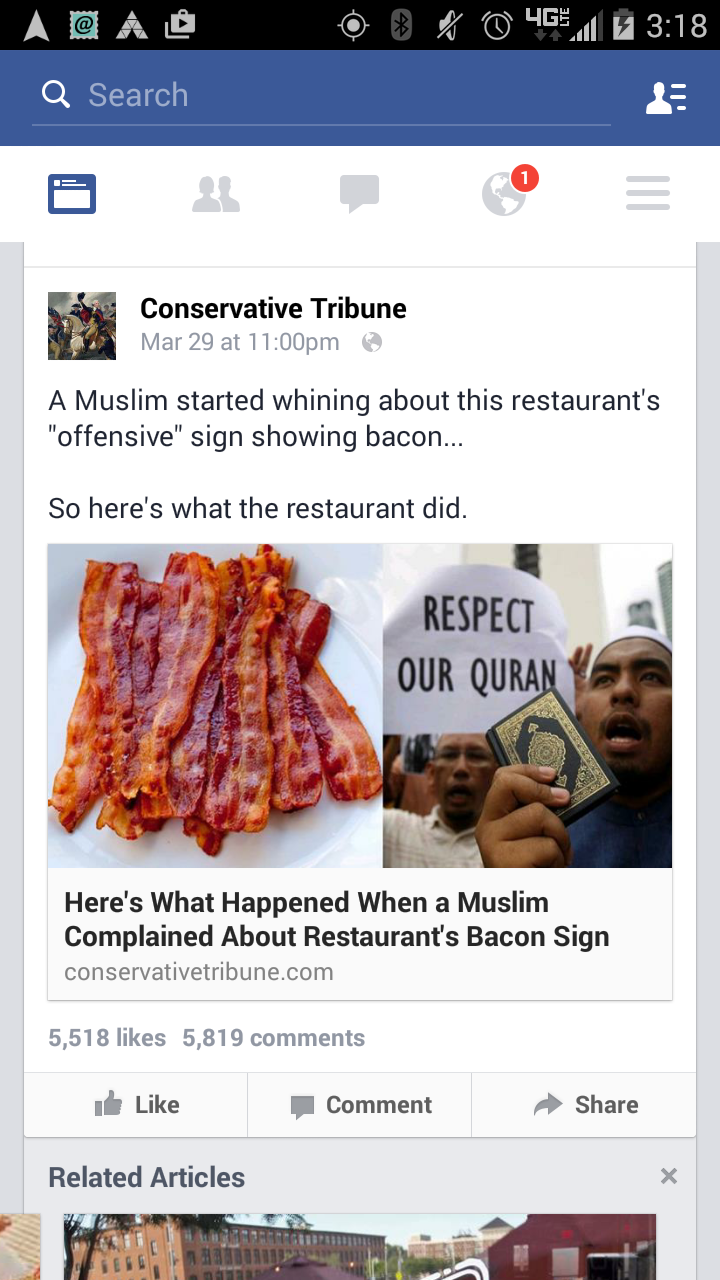
One of these specters repeatedly raised is that of Sharia law and the suggestion it will be imposed on Americans.  A particular story about a sign advertising bacon in a Vermont town caught my eye today after a friend commented.  Here is the screenshot of my news feed:

image

As one could imagine, the response in comments was one of the outrage of thousands of freedom (and bacon) loving Americans who don’t want religion imposed on them.  I realize there is reason to be aware of religious extremism, but what is the reason for this particular furor and do the actual facts support such a dramatic response?  According to the conservativetribune.com story this is the issue:

“Should a restaurant that serves bacon be allowed to display signs and/or advertisements that mention bacon? The U.S. Constitution says that it should, but Muslims in Vermont apparently disagree.”

From that opening paragraph one could assume there is a direct threat to freedom of speech posed by a group of people.  The article goes on to discuss a solitary example of a business owner who took down a sign because “an outraged Muslim woman” complained about it.  There are no further examples given and no evidence that this woman speaks for a plurality of Muslims.

The complaint of one woman does not seem to match the “Muslims in Vermont” description above it and that is quite an over-statement.  What’s the problem?  Well, if one woman can speak for “Muslims in Vermont,” then I suppose Westboro Baptist speaks for Christians in Kansas, right?

Concern for Safety or Fear of Violence?

Anyhow, there’s an article on the Washington Post website that takes a more detailed look and provides the full text of the woman’s complaint.  She describes herself as “a vegan and a member of a Muslim household” then goes on to say the sign is both insensitive to those who don’t eat pork and this:

“Second, it clutters an already dangerous crosswalk. This signage for a business’ food distracts from the purpose of that area: for pedestrians to safely cross and for drivers to safely enter the circle. What is the additive safety factor of this sign being there? I fail to see what benefit it affords people in that intersection and why the city put it up. The only appropriate signage would be standardized official road signs pertaining to the crosswalk and circle.”

I would guess that is why the restaurant owner mentions safety in his response.  However that apparently isn’t as obvious to everyone as it seems to me and leads to this speculation in the conservativetribune.com article about the owners response:

“Notice how he mentioned “safety” concerns. This made it sound as if he feared the Muslims in Winooski would have taken violent action had he not removed the sign”

I cannot fathom how one could make that leap based in the known facts.  It doesn’t “make it sound” as if he feared violence from Muslims to me.  No, it makes it sound as if the restaurant owner read the woman’s letter and was responding to the excerpt of her letter I posted above.  The concern for safety she mentioned was having a business sign creating a distraction.

Right to Free Speech and Threats Thereof

So basically we have a woman with an opinion and a business owner willing to accommodate her preferences.  It hardly seems like a crisis of Constitutional freedom when a woman exercises that her right to express a controversial opinion.  But it does seem a case of journalistic malpractice to make one woman into a representative of Muslims or categorize her as an “acolyte of Shariah law” because she expressed a concern. 

The real threat to liberty is those who abuse it.  I am more concerned over reckless surmises and the feeding of irrational fears than I am of one woman exercising her freedom of speech.  Her opinion, while I disagreed with it, was reasonably explained and it is her right to express it.  The response was a distortion at best, slanderous at worse and one of many similar stories.

Unfortunately I cannot respond to every internet hoax or propaganda piece and even if I did the chances of my words reaching through the mess and changing minds already made up seems slim.  Still I do try to make a difference.

When exception rules…

Standard

image

My boss and I generally get along well.  He has his preferences, I have my own preferences and usually we are able to find an agreement.  But occasionally there are times of conflict as well.

Most of the conflicts are caused by abuse of exceptions.  Exceptions are those times when my usual ‘rules’ are stretched to allow something I otherwise do not tolerate.  Surprises, working weekends or working too late on a Friday are some of my understood (but unwritten) terms.

It is reasonable in the industry I am in that some flexibility is required.  Delays often arise that are no fault of my employer and are the surprises I must tolerate to be reasonable.  Then there are favors or the times I am flexible just because my boss is my friend and I want a good relationship.  I will sometimes break my rules voluntarily as a matter of good will.

However, there seems to be a limit to how many exceptions can be made before the exceptions begin to become the rule.  If I do too many favors soon they become expected entitlements rather than appreciated exceptions. 

When I feel the balance of our mutual self-interests has been violated too far I will respond with protests.  I suppose if my boss would not respond appropriately there would be further reaching consequences.

Broader Application and Implications

Individuals make arrangements between themselves my boss and I do.  Groups of people also make arrangements with their individual parts that allow exceptions to the general rules for representatives of the group or to benefit exceptions within the group.

For example, there is an expectation that if one wants to eat they should work, but we do make exceptions for children and the disabled.  But that list of beneficiaries can eventually grow to include irresponsible adults and those less truly disabled.  It can also morph from being a special exception into an entitlement that is eventually is unfair to those paying the cost and abuse.

If the group never considers the needs of exceptions that is also a failure and negligence.  It may not be at a noticeable cost to the group right away when the weak and minorities are unprotected or considered only an afterthought, but there is a cost even if it isn’t measured in financial losses.  Lack of compassion is a moral loss.

Keeping a Balance of All Factors

This complex mobile of competing interests must constantly be fine tuned to maintain an appropriate balance.  Part of balance is order of priority.  It is recommended in an airliner cabin depressurization emergency that adults put their own masks on first so they aren’t incapacitated and unable to help others. 

image

Rules must always define the exceptions in the same way the gravity that defines the order of a mobile must be respected or chaos will be the result.  The picture of the Liebherr crane mobile above (watch this video) is a prime example.  It is an exceptional display of engineering and some flexibility in weight bearing capacity, yet there are underlying rules that must be followed or the whole system will collapse.

The results of miscalculation, ignoring factors that influence stability and over stressing various structures (social, physical or otherwise) can result in catastrophic failures.  Failure like that of “Big Blue” which fell into a tangled heap on a gusty day:

image

Prevent disasters by finding a balance that puts rules and exceptions in proper order and plans for the winds of life.

Politics, Religion and (Media) Bias

Standard

Here I go again talking about politics and religion.  Well, truthfully, this post is more about ideas, inquisition, how stories are presented by the media and alleged bias.

It seems everyone complains about media bias.  There is endless controversy over what stories get covered, how they are covered and why, with charges of favoritism from all sides.

I suppose I am just another voice adding fuel to that fire.  But hopefully I add a bit of helpful reason and rational to the discussion rather than just one more partisan crying foul only when his own side is (in his own mind) treated unfairly.

Two things got me thinking about media bias.  The first a couple cartoons and social media comments about the shootings in Chapel Hill that allege it was not being covered adequately.  The second the off-topic questioning of an American politician and the way it was presented.

Ho-hum, no story here…

I first heard about the three students killed in North Carolina the morning after (as evidenced by my blog post yesterday) and on the CNN website via my smart phone.  The shooting took place “just after 5 p.m. on February 10” and, according to the New York Times, it was early the next day before specific information was available about the shootings:

“In fact, the police did not release the names of the victims or the accused until after 2 a.m. Wednesday; Mr. Hicks turned himself in to sheriff’s deputies in Pittsboro, a few miles away, but it was not clear when. During a court appearance Wednesday, a judge ordered him held without bond. By that point, most major American news organizations had reported the story, but that did not slow the allegations of news media neglect.”

So basically a local homicide became a national news story overnight and that is likely something to do with the unusual nature of the crime.  But many complained within that time frame that the story was being ignored and that this was an example of media bias.  Here are a few examples I have found from those alleging media bias:

image

image

image

Not every homicide receives widespread attention.  It took over a week before the Trayvon Martin shooting was picked up by Reuters and became a hot topic.  So, with that as a basis of comparison, the murder of Deah Barakat, Razan Abu-Salha and Yusor Abu-Salha was relatively quick.

Favoritism and presumptions…

If anything the murder of these attractive and ambitious young Americans will receive more attention than similar cases.  Beautiful people with promising futures are often are shown preference.  Add to that the man who confessed to the murders is an outspoken atheist, the victims identifiably Muslim, and that feeds speculation.

Having myself been raised in a tradition (Christian) where women veil, and having a dear friend (Muslim) who dresses similar to those pictured, I couldn’t help but take interest and wonder if their appearance played a part.  I have worried for my sisters and my Muslim friend because of prejudicial views I have heard expressed.

It is probably their appearance, the fact they were killed in the manner they were, the race and the views of the man, that made this a big story.  It is understandable the Muslim American community can feel embattled at times and unfairly blamed for the acts of people who do not represent them (terrorists) and thus afraid of reprisals.

However, this case is not necessarily a ‘hate crime’ as some speculate.  Yes, the shooter did openly share his views that blamed religious people for violence and (ironically) proclaimed atheism as the solution, but that doesn’t equal a motive. 

From available evidence he seemed to be an unreasonable and angry man who may have murdered over a parking dispute. Whatever the motive, it is an act beyond my comprehension and I mourn with those who have lost loved ones to this senseless act of evil.

Trading topics…

The other story concerns the Governor of Wisconsin (and potential candidate for President) who was on a visit to discuss trade with British officials.  The story headline, “Wisconsin Gov. Walker refuses to answer evolution question,” centers on a question asked that has nothing to do with trade.

The question if Walker “believes in the theory of evolution” seems a rather odd thing to ask a politician.  Doubly interesting is that the Associated Press writer felt it necessary to mention Walker’s faith and the occupation of his father, as if those two facts were relevant to the story:

“Walker, an evangelical Christian and the 47-year-old son of a Baptist preacher, also declined to answer a series of questions about foreign policy…”

Huh? 

I’m not really sure how his faith comes into play here, especially as it relates to the Governor trying to keep on topic of trade by not answering irrelevant inquisitions.  Maybe somebody can explain the connection between his father and foreign policy, but I’m not understanding it.

What I do suspect, both as the reason scientific theory is being asked about and also why religion is being mentioned, is an attempt to construct a label or pigeonhole Walker.  I think it is a classic example of dog-whistle politics in that the intend recipients are supposed to read between the lines and apply a particular stereotype. 

The intent is likely to paint the fiscally conservative Walker to voters, who are tired of government expansion and yet not religious, as dogmatic and ignorant.  I could be wrong, but when a story that should be about trade becomes one about refusal, theory of evolution and religion, there seems something to be amiss.

Bias is in the eye of the beholder…

If beauty is in the eye of the beholder, perhaps bias is as well.  What we think deservers more or less coverage is probably as much a matter of our own biases as it is of anyone else’s. 

Muslims, understandably, take immediate interest when three who share their faith are killed ‘execution style’ by an irreligious man.  Me, being a political conservative and religious, know too well the presumptions often made about those of faith and saw some sort of prejudice at work in the Walker story.  We take notice when people we identify with in some way are targeted unjustly and we probably miss many instances that counter our own narratives.

The media is undoubtedly biased. The media is produced by people and people are inherently biased.  But our personal biases also mess with our own perception of what is important and our judgment of presentation.  We need to be as aware of our own potential biases to the same degree we believe others are guilty.

God Forgive Us

Standard

There is danger in religious extremism.  But there’s also danger in irreligious extremism and a story out of North Carolina another tragic reminder:

“Washington (AFP) – A North Carolina man espousing anti-religious views has been charged with the murders of three Muslim students, including a husband and wife, who were shot dead in the university town of Chapel Hill, police said Wednesday.”

My heart aches.

Murder, no matter the motive, is a horrible and immoral act, but to kill other peaceable people over ideology (or a parking dispute) seems somehow worse.  There is no defense for man that executes three innocent people.

The damage extends beyond the three killed, it effects those who lost their loved ones and ripples out into the world.  Violence begats more violence and this murder could soon be used to justify reprisals just as irrational.

“Father, forgive them; for they know not what they do.” (Jesus Christ)

God forgive us for our murderous hearts and give us a heart of love for all people.  May we love in extreme, lay down our own lives for the good of others and leave vengeance to you.

We need a love that overcomes evil with good.  We need the love that was found in Jesus or we too may succumb to this mindless cycle of violence.

Amish Lies: I read it on the internet…, part 2

Standard

I was not planning to do a blog about immunization and autism.  However, an article posted by a social media friend, along with comments from US Senator Rand Paul made recently, prompted my response.  The article makes two claims about Amish, immunization and autism (presented in questions) in the title; and both claims turn out to be false. 

Claim: Amish Do Not Vaccinate

It seemed plausible at first brush, especially given that this small Christian sect mandates an austere lifestyle and rejects many modern conveniences, that they would also not vaccinate.  However, I have an advantage in that I know some Amish people.  But, more significantly, I have a sister (Dr. Olivia K. Wenger, MD) who led a study on Amish and their attitudes towards vaccinations. 

The research of Dr. Wenger and her colleagues, although addressing primarily the opinions of Amish parents about vaccinations and not vaccination rates, is sufficient to disprove the idea that Amish do not vaccinate.  This is some of what they found:

“Among 359 respondents, most (68%) stated that all of their children had received at least one vaccine, and 14% of those surveyed said their children had received no vaccines.”

Amish, in fact most who responded in the study cited above, do vaccinate.  So the idea that Amish do not vaccinate is a myth and lie.  That false claim alone is enough reason to dismiss any other claim found in the article, but in case you are unconvinced, I will address the other claim in the title as well.

Claim: Amish Do Not ‘Get’ Autism

The anti-vaccination article claims there are only three known cases of autism amongst Amish people.  Again, I could’ve accepted this as valid, but mostly because there’s a strong possibility of autism being undiagnosed in this community that is as insular and closed as the Amish community.

However, this too was easily refutable despite no studies directly addressing the topic.  I found research, by Dr. D. Holmes Morton, MD and others, that triples the number of cases of Amish children with autism symptoms:

“In March 2006, Drs. Kevin
Strauss, Holmes Morton and others documented 9 autistic Amish children, which could raise the autism rate of Lancaster Amish community Olmstead supposedly investigated to almost 1/5,000 all by themselves.”

So, both claims are untrue based in readily available evidence.  Unfortunately stories like this are posted as true over and over again by those who are anti-vaccination or sympathetic.  It is soaked up as proof of a link between autism and vaccines, yet it is demonstrably false information.

If your primary cause is truth, then carefully vet your sources!

As a believer in individual freedom, religious liberty and one who is respectful of conscience, I am doubly offended by articles like this.  Quite frankly I am embarrassed to see these types of spurious claims circulated by those associated with my political leanings and religious faith.

Yes, opposition to vaccinations crosses political and religious lines, but is often a topic of conversation amongst my Libertarian and Christian peers.  That some of them regularly repeat this sort of thing as legitimate or present it without question is a source of serious frustration for me.  It does a disservice to even good questions about vaccinations.

Nothing is gained by linking falsehoods to what is true.  If anything, people who are not ignorant of science will ‘throw the baby out with the bathwater’ and reject all that is associated with the falsehood.  In a world awash with information, why should they waste time on a source that lied to them once and/or doesn’t carefully vet their sources?

“Do not spread false reports.”  (Exodus 23:1a)

I realize not everyone is a scientific or critical thinker.  I myself struggle with the discipline required for serious research and that is part of the reason I would not make a career of it.  That said, we do need to take responsibility for the information we disseminate online and owe others our due diligence verifying claims with reliable sources before repeating it.

Sadly, anonymous articles with sensational headlines garner more attention than these unsung heroes who are actively creating solutions for sick Amish children.  There are sources far more reliable than an article that does not even include the name of the author.  Professionals like Dr. Morton and Dr. Wenger have dedicated their careers to studying Amish genetics and medical disorders. 

Footnote: I cite secondary sources for the research of Dr. Wenger and Dr Morton, but if you want to read the original studies, the links are below:

Underimmunization in Ohio’s Amish: Parental Fears Are a Greater Obstacle Than Access to Care

Recessive symptomatic focal epilepsy and mutant contactin-associated protein-like 2.

What is God?

Standard

“The question is: is the way the universe began chosen by God for reasons we can’t understand, or was it determined by a law of science? I believe the second. If you like, you can call the laws of science ‘God’, but it wouldn’t be a personal God that you could meet, and ask questions.”  (Stephen Hawking)

Professor Hawking is one of the most intriguing men of our time.  He is known for his work in the field of physics and was popularized by a book, “A Brief History of Time,” that reached a broad audience.  He is undoubtedly a brilliant mathematician, he can reconstruct the universe in his mind using numbers and formulas, and has basically proved that the universe (including time) had a definite beginning.  But Hawking is agnostic, he sees a big impersonal ‘God’ when he looks into the expanse of space and is probably right about what he sees.

A Small View of God

Many people (religious fundamentalists and atheists especially) subscribe to a small view of God.  They confine God to simple ‘black and white’ human moral or logical thinking (theirs) and essentially demand a God on their level.  But if God is the creative force behind the entire universe, then God is bigger than the universe and also bigger than any of the concepts of morality or logic in the universe.  A big concept of God is a God that transcends universal moral categories and exists above or beyond all human reasoning.  A God bigger than scientific law or religion.

Finding God in Our Humility

Picture humanity as an infant, this earth as our playpen and the universe the house over our heads.  We can see the room, we can speculate about other rooms and theorize about some sort of reality beyond house.  We know house is predictable, the temperatures fall between certain parameters, schedules are somewhat consistent and yet we see through a foggy window that there could possibly be more than the house we are in.  God is like the parent who can come and go, lives beyond the playpen and our childish mind.

Finding God Beyond Our Own Dimensionality

image

But my concept and understanding of God goes beyond that have a celestial parent or personality.  I believe Biblical personification of God is simply an attempt to explain what is inexplicable.  Still, I do believe God can give himself personality to relate to us and is more than some vague life force or abstraction.  I believe God is a spirit or mind, but one that dwells beyond the rules of science that govern the dimensions of this universe.  In other words, God sees the Tesseract of our limited dimensionality and exists beyond all dimensionality.

Finding God Beyond Material Reality

I know this might not appeal to those with the materialism perspective who do not feel inclined to accept reality beyond their ability (or the ability of their scientific instruments, mathematics and logic) to see.  But science has many limits.  We cannot scientifically prove our own consciousness exists and still accept it as reality.  Not everything of our reality is provable by experiment or calculations, some things we must just know and accept as reality, the reality of our consciousness one of those things and the idea of greater consciousness another.

Finding God Beyond Cold Calculation

“Consideration of black holes suggests, not only that God does play dice, but that he sometimes confuses us by throwing them where they can’t be seen.”  (Stephen Hawking)

Professor Hawking and other theoretical physicists seek a ‘unified theory’ for their science, an explanation for the paradoxical discoveries that upset a simpler idea of the universe, but the day it is found (if these ‘dice’ were left within our reach) there will be more questions unanswerable by science.  Questions of why, of purpose and morality are probably beyond math.  Why we do not believe it is immoral for a cat to eat a mouse, both sentient beings, the cat remorseless, and yet to kill becomes an issue of morality for us.  Why care if the weak are exploited?

A Unified Theory of God

We are sentient, we are also moral creatures and our morality needs to enter the grand equation or we are left with little more than cold calculus that starts with star dust then ends with the heat death of the universe.  We know there is something more just as we know we consciously exist and therefore we need a bigger view of God than Hawking’s.  We need a God so big he can be personally involved or, in other words, a unified theory of an intimate and big God.  Consciousness, morality and science offer us a place to start a pursuit of God, but we need to pursue further…

The Personal and Intimate God

“Sir,” the woman said, “I can see that you are a prophet. Our ancestors worshiped on this mountain, but you Jews claim that the place where we must worship is in Jerusalem.”  “Woman,” Jesus replied, “believe me, a time is coming when you will worship the Father neither on this mountain nor in Jerusalem.  You Samaritans worship what you do not know; we worship what we do know, for salvation is from the Jews.  Yet a time is coming and has now come when the true worshipers will worship the Father in the Spirit and in truth, for they are the kind of worshipers the Father seeks.  God is spirit, and his worshipers must worship in the Spirit and in truth.”  The woman said, “I know that Messiah” (called Christ) “is coming. When he comes, he will explain everything to us.”  Then Jesus declared, “I, the one speaking to you—I am he.”  (John 4:19-26 NIV)

Looking Backwards and Beyond the Universe for God

Many search for God, but do they look in the right place to find God?  The religious are like this woman who met Jesus, they seek God in physical objects like places, rituals or books.  The scientific mind looks further out, they search the universe for answers down to the tiniest particles and up to the lights of the sky.  But both are looking outward to find God and truth.  Could it be our mind is the closest possible connection we could ever have to the realities beyond the material, mathematical and time universe?

Finding God in the Moral Mind

If the entire universe can be compressed to the size of a point as small as the period at the end of this sentence, then a God big enough to be simultaneously small is not such a big leap.  So perhaps Hawking, like that woman talking to Jesus, is looking in the wrong direction to find the person of God?

409

Standard

“There is a case for telling the truth; there is a case for avoiding the scandal; but there is no possible defense for the man who tells the scandal, but does not tell the truth.” G.K. Chesterton

A few years ago a man I respected greatly became the center of a media frenzy that ended his storied career as a coach and respected mentor.  The popular narrative at the time was that he had participated in a cover-up and sheltered a sexual predator.  It was an idea based in speculation rather than actual fact, there wasn’t even a semblance of due process before he was fired (literally in the dark of night) and yet with sanctimonious glee many presumed his guilt.  It was disturbing to watch for a person actually concerned with justice.

The man, Joe Vincent Paterno, had coached football at Penn State from 1966 to 2011 and during the time had amassed 409 victories.  But his biggest contribution was not on something recorded in the Sunday morning paper. What earned him a spot in the hearts of many who cared very little about football was his character and concern for bigger things.  He was loyal to the concept of student-athlete, was a trailblazer for civil rights once standing up to an opponent that requested some of his players not participate because of their skin color and practically built the university library through his donations.

Obviously none of the accolades one can list about him would excuse Paterno if he were truly guilty of what many had surmised.  But it is a record that should call us to question the narrative as presented and keep us from joining in a rush to judgment.  Well, the push back has begun and the facts seem to support a less damning verdict.  It is for that reason the NCAA has relented on the punitive measures they took against Paterno and that punished athletes who had nothing whatsoever to do with anything criminal or morally reprehensible.

Still, there are some blowhard moralizers who still refuse to ‘get it’ and insist on painting a whole community as willfully ignorant for not sharing in their own surmising and their own selective memory.  Among them sticking to the presumptuous early narrative is Keith Olbermann who blasted those who celebrate the restoration of a legacy that includes 409 wins.  His persistent to neglect fact in his prosecution of Paterno and Penn State fans the subject of an ‘open letter’ response…

>>>click here to read it<<<

I am [not] Charlie

Gallery

I believe in freedom of speech.  Truth can offend and for a right cause we should be bold in speech regardless of consequences. But I do not believe that deliberately causing offense is anything great or special. Insulting another man’s mother is legal and perhaps even a brave thing to do.  However, legal and brave doesn’t make something righteous, honorable, peaceable, justified or moral.

“Do not repay anyone evil for evil. Be careful to do what is right in the eyes of everyone. If it is possible, as far as it depends on you, live at peace with everyone.”  (Romans 12:17-18)

Our society may celebrate the insults of cartoonists or comedians and our freedom of speech. Yet our respective cultures shelter many popular ideas from critical thought.  Sure, one can poke fun at religion in the west and be quite popular, but that doesn’t mean we don’t have our own untouchables.

The biggest threat to freedom of speech is likely not radical religious men with Kalashnikov rifles. What happened in Paris does not frighten me personally and doesn’t negatively influence what I say or do. I don’t fear being literally murdered for what I say here.  Still, there are many truthful things I hesitate to say for fear of risking my popularity or public standing. Unchallenged popular opinion is probably more dangerous to intellectual discourse than anything else.

Free expression of thought is challenged in many ways besides threats of physical violence. There are far subtler ways to kill dissent like popular taboos. Then there are those who effectively bully others into silence with their loud protests and demands for political correctness. Killing the messenger can be accomplished without guns and bullets. Ridicule can be used very effectively to bully those with unpopular opinions into silence.

People collectively wield far more power to enforce intolerance and ignorance by shaming divergent thinking than a small number of radicals. Threats of character assassination and popular criticism or public ridicule are just as effective a means for curtailing free speech as death threats. The pen and protest can be used to suppress ideas just like a terrorist’s gun.

“The pen is mightier than the sword”

What we create with our pen does give us power and it is a power for both good and evil. Speech is a weapon. Speech can be used aggressively and destructively to hurt people. We can use our communication as a tool to build bridges between people and to defend the weak or we can use it to carelessly destroy the things other people care about.  Our freedoms should be used responsibly.

I write to provoke thought, but not to be a provocateur.  I question if the staff of Charlie Hebdo should be treated as martyrs for free speech for their intentionally offending and disrespectful artwork. The true protectors of freedom were two men who died outside defending the right of the cartoonists. I would rather say “je suis Ahmed” or “je suis Franck” rather than honor insult artists.

There are many hypersensitivity and unreasonable people around the world and I know I cannot please them all. My goal is to not unnecessarily offend, to leave vengeance for insults to God and be Jesus. Je suis Jésus.

For the Love of Truth

Standard

“Truth does not need a bodyguard”  (Rhonda Strite)

The news out of Paris today (read here) is a reminder again of the power of ideas.  Twelve people are dead and apparently in killed defense of something deemed sacred.  Charlie Hebdo, a French satirical newspaper that showed less than flattering images of the prophet Muhammad, was the target of assassins today who apparently yelled “we have avenged the prophet” and fled the scene.

I do not believe these murderers speak for all Muslims nor even for the one they claim to have avenged and who should all be left to speak for themselves.  However, what the violence does speak for is the power of ideas.  It is obvious those responsible have been influenced to believe that prophets of God need to be honored by spilling of blood.  It is an idea that ‘truth’ must be defended by violence.

Defending the Image of Our God

This idea of violence in the name of honor isn’t exclusively religious territory either.  In fact, it is a quite common theme in personal romances gone sour.  I don’t even know where to start a list of popular songs about the angry and jilted person taking out their wrath on the vehicle of the a former lover who insulted their dignity by choosing to be intimately involved with someone else.  It is the same sentiment that leads a man to kill his wife and her new boyfriend in a fit of rage.  It is a defense of honor. It is an idea that the other person did damage to you or the reputation of what you value and now deserves to be harmed in return. But this kind of behavior does beg a question about character and specifically the character of a person who thinks violence is their right when insulted.

Since I am not an expert on Islamic teachings, I will leave that analysis to those who are and stick to what I do know.  What I do know well are teachings of another man who is recognized as a prophet by Muslims and that is the man named Jesus. The one who is called both “word” and “truth” in the Bible:

“The Word became flesh and made his dwelling among us. We have seen his glory, the glory of the one and only Son, who came from the Father, full of grace and truth.”  (John 1:14)

“Jesus answered, “I am the way and the truth and the life. No one comes to the Father except through me.  If you really know me, you will know  my Father as well. From now on, you do know him and have seen him.”  (John 14:6-7)

We, in this age of democracy and freedom of the press, can easily forget history. But there was a time not too long ago when insulting a king could cost a person their head.  Throughout human history leaders have demanded, upon penalty of death, that their image be honored and even worshipped. In the time Jesus lived and his followers after it was no exception.  There is speculation that the last book of the Bible was written in response to imperial cult in Rome to encourage believers who had to choose between faith and physical life.

A Different Image of God

Jesus was also referred to as a “king” or “lord” in scripture and yet one quite different from others in example.  He was was the king who served in the lowliest capacity and in a way that even confounded his most loyal followers.  He claimed a different type of leadership, a leadership by example and a radical idea even today in a day of competing individual rights:

“Jesus called them together and said, “You know that the rulers of the Gentiles lord it over them, and their high officials exercise authority over them.  Not so with you. Instead, whoever wants to become great among you must be your servant, and whoever wants to be first must be your slave—just as the Son of Man did not come to be served, but to serve, and to give his life as a ransom for many.”  (Matthew 20:25-28)

It is really an impossible standard in human terms.  Even self-proclaimed Christians are seemingly not able to live out this standard.  I am often caused to wonder about this commitment when I see outrage expressed over a song being played that openly calls religion a lie and overt concern with individual rights among those claiming to be of Christian faith.  It would appear the image of Jesus some claim to defend with their anger is more like the prophet Muhammad than the man described as being stripped naked, beaten mercilessly without a word, humiliated and killed like a common criminal.

Killing as a response to blasphemy is not unique to Islamists and was taught as part of the law of Moses in the Bible.  This Biblical law was enforced in ‘Christian’ United Kingdom (fully up until 1697 and in part until 1921) before falling out of favor.  We could blame religion for this idea of killing to honor or defend a person and idea, but that would be ignorant of the many examples of those who killed only because they themselves felt disrespected.  People have killed in the name of ideas ranging from defense of the Constitution of the United States to Imperialism and Marxism.

Does real truth need to be defended by killing those who dishonor it?

I believe an idea that needs us to kill to defend it is a weakling idea.  A god established on the blood of those who offend is a puny god indeed.  Unfortunately people like little gods and that includes many “people of the book” who confuse Bible for God and their own ideas for truth.  They confine God to the understanding of their own mind and the work of their own hands.  These are the fundamentalists who take offense on behalf of ‘truth’ and kill to defend it.  But I believe in a truth greater than my own mind, one that frees me of need to kill others to defend it and is personified in our following the ultimate example of self-sacrifice:

“To the Jews who had believed him, Jesus said, “If you hold to my teaching, you are really my disciples.  Then you will know the truth, and the truth will set you free.”  (John 8:31-32)

Many have killed in the name of Jesus.  Many feel God is honored in their defense of prophets or books.  Many study the scripture diligently without ever finding the word of God despite their best efforts and that is in fact recorded in the Christian scripture in John 5:16-47.  But there is another way to live.  I believe in a “way” a “truth” and “life” that is bigger than mere human knowledge.  I believe in an advocate that is beyond my own efforts to religiously memorize texts or methods.  The truth is a spiritual person and teacher, not a book or religion:

“If you love me, keep my commands.  And I will ask the Father, and he will give you another advocate to help you and be with you forever—the Spirit of truth. The world cannot accept him, because it neither sees him nor knows him. But you know him, for he lives with you and will be  in you. […] But the Advocate, the Holy Spirit, whom the Father will send in my name, will teach you all things and will remind you of everything I have said to you.”  (John 14:15-17, 26)

A Different Defense and Truth

The bigger view is that God can speak for himself and real truth does not need murder to protect it.  Silencing the voices that oppose us is a weak defense.  Do not kill the messenger and think you are defending truth.  Instead, speak the truth with love, because God is love.  There are many ideas that people use as justification to kill, but just one that is worth dying for and that is love.

“When you are brought before synagogues, rulers and authorities, do not worry about how you will defend yourselves or what you will say, for the Holy Spirit will teach you at that time what you should say.”  (Luke 12:11-12)

The law brings judgement, but the Spirit brings love and life. That should be our source and guide to all truth.

The Dilemma of a Colorful Thinker

Standard

I write this post with trepidation. I have been accused before of being too open with my thoughts by some. But I have been told by others that I am very guarded about my personal life and have been urged to express more of that. The truth is that my sharing is often intentionally not vulnerable. Talk may be cheap, but sharing my innermost feelings always comes with an emotional price tag and the risk feels too great. I can discuss abstract ideas for hours without wearying, but when I lay my deeper feelings out it leaves me exhausted, often also feeling degraded and disappointed.

I believe all people desire affirmation or acceptance. We also want to maintain our own separate identity, to be different from others and still be accepted. I had that conflict growing up as a religious minority. I wanted to be identified with my unique heritage. However, I also wanted to be treated as a unique individual and resisted being cornered with the many stereotypes of classmates. Questions, frequently asked without ill-intent, would often be framed as statements categorizing me, “you are X therefore you do Y and Z…”

Uniquely Mennonite; also a Unique Mennonite

I was born into a Mennonite home. Mennonites are a small Christian sect, a product of the Anabaptist movement that swept through Europe in the 1500’s and are known today for their traditional way of life and non-violent stance. Mennonite is both a religious denomination in that ‘members’ conform to certain established standards and, because historically many members come from within existing Mennonite families, it can also classify as a distinct ethnic group.

Most Mennonite children attend private schools and some, more frequently over the past couple decades, are home schooled. However, my parents chose differently, my siblings and I all attended the local public school. It was a consequential decision and a source of some inner turmoil for me as well. I am a proud alumnus of Lewisburg Area High School, yet there was a time where I begged my mom to home school me and throughout my schooling I always identified more strongly with my Mennonite sub-culture.

At school I conscientiously did not join my classmates in various activities. I would stand respectfully and silent during the reciting of the pledge of allegiance. As a devout Christian, I believed my allegiance was owed to something greater than country and I felt I could not pledge to anything besides God. I was separated in other ways as well. I did not grow up with a television at home, so I was out of the loop as far as popular culture and could not identify with much of the chatter about this or that celebrity. I didn’t wear shorts in the summer. I was odd.

But, in church, I did not always identify well with my Mennonite peers either, they had their own school experience and cliques. Prayers by church leaders would give specific mention of the students and staff of the Maranatha Christian School, but would leave out those few of us who attended elsewhere and I noticed it. The neglect of mention was completely unintentional, but it did contribute to a feeling of not mattering, that feeling was a source of insecurity then and lingers in my mind today. I never felt I fit into my school or church culture.

I savored my independent mindedness. I could feel privileged over both my public school and Mennonite peers at times. I had a spot amongst the misfits in both categories too. But, my finding a place among the misfits was to still feel excluded from the mainstream of both settings and was to be a double misfit. It was exclusivity with some exclusion or at least I felt excluded. I had one foot in with mainstream American thinking, with another in a culture that celebrates a persecuted past, and with that a mixed identity all my own.

My Place Amongst the Persecuted

Mennonites have a long memory. We are dutifully reminded of acts of gruesome torture committed against our people from hundreds of years ago. There’s a book, Martyr’s Mirror, nearly as sacred as the Bible in many Mennonite (and Amish) homes, which is basically a chronicle of the violence done to Christian believers. The book includes haunting etchings of the terrifying ends of some who would not recant their faith under trial and these stories help shape Mennonite identity as a persecuted minority.

image

Torture of Geleijn Cornelus, Breda, 1572

Mennonites have a mistrust of mainstream society. Part of it is in a product of a religious emphasis to intentionally maintain a ‘non-conformed’ outward appearance and lifestyle. But the other big part is a real fear that persecution is just around the corner and that we could all soon suffer the same fate as our spiritual/ethnic fathers. Mennonites (and Amish) have been so insular and so separated from mainstream society that they actually have their own unique genetic disorders. Many still maintain their own German dialect, commonly referred to as “Pennsylvania Dutch” or “PA Dutch” for short, and church outsiders are referred to as “English” by Amish people.

The irony of it all is that Mennonites are more frequently adored than they are despised. Our biggest critics tend to be those who are disgruntled ex-members or those who had a bad experience in one church and judge all Mennonites based in it. We are treated both with respect and also patronizingly at times. My sister, a medical doctor, was once asked by a non-Mennonite if she would be interested in cleaning houses or babysitting, which could be taken as an insult to a person who was qualified for much more. Many have assumed my ignorance as well and apparently because of my rural and religious upbringing.

People do judge by outward appearances. People do make prejudiced assumptions based on ethnic heritage or religious connection and I have experienced this first hand. I believe that is likely why I have instinctively classified myself with the victims of prejudice rather than with the perpetrators. My unique upbringing may have been the reason why I was fascinated with history of racism in America. I read books; some of them required reading, but many others by curiosity and choice. The titles escape me, but I remember experiencing the civil rights era from the perspective of a woman in the NAACP, then living life as a young woman in Japanese internment camps and later spending time with a fictional lawyer named Atticus Finch.

My Struggle to Find Acceptance

I also have another identity and that one created in my slow development that earned me nicknames which included “micro” in them. I was short and small for my age. I was a late-bloomer beyond even my then diminutive size. I was older in my class, a polite and respectful student, I would often find more in common with adult teachers than my age-group peers, I had keen interest in history, was knowledgeable, but was also very innocent. I had little more than platonic interest in girls until my late school years and had mostly kept a safe distance from them. I did not seem to draw a whole lot of female attention either. I was an introvert in a crowd and shy around women.

With my struggle with stature, with a lack of strong social skills, athletic abilities, or other especially developed talents (besides being a non-stop daydreamer with some artistic gifts) and having not received an abundance of popular attention, I developed a bit of an inferiority complex. It only intensified as I became interested in dating and noticed many girls were more interested in a muscular, square shouldered or smooth talking male figures and I realized that just wasn’t me. I was this sensitive bundle of analytical thoughts without an adequate ability to express them. It was also furthered by the fact that I felt I was a misfit. I was way too religious for the more secular public school girls, but I was way too nuanced and philosophical for the cut-and-dried products of my own conservative religious culture.

For whatever reason, fate or fortune, I struck out with the first Mennonite girl I asked and that experience was where my confidence really began to wane. I had a an acute awareness of nuance differences of how people treat each other and knew too well how girls treated the ‘cool’ guys compared to those less popular. I was not disliked or mistreated. But I was also not that quintessential Mennonite guy either. It seemed the average Mennonite girl wanted this simple, macho, disinterested, reserved fellow and I did not fit that conventional mold. I was complicated; I alternately talked too much while not saying enough of the ‘right’ things, was fully Mennonite in some ways and not enough in others. I also lucked out with a church full of first cousins.

I was a deep-thinker, a conscientious person, fiercely loyal, told multiple times (by marriageable women) that I would make a wonderful husband, earnestly faithful, protective and gentle. I wanted to be the hero of the woman I admired, unfortunately I always seemed to play the cards of the villain or that’s how it felt my sincere efforts were received. It is against my nature (or maybe my Mennonite training) to harbor ill-will towards anyone. But feelings of rejection (both real and perceived) are as a poison to the soul. I have had my flashes of misogyny or jealousy, with those feelings immediately followed by longer moments of self-loathing and contempt for everything I was or was not. I was a victim of bad-timing, I was disadvantaged by my genetics, I was unfairly categorized and felt it all to be an injustice.

image

Drowning of Mattheus Mair, Wier, 1592

It may be irony, but it was black women who later affirmed my strengths and restored some of my confidence lost along the way. Like in the books I read, where I could identify with the female minority lead character, I felt minority women could somehow understand me and with them is where I felt most accepted. I was treated like I mattered. It did not hurt that some were educated beyond my Mennonite peers and could appreciate discussions of philosophy, psychology, sociology, identity and race.  Not wanting to produce a stereotype about Mennonites, but I would probably be more popular with my ethnic kinfolk if I would shoot more deer, get a big diesel truck, be an outstanding volleyball player and learn to love card games.

The Schizophrenic Demands of Insecure People

We live in a culture that both tells us to “be you” and yet also encourages conformity of thought or action and shames divergent thinking. We live in a society that preaches against stereotypes, that celebrates individuality and yet continually it categorizes people by race, religion or gender. I am simultaneously castigated as the perpetrator of racism and sexism, as a white male, but then instructed not to build identity around race or to make any judgments about sexuality. It is a feeling of being whipsawed, assailed for doing something that I have not done by those who are doing exactly what they say I shouldn’t do and that I didn’t do.

That is the dilemma of a colorful thinker: Do I go with those who say I should be identified with the perpetrators of historical violence? Or should I go with my instincts, my experience as a minority, and make my identity with the victims?

For me the choice is clear: I am neither victim nor villain. I have felt a victim of circumstance in the past. I have been treated unfairly, excluded unjustly, felt like a perpetual underdog. I have been condescended to and even discriminated against based in my race or religion. I have withstood bullies who picked on me because of my differences (my genetics did not lend to physical intimidation) and I have endured educated elitists who hurled insults, alleged my ignorance for challenging their perspectives and then would burned their straw-man effigies of me with an unwarranted glee. But I refuse to make my identity center on my claim to victimhood.

image

Burning of Anneken Hendriks, Amsterdam, 1571

I will not be like the bitter white co-worker who blamed his lack of success in college on not having the special privilege of affirmative action and would spout one racist opinion after another. I rebuked him without hesitation. I share no identity with his racism and hatred. I will likewise not patronize, show favoritism or cater to others simply on the basis of skin color and historical injustices. We all have challenges to overcome in life and it is easy to assume that our own are bigger or more real than someone else’s. I am not going to coddle and perpetuate the insecurities of any person, white, black or otherwise. I do not believe we help people overcome by treating people as helpless and hapless victims.

In discussions over race, with constructions like ‘white privilege’ and such, I have more frequently been lumped in with the perpetrators of racism rather than treated as a unique individual. It is frustrating, because Mennonites were some of the first to protest slavery and that is the identity that is more real to me than my skin color. Amish and Mennonites were even singled out in America for their ethnicity and conscience, some locked in prison during the First World War because they refused to fight. I feel, at times, that I have more in common with a persecuted minority than with anyone else. Yet, because I am a white male, some assume I could not possibly understand them and seemingly dismiss my perceptive without ever hearing it.

image

Burning of David and Levina, Ghent, 1554

I may not understand exactly what it feels like to be black in America. But I do know how it feels to be treated as inferior and less of a man on the basis of superficial things. I know too well what it is like to be categorized and stereotyped. I understand the conflict of one who loves their own heritage, has a defensive urge against those who attack their ethnic community and yet is still aware of the problems of their own people. I have a love-hate relationship with my own Mennonite religious/ethic heritage. I was taught to be afraid, not just of the police, but of mainstream society in general and some of my religious peers think they are persecuted because of perceived slights.

I have felt insulted and belittled at times. The slights were real and sometimes intentional too, but not always. I have found my reactions are a product of personal insecurities and sometimes little more than that. People all have their sources of insecurity. Conservatives fear a tyrannical government will soon take away their rights, thus fearfully stockpile guns and ammunition. Liberals think that the economic system is stacked against them and want government to impose on their neighbors allegedly as an act of justice. We can build identities around these insecurities. We may find people who share our fears and can look for evidence to ‘prove’ our own disadvantaged status or victim role. Unfortunately, while we do this, while we are demanding respect of our own person or people like us, we are also often leaving a wake of destruction behind us.

Insecure people produce more problems for themselves and others. We all know them, that super-sensitive person who is so insecure that they see an insult in even the most innocent requests or gestures. Take, for instance, a guy who told a story (apparently thinking his audience would be sympathetic) of a time he was driving down the road and a woman driving in the opposite direction scratched her nose as they passed. He knew an insult when he saw one. So he spun his vehicle around, aggressively pursued the offending party and gave a lecture on her disrespectful behavior. Of course, who knows why she touched her nose at that moment. Much more disturbing is a man who assumes an insult or injustice at every turn—and does not see his own offending belligerence.

Seeing Beyond Divisions of Black and White

I am a person with multiple identities and with none in particular. I am not alone either, I believe many Americans have many different identities and do not fit neatly into statistical categories. That said, Americans do also have bigger common identities of race or gender and these identities can sometimes be used to divide us. Our differences can be a cause for celebration, but they are also the basis of falsely dichotomous ‘us’ versus ‘them’ narratives and are used feed existing insecurities. But, treating every person like a unique person to be individually loved as a unique person, rather than in category of victim or villains, would solve a multitude of problems.

Pigeonholing, finger-pointing, scapegoating or shaming those who have offended me probably will not solve my own insecurities and I’m doubtful this type of action would ever create desirable results those whom I deem as guilty. Demonization usually only creates another class of victim. When we treat people like problems rather than people, when we throw them into categories of perpetrator on the basis of their appearance or history, then we have become contributors to the disease of prejudice rather than healers and helpers. If we want more heroic people in the world, then we must treat more people like heroes and as we wish to be treated. If we want dignity and respect for ourselves, then we need to stay committed to treating others with dignity and respect.

Healing of existing wounds will not come from two sides beating each other with superior arguments or competitive claims to offense. Tensions certainly will not be solved by making any person feel inferior or labeled as a villain. The urge to point out statistics about black men in response to those who cite statistics about police will not bring us closer to peace. The truth is if there is to be healing it will come from us learning to identify with all men, and not with only those who look like us or share our own opinions.

We need to recognize even our own intuitions, even those that are informed with history or statistical evidence, might be skewed, prejudicial and wrong. What we perceive to be true is not always whole or complete truth. We need to be more introspective, practice more constructive self-criticism, and address our own faults squarely. The assumptions we make about ourselves and about other people can hurt our chances for success. Yes, I could build a pretty solid rationalization to defend my own insecurities, but it would get me nowhere towards overcoming the obstacles to my success and, if reinforced long enough, could become a reason to not try at all.

Creating Shared Identities

It is impossible to say categorically that every white man has it better or every black woman has it worse and it is foolishness to assume it. A single black mother probably has more in common with a single white mother than she does with a black woman who is happily married. Then again, a black woman, who endures assumptions about her appearance, might actually be able to identify with a young Mennonite woman who dresses differently because of her own religious/ethnic heritage.

image

Dirk Willems rescuing his pursuer, Asperen, 1569

We need to endeavor to create shared identities bigger than race or gender or religion or even economic status and rid ourselves of crippling victim identities entirely. There are more of us misfits than there are those of us defined by statistics or stereotypes. We all have unique advantages or disadvantages and also our own special challenges to face. So, rather than dwell on ourselves only, or focus solely our own specific problems, we could realize struggle in various forms is common to all people and part of our shared humanity. I have my own struggles, you have your struggles and in sharing our burdens together we become brothers and sisters in the same fight rather than rivals or enemies.

I am not saying we should lose our unique identity either. What I am saying is that categories of white and black, privileged or persecuted, hero and villain are too small. We are colored, but not in black and white or shades of gray, we are truly many shades of many colors and uniquely our own person. We have many shared identities that could bridge our gaps and create common understanding, but to find them we need not to be bound to our past or prejudices.

My advice: Build an identity with those who overcome with love and despite the odds against them. Tune out those who only feed insecurity and fear.

(Click here for more Martyr’s Mirror images)