A Community Perspective of Mass Murder

Standard

Another well-armed angry young man goes on a murderous spree and again political ambulance chasers jockey to take advantage to win points for their pet projects.

President Obama used the recent massacre at an Oregon college as an opportunity to campaign for gun control measures that would not have prevented it.  Militant 2nd Amendment gun rights advocates responded with the tired ‘good guys with guns’ arguments and arming teachers as the solution.  Others ranted about correlations between pharmaceuticals and deranged minds.  (Well, duh?) 

Those using the issue for their various (political) causes seem to be vastly misunderstanding the actual issue.  Their response is a knee-jerk reaction rather than a careful analysis of fact and their canned solutions show the functional fixedness in their thinking.  There are too many assumptions that steer the current conversation and could be distracting us from addressing the real problem.

Many seem to assume that killers are simply incurable killers and we simply need to better secure ourselves (with more guns or gun control laws) against this inevitability of angry men.  But could a killer be stopped before they stockpile weapons and act out their violent fantasies against those who they blame for their unhappiness? 

Perhaps more guns, curbs of liberty and drugs (more or less) are not the solution to the real problem?

The root issue is that a young man made a choice to act violently.  He had reasons, rational or irrational, for the choice that should be understood.  (Note, I am not saying that the choice was justified, I believe murder is always immoral and a sin.)  We should acknowledge the choice as a choice and at least explore the possibility we can help those who are tempted by violence to choose rightly.

#1) Understand the Problem is a Person

I think often there is an urge to sanctimoniously distance ourselves from the bad actors of society.  Simply labelling the perpetrator of violence as a “thug” or “monster” or “animal” allows us to build emotional wall of separation between ourselves and evil deeds.  If we were to acknowledge the humanity of the person doing the evil act we would be tying our own humanity to the evil and in a sense making ourselves responsible.

image

Fundamental attribution error or correspondence bias is an assumption that another person’s behavior is all a product of their defective character.  (And, again, I do absolutely believe in personal accountability and responsibility for choices.)  But then, what it comes to our own bad choices we always have an external excuse or justification and blame circumstance for our choices.

Killers do what we do.  Killers often feel justified in what they do like we do because they were cheated or mistreated.  They take out their jealous rage against those who they blame for their unhappiness.  It is actually their humanity, the fact that they have emotions or just desire for significance—like we all do—that they act.  The difference is that they choose to turn to acts of violence rather than grace.

The answer to the perceived offenses we endure is not hate or vengeance and love for our enemies needs to be encouraged.  We need to fight against our own urge to be consumed totally by securing our own rights and love others as we would like to be loved.  We should distance ourselves from using their evil choices to justify our own.  We must love the hurting person behind the choice before they make it.

#2) Recognizing that Social Needs are Real

The elephant in the room is the vast changes in American culture and lifestyle that correlate with the trend of mass murder.  We are linked with more and more technology, but are actually less connected (in flesh) than generations prior.  Community has been replaced with increasing individualism and isolation.  It is not a change without consequence.

image

People are not good in isolation, people have social needs and can be damaged by lack of adequate human interaction.  Just a bit of research into solitary confinement or extreme cases of child neglect quickly show the psychological consequences are profound when social needs are not fully met for extended periods.

Perhaps the ideal of suburbia is not so ideal after all?  Suburban life is not extreme isolation.  But, in many cases, it is an environment deficient of social interaction—and especially in the case of single child homes.  A child without brothers or sisters and separated from regular intimate interaction with other people is probably going to feel a deficit.

The problem is exacerbated for those who are socially awkward or shy.  Some people are able to make friends everywhere, they are outgoing, easily put others at ease and popular.  Other people struggle getting past that initial barrier of first contact, they watch frustrated as others interact with ease and feel ignored.  Nobody wants to be marginalized.

We need to start recognizing that society and lifestyle do have a part to play in the choices of individuals.  We need fewer fenced in yards, fewer spiritually empty McMansions and more opportunity for inclusion for those who would otherwise be marginalized by their natural dispositions or disabilities.  We need less individualism and more community spirit.

#3 Bringing Outliers into our Community

There are some people who are probably gone beyond hope unreachable.  There are some who have a defect that makes them almost impossible to relate to and interact positively with. 

However, I do not believe that is the case in all cases or even most cases and we could do better at finding a place for those who need a place to belong.  There is no amount of entertainment or material wealth that can fill the void of purpose caused by social isolation.  We should not underestimate the role of community in shaping individual attitudes and mental health.

I see a solution in intentional community.  A friend recently posted a story about a preschool in a nursing home.  It was a beautiful example of the social needs of elderly being met by their inclusion with children.  That is the type of mindset that could be applied more broadly. 

image

But intentional community doesn’t need to start with a collective managed structural change like melding elderly and child care.  It can start with how we as individuals interact with the outliers among us.  It starts with our being aware that there are those who are marginalized and suffering from social isolation.  If we look for it we can be a help.

It takes a change in perspective.  Perhaps the weirdo is weird only because they have no friends to help them assimilate?  Are you willing to be that weird person’s friend and bring them into your circle of friends?  Forget mass killers even, what if we could prevent one suicide by being more proactive and inclusive?  What if we could make one person’s day better?

#4 Know the Individual Power You Wield

I believe many of us underestimate our own influence.  We turn to solutions like guns and laws because we feel too small to fight the demons of our culture without them.  We look for ‘silver bullet’ solutions (pardon the expression) and forget that people are complex social creatures.  One-size-fits-all solutions are not the best answer.

We need to fight back against evil, but not with superior firepower which is often misused or increased enablement of governments that often ends in abuse.  We need to overcome evil with good.  We need to fight isolation with inclusion, beat social awkwardness with understanding and prevent the seeds that lead to violence from ever taking root.

It takes a community of willing individuals to solve community problems.  Violence against the community is intended as an attack on the community and must therefore be addressed as a community.  But the community is not those we elect to represent us, the community is us and the problems of community require us as individuals to take part in being the solution.

Stop looking side to side or over your shoulder waiting for someone else to save society from its own destruction.  Instead use your own unique talents and abilities, search out the needs in your own community and fill them.  As the saying goes, an ounce of prevention is worth a pound of cure, and maybe even just a hug or smile can make a life changing difference.

#5 The Example of a Social Physician

Jesus was an advocate for unpopular people.  The religious people of his day criticized him for what they perceived as his lack of judgment for his inappropriate mingling with women and men who they saw as inferior.  Jesus turned the tables, he condemned the socially powerful and popular, he spoke for those marginalized by society.

There are many Gospel accounts like this…

“While Jesus was having dinner at Matthew’s house, many tax collectors and sinners came and ate with him and his disciples.  When the Pharisees saw this, they asked his disciples, “Why does your teacher eat with tax collectors and sinners?”  On hearing this, Jesus said, “It is not the healthy who need a doctor, but the sick.  But go and learn what this means: ‘I desire mercy, not sacrifice.’  For I have not come to call the righteous, but sinners.”  (Matthew 9:10-13)

We don’t like the IRS today, but tax collectors in Jesus day were traitors who had sided with the Roman occupation of Palestine and were hated by the Jews.  In the eyes of his accusers he was guilty by association.  How could a great man find company with traitors, prostitutes and other sinners?  But what is greatness without mercy to those who need it most? 

Jesus was greater because he was merciful to all people, even the least of society and we should follow the lead he offers.  We should be doctors of social ailments.  We do not excuse or offer justification for sin anymore than a doctor is an advocate for disease.  No, we, like a doctor, need to diagnose the true problem and provide the right cure.

We can exercise the same power to heal as Jesus did.  We have a choice to create a better society.  We can choose to respond to problems with love and not fear.  We need to be the solution in the same way as Jesus, by overcoming prejudice through self-sacrificial love and love for the enemies we face every day.

God bless.  Be strong.  Be a solution not a spectator.

Would the real bigots please stand up!

Standard

Politicians aren’t supposed to say what’s really on their mind.  People are annoyed by the carefully worded statements of career politicians. Many claim they want something more genuine and real. Yet, if we have no grace for honesty that we disagree with, can we blame politicians for their lawyer language?

I like honesty. No, not that of a nasty, intentionally inflammatory or unnecessarily disrespectful kind either. I like honesty that doesn’t take into account political expediency.  Honesty like when Ben Carson said he “would not advocate” for a hypothetical Muslim candidate that did not support the US Constitution and whose faith was inconsistent with American values.

Of course this became an opportunity to label Carson as a bigot and Islamophobe.  Both Republican and Democrat competitors alike condemned his honesty and some (ironically) think this disqualifies him to run for President.  Carson’s political adversaries delight in taking his comments out of context and yet many should agree with him if they were honest.

As another blogger has pointed out already, many moderate Muslims would not vote (or advocate for) a Muslim candidate who supported the brutal application of Shari’a law.  I am doubtful, very doubtful, that most of those lambasting the conservative physician would advocate for the oppression of women or death penalty for homosexuality.

In fairness to my Muslim friends, interpretations of the Qur’an do vary and the brand of Islam fueling terrorism represents them about as much as Westboro Baptist represents the mainstream of Christianity.  It would’ve been helpful had Carson been more specific about what kind of Muslim he would not advocate for rather than leave that to interpretation.

However, if it is not bigoted or Christo-phobic to tell Kim Davis to step down or advocate against candidates who want Creationism taught, why is what Carson actually said so inexcusably wrong?

I, as a Christian, would not advocate for a Christian who believes that the law of Moses should be enforced by the government.  There are some Bible-believing people who are convinced that both the Old and New Testament should be considered equally, their theological perspective is called Theonomy, and I would not advocate for their political ambitions.  Am I an anti-religious bigot?

Do I need to advocate for the Pope to escape an accusation of being an anti-Catholic bigot? 

Is hate for Mormons the reason some refused to vote for Mitt Romney’s conservative (religiously influenced) values?

Is it wrong that an atheist believer in gun control to say they would not support a Christian NRA member?

No, no, and no, who we advocate for or against is our own choice, we are free to our own opinions and there’s nothing wrong with being honest about what we believe.  Sure, it might not be the smart political move to say everything we think out loud.  But, for all you who complain about dishonest politicians, maybe we should stop punishing the decent and honest ones?

This outrage over Carson’s comments seems more than a little bit disingenuous and is logically inconsistent at very least.  He didn’t say Muslims should not be permitted to run for political office.  He didn’t say they should be stopped from voting their conscience.  What he said is he would not advocate for a Muslim of a particular interpretation of that religion.

In conclusion, I would take Ben Carson over a man or woman who lies and says what people want to hear.  I don’t agree with him in all areas, yet I do know where he stands and that’s refreshing.  I am doubtful that many Americans (including Muslims) disagree with his actual stance.

Trump: The Man and the Myth

Standard

A fellow Christian (and conservative) friend asked me to list the problems I had with Donald Trump as a Republican candidate. The hard part is knowing where to start.

Trump claims to be conservative. He is definitely saying things that resonate with those who are concerned about jobs, border security and immigration. But, I believe proven character and integrity is far more important than what a person claims about themselves.

Trump supporters are convinced he is genuine simply because he says things they want to hear. Yet seem to forget that the art of demagoguery is to say what plays well with a particular crowd. Trump is shrewd enough to make a sale, but is he honest?

Myth #1—Trump ‘says it how it is’ and is honest.

Trump’s claim to fame is not personal integrity or conservatism. He is known for salesmanship and a bestselling book, “The Art of a Deal,” where he talks about creating a big impression. In other words, try to create an appearance of success and dazzle.

image

Trump parroting popular prejudice doesn’t make a him honest anymore than me moonwalking makes me Michael Jackson. There’s a strong possibility he may just be saying what some want to hear in order to make the sale. Those saying that Trump ‘says it how it is’ might want to consider who they are dealing with.

Trump, like the used car salesman who sold you that clunker, is trying to make a deal with you.

image

Sure, he might not be saying what ‘they’ want to hear, just as a used car salesman might also act like he’s at odds with the management because the deal he is making with you is going to cost ‘them’ too much. But that doesn’t mean you take the salesman at their word on it!

From a Christian perspective, there is even more need to be discerning and skeptical of claims that sound good to us:

“For the time will come when people will not put up with sound doctrine. Instead, to suit their own desires, they will gather around them a great number of teachers to say what their itching ears want to hear. They will turn their ears away from the truth and turn aside to myths.” (2 Timothy 4:3-5)

Trump has claimed a mythological net worth of near nine billion dollars, but Trump’s actual net worth is half of what he claims according to Forbes. So is Trump clueless about his own business holdings? Or does he know that the attention span of the average person is short and that he can dazzle people with a huge number that they’ll never check?

Even Trump’s business prowess seems as grossly exaggerated. Yes, he’s extremely wealthy, but he also had a huge head start and his daddy’s fortune to build from. It is said that the first million is the hardest and there’s some truth to that. You are far ahead when you can reinvest rather than spend your income on necessities. Trump had that advantage.

The real way to measure Trump is to put his accomplishments in perspective of his own peers:

image

Reality check: Trump’s success really is not as impressive when put in proper context. Trump is trying to make a sale, he is out to make a big impression with his target audience and willing to deceive.

Myth #2—Trump is rich and therefore he cannot be bought.

John D. Rockefeller, the world’s wealthiest man, was once asked: “How much money is enough money?”. His reply: “Just a little bit more.”

Rockefeller’s answer should be the end of this myth that the rich man cannot be bought or bribed. G.K. Chesterton took it a step further and said:

“You will hear everlastingly that the rich man cannot be bribed. The fact is, of course, that the rich man is bribed; he has been bribed already. That is why he is a rich man.”

I could understand how a secular person could be fooled into believing that wealth is a virtue. But a Christian has absolutely no excuse, Jesus makes mention of the “deceitfulness of riches” (Mark 4:19) and may well have been paraphrasing the book of Habakkuk:

“Wealth is deceitful. Greedy people are proud and restless—like death itself they are never satisfied.”

Could it be that Trump is rich because he has already been bought?

The wealth of a man does not prove anything positive about his character or integrity. There are good wealthy people, but there are also many wealthy people who would steal from their own grandmother and wouldn’t think twice about scamming you.

Is every wealthy person a crook? No, certainly not! I disagree with those who automatically equate wealth and greed. However, in many cases great wealth can be a sign of moral bankruptcy.

One of Trump’s holdings could say a bit about his philosophy in business and in life. That is that he’s in the Casino business. Sure, this is a perfectly legal enterprise, gambling is an activity many people enjoy, but it is also a game stacked against the participant, the house always wins, and the people who can least afford it are often the losers.

Reality check: Trump’s wealth may be legally acquired, but that doesn’t mean it was acquired through morally upright and non-exploitative means.

Myth #3—Trump is a political outsider and not an ‘establishment’ candidate.

During the debate Trump was asked:

“You’ve also supported a host of other liberal policies, you’ve also donated to several Democratic candidates, Hillary Clinton included, Nancy Pelosi. You explained away those donations saying you did that to get business related favors. And you said recently, quote, “when you give, they do whatever the hell you want them to do.”

Trump answered:

“You better believe it… I will tell you that our system is broken. I gave to many people. Before this, before two months ago, I was a businessman. I give to everybody. When they call, I give. And you know what? When I need something from them, two years later, three years later, I call them. They are there for me. And that’s a broken system.”

Now some may say such a brazen admission is a ‘breath of fresh air’ and refreshing honesty. I suppose a serial killer bragging about how he outwitted investigators could also be considered the same. But I’m not sure a shameless corruption is an improvement over the run of the mill variety.

If Trump were a poor person gaming the welfare system to his own advantage and bragging about it, would we applaud his shameless corruption or condemn it?

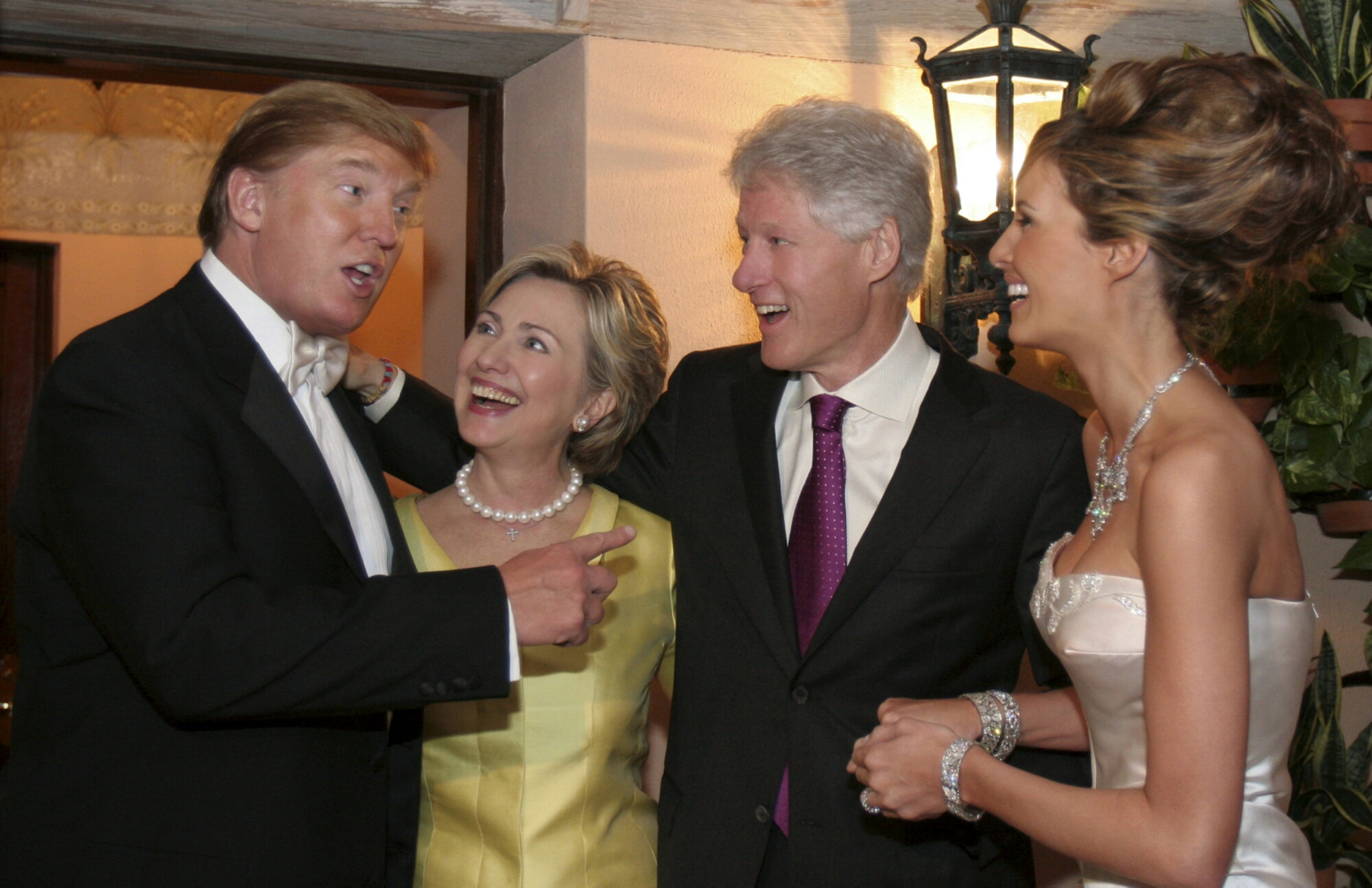
If Trump were a politician, would an ‘everyone else is doing it’ rationale and a witty response about the Clinton’s attending his wedding absolve him of guilt for being complicit in corruption?

Then there’s the matter of Trump’s attempts to use eminent domain for personal gain. As a National Review editorial puts it:

“Donald Trump’s covetous nature is not in dispute, but what many may forget is that he’s no great respecter of the admonition not to steal, either: The man has a track record of using the government as a hired thug to take other people’s property.”

Trump tried to use government power to force a widow from her property and was struck down in court. That is the modern day equivalent of king Ahab seizing Naboth’s vineyard (1 Kings 21) and is the kind of crony capitalism that is the problem.

There are two sides of the political establishment. One side is the politicians and the other side is men like Trump who work tirelessly to corrupt politicians. Men with money, like Trump, who exploit the system for personal gain, are just as much the problem as crooked politicians who take their money.

image

Trump is as much a part of the political establishment as a Bush or a Clinton. He is not an ‘outsider’ by any stretch of the imagination. So, it is time to see past the sales pitch, do not be dazzled by a man who has never proven himself loyal to anything besides his own self-interest.

Reality check: Trump shows no sign of having embraced Christian ethics. Trump’s confessions of his own corruption come without any sign of remorse and repentance.

Myth #4—Trump will govern differently than he does business.

If we have not learned by now maybe we will never learn. But every manipulator on the planet claims that they will change if only you give them what they want.

Trump shows no sign of remorse or repentance for exploiting the system for personal gain, yet we are supposed to believe he would never abuse government power for personal gain if he secures the White House?

If you believe that, I have a bridge I am selling…

I prefer open racism…

Standard

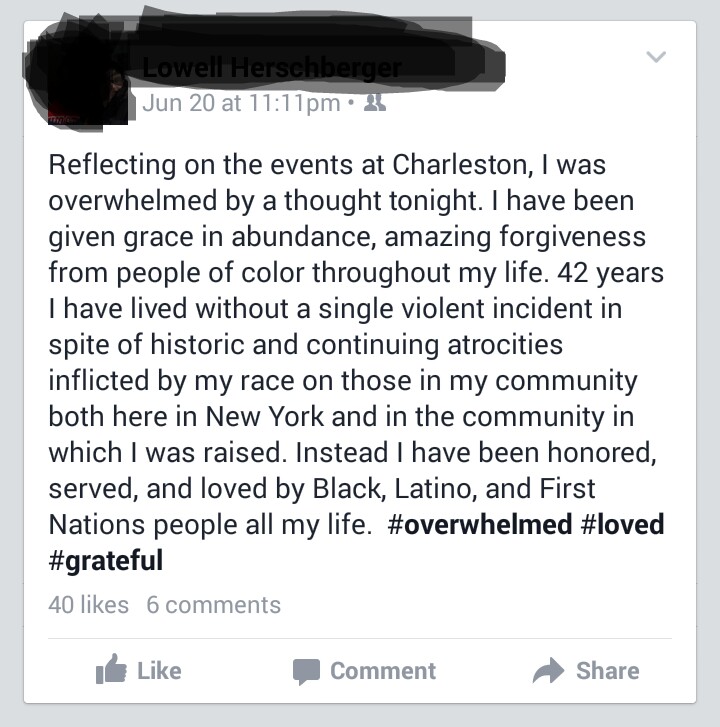
I shook my head as I read a social media post from a well-meaning white friend thanking various “people of color” for not doing him harm because of historical and current injustices.

Many of his friends liked the post—a vast majority of the affirmation, despite his diverse mix of friends, came from his white friends. On the surface his post is contrite or considerate and praise-worthy.  What could be wrong about a man owning up to the sins of his own kind?

But under the surface of his post lurks something insidious.  It uncovers a secret expectation that “people of color” should be irrationally violent and thus are deserving of his praise when they are not.  It is a demeaning and belittling message cloaked in empathy.  It actually reinforces an awful stereotype.

Think about it: Would it be praise to thank a white man for being civilized or would it be patronization and a backhanded insult?

What is more disturbing is this persistent idea that a whole race should be held accountable for the sins of one of their own.  Apparently I should be judged by the depraved acts of Dylann Roof (and every white man in history) because I share his skin color and gender.  But isn’t that exactly the logic of every racist in history and the way of thinking we are trying to escape? 

I believe ‘white guilt’ is a symptom of racist thinking rather than a solution.  When we thank “people of color” for not harming us as white people we are perpetuating the idea that people should be judged as a race rather than as unique individuals.  It is a tribalist suggestion that violence against a whole race is justified therefore we need forgiven as individual members of a racial tribe.

But this thinking is racist to the core.  It keeps “people of color” as something separate from us.  It treats them as something to be pandered to in a way that we would never do to another white man.  (My thanking a white man for not killing me today would be taken as foolishness or sarcasm.)  It is also saying that we expect irrationality and violence from them—which is exactly the same reasoning of a racist killer.

We cannot help but see people as white or black.  We should not be ignorant of historical injustice or continuing racism either.  But we can stop believing that people are fundamentally different because of their skin color.  Part of that is not apologizing in a grandstanding fashion for our own skin color.  Part of that is not treating “people of color” as inferior by thanking them for things we would not even thank a small child for.

We recognize calling a black man “boy” may be insulting.  We also see the battle flag of the Confederacy (the “rebel flag”) as symbolic of racism.  However, do we see subtle racism of those who’s words betray an expectation that black people should be irrational and violent?

I myself prefer those who display their true colors openly, because then we know what we are dealing with and don’t need to dig through the layers of carefully hidden prejudices to find the truth.

What does Charleston say about us?

Standard

There are many who react to the church shooting at Charleston’s historic Emanuel A.M.R. Church by blaming availability of guns and decrying racism.

But one thing missing from the discussion, that is a victimhood mentality and the idea that all people of a particular race are guilty because of the acts of a few. 

When Dylann Storm Roof walked into the doors of that church he was armed with two ideas: 1) his tribe (white people, women, etc) were the victims, and 2) their tribe (black people) were collectively responsible for black rapists, perceived injustice, etc.

It was the ideas that this depraved young man harbored in his heart that were dangerous.  However, these ideas are not unique to him or just to unreasonable and angry white men.  These are ideas accepted accepted in mainstream thought that divides people into falsely dichotomous categories.

Who kills the innocent? We do!

Ideas that white is equal to privilege or black is equal to victimhood are equally dangerous.  When we feed the martyr complex and victimhood mentality we are giving license to those of an even more deranged mind to take it a step further. 

The problem with Roof and those like him (of all races, genders, etc) is not what they do—but that they feel justified to do it.  We can fret about availability of guns and a multitude of other factors, but until we address the heart issue we are only treating the symptoms.

We won’t stop a person bent on evil and destruction with more legislation.  If anything more law will only create the next inequity and give some other person reason to feel disenfranchised.  But what we do need is to unravel the false dichotomies and prejudice assumptions that fuel hatred.

Being on the ‘right’ side of history…

We are urged to be on the “right side of history” yet the problem is that everyone (including Roof) feels they are on the ‘right’ side and justified.  Jesus encountered this in the Pharisees who thought themselves better than other people and superior to their own ancestors:

“Woe to you, teachers of the law and Pharisees, you hypocrites!  You build tombs for the prophets and decorate the graves of the righteous.  And you say, ‘If we had lived in the days of our ancestors, we would not have taken part with them in shedding the blood of the prophets.’  So you testify against yourselves that you are the descendants of those who murdered the prophets.”  (Matthew 23:29-31)

There are many sanctimonious today who think they are superior to other people.  They may decry the injustices of the past, support punishment for those they hold responsible and blame, but they themselves often as guilty or more of similar abuse.

Is an anti-abortion activist who calls women entering a clinic names or murderers a provider any better than those they accuse? 

Is a person who labels others as “racist” or “homophobic” or “hateful” in response to a disagreement over opinion less abusive than a person who uses the n-word?

I say, no and no. 

The solution to hate is not to be hateful.  As Mahatma Gandhi wisely observed: “An eye for an an eye only leaves the whole world blind.”  What he observed is the same as when Jesus quipped that those who live by the sword will die by it (Matthew 26:52) or ‘what goes around comes around’ in essence.

We make a difference by being different…

Everyone has reason for their own abuses.  Many of the most abusive people in history believed they served a righteous cause.  Many people can identify the sins of other tribes or the prior generation, but few seem able to see their own abuses.  We prefer to keep the spotlight on those whom we perceive to be worse than us than we are interested in searching out the wickedness of our own hearts.

Ben Carson spoke well:

“You know, we have a war on women, race wars, income wars, age wars, religious wars. Anything you could imagine, we have a war on it… And we’re giving people a license to hate people who disagree with them.”

We need to stop arming ourselves with contempt and be committed to loving as we wish to be loved.  It is easy to love our own and hate others, but divine love seeks unity rather than encourage division.  It sacrifices self rather than perpetuate cycles of violence.  It brings grace to the fight even when vengeance feels justified.

Grace saves us…

It is the Spirit of love like that of Marcus Stanley, who was shot eight times but lived, and chose grace in response to hate:

“I don’t look at you with the eyes of hatred, or judge you by your appearance or race, but I look at you as a human being that made a horrible decision to take the lives of 9 living & breathing people. Children do not grow up with hatred in their hearts. In this world we are born color blind. Somewhere along the line, you were taught to hate people that are not like you, and that is truly tragic. You have accomplished nothing from this killing, but planting seeds of pain that will forever remain in the hearts of the families that lost their lives and countless hearts around our country.”

Let’s not fall victim to those who would divide us into categories, but instead seek the unity of all people only possible with a love that tears down walls, bridges divides and believes when others say it is impossible. 

May those seeds of Roof’s hate stay dead and the love of Jesus in Stanley’s gracious response grow in us.  The answer is not more or less guns nor petitions against flags and protest, it is less hate and more Jesus.

“Do not be overcome by evil, but overcome evil with good.”  (Romans 12:21)

Good Men Do Not Blame Women

Standard

The claim ‘based in actual events’ is used to give credibility to a dramatization of a story.  One might take the phrase to mean that the portrayal of an event is basically accurate or true.

But to me the claim is a warning to do my own research.

In some cases great liberties have been taken in the storytelling—and sometimes to the point that there is little resemblance to the actual events it is supposedly ‘based’ on.

Likewise, authentic Christian faith and a Bible ‘based’ tradition are two distinct things and sometimes entirely different things. 

Bible ‘based’ is not always Christ centered

There are many organizations that advertise their promotion of ‘Biblical’ principles, they give the impression of having real spiritual authority, and yet very little of what they offer seems based in real Christian love or the actual example of Jesus Christ. 

Christian leadership is to emulate the example of Jesus.  Christian leadership is supposed to be about serving others with a heart of humility.  A good leader is one who takes responsibility (in love) for things not even their own fault and will take punishment upon themselves rather than delegate the blame.

Unfortunately many twist the Scripture turning it on its head and copying the very example of those whom Jesus condemned. They clamor for power and position over others, yet when time comes for accountability they find everyone but themselves to blame.

Good leadership takes responsibility.

According to the book of Genesis there was a man.  This man was given a garden with two trees, one the “tree of life” and the other the “tree of the knowledge of good and evil” with instructions by God not to eat the fruit of the latter tree. 

In the familiar account both man and woman disobey God by eating the forbidden fruit.  But, when confronted for his own sin, the man responds:

“The woman you put here with me—she gave me some fruit from the tree, and I ate it.” (Genesis 3:12 NIV) 

Sounds pretty true to life, huh? 

Instead of taking responsibility for their own actions many men will look for someone else to blame.  I know of one man who blamed his own obesity on the meals his wife cooked.  I know many other men who blame women for their own sexual sins and lust.  This, coupled with a few (misused) Biblical proof texts, has become a justification for all types ‘modesty’ requirements for women.

A shameful example of an immodest man.

I was talking to a friend recently, a woman raised in a conservative Mennonite community, who recalls a three hour meeting over the issue of a couple buttons being closed on her sweater. 

I had to ask twice about the buttons being closed, because it didn’t make sense (even to a person like me raised around this type of mindset) that closed buttons would be a problem. 

I’m still perplexed… 

I would guess the particular group had a standard of a loose outer garment for women and buttons made it too tight? 

Who knows?

Whatever the case, this is an all too common scenario in traditional ‘Bible based’ communities and amounts to spiritual abuse. 

In the story I told the man huffing and puffing was an elderly ‘bishop’ (I use the apostrophes because I don’t think the title of respect is deserved) and the one he was calling rebellious and a “whore” was a teenager. 

The man should be rebuked, once for being a creep who was ogling teenage girls and again for being completely antithetical to the example of Jesus Christ.

A modest mistake and a big problem of interpretation.

Modesty is an obsession in conservative churches.  I’ve heard more sermons on the topic than I care to mention and almost always focused disproportionately on matters of women’s clothing. 

These constant reminders may make one think that the Bible must be similarly preoccupied.  Interestingly the word “modesty” is found only once in the entire Bible.

However, while the word “modesty” is found only once in English translations, the Greek word translated as modesty is actually used twice.  It is used once speaking about women and later in reference to men.  The first usage is in 1 Timothy 2:9 quoted below in King James Version English:

“In like manner also, that women adorn (kosmein) themselves in modest (kosmio) apparel, with shamefacedness and sobriety; not with broided hair, or gold, or pearls, or costly array…”

This is the Greek it was translated from:

ωσαυτως και τας γυναικας εν καταστολη κοσμιω μετα αιδους και σωφροσυνης κοσμειν εαυτας μη εν πλεγμασιν η χρυσω η μαργαριταις η ιματισμω πολυτελει

I am not an expert on Greek (so I do encourage everyone to study the language themselves) but I do know that there is an interesting repetition that is not carried over as clearly in the English translation.  I’ve been told it could translate better as “women should get themselves in order in ordered apparel.” 

Apparently it is an idea that describes soldiers arranged in their ranks. It also has similarity to “cosmos” or the idea of the order in the universe. That is what makes “orderly” a good alternative translation. 

I asked a Russian speaking friend to translate the word from her Russian language Bible and she translated it as neatness. So the writer is conveying an idea of neat and orderly attire, perhaps like a professional or dignified person.

The same Greek word is used later in 1 Timothy 3:2 as quality of leadership.  It is translated as “respectable” in the New International Version and translated as follows in the King James Version English:

“A bishop then must be blameless, the husband of one wife, vigilant, sober, of good behaviour (kosmion), given to hospitality, apt to teach…”

The whole idea of modesty (in a Biblical usage) meaning more coverage to prevent lust is wrong and is a glaring example of reading a presupposition back into a text.  The idea is actually more to the effect of neatness, orderliness or respectability and not of concealment of body for sake of protection from the lusts of men.

(More good thoughts on the Biblical idea of modesty from a female perspective…)

Unfortunately there are many teachers out there who use a few words from the Bible to build their own rigid prescriptions. Literature from Bill Gothard, for example, encourages victims of sexual abuse to blame themselves and is basically rationalizing abuse as a product of female immodesty or rebellion from parents and God’s will.

It is never the responsibility of women to control male impulses.

Jesus spoke directly to matters of lust—he gave no excuse to irresponsible and leering men:

“…I tell you that anyone who looks at a woman lustfully has already committed adultery with her in his heart.  If your right eye causes you to stumble, gouge it out and throw it away.  It is better for you to lose one part of your body than for your whole body to be thrown into hell.”  (Matthew 5:28-29)

Even Bible literalists may dismiss that as hyperbolic.  But even as that could be the case, the message is pretty clear about where responsibility for sin of lust lies and Jesus offers the solution. There is no excuse given for men, no blame he puts on women and no uncertainty of terms: Men are responsible for their own thought life, not women. 

Men who point a finger of blame at women are doubling their sin. 

A man who blames a woman is both guilty of the lust and also guilty of false accusation. They are like king Saul who blamed his disobedience against God on the will of the people. (1 Samuel 15) They are opposite of a man after God’s heart (Acts 13:22) like David who did not make excuses when confronted for his sin. Men who blame women are failures of Christian leadership and may need to be cut off until they repent of their false testimony.

Jesus did not give an example of a patriarchal tyrant who could not be questioned and then always blames others when things go wrong. No, Jesus led by self-sacrifice, he took responsibility for sins that were not even his own—the sins of the world—and brought grace to every situation. That is the example of real Christian leadership.

The Bible might be a basis for some to excuse their own failures and justify their own abuses, but good Christian men do not ever blame others for their own sin. Beware of those who claim to be based in the Bible and yet lack the evidence of the attitude of Jesus Christ.

What’s in a word?

Standard

Words are interesting things.  The word “gay” for example.  According to my grandpa it once just meant happy and excited.  In Webster’s 1828 edition dictionary it carries the same basic idea.  However, compare that definition to those found in modern dictionary and the change is significant.

Words change in meaning.  Words like “retarded” to describe a person have been replaced with terms like “special needs” by those trying to soften the label.  But as a result, now saying “he’s ‘special’…” takes a whole new meaning and doesn’t imply greater or better.  Changing the labeling word has not removed the stigma associated with mental handicap.

Are Black Men Thugs?

The word “thug” is another word that has seemed to have evolved in meaning.  It once meant “ruffian” or a murderous criminal and yet lately it is often used for a much more specific group of people.  Thug seems the new favorite word to describe a young black person involved in a violent confrontation and that has raised the hackles of numerous social commentators who say it is a racist code word.

Richard Sherman, the ever so outspoken Seattle Seahawks cornerback, put it plainly when he suggested that the word “thug” is the new N-word. 

I do not go as far as some do, I do not believe it is a word used exclusively for young black men, and I do not believe all who use it intend it with a racial connotation.  I am doubtful President Obama or Stephanie Rawlings-Blake, the mayor of Baltimore, meant their usage of “thug” as racist and believe we should give all people the same benefit of doubt regardless of skin color.

That said, that doesn’t mean those who are describing “thug” as a new racist code word are totally wrong either.  I myself began to suspect something amiss with the word before it became a topic of widespread outrage and media hand wringing.  It was because of overzealous spam posts of conservative (white) friends that I began to wonder about the usage.

Will the Real Thug Please Stand Up!

A story, “INSTANT JUSTICE: Black Thug Tries to Bully ‘Little’ White Teen…BAD IDEA,” links a video showing a white teen mercilessly beating a black teen.  I can hardly see the justice in it.  Furthermore, if “thug” is just a general term for a violent person, why is the more violent of the two in the video only a “white teen” and not also a thug?  Hitting a dazed opponent seems thuggish behavior to me.

Another story, “High School Thug Bullies Classmate for ‘Talking White’ — Doesn’t End Well for Him,” shows one black teen harassing another and things turn violent.  Again race is the topic.  Again the one delivering the beating is the “classmate” and not labeled as a “thug” like the other guy.  It is a bit murkier because both involved are black.  But nevertheless you have “thug” versus “white” in the title and a curiously sympathetic accompanying article.

A third video, “NY Thug Picks Fight With Wrong Trucker, Gets Beating Of A Lifetime,” also starts after the fight has already began (removing context) and again the word “thug” is only used to describe the black participant.  Again the suggestion seems to be that the beating was a justified response.

Why is a young man described as “black thug” or “thug” and not just as a bully, harasser, instigator, etc?

I can’t read the minds of those who posted the videos.  But the framing of these stories does cause me to wonder about the intent in sharing them.  It would be as strange as a title, “Offended Young People Provoked by Thug Police,” to a story about the Baltimore rioters pummeling officers with rocks.  There would seem to be an intent to bias the reader at very least.

The (Thuggish) Hypocrisy on Both Sides…

Not every use of “thug” carries an extra racial overtone.  I believe it would not be fair to characterize it as a racist term or all those who use it as racists.  It is unfair to assume every person who uses a certain word has loaded it up the same as you do.

The word “racist” itself can be used in a prejudicial and unjust way.  The usage of the term “racist” to describe an offending white person is probably as damaging to them as any other contemptuous and derisive term.  Words like “privilege” and “redneck” are also questionable.  They are words used to categorize people and often unfairly.  Sure, many people use those terms as descriptive or even as terms of endearment, but the same is also true of “thug” and the N-word. 

In fact, the popularity of the word “thug” used to describe young black urbanites could have come in part to use of the word as a self-description: 

image

image

image

Understandably is is different when a word is used as derogatory and not as a term of endearment.  But it should also not be a surprise when descriptions we use for ourselves are picked up in popular dialog and become a nucleus for stereotypes.

Making ‘Thug’ a Taboo Word Is NOT the Answer.

I am reminded of the wise words of W.E.B. DuBois in reply to Roland A. Barton in 1928 about the topic of names (please take the time to read the whole letter) and his solution:

“Your real work, my dear young man, does not lie with names. It is not a matter of changing them, losing them, or forgetting them. Names are nothing but little guideposts along the Way. The Way would be there and just as hard and just as long if there were no guideposts, but not quite as easily followed! Your real work as a Negro lies in two directions: First, to let the world know what there is fine and genuine about the Negro race. And secondly, to see that there is nothing about that race which is worth contempt; your contempt, my contempt; or the contempt of the wide, wide world.”

As an alternative to abolishing words (that will soon replaced by new words to fill the vacuum) and being offended at every turn: Be the solution.  The solution, of course, is to live outside of the labels used to box us in and beyond identities built around race.  The solution ultimately is for everyone to do unto others what they want others to do to them (Luke 6:31) and abandoning their right to retaliation.  Be what you want others to be.

Words come and go, so don’t let them define you!

Baltimore: Race, Rage, and Reality

Standard

As fires rage in Baltimore, my thoughts go to the many good people of all races harmed by those who excuse their own destructive and abusive behavior. Mob violence only adds to injustice.

A (Completely Open and Honest) Conversation About Race and Violence

Many, including President Obama, have urged a conversation on race. I have avoided speaking in terms of black and white because I didn’t want to feed existing prejudices. Unfortunately, by my silence, I am also feeding into a dangerous ignorance about the root causes of violent behavior. There is a real elephant in the room when it comes to discussion of race and statistics, here’s a part of it:

image

It seems to me there could be a connection between that and the disproportionate violence here:

image

And this is how it breaks down as far as who is murdering who:

image

Media Fueled Ignorance and the Bigger Threat to Black Lives

A few weeks ago I read an article, “I Fear for Our Black Men,” and then began reading the comments in response. I was shocked. Instead of shared sympathy from other black women there was a lot of anger towards black men. From what I gather the complaint is that when a police officer harms a black man it is an outrage and a cause for civil unrest, but when a black man beats his wife or girlfriend nobody cares:

image

Why do we focus on stories about men being victims of police and yet ignore a far bigger problem of women and children victimized by men? Police brutality, while a matter of real concern, is a drop in the bucket of violence in general society and the black community. And the real disproportion is how much attention is focused on their failures rather than the bigger problems. It is straining on the gnat while swallowing the camel.

Which leads me to the topic of government and media complicity. Much is said about disproportionate arrest statistics or incarceration rates. But very little is mentioned about the disproportionately higher levels of violence I highlight above. Apparently we are supposed to obsess on the race only as an explanation and ignore all other factors—factors like resisting arrest, criminal records, dysfunctional homes, etc.

Why Not Build Identity Around Good Behavior Instead of Race?

I would rather talk about behaviors than race. I would rather good people of all races identify with other good people of all races. However, since shared race is how some people choose to build their identity, then I need to address the issue of racial tribalism directly: If you take the side of a person simply because they share your racial tribe identity, then you need to take complete ownership of the bad they do as well and you are a partner in it.

But I would rather we didn’t do that. I say we lose the tribalism motif. I say we stop focusing all of our attention on race and historical grievance. I say we start to address current behavior instead. That is fairer. It is fairer because the vast majority of people (all races) are not criminals. If we are not criminals we should not lump ourselves together with bad actors and defend them simply because we share their skin tone.

Christian Humanism: An Oxymoron?

Standard

Humanism, the idea that people are capable of bettering themselves or society through effort, has in modern times become a term monopolized by secularists.  That is probably why the words “evangelical humanism” jumped out to me when used to describe Menno Simons.

What does humanism have in common with a leader in centuries ago Christian movement?

Today many Christians (including those claiming “Menno” as their namesake) seem to have a terrible fatalistic streak.  There are token forms of ‘outreach’ that appear only marginally interested in creating real lasting solutions to practical problems.  There is also no shortage of negativity about the world and cynicism about our ability to change it.  It could seem resignation to the current state of affairs is even view as the epitome of faith.

Dreams Beyond the Status Quo

“The future belongs to those who believe in the beauty of their own dreams.”  (Eleanor Roosevelt)

It was that quote of the illustrious first lady on a motivational poster that stirred my thoughts again.  What it describes could be both humanistic and evangelical faith.  Secular humanism is motivated by doing good for the sake of good, while religious faith is supposed to be about doing good for the sake of God.  Both are concerned with humanity and aim for a better future.

The difference could be that the religious are too often less practical in aim than their secular counterparts and this could be because the promises of eternity deadens the urge to be an agent of change in the world today.  The secular humanist, on the other hand, is committed to practical change today and attempts to deliver more than just promises of future paradise.

Knocking at doors at 7:30 am to tell people about Jesus might have a ring of faithfulness to it.  However, unless you show up with coffee and an egg sandwich to give, you probably just created another annoyance—a door slammed in your face might be your just reward.  It could be you are getting the cart ahead of the horse.

Eternity Can Wait, Love Practically Today

Without practical love Christianity loses the strongest evangelical tool that it has.  Jesus was extremely practical.  Jesus was so practical that many of those following him thought he would lead a revolt against Rome.  He did practical things like provide beverage for a wedding, healing sick people and feeding thousands.  He promised a kingdom soon at hand that would change practically everything:

“Repent, for the kingdom of heaven has come near…”  (Matthew 4:17 NIV)

The “kingdom of heaven” isn’t just some future ‘pie in the sky‘ ideal.  No, it is something that must be lived out practically today.  And, not as a purely informational campaign or token help either.  Christianity should be about making heaven a literal reality for as many people as we can today and in as many ways as humanly possible.  When we have faith and pray as Jesus did, this is not just wishful thinking:

“Our Father in heaven, hallowed be your name, your kingdom come, your will be done, on earth as it is in heaven.  Give us today our daily bread.  And forgive us our debts, as we also have forgiven our debtors.  And lead us not into temptation, but deliver us from the evil one.”  (Matthew 6:9-13 NIV)

We act on what we believe is possible.  We should not wait to free ourselves from temptation, we should not hesitate to forgive others if we want to be forgiven and we certainly cannot expect bread to come to us without our own effort.  So why do we assume ourselves powerless to bring to “earth as it is in heaven” and instead practice fatalism as if it is faith? 

We would be much more convincing if we put our money where our mouth is and gave people a taste of heaven rather than give them hell.

Humanist and Christian Hypocrisy

Ironically secular humanism often breaks down the same way religions do, in that adherents become less practically oriented and more ideological only and lazy.  People look to institutions and charismatic leaders to show the way rather than do their part by fully living their ideals.

This is how Al Gore ends up in a sprawling mansion while preaching climate change dogma.  This is how Christians preach Christ Jesus and leave many sharing the same sentiments of Joe Hill or of the quote below:

“I like your Christ, I do not like your Christians. Your Christians are so unlike your Christ.”  (Mahatma Ghandi)

If you want to convince others of your dreams or ideals start first by living them and if you are Christian especially.  If your faith does nothing for real human needs, and is only about future rewards and glory, then it is just theory.  Being like Jesus requires you to change the world for good with the talents you are given.

Be a Human Example of Good

Don’t ask anyone (including God) to do anything on your behalf.  Leadership is not pointing out how others are doing wrong.  Leadership is being an example and laying down our own life for sake of love for humanity and God.  Be a leader for Christ’s sake.

Don’t wait on conditions to improve before acting; act to improve the conditions.  Be an evangelical humanist.  Endeavor to do what is impossible by acting in faith in a power greater and beyond your own comprehending. Bring heaven to earth today.

Christian humanism might or might not be an oxymoron, but faith without practically applied love for humanity is certainly an oxymoron.

Dream big, be practical.

Will Stack vs. Ignorance

Standard

“Ignorance has no color, God doesn’t see color, why should we?”

Yesterday I had the distinct honor and privilege of a short conversation with Will Stack.  You may have already seen the video of his that went viral and if you haven’t you really should.  So many of the world’s problems could be solved instantly if more people shared this kind of perspective. 

The good news is that there is one young man who is a real role model.  The great news is that, judging by the response, there are millions of others like him who are respectful and loving of all people regardless of differences.  I think his video resonates with so many people because it is the message too often missing from the front pages.

Another Story of Contrast

That same day another friend posted this video (warning: the content is vulgar) of a group seeking violent retribution against those who they describe as “devils” and was so over the top I could hardly take it serious.  I debated even giving them more credibility than they deserve by linking their hatred.

I was struck by the sharp contrast.  It reminded me of the two mothers I posted about the other day and I thought maybe I would do a follow-up about these two different sons.  The son of hate that screams vengeance and promises only continuation of violence.  Then there is this son of grace who speaks words of peace and respect.

Leadership by Example

Will Stack responded almost immediately to my friend request on Facebook.  He even took the time to write back to me despite being overwhelmed with friend requests and attention.  He is extraordinary, but he also represents an example of an ideal within our own reach and evidently he hit a chord with many people—myself included.

But there is still much work to be done.  There are still those who only see other people through the lenses of their prejudices.  However, we cannot change them, we must change ourselves and lead by example.  And there is one more person I know who has demonstrated this type of leadership…

Well done, Will!