Built for Scarcity: Why I Won’t Give My Son Everything He Wants

Standard

I’ve tried to give my son everything he needs to succeed. But that doesn’t mean I will give him everything he wants. There’s a reality in any pursuit: to be excellent, you’ll need to put in the work or delay gratification to reach your full potential. If a parent gives a child everything they want, there’s no incentive for them to learn and improve.

To a child, everything provided for them is a given, and every task required is an injustice. Why should they have to wash the dishes? The grumbling or attempts to negotiate last longer than the time it would take to finish the chore. And, honestly, the easy route is just to do it ourselves. But that deprives a child of the opportunity to learn all those transferable life skills—at the very least, to get a little practice being helpful rather than entitled.

In the West we already have abundance and the result is atrophied muscles and dull minds.

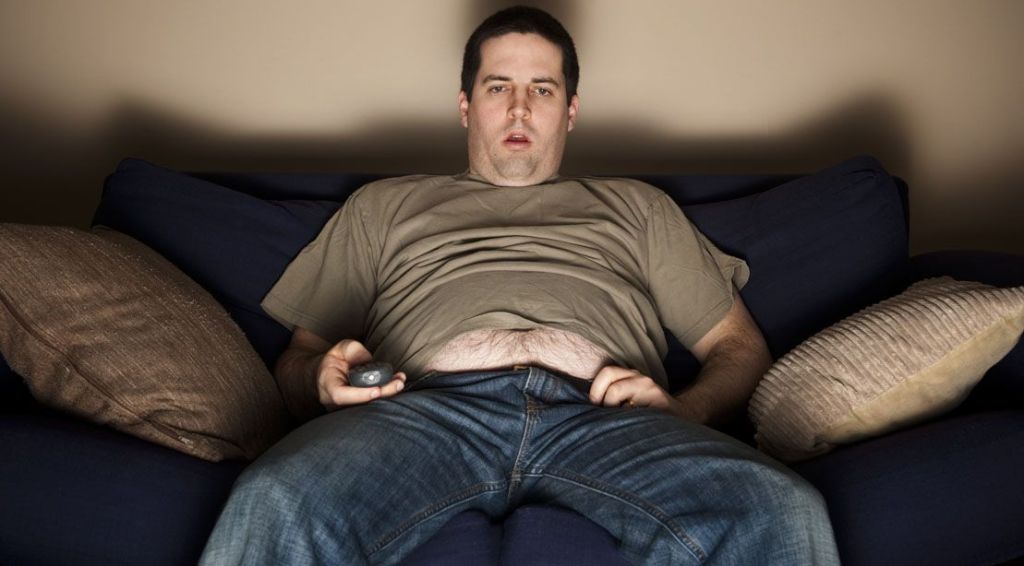
If we shower children with abundance, they will never appreciate what is given nor ever be satisfied. It seems that no matter what we have, we always want more. If given the moon, we’ll want the other planets and the stars as well—and then we still won’t be happy with that. The greatest satisfaction comes through work and accomplishment. Playing video games all day or scrolling social-media feeds may trip reward centers, but it amounts to empty calories and can’t replace substance.

I’ve watched spontaneous interviews with very wealthy men, and nearly every one of them says that their abundance did not bring happiness. At least one admitted he was suicidal despite millions in assets. Our peak enjoyment in life comes when we invest time, effort, and resources and eventually reap the fruit of our labor. Sure, going to the gym may be difficult, but the endorphins are addicting and the muscles are a reward.

Built for Scarcity—Not Utopia

I watched a video about the problems with utopia, and the framing of capitalism as a system built for scarcity was correct. We would need a radically different way of ordering ourselves if the things we wanted just grew on trees. If you could have whatever you wanted without effort, why would you pay for anything or even care who owns it? My property rights only matter because it costs something to acquire or replace the things I own. If everything we wanted was free and completely abundant, we wouldn’t need to value it at all.

The presenter, who seemed intelligent enough, made a critical flaw while talking about providers of generative AI. He claimed that those charging for the service were creating artificial scarcity “because the code is open-source or whatever.” But this totally ignores the immense computing power that’s required—the powerful microchips, massive amounts of energy, and the staff needed to keep it all running. So no, that isn’t an example of abundance.

I’m used to naïve takes coming from the religious side, but it’s fascinating to see secular thinkers stumble over the very same things. Yet it touches directly on the human condition. We are not wired for abundance. Ultimately, even if we could reduce human labor to zero, our brains were created for scarcity, and when faced with unnatural abundance we don’t actually do very well.

Wall-E is probably the best depiction of a world of abundance that goes well.  It could go in many directions, unhealthy ease the better of the many scenarios.

Material wealth, to start with, is never a cure for boredom or lust. If anything, those who have all their physical needs met are often left with a void of purpose. Their abundance never creates fulfillment or a reason to be in the world. And some appetites are basically insatiable: a man can have all the sex he wants and still desire the one he cannot have. It is often the ultra-wealthy—those who have everything we imagine would make us happy—who are also the most perverse and dissatisfied.

It reminds me how young-earth creationist (YEC) types often portray entropy as purely negative when it is as necessary for life as order. Fertile soil, for example, contains organic compounds that come from dead plants and animals. This is part of a cycle—neither good nor bad—like the weather. The same forces that bring a spring shower can also leave behind a swath of destruction. Creativity itself often lives at the edge of order and disorder. You may not enjoy a messy room that needs cleaning, but without it your life would probably feel pointless.

Furthermore, social hierarchy would be the only game left if we completely removed the need for productivity and occupation. If AI replaced all jobs, the result might be material abundance, but not utopia. As the saying goes, “Idle hands are the devil’s workshop,” and some people with nothing to do will create drama. Boredom is good when it provokes us to create something new, but bad when the “new thing” is us causing trouble for others for lack of something else to do. It is better when we need to do something productive to survive, because we’re primed for it.

Consider how an overly sterile environment can trigger autoimmune disorders; similar problems would arise in a world where struggle was fully removed. It wouldn’t solve our environmental or energy problems—there would still have to be limits and rationing to keep from stripping the planet bare. Some people will never be content with the base level of property and possessions. There will still be scarcity even if human labor is no longer a cost. Advantages will still exist. At that point a new hierarchy will form—perhaps one based solely on beauty or charisma—where many have no path to “level up.”

In capitalism, while there’s an advantage to those who go first, there are multiple paths to success. Sure, there is cost-cutting at the expense of quality (see the Campbell’s Soup controversy), but there is also genuine efficiency and a system where nothing need go to waste. Bad actors create opportunities for others. If Enzo Ferrari hadn’t been a pompous jerk, we wouldn’t have Ford’s GT40 legacy or Lamborghini. Ferrari’s rude remarks were the provocation that pushed others to build cars capable of beating his. In a free market there is a profit motive to share rather than hoard. In a post-labor AI world where elites no longer need human workers or customers, would they have any incentive to distribute limited resources?

Abundance, Unearned, Robs Good Character

The video is correct that abundance won’t lead to utopia—yet it misses the deeper reason why. It isn’t just that we’d get bored or turn to status games (true as that is). The real problem is that abundance without cost quietly deletes the only proven mechanism we have for turning a human being into a person worth becoming. 

When everything is given for free, nothing is cherished.  When nothing is earned, nobody is grateful.  When no one is grateful, no one is generous.  When no one is generous, society stops being a community and it becomes a zoo with really nice cages: no material need unmet, the trough always full, and yet we are no different from a lion removed from its natural habitat.

That’s why I won’t hand my son the life he thinks he wants. I’ll give him everything he truly needs: enough security to take risks, enough scarcity to make victories sweet, enough resistance to grow muscle around his soul. I’ll let him wash the dishes, wait for the game he saved up to buy, lose the race he didn’t train hard enough for, feel the sting of “not yet” and the glory of “I finally did it”.

That feeling of a hard fought win cannot be artificially produced.  In a world where AI leads the way can there be human thriving?

Because the cruelest thing a parent can do isn’t to let a child struggle.  The cruelest thing is to raise him in a world so padded, so instantly gratifying, so artificially abundant that he never discovers the one truth every happy adult eventually learns: The joy was never in finally getting the thing.  The joy was in finally becoming the kind of person who could get it—and still know it wasn’t the point.

Scarcity isn’t the enemy of human flourishing.  It’s the narrow gate we have to squeeze through to find out who we actually are.  And I want my son on the other side of that gate—tired, scarred, proud, alive, and deeply, durably grateful—not because he was given the universe, but because he earned his small, yet irreplaceable and fully human corner of it.

Cultural Erasure in the Age of Corporatism: Preserving Local Identity and Sovereignty

Standard

Cultural erasure is often discussed in the context of dramatic examples. Communist efforts to eradicate religious practice or the forced assimilation of Native Americans are two clear instances. Another is the British schoolgirl punished for wearing a Union Jack on a day meant to celebrate cultural diversity. Yet, a more insidious form of cultural erasure is sweeping through the United States, infiltrating every small town under the guise of free markets and capitalism.

What I’m referring to is corporatism, partnered with consumerism. This country was once defined by businesses owned by average people—those “mom and pop” shops. That is no longer the case. Capital and control are increasingly concentrated in the hands of a few (see this video on BlackRock), and choice is largely an illusion in this age of mega-corporations. We have become a nation of employees. Yes, small businesses and boutiques still exist, but they are the exception. Our regulatory regime favors economies of scale, benefiting established players who can absorb compliance costs.

Illusion of choice

On the road—hauling commodities—this economic transformation is alarming to anyone who cares to notice. Local mills and grain elevators have been bought up or are in the process of being acquired by major players. Businesses where locals once knew the owner have been transferred, one after another, to corporate boards far removed from the operations.This trend spans every industry. Thriving downtowns and corner stores have been replaced by Walmarts. Ironically, when communities regain a “local” option, it’s often a Dollar General. The impact extends beyond retail. Doctors can no longer afford to practice independently, and hospitals are absorbed by larger systems to manage ballooning compliance costs. Local communities have lost true choice as corporate brands dominate.

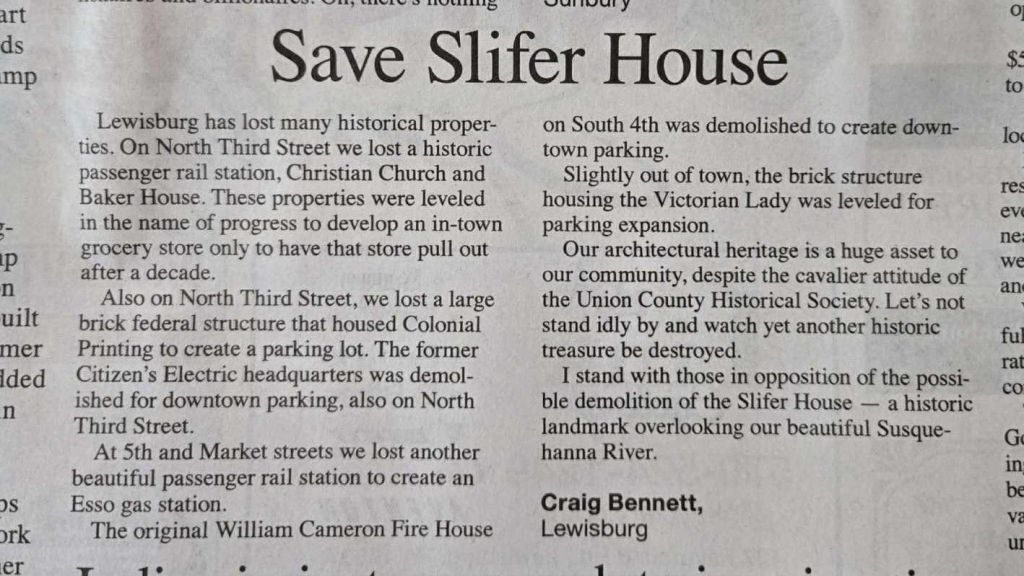
Even decisions within our towns are outsourced. Consider the plan to bulldoze Slifer House, a local landmark designed by a notable architect, listed on the National Register of Historic Places, and honoring a man who played a significant role in the town’s history. This building, originally a private residence, later an orphanage, and then a hospital, faces demolition. The board deciding its fate is disconnected from the community, concerned only with maximizing revenue at the expense of our shared heritage.

https://www.change.org/p/save-the-historic-slifer-house-from-demolition

I spoke with a township supervisor, a relative, and received the typical canned response about property rights. But this boilerplate conservatism fails in an era where BlackRock owns vast swaths of the economy, and we all now owe our souls to the company store. It’s not a free market when Larry Fink can mandate DEI policies across every place we shop or work.  Consumer choice doesn’t exist when all options on the shelf (see this video on BlackRock) are owned by the same entities.  Property rights may have built the middle-class, but appeals to them cannot address this systemic erosion of agency and destruction of ownership society by the current corporatism.

A town known for its Victorian charm and yet can’t protect this heritage from corporate interests.

This corporatist-consumerist machine erodes local identity and sovereignty by homogenizing communities. Regional dialects, traditions, and histories are drowned out by standardized corporate aesthetics and practices. The local diner with its quirky charm is replaced by a chain restaurant with identical menus and decor nationwide. The family-owned hardware store, where the owner knew your name, gives way to a big-box retailer staffed by transient workers. These shifts strip away the unique character of our towns, leaving behind this sanitized, generic, board approved and predictable landscape that could be anywhere—or nowhere.

Retaining local identity and sovereignty requires deliberate resistance to this tide. Communities must protect what matters to them, prioritize policies that support small businesses, such as giving tax incentives for independent retailers (rather than Jeff Bezos) or simply streamlined regulations that don’t disproportionately burden the little guy. Local governments should not side with entities outside of town, but rather should empower residents of the community to have a say in decisions affecting historic landmarks like Slifer House, ensuring that distant corporate interests don’t override community values. Grassroots movements can foster local pride by celebrating regional festivals, preserving historic sites, and promoting artisans who embody the town’s heritage.

Better options closer to home?

Sovereignty also means reclaiming economic agency. Communities could explore cooperative business models, where locals collectively own and operate enterprises, keeping profits and decision-making power in the hands of residents. Supporting farmers’ markets, local craftspeople, and regional supply chains can reduce dependence on corporate giants. Education plays a role too—teaching younger generations the value of their town’s history and traditions fosters a sense of ownership that no corporate boardroom can replicate.

Ultimately, the fight against cultural erasure through corporatism and consumerism is a fight for self-determination. It’s about choosing to preserve what makes our communities distinct, even when the deck is stacked in favor of scale and sucking out profits. By valuing local identity over corporate convenience, we can reclaim the soul of our towns and ensure they remain places worth calling home. Property rights were meant to protect local control—not to consolidate then outsource all decisions to out-of-towners.

Models That Shatter: Air Crashes, Dental Bills, and the Burden of Bad Ideas

Standard

Last time around, I dismantled the myth of indestructible buildings—people dream of granite fortresses, their mental models blind to necessary trade-offs—meanwhile ballooning the cost of new construction and keeping more people are stuck in older less safe buildings.  That same flawed thinking now fuels a frenzy over air disasters and my wife’s legitimate grumble over dental bills and paperwork that could choke a horse.  Whether it’s planes plummeting or crowns now costing thousands, folks cling to busted models—piles of regulations, their wild conspiracies, or broken systems—that splinter when reality bites. In my truss design world, I double-check software because it’s half-baked; we should also scrutinize the narratives and red tape the same way, and not add more wreckage.

Air Disasters and the Partisan Haze

The wacky left, not to be outdone by the kook conspiracy right, keeps blaming air disasters on deregulation. Start with January 29, 2025: a Bombardier CRJ700, American Airlines Flight 5342, slammed into an Army Black Hawk over D.C.’s Potomac River, claiming 67 lives. Then a Canadian Dash 8 skidded off a snowy Quebec runway—no deaths, but headlines aplenty. 

Now the April 10, 2025, Bell 206L-4 chopper crash in New York’s Hudson River, six gone, including Siemens exec Agustín Escobar and his family. X posts scream Trump’s crew gutted FAA rules. Never let truth get in the way of a partisan narrative, right? But the facts don’t bend. D.C. hit nine days into his second term—too soon for policy shifts to ripple. The Hudson chopper passed a March 1, 2025 inspection, clean as a new nail. NTSB points to D.C.’s air traffic staffing woes, Canada’s pilot error, New York’s likely mechanical failure—not slashed budgets.

Stats cut the haze. FAA data shows U.S. aviation incidents down since 2020, though Potomac’s toll spiked fatalities. Crashes in media hubs like D.C. or NYC feel like a deluge, but it’s perception, not reality. I’ve seen this hysteria before—folks panicked over food processing fires, but as someone who supplies building components we see many ‘fire jobs’ and not a surge.  Fires due to hot bearings, bad wiring, heaters or dust are quite common and to be expected.  The funny thing none of these food processing fire alarmists reported on the new feed mill near me—non-confirming news doesn’t go viral.  

Then the tinfoil-hat crowd spins BlackRock plots because Escobar was aboard. What are the chances a Siemens exec’s on a chopper? Pretty high, honestly—they’re the ones dropping $500 a seat, not me touring the harbor for free, with my family, on the  Staten Island Ferry. BlackRock’s got stakes everywhere; a link’s no bombshell. As far as the in-flight breakup of the Bell helicopter, my pilot brother snorted, “Never buy an air frame that does 30+ takeoffs and landings per day.”  That is to say there’s a difference between a vehicle with highway miles and the one used as a weekend racer.  Seized gearbox or stress fractures, not sabotage. The SEAL pilot’s fuel call was logistics, not a scream. Yet they weave a blockbuster rather than look at a shop log.

This echoes the indestructible building myth—deregulation won’t make planes drop tomorrow, nor do cabals rig bolts. More FAA rules don’t sharpen mechanics’ wrenches, just like overbuilt trusses don’t scoff at storms. That ELD mandate for trucks?  It jacked costs, no safer roads. D.C.’s staffing gaps brewed for years; New York’s airspace is a madhouse, and always has been. Good design—trusses or aviation—leans on more clarity: sharpen skills, focused goals, while also acknowledging the risk baked in. Pilots should scan skies, not bury their heads in binders. But folks expect oceans to swallow us if one desk job’s cut, their models deaf to reality’s groan.  Failures aren’t a secret plot nor will more rules prevent them all.

Healthcare’s Paperwork Quagmire

That same broken model—thinking more rules fix it all—bleeds us dry in healthcare, where compliance piles up and costs push higher.  My Filipino wife got sticker shock: Over $2,000 for a crown!  What???  Her gut said yank the tooth, but the doc—and me—aren’t keen on losing one of those original equipment food grinders. Before we hit the chair, she was annoyed by those butt-covering forms—shields for liabilities (“We asked about novacaine allergies!”) and traps to hunt you down if you don’t pay their yacht lease. 

Earlier this year, my son’s middle school emailed another form, they’re playing dental cop to prove his exam. We lucked out—they took our word his Philippines checkup happened, sparing me need to send their paperwork to Baguio for my in-laws to wrangle.  There, we’d stroll into a clinic, no appointment, $20 for a cleaning or filling. Ain’t swanky, but it’s sterile, does the job, and fits a $8/day wage world. Here, insurance bloats costs like student loans—dentists hike prices ‘cause the check’s guaranteed.  The poor folks get Medicaid, rich get their implants—me: never had dental insurance in my life, other than my couple year subscription to a scam “discount” that did squat unless I was already shelling out.

Since the Affordable Care Act (ACA) was turned into law, healthcare costs per capita soared from $10,620 in 2010 to $14,570 in 2023—37.2% up, inflation-adjusted, per CMS. Life expectancy sagged, 78.7 to 77.5 years, says CDC, while costs kept climbing. Rather than keep your own doctor was the promise, choice is diminished.  Big players like UnitedHealthcare—had controlled 15% market share, Statista—grew hungrier and doubled it.  Locally, Evangelical Community Hospital is now under WellSpan, and Geisinger sold to Kaiser Permanente, a $95 billion beast, both 2023 deals. Less choice, more denials, like truss software spitting out only one overpriced and deficient design.

https://paragoninstitute.org/paragon-pic/american-life-expectancy-fell-for-three-straight-years-after-acas-key-provisions-took-effect/

It is easy to forget the undemocratic way the ACA was formed. It was rushed to get around the results of a special election that would cost Democrats their filibuster-proof Senate. The Democrat Congress rammed through a trainwreck bill to circumvent their loss of Ted Kennedy’s seat.  The last thing we needed, in healthcare, was another layer of management.  Upset Americans—54% of the country wanting repeal—rose up in the mid-terms in opposition to this government takeover of their healthcare choice. 

Unfortunately the oligarchy won and we were stuck with a deeply flawed bill, sold with lies, passed in the dark of night, that nobody wanted—results in more mergers while costs continue to explode.

Obama, getting creative to deal with the botched rollout of HealthCare.gov, created what was called United States Digital Service to fix the issues. This basically gave the Executive Branch a backdoor access to the newly minted government agency that was convenient for the Democrats at the time it was formed. And this, ironically, is now what gives DOGE the authority to do what they have been doing over the past few months.  Whether you see DOGE as a phoenix rising from the ashes or a monster coming from the abyss—you have Obama to thank for it. 

It’s like engineers, for compliance, ditching practical talks for nonsense specs that lead to an incoherent mess of conflicting interpretation—it produces more hassle for everyone downstream, not a sturdier roof or better structure.  This compliance Kabuki—fancy waiting rooms, school nurse cops—doesn’t make better teeth or safer streets, it just bloats our bills and increases our taxes for nothing in return. Philippines clinics run lean on cash, keep it real. Here, we’re buried under a pile of paper. 

Good design—trusses, planes, healthcare—cuts the fat, bets on need of good judgment over more forms.  Models that preach more rules will save us or seeing secret plots are as off as thinking properly engineered roofs can never cave.   The FAA didn’t fix Boeing’s focus on DEI over properly installed bolts in doors and the ACA only added to the cost of healthcare.  We must quit chasing fixes that will only add more dead weight to an already strained structure—and ask: what’s propping this whole mess up? And why’s it heavy enough to crush a man’s soul?

A Different Blueprint: Stripping Away the Myths

Things on the periphery are tough to flesh out, like trying to find out what is happening beyond the event horizon of a black hole. We all live in this big bubble—a commonly shared safe space—where folks will bicker over set topics, blind to how both sides are tangled in a bigger myth. The structures we take for granted, holding us up, are just assumptions we gotta question. These bad models—rules to save planes, forms to fix teeth—are flawed assumptions like thinking buildings never fall. If we want to see reality clear, we’ve got to strip away these biases, prejudices, blind spots, layer by layer. That’s my design philosophy: ask silly questions, and then take ‘em seriously. I mean, why don’t banks handle healthcare instead of employers? Why can’t we get checkups at the local bar? No rule says payers have to be governments or bosses.

Most folks can’t see past their battle lines, let alone a third path. But if we look beyond the forms we know, we might find a better way. It’s about exploring our foundations—digging into the functional fixedness of old ideologies, dusty processes, and our creaky systems. In truss work, I don’t simply trust software math ‘til I test it; in life, and I don’t buy models ‘til I poke ‘em. We can do better by imagining something different—say, healthcare that’s cash-simple, like Baguio, or an aviation culture that trusts pilots over paper. Models preaching conspiracy plots or encouraging more red tape are as wrong as thinking roofs don’t cave. 

In Japan, the electronic toll system on the Tomei Expressway and other routes crashed for 38 hours across Tokyo and six prefectures. The toll gates froze, smart interchanges shut, congestion piled up. And the operator, Central Nippon Expressway Company, had no fix in sight, so they threw open the gates, let drivers pass free, and simply asked them to pay later online. Most places, you’d expect folks to floor it and forget it. But over 24,000 drivers—some say 28,000—went online and paid up, no cops, no fines.  An honor system.

That’s not just a country; that’s a different approach to problem solving. They didn’t lean on a coercion model—chasing violators or piling on rules. The culture is what made the difference.  They could trust people to square up and people did. It’s a glimpse of what happens when you question our own status quo.  Why are our systems so heavy, so distrustful, in the first place?  Why does a Christian nation need government to solve all problems yet Japan does not?  This may be a difference between our individualistic frontier mindset and their group harmony formed of rice cultivation.  But it’s also the communal approach of Amish as well.

Mutual aid in Amish country is organic, not institutionalized, they don’t need bulky and wasteful organizations.  They have built an identity together (like the Japanese have) and thus they voluntarily go along with the program.  This may sound stifling, but is it really?  Americans pay a boatload of taxes so that their bought off national leadership can bomb Gaza’s hospitals.  Did we ever vote for that?  No.  The general public is just as indoctrinated and controlled by ideologies as a strict religious sect.  The big difference is that Amish get their barn back days after a fire whereas the rest of us will spend the year sifting through insurance paperwork. 

It isn’t just the Amish who self-organize for sake of immediate needs in their community.

A sustainable future requires effective and efficient resource allocation that does not rely on costly bureaucracy or enforcement agencies.  Governance is best internalized—something we do voluntarily as part of our collective identity or being part of a larger group.  This will require discarding models and myths that aren’t beneficial.  This idea that the world’s problems are either solved by some undefined ideal regulatory regime or are all caused by it’s evil twin of a secret world spanning scheme is simply fantasy that prevents reasonable discussions and pushes away from solutions that will better harness our human potential.

Cooperation doesn’t need to be top down or cumbersome and artificial.  No, love for our own and self-sacrifice love is as coded into human DNA as conflict.  And we should be taking a closer look at Japanese and Amish blueprint.  Honor, a common code of ethics, shared cultural values, an internalized joint identity and being respectful to others can’t outsourced.  Diversity is only strength when it harmonizes and follows the same tune.  It is a combination of building a familial trust, deeper human relationships, and a societal mission that is worthy of fuller investment—not more programs, systems and rules.  

What Thomas Sowell (and Libertarians) Get Wrong About Trump’s Tariffs

Standard

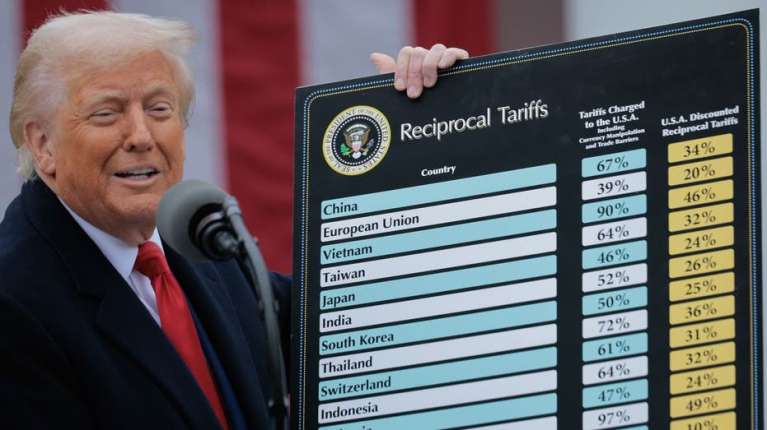
The point of Trump’s tariffs is to get rid of all tariffs.  I can feel the blank stares of my ideological and indoctrinated friends who are hyperventilating about a blip in stock prices and loses for billionaires.  

I get it, Libertarians, you really do not want the government to do anything and Thomas Sowell said stuff about tariffs being bad, so in unison you bleat: “Tariffs are taxes!”

But your sloganeering is not argumentation and—while I generally believe less is more in the case of government—I’m stuck here in the real world with Trump.

Economic theory has it’s place, as do ideals, and yet this isn’t a matter of Sowell said it, I believe it, that settles it.  

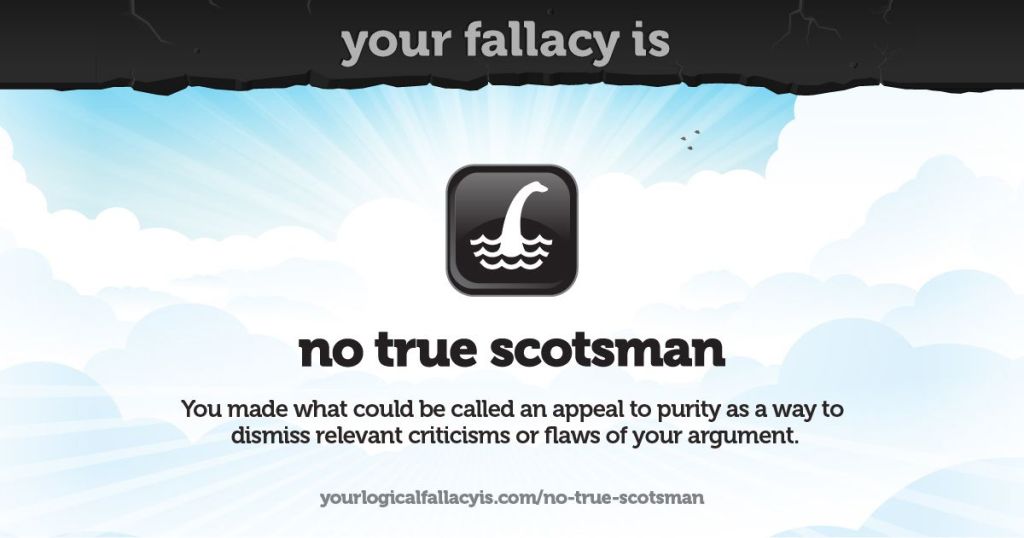
Marxists also believe their man’s theory will work if properly applied.  Ideological people can’t accept when their theory doesn’t work in reality, they will always insist “that wasn’t true [insert ideology here]” and continue on their merry way muttering that next time it will work—if they could just brainwash more children and eliminate more enemies of the revolution.  There’s never a reevaluation in light of the actual evidence.

True X hasn’t been tried.

So, without further ado, let’s dive into where free trade fails and Thomas Sowell after we do that…

Can Hell Be Made Worse?

After the devastating earthquake of 2010, I joined a group of young people on a trip to Haiti.  It was a Christian mission and hosted by a Haitian pastor.  This grandfatherly man had, at one point, been in business and ran a factory manufacturing clothes.  

While I’m not going to make a case against charity or giving, there is often a cost that is unseen and a greater dependency created in the end.  The Haitian pastor was forced to shutter his operation and lay off all of his employees after the combination of cheap imports and donations made it impossible to compete in the marketplace.

But the even sadder story was in a place in the country called “little Africa” where rice farmers tried to make ends meet.  No, they were never rich.  However, they had scraped a living out of cultivation up until Bill Clinton started to dump subsidized American rice on the Haitian market.  These people were desperate.  They mobbed our delivery of a bit of relief and aid.

I know, I know, this isn’t real free trade.  But it is the kind of situation we are in.  Putting our favorite theories and fandom aside, and ideals that could possibly work if all abided by the same rules or assumptions, we don’t live in that fantasy land.  In the real world, it is like Haiti where subsidized products are exported and some will disproportionately suffer consequences.  

Yes, in theory, Haiti still benefits, as a whole, from importing cheap or free stuff.  But we can also make the argument that this kind of unfair trade has undermined a situation that was already fragile.  A government that would protect Haitian industries would not let subsidized products be dumped without something stabilizing in return.

Thomas Sowell vs Donald Trump 

Sowell is a great economist and provides a good answer to ‘progressive’ theories.  His being a guest on the Rush Limbaugh show has made him a favorite of conservatives—wanting validation for their free market and small government views.

As an academic, Sowell’s work dealt mostly with economic theory and to argue against all tariffs he uses abstraction “protectionism hurts market efficiency” and that they don’t solve issues like wealth gap, that they favor special interests, and retaliation against tariffs hurts exports, and they lead to long-term stagnation.  And he may be right if we lived in a vacuum sealed petri dish.

Trump, by contrast, lives in the very messy world of politics and negotiations.  He runs on instincts and intuition, not by intellectual exercises or writing papers or creating a set of principles.  He comes in with the big ask, the threat or the bluff, trying to disrupt and even create a bit of anxiety in the other side, before eventually bringing this process to a resolution that makes all parties leave with a feeling like they’ve won.

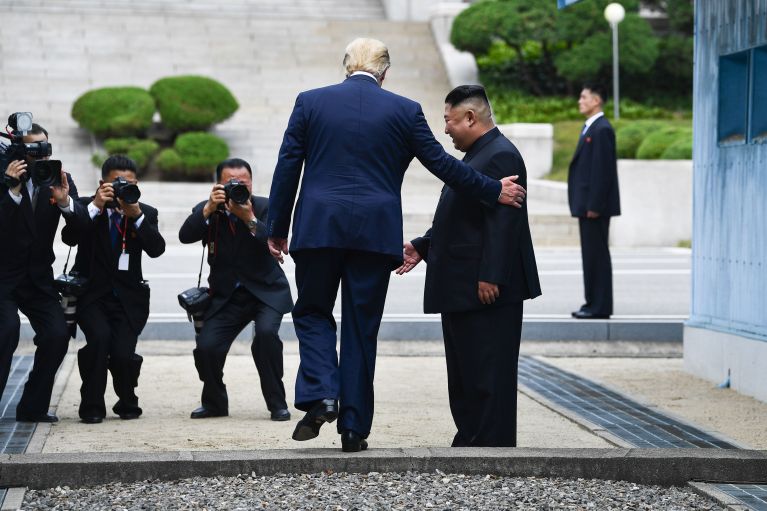
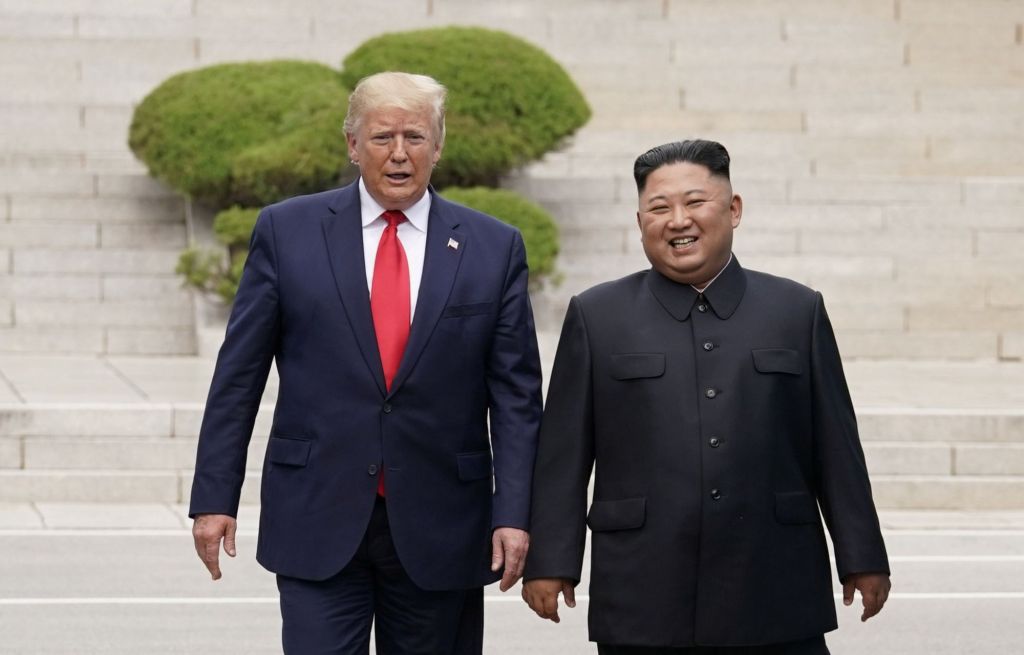
This is how we got from the “fire and fury” rhetoric—with the political class and corporate media hyperventilating about this being a path to war—to Trump being the first US President to set foot in North Korea and then shaking hand of Kim Jong Un.  It is just his method of changing the conversation or moving the Overton window.  You can’t get from point A to point B without shaking up the old status quo a bit.

Trump isn’t ideological, like Sowell, or trying to live off a written in stone economic code of conduct.  No, when he has leverage, or sees an opportunity, he uses it.  There are many countries tariffing US goods.  And our trade deficit is enormous.  So why is it so out of line for our President to cry foul or use the threat of reciprocal tariffs in other to back these countries down and then get a better deal for his country?

Surely Sowell isn’t against pushing for the elimination of tariffs—which likely is the end game.  And, furthermore, Trump’s brazen actions are far more likely to get results than the fine professor’s best lecture on economics.  Already other countries are lining up to start talks about removing their unfair tariffs against the US.  It is a game of musical chairs and you don’t want to be the last one looking for a seat.

Power, Principles, and Persuasion 

Marxism is about the application of power, Libertarians are about strict adherence to a set of principles, but Trump is different.  He is about persuasion.

Marxism is a hammer—raw power of the mob, trying to smashing the old order to hand control to the workers, or so it claims. In reality, it’s a machine for centralization: seize the levers, dictate terms, and dress it up as justice. Think Soviet bread lines or Mao’s famines—equality morphing into control. Libertarians, by contrast, wield a rulebook, not a fist. Their creed—liberty, markets, entirely hands off—is sacred, rigid as stone. Tariffs? Sacrilege. Sowell represents this.  Marxism a power grab, and libertarianism a fortress of unattainable ideals—both are better to be left as theory rather than an approach to real world negotiations.

Marxism would’ve sparked a trade war, not talks; libertarianism would’ve let markets bleed out. Trump’s different—he’s making countries dance. China grumbles but hints at softening; the EU’s haggling too. Stocks have dipped, and Sowell’s costs loom, but the moves are now undeniable: Vietnam’s concessions, India’s play, Japan’s hustle. It’s not a system winning—it’s Trump, raw and loud, proving persuasion trumps power or principle. He’s bending the world his way, one bluff at a time.  He is about persuasion—messy, unscripted, a vibe that bends the room.  

Tariffs are the threat, but trade that is truly free and fair is the actual goal.  And Trump is further along in achieving this simply for his boldness alone.  Maybe he’s not doing it the ‘right’ way or by conventional means, yet who says that we can’t try a new approach to get some better results than we’ve been getting?  The people who have been leaving the American worker behind tot decades now?  As my 13-year-old son would say: Let him cook!

Oxygen Masks and Civilizational Math: Empathy’s Breaking Point

Standard

Anyone who has flown commercial knows the safety rundown before take-off.  You’re instructed on where to find lifejackets and how to put on the oxygen masks.  And one thing they emphasize is before taking care of anyone else, including children, they need to secure their own oxygen first.  This does not mean that a passenger shouldn’t care at all about anyone else.  What it means is that caring for ourselves first can make us more able to help others.

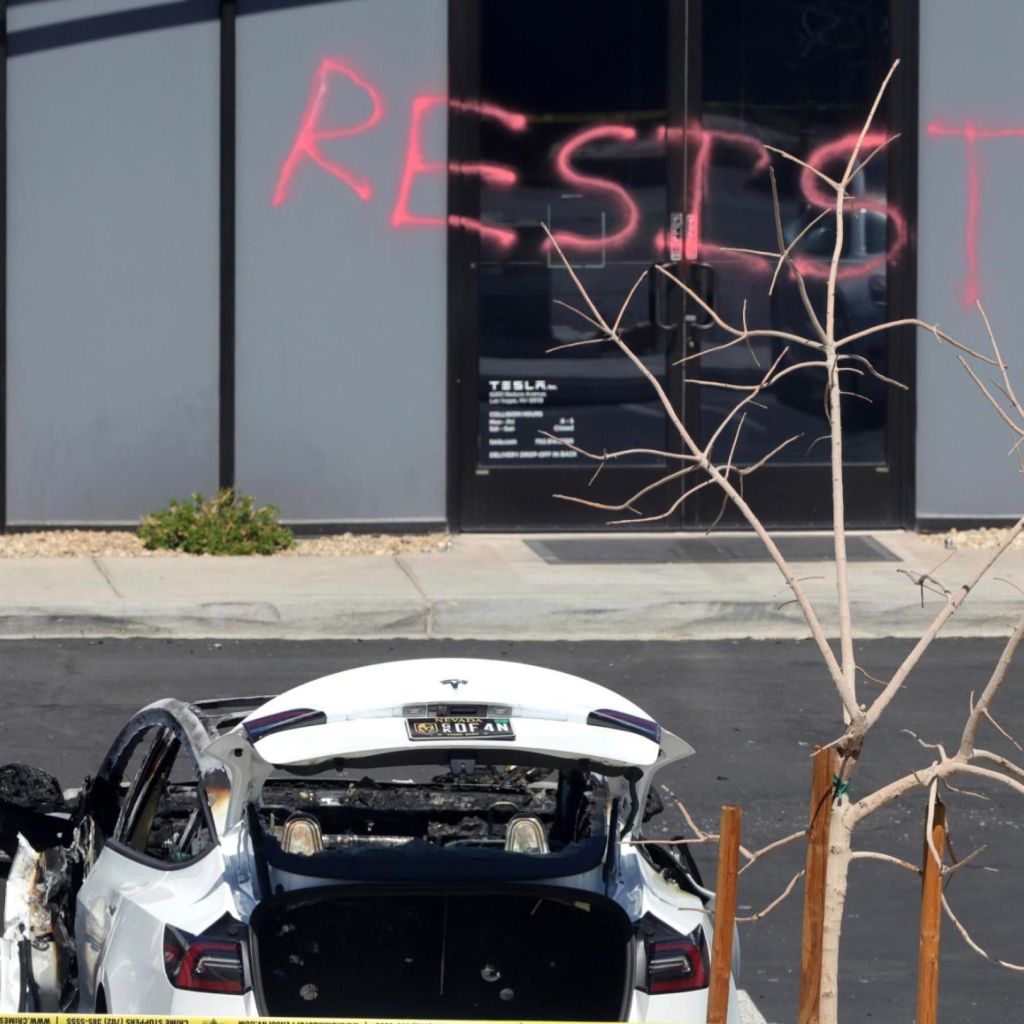
I came across a post of Facebook about the vandalism and terror campaign against Elon Musk’s Tesla brand.  In the comments I saw a left-wing activist justifying their violence by using a paraphrase of Musk, “empathy is a weakness.”  So I looked into the claim and found a quote of Musk during a Joe Rogan Experience podcast:

There’s a guy who posts on X who’s great, Gad Saad? … Yeah, he’s awesome, and he talks about, you know, basically suicidal empathy. Like, there’s so much empathy that you actually suicide yourself. So, we’ve got civilizational suicidal empathy going on. And it’s like, I believe in empathy, like, I think you should care about other people, but you need to have empathy for, for civilization as a whole, and not commit to a civilizational suicide. … The fundamental weakness of Western civilization is empathy, the empathy exploit. They’re exploiting a bug in Western civilization, which is the empathy response.

I’m not sure where “empathy is a weakness” can be found there.  What it seems Musk is saying is to keep everything in balance and not go to self-destructive extremes.  I would call it rational pragmatism rather than use a weird sounding “suicidal empathy” and yet it is a poignant point.  We can understand and share the feelings of others (empathy) while not destroying civilization in the process.  It is sort of how I always listen to my son, but don’t always give him stuff that he wants—because the soda and sweets could lead to tooth decay and diabetes.

This is the Gad Saad quote referenced by Musk in the interview:

Imagine an entire civilization that is taken over by an emotional parasite called suicidal empathy that trumps every other instinct that is within your adaptive repertoire. You are willing to sacrifice everything at the Altar of Suicidal Empathy. Nothing is more important than that.

What he’s taking on is the ideologies that demand we recognize, accept and finance every kind of bizarre behavior.  Money being sent for transgender operas when we have crumbling infrastructure, for example, this is what suicidal empathy looks like.  Or letting a confused men destroy women’s sports—there is an opportunity cost to these special accomodations and, with limited resources, it means many will suffer for the whims of a few demanding empathy in the form of their own exemptions and privileges.

My son may want me to taking him fishing every day.  To him I have limitless time and resources.  He says it would only take me a few minutes to drive him across town to his favorite spot.  But what he doesn’t really get is how doing this is difficult given I can’t just leave baby at home and it also cuts into my time to do the chores he neglects.  To him it seems simple and he reacts with disgust as if he is entitled to transportation and a life of leisure at the expense of everyone else in the house—yet the adults know better.

Performative Empathy vs. True Compassion

Nobody at DOGE is saying we should beat or bully transgender people or forbid people from donating to foreign causes.  What they have advocated is for efficient and effective use of public funds.  Yes, it could be called “tough love” and yet it is really essentially to the thriving—even surviving—of the country that we don’t bleed resources for minimal or no real return.  Government is not a charity, it relies on coercion to attain funds, for that reason it should only be used for things the majority of people support.

Those burning Tesla supercharger stations, smashing out dealership windows, or even attacking vehicles owned by individuals not named Elon may claim to represent the side of empathy, but their’s is only performative empathy and part of their partisan political agenda that is all about maintaining their own power and control over others.  Those same people forcing mandates, in the name of climate change, have now spun a 180 to creating unnecessary pollution.  They never cared about the planet—it is always about their belief they have the right to rule us.

That is what toxic empathy is about.  It is a manipulation game, a virtue signal, and like the jealous boyfriend’s love.  Sure, they say they love, and yet would murder before they would ever let their significant other go their own way or be apart from them.  This is, of course, symptomatic of leftism.  They want complete control over your life and yet call a billionaire greedy for being allowed to keep the wealth they’ve amassed.  And that’s the real culprit here: Envy.  It’s not that those on the left care so much about people, it is that they are looking for a moral justification for their rage against successful people.

Leftist ’empathy’ strikes again.

Elon Musk is many things.  He’s extremely motivated.  A problem solver.  A billionaire.  A bit of an online troll.  A father of fourteen children.  Efficiency expert.  And also has Asberger’s syndrome.  It is that last item on the list that puts him at odds with normies who prefer lawyerspeak to bluntness.  Musk doesn’t coat anything in syrup, he analyzes, identifies the problem, and states it plainly rather than beat around the bush.  Contrast to the left, he puts logic and reasoning first—feelings second.

As an aside, CEOs and political leaders have a higher likelihood of being psychopaths.  It is what makes them good at their jobs.  You can’t make good decisions for a corporation or a country when you’re too zeroed in and obsessing over impacts to individuals.  That is going to lead to analysis paralysis and no necessary corrections being made.  Instead they think on the macro scale.  This is not to say they don’t care about the parts, but the good of the whole is what matters to them and they distribute concern according to the overall picture.  Sure it may seem cold and calculated—but serves the common good much better than empathy run amok.

As much as those on the left like to crow—as if their great empathy stretches across the globe—the reality is their typically very focused on their own feelings.

Their ’empathy’ is unsustainable.

Myopic.

Blind.

Christian compassion, in contrast, balances judgment and mercy. You do unto others as you want them to do to you, but also speak the truth in love—even when it gets you killed by an angry mob that doesn’t want to hear it. The tension or fusion of love and accountability keeps it grounded; it’s not a free-for-all where every whim gets a blank check. Unlike leftist empathy, which often bends toward appeasement or control, Christian compassion holds a line—help the widow and orphan, yes, but don’t burn down the house to warm them. It’s personal, not performative, and it doesn’t bankrupt the future for the sake of today’s applause.

Breathing Room for Civilization

In the end, the clash isn’t about empathy versus apathy—it’s about who gets to breathe first when the masks drop. Musk and Saad aren’t wrong to call out the self-inflicted wounds of suicidal empathy; they’re just pointing to the scoreboard: civilizations that forget their own oxygen don’t survive to help anyone. Leftist empathy, with its envy-fueled ‘virtue’ and reckless spending, dresses up as love but flirts with collapse—torching Teslas while preaching care, funding operas while bridges crumble. Christian compassion, for all its flaws, at least remembers the whole plane matters, not just the loudest sob story. We don’t need more performative tears or smashed windows—we need a hard reset on what keeps us aloft. Secure your mask, folks; the turbulence is just beginning.

Trump: Business, Not Bombs

Standard

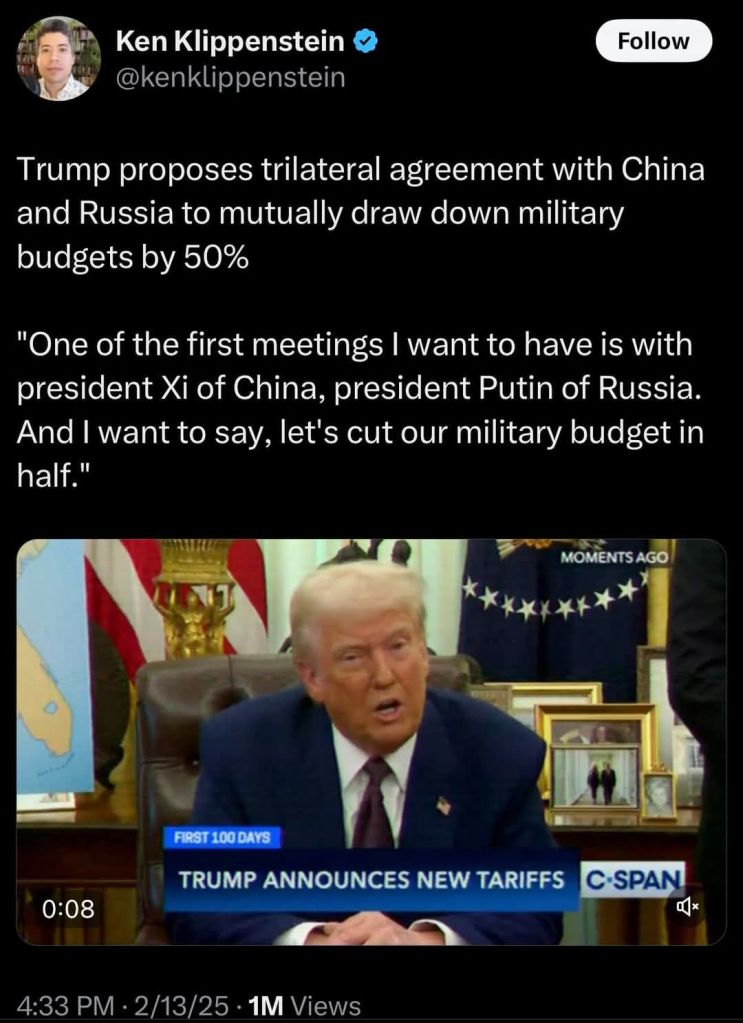
Trump has been full of surprises in the first few weeks of his delayed second term, but this latest proposal was the least expected and one even the professional fault-finders won’t be able to oppose.  He has just made a proposal that could change the world for a generation to come: A trilateral agreement between Russia, China and the US to reduce military spending by 50% and decrease our nuclear stockpiles.

But this isn’t out of character for Trump.  He got started then before he officially entered the office.  According to the Israelis, Trump, who told Netanyahu that the war must end, deserves full credit for the Gaza ceasefire deal.  And this is just a pattern.  Trump has no interest in wars.  He is about business, not bombs, and it goes all the way back to his youth when he, rather the be beholden to phony patriotism, stayed out of Vietnam.

Avoiding War By Any Means

Back in 2016, when Trump was running for President against Hillary Clinton, there was a hearsay report that the MAGA candidate had avoided military service in Vietnam by using a diagnosis of a foot injury.  There is yet to be documentation to prove this.  But it has led to some ridiculing him as “Captain Bone Spurs” and alleging his cowardice.  

To me, knowing what I do about Vietnam, I can’t see how avoiding that meat grinder is a reflection of poor character.  

No, the war was an absolutely horrendous waste of life and resources, a quagmire, in defense of a dying colonial order.  What the US government did to that country and it’s people is beyond the pale.  

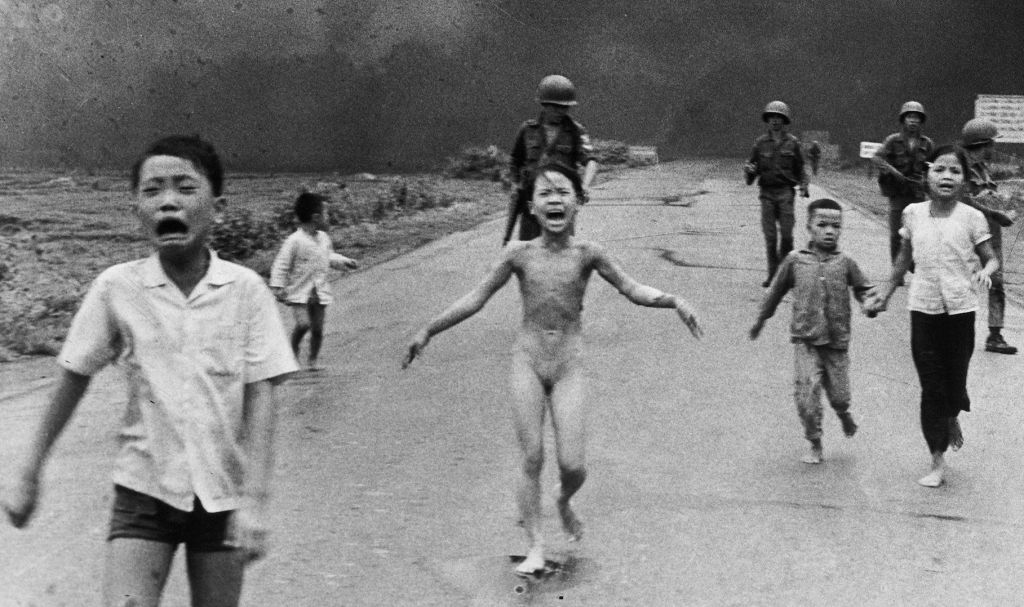
Over one million people died, bombed with napalm in their villages—scores of young American boys killed in the process—and nothing was gained besides an ecological disaster.  Our veterans were left scarred and many of them (like the father of a friend of mine) suffering from debilitating illness—which is likely due to the widespread use of chemical defoliant agents.  

It is easy to see the vanity now.  In the end Vietnam did become a Communist nation.  And yet this did not lead those dominoes falling across Southeast Asia, as ‘experts’ predicted (like they do now claiming Putin has ambition to take all of Europe) and we should be celebrating that anyone avoided this pointless conflict.

Trump may have avoided the Vietnam War for selfish reasons, nevertheless the moral reasoning was correct: Why kill thousands of Asians, at risk of your own life, when you can just do business instead and everyone wins?

Trump Angers Neo-cons

In his first term Trump did something even Obama didn’t do and despite being given a Nobel Peace Prize.  Both Obama and Trump would continue the war in Afghanistan, but it was Obama who bombed Libya in pursuit of “regime change” and turned that country into the hellhole it is today.  Trump, on the other hand, avoided war and even started negotiations for peace with a country we’ve been at odds with since 1953.

I recall being told by a die-hard Democrat friend that Trump, the terrible loose cannon and narcissist he was, would start WW3.  It is quite interesting, to see how that this dire prediction compares to actual reality where the last administration had pushed us to the brink of a nuclear Armageddon.  But in four years of Trump’s presidency, despite all the insane fear-mongering rhetoric from his opponents—nothing close to this happened.  

Instead, what happened under Trump, but not Biden, was a slight thaw of relationship with North Korea.  Yes, Trump engaged in a little rocket size comparison, but eventually would walk across the DMZ to shake hands and get some pictures with Kim Jong Un his counterpart.  That is unprecedented.  And is a legitimate reason to award a peace prize, but nobody recognized that moment and it has faded as Biden returned us to a status quo of use of threats and the proliferation of arms deals, rather than diplomacy, in an attempt to dictate terms.

No, Trump is not a peacenik or even a nice guy (depending on who you ask), but he did avoid a dangerous escalation with Iran over a down surveillance drone.  With neo-cons salivating and only ten minutes from strikes, Trump—learning that 150 Iranians may die—called it off.  This is likely why John Bolton turned on him.  The warmongers wanted a violent confrontation, dead bodies, whereas Trump valued human life.

And maybe it was all just a cynical ploy and part of deal making strategy?

Nevertheless, those Iranian men got to go home to their families rather than die so a President could look like a tough guy.  And, when all lives matter peace is possible.  A President that is even doing a little bit of lip-service in concern for enemies will be even less likely to put US service members into harms way.  Yes, he would retaliate against Qassem Soleimani, the Iranian General who was responsible for the deaths of American people, which shows Trump prefers to hold decision-makers accountable rather than subordinates.

Business, Not Bombs

What makes Trump unique, as a President, is his willingness to entertain different ideas in the open.  Our tireless defenders of the status quo claim it is unpresidential, that he suggests alternatives, but this is how a true innovator works.  Why not float a thought or start a conversation?

A prime example is his proposal for Gaza.  I mean, certainly, the Palestinians have truly got the short end of the stick.  They, being Semitic people themselves, get labeled as being anti-Semites, for fighting for their own deeded land, by the most powerful lobby in the world.  Theirs is a legitimate grievance, if there is any, they were chased off of their land by a campaign of violence and terror—are now portrayed as the villains.

So when Trump proposed they walk away it seemed grotesque. Israel is the one country in the world that didn’t see their foreign aid disrupted by Trump’s America-first doctrine and clearly Netanyahu is in agreement with the plan or they would not be doing a joint press conference.  Palestinians had nobody to represent them in this.  How do you make a deal with only one party present?

However, upon some further thought, this could be the best deal Palestinian people can ever can expect to get.  What really is the alternative?

They are in a war they can’t win.  October 7th caught the IDF off guard and yet it was never a serious threat to the Isreali state nor a reason for the Israeli government to come to the negotiating table.  Hamas may have hoped for a hostage exchange in order to get their own captives back.  But hardliners, like Netanyahu, saw it as an opportunity and used it.  Sure, many in the world do protest indiscriminate bombing that kills far more non-combatants and children than it does members of Hamas, but holding a sign or occupying buildings won’t stop this ethnic cleansing campaign.  

Enter, “Riviera of the Middle East”

Trump reframed the conversation from one of fighting for soil, that has led to decades of suffering and death, to what is truly best for me and my children.  Sure, Hamas may disagree, but many Palestinians will likely take a buy-out deal.  Why stay in Gaza if you have a choice to relocate?  There is no new real estate, the Saudis have a lot of money to invest, so why not redevelop Gaza into a modern vibrant city, like Dubai?

The reality is Palestinians aren’t only being kept walled in by the Israelis.  They are truly caught between the two stubborn sides of a regional conflict, like Ukraine, and they (with their children) are paying the full price.  The nations of this region have not forget about colonialism and obviously consider a nation of expansion-minded European settlers to be a thorn in their side.  Add to this that the official policy of Israel is to destabilize their neighbors and you have a breeding ground of resentment.  Palestinians are their way to return the favor—used as a tool to provoke and prove the evil of the Jewish state.

So, for my liberal friends, is this land really so important that we should, for perpetuity, continue to sacrifice more children.  Or do we find a new and creative way to break the deadlock?  And, for my conservative friends, is it better that we send Israel bombs, at the expense of taxpayers, when we could help to broker some kind of buy-out instead?  It is time for a business deal, to give those in Gaza—who just want to live normal lives—a chance.  

So, Trump, I realize this is at your “ridiculous first offer” stage, but I’m listening.  

Tell me more.

The Status Quo Alternative 

The political establishment has only known old divisions and escalation.  It is one big area of bipartisan agreement.  Republicans and Democrats in Congress may disagree on details, but nearly all support an endless war with Russia and China, through proxies or even direct threats.  The goal is always to box their rivals in militarily or back then into a corner economically—as if this is the only way forward.  

Diplomacy took a back seat.  Instead of the slightest acknowledgement of Russian and Chinese security concerns, our government has made regime change the goal with even near-peers with a nuclear deterrence.  And it is this attitude that led to the bloody conflict in Ukraine that has cost countless lives and billions upon billions of US taxpayer money, all after the US had orchestrated a coup on Russia’s doorstep, leading to a civil war in that country and—after eight years of Kiev’s regime lobbing shells at civilians—a direct intervention by Russia.

The problem is a combination of Cold War ideology and institutions.  Endless war is where the big money is.  Many, in the West, profit off conflict and chaos.  That and they are old.  They’ve become functionally fixed, see only one solution (to further humiliate or defeat those who stand in their way) and lack imagination or even the will to come up with win-win resolutions.

Truly, the only way to win any war is not to fight it.  Wars cost both sides.

Trump, for better or worse, is disruptive of the status quo.

As for his proposal, I would consider 50% to be the “ridiculous first offer” stage of negotiations and do not expect China or Russia will go along with it.  For them that would leave the US on top of the balance of power—given our tremendous head start in comparison—and this maintaining our advantage over them leaves their interests vulnerable.  They will probably come back with an alternative proposal and the horse-trading will begin.

Nevertheless, it sure beats a strategy of endless escalation—that eventually ends in a nuclear war or our bankruptcy.  Even a 10% reduction in defense spending would go a long way to slowing down inflation and give hardworking Americans more bang for their buck.  Our sons not dying in Europe or in the East China Sea the biggest benefit of avoiding confrontation.

Lead, Follow, or Get Out of the Way

Like him, love him, or loath him, Trump is the President of the United States and has resolve to make his second term historic in ways nobody imagined.

Even if we disagree on some policies or we have a different understanding of his drive for government efficiency, we should agree with this aim to convince the great powers to beat their swords into plowshares. 

There is just too much to lose (and also too much to gain) by this to not jump on this unique opportunity to challenge existing order and build a better one. 

Business (and buy-outs) rather than bombs—that’s the Trump way of doing geopolitics.

Even his idea of buying Greenland, as part of a containment strategy for Russia and China, is far better than the alternative we see playing out in the steppes of Ukraine.  There is no way to bomb and kill our way to world peace or at least not a kind of peace where humanity survives and thrives.  We need to find a different approach, we need to dissolve the Cold War organizations and agencies that encourage military solutions or regime change.  We need to double down on diplomacy and fair-trade agreements.

It is time to give peace a chance.  We need to be disruptive, to change the conversation, and work with those who are willing to work towards a better future together.  If Trump is a partner in this, then we should embrace this as his role and not hinder this with old partisan battle lines.  Maybe he’s not pure or perfect, but at least he’s oriented right as far as war and avoiding the costs.

What Is the True Cost of EV?

Standard

The battery electric vehicle (EV) versus the internal combustion engine (ICE) powered debate is one of the most irrational of our time. On both sides of the discussion, you have those frothing-at-the-mouth types who attack the moment you disagree. And this is exactly the response that I got after I had casually mentioned that ICE is 1/3 the cost under a click-bait post…

Model Y starts at $43,990 FYI.

One just called me ignorant, but others tried to make an argument, including this response:

I’m trying to figure out what car cost 1/3 of the price of a Tesla🤔🤔? The long range Model 3 (the one you want for a roadtrip) is $42,500 – $7500 tax credit is $35,000. This is not factoring in gas savings. Please tell me what new car is availability for under $12,000 (that’s the 1/3 cost of a Tesla you mentioned)?

Fair enough question.

Note, I never said new, but assuming that I did…

Believe it or not, and even in this inflationary age, there are still reliable sedans that come in under $20,000. Starting with a Mitsubishi Mirage G4 ($18,500), the Kia Rio ($17,875), and the Nissan Versa ($17,075), the lowest-priced option is half of even the subsidized price of the Tesla base model.

But you can’t exclude the subsidy from the cost of the EV, the government doesn’t have a magic wand to create value and we all end up paying for their expenditures in our taxes or by inflation due to money printing. And it only begins with that “tax credit” (so-called) given directly to privileged people who can afford a new luxury car.

What is the true cost of subsidies?

According to a study by the Texas Public Policy Foundation, the cost to us is nearly $50,000 for every EV produced:

Federal and state subsidies and regulatory credits for EVs totaled nearly $22 billion in 2021, or nearly $50,000 per EV, socializing the true cost of these vehicles to taxpayers, utility ratepayers, and owners of gasoline vehicles

Tens of billions of dollars have been spent trying to make EVs viable, and yet still the average cost of these vehicles is $65,000, compared to $48,000 for ICE. Why haven’t these subsidies leveled the playing field? It is simply the fact that batteries require tons of extra material and a much more complex process to produce.

So we can at least double that visible “tax credit” subsidy and already the true cost of an EV is close to three times a comparable ICE sedan.

We could stop there—the 1/3 number reached—but let’s continue…

What is the true cost of production?

The cost of a vehicle isn’t just the window sticker price or the money that it takes to manufacture. The bigger question—given the reason many say we should switch to EVs is about emissions—is what the increased environmental impact is of producing the batteries that go into these cars. Is this a trade-off we are willing to make?

Lithium batteries are costly, they require an enormous amount of water and also leave a toxic legacy that will grow exponentially as EV is adopted. Is it worth this cost to only marginally reduce carbon emissions?  That is to say, around 17-30% less emissions according to European Energy Agency? 

Sure, it could get better with a heavy investment in electrical generation and transmission—yet that is another huge cost financially and environmentally…

What is the cost of infrastructure demand?

This is where the conversation is the most interesting. We have the refining capacity and distribution network already built for ICE vehicles. Gasoline and diesel fuel have the advantage of being energy-dense and can be moved around using the existing highways. But what about EVs?

There is an illusion that comes with plugging something in. The load we put on the system is invisible. But there is no magic to it. Electricity is something that must be produced somewhere and then transmitted to the charging stations. If everyone adopted EV technology the grid would collapse.
We’re currently nowhere even near what it would take in capacity to convert everyone to EV. The easiest route to more electrical generation is to go anuclear. So how many new nuclear power plants would it take? Well, if we use miles driven and the number of cars on the road today, then we would need to build 250 additional nuclear power plants as big as the largest plant in the US, and the supporting infrastructure to keep up with this demand.

So are you willing to have a Palo Verde in your own backyard?

It cost 5.9 billion dollars to build one in 1988 (the equivalent of 13.9 billion in 2023) and we needed to start building 250 of them yesterday.  The solar and wind equivalent would be even more costly to build and maintain.

The costs would be astronomical and that’s just considering only passenger vehicles. Switching Class 8 trucks would take even more of these massive power plants and spending—the cost of switching would be insane.  Not to mention you would need more trucks to do the same work as you did with diesel.  And remember, every dime that we spend on this mass EV conversion could go to health care or education instead.

Can you now see how extremely costly EVs will become as they are adopted?

But it does not end there…

Why is the cost of wear items greater?

Batteries are heavy and weight is the enemy of “wear items” like brakes or tires—which is not to mention the additional damage to the highway infrastructure.

EV tires wear 20% faster than comparable ICE vehicles.  That is a cost out of your own pocket and also a concern for the environment. And do not forget, to be safe you’ll need those heavy-duty EV-specific tires. Sure, maybe this is not a very big problem for those who can already afford the premium cost of a new EV?  However, for that waitress struggling to make ends meet she will have to make the choice between safety and home utilities.

Next up is excess road wear.  Big trucks are obviously the leading cause of damage to roads. However, EV proliferation will start to cause problems for existing infrastructure:

A 6,000-pound vehicle causes more than five times as much road damage as a 4,000-pound sedan. A GMC Hummer EV, which weighs 9,063 pounds, will cause 116 times as much road damage as a Honda Civic, weighing 2,762 pounds.

The article cited above isn’t about EVs yet does apply given it is about the vehicle weight. Even the Model 3 is a whopping 3,862 to 4,054 lbs. Sure, one vehicle is not going to do a whole lot by itself, but the volume over time will significantly impact bridges and parking garages that were designed for lighter ICE vehicles. This EV vehicle weight bloat caused by batteries will require very costly upgrades to prevent catastrophic failures—like the Ann Street Building Collapse:

Speaking of disasters. With EV there is potential for a thermal runaway or reaction that can’t be stopped—like an ICE fire—by simply denying the source of oxygen. This hazard will result in more damage to road surfaces, more time spent in traffic jams after incidents, and additional toxic emissions. This is a cost to be seriously considered with all of the others.

Cost of time, capability, and resale value…

Many of the costs and drawbacks of EVs are hidden under a pile of subsidies or are moved upstream like the emissions—out of sight out of mind.

But what cannot be ignored is performance in terms of range. Time is by far our most valuable resource and nobody wants to spend hours in a place they don’t want to be because their vehicle battery is drained.

As far as capabilities, even EV trucks are useless for towing, both the Tesla Cybertruck and the Ford Lightning—both costing around $100,000 in the higher trim levels—aren’t so good at doing typical truck things. Sure, they produce a ton of low-end torque and are very fast. But the F-150 EV only went 90 miles pulling a camper and the Tesla only fared a little better.

7000lb luxury land yachts

And finally, we need to talk about plunging resale values. For a while EV was a novelty, the “way of the future” every suburban geek needed to virtue signal. But it appears that this is now starting to fade and reality is starting to take over again—46% of EV owners in the US plan to ditch EV to return back to ICE—and many will not recoup their cost because the floor is dropping out for used EVs:

A recent study from iSeeCars.com showed the average price of a 1- to 5-year-old used EV in the U.S. fell 31.8% over the past 12 months, equating to a value loss of $14,418. In comparison, the average price for a comparably aged internal combustion engine vehicle fell just 3.6%.

That’s bad news for the EV industry.  That is probably why Ford, after losing billions on their EV investments, has made plans to pivot back to hybrid.  Toyota, ever conservative, never made the mistake of getting sucked into the EV mania.  My wife’s C-Max (hybrid) has no range anxiety, saves fuel, and has a plug-in version that can go on battery for a length of a commute.  This is the right compromise.

ICE costs less to build, but the hybrid will likely emerge as the winner for being the best of both worlds. It has range like ICE, and torque like an EV, while also keeping its value and not requiring vast new expenditures to upgrade the electrical infrastructure. If costs are reflected in the market hybrid will come out victorious in the end.  Some can afford EVs today, but only because others are absorbing more than half of the real costs.

As a footnote, I’m not opposed to EVs nor do I think they are destined to go extinct. If resale values continue to drop I would even consider owning one. The whole point of this article is simply to give a bit of pushback against the Pollyannaish sentiments that would lead to an ill-advised mandate. There would be an enormous cost, and opportunity cost, that would come with this. Just the fact that EVs need massive subsidies to be sold should tell us enough. If it isn’t viable in the market it isn’t viable.

Truth Be Told—Who Really Cares About Waitresses?

Standard

Early on in this site, I spent significant time trying to explain the power of description and how bias works.   The underdogs are the ones who are assailed by less favorable language by those who have power in the group.  A good quality can be twisted into something bad or propagandists can cast the exact same actions in a very different light—which is what these two examples capture:

Only difficult when Vance suggests it?

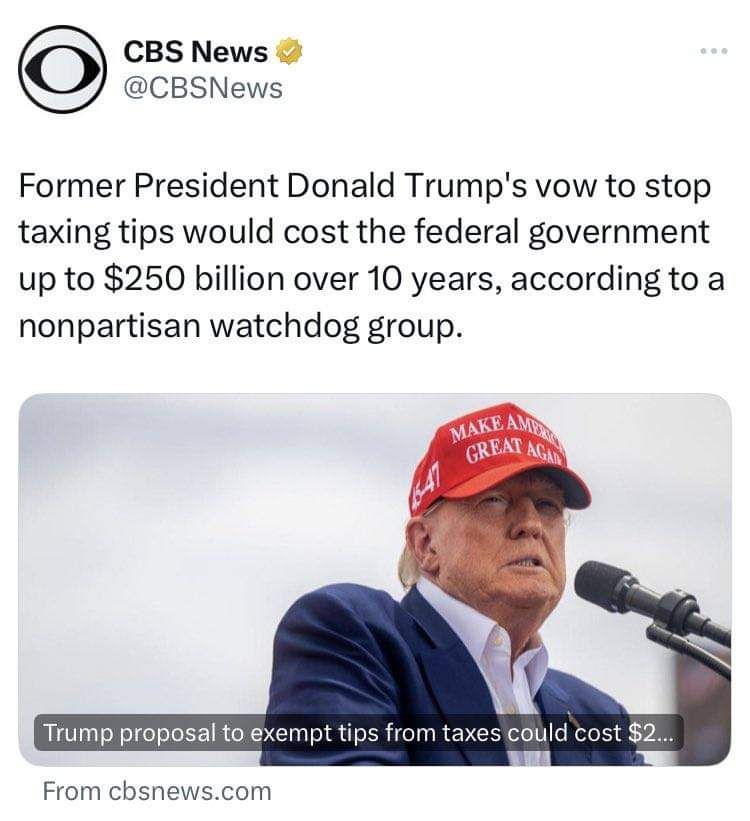
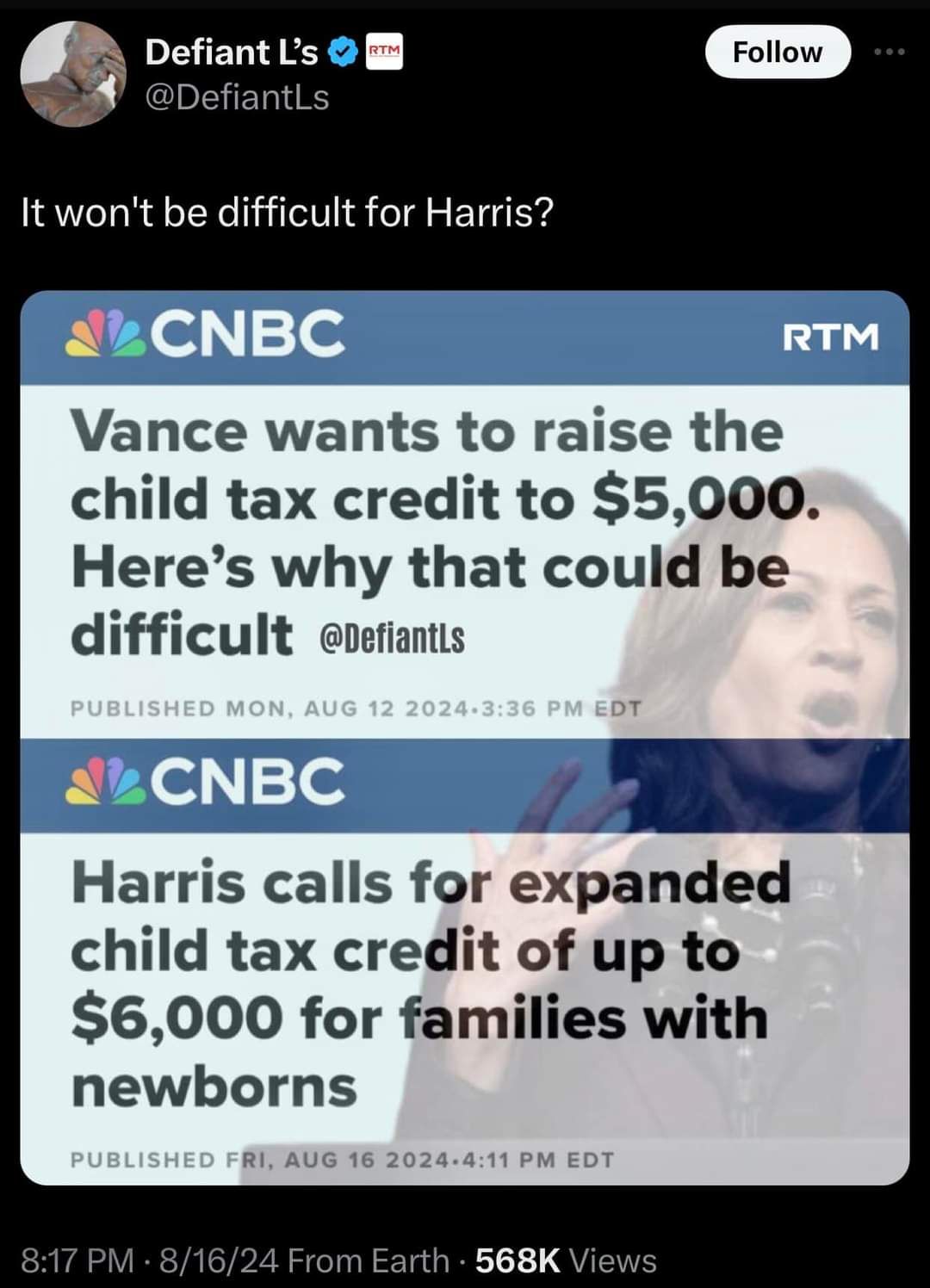
When Trump proposed an end to taxes on tips the focus was on the ‘cost’ of allowing servers to keep more of what they earn.  But when Harris copied the idea, suddenly there is no concern for revenues lost and it is all about her “fight” for the little guy.  Likewise, when JD Vance offered a $5000 tax credit for children it was “difficult” and yet when the Harris campaign did the same it was all about newborn cuteness.  I mean, think of the children!

I suppose we should just be happy that the Democrats are finally coming around to the conservative idea of letting us keep more of our hard-earned wages.  It makes so much more sense than minimum wage hikes and giving everyone food stamps.  Of course, this means less power in the hands of the politicians, who love to run campaigns that scare their constituents about the potential loss of benefits.  

Trump had previously made the mistake of enacting an across-the-board income tax cut. This gave the media propagandists opportunity to claim it was a “tax cut for the rich” since those who pay more get a bigger cut proportional to the amount they paid.  That’s fair.  If you pay more how are you not entitled to more?  But everyone who paid in got a cut and the middle class a higher percentage, as outlined here:

According to IRS statistics of income data analyzed by Americans for Tax Reform, families earning between $50,000 and $100,000 saw their average tax liability drop by over 13% between 2017 and 2018. By comparison, those with income over $1 million saw a far smaller tax cut averaging just 5.8%.This pattern of middle-class tax reduction was also seen in key swing states.

For instance, taxpayers in Pennsylvania earning between $50,000 and $100,000 saw their tax liability drop by over 14%, while households with incomes over $1 million saw their tax liability drop by just 3.1%.Taxpayers in

Colorado earning between $50,000 and $100,000 saw their tax liability drop by over 13%, while households with income over $1 million saw their tax liability drop by just 4.5%.

Clearly everyone was getting a cut, and the middle-class got a higher percentage back than the rich, but the media coverage obsessed with the dollar amount people kept—rather than the percentage being cut—to distort the public perception.

The Trump-Vance ticket has learned and is now outmaneuvering the left.  Most people know that keeping more of their own money is efficient and much better than a new government program.  It is just that the Republicans didn’t sell it. 

But this time, with an idea to end taxes on tips and another to help all young families, the typical deceptive spin doesn’t work.

Harris had no choice but to try to outbid her opponent. 

The problem with this? 

Harris was the tiebreaking vote on a bill that sends IRS agents after waitresses.  Now, yes, the Democrats will claim that they need the 80,000 agents to go after ‘the rich’ since they know CNN, MSNBC, and NY Times would never run a story linking a poor minority woman being audited to DNC policies, yet it in this case is too hard to deny who the true beneficiaries are.

We should question the sincerity of those who only introduced their policies after the other side did.  At best, they’re like the kid who cheats on the test by copying off the smart student in their class.  At worst, they are simply saying whatever it takes to get elected and have no intention to do what are now proposing.  We can’t trust the ‘journalists’ to set the record straight or give unbiased presentation of facts.

Go listen to the interview and see if the headlines match with the reality.

The most frustrating kind of misinformation is factually based. 

They lie by structure or omission, by presenting the costs and not the benefits, and sadly it works because people aren’t able to read through it. 

They did this with Trump’s tariffs, stories zooming in on the few who were inconvenienced and ignoring the many long-term benefits.  But the criticism ended when Joe Biden took over the policy, suddenly it was silence—just necessary to push back against China and finally rebuild some of our deteriorated manufacturing strength.  Nothing changed about the actual policy or benefits, only the presentation.

Now the choice is yours, do you go with the side that originated these steps in the right direction or with those who lied about Joe Biden’s declining mental health, saying he was “sharp as a tack” until the debate made the truth undeniable and now would have us believe they’re telling the truth?

Add that Harris is trying to introduce disastrous price controls and could end up creating food shortages as happens when central planning replaces free markets. If you think inflation is bad, then wait until more food-production businesses start to close, like this fruit farm and market, due to the increased compliance costs and lack of profit. We can’t afford four more years of economic mismanagement.

Philosophical Candidates

Standard

Remember, as a child, those day-dreams of a life unrestricted by parental control, where it would be video games all night, ice cream, pizza, and soda all day?  What is amazing is upon reaching adulthood the thought of this lifestyle is disgusting.  First off, it would be horribly unhealthy—in the sense that those who indulge bulge.  Second, a party every day is totally unsustainable, someone has to do the work to keep the lights on and put food on the table.

Many people become more conservative as they mature and start to realize the value of the limitations they once spurned.  Yes, an adult will modify what was taught to them by their parents and community.  And some grew up in social environments where there was not much worthy to be preserved.  But to totally throw away everything inherited from prior generations is a terrible mistake.  Only an ideological extremist believes stripping it all bare is necessary and good.  It is wiser to build on what works.
That is not to say that the tradition passed down can’t become stifling and overbearing or limiting our potential either.  There must be a bit of flexibility, some Oikonomia, or means to adapt the rules as the need arises.  However, the opposite ditch, of discarding everything and starting from scratch very quickly becomes chaotic, everyone does what is right in their own eyes, and it soon requires authoritarian measures to enforce the vision.  This is the thing Nietzsche warned about—our morality is not self-evident and we should think long and hard about those monsters that we will release with our neglect.

This wasn’t a sacrilege, it was a lament of what happens when you yank the foundational rug out from under a moral system.

Cultural revolution, while always promising to upend systems of oppression and usher in a new utopian age, ends up being worse than what it is replaced.  Yes, “All animals are equal” may be the founding cry, but is very soon after modified by opportunists who sadly are now unrestrained by those institutions despised and yet there for a reason.  The only good thing is that this out-of-balance off-kilter, ‘we know better than all who came before’ attitude, tends to implode on itself if given time.  The Soviet Union only lasted as long as it did because of Christian ethics within the population.

Two Visions For Our Future 

Recently, with the decline of Joe Biden and a failed assassination attempt against his rival, the Democrats decided it was time to make a change up top.  It is her time now—that is to say Vice President Kamala Harris—and there is plenty that could be said about her career thus far, but there is one peculiar repeat statement she has made that really deserves our attention:

“What can be, unburdened by what has been.”

This strange little mantra has been widely panned by the right.  This is more Kamala word salad, they chortle, and yet—while she does sometimes explain things like a school teacher talking to a kindergartener—it is not gibberish.  This is something Harris has apparently put some thought into and is something with a meaning that we should try to unpack.

What does it really mean to be unburdened by what has been?

I’m not going to sinisterize.

Most on the left I know have a glowing hope for the future and could never imagine that their philosophy could lead to Gulags.  I do not believe Harris intends it this way, but it does hint heavily of Marxist thought where we are to be liberated or emancipated from all that came before.  On the surface, this is an inviting thought.  Imagine a world with no abuse, no poor, everyone has their needs provided and has complete freedom.  This would be wonderful—and this is what every cookie-cutter college leftist has in mind as the end product of their efforts.

So how does the unburdening begin?  Well, it already has.  If you have been paying a bit of attention, everything normal is now being called fascist.  Believe that women exist as a category and isn’t something a man can ‘transition’ to?  Fascist!  Maybe you like the nuclear family and see it as a praiseworthy social convention?  Fascist!  How about a border where there is reasonable control over who is allowed in and who is kept out?  That makes you literally Hitler!  And Harris has embraced this side of the debate, she announced her pronouns and the nature of her politics.

None of this is to say that Harris is a terrible person.  I simply don’t want a leader unbound to existing ethics or any standard of decency, or who can write off Constitutional law as being a “what has been”  product of wealthy white men with some of them slave owners and thus should be discarded.  Sure, it may be a document with flaws, and could possibly use more amendments too, but it is better than nothing and represents the will of the people who signed onto this national project to this very day—white, black, Native, or immigrant alike.

What was established is for our benefit.  It is no more a burden than a wool coat in the blistering cold.  To think that we know more than every other generation that came before us, that science and technology have made us into gods, is delusional. 

Furthermore, the left’s unboundness means they do not care about precedents (except as a tool to restrict their rule-obeying opponents and the ends justify the means.  And they mean well.  They plan to fight injustice.  But this script has played out many times before and is the very thing that tradition is a bulwark against.  At the very least those who believe what “has been” has value will hesitate and consider before they destroy the foundations of civilization.

Make America Great Again

Donald Trump rolled out his red hats and MAGA slogan in his 2016 campaign.  The message was simple, a repeat of Ronald Reagan’s “Let’s make America great again” encouraging answer to the total economic disaster of the Carter years.  As he said, in the 1980 Republican convention:

For those without job opportunities, we’ll stimulate new opportunities, particularly in the inner cities where they live. For those who’ve abandoned hope, we’ll restore hope and we’ll welcome them into a great national crusade to make America great again.

Trump knows a good brand and borrowed it from the best Republican leader since a guy named Abraham Lincoln.  The progressives lost their minds.  They dug up the one time it was used by the KKK.  And couldn’t decide to condemn with “America was never great” or be offended because “America is already great and how dare Trump suggest anything otherwise!”  If you were playing a game of “wrong answers only” this harsh criticism of MAGA as white supremacy would make a bit of sense.  

MAGA is not hateful.

When the left says, “Do you know who else said make America great again?” and then goes on to associate this benign statement with all manner of evil, they’re poisoning the well.  There is zero reason to interpret this slogan as Trump’s desire to bring back Jim Crow or the racial policies that were once championed by Democrats.  But this does whip the left into a frenzy and it keeps them from deviating and making an independent decision whom to vote for based on the actual positions of candidates.

What does Trump mean by “make America great again”?

Trump is a businessman, his interests are mostly economic, rebuilding our industrial base, bringing back gainful employment for blue-collar workers lower taxes, and less red tape standing in the way of entrepreneurial spirit.  My wife, who opened a store in her home country, complains that the US is not a free country and is appalled by the many layers of taxes and requirements.  This is what dooms many to working for “the man” or corporations that can afford compliance costs while drowning their competitors with cheap imported foreign goods.

The legalism of US law would make a Pharisee uncomfortable.

From a 2016 Trump campaign speech on jobs and the economy:

Jobs can stop leaving our country, and start pouring in. Failing schools can become flourishing schools. Crumbling roads and bridges can become gleaming new infrastructure. Inner cities can experience a flood of new jobs and investment. And rising crime can give way to safe and prosperous communities.

Had Trump’s first term not been sabotaged by COVID and blue state shutdowns, there is no doubt this would have been fulfilled.  In fact, by the third year of his presidency the minority unemployment rate reached record lows.  Even NPR, while downplaying it, could not deny these numbers Trump touted were real.  Biden’s only success comes from not rolling back those tariffs the fear-mongering media had so roundly criticized.  It is strange how the success and failure of policies is determined only by who is employing them, isn’t it?

No, Trump’s not woke.  He believes in hiring based on qualifications.  He doesn’t want to continue world policing and the massive expansion of government programs.  This is why he is the enemy of those who derive all of their power from the administrative state and sap our resources.  He is keenly aware that a free flow of cheap labor, while it helps elites who want nannies and landscaping at a discount, pulls down wages for those who do not come from wealth.  Even a Senator named Barack Obama understood this:

If this huge influx of mostly low-skill workers provides some benefits to the economy as a whole—especially by keeping our workforce young, in contrast to an increasingly geriatric Europe and Japan—it also threatens to depress further the wages of blue-collar Americans and put strains on an already overburdened safety net.

Make America Great Again is not about a swerve in the direction of Nazism or some new form of ethno-nationalism.  It is about restoring the economic conditions that had allowed our grandparents to buy their home and a car on a single income.  Back in 2015, Bernie Sanders had blamed open borders on a right-wing conspiracy, that will make everyone poorer, but now the left is saying that normal border security is racist.  What changed?  Why are these Democrat policies, like the immigrant cages during the Obama administration, demonized under Trump?

Compassion means disincentivizing illegal crossings where human trafficking is a concern requiring sorting facilities.

It is really disorienting for those who soak propaganda like a sponge.  They never see that Democrats did this full 180 on multiple issues where they had been right.  Trump is right about the border.  It should be the top priority.  Just the Fentanyl overdoses alone are a reason.  I’ve lost a former high school classmate and football teammate this way— 83,000 Americans died in 2022 alone—and it had ironically played as much role in the death of George Floyd as a knee on his shoulder.  Why do we even talk about that dozen killed in a school shooting or Ukraine in light of this?

Reform, Not Revolution 

Progressives tear at the fabric of civilization without understanding the consequences of their actions.  They believe that the erasure of history, destruction of monuments, or the degrading of religion (see Paris Olympics) is a path to a better future.  But this amounts to cultural vandalism and is ignorance of the positive contribution of these religiously created values we’ve internalized.  There is truly nothing that is written on the substrate of the universe that says slavery is wrong or that genocide is evil—the stopping point to “unburdened by what has been” is a return to animalistic impulse.

By design, not accident.

The frontal lobe of the brain is developed by the myths and moralities that progressives do everything in their power to destroy with ridicule and sacrilege.  And it will inevitably go much further than anticipated.  We rarely have enough appreciation for what we have been given.  Everything is taken for granted until it is gone.  And when there is a vacuum that is left to fill, and the ‘demons’ waiting in the wings will come rushing in:

When an impure spirit comes out of a person, it goes through arid places seeking rest and does not find it.  Then it says, ‘I will return to the house I left.’ When it arrives, it finds the house unoccupied, swept clean and put in order.  Then it goes and takes with it seven other spirits more wicked than itself, and they go in and live there. And the final condition of that person is worse than the first. That is how it will be with this wicked generation. (Matthew 12:43-45 NIV)

Christianity led to equal rights in the West, the abolition movement, is a product of St Paul advocating for Onesimus or telling the Galatian church, “There is neither Jew nor Greek, there is neither slave nor free, there is neither male nor female; for you are all one in Christ Jesus.”  The left assumes the values it has are universal.  They see only the faults without giving credit.  

“You will not surely die!”

The progressive left, by contrast, denies all limits and conventions.  Their “can be” may seem good at first glance.  But is opening Pandora’s box, it is releasing what previous generations have built social structures to contain and could end up being more like a trip on Event Horizon.  America has been good and bad, had moments of greatness and failure.  We should tune the ideal it was founded on, not tear it down to start all over again.  There is much to conserve in “what is” with an eye to improvement.  Veer not too far to the right or left.

At least with Trump, morally corrupt as he may be, he comprehends that our inheritance is not a burden. For him, there is something that can be recovered “again” from the past generations even if those lessons were not perfectly applied to him.  He’s a grandpa, he has seen trends come and go, old enough not to care about what is currently popular.  Trump may have some narcissistic traits, at least that is the character he plays on television to the roar of the WWE crowd—but he isn’t trying to be God.

BAY-BEE, Identity Language and Oppression Narratives

Standard

The nurse pronounced baby as “BEE-bee” in our prenatal class and it got me thinking of how language develops.  Words will shift to reflect their usage.  The meaning eventually match with the reality when we attempt to disguise unpleasantness in flowery speech or try moral inversion.  Cultural values will shine through and snap understanding back where it was prior to the manipulation.

How did “bAy-bee” become “BEE-bee”?  

The latter evolution in pronunciation is cuter and therefore a better representation of the subject matter.  The word never will change the thing it describes.  Yes, words influence our perception, they also change to reflect a new understanding of the things that we are describing.  For example, the word “baby” only changed in pronunciation for me when considering the little human now within my wife’s belly.  It was no longer an abstraction or vague category, but a tiny vulnerable ball of loveable life.

When we experience something firsthand it is harder to deny what it is.  We can use the terms detached and technical to distance ourselves from the emotional content.  Say that a baby is just a clump of cells or some kind of parasite—up until the moment when we finally hold it in our hands.  To keep up the charade after this would be delusional or psychopathic.  It is not human to see an infant as anything other than precious.  The political lexicon becomes irrelevant.

A Tangled Ball Of Words 

Words trigger emotions.  I was thinking of this as a tear formed while the instructor in a prenatal class described the ideal of “skin to skin” and a soothing environment.  Some of this reaction may be feeling the weight of my wife’s pregnancy.  But it also has a lot to do with my own identity as the “premie” and “fighter” who struggled for life.  Discussion of baby care today compared to what it was for me.  The thing is, while my experience certainly impacted my development, I don’t have memories of the trauma.  It probably only looms large as a part of my personal identity because my mom told me what I went through and reinforced it.  The I gave further shape and form to it by attributing many of my struggles to the events of my birth—everything from my delayed growth to difficulties with focus in school.

However, it is impossible to know, outside of creating a genetic clone, if I would have been much better off with a normal birth or with more human touch rather than being in a plastic box with ‘stimulating’ music.  This had some impact, no doubt, and yet there is the bigger psychological complex I’ve built on top of this named thing.  Like an irritant in an oyster, it provided a nucleus to attach all of my insecurities to and blame for my failures and shortcomings.  With a normal birth would I have been more like my more accomplished siblings and less a mess?

However, it is very easy to reverse cause and effect to give ourselves an excuse for our being lazy and taking of exceptions.  We become the label that we apply to ourselves as much as it truly describes us.  We act the part.  Things of identity, like race, sexuality, religion, are as much a construct or fantasy as they are facts.  We live up to our name to an extent.  My mom would often tell me that my name meant “strong-willed” and it might be one of those self- fulfilling prophecies.  If we tilt confirmation bias in a direction it isn’t a big surprise if our character develops that direction.  It is like strapping a young tree to influence where it grows.

In a sense, nobody is truly “born this way,” it is a statement discredits conditioning and culture too much. But the environment itself doesn’t make us where we are as much as those descriptive words that reverberate in our heads.  A child that is called “stupid” by a parent or teacher may spend many years trying to sort through their doubts.  My dad letting me look over his blue prints and then giving some affirmation when spotted an error made by the engineers is likely what led to my being confident in my abilities and a career in design.  Our reality is influenced by use of language.

These are just personal observations, but it is also backed up by other sources that put it more succinctly:

Language is not just a medium of communication; it’s a lens through which we view the world and a mold that shapes our identity. From shaping cultural perceptions to influencing personal identities, language’s role is pivotal in constructing our social and personal realities.

Language as a Mirror and Molder of Reality and Identity

Language is more than a mere tool for communication.

It’s a portal through which we perceive and interpret the world.

Imagine how our understanding of colors evolves when we learn names for shades we previously couldn’t distinguish.

With each new word we acquire, a facet of reality emerges from obscurity, offering us a richer tapestry of experiences.

The Dynamic Relationship Between Language and Reality

 Neither of those sources are academic or truly authoritative, but do say what I’m saying in a different way and thus useful so far as my goal here which is to provoke thought.  New use of language reframes the world.  It can amplify our efforts and transform society as more people begin to see the world through the lens we provided.  Memes do this, as do pounding of propaganda headlines, it is why “fact-checkers” exist—all to reinforce a particular narrative.

With so much power in our words there is plenty of reason for cunning and conniving people to exercise this for their own selfish ends. 

They take advantage of insecurities and level accusations to shame or confuse the innocent. 

Wordsmiths, they could turn a baby into a villain and murderer into a saint—beware. 

His talk is smooth as butter, yet war is in his heart; his words are more soothing than oil, yet they are drawn swords. 

(Psalms 55:21 NIV)

There are some use the guise of compassion to gain control.  Their promises are about attaining power.  They seek only to bind us and yet many people are blinded to these motives because their identity has been hijacked by these nefarious actors.

Categories Are Social Constructs 

The structures and constructs of language are entirely fabricated.  There is no person who is “black” or “white” by birth, no, rather these are categories we create, clans that we join, and always artificial divisions.  We are often grouped by others using various label words and internalize the divisions as being inseparable from our own experience, in that we identify with other “rednecks” or “blue-collar” types as those ‘like us’ and yet also *become* like that.  Nothing requires a rural person to use country slang or go buy a massive diesel pick-up truck, some of the markers of this lifestyle (chewing tobacco or dress) can impact opportunities.  This is about politics, not genetics.  It is about the strength of an identity group that helps us gain power for ourselves.  Being a victim of an “ism” is a lever, a social tool or means to build a coalition against others.  

The individual without these groups, that is denied the right to put their fist in the air in solidarity with others ‘like them’ is weakest and most disadvantaged in this game.  That is the irony of the “systems of oppression” language.  Those who describe this kind of problem are actually creating it more than they are simply observing.  In the same way that observation in quantum mechanics is an influence of reality (collapses the wave function), the ‘study’ of human interaction is an interaction and is a product of our bias as much as it has basis in reality.  Those who are concerned with the existing ideas (of racism, sexism, or heterosexism) steal attention (and thus disenfranchise) victims of systemic heightism and those who lack privileges in ways not discussed, defined or even recognized.  The individual is the most vulnerable, a minority of one, and frequently abused by recognized groups.  Bullies travel in big groups—victims are often alone.

This line of questions quoted below is most likely well-intended, but is exploitative:

1) “Language both mirrors reality and helps to structure it” (2). Explain and give an example.

2)Racism, sexism, heterosexism, and class privilege are all interlocking systems of oppression that ensure advantages for some and diminish opportunities for others, with their own history and logic and self-perpetuating relations of domination and subordination (3). Explain what this means. Do you agree/disagree? Why?

3)What are the economic impacts of constructing race, class, and gender?

Sandwiched between the lines of this effort to build awareness (indoctrinate) are a pile of assumptions that, in the end, only serve to darken these artificial dividing lines. 

It is rewarmed class warfare rhetoric, Marxism, and is basically designed to feed envy or feelings of being an other and disenfranchised.  No, this is not to say that prejudice or abuse is entirely a social construct.  What it is to say, rather, is that their worldview, segregated by these simple binaries, is too compartmentalized and minimizing of other factors.

There isn’t one group of oppressor and one group of oppressed. 

There is no hierarchy of victimhood. 

Everything depends on the context or situation.  A Jewish student that is harassed on a college campus because of the IDF dropping bombs on Gaza is not privileged in this moment even if they are ‘white’ and rich.  Nor is it anti-Semitic to characterize the decades long campaign against the Palestinian people as an ethnic cleansing.  Labeling terms like “terrorist” or “occupier,” while useful to an extent, rarely explain accurately and are dehumanizing ends of conversation.

The whole point of claiming the existence of “interlocking systems of oppression” is to make anyone who dares to question their narrow perspective a part of a monolithic enemy rather than an individual with life experience to be respected.  It is truly the educated left’s own version of a conspiracy theory where anything they don’t like is part of some invisible system that can teased out of the statistical categories they created to emphasize identities based on color and physical features.  If some in one of these groups lag behind then some other group must be at fault.

Building humanity requires the de-emphasis of meaningless boundaries and formation of bonds based on behavior.  Skin color is not synonymous with culture or the choices one makes that shape their outcomes.  Yes, we must identify mistreatment of people on the basis of appearance, but this isn’t black and white, nor is it oppression to apply the same standard to all.  Indeed, some people are treated unfairly, but many end up being marginalized for antisocial behavior and yet claim to be victims of oppression when the chickens come home to roost.

Call A Turd a Baby…

Bringing this full circle, the word “baby” is cute (and the pronunciation of the word is becoming cuter) because babies are cute.  The language of description is merging more and more with the reality adorableness that we perceive in a human child by our instincts.  Using the word “baby” to describe an adult does not make them cute.  Albeit pet names, used to convey fondness, do imdue the quality a bit or at least will hijack some of the sentiment that associated with babies.  However, this is something that can only be stretched so far before the absurdity is too obvious.  

In this regard language that is used in an attempt to counter popular perspective, or overrule accurate description, will eventually take on the meaning that it was supposed to erase.   The language police can only temporarily remove a stigma (albeit never long enough to make the effort worthwhile) and it is because the unpleasant reality will always bubble to the surface again.  In fact, “special needs” today probably carries more negative baggage than the use of the words slow or retarded in the past.  

Likewise when a person is accepted at the university or get your job simply as a result of the particular identity group they belong to rather than only on the basis of equal qualifications this leads to an asterisk with the accomplishment—even when equally earned.  New terms like “diversity hire” will spontaneously and organically come into existence as a result of need to delineate between identity and merit based.  These, sadly, are far more damaging stereotypes applied to minorities who are outstanding by their own right.

Just as one cannot relabel a turd as a baby and expect people to cradle it once the truth is revealed, one can’t just apply credentials or distinguished titles to someone thinking this will change a lack of qualifications.  It will only degrade the meaning of words and in the long-term will do nothing to solve the socio-economic divide. 

Calling someone a fisherman and giving them a pile of fish is not the same thing as teaching them how to fish.  You can’t simply declare reality as the left believes they can.  Turds are only cute when the term is used ironically to describe something truly cute.