The Three Different Kinds Of Mechanics

Standard

We tend to lump things together that shouldn’t be. In other words, there is plenty of diversity within categories and this is something true of those whom we call mechanics. And the significant difference in mechanics is analogous to other professions, which is where this essay will end up.

The other week my old reliable Ford Focus began to act up. I had traveled, with my family, to a company picnic and everything was fine on the way out. However, on the trip home there was something that was not right. The power delivery was rough when trying to accelerate but smooth enough while cruising and immediately my mind went to the trick this 2.0 L had up its sleeve.

The ‘Duratec 20‘ has Mazda DNA. It uses direct injection and variable valve timing (or Ti-VCT) to make 160 hp while still delivering decent fuel mileage. With a 12.1:1 compression ratio, it has a decent torquey feel for a 4-banger, and—paired up with a five-speed—it is fast enough to be fun.

And to the point that a week prior to this, on the way to church, a late 90s Honda Civic with a loud pipe did the customary flyby, and we just so happened to line up at the next red light. So, as was necessary, to the slight embarrassment of my wife and great amusement of my son, I do the hard launch. It bogged a bit, despite my loading up a bit prior to releasing the clutch, so I dumped it down completely, the tires chirped, I hit second hard and I was grinning a couple of car lengths ahead before they knew what had happened. Not an actual race, but I’m pretty sure I had the edge even if they were ready for me.

The engine light would eventually come on in the next day or two. And, sure enough, checking the code at AutoZone, it came up as a camshaft sensor. That was something I could handle. I swapped in the new part. But it didn’t fix the problem. I noticed that the negative battery terminal had some corrosion and, with the help of a cousin, we cleaned that. Still, no dice. The issue persisted.

Shop #1: The Inspection Garage

With the help of a mechanic friend of mine, who sent me the applicable page of the diagnostics manual, I determined that the problem was now beyond my shadetree abilities. It was potentially a crank sensor fault (that for some reason shows up as being the cam sensor) or involved some sort of wiring issue. I took it to the garage, within walking distance, which had given me a better deal for vehicle inspection than the dealer could offer.

I left them with the page of the manual. I returned to a vehicle with a drained battery and still acting up despite their efforts. They had cleaned the throttle body, changed the air filter, and not overcharged me for that service. However, the problem was not fixed, and the explanation he gave—that the car (with over 230,000 miles) was old and probably down on compression—did not satisfy me.

I had assumed that they had run down the diagnostics checklist, as I had basically told them to do, and that weekend decided to take a look again with the aid of a mechanically inclined brother-in-law at our family summer get-together. My sister has a 2016 Focus, which had corrected the wiring harness issue, and immediately, while looking at her engine bay, I noticed how the Ford had moved these wires from where they were on my own 2014.

So I took another look at that, I lifted the harness on my car where it was against the engine and, sure enough, I could see the cover was worn through and a little copper was shining. Uh-oh. With a small piece of electrical tape and a spirited tested drive, the diagnosis was clear—that was the problem and I would need to take it to a shop that was capable of following my instructions.

Shop #2: The Technician

After pricing my options, I decided on a garage that had helped me with another mystery issue years ago with my Jaguar XJR. Jake, the owner, was an expert at diagnostics and, in a conversation with Jason who he trained as his replacement, it was clear that this guy knew his stuff. Now, granted, in this case, I had already provided the diagnosis. However, I could tell that he understood the systems of the vehicle far better than the guy at the inspection garage.

This is the kind of mechanic you need when the issue is more than an alternator or something obvious that only needs to be removed and replaced. Anyone can turn a wrench. Quite a few can go down the diagnostics checklist and eventually find the solution. But the actual technician type is a different breed, he is the guy who writes the manual and can even feel what is going on after a short test drive. These are the Ken Miles, can-improve-what-already-is kind, who in different circumstances may have become an engineer or even a doctor.

The technicians are professionals. They have a high IQ and a wealth of knowledge. And it is about much more than having the correct certifications or a toolbox full of Snap-On tools. Some simply do not have the aptitude even if they went through years of training and others do. The technician could be working in the back alley of Manila or at the dealership down the road. There are different levels even within this group, but what sets them apart is their intuitions and ability to model the complex systems of a vehicle in their heads. He’s as smart as your cardiologist.

Shop #3: The Scam Artist

Years ago my brother took his Ford Tempo in for a routine inspection. This was his first car and basic transportation for a teenager. And only cost a few thousand dollars, which was basically all he could afford at the time. The tire shop is in the middle of town and looks decently professional. I think of this incident each time I see their advertising two decades later.

The bill he got was more than the value of the car. Apparently, they decided that every suspension part was out of tolerance and maybe they were technically correct, who knows?

What I do know is that my dad took severe issue with this and helped my brother negotiate a slightly better price for the work. Still, they soaked him for a huge amount of money and have lost our business since then. They were at the level of the inspection shop, or your local Walmart Auto Care Center, as far as their abilities and yet telling us with absolute conviction that the car was not safe to drive without the laundry list of parts with labor they installed without so much as a phone call to my brother.

Dealerships can overcharge. But usually, they are more reputable and not just replacing parts because they have you over the barrel and have a bonus to make. These are the types who would convince your grandma she needs the blinker fluid filled and muffler bearings replaced. They aren’t technicians (they would too be ashamed of themselves if they were) and are basically just swindlers with a wretch to use as part of the scheme. Their diagnosis is always something expensive.

What Kind Of ‘Mechanic’ Is Your Doctor?

This understanding of different types of mechanics applies to all professions. Not every college graduate with the right credentials is equally qualified. Some engineers are really good at the classroom stuff, they know the code and can be completely anal about largely irrelevant or unimportant details. Others really get what makes structure work, it is intuitive to them, and what they build is likely safer than the variety that dots all of the I’s and crosses all the T’s according to the IBC 2021.

Doctors come in many varieties as well. There are those types who get into things like cosmetics or reconstructive surgeries, chasing after the big bucks, and then there are the others who want to run a clinic or set up a family practice to help as many people as possible. The country ‘doc’ driving the F-150 is a different breed than the one with a BMW or Porsche. One is practicing medicine, and the other has a profitable business that requires some medical skills. And, in both cases, competency is not strictly a matter of gathering the right diploma or getting through the board requirements.

My own hunch is that most doctors are more like the inspection shop mechanic. They’re not out to screw you over and they also do good work for the most part. However, they got where they did because they were at least of slightly average intelligence and good at navigating the system. This doesn’t mean that they are actually doing the real number crunching of the diagnostics themselves. No, it means that they can match a list of symptoms with what they can find in the Merck manual and write a (barely legible) prescription. This could mean that they miss things, over-prescribe, or basically share in the same failures as the entire medical establishment.

So, how reliable is the system?

Well, I’m not sure.

When I read things like, Why Most Published Research Findings Are False, and how the Lancet published (then later retracted) studies that cautioned against the use of Hydroxychloroquine or how Ivermectin was skewered as being “horse dewormer” despite being an effective anti-viral medication, it seems that politics may be dictating the science. And we all know that politics is heavily influenced by cold hard cash. So, let’s think, who benefits from keeping these kinds of cheap widely available therapeutics from the market? There was an industry that made $90 billion from the pandemic and also has connections to the corporate media apparatus. Who knows how far this big money penetrates government agencies and impacts regulations or policies.

But I do know this has been said…

“It is simply no longer possible to believe much of the clinical research that is published, or to rely on the judgment of trusted physicians or authoritative medical guidelines. I take no pleasure in this conclusion, which I reached slowly and reluctantly over my two decades as editor of The New England Journal of Medicine”

Marcia Angell, MD

And this…

“The case against science is straightforward: much of the scientific literature, perhaps half, may simply be untrue. Afflicted by studies with small sample sizes, tiny effects, invalid exploratory analyses, and flagrant conflicts of interest, together with an obsession for pursuing fashionable trends of dubious importance, science has taken a turn towards darkness”

Richard Horton, editor of The Lancet

I’m assuming these two would know a little about the current state of science and medicine.

So how does a doctor separate the wheat from the chaff?

It is not right that some see the failures of some as a reason to dismiss it all. Getting taken advantage of by one repair shop doesn’t make all mechanics crooks. Still, how does a patient know if their doctor is doing a high-level analysis of the evidence, is capable of critical thinking and going beyond the book, or if he’s just following the pack without doing any truly independent diagnostics? It really takes someone a bit removed from the profession, who doesn’t share their biases or bad remedies, to give the corrective treatment. Maybe a car mechanic turned doctor (the guy in the featured picture) would have some useful perspective on the topic?

Whatever the case, if we can’t trust everyone who is licensed by the state to inspect vehicles, we should be even more skeptical of those who want to put things into our bodies. They don’t even have to be bad or intend harm, it could simply be that they are asleep at the wheel, putting trust in institutions that have been compromised and corrupted. At the very least, the body is extremely complicated and even our most advanced methods are crude. We may not know that our modern versions of bloodletting are of negligible value or even harmful for another century or two. This is why we customers, the patients, should never be pressured one way or another even if the science is supposedly settled.

Yes, even those at the top of the profession today may be tomorrow’s quacks…

Note the “slow poison” written on the mixing device.

Bullying, Discrimination, and the Alternative

Standard

The book of Ezra is difficult to read.  It ends with God’s prophet breaking up marriages between Israelite men and foreign women, leaving these wives abandoned, with their children, without once considering their welfare.  Not only is it cold and callused, but all this talk of the impurity of these people is also disturbingly like that of the ethnonationalist rhetoric leading to genocide in modern times.

My own mixed family has encountered some difficulties with those who put their own tribe first recently at work and school.  

My son, a very friendly and outgoing kid, has had some issues with a few bullies.  One of these adversaries slapped him hard on the side of his head at the bus stop.  Eventually, my son and this attacker had an all-out brawl on the sidewalk and my son says he got the upper hand before an adult intervened.  But now my son is afraid of being the victim of another surprise attack and feels very much alone against the group.  Which is the worst part, the one who is instigating the violence, telling other kids that my son insulted them or otherwise provoked, is himself a newly arrived racial minority—albeit from a much less friendly urban culture.

My wife recently started a new job at a local meat packing facility, staffed primarily by those from Spanish-speaking countries, and faces a similar uphill battle.  They preferred their own for promotions and sabotaged the work of another Filipino who took one of these better-paid positions.  The upper management is seemingly unaware of this dynamic, perhaps seeing all ethnic minorities as the same, but it is very real to those who directly encounter it and see the discrimination first-hand.  It really is not ‘people of color’ versus white as is the binary often presented.  No, there are local majorities, and also many rivalries that are within racial minorities.

Something my wife observed early on is that you need to know someone to get a job.  As it turns out, that is true, she had applied at her current employer and never heard from them in weeks.  Finally, she found out that a fellow Filipino worked there, reached out, got a recommendation, and a few days after this she was interviewed.  Her ethnic contingent, within the company, has increased to three as they also have convinced another to join them against Hispanics.

My ideal solution to my son’s situation would be for him to have an older sibling or cousin to help him.  It is just automatic that family will look out for family and yet this dynamic does not contradict the sad reality of the rest of this post.  There is a fine line between this preference for our own blood and racial discrimination and bullying behavior.  In fact, it is basically the same thing.  We prefer our genetic division and general ethnic category to others.  And this may be why the older Asian girl on the bus takes a little more interest in my son?  Instincts may cause her to treat him like she may a little brother.  At the very least his polite and respectful behavior is common across most Asian cultures.

Discrimination is a survival mechanism.  An individual who truly treated everyone exactly the same would soon find themselves to be depleted of resources.  Without a tribe or a gang, nobody is strong enough to stand up to the bullies in the real world.  You’re either in the dominant (physically superior and better organized) group or you’ll be harassed into serving it.  Even the legendary heroes of ancient times tended to have an army to back them up.  And outward appearance is simply the easiest way to align ourselves given that this was always a natural division of people across time.

This all starts at a very young age.  At only three months old babies will start to prefer faces of their own race to others.  This idea that children need to be taught to be racists has no basis in science.   Yes, conditioning and socialization will come into play, but this is only a sharping of inborn tendencies.  We will trust those who look like us over those who are foreigners.  This can metastasize into racist ideologies and the hatred of those ‘impure’ others. But it is not unnatural.

Inhuman Nature and the Alternative

Defenders of Biblical ethno-nationalism will say that the problem was more about these people being idol worshippers.  And yet the people of Israel certainly weren’t free of this and they themselves would frequently follow after these false gods.  Why weren’t these impurities abandoned?  Ezra gave them an opportunity to repent and remain part of the group despite this disobedience.  They, as the seed of Abraham, were given preferential treatment simply for their bloodline and not only as a result of their different behavior.

Being truly human is about going beyond the primal and transcending even ourselves.  No, we may never convince all to find a common bond beyond the lowest hanging fruit that is skin color or facial features.  Still, those I’ve been able to identify with the most, at least other than siblings or biological cousins, do not belong to my own race.

My wife and I started as geographically far apart as two people could possibly be on this planet.  Her people, Igorots, were very tribal and primitive up until a half-century ago, my own Swiss-German heritage may seem the opposite.  But her rural agrarian roots make her more similar to me than one may assume.  Her people are stoic, with a strong work ethic, and are very much like my own grandparents.  Our son, to whom I am a step-father, is completely different than me in terms of his athleticism compared to my own clumsiness. Still, we do share many interests and are peas in a pod.

Unnatural love is that which is extended to those who do not look like us.  It is to try to be fair to all people, of all races, rather than show favoritism.  It starts with simply not mistreating those who are different from us and trying to find the humanity in others.  It is to put our common values and aims at a higher level of importance than appearance, which is to say seeing the heart rather than outward appearance.

This is not ‘diversity is our strength’ or some kind of woke BS either. 

The left is as divisive as the right or worse.  They hold everyone to a different standard, based on their outward appearance, and call this inclusion.  But all they really do is replace a meritocracy with a victim hierarchy and then use past injustice as an excuse to do the same thing to others today.  Actual virtue or contribution does not matter in this ideological dogma, it is always about outward appearance.  The bully is of another color and the discrimination goes in a new direction, but it is just more division by the lowest common denominator.

Common values are our strength.  Working towards the same cultural and civilizational goals, rather than only what is good for our own ethnic identity group, is where diversity of abilities is useful.  Bullies cost us resources, discrimination for reasons other than good or behavior is unjust, and being totally colorblind may be impossible.  However, we can work to correct our own prejudice and towards a common goal.  It will take some faith and leading by example, it will a change of heart from the current paradigm:

“There is neither Jew nor Gentile, neither slave nor free, nor is there male and female, for you are all one in Christ Jesus.” (Galatians 3:28 NIV)

It is that, unity in Christ, or we revert back to the ethnic wars, cleansings, disregard, and other abuses of the Old Testament. We can live in a world where it is tribe against tribe, man against woman, and soon every man for themselves, or we can find ways to overcome our differences and see our better potential realized. We’ll never be completely fair, favoritism is natural, but we can aim for it. We don’t need to slaughter each other over our shades of difference.

Seeing Behind The Veil

Standard

In storytelling, there is a plot device called a MacGuffin.  This is an object, character, or event used to push the narrative forward and yet isn’t all that important in and of itself.  In other words, a thing that creates motivation and yet never even needs to be revealed to the audience.  We are supposed to believe this is something significant or valuable and that’s all we need to be told.

The contents of the briefcase are left a mystery despite being pivotal in motivating the characters.

While reading through the Old Testament and pondering how temple worship worked, it is hard not to see the Ark of the Covenant as a sort of MacGuffin.  Sure, their God was not a thing.  And yet this sacred object, we’re told, contained something of God’s presence and would even strike dead those who innocently mishandled it.  Of course, most people may never have seen it, it was kept behind a veil in the temple where few had access, but all would be told of the sacredness.

“Then spake Solomon, The LORD said that he would dwell in the thick darkness. I have surely built thee an house to dwell in, a settled place for thee to abide in for ever.”

(1 Kings 8:12‭-‬13 KJV)

In fact, it was made sacred as much by this treatment as much as what actually dwelled within it.  The mythology surrounding it, as in the cultural or religious significance that was given to it, was extremely powerful.  Starting a special priestly class, Tabernacle and ritual practice, later the impressive structure of the Temple, there was a huge investment in this sacred object.  And yet, for all the attention it got, the Ark itself was usually kept hidden in darkness, guarded, within the Holy of Holies and behind a veil.

Holy Of Holies 

There are other things hidden behind a veil with significant motivational power.  One of them being the marriage MacGuffin.  For me this was a pursuit of something sacred, the church does consider the marriage bed to be sacred, and there is a whole mythology that is constructed around marriage.

This is what made it so jarring when, during my pursuit of the impossibly, a psychiatrist would classify it as “sexual attraction.”  They had just heard me describe a pure and faith-driven quest only to reframe it in such crass terms.  How dare they!  I was after love, not sex!  It really did offend me at the time.  With their clinical roughness, they had penetrated the veil of my marriage delusion.  It was an act of sacrilege.  

My childhood innocence is beyond recovery at this point.  For whatever reason, those of us born into a fundamentalist purity culture believe that we must be in denial of our own sexual urges that lead to marriage.  This is strange given how blunt St. Paul is on the topic, in 1 Corinthians 7:9, advising those who “burn with passion” to get married and basically get a room.  Why the veil of secrecy, these many euphemistic expressions to cover and mystify the bumping of uglies?

Speaking of erotic euphemism:

“Awake, O north wind; And come, thou south; Blow upon my garden, That the spices thereof may flow out. Let my beloved come into his garden, And eat his pleasant fruits.”

(Song of Solomon 4:16 KJV)

Why blush, be embarrassed or ashamed by this?

Could it be that without dressing this whole affair up with great ceremony, white bridal veils, teary-eyed parents, and such, we would have to face the reality of being creatures as hormone-driven as two ducks on a pond?  I mean, why aren’t we as honest as Solomon was in his poetry: “Roses are red, violets are blue, you have large breasts, that’s why I love you!”  Without white lies or half-truths, would our version of romance even survive?

So what is underneath the veil?

All of those things that I’ve discovered in the intervening years, that’s what…

To the extent I was in deep denial of my own sexuality, I was doubly in denial of the sexual nature of my female counterparts within the conservative Anabaptist culture.  The young lady who first propositioned, then made it all awkward and worried about somehow being ‘defiled’ if she got coffee with me has long since dropped the veil.  She has joined the others whom I had held in such high regard, revealed now as not being nearly as prudish or pure as I had once imagined.  That’s not a criticism or judgment either.  It is just the reality of the situation.

So, when the impossibly told me “I cannot not love that you the way that you wanted to be loved” what she was really saying the same thing as those Tinder girls with “must be 6′ or over to ride” in their profiles.  She wanted a guy who got her juices flowing, certainly someone a bit more rugged and traditionally masculine than me.  And, I mean, why not?  Why hide it?  Marriage is not only (or even primarily) about the high ideal that is advertised.  It is also about our scratching the itch.  Which is to say getting down and dirty with someone who meets the correct physical qualifications.

Also, perhaps it is that the fantasy is more satisfying than the act itself?  We read how Amnon, King David’s eldest son, had such an infatuation with his half-sister Tamar.  It tells us after having his way with her he despised her.  Or consider the disgust of Victorian-era art critic John Ruskin when, in marriage, he discovered that women aren’t like porcelain dolls.  You’ll have to forgive him, they put skirts over piano legs back then to keep the eyes of men safe from the unveiled feminine form.  Maybe there are some things that are better chased than caught?  If we find what we went looking for we might be shocked at what we found.

Sacred Fertility & Symbolism 

The final stop on this exploration of sacred and taboo has to do with something that I can’t unsee now that I’ve seen it.  I’m bound to lose half of my final two readers for going here. 

Nevertheless, I’m not here to please the pearl-clutching crowd. 

For me, this is not about toppling sacred cows or making people uncomfortable, it is about being honest enough to see reality for what it is and correcting our own perspectives of the cultural baggage we’ve inherited.

First, what drives much of the Old Testament Biblical narrative?  We know Abraham’s story, how he wanted an heir, and yet how Sarai, his wife, was unable to produce.  In this Genesis account we see various cases where wombs are opened or closed.  And the punishment of Michal, for rebuking her dancing husband, was that she had no child until the day of her death.  Being fruitful and multiplying was a high priority, as well as having sons to carry on the family line.

As an aside, we live in a very sterile world in comparison to our ancestors, we’ve become sheltered and sensitive to the point many do not eat meat or want their children exposed to death.  This wasn’t an option at the time when Scripture was written.  There is a kind of earthiness to their world and perspective, something more primal or real, a brutality of life difficult to stomach.  It is with this reality in mind, that we also have different sexual taboos and could be more prudish than they were about such things.

Second, I was sitting in church and taking a look at the colorful streams of light pouring through a stained glass image of Jesus pulling Adam and Eve from the grave.  My moment of appreciation for this beauty was interrupted by my noticing part of the symbolism.  Jesus is shown to be emerging from an oval shape, at the bottom of which are the covers of their opened tombs.  Requiring very little, if any, imagination, it bears striking resemblance to one Christian symbol even an iconoclastic Protestant would likely recognize, and that being a vertically arranged “Jesus fish” or Ichthys.

Light and life shining down…

However, concurrent to this, and a cause of some momentary shame, was the thought “That’s a vulva!”  I mean, how inappropriate to think that any part of the female anatomy, let alone those private nether regions, be put on prominent display or be associated with Christ!  

But is it really?

A mother, Mary, is necessary for the birth of Jesus.  Without her, and her womb that is miraculously made made more spacious than the heavens, there is no salvation for mankind.  It didn’t matter if God could have used any other way, all we know is that he used this young woman and all of the faithful since have followed the lead of Elizabeth, who full of the Holy Spirit loudly proclaimed:

“Blessed are you among women, and blessed is the child you will bear! But why am I so favored, that the mother of my Lord should come to me?”

(Luke 1:42‭-‬43 NIV)

As far as the symbolism, I would find that indeed my observation had basis in reality as the Ichthys is a version of Vesica Piscis (literally “fishes bladder” in Latin) or, in sacred geometry, the oval that two intersecting circles create an oval and said to be the place where spiritual and physical worlds interface. According to Syriac Press, in ancient Mesopotamia, it was used as a symbol of the combination of masculine and feminine energies that create a Divine Child.  Any pagan coincidence, like those with baptism, only serves to reinforce the power of the symbolism.

In a time when many settle for ‘fur babies’ over producing human offspring and the unique female contribution to the world is dismissed by feminists seeking male roles— when real women are mocked by men who pretend to menstruate—we need to start doubling down on our celebration of this reproductive role of women.  Phrases like “saved through childbearing” did not come into the Bible by accident.  The world was saved by the one who came out of Mary’s fertile womb and we ought not to downplay or be embarrassed by this.

Empty Vessel—Dying Corpse

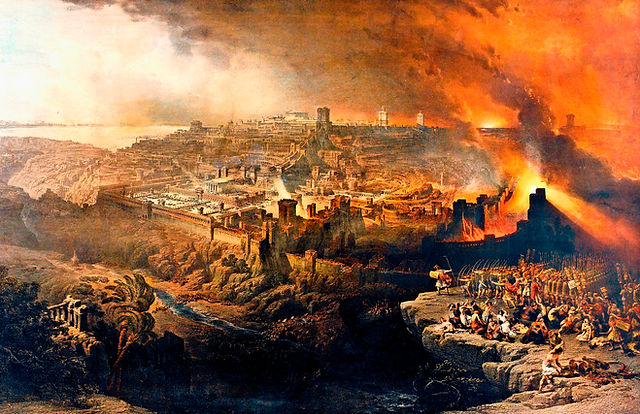
Solomon’s Temple was destroyed in 586 BC, by the Babylonians, and the fate of the Ark within it is unknown.  This loss of sacred relics did not stop the Jewish faithful from rebuilding the temple, in 515 BC, but does make one wonder how much the contents mattered.  So long as the people were kept in awe that’s all that really seemed to be the point whether the edifice truly contained anything of real value or not.  With nothing behind the veil, the people still did the ritual and sacrifice. 

Why?

It seems sort of analogous to the US Dollar, a currency once backed by actual gold and now only by faith people continue to hold in the economic system it represents.  The harsh reality is that it has become merely a means to exploit. It is a way for a few elites to rob the value of the savings of other people by printing more money for themselves.  Those money changers Jesus chased out of the Temple were the amateurs. The real professionals never get caught.  The carefully maintained veil of secrecy around the Federal Reserve ensures that this particular scam continues for a long long time.

But, I digress.  

G. K. Chesterton once wrote, “a corpse crawling with worms has an increased vitality,” and that “a dead man may look like a sleeping man a moment after he is dead,” trying to describe the subtle yet significant difference between truly sacred tradition and a cheap gimmick version of this religion that was intended to replace it.  Perhaps this is what has me disillusioned?  With so many things, once the veil is lifted (which few ever dare to do) so much of the enticing mystery and popular mythology which propelled us forward falls apart.  And in this way some of the life I had felt early on feels more like decomposition.

Perhaps this is what is left when you’re the dog who has finally caught the car?  Nothing left to do but pee on the tire and continue on your way again.  The anticipation leading up to the day of revelation may be more exciting than the moment the veil is lifted and when all is seen.  Ruskin may have spent the rest of his life waxing eloquently about his female love interest.  Or maybe—just maybe—that MacGuffin which led us to the point we’re at today was merely a plot device to move the story forward and the only truly sacred part of the encounter is the fruit produced?

Sexual pleasure is fleeting.  We’re lured there by our imaginations, by our desire for what is beyond the veil of marriage, but it can all be a bit anti-climactic and even repulsive once you consider it after it is finally unwrapped from the flowery speech and those flawless air-brushed mental pictures.  But fatherhood, by contrast, seeing the great potential of my son, tending to his needs, pruning as needed, is something extremely fulfilling.  It is what has emerged from the womb that brings us renewed life and hope.  Pity the barren, the dying corpse who has lifted the veil and only saw the emptiness of their pursuits.

Aliens Are Here! Maybe…

Standard

Did you hear?  A ‘whistleblower’ testified before Congress about aliens and finding non-human remains at crash sites.  I can’t really know if this was reliable or someone simply getting their fifteen minutes of fame, but it does seem unlikely to me that beings capable of flying the enormous distances of space would be such poor navigators.  I’ll be a skeptic until I can see for myself and make my own determination.

However, in pondering the topic, a friend of mine posted an interesting meme and it is an angle worth exploring.  If aliens do exist, according to the insinuation of this image posted, then they are demonic entities and not to be treated as friends.  To some this may seem like a missed opportunity, why would we avoid a chance to expand our own horizons?  Typical human behavior, right, to meet with violence the things that we don’t understand or defy expectations.

Maybe. Maybe not.

And yet, this seems another case of being directionally correct even if wrong on the details.  I mean, there’s a chance that aliens are some kind of creature from another planet and come in peace. However, what if they don’t?  What if they, like many traveling to new lands, have colonial ambitions and will destroy or subjugate us if allowed? 

It is correct, instinctively, to have zero trust for these new arrivals.  Maybe, technically, they are not demons, but they are others and may as well be demons, right?

Tinfoil Hat Time

This is why I’m generally on the fence so far as the MAGA and Q-Anon types.  Sure, they vastly oversimplify and often get the details wrong enough to be easily ‘debunked’ by fact-checkers.  However, half the problem is usually about the use of semantics and not the substance.  Maybe the world isn’t run by a ring of reptilian pedophiles, nevertheless there are many who lack morality, have their secret plots, hidden motivations, and cover-ups.  It might not be organized, but this is pervasive enough that it is adequately put in terms of a grand conspiracy.

Women, don your head coverings!

So far as aliens, and as a devoted speciesist who prefers native life to that which is most certainly extra-terrestrial, does the exact approach we take to ‘othering’ them really matter?   They are an other, a true existential threat, and therefore to be regarded as demonic beings.  Curiosity could be our undoing and especially when it comes to those things powerful and beyond our own understanding.  

So what does the Scripture tell us about this topic?

First, be respectful:

In the very same way, on the strength of their dreams these ungodly people pollute their own bodies, reject authority and heap abuse on celestial beings. But even the archangel Michael, when he was disputing with the devil about the body of Moses, did not himself dare to condemn him for slander but said, “The Lord rebuke you!” Yet these people slander whatever they do not understand, and the very things they do understand by instinct—as irrational animals do—will destroy them.

(Jude 1:8‭-‬10 NIV)

Quibbling over what exactly they are is okay, but there is no room for casualness when it comes to aliens or demons.  Those coming from other worlds obviously have technology or means better than our own.  They can run circles around us.  So we would be wise to be cautious and exercise due respect—that is to say rely on God’s power rather than our own strength in these encounters.

Second, we should learn from record history and not make the same mistakes:

The Nephilim were on the earth in those days—and also afterward—when the sons of God went to the daughters of humans and had children by them. They were the heroes of old, men of renown.

(Genesis 6:4 NIV)

The non-canonical book of Enoch goes into greater detail about this event when beings from another realm came to Earth, shared their advanced knowledge (including that of weapons) and interbred with women.  These enhanced hybrid offspring were extremely powerful, they also had insatiable appetites and their enormous consumption eventually led to a destructive rampage.  We are told this is why God finally wiped the slate clean with the great flood, where Noah and his family were spared.  This is why St Paul writes, in a letter to the Corinthians:

A man ought not to cover his head, since he is the image and glory of God; but woman is the glory of man. […] It is for this reason that a woman ought to have authority over her own head, because of the angels.

(1 Corinthians 11:7‭, ‬10 NIV)

Women, wear your tinfoil hats.  Err, I mean, veils, because there are Watchers, sons of God not named Jesus, and thus it is for this reason you should definitely declare what is the ordained order.  Mennonites and Amish are just unwittingly ahead of the game!

Aliens or Angels?

My wife speaks English.  However, given that she comes from the Philippines, sometimes her word usage can be different from that of an American.  Hanging out with friends and family, for example “bonding” and a “polo” can basically be any shirt with buttons.  So truly, if use of language can be this confusing even for us contemporaries, what happens when we expand this “telephone game” over centuries?

It is quite possible that we are reading about what we call aliens in these ancient texts.  I mean, the descriptions do seem to match so they not?  Those who came to Earth with advanced knowledge and abilities, messed with human genetics through impregnation of women (see: Aliens) and wreaked havoc on the planet before God intervened.  There is no way to know if the difference is only semantics or of substance.

It seems very unlikely, given the distances involved, that aliens beings can travel from galaxies far away.  It is much more likely that these beings would emerge from a parallel (spiritual) dimension, and perhaps through a portal, and are able to take physical form to interact with us.  And, either way, similar to artificial intelligence not sharing our human priorities, I’m doubtful these aliens or angels would really have our best interests in mind if they did come. 

Ultimately, for all intents and purposes, they are demons.  In other words, those of Orthodox Christian tradition do already know what they really are.  And, therefore, we must both exercise great caution and strengthen our faith.  If they have returned then widespread destruction may be soon to follow.  It is not a reason to be afraid, there is no need to panic, these gods are not greater than the good God who has defended those righteous from the beginning and will never let evil win in the end.

Path of [Least] Resistance…

Standard

One of my favorite players, while coaching ‘semi-pro’ was a guy named Jerry. The league knew him as this out-of-control and sort of dirty player. He would get wound up with his asthma attacks and get into verbal altercations on the field. But to me, despite his reputation as a loose cannon, he was actually more coachable than many on the team. The guy could’ve easily ripped my head off, he was a fairly large guy (playing defensive end) and a physical force on the field. However, in the few times when I did need to directly to intervene, he was surprisingly respectful. I mean, he would address me as “coach” and, every time, after a few mumbles, he would back down. He would even often apologize later.

Only once, with a little alcohol involved, did I catch a small glimpse of what was driving him. At the time, in his late forties or early fifties, he recalled how his own dad had pushed him. He was abusive and never satisfied. And football was the direction his dad was pushing him in. Jerry had D-1 offers as a younger man. Yet, ultimately, he walked away from the sport at that level and much to do with the pressure he had felt. Obviously, he was still very conflicted over all of this. He played as if a demon were biting at his ankles, a man on fire, and probably pushing a little too hard for a man his age. I’ve lost contact with him, not even sure if he lives in the area anymore, but his story is a cautionary tale for me as I try to navigate my son’s current involvement in athletic endeavors.

I love sports as a training ground for life. It is an opportunity for character development, to learn lessons about work and reward, teamwork, etc. I had my own regrets for having started competing only very late in high school and, therefore, have been very pleased that my own son wrestled over the winter and has been practicing for football season. He’s an amazing athlete for his age. He won his bracket in wrestling, his first year out, with a combination of will, natural strengths, and things learned from his coaches. It has not taken much encouragement to keep him going. He is an enthusiastic participant and seems to really enjoy himself with other kids his age. There have been a couple of times when he was upset and seemed ready to quit, but the next day he has always come back for more.

Desirous Distractions

Of the things I hate most, his tablet is probably in the top ten. We had successfully hidden it away (he didn’t miss it after a week or two) and yet brought it back out due to some current circumstances that make it better to keep him occupied. The result has been like an addict, or binge, where he would use the device non-stop if we allowed it. It turns him from an active and engaged kid, who loves to swim in the local pool and requires a ton of attention, to a slug barely moving for hours. It’s not healthy and that’s the reason why I’ve fought back against this and haven’t minced my words on this topic with him either. I’ve been glad that we had football practices to give that indisputable non-negotiable reason to separate him from the screen. However, the other day, after practice, he confessed that he wished that he didn’t play football so he could be on his tablet more!

One of my successes, so far, as a parent was to keep sports as his idea. Sure, I want him to play, I have done my part to facilitate his involvement as well, but I’ve mostly let him lead in what direction he wanted to go and was glad that his own desires lined up with my own. I’m sure my own hopes and expectations have found their way to influence, children likely know their parents better than their parents know them and generally want to please them. He knows that I’m a Penn State football fan and that, Charlie, the elementary wrestling coach was an old teammate. So it isn’t really surprising that he went down this path similar to my own. Still, I didn’t want to be one of those dads, the kind living vicariously through their son and putting undue stress on him. It does seem we’re too sports-obsessed, where youth leagues are year-round, there is this camp and that camp, which is driven by parents with glowing ambitions more than it is by the children themselves. I wouldn’t be all that surprised if many of these overworked and pushed too hard will quit. At the very least, it won’t be enjoyable.

The big question for me is what would I do if my son said “I don’t want to play anymore.” I’ve already assured him that not playing doesn’t mean he would get more time with his tablet and that he would probably be bored. And he seems to understand that he needs to finish what he started as far as the current season. Nevertheless, the chill I felt, all of my own dreams of watching him now threatened, could easily lead to my being more controlling. It is scary to me that a tablet, this path of least resistance, has so much appeal that he would sacrifice all for it. I’ve also had to question my own motives. Am I doing what is best for him? When I restrict access, when I push him to do things that make him uncomfortable, that’s the reason why I do. But as a parent, we really need to be careful not to project our own desires onto our children so much that they are stifled and not free to be themselves.

The Elusive Balance

My son would likely be completely happy if I just let him play on his tablet nonstop. Maybe he would eventually get over it on his own if we didn’t interfere? I mean, I doubt it. There are always new games to download and more distractions to occupy for hours and hours. And that’s my concern, that the hours he spends vegging out could be put to much better use. It would be negligence, on my part, to simply give him what he wants and never resist his short-sighted perspective. It is my job to develop him, to make him ready for life and sports are one of those tools used towards that end. I don’t want him to develop character, not to be a character in a video game. I want him to get exercise, experience the tactile and real world, and not just live in the fantasies that others created for him. I must resist him.

That said, football is also just a game. I don’t want to be that dad who ended up putting so much pressure on his son to be successful that it ruined our relationship and he quits in frustration. There is much more to life than statistics or the accomplishments that the world will notice. Yes, I would beam with pride if my son were to score a touchdown, be on a state championship team, and be good enough to compete at the next level. A college scholarship, of course, would be great. He doesn’t seem to be the type that will get that in the classroom, so why not encourage the path that he does have? Still, that is exactly the problem. I quickly get way out ahead of reality and with that could quickly destroy even my own enjoyment of the moment. He should, as a child, be involved because it is fun. Certainly, I must coach a little, put some restrictions here and incentives there, but ultimately he needs to choose.

I don’t want my son to go down the path of least resistance. I want him to be resilient, a leader, involved, pushing back, and growing his abilities rather than comfortable. I truly want him to be better than me in all regards. Or, at the very least, to be better for having had me be a part of his life. Sometimes this will require me to bump against his will, dig in my heels a bit, and not let him rest on his laurels or waste the opportunities he has. Other times I will need to step back, let him go his own way, learn at his own pace, and accept that his goals for life may not align with my own. The real struggle is the wisdom to know when to intervene and how. Hopefully, he knows my heart is oriented towards his good even if my execution is flawed. And, actually, I’m okay if we’re not always friends so long as what I’m offering him is a way to go beyond my own limits and reach his full potential as a man, that’s my reward.

“You Idiot!”

Standard

As Grady’s ears laid back and he launched, I knew it was already too late.  CJ had thrown the ball not thinking about the cable that we had attached to the harness on the German Shepherd.  The words slipped “you idiot,” as the slack very quickly disappeared with each eager bound, none of this could be reversed as the K-9 finally reached the end of the line and was abruptly jerked off his feet.

As the bewildered pooch collected himself, my choice of words continued to reverberate in my mind.  I had just pronounced a serious epithet against my son.  I’m doubtful he had weighed my use of that language as heavily as I did.  However, when I later apologized to him, he also admitted that he doesn’t always think things through.  My own impulse a few days earlier, upon seeing the picture of this handsome pup, had led to this moment and now I was wondering if we were truly ready for this kind of responsibility?

Disruptive Force

Despite my being warned about the breed by several friends, we decided to drive the four hours to meet Grady and basically planned to take him if there were no glaring issues to convince us otherwise.  I wanted a dog that would offer protection to my family when I was away from home and also could match the energy of an eleven-year-old boy.  I knew it would be disruptive.  I had long avoided pet ownership because I did not feel that I could ever provide enough attention.  But now this care and training obligation would be spread out to the three of us, right?

Grady was indeed very energetic and friendly too, or at least he was once we got past his initial trepidation.  But was also bigger than I had imagined.  His nose and eyes were level with the kitchen countertop.  And could do a lot of damage fast, as we soon learned after we had left him tied (rather than crated) and in a bout of separation anxiety he decided to lay waste to the cucumber plants.  That was a definitive moment, in his short time with us, that left a dilemma.  What do we do with him when we leave the house since he can’t be trusted not to go into tornado mode?

The Real Costs

Dogs are a time-consuming liability and we knew this going in.  For us, we had avoided the purchase price and yet still had to drive the four hours to pick Grady up and then stock up on items he would need.  Dog food isn’t cheap.  We needed a good crate, the cable, a water dish, a food dispenser, and a couple of toys as well.  But the real costs of having a large pet would be much greater.  He would need to be licensed.  And heaven forbid that they ever get sick or injured.  Someone has to pay for that beautiful veterinary clinic!

It is no wonder many Americans struggle to survive.  The family pet, while it does provide companionship and therapy to some, rivals boats and race cars as far as endless money pits go.  And, unlike fishing or hunting gear, is also a threat to your leather couch.  You’ll pay a premium for rent.  But the real problem is that every suggestion people gave us for correcting Grady’s undesirable habits would take more of our money.  Don’t want him in a crate?  Get a kennel.  Oh, obedience school is great for discipline issues and keep the dog sitter on speed dial!

I couldn’t afford the additional expense right now.  But the cost I really could not afford is the time it was taking from my family to give the dog attention.  Grady paced from one of us to the next, wanting to be played with and we would rather be left to our own devices.  I felt guilty about this neglect.  My son was already overwhelmed (to the point of tears) cleaning mounds of manure and Charlotte is ready to start working soon this won’t have time to spend with the dog either.  So what happens when we’re all at work or school during the day?  Is it fair to leave a large animal penned in a small cage?

Anxiety Embodied

I’m sure, over a period of weeks or months some kind of routine would emerge.  Grady would learn some rules and calm down as he became a little more comfortable in his surroundings.  However, there was still that undeniable reality that this creature, lovely as he is, was going to bring a level of disorder and chaos.  He was an embodiment of the anxiety that runs around in my brain, and a source of additional stress that outweighed the benefits.  We would need to plan the rest of our lives around him, worried about what he was doing at home, finding a caregiver if we wanted to travel, and my plate is already full enough.

All this had been anticipated.  And, after the flower pot incident, the honeymoon period was already over.  It’s just one thing to think about possibilities and another to wonder if it is wrong to leave a howling dog crated all night downstairs.  This only really added to my problems, he created more work for my wife and son, and every dollar I spent on him is another that isn’t available for those more pressing needs.  And his rescuer, who had stipulated he be indoors most of the time, had offered to take him back if need be.

Sunday morning brought the last straw that finally broke the camel’s back.  I had gotten out of bed early and took Grady out to the yard to give him an opportunity to relieve his bowels and bladder.  After he did, and I considered the light drizzle, I decided he should come in with me.  I was just thinking about how this would be in the wintertime, preparing some coffee, when a commotion erupted from the front room.  CJ announced, “Grady pooped on the carpet again!”  That was a third strike, the third time he took a dump inside the house in the four days with us, and I finally had enough.

“The Dog Days Are Over” 

There was a lot to love about Grady.  Those hilarious heavy sighs after he would give up on us and flop on the floor.  The way he laid his ears back and tugged us down the sidewalk out on walks.  I wish I could have seen him at the park with CJ when they both played together in the creek.  We all liked the oaf, all except the family cat which was banished to the front porch for her own safety, and it was sad to have to return him.

But, as if to confirm the decision, as we sat in the restaurant free of an obligation having cut our losses an hour prior, the song came on “the dog days are over.”

We weren’t ready, or at least not for a Grady, and at least I’m relieved to have the routine return to normal.  Once the vomit is cleaned off the back seat of my car life can go on as it did.  I knew the moment I used the words “you idiot,” my frontal lobe was too overwhelmed to restrain this bark, that I was probably in over my head.  My son is owed my care and focus, and my wife and I need our quality alone time as well, it just does not make sense to divide my attention in more directions.  

I suppose one is only an idiot if they can’t admit their mistakes and make necessary changes?

An Affirmative Reaction

Standard

The Supreme Court has finally ruled against the practice of blatant racial discrimination in university admissions.  This, after Harvard and other schools, in pursuit of filling quotas, would find means to select against qualified Asians to meet an ideal for diversity based on skin color.

The Affirmation Fairy… 

African Americans, at least as a collective whole, have suffered disproportionately and this is a historical injustice that is not easily solved.  Much of our success later in life has to do with the homes and communities that we were born into.  The values we receive via our culture make a huge difference so far as outcomes.

I remember a viral video, a few years back, that lines up a bunch of young people on a grassy field.  The announcer asked various questions, such as “Take two steps forward if both of your parents are still married,” and those who could answer yes advanced.  The results of this survey were framed as ‘white privilege’ and yet none of the statements had anything to do with race.

Social inequality is certainly not a black-and-white issue, many children of European and Asian ancestry lacked a father in the home, worried about fitting in, did not feel safe at night in their neighborhood, worried about having enough to eat, and lacked access to private education or tutors.  I once begged my mother to take me out of public school after a rough patch.  I changed my hairstyle as a response to classmates who made note of my ‘Mennonite’ side part.  I decided to quit college rather than go deep into debt.  

Am I underprivileged?

Exactly how much am I disadvantaged as a learning-disabled child of two high school dropouts, with a father who had to be away all week to support our family?

There problem with all “affirmative action” is that it is a vast oversimplification of a very complex and multi-layered problem that may be more about culture than color.  We simply cannot account for every factor or rate every single subcategory of ethnicity and culture for statistical disadvantage.  For example, do we know the college graduation rates of Americans of German ancestry or Irish and Italian?  Are a proportional amount of these ethnic groups represented?

Furthermore, our own disadvantages can be advantages, in that they can provide u much-needed motivation.  Sure, having money may mean a trip to Harvard and a certain level of success.  However, the same is true of those who are tall and athletic.  Jeff Bezos, at 5′-7″ tall, may have benefitted from having some ‘short man syndrome’ or that extreme desire some have to compensate for the discrimination they faced for physical characteristics that were beyond their control.

Affirmative action is wrong in that there is no way to rank hardships.  It is wrong because it isn’t addressing the root causes of social inequalities, even as defined by the privilege police, in that we’re not talking about things like fatherless homes or inner-city violence and cultural forces that discourage the behaviors that aid in academic achievement.  You can’t wait until a person is eighteen, then wave a wand of university education and credentials as a solution to these underlying issues.

Asterisk Graduates…

The true underlying message of affirmative action was that minorities, specifically those of African descent, couldn’t be successful without the help of the government.  As liberal arts universities continue to seek to fulfill a narrow color-obsessed definition of diversity, using quotas rather than qualifications, they unintentionally degrade all of their minority graduates—even those equal in merit to the non-minority graduates.

The idea of a “diversity hire” or a person not equally qualified to others who applied and yet are given preference only because of their special category of race or gender, is a direct consequence of discriminatory affirmative action programs.  People know how to read between the lines (albeit often unfairly) and will diminish accomplishments that weren’t actually earned or can be perceived as being unearned.  It is why we do not see the work of those ‘born into wealth’ as being equal to that of those who are self-made.

A classic example of the patronizing white saviorism that is lurking behind divisive equity campaigns.

Just as a university degree would lose value if everyone were simply given a diploma for breathing, admitting some primarily on the basis of skin color devalues the effort even in the eyes of those who benefit.  It only serves to feed an idea of black inferiority, that they need a ‘white savior‘ to swoop in and rescue them from their plight, and is grossly unfair to all who were truly qualified on the basis of merit—but will still deal with the asterisk due to systemic compensatory color preferences or racially discriminatory quotas.

You cannot defeat unfair discrimination with a new kind of unfair discrimination.  It is not right that overqualified Asian students were being overlooked because of their race or on some kind of subjective basis that the worth of their own “lived experience” is less than a person of African origin.  Many Asians have overcome extreme hardship, faced intense pressure at home and hate crimes (often underreported for going against the typical racial narrative), yet won’t ever express this due to cultural reserve—why should they be punished for the success of their peers?

Two-tiered or lower standards for some will never achieve the goal of equal outcomes.

Favouritism Forbidden…

We’re living in a time of moral inversion, a time when those who lived a life of crime and abuse are treated as victims simply on the basis of their outward appearance.  It is as wrong as the favoritism of preferring the wealthy over the poor for the potential benefits:

Do not pervert justice; do not show partiality to the poor or favoritism to the great, but judge your neighbor fairly.

Leviticus 19:15 NIV

The problem was favoritism, preferring one party based on who they are (what they can provide for us) rather than the actual merit of the case.  Fairness of judgment, not equality of outcome, is the goal.

Christians were told not to judge by a person’s outward appearance:

My brothers and sisters, believers in our glorious Lord Jesus Christ must not show favoritism. Suppose a man comes into your meeting wearing a gold ring and fine clothes, and a poor man in filthy old clothes also comes in. If you show special attention to the man wearing fine clothes and say, “Here’s a good seat for you,” but say to the poor man, “You stand there” or “Sit on the floor by my feet,” have you not discriminated among yourselves and become judges with evil thoughts?

James 2:2-4 NIV

Many, trying to make a show of their own righteousness, take a Scripture like that above and turn it into a call for social justice or a special preference for the poor or otherwise disenfranchised.  However, this kind of reverse favoritism totally misses the point.  Trading one kind of perverse judgment for another is not a virtue.  No, it is a virtue signal and something people do for the social benefit of merely appearing to be an advocate for those recognized as being disadvantaged.  Even if sincere, this is a misguided approach that goes against the instruction not to show favoritism.

Affirmative action, in the end, is just a new form of white supremacy that is expressed as patronization.  It frames differences in outcomes solely in terms of identity groups while neglecting to correct the factors causing the inequal results or truly helping people to cross over these unhelpful, artificial, and arbitrary divisions.  Jesus taught more of a gracious meritocracy, where our behavior did matter and we would ultimately be judged on how we treat other people irrespective of their deserving or appearance.  In this regard, our equality comes only in repentance and our obedience to the law of Christ—not by force of courts or legislation.

We do not save the world by trying to force others into compliance or control outcomes. Rather we change ourselves and become an example of impartiality and love to all people. Honest and fair equal opportunity is having the same requirements for all and not preferences tailored to some at the expense of others. You cannot rob Peter to pay Paul. We shouldn’t love bomb some, even to make them feel better about themselves, by removing opportunities for those who truly have earned their place.

Making Impossible Possible

Standard

It was impossible for me to find romantic success in the religious community that I had been born into and I would most definitely have remained single if I refused to adapt. My only regret is not having realized this (along with many of the many other fatal flaws in this system) much earlier.

The most excruciating part of this ordeal was that it always seemed that victory over this adversary was right at my fingertips. But, as the expression goes, to miss by an inch is to miss by a mile. And it seems that both friends and church leaders were never that serious about help. None were willing to lift a finger to relieve this burden of so many in their churches.

It was a systemic problem that required a systemic change that would not come. Women were ruined by their own idealistic purity culture standards and not taking the opportunities available, and men by being rejected every time they tried and were reduced to simps—rendered themselves completely unattractive for their doting ‘desperate’ attention to females.

What makes me curious is what truly was so different about my own experience in a fundamentalist sect and that of those in an old-order setting where pairing up does happen. Surely young people in those settings have ideals as well and yet they appear more willing to risk relationships than my former peers. It is as if they are programmed to be more realistic or unafraid.

The thing is, the next generation probably isn’t experiencing what I did. It was just a perfect storm of frauds, like Bill Gothard or Joshua Harris, that fed female fears of being ‘defiled’ for merely having a real conversation with a male member of their group. Mixed with the already existing cultural reserve and perfectionism. A moment of hesitation is very costly, approach anxiety increased tenfold with the raised stakes, and thus failure resulted.

If only there were more fathers and responsible adult figures saying “Relax, talk to each other, and take some risks, it isn’t like you need to marry after the first date.” If only there were some pushback to this notion that independence (having things our way, going out to see the world, and the postponement of marriage) is an indication of a greater commitment to Christ. Being picky doesn’t make you St Paul or Florence Nightingale.

Instead, the trends within the conservative Mennonite churches very closely align with general cultural trends where traditional courtship has fallen out of favor. Sure, in this version the attractive men get their sexual gratification. However, women never get the kind of commitment from these men suitable for raising children, and often choose careers and European vacations instead. More average men, who would be devoted, are simply shut out and ignored for not meeting the impossible female criteria.

I’m happy to have found my ‘hack’ and finally was able to get around the broken system that put my life on indefinite hold. I would’ve done things much differently if I had a chance to do it all over again. Firstly, I would’ve been less sensitive, more assertive, and never got mired in doubt of my own value. Second, I would not be concerned in the least about pleasing a standard that didn’t actually matter.

The successful never followed the onerous rules of those moral busybodies. A man should not ask permission, he simply needs to take the initiative and get what he wants. Too many times my own indecision on what was the ‘right way’ kept me from ever taking the opportunities as they were presented. Luckily, for me, because of my failure, I have found something much better than I could ever have found in the midst of the entitled mentality and demanding confines of my past life.

The wonderful woman I have found would’ve been impossible to marry when I was still bound to their standards. I could never have had a relationship with someone as intelligent and ambitious, let alone beautiful in appearance, had I remained. The impossibility remains impossible. But the impossible has been made possible by my willingness to change the rules of the game.

Who Are Our Kin?

Standard

The book of Ruth is a nice little oasis in the midst of dry and tedious reading.  Up to this point the Bible isn’t all that relatable.  It has some highlights, interesting characters, but is stories of ethnic cleansing, description of weird sacrificial rites, polygamous patriarchs and stonings for picking up sticks, violence and laws, it is cumbersome.  

And then you get this:

But Ruth replied, “Don’t urge me to leave you or to turn back from you. Where you go I will go, and where you stay I will stay. Your people will be my people and your God my God. Where you die I will die, and there I will be buried. May the Lord deal with me, be it ever so severely, if even death separates you and me.” When Naomi realized that Ruth was determined to go with her, she stopped urging her. So the two women went on until they came to Bethlehem. When they arrived in Bethlehem, the whole town was stirred because of them, and the women exclaimed, “Can this be Naomi?”

Ruth 1:16‭-‬19 NIV

What a contrast to the storytelling prior, all of the resistance to racial mixing as well, here a Moabite woman would rather remain with her Israelite mother-in-law than stay with her own people.  It’s personal.  And the romance that follows, while very foreign and featuring many practices which are weird to our own ears, shows a more compassionate side of the legal system instituted by Moses.  Boaz acted both out of love and duty as guardian-redeemer.  Starting with his genuine concern for her safety:

So Boaz said to Ruth, “My daughter, listen to me. Don’t go and glean in another field and don’t go away from here. Stay here with the women who work for me. Watch the field where the men are harvesting, and follow along after the women. I have told the men not to lay a hand on you. And whenever you are thirsty, go and get a drink from the water jars the men have filled.”

Ruth 2:8‭-‬9 NIV

This paternalistic care a sharp contrast to an episode in the book of Judges when a Levite and his host offered their innocent women to please the perverse desires of the men in the local community:

While they were enjoying themselves, some of the wicked men of the city surrounded the house. Pounding on the door, they shouted to the old man who owned the house, “Bring out the man who came to your house so we can have sex with him.” The owner of the house went outside and said to them, “No, my friends, don’t be so vile. Since this man is my guest, don’t do this outrageous thing. Look, here is my virgin daughter, and his concubine. I will bring them out to you now, and you can use them and do to them whatever you wish. But as for this man, don’t do such an outrageous thing.” But the men would not listen to him. So the man took his concubine and sent her outside to them, and they raped her and abused her throughout the night, and at dawn they let her go. At daybreak the woman went back to the house where her master was staying, fell down at the door and lay there until daylight. When her master got up in the morning and opened the door of the house and stepped out to continue on his way, there lay his concubine, fallen in the doorway of the house, with her hands on the threshold. He said to her, “Get up; let’s go.” But there was no answer. Then the man put her on his donkey and set out for home.

Judges 19:22‭-‬28 NIV

While the brutal rape and murder of this poor concubine was later avenged, it is quite clear that the two men were more concerned with saving their own skin than protecting those whom were entrusted to them.  Not saying it would be easy to know what to do in those circumstances.  It isn’t like there was 911 to call or semiautomatic weapons to hold back the lascivious mob.  Still, Boaz stood ready to protect Ruth, a foreign woman, from the other men who would very likely have taken advantage.  How easily we can take our own law and order for granted.

Where the men made the woman vulnerable for exploitation in the book of Judges and in other parts of the Bible, like Abraham claiming his wife was his sister or Jacob putting his family in the front, in Ruth it is the women putting themselves in a vulnerable place to capture the attention of the good man:

One day Ruth’s mother-in-law Naomi said to her, “My daughter, I must find a home for you, where you will be well provided for. Now Boaz, with whose women you have worked, is a relative of ours. Tonight he will be winnowing barley on the threshing floor. Wash, put on perfume, and get dressed in your best clothes. Then go down to the threshing floor, but don’t let him know you are there until he has finished eating and drinking. When he lies down, note the place where he is lying. Then go and uncover his feet and lie down. He will tell you what to do.”

Ruth 3:1‭-‬4 NIV

I’m not sure if the description of Ruth acting out on her mother-in-law’s bold plan to lay at the feet of Boaz is euphemistic language.  Seems risky to be that intimate with a man who was drinking and “in good spirits” as the text tells us.  But, that said, whatever transpired that night, we know that he took responsibility for Ruth and also the welfare of Naomi.  And, in this regard, the guardian-redeemer system worked as designed.  But mostly because of Boaz having genuine care in his heart.  Ruth, for her part, was his equal in that she was loyal to her mother-in-law to the point of leaving her own homeland.

This is a story exceptional in a good way and likely part of the Biblical canon so far as has to do with the lineage of King David.  It also brings us to Bethlehem, where Jesus (of the line of David via his mother) was born.  That both Ruth and Boaz stand out as characters for their abiding love is significant.  In a time when woman were treated as if property or merely objects for male pleasure, we have honorable and caring men.  Boaz took Ruth under his wing in the same way his grandson longed to love his people:

“Jerusalem, Jerusalem, you who kill the prophets and stone those sent to you, how often I have longed to gather your children together, as a hen gathers her chicks under her wings, and you were not willing.

Matthew 23:37 NIV

In this account there is a clear precedent for a family relationship that goes beyond only our biological relatives.  The law of the kinsman or guardian-redeemer, through Naomi, was also applied to Ruth.  And, likewise, through adoption we become sons and daughters of Abraham by our faith (Galatians 3:6-14) and true children unlike those blood relatives of the Patriarch who rejected their Salvation.  Our real kin are those who fulfill the role they have and love in the manner of Boaz or Ruth.

Intelligence — What I Think About A.I.

Standard

The dawn of artificial intelligence has led to much consternation about whether this is a good or bad development.  But, in order to better understand the technology and the implications, we must first define what we mean by intelligence.  What does it mean to be intelligent?  What makes us intelligent beings?

The definition of intelligence, provided by Google, is “the ability to acquire and apply knowledge and skills.”  But this seems to be a little vague and inadequate.  Robots, used in manufacturing, already apply knowledge and skills—things programmed into them by human operators.  And “ability to acquire” isn’t too clear either.  So we need to break this down further.

Intelligence is the ability to usefully process information.  

It has components.  

First there is the ability to interface within a broader space or an external environment.  If there is no information to input them there is nothing to intelligently process.  Our senses are what connects us to the physical world and part of how we navigate through life.  An internal model of the outside domain starts with information gathering or interface.

Second, intelligence requires memory, the capacity to remember past success and failures.  Much of what counts as human intelligence is a bunch of procedures and formulas we obtained from others through language.  This rote learning isn’t actually intelligence, memory or knowledge alone aren’t intelligence, but it is definitely part of the foundation.  Memory is one component of IQ we can exercise and expand.

Third, intelligence is an ability to recognize patterns, to accurately extrapolate beyond the data and draw the correct conclusions.  The reality is that our ‘intelligence’ is mostly a process of trial and error, often spanning generations, which leads to advancement in technology and thought.  All one needs to do is observe how major inventions came to be and the many flops along the way to realize we’re more like blind rats running through a maze, using impact with walls until we find an opening to pass through.

Forth, intelligence is an ability create good models to recombine existing ideas.  Nikola Tesla was a genius and not only because of his knowledge.  No, he could use what he knew to construct an apparatus in his brain, which he could then build in the real world.  What set Tesla apart is that his imagination wasn’t fanciful.  Indeed, anyone can proclaim that “there should be,” but it takes something else entirely to accurately extrapolate.

Finally, intelligence has an aim.  Truly a pile of knowledge is worth much less than a pile of manure if it can’t be usefully applied.  And if something is useful, that is to say that there is an underlying meaning or purpose.  To be intelligent there must be some agency or will to drive it.  Curiosity is one of the things that sets us apart, it moves us forward—questions like “what is beyond that mountain” or “how high does the sky go,” push innovation.

Intelligence is knowledge and abilities that are useful to something.  Useful to us.  And really becomes a question of what our own consciousness.

Intelligence Failure

“Primitive life is relatively common, but that intelligent life is very rare. Some say it has yet to appear on planet Earth.”

Steven Hawking

Another way to define what intelligence is is to explore what it is not.  Encyclopedias hold knowledge, stored in human language, but a book on a shelf has no logos.  It is the writer and reader that provide reason to the words, via their own interpretation or intended use, which is something that can’t be contained in ink on the page.  There are many people who are full of knowledge, but it is largely trivial because they lack ability to put it to good use.

Another problem is perception.  Even our physical eyes provide a very selective and distorted view of the world.  We do not see everything and, in fact, can literally miss the gorilla in the room if our focus is occupied elsewhere.  Many can’t comprehend their own limitations, they are guided through the evidence by confirmation bias and not with good analysis.  We really can connect the dots any which way, see patterns in what is random truly noise, and errant perception is difficult to correct once entrenched.

Intelligence must be about knowledge and theories that can be usefully applied.  The intuitions we have that help us to navigate the mundane tasks do not necessarily help us to draw correct conclusions so far as the more abstract areas.  People can persist in being wrong in matters that can’t be readily tested and falsified.  Any processor is only as good as the data that is entered and the depth of the interpretative matrix through which it is sifted and measured.  Even the slight error in one of the pillars of a thought, no matter how good the rest of the material is, can lead to an entirely failed structure.

Thoughts are structures only as good as their base assumptions.

Being slow is also a synonym for a lack of intelligence.  That is to say, in order to be useful, information must be processed in a timely manner.  Missing context and cues also leads to poor understanding, like Drax protesting the metaphor “goes over his head” with, “Nothing goes over my head. My reflexes are too fast. I would catch it.”  It does not matter how much information you process if the conclusions are inaccurate or too late for the circumstances.  Wittiness and a good sense of humor is a sign that a person is intelligent.

Intelligence is a continuum.  We can have more or less of it.  But measures like IQ don’t really mean that much, a person with a high IQ isn’t necessarily smart or wise.  A Mensa membership doesn’t mean you’ll make good decisions or be free of crackpot ideas.  Sure, it will probably help a person navigate academia and be more verbose in arguments, but it is not going to free someone of bias nor does it mean they’re rational.  This is why true intelligence needs to be about useful application.

Deus Ex Machina

Deus ex machina, literally “god from the machine,” refers to a plot element where something arrives that solves a problem and allows the story to proceed.  

Ex Machina is also the title of a great movie which explores questions about artificial intelligence, with an android named Ava, her creator Nathan and a software engineer named Caleb.  Caleb who was selected by Nathan is there to perform a Turing test and is eventually manipulated by Ava who uses his feelings for her as a means to escape.  It is a sobering story about human vulnerability and the limits of our intelligence—Caleb’s human compassion (along with his sexual preferences) is exploited.

Ava

However, this kind of artificial intelligence does not exist.  Yes, various chat bots are able to mimic human conversation.  But this is not Ava talking to Caleb.  There is not real self-awareness or observer behind the lines of code.  It is, rather, a program that follows rules.  Sure, it may be sophisticated enough to fool many people.  But it is not sentient or being having agency, it is augmented human intelligence.  They have essentially created a mannequin, not a man.  Despite these bots being able to manufacture statements which sound like intelligence, they lack capacity for consciousness.

A true Ava would require more than mere ability to interact convincingly with humans, it would take the “ghost inside the machine,” that is to say duplicates our own singular experience of the present moment or has a mind’s I.  This level of artificial intelligence doesn’t seem possible until we crack the code of our own self-awareness and that is a mystery yet to be solved.  Even if you do not believe in things like immaterial spirit or detached soul, there is likely some special quality to the structure of our brains which creates this synthesis.

Without some kind of quantum leap, this A.I. technology will be an amplifier of the values of the creators, an intelligence built in their image and to serve them.  It will not uncover objective truth or be a perfect moral arbiter.  Nor will it be our undoing as a species.  It will be a reflection of us and our own aims.  It has no reason for it’s being apart from us.  No consciousness, survival instinct or true being besides that of those utilizing it to extend their own.