Dismantling of the Penn State Colossus

Standard

Growing up, college sports, or even sports in general, were not part of my world. My father didn’t toss a football with me in the backyard or gather us around the TV for games—work was his recreation, and that was our normal. I had no reason to care. But something shifted later in high school, culminating in my going out for football my senior year, and I found myself very drawn to Penn State, captivated by the legacy of Joe Paterno and the blue-and-white pride that defined it.

In the years just prior to my tuned in, Penn State had soared to new heights, claiming two national championships and cementing its place as a powerhouse. For that fleeting moment, the Nittany Lions were the best in the gane. State College, just to the west of me, was the heart of this empire—a house that Paterno, a son of Italian immigrants from Brooklyn, had built. He was not just a coach; he was a living legend, embodying the loyalty, community, and tradition that made Penn State more than a football team—it was a shining symbol of our American values at their finest.

I didn’t love Paterno because he won every game. In fact, other than a Rose Bowl win, the program had definitely taken a half step back from the prominence of the 1980s. It was their “success with honor” mantra and Paterno’s commitment to the “kids” as part of his “Grand Experiment” philosophy that had attracted me. Paterno’s stated mission was not only to win on Saturday, but to build men through the game. At least according the brand, the win at all costs attitude was anathema. We are Penn State meant being at a higher standard on and off the field.

The Scandalous End of an Era

There are many good things that Paterno is rightfully remembered for. But history is not kind to those not true to their values and the legacy of “success with honor” is not what any of us wanted as fans from a distance. The man who lived in a very modest house adjacent to the campus—and had donated $4.2 million to the university library—was embroiled in a situation completely at odds with the character of his program. This, of course, being the horrific revelations about Jerry Sandusky—a former Paterno assistant—who was found guilty of sexual abuse of children and was for years according to the allegations.

Shock and denial are a natural response as a defense mechanism. Penn State fandom was more part of our identity where the “We are” was supposed to be a call to a certain moral code and standard. It was supposed to be about more W’s on Saturday and thus it was unthinkable that there was a sexual predator potentially being protected by the program. Those of us who accepted that it happened still wanted to minimize and keep it separate from the man who had preached excellence on and off the field. To this day this is something to be wrestled with—what did he really know and when?

My current stance is that Paterno prioritized the program over everything else. Similar to how religious institutions (like CAM or the Catholic church) too often try to deal with embarrassing issues internally—as a way to minimize fallout—there’s always the desire to save the ‘mission’ by undermining pursuit of the full truth or actual justice. In the end this little leaven of a moral compromise for sake will leaven the whole lump. However, expediency often trumps principles and the putting of reputation first started with Todd Hodne, in the 1970s, when the rapes of the prized Long Island football recruit began to be known. Paterno wanted to deal quietly with these kinds of ‘problems’ and it would blow up in his face at the end.
Hodne was a violent and vile predator.  Initially the rape allegations were hushed.

In my conversations with a cousin, who is a generation younger than me and far less of an idealist, my being completely appalled at fan behavior in the wake of coach Franklin’s collapse is silliness. He says the toxicity is everywhere and, basically, that I should not expect the Penn State football community to be exceptional. Even in response to my own posts on social media some of my friends believe that it is okay to make their vicious attacks against players and future prospects—because apparently sportsmanship is not a goal in the era of NIL money?  To me there has been something we have lost in our dignity and self-respect when we pile on young athletes and those who have invested far more than most in the bleachers ever did.

It feels like the culture has been hollowed out. An ethos has been lost. And my own disappointment with the sudden realization of the total absence of anything that actually distinguishes Penn State today, other than a few symbols and slogans, the final dismantling of the Paterno legacy that I’ve protected so long is complete. Why pretend? Integrity was neglected. And the thin veneer of The Grand Experiment philosophy has long ago worn away, we are not what we’ve claimed to be, we’re just another sports ball brand—class and character a mere facade.

Penn State peaked in the 1980s and has been in a ‘wilderness’ of ten win seasons since. 

Demystifying is the first step in dismantling the Colossus. With the transfer portal and NIL the era of loyalty and commitment to a higher ideal is over. But this shifting is one that goes beyond the football field or Penn State fan base. This is just a microcosm of the failure of the United States of being this “city on a hill” that was imagined by Puritan preacher John Winthrop. The “We are” is a localized flavor of American exceptionalism or the declaration of our unique quality and superiority over others. It is delusion.

It is also decay…

Reclaiming Lost American Values

The erosion of American values, particularly those intangible qualities that once defined community, loyalty, and collective spirit, is vividly reflected in the current state of college football, the influence of Name, Image, and Likeness (NIL) deals, and the broader societal shift toward prioritizing money over meaning. These three threads—Penn State’s football struggles, the commodification of college athletics, and the personal lesson of a child fixated on monetary rewards—converge to reveal a deeper cultural loss that is harder to pinpoint but profoundly felt.

At Penn State, the football program’s collapse mirrors a broader unraveling of shared purpose. The team’s 3-3 record in 2025, with losses to Northwestern, UCLA, and Oregon, has extinguished playoff hopes, compounded by the season-ending injury to quarterback Drew Allar. The program, once ranked #2, has been plagued by self-inflicted wounds—stupid penalties, turnovers, and a lack of team chemistry despite returning key players. The toxic “fire Franklin” narrative, fueled by fans and possibly amplified by wealthy alumni, has created a vicious cycle of negativity. This environment, where success is taken for granted and loyalty to coach James Franklin is eroded, reflects a loss of the communal spirit that once defined college football.

The fans’ inability to appreciate last year’s achievements, coupled with the pressure of high expectations, has turned a storied program into a cautionary tale of how a community’s values—patience, unity, and resilience—can erode under the weight of entitlement and short-term thinking. The prospect of rebuilding under new leadership may spark a recruiting bounce or an influx of NIL funds, but it also risks perpetuating a cycle where only wins and money matter, leaving little room for the intangible pride that once fueled rivalries like the one against Ohio State.

The field at Beaver Stadium is now “West Shore Home Field” after a large donation.  How long before Penn State’s no-name jerseys are replaced with corporate sponsors?

This shift is starkly evident in the rise of NIL, which has transformed college football from a bastion of amateurism into a billionaire’s playground. The purity of the sport, where loyalty to a program and the concept of the student-athlete once held sway, has been supplanted by a system where, as Mark Cuban’s “big number” donation to Indiana University athletics illustrates, wealth dictates outcomes. Fans no longer celebrate players who stay an extra year out of commitment; instead, they view them as paid mercenaries, unworthy of respect or admiration unless they deliver victories.

This also mirrors a broader societal decline in volunteerism and good sportsmanship—values that once rivaled capitalism in shaping America’s identity. The community spirit that made school sports a unifying force has been replaced by a transactional mindset, where loyalty is bought, not earned. This shift reflects a deeper cultural loss: the unquantifiable sense of duty to others or something greater than oneself, whether a team, a school, or a nation.

As the current system prioritizes individual profit over program or principle, it signals a collapse of the traditions that made college football a symbol of American unity, leaving behind a hollow pursuit of wins at any cost.
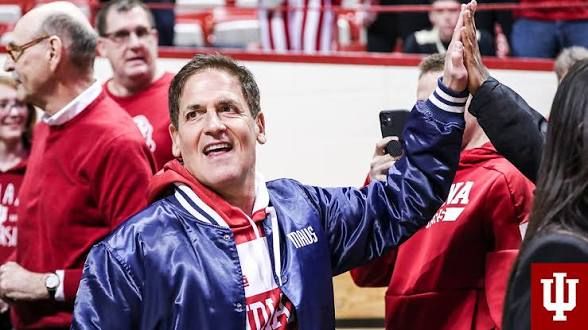
Now billionaires and corporations rule college athletics in the age of NIL.

This same erosion of values plays out on a personal level for me, where my tying my son’s chores to cash rewards has instilled a mindset in him that everything must have an immediate reward or monetary payoff. This mirrors the broader societal trend where wealth is the sole measure of success, undermining the concept of family as a unit bound by mutual care rather than financial transactions.

In cultures like the Philippines, where my wife is from, multigenerational support is just a given, but in America, the collapse of family unit and community has fueled reliance on pay based systems like elderly care, which often exploit the most vulnerable and leave little for future generations.

This shift away from communal responsibility toward an extreme individualism and personal profit reflects a loss of the intangible values—selflessness, duty, and shared burden—that once made America redeemable, if not great. And the rise of socialism, decried by conservatives, is less a cause than it is a symptom of this deficiency, as needy people seek external systems to replace the community support that has faded.

These threads—Penn State’s demoralized and debased fanbase, commodification of college sports through NIL in general, and my own struggle as a father of a teenager to instill non-monetary values—point to a broader cultural decay. The current loss of American values like loyalty, community, and tradition is not easily quantified, as they were woven into the fabric of what it meant to be American, and never before required definition or separate designation.

NIL, like the toxic fan culture or a child’s fixation on cash, is a symptom of a deeper disease: a society that prioritizes money and winning over the unmeasurable qualities that once held it together. This shift, felt more than seen, leaves us grappling with a question: if we cannot identify what we’ve lost, how can we hope to reclaim it?

Records Come and Go—Family Is Forever

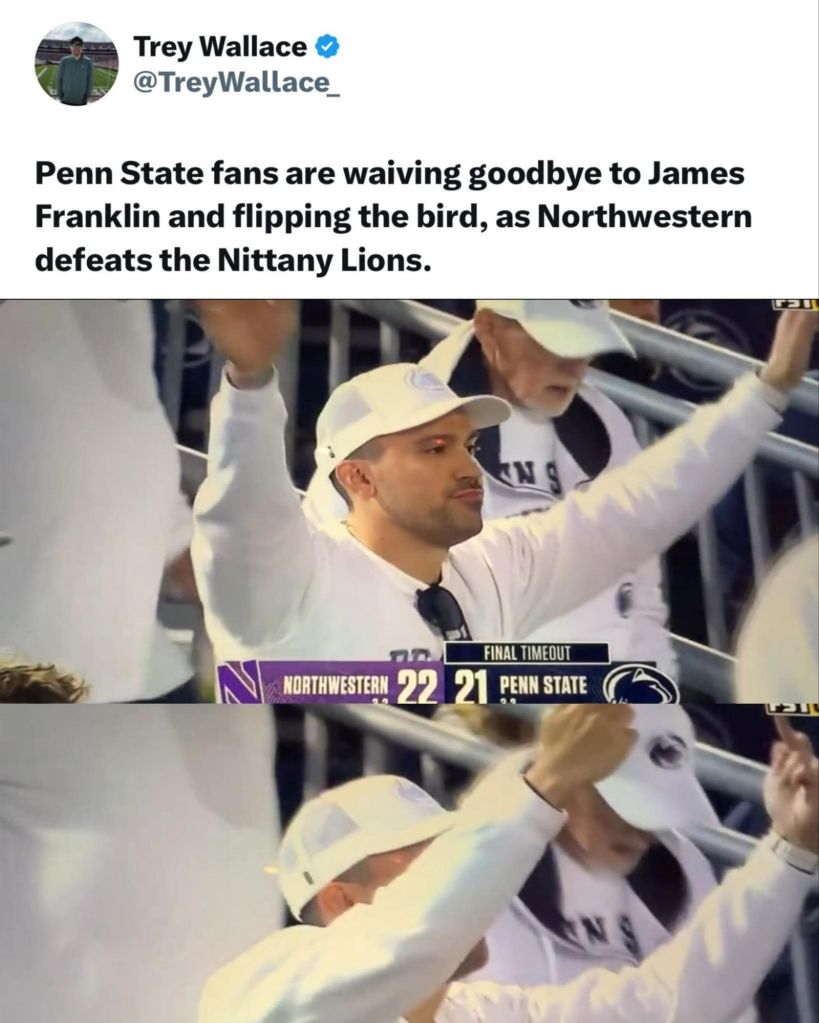
After the Northwestern game, a third loss this year, Franklin waited until everyone else—including his daughter—had gone through the tunnel before he strode through. This is likely because he knew what awaited him—taunts and trash being hurled.

Father and daughter.  Franklin was determined to be a better father than his own.

In comparison to the stupid entitled clowns, Franklin is a class act. He is the father protecting his family. A standard bearer for Paterno (an Italian surname that means father) or at least the commendable part of the late coach’s legacy. I have seen some of the comments online, one claiming Franklin was arrogant because he had only answered one of their emails or something of similar entitled quality—as if he could just sit responding to every moron harassing him. But the players who played for him are unanimous in their support.

In fact, one of the saddest things I’ve seen is the current Penn State roster expressing their guilt over his firing for “not playing well enough” to please the raving lunatics. They didn’t fail Franklin, the fans failed them and the Penn State tradition.

The players taking responsibility is a sign of a relationship with a man who told them his demands of them as players start with love and end with love. In other words, this was a high pressure environment, expectations were high, and yet it was for their good that he challenged them to be better. And, truth be told, Franklin’s teams punch above their weight. He was a player’s coach and that is why Penn State is bleeding top recruits who were coming to State College for something different under his leadership.

The “fire Franklin” types love to talk about how he “couldn’t win the big game” and yet neglect to mention his teams were almost always coming in as the underdog and with less talent and depth than their top ranked rivals. Or, in basic English, he was coaching them up to the level of the elites. And this a testament to his philosophy that had built on the positive part of Paterno’s legacy—he valued the players for more than the wins or losses and they responded with loyalty and inspired football.

Nobody will ever say Franklin was the best game manager or play caller. But then the online critics keep going back to a couple plays a decade ago. A run on 4th and five against Ohio State or kicking a field goal in a 28-0 Michigan game ending the shutout. But ultimately they were one play from the national championship game last year and Franklin was third behind two other coaches from 2022–2024 with a 34-8 overall record during that span—trailing only Kirby Smart (Georgia, 39-5) and Ryan Day (Ohio State, 36-7) for wins. Good luck finding the guy who will top that after we cut the soul out of the program that drew the talent that we did have. Who will come to State College to be nitpicked and unappreciated?

I loved a family man arriving at Penn State and to see it end as it has just makes me think we don’t deserve what we have.

The toxic part of the Penn State fan base is transactional. They believe their watching a game entitles them to perfection execution and results. I mean, imagine that, a howling mass of ingratitude made of mostly grown men who are apparently that unhappy with how their own life went that everything now is a matter of wins on Saturday. Most did not go to The Pennsylvania State University nor do they have any real investment in any tradition of excellence—like that which was upheld by Franklin’s family approach.

Franklin deserved better. He was not a DEI hire. He is certainly not a terrible coach. It is his players—who carry on his legacy—that actually matter. Penn State football should never be about pleasing drunk Uncle Ricos who failed at life, it should continue to be oriented towards success in life. Truly the few Saturdays under the lights are not a measure of a man. Franklin’s tenure should be remembered as a battle against wider societal decay—where the development of moral character and the building of community are too often sacrificed for the fleeting victories or short-term financial gains.

Pattern recognition isn’t for everyone.
Twelve teams with the most National Championships

Both Nick Saban and Urban Meyer, who are legendary coaches, expressed their support for Franklin. And to think delusional Penn State fans believed that they could replace Franklin with one of these two (already past retirement age) by waving a little money in their faces. No, nobody is coming to State College to be unappreciated for producing one winning season after another. We will be lucky to find any successful coach who is tempted by the job—let alone replace all of those who decommitted or will transfer now that James Franklin is gone.

Values Beyond the Scoreboard

In this blog—Irregular Ideation—my struggle with the disconnect between stated values and the values they truly live out. People claim to believe one thing and yet live something else. I’ve dealt with this in the religious and romantic sphere, the disappointment, this false notion that virtue would always win over mere physical or economic superiority. Mennonites teach that the meek shall inherit the Earth or that the first shall be last—these being Christian concepts about the kingdom of Jesus. But the reality lived is always different from that ideal preached.

The reality is that everyone is in it to win it. Yes, even that sweet and submissive young woman doesn’t date no scrubs. Sure, maybe a pious individual will adjust some language or settle on one rather than playing the field, but ultimately they’re going for the status or strength and attractiveness everyone else in the world pursues. Some overestimate the market value they have, but even in love we are being self-sacrificial or altruistic. We’re motivated by hormones and sexual desires—often things we’re not even totally aware of behind our wall of moral rationalizations and narratives.

With denial of this is the delusion that good things will happen to good people. We tend to confuse physical beauty with virtue as it serves our own carnal desires to see them as one and the same. I mean, who wants to say the quiet part out loud by admitting they picked Joe over Bob because he was taller or had charisma? We may say things about nurturing or character traits but this is code for nice breasts and big biceps. So what I am getting at is that we dress all this stuff up as something it is not and revelation of what is underneath is not debasement—it simply exposes what always existed.

From Paterno trying to bury the truth about Todd Hodne to the firing of Franklin, the true ruthless nature of college football culture is revealed.
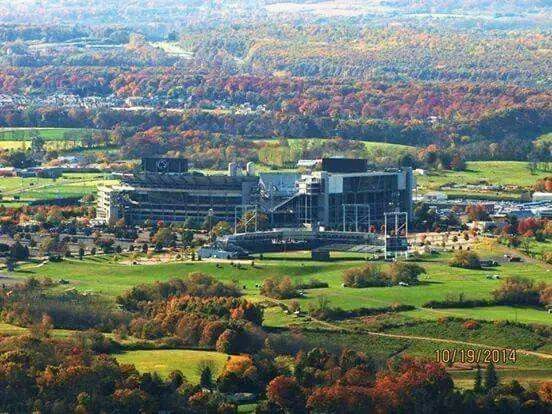
Beaver Stadium rises out of the valley floor, an edifice, a temple where sacrifices were made in the name of success.

Beaver Stadium rises up from the farm fields of Happy Valley, a monument to Pennsylvania pride, like the “city on a hill” of American exceptionalism. But success was not built on anything different here as it was anywhere else. What is buried is the reality it is always about aggression, financial gain, and wins. The Grand Experiment failed and Penn State had to be like everyone else if it wanted to reach the top. Furthermore, there is a sense in which every program becomes a sort of family or builds men—Paterno was only unique for highlighting this.

Are there values beyond the scoreboard?

Is it a zero-sum game?

Yes and no. Friedrich Neitzsche describes “slave morality” or a system of ethics that reverses what we naturally value and then says this denial of reality is virtue. Woke is a manifestation of this, where they attempt to turn the world on its head and celebrate obesity, ugliness, criminal behavior or lack of ambition—and create an artificial reality—rather than deal squarely with the world as it is. Body positive isn’t going to spare you health consequences if you’re obese. Fair or not we must at some point deal with the cards we’ve been dealt and rise above our station or accept what we are. Mutilation of yourself to be something you’re not ends as badly as well. There really are no shortcuts to success or Uno Reverse cards to play—it is what it is on the scoreboard that matters to the world in the end.

Ultimately we also have our limits. We need expectations to match our abilities or we’ll end up in a spiral—always chasing what is beyond our reach rather than just building on what we have. I’ve seen it many times, those who leave a consistent and reliable partner, thinking they’ll do better out in the market, only to find out that (yet never will admit) that their discontentment played a trick on them and they had it better before than after. Not everyone can be a National Champion every year—it just isn’t possible—but we can have a family or community that respects all members and seeks only their best rather than tear them down.

Symbolic?

So maybe Penn State football does need to be dismantled and rebuilt to be great again?

It could be that, like the children of Israel in the wilderness, we’ll need this generation to pass so our children can enter the promised land?

If the foundation laid has led to this ugly spirit of entitlement then it was flawed. We might need to decide if football is so important we will lose our humanity or the immeasurable qualities not displayed on a scoreboard—for a “big game” win that won’t matter in a year or two. What does it truly matter if we gain the and lost our soul?

A race to the lowest common denominator is the end of civilization. Despite my lament above, I don’t believe life is all about money, sex and power—which ever order they come in. I still believe my elderly grandma had a beauty that was unsurpassed and morality is not just a smokescreen for our failure to be the best. Maybe the impossibility for me is possibility for my children. I cannot stay disillusioned. But, like I did in finally leaving my religious roots, I may need to also bury that delusion of Penn State excellence both on and off the field.
Not the tradition that made Penn State great.

Maybe the failure of The Grand Experiment was all Paterno’s own personal failure? Or maybe the message never went beyond the young men who loved him like players love Franklin today. But the Colossus now lies in ruins making me wonder if it was ever great to begin with. They didn’t just fire Franklin—they pushed over what remained of an ideal for sportsmanship, they’ve fully demolished the mythology that so inspired me. A giant ‘moral’ idol is gone—will something real rise up in its place?

Cultural Erasure in the Age of Corporatism: Preserving Local Identity and Sovereignty

Standard

Cultural erasure is often discussed in the context of dramatic examples. Communist efforts to eradicate religious practice or the forced assimilation of Native Americans are two clear instances. Another is the British schoolgirl punished for wearing a Union Jack on a day meant to celebrate cultural diversity. Yet, a more insidious form of cultural erasure is sweeping through the United States, infiltrating every small town under the guise of free markets and capitalism.

What I’m referring to is corporatism, partnered with consumerism. This country was once defined by businesses owned by average people—those “mom and pop” shops. That is no longer the case. Capital and control are increasingly concentrated in the hands of a few (see this video on BlackRock), and choice is largely an illusion in this age of mega-corporations. We have become a nation of employees. Yes, small businesses and boutiques still exist, but they are the exception. Our regulatory regime favors economies of scale, benefiting established players who can absorb compliance costs.

Illusion of choice

On the road—hauling commodities—this economic transformation is alarming to anyone who cares to notice. Local mills and grain elevators have been bought up or are in the process of being acquired by major players. Businesses where locals once knew the owner have been transferred, one after another, to corporate boards far removed from the operations.This trend spans every industry. Thriving downtowns and corner stores have been replaced by Walmarts. Ironically, when communities regain a “local” option, it’s often a Dollar General. The impact extends beyond retail. Doctors can no longer afford to practice independently, and hospitals are absorbed by larger systems to manage ballooning compliance costs. Local communities have lost true choice as corporate brands dominate.

Even decisions within our towns are outsourced. Consider the plan to bulldoze Slifer House, a local landmark designed by a notable architect, listed on the National Register of Historic Places, and honoring a man who played a significant role in the town’s history. This building, originally a private residence, later an orphanage, and then a hospital, faces demolition. The board deciding its fate is disconnected from the community, concerned only with maximizing revenue at the expense of our shared heritage.

https://www.change.org/p/save-the-historic-slifer-house-from-demolition

I spoke with a township supervisor, a relative, and received the typical canned response about property rights. But this boilerplate conservatism fails in an era where BlackRock owns vast swaths of the economy, and we all now owe our souls to the company store. It’s not a free market when Larry Fink can mandate DEI policies across every place we shop or work.  Consumer choice doesn’t exist when all options on the shelf (see this video on BlackRock) are owned by the same entities.  Property rights may have built the middle-class, but appeals to them cannot address this systemic erosion of agency and destruction of ownership society by the current corporatism.

A town known for its Victorian charm and yet can’t protect this heritage from corporate interests.

This corporatist-consumerist machine erodes local identity and sovereignty by homogenizing communities. Regional dialects, traditions, and histories are drowned out by standardized corporate aesthetics and practices. The local diner with its quirky charm is replaced by a chain restaurant with identical menus and decor nationwide. The family-owned hardware store, where the owner knew your name, gives way to a big-box retailer staffed by transient workers. These shifts strip away the unique character of our towns, leaving behind this sanitized, generic, board approved and predictable landscape that could be anywhere—or nowhere.

Retaining local identity and sovereignty requires deliberate resistance to this tide. Communities must protect what matters to them, prioritize policies that support small businesses, such as giving tax incentives for independent retailers (rather than Jeff Bezos) or simply streamlined regulations that don’t disproportionately burden the little guy. Local governments should not side with entities outside of town, but rather should empower residents of the community to have a say in decisions affecting historic landmarks like Slifer House, ensuring that distant corporate interests don’t override community values. Grassroots movements can foster local pride by celebrating regional festivals, preserving historic sites, and promoting artisans who embody the town’s heritage.

Better options closer to home?

Sovereignty also means reclaiming economic agency. Communities could explore cooperative business models, where locals collectively own and operate enterprises, keeping profits and decision-making power in the hands of residents. Supporting farmers’ markets, local craftspeople, and regional supply chains can reduce dependence on corporate giants. Education plays a role too—teaching younger generations the value of their town’s history and traditions fosters a sense of ownership that no corporate boardroom can replicate.

Ultimately, the fight against cultural erasure through corporatism and consumerism is a fight for self-determination. It’s about choosing to preserve what makes our communities distinct, even when the deck is stacked in favor of scale and sucking out profits. By valuing local identity over corporate convenience, we can reclaim the soul of our towns and ensure they remain places worth calling home. Property rights were meant to protect local control—not to consolidate then outsource all decisions to out-of-towners.

Why I Stopped Asking Why

Standard

With God, all things are possible.  That was a phrase that got me in trouble.  If pursued to the full literal extent this is an assurance which leads to disappointment.  All things may be possible, but in the sense that you only want what is about to happen.  What we have is more like the quote attributed to Henry Ford: “Any color the customer wants, as long as it’s black.”

Anything is possible if you want the possible.

It is what it is.  That has more or less been my life of the past few years.  Marriage has been good for me.  There is less need for a fight for a faith in the impossible when the actual has been decent enough.  This could simply be a matter of age.  You’ll become a little agnostic after being on the other side and seeing some of those foolish hopes of a child.  Not saying it is impossible, but it is just improbable that my Filipino son will be over six feet tall as he hopes.

The biggest chance in my life is not asking the question why anymore.  Now I am that father figure supposed to give answers and needing to play a stabilizing role.  There is just not enough time, the dishes need to be done, the baby needs to be fed, and nobody could ever answer my questions.  It seems my own answers were as good as any.  Why is a cry for answers, an underlying belief in an authority that can answer.  Why ask why if there is no authority to ask?

Sunday evening went a bit sideways soon after my wife and I crawled into bed.  I had seen a story, soon before going to the stairs for the night, that made me briefly consider that it could fit the profile of a family friend: A ten-year-old girl being swept away by the swift river current, friends trying to help, an adult woman going in after them.  But then, now in bed, I saw the post on social media confirming that indeed it was a tragedy that was hitting very close to home.

It was Claue

Kevin and Michelle are a couple very similar to my wife and I.  We met a few years back at a Filipino-American event.  He was also employed in an engineering related field, a guy with German background similar to my own, and also had chronic back issues that gave us a common bond considering what a pain my neck had been.  But what I liked most about him is that he was a family man who put his wife and children first.  Michelle likewise is a dedicated mother, one of those hardworking and unassuming types—who offered her quiet support to my wife as we dealt with the immigration gauntlet.

Claue had come with her mother from the Philippines.  Like my son, she had no real choice in the matter and suddenly found herself in South Williamsport with a school of American kids.  Unlike my son, she was shy and spoke very little English.  And, from what I recall, it was difficult for her initially to leave her mother’s side.  That’s why I was so happy to see her in a basketball jersey—it meant that she was finding her niche.

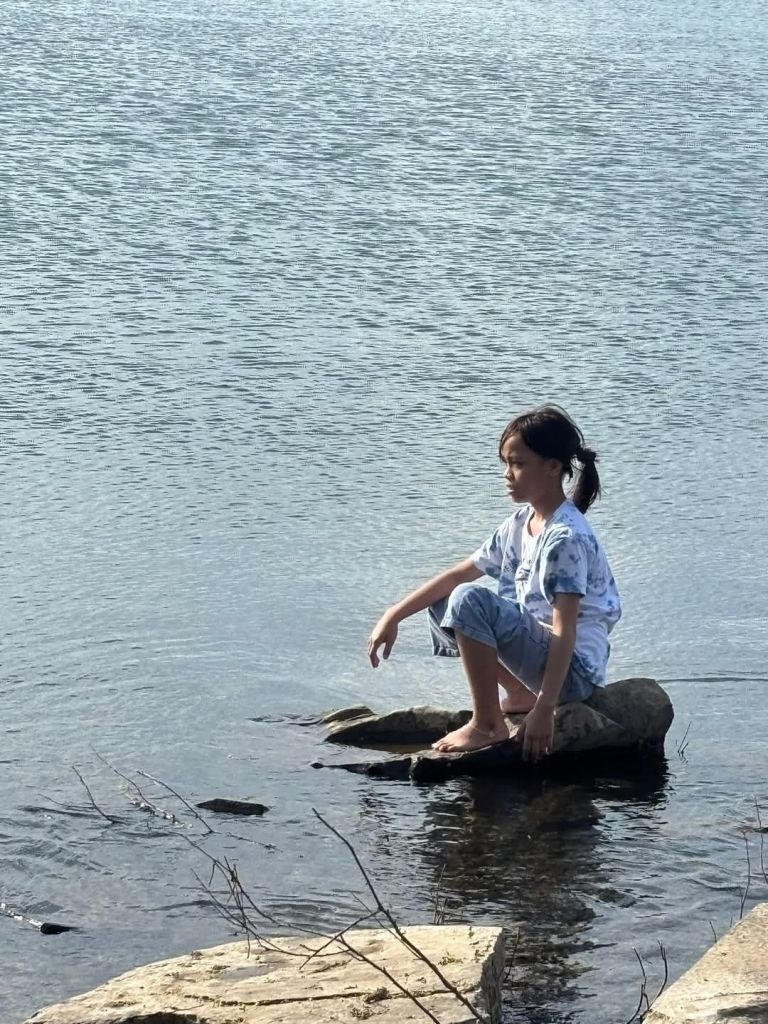
I knew the river was a special place for the mother and daughter.  Many pictures were posted of Claue wading in the shallow parts and enjoying a break.  

On May 4th, with baby in the stroller, Claue was splashing around again as her mother watched from shore.  The river was up just a little after some rains—the water slightly murky at this point—and she slipped.  The current pulled her away into deeper water where she was clearly in distress.  Her two friends tried going out to save her and also were being swept downstream.  Michelle, seeing it all unfold, did not hesitate to enter the water despite—like her daughter—being unable to swim.

The whole group would soon end up over the dam in the turbulence that is known to keep even experienced swimmers trap in its watery grasp.  Miraculously Michelle was pulled out.  But she did not escape without injury, she was taken to the hospital where she was treated for broken heart syndrome and remained for days.  The words “help me Mom” the last thing she heard her precious Claue say before she disappeared.  The two other children were saved—only Claue lost.

A design to keep dams from washing out keeps the victim in the froth where even a great swimmer will be helpless and in danger of drowning.  That our friend, the mother, escaped is a harrowing account requiring presence of mind, will to survive, and a hand from above.

The rescue operation has changed into recovery, but no signs of Claue have emerged a week after she disappeared.  I’ve set up a GoFundMe for the family as we wait and hope for our dear Claue to be brought home.

Waist deep in tragedy…

My life has been rather average, I suppose, in that I can’t claim it has been very tragic in comparison to some.  Nevertheless, there is a ‘tortured soul’ aspect to my existence that has once been called out by my little sister and is to some extent true.  I do tend to feel things very deeply and cannot ignore all the suffering in the world as some seem a little more able to do.  And always with this care came a big question: Why?

Why do such awful things happen to such undeserving people?

It is a question that will stay swirling in your mind if you let it.  Religious people will say it is for some greater reason we don’t know—the judgmental will try to assign blame with their Monday morning quarterbacking skills—and both never satisfied me.  If death is a path to salvation for a child, why would we ever oppose abortion?  We would celebrate the millions of babies sent straight to God to eternal worship.  And if you’re one of the people who think life can be risk free—that all suffering is preventable—you’re either a very lucky person or as dumb as a box of rocks.  

Every year there are around twenty cases of commotio cordis.  That is when a hit within a certain window of time stops the heart.  A young baseball player takes a line drive to the chest—collapses and dies.  

Does this make me a monster for allowing my son to play this dangerous game?

No!

Someone could spend their life hiding under their bed sheets, afraid to do anything, and get hit by a re-entering Soviet-era spacecraft.  The only tragedy, in that case, being that a person so risk adverse has not lived life and is already dead.  My cousin Uriah, who was diagnosed with terminal lung cancer near the start of the Covid shutdowns, had every reason to remain home and ‘safe’ from the disease—yet, with only a year to live, he decided he would live.  My most cherished memories with him would not have been possible if he picked a path of total risk avoidance.  Life is always risky and we cannot prevent tragedy by avoiding it.  Why huddled in fear?

They want easy answers.  Those who look for someone to blame or explain it by some hidden heavenly cause.  But the true reality is murkier.  Job was doing everything right and yet his friends found fault.  That’s not to say that we should not make an attempt to manage probabilities.  But something much bigger than us ultimately holds the dice and there may be no reason why other than that it happened.  Some can cope with a simple explanation—bad parenting or cosmic plan—great if that works for you.

Go with the flow…

Unlike my siblings, who were basically fish, I could not float and could barely swim.  My mom had tried to help and she sent me to swimming lessons, but when the instructor lowered me in the water I would stiffen up like a board and sink.  Some of the problem was that my BMI was probably five, skinny, and my lips would turn blue after a minute or two in the water.  All I could think about is getting back out and being cozy wrapped in a towel.  Add to that, one of my earliest memories was laying face down in a pool thinking it was game over.

That’s the funny part of advice given to “just relax” or “be confident,” we would without all the fear, anxiety, experience or regret in our lives, right?  

But then those who fight for control, who do not deal with life as it truly is, they are most miserable.  Acceptance is key.  It is what it is and what will be will be—because there is no other answer I can find.  That is also to truly choose compassion rather than judgment—it is people with the answers who are harsh in times of tragedy, who truly know nothing and yet believe they are morally superior or act as if they never fail.  Those who don’t lead with mercy either lack self-awareness or have never been chewed up and spit out by those beasts that lurk on the edges of their placid waters—which could draw them in at any moment despite their assumed sure-footing or preparation.

Faith too can also become a banal attempt to right equations that can’t be righted.  This is where I can appreciate Orthodoxy when it doesn’t offer answers, but does offer that a priest (with the right permission) may lead a service for a non-Orthodox person as an act compassion.  I would be more impressed if someone could command Claue to rise and she walked out of the river.  However—with no better answers—I learned to be content with compassion as an answer.  

Asking why does not ease a mother’s pain, nor does criticism, nor do those “God has a plan” pat answers.  Sometimes the best we can do is sit together, talk and laugh a little, humanity has continually won against those devouring forces of nature by sacrifice for the tribe or looking out for each other. Hugs never tell us why, but they do silence those nagging questions even for a moment.  A tear with a friend is medicine for a broken heart.  It is better to rest, not knowing, and be okay with it, because we’ll never know why…

Small, initially shy and yet energetic, Claue came from the Philippines with her mother knowing very little English.  This year she went out for basketball and seemed to be adjusting.  Her classmates miss their friend.

Never Meet Your Heros

Standard

I have lost all of my heroes. The expression, “Never meet your heroes, because they’re sure to disappoint you,” describes the painful realization that those great people you imagined are not as special as you believed they were.  It could be the letdown a friend had when he heard Matt Walsh speak.  It could be a family that learned their eldest brother was cheating on his wife for many years and was not some image of virtue.  For me it was a process and a very long grinding away of faith in these figures.

I was never one for human idols.  I never put posters of celebrity faces on my bedroom wall and would never be as impressed with figures like Ravi Zacharias as some of my friends.  It wasn’t a religious thing nor something just to be ornery.  I simply didn’t have a feeling of awe about these personalities that were mid.  The people I most admired tended to be local—my blue collar dad, my missionary cousin, or that perfect girl I would marry some day.  But time has removed all from the pedestals.

Those women of my youth would end up as the cheating wife or more interested in status than my sincerity.  My dad no longer looks like that man I remember who could carry me on his shoulders (with me hanging on for death life) up a silo ladder, and that zealousness of the ‘compassionate’ types tends to morph into a noxious ideological alignment that is really anything but they profess.  They say that they want the Kingdom, but have replaced faith in God with fraudulent human institutions.

And I’m not just talking about the apologists for CAM in the wake of the Jeriah Mast and years of coverup aftermath.  “Oh, but this is an organization that does such good!”  What I’m talking about is something fully revealed since the DOGE ax has fallen on USAID.  I grew up believing in the strict separation of church and state—that a colonial expansion of Christianity was tainted and this at completely odds with the teachings of Jesus about His kingdom not being of this world.  

My views have certainly evolved—having left my religious cloister—but I’m still appalled by the thoughtlessness of people who I had once thought were smart and uncompromised.

Banality of Evil: When Ends Justify the Means 

The Anabaptists, after the disaster of Münster, had committed to a quiet life of separation.  It is why those in Old Order groups have refused participation in Social Security and other kinds of government benefits.  Mutual aid should be voluntary and Christian charity is not obtained through coercion.  Sure, the power of the state is alluring, that temptation (driven by our ego) to rule over others because we know what is best or they are undeserving of the resources they have—I have had many of those “if I were king” moments—but there is no stopping point when you fail to resist the siren song.

Left-wing politics always clothe themselves in a kind of compassion.  Surely you will not oppose helping these children, right?  And I am pragmatic to the extent I’m glad starving children are fed by any means.  But opening the Pandora’s box of leftist means is always a slippery-slope to more use of state power and, inevitably, to leftist utopian cost-benefit analysis where everyone who opposes us is a literal Nazi and, therefore, we’re justified to stop them with violence.  When coercion is allowed as a means of obtaining the ends we desire there is no stopping point.

The worst form of evil has good intentions.  It is that of those who imagine themselves as the hero of their own narrative and thus allowed to bend the rules.  This explains the extreme narcissism of Luigi Mangione who saw himself as a worthy judge of a father of two and a husband to a practicing physical therapist.  There was no need for this leftist murderer to look inward, he had completely externalized evil and turned other men into caricature representatives of truly complex multi-faceted problems.  When the ends can justify the means we’ll justify any means.

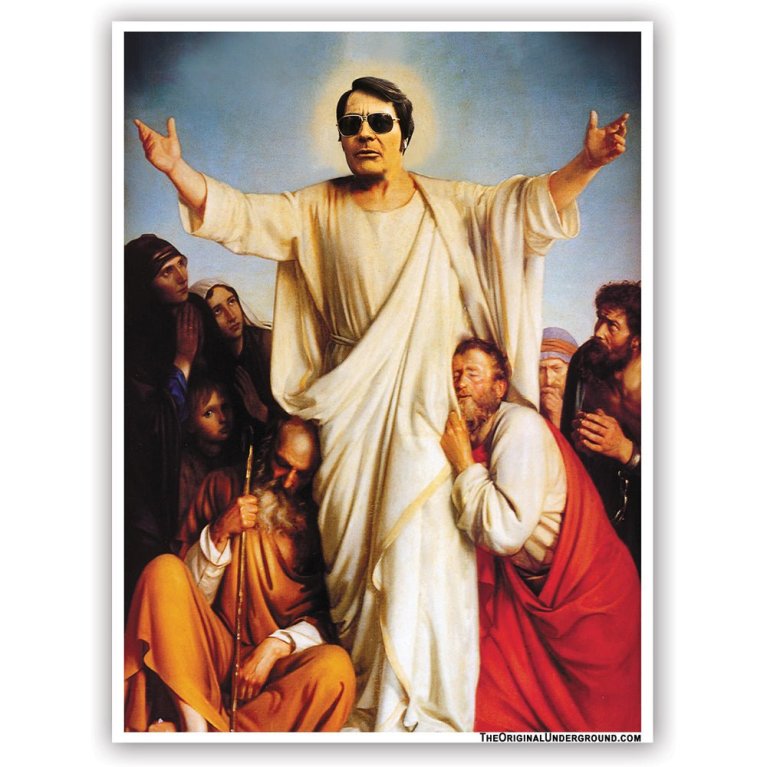
Pastor Jim Jones preaches his counterfeit Gospel before being abandoned by the US government and having to free his cult from bondage with some poison laced Kool-aid.

Seeing someone I thought was a Christian missionary lament how the United States had “abandoned” them was a reminder of how the great have fallen.  There was not a shred of gratitude expressed towards the American taxpayers who financed them nor acknowledgement of the misappropriation of funds that has wearied voters to foreign aid.  But more stunning to me was unholy alliance between this person of faith and agencies of US imperialism.  Since when has the love of Jesus become an extension of the US regime abroad?  Are they of the kingdom, as they proclaim, or agents of empire?

USAID, despite the name, is certainly not a charitable organization and was formed in 1961, at the height of the Cold War, with an aim of promoting the interests of the US political regime.  That’s fine.  But it has long ago gone off the rails even as far as what it was originally imagined.  The Soviet Union had fallen and the Federal agency created to oppose it morphed from something most would support into a beacon of wokeness—pushing transgenderism and abortion.

Break the Yoke of Fraudulence 

The reason why USAID is being dismantled is because we can’t sort the legitimate from illegitimate function of the agency.  Sure, it may help people in need, but funding it also is enabling of evil and maintained through a system of coercion we call taxes.  Anything good that it did can be done through other means.  This functional fixedness of those who depend of government, especially on the part of those professing Christ, makes me wonder where their faith lies and what their actual mission is.

The merger of a Christian charitable cause with government doesn’t purify government—it taints the witness:

Do not be yoked together with unbelievers. For what do righteousness and wickedness have in common? Or what fellowship can light have with darkness?  What harmony is there between Christ and Belial?  Or what does a believer have in common with an unbeliever?  What agreement is there between the temple of God and idols? For we are the temple of the living God. As God has said: “I will live with them and walk among them, and I will be their God, and they will be my people.” Therefore, “Come out from them and be separate, says the Lord. Touch no unclean thing, and I will receive you.” (2 Corinthians 6:14-17 NIV)

The accusations of “Christian nationalism” against those who want a government that performs basic functions were always just a smear by those in alliance with imperialism and Godless globalism.  While I’m not a fan of God and country, at least the flag waving religious patriot knows there is a difference between their Christian mission and secular state.  The left, by contrast, confuses these categories and would have social program replace true charity and community aid.  In one case you have those who may tend to overreverence nation, but in the other there are those who truly represent empire and yet tell us they their only  citizenship is the kingdom of heaven.

The truth is that the ‘Christian’ left is simply the left merely wearing the words of Christ as a disguise for ideological agenda.  Those decrying the reduction of empire and return to responsible governance never said thank you to those funding their do-gooderism.  It was, for them, all about holding those “chief seats in the synagogue” and their own glory as humanitarians.  They may speak against Trump, but then have never uttered a word against the waste, fraud and abuse that has made these broad sweeping cuts popular with common people.

The true Christian spirit is that of a Federal employee who told me about the enormous amount of inefficiency and waste in his own agency and—while making no profession of faith—supports the effort of DOGE knowing it may impact his employment.  That, to me, is someone who understands self-sacrifial love more than someone feeding the poor on another person’s dime and then going to social media to complain when their funds are cut.  They’re grandstanding.  While my Federal employee friend is a truly humble public servant who is grateful and not biting the hand that feeds him.

None of this to say this “abandoned” former hero of mine is a bad person.  They clearly are using their abilities to help other people in desperate need.  I applaud that.  And yet their public statement betrays.  There is an attitude or spirit there that is different from Christ.  I would much rather they just be a secular humanist—subscribed to partisan leftist politics—and own it.  They should just admit that they’ve abandoned faith in Jesus and are looking for a worldly system.  Judas Iscariot is the patron saint of faithless social justice, guilt trips and envy—when you betray your calling just own it.

Technology Versus Humanity

Standard

We love technology because it makes our life easier. Machines do the back-breaking labor that once took an army of men, we all get more as a result, travel between places is a matter of gassing up the car and going rather than a perilous ordeal. In general social media platforms and online retailers reduce friction. That is to say, they facilitate an interaction at a much lower cost of time and effort. Why go shopping or hang out at the mall when you can sit on the couch?

That was a key revelation this week: Snapchat and TikTok have taken the place of roaming the corridors of what was once a retail Mecca. Entertainment is as simple as picking up your smartphone and finding out what Mr Beast is doing. He’s so much cooler than even the cool kids at school, so why even bother to see what they’re doing? It is too hard to make plans with friends, to get dolled up, to drive ten miles and walk on your feet when you feel as if you can get the same reward wearing your underwear at home in your bedroom.

More are living in a fantasy of life, following a path of least resistance, and not realizing the full cost. Social media is to the community what pornography is to sex. Sure, you have escaped the grip of boredom. That desire for interaction has been gratified. It is even more sterile and safe. That pretty girl won’t reject you here in virtual reality, she doesn’t compare to what is available at your fingertips anyways, so why be treated as second rate by what is second rate? We escape our limitations with our imagination.

However, it all comes at a cost, much of this cost is hidden or deferred. The cost is that we don’t accomplish what we could—in the real world—by our reliance on a meaningless space where nothing of value is accomplished.

Our convenience-seeking way is a form of depravity, that is to say, it is trading current pleasure for future pain. If we don’t get any physical exercise, for example, because the machines do all the work for us, we will lose our muscle mass and gain weight. Cuts in calories and gym time can counter this, but there must be proper sacrifices, or diabetes and quality of life decline will follow. Why not walk rather than ride in a vehicle? The exercise would do us good.

Oh, you don’t live in town?

Everywhere you need to go requires a drive?

The suburban sprawl and development built around the automobile have led to an increasingly dependent lifestyle. And that is not a typo. Our convenient mode of travel has made it easier to close a distance; we don’t need to live next to our sources of food, employment, or social interaction. Yet, as a result, everything is now more distant, and this is how we end up commuting forty minutes to work rather than spending the day in our own neighborhood. We can be everywhere all at once and are scattered to the wind because of this.

This is true regarding schools. Even after the one-room schoolhouse had gone away the schools were within talking distance in my hometown. But now nearly every child is either bussed or dropped off since all of the schools are part of the sprawl. It just amazes me, that in an age where we’re worried about sustainability and subsidizing EVs for a marginal reduction in carbon emissions, we are still—as a public policy—developing our communities in the direction of more dependency rather than less.

A smartphone feels so secure in our hands, so intimate, and yet will divulge our secrets (without our knowledge) to anyone with resources. For all we know it is a bomb waiting to explode given we are only the end user of the device and have no idea of its inner workings—let alone who had hands on it before it came to us. And simultaneously, while vulnerable to every nefarious actor that exists, we’re more isolated when it all goes down. Suddenly, in North Carolina, after the flooding, they can’t do business without cold hard cash.

One cost of convenience is dependency on long supply chains. Even those face-to-face transactions often involve third parties who skim a bit for themselves. We empower the global corporate conglomerates and are always at the expense of local control. Could your community survive without trucked-in food and consumer goods? How far would you need to walk for basic needs if the electric power went out or tankers stopped bringing in fuel? A century or two ago most people could find enough to eat simply stepping into their own backyard.

Sure, having a big garden and animals is inconvenient day to day, but it is much more sustainable. Our cars and phones make it easier to travel, but they also have put us in a bubble. As in, not being 100% present even to our own family beside us, where we drive past each other in a metal shell at 70 mph and never meet the people who supply our needs. We feel sophisticated because of the gadgets in our hands, when in reality an Amish man living a century ago had life figured out better than we do.

Given what we’re discovering about microplastics, the Amish were right even in their rejection of rubber tires. Why? Well, it isn’t because they had special knowledge. No, in simply rejecting most new technology they also avoid the unintended consequences as well. This disposition to be wary of what is generally accepted as improvement, asking what it will take away from the community and our humanity, is good. It is moral to take a little time to consider the long-term costs of our technology decisions.

As soon as we embraced technology that we could not manufacture or sustain by ourselves we became vulnerable. Humanity suffers as we look to technology. Sure, the benefits of innovation also can’t be ignored or downplayed. But we must always be as aware of the downside and, therefore, have an intentional approach when adopting the next new device. There is always a price to be paid for convenience. We need to do the hard work, to help rebuild those strong local communities and foster robust humanity.

Watching Gran Torino With My Asian Son

Standard

After reading a review of Gran Torino, a Clint Eastwood movie from 2008, that dismissed it as shallow in its exploration of racism, I’ve decided to explore some of the depth of the movie that was missed.  It was a great story about finding common ground, that takes a bit of twist at the end from the typical Clint Eastwood film.  My family (mixed race and culture) could appreciate the themes more than the average viewer—yet is a beautiful redemption story that all people can enjoy as well.

“Get off my lawn!'”

The story is about an angry old man who is not dealing well with change.  Walter ‘Walt’ Kowalski, a Polish-American retired auto worker, Korean War veteran, and recent widower—his beloved wife passing right before the start of the narrative.

In the opening frame, he fits a stereotype of an elderly homeowner defending their patch of turf from an encroaching world.  It seems every small town has one.  That guy who trims his front lawn with scissors and does not deal well with the trespasses of the younger generation, the snarling “get off my lawn” line from the movie became an instant meme.  

Why?  

It is just too familiar. 

The expression captures the essence of a fading dream.  The American middle class values property ownership.  A lawn, once a complete luxury and exclusively for wealthy estates, had become the mark of post-WW2 affluence.  Walt was the beneficiary of this period of economic growth.  He had lived a quintessential suburban life.  

But now it had become a nightmare.  It is not the same neighborhood anymore. The once tidy little homes, owned by people like him, had fallen into disrepair as a new group of immigrants took over.  The woman who he built a home with was gone.  His sons bought foreign brand vehicles and betrayed the legacy their father had built working at Ford.  The world Walt had known was falling apart and he was bitter.

That patch of land, other than the ghosts of his past, was all Walt really had left.  To set foot on it was to violate his sacred space.  It was a shrine.  And his 1972 Gran Torino in the garage likely represented the pinnacle of his productive career.  Since the Korean War ended in 1953, this would put this car purchase around two decades into civilian life with a young family and point when the future looked bright.  So he was clinging to what was left of his identity and willing to defend it with deadly force.

Demons of the Past

Early on we see Walt, the tough guy, who is playing a part.  His racist language is a part of the facade—a barrier he puts up—because the alternative is to be vulnerable—or a victim.  He is still haunted by his war experience, in the beginning using it as a threat, saying he could kill without remorse:

“Yeah? I blow a hole in your face and then I go in the house… and I sleep like a baby. You can count on that. We used to stack fucks like you five feet high in Korea… use ya for sandbags.”

However, later, when it comes to stopping the neighbor boy from taking revenge, we see the reality under the surface:

You wanna know what it’s like to kill a man? Well, it’s goddamn awful, that’s what it is. The only thing worse is getting a medal… for killing some poor kid that wanted to just give up, that’s all. Yeah, some scared little gook just like you. I shot him in the face with that rifle you were holding in there a while ago. Not a day goes by that I don’t think about it, and you don’t want that on your soul.

Just like today, where Russians are called “Orcs” and portrayed as subhuman by propagandists, racial and ethnic slurs were used against various Asian enemies of US policy in the region.  But for Walt, he knew better, he knew that it was not a demon at the receiving end of his rifle.  He had murdered a human child and he felt immense regret.  Note how he says “poor kid” rather than all of the racist terms he used freely throughout his conversations.  It is almost as if, up to this point, he had to reinforce the dehumanizing descriptions to keep ahead of his shame. The truth is Walt didn’t sleep like a baby. No, he was running his sins his entire life and exhausted.

Walt’s racism was part of his pretty much equal-opportunity disdain for other people, including the young parish priest, and his own family.  He was a broken and hurting man, who had driven away his children and was hiding his own terminal illness.  What he needed was some compassion, a safe place where he could finally let his guard down, and it was the persistent effort of a young Hmong neighbor that finally broke through his wall of insults.

Finding Common Ground

The review, that sparked my response, tried to overlay a “white savior” trope on the story and completely missed that it was Walt who was being saved!

*spoiler alert*

Yes, ultimately, Walt sacrificed himself for the sake of the Asian family next door.  But this only after Sue, played by an actual Hmong actress (some critics panned the amateurism, others praised), went above and beyond to disrupt his dismal world.  

She was his savior.

It was by her effort that he would face the demons of his past and could be at peace with his Creator.  It was a redemption story, a story of an old man who had lost his wife, lost his children, lost his religion and even lost his neighborhood, but finds life again by learning to love his enemies.

I can feel this character.  My own life didn’t go as planned.  I had to leave the religious culture where my hopes had been built.  I had a beautiful Asian woman who was patient with me while I was still lost in delusion and did not give up when times were difficult.  Now we have a blended-culture home.  Yes, my Filipino wife and son are different from me in many regards.  However, after seven years of knowing each other and now over a year of being married, our love has only continued to grow.  Some of my happiest moments were with her family in the Philippines and recently while visiting her relatives in Canada.

I am Walt.

My ‘Sue’ did save me.

The real story of Gran Torino is an old man who finds more common ground with those he had thought were strange than he does with his own children.  Once Walt had got past the superficial differences he realized he had more connection to these Hmong people than many who looked like him.  Unlike the war, he was now defending real people and not political ideologies.  He was fighting for the local community, against those within who are destroying it, and not gunning down random boys thrown into a conflict not truly their own.  The storyline is a comparison between perspectives and shows us what really matters in the end.

It is about relationships, not race.

It is about building bridges.

The ongoing dialogue between Walt and his priest demonstrates this.  The priest, who is of European descent based on appearance, is at first scoffed at by the grizzled military veteran for his youthfulness.  The baby-faced “Padre” is bluntly rejected by him: 

I think you’re an overeducated 27-year-old virgin who likes to hold the hands of superstitious old ladies and promise them everlasting life.

But, despite this insult, Father Janovich will not go away.  And eventually, with his persistence, he does earn the respect of Walt.  The bond, built over a few beers, culminates with Confession and Walt is finally able to have the guilt that had plagued him since Korea absolved.  Now he is free and at peace, ready for a last act that goes contrary to expectations and confirms the redemptive arc.  

It was faith that saved Walt, both that of the young woman who withheld judgment and didn’t allow his wall of nastiness to stop her and finally of the persistent outreach of the Church.  And it is only because of this concerted effort that we get to see the protagonist do what is right. By the end of the film, Walt has overcome those demons driving his anti-social behavior and also has gained a son worthy of his prized Gran Torino.

Now To Review the Reviewer…

Why did the critic miss the obvious?

The reviewer who inspired me to write my own was projecting their own worldview onto the script. Eastwood is a rare conservative Hollywood producer.  In fact, so conservative he spoke at a Republican National Convention and gave a mock interview with an empty chair, used to represent Obama, and he calls Biden “a grin with a body behind it.”  Perhaps it is this that the review is responding to?  But I think it goes a bit deeper than that.

The Marxist left sees the world as being a zero-sum game, or that for some people to gain others must lose, and thus everything is a competition for power.  But, not only this, but everything is divided up into strictly bounded categories based on their skin color, financial status, or sexual classification.  If someone cooperates across these lines then they are an “Uncle Tom” or traitor.  So the themes of Gran Torino just do not compute.  Asians are collaborators. Walt is an irredeemable privileged white man, he needs to be canceled—not humanized.

So, since we can’t have everyone come out as a winner, the only thing the woke reviewer has left is to hallucinate something color-coded and negative.  Thus they see a movie that tells us to reach across lines of age, culture, and race as just another “white savior” trope.  It is bizarre, such a narrow and distorted perspective, to entirely miss everything and then to insert what is not actually there.  Yes, Walt saves, but in the context of others saving him, and that’s not even the point.  The point of is that color (or age) doesn’t matter, finding our common ground and community does.

Gran Torino isn’t a perfect movie.  It may go a bit overboard with ethnic slurs at times.  But, then again, the comedic relief of the barber and Walt exchanging these insults as terms of endearment is also great commentary.  Why do we let words be “violence” when the same utterances can be laughed at in another context? It is because these words have the power we give them.  What this is suggesting is that we can go further when we reframe the conversation. 

The left wants to believe that our behavior is determined by what others have done to us—Eastwood says we can be free to live above their rules.

Politics may be all about power, in-group and out-group, but love overcomes all. 

What Does IQ Measure and Why Does This Matter?

Standard

There are many alt-right types who use IQ statistics to distinguish between groups of people, and yet they themselves do not seem to grasp statistics or even understand what IQ actually measures. They suggest their own lack of intelligence through this. And, given that their use of IQ is most often directed at those whom they deem to be inferior races and is what makes them feel superior, this is deliciously ironic.

Yes, certainly IQ does matter. But it matters in the same way that hitting a golf ball and bench pressing do as being a measure of overall athleticism. Sure, it does differentiate natural ability for those with equal training, and yet says very little about the inborn abilities of those coming from vastly different circumstances. In other words, I can out bench many bigger men who never saw a gym. But not because they couldn’t outperform me if they put the same time in. And, likewise, the kind of intelligence that IQ tests measure is built on practice.

So, basically, without a multi-variant analysis, the results of IQ tests tell us very little. A person can score high because they are genetically gifted. They could score high because they had a stable home, good nutrition, and high-quality education. And, like Koreans getting taller on average, lower average IQ today does not mean the same will be true tomorrow or if all circumstances were equal. In fact, IQ tests are increasing generation by generation, this is called the “Flynn Effect” and not necessarily a result of people actually getting smarter than their grandparents.

No, IQ tests tend to focus on a kind of abstract reasoning that has no practical application for prior generations or those who are raised outside of an advanced economic system. My ability to reason through engineering problems may unlock earning potential in a very controlled environment and yet doesn’t mean I would survive a day in the Amazon basin or on the streets of Rio. So this assumption that my test scores prove something about my superiority is basically nonsense.

Sure, not everyone has the mental capacity to solve differential equations. But that doesn’t mean everyone who couldn’t solve them prior to Isaac Newton and Gottfried Leibniz was an idiot.

The really crazy thing about racial supremacist mid-wits (or at least those who I know of European ancestry) is that they will so often make fun of the pointy-headed intellectuals (those who outscore them in IQ while lacking street smarts) only to turn around and use IQ statistics to create a racial pecking order. I mean, if IQ is a reason for some to rule, why do these same people turn to wild conspiracy theories to explain why many Ashkenazi Jews are disproportionately more successful (academically) and in positions of power or influence? Why not just assume they are the next stage of human evolution?

The truth is culture and environment have a large part to play in our development. What is prioritized in homes and communities can make a huge difference in outcomes. If my dad was an attorney and I was sent to a prep school, I would probably be more likely to score higher and go further in pursuit of a professional career. Alternatively, if I was raised in a place where everyone was obsessed with track speed and achieving celebrity status, I doubt I would’ve grown up playing with Legos or visiting various museums with my parents. My own 97th percentile IQ was likely built on experience as much as anything else.

Lastly, it is worth noting that outliers do not tell us a whole lot. Interestingly enough, men are both smarter and dumber than women and this has to do with standard distribution or how the bell curve works. What this means is that there can be more or less diversity within categories. Or, put otherwise, some Kenyans being excellent long-distance runners doesn’t mean all are and this superiority of some Kenyans will tell us even less about those on the other end of the African continent. Too often we look at the cream of the crop (or bad actors) as an indication of the whole and yet group statistics never tell us about individuals.

The Cooperative Alternative

Standard

There is an intermediate step between our own lonely individualism and some sort of wonky religious or hippie flower child 1960s-style communalism.  There is plenty of room in between the extremes.

My thoughts about this ideal were sparked again by my interactions with a young woman, on the anxious left-wing activist side of things, thinking to declare as a philosophy major, who wanted me to check out some websites about cooperatives.

While I do not embrace the full package of left-wing ideology, I do see the huge deficit of viable communities and the economic forces that are behind this erosion.  We have traded the mom-and-pop stores downtown for the corporately owned big box.

This is as unhealthy an arrangement as the mass-produced junk food many Americans choose.  And yet, if you question this regime of suburban sprawl and consumerism, you’ll get a response similar to the dialogue, in the movie Idiocracy, when Joe suggests using water rather than Brawndo, an energy drink, for irrigating the crops:

“Community, like a cult or Jonestown?”

If you bring up the word commune there will probably be a strong visceral reaction on the part of conservatives.  There is this delusion of independence, a crucial component of the American cultural mythos, which is what drives many to trade community (and potential for their greater success) for a payment plan.

Whereas a generation or two ago, there was the church and social clubs to provide some level of mutual support, now we have a class of some who make it and others who are an unforeseen circumstance and paycheck away from dependence on welfare programs.  We have traded flesh and blood relationship for faceless state or corporate bureaucracy and a truckload of paperwork.

The current system is so woefully inefficient that we’re probably working twice as hard for half the rewards.  Governments, banks, and big corporations are profiting massively by keeping us divided up and dependent on their systems.  Many believe that they are free because they can watch smut or own a deadly weapon, but they’re really slaves to debt and tossed about by entities that have no actual concern for their well-being or wellness.

But, despite their slavery to this system, the moment you suggest that they consider an alternative, working together with those of like-mind towards a common goal, there is strong resistance.  I mean, how dare you suggest that they give up their own property (that the bank owns anyway) or learn how to share anything?

Reducing the friction of commerce…

The reality is, unless you live alone on your Alaskan homestead, you are dependent on other people.  And my thought here is that we should be more intentional about this and choose what makes the most sense.  

The idea of a cooperative is basically to remove the dead weight of a business and distribute profits more evenly amongst the employed.  It means that all involved in the enterprise share in both the risks and the rewards.  Instead of paying interest to banks or making dozens of taxed transactions, all of this cost can be eliminated.  What it all means, in the end, is working less for more in return.

For example, instead of everyone buying their own lawn mower or hiring someone, why not have one person do this for the community and earn credits?  

My own vision is a mix of both cooperation and autonomy, which is negotiated between the members and the group.  There would not be everyone living in some kind of compound or anything like that, everyone could have their own residence.  There would simply be more shared space for all, fewer redundancies, and potentially more access to costly tools or equipment.

The economics of this kind of cooperative arrangement is so superior that once it was started it would vastly outpace those trying to do it on their own through the currently conventional means.  Ever wonder why so many motels and gas stations are owned by immigrants?  It is because they are financed through their ethnic communities and have eliminated the friction of interest.

Americans, by contrast, always seem to see everything as a competition.  They’ll buy the biggest most ridiculous SUV, they truly can’t afford, to keep up with the Joneses and the only real winner is the financer of this silly display of excess.  We would rather sacrifice our time so that the boss can get his hunting land or an executive makes their bonus than give up this faux image of self-reliance and work together.

Finding our commonality…

A successful cooperative arrangement does require some sort of connection or common purpose to unite the individuals.  In the early Church, their having “all things in common” was a byproduct of faith and a commitment to Christ.  The ideological left, on the other hand, begins with a different moral premise and that is the abolition of private property or Capital.  In both cases, there is a shared identity that is the glue.

That is the biggest roadblock in the rapidly atomizing West, where Protestantism has led to a proliferation of denominations with competing claims and now the dissolution of a shared or universal purpose.  Everything is about us now, about our own opinions and wants, to the point that many marriages end in a protest called divorce.  We can’t sacrifice anything in the present, even if our greater integration as a whole would be better for us in the end.

But there is a huge potential upside.  If we could find a way to look past ourselves for a moment and understand how cooperation is a means to reduce friction or cost.  However, the real need is for more people to let go of this delusion that they are better off on their own and that security comes only through money in their bank account.  The absurd part is that we already do lend our time to many people, for a wage,  their services, or whatever, and would do better to choose better partners.

If there was a way to make cooperative arrangements more palatable I would.  The real problem is that anytime we gain the slightest advantage over our neighbors we would rather keep it all for ourselves.  Many cannot see past this pointless competition and appreciate the great gain of voluntarily distributing costs or sharing responsibilities. Perhaps this is why we can’t have nice things?  I know it is why so many are lonely and discontent. They are looking in the wrong direction for fulfillment.

There are always tradeoffs for every arrangement. And yet there are also things that we are biologically wired for and denying them is to our detriment. We are social creatures. We have a neurological reward system built around having positive meaningful interactions with other people. The economic benefits of greater cooperation, at a local level, would be enormous and the social benefits even greater.

Closer Than Blood…?

Standard

Did you know that mothers actually have the blood of their children (born or unborn) in their veins?

It is astonishing, really, but motherhood isn’t actually a one-way relationship. It is symbiotic. The child provides their own blood for the benefit of their mothers. And once the child is born there’s the release of a hormone (Oxytocin) which leads to that special bonding and attachment that mothers have with their children.

Blood relatives can be our closest friends. We share some of the same genetic material and often intimate experiences as well. My siblings and cousins understand my humor, we think alike in many regards, and sometimes I wonder if I have any true friends that aren’t family. I certainly do not trust anyone, besides Charlotte, the same as I do my own relatives.

Don’t get me wrong either. I know many good people, some who might literally give me the shirt off of their back, and yet I’ve had so many friends like that who have faded out of my life.

The Quote…

The fraternity of Christ, is closer than the fraternity of blood.

St. Ambrose of Milan

Is a statement actual truth or wishful thinking?

This is what the body of Christ is supposed to be. A brotherhood, a group of people who carry burdens and cry together, who cheer each other on and encourage, who have real intimacy rather the superficial, make small talk, kind of relationship. The kind of familial investment that goes to bat for others in the Church, as St. Paul did speaking on behalf of Onesimus:

Therefore, although in Christ I could be bold and order you to do what you ought to do, yet I prefer to appeal to you on the basis of love. It is as none other than Paul—an old man and now also a prisoner of Christ Jesus— that I appeal to you for my son Onesimus, who became my son while I was in chains.

(Philemon 1:8‭-‬10 NIV)

When I read that quote of St Ambrose, a couple of days ago, it provoked me to reach out to someone that I love in that way and still did after a sort of falling out. It remains to be seen if that effort, to be a brother, will bear fruit or only widen the divide. But one thing is for certain, no matter how this goes, and that is that relationships that are “closer than blood” have not been my own experience yet.

Sure, the good church people will use weighty words like “brother” and “sister” to describe their relationships, but is it truly reality or is it a faux closeness like those social media scammers trying to exploit religious strangers for personal gain?

Maybe, in this time of social fragmentation and community disintegration, where many children are raised without both of their biological parents, we have lost some of the meaning of these words?

Community, for example, should mean living in close proximity and sharing in common. People used to work and worship with the people who lived in close proximity to them. Now I barely know my next-door neighbors and then drive thirty minutes to ‘fellowship’ for a couple of hours. And then there’s those who watch a sermon at home and make-believe that’s being part of the church. I mean, might as well take it all the way and spend the afternoon gardening, right?

Is It All Fake?

One of my memories, in the church I grew up in, was pastor Sam slapping down a transparency onto the overhead projector, and starting with his wonderful baritone, “You may notice we say brother and sister ’round here…” He was certainly sincere. A fatherly leader in a denomination that neglects such things. Once he caught a hint that I was a fan of high school football he would always ask me about the game. I have fond memories of the times spent in the Corderman’s living room even after leaving my Mennonite roots.

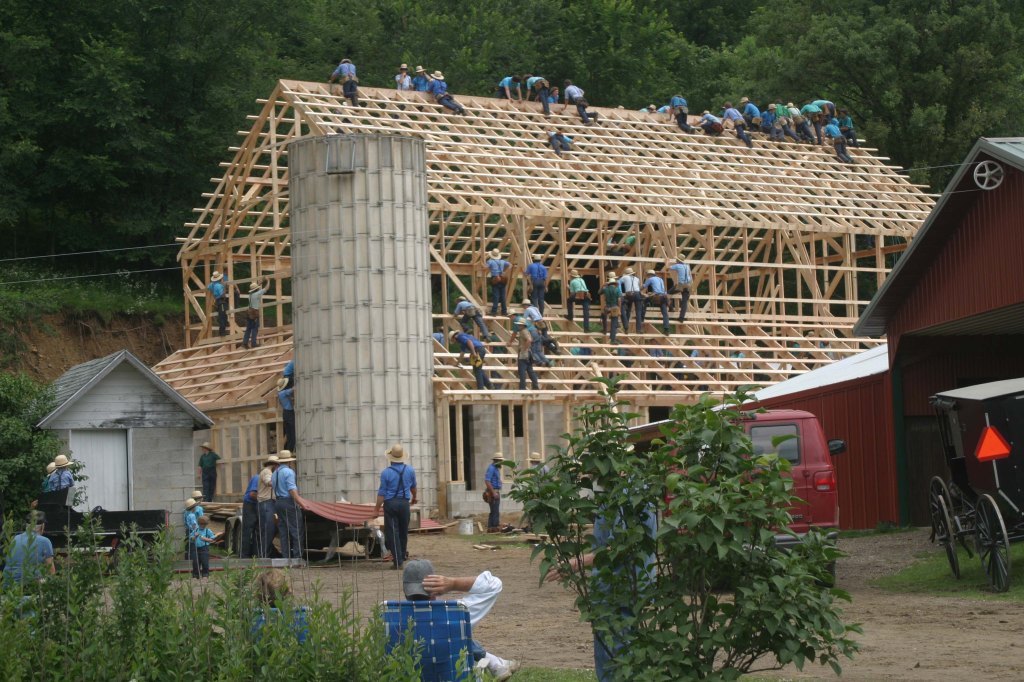
And yet not all there got the memo. We were more glorified acquaintances. Sure, we would smile, shake hands, and make small talk together. There was also that cultural and ethnic component that did give a kind of closeness. There were also those last vestiges of the Anabaptist barn-raising spirit. However, like those veils on the female heads or the foot-washing rituals, it all seemed to be mostly symbolic. A father might set his own son up in business, but no man in the church would ever think of doing the same for a non-family member in the congregation. It was superficial closeness.

Amish community spirit…

I’ve heard it explained before that religious groups hijack the language of family to create a false sense of closeness. At first, I had bristled at this suggestion. It felt like they were trying to discredit this special spiritual bond that people of like faith share. However, if we were close as family, let alone closer than blood, would we even need to use this familiar language? Wouldn’t it just be self-evident, like when Charlotte told me she would rather die with me than go on living without?

It is in that weird territory of language, like when some feel compelled to pray in old English as if this somehow reverences their prayers or those hypocrites that Jesus condemned for their love of important titles. One starts to be able to see through the pretense. There’s a vast difference between the man who treats you as a brother, offers protection, like big Tony Fisher did for me in school, and the people who use the right terms as a way to acquire resources or maintain status.

But, for me, those intuitions only came after being played a fool many times.

And perhaps I learned that lesson a little too well?

It’s Not You, It’s Me

I have trust issues.

And I’m not completely sure why.

It could have something to do with my premature birth and spending my first weeks in a plastic box rather than bonding with my mom. It could simply be a natural disposition. But I do know that I was the one child in my family who had separation anxiety and would go into panic mode if my mom would leave me for a moment to take out the trash. I was clingy and fearful.

Still, I was an extremely trusting person at one time, and long before I knew names like Jerry Sandusky or Jeriah Mast, when I lived in this sort of “Leave It To Beaver” world where people were true as their smiles and everything worked out in the end.

And that’s how childhood should be. Children may pretend, but they don’t put on masks in the same way as an adult and tend to be open about their intentions and accepting of even strangers. It is often easier to talk to eighteen-year-old girls than it is to have a conversation with those that are in their mid-twenties and that’s likely because the latter group understands that male attention usually means romantic interest. We become cagey as we become older, it is a way to protect ourselves from those who might do us harm or simply defile with their hopes of more than we’re willing to offer them.

For me, everything went downhill after puberty and with that gradual (often excruciatingly painful) loss of innocence. One of my earliest memories is walking hand in hand with my cousin when we were five years old. I don’t even talk to her anymore. She’s married to a privileged wackadoodle and didn’t appreciate my opinions of where his far-left politics will lead. Even if that weren’t the case, we probably wouldn’t be holding hands anymore even if we were on better terms. I mean, I would, because I still have fond memories, and yet I’m weird.

Anyhow, my own fear of rejection, a product of my purest hopes being smashed over and over again, has metastasized into disillusionment. I have a hard time trusting. I start to pull away when I sense the slightest bit of phoniness in another person. Call it despair, call it depression, I prefer to think of it as preserving what little sanity I have left, but I don’t want to have fake friendships anymore. I’m tired. Exhausted by it all, truthfully, and simply want to withdraw to the safety of not caring or concerning myself with those who are only going through the motions.

Impossible Expectations, Loving Our Dysfunctional Families

My expectations are impossible. But, then again, they should be. We are told, in Scripture, that with faith all things are possible. And, therefore, if someone declares otherwise, says that they can’t love or live as a Christian ought to live, it is because they lack faith.

Either that or it is all made up.

The thing that has most fed my own fear and doubt, is how people in the church don’t really act any different from people outside of it. In other words, if we don’t act like family then are we even Christians?

My Orthodox parish has a good number of converts and some older singles like me. There is a sort of closeness that came initially, as we traded stories about our experience, and it was very exciting for someone who had looked for depth elsewhere and had come out disappointed. However, there is this class, a sort of misfit club, of converts that is very similar to the Protestant fundamentalists of my past. They are really caught up in getting the Orthodox rituals right and somewhat neglecting as far as the meat of faith which is this self-sacrificial familial love.

My moon shot…

The thing is, I came into this damaged. I had shot for the moon, in faith, and somehow ended up in Williamsport, at Holy Cross, wondering what happened. My expectations were low and it wasn’t about the “smells and bells” to me. There was a combination of things that brought me, excellent theology, Fr. Anthony’s fatherly care, and a connection to the ancient Church. Since I knew no one local who was Orthodox, I went in simply seeking a place to worship and not expecting much. But I did meet many good people there, some who did embrace me as family, I’ll never forget that old woman (I can’t even recall who it was) who warmly told me “welcome home” after my Chrismation.

As with everything in faith, familial love is a work in progress and there are bound to be many failures along the way. At best, we’re a dysfunctional family, like many American families, caught up in our own lives, acting like Protestants when things don’t go our way, and not as truly full of love and grace as we are for our own blood. My want of perfection, and pursuit of the impossibility, must first and foremost mean that I love those who are difficult to love, love who let me down and abandon me, and let God judge those who do not meet my own expectations.

Therefore, as God’s chosen people, holy and dearly loved, clothe yourselves with compassion, kindness, humility, gentleness and patience. Bear with each other and forgive one another if any of you has a grievance against someone. Forgive as the Lord forgave you. And over all these virtues put on love, which binds them all together in perfect unity.

Colossians 3:12‭-‬14 NIV

What Is Love, Friendship, Humanity?

Still, the thought that plagues me most and probably always will is this question of if real love even exists at all. I’m not talking about those passing feelings of fondness we have for another person, but that spiritual bond and willingness to sacrifice ourselves for the good of others. As I’ve posited before, there is a selfish component to love. Not only those who say they “love” someone and then kill them in a jealous rage either. But it seems that it is impossible to love without getting something in return.

It is always nice when a server pays attention to me. I would certainly like to believe that they like me. And I’m guessing a few would actually enjoy spending time with me outside of work too. I’m a polite and considerate guy, I also tend to lay a heavier tip when there’s some conversation that comes along with the meal. I do, indeed, go out because staying home would be lonely and alone since it is simply too hard to coordinate plans with friends or I don’t know whom to ask. So I’ll pay for that time with another human. But it can also be unfulfilling. The relationship could have an element of truth and yet really it is centered on the economic transaction or they would be inviting me to hang out when they’re not on the clock.

There is a scene, in Blade Runner 2049, a science fiction thriller about what it means to be human, that illustrates the point. The story follows, K, a “replicant” (or bioengineered ‘human’), and his relationship with his girlfriend named Joi. Except she is not flesh and blood, not even human, but artificial intelligence, software on a computer, with a holographic projection. Still, despite this, the relationship is real. And, when the device containing her (their memories together that made the interaction meaningful) is crushed, he mourns. As the audience, you feel some pain. Yet, later, an interactive sign, with her likeness, uses the same pet name, and it is obvious that the original Joi was programmed to “fall in love” with anyone who wanted companionship.

The part that gets to me is how hormones and the positive feedback loop of emotions is, practically speaking, the same as programming. So how are the emotional responses we receive from others any more authentic than that of Joi?

What about our own friendships?

Why do we favor some people over others?

Do we love people or do we merely enjoy what benefits we get from them and that’s why we show such strong preference. Sure, there are some who are kinder and more willing to give attention to the unattractive or social outcasts. However, as far as real commitment, ongoing investment, we generally spare that for those most likely to produce a return. In other words, we love those who do what we want them to do, have something we want in terms of their physical form, intellect, or other abilities, or simply feel drawn to as a result of our coding and subconscious desires.

And then we expect people to stay at the level of friendship assigned to them. One sure way to make things awkward is to make an expression of love that is more intimate or deep than the level the other person wants. Asking a girl on a date is a good way to get put on her blocked list, to get an industrial strength cold shoulder, and even if she was seeming to enjoy the relationship up until then. Why? Well, maybe the ‘friendship’ was a social obligation more than anything authentic? You just know, when push comes to shove, most on your social media friends list aren’t going to be there for you, or at least not like blood relatives.

The Impossible Love

Still, I’m not comfortable with this mechanistic, bound by programming and mere product of circumstances, perspective. If love is not a choice, if we can only love those who are attractive, have resources we want, or are this sort of enjoyable reflection of ourselves, then we would not have agency or the ability to follow the commands to love God and our neighbors. Can we really do that? Do people ever go beyond and actually transcend themselves by loving those whom they would not naturally love?

I’m not sure, when I look at the Christian experiment, that I see much evidence of these relationships that are closer than blood. I mean, maybe, if we were willing to “fake it until we make it” then we would be able to overcome. Isn’t that what faith is really about, doing things that are uncomfortable, going against our own natural condition, or an exercise? I’m pretty sure my grandparents didn’t always feel like loving each other and yet going through the motions of a relationship, in those tough times, is how their love became such pure gold. Sixty years of marriage is impossible for many today because they’ve decided to be ruled by what is comfortable at the moment.

So when church people say they can’t love, and I’m talking about any kind of love, what they’re actually saying is that they don’t believe. It is agnosticism, denial of the humanity of another, and have refused to see the command of Christ as being actually true. When we decide we can’t love as we ought to love or pretend that we are loving while we truly are not, we are essentially making Scripture into a lie. At that point we are nothing but animals following after our programmed instincts and selfish desires. Do you truly love the body of Christ as much as you do your own blood?

I’m not there yet…

Struggle, Meaning of Life and Suicide

Standard

In the early hours of a Sunday morning, I was lying in bed, engaged in a conversation with an old classmate, now living in New Zealand, about the drug overdose death of someone familiar to both of us and what it says about the times we live in.

The dialogue itself, scattered about my morning routine, was an example of the unique pressure of modern life. Our discourse continued, in fragmented text message form, one of us going to bed soon and the other starting their day, past my short nap, beyond my morning shower, on the way to church and ended only as I entered the sanctuary for worship.

My “smartphone” allowed me a level of connection to someone on the opposite side of the world that was impossible a generation ago. And I am glad to be able to maintain this relationship despite the distance and for the electronic tool in my hand that allowed me to do this once unimaginable feat with ease. But this device also deprived me of some extra sleep, it often interrupts my most private moments, distracts me while driving, and does not allow me to be singularly focused. It comes along to work, to the gym, while I’m out dining, and visiting friends, and is almost impossible to control.

My grandpa had morning chores—mundane physical tasks like feeding animals, milking a few cows or shoveling manure. And grandma too—she would, in the wee hours of the day, go about making breakfast for her working man and the family clan. But they likely did not (at least not frequently) get a surprise visit from a former debate partner (geared up for a discussion of weighty matters) while they were in bed and still seeing double.

So, what did we discuss?

The rate of drug overdoses and number of suicides have risen dramatically over the past few decades and for poor middle-aged white men in particular. Several of my former classmates have now become part of this statistical category and, sadly, their stories are being repeated over and over again across the United States and especially in rural areas. The suicide rate for African American men has actually decreased over the same time period, which has led to some speculation as to why this is the case.

My left-leaning friend speculated this is a product of eroding “white male privilege” and yet all the cases that I am familiar with involved men who were, since childhood, as disenfranchised as anyone by the current system. There was never an erosion for them because they never had this imagined privileged status, they grew up in predominately white communities, from working-class homes, they didn’t go to college, they couldn’t seem to get out of their rut of low-paying jobs, relationship drama or financial woes, struggled against addiction and depression.

No, while true that white men are not a protected class and some do endure a significant amount of bullying and are just expected to take it, I do not see this as the real issue. Men in prior generations went into mines, labored hard under the sun, endured the terror of war, worked long-shifts on the assembly line and all without the help of a psychiatrist to tell them how to feel. They were just supposed to suck it up and keep going, against the odds, for the good of their communities and families—which is exactly what they did.

What has changed?

A more likely explanation for the increase in suicide and drug abuse is a combination of factors rather than one—the evaporation of economic opportunity and dissolution of the family unit and communities, along with the hectic pace of modern life, playing primary roles in the epidemic. A couple of decades ago decent paying manufacturing jobs were plentiful, the community was strong (usually with a local church as the nucleus) and the world’s problems were not constantly being shoved in our faces in a 24-7 on cable news, social media, etc. There have been big changes in rural America and some are impacted more than others.

The media deluge…

In the 1990s Ted Turner’s CNN was a novelty, the breathless reporting of alleged atrocities used to sell the American public on the Persian Gulf War, and only a foreshadowing of the media deluge to come. Two decades later there is almost no escape, there is no time anymore to process the information assaulting us from all angles, and the coverage is by and large negative.

Then there is the explosion of social media. It is a world where we primarily see the highlights of the lives of our friends and skews towards a positive presentation—because nobody wants to be that person.

This alone doesn’t drive anyone into depression and despair. But it certainly can help to feed feelings of isolation, it can never replace in-the-flesh social interaction, and could leave a person feeling overwhelmed. I mean, how can we not be influenced by this endless stream of information? It is a far cry from the time of our grandparents when yesterday’s news arrived in print form and the only scandal that really mattered was that juicy bit of gossip overheard on the party line.

Could it be that we aren’t built to take in the world all at once?

Could it be that we are reaching our capacity to handle and that the most vulnerable are first to fall down under this load?

We should consider the increase in suicides and drug overdoses as the “canary in a coal mine” and an indication of something very wrong in the air of our current culture. Where some have been overcome by the noxious fumes there are probably many more who are gasping for breath or in the beginning stages of hypoxia and need to be guided back to fresh air or they will soon also perish. An overdose of bad news and fear-mongering propaganda won’t take a strong person down, but it might be enough to push the vulnerable over the edge.

Working more for less…

Twenty years ago, in the towns around where I grew up in (prior to the NAFTA disaster) the wheels of industry were still turning and a blue-collar worker could easily make $20/hour or more working a factory shift. Yes, the cracks of outsourcing where beginning to show before this, the domestic steel and auto industry collapsed against cheap foreign imports before then, but it was mostly big urban areas like Detroit and Baltimore that felt the pain. We still proudly produced furniture, paper, bread, cable assemblies, and various other products before these businesses were shuttered.

However, since then we have felt the full brunt of trade policies that primarily have benefitted globalist elites. Since the 1990s, dozens of factory doors have closed in my own immediate area and nothing came to replace them. Well, nothing besides more low paying retail jobs—shopping centers springing up in the same lots, literally, where many men and women once made a wage where they had a chance of economic advancement. The idea that everyone could simply get some additional education and become a computer programmer or a professional with a bachelor’s degree has become the out-of-touch “let them eat cake” statement of the modern era.

Wages have stagnated in a time when costs in housing, healthcare, education, and housing have skyrocketed. The cost of college, for example, has gone up at eight times the pace of wages, in 2016, home prices increased at twice the rate of inflation, and we now spend thirty times what we did for healthcare a few decades ago. And again, this is a change the predominantly white working-class men who, unlike many others in the economy, have no control of their wages and, in addition, are often in direct competition with illegal immigrants for the same jobs. There is no professional licensing to protect the jobs of the yard guy or the drywaller—thus they are forced to work more for less.

Only the wealthy elites and beneficiaries of the welfare system have come out on top. For those taught that their value is in their ability to provide for their own, who are unable to compete in the academic or intellectual realm, prospects can indeed be very bleak and especially when coupled with other factors like failed relationships, lack of community and loss of purpose. It is no surprise that in this environment more are turning to the various means of escape available to them—with suicide being the ultimate expression of their deep despair.

Life without purpose…

The one place where rates of suicide are higher is amongst those who are part of the Native American population. This, coupled with substance abuse, has been a tragic outgrowth of the reservation system for many years and underscores the problem of a purposeless existence. There is not much to do on a reservation. The land is rural and very sparsely populated, the opportunities for gainful employment are extremely limited, basic needs are often subsidized by the government, many succumb to feelings of boredom and/or isolation and decide to end what seems (from their perspective) to be a purposeless life.

I believe the circumstances leading to higher suicides on reservations are very similar to that of many non-Natives living in rural areas. We all have an idea of what we are supposed to be, we have religious and cultural expectations to live up to, but not all are able to overcome the obstacles between themselves and these higher aspirations. Perhaps they were born into a dysfunctional home, sexually abused, are less naturally gifted than their peers, born in a time of declining wages and are unable to compete in the market or attain their life goals? Failure early on can lead a person into self-defeating cycles, especially when there is nobody intervening to help overcome them, and the result is depression, substance abuse, etc.

Men, at least in rural America, are expected to be the “breadwinner” for their families. Those who do not provide are disparaged as “deadbeat dads,” he cannot simply abort his bad decisions, and will be on the hook financially long after his fifteen minutes of fun is up. It is a matter of Christian conscience, the Bible says that a man who does not provide for his own “is worse than an infidel” (1 Tim. 5:8 KJV), and is a standard that is embedded in our laws. And, truth be told, most men don’t need to be told that their children are their own responsibly either. So, naturally, it is no small thing for men conditioned this way to underperform or fail at their duties.

Men unable to provide adequately (according to cultural norms) for themselves or their families will struggle to find great purpose anywhere else. And while there is the “welfare queen” pejorative to describe a woman who fraudulently games the system, women were traditionally dependent on men to provide financially and there is not nearly the same stigma for a woman who is unable provided financially for her own needs. Things may have changed elsewhere, but in rural America, a man who doesn’t pay child support, even for children he is rarely (if ever) allowed to see is considered to be worthless and a bum.

Relationships are less stable than they were when marital commitment meant something and yet, in a time of wage stagnation, men are still expected to carry the financial burden. The purpose religion once brought men (beyond their work and family) has been under withering assault for many years now, but the yoke of moral responsibility has not faded away and leaves many to struggle in the wilderness alone. So it comes as no surprise when men, surrounded by dysfunction, deprived of their purpose and absent of any real help, could see death by their own hands as something honorable.

From an article about veterans returning to ‘normal’ civilian life:

Now one was looking for work in Wisconsin, one had killed himself, and several had returned to Afghanistan to get back into the fight. Most of them wanted to be back there, in their own ways. Like so many vets, they missed the camaraderie. And as with so many vets, their lives at home were defined less by togetherness than by isolation, which took on many forms. Dodd was in Kansas City making aerospace bolts and smoking weed on his breaks to stave off the stress of “dumb-ass civilian questions.” Simpson was working the phones at a call center for the Department of Veterans Affairs, talking to vets who wanted counseling or benefits or sometimes nothing at all, other than to talk with another combat veteran.

Men would rather be in a literal war than alone and stuck in a purposeless life.

Lack of community…

The collapse of community is one thing my left-leaning friend did seem to strongly agree on as a possible explanation for the epidemic of drug use and despair. His definition of community tended towards civic engagement and mine went in the direction of religious involvement, but we both agreed that this is something essential. And that community, real life “in the flesh” community, has been on a precipitous decline and especially in rural America.

This is the trend even in the conservative Mennonite culture I was born into and spent many years of my life. Guilt-driven church attendance may be holding steady, there is certainly more involvement there than in some other segments of society, but there has definitely been a big change in my lifetime. Sunday evening visits became far less frequent, more parents choose to homeschool their children rather than risk other schooling options and the church community has more or less devolved into a conglomeration of cliques. Of the dozens who called me “brother” over the years, as part of religious ritual, only a couple (primarily one family) have checked in to see how I’ve been doing.

A community is one of those underrated privileges. It is a place where you are missed when you’re gone, where a person can live with far less material wealth and still be happy having their place in the social fabric. Even a slightly dysfunctional community offers protections, a social support network, for those that are a part of it and the individual members are all stronger as a result. Communities take many different forms and can center around many different things. It can be as simple as a group of friends who care about each other and do things together. It can be a military unit that is compelled to do drills together, who eat, sleep and live as a group, and where comradery is encouraged.

In rural America, in the past, the church was often a center of a community, a place where people got together for worship, to make perogies together and share each others’ burdens. Church attendance has been in steady decline, “nones” now constitute the largest religious group affiliation, and with this, there has been a parallel decline in mental health.

And organized religion isn’t the only dwindling expression of rural community, volunteer fire departments are having difficulty filling their ranks—people are too busy with their other obligations and do not have the time.

People also have fewer close friends than they once did according to a recent study, in the time between 1985 and 2004 Americans have gone from an average of three close friends to only two, and this implies a shrinking support network.

The increase in social isolation cannot be good for those already vulnerable.

A profile of a vulnerable person…

When I saw a friend request from “Adam Bartlett” it was a name that I recognized immediately and accepted without hesitation.

Adam was a grade below mine in school. He was one of those anonymous in a crowd people, average height, not particularly athletic or anything, friendly enough, and not too different from me other than my being Mennonite. We both went out for football the same year, he quit the team early (which, in my teenage mind, made me think of him as a quitter) and that is pretty much all I knew about him—there was a gap of twenty years before I heard from him again.

It was not too long after connecting on Facebook that I received a message from Adam. We chatted briefly about a mutual acquaintance, my being off work because of an ACL tear, a shared interest in firearms, how he wanted to reconnect with “old friends” because he had few friends anymore, I offered the next weekend might be a possibility and left it at that—we never did get together the next weekend despite my offer and his interest.

However, a month after that he messaged me about his financial woes. He was upside down in his car payments and was hoping that I could help him out with that. I felt bad about his situation. But, I was not in a position to purchase the vehicle and was not very interested even if I did have the extra cash. It was in the course of that discussion where we ventured a little into his relationship problems, he told me his wife stopped paying bills without telling him and things would soon go from bad to worse.

In our next exchange, he asked me for a place to sleep. His wife had moved back with her parents and he told me he was not welcome to stay there. Of course, being that we had just got reconnected, and also considering that I was on the road all week in the truck, I was leery of having him live in my house alone. Still, he definitely needed help. I decided, rather than have him move in, to pay his security deposit and the first month of rent instead.

He accepted this solution. We met a few days later in the Big Lots parking lot where I handed him a check for his rent.

Then, on the spur of the moment, I asked if we could pray together, he said we could. So I put my hand on his shoulder, prayed that he could get his life turned around and hoped my small contribution would make a difference.

Later on, in many different private conversations online, he complained about the hypocrisy of Christians (including his significant other) and would ask me many questions. Why couldn’t these different denominations agree on anything in the Bible? Which denomination was right? How could his wife be so dogmatic about things like Creationism and then cheat on him over and over again?

Adam had basically given up on religion.

He was rightly skeptical too.

However, it seemed that the prayer had helped. He never did use the check that I gave him, he eventually would start to attend church services again, his social media posts seemed more positive, and last I had known he was back with his wife and daughters.

There were still problems at work and at home. Our last conversation, that he initiated, was on the topic of his drinking habits. He told me that alcohol made him honest, even more spiritual, but was frustrated because his wife disapproved. Perhaps I could have called him out a bit more or been a little more forceful with my opinion, because he definitely sounded like an alcoholic excusing his bad habit—but I figured I would not win an argument and, rather than say too much, simply encouraged him to honor his wife.

A year so after our alcohol discussion, I asked, “How have things been going for you?”

He never did answer.

Adam had confided many things and, both for the sake of those struggling and for those who wish to do something to help, I’ve decided to share his story more openly than I would otherwise. His dysfunctional home life was only made worse by the fact that he had been exploited, as a child, by a sexual predator (a college professor) who was only very recently prosecuted for his serial abuses and given a light prison sentence. He had no real friends in the world, he seemed to try to bury his pain using substance, and this coping strategy, evidently, failed him in the end.

In August, less than a year ago, Adam gunned down a man who had emerged from the apartment where his wife had moved and then, using the same handgun, took his own life.