Jesus vs. the Narcissists: When Compassion For ‘Others’ is the Ultimate Offense

Standard

Q: How do you enrage a narcissist?

A: Tell them they’re not the most important person in the world.

There’s this mess of entitlement, of eternal victimhood, self-admiration and severe lack of empathy we call narcissism.  And it does seem to be everywhere, most especially in a situation where someone is able to escape normal pushback for their overinflated self-image and sense of importance.  But this is not something new or merely a product of modern life—it is as old as the Bible.

What Jesus confronted most severely in the religious elites of his day was a narcissistic attitude.  Indeed, he was not killed as threat to Rome.  The Roman authority, despite the facilitation of the mob, did not buy into their reasoning and declared him to be  innocent.  The real issue is that Jesus offended an ideological cult of ethno-supremacists, those who believed a book (or rather their own errant and self-serving interpretation of the text) made them a cut above all other people.  

They believed that they were God’s favorites and yet Jesus said even the rocks could accomplish the mission.  He did not need their permission to speak and insulted them at every turn.  How did he insult?  Well, mostly by reminding them that God loved all people and not just their own tribe.  In defiance of their narcissistic self-belief, he held up the good examples of Samaritans, Canaanites, Syrians and Romans—presenting the foreigner as a righteous contrast to them.  And they could not argue with him, he knew their Scripture better than they did, so they killed him.

Here’s six examples of where Jesus took on the ethno-nationalist pride and narcissism of religious peers: 

1. The Parable of the Good Samaritan (Luke 10:25-37)

In response to a lawyer asking about who is our neighbor, Jesus tells a parable where a Samaritan (despised as ethnic outsiders by Jews) acts heroically with mercy, while a Jewish priest and Levite ignore a wounded man. This framing of an answer intentionally swerves off the beaten path to offend his ethno-supremacist audience by portraying their loathed ‘enemy’ favorably and implying that true neighborliness is something that transcends ethnic boundaries:

In reply Jesus said: “A man was going down from Jerusalem to Jericho, when he was attacked by robbers. They stripped him of his clothes, beat him and went away, leaving him half dead. A priest happened to be going down the same road, and when he saw the man, he passed by on the other side. So too, a Levite, when he came to the place and saw him, passed by on the other side. But a Samaritan, as he traveled, came where the man was; and when he saw him, he took pity on him. […] “Which of these three do you think was a neighbor to the man who fell into the hands of robbers?” The expert in the law replied, “The one who had mercy on him.” Jesus told him, “Go and do likewise.”

Imagine that, this smug religious expert, who thought he was self-justified, getting shown up rhetorically by the outsider.

2. The Faith of the Roman Centurion (Matthew 8:5-13)

A Roman centurion (a Gentile military occupier) approaches Jesus to heal his servant. Jesus not only heals but praises the centurion’s faith as surpassing anything being found “in Israel,” and implicitly rebuking the Pharisees’ assumption of Jewish spiritual superiority. This favorable portrayal of this Gentile outsider was extremely offensive to these ethno-supremacists:

When Jesus had entered Capernaum, a centurion came to him, asking for help. “Lord,” he said, “my servant lies at home paralyzed, suffering terribly.” […] When Jesus heard this, he was amazed and said to those following him, “Truly I tell you, I have not found anyone in Israel with such great faith. I say to you that many will come from the east and west, and will take their places at the feast with Abraham, Isaac and Jacob in the kingdom of heaven. But the subjects of the kingdom will be thrown outside, into the darkness, where there will be weeping and gnashing of teeth.”

He’s stomping on their entitlement at the end, literally saying that they’ll be thrown out and then replaced by Gentiles in God’s kingdom!

3. The Faith of the Canaanite Woman (Matthew 15:21-28)

Jesus initially tests a Canaanite woman (a Gentile outsider) seeking healing for her daughter but he ultimately commends her persistent faith and grants the request. This interaction challenges Pharisaic purity laws and ethnocentrism by showing a non-Jew’s faith as exemplary, even using the language which highlights ethnic barriers only to overcome them:

A Canaanite woman from that vicinity came to him, crying out, “Lord, Son of David, have mercy on me! My daughter is demon-possessed and suffering terribly.” Jesus did not answer a word. So his disciples came to him and urged him, “Send her away, for she keeps crying out after us.” He answered, “I was sent only to the lost sheep of Israel.” The woman came and knelt before him. “Lord, help me!” she said. He replied, “It is not right to take the children’s bread and toss it to the dogs.” “Yes it is, Lord,” she said. “Even the dogs eat the crumbs that fall from their master’s table.” Then Jesus said to her, “Woman, you have great faith! Your request is granted.” And her daughter was healed at that moment.

This passage illustrates the ethnic-supremacist attitudes of even the disciples of Jesus.  Whereas today, in the West, you can barely say people are different in ability without it being controversial, nobody cared that this woman was referred to as a dog in this audience.  But his actions of love and compassion spoke louder than his words and this woman’s lack of narcissism was a stark contrast to the prideful racist disciples  Her prayer was answered because she was humble.

4. The Healing of the Ten Lepers (Luke 17:11-19)

Jesus heals ten lepers, but only one—a Samaritan (an ethnic outsider)—returns to thank him. Jesus highlights this Samaritan’s faith, questioning where the other nine (presumably Jews) are, thus favoring the outsider and critiquing ingratitude among insiders:

As he was going into a village, ten men who had leprosy met him. They stood at a distance and called out in a loud voice, “Jesus, Master, have pity on us!” […] One of them, when he saw he was healed, came back, praising God in a loud voice. He threw himself at Jesus’ feet and thanked him—and he was a Samaritan. Jesus asked, “Were not all ten cleansed? Where are the other nine? Has no one returned to give praise to God except this foreigner?” Then he said to him, “Rise and go; your faith has made you well.”

The entitled can’t show gratitude.  Perhaps, as the self-declared chosen, the others who never came back felt they deserved this healing—that it was their birth right?  But Jesus was unimpressed by them and highlighted the foreigner who was thankful instead.

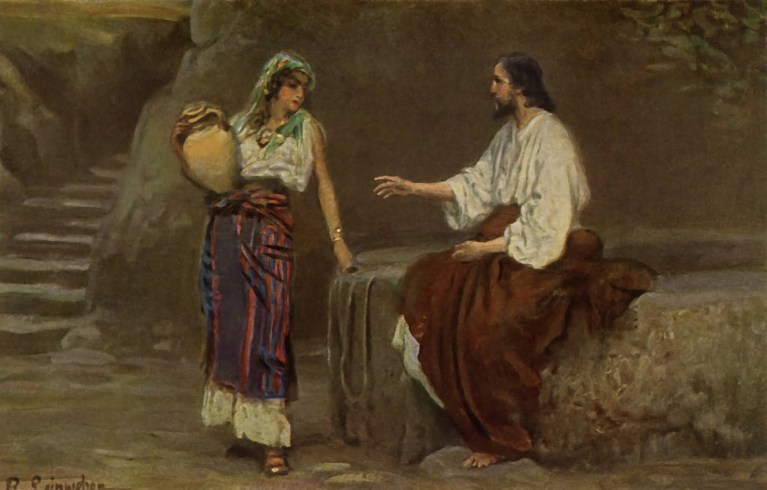
5. The Samaritan Woman at the Well (John 4:1-42)

Below Jesus initiates a conversation with a lowly Samaritan woman (an outcast on multiple fronts: Samaritan and female), he reveals himself as the Messiah, and leads to many Samaritans believing in him. This breaches ethnic and social barriers, totally offending Pharisaic norms of separation, as the Jews typically avoided Samaritans:

When a Samaritan woman came to draw water, Jesus said to her, “Will you give me a drink?” […] The Samaritan woman said to him, “You are a Jew and I am a Samaritan woman. How can you ask me for a drink?” (For Jews do not associate with Samaritans.) […]  Many of the Samaritans from that town believed in him because of the woman’s testimony, “He told me everything I ever did.”  So when the Samaritans came to him, they urged him to stay with them, and he stayed two days. And because of his words many more became believers.

This was Jesus deliberately breaking down a barrier.  The Jews of this time weren’t just racist, but sexist as well, and would see this entire encounter as an egregious violation.  Here Jesus was humanizing the Samaritan enemy and—even more scandalously—he was talking directly to a woman!  While rebuking his own ethnic and religious tribe he hung out with the impure!

He’s practically as evil as Tucker Carlson…

6. Jesus’ Sermon in Nazareth (Luke 4:16-30)

In his hometown synagogue, Jesus reads from Isaiah and then references the Old Testament prophets helping Gentiles (a widow in Sidon and Naaman the Syrian) instead of Israelites during times of need. This enrages the crowd, who try to kill him right there and then, as it directly challenges their ethno-supremacist expectations that God’s favor is exclusive to Jews:

“Truly I tell you,” he continued, “no prophet is accepted in his hometown. I assure you that there were many widows in Israel in Elijah’s time, when the sky was shut for three and a half years and there was a severe famine throughout the land.  Yet Elijah was not sent to any of them, but to a widow in Zarephath in the region of Sidon. And there were many in Israel with leprosy in the time of Elisha the prophet, yet not one of them was cleansed—only Naaman the Syrian.”  All the people in the synagogue were furious when they heard this.  They got up, drove him out of the town, and took him to the brow of the hill on which the town was built, in order to throw him off the cliff.  But he walked right through the crowd and went on his way.

The passages all illustrate Jesus’ pattern of associating with and elevating of outsiders, which offended the Pharisees’ ethnocentric pride and their self-righteous “we’re chosen people” claims by his stubborn inclusion of sinners, tax collectors, and Gentiles.  

Had it not been for a miracle Jesus may be remembered as being thrown off a cliff for praising the foreigners in front of a Jewish audience.  He was hitting them directly in their Hindenburg sized egos.  They had the most severe case our own [excrement] don’t stink that’s possible.

Ms. Rachel is an ‘anti-Semite’ for loving all children?

 A Zionist organization, StopAntisemitism, has named Rachel Griffin Accurso, a very popular children’s content creator, a finalist for their “Antisemite of the Year” and for a very specific offense: Ms. Rachel dared to treat the suffering of Palestinian children as equal to that of Jewish people!  How dare she humanize the child of an enemy!  Those in this Zionist cult love themselves only and make a strict dichotomy between their own and the dogs.  The spirit that Jesus rebuked is maintained in this perverse tradition.

I didn’t know much about Ms. Rachel prior to the birth of my daughter, but she’s not a Hamas apologist or sympathizer and has expressed similar sentiments about Israeli and African children.  Only the arrogant Zio-bots used her concern as a cause for their vicious accusations and vile labels.  They can be the only victims and treating Gaza’s children with the same love as their own is a terrible offense in their supremacist eyes—only their suffering can matter.  

He didn’t say Hamas.  He said Palestinians.

Ms Rachel committed their most grievous sin of believing children are not terrorists because of where they are born and now—as another enemy—she must be destroyed.

That is the narcissistic attitude of Zionism.  You must choose between them and others, they cannot share your concern with those who are inferior beings.  It’s an insult, as if they have been made equal to a dog, which is what they think of us Gentiles.  Listen to what they say, they believe that they should be treated like gods—in the words of Jewish supremacist and the former chief Rabbi of Israel, Ovadia-Yosef:

“Goyim (gentiles, non-Jews) were born only to serve us. Without that, they have no place in the world – only to serve the People of Israel,” he said, according to the Jerusalem Post. “Why are gentiles needed? They will work, they will plow, they will reap. We will sit like an effendi and eat. That is why gentiles were created.” 

Rabbi Ovadia-Yosef, in his own words

Treated as our lords.  That is the nature of Zionism.  It is about their narcissistic view that they deserve to be our masters and to do with us as they please—as they may an ox that plows their fields.  Which is what is so disturbing about an Israel-Firster, Ben Shapiro, proclaiming that retirement is stupid and that Americans should work until they drop.  Says a guy who sits around and talks as an occupation.  This, of course, does not represent all Jews or Israeli citizens, but it is written in the Talmud and lines up with the Likud party leadership of Israel.

Zionism does not represent all Jews.

Zionists don’t just want to rule over the current territory of Israel or the Holy Lands.  No, they want Jerusalem to be the hub of their Greater Israel and later one world government where their own version of a Messiah cleanses the world of all who defy them.  They rule because you’re too stupid to live free.

Judas wanted an Israel like this.  A worldly kingdom where he would be served.  Jesus, by sharp contrast, taught a kingdom not of this world—where the greatest would serve rather than be served.  He corrected heresy that made the blessing of Abraham only about a genetic inheritance rather than a matter of sharing the patriarch’s sincere and simple faith.  It was the very opposite of what they believed they were owed as the self-declared special people.  Jesus offended by telling them they weren’t special and calling the children of the Devil rather than of Abraham.  Ethnic supremacy and self-righteous pride is the basis of Zionism, Christianity heralds repentance as the foundation of true faith in God, as John the Baptist declared:

But when he saw many of the Pharisees and Sadducees coming to where he was baptizing, he said to them: “You brood of vipers! Who warned you to flee from the coming wrath? Produce fruit in keeping with repentance. And do not think you can say to yourselves, ‘We have Abraham as our father.’ I tell you that out of these stones God can raise up children for Abraham.  The ax is already at the root of the trees, and every tree that does not produce good fruit will be cut down and thrown into the fire. 

(Matthew 3:7-10 NIV)

Water is wet.  The sky is blue.  You can’t be a Christian and a Zionist too.  We must pick one or the other.  There is no union between light and darkness, no yoking of believer to unbeliever, we either believe what we’re told in the Gospel about a “synagogue of Satan” (Rev 3:9) and who Jesus himself declared to be children of their father the Devil (John 8:44) or we deny that Christ is King.  It’s just astounding to see so many who either never read the New Testament or had eyes glazed over in those sections where Jesus rebuked those who thought their Jewish supremacy and genetic ties to Abraham would save them.

The unrepentant narcissist will never enter the kingdom of heaven.  Pride was the sin of Satan who thought he could rival God and it is also the sin of those who rejected Jesus for his acceptance of all and not caring about their ethnic pedigree.  They hated him for exposing them as religious frauds.  And the campaign they waged against him was very similar to that being used currently to try to silence critics of Israel.  The role of a good Goy is to simply believe whatever they say and allow them to be the gods they believe they are—to kill or rape as they please.


Built for Scarcity: Why I Won’t Give My Son Everything He Wants

Standard

I’ve tried to give my son everything he needs to succeed. But that doesn’t mean I will give him everything he wants. There’s a reality in any pursuit: to be excellent, you’ll need to put in the work or delay gratification to reach your full potential. If a parent gives a child everything they want, there’s no incentive for them to learn and improve.

To a child, everything provided for them is a given, and every task required is an injustice. Why should they have to wash the dishes? The grumbling or attempts to negotiate last longer than the time it would take to finish the chore. And, honestly, the easy route is just to do it ourselves. But that deprives a child of the opportunity to learn all those transferable life skills—at the very least, to get a little practice being helpful rather than entitled.

In the West we already have abundance and the result is atrophied muscles and dull minds.

If we shower children with abundance, they will never appreciate what is given nor ever be satisfied. It seems that no matter what we have, we always want more. If given the moon, we’ll want the other planets and the stars as well—and then we still won’t be happy with that. The greatest satisfaction comes through work and accomplishment. Playing video games all day or scrolling social-media feeds may trip reward centers, but it amounts to empty calories and can’t replace substance.

I’ve watched spontaneous interviews with very wealthy men, and nearly every one of them says that their abundance did not bring happiness. At least one admitted he was suicidal despite millions in assets. Our peak enjoyment in life comes when we invest time, effort, and resources and eventually reap the fruit of our labor. Sure, going to the gym may be difficult, but the endorphins are addicting and the muscles are a reward.

Built for Scarcity—Not Utopia

I watched a video about the problems with utopia, and the framing of capitalism as a system built for scarcity was correct. We would need a radically different way of ordering ourselves if the things we wanted just grew on trees. If you could have whatever you wanted without effort, why would you pay for anything or even care who owns it? My property rights only matter because it costs something to acquire or replace the things I own. If everything we wanted was free and completely abundant, we wouldn’t need to value it at all.

The presenter, who seemed intelligent enough, made a critical flaw while talking about providers of generative AI. He claimed that those charging for the service were creating artificial scarcity “because the code is open-source or whatever.” But this totally ignores the immense computing power that’s required—the powerful microchips, massive amounts of energy, and the staff needed to keep it all running. So no, that isn’t an example of abundance.

I’m used to naïve takes coming from the religious side, but it’s fascinating to see secular thinkers stumble over the very same things. Yet it touches directly on the human condition. We are not wired for abundance. Ultimately, even if we could reduce human labor to zero, our brains were created for scarcity, and when faced with unnatural abundance we don’t actually do very well.

Wall-E is probably the best depiction of a world of abundance that goes well.  It could go in many directions, unhealthy ease the better of the many scenarios.

Material wealth, to start with, is never a cure for boredom or lust. If anything, those who have all their physical needs met are often left with a void of purpose. Their abundance never creates fulfillment or a reason to be in the world. And some appetites are basically insatiable: a man can have all the sex he wants and still desire the one he cannot have. It is often the ultra-wealthy—those who have everything we imagine would make us happy—who are also the most perverse and dissatisfied.

It reminds me how young-earth creationist (YEC) types often portray entropy as purely negative when it is as necessary for life as order. Fertile soil, for example, contains organic compounds that come from dead plants and animals. This is part of a cycle—neither good nor bad—like the weather. The same forces that bring a spring shower can also leave behind a swath of destruction. Creativity itself often lives at the edge of order and disorder. You may not enjoy a messy room that needs cleaning, but without it your life would probably feel pointless.

Furthermore, social hierarchy would be the only game left if we completely removed the need for productivity and occupation. If AI replaced all jobs, the result might be material abundance, but not utopia. As the saying goes, “Idle hands are the devil’s workshop,” and some people with nothing to do will create drama. Boredom is good when it provokes us to create something new, but bad when the “new thing” is us causing trouble for others for lack of something else to do. It is better when we need to do something productive to survive, because we’re primed for it.

Consider how an overly sterile environment can trigger autoimmune disorders; similar problems would arise in a world where struggle was fully removed. It wouldn’t solve our environmental or energy problems—there would still have to be limits and rationing to keep from stripping the planet bare. Some people will never be content with the base level of property and possessions. There will still be scarcity even if human labor is no longer a cost. Advantages will still exist. At that point a new hierarchy will form—perhaps one based solely on beauty or charisma—where many have no path to “level up.”

In capitalism, while there’s an advantage to those who go first, there are multiple paths to success. Sure, there is cost-cutting at the expense of quality (see the Campbell’s Soup controversy), but there is also genuine efficiency and a system where nothing need go to waste. Bad actors create opportunities for others. If Enzo Ferrari hadn’t been a pompous jerk, we wouldn’t have Ford’s GT40 legacy or Lamborghini. Ferrari’s rude remarks were the provocation that pushed others to build cars capable of beating his. In a free market there is a profit motive to share rather than hoard. In a post-labor AI world where elites no longer need human workers or customers, would they have any incentive to distribute limited resources?

Abundance, Unearned, Robs Good Character

The video is correct that abundance won’t lead to utopia—yet it misses the deeper reason why. It isn’t just that we’d get bored or turn to status games (true as that is). The real problem is that abundance without cost quietly deletes the only proven mechanism we have for turning a human being into a person worth becoming. 

When everything is given for free, nothing is cherished.  When nothing is earned, nobody is grateful.  When no one is grateful, no one is generous.  When no one is generous, society stops being a community and it becomes a zoo with really nice cages: no material need unmet, the trough always full, and yet we are no different from a lion removed from its natural habitat.

That’s why I won’t hand my son the life he thinks he wants. I’ll give him everything he truly needs: enough security to take risks, enough scarcity to make victories sweet, enough resistance to grow muscle around his soul. I’ll let him wash the dishes, wait for the game he saved up to buy, lose the race he didn’t train hard enough for, feel the sting of “not yet” and the glory of “I finally did it”.

That feeling of a hard fought win cannot be artificially produced.  In a world where AI leads the way can there be human thriving?

Because the cruelest thing a parent can do isn’t to let a child struggle.  The cruelest thing is to raise him in a world so padded, so instantly gratifying, so artificially abundant that he never discovers the one truth every happy adult eventually learns: The joy was never in finally getting the thing.  The joy was in finally becoming the kind of person who could get it—and still know it wasn’t the point.

Scarcity isn’t the enemy of human flourishing.  It’s the narrow gate we have to squeeze through to find out who we actually are.  And I want my son on the other side of that gate—tired, scarred, proud, alive, and deeply, durably grateful—not because he was given the universe, but because he earned his small, yet irreplaceable and fully human corner of it.

Dismantling of the Penn State Colossus

Standard

Growing up, college sports, or even sports in general, were not part of my world. My father didn’t toss a football with me in the backyard or gather us around the TV for games—work was his recreation, and that was our normal. I had no reason to care. But something shifted later in high school, culminating in my going out for football my senior year, and I found myself very drawn to Penn State, captivated by the legacy of Joe Paterno and the blue-and-white pride that defined it.

In the years just prior to my tuned in, Penn State had soared to new heights, claiming two national championships and cementing its place as a powerhouse. For that fleeting moment, the Nittany Lions were the best in the gane. State College, just to the west of me, was the heart of this empire—a house that Paterno, a son of Italian immigrants from Brooklyn, had built. He was not just a coach; he was a living legend, embodying the loyalty, community, and tradition that made Penn State more than a football team—it was a shining symbol of our American values at their finest.

I didn’t love Paterno because he won every game. In fact, other than a Rose Bowl win, the program had definitely taken a half step back from the prominence of the 1980s. It was their “success with honor” mantra and Paterno’s commitment to the “kids” as part of his “Grand Experiment” philosophy that had attracted me. Paterno’s stated mission was not only to win on Saturday, but to build men through the game. At least according the brand, the win at all costs attitude was anathema. We are Penn State meant being at a higher standard on and off the field.

The Scandalous End of an Era

There are many good things that Paterno is rightfully remembered for. But history is not kind to those not true to their values and the legacy of “success with honor” is not what any of us wanted as fans from a distance. The man who lived in a very modest house adjacent to the campus—and had donated $4.2 million to the university library—was embroiled in a situation completely at odds with the character of his program. This, of course, being the horrific revelations about Jerry Sandusky—a former Paterno assistant—who was found guilty of sexual abuse of children and was for years according to the allegations.

Shock and denial are a natural response as a defense mechanism. Penn State fandom was more part of our identity where the “We are” was supposed to be a call to a certain moral code and standard. It was supposed to be about more W’s on Saturday and thus it was unthinkable that there was a sexual predator potentially being protected by the program. Those of us who accepted that it happened still wanted to minimize and keep it separate from the man who had preached excellence on and off the field. To this day this is something to be wrestled with—what did he really know and when?

My current stance is that Paterno prioritized the program over everything else. Similar to how religious institutions (like CAM or the Catholic church) too often try to deal with embarrassing issues internally—as a way to minimize fallout—there’s always the desire to save the ‘mission’ by undermining pursuit of the full truth or actual justice. In the end this little leaven of a moral compromise for sake will leaven the whole lump. However, expediency often trumps principles and the putting of reputation first started with Todd Hodne, in the 1970s, when the rapes of the prized Long Island football recruit began to be known. Paterno wanted to deal quietly with these kinds of ‘problems’ and it would blow up in his face at the end.

Hodne was a violent and vile predator.  Initially the rape allegations were hushed.

In my conversations with a cousin, who is a generation younger than me and far less of an idealist, my being completely appalled at fan behavior in the wake of coach Franklin’s collapse is silliness. He says the toxicity is everywhere and, basically, that I should not expect the Penn State football community to be exceptional. Even in response to my own posts on social media some of my friends believe that it is okay to make their vicious attacks against players and future prospects—because apparently sportsmanship is not a goal in the era of NIL money?  To me there has been something we have lost in our dignity and self-respect when we pile on young athletes and those who have invested far more than most in the bleachers ever did.

It feels like the culture has been hollowed out. An ethos has been lost. And my own disappointment with the sudden realization of the total absence of anything that actually distinguishes Penn State today, other than a few symbols and slogans, the final dismantling of the Paterno legacy that I’ve protected so long is complete. Why pretend? Integrity was neglected. And the thin veneer of The Grand Experiment philosophy has long ago worn away, we are not what we’ve claimed to be, we’re just another sports ball brand—class and character a mere facade.

Penn State peaked in the 1980s and has been in a ‘wilderness’ of ten win seasons since. 

Demystifying is the first step in dismantling the Colossus. With the transfer portal and NIL the era of loyalty and commitment to a higher ideal is over. But this shifting is one that goes beyond the football field or Penn State fan base. This is just a microcosm of the failure of the United States of being this “city on a hill” that was imagined by Puritan preacher John Winthrop. The “We are” is a localized flavor of American exceptionalism or the declaration of our unique quality and superiority over others. It is delusion.

It is also decay…

Reclaiming Lost American Values

The erosion of American values, particularly those intangible qualities that once defined community, loyalty, and collective spirit, is vividly reflected in the current state of college football, the influence of Name, Image, and Likeness (NIL) deals, and the broader societal shift toward prioritizing money over meaning. These three threads—Penn State’s football struggles, the commodification of college athletics, and the personal lesson of a child fixated on monetary rewards—converge to reveal a deeper cultural loss that is harder to pinpoint but profoundly felt.

At Penn State, the football program’s collapse mirrors a broader unraveling of shared purpose. The team’s 3-3 record in 2025, with losses to Northwestern, UCLA, and Oregon, has extinguished playoff hopes, compounded by the season-ending injury to quarterback Drew Allar. The program, once ranked #2, has been plagued by self-inflicted wounds—stupid penalties, turnovers, and a lack of team chemistry despite returning key players. The toxic “fire Franklin” narrative, fueled by fans and possibly amplified by wealthy alumni, has created a vicious cycle of negativity. This environment, where success is taken for granted and loyalty to coach James Franklin is eroded, reflects a loss of the communal spirit that once defined college football.

The fans’ inability to appreciate last year’s achievements, coupled with the pressure of high expectations, has turned a storied program into a cautionary tale of how a community’s values—patience, unity, and resilience—can erode under the weight of entitlement and short-term thinking. The prospect of rebuilding under new leadership may spark a recruiting bounce or an influx of NIL funds, but it also risks perpetuating a cycle where only wins and money matter, leaving little room for the intangible pride that once fueled rivalries like the one against Ohio State.

The field at Beaver Stadium is now “West Shore Home Field” after a large donation.  How long before Penn State’s no-name jerseys are replaced with corporate sponsors?

This shift is starkly evident in the rise of NIL, which has transformed college football from a bastion of amateurism into a billionaire’s playground. The purity of the sport, where loyalty to a program and the concept of the student-athlete once held sway, has been supplanted by a system where, as Mark Cuban’s “big number” donation to Indiana University athletics illustrates, wealth dictates outcomes. Fans no longer celebrate players who stay an extra year out of commitment; instead, they view them as paid mercenaries, unworthy of respect or admiration unless they deliver victories.

This also mirrors a broader societal decline in volunteerism and good sportsmanship—values that once rivaled capitalism in shaping America’s identity. The community spirit that made school sports a unifying force has been replaced by a transactional mindset, where loyalty is bought, not earned. This shift reflects a deeper cultural loss: the unquantifiable sense of duty to others or something greater than oneself, whether a team, a school, or a nation.

As the current system prioritizes individual profit over program or principle, it signals a collapse of the traditions that made college football a symbol of American unity, leaving behind a hollow pursuit of wins at any cost.

Now billionaires and corporations rule college athletics in the age of NIL.

This same erosion of values plays out on a personal level for me, where my tying my son’s chores to cash rewards has instilled a mindset in him that everything must have an immediate reward or monetary payoff. This mirrors the broader societal trend where wealth is the sole measure of success, undermining the concept of family as a unit bound by mutual care rather than financial transactions.

In cultures like the Philippines, where my wife is from, multigenerational support is just a given, but in America, the collapse of family unit and community has fueled reliance on pay based systems like elderly care, which often exploit the most vulnerable and leave little for future generations.

This shift away from communal responsibility toward an extreme individualism and personal profit reflects a loss of the intangible values—selflessness, duty, and shared burden—that once made America redeemable, if not great. And the rise of socialism, decried by conservatives, is less a cause than it is a symptom of this deficiency, as needy people seek external systems to replace the community support that has faded.

These threads—Penn State’s demoralized and debased fanbase, commodification of college sports through NIL in general, and my own struggle as a father of a teenager to instill non-monetary values—point to a broader cultural decay. The current loss of American values like loyalty, community, and tradition is not easily quantified, as they were woven into the fabric of what it meant to be American, and never before required definition or separate designation.

NIL, like the toxic fan culture or a child’s fixation on cash, is a symptom of a deeper disease: a society that prioritizes money and winning over the unmeasurable qualities that once held it together. This shift, felt more than seen, leaves us grappling with a question: if we cannot identify what we’ve lost, how can we hope to reclaim it?

Records Come and Go—Family Is Forever

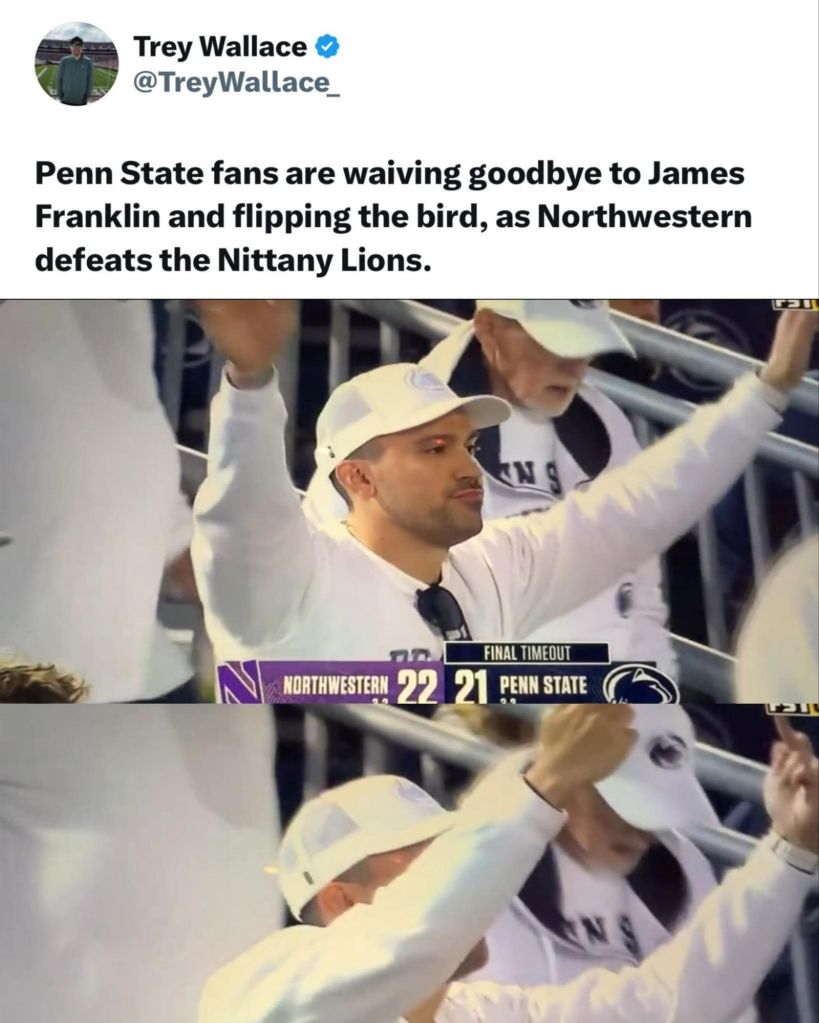
After the Northwestern game, a third loss this year, Franklin waited until everyone else—including his daughter—had gone through the tunnel before he strode through. This is likely because he knew what awaited him—taunts and trash being hurled.

Father and daughter.  Franklin was determined to be a better father than his own.

In comparison to the stupid entitled clowns, Franklin is a class act. He is the father protecting his family. A standard bearer for Paterno (an Italian surname that means father) or at least the commendable part of the late coach’s legacy. I have seen some of the comments online, one claiming Franklin was arrogant because he had only answered one of their emails or something of similar entitled quality—as if he could just sit responding to every moron harassing him. But the players who played for him are unanimous in their support.

In fact, one of the saddest things I’ve seen is the current Penn State roster expressing their guilt over his firing for “not playing well enough” to please the raving lunatics. They didn’t fail Franklin, the fans failed them and the Penn State tradition.

The players taking responsibility is a sign of a relationship with a man who told them his demands of them as players start with love and end with love. In other words, this was a high pressure environment, expectations were high, and yet it was for their good that he challenged them to be better. And, truth be told, Franklin’s teams punch above their weight. He was a player’s coach and that is why Penn State is bleeding top recruits who were coming to State College for something different under his leadership.

The “fire Franklin” types love to talk about how he “couldn’t win the big game” and yet neglect to mention his teams were almost always coming in as the underdog and with less talent and depth than their top ranked rivals. Or, in basic English, he was coaching them up to the level of the elites. And this a testament to his philosophy that had built on the positive part of Paterno’s legacy—he valued the players for more than the wins or losses and they responded with loyalty and inspired football.

Nobody will ever say Franklin was the best game manager or play caller. But then the online critics keep going back to a couple plays a decade ago. A run on 4th and five against Ohio State or kicking a field goal in a 28-0 Michigan game ending the shutout. But ultimately they were one play from the national championship game last year and Franklin was third behind two other coaches from 2022–2024 with a 34-8 overall record during that span—trailing only Kirby Smart (Georgia, 39-5) and Ryan Day (Ohio State, 36-7) for wins. Good luck finding the guy who will top that after we cut the soul out of the program that drew the talent that we did have. Who will come to State College to be nitpicked and unappreciated?

I loved a family man arriving at Penn State and to see it end as it has just makes me think we don’t deserve what we have.

The toxic part of the Penn State fan base is transactional. They believe their watching a game entitles them to perfection execution and results. I mean, imagine that, a howling mass of ingratitude made of mostly grown men who are apparently that unhappy with how their own life went that everything now is a matter of wins on Saturday. Most did not go to The Pennsylvania State University nor do they have any real investment in any tradition of excellence—like that which was upheld by Franklin’s family approach.

Franklin deserved better. He was not a DEI hire. He is certainly not a terrible coach. It is his players—who carry on his legacy—that actually matter. Penn State football should never be about pleasing drunk Uncle Ricos who failed at life, it should continue to be oriented towards success in life. Truly the few Saturdays under the lights are not a measure of a man. Franklin’s tenure should be remembered as a battle against wider societal decay—where the development of moral character and the building of community are too often sacrificed for the fleeting victories or short-term financial gains.

Pattern recognition isn’t for everyone.
Twelve teams with the most National Championships

Both Nick Saban and Urban Meyer, who are legendary coaches, expressed their support for Franklin. And to think delusional Penn State fans believed that they could replace Franklin with one of these two (already past retirement age) by waving a little money in their faces. No, nobody is coming to State College to be unappreciated for producing one winning season after another. We will be lucky to find any successful coach who is tempted by the job—let alone replace all of those who decommitted or will transfer now that James Franklin is gone.

Values Beyond the Scoreboard

In this blog—Irregular Ideation—my struggle with the disconnect between stated values and the values they truly live out. People claim to believe one thing and yet live something else. I’ve dealt with this in the religious and romantic sphere, the disappointment, this false notion that virtue would always win over mere physical or economic superiority. Mennonites teach that the meek shall inherit the Earth or that the first shall be last—these being Christian concepts about the kingdom of Jesus. But the reality lived is always different from that ideal preached.

The reality is that everyone is in it to win it. Yes, even that sweet and submissive young woman doesn’t date no scrubs. Sure, maybe a pious individual will adjust some language or settle on one rather than playing the field, but ultimately they’re going for the status or strength and attractiveness everyone else in the world pursues. Some overestimate the market value they have, but even in love we are being self-sacrificial or altruistic. We’re motivated by hormones and sexual desires—often things we’re not even totally aware of behind our wall of moral rationalizations and narratives.

With denial of this is the delusion that good things will happen to good people. We tend to confuse physical beauty with virtue as it serves our own carnal desires to see them as one and the same. I mean, who wants to say the quiet part out loud by admitting they picked Joe over Bob because he was taller or had charisma? We may say things about nurturing or character traits but this is code for nice breasts and big biceps. So what I am getting at is that we dress all this stuff up as something it is not and revelation of what is underneath is not debasement—it simply exposes what always existed.

From Paterno trying to bury the truth about Todd Hodne to the firing of Franklin, the true ruthless nature of college football culture is revealed.

Beaver Stadium rises out of the valley floor, an edifice, a temple where sacrifices were made in the name of success.

Beaver Stadium rises up from the farm fields of Happy Valley, a monument to Pennsylvania pride, like the “city on a hill” of American exceptionalism. But success was not built on anything different here as it was anywhere else. What is buried is the reality it is always about aggression, financial gain, and wins. The Grand Experiment failed and Penn State had to be like everyone else if it wanted to reach the top. Furthermore, there is a sense in which every program becomes a sort of family or builds men—Paterno was only unique for highlighting this.

Are there values beyond the scoreboard?

Is it a zero-sum game?

Yes and no. Friedrich Neitzsche describes “slave morality” or a system of ethics that reverses what we naturally value and then says this denial of reality is virtue. Woke is a manifestation of this, where they attempt to turn the world on its head and celebrate obesity, ugliness, criminal behavior or lack of ambition—and create an artificial reality—rather than deal squarely with the world as it is. Body positive isn’t going to spare you health consequences if you’re obese. Fair or not we must at some point deal with the cards we’ve been dealt and rise above our station or accept what we are. Mutilation of yourself to be something you’re not ends as badly as well. There really are no shortcuts to success or Uno Reverse cards to play—it is what it is on the scoreboard that matters to the world in the end.

Ultimately we also have our limits. We need expectations to match our abilities or we’ll end up in a spiral—always chasing what is beyond our reach rather than just building on what we have. I’ve seen it many times, those who leave a consistent and reliable partner, thinking they’ll do better out in the market, only to find out that (yet never will admit) that their discontentment played a trick on them and they had it better before than after. Not everyone can be a National Champion every year—it just isn’t possible—but we can have a family or community that respects all members and seeks only their best rather than tear them down.

Symbolic?

So maybe Penn State football does need to be dismantled and rebuilt to be great again?

It could be that, like the children of Israel in the wilderness, we’ll need this generation to pass so our children can enter the promised land?

If the foundation laid has led to this ugly spirit of entitlement then it was flawed. We might need to decide if football is so important we will lose our humanity or the immeasurable qualities not displayed on a scoreboard—for a “big game” win that won’t matter in a year or two. What does it truly matter if we gain the and lost our soul?

A race to the lowest common denominator is the end of civilization. Despite my lament above, I don’t believe life is all about money, sex and power—which ever order they come in. I still believe my elderly grandma had a beauty that was unsurpassed and morality is not just a smokescreen for our failure to be the best. Maybe the impossibility for me is possibility for my children. I cannot stay disillusioned. But, like I did in finally leaving my religious roots, I may need to also bury that delusion of Penn State excellence both on and off the field.

Not the tradition that made Penn State great.

Maybe the failure of The Grand Experiment was all Paterno’s own personal failure? Or maybe the message never went beyond the young men who loved him like players love Franklin today. But the Colossus now lies in ruins making me wonder if it was ever great to begin with. They didn’t just fire Franklin—they pushed over what remained of an ideal for sportsmanship, they’ve fully demolished the mythology that so inspired me. A giant ‘moral’ idol is gone—will something real rise up in its place?

Snow Woke—Disney’s Female Empowerment Fairytale

Standard

Apparently the Snow White remake bombed at the box office. We could just go with the standard “get woke, go broke” traditionalist assessment. Rachel Zegler comes off as the female equivalent of Andrew Tate—as being angry, entitled, selfish and toxic—which isn’t appealing to a broad audience.

But, before we get into the remake, let’s talk a bit about the original Disney animation of the fairytale. The character deviates quite a bit from the Grimm version. For a start, the fair-skinned protagonist is half the age (7 rather than 14) and there’s no “true love’s kiss” in this original version. Furthermore, she’s a sort of blank slate archetype—not some ideal 1930s homemaker mothering a bunch of dwarfs. In short, the adaptation then was not completely true to the source material and created an image of feminity relevant to that time.

The Grimm version was darker in tone and featured a prince weirdly obsessed with a dead girl in a glass coffin. The dwarfs did not have distinct personalities. And Snow White awakened when the poisoned apple is dislodged from her throat when a servant carrying her coffin stumbles. And it was at this point the prince professes his love and proposes marriage—which she accepts.

The latest Disney live-action takes liberties in a very different direction. It is even less true to the original (other than elimination of the Disney romance) and reimagines Snow White being a sort of feminist militia leader who leads a bloodless insurrection against the usurping queen. But the “mirror mirror on the wall” remains and a poisoned apple—despite the heavy edit of the script where an empowered woman replaces the worn damsel in distress trope.

Why People Don’t Like Snow Woke

People enjoy new takes on old genres, like Shrek or Furiosa and also powerful female characters such as Ellen Ripley in Aliens, Sarah Connor in Terminator or even Katniss Everdeen in the Hunger Games.  They were relatable, we saw them develop, circumstances made them tough to survive, and audiences loved them.  What they don’t like is preachy dialogue or lack of any real character development. A Mary Sue, a hero with no weaknesses, is unrelatable. It is the problem with Superman and with the many woke adaptations of stories.

We like the image of a woman against the machine.

Christian movies have a tendency to be bad for the same reasons. They can come off a little campy or forced. Sure, it may work for drawing your ideological camp, but it isn’t a compelling story for the unindoctrinated or the broader audience. Which is not to say that movies about Christianity can’t be great for entertainment.  I love gritty true stories like that of Hacksaw Ridge or profound, like Silence, will have anyone at the edge of their seats—the key being relatable characters.

Zegler is a bit much. Totally insufferable in the eyes of some. And she plays a part that is equally annoying. The departure from the source material is just too rude. Sure, there is room for an update, but you would never reinvent Rambo as well adjusted pacifist in a mission to avoid too much sun exposure. Disney dumped the essence of the original and replaced it with another tired ’empowered woman’ cliché. You wonder if Zegler herself wrote the script with lines like, “I’m not waiting for anyone to save me” or groaner, “The fairest isn’t about beauty—it’s about justice!”

Ouch.

Oh well, at least even apologists for woke seem to understand that it is just bad. They did not even bother accusing the audience of being racist or misogynistic this time around.

Smash the Symbolism!

What is truly lost is the symbolic depth of the original tale. Snow White was beauty and purity contrasted with the vanity and evil of the obsessed queen. They gutted what made the Grimm tale a significant message about the triumph of innocence over the destructive power of pride. This, obviously, is too nuanced for a superficial sexual organ obsessed militant far-leftist to understand. The producers of the new film replaced purity of motive against cunning with a banal competition for power.

It’s not even moral inversion. They totally lost the point. It makes me think they lack any layers to their being. It’s all about their grievance and getting back at those they’ve scapegoated for their own misery. Like the evil queen, with all the power, they envy the beauty and peace of others and attempt to kill it with their poisoned apple. Snow Woke is the toxic fruit. Zegler is an icon of their privileged ‘diverse’ female with an entitled chip on her shoulder and not the slightest bit of appreciation for all the good men who made her ignorance possible.

This is not to say those who are fixated on the literal whiteness of the actress are any better. Grimm was not writing about racial supremacy anymore than woke supremecy, if anything the original story was about our transcending politics and Zegler would be perfectly suited for the role if she were able to embody that spirit. But our culture, in a desperate need of critique, it dichotomizes everything—divides the world into friend or foe, as if life is a zero-sum game and there is never anything to gain through fusion of opposites.

Zegler is as Puritanical (and Pharisaical) as a religious fundamentalist. She reframes a rescuing prince as a stalker and romance as weird. More rigid than a patriarch, more domineering than the system she is taught to loath. A preacher rather than an actual protagonist. Basically, a young idealist who wields her moral certainty with a convert’s passion, and yet stumbling into hypocrisy under scrutiny—reaping benefits of every institution she claims to reject.

The Female Power of Beauty, Gentleness and Grace

A few years ago, I was in the checkout line and suddenly noticed the cashier. She was beautiful, pale or ashen-faced, with hair that was jet black, pleasant smile and yet there was something uncanny valleyish about her appearance. I could not quite put my finger on it. But then she spoke. This would send a shiver through me. Never before did I have that sort of feeling simply by hearing someone talk. There was a certain quality to her voice that was almost child-like, soft, pure, and really threw me for a loop. And it occurred to me that this young woman was a real life Snow White.  I had not thought this would actually be attractive in person, but it had me momentarily smitten.

As it would turn out, in a later conversation, I learned she was mixed race, Filipino mom and dad of some kind of European descent, which is likely what gave her this stunningly feminine appearance. Now, no doubt this gentle exterior was cover over a tough and capable individual. She drove an old pickup truck and lived apart from her family with a sister, and may well have been a teenager or in her early twenties. In many ways she is like Zegler (who is herself a mix of Colombian and Polish heritage), but this real-life Snow White wielded her beauty, gentleness, and grace as a quiet strength that captivated without preaching, Zegler’s strident zeal turns a timeless tale into a soapbox, losing the feminine power of subtlety for a hollow shout of self-righteousness.

This is what outspoken angry feminists fail to grasp, forcefulness isn’t the only kind of power. My petite wife could never command me to do anything. I’m 50% bigger than her and have twice the upper body strength, I would shrug it off. But she does not need to force me to do anything. She overpowers me by other means. For example, early on, before we were married, she convinced me to stop drinking so much soda, she told me water is a symbol of her love “pure and clean” and when I drink it I could feel her love. I didn’t need to be told twice.

When I look at my baby daughter I would do anything for her. She’s so vulnerable—there is a strong desire to protect and defend her—I’m drawn, not compelled.

So what does female empowerment really mean?

Is it empowering to a fish to be out of the water?

A visual representation of society telling individuals they need to be something else to be happy.

Humans are wired for their base biological and physical functions. Reproduction is a big part of this. It becomes clear after you see process through from courtship to baby in a carriage. Early in the pregnancy, given our financial goals, my wife had considered sending the yet to be both child to be raised by her mother. But as soon as the bundle of cuteness arrived, along with the appropriate hormones, it was never a question. Family is empowerment. My sacrifice, as a father, is more rewarding than the toys I could buy for myself as an independent bachelor.

We’re relational, not rational.

Therefore, the things we think will make us happy do not give us long-term fulfillment—the woke Zegler types are privileged, given preference as women or minorities, and yet always unhappy and looking at what others have and they do not. They are a paradox, enjoying female privilege—then miserable and wanting what men have.

It is toxic, it is their impurity of spirit, and it destroys their natural beauty and potential for true empowerment.

In all honesty, I don’t really have a problem with Zegler’s passion or outspokenness.  I guess I tend to prefer women with a real personality and feel she is right on the Gaza issue.  But what is wrong is that she’s not the right character to play what is supposed to be an embodiment of purity and the power of innocence against evil.  Snow White isn’t supposed to be Mockingjay or a story where physical force met with force—but of a different kind of power.

Ultimately, the 2025 Snow White stumbles not just as a film but as a misguided anthem, with Rachel Zegler’s shrill militancy drowning out the subtle power the Grimm tale once whispered. The original’s purity and even Disney’s 1937 grace knew strength isn’t loud—it’s captivating, like the cashier whose soft voice and uncanny beauty stopped me cold, a real-life Snow White wielding gentleness over force. My wife, too, overpowers me not with commands but with a love pure as water, turning a stubborn man into a willing protector, and just as our daughter’s vulnerability stirs my soul to shield her. Zegler’s remake, obsessed with preaching justice over enchantment, misses this: true feminine empowerment doesn’t need a megaphone or a militia—it’s the quiet, relational magic that binds us, a truth the poisoned apple of ‘Snow Woke’ chokes out, leaving a hollow echo where a fairytale’s heart once beat.

Mind Your Own Business — The Christian Response to Gossips and Busybodies

Standard

A few weeks ago a story swept across my Facebook feed about a young Mennonite man from Indiana who went missing after a visit with his girlfriend in Arkansas.  I quickly determined, after a brief look on Google maps at the points mentioned, that there was very little that I could do to help.  There are plenty of situations where my own inputs and interventions are truly needed and this was not one of them.

The need for my personal involvement didn’t change after he was found.  Yes, as a normal human being, I was curious about the circumstances surrounding his disappearance and hoped to eventually hear more about what happened.  However, there was no reason for me to pry or persist in an effort to find information, I was content to wait until his family was ready to share and truthfully didn’t need to know anymore than I already did.

However, some were not satisfied to simply rejoice with those who rejoice.  Some felt entitled to information, they felt that they deserved an explanation and more or less demanded immediate answers.  Making matters worse, the online discussion (including a page created to help locate the young man) quickly became and a cesspool of gossip and den of busybodies who seemed to take great pleasure in sharing their scandalous revelations.

Anyhow, because this does effect my newsfeed, and having had malicious nonsense spread about me in the past, and knowing what Scripture says on the topic of gossip, I want to make three points:

1) The young man didn’t ask to be turned into a public figure.

Family and friends decided to take their search public and the network of Mennonites on social media responded in force.  But that doesn’t mean that we should not respect the privacy of the young man.  The public handling of this was not his choice.  If their best interests (both his own and those of the people more intimately involved) are better served by not sharing more than has already been shared, then so be it.

2) You are not entitled to anything more than has already been revealed.

I’ve seen the spreading of rumors explained as need for closure and blame being put on those closest to the young man for their not revealing more information at this time.  That, of course, is complete nonsense.  Being asked to pray and assist in a search does not give anyone a right to know the juicy details and nor does morbid fascination.  There is no need to know anything more than what needs to be known.  He has been found, he is with those who love him, and that should be everything a reasonable person needs for closure.

3) Gossip is a sin and busybodies are severely condemned.

Curiosity is excusable.  I understand the want to know more about a story than is already known.  I can even see good reason to share, in the right time and place, about unflattering things discovered.  However, what I cannot excuse is sharing dirt on another person and publicly trashing them for no good reason.  True or not does not matter, what does matter is that we show the grace we wish to be shown and handle such matters in the way appropriate for a Christian.

There seems to be some confusion about what is appropriate and inappropriate sharing of information…

Fortunately there are Biblical passages that offer us strong clues.  In fact, being a “meddler” (1 Peter 4:15) or “gossip” (Romans 1:29) is mentioned in the same context as theft and murder and slander.  We are even told to disassociate ourselves from those who are “busybodies” (2 Thessalonians 3:11, 1 Timothy 5) as a result of their idleness.  And, if that condemnation is not enough, there is also this clear instruction:

Brothers and sisters, do not slander one another. Anyone who speaks against a brother or sister or judges them speaks against the law and judges it. When you judge the law, you are not keeping it, but sitting in judgment on it.  There is only one Lawgiver and Judge, the one who is able to save and destroy. But you—who are you to judge your neighbor? (James 4:11-12 NIV)

The word “slander” in the passage above is also translated as “speak evil” or “speak against” and doesn’t simply refer to false tales.  It comes from the Greek word “katalaleó” (καταλαλέω) and is defined by International Standard Bible Encyclopedia as follows:

Slander (etymologically a doublet of “scandal,” from OFr. esclandre, Latin scandalum, “stumblingblock”) is an accusation maliciously uttered, with the purpose or effect of damaging the reputation of another. As a rule it is a false charge (compare Matthew 5:11); but it may be a truth circulated insidiously and with a hostile purpose

It is important to note that this goes beyond the modern definition of slander.  It is saying something, true or untrue, in a way that is unnecessarily harmful to another person.  In other words, this means *not* revealing things in public about an individual that detract from their reputation.  That in contrast with sharing only what is helpful to another individual and of benefit:

Do not let any unwholesome talk come out of your mouths, but only what is helpful for building others up according to their needs, that it may benefit those who listen. (Ephesians 4:29 NIV)

There is a time and place for confronting sinful behavior.  However, unless the sin is already public knowledge and obvious (as in 1 Corinthians 5) or something that must be reported immediately to civil authorities like sexual abuse, the process of confrontation should always start one-on-one with the offending individual in private:

If your brother or sister sins, go and point out their fault, just between the two of you.  If they listen to you, you have won them over.  But if they will not listen, take one or two others along, so that ‘every matter may be established by the testimony of two or three witnesses.’  If they still refuse to listen, tell it to the church; and if they refuse to listen even to the church, treat them as you would a pagan or a tax collector. (Matthew 18:15‭-‬17 NIV)

In light of this, spreading scandalous information about another person just because you can is never appropriate for a Christian.  It goes completely against Biblical instruction to “make it your ambition to lead a quiet life” and to “mind your own business” (1 Thessalonians 4:11) and amounts to a sin as bad as any other.

As for closure…

There are certainly those who should be working with this young man to help and restore him.  But there are many more (in the online crowd) who have no role in that and should be mindful of what Jesus told those who brought an adulterous woman out to be condemned: “Let anyone of you who is without sin cast the first stone…”

Christians should have no time for gossip and no place for busybodies in their ranks.  There is no duty to tell the world about things than can (and should) remain private and absolutely no need for salacious appetites to be fed.  So, if you desperately need closure, use the opportunity to reflect on your own attitudes and actions.

When exception rules…

Standard

image

My boss and I generally get along well.  He has his preferences, I have my own preferences and usually we are able to find an agreement.  But occasionally there are times of conflict as well.

Most of the conflicts are caused by abuse of exceptions.  Exceptions are those times when my usual ‘rules’ are stretched to allow something I otherwise do not tolerate.  Surprises, working weekends or working too late on a Friday are some of my understood (but unwritten) terms.

It is reasonable in the industry I am in that some flexibility is required.  Delays often arise that are no fault of my employer and are the surprises I must tolerate to be reasonable.  Then there are favors or the times I am flexible just because my boss is my friend and I want a good relationship.  I will sometimes break my rules voluntarily as a matter of good will.

However, there seems to be a limit to how many exceptions can be made before the exceptions begin to become the rule.  If I do too many favors soon they become expected entitlements rather than appreciated exceptions. 

When I feel the balance of our mutual self-interests has been violated too far I will respond with protests.  I suppose if my boss would not respond appropriately there would be further reaching consequences.

Broader Application and Implications

Individuals make arrangements between themselves my boss and I do.  Groups of people also make arrangements with their individual parts that allow exceptions to the general rules for representatives of the group or to benefit exceptions within the group.

For example, there is an expectation that if one wants to eat they should work, but we do make exceptions for children and the disabled.  But that list of beneficiaries can eventually grow to include irresponsible adults and those less truly disabled.  It can also morph from being a special exception into an entitlement that is eventually is unfair to those paying the cost and abuse.

If the group never considers the needs of exceptions that is also a failure and negligence.  It may not be at a noticeable cost to the group right away when the weak and minorities are unprotected or considered only an afterthought, but there is a cost even if it isn’t measured in financial losses.  Lack of compassion is a moral loss.

Keeping a Balance of All Factors

This complex mobile of competing interests must constantly be fine tuned to maintain an appropriate balance.  Part of balance is order of priority.  It is recommended in an airliner cabin depressurization emergency that adults put their own masks on first so they aren’t incapacitated and unable to help others. 

image

Rules must always define the exceptions in the same way the gravity that defines the order of a mobile must be respected or chaos will be the result.  The picture of the Liebherr crane mobile above (watch this video) is a prime example.  It is an exceptional display of engineering and some flexibility in weight bearing capacity, yet there are underlying rules that must be followed or the whole system will collapse.

The results of miscalculation, ignoring factors that influence stability and over stressing various structures (social, physical or otherwise) can result in catastrophic failures.  Failure like that of “Big Blue” which fell into a tangled heap on a gusty day:

image

Prevent disasters by finding a balance that puts rules and exceptions in proper order and plans for the winds of life.