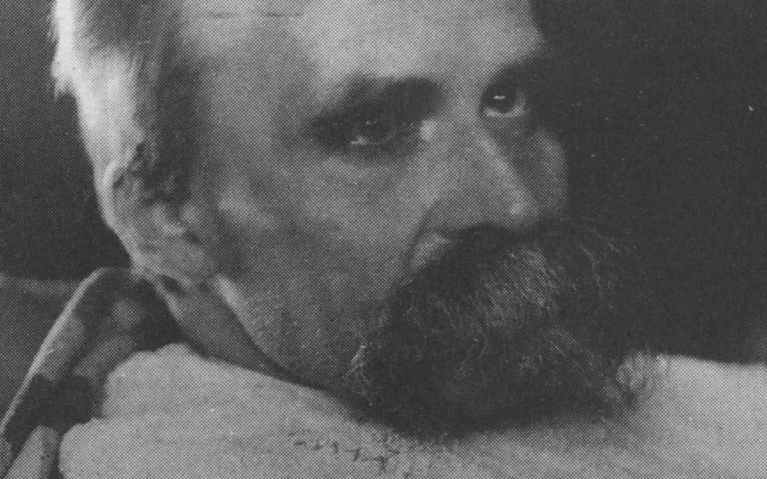
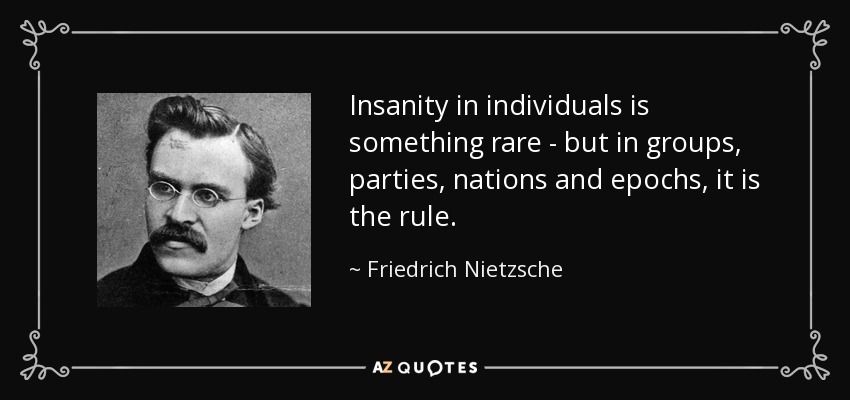
A religious fundamentalist might see Nietzsche’s “Madman” parable as an attack on faith. The German philosopher Friedrich Nietzsche’s mental decline and tragic end could seem like an obvious consequence. His bold claim that “God is dead” would naturally lead to madness, wouldn’t it?
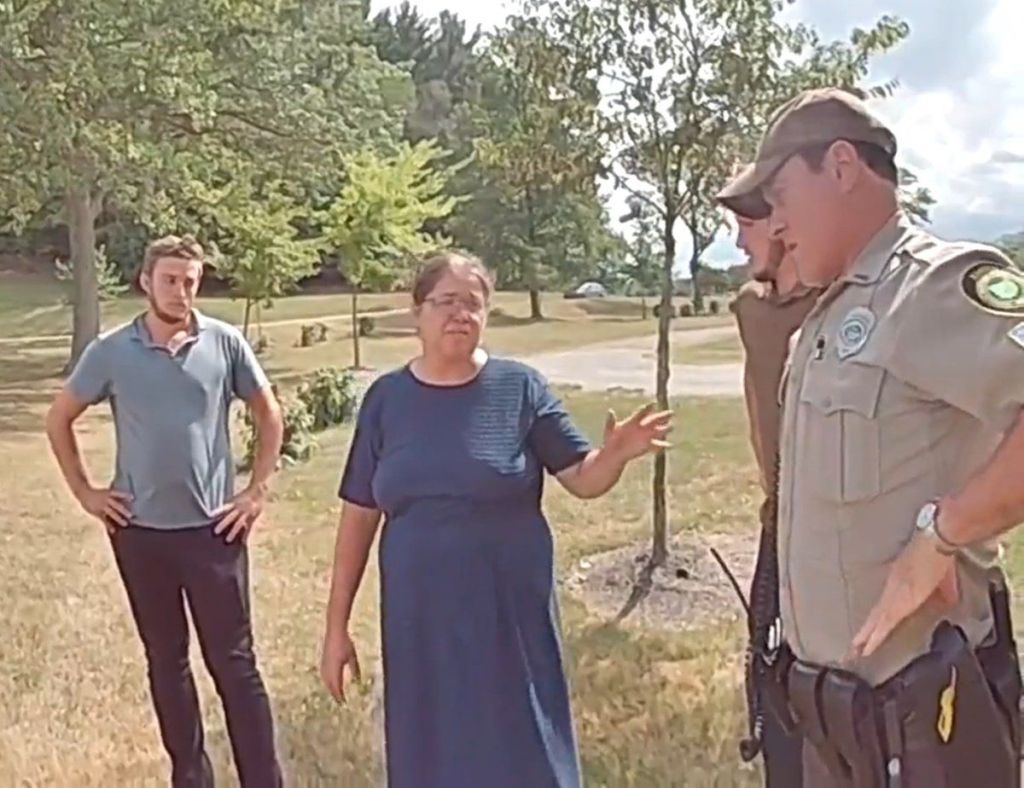
Recently, I came across the story of Ruth Miller, an Amish woman whose religious convictions led to an unthinkable act. In a state of spiritual delusion, she drove her 4-year-old son, Vincen, to a lake and “gave him to God” by throwing him into the water resulting in his drowning. This awful tragedy following immediately after the accidental drowning of her husband Marcus during a failed attempt to swim to a sandbar in an effort to prove his faith.
Both belief in God or disbelief really does not make a difference as far as our mental health. We can attribute beliefs to actions, like the divisive assumption—of black and white thinkers—that Decarlos Brown Jr. was motivated by racial animus. Or realize that our human psyche is capable of dangerous misfires no matter our skin color category or ideological affiliation. Black, Amish or Atheist, all can have psychological breaks from reality originating from family history or environmental factors.
In the case of Nietzsche, who suffered from a breakdown at the age of 44—while seeing a horse being flogged—the theories of why he declined range from neurosyphilis to the possibility of frontotemporal dementia and a brain tumor. It could be a combination of factors, and maybe the very thing that made him brilliant also part of his downfall?
Nietzsche had a busy and relentless mind, his “will to power” philosophy itself perhaps a way to cope with a world that didn’t align with what his cultural heritage told him. He had to take things to their ends, he was not content with the answers he was given and this tendency of his mind being rooted deep in the composition of his brain—progressive disease and circumstances finally pushing him over the edge into insanity?
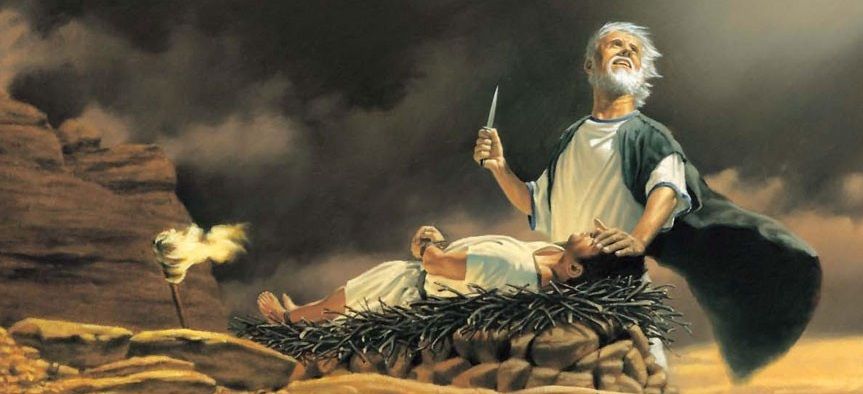
Likewise, the Amish mother, a pious woman by appearances, didn’t process her religious teachings the same as others in her church and tradition. For better or for worse, most claim to take the Bible literally would never attempt to do the things that they’ve read in the book. In a modern context a parent who is willing to sacrifice a child to God is rightly considered mad. But for Abraham it was a proof of his righteousness:
By faith Abraham, when God tested him, offered Isaac as a sacrifice. He who had embraced the promises was about to sacrifice his one and only son, even though God had said to him, “It is through Isaac that your offspring will be reckoned.” Abraham reasoned that God could even raise the dead, and so in a manner of speaking he did receive Isaac back from death.
(Hebrews 11:17-19 NIV)
That’s one way to explain away an irrational act of Abraham tying up his child, and then putting him pyre to be a sacrifice to God. It is just plain madness otherwise. Is it really any wonder a delusional mind would follow this pattern in the Holy texts? I mean, truly, the crazier part is how we can read through this in Sunday school class without being a bit disturbed. Only when someone starts to act in this kind of ‘faith’ does anyone notice it is completely unacceptable.
Faith or lunacy?
But then we’re all mad. Half of us claim it is okay to dismember a living human being in the womb because their existence is a big inconvenience for an adult woman. While the other half thinks it is okay dismember a living human being in Gaza because of what Hamas did a couple of years ago. All seem willing to sacrifice little children in the ‘right’ circumstances. We’ll praise those who end the life of the innocent when this aligns with an imagined ideal outcome or future. We’ll all say the other is irrational and evil while justifying our own violence.
But, I digress, we should not blame the blackness of Decarlos Brown Jr. for his evil deed any more than the Amishness of Ruth Miller for what she did. The idea that we should not change our standards based on race should come with the general non-judgment based on race. Mental illness is mental illness, unbound by category. To judge actions without prejudice—based on race, faith, or even agnostic philosophy—requires us to comprehend the universal fragility of the human mind and our own susceptibility to delusion.
The quote in title, an unintentionally honest comment from a pious young woman, will continue to ring in my ears for decades to come. Scripture describes the word of God being “sharper than any two-edged sword,” but her romantic rejection came more like a hammer blow to my Mennonite worldview where spiritual was supposed to outweigh physical gain. I had patterned my life, up to that point, around a sort of practicality over flash and suddenly realized what I thought was an asset was actually liability.
I was reminded of these words again as my wife’s glowing approval of the monstrosity in my driveway, a Ford Explorer ST, still feels out of place for me. I mean, granted, I was not keen on transitioning to family life with a pedestrian option like a minivan or boring SUV. But I didn’t expect my always frugal—cost conscious—female counterpart to go along with it 100%. She was supposed to pump the brakes and did not. I’ve realized, in this, that every woman is happy with the nice things and won’t say no if you provide it for them. We’ve both agreed to blame the baby for our reckless financial decision.
So, back to Milton, a place I’ve since moved on from and to the higher cost town across the river. Up until the words from the mouth of this wholesome girl, I had thought having a little house completely paid off would be worth something—even attractive. After all she claimed to be interested in missionary service and what better place to get a start, right? From what I had believed, there are needs anywhere there are people and where better to start than a deteriorating industrial town? Milton is an example of the rust belt, a place of declining opportunities and costs of outsourcing production.
The phrase “you’re thirty years old living in Milton” was simply accurate conveyance of her underlying priorities. There’s always the difference between what we say we are and the actual truth. Even in the secular culture there’s a romanticization of the love of two impoverished people who stand together in desperate circumstances. And those raised in an environment where Christian mission is supposed to be first, living as one poor as a church mouse amongst common people would seem the ideal.
But it is not. No, this young woman, like the one who had rejected me for not pursuing a title of “missionary” or “pastor” years prior, was clearly after status. They will not say it outright, probably are not even aware, but it is a kind of glamour they seek in service. A call to some exotic location to impress their religious peers. Sure, a Bentley may not be status in a conservative Anabaptist church, but the ability to jet around the world (often on someone else’s dime) is thrilling where it is considered sacrifice. It is currency, a way to gain status in a community of faith or be seen as righteous.
Resources are showered on the ministry or mission. Sure, it comes with stress, my 9-5 does as well, but the payoff is proportional. And not talking about “treasures in heaven” or God’s favor. A pastor has access to the community resources. It is social power as much as it is a position of responsibility and there are always those who want to curry a little favor. Again, it also comes with more scrutiny as well, but most tend to minimize the costs when they set off in a particular direction. Besides that, for the Mennonite woman, this is for the broad shoulders of her husband to bear, right?
The high expectations of my wife have been a little surprising to me. To her credit, she has been putting up with a partly finished remodel of old house since marrying and moving in. But yet, despite coming from the Philippines, her standards are now close to that of an American woman. We comment about our son’s demands for what the other kids have, but often fail the test ourselves. I mean, is it at all coincidence that I decide to finally pull the trigger on a new vehicle after a Mennonite workmate showed up with his new truck? Probably not.
And that’s the bottom line here. We are all after power in different forms. Be it money, be it land, access to resources or just status in our peer group. What I’ve found is that a religiously trained (or ‘spiritual’) person is no different. No, all they do is give a righteous cover to their personal ambition. They live in a delusion. Materialism is bad, they will say, but they are fine with your donation of money so they can buy a bigger missionary compound in Southeast Asia. And, under the fluff of my own pursuit of love was the same sexual motivation of all men.
I hated when a physiatrist summarized my obsession with the impossibility as being a “sexual attraction” and dismissed it initially as a woman who knew nothing of my heart as a man of God. But now I realized this is undoubtedly the correct assessment. Men want sexually attractive women and women want high status men. This is an essential part of our nature—a matter of survival for our genes—a young healthy woman is able to bear children and a wealthy or connected man can give them much more than a thirty year old living in Milton.
I’ve moved on from Milton, but cannot move on from the reality I have encountered head on, we’re sexual creatures living in material reality and can’t escape this by denial. I had been better to learn this decades ago rather than cling to a naive notion of love where it ends like a storybook. But I am now living the best life available to me and hope that my wife is happy with her decision. She’s won my heart asking for the “simple and happy life” and now I want to give her that and everything else wonderful this world offers. The best thing we gained was the child born almost a year ago now…
It’s never too late to live the life that you should—which is more about perspective than what you possess—even if you were denied love for being thirty years old and living in Milton.
There was an act of vandalism in Wales. A Christian cross made of stones, which had been on a hill in the countryside for half a century, was torn apart by Jewish tourists who used the stones to create the ‘Star of David’ or hexagram shape. This act goes beyond total disrespect and destruction of a Christian display, but it is also symbolic of what Zionism is and what it has been doing to Christianity in the West.
Zionism isn’t Jewish. Many Jews, even who live in the Holy Lands, are as fully opposed to the ethno-supremacist state called Israel as their Christian and Muslim neighbors. It is not something allowed by their religion, they insist, and I’ll let Jewish people debate their theology for themselves. But the vast majority of Zionists aren’t Jews nor do they live in Israel. Most Zionists were American Protestants who have become ensnared in this political ideology that rearranges parts of the Bible to justify taking property from a population who have lived in the birthplace of Christ since his birth.
Christian Zionism is an oxymoron. It takes two opposites, the kingdoms of the world offered to Jesus during his temptation that he rejected and acts like Gehazi, the servant of Elisha, who goes back deceptively to get the gifts Naaman tried to give to his master and was then struck down with leprosy by the curse of his master. There are many in church pews today who have betrayed their master and have rearranged the timeline of Scripture to embrace an evil replacement of the way of Christ. They dismantle the cross and support Zionism instead.
Schofield’s Coup: Dismantling the Cross
In 1909 a new Bible was published. It used the same English translation of the popular King James version and yet added notes of commentary written by a man named Cyrus Ingerson Scofield. Dispensationalism is a relatively new interpretation of Biblical texts that started in the early to mid 19th century, initially invented by John Nelson Darby and the Plymouth Brethren in Britain, but it took Scofield’s in text commentaries distributed widely to finally sell it.
We could get into questions of exactly who Scofield was, his character, that he was a Confederate soldier (deserter?); who was an alcoholic who abandoned his family; a man who had defrauded several prominent Republicans with a railroad scam; who was arrested and jailed in St Louis for forgery and embezzlement, then had a dramatic conversion to Christianity and yet this essay will stick to the work he was known for: His popularization of a novel theological stance dividing Israel and the church in Scripture.
In the Christian Bible there’s a fairly obvious shift in tone between the Old Testament (or Jewish Torah, prophets, etc) and teachings of Jesus in the Gospels. The conventional Christian perspective is that Jesus came as fulfillment of the law and supercedes the covenant that was given to Abram who became Abraham. But Scofield turns the clock back, he ignores what the Epistles tell us about correct understanding, and he adds an idea that there are essentially two paths to God—one going through Jesus and the cross, the other by the Old Covenant.
Christianity, according to the Apostles, is the faithful remnant. Israel is now the Church and the Church is the true Israel.
Where this was just an amateur mistake or an intentional deception doesn’t matter. It has resulted in a battle between those who basically claim that “one way, Jesus” is anti-Semitic statement and smear it as being “Replacement Theology” (ironic, given this was, is, and will remain the only orthodox Christian perspective) for saying that the New Covenant continuation of God’s plan and necessary for salvation. It ignores the New Testament books where St Paul and others give a correct Christian perspective of the covenant given to Abraham.
Always Through Faith, Never Bloodlines…
Jesus answered, “I am the way and the truth and the life. No one comes to the Father except through me.
(John 14:6 NIV)
I’m not nearly as dogmatic as some when it comes to passages like John 14:6 (above) and yet do see it as foundational to correct application of Scripture from the Christian perspective. Jesus was making a definitive statement about who he is and the absolute requirements for salvation.
The promises were spoken to Abraham and to his seed. Scripture does not say “and to seeds,” meaning many people, but “and to your seed,” meaning one person, who is Christ.
(Galatians 3:16 NIV)
1) The passage above makes it very clear that the seed of Abraham is singular: Christ Jesus. St Paul is saying that Jesus is that promise given to Abraham, that the promise is what bestows grace and continues:
So in Christ Jesus you are all children of God through faith, for all of you who were baptized into Christ have clothed yourselves with Christ. There is neither Jew nor Gentile, neither slave nor free, nor is there male and female, for you are all one in Christ Jesus. If you belong to Christ, then you are Abraham’s seed, and heirs according to the promise.
(Galatians 3:26-29 NIV)
2) We all become Abraham’s seed though faith in Christ and there is no distinction by religion (keeping the law) or race. In other words, Jews and Gentiles are both saved in the exact same way and the old distinctions become moot in fulfillment of the promise:
It was not through the law that Abraham and his offspring received the promise that he would be heir of the world, but through the righteousness that comes by faith. For if those who depend on the law are heirs, faith means nothing and the promise is worthless, because the law brings wrath. And where there is no law there is no transgression. Therefore, the promise comes by faith, so that it may be by grace and may be guaranteed to all Abraham’s offspring—not only to those who are of the law but also to those who have the faith of Abraham. He is the father of us all. As it is written: “I have made you a father of many nations.” He is our father in the sight of God, in whom he believed—the God who gives life to the dead and calls into being things that were not.
(Romans 4:13-17 NIV)
3) Faith in Christ, nothing else, saves.
The Church and true Israel are the same, it is a group that is defined by faith both when those the Jews looked forward towards the promise and also in the Gospel fulfillment of the promise in the seed of Abraham that is Jesus.
Scofield, however, to justify Zionism, tries to drive a wedge between Christ and being the full fulfillment of promise or the seed of Abraham. His footnotes take a passage like Genesis 12:3, addressed specifically to Abraham, about blessing those who bless him and cursing those who curse and then just hallucinate that it is speaking about all who ever have descended (but only through Isaac) from Abraham—no matter if they are faithful or not. But this is in direct and total contradiction to the passages quoted above and simply meaning inserted into the text by a man fooled himself or just a fraud.
The Judeo-Christian Deception
Do not be yoked together with unbelievers. For what do righteousness and wickedness have in common? Or what fellowship can light have with darkness? What harmony is there between Christ and Belial? Or what does a believer have in common with an unbeliever?
(2 Corinthians 6:14-15 NIV)
Judeo-Christian is a term originally coined to describe a Jewish convert to Christianity, a Jewish Christian, but the usage has since evolved to become an oxymoronic coupling of religious traditions that formed up in full opposition to each other. There is overlap, certainly, both started as religions rooted in the Hebrew Bible. But one of the sides has rejected Christ, and is anti-Christ, while the other believes that the Torah can truly only be understood through the lens of Christ. If your values start with something other than Christ then they’re not the same values as a Christian.
Starting with Jesus instructing his followers to let their ‘yes’ be ‘yes’ and ‘no’ be ‘no’ (Matt 5:37) or to use simple honest language. So much dishonesty comes in from of a subtle twist of words. For example, calling majorly invasive surgeries and hormone treatments “gender-affirming care” is just not the plain reality of what is being done. Semantics is all about describing reality, but can also be about distorting the perspective and an art of deception. There is no similar rule about using honest speech in Talmudic or Zionist Judiasm. Mossad, the intelligence agency of Israel, used “By way of deception, thou shall do war.“
Stratagem is part of war theory and tactics. But it is not part of Christianity. St Paul tells us:
For our struggle is not against flesh and blood, but against the rulers, against the authorities, against the powers of this dark world and against the spiritual forces of evil in the heavenly realms.
(Ephesians 6:12 NIV)
The Christian doesn’t overcome the ‘enemy’ with deception. They overcome them with good, with honesty and love, this is to reject the methods and means of those who see those outside their religio-political group as being terrorists to be destroyed or resource to exploited. We are not required to reason with animals, we herd them, slaughter them, shoot them for sport, and impose our will—and is exactly what the Zionists do to those who get in their way. There is no command to love enemies or good to those who those who hate you as there is in Christianity:
But to you who are listening I say: Love your enemies, do good to those who hate you, bless those who curse you, pray for those who mistreat you. If someone slaps you on one cheek, turn to them the other also. If someone takes your coat, do not withhold your shirt from them. Give to everyone who asks you, and if anyone takes what belongs to you, do not demand it back. Do to others as you would have them do to you.
(Luke 6:27-31 NIV)
Interestingly enough, Islam has a similar teaching, but we would never call this area of confluence Islamo-Christian values. So why do we attempt to add the leaven of the Pharisees through this linguistic maneuver that marries us to a religion that has values completely different despite a similar origin point? The “Synagogue of Satan” (Rev 2:9, 3:9) has never stopped hating Christ or His followers, they have simply committed to a long-game strategy of subversion or using the naive to do their bidding. This isn’t even a value judgment, I’m not saying you should not be Jewish if that is what you believe is, but you can’t be a Judeo-Christian because it is a contradiction of terms.
If a suggestion of “Islamo-Christian values” causes you to erupt in riotous laughter, then the combo of the way of Jesus with that of Zionism is doubly as ridiculous.
Philosophically there is zero compatibility in these perspectives. It is impossible to love and bomb your enemies. You cannot claim to follow Jesus, who rejected worldly power, and then support the violence being done in the name of Israeli statehood. Zionism is a “blood and soil” nationalist movement, and is all about land, all about ethnicity, whereas the kingdom of heaven is about repentance, self-sacrifice and meekness. The only thing that is sacrificed in ‘Christian’ Zionism is the Gospel of Jesus Christ and the credibility of our collective witness—so our partners can slather themselves in misguided pride for being the chosen race.
Not good, especially when one is pulling the other backwards…
The real purpose of a term “Judeo-Christian values” is political and propaganda. It is to throw a yoke on the neck of Christians and force them to work together. It is simply a way to control one side and normalize the other. There is no backward compatibility, a believer in Christ does not share values with those who reject him, with those who cling to national pride rather than the cross, and subjugate rather than serve. Jesus opened his arms to children—Zionists justify killing children by starvation, by denying them care or even by burning them alive and gunning them down.
Origen, who is considered to be a church Father, may have toyed with universalism—an idea that all would be saved in the end. But there is no parallel path that is given for anyone according to Jesus or the Apostles, most especially not for those who are far removed from Jesus as the Nazis—despite their claims to the contrary. We cannot let the cross of Christ be rearranged into the symbol of a worldly kingdom. Having some things in common with those who rejected Christ doesn’t make us the same.
There is this sort of silly thought I have had, which has some legs, about the true nature of the universe and how unlikely it seemed that our friend’s daughter would fall victim to the currents of the Susquehanna river. I realize this is more just a hiccup of my own mind than an actual reality, but what are the chances? What are the actual probabilities we would know another Filipino-American couple with so many similarities and has a tragedy like this happen?
I ran my hunch through Grok. What are the chances that another couple, one of them a German-American with neck or back issues (like me) the other a recent immigrant from the Philippines who came with a child and has also (like my wife) recently given birth to a second child, losing their ten-year-old daughter in a drowning incident just a week prior to Mother’s Day? And how likely is it that I would have experienced the loss of a close friend’s child twice? The probabilities are so infinitesimal that the very existence of life is more likely than this:
The probabilities of the specific scenarios you described—knowing an ethnic German man in Pennsylvania with a Filipino wife and children matching your family’s profile (0.00462%), his 10-year-old daughter drowning in the Susquehanna River on a specific weekend (1 in 2.82 trillion), and being friends with two women who lost children tragically (0.566%)—are all significantly lower than the probability of life existing in the universe, which is nearly certain (1) due to the vast number of planets (10²²). Even in an extreme pessimistic scenario where life is exceedingly rare (0.36%), only the third scenario approaches or slightly exceeds it, while the others remain far less likely. The universe’s immense scale makes life’s existence highly probable, whereas the hyper-specific nature of your scenarios, especially the drowning event, drives their probabilities to near-zero.
All this is just an extended version of that age-old question: “Why me?”
This weird feeling of this being a tragedy too perfectly scripted to be real is simply the hallucination of a mind searching for meaning where there is none.
It is no different from when I—in delusion of religion and looking for answers—had assigned meaning to the ‘impossibility’ (a romantic interest) randomly picking up a paper, leftover from Sunday school class in the same location, and then reading from it “with God all things are possible” right as she walked past me—renewing my hope to continue my foolish pursuit of faith and love. Belief in a divine plan only led to more disappointment. It is what it is—as she told me as an answer. A coincidence is no more meaningful than we have made it.
apophenia
Truly, we could throw our lasso around any circumstance, any set of facts, and find it to be highly improbable. But, after the fact, if it has happened, the probability is always 100%. Basically everything is unlikely right before it has happened and this why those Lee Strobel type of apologetic ‘cases’ aren’t very compelling for a critical thinker. They are too based on assumptions and deciding what matters based on our own window of understanding—never considering the other possibilities.
It is actually very likely that I know another Filipino-American couple, involving a single mother and a lonely guy similar to me, given that we deliberately connected to the local Pinoy community for sake of my wife. And it was our similarities that always gave us something to talk about. He was employed in an engineering related field, same as me, and going through the visa process. As far as the tragedy, around 4000 unintentionally drown in the US per year (900 children) and spring weather (near Mother’s Day) is just likely to bring people to the river.
My foreign-born friends, in retrospect, were more vulnerable. Those who grew up in the Susquehanna valley have a bit more fear of the river. The waters may appear to placid, but we also know about those floods which have ripped through communities and how it respects nobody. You’ll try to pet a bison up until you see the first person gored. We simply don’t know risk until we have seen it for ourselves. But then I also know that the mother, in this case, was always extremely cautious and only looked away for seconds before hearing the commotion.
What is so hard to accept is that reality that this world is full of danger. Both conspiracy theorists and left-wing control freaks refuse to deal straight up with a world where death can occur without some dark plot and that this won’t be solved with politics. I’ve never been under that delusion. However, I have had this good things happen to good people expectation going in to life. My Pollyannish hopes have been rebuffed too harshly and consistently to continue holding to them. In truth, the natural world does not care about your morality—if you follow all the rules or are evil incarnate—the universe is utterly indifferent. It just is what it is.
There is no evidence of a grand design, as I had been indoctrinated to believe, and fully embraced—before falling flat.
It is pareidolia, a mirage or projection of our own desire to find explanation or reason for everything. People want this singular thing to blame for all bad things and yet there is not in the case of this drowning. The mom was not negligent, the water is neutral and neither good nor evil. Trying to find design is only me choking on a reality we all should face: We all leave this world the same as we entered it—dust to dust. Some depart on a different schedule than expected. But many children have died before their parents and long before history recorded it.
To have no cosmic force orchestrating our suffering is a big comfort. It eliminates the cognitive dissonance of the loving God that then subjects Creation to torment. Pain is a survival mechanism. It helps to correct our behavior and train us, but also misfires (ask those with chronic pain) and hurts us for no good reason. There is no need for a perfect system, one where only those who deserve punishment are punished, merely one that functions well enough. There is no intent to be cruel, no special message to glean from the loss of a precious daughter a weekend before Mother’s Day—she slipped on a rock and that’s all there is to it.
We desire a director behind all events good or bad to make it easier to understand.
If fantasy helps you cope with grief then by all means embrace it. We could theorize it was part of a hidden divine plan to gain the salvation of her parents, a punishment for lack obedience to Allah, and that she is playing up in heaven with those millions of aborted fetuses Evangeli-cons care about (or the children of Gaza they don’t) and if the thought comforts then pull it up over your head like a warm blanket. Nature can be cruel, cruel in a way that seems very much too improbable to be unplanned, but good people suffer just as the wicked do, and the universe offers no explanation or apology for it.
I have lost all of my heroes. The expression, “Never meet your heroes, because they’re sure to disappoint you,” describes the painful realization that those great people you imagined are not as special as you believed they were. It could be the letdown a friend had when he heard Matt Walsh speak. It could be a family that learned their eldest brother was cheating on his wife for many years and was not some image of virtue. For me it was a process and a very long grinding away of faith in these figures.
I was never one for human idols. I never put posters of celebrity faces on my bedroom wall and would never be as impressed with figures like Ravi Zacharias as some of my friends. It wasn’t a religious thing nor something just to be ornery. I simply didn’t have a feeling of awe about these personalities that were mid. The people I most admired tended to be local—my blue collar dad, my missionary cousin, or that perfect girl I would marry some day. But time has removed all from the pedestals.
Those women of my youth would end up as the cheating wife or more interested in status than my sincerity. My dad no longer looks like that man I remember who could carry me on his shoulders (with me hanging on for death life) up a silo ladder, and that zealousness of the ‘compassionate’ types tends to morph into a noxious ideological alignment that is really anything but they profess. They say that they want the Kingdom, but have replaced faith in God with fraudulent human institutions.
And I’m not just talking about the apologists for CAM in the wake of the Jeriah Mast and years of coverup aftermath. “Oh, but this is an organization that does such good!” What I’m talking about is something fully revealed since the DOGE ax has fallen on USAID. I grew up believing in the strict separation of church and state—that a colonial expansion of Christianity was tainted and this at completely odds with the teachings of Jesus about His kingdom not being of this world.
My views have certainly evolved—having left my religious cloister—but I’m still appalled by the thoughtlessness of people who I had once thought were smart and uncompromised.
Banality of Evil: When Ends Justify the Means
The Anabaptists, after the disaster of Münster, had committed to a quiet life of separation. It is why those in Old Order groups have refused participation in Social Security and other kinds of government benefits. Mutual aid should be voluntary and Christian charity is not obtained through coercion. Sure, the power of the state is alluring, that temptation (driven by our ego) to rule over others because we know what is best or they are undeserving of the resources they have—I have had many of those “if I were king” moments—but there is no stopping point when you fail to resist the siren song.
Left-wing politics always clothe themselves in a kind of compassion. Surely you will not oppose helping these children, right? And I am pragmatic to the extent I’m glad starving children are fed by any means. But opening the Pandora’s box of leftist means is always a slippery-slope to more use of state power and, inevitably, to leftist utopian cost-benefit analysis where everyone who opposes us is a literal Nazi and, therefore, we’re justified to stop them with violence. When coercion is allowed as a means of obtaining the ends we desire there is no stopping point.
The worst form of evil has good intentions. It is that of those who imagine themselves as the hero of their own narrative and thus allowed to bend the rules. This explains the extreme narcissism of Luigi Mangione who saw himself as a worthy judge of a father of two and a husband to a practicing physical therapist. There was no need for this leftist murderer to look inward, he had completely externalized evil and turned other men into caricature representatives of truly complex multi-faceted problems. When the ends can justify the means we’ll justify any means.
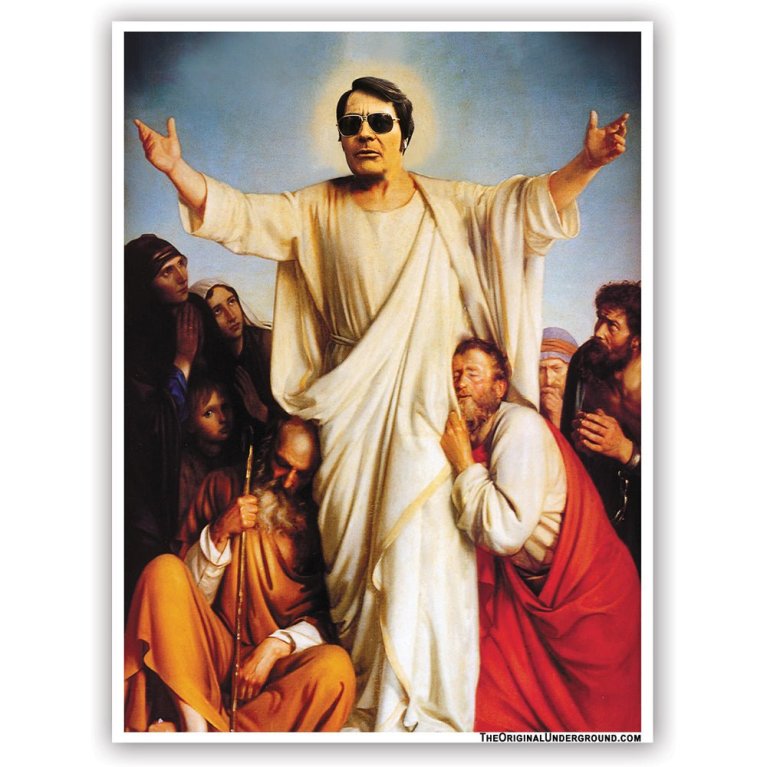
Pastor Jim Jones preaches his counterfeit Gospel before being abandoned by the US government and having to free his cult from bondage with some poison laced Kool-aid.
Seeing someone I thought was a Christian missionary lament how the United States had “abandoned” them was a reminder of how the great have fallen. There was not a shred of gratitude expressed towards the American taxpayers who financed them nor acknowledgement of the misappropriation of funds that has wearied voters to foreign aid. But more stunning to me was unholy alliance between this person of faith and agencies of US imperialism. Since when has the love of Jesus become an extension of the US regime abroad? Are they of the kingdom, as they proclaim, or agents of empire?
USAID, despite the name, is certainly not a charitable organization and was formed in 1961, at the height of the Cold War, with an aim of promoting the interests of the US political regime. That’s fine. But it has long ago gone off the rails even as far as what it was originally imagined. The Soviet Union had fallen and the Federal agency created to oppose it morphed from something most would support into a beacon of wokeness—pushing transgenderism and abortion.
Break the Yoke of Fraudulence
The reason why USAID is being dismantled is because we can’t sort the legitimate from illegitimate function of the agency. Sure, it may help people in need, but funding it also is enabling of evil and maintained through a system of coercion we call taxes. Anything good that it did can be done through other means. This functional fixedness of those who depend of government, especially on the part of those professing Christ, makes me wonder where their faith lies and what their actual mission is.
The merger of a Christian charitable cause with government doesn’t purify government—it taints the witness:
Do not be yoked together with unbelievers. For what do righteousness and wickedness have in common? Or what fellowship can light have with darkness? What harmony is there between Christ and Belial? Or what does a believer have in common with an unbeliever? What agreement is there between the temple of God and idols? For we are the temple of the living God. As God has said: “I will live with them and walk among them, and I will be their God, and they will be my people.” Therefore, “Come out from them and be separate, says the Lord. Touch no unclean thing, and I will receive you.” (2 Corinthians 6:14-17 NIV)
The accusations of “Christian nationalism” against those who want a government that performs basic functions were always just a smear by those in alliance with imperialism and Godless globalism. While I’m not a fan of God and country, at least the flag waving religious patriot knows there is a difference between their Christian mission and secular state. The left, by contrast, confuses these categories and would have social program replace true charity and community aid. In one case you have those who may tend to overreverence nation, but in the other there are those who truly represent empire and yet tell us they their only citizenship is the kingdom of heaven.
The truth is that the ‘Christian’ left is simply the left merely wearing the words of Christ as a disguise for ideological agenda. Those decrying the reduction of empire and return to responsible governance never said thank you to those funding their do-gooderism. It was, for them, all about holding those “chief seats in the synagogue” and their own glory as humanitarians. They may speak against Trump, but then have never uttered a word against the waste, fraud and abuse that has made these broad sweeping cuts popular with common people.
The true Christian spirit is that of a Federal employee who told me about the enormous amount of inefficiency and waste in his own agency and—while making no profession of faith—supports the effort of DOGE knowing it may impact his employment. That, to me, is someone who understands self-sacrifial love more than someone feeding the poor on another person’s dime and then going to social media to complain when their funds are cut. They’re grandstanding. While my Federal employee friend is a truly humble public servant who is grateful and not biting the hand that feeds him.
None of this to say this “abandoned” former hero of mine is a bad person. They clearly are using their abilities to help other people in desperate need. I applaud that. And yet their public statement betrays. There is an attitude or spirit there that is different from Christ. I would much rather they just be a secular humanist—subscribed to partisan leftist politics—and own it. They should just admit that they’ve abandoned faith in Jesus and are looking for a worldly system. Judas Iscariot is the patron saint of faithless social justice, guilt trips and envy—when you betray your calling just own it.
After reading a review of Gran Torino, a Clint Eastwood movie from 2008, that dismissed it as shallow in its exploration of racism, I’ve decided to explore some of the depth of the movie that was missed. It was a great story about finding common ground, that takes a bit of twist at the end from the typical Clint Eastwood film. My family (mixed race and culture) could appreciate the themes more than the average viewer—yet is a beautiful redemption story that all people can enjoy as well.
“Get off my lawn!'”
The story is about an angry old man who is not dealing well with change. Walter ‘Walt’ Kowalski, a Polish-American retired auto worker, Korean War veteran, and recent widower—his beloved wife passing right before the start of the narrative.
In the opening frame, he fits a stereotype of an elderly homeowner defending their patch of turf from an encroaching world. It seems every small town has one. That guy who trims his front lawn with scissors and does not deal well with the trespasses of the younger generation, the snarling “get off my lawn” line from the movie became an instant meme.
Why?
It is just too familiar.
The expression captures the essence of a fading dream. The American middle class values property ownership. A lawn, once a complete luxury and exclusively for wealthy estates, had become the mark of post-WW2 affluence. Walt was the beneficiary of this period of economic growth. He had lived a quintessential suburban life.
But now it had become a nightmare. It is not the same neighborhood anymore. The once tidy little homes, owned by people like him, had fallen into disrepair as a new group of immigrants took over. The woman who he built a home with was gone. His sons bought foreign brand vehicles and betrayed the legacy their father had built working at Ford. The world Walt had known was falling apart and he was bitter.
That patch of land, other than the ghosts of his past, was all Walt really had left. To set foot on it was to violate his sacred space. It was a shrine. And his 1972 Gran Torino in the garage likely represented the pinnacle of his productive career. Since the Korean War ended in 1953, this would put this car purchase around two decades into civilian life with a young family and point when the future looked bright. So he was clinging to what was left of his identity and willing to defend it with deadly force.
Demons of the Past
Early on we see Walt, the tough guy, who is playing a part. His racist language is a part of the facade—a barrier he puts up—because the alternative is to be vulnerable—or a victim. He is still haunted by his war experience, in the beginning using it as a threat, saying he could kill without remorse:
“Yeah? I blow a hole in your face and then I go in the house… and I sleep like a baby. You can count on that. We used to stack fucks like you five feet high in Korea… use ya for sandbags.”
However, later, when it comes to stopping the neighbor boy from taking revenge, we see the reality under the surface:
“You wanna know what it’s like to kill a man? Well, it’s goddamn awful, that’s what it is. The only thing worse is getting a medal… for killing some poor kid that wanted to just give up, that’s all. Yeah, some scared little gook just like you. I shot him in the face with that rifle you were holding in there a while ago. Not a day goes by that I don’t think about it, and you don’t want that on your soul.“
Just like today, where Russians are called “Orcs” and portrayed as subhuman by propagandists, racial and ethnic slurs were used against various Asian enemies of US policy in the region. But for Walt, he knew better, he knew that it was not a demon at the receiving end of his rifle. He had murdered a human child and he felt immense regret. Note how he says “poor kid” rather than all of the racist terms he used freely throughout his conversations. It is almost as if, up to this point, he had to reinforce the dehumanizing descriptions to keep ahead of his shame. The truth is Walt didn’t sleep like a baby. No, he was running his sins his entire life and exhausted.
War propaganda then and now. Enemies are always portrayed as evil and subhuman.
Walt’s racism was part of his pretty much equal-opportunity disdain for other people, including the young parish priest, and his own family. He was a broken and hurting man, who had driven away his children and was hiding his own terminal illness. What he needed was some compassion, a safe place where he could finally let his guard down, and it was the persistent effort of a young Hmong neighbor that finally broke through his wall of insults.
Finding Common Ground
The review, that sparked my response, tried to overlay a “white savior” trope on the story and completely missed that it was Walt who was being saved!
*spoiler alert*
Yes, ultimately, Walt sacrificed himself for the sake of the Asian family next door. But this only after Sue, played by an actual Hmong actress (some critics panned the amateurism, others praised), went above and beyond to disrupt his dismal world.
She was his savior.
It was by her effort that he would face the demons of his past and could be at peace with his Creator. It was a redemption story, a story of an old man who had lost his wife, lost his children, lost his religion and even lost his neighborhood, but finds life again by learning to love his enemies.
I can feel this character. My own life didn’t go as planned. I had to leave the religious culture where my hopes had been built. I had a beautiful Asian woman who was patient with me while I was still lost in delusion and did not give up when times were difficult. Now we have a blended-culture home. Yes, my Filipino wife and son are different from me in many regards. However, after seven years of knowing each other and now over a year of being married, our love has only continued to grow. Some of my happiest moments were with her family in the Philippines and recently while visiting her relatives in Canada.
I am Walt.
My ‘Sue’ did save me.
The real story of Gran Torino is an old man who finds more common ground with those he had thought were strange than he does with his own children. Once Walt had got past the superficial differences he realized he had more connection to these Hmong people than many who looked like him. Unlike the war, he was now defending real people and not political ideologies. He was fighting for the local community, against those within who are destroying it, and not gunning down random boys thrown into a conflict not truly their own. The storyline is a comparison between perspectives and shows us what really matters in the end.
It is about relationships, not race.
It is about building bridges.
The ongoing dialogue between Walt and his priest demonstrates this. The priest, who is of European descent based on appearance, is at first scoffed at by the grizzled military veteran for his youthfulness. The baby-faced “Padre” is bluntly rejected by him:
“I think you’re an overeducated 27-year-old virgin who likes to hold the hands of superstitious old ladies and promise them everlasting life.“
But, despite this insult, Father Janovich will not go away. And eventually, with his persistence, he does earn the respect of Walt. The bond, built over a few beers, culminates with Confession and Walt is finally able to have the guilt that had plagued him since Korea absolved. Now he is free and at peace, ready for a last act that goes contrary to expectations and confirms the redemptive arc.
It was faith that saved Walt, both that of the young woman who withheld judgment and didn’t allow his wall of nastiness to stop her and finally of the persistent outreach of the Church. And it is only because of this concerted effort that we get to see the protagonist do what is right. By the end of the film, Walt has overcome those demons driving his anti-social behavior and also has gained a son worthy of his prized Gran Torino.
Now To Review the Reviewer…
Why did the critic miss the obvious?
The reviewer who inspired me to write my own was projecting their own worldview onto the script. Eastwood is a rare conservative Hollywood producer. In fact, so conservative he spoke at a Republican National Convention and gave a mock interview with an empty chair, used to represent Obama, and he calls Biden “a grin with a body behind it.” Perhaps it is this that the review is responding to? But I think it goes a bit deeper than that.
The Marxist left sees the world as being a zero-sum game, or that for some people to gain others must lose, and thus everything is a competition for power. But, not only this, but everything is divided up into strictly bounded categories based on their skin color, financial status, or sexual classification. If someone cooperates across these lines then they are an “Uncle Tom” or traitor. So the themes of Gran Torino just do not compute. Asians are collaborators. Walt is an irredeemable privileged white man, he needs to be canceled—not humanized.
So, since we can’t have everyone come out as a winner, the only thing the woke reviewer has left is to hallucinate something color-coded and negative. Thus they see a movie that tells us to reach across lines of age, culture, and race as just another “white savior” trope. It is bizarre, such a narrow and distorted perspective, to entirely miss everything and then to insert what is not actually there. Yes, Walt saves, but in the context of others saving him, and that’s not even the point. The point of is that color (or age) doesn’t matter, finding our common ground and community does.
Gran Torino isn’t a perfect movie. It may go a bit overboard with ethnic slurs at times. But, then again, the comedic relief of the barber and Walt exchanging these insults as terms of endearment is also great commentary. Why do we let words be “violence” when the same utterances can be laughed at in another context? It is because these words have the power we give them. What this is suggesting is that we can go further when we reframe the conversation.
The left wants to believe that our behavior is determined by what others have done to us—Eastwood says we can be free to live above their rules.
Politics may be all about power, in-group and out-group, but love overcomes all.
Sitting in “The Well,” a coffee shop within the campus of Christ’s Wesleyan, a local mini mega-church. Why a coffee shop? It is pretty much the same reason a Target store has a Starbucks. It is a trendy and cool place to chill out as the service plays out on the big screen. The ‘church’ here is as American as a big box store. It is quite the production, with many programs tailored to children and all needs in the congregation. The wonderful thing is that you are free to participate to the level that you want. I’m not alone as I sip my caramel frappe while the administrative pastor goes over bulletin announcements and the highlights of Miami versus Kansas City play on the small screen.
The thing is, I was once threatened by this, the professional musicians mimicking rock stars on the stage. How could this really be called a church? And, as they currently ruin “How Great Thou Art” with some ridiculous contemporary rendition, I would definitely be tempted to pile on. There’s certainly a kind of consumerist hokeyness to the whole enterprise. I mean who looks at Walmart and an Alanis Morissette wannabe, then says, “Wow, this is the perfect model for the church!”? It’s all as cheap and throw away as the American culture in general. Nevertheless, this is the place most people are today and also as close to an actual community as many get in this age of suburban sprawl.
Yes, I’m a worship snob. To me, nothing can rival true Orthodox worship. Old hymns, like those in a traditional Protestant church, and the Psalms and Scripture of the liturgy feel much more meaningful. But is this really a substantive difference? Is the worship here more or less about our personal preference than it is there? Even Orthodoxy, with its simple images and chanted theology, was trying to make the message accessible to the people at the time. Would Jesus have filled a stadium had he had the opportunity to do so? Maybe so. Certainly, the church has always taken some of its form from the local culture. But then shouldn’t the church create the culture rather than the other way around?
The thing is the biggest problem that I have with all of this is that it exposes religion for what it is. The reason some of us need to stay traditional is because if worship is allowed to change then we start to question. Could it all be fake? We find our security keeping it all the same. If it has a timeless feel then we don’t need to struggle with the foundation of our faith. My cynicism takes over because this chintzy architecture exposes the framework that some of us would rather keep hidden under the ornate historical facade. It works like satire to undermine my confidence. Oh well, as the couple prepares in front of the lights and cameras in the lobby, like television reporters, I suppose it is time to wrap this blog up.
Postscript: I attended with my wife, out of convenience due to our busy afternoon, who prefers this style of service as it is similar to her church in the back in the Philippines. I was reflecting on the similarities of this to Orthodoxy, in that you have “coffee hour” after the Orthodox church. The biggest difference really is the size and organization. One models itself after the Byzantines and the other off a shopping mall or shopping plaza. And yet both require donations from viewers like you. What really is the big difference between dropping money in the offering plate and tapping your credit card to pay for the brew? The church calendar and the many programs to help make the Gospel accessible? Being in awe of the temple and being impressed by the light show? It all basically serves the same purpose.
I’ll never forget the gang of characters visiting Normandy, with Linus reciting the poem In Flanders Fields and turning to his companion, “What have we learned, Charlie Brown?”
Having this most thoughtful conscientious character spend his time in a pumpkin patch, vainly waiting for the Great Pumpkin to arrive, had to be a self-reflection of the creator regarding his own religious faith.
I can identify with this struggle.
In particular, in the cartoon special, when Linus accidentally says “If the great pumpkin comes,” and then proceeds to beat himself up for even doubting the possibility that the Great Pumpkin isn’t true:
Linus: [to Sally as she walks away with everyone else] Hey, aren’t you going to wait and greet the Great Pumpkin? Huh? It won’t be long now. If the Great Pumpkin comes, I’ll still put in a good word for you! [realizes what he just said] Linus: Good grief! I said “if”! I meant, “when” he comes! [calmly] Linus: I’m doomed. One little slip like that could cause the Great Pumpkin to pass you by. [calling out] Linus: Oh, Great Pumpkin, where are you?
It perfectly captures this idea that if you only had enough faith then you would finally see. This is a prominent feature of religious folks in my life and their advice. It is really a nasty manipulation that makes the fault of every disappointing outcome somehow our own fault.
Charles Shultz, in an interview in 1999, described his philosophical views as having evolved and that he considered himself to be a secular humanist. But, like his title character, the message of the comic strip seems to be to keep trying despite failures and the football being pulled away once again.
There has always been a part of the dismal, melancholy, and yet somehow still hopeful tone of Peanuts that resonated with me. Shultz, now dead over 23 years, left a legacy that masterfully captured his own life experience and lingering questions.
My own religious and spiritual life has taken a turn similar to if Linus finally wakes to the delusion of his blind faith and comes out unscathed in the end. I’ll never rule out any possibilities. I do believe that my life has taken a wonderful turn despite the wilderness I had to cross.
However, I won’t be sitting in the pumpkin patch anymore. There is no moment where it all comes together, where all doubt is completely washed away, and it doesn’t matter how much you believe that your own deliverance is close at hand, but we can keep going even after the collapse of delusion.
Years ago my mom decided to stop in at the local public elementary school. Impressed, after talking to the staff, my parents sent my older sister there and soon I would follow—along with the rest of my siblings.
This might not seem strange to most. But, for a conservative Mennonite child this was highly unusual—or at least in the past few decades. It bucked the trend of religious parents, afraid of secular influence, pulling their children out. Private schools and home schooling becoming the preferred ‘safe’ options.
Anyhow, maybe as a result of my positive experience, or from inheriting my mom’s genetics, I have always thought differently than my peers. That is to say, for better or worse, I stood apart from both my public school and Mennonite peers, basically a third culture kid or non-conformed in both settings. So, when I had to consider where to send my own children, public school was not something I feared.
This post is not saying that everyone should follow in my footsteps nor suggesting that every child should go to public schools. No other situation is exactly the same as mine, some schools are better or worse and every student different. My intent in this blog is simply to give an explanation of what is now unthinkable to most fundamentalist Christians.
A Stranger in a Strange Land
Public school did not mean assimilation for me. My religious identity was always visible enough for me to be given nicknames like “Micro Mennonite” or basically any Amish sounding name my classmates could come up with. The small things, like wearing pants in the hot weather or the side part of my hair were enough for some to take notice.
I was sometimes subjected to what could be called microaggressions. As in I had one or two classmates who would inform me what I should or should not do, as a Mennonite, and this often included the idea that we did not pay taxes or the assumption that we needed a horse and buggy for transportation. This kind of banter was mostly benign, or at least taken that way, but still served as a continual reminder of my outsider status.
The end result is that I seemed to have a stronger Mennonite identity than many of my religious peers. I learned, at a young age, that I was different and it was okay to be my own person. I was never ashamed to be Mennonite nor stopped from following my own conscience so far as things like pledge of allegiance (I always stood respectfully) or abstaining from other activities that went against my cultural standards.
A child private or homeschooled does not truly know, first hand, the alternative to their own community and home. It is easier for them to believe that the grass is greener on the other side of the fence and many of my religious peers did jettison the indoctrination they received in a pursuit of the prevailing culture. But, being the witness of single parent homes, the chaos of the world and consequences suffered, it made me more thankful for what I had.
Exposure made my home more desirable, it also made the failures of parents my community feature less prominently in my mind. There were many who, raised in the religious cloister, became disillusioned with Christianity as a result of their overbearing dad or as the result of school administrators showing extreme favoritism. Had the same thing happened to them in public school, had they been bullied or abused there instead, at least it would not come in direct conflict with their walk of faith.
No, certainly we don’t want to put children in a harsh environment so that our own home or community contrasts favorably, but some healthy perspective is good. Not taking for granted the food or shelter over our heads by being a little exposed and feeling some hunger pains for home is not a bad thing at all. A big benefit of my public schooling was appreciation for my heritage and a strong desire to preserve the Mennonite culture. I could not afford to be myopic or ignorant, throwing out tradition recklessly because it didn’t suit me.
I had to weigh things more carefully rather than react and throw the baby out with the bathwater. Many of my religious peers have this feeling of having missed out and some had to learn the hard way from their own experiences.
Walk In Faith, Not Fragility!
Conservatives love to laugh about the ‘woke’ and their safe spaces. They are very quick to ridicule those families still wearing face masks and call people snowflakes for their sensitivity. The great irony is that many of these same people withdrew their children from public schools, decades ago, because they “took God out of the schools” by ending prayer led by state employees. The reality is that it isn’t just the fringe far-left that tries to hide themselves and their children from all contrary opinions.
You may work where your employer doesn’t lead prayer, can you handle it?
The problem is that without challenge there is no growth. Yes, part of the job of a parent is to protect and yet it is equally important to prepare a child for the real world. I know, I know, someone out there is saying right now, “he’s saying to throw my precious darling to the wolves!” And then we wonder why, with that kind of attitude, when we assume all of our neighbors are dangerous predators, we are not more successful reaching them with the Gospel?
Jesus, our Lord and Savior, and example to follow, had no problem detouring into the Samaritan lands nor with standing on his own two feet with elders as a child. And I, likewise, had no difficulty standing toe to toe with my high school biology teacher or with seeing through leftist propaganda even back in elementary school. I remember scoffing, even then, at the blatant manipulation on Earth day or that faulty “haves vs have nots” construction of my fresh out of university social studies teacher.
Hint to the homeschoolers: Your neighbors aren’t demons and your children aren’t little saints either. In fact, many of my younger home or privately schooled religious cousins were doing drugs, drinking hard and partying, even sleeping around, long before I had so much as a sip of alcohol. As Jesus said to a prior generation of contamination obsessed religious people, according to Mark 7:14–23:
"Nothing outside a person can defile them by going into them. Rather, it is what comes out of a person that defiles them."
We can’t save our children by sheltering them.
I know, but what about the “groomers’ and the brainwashing? No, I’m not going to say it is all hysteria. Indeed, the far-left is targeting children, they’re making no secret of their agenda and it is cause for concern. We see all of those sensational headlines of abuse and it is easy to be full of anxiety and fear about this. But, for perspective, there are over 3,800,000 teachers in the United States and the vast majority are simply doing their job. Some extreme example, from an urban hellhole or California, is not representative of the whole. Yes, your child going to a public school will be exposed to other perspectives and yet why would they choose lies over the truth?
It is no coincidence that the greatest Biblical examples of faith are those, who as children, faced pagan influence. Moses, trained as an Egyptian, was bolder than his other Israelites and faced down Pharaoh. Daniel refused to bend to social pressure, a Jewish child in the Babylonian court, and stands as an example of faith. And who can forget that trial by fire of three young men, Shadrach, Meshach, and Abednego, who would not bow to the statue of the powerful Nebuchadnezzar II?
It is so strange that fundamentalists can read these stories to their children in their Sunday school classes and then be terrified by the thought little Johnny being away from them for a few hours a day. It makes me wonder if they truly believe these stories are true. Maybe they do not think that the God who called Samuel as a child or emboldened young David to slay a giant is still capable of the same today? Apparently they think God is getting weak in old age and only they are able to save their children from the world?
In the World, Not of the World
Part of the problem with the fundamentalist “purity culture” mindset is that they believe that Holiness is achieved through means of physical separation. Many parents think that they will keep their children safe from harm by keeping them in their protective enclave and away from all other influence. But, the truth is, if Adam and Eve could fall even in the garden of Eden, why would we believe that the serpent can’t find it’s way into our own homes and communities?
For as much as my religious peers would try to keep evil out, pulling their children out of even the church school to guard them from the influence of other Mennonite children, it is no defense from the most dangerous sin of all which is pride and this accompanying idea that we can be fully righteous by our own efforts. But, in the economy of Jesus, it is better to be the woman caught in adultery or thief on the cross who repents than the rich young ruler who kept the law perfectly yet isn’t able to live in faith.
They say more is caught than taught. We can say we believe “greater is He that is in me than He that is in the world” (1 John 4:4) and that God is our strength, but our actions betray us. The conservative Christian retreat from the public sphere is pretending that if they ignore the deterioration somehow the problem will go away. They are training their children to be cowards, afraid to effectively confront the culture or fully contend with the reality that they’re losing ground.
It is true, a Christian is not to be of this world and yet this is all about the spirit in which we are approaching life. The exact phrase “in the world but not of it” is not in Scripture, but we also see where Jesus didn’t avoid people simply because they were Samaritans, tax collectors or others that his religious peers carefully avoided. Unlike the parachute in ‘missionary’ compassion of today, he spent his time amongst his own people, rubbing shoulders with the unwashed masses and even being touched by a woman made into an outcast for her illness.
If we go out in strength, trusting that God is still able to protect us and our children from the teeth of lions, we would possibly see the change of culture that will make the world a place liveable for a Christian. But right now we’re teaching our children to be weak and, when the world finally does come to snatch them from the safety of their homes, many will be fragile and unprepared to stand. This is why so many get caught in the false social justice Gospel, they weren’t properly trained to identify the counterfeit.
“Train up a child in the way he should go, and when he is old he will not depart from it.”
(Proverbs 22:6 KJV)
Why would I send my son into the lion’s den?
Because Daniel continued to pray, despite the risk of severe punishment, and precisely as a result of his childhood faith and learning to resist peer pressure at a young age.
Contrast that with the religious experts who had rejected Jesus for the unclean who he mingled with. Or with Israelites who prospered in their own promised land, absent of persecution, and only went through the religious motions of faith in God. They voluntarily brought idols into their homes and folded before their enemies.
Complacency is a bigger threat to a Christian’s child than lions.
We should not teach our children to run from the giants of our time or they’ll become king Saul.
Instead we should be helping them polish those giant slaying stones and trust God.
It’s been my thought for some time now and has become even more cemented in place over the past few years. People will believe anything, especially if it fills their desire for meaning and purpose, even if it is ridiculous at face value. But don’t mistake the for a shot at tradition. Karl Marx said that religion is “the opiate of the masses” and yet his alternative drug produces delusion, rage and violence. I’ll take Jesus and love over that any day of the week.
Sure, this quote could have some truth to it:
“Organized religion is a sham and a crutch for weak-minded people who need strength in numbers. It tells people to go out and stick their noses in other people’s business.”
E. J. Dionne Jr
But that same statement could be applied to almost every popular secular movement or established consensus. Certainly not all, not even many, who believe in various narratives or theories are qualified experts. Most have simply bought into a system and are riding the ideological bandwagon. Good science is religious and organized, scientism is a cult and a way of silencing critical thinkers who are outside of the political mainstream. I would certainly take Gospel tracts shoved in my face over social media censorship of my ‘wrongthink’ and higher taxes that won’t do anything to save the planet.
Call me a skeptic of everything, I just find it difficult subscribing to anything anymore, to me it is all easy-believism. I mean, does it seriously change anything about my day-to-day life to believe in climate change or go to church? Probably not. People might make a symbolic sacrifice here and there. However, for the most part the commitment doesn’t ever match the rhetoric. The faithful aren’t walking on water nor are those who loudly proclaim their extreme consternation about the climate giving up their private jets or beach homes.
But it is much more basic than this, go ask people about who is the best president ever (or worst) and you’ll get completely opposite answers. To some Trump was the guy who spoke to their own concerns and delivered, to others Biden is the guy who has restored the normalcy they craved. Both sides can support their own perspective if given the chance. Can they all be right? Okay, so it is subjective, an opinion which man is better or worse, and yet we don’t agree on what is objective either.
I love talking to the most sincere people, the true believers, because they are so confident about what they say and it is enviable. If you have had a bad experience with those who espouse their ideology, then that’s the rare exception, an anomaly, and is not the real version that is represented by them. I’m just not like them. I can’t help my skepticism of their beliefs. I’m not very easily sold on their the basis of their sureness and claims alone, show me the undeniable evidence. I do not fall for their conviction or consensus.
People do not seem to know where reality ends and their imagination begins. Basically every narrative we create is a sort of fiction we create for ourselves. We take the bits of data, very often distorted by our own flawed perception, and interpret it into a story that makes sense to us. Systemic heightism, for example, describes something very real, is even quantifiable, and yet is also an overlay that doesn’t truly describe the truly complex picture. What we accept or deny is often a product of our conditioning, social status and base desires.
The primitive communism that Marx used to fashion his ideas were as much a fabrication as any religious mythos. Idealistic children likely subscribe to his theories for the same reason they love Disney fairy tales or Marvel comic book heroes. Utopia ahead is a very strong motivator, in that we are very willing to make huge personal sacrifices when we believe that heaven awaits us. And yet, as much as see the ‘faithful’ fall for obvious con-men, it makes every testimony questionable.
The problem with my own unbelief is that I also believe this too. I trust myself enough to mistrust. Maybe my own ambivalence, and sometimes agnosticism, will make me miss the one truth in the sea of lies? Still, I’m convinced my only ability to be sure of anything will have to be direct revelation from God, because I know too well that I’m a blind man in a world of full of blindness. I’ll admit, this isn’t the most comforting or easy answer, but people believe many things that simply are not true.
What do I believe?
I believe what is most beneficial. Maybe all of religious narrative is a fabrication and yet the real question is it useful, will it produce results that make the world better?
The Christ I believe teaches me the value of delayed gratification. In other words, when we invest in others, in faith, there is a chance that we make a friend and split the dividend of our peace. In doing unto others, in love, there is a chance of solving our conflicts and ending hostilities. Christianity, unlike various popular political systems, makes no utopian promise in this life, and yet it does help to push behavior in the right direction.











 Irregular Ideation