Anticipating November’s Delivery

Standard

In November, as the world tunes in to know who will be elected president, my wife and I will anticipate something else. 

We expect a baby girl, our first child together and second that Charlotte has brought into the world.  It has been my joy to raise our son, but having this miracle of life unfold before my eyes is still a powerful experience.  How a moment of intimacy can create such potential is just completely amazing.

There is no greater role in the world than a woman who takes her pregnancy to term, motherhood is simply the most important job there is.  In a century nobody will care about who won the popular vote or their policies.  Truly, short of a civilization ending nuclear war, they’ll remember Trump like we remember Taft or Harris as we recall all the many noteworthy accomplishments of the Harding administration.  But old folks then will remember their mothers.

The most powerful position in the world is not one with four year terms.  A President can reallocate resources, make things more or less difficult, wage war and destroy, but only mothers produce new life.

Early in our relationship, when marriage had become a possibility, Charlotte was excited about the prospect of a mixed baby.  That is a combination of my German genetics “long nose” with her own.  But as months waiting turned into years that initial enthusiasm had wore off and, by the time she arrived, it was all about financial goals.  We couldn’t afford a baby—we could barely keep up with rising costs due to inflation!  

Besides that, we are both getting old.  The world seems less stable now than ever, my own skepticism has grown and I’ve become untethered from assumptions that brought me easy answers in the past.  Our son was already here, we weren’t bringing a new life into the mess.  So maybe it was better that we didn’t bring a child into this to suffer the hardships and pain that we have?

I’ll also admit that my wife, despite having given birth once, had a flat belly and that is completely desirable.  We all want to hang onto our youthful appearance.  Men tend to prefer women that are in shape or pleasing for aesthetic reasons.  Why ruin that?

However, a bottle of wine and nature have won against rational concerns.  No, those anxieties about how to raise a child in this environment did not go away and, for the first time ever, abortion entered my mind as an escape of this enormous responsibility.  This could all just go away with a ‘medical procedure’ and nobody would need to know, right?  Of course, that momentary reflection was swallowed up by excitement.

No, we don’t know how all of the details will work out.  Our hopes of moving Charlotte’s mom here didn’t pan (only the parents of US citizens can be petitioned) and we’ll have to adapt as we go.  We have no regrets, the kicks we feel now soon to give way to cries in the night, diaper changes and all of those steps of development.  But in the end this is the only legacy we will leave to the world—the only future we have.

Preparations are underway for the inaugural moment when this winner against the odds will emerge.  We want our daughter to have the very best introduction to the world we can provide—a safe and stimulating environment.  We’re stocking up on diapers and bottles, have a crib and car seat that can double as a stroller, friends and family will celebrate—the anticipation builds!

Coddled to Death—How the West Made Weakness a Virtue

Standard

My son complains that he doesn’t get paid enough for household chores.  He feels he is somehow entitled to everything that we’re giving him and more.  It is a struggle trying to explain why we won’t simply hand him all that he wants.  We have plenty, in his eyes, and can just share our wealth with him.  But the reason we hold back isn’t our greed or that we don’t want him to have the best life has to offer.  No, quite the contrary, in fact, it is because we want him to do well life that we resist the urge to coddle him.

What is coddling?

On the surface it is being overprotective and indulgent.  It stems from distrust of another other person’s ability to deal with normal life situations and emotions on their own.  And, while it may appear to be motivated by love or compassion, it only ever empowers those who keep the other confined to the bubble wrapped world.  It is the devouring mother, the one who uses their nurture as a tool of control.  They only care about the target of their efforts so far as it feeds their ego or feelings of self-importance.  It is a virtue signal and degrades those coddled.

Bigotry of Low-expectations

Along with thoughts about parenting and the goal, some of the inspiration for writing this came from the governor of the state of New York, Kathleen Hochul, who declared:

Young black kids growing up in the Bronx, who don’t even know what the word a computer is, they don’t know. They don’t know these things. And I want the world open up to all of them, because when you have their diverse voices, innovating solutions through technology, then you’re really addressing societies broader challenges.

Other than to call this statement what it is: Bigotry (or racism) of low expectations and patronization.  I’ll not pile on.

Many, like Hochul, are isolated.  They have not spent much time in urban communities nor met the people who live there.  From my own first hand experience her claim (which she now claims was misspoken) is absurd, none of the black I met were unfamiliar with or incapable of using computers.  Many of my acquaintances there could afford to go to college and more credentialed than I am, so where does this notion come from that they’re hapless ignorant people in desperate need of government assistance?

The answer, in this case at least, is that it is hard to maintain a bloated state budget (let alone greedily expand it) without somehow justifying it and what better way to do that convince people that they need you to get somewhere in life?

Condescending political elites are not moral paradigms and minority voters are not stupid.  I believe those pandered to know it is insincere and coming from someone who sees them as dumb.  But they also understand it works to their advantage and don’t say no to it.  We naturally take the path of least resistance and rationalize why we are deserving of the help.  By playing up the consequences of slavery and impacts of racial prejudice, a little wealth redistribution (looting or theft) can be redeemed as social justice.

Unfortunately, low expectations produces what it is supposed to remedy, it gives an excuse to wait around for a handout and kills initiative.  This contributes to racism in that it creates the impression that the only way some can compete is by lowering the bar or a double standard.  It diminishes the accomplishments of those who knew what a computer is without the help of those in the the benevolent class.  Now, because of politicians meddling, there is the question, did they earn it by being the best candidate or are they a diversity hire?

Woke is Weak

My conservative friends wouldn’t likely see the link between Christianity and wokism, but it is definitely there.  The woke glorify the victim and reframe accomplishment as unearned privilege.  For those who started a business, “You didn’t build that” they reason, and nullify the hard work and the sacrifice of those who followed the entrepreneurial spirit to success.  Likewise, in church we’re encouraged to tithe generously and be charitable since it is giving back a portion of all that is given to us by God.  The difference being that the woke want us to give to the government, the religious their own organizations.

And there’s nothing wrong with our helping those in need.  I provide for my son and my wife as well.  However, when I give I give to empower rather make them dependent and weaker.  My hope is for my son to grow his strength and ability so that in time he does not need me to survive.  And the same thing is true of my wife, she is my partner not my patron, we both contribute different things to the whole and neither of us is entitled to what the other gives to the relationship.  It is how a real community works, we give and take as necessary, and we do it for the good of the common project.

Wokism, by contrast, is motivated by envy and pity, it encourages fragility by marking off space spaces and enforcement of strict language codes.  Again, this strict regulation has a parallel in religious fundamentalism.  Home schooling parents are terrified of the influence of the ‘world’ on their children.  They, like the woke, overemphasize the role of the environment in the formation of the individual.  The one exempts swaths of the population from the normal civil expectation (while increasing the burden on others) and the other thinks salvation of poor little Johnny depends on them.  Bad behavior always blamed on an external influence rather than a lack of will to do better on the part of their designated eternal victims.

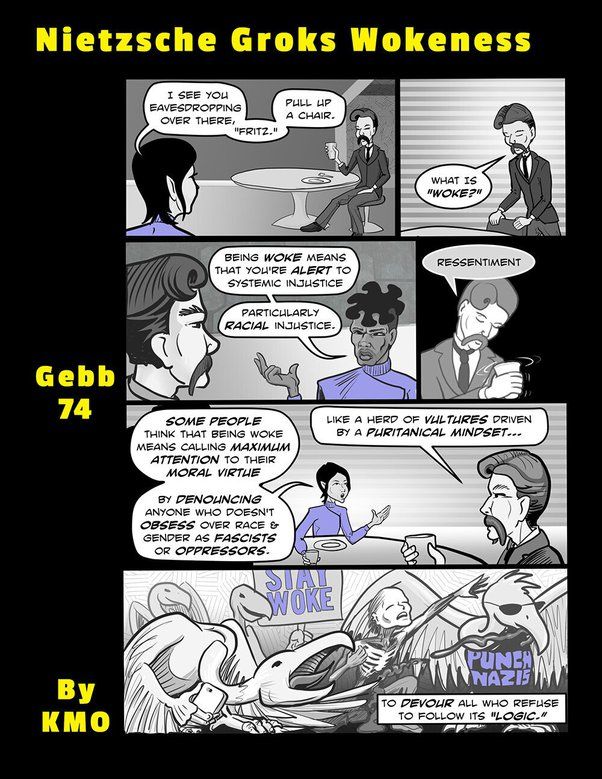
This is what Friedrich Nietzsche critiqued as being a hatred for life.  When we remove temptation rather than ever teach children to resist it—when we are constantly vilifying strength rather than encourage it—when we follow after reasoning or rationality instead of developing our instincts, we are promoting the weakness of our society and degeneration. 

Woke is weak.  It attempts to foster spirits of ressentiment and forms an identity around a person’s fear of being disenfranchised for things completely out of their control.  And in the end it destroys the incentive to find a way to overcome by our own means.

The Meek Shall Inherit 

Neitzsche could be accused of painting with too broad a brush for the dismissal of the Christian ethic as slave morality and an opposition to the powerful.

The message of Jesus and his Apostles was, in part, freedom from those human laws of “Do not handle! Do not taste! Do not touch!” (Colossians 2:21) and very nearly could be the “will to power” that the German philosopher championed once unpacked.  Hedonism wasn’t the goal of the departure from “slave-morality,” the aim was instead for people to exercise will-power and resolve.  In the same manner Jesus and St Paul preached freedom from the law that brought only bondage and death:

But now, by dying to what once bound us, we have been released from the law so that we serve in the new way of the Spirit, and not in the old way of the written code.

(Romans 7:6 NIV)

This is not to suggest that there is any kind of compatibility between the Spirit-led and the Übermensch.  Nevertheless, both would have us abandon a lower morality based on restrictions for a pursuit of our own ultimate form.  To St. Paul the Gospel means we are free from “the flesh” or the unbridled urges, while Nietzsche thinks we’re instinctively at our best, and both men are not opposed to impulse control.  The big difference is that the Apostle’s answer is spiritual whereas the philosopher says that additional layer is not needed and morality a hindrance.  Both would disagree devaluing the attitudes and culture that lead to success.  Being master of ourselves requires strength and never allows for excuses.  

Furthermore, the Jesus of the Bible wasn’t weak, he spoke with authority and we are told that he had power over all things, but he chose a meek posture rather than wield this power destructively.  Now it is a matter of faith if you accept this or not.  I could say that I could strangle Mike Tyson yet choose not to.  Talk is cheap.  But meekness is the ability to restrain ourselves.  Having the power to impose our will is always desirable, nobody wants to be at the mercy of the elements or other people.  However, sacrifice for sake of the next generation is better, to parent is to live beyond ourselves, that is why this is an instinct for those who have children, and it is the role of the Father.

When I wrestle with my son I don’t use all of my strength.  I would hurt him if I employed full power.  My goal is not to destroy him, he is not my enemy or threat to obliterate, but it is to train and strengthen him.  I restrain to protect him currently and also challenge to protect him in the future.  That is the real Biblical kind of meekness, it submission to the greater role we can serve as protectors and builders of civilization.  It is the having all things in balance, which Nietzsche might agree, and using our strength to take on the burden of creating the future.  We do not retreat from life.  Faith requires the we go headlong into the fight rather than hide or be ruled by resentment.

Late-stage Protestantism

I can understand the campaign Nietzsche waged against morality in light of wokeism and virtue signaling nonsense.  Apparently he was very well-versed in theology and did not find answers there.  Which is correct, it is not intellect that brings us life, study for sake of study is vanity, and truth is more in the practical telos than in some theoretical construct.  Nietzsche attacks rationality and reason as an end and those things do implode upon themselves when no longer grounded in a higher life-serving purpose.

The current ideological push for wokeism, and the mindless promotion of diversity, equity and inclusion at the expense of standards, merit or competency, is simply another step down the path of trying to eliminate all suffering and in the process destroying excellence.  I want my son to face some hardship, even if it is only artificial, because his striving will build strength.  It is the thought behind Proverbs 13:24: 

Whoever spares the rod hates their children, but the one who loves their children is careful to discipline them.

Or, as Nietzsche postulates in Beyond Good and Evil:

The discipline of suffering, of great suffering – do you not know that only this discipline has created all enhancements of man so far? 

In the same vein, in The Will to Power, he wrote:

To those human beings who are of any concern to me I wish suffering, desolation, sickness, ill-treatment, indignities – I wish that they should not remain unfamiliar with profound self-contempt, the torture of self-mistrust, the wretchedness of the vanquished: I have no pity for them, because I wish them the only thing that can prove today whether one is worth anything or not – that one endures.

No, I don’t want my son to be last picked for his dark skin.  And yet I also don’t want him to live in a world so sanitized that he’ll need to invent offenses (in the same way that an autoimmune disorder is the body attacking itself) then expects me to always step in on his behalf rather than face it.  Success in life requires some voluntary submission or suffering for sake of our goals.  Coddling and bigotry of low expectations does not serve the long-term benefit of children or civilization.

We need to discard this ugly paradigm of late-stage Protestantism.  There are great men, powerful and worthy of our respect, then there are those in desperate need of improvement.  We don’t help the latter by going soft and changing the requirements to make everything easier.  There is nothing radical or reforming about the direction the church in the West has gone.  This “have it our way” drive has led to a fracturing of the church, a consumerist mentality in worship and a new religion without obligation to the fathers or their commands.

Woke is simply the latest development in the direction.  It is the child with imperfect parents now thinking they know better and don’t need the silly disciplines of their parents to thrive.  Whether Anglican or Anabaptist, it is always about rejection of authority and the hierarchies established by the early church and originating with Christ.  We think we can do better, that the home is better if there is equal with no patenting or need for development of conscience.  In the end we get the complete agnosticism which goes further and to destroy everything the generations of faithful built for our good. 

Attainment and success doesn’t need to be made more accessible.  My son may think he deserves everything without effort, that we’re hoarding a kind of wealth just given to us and undeserved.  But that’s his ignorance.  There are no shortcuts to heaven and you can only keep the benefits of civilization if you continue to maintain the very foundation it is built upon.  We think that we will be saved by technology and the vague notions of progress of those who think power comes from the stroke of a pen—but that’s not how we got here nor is it a path to a better future.

Do you *really* want a life without conflict?

Standard

Thinking, as I’m sipping my coffee at Dunkin, a Saturday habit, we build civilization as part of the urge to reduce variables and the effort of living.  The thought started during my pre-waking slumber: We work, build shelters and store resources, create complex networks, to try to decrease unpredictability and the end result is that I don’t need to worry about my source of caffeine.

This orderly environment we create is ideal for raising children.  It is a nest.  Or at least at some levels.  Where we, like birds, weave a structure out of chaos in order to keep our offspring safe from predators and ourselves protected a world that can be unkind to the unprepared.  Squirrels scurry around, in the fall, gathering up things to keep for food over the hard winter months.  Our own species, likewise, is as instinctively forward thinking and creates systems to ease the strain.

The human endeavor, towards these ends of producing stability and abundance, has been so successful that many can go their entire lives not appreciating it. 

We’re so well-off, in the developed world, that our impoverished are obese rather than hungry and many now think that healthcare (a service provided by others) is a right.  we live in such unprecedented luxury and ease, even the poor can afford a lifestyle that many ancient kings would envy and yet feel so entitled to everything that we will shoot up the McDonald’s drive thru if we can’t get our bacon:

Evidently, being in civilization doesn’t make someone civilized.

Anyhow, other than entitlement and lack of appreciation, another product of civilization is boredom and fat.  In the absence of wars we created sport and without hard work, to keep from physical deterioration, we go to the gym.  It is truly bizarre, when you think about it, that we go out and seek the very anxieties that our ancestors built civilization to escape.  We are adrenaline junkies, doing intentionally dangerous things for the fix, we want to have unpredictable outcomes.

All of this really does make everything about our existence a weird paradox.  As soon we achieve a little bit of stability and peace we become restless.  That’s what convinces me that we are as much nature, made for the world we are in, as we are not.  That feeling that we somehow do not belong in this place with death and sorrow is what has motivated our progress.  It is less about our own being otherworldly and more what has enabled us to survive this universe that would kill us the moment we grew complacent.

This, incidentally, is the one thing that many people do not grasp about entropy, we tend to see decay and deterioration as being only a bad thing.  I mean, we fight it.  If someone walks into the house with muddy boots it is upsetting and spurs action.  But, without this tendency to disorder, without this repeated need to clean up on aisle five, would we even have a reason to live?  As much as we hate disorder, it is this continual struggle against it that gives us meaning and purpose.

The Man I Never Met — Remembering Wayne_in_Maine

Standard

There are some characters you meet online and never forget.

Such was the case with Wayne_in_Maine, who could come off as a sort of cranky or cantankerous old man and yet seemed (even then) to have a golden heart under the bluster. There is a way or an intuition I have, that can cut through the harshness on the surface. I can just know when someone is full of themselves and cruel despite their nice-sounding words or truly compassionate despite their surface-level unpleasantness.

Wayne was the latter kind.

The first thing notable about Wayne was that he was intelligent, he had been a nuclear engineer, could articulate his arguments well, and clearly was not going to be backed into a corner. The second thing was that he had a very unique journey and a different perspective from the other ethnic cultural inhabitants of the MennoDiscuss forum. He had gone from a hippy leftist to a conservative-minded neo-Anabaptist and could speak with authority on matters of science unlike the religiously indoctrinated parroting their fundamentalist teachers.

Initially, I saw him as a sort of threat to my worldview, another person compromised by secular influence trying to get Mennonites to shift to his views, and yet later his perspective would actually strengthen my faith when it faltered against the scientific evidence clearly pointing to the appearance of age in the universe.

Because of Wayne, I learned that young-Earth Creationism (or YEC) is not necessary to have a sincere and grounded faith in Jesus Christ.

In fact, it might actually be a liability and cause many to fall into a serious crisis of faith when they go to university, study biology or almost any science and find out the case for YEC is not as clear as it was presented. That Wayne, a rational mind and well-educated, could both reconcile modern scientific theory and his faith was more useful to me (a critical thinker) than some Hammy tourist attraction put there to feed the confirmation bias of fundamentalist midwits. I came around to his position and haven’t looked back.

I have long respected Wayne despite our sometimes clashing and my occasionally coming away feeling unappreciated by him.

He was a man a conviction. He gave up lucrative career paths, actually tried communal living, literally sold all from what I recall, and had come much further in developing his own perspective than most do.

However, despite my respect, Wayne’s version of Christianity didn’t appeal to me. He had, inadvertently, pushed a friend of mine away from Anabaptism with one of his responses. I still believe his take on the rich young ruler account misses the mark, where he read the response of Jesus as a sort of legalistic prescription rather the same as we understand Luke 14:26 where Jesus says if someone “does not hate father and mother, wife and children, brothers and sisters—yes, even their own life—such a person cannot be my disciple.”

I know, for a fact, that he did not take that literally. He came across, from my limited ability to see, as a very loving father and committed husband. I can’t imagine him hating his family to prove his commitment to Christ. Nevertheless, he was adamant about being completely Anabaptist in his perspective about wealth or warfare, an inconsistency of thought that bothers me about him and others of that fold. It did annoy me too when he characterized the Orthodox tradition as “smells and bells” as if worship was supposed to be something other than a beautiful or full sensory experience.

The Cancer and Change

After I heard about Wayne’s cancer diagnosis, none of our previous sparrings mattered much to me. Wayne, despite our differences, was a true friend and someone that mattered to me. It was especially important to me, given my mourning of Uriah, to talk to someone coming to terms with their poor prognosis and yet not giving up hope.

When I reached out on Facebook Messenger, mentioning Uriah and my desire to meet with him, he replied quickly and with more warmth than I had expected. There was no standoffishness, as had kind of been a feature of his personality, he reciprocated the desire to meet and we talked about various matters of faith.

I took a look at some of the MennoNet discussions he was involved in and got a laugh together about the various bad arguments being used. That’s one thing about him, his humor was dry and always fun, or at least fun when you were on the same side.

It was a sort of therapy, talking to this different side of the pragmatic engineer. Truly, it was special, the man that I saw emerge in this final trial was different. My own thought was that this was the Wayne that was always there under the snide comment and cynicism. Men can put up their walls, to not appear vulnerable, and that was no longer there. We were just two old keyboard warriors with nothing left to prove to the other.

And that’s not to take away from anything he said as far as the grace he was given to endure to the end. It was definitely something spiritual. His testimony of faith was clear. As a friend described him, in this transformed version, “It was like he became a totally different person. Happy, cheerful, optimistic.” He would not be defeated in death and I wanted to hear more about how a rational man, such as himself, given my own struggles, could continue in hope of the eternal.

I had to think of this Scriptural passage:

Praise be to the God and Father of our Lord Jesus Christ! In his great mercy he has given us new birth into a living hope through the resurrection of Jesus Christ from the dead, and into an inheritance that can never perish, spoil or fade. This inheritance is kept in heaven for you, who through faith are shielded by God’s power until the coming of the salvation that is ready to be revealed in the last time. In all this you greatly rejoice, though now for a little while you may have had to suffer grief in all kinds of trials. These have come so that the proven genuineness of your faith—of greater worth than gold, which perishes even though refined by fire—may result in praise, glory and honor when Jesus Christ is revealed. Though you have not seen him, you love him; and even though you do not see him now, you believe in him and are filled with an inexpressible and glorious joy, for you are receiving the end result of your faith, the salvation of your souls.

(1 Peter 1:3-9)

More important than all of his intellectual endeavors and Christian apologetics, theory or theology, is Wayne’s undying faith through trial is of the greatest comfort to those still in the fight. I never did get to have that face-to-face meeting that we had committed to upon his planned move to Pennsylvania to be closer to his daughter and grandchild. We had planned to meet in order to give us both something to look forward to when he did.

Now that meeting will have to change locations. Wayne took his final breaths yesterday evening, on August 12th, a couple of days after his 65 birthday. By God’s grace, in triumph, we’ll see each other on that other side.

I’m sad that Wayne remains a man that I’ve never met, in the flesh, despite our interactions over the years. However, in his terminal illness, there was also a man that I never met, that softer side, and feel blessed have finally met this man. I loved him and believe that he loved me too. I’ll remember our last interactions for much more fondly than our first. It was beautiful to see his golden heart revealed.

Let the Seed Fall!

Standard

Some might wonder why I have such a visceral reaction to wokeism.  I have written a few no holds barred blogs trying to warn people of what this is and where it invariably leads.  But each time I write it feels as if my concern is not well-explained.  I mean, I know some probably read and ask, “why is Joel attacking these well-intentioned people?”

However, I’m having a moment of clarity and therefore will try to expound on why it is absolutely necessary to shock people out of their stupor.  The reality is that wokeism (or grievance culture) and religious purity culture are two branches off of the same tree.  Both patriarchal conservative men and those angry pink-haired feminists are trying to create a world without suffering.  Both, tragically, create more problems than they solve.

First, what is purity culture?  

As I experienced it, in the conservative Mennonite context, it was a branch of Biblical fundamentalism (Protestantism) that had been grafted in to the Anabaptist tree.  It was a legalistic perspective.  The pure life was to avoid vice (no drinking, dancing, going to movies, etc) and remain completely a virgin until marriage.  It is not that the aim is entirely bad, but there was also a lack of grace accompanying this perspective.

In other words, there was no room for failure.  It a hellscape of unchecked perfectionist tendencies.  People who should be diagnosed as having obsessive compulsive disorder (OCD), along with other mental illness, viewed as being virtuous.  And the rest of us struggling to meet an unreasonable standard without the actual spiritual help we needed.  

For example, girls who thought they were ‘defiled’ for simply talking to a guy that they didn’t intend to marry.  And heaven forbid you did date and break-up.  Then you were damaged goods.  Cursed to walk the earth, like Cain, a stigma tattooed to your chest, a scarlet letter.  

To those steeped in this religious purity culture it was about saving the next generation.  It was a reaction to a world of promiscuity and failed commitments have produced far-reaching consequences.  And yet, while it does work for some, those who check all the right boxes, it permanently marginalize others and gives them no real road to redemption.  Divorced and remarried?  Tough luck, you’ll need to break up that successful loving family to become a Mennonite.

That’s the purity culture I know all too well and, for reasons I’ll get to later, have fully rejected as being unChrist-like and spiritually void.

Wokeism, despite the vast difference in appearance to what I’ve described above, is another subset of purity culture.  It is a reaction to the ‘privilege’ of those who better represent the cultural ideal.  It is another form of utopian idealism.  

Whereas the latter religious variety of purity culture believes that if their children only kiss one person, never experience the pain or disappointment of a break-up, then heaven will come to earth—the ‘woke, by contrast, believe that if everyone was forced to tolerate their ugliness and embrace their toxic grievance; if they could live free of further offense, then they would be fulfilled.  

Both forms of purity culture are offshoots of Western values.  They both see suffering as a flaw in the system and try to eradicate it through their own means.  And they do have their valid points.  No, the girl, the victim of sexual abuse, who (because of her loss of self-worth) goes from one guy to the next, should not be called a slut.  But, that said, nor should her unhealthy coping behavior be normalized.  Instead, we should stop seeing people as damaged goods because they failed to reach some sort of phony cultural ideal.

The truth is, the woke, as much as they attack whiteness.  Or the feminist who acts aggressively and looks to a career as being freedom.  The patriarchal father, as much as he claims to be protecting.  Are all the thing that they despise most.  Religious purity culture, sadly, is hypersexual in focus and produces conflicted men like Bill Gothard, Doug Philips and Josh Duggar.  Feminism amounts to a form of female self-loathing that unwittingly idealizes the male role.  And so-called social justice is simply a means to manipulate and enslave another group of people.

All of them assume that if a person could simply avoid pain and bad experience they would find their completeness.  All seek a kind of perfection outside of Christ and very quickly, despite their wonderful intentions, turn into a dystopian hell.  

What is wrong is this idea that pain us is less for our good than pleasure.  The religious, ignoring the lesson of Job, neglecting what Jesus said about the tower tower of Siloam or the man blind from birth, see suffering as a sign of God’s displeasure and a punishment.  Likewise, the woke want to be embraced without repentance, if they would simply be called clean then they could finally escape their terrible anguish, right?

The truth is, bad experience is part of life and as beneficial as the good.  Growing up in a single parent home can be an excuse or a motivation to do better.

This is what makes the story of Jesus so compelling.  Unlike us, he was completely innocent, his intentions were pure and should have been loved by all.  But, instead of embrace him, his own people saw him as a threat, he would undermine their system and perspective, show them for what they were, thus had to be eliminated.  That he was executed with criminals would seem like a humiliating defeat.  He suffered and died for what?

The tree of life.

However, it was in this suffering that salvation came.  Sure, the burden of the cross comes with anguish.  We would rather seek pleasure and avoid pain.  However, in Jesus, the cross is transformed from being a brutal instrument of death into a well of eternal life.  How?  It is in the same way that a seed falls to the ground, is buried and leads to new life.  

Why would we cling to the seed or refuse to let it be buried and prevent the tree?

The overprotectiveness of religious purity culture, the refusal to acknowledge our brokenness and need of transformation of wokeism, both try to find salvation by human means.  One seeks to impress God, like the rich young ruler or proud Pharisee, whereas the other (like Cain) demands that God accept their unworthy sacrifice and then murders their righteous brothers.  Both need Jesus.

The wonderful cross

In conclusion. We’re all damaged goods and can be made more beautiful than ever through repentance. Jesus can make our pain as much a joy as our pleasure.

Simone Biles, Joey Julius, Jim Thorpe and Mental Strength

Standard

Simone Biles, arguably the best female US gymnast ever, decided to quit the competition at the Tokyo Olympics.  This decision was as celebrated as if she had won gold and that caused some conservative friends to protest.  The bulk of the criticism having to do with the glowing coverage of this choice.  But then there was a lot that was aimed at her personally, calling her a deserter, “an entitled, weak, brat,” and part of the “participation trophy” behavior. 

While I won’t call what she did stunning or brave, I will also withhold any sort of hard judgment concerning her.  Maybe it was the right decision?  If she isn’t feeling up to the task then it might be good to allow the next one up to fill the spot on the team?

Given that it was leaked, back in 2016, that Biles uses Adderall, a common stimulant used to treat ADHD, and banned by the Olympics, it is little wonder she is out of sorts.  That’s a strong drug, in the methylamphetamine class, and going off of it could severely hamper a person mentally.  Many people (conservatives, in particular) do not understand how much their mood and level of ambition are predetermined.  During my brief stint using Adderall, I learned a lot about how easy it is to get things done when you have complete focus  The withdrawal is something fierce too.  For me it left a dead inside, can’t get out of my own way, feeling when in withdrawal. 

So, rather than an indictment of Biles, this may be a concern about how we deal with life in the United States.  Whereas previous generations and most people in the world cope without drugs, the US is very drug dependent.   The US, in fact, is the world leader in prescription drug usage.  The US produces and uses about 85% of the world’s methylphenidate.  Rather than overcome by internal means, learning coping skills, or building mental strength by simply getting up and after it, we are relying on the take a little pill solution to problems.

Then again, we can’t know if Biles would ever be competing at this level without Adderall.  But we do know that she has had many things to overcome.  She has worked very hard to get to where she is.  She has endured a childhood of hunger and sexual abuse too.  This is why I’m not going to join anyone in calling her weak or anything else.  Unless someone has competed at the highest levels of gymnastics and knows a little of the commitment and strength it takes, then it may be best to leave judgment to those who have been there and done that.

That said, the question of whether we are getting mentally weaker is worth looking into, but first another athlete’s story…

A hard-hitting and short career

Joey Julius stormed onto the college football scene with his big boot and his hit stick tackles. 

Kickers are not generally known for their toughness.  It is typical that they hang back and play safety on the kick coverage.  It is expected that they might try to run the play out of bounds or go for a feeble attempt at the runner’s ankles.

Moment before impact

But that wasn’t Julius.  He was a big boy, 260lbs, and very quickly became a Penn State fan favorite with his ferocious coverage team collusions.  He was a walk-on and seemed to be ready to entertain for years to come.  Yet, right as his fame rose, he disappeared.

It certainly was disappointing for me, as a fan, to see this exciting and unique player off of the roster. And, of course, I had to ask why. For me being able to start for a college football team would be an amazing privilege and never something I would pass up. However, as one who saw my own cousin, a 6′-8″ 320lb lineman, confident as he was going in, get bogged down with injuries and the pressure of college life, end up off the team after one season, I understood that it isn’t an easy thing to be an athlete at that level.

As it turns out, Julius, despite his new celebrity, still struggled with body image issues and binge eating disorder. For all his success on the field, and the acceptance it brought, he felt he was not as he was supposed to be, was overcome by anxiety, depression, and suicidal ideation.

As for toughness?

I know for certain, at least at my own size and strength, I wouldn’t run full speed into a division one athlete. So it would be hard to call Julius a weakling. As with Biles dropping out, their fame and athletic pursuits, our want of entertainment, all come secondary to their well-being and only they know what is right for them.

I wish him well.

My own story of quitting early…

I was picked to be on the church council late last year.  My congregation is small, yet a serious responsibility and, in my mind, an honor.  I had planned to serve out my full-term and was even a little excited.  It was the first time I would serve in a leadership position.  I had not been so much as a youth officer in my old denomination and it did bother me a little.  That said, I’ve never sought out mundane administrative duties, so being overlooked for the role wasn’t that big of a deal either.  Nevertheless, I took the reminders of Father Seraphim to heart, that we were to be an example to the rest of the church, and that would eventually lead to me resigning my post.

I would love to see myself as being mentally strong and might be in some regards.  However, the death of Uriah had taken an emotional toll and I really was not feeling up to the task of being a council member.  I was simply not putting in the kind of energy that I thought would be right for the position and started to have second thoughts after the first couple of meetings.  So I shared these thoughts privately with sub-deacon Anthony, who graciously responded, but then decided to continue the course.  However, that resolve did not last long.  The next meeting, for whatever reason, I was just feeling very discombobulated and even angry, it didn’t make any sense.  It was at that point that I decided to send Father a message to ask if it was okay to resign and he accepted.

It was embarrassing to me. 

As Jesus said, concerning discipleship:

Suppose one of you wants to build a tower. Won’t you first sit down and estimate the cost to see if you have enough money to complete it? For if you lay the foundation and are not able to finish it, everyone who sees it will ridicule you, saying, ‘This person began to build and wasn’t able to finish.’  “Or suppose a king is about to go to war against another king. Won’t he first sit down and consider whether he is able with ten thousand men to oppose the one coming against him with twenty thousand? If he is not able, he will send a delegation while the other is still a long way off and will ask for terms of peace. In the same way, those of you who do not give up everything you have cannot be my disciples.

(Luke 14:28-33 NIV)

Yes, perhaps the death, after a year hoping for a miracle, presented an extenuating circumstance.  But then everyone on the council has their own crap to deal with and some of them possibly more than me.  With a combination of perfectionism with some laziness, I had taken the easy way out.  Sure, it was good that I took my job seriously enough that underperformance was an issue.  And I knew when I agreed to the position that I wasn’t going to be a flawless participant.  Furthermore, I don’t quit my day job because of a bad day or even months of struggle.  So maybe it was all simply an excuse as soon as things got tough? 

I do know this, my replacement on council is an elderly fellow who probably should be enjoying his retirement rather than pick up the pieces for this me-first generation.

Is weakness a choice?

There is a character issue to be considered.  I’m the guy who can show up to work, in absolute agony, head ready to explode from an infected tooth, because someone has to do the job. 

Diminished capabilities or not, I understand that my participation in the group effort makes a difference and also that my paycheck depends on showing up.  In other words, maybe my quitting council was a sort of self-indulgence, or willing fragility, rather than an absolute reflection of my true ability to complete the task?

Sounds harsh. 

But then it is part and parcel of my generation’s ‘authenticity’ at all costs mindset.  We cast this as being strength, the “you do you” mantra is repeated often.  Still, it is also likely costing our greater potential when we choose to quit because of feelings of inadequacy or our lack of mental fortitude.  The idea of “fake it until you make it” does not exist because other generations had it easier than we do.  This learned helplessness, while comfortable, is essentially a self-fulfilling prophecy and keeps many people from ever reaching their full potential.

The name Jim Thorpe comes to mind. This Olympic athlete, the first of Native American heritage to win gold, was an incredible story of mental toughness. While in competition, having had his shoes stolen, he found a mismatched pair of shoes in the garbage—used an extra sock on one foot to make it work—and went on to win a couple of gold metals in this hasty arrangement. This is a man who had every excuse to give up. Have you ever try to run, let alone compete at the highest level, in shoes that don’t fit?

The true GOAT

It would be worthwhile to read up on Thorpe, compare what he endured to the stories of Biles, Julius, and my own, then draw some conclusions. Perhaps the reality is that we could and we simply didn’t? In other words, we made a choice, picked an easier path, and missed an opportunity for growth?

My grittier moments…

I’ve had many setbacks in my life. I started struggling for breath, as a preemie, was a slow developer physically and late bloomer otherwise. Opportunities were often behind me before I even realized I should be seeking them.

I don’t recall, it was relayed to me, but apparently an elementary school teacher had told my mom about an incident, during a math test, where I jumped up beside my desk and screamed. Why that shy child would make such an outburst? Well, probably because I was so frustrated, trying so hard to focus, full of anxiety, and was barely able to do the work.

Obviously, like my eldest sister who blazed her path, I was driven. But, unlike my sibling, who could put her mind to something and do it, I would be overcome with my perfectionism and eventually defeated in various pursuits by my fear and doubt. The most crushing of those being my inability to pull myself together when things became uncertain in romantic hopes.

That’s not to say that my sheer will and determination gained me nothing. As a 112lb senior, I started and finished a season of football. I’ve comeback, on a couple of occasions, from injuries that might have caused some to put an end to their fitness regime. I had even walked in faith, against the odds, to pursue the impossibly, to the point that I became mentally ill and had nothing left to give. I’m still here.

At times I hated whatever made me want to keep going despite these setbacks. My mind, like Job’s wife, telling me “curse God and die.”

Fortunately, unlike many in this age that loves victimhood, I had a mom who would not let me slack off or quit. Sure, she could never do the work for me. But she could have easily nurtured me to death by catering to her poor Joel. I was a trouble child, especially as a teen, a tortured soul, someone always stuck in the mud, spinning his wheels as dreams sped away and vanished over the horizon. I didn’t actually know how to grow up or be independent. I would still be living at home had my mom allowed it. She didn’t.

Nobody is born ready to soar, not even a bird!

The idea of a home mortgage had terrified me. Could I make the payments? What if I could not pay it back? It was too much for me to do voluntarily, without that push, because I didn’t have the mental strength. And yet, when the time came, when I finally did sign the papers, not only did I pay off the loan, I actually paid it off in half of the time!

Incidentally, it was this that made me more confident when facing the impossibly, that Mennonite female interest to end all, and also totally upended me when she said, “you’re thirty years old living in Milton.” In one sentence she had destroyed the meaning of the entire struggle up to that point.

Nevertheless, even then, when I stopped eating and holed up in that cracker box house, wishing to die. It was my parents, especially my mom, who continued to push. Yes, there was comfort and consolation, time given for me to grieve, rest and collect myself again, yet never coddling or agreement with my despair.

It is absolutely terrifying for me to imagine what I may have become had I quit the first time things required digging deeper. I mean, I would have likely died in that plexiglass box—the isolette—had I not been a fighter, had my physician uncle given up, etc.

Not to mention had my mom decided pregnancy was too much for her or my grandparents lacked the commitment of marriage.

Life is tough.

We would not get very far if we make quitting when things don’t go our way into a habit. That is why we should be concerned about the new turn towards making heroes out of those who do not finish. Sure, there are reasons to quit, to avoid injury or whatever, but when it is simply an excuse for not putting forth effort? That’s a problem.

Build strength—Do not coddle weakness

Our culture, sadly, is coddling many to their own detriment. Many young adults live as overgrown children, unfulfilled, because they’re encouraged to be mentally weak and their needs are being provided. By contrast, I’ve seen an Amish toddler herd cows, Chinese toddlers can cook meals, and humans have an amazing ability to rise to the challenge.

It is a sad day when we go from honoring strength, that hard work it requires to achieve greatness, to celebration of weakness. It is basically a suicide pact, a death spiral, and makes thriving impossible. By telling people that they’re unable, that quitting is okay, we are doing them a lifetime of harm. We are currently at a crisis point it is not sustainable to go the direction we are going.

We need more heroes like Jim Thorpe now more than ever. The future of our species depends on it. However, this mental toughness, it doesn’t start (or end) with elite athletes on the world stage. It means having the courage to get up and go again, despite our feelings, and repeat as many times as necessary until we’re able to overcome. There is no pill, no magic solution, only learning not to make excuses and push on.

My New Normal, For Now…

Standard

It is official.

I cooked my first meal using a gas oven.

Well, that’s if you don’t count those canned soups that I heated.

Anyhow, it was in the midst of my dinner preparation that I discovered that I had accidentally purchased “angel hair” rather than my normal “thin spaghetti” noodles, which there was also a box of the latter as well and, besides that, another box of regular spaghetti.

So, apparently, in my panic buying “just buying a few things” (to use the words of a classmate I bumped into stayed a safe six foot away from at the grocery store) I had grabbed a couple of different spaghetti noodle varieties from my usual. So this apocalypse I will have to deal with the mix up and be more careful in my panic buying routine restocking for next apocalypse.

But, as a general rule, I’ve been pretty lucky throughout this Covid-19 event. First, I’m not dead yet. Second, I had purchased a pack of eighteen “mega rolls” of toilet paper before the hoarders emptied the shelves. I also got a haircut while it was still safe and legal. Add to that, my having a D-Link router installed weeks prior made the shift to working at home rather than forty-minutes drive away a smoother transition.

Truly, the timing of everything has been fortuitous, so far, and I hope that streak continues.

Things had been overwhelming at work.

Now, with an extra hour of sleep at night and some flexibility to meet obligations during the day (by making up for the time lost in the evening) I feel more productive and relaxed.

Sure, I do miss my three big screens at work. But nothing beats rolling out of bed and getting right to work. And I’m not really sure how I would’ve gotten through all of the necessary steps to get a renter into my old house had I needed to run back and forth from the office right now, it would be next to impossible and, considering my current workload, completely stressful at very least.

Oh, and did I mention that my new renters (recently unemployed) are awesome???

Yeah, they spent last week raising the value of my property and are anxious to do more. They do great work, he can do the laundry list of small items the home inspector found, and I’ll consider keeping them employed to help me get some projects in my new house wrapped up. I mean, it just so happens that they’re currently unemployed.

I honestly don’t know how I would’ve gotten everything done there without them and hope they are as happy with the arrangement as I am. It will be interesting to see how long we are off work, I’ve already told them there would be flexibility as far as move-in dates, given the current unforeseen circumstances. yet (given Congress finally did get their act together) they are set to receive a check for the US Treasury soon and their state compensation, so we should be good to go.

My anxiety-prone nature also gives me an advantage in times of crisis when the confident people are feeling lost. I mean, it is a sort of “welcome to my world” type of scenario for me. When your whole life is basically a crisis there’s no big adjustment needed for the end of the world, it’s just another day and you know you’ll figure out a way through or die.

And, so long as I don’t get a bad strain of Covid with my Dunkin coffee, I’m not dead yet!

Anyhow, it was nice to at least get a practice run working remotely, I think I might take my work on the road this winter, at least if we get that far, and make my second trip to the Phillippines to visit my bhest again…

What is a bhest, you might ask?

That is a topic for another blog…

The Terrible Irony of a Person Who Hates People

Standard

One of my biggest pet peeves?

How so many people hate people.

They see encroachment on animal habitats, destruction of the environment, our nature, and imagine the world as being better without people.

Sure, I do understand the sentiment, I do not want to see something good be ruined. And I believe, for the good of humanity and all other living things, we should be caretakers of this amazing planet to the extent that we are able.

However, without us to observe, what would be left to make the judgment that the world is better or worse without us?

Without a Capable Observer—Does Anything Really Matter?

Like beauty is in the eye of the beholder, the existence of anything is a matter of there being a capable observer. Rocks or even simple organisms show no sign of being capable of appreciating their own existence—let alone beauty or the universe.

Our existence in time and space is something profoundly mysterious no matter what you believe about the origin of life—created in six days or over the span of 13.8 billion years—it is incredible.

But we are unique in this capacity to use words to describe our existence. We are, by all appearances, alone in this ability to contemplate our own existence or at least able to do it at a level unmatched by anything else known. Dolphins and elephants are, indeed, very intelligent yet, at very least, lack our vantage point as observers.

The Contradiction of a People Hating Person

Those who claim to prefer the creature over humanity are truly at odds with themselves. Not only are humans the pinnacle of the complexity of life on this planet, but we are also special for our ability to appreciate that we or anything else exists.

In other words, no beholder means no beauty, because beauty is not something out there or independent of an observer—beauty is rather a concept of mind that depends on the existence of the observer as much as the things being observed. What is out there only exists to the extent that something is able to assign value or appreciate that it does exist.

People who hate people underappreciate the wonderful mystery of their own consciousness and completely fail to comprehend that their observation is what gives all things value.

An amoeba may exist independently of us in some form, but it lacks the human mind to process things like future and understand the result of actions or consequence—which is the basis of the moral reasoning and the very thing that can cause some to view themselves (or just other people) with contempt.

Maybe it isn’t that people hate all people so much as they are narcissistic and simply hate every other person—with exception of themselves?

Narcissists Only Value Their Own Consciousness

It does seem that there are many people, who see themselves as being worthy of resources because they are (in their own minds) enlightened and special in comparison to others.

This aggrandized perception of self is possibly due to their own inability to imagine others being equally (or more) intelligent, as consciously aware or moral as they are, and otherwise equal. Their deficiency of imagination is only made worse by a culture that promotes a notion of self-worth that is independent of love for humanity in general.

Whatever the case, it leads to self-contradiction, it leads to a person who values themselves and their own moral judgment while not recognizing this capacity in others to do the same. It is basically a person who loves their own consciousness so much that they can no longer value perspectives that do not mirror their own and thus hate (rather than appreciate) anyone in competition with them for resources.

A people hating person sees other humans as being greedy and abusive, but fail to comprehend their own jealousy and control freakishness. They judge humanity as a whole without turning the criticism back on themselves or understanding that they themselves, with the mundane choices they make on a daily basis, are as responsible for the large scale problems as the collective whole.

A person who sees others as morally or otherwise inferior to themselves it is on a path to self-destruction. Pride coming before the fall is not karma—it is consequence. A person can become so blinded by their own arrogance and contempt for others that they are actually worse than those whom they condemn. They cannot learn or grow and are bound to hit a wall at some point when their own hatred makes their own life unbearable.

In some cases, when coupled with young male aggression, they become school shooters.

But in most cases, people who undervalue people simply live as one led by the nose by their own confirmation biases and emotions. They see themselves as having all the right answers, as always being the good or righteous person, and are really just egotistical and hypocrites. They may feel entitled because of their inflated self-worth—but are deceived. Like Cain who slew his brother Abel (as means to deal with his own cognitive dissonance as a result of his sacrifice being rejected), they are truly an enemy of themselves.

Why Care About What Will Eventually Burn Anyways?

Another deficiency of a person who hates other people is their inability to comprehend the reality of the universe as it is. Both an atheist astrophysicist and religious fundamentalist should be able to agree on this and that is that the universe as we know it will eventually end. Solar physics (evidenced in the stars) and Scripture point to fire as being the ultimate end of life on earth.

Even if some life were to somehow escape that consuming fire it too would cease as the cosmic clock spring of thermodynamics (behind all movement and life in the universe) became completely unwound. That, the “heat death of the universe” may be billions upon billions of years in the future, but it is as inevitable as the sun coming up in the morning and everything we know in this life will cease. There will be no stars flickering, no photosynthesis, no warmth or entropy—all will have expired.

But we do not even need to go that far out in time to understand the reality of life. Take a visit to the American Museum of Natural History in New York City sometime, consider for themselves all of those various forms of creature that went extinct and went extinct long before humans could have played a significant role in the environment. Nobody cries over Pakicetus nor laments the complexity of the ecosystem that it lived in, so why be upset about Pandas or Polar Bears following the same path?

Certainly, we should be concerned about the decline in the diversity of life, especially as rapid as it has been in recent centuries. That said, there have always been periods of expansion and contraction, usually related to cataclysmic events such as comet strikes or super volcanos, which will happen whether we campaign to “save the whales” or not. Which isn’t to say that we should care any less than we do, but we should probably care differently knowing that it is all temporal regardless.

Which leads into a question, if all this will end one way or another…

What Really Is Important?

Humans are magnificent creatures. We are the only creature capable of planetary destruction. But also creatures so extraordinarily capable of perceiving the future and contemplating things like value. It is our unique abilities that make our complex moral reasoning possible, where we can examine our own actions (collectively or individually) and pronounce judgment.

We are more responsible, but only because we are better at understanding the consequences of our actions and are able to adjust our behavior accordingly. We make priorities. We decide, in our own minds, what is good or bad, what is worthy of our love and what is deserving of our hate, whether flamingos matter more than fetuses.

We determine what is important.

So what is most important given that everything in this universe has a definite expiration date?

If there is anything timeless or beyond this universe, more important than life itself, what is it?

For me the answer is love.

If anything can escape our temporal existence it is love. Love transcends. Love allows us to show grace to the other creatures on this planet which are most like ourselves and that being all of those other fallible human beings. It is true, people are often unappreciative and wasteful. But hate for other people is really only self-loathing (removed a few steps) and to underestimate the value of our existence as the observers most capable of appreciating the beauty of this world.

It is important that we love other people. Sure, there billions of us and it is really hard to love those faceless masses sometimes. Still, other people have as much right to exist as anything else in the universe, we should appreciate them that they are conscious, like us, and love them as we want to be loved ourselves. Without love, nothing is really important and our existence, this tiny snapshot we get of the universe as humans, is meaningless.

I Prefer Representatives, Sound Doctrine and the Holy Spirit Over False Choices

Standard

I was speaking with a friend a week or two ago (a conservative Mennonite searching for his place in the church) and he shared this quote:

“Doctrine is dead as a doorknob without the presence of the Holy Spirit in an individual’s life.” (Paul Washer)

That quote drop of a Calvinist commentator was annoying to me. It was annoying because it was shared in the context of a conversation about Orthodox worship and prayers. The clear implication being that established doctrine is somehow in conflict with spiritual life.

So, without hesitation, I asked my friend: “How do you know Washer’s doctrines (like the one you just quoted) are inspired by the Holy Spirit?”

My question was based on my own experience as one who had put his full confidence in the Holy Spirit and has since learned (the hard way) the need to be grounded in sound doctrine as well. In fact, it was my desire to follow the Spirit without compromise which had led to my pursuit of the impossibility, which led to my eventual disillusionment with the Mennonite denomination, which led me to the ancient faith of Orthodoxy and new spiritual life.

So, getting back to Washer’s quote, he presents a false choice between doctrine and the Holy Spirit. He, like many Protestant commentators, seems to equate established religious dogma with spiritual deadness. His quote suggests that we devalue church traditions (those pertaining to worship and prayer in the case of my friend) based in an assumption that what is new or spontaneous is somehow more authentic and real than something that has been passed down through many generations.

But is that truly the case?

Do we ever need to choose between established doctrine and authentic faith?

From what I can tell, church doctrine and real spiritual life originate from the same source (that source being the Holy Spirit) and thus we should not ever have to choose between the two. The traditions passed down by the church (including the canon of Scripture) and the Holy Spirit are never at odds. To deny the importance of church doctrines and tradition is basically to speak against the authority of Scripture:

“For the time will come when people will not put up with sound doctrine. Instead, to suit their own desires, they will gather around them a great number of teachers to say what their itching ears want to hear. They will turn their ears away from the truth and turn aside to myths.” (2 Timothy 4:3‭-‬4 NIV)

Nowhere in Scripture do I see sound doctrine being presented in contrast with living according to the Holy Spirit. However, I do see James tells us “faith without works is dead” (James 2:14-26) and also know, according to the Gospel (Matthew 7:22-24), that there will be those who have professed faith in Jesus, even worked miracles in his name, whom he will tell to depart because he never knew them and therefore authenticity of faith is about more than making a claim.

Thus I do question the basis for this commentator’s opinion and the many others out there of those who speak with a similar confidence about spiritual matters. By what authority do they speak? How do we know that they, along with their devoted followings, are not deceived? I mean these ‘spiritual’ commentators are often at complete odds with one another. Don’t believe me? Do a Google search “Paul Washer false teacher” and you’ll find dozens of articles denouncing him and his teachings.

So who is right? Who is wrong? How do we know?

My contempt for commentators…

My reaction to the Washer quote isn’t something unusual for me. I have a near-universal contempt for commentators and especially those who can’t at least ground their statements directly to something found in Scripture. And perhaps that strong aversion is because I have enough strong opinions of my own, more than my fill, and therefore seek something a little more grounded than mere opinions?

Not to be misunderstood, that’s not to say that I find no value in reading commentators. I do believe we can gain many valuable insights from listening to various men and women sharing their personal perspectives on spiritual issues.

But, that said, not all commentators are equal and anyone can say anything and our feelings (one way or another) about what someone says doesn’t make it any more or less true. There are likely false teachings that would resonate with any one of us and we should guard against being closed off to truth based on our emotions. We should remember that all religious groups are able to justify their own understanding of spiritual matters, many of them live morally upright lives, and can be very convincing to those who don’t know any different.

And, to be clear, I’m not just talking about those commentators who say “the Holy Spirit tells me thus and such” without offering any corroborating evidence from church history or Scripture. Being a Bible scholar or well-educated and intelligent does not make a person less susceptible to confirmation bias. No, if anything, being well-studied and smart brings a danger of pride and pride can prevent us from seeing our own biases and the many things we have missed in our studies.

Proof-texting, when a person soundbites Biblical texts at the cost of context, is a real problem for any commentator. That is why we have a multitude of denominations all claiming their authority comes from Scripture and, yet, can’t agree on some very basic issues. It isn’t that one side is more ignorant of the book than another nor that one side is less sincere about their profession of faith than another either—the problem is a lack of accountability to anything more than what feels right to us.

My own commentary on spiritual life…

Going back to Washer’s quote, I believe we can all agree that there is no life in the church or elsewhere without the Holy Spirit.

As the Orthodox pray on a regular basis:

“O Heavenly King, the Comforter, the Spirit of Truth, Who art everywhere and fillest all things; Treasury of Blessings, and Giver of Life – come and abide in us, and cleanse us from every impurity, and save our souls, O Good One.”

We know, from the creation narrative, that “the Spirit of God was hovering over the waters” (Genesis 1:2) and is also the “breath of life” (Genesis 2:7) that entered Adam. Life, both physical and spiritual, comes from the Holy Spirit, and we see this pattern throughout Scripture and even at the end of the Gospel when Jesus empowered the disciples to continue his ministry of forgiveness:

And with that he breathed on them and said, “Receive the Holy Spirit. If you forgive anyone’s sins, their sins are forgiven; if you do not forgive them, they are not forgiven.” (John 20:22‭-‬23 NIV)

Note how that parallels with the Genesis account where God breathes life into Adam. Note also that this being “breathed on” comes after the resurrection, after Jesus spent years teaching these men, and is what enabled them to fully understand what he had taught:

Then he opened their minds so they could understand the Scriptures. He told them, “This is what is written: The Messiah will suffer and rise from the dead on the third day, and repentance for the forgiveness of sins will be preached in his name to all nations, beginning at Jerusalem. You are witnesses of these things. I am going to send you what my Father has promised; but stay in the city until you have been clothed with power from on high. (Luke 24:45‭-‬49 NIV)

The disciples being “clothed with power from on high” (a step that should happen before we go out on our own commission) is something that happened in the book of Acts, on the day of Pentecost, when they received an outpouring of the Spirit and many came to believe in Jerusalem.

Truth, according to Paul’s commentary, in 1 Corinthians 2:6-16, is something revealed by the Holy Spirit. That is something that mirrors what Jesus said in his promise of a “Comforter” that would “guide you (his disciples) into all the truth” (John 16:13), and there is no way around it. All the Bible study and religious knowledge in the world cannot breath spiritual life into anyone.

All that said, sound doctrine and spiritual life are never at odds with each other. That it took a special outpouring of the Spirit before the disciples could understand what Jesus taught doesn’t make his prior effort useless. His teachings, if anything, provided substance, like the dust God formed up into a man in Genesis, and his breath the catalyst.

Furthermore, those waiting on the right feelings, or teachings that resonate with them and their own prior experience, will likely be like the rich young ruler who left disappointed after asking what he must do to be saved. Faith demands we go outside of our own comfort zone, that we go beyond our own understanding, preferences or calculations, and begin to walk before we have our eyes opened. In fact, the Spirit is something promised only to those who those who love Jesus and keep his commandments:

“If you love me, keep my commands. And I will ask the Father, and he will give you another advocate to help you and be with you forever—the Spirit of truth. […] “Anyone who loves me will obey my teaching. My Father will love them, and we will come to them and make our home with them. (John 14:15‭-‬17a‭, ‬23 NIV)

So, what comes first, belief and obedience to Jesus or is it the revelation of truth via the Holy Spirit that enables us to understand what we read?

That is a paradox and something that has always made me uncomfortable. Jesus appears to make obedience a prerequisite to spiritual revelation, which ran counter to my own intuition, and why I had always stressed the second half of the teaching rather than the first part. How could I know what is sound doctrine (as in the correct understanding of what Jesus taught enabling my obedience) without the Holy Spirit coming first?

My understanding was clouded by an individualistic filter…

One would think that I, as one raised in a church with Anabaptist heritage, would understand that interpretation of Scripture and establishing doctrine is something we do together, empowered by the Holy Spirit, as a church.

But somewhere along the line (somewhere between urban myths being shared from the pulpit and men like Bill Gothard being given a platform), I had lost trust in the ‘ordained’ leadership and other members to discern truth. And, as a result, I began to look beyond my religious peers for answers. Eventually, after an epiphany about faith, I began to find answers in Biblical passages that had once confounded me and became more confident in my own individual discernment through the Spirit.

However, that paradigm of understanding was incomplete and all came crashing down when my own individual ability to discern spiritual truth came into serious question.

It is easy to claim the Holy Spirit is leading you while you remain safe within the boat of religion. But true faith requires going beyond our own established range of possibilities, to let go of our own human logic and reason, and step out of the boat. I did that. I stepped out. I took a few steps across the waves and then was promptly overwhelmed by doubts—doubts that were, in part, a product of running headlong into the plans, prejudices and cynical calculations of those in the church whom I had still counted on to mirror my faith.

I had questions that I could not answer nor could be answered in the Mennonite context. I had lost faith in my Mennonite identity and Anabaptist heritage to provide reliable guidance. I felt I had been fooled, once again, misled by the desire to find meaning in my struggles and a delusional faith that the impossible would be made possible. I had nothing, besides an obligation to continue to fight for the hopes of my bhest, and needed answers.

Fortunately, I ran into a man, a fatherly figure, who did have answers that I needed and set me right again.

Fr. Anthony, an Orthodox priest, arrived in my life as if by divine appointment. He had the right attitude, asked the right questions, never said a disrespectful word about my Mennonite identity (offering praise for our “peace witness” instead) and could speak with an authority that was missing where I was coming from. There was no pressure. However, he always seemed to show up at the right time and was always able to explain things in a way that made sense to me.

The timing was right for me in the same way it was for the man St. Philip encountered on the road:

The Spirit told Philip, “Go to that chariot and stay near it.” Then Philip ran up to the chariot and heard the man reading Isaiah the prophet. “Do you understand what you are reading?” Philip asked. “How can I,” he said, “unless someone explains it to me?” So he invited Philip to come up and sit with him. (Acts 8:29‭-‬31 NIV)

In an individualistic understanding, this man (the eunuch) should’ve had all he needed to find salvation—I mean, according to what many Biblical fundamentalist commentators put forward, Scripture is basically self-explanatory and all we need to do is believe what we read, right?

But clearly, that is not the case.

The Bible itself tells us that somethings in it are difficult to understand (2 Peter 3:16) and this eunuch, an important and likely very intelligent person, could not discern for himself what was written in Isaiah.

The Holy Spirit did provide him with an interpretation, yet that interpretation came through a man named Philip. Philip did not speak his own “private interpretation” (2 Peter 1:20) as a mere commentator offering an opinion. He was a representative. He was a man both directed by the Spirit and also commissioned by the church in the book of Acts:

In those days when the number of disciples was increasing, the Hellenistic Jews among them complained against the Hebraic Jews because their widows were being overlooked in the daily distribution of food. So the Twelve gathered all the disciples together and said, “It would not be right for us to neglect the ministry of the word of God in order to wait on tables. Brothers and sisters, choose seven men from among you who are known to be full of the Spirit and wisdom. We will turn this responsibility over to them and will give our attention to prayer and the ministry of the word.”

This proposal pleased the whole group. They chose Stephen, a man full of faith and of the Holy Spirit; also Philip, Procorus, Nicanor, Timon, Parmenas, and Nicolas from Antioch, a convert to Judaism. They presented these men to the apostles, who prayed and laid their hands on them. (Acts 6:1-6)

Philip was chosen and ordained to be a representative of the apostles, the apostles who themselves were representatives of Christ. His authority to interpret Scripture went beyond being merely a product of his own religious studies. He was not simply a religious commentator spouting his own opinions. No, rather, he was ordained as a representative, as one judged to be “full of the Spirit and wisdom” by the church, and therefore had an authority greater than a mere commentator with an opinion.

My individualistic filter was wrong, I could not understand everything on my own, we still need those representatives who are sent:

How, then, can they call on the one they have not believed in? And how can they believe in the one of whom they have not heard? And how can they hear without someone preaching to them? And how can anyone preach unless they are sent? As it is written: “How beautiful are the feet of those who bring good news!” (Romans 10:14-15 NIV)

Why I prefer representatives…

Anyone can offer commentary, we hear ‘expert’ commentators tell us their opinions of sports, politics and the economy all the time. Some people prefer Paul Krugman, others Rush Limbaugh, and typically we choose those who confirm our existing biases to those who would challenge them. That is also true of Biblical commentators as well. We like those men whom we choose based on our own feelings, on what resonates with us or provide our itching ears with what we wish to hear. Unfortunately, commentators are not accountable to anything besides their own understanding and too often play to the prejudices of their particular audience.

A representative, by contrast, does not speak on their own authority and is ultimately accountable to the authority that sent, commisioned or ordained them.

For example, in a Republic, like the United States, we elect Representatives to speak on our behalf and represent our interests. There are also representatives of a corporation authorized to act on behalf of the collective group and must also answer to the other representatives of the group.

Jesus, likewise, came as a representative of the Father who sent him, on several occasions he tells his audience that he speaks on behalf of the Father and not by his own authority:

Not until halfway through the festival did Jesus go up to the temple courts and begin to teach. The Jews there were amazed and asked, “How did this man get such learning without having been taught?”

Jesus answered, “My teaching is not my own. It comes from the one who sent me. Anyone who chooses to do the will of God will find out whether my teaching comes from God or whether I speak on my own. Whoever speaks on their own does so to gain personal glory, but he who seeks the glory of the one who sent him is a man of truth; there is nothing false about him. (John 7:14-18 NIV)

Jesus is imploring his audience to test his credentials. He is saying that those who choose to do the will of God, by following his teachings, will find out if his words are true or not. In other words, his teachings are a testable hypothesis, established directly on the authority of the Father, and not just his opinions that can’t be verified one way or another. Jesus is not a commentator speaking by his own authority, but a representative, commissioned by the Holy Spirit (confirmed with a voice from heaven and dove descending upon him at his baptism) and spoke with the authority of the Father rather than his own.

The difference between a commentator and a representative is accountable to an authority beyond their own. If a representative goes beyond their commissioning they can be voted out or brought before a council and condemned. A commentator, on the other hand, only needs to be accountable to their own understanding and the whims of their particular audience—their authority rests on their own credentials rather than on a true commissioning by an authority already established.

Doesn’t the Holy Spirit make us representatives as well?

My answer to this question, with my shift in paradigm, has changed.

The answer is both yes and no.

Yes, in that we do, as individuals, receive authority from the Holy Spirit.

But, no, as far that authority giving us license to be free from accountability and operate apart from what has been established by Christ and his church.

The Holy Spirit, the true spiritual guide sent by the Father rather than a counterfeit spirit, should lead us into unity together rather than to divisions. The early church was full of commentators, some who claimed to have the authority of the Spirit or Scripture on their side, but the book of Acts shows us that not all commentators were equal and some had to be rebuked:

Then some of the believers who belonged to the party of the Pharisees stood up and said, “The Gentiles must be circumcised and required to keep the law of Moses.” The apostles and elders met to consider this question. After much discussion, Peter got up and addressed them: “Brothers, you know that some time ago God made a choice among you that the Gentiles might hear from my lips the message of the gospel and believe. God, who knows the heart, showed that he accepted them by giving the Holy Spirit to them, just as he did to us.

[…]

They chose Judas (called Barsabbas) and Silas, men who were leaders among the believers. With them they sent the following letter: The apostles and elders, your brothers, To the Gentile believers in Antioch, Syria and Cilicia: Greetings. We have heard that some went out from us without our authorization and disturbed you, troubling your minds by what they said… (Acts 15:5‭-‬8,22‭-‬24 NIV)

Heretical teachings in the church have always been sorted out by council and consensus.

Even St. Peter and St. Paul were accountable to the body of believers represented in this coming together of apostles and elders.

It is by this process we were even provided with a canon of Scripture: Councils, representatives of the church, decided what books belong in the Bible and which ones (while possibly still useful) did not meet the criteria of Orthodox teachings. Not every book, not every person, is equally authorized to speak on behalf of Christ and his church. The Holy Spirit does work in the life of the individual, but the Holy Spirit also speaks through the church and especially through those sent, ordained or commissioned by Christ and is church:

But we ought always to thank God for you, brothers and sisters loved by the Lord, because God chose you as firstfruits to be saved through the sanctifying work of the Spirit and through belief in the truth. He called you to this through our gospel, that you might share in the glory of our Lord Jesus Christ. So then, brothers and sisters, stand firm and hold fast to the teachings we passed on to you, whether by word of mouth or by letter. (2 Thessalonians 2:13‭-‬15 NIV)

We are told the church, empowered by the Holy Spirit, is “the pillar and foundation of the truth” (1 Timothy 3:15) and that is to say that the church does have authority over the individual as a representative of Christ. We really do need that—we really do need to be accountable to something more than our own ideas and/or interpretations—and should seek to hold fast to the teachings that have been passed by “word of mouth or by letter” of those who, through Christ and his church, have more authority than their own personal opinion.

Good commentary must be rooted in sound doctrine…

Anyone can claim to have the Holy Spirit, but not all who do are true representatives of Christ or his church, and we must use discernment. There have many heresies throughout the ages of those who felt they individually could discern truth without being accountable to anything besides their own religious knowledge and feelings of spiritual superiority to others. We need to be on the guard against their false teachings and also against being deceived by ourselves.

We are all very fortunate, we do not need to choose between the Holy Spirit and sound doctrine. This is a case where we can both have our cake and eat it. The church has preserved the teachings of Jesus, in traditions both written and spoken, as the basis for sound doctrine and that “breath of life” comes in our Communion together. We are not called to be “Lone Rangers” finding our own way, serving our own preferences, etc. We are called to be a part of the body of the church, representatives of the church past, present and future, this church:

And I tell you that you are Peter, and on this rock I will build my church, and the gates of Hades will not overcome it. I will give you the keys of the kingdom of heaven; whatever you bind on earth will be bound in heaven, and whatever you loose on earth will be loosed in heaven.” (Matthew 16:18‭-‬19 NIV)

A Beautiful Vision of God’s Spirit Pouring Down On His Church

Standard

One of my favorite features of Orthodox architecture is that Jesus is always above all.

And by this I mean, literally, there is an image of Jesus painted on the ceiling, looking down from the highest point, and this is a constant reminder during worship of what it means to cast our eyes up towards heaven:

This past Sunday I had a beautiful vision while Fr Seraphim blessed the bread and wine. I saw this flow, like a vapor or a cloudburst, coming down through Jesus, pouring down on us and then fanning out in all directions into the world. It was a glimpse of what Holy Communion really is, it is God bringing life into those who are gathered so they can go out bring hope and healing to the world.

Microburst in Pittsburgh

During the liturgy (which literally means “the work of the people“) we bring our petitions to God. Our prayers, which are represented by incense, rise towards God’s heavenly throne. It is a picture of worship found throughout Scripture. It is found in the description of worship throughout the Old Testament and also in Malachi, at the end of that volume of books, in this a promise:

“Oh, that one of you would shut the temple doors, so that you would not light useless fires on my altar! I am not pleased with you,” says the Lord Almighty, “and I will accept no offering from your hands. My name will be great among the nations, from where the sun rises to where it sets. In every place incense and pure offerings will be brought to me, because my name will be great among the nations,” says the Lord Almighty. (Malachi 1:10‭-‬11 NIV)

Of course, we know that Jesus brought a permanent end to temple worship in Jerusalem. The old temple was destroyed in 70 AD, as Jesus had prophesied would happen in the generation to which he spoke (Luke 21:5-32), and now the promise of Malachi is fulfilled in the church which has been founded by Christ. We have become the new temple, the Spirit of God dwells in us, and worship in every place. It is the church that offers incense and pure offerings and makes God’s name great among the nations.

It is a picture of heaven found in the last book of the New Testament:

Another angel, who had a golden censer, came and stood at the altar. He was given much incense to offer, with the prayers of all God’s people, on the golden altar in front of the throne. The smoke of the incense, together with the prayers of God’s people, went up before God from the angel’s hand. (Revelation 8:3‭-‬4 NIV)

Our prayers go up, with a sweet savor of incense, for the country we live in, for the city we are in and every city and land, for favorable weather, an abundance of fruit and peaceful times, for those traveling by land, sea, and air (also through space), for deliverance from affliction, wrath, danger and necessity, and asking “Lord have mercy” after each petition led by the priest. These prayers go up, culminating with the Holy Oblation, the blessing of the Precious Gifts, and we sing:

Holy, holy, holy, Lord of Sabaoth; heaven and earth are full of your glory. Hosanna in the highest. Blessed is he who comes in the name of the Lord. Hosanna in the highest.

Those words a combination of the hymn of the Seraphim (Isaiah 6:3, Revelation 4:8) and the words of the crowd called out when Jesus made his triumphant entry to Jerusalem. It is in anticipation of what is to come. Our prayers go up and God pours out his mercies through the body and blood of Jesus, through the life of Spirit as it was foretold in the book of Joel:

And afterward, I will pour out my Spirit on all people. Your sons and daughters will prophesy, your old men will dream dreams, your young men will see visions. (Joel 2:28 NIV)

Peter quotes this on the day of Pentecost, in Acts 2, to explain the miraculous things happening then and that continues in us today as well. It is through Communion, our partaking of the body of Christ together, that we can be filled with the Spirit and flow out into the world. The life of the church comes through our Communion with each other and with God. This is the picture of what happens next:

A fountain will flow out of the Lord’s house and will water the valley of acacias. (Joel 3:18b NIV)

From what I’ve read, the “valley of acacias” was a dry and barren place.

Looks like it too:

That is the world, people are thirsty for spiritual life and to be watered by the fountain of truth. It is in our Communing with God (and being anointed with oil) that we have a cup that runs over (Psalm 23) that brings life and healing to those whom we touch. We, as those in Communion with Christ and his Church, are the Lord’s house, we are “God’s temple” (1 Cor. 3:16) and our “body is the temple of God” (1 Cor. 6:19) and, therefore, we are the fountain of life in the world.