“You’re Thirty Years Old Living In Milton”

Standard

The quote in title, an unintentionally honest comment from a pious young woman, will continue to ring in my ears for decades to come. Scripture describes the word of God being “sharper than any two-edged sword,” but her romantic rejection came more like a hammer blow to my Mennonite worldview where spiritual was supposed to outweigh physical gain. I had patterned my life, up to that point, around a sort of practicality over flash and suddenly realized what I thought was an asset was actually liability.

I was reminded of these words again as my wife’s glowing approval of the monstrosity in my driveway, a Ford Explorer ST, still feels out of place for me. I mean, granted, I was not keen on transitioning to family life with a pedestrian option like a minivan or boring SUV. But I didn’t expect my always frugal—cost conscious—female counterpart to go along with it 100%. She was supposed to pump the brakes and did not. I’ve realized, in this, that every woman is happy with the nice things and won’t say no if you provide it for them. We’ve both agreed to blame the baby for our reckless financial decision.

So, back to Milton, a place I’ve since moved on from and to the higher cost town across the river. Up until the words from the mouth of this wholesome girl, I had thought having a little house completely paid off would be worth something—even attractive. After all she claimed to be interested in missionary service and what better place to get a start, right? From what I had believed, there are needs anywhere there are people and where better to start than a deteriorating industrial town? Milton is an example of the rust belt, a place of declining opportunities and costs of outsourcing production.

The phrase “you’re thirty years old living in Milton” was simply accurate conveyance of her underlying priorities. There’s always the difference between what we say we are and the actual truth. Even in the secular culture there’s a romanticization of the love of two impoverished people who stand together in desperate circumstances. And those raised in an environment where Christian mission is supposed to be first, living as one poor as a church mouse amongst common people would seem the ideal.

But it is not. No, this young woman, like the one who had rejected me for not pursuing a title of “missionary” or “pastor” years prior, was clearly after status. They will not say it outright, probably are not even aware, but it is a kind of glamour they seek in service. A call to some exotic location to impress their religious peers. Sure, a Bentley may not be status in a conservative Anabaptist church, but the ability to jet around the world (often on someone else’s dime) is thrilling where it is considered sacrifice. It is currency, a way to gain status in a community of faith or be seen as righteous.

Resources are showered on the ministry or mission. Sure, it comes with stress, my 9-5 does as well, but the payoff is proportional. And not talking about “treasures in heaven” or God’s favor. A pastor has access to the community resources. It is social power as much as it is a position of responsibility and there are always those who want to curry a little favor. Again, it also comes with more scrutiny as well, but most tend to minimize the costs when they set off in a particular direction. Besides that, for the Mennonite woman, this is for the broad shoulders of her husband to bear, right?

The high expectations of my wife have been a little surprising to me. To her credit, she has been putting up with a partly finished remodel of old house since marrying and moving in. But yet, despite coming from the Philippines, her standards are now close to that of an American woman. We comment about our son’s demands for what the other kids have, but often fail the test ourselves. I mean, is it at all coincidence that I decide to finally pull the trigger on a new vehicle after a Mennonite workmate showed up with his new truck? Probably not.

And that’s the bottom line here. We are all after power in different forms. Be it money, be it land, access to resources or just status in our peer group. What I’ve found is that a religiously trained (or ‘spiritual’) person is no different. No, all they do is give a righteous cover to their personal ambition. They live in a delusion. Materialism is bad, they will say, but they are fine with your donation of money so they can buy a bigger missionary compound in Southeast Asia. And, under the fluff of my own pursuit of love was the same sexual motivation of all men.

I hated when a physiatrist summarized my obsession with the impossibility as being a “sexual attraction” and dismissed it initially as a woman who knew nothing of my heart as a man of God. But now I realized this is undoubtedly the correct assessment. Men want sexually attractive women and women want high status men. This is an essential part of our nature—a matter of survival for our genes—a young healthy woman is able to bear children and a wealthy or connected man can give them much more than a thirty year old living in Milton.

I’ve moved on from Milton, but cannot move on from the reality I have encountered head on, we’re sexual creatures living in material reality and can’t escape this by denial. I had been better to learn this decades ago rather than cling to a naive notion of love where it ends like a storybook. But I am now living the best life available to me and hope that my wife is happy with her decision. She’s won my heart asking for the “simple and happy life” and now I want to give her that and everything else wonderful this world offers. The best thing we gained was the child born almost a year ago now…

It’s never too late to live the life that you should—which is more about perspective than what you possess—even if you were denied love for being thirty years old and living in Milton.

Never Meet Your Heros

Standard

I have lost all of my heroes. The expression, “Never meet your heroes, because they’re sure to disappoint you,” describes the painful realization that those great people you imagined are not as special as you believed they were.  It could be the letdown a friend had when he heard Matt Walsh speak.  It could be a family that learned their eldest brother was cheating on his wife for many years and was not some image of virtue.  For me it was a process and a very long grinding away of faith in these figures.

I was never one for human idols.  I never put posters of celebrity faces on my bedroom wall and would never be as impressed with figures like Ravi Zacharias as some of my friends.  It wasn’t a religious thing nor something just to be ornery.  I simply didn’t have a feeling of awe about these personalities that were mid.  The people I most admired tended to be local—my blue collar dad, my missionary cousin, or that perfect girl I would marry some day.  But time has removed all from the pedestals.

Those women of my youth would end up as the cheating wife or more interested in status than my sincerity.  My dad no longer looks like that man I remember who could carry me on his shoulders (with me hanging on for death life) up a silo ladder, and that zealousness of the ‘compassionate’ types tends to morph into a noxious ideological alignment that is really anything but they profess.  They say that they want the Kingdom, but have replaced faith in God with fraudulent human institutions.

And I’m not just talking about the apologists for CAM in the wake of the Jeriah Mast and years of coverup aftermath.  “Oh, but this is an organization that does such good!”  What I’m talking about is something fully revealed since the DOGE ax has fallen on USAID.  I grew up believing in the strict separation of church and state—that a colonial expansion of Christianity was tainted and this at completely odds with the teachings of Jesus about His kingdom not being of this world.  

My views have certainly evolved—having left my religious cloister—but I’m still appalled by the thoughtlessness of people who I had once thought were smart and uncompromised.

Banality of Evil: When Ends Justify the Means 

The Anabaptists, after the disaster of Münster, had committed to a quiet life of separation.  It is why those in Old Order groups have refused participation in Social Security and other kinds of government benefits.  Mutual aid should be voluntary and Christian charity is not obtained through coercion.  Sure, the power of the state is alluring, that temptation (driven by our ego) to rule over others because we know what is best or they are undeserving of the resources they have—I have had many of those “if I were king” moments—but there is no stopping point when you fail to resist the siren song.

Left-wing politics always clothe themselves in a kind of compassion.  Surely you will not oppose helping these children, right?  And I am pragmatic to the extent I’m glad starving children are fed by any means.  But opening the Pandora’s box of leftist means is always a slippery-slope to more use of state power and, inevitably, to leftist utopian cost-benefit analysis where everyone who opposes us is a literal Nazi and, therefore, we’re justified to stop them with violence.  When coercion is allowed as a means of obtaining the ends we desire there is no stopping point.

The worst form of evil has good intentions.  It is that of those who imagine themselves as the hero of their own narrative and thus allowed to bend the rules.  This explains the extreme narcissism of Luigi Mangione who saw himself as a worthy judge of a father of two and a husband to a practicing physical therapist.  There was no need for this leftist murderer to look inward, he had completely externalized evil and turned other men into caricature representatives of truly complex multi-faceted problems.  When the ends can justify the means we’ll justify any means.

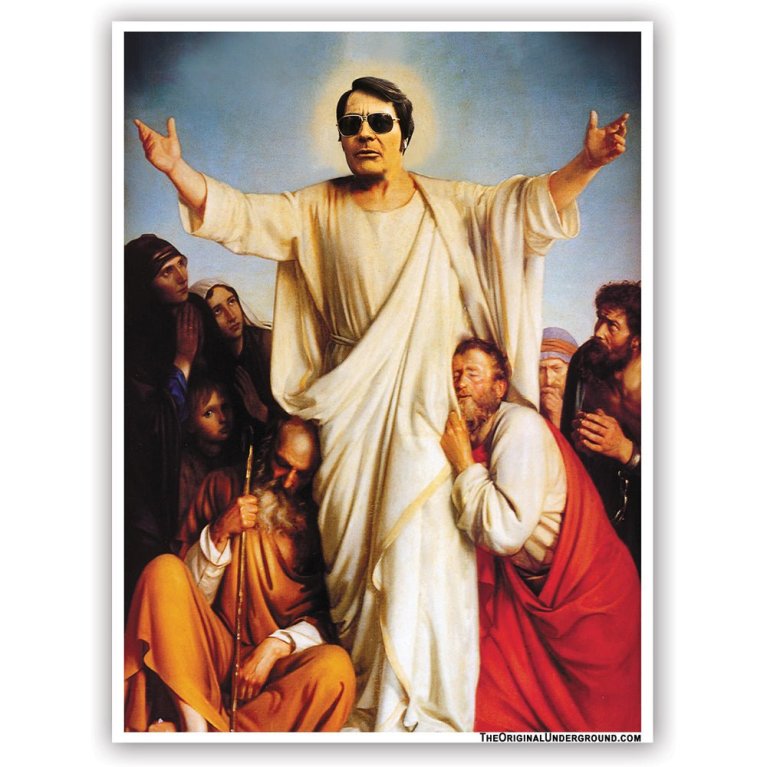
Pastor Jim Jones preaches his counterfeit Gospel before being abandoned by the US government and having to free his cult from bondage with some poison laced Kool-aid.

Seeing someone I thought was a Christian missionary lament how the United States had “abandoned” them was a reminder of how the great have fallen.  There was not a shred of gratitude expressed towards the American taxpayers who financed them nor acknowledgement of the misappropriation of funds that has wearied voters to foreign aid.  But more stunning to me was unholy alliance between this person of faith and agencies of US imperialism.  Since when has the love of Jesus become an extension of the US regime abroad?  Are they of the kingdom, as they proclaim, or agents of empire?

USAID, despite the name, is certainly not a charitable organization and was formed in 1961, at the height of the Cold War, with an aim of promoting the interests of the US political regime.  That’s fine.  But it has long ago gone off the rails even as far as what it was originally imagined.  The Soviet Union had fallen and the Federal agency created to oppose it morphed from something most would support into a beacon of wokeness—pushing transgenderism and abortion.

Break the Yoke of Fraudulence 

The reason why USAID is being dismantled is because we can’t sort the legitimate from illegitimate function of the agency.  Sure, it may help people in need, but funding it also is enabling of evil and maintained through a system of coercion we call taxes.  Anything good that it did can be done through other means.  This functional fixedness of those who depend of government, especially on the part of those professing Christ, makes me wonder where their faith lies and what their actual mission is.

The merger of a Christian charitable cause with government doesn’t purify government—it taints the witness:

Do not be yoked together with unbelievers. For what do righteousness and wickedness have in common? Or what fellowship can light have with darkness?  What harmony is there between Christ and Belial?  Or what does a believer have in common with an unbeliever?  What agreement is there between the temple of God and idols? For we are the temple of the living God. As God has said: “I will live with them and walk among them, and I will be their God, and they will be my people.” Therefore, “Come out from them and be separate, says the Lord. Touch no unclean thing, and I will receive you.” (2 Corinthians 6:14-17 NIV)

The accusations of “Christian nationalism” against those who want a government that performs basic functions were always just a smear by those in alliance with imperialism and Godless globalism.  While I’m not a fan of God and country, at least the flag waving religious patriot knows there is a difference between their Christian mission and secular state.  The left, by contrast, confuses these categories and would have social program replace true charity and community aid.  In one case you have those who may tend to overreverence nation, but in the other there are those who truly represent empire and yet tell us they their only  citizenship is the kingdom of heaven.

The truth is that the ‘Christian’ left is simply the left merely wearing the words of Christ as a disguise for ideological agenda.  Those decrying the reduction of empire and return to responsible governance never said thank you to those funding their do-gooderism.  It was, for them, all about holding those “chief seats in the synagogue” and their own glory as humanitarians.  They may speak against Trump, but then have never uttered a word against the waste, fraud and abuse that has made these broad sweeping cuts popular with common people.

The true Christian spirit is that of a Federal employee who told me about the enormous amount of inefficiency and waste in his own agency and—while making no profession of faith—supports the effort of DOGE knowing it may impact his employment.  That, to me, is someone who understands self-sacrifial love more than someone feeding the poor on another person’s dime and then going to social media to complain when their funds are cut.  They’re grandstanding.  While my Federal employee friend is a truly humble public servant who is grateful and not biting the hand that feeds him.

None of this to say this “abandoned” former hero of mine is a bad person.  They clearly are using their abilities to help other people in desperate need.  I applaud that.  And yet their public statement betrays.  There is an attitude or spirit there that is different from Christ.  I would much rather they just be a secular humanist—subscribed to partisan leftist politics—and own it.  They should just admit that they’ve abandoned faith in Jesus and are looking for a worldly system.  Judas Iscariot is the patron saint of faithless social justice, guilt trips and envy—when you betray your calling just own it.

The Evangeli-con—Gospel or a Get-Rich Scheme?

Standard

Typically we do not let customers past the front counter.  We prefer to work off of complete drawings and do most of our business over the phone or by email.  However, a few years ago, we got a call from a potential new customer, apparently a building contractor or developer, and he wanted to have a sit-down meeting to discuss this project.  So we decided to make an exception.

His name rang a bell.  And given his antics to this point, I decided to do a little online search and found out rather quickly that he had been convicted of both forgery and fraud.  From what I could gather in the news reports, he had collected hundreds of thousands of dollars from investors, but spent the money elsewhere and never actually finished the projects.  

So when this brash middle-aged man showed up at our office, I already had him sized up and advised my employer to collect upfront if he ever did actually order.  The meeting wasn’t all that beneficial.  I already had the overview of the condo project he was proposing.  What I really needed was a completed set of architectural plans.  But, for whatever reason, getting critical dimensions was a fiasco.  He was the draftsman, using his rudimentary AutoCAD skills, and did not seem to understand why we need to know exactly where the bearing walls were.

But what did come out of the meeting is that he had been incarcerated, something which he played off as being political persecution, and during his time behind bars he found inspiration for a new ministry.  They have a website.  I won’t name this man or the ministry for multiple reasons.  However, this site does have a donate button and also lists a board of directors, with bios, and includes a couple of members who share his surname.

Anyhow, despite his grandiose plans, on paper, we have yet to sell anything to him.  He has gotten updates on the quotes about once a year since then and more recently has given plans, similarly half-baked, for another large development project.  We’re not holding our breath on any of these grand ideas ever breaking ground. 

Still, there is something about this man’s essential character that has intrigued me and it seems to parallel a particular brand of Protestant religion that could be summed up this way:

They have an unhealthy interest in controversies and quarrels about words that result in envy, strife, malicious talk, evil suspicions and constant friction between people of corrupt mind, who have been robbed of the truth and who think that godliness is a means to financial gain. 

(1 Timothy 4a-6 NIV) 

Forgive Me, I’m Grandiose!

The one thing that jumped out to me about this particular man is that his ministry is focused on forgiveness.  In his testimony, there is lots of talk about his personal growth, and the sins of the other incarcerated men he met, but no admission of guilt or expression of repentance.  Now, that said, he does seem to be sincere enough, and I don’t want to extrapolate too much from that omission.  And yet, that is where the Gospel of Jesus Christ actually begins, with our humility and making restitution if we can.

What it looks like to me is that this is a guy out to impress.  A product of health and wealth evangelicalism.  I mean, it isn’t just enough for him to keep having Bible studies with those he met.  No, he needs to build a ministry empire, a huge complex complete with a basketball court the he drew up, with himself being the center of it all.

This is a good time to look at how the passage quoted above continues:

But godliness with contentment is great gain.  For we brought nothing into the world, and we can take nothing out of it.  But if we have food and clothing, we will be content with that.  Those who want to get rich fall into temptation and a trap and into many foolish and harmful desires that plunge people into ruin and destruction.  For the love of money is a root of all kinds of evil. Some people, eager for money, have wandered from the faith and pierced themselves with many griefs.

(1 Timothy 7-10 NIV)

So many in America seem to be obsessed with size and comfort.  Bigger is better.  And give me heated seats with leather too!  People flock to mega-churches, like Joel Osteen’s, looking for some of that low-commitment high reward religion.

But for every one of the televangelist salesmen who made it, there are a hundred other Evangeli-cons with ‘ministries’ writing books or seeking donations for their vision and never quite getting there.

You would think that the Christian life was more about having a campus and private jet, with flashy seminars, like Bill Gothard in the 1980s, and not about following a guy who gave up the power of God’s throne, who even transferred his ministry to his disciples rather than stick around:

But very truly I tell you, it is for your good that I am going away. Unless I go away, the Advocate will not come to you; but if I go, I will send him to you.

(John 16:7 NIV)

There is something to be said for starting something and then getting out of the way.  Or at least being happy to just do what is within your reach already rather than keep dreaming about bigger.  If Jesus was willing to exit stage left and step out of the picture so the disciples would be able to do “greater things” (John 14:12 NIV) who are we to ever cling to our own ‘ministry’ ambitions?

Whether they start out being good or not, many of these parachurch organizations lack appropriate oversight, exacerbate the flaws of the founders, and end up hurting people or embroiled in scandal.  Perhaps more should heed the warning of James:“Not many of you should become teachers, my fellow believers, because you know that we who teach will be judged more strictly.”  Perhaps more, taking this to heart, would bridle their tongues rather than appoint themselves as the big cheese out to teach or impose their perspective on the masses?

I know the rush that comes from having an audience.  When a couple of my blogs went viral I had thoughts that it may be the launching pad to something even greater.  But, fortunately, that blew over and I’m really not in need of that kind of pressure.  My goal, right now, is to be the best husband and father I can be and any ministry besides that will need to come from God.  As grandiose as I can be, the thought of thousands of people following after my lead is absolutely terrifying, and thus I’m glad to be a bit player—I don’t think I could be saved from myself if I were too popular or powerful.

It seems many, raised under Biblical preaching, fall easy prey to get-rich-quick scams and religious frauds.  Instead of heeding St Paul and being content with food and shelter, they chase wealth and notoriety or position for themselves.  Despite the rebukes of Matthew 13, they clamor for titles important to their peers, like missionary or pastor, they’re self-important people, creating a new parachurch organization rather than falling under an established body that may require them to be accountable to more than their fawning yes men or adoring fans.

There are many who will have had their reward, their name being known here and not in heaven.  Many more are led astray by these ‘spiritual’ guru con-artists who exploit their itching ears and insatiable appetites.

God of the Paradox

Naturally, we’re drawn to the awesome. A spectacular sunset or sunrise, powerful war machines, the massive pyramids or majestic mountains. God too is frequently put in terms of his boundless attributes or those events like destructive floods, miraculous parting of a sea, and even the creation of the universe.

Why would God, obsessed with size and power, be interested in man?

The answer is that God is as much God of the still and small as the feats beyond human comprehension:

The Lord said, “Go out and stand on the mountain in the presence of the Lord, for the Lord is about to pass by.”  Then a great and powerful wind tore the mountains apart and shattered the rocks before the Lord, but the Lord was not in the wind. After the wind there was an earthquake, but the Lord was not in the earthquake.  After the earthquake came a fire, but the Lord was not in the fire. And after the fire came a gentle whisper.  When Elijah heard it, he pulled his cloak over his face and went out and stood at the mouth of the cave. 

Then a voice said to him, “What are you doing here, Elijah?”

(1 Kings 19:11-13 NIV)

Elijah had just witnessed something incredible prior to this, fire from heaven, and one would think may cement his faith. But he still fled into the wilderness, terrified of a wicked queen and wanting to die.

We may think that God is like us, loving to intimate with shock and awe. And yet God is as present in the still and small as anywhere else.

You can’t have a relationship with a powerful wind, an earthquake or fire.

So maybe rather than the performance with a light show or having a following of thousands, we should seek to be like the One who wants to be personal and intimate with us? Indeed, it is not the charismatic preacher, aloof in those designer jeans, raking in six figures nor those who parachute in for a charity project before returning home to their comforts, who make the most difference. Rather it is those who have integrity, who admit their faults, and who live at the same level as those whom they love.

This is the true Gospel:

In your relationships with one another, have the same mindset as Christ Jesus: Who, being in very nature God, did not consider equality with God something to be used to his own advantage; rather, he made himself nothing by taking the very nature of a servant, being made in human likeness. And being found in appearance as a man, he humbled himself by becoming obedient to death— even death on a cross!

(Philippians 2:5‭-‬8 NIV)

This is why wealth and power too easily stand in the way of following Christ. Sure, we can always say that if we had more resources we could do more. But, in reality, being rich in resources often comes at the expense of the mission of introducing others to Jesus. How can we ever claim to represent God who became man when we need a private jet, fancy literature or sponsors back home, to follow Him?

Dare I say that those many who most confidently claim to be the representatives of Jesus are, in truth, the most full of themselves?

Satan was obsessed with glory for himself and Judas loved money at the expense of mercy for others. We should take this into consideration before seeking the spotlight for ourselves. It is better to remain humble.

The way of Christ is suffering for the sake of others—not to build a ministry empire that seems to be suspiciously about us. It is about those visiting those imprisoned for their righteousness—not about demanding others spare us the consequences of our own sins. 

When It Is Better To Do Nothing

Standard

Have I mentioned that I’m tired of religious people and the prescriptions they give?

The real Jesus was defiant.  He upended the systems and standards of his time.  He was intentionally offensive to the self-righteous religious elites and then completely gentle with those who were broken.  There was no one-size-fits-all, no attempt to simplify the process.  Salvation is a walk of faith, not our ability to keep a set of fixed rules or pray a certain way, it is about our heart.

No, I’m not saying this as favoring the more libertine amongst us.  Being “free in Christ” is not a license to do whatever we want.  It is not about being ‘spiritual’ rather the religious either.  Rather it as about love:

It is for freedom that Christ has set us free. Stand firm, then, and do not let yourselves be burdened again by a yoke of slavery. […] You, my brothers and sisters, were called to be free. But do not use your freedom to indulge the flesh; rather, serve one another humbly in love.”

(Galatians 5:1‭, ‬13 NIV)

A great deal of my social media connections are unregenerate social conservatives.  They love those fading structures that once kept people bound to their moral standards and yet lack any comprehension of grace or their own need of it.  They may see themselves as being righteous, for their exceptional ability to keep up certain cultural conventions, but they are very much like those rebuked and condemned by Jesus.

But still the alternative is not to go in the complete opposite direction.  It is not better to have no structure, to completely defy all cultural convention or use Christian freedom as an excuse to do whatever we please.  No, rather it is to serve and save others:

Though I am free and belong to no one, I have made myself a slave to everyone, to win as many as possible. To the Jews I became like a Jew, to win the Jews. To those under the law I became like one under the law (though I myself am not under the law), so as to win those under the law. To those not having the law I became like one not having the law (though I am not free from God’s law but am under Christ’s law), so as to win those not having the law. To the weak I became weak, to win the weak. I have become all things to all people so that by all possible means I might save some. I do all this for the sake of the gospel, that I may share in its blessings.

(1 Corinthians 9:19‭-‬23 NIV)

Which is to reiterate the example of Christ:

…whoever wants to become great among you must be your servant, and whoever wants to be first must be slave of all. For even the Son of Man did not come to be served, but to serve, and to give his life as a ransom for many.”

(Mark 10:43‭-‬45 NIV)

Our love for God is always, always, a matter of how we treat each other.  If we can’t love the people we see, specifically our brothers and sisters in Christ, then our claim to love God is a lie. (1 John 4:20)  Therefore, to be free in Christ, is not to shirk responsibility to each other.  It is not worshipful, at least not of God, to go to church (or not go) for own sake:

“Therefore, if you are offering your gift at the altar and there remember that your brother or sister has something against you, leave your gift there in front of the altar. First go and be reconciled to them; then come and offer your gift.

(Matthew 5:23‭-‬24 NIV)

This is putting reconciliation with each other, true reconciliation. before or ahead of the ritual worship that religious people do.  No, it is not negotiable.  This is the command of Jesus.  And yet it is so often reversed.  It is acceptable to act or go through the motions of righteousness, but not to ask for the same authenticity that put Jesus at odds with the religious authorities.

Had Jesus just followed the rules and did what was expected he would never have been a threat to anyone.  The reality is that he saw through the empty gestures.  He was not impressed with those pious people who had their performative religion.  His call was for genuine love, to be merciful as our Father is merciful:

On hearing this, Jesus said, “It is not the healthy who need a doctor, but the sick. But go and learn what this means: ‘I desire mercy, not sacrifice.’ For I have not come to call the righteous, but sinners.”

(Matthew 9:12‭-‬13 NIV)

That’s our true worship, to truly forgive and love those undeserving and broken.

Early Christians had a saying “unus Christianus, nullus Christianus,” which is to say that one Christian is no Christian.  This is to say that our Communion together, in Christ, needs to go beyond merely sharing the same physical space for a few hours or it is fake.  True Christianity can’t be reduced to mere individualistic pursuit of the Divine.  It is not an “only God can judge me” freedom from duty to others.

I could quote two dozen other texts and it would not matter.  So many are caught up in their own corrupted ‘traditions’ that they’ll always miss the forest for the trees.  But I’m not interested in dime-store Christianity, the kind that only loves in prescribed ways.  I want the real deal, the kind that frees and truly forgives.  I want what is alive, what has the true Spirit of truth and love in it, not the lifeless self-serving counterfeit form.

It’s not that the wonderful symbolism and designated acts of ‘Christian’ service are unimportant or useless either.  But it’s just that none of it really matters if it is not a part of something genuine.  As Jesus said, in Matthew 23:15, a person can “travel over land and sea to win a single convert” and only be successful in making their new convert “twice as much a child of hell” as themselves.  In that case it would be better to do nothing at all.

Even the mystical “cup of salvation” can be our damnation if we drink unworthily (1 Corinthians 11:29) or in disregard and without care for His body. The body of Christ meaning, at times, our fellow members of the Church or the people we encounter who are in need of love:

For I was hungry and you gave me something to eat, I was thirsty and you gave me something to drink, I was a stranger and you invited me in, I needed clothes and you clothed me, I was sick and you looked after me, I was in prison and you came to visit me.

(Matthew 25:35‭-‬36 NIV)

Filipino Christians Forced To Convert, Raped.

Standard

In an article, “Filipino Diaspora: Modern-day Missionaries of the World,” the plight of Overseas Filipino Workers (OFWs) is put in a positive light as a way that the Gospel is being spread throughout the word:

Mary Jane Soriano, a 25-year college-graduate Filipino domestic worker, has been working in Hong Kong for some years. During her stay there, she always made a point to attend the Sunday Mass in a local church, even if her employer and his family belonged to another religion. Besides Mary’s humility, simplicity, hard work, honesty and other human qualities that inevitably impressed her employer is her indomitable Catholic faith the way she practiced—simple ways to keep her life and faith going and always trusting in God and pray daily, and be good and do good to others.

Indeed, God moves in mysterious ways, Christianity swept through the Roman empire as “a religion of woman and slaves” (probably because it gave hope to these disenfranchised people) and in that way this diaspora of Filipinos is bringing Christianity to the world. The message of Jesus, and the cross, is that we will suffer for the sake of his kingdom—but that, in the end, the sacrifice we make is going to be rewarded:

“So the last shall be first, the first last.” (Matthew 20:16 KJV)

I have deep respect for those who aren’t missionaries as an extension of their privilege, living in behind compound walls, and entirely supported by the generosity of others. OFWs may indeed be the greatest missionaries of our time.

However, there is also a flipside, according to AsiaNews.it, in an article from 2010:

“In my tens in Saudi Arabia, I have witnessed several Catholic or Christian Filipino migrants accept Islam under duress,” said Joselyn Cabrera, a Filipino Catholic nurse working at Riyadh hospital. Because of high unemployment levels in the Philippines, more than ten million Filipinos have left to seek jobs abroad. Every day, about 3,000 leave the country. Recently, a majority has gone to Arab countries—some 600,000 in all, 200,000 in Saudi Arabia alone.

And continues:

The most recent case involves a woman who was raped at work. Because of the incident, Saudi authorities accused her of unlawful extramarital sex and on 11 September jailed her in the capital.

That doesn’t sound much like missionary service. It sounds like the vulnerable being exploited, forced to convert under duress, and is unacceptable.

Yes, the New Testament is full of stories of Christians ensuring terrible persecution for their faith. Yes, by their example of suffering example Christianity did spread to the world. But, no, that reality does not mean there is not a terrible cost nor does it absolve us of our own responsibility to intervene.

Suffer With Those Who Suffer

We should never allow our brothers and sisters to continue to endure hardships due to our own negligence or lack of compassion. No, as Christians, we are called to be their advocate, to care for them as we would for a member of our own families, and act on their behalf of them—like St Paul did in pleading for Onesimus:

Therefore, although in Christ I could be bold and order you to do what you ought to do, yet I prefer to appeal to you on the basis of love. It is as none other than Paul—an old man and now also a prisoner of Christ Jesus— that I appeal to you for my son Onesimus, who became my son while I was in chains. (Philemon 1:8‭-‬10 NIV)

St Paul, in taking action on behalf of this runaway slave, was practicing what he preached:

If one part suffers, every part suffers with it; if one part is honored, every part rejoices with it. (1 Corinthians 12:26 NIV)

This is what it means to be Christian:

Love must be sincere. Hate what is evil; cling to what is good. Be devoted to one another in love. Honor one another above yourselves. Never be lacking in zeal, but keep your spiritual fervor, serving the Lord. Be joyful in hope, patient in affliction, faithful in prayer. Share with the Lord’s people who are in need. Practice hospitality. Bless those who persecute you; bless and do not curse. Rejoice with those who rejoice; mourn with those who mourn. Live in harmony with one another. Do not be proud, but be willing to associate with people of low position. (Romans 12:9‭-‬16 NIV)

Incidentally, the description “low position” in the passage above means those who do menial tasks. That is to say the domestic worker, the migrant laborer, and all those toiling away in the factories, that make our electronic gadgets, for wages a fraction of our own. We should love them, suffer with them, and share out of our own abundance as need be. Those of us living in peace and prosperity have an obligation to help those who are currently endure terrible circumstances and especially those of the household of faith.

To be a part of the body of Christ means not being too busy with our own lives to care. It means being willing to intervene in love on behalf of OFWs around the world, to carry their cross and be an example of Christ.

Carrying the Cross of the Overseas Worker

We live in a culture that has been Christianized to the point that even secular artists now encourage Christian values. We now act as if compassion for those who are not part of our own biological families, national identity or ethnic tribe and race is something normal. That we should care about these others rather than use them as had been common prior to Christ. Take the lyrics of Pink Floyd’s, “On the Turning Away,” for example:

On the turning away
From the pale and downtrodden
And the words they say
Which we won’t understand
“Don’t accept that what’s happening
Is just a case of others’ suffering
Or you’ll find that you’re joining in
The turning away”

A Christian should never turn away from those in desperate need. We should feel the loneliness of an OFW, as those who are far from home and are separated from their families (including their own young children) for years at a time, and share their sadness. We should think about their fears, mourn the trauma of those who have been sexually assaulted and are being held captive, as slaves, by their abusive employers. We should pray, encourage and absolutely—by all means available to us—work to deliver them from their captivity and bring them home to the families they love.

Sure, it may be the job of the OFW to be a witness to the world of Christ’s love. But it is also our responsibility as fellow Christians, their brothers and sisters in Christ, to be a witness of the Gospel to them by helping to carrying their cross. If Christ himself, according to Scripture, needed help to carry his cross—then how much more does an OFW need our intervention for them? It is for this very purpose that Jesus told the disciples he would go, so that we (who are part of his body and filled with the Holy Spirit) will do greater things in his name.

But What Can We Do?

Many do have compassion. However, the problem is, how do we effectively do anything to change the circumstances for millions of people on the opposite side of the world? Even if we spent every nickel and dime we earned trying to support them and their families it would only help a fraction of those who are in need and it would do absolutely nothing to solve the actual underlying causes of this grim reality for countless Filipino people.

There is not much we as individuals can do as individuals. However there is much we can do in our working together towards a particular end. It is my hope that in my bringing awareness to this issue that others will partner with me, willing to contribute in their own small part, and together we can bring an end to the abuse.

That is why I’ve started the Filipino American Coalition of Trade (FACT) to give opportunity to those who want to make a difference for those who bear the cross as the truest missionaries of our time.

Like and follow FACT both on Facebook and also at the new blog site.

Pray for those who will spend this Christmas as slaves, sojourners in foreign lands, and victims of circumstances beyond their own control. Pray for the well-being of the OFW and their families, pray for their freedom from the economic conditions that keep them bound and separated from their loved ones, and may God be glorified in us all.

Missionaries From Hell — Revisited

Standard

The picture above is from a glowing LancasterOnline article, from 2016, about a couple who sold everything to start an orphanage in Kenya.

A few years ago, while at an annual conservative Mennonite revivalist effort, specifically the youth tent meetings at Terry Hill, I was involved in a conversation with a parent who spoke of their great admiration of the missionary zeal of the younger generation. To this person, the desire to travel to exotic places, purportedly to “share the Gospel,” was proof of sincere faith and fulfillment of the great commission. But, having decided that questioning this paradigm would likely be misunderstood, I did not express my reservations then.

Since then I have written two blogs, most recently one (“Missionaries From Hell?“) as part of a series on Matthew 23 and another before that (“Missionary or Imposter?“) exploring the true meaning of a quote of a famed fundamentalist preacher, Charles Spurgeon, about Christian missionary work. In both I point out the many different motives, besides a sincere desire to reach vulnerable people, why someone would leave the comforts (and boredom) of rural American life to be with a group of ambitious (and unmarried) young people. My basic point being that missionary zeal does not necessarily mean prayer cards and world travel.

My Blindspot

However, in those prior efforts, while listing the many possibilities of corrupt motivations and relating my own experiences, not once did it occur to me to add sexual predation to the list. At the time it would have seemed a bit over the top. My simply challenging the assumption that all things done in the name of Jesus are legit service “for the kingdom” may have been enough for some to tune me out. I mean, isn’t it great that some are trying to do something, even if that effort is misguided, largely ineffective and born of suspect motives?

Yes, maybe the execution was flawed, but isn’t the road to heaven paved with good intentions?

(Or maybe I’m remembering that expression wrong…?)

Anyhow, to suggest that some are there some there in these impoverished countries as a means to prey on the vulnerable would have been unconscionable until it became otherwise. When the bombshell report of Jeriah Mast’s confessions to sexually predatory behavior, both while a missionary in Haiti and also swept under the rug at home, rocked the conservative Mennonite world it immediately reminded me of the two blogs I wrote about the potential for ulterior motives.

It makes perfect sense now and should’ve years before in the wake of the sexual abuse scandal at Penn State. If Jerry Sandusky, the founder of an organization supposedly to help disadvantaged boys, the “Second Mile,” could use his access to the university and reputation as a former coach as a means to hide in plain sight, why not a Mennonite missionary?

Except, for some reason, it was unimaginable.

My concerns expressed missed and not because they were too critical either. No, if anything, I was too gentle and generous. All cultures have their sacred cows, it is risky business trying to confront them head-on, and maybe that is what caused me to unconsciously tread lightly as not to offend. But charities and church ministries are opportunity zones for wolves in sheep’s clothing. The reality is this: The same things that draw those with pure motives to the mission also attracts those looking to exploit vulnerable people.

The Bigger Issue

It certainly isn’t just the case in Mennonite missions either. In fact, the reason I’m writing is because of another case involving a Lancaster County man, a convicted sex offender, who started an orphanage in Kenya—the man in the LancasterOnline picture. Then there is that “incredible story of decades of adultery, rape, and pedophiliac sexual abuse by Donn Ketcham” mentioned by Hans Mast in his blog. And that’s only scratching the surface, only the most current and obvious examples, and who knows what is yet to come to light.

Do we have any excuse anymore not to be aware?

We can fairly easily detect a fraud when it is not one of our own. Like the Manhattan ‘pastor’ who wrote in USA Today about her late-term abortion, had a salary of $250,000 (“plus more than $150,000 in fringe benefits”) and recently lost her job over a harassment complaint involving sex toys. Most people know to be wary of men like televangelist Kenneth Copeland, who live like celebrities and fleece their flocks for Gulfstream jets. But the truth is that these aren’t the wolves relevant to conservative Mennonite (or Orthodox Christian) sheep and we do definitely have wolves amongst us.

We were warned…

“Keep watch over yourselves and all the flock of which the Holy Spirit has made you overseers. Be shepherds of the church of God, which he bought with his own blood. I know that after I leave, savage wolves will come in among you and will not spare the flock.” (Acts 20:28‭-‬29 NIV)

Perhaps the most uncomfortable truth is that we all have this potential to be the imposter or to be one who looks and acts the part of a Christian, yet is only really in it for themselves. Living the part of a religious or cultural ideal often gives you access to funding, better jobs, travel, and other opportunities. Sure, not everyone who goes abroad is a sexual predator. It is likely that this kind of abuse is the rare exception of those who travel. However, sexual predation is not the only form of exploitation.

It could be argued that populating an Instagram page with cute pictures of foreign children is more for the benefit of the one posting them. In well-funded funded Western-style missions there is also plenty of power and cultural imperialism that comes along for the ride in our missionary efforts. In other words, there are many ways that a person can be a missionary from hell.

Some Monday Musings About Missionaries and Exploitation

Standard

Trudy Metzger has been a warrior shedding light on sexual abuse within the Anabaptist context and has once again reported on something that has been concealed from many of us. Her latest blog about a confessed pedophile, associated with Christian Aid Ministries, and the consequences of his actions being visited upon a hapless Haitian pastor, really did hit a raw nerve with me.

You can read her blog: “Haitian Commissioner Orders Christian Aid Ministries (CAM) to appear in court with offender

The CAM organization has enjoyed a reputation of having relatively low overhead and for promoting conservative Mennonite values both here in the United States and abroad. I have some friends and family associated with the organization, good people, who I’m guessing are as outraged by this situation in Haiti as I am. It is sad, their work should not be discredited on the account of a few corrupt individuals and yet there must be a robust response on the part of current CAM leadership or these good people will have some tough decisions to make.

Full disclosure: I’ve long been a critic of short-term missions, which seem to be exploitative by nature even if well-intentioned. My own experience, on a trip to Haiti, was enough to convince me of that, when a few dozen youths can travel to an impoverished country for a week or two, at great expense to those who donated to our fundraising efforts and accomplish so little of real value. Meanwhile, we could have employed the Haitian man, like the one who begged me for work while we painted the church, for months and gotten much more accomplished.

That is my general complaint with what passes as missionary service. It too often involves a bunch of young people, out for a religious culturally sanctioned adventure, and bears very little resemblance to anything we find in Scripture. For one, Jesus sends his disciples (adults) without funding, they went on faith and only the shirts on their backs. By contrast, what passes for missionary service today is too often a bunch of privileged youths, living in compounds and being catered to, doing a couple dogooder projects while spouse shopping the other volunteers.

That said, CAM seemed to be making a far more substantial effort. Yes, well-funded by the many deep pockets in the conservative Anabaptist sphere, but with many very committed and completely blameless individuals. Still, if their organization is being used as shelter by sexual predators, then this needs to be fully exposed. Like I’ve said in a social media post, sunlight is the best disinfectant. Those who support the work of CAM really do need to hear everything—the good, bad and the ugly—because there are certainly many other ways to serve the cause of Christ with their resources they might otherwise donate to CAM.

It is my hope that CAM comes completely clean as far as all allegations regarding their staff or the families of their staff members. I’m not saying that the innocent who are falsely accused should have their names drug in the mud either, that is an abuse in and of itself, but certainly, those who have confessed to sexual abuse and other crimes while associated with CAM. Of course, this sort of thing is embarrassing, it is always easy to hide behind the idea that the greater good will somehow be served by silence, yet what is done is done and it must be handled openly rather than concealed:

“Stories surface stating there were more crimes in other countries, by other CAM staff members. Not all informants feel comfortable sharing names of alleged offenders, but some names and details by various informants begin to fill the gaps left by others. An orphanage. Three offenders.”

My questions:

1. How many cases like this have there been before?

2. What, if anything, was done to address this immoral and criminal behavior?

3. What steps will be taken to protect against this sort of sexual abuse from reoccurring in the future?

“Why Don’t Mennonites Pay Taxes?” And Other Similar Questions…

Standard

Growing up conservative Mennonite and going to a public school opened me up to many questions about my religion. However, while these inquiries were presented in form of a question, they often came off as statements:

“Hey, don’t Mennonites have horse and buggies, where’s yours?”

“Why don’t Mennonites pay taxes?”

Understand, this wasn’t intended as obnoxious, this was in elementary school and these classmates were genuinely curious. They were trying to take what they knew about Mennonites (or thought they knew) with what they observed in me and reconcile the two. I suppose these could be called “micro-aggressions” according to the currently popular terms, but I prefer a more gracious explanation.

Still, while I prefer to be gracious, the presumptions still annoyed me. This exposure might explain my sometimes strong visceral reaction to being pigeonholed in a debate. It might also have contributed to my desire to be a non-conformist in a culture that took pride in being non-conformed and did things a little different from other Mennonites. I’ve always wanted the right to speak for myself and for that reason have tried to give others the same respect and let them speak for themselves.

Anyhow, I’m pretty sure that any conservative Mennonite who spent time outside of their own religious cloister has experienced much of the same thing. The people asking if they are Amish, those inquiring if they ever considered the possibility there is no God, etc. And presumably, this would make us more careful not to do the same others. But that’s not always the case, as I’ve discovered…

Oh No, Not Again!!!

Since becoming Orthodox I’ve encountered the same kind of presumptions in a different form. This time, rather than public school peers, it is Mennonite family and friends. And it is not that I mind the questions either, but when someone starts with “I know a Catholic…” it reminds of those who cannot distinguish conservative Mennonites from Amish or Old Order Mennonites.

So I’ll start with that one…

“Aren’t Orthodox basically Catholics?”

Yes and no.

The word “Catholic” means universal. In the words of St Paul, there is “one body” (Rom 12:5, 1 Cor 10:17, 12:20, Eph 2:16, 4:4, etc.) and that is what universal or catholic means when applied to the Church. There may be multiple denominations, differences, and divisions within the Church, but there is only one universal Christian body of believers and that is what Catholic means. So, yes, all Orthodox Christians believe in a Catholic church, in that they believe there is only one universal Christian Church—that is what Biblical tradition tells us and that is what we must believe is true.

However, no, despite some similarities, we are not *Roman* Catholic. The early church had five patriarchs, one in Jerusalem, one in Alexandria, one in Antioch, one in Constantinople and another in Rome. These were geographic centers and separate jurisdictions of the early church and all were basically in agreement. However, in a similar fashion to how Amish split from other Anabaptists, there was a “Great Schism” in 1054 between the four patriarchs of the “East” and the Roman “West” over a variety of issues—including Rome’s unilateral addition to the creed (called the “filioque“) and the elevation of Papal power.

The Roman side veered towards more authority being granted to “Peter’s seat” in Rome. The Orthodox, by contrast, put more emphasis on maintaining Church tradition both written and spoken (or Orthodoxy) and hold that Peter was the “first among equals” rather than the “Vicar of Christ” in the way that the Romans do. This is a very significant difference of perspective, yet Orthodox and Roman Catholics do recognize each other at some level despite not being in Communion together. Both the Orthodox East and Roman West are Catholic in the sense they are parts of the universal Church, but they are not the same.

“Do Orthodox worship Mary?”

One of the first things a non-Orthodox will notice when entering an Orthodox sanctuary is the many pictures. These are called “icons” (after the Greek word for “image”) and are a visual representation of various saints, scenes, etc. This is a Christian tradition back to depictions in the Catacombs, there are icons of many virtuous Biblical characters, and of those most prominently displayed are those of Jesus and Mary the mother of Jesus. There is also mention of Mary, the mother of Jesus, “with the saints” throughout the divine liturgy and special honor is given to her.

However, Mary, while venerated (or honored) as the mother of our Lord, is never worshipped by an Orthodox Christian. Worship is only for the Trinity (Father, Son, and Holy Spirit) and all others are honored for their various roles. Mary’s role is more significant because her body was quite literally the ark of the new covenant. That is why Mary knew, early on, that “all generations will call me blessed” (Luke 1:48) and why Elizabeth (who were are told was “filled with the Holy Spirit”) loudly proclaims: “Blessed are you among women, and blessed is the child you will bear!” Nowhere in Scripture do we have a similar proclamation made and it is only right that the mother of Jesus is recognized by us in the same manner that she is by Elizabeth.

For Jesus to be fully man he needed a mother and his mother was Mary and that is why we celebrate her role. But that honor is not worship. In Chrismation, one has to make agree and make clear that their recognition of Mary and the saints in form of icons is “not unto idolatry” but for sake of “contemplation” and so that “we may increase in piety, and emulation of the deeds of the holy persons represented.” It is no more idolatry to venerate Mary and the saints than it is to have pictures of your grandparents on the wall or to speak of your own mother glowingly on Mother’s day or to treat your own children or spouse differently than other people. There is a vast difference between honor and worship.

“Why aren’t there Orthodox missionaries?”

This one caught me off guard. First off, every Orthodox Christian is (borrowing the words of Charles Spurgeon) “either a missionary or an imposter” and by this, I mean every member of the body of Christ is sent into the world as his representative. Sure, not every Christian is sent abroad in the manner of Hudson Taylor, but every Christian is called to be an ambassador for Christ (2 Cor. 5:20) and should do this wherever they are in the world. Secondly, Orthodox Christians, from St Paul onward have journeyed physically to spread the Gospel to the four corners of the world. Again, not all traveled to far away places, but every Orthodox believer is a missionary and there are no exceptions.

Some of the confusion of my Mennonite friends (who more or less proclaimed that Orthodox lack missionaries) could a product of Evangelical Protestantism and the influence this movement has had on defining their current practice. It seems many under that influence see missionary service as an activity that Christians do rather than an all-encompassing lifestyle. In other words, according to this mindset, one is only a missionary when shoving a tract in the face of an unsuspecting passerby or when they go with a group to do a project in a country that could use jobs more than donated labor. And yet, while that may be a part of what missionary work entails, this too is how we are to proclaim the good news:

“Slaves, obey your earthly masters in everything; and do it, not only when their eye is on you and to curry their favor, but with sincerity of heart and reverence for the Lord. Whatever you do, work at it with all your heart, as working for the Lord, not for human masters, since you know that you will receive an inheritance from the Lord as a reward. It is the Lord Christ you are serving.” (Colossians 3:22‭-‬24 NIV)

And, as far as Orthodox being missionaries in the forms more celebrated, there are many powerful examples of wonderworkers and martyrs for the faith. Orthodox don’t just travel to tropical paradises, do fun projects, and then jet back home again (back to their privileged lifestyles) after a few days or couple years. No, the Orthodox live in some of the most hostile places for a Christian to live and many have become the truest witness of Christ—they have died as martyrs for their faith, in this century as much as any other, and not only in the history books. It was not Protestant missionaries or Evangelicals being brutalized and beheaded by ISIS.

Furthermore, having entertained (very briefly) proselytizers of a sect widely viewed as heretical (even by Protestants) and having considered the words of Jesus about missionaries that make their converts twice as damned as themselves (Matt. 23:15) or those who will cry “Lord, Lord, have we not” when standing condemned in front of Him (Matt. 7:21-23) and listing their missionary works as if that is their salvation, there is something to be said for correct teachings and practice. The Orthodox, while all over the world (including Africa, where a baptism of 556 took place), seem to be more concerned with quiet and sincere obedience than they are with loud and proud professions.

“I’ve heard Orthodox don’t believe in being ‘born again’ experience, is this true?”

Conservative Mennonites, like other Evangelicals, tend to put much stock in a “born again” salvation experience. They take a phrase out of an analogy Jesus used (while speaking to Nicodemus in John 3:1-20) to explain spiritual transformation that must take place before someone can enter the kingdom of God. He likens being born of the Spirit to the wind, it is something mysterious, and then foretells his dying on the cross by likening it to the brass serpent Moses raised in the wilderness that healed those who looked upon it. And, yes, there is an experience, at the foot of the cross, for those who look up to Jesus and cry out for God’s mercy to them as a sinner.

However, salvation is not simply saying something and having an emotional experience attached or a once and done event, there’s so much more. We are told in the letters of St. Paul to “work out your salvation with fear and trembling” (Phil. 2:12) and then also that we are saved by grace “through faith” and as a “gift from God” (Eph. 2:1-10) rather than by our righteous works, which (with many other Biblical texts) could seem to present a contradictory view of salvation—splitting Protestants into competing camps of works versus faith, eternal security versus potentially losing our salvation, or Calvinist and Armenian. Meanwhile, Orthodox Christians avoid this debate entirely with a view of salvation that transcends easy categorization. We are saved, being saved, and will be saved so long as we continue to believe.

The Orthodox see salvation as a direction, not just a destination, as an intentional alignment with God’s perfect will and the choice we make daily in following after Jesus. In other words, salvation is less about declaring oneself to be “born again” or a singular event in time that we look back on and more about taking up our cross. Salvation is not a mere once-and-done transaction for them, it is a continuous relationship and being in Communion together with the body of Christ. So, yes, we should all be “born of the Spirit” and yet we should also be connected to the vine (John 15:1-8) or we will die as spiritual babies and never bear the fruit of salvation. Ultimately salvation is not a past event or a promised future reward, it is something we choose every day in our being faithful to God and living out the commitment to love each other.

“If we make every effort to avoid death of the body, still more should it be our endeavor to avoid death of the soul. There is no obstacle for a man who wants to be saved other than negligence and laziness of soul.”

+ St. Anthony the Great, “On the Character of Men and on the Virtuous Life: One Hundred and Seventy Texts,” Text 45, The Philokalia: The Complete Text (Vol. 1)

“I know an Orthodox and…”

It is one of the most annoying statements. Annoying because it is usually followed by some sort of negative characterization which they then use their anecdote to generalize about the entire two millennia of Orthodox Christianity and a church made up of hundreds of millions of people. It is a statement many Mennonites have encountered as well, which makes it all the more annoying when the same thing in slightly different form comes from the mouth of a Mennonite. I recall a time, broke down while driving truck, when the service technician (who didn’t know I was Mennonite) went on a long rant about some Mennonites he knew and how hypocritical Mennonites are, etc. Of course, his criticisms weren’t entirely incorrect nor are many of those leveled against the Orthodox (we don’t claim to be a church of perfect people) and yet they were definitely unfair to use as a basis to judge the entire group.

This tendency to remember their worse examples and our own best is a human universal. It is something called in-group-out-group-bias which means we tend to recall good examples of our own group (minimizing our bad) and bad examples of other groups (minimizing their good) or, in a word, favoritism. But this is especially true where the perfect church myth is prevalent or there is a lack of contemplation, introspection, and ownership. The smaller a group is, the easier it is to imagine that you are not like those others—those who do not live up to your own personal standards—and forget that a judgmental, divisive and prideful spirit is as sinful as anything else. Pointing out the faults of others is never a good defense. We should recall the story Jesus told about the confident religious elitist who thought only of his own righteousness in comparison to others and the humble man who begged only for mercy in his prayer:

To some who were confident of their own righteousness and looked down on everyone else, Jesus told this parable: “Two men went up to the temple to pray, one a Pharisee and the other a tax collector. The Pharisee stood by himself and prayed: ‘God, I thank you that I am not like other people—robbers, evildoers, adulterers—or even like this tax collector. I fast twice a week and give a tenth of all I get.’ “But the tax collector stood at a distance. He would not even look up to heaven, but beat his breast and said, ‘God, have mercy on me, a sinner.’ “I tell you that this man, rather than the other, went home justified before God. For all those who exalt themselves will be humbled, and those who humble themselves will be exalted.” (Luke 18:9-14)

So, anyhow, maybe you know an Orthodox Christian and can only recall bad things about them. But I probably know a few more and can tell you that they are just as sincere as any conservative Mennonite or other Evangelical I’ve met. Maybe you know some Orthodox who do not live to your own religious standards or can point to a historical blemish or two from a thousand years ago? Well, I’ll raise you one pedophile ordained by a Mennonite church in the past decade (here’s a list of some other Mennonite sexual abusers, if that’s not enough) and the Münster rebellion. Every denominational group has their less than celebrated moments and members, I can assure you of that. And if a group is too small to have a history of mistakes, that is not a great strength, it is a weakness, it only means they are more vulnerable. So “let he who is without sin cast the first stone” or maybe we should just take the advice of Jesus to be humble about ourselves and understand our own continual need of God’s mercy?

The Orthodox do not run from their history by starting a new denomination (or ‘non-denominational’ group) every time there’s a failure, they have their greater and lesser examples like every other group. But one thing that can be said is that they have maintained their unity centered on Christ and keeping the traditions of the Church from the time of the Apostles to the present moment. Fr Anthony, the Antiochian priest who served during my Chrismation, can trace his ordination all the way back to Peter and the first Gentile church, the church of Antioch (Acts 11:19-30) where believers were first called Christian. There is a great wealth of history to draw from, some cautionary tales, and many who were faithful until the end. Like the church that Paul preached to, the Church today is by no means perfect and yet, as Jesus promised, the “gates of hell” have not prevailed against the Church he founded.

For all of my non-Orthodox friends, the door is open, all people are welcomed, and there are good answers to questions for those who have them. There is truly a wonderful diversity within Orthodoxy, and a beauty of traditions—traditions packed with deep meaning—that span thousands of years. This is not something that one can begin to summarize in a blog post. There are volumes written and many more yet to be written about the Church.

But the best way to start learning about Orthodoxy is first-hand—to come and see.

There Is No Such Thing As Selfless Love

Standard

I had an idea of a supernatural love.  It was a love that would overcome differences in ambition, personality, experience, etc.  I had imagined a spiritual bonding of two people united only in their faith, going against their natural preferences and depending fully on God.

My pursuit of this greater love came as a result of what I had considered a spiritual experience and my desire to do God’s will.  I had a comfortable life and no real desire to disrupt my secure existence, but I sought to be uncomfortable and decided to step out in faith to pursue what was impossibility to me.

After a journey of a few years (and going against the flow of advice of people who claim to have faith yet live as if agnostic) I’ve realized something about love.  First, love is not supernatural, there is nothing inexplicable about love, and my chasing after more was a waste of time.  Second, we only love when we gain from it.

Not even Jesus loved selflessly…

Altruism, or selfless love, is an idea that doesn’t work in the real world and is not even a Christian ideal.

Jesus didn’t love altrustically.  Jesus loved as an investment, in a hope that he could gain followers, and with the intent to build a kingdom where he would be Lord.  He encouraged others to love as he did as a means of gaining his favor and inheriting eternal life.  Eternal life is a really big incentive.

All sustainable love is either a repayment for something already done or delayed gratification in hopes of future gain.  We love because we owe a debt or in anticipation of receiving a return on investment.  Yes, in some love relationships there is no balance sheet kept (because it would be cumbersome and ruin the mood) and yet all love is, at some level, about self-gratification.

We cannot live separate from our own desires.  Not even Jesus had an endless supply of unconditional love for those who went against his teachings, we see that expressed in his words of condemnation in Matthew 23, and his abiding love was only shown to those who continually submitted to his will.

Now, it can be argued that this demand of submissive love is only for our own good, as in a parent’s chastisement of their child in order to get the best from them, and yet ultimately the proposition was to love me or else you die.  That isn’t altruism nor is it extraordinary or inexplicable.

What love is and is not…

Love is a feeling of pleasure we get.  This feeling is a product of brain chemistry—the result of natural chemical substances, such as oxycotin, that underlie our emotional experiences and all human behavior.  Love is something involuntary, a natural attachment we get towards something or someone attractive to us.  Love requires no special spiritual explanation.

When a Mennonite woman told me she couldn’t love me as I wished to be loved it was true.  What I was hoping for was a supernatural love, the kind that is impossible by human standards, and only possible with faith in God.  I figured that two faithful people, equally in pursuit of God’s will, would be able to overcome their own differences and ambitions.

However, what I didn’t realize, despite my sincere feelings and delusion of faith, is that my love for her was nothing special or supernatural.  Sure, I believed it was something of God and was deeply offended when people would suggest I was driven by sexual desire.  Yet, at some subconscious level, it was all completely natural and my confirmations from God all hallucination.

What made it seem bigger was what it represented as far as acceptance in my birth culture.  There are first and second tier Mennonites.  The father and family that this young woman belonged to was squarely in the first tier.  They are popular, connected and sought after because of the pleasant feelings they produce in other Mennonites.

In reality, other than my being a second tier Mennonite and therefore not as pleasurable to her senses, I’m no different from the young man who did finally meet her criteria.  The only real difference is that he will be able to continue on in his delusion.  He can go on seeing her love as something supernatural and proof of God’s​ perfect plan.

Perhaps some day he will be oblivious (like her dad) and share, to a crowd of those craving love, that his dear wife made him who he is?

Love and conservative Mennonite idealism…

All that sounds pretty negative and depressing considering the high ideals that I had for love.

I believe we prefer to frame our love as a divine mystery because it makes us feel better about ourselves.  Who really wants to think of themselves as governed by their biological impulses and base desires?

And still, when we divorce ourselves from the reality of who and what we are, we do more harm than good.  The religious culture I was born into created many unrealistic expectations in me and this idealism has played a large part in my recent disappointments.

It was actually the father (of the girl that rejected my love) who had advised me against a relationship with a faithful woman outside the Mennonite denomination citing our cultural differences.  And, truth be told, it was advice that resonated only because I shared his ideals and was seeking after a perfect little Mennonite world like his.

Unfortunately that is the bad advice many Mennonite young people have taken and, in their uncompromising​ impractical pursuit of some kind of supernatural experience, they miss out on the best opportunities for love they may ever have.

One example is the attractive single woman who asked me to blog about how to fend off unwanted suitors.  This same girl later publically expressed her deep longing for children, as if she had no opportunity to make that happen, and yet she will go on rejecting the possibilities that exist because she is unwilling to compromise her own ideals for love.

It is sad that unrealistic ideals prevent so many Mennonite young people from taking those first steps that allow love to grow and why so many are choosing singleness over sacrifice—which is a trend will continue so long as we reject what is suitable to chase after our own grandiose delusions.

We can’t develop feelings because we are too carefully “guarding our hearts” to truly love people who don’t meet our own personal standards.  That is probably why we will never be very effective as missionaries.

The love I have found…

Over the past couple years, while in pursuit of a Mennonite ideal, I had opportunity to lower my barriers and be friends with people who didn’t meet Mennonite standards.

I have found true love in the crowd of misfits on the edge and outside of the Mennonite denomination.  I loved those who, like me, were lonely and in need of a friend.  As a result I feel I’ve gained more than I have in all my years amongst my spoiled and self-congratualtory religious peers.

The family of misfits I’ve gained might not know the right things to say and do to appear righteous, but they have a heart similar to my own.  My new friends, unlike my pretty-on-the-outside religious peers, are like me in the ways that really matter and that is why I love them.

Most Mennonites, like other religious fundamentalists, will not make a lifetime commitment to those whom they consider less than themselves and are not at all like the Jesus they claim to follow after.  They can’t love me because I am not like them and I’ve given up wasting my time with them because there are many others who do appreciate what I have to offer.

The irony is that I probably have more and deeper connections formed through social media than many who have had their face on a prayer card and spend thousands to fly around the world.  In fact, I pick up the pieces for the fly-by missionaries who seem motivated by passion for adventure more than compassion for people.  We could do more staying home using social media and MoneyGram.

We really only love ourselves. We love only the people who we can identify with and can only patronize those who we do not. This is why Mennonites are bad missionaries, their love (beyond their own clique) is often disingenuous or out of religious duty rather than true humility and real identity with the downtrodden, their love for the outsider is a fly-in-fly-out superficial kind.

I have found my twin, a special person who doesn’t meet a Mennonite standard and yet mirrors me in her simple devotion to love.  It is not supernatural or mysterious, nor is it adorned with the typical triumphalism of those who always get everything they want, but it is genuine.

What Is True Distinction? (Matthew 23:5-12)

Standard

The world loves distinctive dress and titles.

If I wear an expensive suit and fancy tie to an event, that will probably result in my being treated differently than if I show up in street clothes.  Having “PhD” behind my name would earn me more respect in some circles.

The world judges by outward appearance.

People rank and categorize other people based on what clothing they wear and what positions they hold.  Wear the wrong dress to an occasion and expect to be shamed in the gossip columns.  The climb up the social ladder can be brutal.

The church, unfortunately, is not much different.  The expectations and dress standards might vary, but the harmful focus on distinction of title or outward appearance is the same.

What did Jesus say about obsession with dress and titles?

Jesus, continuing his rebuke of unhelpful religious elites, said…

Everything they do is done for people to see: They make their phylacteries wide and the tassels on their garments long; they love the place of honor at banquets and the most important seats in the synagogues; they love to be greeted with respect in the marketplaces and to be called “Rabbi” by others. ‘But you are not to be called “Rabbi,” for you have one Teacher, and you are all brothers.  And do not call anyone on earth “father,” for you have one Father, and he is in heaven.  Nor are you to be called instructors, for you have one Instructor, the Messiah.  The greatest among you will be your servant.  For those who exalt themselves will be humbled, and those who humble themselves will be exalted. (Matthew 23:5‭-‬12)

The religious elites were obsessed with what other people thought and how they appeared.

Jesus mentions the “phylacteries” and “tassels” they wore, meant as symbolic reminders of their devotion to God, became about drawing attention to themselves.  They pranced to the front benches, loved to be noticed when out in public, and sought titles to impress their religious peers.

Jesus was unimpressed.  It is apparent that their religious devotion was not about God’s glory and honor as they would claim, it was all to draw attention to themselves and prideful.  Jesus again alludes to the tables being turned and roles being reversed—a time when the first shall be last and last shall be first.

But how is this applicable today?

Nobody I know wears phylacteries or tassels.

However, I believe the warnings against obsession with appearance still apply as much to religious people today as it did then.  We have different versions of the same prideful behavior in our churches today.

Here’s what we are doing:

1) Seeking the important seats:  I sit anywhere in the church because it does not matter.  There is nothing wrong with sitting in the back benches in an age of microphones and amplifiers.  Socially awkward people do not enjoy parading up to the front of the church; they don’t want the attention.  And so what if the rebels sit in the back, at least they are at church, right?

Funny how some Mennonite leaders have apparently not gotten the memo about those who love the “place of honor” and “most important seats” in a religious setting.  From the way they commend people who sit in the front benches you might be led to think that Jesus said that makes a person special or better.

Yes, there is something to be said for accommodating visitors and mothers with young children.  There’s also something to be said for not creating a distraction by yukking it up with your buddies.  We should always be considerate of others.

That said, seating position is no indication of spiritual condition.

2) Loving important titles: There are some people who use the letter of what Jesus said as a means to bash Catholics for their use of “father” in reference to church leaders past and present.

Unfortunately they entirely miss the point being made and in their arrogance are potentially slandering those who appropriately use these terms.  The admonition against calling anyone “teacher” or “father” is not about the specific words used, but about how and why they are used.

How do I know this?

Well, the Apostle Paul refers to himself as “father” (1 Corinthians 4:15, Philippians 2:22) and I’m doubtful he did it in ignorance of or contradiction to what Jesus said.  I believe he used it as a description of his true fatherly love and affection for the children of the faith and not vainly as a means to secure unearned respect from others—which is what Jesus was speaking about.

Sadly, those who turn the words of Jesus into a legal code miss the spirit of what he is saying.  Sure, they might never use the words he mentioned to describe themselves, but they do use words like “reverend” or “evangelist” in the same way as a Pharisee.  With different words they embody the same self-seeking spirit of the religious elites condemned by Jesus.

And we do this too.  We may not seek fancy titles outright.  However, I was turned down by a young woman who wanted someone who used “missionary” or “pastor” to flaunt their ambitions and I was uncomfortable describing my calling in those terms.  Love of religious importance is not unusual amongst Mennonites even if not as openly stated.

There is nothing new under the sun when it comes to spiritual pitfalls.  As my sister would say: Same manure, different piles.  Except she doesn’t use the word “manure” when she says it…

3) Dressing distinctly: It blows my mind how far off the mark people can be when it comes to matters of dress.  There are some churches where people will frown on those who do not wear a suit and tie (while some conservative Mennonites will frown on those who do) and for some reason carrying a big leather-bound Bible is important too.

It makes me wonder what these proper religious people would do if a man like John the Baptist showed up in camel’s hair.  They might be suffering from the same ailment as Saul’s daughter; Michal, when she saw David dancing in a “linen ephod” and called him a “vulgar person” for it (2 Samuel 6:14-23).  Apparently God was not impressed with her judgment of propriety according to what I read.

That is not to say we should intentionally draw attention to ourselves and dress in a provocative or ostentatious manner.

Which leads to my next point…

Many conservative Mennonites look to distinctive dress as a means to be a witness.  They claim this is an act of “non-conformity” and taking a stand against “worldly” fad and fashion.  And I do appreciate the idea of not being jerked around by every whim and fancy of the mainstream culture.

Unfortunately, this non-conformity of outward appearance does not always reflect change at a heart level.  We might not look like our “worldly” neighbors in the way we dress and yet many of us are even more obsessed with fashion than they are.  The smallest differences (the number of pleats in a dress or the collar of a suit coat) can lead to venomous accusations and division.

Distinctive dress has become a stumbling block for conservative Mennonites.  We judge each other based on our differences, we shut people out for not meeting our own dress standards, and forget to love each other as Christ commanded.  We have taken Scripture that instructs Christians to be focused on inner change rather than outward adoring (1 Peter 3-4, 1 Timothy 2:9-10) and turned it into a fixation about outward appearance.

Perhaps we forget what Scripture tells us about pride and clothing?

Peter describes the true distinctiveness of being “clothed” with sincere faith:

All of you, clothe yourself with humility toward one another, because, “God opposes the proud but shows favor to the humble.” Humble yourself, therefore, under God’s mighty hand, that he may lift you up in due time. (1 Peter 5:5-6)

We are told to be distinctively dressed.  However, that distinction of dress means to “clothe yourself with humility” and to “clothe yourselves with the Lord Jesus Christ” (Galatians 3:27, Romans 13:14) rather than with our own religious works–that is a far deeper distinction than mere outward appearance.  Our distinctiveness should be less about what we wear on the outside and more about being a manifestation of this:

A new command I give you: Love one another.  As I have loved you, so you must love one another.  By this everyone will know that you are my disciples, if you love one another. (John 13:34,35)

Distinguished titles and distinctive outward appearance is vanity when it causes strife or leads to a pecking order.  We must embody the character of Christ by loving each other as he commanded.  It is not about looking different or having a fancy title, it is about being different in heart.

If a person professes faith in Jesus, then accept them as a brother or sister and don’t be a religiously pretentious snob.  Jesus, as far as I know, did not dress like a Mennonite, Amish man or Baptist.  I’m doubtful he was much concerned about solids or stripes and the size of floral prints.