The quote in title, an unintentionally honest comment from a pious young woman, will continue to ring in my ears for decades to come. Scripture describes the word of God being “sharper than any two-edged sword,” but her romantic rejection came more like a hammer blow to my Mennonite worldview where spiritual was supposed to outweigh physical gain. I had patterned my life, up to that point, around a sort of practicality over flash and suddenly realized what I thought was an asset was actually liability.
I was reminded of these words again as my wife’s glowing approval of the monstrosity in my driveway, a Ford Explorer ST, still feels out of place for me. I mean, granted, I was not keen on transitioning to family life with a pedestrian option like a minivan or boring SUV. But I didn’t expect my always frugal—cost conscious—female counterpart to go along with it 100%. She was supposed to pump the brakes and did not. I’ve realized, in this, that every woman is happy with the nice things and won’t say no if you provide it for them. We’ve both agreed to blame the baby for our reckless financial decision.
So, back to Milton, a place I’ve since moved on from and to the higher cost town across the river. Up until the words from the mouth of this wholesome girl, I had thought having a little house completely paid off would be worth something—even attractive. After all she claimed to be interested in missionary service and what better place to get a start, right? From what I had believed, there are needs anywhere there are people and where better to start than a deteriorating industrial town? Milton is an example of the rust belt, a place of declining opportunities and costs of outsourcing production.
The phrase “you’re thirty years old living in Milton” was simply accurate conveyance of her underlying priorities. There’s always the difference between what we say we are and the actual truth. Even in the secular culture there’s a romanticization of the love of two impoverished people who stand together in desperate circumstances. And those raised in an environment where Christian mission is supposed to be first, living as one poor as a church mouse amongst common people would seem the ideal.
But it is not. No, this young woman, like the one who had rejected me for not pursuing a title of “missionary” or “pastor” years prior, was clearly after status. They will not say it outright, probably are not even aware, but it is a kind of glamour they seek in service. A call to some exotic location to impress their religious peers. Sure, a Bentley may not be status in a conservative Anabaptist church, but the ability to jet around the world (often on someone else’s dime) is thrilling where it is considered sacrifice. It is currency, a way to gain status in a community of faith or be seen as righteous.
Resources are showered on the ministry or mission. Sure, it comes with stress, my 9-5 does as well, but the payoff is proportional. And not talking about “treasures in heaven” or God’s favor. A pastor has access to the community resources. It is social power as much as it is a position of responsibility and there are always those who want to curry a little favor. Again, it also comes with more scrutiny as well, but most tend to minimize the costs when they set off in a particular direction. Besides that, for the Mennonite woman, this is for the broad shoulders of her husband to bear, right?
The high expectations of my wife have been a little surprising to me. To her credit, she has been putting up with a partly finished remodel of old house since marrying and moving in. But yet, despite coming from the Philippines, her standards are now close to that of an American woman. We comment about our son’s demands for what the other kids have, but often fail the test ourselves. I mean, is it at all coincidence that I decide to finally pull the trigger on a new vehicle after a Mennonite workmate showed up with his new truck? Probably not.
And that’s the bottom line here. We are all after power in different forms. Be it money, be it land, access to resources or just status in our peer group. What I’ve found is that a religiously trained (or ‘spiritual’) person is no different. No, all they do is give a righteous cover to their personal ambition. They live in a delusion. Materialism is bad, they will say, but they are fine with your donation of money so they can buy a bigger missionary compound in Southeast Asia. And, under the fluff of my own pursuit of love was the same sexual motivation of all men.
I hated when a physiatrist summarized my obsession with the impossibility as being a “sexual attraction” and dismissed it initially as a woman who knew nothing of my heart as a man of God. But now I realized this is undoubtedly the correct assessment. Men want sexually attractive women and women want high status men. This is an essential part of our nature—a matter of survival for our genes—a young healthy woman is able to bear children and a wealthy or connected man can give them much more than a thirty year old living in Milton.
I’ve moved on from Milton, but cannot move on from the reality I have encountered head on, we’re sexual creatures living in material reality and can’t escape this by denial. I had been better to learn this decades ago rather than cling to a naive notion of love where it ends like a storybook. But I am now living the best life available to me and hope that my wife is happy with her decision. She’s won my heart asking for the “simple and happy life” and now I want to give her that and everything else wonderful this world offers. The best thing we gained was the child born almost a year ago now…
It’s never too late to live the life that you should—which is more about perspective than what you possess—even if you were denied love for being thirty years old and living in Milton.
I have lost all of my heroes. The expression, “Never meet your heroes, because they’re sure to disappoint you,” describes the painful realization that those great people you imagined are not as special as you believed they were. It could be the letdown a friend had when he heard Matt Walsh speak. It could be a family that learned their eldest brother was cheating on his wife for many years and was not some image of virtue. For me it was a process and a very long grinding away of faith in these figures.
I was never one for human idols. I never put posters of celebrity faces on my bedroom wall and would never be as impressed with figures like Ravi Zacharias as some of my friends. It wasn’t a religious thing nor something just to be ornery. I simply didn’t have a feeling of awe about these personalities that were mid. The people I most admired tended to be local—my blue collar dad, my missionary cousin, or that perfect girl I would marry some day. But time has removed all from the pedestals.
Those women of my youth would end up as the cheating wife or more interested in status than my sincerity. My dad no longer looks like that man I remember who could carry me on his shoulders (with me hanging on for death life) up a silo ladder, and that zealousness of the ‘compassionate’ types tends to morph into a noxious ideological alignment that is really anything but they profess. They say that they want the Kingdom, but have replaced faith in God with fraudulent human institutions.
And I’m not just talking about the apologists for CAM in the wake of the Jeriah Mast and years of coverup aftermath. “Oh, but this is an organization that does such good!” What I’m talking about is something fully revealed since the DOGE ax has fallen on USAID. I grew up believing in the strict separation of church and state—that a colonial expansion of Christianity was tainted and this at completely odds with the teachings of Jesus about His kingdom not being of this world.
My views have certainly evolved—having left my religious cloister—but I’m still appalled by the thoughtlessness of people who I had once thought were smart and uncompromised.
Banality of Evil: When Ends Justify the Means
The Anabaptists, after the disaster of Münster, had committed to a quiet life of separation. It is why those in Old Order groups have refused participation in Social Security and other kinds of government benefits. Mutual aid should be voluntary and Christian charity is not obtained through coercion. Sure, the power of the state is alluring, that temptation (driven by our ego) to rule over others because we know what is best or they are undeserving of the resources they have—I have had many of those “if I were king” moments—but there is no stopping point when you fail to resist the siren song.
Left-wing politics always clothe themselves in a kind of compassion. Surely you will not oppose helping these children, right? And I am pragmatic to the extent I’m glad starving children are fed by any means. But opening the Pandora’s box of leftist means is always a slippery-slope to more use of state power and, inevitably, to leftist utopian cost-benefit analysis where everyone who opposes us is a literal Nazi and, therefore, we’re justified to stop them with violence. When coercion is allowed as a means of obtaining the ends we desire there is no stopping point.
The worst form of evil has good intentions. It is that of those who imagine themselves as the hero of their own narrative and thus allowed to bend the rules. This explains the extreme narcissism of Luigi Mangione who saw himself as a worthy judge of a father of two and a husband to a practicing physical therapist. There was no need for this leftist murderer to look inward, he had completely externalized evil and turned other men into caricature representatives of truly complex multi-faceted problems. When the ends can justify the means we’ll justify any means.
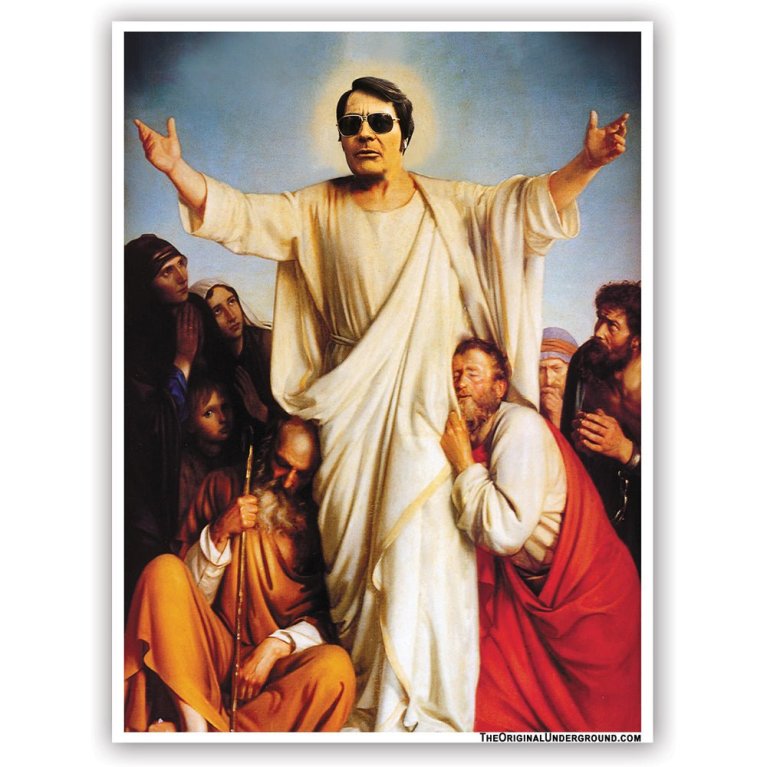
Pastor Jim Jones preaches his counterfeit Gospel before being abandoned by the US government and having to free his cult from bondage with some poison laced Kool-aid.
Seeing someone I thought was a Christian missionary lament how the United States had “abandoned” them was a reminder of how the great have fallen. There was not a shred of gratitude expressed towards the American taxpayers who financed them nor acknowledgement of the misappropriation of funds that has wearied voters to foreign aid. But more stunning to me was unholy alliance between this person of faith and agencies of US imperialism. Since when has the love of Jesus become an extension of the US regime abroad? Are they of the kingdom, as they proclaim, or agents of empire?
USAID, despite the name, is certainly not a charitable organization and was formed in 1961, at the height of the Cold War, with an aim of promoting the interests of the US political regime. That’s fine. But it has long ago gone off the rails even as far as what it was originally imagined. The Soviet Union had fallen and the Federal agency created to oppose it morphed from something most would support into a beacon of wokeness—pushing transgenderism and abortion.
Break the Yoke of Fraudulence
The reason why USAID is being dismantled is because we can’t sort the legitimate from illegitimate function of the agency. Sure, it may help people in need, but funding it also is enabling of evil and maintained through a system of coercion we call taxes. Anything good that it did can be done through other means. This functional fixedness of those who depend of government, especially on the part of those professing Christ, makes me wonder where their faith lies and what their actual mission is.
The merger of a Christian charitable cause with government doesn’t purify government—it taints the witness:
Do not be yoked together with unbelievers. For what do righteousness and wickedness have in common? Or what fellowship can light have with darkness? What harmony is there between Christ and Belial? Or what does a believer have in common with an unbeliever? What agreement is there between the temple of God and idols? For we are the temple of the living God. As God has said: “I will live with them and walk among them, and I will be their God, and they will be my people.” Therefore, “Come out from them and be separate, says the Lord. Touch no unclean thing, and I will receive you.” (2 Corinthians 6:14-17 NIV)
The accusations of “Christian nationalism” against those who want a government that performs basic functions were always just a smear by those in alliance with imperialism and Godless globalism. While I’m not a fan of God and country, at least the flag waving religious patriot knows there is a difference between their Christian mission and secular state. The left, by contrast, confuses these categories and would have social program replace true charity and community aid. In one case you have those who may tend to overreverence nation, but in the other there are those who truly represent empire and yet tell us they their only citizenship is the kingdom of heaven.
The truth is that the ‘Christian’ left is simply the left merely wearing the words of Christ as a disguise for ideological agenda. Those decrying the reduction of empire and return to responsible governance never said thank you to those funding their do-gooderism. It was, for them, all about holding those “chief seats in the synagogue” and their own glory as humanitarians. They may speak against Trump, but then have never uttered a word against the waste, fraud and abuse that has made these broad sweeping cuts popular with common people.
The true Christian spirit is that of a Federal employee who told me about the enormous amount of inefficiency and waste in his own agency and—while making no profession of faith—supports the effort of DOGE knowing it may impact his employment. That, to me, is someone who understands self-sacrifial love more than someone feeding the poor on another person’s dime and then going to social media to complain when their funds are cut. They’re grandstanding. While my Federal employee friend is a truly humble public servant who is grateful and not biting the hand that feeds him.
None of this to say this “abandoned” former hero of mine is a bad person. They clearly are using their abilities to help other people in desperate need. I applaud that. And yet their public statement betrays. There is an attitude or spirit there that is different from Christ. I would much rather they just be a secular humanist—subscribed to partisan leftist politics—and own it. They should just admit that they’ve abandoned faith in Jesus and are looking for a worldly system. Judas Iscariot is the patron saint of faithless social justice, guilt trips and envy—when you betray your calling just own it.
A frequent complaint of Western men (who were burned) in a relationship with a Filipino woman is that she was only ever interested in his money and not truly in love. I mean, it couldn’t possibly be that he was an entitled and whiny beach who expected her undying adoration while producing minimal returns, right? She was supposed to love them like their dear mother who had let them live in the basement rent free for thirty years!
And you think I’m exaggerating.
Part of the problem (which is not a problem for those who understand the arrangement) is age-gap. My wife and I have a difference in age that is normal or within several years of each other. But frequently there is a gap of decades in these pairings and these men marrying women that are young enough to be their daughter (or granddaughter) don’t seem to get that she didn’t marry him for his charm or charisma. She is hoping for a bit of financial security and her happiness will depend on his ability to deliver.
Many are aghast that Bill Belichick, 73 years old, would dare to enter into a romantic relationship with a 23 year old Jordan Hudson. They say what business does a man his age have to date this young woman? Isn’t it exploitative, an illegitimate relationship? But they hate it because it exposes the reality of love. Sure, the young cheerleader and old coach is extreme on the age scale. And yet how is it any different from a 5′ tall 100lb female who picks a 220lb 6′ male rather than a guy that is her own size?
Is this gross?
Women Instinctively Marry Up
We all love those “living on a prayer” stories about two people surviving together against the odds. And certainly there is an element of this type of spirit that we will needed to sustain love through thick and thin. But, as my wife put plainly in our discussion of this, “You can’t live on just love.” The practical is not as glamorous, we prefer not to see the crude mechanics that are always working beneath the surface. And yet a man must deliver if he wants to have her adoration for more than the first year of marriage.
We don’t hear anything about Joseph when Jesus was an adult. He’s already out of the picture. And it is probably because he was older (maybe a widower) when he married Mary, a teenager, and died. Traditionally an older and thus more established man was considered to be safer. He already had his land and house. He could provide support for her children and had a reputation going before him that younger men did not. Why take a chance on an unknown commodity when there’s man who can afford to care for his new bride?
And despite the egalitarian push in the West women still want to marry up. High earning educated women do not lose this tendency towards hypergamy. Sure, maybe they will settle for less, but prefer the man who can provide more. This, incidentally, is why my pursuit of the impossibly failed, as she put, “You’re thirty years old living in Milton.” Or, in other words, I lacked the size of ambition and type of social status she was into. And, shallow as it sounds, this is just the honest truth. Men marry youth and beauty, women marry size, strength and status.
Potential Drives Attraction
Young women marry the poor young man’s potential, but all want financial security and physical protection. While men, no matter how old or pious, appreciate women who of fertile age. Men marry her potential to bear children. This is reproductive instinct. Even if both parties in a sexual relationship are not consciously interested in offspring—this is what drives their behavior.
He provides, she nurtures.
While the Belichick and Hudson pairing did raise my eyebrows and likely would not be possible if he wasn’t worth 70 million. I’m also guessing they do have a few points of compatibility. It is possible, you perverts, that they really do enjoy logic that much and have stimulating intellectual intercourse. In the end, it doesn’t matter if your ideal says otherwise, you’ll always need to give something in order to get—nobody is going to fall in love with you for simply existing.
Whether it is paid in cash up front or in IOUs of our future potential, we all must pay the bride’s dowry or move on. If you’re old or ugly it is going to take a lot of money for her (and her family) to make her interested. Only the young men can win by promising her the moon. Of a certain age and you will need to deliver those goods up front.
Hide this reality under layers of your storybook romantic fantasies and feelings of meant to be—love is transactional.
The order and protection of patriarchalism and purity culture could appear to be the alternative to the chaos, confusion, risk and hurt of sexual liberation. We know that women are taken advantage of all the time by men who have no intentions of making a commitment, they do naturally bear the higher cost of sexual promiscuity and therefore it does make sense to offer them some special protection, right?
Men should be protectors. This is a role that men are well suited for and, in correct form, actually enables women to thrive and be the best version of themselves. Does this mean that women can’t do what men do? No. But it is simply optimal, in a trade relationship, that both parties specialize and do what they are better suited to do. For the betterment of the whole and ultimately for themselves. My grandma kept the books for the farm while my grandpa ran the equipment and did the field work. Why? Well, it’s simply what worked for them.
The patriarch, the elder man of a household or a community, should indeed protect those who are under his care. That’s what he is there for. He can provide food, shelter, shepherding and defense for the vulnerable. His age and experience, his humbly knowing his own place under God, can give him perspective valuable to his children and appreciated by the woman that he has committed to love. This may be patriarchy, I’m not sure, but the good kind.
Unfortunately, patriarchalism, like that often found in religious purity cultures, tends to be the wrong kind of protection. It elevates women while simultaneously not treating them as equals. It protects some women, but not all. And, while framed as a male advantage, because it does privilege some men, actually hurts men. It may prevent some promiscuity, but it doesn’t protect people or truly show Christian mercy to anyone. Worse, since it never gets to the heart of the matter, it often only covers for abuse. That’s the paradoxical part: Below the surface it is not really any different from the degrading and demeaning alternative.
1) Paradox: Both Elevates And Demeans Women
Patriarchalism is often framed in terms of dominant men who think women should follow two steps behind, which is certainly one part of it. But it can also be much more subtle than those notions of women remaining barefoot in the kitchen, pregnant, submissively waiting on their husbands.
In fact, many men who identify with feminism are very often unwittingly patriarchal in their overzealous protective and preferential treatment of women. Coddling or patronizing women, assuming their motives are always pure, is ultimately another form of patriarchal protection. This is, incidentally, the reason why some feminist women resent having the door held for them. Is it a kind gesture or is it an assumption of her inferiority and need for male help?
What I’m talking about is this idea that a woman can do no wrong, that assumes that she is always a hapless victim of male abuses and basically lacking any agency or discerning capacity equal to a man.
I know women like this, who look adoringly at their husband as he compliments her (patronizingly) for her being able to pick the drapes. He gets to make all of the real decisions and she can live comfortably without the stresses of adulthood.
And, not surprisingly, some women are completely fine with this arrangement. Why not stay on the gravy train if you can?
However, many more women are uncomfortable with this protection. They sense this treats them as if they’re not fully formed humans and, in the end, will stifle their God-given potential.
Of these backhanded insults that intelligent and capable women face constantly in this current social paradigm is that they are either a) in need of some crusty politician to help them or b) they are some sort of faultless Mary Sue, with no need of character development, who only had to show up to dominate men. Nobody truly wants to be treated as special simply because they have a certain type of genitals. Putting women on a pedestal (even if called feminism) is patriarchalism.
The protection of patriarchalism is the wrong kind of protection. It treats women sacred objects, idols, faultless and not real people with complexity or depth. It protects the female body, at least in theory, yet neglects her soul. It objectifies.
2) Paradox: Protects Some Women, But Not All
In purity cultures (both secular/political or traditional/religious) only those who meet a certain standard or subscribe to a particular ideological agenda are actually protected. Those who do not conform the cultural expectation are not valued or respected.
In the religious culture which I was born into, the woman who follows the rules (kept up outward appearances and acted the part of innocent) is always treated as pure-minded and virtually incapable of evil. A young woman, who outwardly obeys, is her daddy’s little angel, practically divinity, and subject to unceasing praise. Women are protected, but not as equal to a man, and only so long as they represent the ideal.
Perhaps this ‘protection’ is motivated by guilt and a way to make up for the extra pressure put on women to conform and submit? Or simply a way for some men to advantage themselves over other men by playing the hero? Maybe it is just a bias of those in a culture where everything is judged by outward appearances and men can’t imagine their female counterparts as being anything but porcelain dolls, where it is unimaginable that a beautiful young woman, from a good home, wearing the prescribed attire, could be anything but sinless and a saint. Whatever the case, it is real and is a privilege (albeit perverse) that women enjoy in patriarchal purity cultures.
This privilege, and pedestal, of course, does not apply to ‘worldly’ women. No, only the girl who meets the patriarchal religious standard is sort of viewed as some kind of unattainable perfection. A woman is either a paradigm of virtue, a Madonna, or she is a Jezebel, a Potiphar’s wife and temptress, with very little room in between. An too often, the woman who stands up for herself a bit or defies their cultural expectations, to the patriarchal men, are comparable to a prostitute and totally debased. They need women to be weak so they can feel strong by comparison.
The patriarchal paradox is that it does elevate and protect women, but not in a way that humanizes or allows women to have the same fullness of character as a man. Patriarchalism doesn’t protect women as people, but rather as they represent an image of femininity and cultural ideal. This is revealed or exposed, in the reality that patriarchal men do not protect all women. No, they only protect their women and only so long as they fit the cultural prescription.
Furthermore, the protection patriarchal purity culture is mostly focused on defending the physical body of a woman, managing her outward behavior, rather than her actual spiritual well-being. She is the trophy on a man’s shelf, a conquest, but not recognized as a fully formed person. Women are valued for their virginity and only protected if deemed pure by some cultural standard. A woman is only worthy of protection if his purity fantasies can be projected onto her feminine frame.
This ‘protection’ (or at least as it is combined with purity culture) labels those who fall short as “defiled” and treats them like damaged goods rather than broken people to be loved. The paradox is that patriarchalism protects a cultural ideal for women rather than protect women. It offers condemnation, not care, for those who fall short.
3) Paradox: Hurts Rather Than Helps Most Men
Patriarchal treatment of women also leaves many men feeling inadequate amongst women who are truly their equals and not perfect as imagined. In my own life, I’ve put Mennonite women so high on a pedestal that their rejection felt like a judgment from God. That is unfair to the men, it is unfair to the women, and yet is very common in patriarchal religious purity cultures.
Again, in patriarchal purity culture, so long as a woman dressed and acted in a particular manner she was basically immune from criticism. I’ve seen very patriarchal pastors side with a wife against her husband, when she was as much at fault, and suspect it was a matter of sexual preference. And I do mean “sexual preference” in the crassest and literal manner, in that they were protecting women to preserve their own sexual status with her. Somewhere, in their reptile brain, they needed to impress the woman, play savior to the damsel in distress, and did a terrible disservice to both sides with their prejudice.
Young conservative Mennonite men, unlike the females within the culture who are treated as blameless, are frequently called out for their more open expression of their lusts and pornography addictions. It is as if it never registered to them that Jesus called out those who appeared to be righteous more harshly than those caught in their sin. Mennonite women sin. They have their vices, even if less obvious. Anyhow, when some are left feeling dirty and irredeemable rather than sinners in need of God’s grace like anyone else, this is patriarchal purity culture and unChristian.
Men in patriarchal purity culture, rather than love other men, enjoy eliminating competition. By highlighting and haranguing about the more visible weaknesses or inadequacies of other men they hope to increase their own social stature. This is even more pronounced in purity cultures where polygamy allowed. The “lost boys” of fundamentalist Mormonism, where young men are accused and run off, a clear example.
Other men are a far bigger threat to abusive patriarchal men than women. And this is why Biblical fundamentalist (Protestant) men demand submission to themselves and yet absolutely refuse to fall under any authority other than their own. It is not so much about women or purity as it is about protecting the overblown ego of some men and comes at the expense of all. It is actually about power not protection.
4) Paradox: Patriarchal Protection Often Covers For Abuse
The great irony of patriarchal purity cultures are that they are as focused on sex as the ‘worldly’ whom they condemn. Even in their condemnations of promiscuity there is this “methinks thou dost protest too much” feeling and sense that this constant bluster is for their titillation or pleasure.
But, more than that, this display doesn’t mean these moralizers are free from sexual sin themselves.
No, they are as obsessed with the physical bodies as anybody in the world outside their cults.
And, while they consider themselves to be moral authorities, they often blame-shift responsibility for their own lust onto women. From pulpit pounding sermons about “immodesty” (in front of an audience of women wearing long dresses) to men who literally blame the young girls they molested for the abuse.
However, the worst part is when those in these cultures are more concerned about the victims remaining silent than they are about the abuse. This is probably not so much about keeping individual abusers from justice so much as it is about protecting the culture. To feel good about themselves, to keep up the “holier than thou” show, they must conceal the impurities. It is about protecting image not people.
Purity cultures are about preserving an outward image of purity and avoid looking inward at all costs. They need to externalize blame, keep the focus on the sins of those outside of the group, or it would be impossible to sustain the system. So deny the extent of their own problems, to try to keep their sins secret, is a means to protect their special identity and culture.
The Wrong Kind Of Protection
In the end, patriarchalism protects the cultural ideal of purity rather than actually loving people. It is concerned primarily with a woman’s body, or outward behavior, not her being. It is centered on the physical rather than the spiritual. It stifles women who don’t fit the cultural mold, does not protect their dreams or ambitions, and also gives cover to bad behavior that flies beneath the radar of dress standards and superficial obedience. It protects the power of a few men at the top, but does not serve many (or most) of the males within the culture very well.
It does not follow the example of Jesus, who did associate with prostitutes and others who did not keep up their righteous image according to the standards of the religious paradigm of that time. He intervened on behalf of a woman accused of adultery and condemned the sanctimonious elites. They Pharisees were obsessed with maintaining an outward image, creating physical separation between themselves and those deemed impure, yet knew nothing of spiritual transformation or even their own need of an inner change. They loved status and outward image, they protected a religious ideal, but not real people.
The problem with the patriarchal purity culture protection is that it protects women like property, as sex objects, and not as people. It is dehumanizing in the way that it puts women on a pedestal. The problem is not male leadership. The problem is any leadership that does not protect other than for it’s own benefit. Despite what it claims, patriarchalism is about defending the status of some men, keeping their lust satiated, rather than Christian love. It is ‘protection’ of the wrong spiritual source.
And, thus unlike what popular mythology would suggest, this is not a problem that would be solved by replacing men in leadership with equally domineering women. That is the one big absurdity of our time, we are told that women would be better more empathetic leaders than men and then given purple-haired Vice-Admiral Amilyn Holdo berating a subordinate man as an example. That’s not an empowered woman, that’s a woman that is dangerously entitled or so uncertain of her own command that she needs to make an example of anyone who dares to question.
It is the spirit of patriarchalism that’s wrong and why it creates such resentment. Most of us would fall willingly behind a fatherly figure that we trusted was not in it for himself and had our best interests in mind. If we knew that our unique personhood was being protected rather than how we fit into their own cultural ideal and scheme then we would be less skeptical. More would fall into place as God intended if we would all start here, with humility and a truly serving spirit:
In your relationships with one another, have the same mindset as Christ Jesus: Who, being in very nature God, did not consider equality with God something to be used to his own advantage; rather, he made himself nothing by taking the very nature of a servant, being made in human likeness.
The word “gentleman” once described someone of noble birth, a man of the gentry, and thus one of good manners. Today the term is used for any man who is courteous, especially to women, and generally conducts himself well.
The alternative to gentleman?
I suppose it could be feral masculinity, an undomesticated man, a man who uses his superior strength only to his own personal advantage and is unconcerned about the good others?
But then again, a gentleman is not a man who is lacking in animal strength or incapable of doing selfish or violent and evil things. Rather, a gentleman is someone who decided not to be governed by their animal instincts and despite being strong enough to acquire what they want through force.
A young André the Giant
A gentleman is not someone without animal instincts and strength. Rather, a gentleman is a man of inner strength, one who uses this spiritual fortitude to hold back those urges to use his physical, intellectual or other carnal strength to dominate others.
The Dominion of the Weak
We live in absurd times, cartoonish actually, where self-designated victims use shame to leverage a social advantage and yet are not called out for this bullying behavior. The victimhood narrative, ironically, has become a tool of oppression and only works because most of the ‘privileged’ people are too polite to stand up to it.
In fact, gentlemanly behavior, like opening a door for someone else, can lead to accusations of oppression.
Umm, no?
And, that’s not to say that some gentlemanly behavior is inauthentic and merely a means of some men to manipulate women. Many have learned to “play nice” simply as a method of gaining advantage for themselves. Their polite public behavior is a social tool and their true colors come out when they finally get what they want. These are not true gentlemen, but are weak-minded opportunists in a gentlemanly guise.
It would be better that the fakers would dispense with the pretense. And, with the rise of feminism, many of these weak men do the same thing, giving up the mask of traditional gentlemanly behavior, and use the new guise of ‘woke’ politics instead. This “wokefishing” enables them to get in the pants of unsuspecting ‘progressive’ counterparts and has been the subject of some online outrage.
It is quite similar to those who use a false minority status, like Rachel Dolezal, Jessica Krug, and Elizabeth Warren, as a means to gain an economic or social advantage. Being oppressed is not what it once was. Identity politics is extremely lucrative for those able to exploit it. It actually means special treatment, a fast-tracked educational or political career without the normal merit based requirements.
In the current paradigm women and minorities enjoy both the benefits of traditional Christian cultural values, of care for the poor and protection of the week, while also browbeating those who provide those things. The odd part is that true toxic masculinity, cultures that objectify women and give them a decidedly second tier status, is now given a free pass by also claiming for themselves that coveted victimhood status.
President Trump can be cast as the victim. As can Vice-Presidential candidate, Kamala Harris, by those turning normal debate interruptions into some kind of affront to minority women. In both cases, by traditional standards, these personalities would be proving themselves unworthy of a leadership role. But when the oppressed rule a person can play victim and still exercise dominion over others.
Politics is a domain for the weak and shortsighted, not the meek and eternally minded…
The Meek Shall Inherit the Earth
For years my understanding of meekness was off a little. I may have taken it to be a sort of spiritualized synonym to weakness. In other words, a weak person who keeps their head low and accepts their place of inferior status. The word, in my religious upbringing, was often used in reference to women by those quoting Saint Peter:
Likewise, ye wives, be in subjection to your own husbands; that, if any obey not the word, they also may without the word be won by the conversation of the wives; While they behold your chaste conversation coupled with fear. Whose adorning let it not be that outward adorning of plaiting the hair, and of wearing of gold, or of putting on of apparel; But let it be the hidden man of the heart, in that which is not corruptible, even the ornament of a meek and quiet spirit, which is in the sight of God of great price.
(1 Peter 3:1-4 KJV)
To many in my past that passage is roughly translated as “do not stand up to patriarchal abuse or we will brand you as a Jezebel.” To them it is a woman’s place to accept a sort of secondary status and these truly weak men, like the first Adam, are constantly blaming woman for their own moral failures. They want the respect of a leader while simultaneously being unwilling to take responsibility or sacrifice themselves.
However, these phony self-serving patriarchs should have continued reading, meekness and falling under authority is not only for women, this is addressed to all:
But sanctify the Lord God in your hearts: and be ready always to give an answer to every man that asketh you a reason of the hope that is in you with meekness and fear: Having a good conscience; that, whereas they speak evil of you, as of evildoers, they may be ashamed that falsely accuse your good conversation in Christ.
(1 Peter 3:15-16 KJV)
A man who does not fall under authority, who does not lead with a meek and respectful spirit, no matter what he claims to be, is not a Christian leader. A Christian leader follows after the example of Christ Jesus who, in meekness, took the sins of the world on his own shoulders, suffered and died. He was willing to be mistreated and humiliated, not only for sake of his disciples, but also (and perhaps especially) for his abusers.
John Coffey (Michael Clarke Duncan), in “Green Mile,” a picture of meekness?
Only the truly strong can be meek. A weak person uses all means to gain political or social advantage, including a claimed inferior victim status, whereas the meek subject themselves willingly to the good of the other. A weak person uses their strength to dominate, the meek person uses their strength to serve and protect. In other words, to be meek means having strength or something to give. Meekness is a synonym for gentleness, not weakness, and a posture that one of strong faith chooses to take:
“Blessed are the meek: for they shall inherit the earth.”







 Irregular Ideation