The Cost of Treachery: Israel’s Surprise Attacks and the Erosion of Global Credibility

Standard

Suddenly the surprise attack has become cool again. When Hamas launched their incursion, on October 7th of 2023, to take hostages to exchange for Palestinians who were taken by Israel, this was portrayed as proof of their derangement. This was used as an excuse for a brutal air campaign that has turned Gaza into rubble. To this today dozens are being slaughtered, while the rest of the population of over a million souls is subjected to a starvation death. But we’re told even the babies burned head to toe are acceptable collateral damage—Israel has a right to defend itself, right?

The sucker punching lion, Israel, decided to end Trump’s nuclear talks early with what is called a preemptive strike. Netanyahu has been warning, for decades now, that Iran is just two years from a nuclear bomb. Much to his dismay, however, the US population—having been fooled once by his talk of Iraq being an imminent threat—is war weary and was not ready to make a move. So like old Thanos finally saying, “Fine, I’ll do it myself,” and executing his plan to destroy half of the life in the universe, Netanyahu gambled and surprise attacked, Pearl Harbor style, while peace attacks were ongoing and Iran was making major concessions.

Much like the Six-day War, when Israel went on an offensive before a war even started, it is the modus operandi of the IDF to hit first, to simply declare neighboring people to be an imminent threat and then attack. There is no other country in the world permitted to do this. Only Israel can and then, when they draw reprisals, portray themselves as being a victim. This notion that Iran should just surrender it’s sovereignty to Netanyahu or the US is incomprehensibly absurd. I hope this is just part of the “big ask” strategy of Trump before a deal, but all bets are off at this point where this goes.

However, Iran is not an open air prison with only small arms and home-made rockets—if the IDF hoped to send them into complete disarray with this blitzkrieg, then they failed miserably. Yes, Iran is back on its heels, yet even while being struck while having guard lowered by treachery, effectively blinded by a vicious rabbit punch, they will managed to land an effective counterpunch. The bully, accustomed to ‘winning’ against opponents that were virtually fish in a barrel, made a huge miscalculation. Israel can bleed, with parts of Tel Aviv looking like they belong in Gaza, and it ends the illusion of invincibility that has cowed other nations in the region into compliance.

Half of the power Israel has in the Middle-East and the US in the world is a notion of legitimacy, that they can’t be beat, and this is now compromised. How did Israel know where to find the leading nuclear scientists of Iran? Well, the Iranians, had been fully cooperating with the IAEA and thus by this had given the location of these men. It is treachery that won’t soon be forgotten. The US and Israel are losing their credibility on multiple fronts. Decades of reputation are being erased with each broken promise and every thunderous hypersonic impact. Even if Iran is hit with a nuke or the US hangs on to global control for another decade, there is writing of our end on the wall.

Writing on the Wall 

Unlike past elective wars where Russia and China remained on the sidelines, both of these countries are signalling that they will not put up with it.  In recent days two Chinese surveillance ships have arrived in the region, massive cargo planes also landing in Tehran, and Putin (while chiding the leadership in Iran) for not taking his offer of a more advanced air defense, won’t hesitate to get some payback against the imperial West.  It only gets worse if the US, were to employ some tactical nukes in trying to destroy bunkers.  It would only open that Pandora’s box in Ukraine.  The best option would be stepping back from the brink to save face and move on.  Unfortunately this better end is unlikely to happen.

Netanyahu has been arrogant and he is now overextended, Trump betrayed negotiations entered in good faith and he will never be a trusted deal maker anymore. The fallout from Israel’s audacious preemptive strike on Iran, much like the Hamas attack on October 7, 2023, has reshaped the geopolitical landscape in ways that may prove irreversible. Netanyahu’s gamble, driven by a decades-long obsession with Iran’s nuclear program, has not only failed to deliver the decisive blow he envisioned but has also exposed the fragility of Israel’s perceived invincibility. The counterpunch from Iran, though delivered under duress, has left Tel Aviv scarred and the myth of an untouchable Israel in tatters. This was no mere military miscalculation—it was a strategic blunder that has eroded the legitimacy Israel and its ally, the United States, have long relied upon.

The treachery of exploiting Iran’s cooperation with the IAEA to target its nuclear scientists has shattered trust in international negotiations. Iran, far from the disarmed prisoner Gaza has become, proved resilient, landing blows that revealed Israel’s vulnerability. This betrayal, coupled with the U.S.’s complicity in undermining Trump’s own peace talks, has tarnished America’s reputation as a global mediator. Trump’s “big ask” strategy, if that was the intent, has backfired spectacularly, leaving him sidelined as a dealmaker and the U.S. further isolated on the world stage.

“This is the inscription that was written: mene, mene, tekel, parsin “Here is what these words mean: Mene : God has numbered the days of your reign and brought it to an end.  Tekel : You have been weighed on the scales and found wanting. Peres : Your kingdom is divided and given to the Medes and Persians.”

(Daniel 5:25-28 NIV)

The broader consequences are dire. Israel’s modus operandi—preemptive strikes justified by vague claims of imminent threats—has long been tolerated by the West, but the world is growing weary of this exceptionalism. The rubble of Gaza, the starvation of its people, and now the reckless escalation with Iran have stripped away the moral veneer Israel once claimed. Each hypersonic missile and broken promise chips away at the credibility of both Israel and the U.S., hastening the decline of their influence. Even if tactical victories are won, the writing is on the wall: arrogance and betrayal have set the stage for a new era where their dominance is no longer assured. The question now is not whether this decline can be stopped, but how swiftly it will unfold and what new powers will rise in its wake.

Shedding Identity

Standard

There was a time when I could simply say “I’m Mennonite.”  That is what I was.  It was my religion, culture and ethnicity wrapped up into one tidy package.  It was as real to me as my gender and first name.  But now, having left the denomination of my youth behind, it is really difficult to buy-in to a new identity or at least not to the extent of feeling a significant attachment to the distinguishing title.

We live in a great identity crisis.  We might celebrate more identities than ever, and yet somehow along the way, we have lost the very meaning of the words that we use to define these identity categories.  

What is an identity?

An identity is a word used to distinguish one from another.  Or a statement of what we are in comparison to the whole group.  Are you Catholic or Protestant?  Black or white?  A Republican, Democrat or Independent?  And whether it is identity or not has much to do with the emotional weight that we place on these categories and terms.  In other words, blue-eyed is certainly a category that some of us belong to, but is not currently an true identity marker.

There are also various kinds of identity, there are those inborn or assumed—Charlotte, due to her inherited genetics, is Kankanaey, and would be no matter what she believed about herself or if she prefers that another term be used.  Then there are those types of identities that are less about our immutable being and more about what we are doing.  By contrast, trucker or truck driver is an identity, and even comes with a license to prove it, but it is not something that is actually written in a CDL holder’s DNA.

Identity is never something we can select for ourselves.  I can claim to be a Dill Pickle and even legally require the moniker be used in reference to me. But this is never going to change what other people will perceive me to be.  Identity is something that others construct, with us, and not only a thing that we independently choose for ourselves.  Put another way, a rose by any other name is still a rose and even if we paint it blue.  And blue does not become yellow because we switch the color identity labels either.

Our “I am” identity…

I’m sexually attracted to the female form and this has dictated my priorities and activities throughout the years.  But, as important as it is to me, I don’t tout my ‘straight’ preference as being my identity.  I am many things, but my sexuality is not something to hang my sense of who I am on.  There are no hetero pride parades for this reason and no need to fly a special banner in front of my house to announce my preferences either.  Sexuality is not who we really are.

So, when someone says “I am gay,” my mind always must go to the question, “you are a sexuality?”  The reality is that this identity is about far more than what they do in bed.  It is about the community or lifestyle and an identity built around being their status as an exception.  Being “gay” is just as much about the social aspect as the orientation.  It is not just something you only do in private.  No, it requires a public display and solidarity with others like you.  If it were simply about sex there would be no parades or neverending need to be legitimized by others.  Identity is bigger than the individual.

And trans is simply the next level.  Those calling themselves “trans” may (in direct contradiction with their biological gender assignment) self-identify as a man or a woman.  But those who are truly male or female simply are and there is no need for hormones, reconstruction of genitals or to exaggerate gender stereotypes with weird provocative displays.  On the other hand, no matter how much  surgery is performed on the body of a ‘trans’ person they will always be trans.  The more trans people try to force others to recognize them (despite our own eyes) the more they will stand out as being different.  Which is truly the point.

Identity is about our distinguishing ourselves from the larger group.  It is also about what is the most important thing to us.  If a person were ask who I am I would probably start with my given name.  That is where I am oriented in society, as a product of my parents, and also gives others a shorthand to address my person.  Then I might mention my role as a husband and father as those things are currently the most meaningful parts of my life.  Of course, also in the mix is my religious affiliation and occupation.  Sexuality, while very important, wouldn’t even make the top of the list.

Furthermore, there is no need for anyone to defy their own eyes or be forced to recognize anything about me against their will.  Identity is not only about what I declare.  A large part of real identity is what others recognize with no coercion.  If I had to demand that my son call me daddy or that my wife appreciate my bad cooking the same as she did the work of a master chef, would their bending to my will really make me any more legitimately those things?  No, it would certainly not!  It would make me a bully and look very insecure.

The Identity Gambit…

Special identity is a way to gain advantage over others. In the past it was about having the right privileging title or family pedigree. Now it has become a no holds barred fight between various victim categories. But in both cases it was about unearned respect, about people who did not do anything noteworthy enough in their lives to be recognized and thus invent illegitimate reasons why others must genuflect to them. These frauds are enabled by those who have twisted morality and a corrupted political system.

Stop. I look like a police officer!

People can lie about their identity for many reasons.  Impersonation of a police officer, for example, gives a person false authority and ability to manipulate the unsuspecting.  Or stolen valor, in the case of those who, for attention, dress like and pretend to be a military veteran.  Sure, the act is usually off, since these posers don’t have the requisite qualifications, but it fools enough people that they get the payoff of the true identity—or at least until caught.  Then again, prancing around and pathologically pretending to be a girl is now extremely lucrative for some men.

Pretending to be a doctor or airline pilot is something children do innocently and yet it would be silly to legally recognize this as not to make them feel bad.  True identity is not an act or a costume we put on. 

Shedding identity…

Identity is powerful.  For example, a person calling themselves a “gangsta” or “thug” is declaring a whole package of behaviors and dress styles.  It is a choice as well as a habit, they could change and yet their momentum is in a particular direction.  They have been conditioned, for years and years, by culture and peers, to assume this posture towards the world.  

There is some truth to the statement, “you can take the boy out of the country, but you can’t take the country out of the boy.”  We have many things instilled in us, accents to tastes, but this is not written into our DNA and doesn’t mean it is an “I am what I am” excuse.  We will send children to speech therapy if they have an impediment rather than let them be their true selves.  We can and should modify things that an identity is built from.  This notion of a genuine self that can’t be changed is ridiculous.

Right now there is a Ukrainian vs. Russian war.  The narrative we’re being sold is that there is a vast difference between the two sides—that this is a fight between freedom and democracy or authoritarian rule.  We are told the Russians are barbaric and cruel, the Ukrainian’s heroic and capable.  But both are from the same Kievan Rus origins, speak a dialect of the same language, and truly have much more in common with each other than they do with us.  Furthermore, the regime in Kiev is hopelessly corrupt, and had been shelling those trying to escape this rule for years prior to the Russian invasion—it isn’t a distinction worth dying over.

Ukraine vs. Russia is more like the US Civil War than WW2.

The reality is we are not bound to identity, especially not to those that are more about what we are currently doing rather than our actual being.  We choose our divisions as much as we are born with them.  Sure, we can’t help what side of a border we are born on nor if our personality traits are judged as being masculine or feminine.  But we can decide what is most important to us.  And, more importantly, we can pick identities that are greater than sexuality or gender.  We must reject this idea that we can’t change or improve while also accepting what we are and were born to be.

Many people get off from being contrarian and offending others, they especially enjoy being able to force others to go along with their language games.  But, in the end, their ‘preferred pronoun’ is a distinction without a difference.  We will remain what we are no matter how we dress it up or how much we compel others to go along with the delusion and falsehoods we peddle.  It is only in our spiritual transformation, in finding a bigger purpose, that we can be free from needing the approval and attention of others.

More and more I have no identity to cling to outside of being who I am.  I am what I am and don’t need to hide behind a special label or find my place in the world.  While many in my religious past hold conference in search of their identity and as many converts in the tradition in which I currently participate tout the Orthodox adjective in the manner some do they/them pronouns, I have little interest in joining them in this inane competition.  St Paul, in Galatians 2:38, would have us shed our divisive identities for a joint identity in Christ.

Blessed Are the Meek

Standard

The word “gentleman” once described someone of noble birth, a man of the gentry, and thus one of good manners. Today the term is used for any man who is courteous, especially to women, and generally conducts himself well.

The alternative to gentleman?

I suppose it could be feral masculinity, an undomesticated man, a man who uses his superior strength only to his own personal advantage and is unconcerned about the good others?

But then again, a gentleman is not a man who is lacking in animal strength or incapable of doing selfish or violent and evil things. Rather, a gentleman is someone who decided not to be governed by their animal instincts and despite being strong enough to acquire what they want through force.

A young André the Giant

A gentleman is not someone without animal instincts and strength. Rather, a gentleman is a man of inner strength, one who uses this spiritual fortitude to hold back those urges to use his physical, intellectual or other carnal strength to dominate others.

The Dominion of the Weak

We live in absurd times, cartoonish actually, where self-designated victims use shame to leverage a social advantage and yet are not called out for this bullying behavior. The victimhood narrative, ironically, has become a tool of oppression and only works because most of the ‘privileged’ people are too polite to stand up to it.

In fact, gentlemanly behavior, like opening a door for someone else, can lead to accusations of oppression.

Umm, no?

And, that’s not to say that some gentlemanly behavior is inauthentic and merely a means of some men to manipulate women. Many have learned to “play nice” simply as a method of gaining advantage for themselves. Their polite public behavior is a social tool and their true colors come out when they finally get what they want. These are not true gentlemen, but are weak-minded opportunists in a gentlemanly guise.

It would be better that the fakers would dispense with the pretense. And, with the rise of feminism, many of these weak men do the same thing, giving up the mask of traditional gentlemanly behavior, and use the new guise of ‘woke’ politics instead. This “wokefishing” enables them to get in the pants of unsuspecting ‘progressive’ counterparts and has been the subject of some online outrage.

It is quite similar to those who use a false minority status, like Rachel Dolezal, Jessica Krug, and Elizabeth Warren, as a means to gain an economic or social advantage. Being oppressed is not what it once was. Identity politics is extremely lucrative for those able to exploit it. It actually means special treatment, a fast-tracked educational or political career without the normal merit based requirements.

In the current paradigm women and minorities enjoy both the benefits of traditional Christian cultural values, of care for the poor and protection of the week, while also browbeating those who provide those things. The odd part is that true toxic masculinity, cultures that objectify women and give them a decidedly second tier status, is now given a free pass by also claiming for themselves that coveted victimhood status.

President Trump can be cast as the victim. As can Vice-Presidential candidate, Kamala Harris, by those turning normal debate interruptions into some kind of affront to minority women. In both cases, by traditional standards, these personalities would be proving themselves unworthy of a leadership role. But when the oppressed rule a person can play victim and still exercise dominion over others.

Politics is a domain for the weak and shortsighted, not the meek and eternally minded…

The Meek Shall Inherit the Earth

For years my understanding of meekness was off a little. I may have taken it to be a sort of spiritualized synonym to weakness. In other words, a weak person who keeps their head low and accepts their place of inferior status. The word, in my religious upbringing, was often used in reference to women by those quoting Saint Peter:

Likewise, ye wives, be in subjection to your own husbands; that, if any obey not the word, they also may without the word be won by the conversation of the wives; While they behold your chaste conversation coupled with fear. Whose adorning let it not be that outward adorning of plaiting the hair, and of wearing of gold, or of putting on of apparel; But let it be the hidden man of the heart, in that which is not corruptible, even the ornament of a meek and quiet spirit, which is in the sight of God of great price.

(1 Peter 3:1‭-‬4 KJV)

To many in my past that passage is roughly translated as “do not stand up to patriarchal abuse or we will brand you as a Jezebel.” To them it is a woman’s place to accept a sort of secondary status and these truly weak men, like the first Adam, are constantly blaming woman for their own moral failures. They want the respect of a leader while simultaneously being unwilling to take responsibility or sacrifice themselves.

However, these phony self-serving patriarchs should have continued reading, meekness and falling under authority is not only for women, this is addressed to all:

But sanctify the Lord God in your hearts: and be ready always to give an answer to every man that asketh you a reason of the hope that is in you with meekness and fear: Having a good conscience; that, whereas they speak evil of you, as of evildoers, they may be ashamed that falsely accuse your good conversation in Christ.

(1 Peter 3:15‭-‬16 KJV)

A man who does not fall under authority, who does not lead with a meek and respectful spirit, no matter what he claims to be, is not a Christian leader. A Christian leader follows after the example of Christ Jesus who, in meekness, took the sins of the world on his own shoulders, suffered and died. He was willing to be mistreated and humiliated, not only for sake of his disciples, but also (and perhaps especially) for his abusers.

John Coffey (Michael Clarke Duncan), in “Green Mile,” a picture of meekness?

Only the truly strong can be meek. A weak person uses all means to gain political or social advantage, including a claimed inferior victim status, whereas the meek subject themselves willingly to the good of the other. A weak person uses their strength to dominate, the meek person uses their strength to serve and protect. In other words, to be meek means having strength or something to give. Meekness is a synonym for gentleness, not weakness, and a posture that one of strong faith chooses to take:

“Blessed are the meek: for they shall inherit the earth.”

Matthew 5:5

Assaults, Allegations and Justice For All

Standard

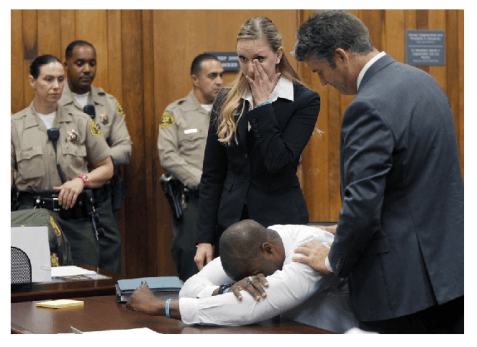
It was an open and shut case. A young woman reported that she had been drug into a stairwell at school and raped. The young man, seventeen, enters a guilty plea and is sentenced as an adult. He will serve five years behind bars, then five years of strict probation, and will need to register as a sex offender for the remainder of his life.

Justice served, right?

That’s the story of Brian Banks, a high school football star, accused of rape by his classmate, Wanetta Gibson, and threatened with forty years to life on the basis of her allegation. His legal counsel, despite Brian maintaining that he was innocent, feared a conviction and advised he go the route of a plea bargain—so that’s what the young man did.

He served his time. He had asked the California Innocence Project to take up his case, but they declined because there was a lack of evidence to prove his innocence. It seemed Brian would spend his entire life, denied opportunities, treated like a sexual predator, and unable to clear his name—all on the basis of her words. I mean who, besides his close friends and family, would believe him, that he had been falsely accused? Doesn’t every rapist claim to be innocent?

But then something extraordinary happened. His accuser, Wanetta, recanted her story (privately) and confessed that she had fabricated everything. Finally, Brian’s name was cleared. His accuser, who had won a 1.5 million dollar settlement against the school, was sued to recoup the money paided to her and has since failed to show for her court dates. Brian had a brief NFL career after this and is now an activist for those wrongly convinced.

The “only” who are falsely accused…

“The ruthless will vanish, the mockers will disappear, and all who have an eye for evil will be cut down— those who with a word make someone out to be guilty, who ensnare the defender in court and with false testimony deprive the innocent of justice.” (Isaiah 29:20‭-‬21 NIV)

There is an oft-repeated claim about the frequency of false accusations being “only” 2-10%. It is a number often used by those trying to downplay the possibility that a man is innocent.

But what is the basis for this number?

The number itself is an estimate. It is based on various studies, studies like one published in the Journal of Forensic Psychology from 2017, that compare numbers of claims deemed false or baseless after an investigation. They found that between the years 2006–2010, out of 87,000–90,000 accusations of rape a year, that around 4,400–5,100 of the reports were deemed false or baseless—that works out to roughly 5.55% of allegations being determined to be false.

However, what a study like that does not take into account is that some accusations of rape are entirely baseless despite an investigation that leads to a conviction. Brian’s case is a prime example, he was found guilty despite his innocence and only exonerated because the woman who accused him later recanted her tale. There could be many more men, convicted on the basis of a false accusation, who are never exonerated because their accuser never recants.

Brian’s story is extraordinary in that his accuser was caught in her lie. However, that’s not always the case. (Not to mention, he had already served five years.) There is really no way of knowing how many, convicted on the word of an accuser, may actually be innocent despite their entering a guilty plea and being convicted. So we really do not know how many accusations are false accusations based on convictions

But, more glaring than the possibility that the number of false accusations could be far higher, is the very reality that thousands of accusations per year are false.

That is, put another way, 4,400–5,100 lives (and potentially more) with their lives turned completely upside down by a false accusation. This could be your own father, brother, nephew or son. Thousands are accused, even imprisoned, and are actually completely innocent—that is an “only” that should slow us from rushing to judgment in the case of an allegation.

That said, not near all rapes and sexual assaults are reported.

“Speak up for those who cannot speak for themselves, for the rights of all who are destitute. Speak up and judge fairly; defend the rights of the poor and needy.” (Proverbs 31:8‭-‬9 NIV)

It is important, at this point, to note that there are many who are victims of crimes that were never reported. I personally know multiple cases of men and women who were sexually molested and/or raped and never reported the assault to authorities. They were abused by family members, grabbed in the groin by a coworker, raped by their boyfriend and there was no police report of the incidents. That too is a sad reality, a traumatic experience that many live with, that should not be ignored.

According to the Department of Justice, in a 2014 report, an estimated 34.8% incidents of sexual assaults are reported to authorities. That is to say that only 3 or 4 out of ten sexual assaults are ever properly investigated and adjudicated.

Now, that this is NOT to say that there is an equal number of rapists to those unreported incidents.

According to a report about repeat rape among “undetected” offenders, repeat rapists “average 5.8 rapes each” and thus the number of undetected rapists is only a fraction of the number of victims. In other words, only a small number of men account for the majority of the incidents and this is precisely why people should report criminal incidents—reporting in a timely manner will protect other people from repeat offenders.

It should come as no surprise, then, that someone who was raped would not report it at the time it happened. Likewise, it should not be a surprise that many rapists continue their life free of consequence for their actions. This is an unfortunate reality of the world we live in, it is the reason why we should always take allegations seriously even if they come out years and years after the assault is said to have happened. There are many unreported assaults, people come forward at different times for different reasons, and this is something to always be aware of in our analysis of reports.

We can (and should) take a clear stand against all forms of abuse.

There is a false choice out there. There are some who deny allegations on the basis of false reports. There are others who dismiss claims of innocence and downplay false allegations as insignificant on the basis of under-reporting statistics.

But we should not choose one or the other. It does the real victims of sexual assault no good to presume the guilt of a man simply on the basis of accusations. It also is wrong to side against an accuser because there are false accusations or they haven’t reported the event immediately after it happened.

We should never disregard an allegation off hand. We should never decide someone’s guilt or innocence by a mere claim or statistics. We can both take sexual abuse allegations seriously and also be reasonably skeptical of the accusations. When pressured to take the side of an accuser or the accused we should take neither side and take the side of justice instead. Every case is different. Every court is different. We must be wise.

Know your own bias and adjust your judgment accordingly!

Still, we all tend to see things from a biased perspective. In the case of Brian Banks, the prosecutor and other authorities believed he was guilty on the basis of the testimony of the young woman. These were well-educated people, people aware of bias, and yet they failed him. In many other cases, there is undo skepticism of those coming forward with allegations and denial of justice to victims of abuse. Both of these things must be guarded against. A person making an allegation should be heard and their story believed. An accused person should be presumed innocent until proven guilty and not be denied due process.

Ultimately, if an allegation falls within the statute of limitations, it is the responsibility of the police to investigate and the job of the courts to decide based on the evidence that they have. I prefer that we side with the evidence, that a charge must be proven beyond a reasonable doubt, and that defendants not be tried in the court of public opinion, perp-walked or treated as if guilty unless there is evidence that proves beyond a reasonable doubt:

“It is better that ten guilty persons escape than that one innocent suffer” (Sir William Blackstone)

Two wrongs never make a right. As much as we want justice for the victims of sexual abuse we should not neglect justice for those accused. It does the true victims no good to create another victim by locking up those falsely accused and truly innocent. We should not punish anyone for a crime that they did not commit and especially not as a result of our prejudice against their race, gender, religion or other a defining characteristic.

We need to be a voice for justice.

False accusations, from the Salem Witch Trials to Emmett Till and everything before or after, come because there is power in making them. An accusation can bring a confirmation hearing to a grinding halt, it can cause questions about a political rival’s character that didn’t exist before and mere words can destroy lives—therefore we must always stand for the rights of the accused.

That said, we must never deny the oppressed, we should have compassion for those abused and especially for abused who have remained silent for fear of not being believed or other reasons—therefore we must always be a voice for the abused.

May God give us wisdom!

Good Men Do Not Blame Women

Standard

The claim ‘based in actual events’ is used to give credibility to a dramatization of a story.  One might take the phrase to mean that the portrayal of an event is basically accurate or true.

But to me the claim is a warning to do my own research.

In some cases great liberties have been taken in the storytelling—and sometimes to the point that there is little resemblance to the actual events it is supposedly ‘based’ on.

Likewise, authentic Christian faith and a Bible ‘based’ tradition are two distinct things and sometimes entirely different things. 

Bible ‘based’ is not always Christ centered

There are many organizations that advertise their promotion of ‘Biblical’ principles, they give the impression of having real spiritual authority, and yet very little of what they offer seems based in real Christian love or the actual example of Jesus Christ. 

Christian leadership is to emulate the example of Jesus.  Christian leadership is supposed to be about serving others with a heart of humility.  A good leader is one who takes responsibility (in love) for things not even their own fault and will take punishment upon themselves rather than delegate the blame.

Unfortunately many twist the Scripture turning it on its head and copying the very example of those whom Jesus condemned. They clamor for power and position over others, yet when time comes for accountability they find everyone but themselves to blame.

Good leadership takes responsibility.

According to the book of Genesis there was a man.  This man was given a garden with two trees, one the “tree of life” and the other the “tree of the knowledge of good and evil” with instructions by God not to eat the fruit of the latter tree. 

In the familiar account both man and woman disobey God by eating the forbidden fruit.  But, when confronted for his own sin, the man responds:

“The woman you put here with me—she gave me some fruit from the tree, and I ate it.” (Genesis 3:12 NIV) 

Sounds pretty true to life, huh? 

Instead of taking responsibility for their own actions many men will look for someone else to blame.  I know of one man who blamed his own obesity on the meals his wife cooked.  I know many other men who blame women for their own sexual sins and lust.  This, coupled with a few (misused) Biblical proof texts, has become a justification for all types ‘modesty’ requirements for women.

A shameful example of an immodest man.

I was talking to a friend recently, a woman raised in a conservative Mennonite community, who recalls a three hour meeting over the issue of a couple buttons being closed on her sweater. 

I had to ask twice about the buttons being closed, because it didn’t make sense (even to a person like me raised around this type of mindset) that closed buttons would be a problem. 

I’m still perplexed… 

I would guess the particular group had a standard of a loose outer garment for women and buttons made it too tight? 

Who knows?

Whatever the case, this is an all too common scenario in traditional ‘Bible based’ communities and amounts to spiritual abuse. 

In the story I told the man huffing and puffing was an elderly ‘bishop’ (I use the apostrophes because I don’t think the title of respect is deserved) and the one he was calling rebellious and a “whore” was a teenager. 

The man should be rebuked, once for being a creep who was ogling teenage girls and again for being completely antithetical to the example of Jesus Christ.

A modest mistake and a big problem of interpretation.

Modesty is an obsession in conservative churches.  I’ve heard more sermons on the topic than I care to mention and almost always focused disproportionately on matters of women’s clothing. 

These constant reminders may make one think that the Bible must be similarly preoccupied.  Interestingly the word “modesty” is found only once in the entire Bible.

However, while the word “modesty” is found only once in English translations, the Greek word translated as modesty is actually used twice.  It is used once speaking about women and later in reference to men.  The first usage is in 1 Timothy 2:9 quoted below in King James Version English:

“In like manner also, that women adorn (kosmein) themselves in modest (kosmio) apparel, with shamefacedness and sobriety; not with broided hair, or gold, or pearls, or costly array…”

This is the Greek it was translated from:

ωσαυτως και τας γυναικας εν καταστολη κοσμιω μετα αιδους και σωφροσυνης κοσμειν εαυτας μη εν πλεγμασιν η χρυσω η μαργαριταις η ιματισμω πολυτελει

I am not an expert on Greek (so I do encourage everyone to study the language themselves) but I do know that there is an interesting repetition that is not carried over as clearly in the English translation.  I’ve been told it could translate better as “women should get themselves in order in ordered apparel.” 

Apparently it is an idea that describes soldiers arranged in their ranks. It also has similarity to “cosmos” or the idea of the order in the universe. That is what makes “orderly” a good alternative translation. 

I asked a Russian speaking friend to translate the word from her Russian language Bible and she translated it as neatness. So the writer is conveying an idea of neat and orderly attire, perhaps like a professional or dignified person.

The same Greek word is used later in 1 Timothy 3:2 as quality of leadership.  It is translated as “respectable” in the New International Version and translated as follows in the King James Version English:

“A bishop then must be blameless, the husband of one wife, vigilant, sober, of good behaviour (kosmion), given to hospitality, apt to teach…”

The whole idea of modesty (in a Biblical usage) meaning more coverage to prevent lust is wrong and is a glaring example of reading a presupposition back into a text.  The idea is actually more to the effect of neatness, orderliness or respectability and not of concealment of body for sake of protection from the lusts of men.

(More good thoughts on the Biblical idea of modesty from a female perspective…)

Unfortunately there are many teachers out there who use a few words from the Bible to build their own rigid prescriptions. Literature from Bill Gothard, for example, encourages victims of sexual abuse to blame themselves and is basically rationalizing abuse as a product of female immodesty or rebellion from parents and God’s will.

It is never the responsibility of women to control male impulses.

Jesus spoke directly to matters of lust—he gave no excuse to irresponsible and leering men:

“…I tell you that anyone who looks at a woman lustfully has already committed adultery with her in his heart.  If your right eye causes you to stumble, gouge it out and throw it away.  It is better for you to lose one part of your body than for your whole body to be thrown into hell.”  (Matthew 5:28-29)

Even Bible literalists may dismiss that as hyperbolic.  But even as that could be the case, the message is pretty clear about where responsibility for sin of lust lies and Jesus offers the solution. There is no excuse given for men, no blame he puts on women and no uncertainty of terms: Men are responsible for their own thought life, not women. 

Men who point a finger of blame at women are doubling their sin. 

A man who blames a woman is both guilty of the lust and also guilty of false accusation. They are like king Saul who blamed his disobedience against God on the will of the people. (1 Samuel 15) They are opposite of a man after God’s heart (Acts 13:22) like David who did not make excuses when confronted for his sin. Men who blame women are failures of Christian leadership and may need to be cut off until they repent of their false testimony.

Jesus did not give an example of a patriarchal tyrant who could not be questioned and then always blames others when things go wrong. No, Jesus led by self-sacrifice, he took responsibility for sins that were not even his own—the sins of the world—and brought grace to every situation. That is the example of real Christian leadership.

The Bible might be a basis for some to excuse their own failures and justify their own abuses, but good Christian men do not ever blame others for their own sin. Beware of those who claim to be based in the Bible and yet lack the evidence of the attitude of Jesus Christ.