I Feel Bad For The Shooter On The Roof

Standard

It was inevitable.

Trump, who packs rallies despite somehow losing the last election, took the stage again in Butler, Pennsylvania.

Nearby another man crawls on a roof top, a rifle in his hands, takes aim and he pulls the trigger.  He missed his mark, but continues to fire, one bullet fired striking a person in the crowd, killing them instantly, another hit the former President who drops.

Thomas Matthew Crook was only 20-years-old.  His entire life he has been propagandized by a partisan media blinded by rage.  After the dismal debate performance of Joe Biden, a heroic old man fighting till his last breath for the good of the country he loved, great fear gripped this young man.  The evil Drumfler would ascend to power again!

And this time, as the headlines screamed in warning and even Biden himself claimed in the debate, Trump would be out for revenge—which would lead to a literal bloodbath.

Worse yet, the justice system that a month back would never make an error in regards to charges against Trump, suddenly gave way to a Supreme Court that wants Trump to be a dictator!  This gullible young mind absorbed the hysteria.

Voting would not be enough!

No, Crook wasn’t going to leave the future of the nation in the hands of fate.  Women depended on him.  Black people too.  Gays and lesbians as well.  The time for talk was over, Trump and his MAGAt minions needed to be stopped and he was prepared to lay down his life for the good of his country to put an end to this threat.  If the courts could not stop Trump, if Biden couldn’t, then the only option left was a rifle.

If only someone could have talked some sense into him.  If only he had gone outside the ‘mainstream’ corporate news bubble or considered other possibilities.  

Had he done this he would’ve have learned Trump is liberal, a New York businessman with an immigrant mother and married to a foreign born wife, who (despite gesturing to Evangelicals) has the morals of Bill Clinton and is therefore not remotely interested in implementing the Heritage Foundation’s “Project 25” conservative fever dream.

Trump is actually a disappointment to the right-wing, he banned bump stops and has a centrist platform when you stop taking the Democrat claims as fact or the full truth.  It isn’t like he’s going to bring back slavery or force women to be barefoot and pregnant in the kitchen.  He’s a fiscal conservative who supports bringing manufacturing jobs back and likes trolling on social media.  That’s it.  He’s not a fascist.  He won’t ban abortion (which he says should be up to states) nor is he any more evil than those who falsely accuse him for their own gain.

Crook came within millimeters of his target, which is quite impressive for 150 meters, but will be remembered as a brainwashed fool who mistook rhetoric for reality. 

He may have actually secured a second term for Trump when most people take a step back and realize that the extremists might be on the side of the leftist media—that initially had responded to the assassination attempt by playing it off as popping noises and Trump falling down. 

Reprehensible misreporting!

It is time to start seeing through this nonsense.

If Trump were literally Hitler, the President Biden would not have come out against the shooter.  No, he would’ve lamented the bad aim and reiterated the bullseye statement he made just days ago.  Instead he is now pulling ads and admitting that the show has gone too far after his opponent was nearly killed.  Ironically, for a brief moment, Biden has looked very presidential.

Too bad Crook didn’t realize that he was a pawn in a manipulation game before he executed on the plan.

Responsible people failed him.

He died for nothing. 

Watching Gran Torino With My Asian Son

Standard

After reading a review of Gran Torino, a Clint Eastwood movie from 2008, that dismissed it as shallow in its exploration of racism, I’ve decided to explore some of the depth of the movie that was missed.  It was a great story about finding common ground, that takes a bit of twist at the end from the typical Clint Eastwood film.  My family (mixed race and culture) could appreciate the themes more than the average viewer—yet is a beautiful redemption story that all people can enjoy as well.

“Get off my lawn!'”

The story is about an angry old man who is not dealing well with change.  Walter ‘Walt’ Kowalski, a Polish-American retired auto worker, Korean War veteran, and recent widower—his beloved wife passing right before the start of the narrative.

In the opening frame, he fits a stereotype of an elderly homeowner defending their patch of turf from an encroaching world.  It seems every small town has one.  That guy who trims his front lawn with scissors and does not deal well with the trespasses of the younger generation, the snarling “get off my lawn” line from the movie became an instant meme.  

Why?  

It is just too familiar. 

The expression captures the essence of a fading dream.  The American middle class values property ownership.  A lawn, once a complete luxury and exclusively for wealthy estates, had become the mark of post-WW2 affluence.  Walt was the beneficiary of this period of economic growth.  He had lived a quintessential suburban life.  

But now it had become a nightmare.  It is not the same neighborhood anymore. The once tidy little homes, owned by people like him, had fallen into disrepair as a new group of immigrants took over.  The woman who he built a home with was gone.  His sons bought foreign brand vehicles and betrayed the legacy their father had built working at Ford.  The world Walt had known was falling apart and he was bitter.

That patch of land, other than the ghosts of his past, was all Walt really had left.  To set foot on it was to violate his sacred space.  It was a shrine.  And his 1972 Gran Torino in the garage likely represented the pinnacle of his productive career.  Since the Korean War ended in 1953, this would put this car purchase around two decades into civilian life with a young family and point when the future looked bright.  So he was clinging to what was left of his identity and willing to defend it with deadly force.

Demons of the Past

Early on we see Walt, the tough guy, who is playing a part.  His racist language is a part of the facade—a barrier he puts up—because the alternative is to be vulnerable—or a victim.  He is still haunted by his war experience, in the beginning using it as a threat, saying he could kill without remorse:

“Yeah? I blow a hole in your face and then I go in the house… and I sleep like a baby. You can count on that. We used to stack fucks like you five feet high in Korea… use ya for sandbags.”

However, later, when it comes to stopping the neighbor boy from taking revenge, we see the reality under the surface:

You wanna know what it’s like to kill a man? Well, it’s goddamn awful, that’s what it is. The only thing worse is getting a medal… for killing some poor kid that wanted to just give up, that’s all. Yeah, some scared little gook just like you. I shot him in the face with that rifle you were holding in there a while ago. Not a day goes by that I don’t think about it, and you don’t want that on your soul.

Just like today, where Russians are called “Orcs” and portrayed as subhuman by propagandists, racial and ethnic slurs were used against various Asian enemies of US policy in the region.  But for Walt, he knew better, he knew that it was not a demon at the receiving end of his rifle.  He had murdered a human child and he felt immense regret.  Note how he says “poor kid” rather than all of the racist terms he used freely throughout his conversations.  It is almost as if, up to this point, he had to reinforce the dehumanizing descriptions to keep ahead of his shame. The truth is Walt didn’t sleep like a baby. No, he was running his sins his entire life and exhausted.

Walt’s racism was part of his pretty much equal-opportunity disdain for other people, including the young parish priest, and his own family.  He was a broken and hurting man, who had driven away his children and was hiding his own terminal illness.  What he needed was some compassion, a safe place where he could finally let his guard down, and it was the persistent effort of a young Hmong neighbor that finally broke through his wall of insults.

Finding Common Ground

The review, that sparked my response, tried to overlay a “white savior” trope on the story and completely missed that it was Walt who was being saved!

*spoiler alert*

Yes, ultimately, Walt sacrificed himself for the sake of the Asian family next door.  But this only after Sue, played by an actual Hmong actress (some critics panned the amateurism, others praised), went above and beyond to disrupt his dismal world.  

She was his savior.

It was by her effort that he would face the demons of his past and could be at peace with his Creator.  It was a redemption story, a story of an old man who had lost his wife, lost his children, lost his religion and even lost his neighborhood, but finds life again by learning to love his enemies.

I can feel this character.  My own life didn’t go as planned.  I had to leave the religious culture where my hopes had been built.  I had a beautiful Asian woman who was patient with me while I was still lost in delusion and did not give up when times were difficult.  Now we have a blended-culture home.  Yes, my Filipino wife and son are different from me in many regards.  However, after seven years of knowing each other and now over a year of being married, our love has only continued to grow.  Some of my happiest moments were with her family in the Philippines and recently while visiting her relatives in Canada.

I am Walt.

My ‘Sue’ did save me.

The real story of Gran Torino is an old man who finds more common ground with those he had thought were strange than he does with his own children.  Once Walt had got past the superficial differences he realized he had more connection to these Hmong people than many who looked like him.  Unlike the war, he was now defending real people and not political ideologies.  He was fighting for the local community, against those within who are destroying it, and not gunning down random boys thrown into a conflict not truly their own.  The storyline is a comparison between perspectives and shows us what really matters in the end.

It is about relationships, not race.

It is about building bridges.

The ongoing dialogue between Walt and his priest demonstrates this.  The priest, who is of European descent based on appearance, is at first scoffed at by the grizzled military veteran for his youthfulness.  The baby-faced “Padre” is bluntly rejected by him: 

I think you’re an overeducated 27-year-old virgin who likes to hold the hands of superstitious old ladies and promise them everlasting life.

But, despite this insult, Father Janovich will not go away.  And eventually, with his persistence, he does earn the respect of Walt.  The bond, built over a few beers, culminates with Confession and Walt is finally able to have the guilt that had plagued him since Korea absolved.  Now he is free and at peace, ready for a last act that goes contrary to expectations and confirms the redemptive arc.  

It was faith that saved Walt, both that of the young woman who withheld judgment and didn’t allow his wall of nastiness to stop her and finally of the persistent outreach of the Church.  And it is only because of this concerted effort that we get to see the protagonist do what is right. By the end of the film, Walt has overcome those demons driving his anti-social behavior and also has gained a son worthy of his prized Gran Torino.

Now To Review the Reviewer…

Why did the critic miss the obvious?

The reviewer who inspired me to write my own was projecting their own worldview onto the script. Eastwood is a rare conservative Hollywood producer.  In fact, so conservative he spoke at a Republican National Convention and gave a mock interview with an empty chair, used to represent Obama, and he calls Biden “a grin with a body behind it.”  Perhaps it is this that the review is responding to?  But I think it goes a bit deeper than that.

The Marxist left sees the world as being a zero-sum game, or that for some people to gain others must lose, and thus everything is a competition for power.  But, not only this, but everything is divided up into strictly bounded categories based on their skin color, financial status, or sexual classification.  If someone cooperates across these lines then they are an “Uncle Tom” or traitor.  So the themes of Gran Torino just do not compute.  Asians are collaborators. Walt is an irredeemable privileged white man, he needs to be canceled—not humanized.

So, since we can’t have everyone come out as a winner, the only thing the woke reviewer has left is to hallucinate something color-coded and negative.  Thus they see a movie that tells us to reach across lines of age, culture, and race as just another “white savior” trope.  It is bizarre, such a narrow and distorted perspective, to entirely miss everything and then to insert what is not actually there.  Yes, Walt saves, but in the context of others saving him, and that’s not even the point.  The point of is that color (or age) doesn’t matter, finding our common ground and community does.

Gran Torino isn’t a perfect movie.  It may go a bit overboard with ethnic slurs at times.  But, then again, the comedic relief of the barber and Walt exchanging these insults as terms of endearment is also great commentary.  Why do we let words be “violence” when the same utterances can be laughed at in another context? It is because these words have the power we give them.  What this is suggesting is that we can go further when we reframe the conversation. 

The left wants to believe that our behavior is determined by what others have done to us—Eastwood says we can be free to live above their rules.

Politics may be all about power, in-group and out-group, but love overcomes all. 

Love Is Transactional

Standard

A frequent complaint of Western men (who were burned) in a relationship with a Filipino woman is that she was only ever interested in his money and not truly in love.  I mean, it couldn’t possibly be that he was an entitled and whiny beach who expected her undying adoration while producing minimal returns, right?  She was supposed to love them like their dear mother who had let them live in the basement rent free for thirty years!

And you think I’m exaggerating.

Part of the problem (which is not a problem for those who understand the arrangement) is age-gap.  My wife and I have a difference in age that is normal or within several years of each other.  But frequently there is a gap of decades in these pairings and these men marrying women that are young enough to be their daughter (or granddaughter) don’t seem to get that she didn’t marry him for his charm or charisma.  She is hoping for a bit of financial security and her happiness will depend on his ability to deliver.

Many are aghast that Bill Belichick, 73 years old, would dare to enter into a romantic relationship with a 23 year old Jordan Hudson.  They say what business does a man his age have to date this young woman?  Isn’t it exploitative, an illegitimate relationship?  But they hate it because it exposes the reality of love.  Sure, the young cheerleader and old coach is extreme on the age scale.  And yet how is it any different from a 5′ tall 100lb female who picks a 220lb 6′ male rather than a guy that is her own size?

Is this gross?

Women Instinctively Marry Up

We all love those “living on a prayer” stories about two people surviving together against the odds.  And certainly there is an element of this type of spirit that we will needed to sustain love through thick and thin.   But, as my wife put plainly in our discussion of this, “You can’t live on just love.”  The practical is not as glamorous, we prefer not to see the crude mechanics that are always working beneath the surface.  And yet a man must deliver if he wants to have her adoration for more than the first year of marriage.

We don’t hear anything about Joseph when Jesus was an adult.  He’s already out of the picture.  And it is probably because he was older (maybe a widower) when he married Mary, a teenager, and died.  Traditionally an older and thus more established man was considered to be safer.  He already had his land and house.  He could provide support for her children and had a reputation going before him that younger men did not.  Why take a chance on an unknown commodity when there’s man who can afford to care for his new bride?

And despite the egalitarian push in the West women still want to marry up. High earning educated women do not lose this tendency towards hypergamy.  Sure, maybe they will settle for less, but prefer the man who can provide more.  This, incidentally, is why my pursuit of the impossibly failed, as she put, “You’re thirty years old living in Milton.”  Or, in other words, I lacked the size of ambition and type of social status she was into.  And, shallow as it sounds, this is just the honest truth.  Men marry youth and beauty, women marry size, strength and status.  

Potential Drives Attraction

Young women marry the poor young man’s potential, but all want financial security and physical protection.  While men, no matter how old or pious, appreciate women who of fertile age.  Men marry her potential to bear children.  This is reproductive instinct.  Even if both parties in a sexual relationship are not consciously interested in offspring—this is what drives their behavior.

He provides, she nurtures.

While the Belichick and Hudson pairing did raise my eyebrows and likely would not be possible if he wasn’t worth 70 million.  I’m also guessing they do have a few points of compatibility.  It is possible, you perverts, that they really do enjoy logic that much and have stimulating intellectual intercourse.  In the end, it doesn’t matter if your ideal says otherwise, you’ll always need to give something in order to get—nobody is going to fall in love with you for simply existing.  

Whether it is paid in cash up front or in IOUs of our future potential, we all must pay the bride’s dowry or move on.  If you’re old or ugly it is going to take a lot of money for her (and her family) to make her interested.  Only the young men can win by promising her the moon.  Of a certain age and you will need to deliver those goods up front.  

Hide this reality under layers of your storybook romantic fantasies and feelings of meant to be—love is transactional.

Two Kinds Of Black

Standard

Identity is fluid, a physical characteristic is not.  I had identified as being “Mennonite” for many years of my life.  It was not much of a choice for me.  Raised in a Mennonite home, participated in a Mennonite church, and had internalized the values, the belief system, etc.  Mennonite was simply what I was and it still remains by ethnic/cultural background.  Leaving the community does not mean I’ll escape the genetic realities of my birth tribe.  

Is an identity surface level or deeper?

There was many of these labels that have to do with our social status, some we pick and others are picked for us.  In school if you’re into sports, hang out with other athletes, it is going to get you a “jock” designation and likely also stereotype applied with that.  Likewise, if were to wear a particular wardrobe to conform with a group of self-described non-conformists then you’re Goth or Emo.  People tend to coagulate into identity group—they find others who are like them and also become more like those whom they identify with.

But there’s a huge difference between these identities built around how we dress or who we associate with and those like eye color, bone structure or genitalia.  Sure, someone can dye their hair purple and claim that they are an astronaut, but that does not change what they were born with nor does it make them qualified to fly a space shuttle.  There are those ‘assigned’ categories that need to be objective facts rather than some kind of self-identity or cosplay act.  Science needs to have clear definitions or the endeavor is impossible.  And society simply can’t let you be a medical doctor because you feel like you should be a Porsche owner while you’re stuck driving a Kia.

Anyhow, getting to the point, a big problem with these conversations is that people are using the same words to mean something different.  For example, Rachel Dolezal, the woman who identified as ‘black’ despite her being born a daughter of European parents and having their biological characteristics, yet she could be ‘black’ for many years.  In my mind she can be both black or not black depending on what the term is describing—is it the genetic inheritance or the adopted culture?

I mean, think of Eminem’s lyrics: “I am the worst thing since Elvis Presley, to do Black music so selfishly and use it to get myself wealthy.”

Technically, if it is a ‘white’ artist doing the writing and performing, what is so ‘black’ about it?  He’s performing in English.  He’s doing naval gazing more common with the self-loathing European culture and his lyrics were about being some weird trailer trash hybrid rather than the themes common with the gangsta rap I knew growing up where it was at least presented as being something to take seriously.  How is a genre of music a skin color?  Asians are quite good at playing instruments and music first developed by the West—is that appropriation?

In many cases ‘black’ is not referring to something truly immutable.  No, rather it is about a lifestyle, a set of values, a certain way of behaving and, by this definition, it is perfectly legitimate for someone to identify as black without African genetics.  In other words, it is more like belonging to political party or religion than something someone is born.  And this is how suddenly the far left can claim work ethic or nuclear families are ‘white’ despite the Africans I know being as hard working and loyal to their spouses as any other person.

It is grotesque, horrendously racist, when a political candidate tells a whole segment of the population that if they don’t vote for him then, “You ain’t black.

Of course that was to intentionally confuse actual skin color and everything associated with it, with a ideology and perspective.  It is to rob the targets (black people who think differently than him) of their identity and is a form of gaslighting.  An outsider doesn’t get to decide what people should or should not belong.  It is inappropriate and bullying behavior, this truly is the worst kind of manipulation, it reinforces stereotypes and denies the true diversity within a category of color.

So identity is fluid.  We can change our own idea of what we are.  Still, there are also the fixed points determined by birth, a physical characteristic, that even if the surface level manifestations are surgically changed and hormones artificially employed, cannot be chosen or changed.  A man can behave in a feminine way, a woman in a masculine way, yet he doesn’t lose a Y chromosome simply for declaring himself a woman.  Sure, he can have his male anatomy reconstructed to resemble the female sex.  But there is more to being a woman.

Due to chromosomal abnormalities, there may not be a binary of male and female, but there most certainly is between female and not female.  It is one thing for the man once known as Bruce Jenner to reject the typical male role and change his name.  But that does not change the fact that he fathered his children and lacks the real hardware to be a woman.  Again, Rachel Dolezal can act in a manner that is associated with those of African origins, even fool the NAACP with her outward appearance, but she is not truly African American.

We do not need to recognize every claim as being valid.  I can’t just thrash around in the pool, march up to the podium and demand to be recognized as the winner of a swim meet without the necessary qualifications or actual achievement.  Why then is it ever okay for someone with male genitals and body to dominate in a female category for simply changing his name and having the powers that be join him in his psychosis?  

Changing your name and official category doesn’t change the physical reality.

It is a serious threat to civilization to attack the common language in this manner and it cannot be taken lightly.  One person with a delusion is not a problem.  However, when it is a significant portion of society going off the rails together then very quickly becomes dangerous.  Matters of our preference and culture are subjective, what is feminine or masculine is not set in stone, but science and reason must be built on something that is objective.  There must be a wall between identity that is merely social construct and that which is grounded in substance.

Coddled to Death—How the West Made Weakness a Virtue

Standard

My son complains that he doesn’t get paid enough for household chores.  He feels he is somehow entitled to everything that we’re giving him and more.  It is a struggle trying to explain why we won’t simply hand him all that he wants.  We have plenty, in his eyes, and can just share our wealth with him.  But the reason we hold back isn’t our greed or that we don’t want him to have the best life has to offer.  No, quite the contrary, in fact, it is because we want him to do well life that we resist the urge to coddle him.

What is coddling?

On the surface it is being overprotective and indulgent.  It stems from distrust of another other person’s ability to deal with normal life situations and emotions on their own.  And, while it may appear to be motivated by love or compassion, it only ever empowers those who keep the other confined to the bubble wrapped world.  It is the devouring mother, the one who uses their nurture as a tool of control.  They only care about the target of their efforts so far as it feeds their ego or feelings of self-importance.  It is a virtue signal and degrades those coddled.

Bigotry of Low-expectations

Along with thoughts about parenting and the goal, some of the inspiration for writing this came from the governor of the state of New York, Kathleen Hochul, who declared:

Young black kids growing up in the Bronx, who don’t even know what the word a computer is, they don’t know. They don’t know these things. And I want the world open up to all of them, because when you have their diverse voices, innovating solutions through technology, then you’re really addressing societies broader challenges.

Other than to call this statement what it is: Bigotry (or racism) of low expectations and patronization.  I’ll not pile on.

Many, like Hochul, are isolated.  They have not spent much time in urban communities nor met the people who live there.  From my own first hand experience her claim (which she now claims was misspoken) is absurd, none of the black I met were unfamiliar with or incapable of using computers.  Many of my acquaintances there could afford to go to college and more credentialed than I am, so where does this notion come from that they’re hapless ignorant people in desperate need of government assistance?

The answer, in this case at least, is that it is hard to maintain a bloated state budget (let alone greedily expand it) without somehow justifying it and what better way to do that convince people that they need you to get somewhere in life?

Condescending political elites are not moral paradigms and minority voters are not stupid.  I believe those pandered to know it is insincere and coming from someone who sees them as dumb.  But they also understand it works to their advantage and don’t say no to it.  We naturally take the path of least resistance and rationalize why we are deserving of the help.  By playing up the consequences of slavery and impacts of racial prejudice, a little wealth redistribution (looting or theft) can be redeemed as social justice.

Unfortunately, low expectations produces what it is supposed to remedy, it gives an excuse to wait around for a handout and kills initiative.  This contributes to racism in that it creates the impression that the only way some can compete is by lowering the bar or a double standard.  It diminishes the accomplishments of those who knew what a computer is without the help of those in the the benevolent class.  Now, because of politicians meddling, there is the question, did they earn it by being the best candidate or are they a diversity hire?

Woke is Weak

My conservative friends wouldn’t likely see the link between Christianity and wokism, but it is definitely there.  The woke glorify the victim and reframe accomplishment as unearned privilege.  For those who started a business, “You didn’t build that” they reason, and nullify the hard work and the sacrifice of those who followed the entrepreneurial spirit to success.  Likewise, in church we’re encouraged to tithe generously and be charitable since it is giving back a portion of all that is given to us by God.  The difference being that the woke want us to give to the government, the religious their own organizations.

And there’s nothing wrong with our helping those in need.  I provide for my son and my wife as well.  However, when I give I give to empower rather make them dependent and weaker.  My hope is for my son to grow his strength and ability so that in time he does not need me to survive.  And the same thing is true of my wife, she is my partner not my patron, we both contribute different things to the whole and neither of us is entitled to what the other gives to the relationship.  It is how a real community works, we give and take as necessary, and we do it for the good of the common project.

Wokism, by contrast, is motivated by envy and pity, it encourages fragility by marking off space spaces and enforcement of strict language codes.  Again, this strict regulation has a parallel in religious fundamentalism.  Home schooling parents are terrified of the influence of the ‘world’ on their children.  They, like the woke, overemphasize the role of the environment in the formation of the individual.  The one exempts swaths of the population from the normal civil expectation (while increasing the burden on others) and the other thinks salvation of poor little Johnny depends on them.  Bad behavior always blamed on an external influence rather than a lack of will to do better on the part of their designated eternal victims.

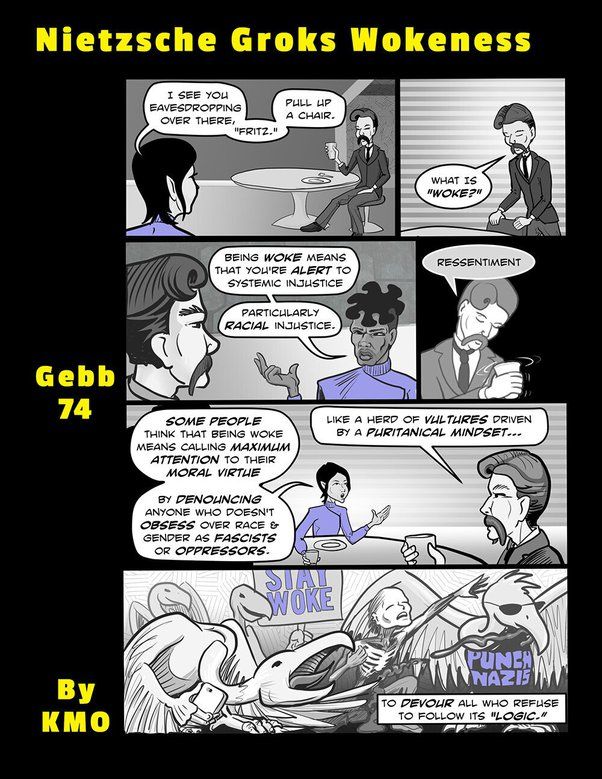
This is what Friedrich Nietzsche critiqued as being a hatred for life.  When we remove temptation rather than ever teach children to resist it—when we are constantly vilifying strength rather than encourage it—when we follow after reasoning or rationality instead of developing our instincts, we are promoting the weakness of our society and degeneration. 

Woke is weak.  It attempts to foster spirits of ressentiment and forms an identity around a person’s fear of being disenfranchised for things completely out of their control.  And in the end it destroys the incentive to find a way to overcome by our own means.

The Meek Shall Inherit 

Neitzsche could be accused of painting with too broad a brush for the dismissal of the Christian ethic as slave morality and an opposition to the powerful.

The message of Jesus and his Apostles was, in part, freedom from those human laws of “Do not handle! Do not taste! Do not touch!” (Colossians 2:21) and very nearly could be the “will to power” that the German philosopher championed once unpacked.  Hedonism wasn’t the goal of the departure from “slave-morality,” the aim was instead for people to exercise will-power and resolve.  In the same manner Jesus and St Paul preached freedom from the law that brought only bondage and death:

But now, by dying to what once bound us, we have been released from the law so that we serve in the new way of the Spirit, and not in the old way of the written code.

(Romans 7:6 NIV)

This is not to suggest that there is any kind of compatibility between the Spirit-led and the Übermensch.  Nevertheless, both would have us abandon a lower morality based on restrictions for a pursuit of our own ultimate form.  To St. Paul the Gospel means we are free from “the flesh” or the unbridled urges, while Nietzsche thinks we’re instinctively at our best, and both men are not opposed to impulse control.  The big difference is that the Apostle’s answer is spiritual whereas the philosopher says that additional layer is not needed and morality a hindrance.  Both would disagree devaluing the attitudes and culture that lead to success.  Being master of ourselves requires strength and never allows for excuses.  

Furthermore, the Jesus of the Bible wasn’t weak, he spoke with authority and we are told that he had power over all things, but he chose a meek posture rather than wield this power destructively.  Now it is a matter of faith if you accept this or not.  I could say that I could strangle Mike Tyson yet choose not to.  Talk is cheap.  But meekness is the ability to restrain ourselves.  Having the power to impose our will is always desirable, nobody wants to be at the mercy of the elements or other people.  However, sacrifice for sake of the next generation is better, to parent is to live beyond ourselves, that is why this is an instinct for those who have children, and it is the role of the Father.

When I wrestle with my son I don’t use all of my strength.  I would hurt him if I employed full power.  My goal is not to destroy him, he is not my enemy or threat to obliterate, but it is to train and strengthen him.  I restrain to protect him currently and also challenge to protect him in the future.  That is the real Biblical kind of meekness, it submission to the greater role we can serve as protectors and builders of civilization.  It is the having all things in balance, which Nietzsche might agree, and using our strength to take on the burden of creating the future.  We do not retreat from life.  Faith requires the we go headlong into the fight rather than hide or be ruled by resentment.

Late-stage Protestantism

I can understand the campaign Nietzsche waged against morality in light of wokeism and virtue signaling nonsense.  Apparently he was very well-versed in theology and did not find answers there.  Which is correct, it is not intellect that brings us life, study for sake of study is vanity, and truth is more in the practical telos than in some theoretical construct.  Nietzsche attacks rationality and reason as an end and those things do implode upon themselves when no longer grounded in a higher life-serving purpose.

The current ideological push for wokeism, and the mindless promotion of diversity, equity and inclusion at the expense of standards, merit or competency, is simply another step down the path of trying to eliminate all suffering and in the process destroying excellence.  I want my son to face some hardship, even if it is only artificial, because his striving will build strength.  It is the thought behind Proverbs 13:24: 

Whoever spares the rod hates their children, but the one who loves their children is careful to discipline them.

Or, as Nietzsche postulates in Beyond Good and Evil:

The discipline of suffering, of great suffering – do you not know that only this discipline has created all enhancements of man so far? 

In the same vein, in The Will to Power, he wrote:

To those human beings who are of any concern to me I wish suffering, desolation, sickness, ill-treatment, indignities – I wish that they should not remain unfamiliar with profound self-contempt, the torture of self-mistrust, the wretchedness of the vanquished: I have no pity for them, because I wish them the only thing that can prove today whether one is worth anything or not – that one endures.

No, I don’t want my son to be last picked for his dark skin.  And yet I also don’t want him to live in a world so sanitized that he’ll need to invent offenses (in the same way that an autoimmune disorder is the body attacking itself) then expects me to always step in on his behalf rather than face it.  Success in life requires some voluntary submission or suffering for sake of our goals.  Coddling and bigotry of low expectations does not serve the long-term benefit of children or civilization.

We need to discard this ugly paradigm of late-stage Protestantism.  There are great men, powerful and worthy of our respect, then there are those in desperate need of improvement.  We don’t help the latter by going soft and changing the requirements to make everything easier.  There is nothing radical or reforming about the direction the church in the West has gone.  This “have it our way” drive has led to a fracturing of the church, a consumerist mentality in worship and a new religion without obligation to the fathers or their commands.

Woke is simply the latest development in the direction.  It is the child with imperfect parents now thinking they know better and don’t need the silly disciplines of their parents to thrive.  Whether Anglican or Anabaptist, it is always about rejection of authority and the hierarchies established by the early church and originating with Christ.  We think we can do better, that the home is better if there is equal with no patenting or need for development of conscience.  In the end we get the complete agnosticism which goes further and to destroy everything the generations of faithful built for our good. 

Attainment and success doesn’t need to be made more accessible.  My son may think he deserves everything without effort, that we’re hoarding a kind of wealth just given to us and undeserved.  But that’s his ignorance.  There are no shortcuts to heaven and you can only keep the benefits of civilization if you continue to maintain the very foundation it is built upon.  We think that we will be saved by technology and the vague notions of progress of those who think power comes from the stroke of a pen—but that’s not how we got here nor is it a path to a better future.

Playing Church

Standard

One of those fun things to do after church, as a child, when the adults had left the auditorium, was to go up and play preacher. We could mimic the motions of our elders in a convincing enough way to be funny and yet really had no idea what we were doing. And this reality would be quite obvious the moment we were asked a serious question.

Part of becoming an adult is the realization that many don’t really know what they are doing. Sure, some might enthusiastically perform their roles, and they have the necessary qualifications, but they either lack practical experience or simple aptitude. Not every doctor or engineer is equal, for example, some are more competent, and others—not so much. But none of these ‘professionals’ have an authority that should be unchallenged.

Reflecting on the priorities, and performative religion, I can’t help but come to the conclusion that some are really only concerned about looking the part and lack any real spiritual substance. It is disheartening when getting customs right is of greater importance than welcoming children. When leaders can answer on matters of trivia but are unable to offer any real wisdom or direction when it comes to the practical application of the clichés they preach, they’re phonies.

I’ve concluded that many participate in church as a sort of social club. And it goes all the way to the top. They have clout in the organization. They can wear the costumes and get the recognition that they so desperately need. But, in the end, they are empty vessels, a noisy gong or a clanging cymbal. It would be better to be a child going through the motions, in play, than to take yourself seriously and offend the little ones in the faith. Jesus wasn’t talking about pedophiles in Matthew 18:6.

Reliable Sources

Standard

My initial reaction to the collapse of the Francis Scott Key Bridge was disbelief, I had just swiped open my phone, eyes adjusting after I rolled out of bed Tuesday morning, and saw the Daily Mail headline blazing on my Facebook news feed.  So immediately I Google “bridge collapse” and, sure enough, the highlighted results were full of similar headlines.  It must be true.

Since that moment there has been a flurry of speculation.  My first thought, of course, is was this deliberate?  Did the Russians do it?   But as I started to gather evidence, like the video showing the lights going out and puff of black smoke, mechanical failure was a plausible explanation.  That didn’t rule out some kind of sophisticated hacking attack, but then this isn’t a Tesla car or Hollywood fantasy where anything electronic can just be operated remotely through undisclosed magical means.

Theories are easy to create.  The hard part is to sift through the information pouring in and come up with something actually likely given probabilities and reliable sources.  A random guy online or old Larry at the parts counter isn’t trustworthy.  The corporate media is only slightly better, in that they at least get the general story right, yet are also politically motivated and basically parroting official sources or their ‘experts’ at a lower resolution.

What of these officials and experts?

I generally rate someone who has their own reputation on the line over someone who is spit balling and couldn’t change their own spark plugs.  Someone with credentials is a better choice for information given that they did put in the work to get their degree and prove their competence.  However, a PhD or government position doesn’t make a person honest or free of bias.  Those who get paid by the government are part of the political establishment and their partisan agenda should be assumed.

1) Professional Experience 

The sources that I trust are those who built a reputation outside of politics and within the industry—this is why I’ve subscribed to “What is Going on With Shipping?”  Later in the day of the collision and collapse of the bridge I found an established channel about maritime matters for explanation.  How do I know he’s credible?  His fluency is a start, he has the technical jargon and credibility with others who know shipping from first hand experience.  It is notable that nobody here is surprised that this incident could happen.  The details of his analysis give me confidence that the information is good.

Authority comes from having professional experience and a proven record.  When I picked my neck surgeon, for example, we had a conversation about his prior record and the procedure.  I sized him up.  He was articulate, empathetic, and had all the expected confidence of someone who could work a miracle of modern medicine.  He also was able to explain everything in terms that I could understand.  The trust I put in him paid off, my recovery was great and I’ve come back stronger than ever.  Licensing with charisma doesn’t mean someone is competent, but it definitely helps.

2) My Own Aptitude 

But my main tool for determining who to trust is based on my own aptitude.  I have a decent understanding of physics and spent my younger days curious about mechanical systems—and always needed to understand how they work.  I could turn a wrench.  I did my own diagnostics and repairs.  So when I do bring my car to the mechanic I’ve already done my homework. 

For example, when my car lost power right away I suspected the Ti-VCT system was to blame.  The engine then gave a code that supported this hypothesis and I took it to a local tire shop and inspection garage.  I told them exactly what to look for giving them a page of the diagnostics manual.  And yet, after having the car for a day or two (after changing the air filter and cleaning the MAF sensor) they concluded it could just be the car is old and losing compression.  Finally, after taking the time to look under the hood, I found the problem.  It was what I had been suspecting.  This time I took the vehicle to a real technician, a guy who with a reputation for good diagnosis, and he gave a beautiful technical explanation of what happens with a short in that system.  After an inexpensive repair I’ve had no issues since.

I’ve never worked in the engine room of a big cargo ship.  I know that they are huge and, despite involving the same principles, are on an entirely different scale.  For one, it takes a team to keep them running, this isn’t like your Toyota where you can simply turn the key, put it in drive and go.  No, they have a startup sequence and when I heard a play-by-play of the disaster unfolding, where the puff of black smoke was explained as being a fuel-air mixture imbalance when they were using a burst of compressed air to start the massive engine, I recalled hearing this being explained in a documentary and it all lined up with what I know about engines.  It is clear he was credible and therefore I felt the rest of his commentary had merit.  I’ll never trust the people who completely miss on the basics and then expect me to believe their conspiracy theories.

3) Most Plausible Explanation 

It could be the MV Dali crew were attacked by mind control aliens using the 5G cell phone network.  There’s no way to disprove this is not what happened.  However, it is not the most plausible explanation and certainly not the first stop (or last) of a reasonable analysis.  What is probable is the answer with the least amount of moving parts or crazy assumptions, which points currently in the direction that this was an accident waiting to happen or a matter of reasonable probabilities that needs no fanciful dreamt up explanation.

There are those times when fact is stranger than fiction.  But we should only go there if there is plain evidence of motives and the means.  Like when the Nord Stream pipeline exploded and prior to this the US President made a threat “We will bring an end to it.” It isn’t a big stretch to believe he had a hand in the sabotage.  The US Navy is one of the few in the world that have the capability of making this kind of attack, so that is a very plausible explanation.  It also wouldn’t just happen on its own or accidentally, so we do look for the potential connections.

Nothing is ever absolute.  We can’t know for certain.  But I’m going with the assessment of the professionals who don’t seem at all surprised that this could happen and can give an informative analysis.  I’ll weigh one of their opinions over ten thousand who claim that there’s something fishy or they feel it in their gut and who have never set foot in the bowels of a cargo ship.  The reliable sources are those with professional experience and are not tainted by ideologies or narratives that color their perspective of all events.

Navigation Of The Virtual Space

Standard

As we rolled into Washington DC, national symbols emerging into view, I alerted my twelve-year-old son to the sites ahead.  He looked up, grunted an acknowledgement, and then immediately buried his head back into the device in his hands.  At which point, now frustrated, I let him have it with one of those classic back in my day dad speeches imploring that he join us in the real world.  

This episode segues well with a thoughts developed further this past weekend.

I had an informative conversation with a man who worked in the US Capital with prominent politicians and also knew a little about astronomy.  He showed me a picture of this formation of stars that he took while at his home in the Philippines.  I didn’t recognize it and he then proceeded to tell me that this is the Crux (or Southern Cross) and how early explorers had used this for navigation after the North Star slipped under the horizon.

I’ve been trying to define a problem that is more prevalent in to our time.  And it has to do with the difference between social constructs, suspended in language, and actual substance.  Before GPS, to navigate the globe required direct observation and accurate intuition.  A successful voyage depended on being grounded in the realities revealed by the tapestry of the stars above and celestial bodies.  Even without images from satellites they could properly deduce the shape of the Earth.

Today we are not looking up anymore, we look down to our smart phones and get lost in the mire of information space and tangle of interpretation.  It is sort of like the night sky is blotted out by artificial light, many do not know the difference between overlay of language or theory and the real bedrock of science.  They live in a world of distracting fantasies and imaginary monsters.  They float off into a sea of nothingness at very best and could potentially imperil the ship of civilization if their delusions took the helm.

Abstraction is great.  Thinking beyond what can be immediately seen is an important tool of human intellect.  Language, likewise, is a superpower.  And yet these things must be properly calibrated.  The sextant is only useful with the correct inputs.  Likewise, if the waypoints of our thoughts are incorrect and the final conclusions that we reach will be flawed as well.  Many sail boldly, despite having deviate far off course of sound logic and reason, with disaster ahead.

Collapsing the Narrative

The Francis Scott Key bridge was struck by a careening cargo ship after the first part of this of this blog was written and the many interpretations of that event provide even more fodder for thought.  Many have a hard time believing that this kind of accident can just happen without some kind of nefarious behind the scenes orchestration. 

These conspiracy minded folks are like the ‘woke’ who always see everything through the lens of race.  From my friends who tell me to not believe my eyes (or engineering intuition) and follow their gut feelings about “something fishy” or those on the opposite side trying to make a connection between this and “MAGA extremists” voting against a pork-filled ‘infrastructure’ bill—they mistake their ideological lens and partisan bias with special discernment.

The problem is, unlike the Key bridge that needs actual physical pillars to remain as a viable structure, there is no amount tonnage of reality that can knock down these towers of ignorance.  Those who confuse their own interpretive matrix with the actual substrate of reality can free-float in their fantasy lands and delusions pretty much indefinitely.  It is what Jonathan Swift explained: “You cannot reason a person out of a position he did not reason himself into in the first place.”

The other day I stumbled across a video, “Why Smart People Believe Stupid Things,” that discussed the motivated reasoning that is detached from reality and delusion.  The description “fashionably irrational beliefs” (or FIBs) gets to the heart of the matter and that is that our intelligence is oriented in the direction of social status or acceptance and group belonging rather than some notion of objective truth.  This identity protective cognition leads us to believe a pile of nonsense:

“A great deal of intelligence can be invested in ignorance when the need for illusion is deep.”

Saul Bellow

This disposition explains the eagerness of academics to join with their other colleagues in pushing agendas like transgenderism and concepts of white privilege. 

It also relates religious dogmas and doctrines, where you post a blog post questioning the idea that Anabaptists are the true church resulting in hate-mail from a self-described radical who couldn’t find polite words when their most cherished identity was challenged.  Whether the defense mechanism is middle-school insults or doctoral dissertations, it can all be lacking substance underneath.

As I’ve thought how to make this blog more concrete, I believe it all does come down to the disconnect between language (and the ideas contained) and the material world.  I can tell you that gravity is fake—something invented by the Pope in Rome to control and subjugate, but jumping off of a tall building will not likely go well for me.  In that case the ground rising up to meet me would be the final authority and my special “wisdom of the ages” splattered.

Unfortunately, while we can escape the virtual reality of our cell phones by looking up and just observing the world around us, we can’t ever be free of our own minds.  We’ll always be limited by our own perceptions and concepts—seeing the world as we are rather than as it is—but we can always at least be aware that we need constant calibration.  Abstraction needs to be grounded or it is useless for navigation and only good for entertainment.

The Big Box Church

Standard

Sitting in “The Well,” a coffee shop within the campus of Christ’s Wesleyan, a local mini mega-church.  Why a coffee shop? It is pretty much the same reason a Target store has a Starbucks. It is a trendy and cool place to chill out as the service plays out on the big screen.  The ‘church’ here is as American as a big box store.  It is quite the production, with many programs tailored to children and all needs in the congregation.  The wonderful thing is that you are free to participate to the level that you want.  I’m not alone as I sip my caramel frappe while the administrative pastor goes over bulletin announcements and the highlights of Miami versus Kansas City play on the small screen.

The thing is, I was once threatened by this, the professional musicians mimicking rock stars on the stage.  How could this really be called a church?  And, as they currently ruin “How Great Thou Art” with some ridiculous contemporary rendition, I would definitely be tempted to pile on.  There’s certainly a kind of consumerist hokeyness to the whole enterprise.  I mean who looks at Walmart and an Alanis Morissette wannabe, then says, “Wow, this is the perfect model for the church!”? It’s all as cheap and throw away as the American culture in general.  Nevertheless, this is the place most people are today and also as close to an actual community as many get in this age of suburban sprawl.

Yes, I’m a worship snob.  To me, nothing can rival true Orthodox worship.  Old hymns, like those in a traditional Protestant church, and the Psalms and Scripture of the liturgy feel much more meaningful.  But is this really a substantive difference?  Is the worship here more or less about our personal preference than it is there?  Even Orthodoxy, with its simple images and chanted theology, was trying to make the message accessible to the people at the time.  Would Jesus have filled a stadium had he had the opportunity to do so?  Maybe so.  Certainly, the church has always taken some of its form from the local culture. But then shouldn’t the church create the culture rather than the other way around?

The thing is the biggest problem that I have with all of this is that it exposes religion for what it is.  The reason some of us need to stay traditional is because if worship is allowed to change then we start to question.  Could it all be fake?  We find our security keeping it all the same.  If it has a timeless feel then we don’t need to struggle with the foundation of our faith.  My cynicism takes over because this chintzy architecture exposes the framework that some of us would rather keep hidden under the ornate historical facade. It works like satire to undermine my confidence.  Oh well, as the couple prepares in front of the lights and cameras in the lobby, like television reporters, I suppose it is time to wrap this blog up.

Postscript: I attended with my wife, out of convenience due to our busy afternoon, who prefers this style of service as it is similar to her church in the back in the Philippines. I was reflecting on the similarities of this to Orthodoxy, in that you have “coffee hour” after the Orthodox church. The biggest difference really is the size and organization. One models itself after the Byzantines and the other off a shopping mall or shopping plaza. And yet both require donations from viewers like you. What really is the big difference between dropping money in the offering plate and tapping your credit card to pay for the brew? The church calendar and the many programs to help make the Gospel accessible? Being in awe of the temple and being impressed by the light show? It all basically serves the same purpose.

We’re Not Made for Paradise

Standard

Having overindulged in a stimulating activity more than once, I’ve felt the effects of the dopamine withdrawal.  Trivia Crack, aptly named, consumed me for a few weeks as I moved up through the ranks of friends.  The game played to my strengths and it became obsession after a little success.

The chemical rewards system of our body is hijacked by addiction.  For me things will often spiral quickly when exposed to a new stimulant.  Which is the nature of things in the social media and smart phone era, it is not restricted to location, the gratification of desire is instant, and the stigma is not large enough to restrain us.

What gives me new clarity about this is my good intentions for my son.  He loves to be on his tablet, watching TikTok videos, and can do this for hours on end.  Which is fine if his life is to be a consumer rather than a creator.  The problem is there is no need of art or mastery, both of which require some effort end struggle.  His entertainment will come at the expense of ambition.

The reason why I limit his screentime is to keep him directed towards development of talents.  In the ‘real world’ you don’t actually get any where sitting on your butt glued to a screen.  I mean, I do make a living this way, by clicking imaginary objects on a screen that others will fabricate into trusses using wood and metal plates.  Still, this isn’t really as fulfilling as it would seem and certainly isn’t as rewarding as winning a hard fought basketball game after weeks of practice.

Whether by creation in an instant or through generations, the basic systems of our body are designed to seek out those things that we need to survive.  And the rarer that these things are the more desirable they must be because this is what drives us.  Essentially, free will is questionable when so much of our own behavior is governed by impulses we have little control over.  Just try going without food for a day or two and tell me who is really in control of your actions.

The real problem is both excessive supply of things meant to be rare and the artificial replacements.  Eat too much sugar and the results will eventually catch up in the form of weight gain and diabetes.  If you wish to crush a man’s natural desire, the kind that is accompanied by productive behavior, then give him a unending access to sources of pleasure that aren’t tied to any work.

And this is the true sin of pornography and masturbation.  It isn’t so much that seeing the female form and appreciation of those feminine assets is so bad, it is why men get married after all.  However, it is when these things are satisfied in a way that does not produce the end that was intended.  Sexual activity without relationship or commitment is certainly fun and yet equivalent to empty calories.  It doesn’t build anything.

Which leads to the other problem of access and that being diminished returns.  In other words, with the replacements, while killing natural drives, one must do more and more to get the same pleasure.  No, maybe it isn’t good to enter the world always horned out or starved, that has it’s own problems, but some things are meant to be obtained via the traditional path.  Men who always get what they want in life never develop good character.

Which is the paradox.  We dream of having our desires satisfied.  And yet, even if we had the real deal to indulge ourselves to the max, would we be happy?  Was King David content with multiple wives?  Did it prevent him from noticing what other men had and acting out in lust?  The reality is most of us would be lascivious and bloated, like Harvey Weinstein, if we actually had the power to take shortcuts to our paradise.

We are not made to be removed from the limitations of our environment.  But, beyond this, all triumphs are short lived.  The point of our natural desires isn’t to ever lead us to contentment.  If anything, accomplishment of our ultimate goals may be anticlimactic and a disappointment.  That ‘perfect’ girl is going to fart in bed.  She’s not going to look dolled up and sexy like the fantasy version of her suitor’s mind.

As a child I wasn’t much different from my son.  I would draw my ideal world.  And in one of these visions was a bedroom with an automatic pizza making machine and soda fountain.  As an adult, I now know that this would be awesome for a week and not too long after that it would be disgusting.  The same goes for almost anything when piled up in excess.  Value drops with availability, which deprives is of satisfaction.

In the end, a Grand Theft Auto world, or one where we can simply take anything we want and is free of all consequences, would not be wonderful.  This is what went wrong with sexual liberation and dismissal of the moral wisdom passed down.  No, religious authority doesn’t accomplish the balance without wisdom, but it definitely can give a head start to the wise.  We’re not made for heaven—only to strive for it.