
Excuse Me, Miss…

Standard

My wife and I were taking advantage of the spring weather, out on a walk together, baby in stroller, when a voice from behind us interrupted our stride:

“Excuse me, miss, why do you walk with your hands behind your back?”

Apparently, according to this inquirer, my wife was walking with her hands clasped together behind her and it made him curious.  And, after he said it, I immediately knew what he meant, I had seen her do this before and now considered that it wasn’t a common thing for American women to do.  

My wife—other than to answer the man with his New Jersey accent that it is something common with older people from her place—had no good answer.

She told me later it was something she recalls her grandma doing and was not something she ever gave much conscious thought to until he stopped us.  It was just what felt natural or right to her—a mannerism that the Igorot women of certain age and good reputation simply did.

The best explanation I have found is that this is social signalling in Asian culture.  It is an image of authority and composure.  And it could mean my wife feels confident, does not need to be in a rush or has earned the right to be contemplative, non-defensive and like a respected elder in her native culture. 

Whatever it is, it isn’t deliberate or something she tried to do, it had just naturally came to her.

Mennonite Matriarchs and Mirroring Behaviors

What piqued my further interest was a parallel conversation, led by Dorcas Smucker (a popular conservative Mennonite blogger), trying to figure out why her female religious peers cross their arms in front of them while standing.

The answers ranged from comfort to having no pockets in their traditional dress—or a resting position.  Others say it is a defensive posture or a symptom of women ashamed of their feminity or trying to hide themselves.   However, I have also noticed, in office meetings, my male coworkers—all of us from Amish or Mennonite background—sit around the table with their arms crossed.  The room is a bit cool.  Maybe that’s all it is?
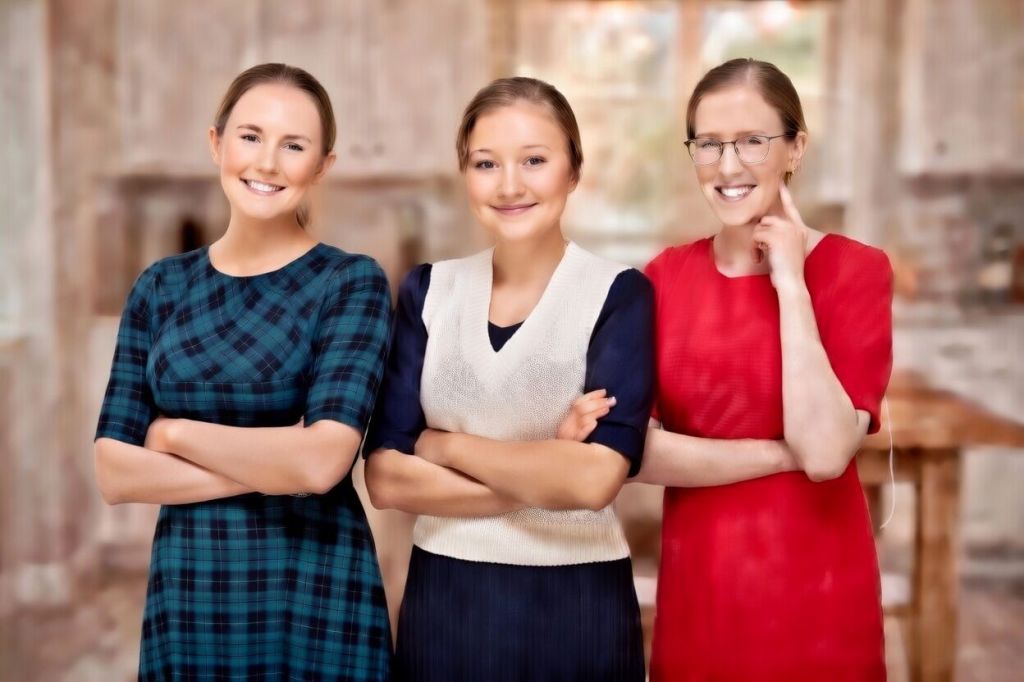
I’m guessing this has very little to do with what is projected onto it by those who often seem to see the broader American culture as some kind of benchmark for normal. 

Yes, it is the case that those of us born into this religious subculture tend to be self-conscious about what we wear and appearance.  I knew I was odd, at a public school, wearing long pants during the heat of August, and had classmates who would remind me of my being Mennonite.  But is it the cause every mannerism?

Chimpanzees also cross their arms.  But it is described as just being a neutral relaxed position or simply a way to rest and relieve muscle strain.  The crossed arms as being a defensive posture has fallen out of favor with experts.  Could there be some post hoc rationalizing in how we explain human body language? 

Mirroring behavior provides a more plausible explanation.  This is to say we will just imitate the postures or mannerisms of others in our group without a thought.  This is called “chameleon effect” and part of the way we build rapport or trust.  It is part of our sense of belonging within a community.  It’s wired in our brain—the “mirror neurons” which fire off both when we perform a particular action as well as when we see someone else doing the same thing.  Nobody has to tell us to do it.

This is deliberate.  Whereas mirroring is subconscious.
This hand gesture is very common all throughout the Philippines.  The “I’m good looking” pose.  Click here for more gestures.

So what is likely, whether those Mennonite arms crossed or Igorot elders walking with their hands clasped behind, is that these postures are about a cultural identity and unconscious process where we copy those whom we respect in the group or just what we have seen thus accept as normal.  It is social glue—in the same way my cousin picked up her Southern drawl after marrying a Virginia boy.  This is similar to how we yawn when other people do.  It’s just an instinct.

Social Glue in Religious Ritual Too

What’s interesting is that religions attempt to capitalize on this by forced mirroring that becomes unconscious.  The extended hand, the greeting a non-relative as “brother” and all ritual is about building an artificial bond that makes us feel like we belong.  It’s in the silly cliché phrases, they’re part of that “hedge of protection” around community identity, and just social connection that makes us feel comfortable.
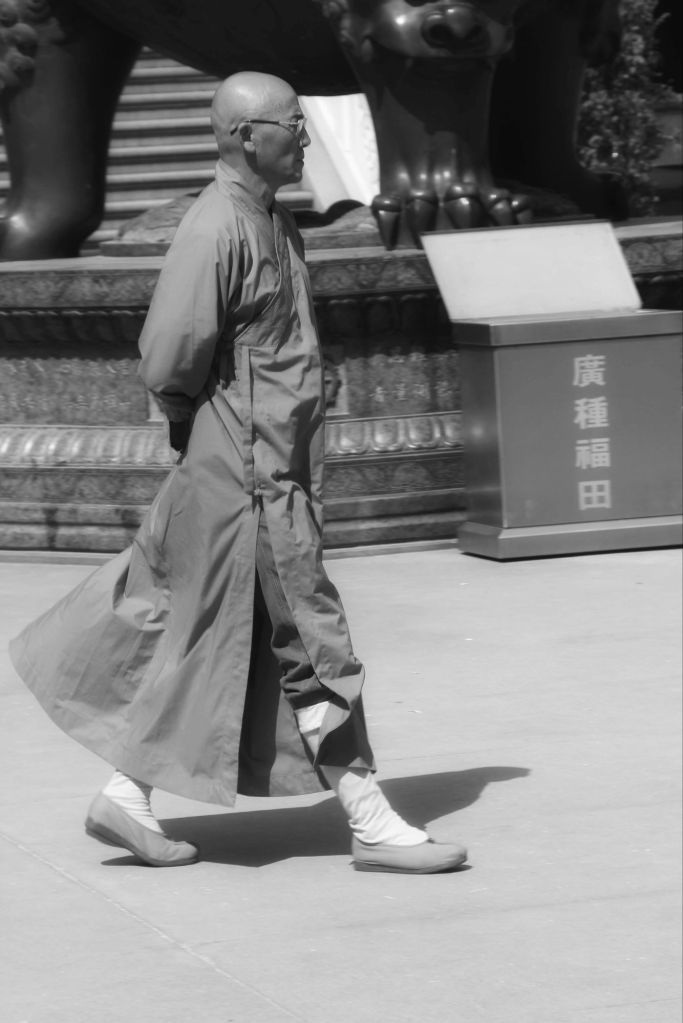
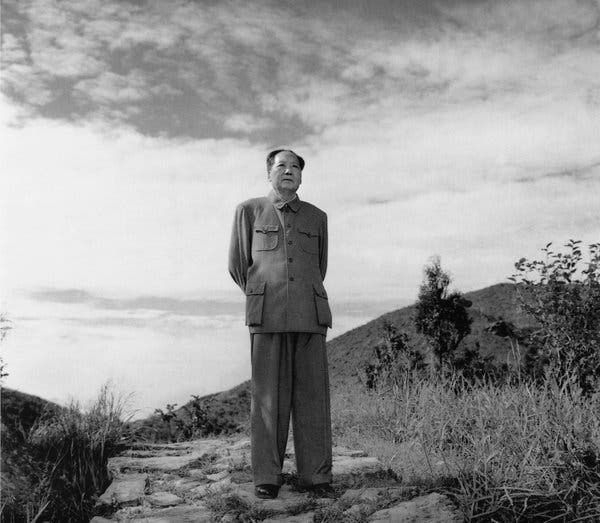
Common in the East.
The “Four Olds” (old ideas, old culture, old customs, and old habits) of the Cultural Revolution didn’t reach Chairman Mao.  His hands are still in the traditional Asian authority position.

However, this can also make life very difficult for those outside coming in.  An outsider that tries to go through the same motions will very likely look forced—like a mask or performance rather than genuine.  This “false signal” could be taken as mockery and give off an uncanny valley feel that makes people suspicious or uncomfortable. Not to mention it is hard for the person trying to keep up the appearance as well.  Like the time when I awkwardly did a full prostration rather than the requested bow from the priest for that part of an Orthodox service.

And yet, off the insecurities most contemptible, it is this need to explain or apologize for what was programmed into us by our culture.  Hands in contemplative clasp behind our back while we walk or an assuring restful self-hug, we need not ever feel awkward about our mannerisms and physical pose simply because it is unique to our own subset of humankind.  It is an unfortunate side-effect of modern pluralism and exposure is we’re left second guessing our status rather than just being a part of the social fabric.

We don’t need to defend or pathologize this. 

At the same time, like physical posture, culture is built on religion and our moral assumptions are simply inherited.  So there is a place for careful deliberation and more intentionality in what we do.  And by understanding how new generations absorb through a process of socialization osmosis rather than verbally through instruction.  If more is caught than taught; if many things are learned through unconscious mirroring—then we need to practice much more than we ever preach.


“You’re Thirty Years Old Living In Milton”

Standard

The quote in title, an unintentionally honest comment from a pious young woman, will continue to ring in my ears for decades to come. Scripture describes the word of God being “sharper than any two-edged sword,” but her romantic rejection came more like a hammer blow to my Mennonite worldview where spiritual was supposed to outweigh physical gain. I had patterned my life, up to that point, around a sort of practicality over flash and suddenly realized what I thought was an asset was actually liability.

I was reminded of these words again as my wife’s glowing approval of the monstrosity in my driveway, a Ford Explorer ST, still feels out of place for me. I mean, granted, I was not keen on transitioning to family life with a pedestrian option like a minivan or boring SUV. But I didn’t expect my always frugal—cost conscious—female counterpart to go along with it 100%. She was supposed to pump the brakes and did not. I’ve realized, in this, that every woman is happy with the nice things and won’t say no if you provide it for them. We’ve both agreed to blame the baby for our reckless financial decision.

So, back to Milton, a place I’ve since moved on from and to the higher cost town across the river. Up until the words from the mouth of this wholesome girl, I had thought having a little house completely paid off would be worth something—even attractive. After all she claimed to be interested in missionary service and what better place to get a start, right? From what I had believed, there are needs anywhere there are people and where better to start than a deteriorating industrial town? Milton is an example of the rust belt, a place of declining opportunities and costs of outsourcing production.

The phrase “you’re thirty years old living in Milton” was simply accurate conveyance of her underlying priorities. There’s always the difference between what we say we are and the actual truth. Even in the secular culture there’s a romanticization of the love of two impoverished people who stand together in desperate circumstances. And those raised in an environment where Christian mission is supposed to be first, living as one poor as a church mouse amongst common people would seem the ideal.

But it is not. No, this young woman, like the one who had rejected me for not pursuing a title of “missionary” or “pastor” years prior, was clearly after status. They will not say it outright, probably are not even aware, but it is a kind of glamour they seek in service. A call to some exotic location to impress their religious peers. Sure, a Bentley may not be status in a conservative Anabaptist church, but the ability to jet around the world (often on someone else’s dime) is thrilling where it is considered sacrifice. It is currency, a way to gain status in a community of faith or be seen as righteous.

Resources are showered on the ministry or mission. Sure, it comes with stress, my 9-5 does as well, but the payoff is proportional. And not talking about “treasures in heaven” or God’s favor. A pastor has access to the community resources. It is social power as much as it is a position of responsibility and there are always those who want to curry a little favor. Again, it also comes with more scrutiny as well, but most tend to minimize the costs when they set off in a particular direction. Besides that, for the Mennonite woman, this is for the broad shoulders of her husband to bear, right?

The high expectations of my wife have been a little surprising to me. To her credit, she has been putting up with a partly finished remodel of old house since marrying and moving in. But yet, despite coming from the Philippines, her standards are now close to that of an American woman. We comment about our son’s demands for what the other kids have, but often fail the test ourselves. I mean, is it at all coincidence that I decide to finally pull the trigger on a new vehicle after a Mennonite workmate showed up with his new truck? Probably not.

And that’s the bottom line here. We are all after power in different forms. Be it money, be it land, access to resources or just status in our peer group. What I’ve found is that a religiously trained (or ‘spiritual’) person is no different. No, all they do is give a righteous cover to their personal ambition. They live in a delusion. Materialism is bad, they will say, but they are fine with your donation of money so they can buy a bigger missionary compound in Southeast Asia. And, under the fluff of my own pursuit of love was the same sexual motivation of all men.

I hated when a physiatrist summarized my obsession with the impossibility as being a “sexual attraction” and dismissed it initially as a woman who knew nothing of my heart as a man of God. But now I realized this is undoubtedly the correct assessment. Men want sexually attractive women and women want high status men. This is an essential part of our nature—a matter of survival for our genes—a young healthy woman is able to bear children and a wealthy or connected man can give them much more than a thirty year old living in Milton.

I’ve moved on from Milton, but cannot move on from the reality I have encountered head on, we’re sexual creatures living in material reality and can’t escape this by denial. I had been better to learn this decades ago rather than cling to a naive notion of love where it ends like a storybook. But I am now living the best life available to me and hope that my wife is happy with her decision. She’s won my heart asking for the “simple and happy life” and now I want to give her that and everything else wonderful this world offers. The best thing we gained was the child born almost a year ago now…

It’s never too late to live the life that you should—which is more about perspective than what you possess—even if you were denied love for being thirty years old and living in Milton.

Anticipating November’s Delivery

Standard

In November, as the world tunes in to know who will be elected president, my wife and I will anticipate something else. 

We expect a baby girl, our first child together and second that Charlotte has brought into the world.  It has been my joy to raise our son, but having this miracle of life unfold before my eyes is still a powerful experience.  How a moment of intimacy can create such potential is just completely amazing.

There is no greater role in the world than a woman who takes her pregnancy to term, motherhood is simply the most important job there is.  In a century nobody will care about who won the popular vote or their policies.  Truly, short of a civilization ending nuclear war, they’ll remember Trump like we remember Taft or Harris as we recall all the many noteworthy accomplishments of the Harding administration.  But old folks then will remember their mothers.

The most powerful position in the world is not one with four year terms.  A President can reallocate resources, make things more or less difficult, wage war and destroy, but only mothers produce new life.

Early in our relationship, when marriage had become a possibility, Charlotte was excited about the prospect of a mixed baby.  That is a combination of my German genetics “long nose” with her own.  But as months waiting turned into years that initial enthusiasm had wore off and, by the time she arrived, it was all about financial goals.  We couldn’t afford a baby—we could barely keep up with rising costs due to inflation!  

Besides that, we are both getting old.  The world seems less stable now than ever, my own skepticism has grown and I’ve become untethered from assumptions that brought me easy answers in the past.  Our son was already here, we weren’t bringing a new life into the mess.  So maybe it was better that we didn’t bring a child into this to suffer the hardships and pain that we have?

I’ll also admit that my wife, despite having given birth once, had a flat belly and that is completely desirable.  We all want to hang onto our youthful appearance.  Men tend to prefer women that are in shape or pleasing for aesthetic reasons.  Why ruin that?

However, a bottle of wine and nature have won against rational concerns.  No, those anxieties about how to raise a child in this environment did not go away and, for the first time ever, abortion entered my mind as an escape of this enormous responsibility.  This could all just go away with a ‘medical procedure’ and nobody would need to know, right?  Of course, that momentary reflection was swallowed up by excitement.

No, we don’t know how all of the details will work out.  Our hopes of moving Charlotte’s mom here didn’t pan (only the parents of US citizens can be petitioned) and we’ll have to adapt as we go.  We have no regrets, the kicks we feel now soon to give way to cries in the night, diaper changes and all of those steps of development.  But in the end this is the only legacy we will leave to the world—the only future we have.

Preparations are underway for the inaugural moment when this winner against the odds will emerge.  We want our daughter to have the very best introduction to the world we can provide—a safe and stimulating environment.  We’re stocking up on diapers and bottles, have a crib and car seat that can double as a stroller, friends and family will celebrate—the anticipation builds!