The People Want a King, Part II: The Idolatry of the State and the Call to Self-Rule

Standard

A decade ago, in “The People Want a King, Part I,” I wrestled with the ancient cry of Israel—“Give us a king!”—from 1 Samuel 8, seeing in it a mirror to our own craving for centralized power. I cast Trump, then a looming figure on the horizon, as a Saul-like pretender—brash, self-absorbed, a king unfit for the throne. The heart of man, I argued, is frail and fearful, ever eager to trade liberty for the illusion of security. Now, ten years on, we revisit that cry, turning the lens inward and upward: what happens when the king we demand becomes a god we worship? And what might it mean to cast down that idol and govern ourselves under a higher law—one that admits no rival?

Let us begin with a heresy: government is not sacred. It is not a divine institution bestowed from on high, nor are its stewards a priestly caste anointed with heavenly oil. Scripture offers no such mandate. The state is a human construct—a tool, a mechanism, a servant of necessity. It is not the ekklesia, the called-out assembly of God’s people, nor the Kingdom of Heaven breaking through the veil. It is, at its core, a business: a transactional entity exchanging services for tribute. When it ceases to serve—when it grows fat and lazy, a Blockbuster Video in a Netflix world—it deserves no reverence, only replacement. To treat it otherwise is to fashion a golden calf from the scraps of bureaucracy.

Yet the cry persists: “The nation is too complex for such simplicity!” I encountered this objection recently, a rebuttal to my call for radical restructuring. The argument, draped in the garb of sophistication, insists that governance transcends mere commerce—that its intricacies demand a permanence beyond critique. This is a shade thrown at those, like the DOGE reformers, who dare to wield the axe of efficiency against the overgrowth of empire. It is a plea for the status quo, cloaked as concern for “public trust.” But trust in whom? The regime that has ruled longer than memory, entwined with corporate titans and special interests, bleeding the commons dry? The trust was shattered long before any billionaire CEO took the helm; it crumbled under tax rates that plunder and wars that pulverize the defiant.

Here lies the theological crux: complexity is not a virtue—it is a veil. In 1 Samuel 8, Samuel warned Israel that their king would take and take—sons, daughters, fields, flocks—until they were slaves in all but name. The modern state has fulfilled this prophecy with chilling fidelity, its mission creep a slow idolatry. What begins as a servant becomes a lord; what promises order delivers oppression. The labyrinthine bills, the thousand-page tomes of legislation—these are not signs of wisdom but of deceit, a Sanhedrin of scribes hiding corruption behind the law’s letter. To call this sacred is to confuse the Temple with the moneychangers’ tables.

Government as business is no mere metaphor—it is a functional truth. It trades protection and infrastructure for our coin and consent, a covenant not unlike the marketplace. Yet unlike the agora, where competition hones the blade of excellence, the state resists renewal. Private enterprise, for all its flaws, bends to the will of the consumer: Sears falls, Amazon rises. Governance, enthroned as monopoly, calcifies. Its priests—elected or appointed—crown themselves with divine right, decrying reform as sacrilege, a “threat to democracy.” But democracy is not their god; power is. And power, unchecked, builds altars to itself.

This is the sin of the political establishment: they have conflated the nation with their institution, the people with their rule. The nation is not the state, nor the state the nation—just as Israel was not its kings, nor its kings Israel. Government should reflect the imago Dei in its people, a stewardship of justice and flourishing. Instead, it mirrors Baal, demanding sacrifice from the many for the feast of the few. How is this sustained? Through a catechism of control—children reciting pledges, citizens taught to venerate the machine as eternal. To question it is to court excommunication.

Yet Scripture beckons us elsewhere. The restoration of governance requires a return to first principles: simplicity as clarity, transparency as righteousness, accessibility as the leveling of pride. The state’s convolution is no accident—it is a shroud for sin, a “you wouldn’t understand” that echoes the serpent’s whisper. To dismantle it is not anarchy but exorcism, a stripping back to the studs to expose what festers. The old guard, like Saul clinging to his throne, shriek at the loss of their sacred monopoly. But their divinity is a lie, and their temple must fall.

The Stagnation of the External, the Promise of the Internal

Consider the contrast: a business that squanders its capital dies; a government that squanders ours endures. This is the curse of external governance—its inertia defies the natural law of adaptation. Were it subject to the crucible of choice, only the fittest form would stand. Instead, it grows sclerotic, a Leviathan too holy to slay. And the people, seduced by its permanence, make it their idol. They crave a king to think for them, a mediator to absolve their agency. Politicians—prostitutes of the soul—oblige, peddling promises they half-believe, deluded into messiahs of their own making. Zelensky’s advisors call him mad with grandeur; Washington’s geriatrics are no different, mistaking their tenure for providence.

This is not governance but bondage, a learned helplessness masquerading as piety. The privately employed know their limits—life persists beyond their shift. But the state’s acolytes preach indispensability, as if only they can wield the scepter. Contrast this with self-governance: a people ruled not by fleshly lords but by principle, by the law written on their hearts. Jeremiah 31:33 whispers of such a day; Hebrews 8 seals it in Christ’s blood. At the civic level, this need not mean chaos but discernment—shuffling roles, pruning branches, trusting that micromanagement by fools yields only thorns.

Why, then, the sanctity of the status quo? It is the coward’s theology: easier to bow to mystery than to wrestle truth. As Israel preferred a king to the uncertainty of judges, so we prefer bureaucracy to responsibility. Samuel’s warning rings anew: the king takes, and we cry too late. External governance is not our salvation—it is our stagnation, a false god promising safety while forging fetters.

The Myth and Monuments of the Federal Cult

To cement this idolatry, the Federal government has woven a mythology and erected monuments rivaling the temples of old. Consider the Capitol, that domed sanctum of marble and myth, its steps ascending like an altar to a civic deity. The Lincoln Memorial, a brooding Parthenon, gazes over a reflecting pool as if to baptize the nation in its own reverence. These are not mere buildings—they are shrines, designed to awe, to whisper: “This is eternal, this is beyond you.” Like the ziggurats of Babylon or the temples of Rome, they fuse power with divinity, demanding obeisance from the pilgrim and the peasant alike. The Founding Fathers, recast as demigods, stare down from friezes and statues, their words carved into stone as if they were Moses descending Sinai. Big Brother is not God—yet here he looms, a surveillance state cloaked as savior, its all-seeing eye promising protection while its fist tightens the leash.

This cultic architecture is no accident—it sells the lie that the state is sacrosanct, its form immutable. The pledge of allegiance, recited by schoolchildren, is a liturgy; the flag, a totem; the Constitution, a holy writ too sacred to amend save by the high priests of amendment. Yet this is a sleight of hand. The Constitution, for all its brilliance, is a human document, not a divine oracle—its framers knew it, urging vigilance against its abuse. The Federal cult inverts this, turning a tool into a god, a means into an end. As the temples of Baal housed idols to blind the masses, so these monuments obscure the state’s frailty, its susceptibility to rot.

Enter January 6th, 2021—a day branded as a desecration, a violation of the “sacred ground” of democracy. The narrative drips with priestly indignation: rioters stormed the Capitol, profaned its halls, threatened the holy order. Politicians clutched their vestments, decrying the “insurrection” as an assault on the nation’s soul. But let us parse this claim with a smirk—how many have died at the hands of this government, overseas and at home, in the name of “protecting democracy”? Millions, if you tally the wars and drones, yet the single death of that day gets the sackcloth and ashes. If the Capitol is sacred, what makes it so? Not its service to the people—its corridors have long echoed with the clink of corporate coin and the murmur of self-interest. Not its fidelity to justice—its laws have sanctioned plunder at home and terror abroad, not least against Argentina, whose people still bear the scars of U.S.-backed meddling and economic strangulation. The sanctity, then, is a projection, a mythos guarding the idol. January 6th was chaos, yes—ugly, reckless, and lawless—but to call it a sacrilege assumes the temple was holy to begin with. It wasn’t. It was a house of power, not of God.

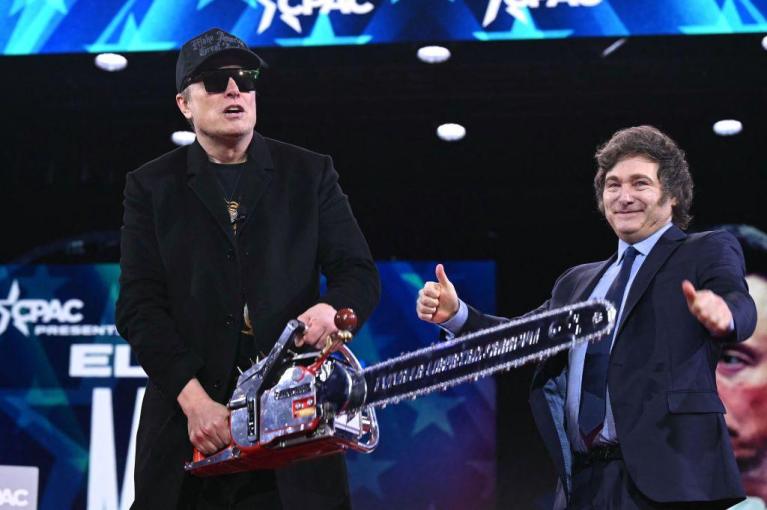
The true violation predates that day: the slow consecration of a bureaucracy into a deity, the elevation of marble over morality. Ancient temples hid their emptiness behind splendor; the Federal cult does the same, crying “blasphemy” when the curtain is pulled. January 6th didn’t defile a sacred space—it exposed a hollow one, a monument to a king the people demanded but never needed. And here’s where Argentina’s President Javier Milei enters, grinning like a Cheshire cat as he handed Elon Musk a chainsaw in 2025, etched with “Viva la libertad, carajo” (“Long live liberty, damn it”). Milei, who’s taken his own chainsaw to Argentina’s bloated state, wasn’t just gifting Musk a tool for bureaucracy—he was practically dancing with glee to see Musk turn it on the U.S. regime that’s bullied his nation for decades, from IMF debt traps to covert coups. It’s less a symbol of shared efficiency and more a middle finger to the empire, wrapped in a libertarian bow.

Trump’s Mandate and the Singular King

So where does Donald Trump fit in this unholy pantheon? In Part I, I cast him as a flawed Saul—brash, impulsive, a king more enamored with his own mirror than his people’s good. I stand corrected, or at least refined. Trump is no savior, nor should he be—Christians have but one King, enthroned above all earthly powers (Colossians 1:16-17). Yet he wields a mandate, both legal and theological, to tear down these idols, and therein lies his purpose—not as messiah, but as iconoclast.

Legally, Trump’s authority stems from the Constitution itself—a document that vests executive power in a president elected by the people (Article II, Section 1). His 2024 victory, a roar against the entrenched cult, grants him the democratic right to wield that power against inefficiency and corruption. The Federal government, swollen beyond its constitutional bounds, has no divine charter to resist pruning. The framers envisioned a lean state, not a Leviathan; Trump’s DOGE-inspired axe—however blunt—aligns with that original intent. He can shutter departments, slash budgets, and fire the high priests of waste, all within the law’s letter. The shrieks of “threat to democracy” from the old guard are the death rattles of a dethroned idol, not a defense of principle.

Theologically, his warrant runs deeper. Scripture abhors idolatry—Exodus 20:4-5 commands no graven images, no bowing to crafted gods. The Federal cult, with its temples and myths, is precisely that: a false deity usurping allegiance owed to Christ alone. When Jesus declared, “Render to Caesar what is Caesar’s, and to God what is God’s” (Matthew 22:21), He drew a line—Caesar gets coins, not worship. Trump, for all his bombast, serves as a wrecking ball to this blasphemy. He need not be pious to smash Baal’s altars; Gideon was a coward before he toppled the poles (Judges 6:27). If Trump’s tenure exposes the state’s hollow sanctimony—January 6th as symptom, not sin—then he fulfills a divine irony: a flawed vessel breaking a greater folly.

Yet here’s the correction to my 2015 take: Trump is not the point. I overstated his flaws as disqualifying, missing the forest for the trees. He’s no king to crown—Christians must reject all earthly thrones save one. “My kingdom is not of this world,” Christ said (John 18:36), and Paul echoed, “Our citizenship is in heaven” (Philippians 3:20). Trump’s role is transient—permitted, not ordained—to dismantle a false god, not to replace it. The Christian’s allegiance lies with the King of Kings, whose rule brooks no rival, be it Trump, Biden, or the marble gods of DC. Self-governance, then, is not just civic—it’s spiritual, a refusal to outsource our souls to any throne but His.

The Eschatological Hope

The people want a king, but the King we need refuses a throne of stone. To cling to the state as sacred is to repeat Israel’s folly, to trade the Spirit’s freedom for Saul’s spear. Self-governance is not utopia—it is obedience to a higher call, a shedding of idols for the stewardship God demands. Complexity is a liar’s refuge; trust is a martyr of our making. Let Trump tear down the temples—legally, he can; theologically, he should—but let us not crown him in their place. Overturn the tables, tear the veil, and build anew—not a kingdom of men, but a commonwealth of the free, under no crown but His.

And Jesus Had Compassion…

Standard

I’ve frequently been appalled and dismayed by the things I see coming from my former religious peers.  It is very well-meaning, but so horribly misguided.  And recently I saw a post like that, and imagined an incredulous Jesus: “You are Israel’s teacher, and do you not understand these things?”

*sigh*

What I’m talking about is the intellectuals of the conservative Mennonite cloister, those who teach the Gospel of Niceness and side with Judas and Social Justice who confuse Jesus with a political figure who is seeking to install a Marxist regime.  They ride on the leftist bandwagon, believing it makes them countercultural—when they’re simply going along with the powerful elites of our time.  Hypocritical elites who have mandates for us and exceptions for themselves.

The offending post was one of such glaring false equivalency that I can hardly fathom a thinking person would come up with it.  The misleading commentary is that Elon Musk resharing a meme in support of his efforts to remove waste, fraud, and abuse from the government is the same as Hillary Clinton applying a nasty label to those who dared to vote against her.  This is the statement:

Clinton called millions of ordinary Americans a “basket of deplorables.” 

Musk called millions of ordinary Americans “the Parasite Class.” 

When Jesus saw the crowds, he had compassion for them, because they were harassed and helpless, like sheep without a shepherd. (Matthew 9:36)

First of all, the first part is true, Clinton did indeed call ordinary Americans a “basket of deplorables” saying that half of those who were voting against her were “racist, sexist, homophobic, xenophobic, Islamophobic.”  It is to say that over thirty-one million people who got tired of the glib “We came, we saw, he died” imperial-lib establishment that she represents are just horrible people.  

Not only is she punching down, attacking a bunch of ordinary people for voting against her, but the reason she is demonizing then is to terrify vulnerable people.  It is a cynical divide and conquer strategy, purely for sake of securing political power for herself, and part of a campaign to turn Trump’s simple effective “Make America Great Again” into something divisive and scary rather than an inclusive unifying message.

Elon Musk, by contrast, merely reshared a post.  He did not say half of the Democrat party support is parasites.  What he did say is “90% of America loves @DOGE.”  In other words, he is speaking for the crowd rather than against it.  Furthermore, the meme is not about legitimate social programs and those who benefit.  Nobody in the Trump administration is calling for slashing the rightful entitlements of Social Security or Medicare and Medicaid.

Name calling!  Accusing elites of exploitation!  Jesus would never do that, right?

What DOGE has taken aim at is the totally ridiculous and absurd, obviously fraudulent use of public funds, which 90% of America (if properly informed) supports.  The ‘crowd’ would be fully on Musk’s side if they weren’t being lied to or blinded by partisan bias.  It is compassion for those truly “harassed and helpless” that is drives the effort to increase government efficiency—and the social elites who willfully take advantage of taxpayers should be called out.

To those doing apologetics for waste, fraud and abuse, who are pushing this dishonesty take and misrepresentation: I would find it so much more tolerable if it was a forthright endorsement of sending money for far-left causes.  Just come out with it and say that you want money funnelled through USAID to pay for global promotion of transgenderism and pro-imperialist propaganda—you want this, be honest.

Compassion for the Brood of Vipers?

“You snakes! You brood of vipers! How will you escape being condemned to hell?” (Matthew 23:33 NIV)

Jesus had compassion for the crowds, but he spoke very condemningly of social elites who used their positions of influence to put heavy burdens on the shoulders of others—while not offering a finger to help.  

Jesus pretty much describes the telescopic philanthropy, the virtue-signaling and pearl-clutching of modern social justice.  

Jesus did not show compassion for these moralizing frauds.

Nice Jesus is upset about mean Tweets calling out social elites.  Real Jesus was killed because he wouldn’t stop insulting the people who thought they were above the ‘deplorable’ unwashed crowds.  Nice Jesus only would affirm and accepts everyone without ever requiring a change.  Real Jesus once compelled a tax collector (and cheat) to give back his ill-gotten gains—he greeted the promise of restoration by pronouncing salvation had come to this house.

If Jesus walked the streets of Manhattan today he would be accused of being very meanspirited, labeled as hateful, and likely cancelled by the woke elites.  They would whip up the crowd by taking things he said out of context, by calling him a homophobe, sexist or racist.  After all, he used the word “dog” to describe a foreign woman.  That is what the critics of Jesus did, he called them out and they false accused him.  He would most certainly be diagnosed as being a cult leader and narcissist for his claims.

Not saying a pair of trolling billionaires are the same as Jesus.  But they certainly do take after the character of that man who was overturning the tables of the money changers and chasing out of the temple.  Lest we forget, the money changers were those who took advantage of the poor who were obligated to pay the tax.  This money was supposed to go to the upkeep of the temple and yet teams of grifters, offering a service, were being parasites:

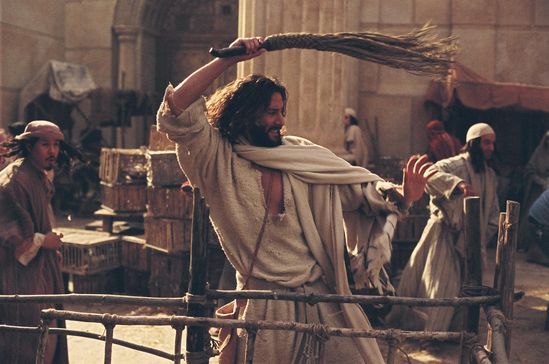
Jesus entered the temple courts and drove out all who were buying and selling there. He overturned the tables of the money changers and the benches of those selling doves. “It is written,” he said to them, “ ‘My house will be called a house of prayer,’ but you are making it ‘a den of robbers.’” (Matthew 21:12-13 NIV)

The Gospels contain differing accounts of this event, some scholars believe it may be about two separate times when Jesus went charging in on a little ‘insurrection’ rampage, but interestingly his explanation of authority to do this cleansing was later misconstrued and used at his trial.  

Sounds familiar, doesn’t it?

The corporate media has taken fabricated tales and normal diplomacy with a foreign power—and they spun it into an incredible “Russian collusion” narrative.  Trump talked about the “very fine people” on both sides of the Charlottesville statue controversy, and he took great pains to qualify his statement—by very specifically condemning the white nationalists and Nazis in the crowd.  But it didn’t stop the media from running the story “Trump Calls Nazis ‘Fine People'” and Joe Biden, along with many other Democrat partisans, have continued to repeat this lie.

Where Trump, and MAGA, clearly delineate between legal and illegal immigration, their detractors muddy the waters.  The left takes Trump’s desire to keep America safe from the flow of Fentanyl and of unvetted foreign nationals and twists it into xenophobia and a threat to legal immigration.  It is deliberate deception.  The far-left wants to keep brown and black people terrified that’s how they’ve always won—by fear-mongering the crowd, they deceive the sheep and, when that does not work, they will imprison or assassinate their opponents.

Remember ‘kindness is everything’ my leftist friends, right?

Evil doesn’t like to have a light shown on it and when you see all of the screeching in response to DOGE taking a look behind the walls of bureaucracy you do really start to wonder why.  Why are they treating Musk as if he’s just some Nigerian scammer trying to get our information?  Is it because he’s from Africa?  It is totally ridiculous.  Lawmakers circle the wagons and tell us we have no right to know how our money is spent!  It’s time to drive out those who have used us to enrich themselves.

There is always a spy versus spy aspect to this where accusation is met with a recrimination.  Both Jesus and those elites questioning his authority claimed that their counterpart was demon possessed or of the Devil.  It would require some wisdom and discernment to know which of the two sides to believe.  But the religious frauds of our day still side with the elites against the crowd.  They defend the status quo and the corrupted established system.  It is always the beneficiaries of fraud that fight against the reform.

When My Own Neck Was on the Line

Standard

On December 4, 2024, a shadowy figure, in a dark hoodie, waited for his opportunity, ran across the street, and then fired three shots.  A married father of two stumbled to the ground as his killer fled the scene.  Brian Thompson, the CEO of UnitedHealthcare was murdered and his killer allegedly a 26-year-old, disgruntled by botched a neck surgery that had left him in pain and disabled.

As father of two, husband of one, who had severe neck issues, and surgery, I had a lot of empathy for both men.  Very clearly this was an act of misdirected rage.  The killer, like most of us, wanted someone to blame for their life falling apart and a very wealthy insurance company chief executive made a convenient target, made a scapegoat, for a system that is broken at multiple levels.

When I was initially injured, in my twenties, I went to Dr. Rajjoub, he was known as one of the leading neurosurgeons in the area from what my mom found and we sat waiting in his office for a long time.  When we finally got to the exam room, the doctor was very brisk, “physical therapy.” 

My parents and I sat with our jaws open.  And my mom, a bit faster on her feet, stammered a protest.

Rajjoub broke his stride.  And he explained, very briefly, that better surgery options, like disk replacements, were on their way and I should wait.  And amazingly enough, a little physical therapy would get me back on my feet again.  He was right.

Fast-forward to a couple of years ago and a decade or so after this conversation and my neck pain was back with a vengeance.  And this time physical therapy, after an ill-advised trip to a chiropractor, would not produce sufficient results.  I knew with the numbness and loss of strength, the window of opportunity was beginning to close, there would need to be surgery soon or I may never be restored to full use of my right arm.

So I got an appointment with a specialist, at our local hospital, explained the history and my current symptoms.  This neurosurgeon agreed that it was time to go under the knife and we began to discuss the particulars of the procedure he would do.  What he would describe is a neck fusion.  They bond a few vertebrae together, around the injury area, to bring some stability and restore the gap for the pinched nerve to travel through.

I was underwhelmed.  I didn’t wait this long to get an inferior surgery.  So, once again, I enlisted the help of my mom.  And the goal was to find an alternative option who would do a replacement rather than a fusion.  We ended up contacting Virginia Spine Institute and I was soon talking to a young energetic Bucknell graduate.  We exchanged stories about my home town, and common experience at the local watering hole, before we got down to the business at hand.

One of the items to consider, going in, was that this medical group was out-of-network, my insurance would likely reimburse for a little and yet not nearly the whole cost.  But, given I only have one neck to spare, and that VSI seemed state of the art—I went with my gut and bit the bullet.

The results were phenomenal.

My veteran physical therapist was totally amazed at the speed of my progress.

As if to confirm my decision, already on my way back to work, I went through the drive thru at Dunkin a few days after the surgery, still wearing the neck collar as precaution, and had a brief exchange with the cashier who gave an account of her own experience with neck surgery.  She had the fusion, was still dealing with chronic pain, and validated every concern that I had with the outdated practice.

An activity not doctor recommended.

So why did she, and the killer of Thompson, have a surgery that should be discarded to the annals of medical history?

There are multiple contributing factors, as always, insurance companies slow in their acceptance of change, surgeons who don’t want to get trained in a whole different way of doing things when they have mortgage to pay plenty of work, but truly at the heart of it all is the FDA moving at a turtle’s pace.  The agency has lagged well behind counterparts in Europe and who knows why.  There is no Big Fusion industry lobby to blame as far as I can tell.  So what’s the hold up?

This approval process really underlines the misplaced faith many have in government agencies.  While Europeans were getting a far better option, literally for decades, those of us under the protective care of a Federal regulatory bureau, suffered the ‘cure’ barely an improvement on the disease.  And really need to ask the question why.  Why can the FDA work fast to approve a pharmaceutical and yet not to ban dangerous red dyes?

The answer is likely a combination of lack of political will and bureaucracy.  The real problem is this notion these institutions are all science and not political or biased.  

It is tempting to just call it incompetence (or cook up some cockamamie theory) but it is more than that.  We do fusion surgery rather than risk replacements and that is because what is established seems less risky than a newer procedure.  There is probably a big assumption that because an opinion exists there is no need to move quickly.  And then an agency is made of people.  It is not some monolith constructed of pure unadulterated science.  No, it is rather like where you work, an institution that is really only ever as good as the management.

Many smart people work at the FDA.  But it is not their job to make sure that the latest technology gets to the consumer.  They do their assigned tasks.  And thus some items may fall through the cracks.

The most tragic part of Thompson’s murder is that it targeted someone who was doing their job and working within conditions set by the industry and the government.  This idea that removing a profit motive will just magically fix everything is wrong.  What is truly needed is a major disruption of status quo for regulatory agencies.  There is really nothing sacrosanct or unquestionable that the FDA does.  Science needs scrutinized, the experts miss things and have their own private motives.

Furthermore, the rising cost of healthcare doesn’t have one singular cause.  The left wants to explain everything bad as being a result of evil capitalism, whereas the right always wants a secret plot to destroy the health of America, but the reality is much more complex and not nearly as exciting as these two ideologically driven fantasies.  It is simply the limits of system and cost of the technology in many cases, coupled with a crippling burden of compliance.

There is a big reason why the small medical practices are disappearing, swallowed up by giant politically connected and bureaucratic nightmares.  There is also a reason why, in the age of the ACA requirements, insurance companies must push back against waste of invested resources.  We’re all caught in a tangled ball of competing interests and may need our Alexander to take a sword to this gigantic seemingly unsolvable knot.  

Isn’t Socialism wonderful?

This is why I’m willing to give new Health Secretary Robert Kennedy Jr. a chance.  We need reform and we needed it yesterday, it is decades overdue like the eventual approval of the disk replacement surgery that has allowed my return to an active and fulfilled life.  And, if you don’t like it, then maybe you should try Canada where healthcare is free, if you can get through the line.  Amazing how nobody blames public health officials—until you get one who goes against the status quo they claim to hate.

Trump: Business, Not Bombs

Standard

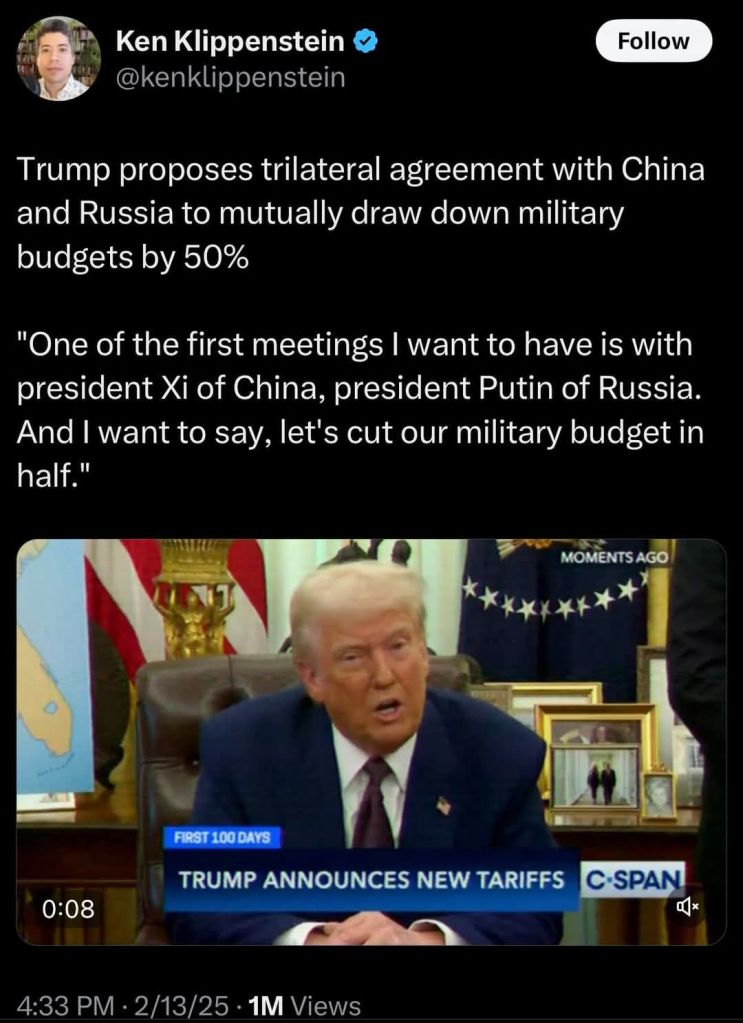
Trump has been full of surprises in the first few weeks of his delayed second term, but this latest proposal was the least expected and one even the professional fault-finders won’t be able to oppose.  He has just made a proposal that could change the world for a generation to come: A trilateral agreement between Russia, China and the US to reduce military spending by 50% and decrease our nuclear stockpiles.

But this isn’t out of character for Trump.  He got started then before he officially entered the office.  According to the Israelis, Trump, who told Netanyahu that the war must end, deserves full credit for the Gaza ceasefire deal.  And this is just a pattern.  Trump has no interest in wars.  He is about business, not bombs, and it goes all the way back to his youth when he, rather the be beholden to phony patriotism, stayed out of Vietnam.

Avoiding War By Any Means

Back in 2016, when Trump was running for President against Hillary Clinton, there was a hearsay report that the MAGA candidate had avoided military service in Vietnam by using a diagnosis of a foot injury.  There is yet to be documentation to prove this.  But it has led to some ridiculing him as “Captain Bone Spurs” and alleging his cowardice.  

To me, knowing what I do about Vietnam, I can’t see how avoiding that meat grinder is a reflection of poor character.  

No, the war was an absolutely horrendous waste of life and resources, a quagmire, in defense of a dying colonial order.  What the US government did to that country and it’s people is beyond the pale.  

Over one million people died, bombed with napalm in their villages—scores of young American boys killed in the process—and nothing was gained besides an ecological disaster.  Our veterans were left scarred and many of them (like the father of a friend of mine) suffering from debilitating illness—which is likely due to the widespread use of chemical defoliant agents.  

It is easy to see the vanity now.  In the end Vietnam did become a Communist nation.  And yet this did not lead those dominoes falling across Southeast Asia, as ‘experts’ predicted (like they do now claiming Putin has ambition to take all of Europe) and we should be celebrating that anyone avoided this pointless conflict.

Trump may have avoided the Vietnam War for selfish reasons, nevertheless the moral reasoning was correct: Why kill thousands of Asians, at risk of your own life, when you can just do business instead and everyone wins?

Trump Angers Neo-cons

In his first term Trump did something even Obama didn’t do and despite being given a Nobel Peace Prize.  Both Obama and Trump would continue the war in Afghanistan, but it was Obama who bombed Libya in pursuit of “regime change” and turned that country into the hellhole it is today.  Trump, on the other hand, avoided war and even started negotiations for peace with a country we’ve been at odds with since 1953.

I recall being told by a die-hard Democrat friend that Trump, the terrible loose cannon and narcissist he was, would start WW3.  It is quite interesting, to see how that this dire prediction compares to actual reality where the last administration had pushed us to the brink of a nuclear Armageddon.  But in four years of Trump’s presidency, despite all the insane fear-mongering rhetoric from his opponents—nothing close to this happened.  

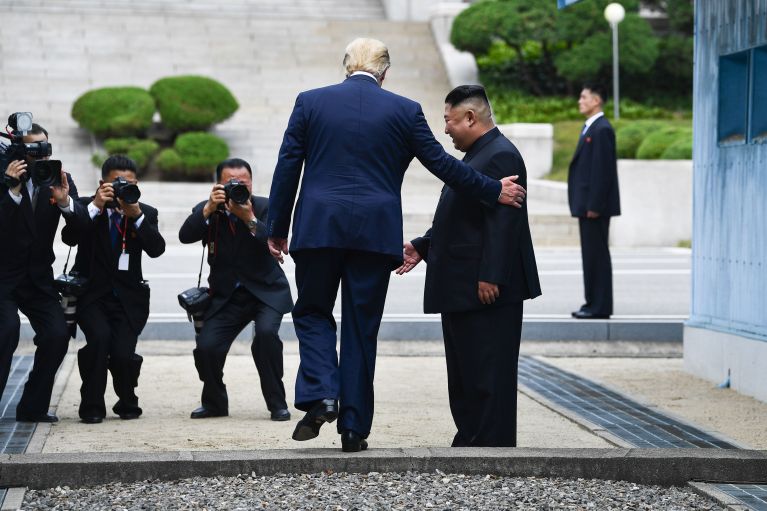
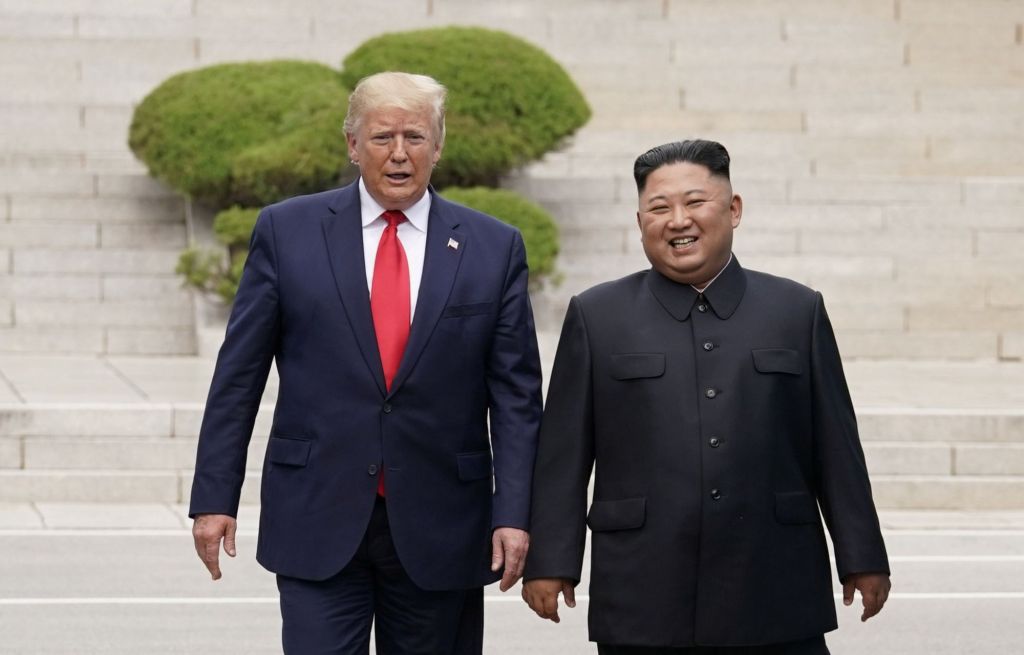
Instead, what happened under Trump, but not Biden, was a slight thaw of relationship with North Korea.  Yes, Trump engaged in a little rocket size comparison, but eventually would walk across the DMZ to shake hands and get some pictures with Kim Jong Un his counterpart.  That is unprecedented.  And is a legitimate reason to award a peace prize, but nobody recognized that moment and it has faded as Biden returned us to a status quo of use of threats and the proliferation of arms deals, rather than diplomacy, in an attempt to dictate terms.

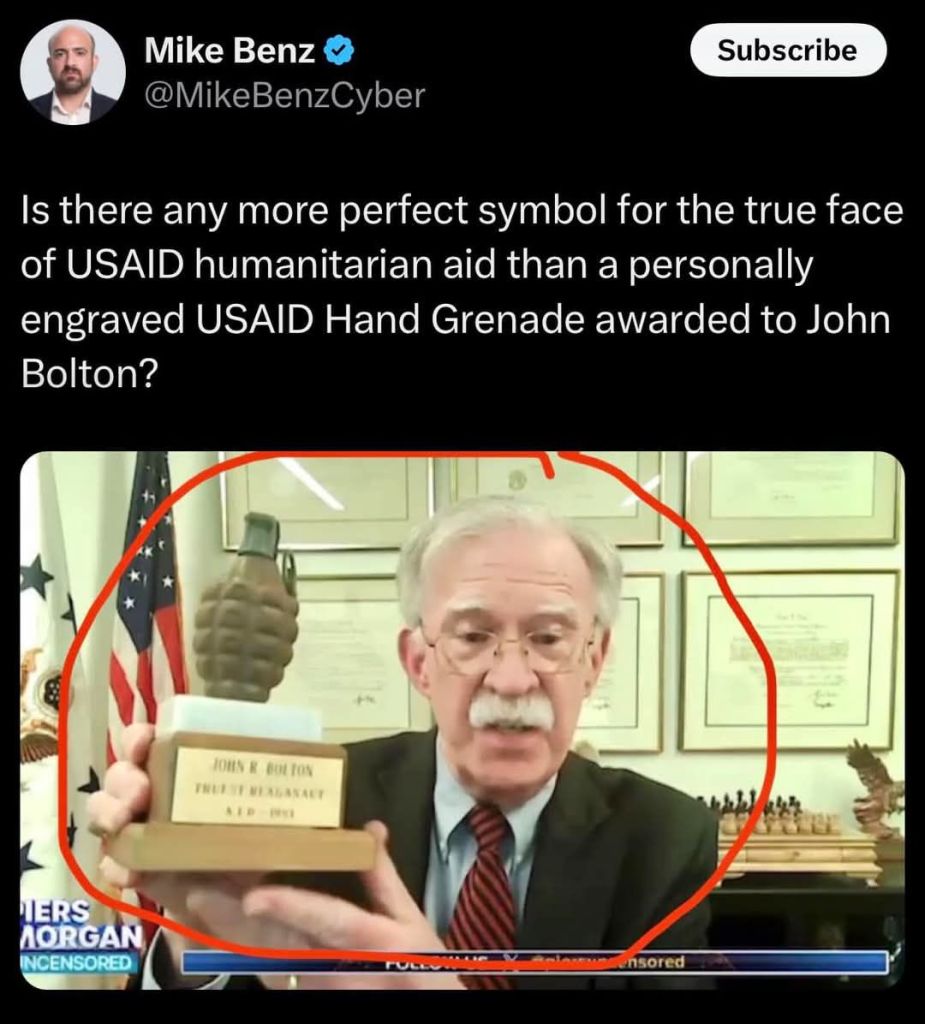
No, Trump is not a peacenik or even a nice guy (depending on who you ask), but he did avoid a dangerous escalation with Iran over a down surveillance drone.  With neo-cons salivating and only ten minutes from strikes, Trump—learning that 150 Iranians may die—called it off.  This is likely why John Bolton turned on him.  The warmongers wanted a violent confrontation, dead bodies, whereas Trump valued human life.

And maybe it was all just a cynical ploy and part of deal making strategy?

Nevertheless, those Iranian men got to go home to their families rather than die so a President could look like a tough guy.  And, when all lives matter peace is possible.  A President that is even doing a little bit of lip-service in concern for enemies will be even less likely to put US service members into harms way.  Yes, he would retaliate against Qassem Soleimani, the Iranian General who was responsible for the deaths of American people, which shows Trump prefers to hold decision-makers accountable rather than subordinates.

Business, Not Bombs

What makes Trump unique, as a President, is his willingness to entertain different ideas in the open.  Our tireless defenders of the status quo claim it is unpresidential, that he suggests alternatives, but this is how a true innovator works.  Why not float a thought or start a conversation?

A prime example is his proposal for Gaza.  I mean, certainly, the Palestinians have truly got the short end of the stick.  They, being Semitic people themselves, get labeled as being anti-Semites, for fighting for their own deeded land, by the most powerful lobby in the world.  Theirs is a legitimate grievance, if there is any, they were chased off of their land by a campaign of violence and terror—are now portrayed as the villains.

So when Trump proposed they walk away it seemed grotesque. Israel is the one country in the world that didn’t see their foreign aid disrupted by Trump’s America-first doctrine and clearly Netanyahu is in agreement with the plan or they would not be doing a joint press conference.  Palestinians had nobody to represent them in this.  How do you make a deal with only one party present?

However, upon some further thought, this could be the best deal Palestinian people can ever can expect to get.  What really is the alternative?

They are in a war they can’t win.  October 7th caught the IDF off guard and yet it was never a serious threat to the Isreali state nor a reason for the Israeli government to come to the negotiating table.  Hamas may have hoped for a hostage exchange in order to get their own captives back.  But hardliners, like Netanyahu, saw it as an opportunity and used it.  Sure, many in the world do protest indiscriminate bombing that kills far more non-combatants and children than it does members of Hamas, but holding a sign or occupying buildings won’t stop this ethnic cleansing campaign.  

Enter, “Riviera of the Middle East”

Trump reframed the conversation from one of fighting for soil, that has led to decades of suffering and death, to what is truly best for me and my children.  Sure, Hamas may disagree, but many Palestinians will likely take a buy-out deal.  Why stay in Gaza if you have a choice to relocate?  There is no new real estate, the Saudis have a lot of money to invest, so why not redevelop Gaza into a modern vibrant city, like Dubai?

The reality is Palestinians aren’t only being kept walled in by the Israelis.  They are truly caught between the two stubborn sides of a regional conflict, like Ukraine, and they (with their children) are paying the full price.  The nations of this region have not forget about colonialism and obviously consider a nation of expansion-minded European settlers to be a thorn in their side.  Add to this that the official policy of Israel is to destabilize their neighbors and you have a breeding ground of resentment.  Palestinians are their way to return the favor—used as a tool to provoke and prove the evil of the Jewish state.

So, for my liberal friends, is this land really so important that we should, for perpetuity, continue to sacrifice more children.  Or do we find a new and creative way to break the deadlock?  And, for my conservative friends, is it better that we send Israel bombs, at the expense of taxpayers, when we could help to broker some kind of buy-out instead?  It is time for a business deal, to give those in Gaza—who just want to live normal lives—a chance.  

So, Trump, I realize this is at your “ridiculous first offer” stage, but I’m listening.  

Tell me more.

The Status Quo Alternative 

The political establishment has only known old divisions and escalation.  It is one big area of bipartisan agreement.  Republicans and Democrats in Congress may disagree on details, but nearly all support an endless war with Russia and China, through proxies or even direct threats.  The goal is always to box their rivals in militarily or back then into a corner economically—as if this is the only way forward.  

Diplomacy took a back seat.  Instead of the slightest acknowledgement of Russian and Chinese security concerns, our government has made regime change the goal with even near-peers with a nuclear deterrence.  And it is this attitude that led to the bloody conflict in Ukraine that has cost countless lives and billions upon billions of US taxpayer money, all after the US had orchestrated a coup on Russia’s doorstep, leading to a civil war in that country and—after eight years of Kiev’s regime lobbing shells at civilians—a direct intervention by Russia.

The problem is a combination of Cold War ideology and institutions.  Endless war is where the big money is.  Many, in the West, profit off conflict and chaos.  That and they are old.  They’ve become functionally fixed, see only one solution (to further humiliate or defeat those who stand in their way) and lack imagination or even the will to come up with win-win resolutions.

Truly, the only way to win any war is not to fight it.  Wars cost both sides.

Trump, for better or worse, is disruptive of the status quo.

As for his proposal, I would consider 50% to be the “ridiculous first offer” stage of negotiations and do not expect China or Russia will go along with it.  For them that would leave the US on top of the balance of power—given our tremendous head start in comparison—and this maintaining our advantage over them leaves their interests vulnerable.  They will probably come back with an alternative proposal and the horse-trading will begin.

Nevertheless, it sure beats a strategy of endless escalation—that eventually ends in a nuclear war or our bankruptcy.  Even a 10% reduction in defense spending would go a long way to slowing down inflation and give hardworking Americans more bang for their buck.  Our sons not dying in Europe or in the East China Sea the biggest benefit of avoiding confrontation.

Lead, Follow, or Get Out of the Way

Like him, love him, or loath him, Trump is the President of the United States and has resolve to make his second term historic in ways nobody imagined.

Even if we disagree on some policies or we have a different understanding of his drive for government efficiency, we should agree with this aim to convince the great powers to beat their swords into plowshares. 

There is just too much to lose (and also too much to gain) by this to not jump on this unique opportunity to challenge existing order and build a better one. 

Business (and buy-outs) rather than bombs—that’s the Trump way of doing geopolitics.

Even his idea of buying Greenland, as part of a containment strategy for Russia and China, is far better than the alternative we see playing out in the steppes of Ukraine.  There is no way to bomb and kill our way to world peace or at least not a kind of peace where humanity survives and thrives.  We need to find a different approach, we need to dissolve the Cold War organizations and agencies that encourage military solutions or regime change.  We need to double down on diplomacy and fair-trade agreements.

It is time to give peace a chance.  We need to be disruptive, to change the conversation, and work with those who are willing to work towards a better future together.  If Trump is a partner in this, then we should embrace this as his role and not hinder this with old partisan battle lines.  Maybe he’s not pure or perfect, but at least he’s oriented right as far as war and avoiding the costs.

A Divided House—Yesterday’s Revolution

Standard

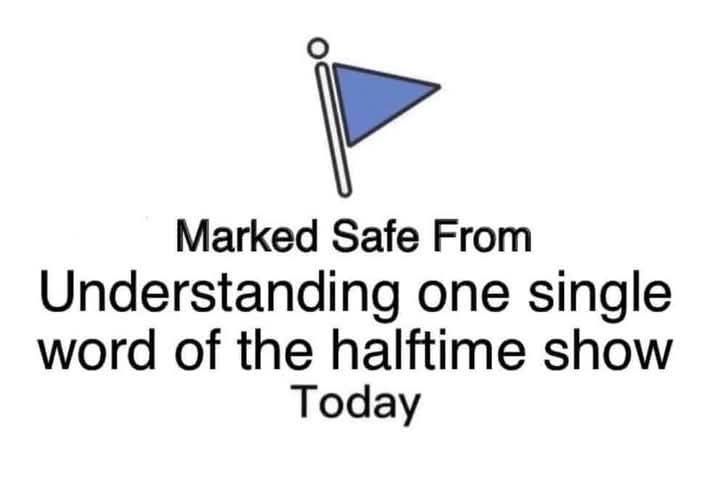
It has become a Superbowl tradition to hate the halftime show.  The performance is a no win situation for the NFL, it is impossible to please such a broad audience.  I’ll confess, probably revealing my age, that I really didn’t know Kendrick Lamar existed and nothing I saw convinces me to go buy his album.  My overall reaction is basically, “Meh, another mediocre halftime show, what’s new?”

Now, should I start my critique with some deconstruction of themes or with some of my own lived experience?

Let’s do the latter.

Rebellion is part of the American cultural zeitgeist.  From the throwing tea into the Boston harbor, in 1773, to women burning their bras in the 1960s and soot-spewing diesel pickups with obnoxious flags, we’re not going to take it—anymore!  Basically, we’re a nation of rebels without a cause.  If you tell us not to do something we’ll feel obligated to be defiant because “We got rights!”  The “culture wars,” in this country, really all come down to whose big grievance with authority is most recognized.  

As far as the prior, I have been conscious of rap and hip-hop scene since “Hammer time” and seeing my middle school classmates turning their clothes inside out to be like Kris Kross.  Yes, I was a sheltered, a part of the conservative Mennonite cloister, but would also end up sampling a lot of the popular music and had a special affinity for the harder stuff.  Heavy Metal and Gangsta Rap appealed to me as a sort of alter ego.  I had to be well-behaved—yet had pent up anger and could identify with any expression of existential angst.

The pinnacle experience, regarding the rap genre, was cruising through Compton with a former classmate, in his Mitsubishi Eclipse, while bumping to “California Love.”  I had stayed relevant up until around the time when 50 Cent showed up and listened to Eminem as a sort of guilty pleasure—before he became a whiny Democrat shill.  Ludacris, Cypress Hill, DMX, Kanye West (specifically “Jesus Walks”), Biggie and Tupac rounded out my play list.  Never as a first choice, but always part of the mix or when I was in the mood to change things up.

So, approaching the halftime show, I’m an equal opportunity cynic and not moved by the moral panic on both sides.  Nobody needs to love hip-hop music.  You are not special if you love it—you are not special if you hate it.  Announcing that it is the worst halftime show ever doesn’t make you better than claiming it is the best ever.  We have our unique tastes, different preferences, and personal opinions.  You’re not less racist if you like it nor are you eugenically superior for viewing it with total contempt.  I’m unimpressed knee-jerk reactionaries on both sides.  To me “the worst ever” people sound no different from religious folks who dutifully post “I don’t watch the Super Bowl” to virtue-signal to their peers—I suppose we all like reaching out to our own respective tribes for validation?

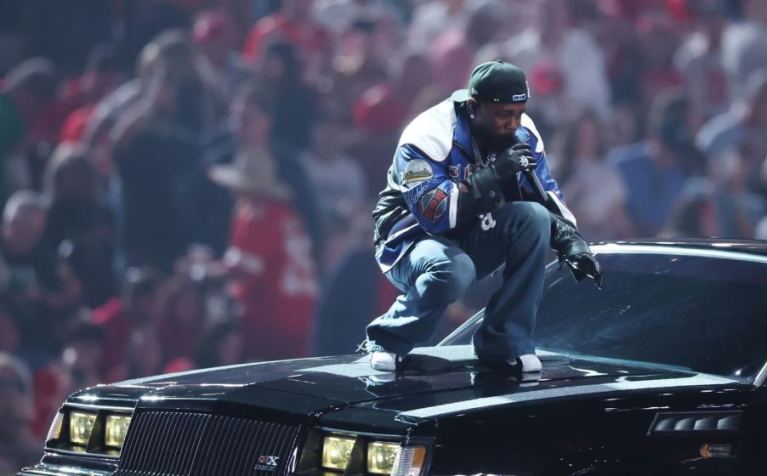
First thing I noticed that GNX shell on the stage.  That 1987 Buick was a monster for it’s time, under the hood a turbocharged 3.8 liter V-6, and one of the few GM cars I have desired.  It made me a bit sad when dozens of backup dancers emerged from the coupe and showed the classic wasn’t more than a hollowed out empty prop.  Nevertheless, it was a good choice of vehicle, showed someone had decent taste.

My overall impression?

The flag choreography was cool.

Samuel L. Jackson played a funny role.

But the lyrics were muffled—difficult for me to decipher as someone who doesn’t listen to the ‘new’ stuff—and nothing really stood out besides the those things I have already mentioned.

I’ve learned later that there was a ‘diss track’ mixed in.  Apparently this Lamar fellow has some issue with a Canadian rapper (yeah, I also think that those two words “Canadian” and “rapper” are hilarious together) named Drake.  Which is what you call a male duck and may fit given ducks are promiscuous and aggressive.  Who knows?  But what I do know is that Mr. Canadian Duck dated one of the Williams sisters—Serena (or the more feminine one), and apparently things did not go too well?

Wherever the case, we have two grown men in a petty feud, both of them nearly in their forties, both multi-millionaires, sort of juvenile.  Then again, we also had a guy named Donald Trump in the audience—and know the beef between him and a Canadian named Justin Trudeau.  So, of all people, a MAGA voter should appreciate the art form.  There’s also a reason why Big Don was so loved by rap artists prior to them finding out that he was running for office as a Republican.  His ‘mean Tweets’ are basically a battle rap.  I still say it was a huge mistake of the Democrats to label Trump a “convicted felon” and give him some real street cred.

An aside here: Rednecks are basically the country version of Ghetto.  The two really should ‘get’ each other.  I mean, these are the two groups that were, by far, the biggest reactionaries against the mask mandates.  The rural resistance going to social media to announce to us, “I can smell ma farts through dem dar masks, y’all look dumb,” whereas the other busting a cap in the ass of any who dared (as part of their gainful employment) to “disrespect” them by asking to wear a mask or leave the store.  So there is some real common ground.  Unfortunately both are too bleary-eyed with alcoholism or general substance abuse to realize that they are being played against each other.

So, back on the halftime show, I thought it was a great trolling moment when Samuel L. Jackson, the parody Uncle Sam, exclaims “Too loud, too reckless, too ghetto!”  Which is a dig at the very people who went online, the very moment the performance started, to voice their displeasure.  It basically the same thing that the political establishment pearl-clutchers hate Elon Musk, and his new boss, Donald Trump, for doing.  Yet, in this case, NPR will do a breathless review, to showcase this wonderful artistic expression, and the right-wing WWE crowd will bray in unison about how unsophisticated it is.  Strange.

All that said, while there was a little bit of self-awareness in the act, it was not edgy or even fresh.  Oh no, here’s another artist who is worth $150 million and somehow at odds with the world!  Boo!  Put Ye up on stage, at least then we would get a couple unscripted moments and a genuine controversy rather than a refresh of the same tired old tropes. Tell me again how the police harassed you for the crimes confessed in lyrics and how it makes you special. *yawn*

Hip-hop is mainstream.  The self-declared king of the rap genre (who vastly undersells his rival) represents youthful rebellion only as much as those old prunes—called the Rolling Stones—did in their prancing on the stage a few years back.  The presentation, overall?  Just plain campy and unoriginal.  Like the angry girl with pink hair or that disaffected guy who puts a Confederate flag on his wall.  It is not counterculture, there was nothing really clever.  To me it was about as exciting as the latest Britney Spears dance video and cry for help/attention.  A demonstration of poor taste or trying too hard.  Maybe that’s why I stopped listening to rap music?  Just too much repetition of same old themes and not enough true revolution?

I mean, politics right now have more value as far as entertainment goes.  Trump got shot, on stage, and his bars make actual world leaders squirm in their seats.  Why settle for make-believe ghetto turf battles when you can gun for Greenland or claim a gulf for ‘merica?

I didn’t hate the halftime show.  I just simply did not care.  I spent the time watching with one eye and writing checks for my property tax bill.  My thirteen year old son didn’t look up from his phone the entire time.  Boring is what I saw.  Other than that GNX and a flag formed from the dancers.  Discussion of it is much ado about nothing.  Those days of N.W.A. causing riots or Wu-Tang Clan being controversial are over.  Unless you’re looking for the exit at a Diddy party, the menace that made rap rebellious is gone.  This rerun is as dated as the car on the stage.  The professional critics just can’t say that because they’re too busy trying to be relevant themselves.

And maybe that’s just the nature of things—the revolution eventually becomes the old news?  The wild Anabaptists who burned a path through the cultural landscape of Europe became today’s Amish.  Other than those three cages hung from St Lambert’s Church in the city of Münster, the place where the most extreme of these rebels were put on display, as an example, there is nothing to show of them in the old world.  Likewise, having a Slayer patch on your old blue jeans don’t mean that you’re going to murder your family—it simply means that you’re over forty and clinging to the past when you were too cool for school.

As for the halftime show whiners, complaining when the NFL—what do you really want?

Taylor Swift?

Dead Men Talking—Why MLK Was Made Into A National Hero?

Standard

When I was in elementary school we sang a song with lyrics, “Martin Luther King, Martin Luther King, was a great man.” Looking back it was even strange then.  Why were we, in a rural Pennsylvania public school, instructed to heap such adoring praise on this man?  It was a weird indoctrination.

One explanation is that this was atonement ritual.  Dr. King was murdered.  Thus maybe the weight of guilt on the generation of the Civil Rights Era was just that high that this was a way they try to correct the injustice.  And it is sufficient to explain why the rank-and-file liberals, such as Mrs. Lawrence, my elementary music teacher, would promote his legacy or turn him into a legend.

But was it all well-intentioned?

I don’t have a black and white view of MLK Jr.  I think he was a complex character, he advocated for peaceful protest and yet was also a sexual deviant despite his status as a Baptist Reverend.  He’s probably as worthy of honor as any other figure in the American pantheon.  However, the big question is why is he there?  Why was there a holiday put on the calendar to celebrate this man?

The answer to how is that there was a bipartisan effort, after a significant campaign, to put him there.  Everyone, except a few racist hold out Democrats, supported this move.  Jimmy Carter endorsed it, and Ronald Reagan signed it into law, lauding King as being “a drum major for justice” in a Presidential proclamation.  So it is a reminder to carry on the mission of the man who preached a brotherhood that goes beyond race and reconciliation.

As a child of the 1990s, I was indoctrinated into an ideal of a colorblindness—a society that made the dream of Dr MLK Jr a reality:

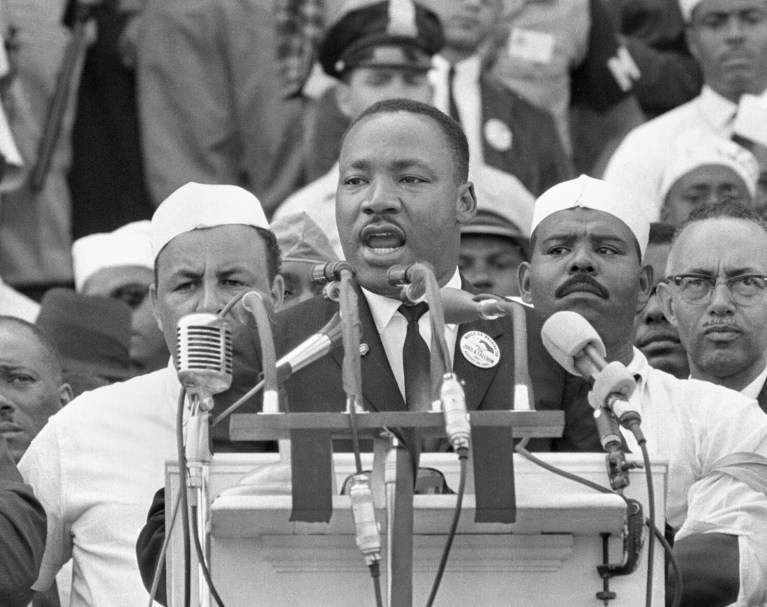
“I have a dream that my four little children will one day live in a nation where they will not be judged by the color of their skin but by the content of their character.”

It had worked.  Racial tensions had dropped off and it had really felt then like a new post-racial epoch had begun.

Unfortunately, since then the progress has been backwards.  Or at least as far as sentiment.  Many are convinced that race relations are worse than before.  And that what MLK had preached is impossible, that we must see color, and many advocate that we discriminate in favor of racial minorities—or against them.  Both the far-right and far-left agree with racism.  They both refuse the multi-variant analysis, one which considers factors like fatherless homes apart from race, and have decided that race determines all.

The left claims that the content of character speech is misused and that we must force equal outcomes or we are disingenuous—while the right uses disparity in outcomes as the proof of inferiority at a genetic level.  It is truly amazing how the same data can be read so differently.  However, I disagree with both sides and put far more weight on culture and messaging than they do.  Telling people they need our help in order to reach their full potential is disempowering and the worst kind of political opportunism.

Which does make me wonder if this is the real reason why we celebrate MLK?  Would we ever turn him into an immortal figure if he were alive to speak for himself?

No, I don’t believe so.  I believe that MLK Jr. became much more useful to the political establishment in his death.  No matter what side you’re on, Republican or Democrat, you can make use of his words.  And the reason they recognize him is to use his legacy as a tool for their own ends.  This is the beauty of all those made maytrs for a cause, they always get turned into whatever the current owners of their image want them to be.  I would contend the holiday is intended as a way to co-opt his legacy—both as a way to pacify and to bend it to their own agenda.

MLK was silenced.  His legacy of words and of speeches are now open to interpretation.  He’s a national hero only because he’s dead and cannot oppose those employing his name on all sides of the debate.  Those who made his birthday into a holiday were likely doing it as a virtue signal, a way to prove (to those who cared in the voting public) how they are better than his killers. 

These same people would likely have destroyed him—for his sins—if he were alive and opposed them.  Only dead heroes are useful in politics.

‘Masculine’ Orthodox Growth

Standard

I awoke this morning to a message from Fr. Siewers. He shared a NY Post article, “Young men leaving traditional churches for ‘masculine’ Orthodox Christianity in droves,” which I read with my coffee. This is a trend within Orthodoxy, and arguably I’m part of it, where (relatively) young men are leaving the consumerist ‘Big Box’ and the compromised traditional churches for a weird alternative that feels foreign to most Americans.

I know, in past blogs, about Orthodox growth, I’ve done a sort of victory lap about Orthodoxy and in doing so left out valid counterpoints. Yes, indeed, many young men are finding Orthodoxy. But it may not be as big a trend as articles like this NY Post story or the Orthodox faithful make it out to be. The growth from fundamentalist reactionaries is limited—and most especially if it is only drawing in males. It is difficult to sustain this if no accompanying young women are willing to procreate with these transplanted men.

The truth is that Orthodox, in the United States of America, only number around 6-7 million. Who knows how many show up on Sunday?  For sake of reference, that is less than the estimates for illegal immigrants who currently live in this country, around 11.7 million, and basically makes the Orthodox contingent a demographic drop in the bucket. Yes, growth is good, but is this sustainable? Or is it just a blip driven by those desperate to do something a little different from everyone else and destined to fade like Hipster fashion after a decade?

My own conversion to Orthodoxy was not the same as the template laid out in the NY Post article. I wasn’t running from a church with a ‘woke’ or social justice agenda that replaced the Gospel. Yes, maybe I was a bit disgruntled with a feminized church culture where marriage and family were sacrificed for impossible ideals and visible missions. But it wasn’t in reaction to liberalization. I had done it from a conservative Mennonite church and was attracted to Orthodoxy as it was different from fundamentalism.

Ironically, this new flow of reactionary men to Orthodoxy may come at the expense of the very attitude of the church that had initially drawn me. While adopting the Orthodox worship ritual, some bring their Protestant or Catholic baggage with them, there are too many Ortho-bros or those simply trying to be edgelords and unique. It is part of the Alt-right vibe, those who have on one hand rejected the far-left’s absurdity and yet are still looking for a reaction more than they are serious about their faith.

There will always be that small percentage of people who will buy a Tesla Cybertruck to be strange. Those who do things to piss off everyone else with normal tastes. And the growth of Orthodoxy is as much a rejection of the political mainstream as it is about seeking God. It feels more like cosplay, in my experience, than it is something born of a repentant spirit and desire to truly submit to the authority of Christ vested in the church. It is a bunch of dressed-up Protestants.

Case and point? The parish I left has an old Baptist convert as a priest who offended a couple (very fragile extremely idealistic homeschoolers) and the mom of this union made it her personal mission to pull as many people away as possible through lies and attacks. That’s where much of the new growth in the ROCOR parish down the road has come from and why I’ve been inclined to stay home on Sunday to be away from all of it. Not all growth is good growth.

As a postscript, my wife and I do not share the same perspective as far as worship and what church is ideal. She got along with the folks at Holy Cross. But didn’t get much out of the preaching (which was fundamentalist in flavor more than Orthodox) and practice. We sometimes attend a generic Protestant consumerist church, with a rock band and a coffee shop, because it is what reminds her most of her own generic Evangelicalism in the Philippines. My son and new daughter remain unbaptized.

What Is the True Cost of EV?

Standard

The battery electric vehicle (EV) versus the internal combustion engine (ICE) powered debate is one of the most irrational of our time. On both sides of the discussion, you have those frothing-at-the-mouth types who attack the moment you disagree. And this is exactly the response that I got after I had casually mentioned that ICE is 1/3 the cost under a click-bait post…

Model Y starts at $43,990 FYI.

One just called me ignorant, but others tried to make an argument, including this response:

I’m trying to figure out what car cost 1/3 of the price of a Tesla🤔🤔? The long range Model 3 (the one you want for a roadtrip) is $42,500 – $7500 tax credit is $35,000. This is not factoring in gas savings. Please tell me what new car is availability for under $12,000 (that’s the 1/3 cost of a Tesla you mentioned)?

Fair enough question.

Note, I never said new, but assuming that I did…

Believe it or not, and even in this inflationary age, there are still reliable sedans that come in under $20,000. Starting with a Mitsubishi Mirage G4 ($18,500), the Kia Rio ($17,875), and the Nissan Versa ($17,075), the lowest-priced option is half of even the subsidized price of the Tesla base model.

But you can’t exclude the subsidy from the cost of the EV, the government doesn’t have a magic wand to create value and we all end up paying for their expenditures in our taxes or by inflation due to money printing. And it only begins with that “tax credit” (so-called) given directly to privileged people who can afford a new luxury car.

What is the true cost of subsidies?

According to a study by the Texas Public Policy Foundation, the cost to us is nearly $50,000 for every EV produced:

Federal and state subsidies and regulatory credits for EVs totaled nearly $22 billion in 2021, or nearly $50,000 per EV, socializing the true cost of these vehicles to taxpayers, utility ratepayers, and owners of gasoline vehicles

Tens of billions of dollars have been spent trying to make EVs viable, and yet still the average cost of these vehicles is $65,000, compared to $48,000 for ICE. Why haven’t these subsidies leveled the playing field? It is simply the fact that batteries require tons of extra material and a much more complex process to produce.

So we can at least double that visible “tax credit” subsidy and already the true cost of an EV is close to three times a comparable ICE sedan.

We could stop there—the 1/3 number reached—but let’s continue…

What is the true cost of production?

The cost of a vehicle isn’t just the window sticker price or the money that it takes to manufacture. The bigger question—given the reason many say we should switch to EVs is about emissions—is what the increased environmental impact is of producing the batteries that go into these cars. Is this a trade-off we are willing to make?

Lithium batteries are costly, they require an enormous amount of water and also leave a toxic legacy that will grow exponentially as EV is adopted. Is it worth this cost to only marginally reduce carbon emissions?  That is to say, around 17-30% less emissions according to European Energy Agency? 

Sure, it could get better with a heavy investment in electrical generation and transmission—yet that is another huge cost financially and environmentally…

What is the cost of infrastructure demand?

This is where the conversation is the most interesting. We have the refining capacity and distribution network already built for ICE vehicles. Gasoline and diesel fuel have the advantage of being energy-dense and can be moved around using the existing highways. But what about EVs?

There is an illusion that comes with plugging something in. The load we put on the system is invisible. But there is no magic to it. Electricity is something that must be produced somewhere and then transmitted to the charging stations. If everyone adopted EV technology the grid would collapse.

We’re currently nowhere even near what it would take in capacity to convert everyone to EV. The easiest route to more electrical generation is to go anuclear. So how many new nuclear power plants would it take? Well, if we use miles driven and the number of cars on the road today, then we would need to build 250 additional nuclear power plants as big as the largest plant in the US, and the supporting infrastructure to keep up with this demand.

So are you willing to have a Palo Verde in your own backyard?

It cost 5.9 billion dollars to build one in 1988 (the equivalent of 13.9 billion in 2023) and we needed to start building 250 of them yesterday.  The solar and wind equivalent would be even more costly to build and maintain.

The costs would be astronomical and that’s just considering only passenger vehicles. Switching Class 8 trucks would take even more of these massive power plants and spending—the cost of switching would be insane.  Not to mention you would need more trucks to do the same work as you did with diesel.  And remember, every dime that we spend on this mass EV conversion could go to health care or education instead.

Can you now see how extremely costly EVs will become as they are adopted?

But it does not end there…

Why is the cost of wear items greater?

Batteries are heavy and weight is the enemy of “wear items” like brakes or tires—which is not to mention the additional damage to the highway infrastructure.

EV tires wear 20% faster than comparable ICE vehicles.  That is a cost out of your own pocket and also a concern for the environment. And do not forget, to be safe you’ll need those heavy-duty EV-specific tires. Sure, maybe this is not a very big problem for those who can already afford the premium cost of a new EV?  However, for that waitress struggling to make ends meet she will have to make the choice between safety and home utilities.

Next up is excess road wear.  Big trucks are obviously the leading cause of damage to roads. However, EV proliferation will start to cause problems for existing infrastructure:

A 6,000-pound vehicle causes more than five times as much road damage as a 4,000-pound sedan. A GMC Hummer EV, which weighs 9,063 pounds, will cause 116 times as much road damage as a Honda Civic, weighing 2,762 pounds.

The article cited above isn’t about EVs yet does apply given it is about the vehicle weight. Even the Model 3 is a whopping 3,862 to 4,054 lbs. Sure, one vehicle is not going to do a whole lot by itself, but the volume over time will significantly impact bridges and parking garages that were designed for lighter ICE vehicles. This EV vehicle weight bloat caused by batteries will require very costly upgrades to prevent catastrophic failures—like the Ann Street Building Collapse:

Speaking of disasters. With EV there is potential for a thermal runaway or reaction that can’t be stopped—like an ICE fire—by simply denying the source of oxygen. This hazard will result in more damage to road surfaces, more time spent in traffic jams after incidents, and additional toxic emissions. This is a cost to be seriously considered with all of the others.

Cost of time, capability, and resale value…

Many of the costs and drawbacks of EVs are hidden under a pile of subsidies or are moved upstream like the emissions—out of sight out of mind.

But what cannot be ignored is performance in terms of range. Time is by far our most valuable resource and nobody wants to spend hours in a place they don’t want to be because their vehicle battery is drained.

As far as capabilities, even EV trucks are useless for towing, both the Tesla Cybertruck and the Ford Lightning—both costing around $100,000 in the higher trim levels—aren’t so good at doing typical truck things. Sure, they produce a ton of low-end torque and are very fast. But the F-150 EV only went 90 miles pulling a camper and the Tesla only fared a little better.

7000lb luxury land yachts

And finally, we need to talk about plunging resale values. For a while EV was a novelty, the “way of the future” every suburban geek needed to virtue signal. But it appears that this is now starting to fade and reality is starting to take over again—46% of EV owners in the US plan to ditch EV to return back to ICE—and many will not recoup their cost because the floor is dropping out for used EVs:

A recent study from iSeeCars.com showed the average price of a 1- to 5-year-old used EV in the U.S. fell 31.8% over the past 12 months, equating to a value loss of $14,418. In comparison, the average price for a comparably aged internal combustion engine vehicle fell just 3.6%.

That’s bad news for the EV industry.  That is probably why Ford, after losing billions on their EV investments, has made plans to pivot back to hybrid.  Toyota, ever conservative, never made the mistake of getting sucked into the EV mania.  My wife’s C-Max (hybrid) has no range anxiety, saves fuel, and has a plug-in version that can go on battery for a length of a commute.  This is the right compromise.

ICE costs less to build, but the hybrid will likely emerge as the winner for being the best of both worlds. It has range like ICE, and torque like an EV, while also keeping its value and not requiring vast new expenditures to upgrade the electrical infrastructure. If costs are reflected in the market hybrid will come out victorious in the end.  Some can afford EVs today, but only because others are absorbing more than half of the real costs.

As a footnote, I’m not opposed to EVs nor do I think they are destined to go extinct. If resale values continue to drop I would even consider owning one. The whole point of this article is simply to give a bit of pushback against the Pollyannaish sentiments that would lead to an ill-advised mandate. There would be an enormous cost, and opportunity cost, that would come with this. Just the fact that EVs need massive subsidies to be sold should tell us enough. If it isn’t viable in the market it isn’t viable.

Truth Be Told—Who Really Cares About Waitresses?

Standard

Early on in this site, I spent significant time trying to explain the power of description and how bias works.   The underdogs are the ones who are assailed by less favorable language by those who have power in the group.  A good quality can be twisted into something bad or propagandists can cast the exact same actions in a very different light—which is what these two examples capture:

Only difficult when Vance suggests it?

When Trump proposed an end to taxes on tips the focus was on the ‘cost’ of allowing servers to keep more of what they earn.  But when Harris copied the idea, suddenly there is no concern for revenues lost and it is all about her “fight” for the little guy.  Likewise, when JD Vance offered a $5000 tax credit for children it was “difficult” and yet when the Harris campaign did the same it was all about newborn cuteness.  I mean, think of the children!

I suppose we should just be happy that the Democrats are finally coming around to the conservative idea of letting us keep more of our hard-earned wages.  It makes so much more sense than minimum wage hikes and giving everyone food stamps.  Of course, this means less power in the hands of the politicians, who love to run campaigns that scare their constituents about the potential loss of benefits.  

Trump had previously made the mistake of enacting an across-the-board income tax cut. This gave the media propagandists opportunity to claim it was a “tax cut for the rich” since those who pay more get a bigger cut proportional to the amount they paid.  That’s fair.  If you pay more how are you not entitled to more?  But everyone who paid in got a cut and the middle class a higher percentage, as outlined here:

According to IRS statistics of income data analyzed by Americans for Tax Reform, families earning between $50,000 and $100,000 saw their average tax liability drop by over 13% between 2017 and 2018. By comparison, those with income over $1 million saw a far smaller tax cut averaging just 5.8%.This pattern of middle-class tax reduction was also seen in key swing states.

For instance, taxpayers in Pennsylvania earning between $50,000 and $100,000 saw their tax liability drop by over 14%, while households with incomes over $1 million saw their tax liability drop by just 3.1%.Taxpayers in

Colorado earning between $50,000 and $100,000 saw their tax liability drop by over 13%, while households with income over $1 million saw their tax liability drop by just 4.5%.

Clearly everyone was getting a cut, and the middle-class got a higher percentage back than the rich, but the media coverage obsessed with the dollar amount people kept—rather than the percentage being cut—to distort the public perception.

The Trump-Vance ticket has learned and is now outmaneuvering the left.  Most people know that keeping more of their own money is efficient and much better than a new government program.  It is just that the Republicans didn’t sell it. 

But this time, with an idea to end taxes on tips and another to help all young families, the typical deceptive spin doesn’t work.

Harris had no choice but to try to outbid her opponent. 

The problem with this? 

Harris was the tiebreaking vote on a bill that sends IRS agents after waitresses.  Now, yes, the Democrats will claim that they need the 80,000 agents to go after ‘the rich’ since they know CNN, MSNBC, and NY Times would never run a story linking a poor minority woman being audited to DNC policies, yet it in this case is too hard to deny who the true beneficiaries are.

We should question the sincerity of those who only introduced their policies after the other side did.  At best, they’re like the kid who cheats on the test by copying off the smart student in their class.  At worst, they are simply saying whatever it takes to get elected and have no intention to do what are now proposing.  We can’t trust the ‘journalists’ to set the record straight or give unbiased presentation of facts.

Go listen to the interview and see if the headlines match with the reality.

The most frustrating kind of misinformation is factually based. 

They lie by structure or omission, by presenting the costs and not the benefits, and sadly it works because people aren’t able to read through it. 

They did this with Trump’s tariffs, stories zooming in on the few who were inconvenienced and ignoring the many long-term benefits.  But the criticism ended when Joe Biden took over the policy, suddenly it was silence—just necessary to push back against China and finally rebuild some of our deteriorated manufacturing strength.  Nothing changed about the actual policy or benefits, only the presentation.

Now the choice is yours, do you go with the side that originated these steps in the right direction or with those who lied about Joe Biden’s declining mental health, saying he was “sharp as a tack” until the debate made the truth undeniable and now would have us believe they’re telling the truth?

Add that Harris is trying to introduce disastrous price controls and could end up creating food shortages as happens when central planning replaces free markets. If you think inflation is bad, then wait until more food-production businesses start to close, like this fruit farm and market, due to the increased compliance costs and lack of profit. We can’t afford four more years of economic mismanagement.

Sight, Sources, Statistics and Science

Standard

Social media provocateurs love to push popular controversies to generate clicks on their sites and get those heated comments sections.  The question about the gender of two boxers in the female category of the competition was that perfect story.  It was not straight up or settled, but generated a lot of strong opinions on both sides.

For myself, it is fairly evident that these two boxers do have a competitive advantage or they would not have won in their respective divisions.  I mean, that’s not even a matter of dispute.  An advantage is how anyone wins an athletic contest and it doesn’t mean they cheated.  However, when not only one but two people with the same extremely rare and potentially enhanced condition—both get the gold?  What are the odds?

Only one out of 500,000 people in the world go to the Olympics.  But, of course, nothing is ever that simple.  Those who live in small countries, like Algeria or Taiwan, have a far greater chance of representing their home countries simply because there are fewer people to fill the same spots.  And then not everyone in the world is competing to be in the Olympics.  Most of us don’t try out.  It is sort of like my being sixth while wrestling in the Eastern National AAUs—many superior to me simply didn’t make the trip.

But to go to Paris and beat everyone?  There is a reason why we give precious medals to those who do.  It is one thing to be that PhD who identified as a breakdancer and ended up scoring zero, it is quite another to get on the podium.  There were 124 boxers in the female category, divided into six different weight classes, and went through three qualification tournaments.  This is certainly not an easy road.  The champion is one out of every woman in the world who can make that weight and is into boxing.

There is speculation that those two boxers who had been disqualified from IBA fights due to failed gender tests—and masculine appearance—is they may have a disorder called Swyer syndrome.  This isn’t a fact, but it would explain why they would have been declared women at birth and always identified as women.  Those with this very rare condition have a male Y chromosome despite their female sexual hardware and offer no male advantage.  

However, it is also possible that the two have Androgen Insensitivity Syndrome, which impacts 2-5 out of 100,000 females, which means they would have characteristics of a female outwardly but also have male testes that are undescended.  Severe AIS wouldn’t confer an athletic advantage, according to the sources I’ve read, and yet that does not tell us anything about milder cases.  

Still, the conversation can’t end there, we have other possibilities:

Some press reports have mentioned 5alpha-reductase type 2 deficiency.  This rare syndrome is best reported in the Güevedoces in the Dominican Republic.  Affected XY individuals are apparently female at birth because they can’t activate sufficient testosterone to the much more potent dihydrotestosterone to masculine in utero and thus appear female (the default gender in the absence of masculinising hormones).  However, they have testes in what appear to be labia.  At puberty, the testes produce much more testosterone sufficient to activate receptors and masculinise the child.  Such subtleties are beyond the capacity of most regulatory bodies to accommodate.

The chances of two women with these rare chromosomal disorders somehow making it to the Olympics would be incredibly low.  For example, Swyer Syndrome is around 1 in 80,000 births.  So multiply those odds by the chances of getting to the Olympics and then take that times two.  The number is incredibly large.  There is a far greater chance of being struck by lightning.  If the XY chromosome is present in these two—along with higher testosterone levels—the fact they dominated the field, given what coaches have said, should be considered proof of a potential unfair advantage.

Sources Please Vs. What We See

Much of the smirking response of mid-wit “sources please” types—who simply went along with the ‘official’ International Olympic Committee (IOC) narrative—comes down to many of the slightly dimwitted “I see what I see” types misidentification of the issue as being about transgenderism.  When the real issue is whether or not these athletes have intersex characteristics and thus an unfair advantage in female competition.

Yes, the right is too reactionary.  However, not without cause, they know too well how the NCAA and corporate media denied that Lia Thomas had an unfair advantage as one born a man and still having a penis as well as the rest of a man’s hardware.  And they correctly see that these two Olympic boxing competitors have a masculine appearance.  They had incorrectly assumed that this was just another case of a man cheating his way to the top by pretending to be a woman.

However, that misunderstanding of some is being used as a strawman of the real issue, the real argument is source versus source.  Specifically, the fact that these two athletes were disqualified by the International Boxing Association (IBA) for having male XY chromosomes.  These laboratory tests took place in Turkey and India  So, despite the attempts, by bigots, to smear the IBA as being corrupt for ties to Russia.  But the reality is that no organization is totally without political ties and there’s a reason why the IOC has never banned the US for our military aggression around the world.

So it really comes down to who we want to believe.  The IOC rests its entire claim of gender, on legal documents, passports, and birth certificates, provided by the country of origin, and says this gender assignment makes the boxers women.  By contrast, the IBA cites biological science and test results and tells us these two ‘women’ have XY chromosomes.  Right off the bat, the criteria of the IBA are science and laboratories whereas the IOC is relying on political entities.  Should we follow the science or believe those appealing to non-scientific evidence?

At this point, the mid-wits completely lose the plot and rely on their confirmation bias rather than logical deduction.  They’ll simply refuse to acknowledge the obvious, that the official IOC criteria to determine eligibility is entirely inadequate for solving this riddle; that the IBA at least has what appears to be scientific evidence, and thus this is a question to be answered in the lab rather than the court of public opinion—so they double down on their insults trying to deflect from the real issue.

But, in the end, this isn’t about science, what we see, statistics, or sources.  No, it is about partisan politics that blind many somewhat intelligent adults to what even a child could see.  It exposes those “sources please” mid-wits as just another level of ignorance.  And social conservatives could help themselves a whole lot by not jumping the gun and not oversimplifying complex issues.  Both sides are guilty of false dichotomies and believing misinformation.  Lastly, those who are suggesting that I-man Khelif is representative of Algerian femininity are guilty of the bigotry of low expectations.