Trump: The Man and the Myth

Standard

A fellow Christian (and conservative) friend asked me to list the problems I had with Donald Trump as a Republican candidate. The hard part is knowing where to start.

Trump claims to be conservative. He is definitely saying things that resonate with those who are concerned about jobs, border security and immigration. But, I believe proven character and integrity is far more important than what a person claims about themselves.

Trump supporters are convinced he is genuine simply because he says things they want to hear. Yet seem to forget that the art of demagoguery is to say what plays well with a particular crowd. Trump is shrewd enough to make a sale, but is he honest?

Myth #1—Trump ‘says it how it is’ and is honest.

Trump’s claim to fame is not personal integrity or conservatism. He is known for salesmanship and a bestselling book, “The Art of a Deal,” where he talks about creating a big impression. In other words, try to create an appearance of success and dazzle.

image

Trump parroting popular prejudice doesn’t make a him honest anymore than me moonwalking makes me Michael Jackson. There’s a strong possibility he may just be saying what some want to hear in order to make the sale. Those saying that Trump ‘says it how it is’ might want to consider who they are dealing with.

Trump, like the used car salesman who sold you that clunker, is trying to make a deal with you.

image

Sure, he might not be saying what ‘they’ want to hear, just as a used car salesman might also act like he’s at odds with the management because the deal he is making with you is going to cost ‘them’ too much. But that doesn’t mean you take the salesman at their word on it!

From a Christian perspective, there is even more need to be discerning and skeptical of claims that sound good to us:

“For the time will come when people will not put up with sound doctrine. Instead, to suit their own desires, they will gather around them a great number of teachers to say what their itching ears want to hear. They will turn their ears away from the truth and turn aside to myths.” (2 Timothy 4:3-5)

Trump has claimed a mythological net worth of near nine billion dollars, but Trump’s actual net worth is half of what he claims according to Forbes. So is Trump clueless about his own business holdings? Or does he know that the attention span of the average person is short and that he can dazzle people with a huge number that they’ll never check?

Even Trump’s business prowess seems as grossly exaggerated. Yes, he’s extremely wealthy, but he also had a huge head start and his daddy’s fortune to build from. It is said that the first million is the hardest and there’s some truth to that. You are far ahead when you can reinvest rather than spend your income on necessities. Trump had that advantage.

The real way to measure Trump is to put his accomplishments in perspective of his own peers:

image

Reality check: Trump’s success really is not as impressive when put in proper context. Trump is trying to make a sale, he is out to make a big impression with his target audience and willing to deceive.

Myth #2—Trump is rich and therefore he cannot be bought.

John D. Rockefeller, the world’s wealthiest man, was once asked: “How much money is enough money?”. His reply: “Just a little bit more.”

Rockefeller’s answer should be the end of this myth that the rich man cannot be bought or bribed. G.K. Chesterton took it a step further and said:

“You will hear everlastingly that the rich man cannot be bribed. The fact is, of course, that the rich man is bribed; he has been bribed already. That is why he is a rich man.”

I could understand how a secular person could be fooled into believing that wealth is a virtue. But a Christian has absolutely no excuse, Jesus makes mention of the “deceitfulness of riches” (Mark 4:19) and may well have been paraphrasing the book of Habakkuk:

“Wealth is deceitful. Greedy people are proud and restless—like death itself they are never satisfied.”

Could it be that Trump is rich because he has already been bought?

The wealth of a man does not prove anything positive about his character or integrity. There are good wealthy people, but there are also many wealthy people who would steal from their own grandmother and wouldn’t think twice about scamming you.

Is every wealthy person a crook? No, certainly not! I disagree with those who automatically equate wealth and greed. However, in many cases great wealth can be a sign of moral bankruptcy.

One of Trump’s holdings could say a bit about his philosophy in business and in life. That is that he’s in the Casino business. Sure, this is a perfectly legal enterprise, gambling is an activity many people enjoy, but it is also a game stacked against the participant, the house always wins, and the people who can least afford it are often the losers.

Reality check: Trump’s wealth may be legally acquired, but that doesn’t mean it was acquired through morally upright and non-exploitative means.

Myth #3—Trump is a political outsider and not an ‘establishment’ candidate.

During the debate Trump was asked:

“You’ve also supported a host of other liberal policies, you’ve also donated to several Democratic candidates, Hillary Clinton included, Nancy Pelosi. You explained away those donations saying you did that to get business related favors. And you said recently, quote, “when you give, they do whatever the hell you want them to do.”

Trump answered:

“You better believe it… I will tell you that our system is broken. I gave to many people. Before this, before two months ago, I was a businessman. I give to everybody. When they call, I give. And you know what? When I need something from them, two years later, three years later, I call them. They are there for me. And that’s a broken system.”

Now some may say such a brazen admission is a ‘breath of fresh air’ and refreshing honesty. I suppose a serial killer bragging about how he outwitted investigators could also be considered the same. But I’m not sure a shameless corruption is an improvement over the run of the mill variety.

If Trump were a poor person gaming the welfare system to his own advantage and bragging about it, would we applaud his shameless corruption or condemn it?

If Trump were a politician, would an ‘everyone else is doing it’ rationale and a witty response about the Clinton’s attending his wedding absolve him of guilt for being complicit in corruption?

Then there’s the matter of Trump’s attempts to use eminent domain for personal gain. As a National Review editorial puts it:

“Donald Trump’s covetous nature is not in dispute, but what many may forget is that he’s no great respecter of the admonition not to steal, either: The man has a track record of using the government as a hired thug to take other people’s property.”

Trump tried to use government power to force a widow from her property and was struck down in court. That is the modern day equivalent of king Ahab seizing Naboth’s vineyard (1 Kings 21) and is the kind of crony capitalism that is the problem.

There are two sides of the political establishment. One side is the politicians and the other side is men like Trump who work tirelessly to corrupt politicians. Men with money, like Trump, who exploit the system for personal gain, are just as much the problem as crooked politicians who take their money.

image

Trump is as much a part of the political establishment as a Bush or a Clinton. He is not an ‘outsider’ by any stretch of the imagination. So, it is time to see past the sales pitch, do not be dazzled by a man who has never proven himself loyal to anything besides his own self-interest.

Reality check: Trump shows no sign of having embraced Christian ethics. Trump’s confessions of his own corruption come without any sign of remorse and repentance.

Myth #4—Trump will govern differently than he does business.

If we have not learned by now maybe we will never learn. But every manipulator on the planet claims that they will change if only you give them what they want.

Trump shows no sign of remorse or repentance for exploiting the system for personal gain, yet we are supposed to believe he would never abuse government power for personal gain if he secures the White House?

If you believe that, I have a bridge I am selling…

Love: Feeling or Choice?

Standard

This blog is about ideas and the idea that ideas matter.  I believe the ideas people have can dramatically influence the direction of their lives.  Our choices, based in our ideas, could actually help shape reality in a ways not previously understood.

The view that seems popular today makes people simply products of the universe.  We emphasize the role of genetics and the influence of environmental factors in shaping what a person is, which is an idea that is certainly not without merit.  We bear a close resemblance to our parents for a reason and had no choice in determining that.  There’s also a good explanation of why I am writing this in English rather than Chinese. 

Obviously we have a given nature and are influenced by the nurture we received, which could lead to a ‘it is what it is’ fatalistic view that we have no choice or free will and ability to determine the future.  But could there be more than that?  Is it possible that the universe is only an influence and not a dictator of our consciousness?  Could it be that our own consciousness acts as a co-creator of the future universe?

Advances in physics have opened a whole new realm of possibilities.  The wave-particle duality of quantum mechanics is a paradox that suggests there is a bigger picture of the universe and one that could put our own consciousness in a far more important role than previously understood.  If our observation actually shapes reality at a quantum level (collapsing the wave function) then the future may not actually be determined outside of our own mind and will as is a common assumption.

If the future is not a destiny and is in fact something we co-create, then that could change many things including our ideas on love, which leads to the question…

Is love an existent feeling or a willful choice?

Both religious and secular people have seemed to have embraced a fatalistic view of love.  We could be scientific and point to natural explanations like pheromones, cultural expectations, chance opportunity, etc.  It is basically to conclude that love is something pressed out of a myriad of factors that all combine at the right time—which is a view that makes love seem sort of like sausage.  The religious, on the other hand, may turn to a meant-to-be (or God-did-it) rational to explain love and downplay choice.

Our culture, religious or otherwise, tends to emphasize the feelings of attraction above all else.  Love is something we are told we should ‘fall’ into and that there is a ‘right’ person out there for everyone. The idea is that attraction produces a feeling that produces a choice that produces commitment and ends with happily ever after. 

Unfortunately, I believe this is a view of love that has produced a great deal of disappointment and disillusionment in our day. It doesn’t work for many people. For some the problem is that they never find someone who produces that feeling of attraction enough to make them commit and they remain single or go from one relationship to the next in search of it.  The problem for others is that they marry based in superficial feelings, eventually those feelings fade away and they want out of the commitment. 

In both cases (above) the idea of love centers around feelings of attraction and presents love as a product of circumstances outside of our own control.

But what if there is an alternative view? What if we flip the order of things and put commitment first? Or, rather than love being a fate produced by an initial attraction that eventually ends in commitment and happily ever after, could love be a commitment to love that lead to a continual choice that produces a deepening relationship that produces a feeling of love and marital bliss? 

It is my view that love is less of an ‘it is what it is’ fate and more an ‘it is what we make it’ choice.  I believe the idea of love as a choice would produce healthier more sustainable relationships than the current popular view.  We believe we would see a reversal in trends towards non-commitment if we stopped waiting for the ‘right’ feeling to come and started to be more actively loving to others even when the feelings do not exist.

What is the (proper) Christian view of love?

In the American church there is a heavy emphasis on experience and emotion in worship.  We want music, we want excitement and entertainment, because the more feeling we have in the moment the more we love God, right? 

Wrong.

Christian faith is not supposed to be primarily about feelings or ‘spiritual’ experience.  Christian faith should be about obedience to the Spirit of love and that is the true evidence of faith according to Jesus:

“A new command I give you: Love one another.  As I have loved you, so you must love one another.  By this everyone will know that you are my disciples, if you love one another.”  (John 13:34-35)

Many Christians have confused positive emotions for spiritual depth.  A person who proclaims the loudest how great God is and puts on the biggest public display of praise is not necessarily the one who loves God the most.  The Gospel presents a different view of love that doesn’t resonate as well with our feelings based culture.  Jesus says, “if you love me, keep my commandments,” (John 14:15) and equates love with obedience.  

To obey Jesus means to love others as we wish to be loved (Luke 6:31) and to love perfectly like God does:

“You have heard that it was said, ‘Love your neighbor and hate your enemy.’  But I tell you, love your enemies and pray for those who persecute you, that you may be children of your Father in heaven.  He causes his sun to rise on the evil and the good, and sends rain on the righteous and the unrighteous.  If you love those who love you, what reward will you get?  Are not even the tax collectors doing that?  And if you greet only your own people, what are you doing more than others?  Do not even pagans do that?  Be perfect, therefore, as your heavenly Father is perfect.”  (Matthew 5:43-48)

If Christian love were a feeling and emotion how would it be possible to love our enemies?  Enemies are, by common definition, the people we do not love because they have in some way offended us or they are out to destroy us.  But, perfect love is not a feeling.  Perfect love is a choice to obey and love in action even when the feelings aren’t there.  Perfect love is a choice rather than a feeling, perfect love is the kind that sacrifices our own selfish ambitions for the good of others, and without that kind of love we are not actually true disciples of Jesus:

“Dear friends, let us love one another, for love comes from God. Everyone who loves has been born of God and knows God.  Whoever does not love does not know God, because God is love.  This is how God showed his love among us: He sent his one and only Son into the world that we might live through him.  This is love: not that we loved God, but that he loved us and sent his Son as an atoning sacrifice for our sins.  Dear friends, since God so loved us, we also ought to love one another.  No one has ever seen God; but if we love one another, God lives in us and his love is made complete in us. 

This is how we know that we live in him and he in us: He has given us of his Spirit.  And we have seen and testify that the Father has sent his Son to be the Savior of the world.  If anyone acknowledges that Jesus is the Son of God, God lives in them and they in God.  And so we know and rely on the love God has for us.  God is love. Whoever lives in love lives in God, and God in them.  This is how love is made complete among us so that we will have confidence on the day of judgment: In this world we are like Jesus.  There is no fear in love. But perfect love drives out fear, because fear has to do with punishment. The one who fears is not made perfect in love.

We love because he first loved us.  Whoever claims to love God yet hates a brother or sister is a liar. For whoever does not love their brother and sister, whom they have seen, cannot love God, whom they have not seen.  And he has given us this command: Anyone who loves God must also love their brother and sister.”  (1 John 4:7-21)

Christian love is preemptive.  Christian love follows the example of Jesus who loved us BEFORE we loved him.  True love is not based in initial attraction nor does it wait in fear of not being reciprocated.  True love steps out in faith.  Perfect love is not a pursuit of an immediate feeling or instant gratification. 

Love is a choice to invest in the good of another person even when we do not feel like they are worth our investment.  Love means a choice to obey and the choice to obey is a choice to follow the example of Jesus.

So, if love is a choice, then feelings do not matter?

No, not exactly.  I do believe feelings do matter.  But, a love based primarily in initial superficial attraction is a shallow love and deep love is only possible with deep (and self-sacrificial) commitment.  Deeper love is a continual choice to love more than a fleeting feeling of love.  For that reason we should be emphasizing the choice to love over the feeling of love and not the other way around.

This is not to say that those who started with a feeling of superficial attraction never develop depth of relationship—some do and some do not.  But I will say that love that is a choice and a commitment in faith is starting at a deeper level.  The better love is not a feeling.  The better love is a choice to put aside fear (or hate) and invest in the betterment of another person.  It is a love that is based in faith rather than feeling.

If love is a matter of will rather than a determined or predestined fate, then when a person says that they cannot love a person what they are really saying is that they unwilling to love that person.  The feelings can never develop in a person who is not willing to step out in faith.  Therefore, if you want to find love, be willing to bring love into the world and give it away in faith.

Love first.  Plant seeds of love in the world.  Do not wait on feelings to arrive before investing in the good of others.  Do not expect the Spirit of God to come to you (or the world) unless you live in obedience to the command to follow Jesus and love self-sacrificially by his example.  Love before you expect love to arrive.  Yes, this is absolutely a paradox, a causality dilemma, but that is the nature of our reality in a quantum universe.

Do not be resigned to an idea that we are haplessly tossed about without a will of our own.  Instead, consider the last lines of Invictus, “I am the master of my fate: I am the captain of my soul.”  Choose to love supernaturally.  Be a co-creator of a higher and deeper love rather than a mere consumer of the feelings produced by base human nature.

For Sale: 2001 Jaguar XJR and a duty to impress…

Standard

Little brothers must be impressed.  It is a rule of being a big brother.

Several years ago my brother Brent, still in school, had a fixation with jaguars.  He was both a fan of the NFL franchise of that name and also the automobiles of that same denomination.

Brent had mentioned a Jaguar for sale and wanted me to check it out.  But I really had no need of another vehicle, I had two already and felt that was plenty.  However, one day I was in town with some spare time and then spotted this beautiful machine at a used car lot.

“Hmm, that must be the Jaguar Brent has been talking about…”

I decided to inquire about it.  The salesman ended up tossing me the keys just in time for me to pick up my little brother at the school bus platform.  The look on his face was priceless and enough to convince me to do my big brotherly duty to impress him. 

I purchased that Jaguar XJR a few weeks later.  The “Grace, Pace, Space” slogan of the brand fit this car.  Classic lines, the power of a muscle car and luxury combined perfectly.  It is a supercharged 370hp beast that beat out the Beemers, Benzes and Porsches of It’s day—it is still faster than most.

It has served me well.  It has been the source of many grins.  It possess every bit of the charm and sophistication of Daniel Craig playing James Bond.  It is an impressive machine.  I have not regretted my decision to do my big brotherly duty.

Seasons have come and gone.  I have decided it is time to part with the XJR in order to free up garage space.  It is in excellent condition and I will probably regret selling it. 

But Brent is now married and away, so maybe it is time?

image

image

image

A Shameless Arrival — Mission Accomplished!

Standard

I arrived at Lock Haven’s Piper William T. Piper Memorial Airport at precisely 9:59 a.m.  The plan was to meet at 10:00 and fly to the Ponderosa cabin north of the airport.

I parked my little Ford next to a handsome Porsche.  I stepped out of the car, a twelve year old again, and full of anticipation as I took in my surroundings.  I scanned the tarmac through the security fence for the Cessna 150 or my brother.  I could not identify machine or man, so I headed to the office adjacent to the parking lot.

Inside I struck up a conversation with the natives.  They had not seen my brother, but they did share my enthusiasm for flying and soon I found out the man I was speaking to was an instructor.  I got the full sales pitch for flight lessons from an instructor.  I probably could’ve been signed up on the spot.

“Lock Haven traffic, Cessna 11479 is 4 to the north, inbound for landing 27 right. Full stop landing. Lock Haven.”

The words over the radio sounded.  “That’s your brother?”  I quickly opened the email that told me what Cessna I was to expect and indeed, it was!  I quickly stepped outside looking and listening for that distinct buzz of a boxer-type engine. 

It took a minute or two until I spotted the small aircraft on approach.  He came in over the trees and levee as I cringed as if trying to help him fly, but he nailed the landing with a chirp of the tires and was soon taxing towards me. 

image

I suppose I am allowed some brotherly pride, right?   

The Cessna 150L was remarkably small inside, only two seats, and was a bit hot without air movement, but was comfortable enough.  I put my headset on as Kyle switched on the intercom and yelled “clear prop” as a precaution before turning the engine over…

image

Life!  The four cylinders sputtered to a relatively smooth idle…  

image

We continued through the pre-flight rituals designed to identify those things that could end a sunny day with a violent death and before long we were looking down the length of the runway with the intent to defy gravity. 

The engine revved, the brakes released and we were rolling.  The little Cessna still had what it took!

Soon the ground slipped away and the town of Lock Haven turned into the world’s most wonderfully detailed model train set.  We gained altitude, then turned north towards the sea of trees and swells of mountains north of the town below.  We flew over a baseball game between people who looked like flees.  We passed a gas drilling rig in the wilderness…

image

It didn’t take long before we spotted the small airstrip cut out of the trees.

We were later than the initial plan.  But as we swooped in for a high speed pass we could see the crowd of spectators gathered.  Our siblings, cousins, aunts, uncles, parents and grandparents wanted to witness this historical event and also to prevent anyone from crossing the driveway that bisected the small strip while we were on approach. 

image

We circled around for a practice run and were too high.  Kyle corrected for the final approach.  The runway sloped upward at a slightly awkward angle and I made sure my brother was aware of that tall tree nearly blocking the trajectory we were on. 

Kyle wagged the wings ever so slightly to avoid the obstruction as we dropped through the trees and set down on terra firma again.  We survived!  No violent death or unexpected drama either…

image

(Click here for a video of our departure and other pictures.)

Sunny with a chance of violent death…

Standard

It has been a serious few weeks for me.  I had been cruising along until then ran smack into a brick wall of reality and have been sorting the damage for what I can salvage since.

But, still, amid disappointments and deliberations, I have found enjoyment in various things, from meeting new and interesting people to learning more about quantum mechanics.  I have things to look forward to in the coming months, one right around the corner and that the chance to fly with my little brother.

My little brother actually isn’t too little.  He outgrew me to about 6′-2″ and is a (mostly) responsible adult.  He also followed through on a childhood dream a few years ago by earning a pilot’s license.  However, sad as it is considering he was my first ever wingman, I have not yet taken the opportunity to fly with him.

Well, weather cooperating, I will get my chance to fly with him and I thought those of you with a morbid sense of humor may enjoy are little email exchange.  The plan is for me to join him in flying into a family cabin or rather landing on a small airstrip cut in the woods beside the cabin. 

Here is my request:

I have a proposal that could maximize your use of a small aircraft and increase my risk of dying a terrible death at the hands of my own brother.  My idea is that I meet you in Lock Haven, fly with you to the Moyer cabin and then fly back with you later.  I don’t know how that fits in with your plans, but I put it out there as a proposal and under the condition that you agree to ditch only into trees or rocks rather than water.  Crashing would be terrifying enough without the prospect of drowning with a broken femur while trapped in the crushed confines of a small aircraft.  Burned alive has a far more romantic appeal.  So anyhow, bring a contact with correct legal language and I shall consent.

Joel

His response:

Oh fun! Violent death! Yes, it’ll be way more romantic to share those last, lingering moments with someone instead of slipping away unnoticed.

Lock Haven airport was part of the plan. I was going to stop by to refuel on the way back to Franklin (airport of origin). However, it doesn’t add much to stop there on the way to the Moyer cabin as well. It’ll be nice to have someone along to mutter to while I figure out if it’s possible to get the craft down at the cabin. Worst case, we’ll abort the whole thing and go back to Lock Haven. Or, in a shame-induced delirium at a failure to land, we could take it into the pond. There, amidst a flaming slick of avgas, we’d slip beneath the ripples before the horrified paddle-boaters.

Piper Memorial airport (Lock Haven) has public parking at the end of Proctor Street. Time of meeting TBD.

My response:

The benefit to you is having a backup plan for reaching the cabin.  We already know the Focus can get stopped on that runway…

We could try to cartwheel across the pond wing tip over wing tip, the visuals would be stunning for all observers.  Maybe someone would get our parting moments on video and we’d be a YouTube sensation postmortem?  I could try to flash a peace sign out the window or something…

His response:

Good point. It’ll be nice to have a backup plan. 

You’ll be the perfect right-seat man. We’ll fly over the place at altitude, do a low pass on the airstrip (to scare away forest critters), and then shoot an approach. If the approach is stable, we land. If not, it’s a go-around. Practice landings yesterday ranged from 800-1200 feet. The strip at Ponderosa is 2400, so we should be ok.

Hopefully, enough glory will be won by a successful landing to make a grandstanding exit unnecessary.


Wouldn’t it be great if all business could be handled that way?

Despite appearances and the risk inherent in flying, I am quite confident that we will arrive safely at our destination.  I trust my brother’s hands are capable.  But if they and our plans fail, then may our death be glorious!  So, if you are somewhere in the vicinity of Lock Haven and the mountains just north this weekend, keep an eye on the sky and be ready for anything.

Anyhow, pictures to follow…

(That, assuming the camera survives two crazy brothers in an airplane. — If things are looking down while we are up I shall attempt one last parting Instagram post before we become one with nature, intimate with the terrain, a flaming mess of twisted metal and broken bones, etc.)

I prefer open racism…

Standard

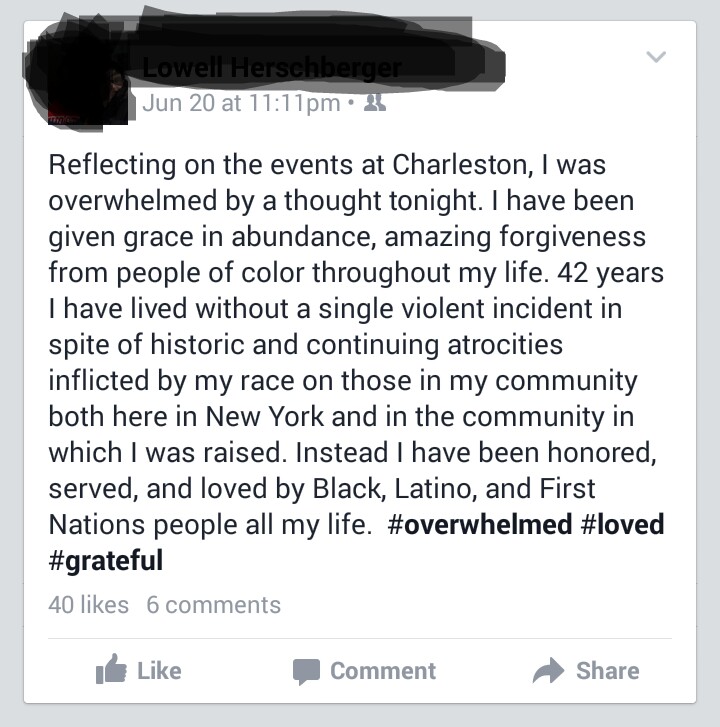
I shook my head as I read a social media post from a well-meaning white friend thanking various “people of color” for not doing him harm because of historical and current injustices.

Many of his friends liked the post—a vast majority of the affirmation, despite his diverse mix of friends, came from his white friends. On the surface his post is contrite or considerate and praise-worthy.  What could be wrong about a man owning up to the sins of his own kind?

But under the surface of his post lurks something insidious.  It uncovers a secret expectation that “people of color” should be irrationally violent and thus are deserving of his praise when they are not.  It is a demeaning and belittling message cloaked in empathy.  It actually reinforces an awful stereotype.

Think about it: Would it be praise to thank a white man for being civilized or would it be patronization and a backhanded insult?

What is more disturbing is this persistent idea that a whole race should be held accountable for the sins of one of their own.  Apparently I should be judged by the depraved acts of Dylann Roof (and every white man in history) because I share his skin color and gender.  But isn’t that exactly the logic of every racist in history and the way of thinking we are trying to escape? 

I believe ‘white guilt’ is a symptom of racist thinking rather than a solution.  When we thank “people of color” for not harming us as white people we are perpetuating the idea that people should be judged as a race rather than as unique individuals.  It is a tribalist suggestion that violence against a whole race is justified therefore we need forgiven as individual members of a racial tribe.

But this thinking is racist to the core.  It keeps “people of color” as something separate from us.  It treats them as something to be pandered to in a way that we would never do to another white man.  (My thanking a white man for not killing me today would be taken as foolishness or sarcasm.)  It is also saying that we expect irrationality and violence from them—which is exactly the same reasoning of a racist killer.

We cannot help but see people as white or black.  We should not be ignorant of historical injustice or continuing racism either.  But we can stop believing that people are fundamentally different because of their skin color.  Part of that is not apologizing in a grandstanding fashion for our own skin color.  Part of that is not treating “people of color” as inferior by thanking them for things we would not even thank a small child for.

We recognize calling a black man “boy” may be insulting.  We also see the battle flag of the Confederacy (the “rebel flag”) as symbolic of racism.  However, do we see subtle racism of those who’s words betray an expectation that black people should be irrational and violent?

I myself prefer those who display their true colors openly, because then we know what we are dealing with and don’t need to dig through the layers of carefully hidden prejudices to find the truth.

What does Charleston say about us?

Standard

There are many who react to the church shooting at Charleston’s historic Emanuel A.M.R. Church by blaming availability of guns and decrying racism.

But one thing missing from the discussion, that is a victimhood mentality and the idea that all people of a particular race are guilty because of the acts of a few. 

When Dylann Storm Roof walked into the doors of that church he was armed with two ideas: 1) his tribe (white people, women, etc) were the victims, and 2) their tribe (black people) were collectively responsible for black rapists, perceived injustice, etc.

It was the ideas that this depraved young man harbored in his heart that were dangerous.  However, these ideas are not unique to him or just to unreasonable and angry white men.  These are ideas accepted accepted in mainstream thought that divides people into falsely dichotomous categories.

Who kills the innocent? We do!

Ideas that white is equal to privilege or black is equal to victimhood are equally dangerous.  When we feed the martyr complex and victimhood mentality we are giving license to those of an even more deranged mind to take it a step further. 

The problem with Roof and those like him (of all races, genders, etc) is not what they do—but that they feel justified to do it.  We can fret about availability of guns and a multitude of other factors, but until we address the heart issue we are only treating the symptoms.

We won’t stop a person bent on evil and destruction with more legislation.  If anything more law will only create the next inequity and give some other person reason to feel disenfranchised.  But what we do need is to unravel the false dichotomies and prejudice assumptions that fuel hatred.

Being on the ‘right’ side of history…

We are urged to be on the “right side of history” yet the problem is that everyone (including Roof) feels they are on the ‘right’ side and justified.  Jesus encountered this in the Pharisees who thought themselves better than other people and superior to their own ancestors:

“Woe to you, teachers of the law and Pharisees, you hypocrites!  You build tombs for the prophets and decorate the graves of the righteous.  And you say, ‘If we had lived in the days of our ancestors, we would not have taken part with them in shedding the blood of the prophets.’  So you testify against yourselves that you are the descendants of those who murdered the prophets.”  (Matthew 23:29-31)

There are many sanctimonious today who think they are superior to other people.  They may decry the injustices of the past, support punishment for those they hold responsible and blame, but they themselves often as guilty or more of similar abuse.

Is an anti-abortion activist who calls women entering a clinic names or murderers a provider any better than those they accuse? 

Is a person who labels others as “racist” or “homophobic” or “hateful” in response to a disagreement over opinion less abusive than a person who uses the n-word?

I say, no and no. 

The solution to hate is not to be hateful.  As Mahatma Gandhi wisely observed: “An eye for an an eye only leaves the whole world blind.”  What he observed is the same as when Jesus quipped that those who live by the sword will die by it (Matthew 26:52) or ‘what goes around comes around’ in essence.

We make a difference by being different…

Everyone has reason for their own abuses.  Many of the most abusive people in history believed they served a righteous cause.  Many people can identify the sins of other tribes or the prior generation, but few seem able to see their own abuses.  We prefer to keep the spotlight on those whom we perceive to be worse than us than we are interested in searching out the wickedness of our own hearts.

Ben Carson spoke well:

“You know, we have a war on women, race wars, income wars, age wars, religious wars. Anything you could imagine, we have a war on it… And we’re giving people a license to hate people who disagree with them.”

We need to stop arming ourselves with contempt and be committed to loving as we wish to be loved.  It is easy to love our own and hate others, but divine love seeks unity rather than encourage division.  It sacrifices self rather than perpetuate cycles of violence.  It brings grace to the fight even when vengeance feels justified.

Grace saves us…

It is the Spirit of love like that of Marcus Stanley, who was shot eight times but lived, and chose grace in response to hate:

“I don’t look at you with the eyes of hatred, or judge you by your appearance or race, but I look at you as a human being that made a horrible decision to take the lives of 9 living & breathing people. Children do not grow up with hatred in their hearts. In this world we are born color blind. Somewhere along the line, you were taught to hate people that are not like you, and that is truly tragic. You have accomplished nothing from this killing, but planting seeds of pain that will forever remain in the hearts of the families that lost their lives and countless hearts around our country.”

Let’s not fall victim to those who would divide us into categories, but instead seek the unity of all people only possible with a love that tears down walls, bridges divides and believes when others say it is impossible. 

May those seeds of Roof’s hate stay dead and the love of Jesus in Stanley’s gracious response grow in us.  The answer is not more or less guns nor petitions against flags and protest, it is less hate and more Jesus.

“Do not be overcome by evil, but overcome evil with good.”  (Romans 12:21)

The People Want a King…, Part 1

Standard

I felt like the dog who finally caught the car.  I was perplexed with a question: Now what?

My goal in blogging is to make a difference with the ideas that I share.  I know ideas are powerful.  I want to share good ideas and debunk or discourage destructive ideas.  It has been my goal from the beginning to write things worthwhile in hope of creating dialogue.

It was exciting when Good Men Do Not Blame Women quickly surpassed my previously most viewed blog in a matter of hours.  It was also terrifying that my words were being read by hundreds of people rather than just the usual handful of friends and followers.

But, amid worries about if I had proofread enough and given fair treatment to a complex topic, I enjoyed my new found popularity.  I enjoyed it so much that I worried that I enjoyed it too much.

I worried that maybe I was ‘going negative’ instead of sharing something helpful and constructive.  Just a week or so prior I had remarked to a friend that people who criticize other people (not like them) seemed to build a fan club quicker than those who shared good ideas.

I had to think there’s a danger of becoming a different version of what we preach most passionately against.  I do not want to contribute in an overreaction in the opposite direction and abandon what is good in proper order or at the right priority level.

I had a taste of power that I both liked and that I did not like.  It provoked many questions in my mind about what would happen if I gained a following.  Would I be an example of the ideals in my mind of leadership?  Or would I insulate myself from criticism and become arrogant?

“Power tends to corrupt, and absolute power corrupts absolutely.  Great men are almost always bad men.”  (Lord Action)

The good news is that my blogger stardom was very short lived and—besides a few new friends—I’m back to blogging to my usual small audience.  It means less pressure.  I feel I can share again without worrying as much about my imperfections being amplified over a large audience.

The people want a king to lead them…

In the beginning God was sufficient to lead his people.  The patriarchy of Abraham gave way to tribal elders and officers.  Later Moses acted as a prophet and arbitrator in disputes. However, eventually it was too much for Moses, the task was taking all of his time from “morning to evening,” which led to his visiting father-in-law to ask him why:

“Moses answered him, “Because the people come to me to seek God’s will. Whenever they have a dispute, it is brought to me, and I decide between the parties and inform them of God’s decrees and instructions.”  Moses’ father-in-law replied, “What you are doing is not good. You and these people who come to you will only wear yourselves out.  The work is too heavy for you; you cannot handle it alone.  Listen now to me and I will give you some advice, and may God be with you. You must be the people’s representative before God and bring their disputes to him.  Teach them his decrees and instructions, and show them the way they are to live and how they are to behave.  But select capable men from all the people—men who fear God, trustworthy men who hate dishonest gain—and appoint them as officials over thousands, hundreds, fifties and tens.  Have them serve as judges for the people at all times, but have them bring every difficult case to you; the simple cases they can decide themselves.  That will make your load lighter, because they will share it with you.  If you do this and God so commands, you will be able to stand the strain, and all these people will go home satisfied.”  (Exodus 18:15-23)

Moses took the advice, he delegated the task of settling disputes to other capable men and that became the system for hundreds of years. 

It was a sort of anarcho-theocracy.  The prophet was the liaison between God and the people, the messenger of God, but not a ruler per se.  The laws handed down by Moses were the standard for judgment.  Enforcement of the law was carried out by the people rather than delegated to a few people and judges a final arbitrator between parties as needed…

“At that time the Israelites left that place and went home to their tribes and clans, each to his own inheritance.  In those days Israel had no king; everyone did as they saw fit.”  (Judges 21:24-25)

There was a time after the Exodus of freedom from oppression and obligation.  Judges came and went as heroes who did God’s work to save the people from captivity.  Judges were representatives and deliverers of the people, but not rulers like a king.  However, eventually, when a worthy successor could not be found for Samuel amongst his sons, the elders of the people made a fateful demand:

“So all the elders of Israel gathered together and came to Samuel at Ramah. They said to him, “You are old, and your sons do not follow your ways; now appoint a king to lead us, such as all the other nations have.”  But when they said, “Give us a king to lead us,” this displeased Samuel; so he prayed to the Lord . And the Lord told him: “Listen to all that the people are saying to you; it is not you they have rejected, but they have rejected me as their king. As they have done from the day I brought them up out of Egypt until this day, forsaking me and serving other gods, so they are doing to you. Now listen to them; but warn them solemnly and let them know what the king who will reign over them will claim as his rights.”  (1 Samuel 8:4-9)

Samuel went on to warn how kings would take their sons for wars and daughters as workers.  He spoke of how the future kings would take the best of their possessions for themselves and for their own purposes.  Still, despite the warning, he did not persuade them, the chapter continues:

“But the people refused to listen to Samuel. “No!” they said.  “We want a king over us.  Then we will be like all the other nations, with a king to lead us and to go out before us and fight our battles.”  (1 Samuel 8-19-20)

The people were delusional just like their forefathers who begged Moses for a return to slavery and Egypt.  Despite Samuel’s warning of conscription, they apparently had an idea a king could miraculously do all the fighting for them and they ignored all rational concern.

A couple of the kings were good, David and Solomon notable examples, but a majority were more concerned with themselves, they all took special privileges for themselves and loaded the people down with increased burdens.  The prophecy of Samuel became reality—the people traded their greater freedom for a false security and eventual rule of tyrants.  Instead of protecting against oppression the kings became oppressors themselves.

Consequence #1: Increased Burden

“A government big enough to give you everything you want is a government big enough to take from you everything you have.”  (Gerald R. Ford)

Kings and government leaders promise big things to their people.  But what often is forgotten by the enthusiastic crowds is that nothing is free.  When a Pharaoh promised a pyramid for the glory of Egypt Pharaoh, he wasn’t planning to build it on his own time with godlike powers.  No, the people paid the price of a king’s grandeur with their own backs and we still bear the weight of the audacious promises of our leaders. 

The burdens never seems to be lightened either. Consider when Rehoboam took over after his father Solomon and was confronted by the people:

“Your father put a heavy yoke on us, but now lighten the harsh labor and the heavy yoke he put on us, and we will serve you.” … The king answered the people harshly. Rejecting the advice given him by the elders, he followed the advice of the young men and said, “My father made your yoke heavy; I will make it even heavier.  My father scourged you with whips; I will scourge you with scorpions.”  (1 King 12:4-14)

King Reheboam was more concerned with pleasing his young peers than he was in listening to the people or the elders.  As a result some did not accept his rule over them and the nation was divided.  It is interesting to see this same pattern play out today.  Leaders pursue their own vision, they increase the burden on the people without ever easing up, which leads to division and eventual rebellion.

Consequence # 2: Increased Corruption

“Our country is now taking so steady a course as to show by what road it will pass to destruction, to wit: by consolidation [of power] first, and then corruption, its necessary consequence.”  (Thomas Jefferson)

Kings and government leaders represent a consolidation of power and with consolidation of power comes increased opportunity for corruption.  Many leaders rise to power on their idealistic vision, but once they have power the vision fades and the desire to hold or increase power becomes the bigger priority.  We may call it “special interests” and political pandering today, but here’s how the Bible describes it:

“See how the faithful city has become a prostitute!  She once was full of justice; righteousness used to dwell in her—but now murderers!   Your silver has become dross, your choice wine is diluted with water.  Your rulers are rebels, partners with thieves; they all love bribes and chase after gifts.  They do not defend the cause of the fatherless; the widow’s case does not come before them.”  (Isaiah 1:21-23)

Described above is the chipping away of principles.  Many institutions of men are founded with good intentions but become corrupted over time.  Corruption is a natural product of consolidation of power.  When power is given to one person (or a small body of people) they seem to inevitably try to use that power to secure more power for themselves.  There is no system of external controls that seems to be able to keep it in check.  Those in power have the tools to manipulate the rules for their own gain.

Consequence #3 Loss Without Gain

“If the people cannot trust their government to do the job for which it exists – to protect them and to promote their common welfare – all else is lost.”  (Barack Obama)

Kings and government leaders are established to protect the people against harm.  But, not only do they fail to be able to protect a people from harm, they themselves often another source of harm.

The strength of a king is not in themselves as much as it is in the strength of their people.  As Samuel had warned, a king takes and can only give back what is taken and thus a corrupted people produce corrupt leaders:

“You are destroyed, Israel, because you are against me, against your helper.  Where is your king, that he may save you?  Where are your rulers in all your towns, of whom you said, ‘Give me a king and princes’?  So in my anger I gave you a king, and in my wrath I took him away.”  (Hosea 13:9-11)

Installing a king ultimately did not solve anything.  The people still ended up taken captive by other nations as they had before, they also endured the abuses of power hungry and corrupt leaders when not in captivity.  They gave away freedom for security and got captivity because they were corrupted themselves.

People want a king to blame…

The paradox of kings is that kings need strong people to maintain power—but strong people don’t need kings.  Weak people turn to leaders to do their work for them, but a man wearing a fancy crown and holding a scepter is only empowered by those who do his bidding.

It feeds a vicious cycle.  When things go wrong people blame the king.  As a result the king is driven to take more power upon themselves or risk losing power they already have.  Of course, since their power is derived from other people this means taking more from the people who are able to give.  It can only last so long as their are enough strong people to take from—when the weight of dependents comes closer to outweighing those able (or willing) to provide there is nothing a king can do but manage the decline.

Only, it is worse than that, because as already mentioned, consolidation of power is like a petri dish for corruption.  So, not only do these kings give a convenient scapegoat, they also are too often the goats among the sheep and motivated by their own gain rather the good of all in the herd.  In other words, if a couple sheep get thrown to the wolves and it saves a goat from an undesirable outcome and nobody notices, what sheep, right?

It is exactly what king David did to Uriah.  David goofed, he got Uriah’s wife (Bathsheba) pregnant.  He evidently didn’t want to suffer the political repercussions and attempted to hide the adultery.  So plan ‘A’ was urge Uriah to spend some quality time with Bathsheba and thus disguise the origin of the pregnancy.  Unfortunately Uriah, a true warrior, would not go home to his wife while his comrades were still fighting and David needed another plan.  Plan ‘B’ was to deliberately set Uriah up to be killed in battle.  It worked, except the prophet Nathan knew and he confronted the king with a story about a wealthy man who killed a neighbor’s pet sheep.

And David was one of the good kings and probably mostly because he could admit his sins…

This post is about faith, not kings…

My point here is not purely political or just historical.  I am using kings and government leaders as a metaphor for anything (be it an institution, a system of philosophy or theology, a man, etc) that replaces our own obedience to God. 

We cannot expect the world to be good if we continually delegate the tasks of our own conscience to others.  Faith is about being the solution ourselves and not sending others (who we can conveniently blame for the eventual failure) to do what is impossible for them to do alone.  We cannot expect the fullness of God’s blessing when we look to men to lead us.  If God is alive in us then we must be the agents of good in the world with our own abilities and be faithful to our calling.

This is not a call for a return to anarcho-theocracy and judges either.  Kings and governments rise in prominence because the people aren’t doing their jobs.  Therefore, the solution is not to reform government, the solution is to reform people and make government irrelevant.  If we were taking care of the widows and fatherless as we ought, for example, what need would there be for corrupt welfare programs?  If fathers weren’t leaving their sons to be raised by the brutal streets, what need would their be for police as brutal?

“Every country has the government it deserves.”  (Joseph de Maistre)

It is a collective problem when the people demand a king.  It becomes an individual problem when the people finally empower a man to do their dirty work.  There is always someone all too willing to seize power—those with an appetite for power—who will take the glory for themselves and then delegate responsibility for failure to others, exploits position, etc. 

It is a spiritual problem.  It is often only our own sloth, envy, pride, mistrust, fears, poor judgments and overreactions that are reflected back to us in the immoral whims of our leaders.  We delude ourselves when we abandon accountability to God for kings that are no better than us.

Now, enough said for now, back to chasing cars for me…

Discipleship: One Size Fits (Not) All

Standard

Genetic research is a burgeoning field of study.  It reveals the complexity of our physical form in a new way and also my own unique DME genotype. 

For years medication was designed as a one size fits all solution.  However, how my body responds to a medication and how your body responds to the same dosage could be vastly different.  Not all people are created equal when it comes to their genetics. 

One of those differences is DME genotype.  DME is an abbreviation that stands for drug metabolism enzyme.  Most drugs are designed to be metabolized through by a certain set of enzymes. 

There are now labs that test genotype for drug compatibility.  Some of us are “poor metabolizers,” others are “intermediate metabolizers,” and on the far end of the scale are the “ultra-rapid metabolizers.” 

The implications are huge and there might be a day when drugs will be tailor made to suit our own unique individual body chemistry.  Unfortunately, until that day, we are stuck using drugs that are like misfitting hand-me-downs.

Are people created as spiritual clones?

People are genetically diverse and different.  We understand that and it is a reason to test before assigning drug prescriptions to treat people.  But do we apply that same idea spiritually?

One thing I have noticed in my reading the Bible is that no two people were the same.  The similarity of Biblical characters was not one of having the exact same spiritual journey or experience.  Their strengths varied, as did their weaknesses, they also had a wide range of spiritual experiences, life challenges and gifts.  The unifying factor of all was simply faith in God.

Take Abraham, for example, he was an old nomad wandering without an heir until God made him a promise.  His transformative spiritual experience came late in life.  He messed up in his attempt to reconcile the reality of his situation with what God told him and tried to do things his own way by impregnating a woman not his wife.  But ultimately, despite his mistakes, he served the purpose God had designated for him and was blessed richly for it.

David was a young man, he was looked over as a leader for his age and sidelined to tend the sheep.  But later he become symbolic of courageous faith to a nation for his slaying of Goliath.  He went on to live a life full of missteps, he endured personal tragedy (as a result of his own corrupt deeds) and still ended up a hero of faith at the end of his story.  He was described as a man after God’s own heart in the book of Acts.

Women, from prostitutes like Rehab to queens like Esther, from Deborah the warrior-judge to deaconesses to desperate widows, played their own unique roles in the Biblical faith narrative.  They were all faithful in different ways, some were courageous women who shouldered tremendous tasks, some hospitable to prophets in keeping their homes and others were mothers who were favored by God.

Some of the strongest examples of faith were from those who were raised in captivity.  They were exposed at a young age to the best of what a worldly king could offer and yet chose faith in God over the pleasures of princely wealth.  Daniel, those three guys with long weird names who survived unscathed after being thrown in a furnace, and Moses who later led his people, are all examples of extraordinary faith. 

Some of the worse cases of unbelief were found in those steeped in Biblical tradition who rejected Jesus.  Their religious devotion and diligent study of Scripture did not save them.  They were outwardly images of righteousness, they had all the knowledge of theology they knew to have and still missed the truth badly.  Allegiance to rules and roles produced hypocrites.

What does this mean for established rules and roles?

The idea that spiritual journeys must follow a set pattern or time frame does not fit with the Biblical pattern.  Yes, the Bible probably does make more mention of the exceptional characters and there were many faithful besides who were less the exception.  There certainty are statistical averages of people too, but there is no average person and that is the lie of statistics.

Men, on average, are physically stronger and also born with other strengths over women.  Women, on the other hand, also have their own unique strengths and abilities that make them generally superior to men in some areas.  That is what makes men and women a natural pair—they are complimentary (or stronger together) because they are different rather than the same.

People of the same gender also, while having some obvious similarities, are very different.  Paul alludes to this diversity often in his letters to the church.  In 1 Corinthians 12 he draws a vivid analogy between the church and a human body.  He compares people with different parts of the body that are reserved for unique purposes.  He was illustrating that their could be unity (and strength) in our differences when we are connected together by a same love.

It reminds me of the “united we stand” attitude of post 9/11 or the “unite or die” flag of the American Revolution:
image

We understand nations do not survive if they are too divided.  We also understand that an economy without diversity of talents and diversity of contributions is probably not going to be very strong.  Thriving depends on cooperation between different parts rather than strict legalistic conformity.  But is that logic applied to the church as a collection of its individual parts?

The unity of the church was supposed to be built around common love and faith, not on absolute monochromatic sameness of personality and perspectives.  The church has unfortunately segregated by ethnicity, economic status, education, extremes of liberalism or conservativism, and along many other dividing lines of application.  In our division we miss an opportunity to see our full potential as a body.  Sadly, many seem to prefer images of themselves and doing things their own way over a commitment to love as Jesus loved.

Too often we create rules (or roles) to serve our own preferences rather than our fellows.  Many complex religious rationales have been created to justify hierarchies of men in fancy array.  Whole Biblical hermeneutics built around dominionism (in the model of the first Adam and Old Testament patriarchs) that serves the needs of selfish men rather than the cause of Christ. 

It is an anathema, it is a horrible distortion of Scriptural narrative, when the example of Christ (the better Adam) who turned down worldly dominion (Matthew 4:8-9) and instead bent low to wash the feet of his disciples.  It is tragic when the better way of Jesus is discarded for worldly dominion, it is selling a heavenly birthright for a bit of porridge.

There are spiritual constants, like love…

God’s love does not change.  I believe one unifying theme of Scripture is God’s constant love for humanity.  It is certainly the main message of the Gospel of Jesus Christ which is summed up eloquently:

“For God so loved the world that he gave his one and only Son, that whoever believes in him shall not perish but have eternal life.”  (John 3:16)

Belief is love:

“Before long, the world will not see me anymore, but you will see me. Because I live, you also will live.  On that day you will realize that I am in my Father, and you are in me, and I am in you.  Whoever has my commands and keeps them is the one who loves me. The one who loves me will be loved by my Father, and I too will love them and show myself to them.  (John 14:19-21)

My command is this: Love each other as I have loved you.  Greater love has no one than this: to lay down one’s life for one’s friends.  You are my friends if you do what I command.  I no longer call you servants, because a servant does not know his master’s business. Instead, I have called you friends, for everything that I learned from my Father I have made known to you.  You did not choose me, but I chose you and appointed you so that you might go and bear fruit—fruit that will last—and so that whatever you ask in my name the Father will give you.  This is my command: Love each other.  (John 15:12-17)

When asked what is the “greatest commandment” Jesus answered:

“Love the Lord your God with all your heart and with all your soul and with all your mind.’  This is the first and greatest commandment.  And the second is like it: ‘Love your neighbor as yourself.’  All the Law and the Prophets hang on these two commandments.”  (Matthew 22:36-40)

Paul expounded on what Christian love means practically:

“If I speak in the tongues of men or of angels, but do not have love, I am only a resounding gong or a clanging cymbal. If I have the gift of prophecy and can fathom all mysteries and all knowledge, and if I have a faith that can move mountains, but do not have love, I am nothing.  If I give all I possess to the poor and give over my body to hardship that I may boast, but do not have love, I gain nothing.  Love is patient, love is kind. It does not envy, it does not boast, it is not proud. It does not dishonor others, it is not self-seeking, it is not easily angered, it keeps no record of wrongs. Love does not delight in evil but rejoices with the truth. It always protects, always trusts, always hopes, always perseveres.   Love never fails…”  (1 Corinthians 13:1-8)

“Therefore, as God’s chosen people, holy and dearly loved, clothe yourselves with compassion, kindness, humility, gentleness and patience. Bear with each other and forgive one another if any of you has a grievance against someone. Forgive as the Lord forgave you. And over all these virtues put on love, which binds them all together in perfect unity.  (Colossians 3:12-14)

“Be completely humble and gentle; be patient, bearing with one another in love. Make every effort to keep the unity of the Spirit through the bond of peace… speaking the truth in love, we will grow to become in every respect the mature body of him who is the head, that is, Christ.”  (Ephesians 4:2-3, 15)

Love is a spiritual concept, not a mere code of conduct, not a blind allegiance to doctrinal statements nor a slavery to traditional application or religious dogmas.  Love is death to selfish ambition, dedication to an eternal goal and lives to serve the good of others.  Love comforts, love encourages, love provides tangibly for needs and rebukes immorality.

Love disciples.

If there is anything most lacking in the church today (and world in general) it is love.  Sure, many love selectively, they love their own family, their own tribe (of race, gender, cultural group, religious denomination, social class, etc) and yet that is not the love of Christian faith.  The love of Jesus transcends tribal difference, it extends beyond biological offspring, and returns multiplied.

One place our love is most lacking is in commitment to true discipleship.  As part of his parting words, Jesus told his followers, “make disciples of all nations” (Matthew 28:19) but it seems that is a concept often lost.  Discipleship is supposed to be something personal, interactive and ongoing.  But it also requires sacrifice of time, energy and our own pursuits.  Discipleship takes loads of patience and it is too easily replaced by a cheap imitation or neglected entirely.

It is easy to designate the difficult task of discipleship to a few in an effort to absolve ourselves of responsibility.  It is easy for tailored and flexible discipleship to be displaced by one-size-fits-all cookie cutter solutions.  However, having people sign on to a book of regulations enforced rigidly (without love) is not true discipleship and not the example Jesus gave for us to follow.

Ironically, by not disciplining as we ought, we are not only shortchanging those who need an example of love and grace to follow, we are also robbing ourselves of the full experience of Christian faith.  Everything worth doing requires hard work and a dedicated effort.  Loving others enough to disciple them in a way tailored to their individual needs is no exception to the rule.  Real love takes effort. 

People are unique and “fearfully and wonderfully made” according to Psalms.  Programs with simplistic algorithms are not sufficient.  People do not need more generic prescriptions or clunky twelve step programs.  People need genuine authentic self-sacrificial living breathing Christian love and a real investment of faith.  So don’t give what is second rate if you want first rate results.

God bless.

Gothard: Messenger or Manipulator?

Standard

I was walking across the mall with no time to waste.  Up ahead was one of those Dead Sea salt kiosks staffed by Israelis trained to intercept passing Gentiles. 

My intentions were to stride on by, keep my eyes focused ahead and totally avoid the high pressure sales tactics that make men of less mental fortitude into suckers.  I am not a sucker.

But as I passed I failed.  She spoke sweetly with an irresistible accent.  I was too nice to not answer a friendly greeting.  Sales people are human after all.  I let a reply slip.  “Thank you,” I said, “but, I’m in a hurry…” 

She was ready with an answer before I had even opened my mouth, my forward progress had somehow stopped, and she was rubbing lotion on my hand before I could think to protest.  My higher cognitive functions suddenly neutralized by the sensory input filling that primal need of physical touch.

I still was determined to resist.  I refused to make a purchase.  I am a consummate saver, a responsible spender, only buy things I need, and have no need of lotion, deep cleansers or any of that overpriced slime.  And, no, not for my mother, nor my sister, and what girlfriend, right?

“You’re really good at your job.”  I said, as I as I paid penance to the wiles of a soothing seductress, and contemplated male stupidity, and wondered what I would do with all the clutter she left in my hands, as if I had an obligation to spare her embarrassment of failure to sell. 

She never gave me the satisfaction of being right about her insincerity. 

What is manipulation?

To manipulate is to bend, form or move something and make it conform to your will.  We use a hammer as a persuasion device to manipulate steel or to pound a nail into a block of wood.  We try to manipulate our environment to make it more suitable to our own desired ends.

There are also people who manipulate other people, like my temporary friend at the mall kiosk, and try to control people through false means or fear.  This goes beyond simple persuasion.  Psychological manipulation, according to Wikipedia,“is a type of social influence that aims to change the perception or behavior of others through underhanded, deceptive, or abusive tactics.”

In the political sphere there is fear-mongering, demagoguery and pandering as manipulative tactics.  The manipulator plays on the emotions of the target audience.  He set himself up as an authority or in the know and trustworthy.  She poses as a concerned friend, a common person standing up against the bad people, or a heroic altruist.  But beneath the rhetoric is often a cynical calculated effort to buy votes and control people.

This is also an unfortunate aspect of religion.  Jesus warned of those who “tie up heavy, cumbersome loads and put them on other people’s shoulders,” and yet, “they themselves are not willing to lift a finger to move them.” (Matthew 23) These people, he goes on to say, are “hypocrites,” who “strain out a gnat but swallow a camel.”  He’s speaking of the religious experts, the “teachers of the law” and Pharisees.

The Pharisees were outwardly righteous, they followed many rules trying to please God, they would continually ask, “what must I do to inherit eternal life?”  But, despite their “diligent” study of the Scripture, we are told, “the Father who sent me has himself testified concerning me. You have never heard his voice nor seen his form, nor does his word dwell in you, for you do not believe the one he sent.” (John 5)  They missed the answer standing literally (literally) in front of them.

They were deceived, self-decieved, and destroyed the very people they ‘won’ over by their dedicated missional efforts, making them “twice as much a child of hell” as they are according to Matthew’s account.  They posed as gate keepers to the “kingdom of heaven” and, unfortunately, did not enter themselves.  They are “blind guides” who neglected more important matters of actual spiritual weight.  These were men full of themselves and not the Spirit of God. 

Who is Bill Gothard?

Bill Gothard, PhD is a teacher popular in some Biblical fundamentalist communities.  He is known for his seminars which give “principles” loosely based on the Bible.  He is an elderly man now, he was never married (although he does give marriage and child rearing advice) and founder of Institute in Basic Life Principles.  He recently resigned from his organization amid sexual harassment allegations.

image

(Read the “about me” on his website: http://billgothard.com/about )

I was asked for my thoughts about Gothard after my last blog post.  I had made a passing mention of him as one who rationalizes sexual abuse as a product of female immodesty or rebellion (kind of like earthquakes in Nepal) and I was also criticized for jumping on the bandwagon against him.  The link I provided was written from a “victim’s perspective” and apparently (in the critic’s opinion) the only right response for those who suffer abuse is forgiveness.

Well, I am not a victim of Mr. Gothard.  I have never met him in person.  I will leave it for God and others to judge Gothard’s personal life.  But, as one committed to “rightly dividing the word of truth,” (2 Timothy 2:15) I feel I must examine his teachings against Scripture.  I am familiar with his teachings. My church has hosted his seminars. I have had questions about his ideas and long before the Duggar family sexual molestation controversy put Gothard’s Advanced Training Institute in the spotlight.

My primary concern in this essay is with Gothard’s Scriptural hermeneutic and his theology, not his person.  There is some obvious overlap between the influence of his teachings, his behavior as a person and what he believes.  However, I prefer to stick as much to what is verifiable.  I do, as always, recommend looking for yourself rather than just take my word for it.  So I will give my perspective as an invitation to study for yourself and find the truth.

Gothard‘s teaching manipulates Scripture.

There are many different perspectives on Scripture and many opportunities to be wrong about what the Bible says.  I’ve made my share of mistakes when it comes to correctly understanding written texts.  I cannot fault a person for an occasional error in their interpretation and application of the Bible.  The Bible is a complex book and difficult to understand according to what is written in it:

“Bear in mind that our Lord’s patience means salvation, just as our dear brother Paul also wrote you with the wisdom that God gave him. He writes the same way in all his letters, speaking in them of these matters. His letters contain some things that are hard to understand, which ignorant and unstable people distort, as they do the other Scriptures, to their own destruction. (2 Peter 3:15-16 NIV)

Gothard’s teaching goes beyond just a simple misinterpretation of Scripture.  He makes fundamental and systematic errors in his Biblical exegesis.  He reads his own presuppositions into the text of the Bible and in ways that go directly against the actual explanations supplied within the text itself.  His understanding of Scripture seems to revolve around his own established ‘principles’ rather than go the other way around.  He neglects important concepts of faith while emphasizing his own prescriptions at the expense of whole truth.

This is not a perspective of Gothard’s work unique to me.  In a paper, “Issues of Concern—Bill Gothard and the Bible: A Report,” published May 30, 1984, Ronald B. Allen, ThD expressed the following evaluation:

“Gothard’s approach is not that of the careful exegete who wishes to determine the meaning of the text, but of the engineer who wishes to use the material in his own programmatic approach which is mechanical and not personal, mechanistic and not dynamic. Gothard does not really teach the Scripture; he really uses the Scripture to fit into his own categories.”

Gothard seemingly throws out the baby (what the Bible explains) to keep the bathwater of his own preconceived notions and prescriptive formulas.  His analysis of the book of Job is a glaring example of his editorial manipulation of a text.  Gothard actually comes out on the side of those who are rebuked by God for their false attribution of reasons for Job’s suffering, as Allen explains:

“The clear teaching of the Book of Job is that a mechanistic, cause-and-effect, approach to life may be way off base! Is it any wonder that Gothard tries to evade the clear teaching of the Bible that Job was a righteous man (the only reading on which the book works!), and finds many sins and character flaws in him (overwork in Christian causes, neglect of his family, embittered sons, estranged from family, wrong attitudes toward the workers). In this way the book is turned inside out and by this strange alchemy Job supports Gothard’s lists.

There is nothing in the Biblical text to suggest Job brought his suffering upon himself for something wrong he did.  In fact it was the righteousness of Job that was the theme of the book. At the end of the book God vindicated Job and rebuked his persecuting comforters:

“After the Lord had said these things to Job, he said to Eliphaz the Temanite, “I am angry with you and your two friends, because you have not spoken the truth about me, as my servant Job has… My servant Job will pray for you, and I will accept his prayer and not deal with you according to your folly. You have not spoken the truth about me, as my servant Job has.”  (Job 42:7-8)

Gothard is repeating the folly of Job’s falsely accusing friends and does so despite having the end of the book where God sets them straight.  So, why would Gothard take the Job story and turn it upside down?  Well, perhaps it is because he over-applies an idea of sowing and reaping (or cause and effect) to every circumstance?  It becomes quite evident in Gothard’s teaching that every bad thing that happens to a person is a result of their own sin.

This erroneous idea is nothing new or unique to Job’s friends or Bill Gothard, the disciples of Jesus made the same mistake when they encountered a blind man in this Biblical account:

“As he went along, he saw a man blind from birth. His disciples asked him, “Rabbi, who sinned, this man or his parents, that he was born blind?”  “Neither this man nor his parents sinned,” said Jesus, “but this happened so that the works of God might be displayed in him.”  (John 9:1-3)

Sometimes bad things are the result of nobody’s sin.  Jesus made a similar point as why we should show grace to all people when he reminded that God“causes his sun to rise on the evil and the good, and sends rain on the righteous and the unrighteous.”  (Matthew 5:45)  In other words, sometimes (or even most times) a rainstorm is just a rainstorm and not judgment or a reward for behavior from God.  Not every good thing that happens to a person is a reward, not every bad thing that happens is a punishment.

Gothard’s teaching manipulates people.

One of the responses to my last blog came from a woman molested by her own father at age nine.  She did not invite that upon herself by something she did.  Sexual abuse victims often feel a sense of guilt or shame and need to be freed from that to be able to move on.  But, if she goes to Gothard, this may be the tenor of the advice she gets:

image

Note the fourth point, “Why did God let it happen?”  In that there is “Result of defrauding by” and that followed by a list of four subpoints: Immodest dress; Indecent exposure; Being out from the protection of our parents; Being with evil friends?

I spoke at greater length about what the Bible actually says about modesty in my last post and there is absolutely nothing in the Bible that says sexual molestation or rape is a result of female immodesty.  That woman molested at nine years old did not dress to draw her own father’s attention, she was in her own home, she was molested by a parent and, again, in her own home!  So that is quite the exception to the logic of “defrauding” laid out by Gothard’s counseling literature.  There should be a big exception clause at very least.

But Gothardism doesn’t allow for exceptions to his own rules.  In Gothard’s view, as with his mistreatment of Job’s suffering as somehow self-inflicted, if a young woman is raped then she must’ve done something to deserve it.  In his “character sketches” he twists the Biblical account of Dinah by attributing wrongful attitudes to her that cannot be found anywhere in the text.  Gothard makes Dinah out to be a rebellious daughter and thus responsible for what happened to her.  Then he turns the opposite direction and is critical of Tamar for actually obeying her father’s request.  Gothard’s logic is self-contradictory and contradicts the Bible.  Worse, it shames sexual assault victims by implicating them and it adds a weight of guilt undeserved.

The Bible doesn’t support the false dichotomies and overly simplistic principles of Gothard’s teachings.  But, rather than admit his thinking is flawed and repent, Gothard attempts to manipulate the Bible to fit his own preconceived ideas.  That is to elevate his own opinions above the very explanations given in Scripture.  Gothard manipulates Biblical evidence in the same way Satan twisted God’s words to deceive Eve and in the same way Satan later misused Scripture to tempt Jesus.

Gothardism attempts to manipulate God

It also appears Gothard thinks of God like a vending machine: You insert devotion to a list of basic principles, you turn a few levers, pull a few knobs and out pops a blessing.  This is a mechanical view of God.  Another blogger critiquing Gothard put it this way:

Perhaps the most disturbing aspect of Gothard’s heterodoxy is what it does to God. Not only does God plays little or no part in a believer’s life through omission, but Gothard actually teaches that God’s grace is bound to the limitations of our own abilities. It is not simply that God helps those who help themselves, but that God will not and cannot help anyone who is not already practicing the right principles.”

It is an underestimate of God that essentially makes us our own savior and that is antithetical to the Gospel of Jesus Christ.  Sure, I see many good things in what Gothard teaches, his textbook contains many interesting anecdotes and observations about human nature, but it is missing something.  It reminds me of when Jesus said to the Pharisees, “go and learn what this means: ‘I desire mercy, not sacrifice.’” (Matthew 9:13)

The quote Jesus used was from the sixth chapter of the book of Hosea.  At the time there was a complex ritual of sacrificial devotion to God and in that chapter the people, treating God like a vending machine, give a superficial repentance.   But God is not impressed.  God answers with “I desire mercy, not sacrifice” and doesn’t accept their religious devotion.

Gothard seems intent on trying to please God by his devotion to a set of life principles.  Unfortunately, in that he seems to have gotten off track and is so concerned about tithing spices of his own system that he neglects the weightier matters of spiritual life (Matthew 23) and that being genuine relationship with God.  God is not a machine.  Faith is not mere religious devotion to a set of principles.

What is missing from Gothard’s teaching?

Grace is the wild card in a black and white world of determinism’s cause-and-effect dictates.  The Gospel without grace is like a car without wheels.  Over and over again in the critique of Gothard’s work is mention of a lack of his proper understanding of grace.  Yes, there is mention of grace in Gothard’s work, but there seems to be a difference between what he means by grace and what is spelled out in Scripture.  Grace is not a mechanical process of our careful application of correct principles, it is a mysterious paradox of God’s love:

“But because of his great love for us, God, who is rich in mercy, made us alive with Christ even when we were dead in transgressions—it is by grace you have been saved. And God raised us up with Christ and seated us with him in the heavenly realms in Christ Jesus, in order that in the coming ages he might show the incomparable riches of his grace, expressed in his kindness to us in Christ Jesus. For it is by grace you have been saved, through faith—and this is not from yourselves, it is the gift of God—not by works, so that no one can boast. For we are God’s handiwork, created in Christ Jesus to do good works, which God prepared in advance for us to do.”  (Ephesians 2:4-10)

This is the work of religion…

“Do not let anyone who delights in false humility and the worship of angels disqualify you.  Such a person also goes into great detail about what they have seen; they are puffed up with idle notions by their unspiritual mind.  They have lost connection with the head, from whom the whole body, supported and held together by its ligaments and sinews, grows as God causes it to grow.  Since you died with Christ to the elemental spiritual forces of this world, why, as though you still belonged to the world, do you submit to its rules: “Do not handle! Do not taste! Do not touch!”? These rules, which have to do with things that are all destined to perish with use, are based on merely human commands and teachings. Such regulations indeed have an appearance of wisdom, with their self-imposed worship, their false humility and their harsh treatment of the body, but they lack any value in restraining sensual indulgence.  (Colosians 2:18-20)

This is the work of faith…

“What good is it, my brothers and sisters, if someone claims to have faith but has no deeds?  Can such faith save them? Suppose a brother or a sister is without clothes and daily food.  If one of you says to them, “Go in peace; keep warm and well fed,” but does nothing about their physical needs, what good is it?  In the same way, faith by itself, if it is not accompanied by action, is dead.  But someone will say, “You have faith; I have deeds.” Show me your faith without deeds, and I will show you my faith by my deeds. You believe that there is one God. Good!  Even the demons believe that—and shudder.  You foolish person, do you want evidence that faith without deeds is useless?”  (James 2:14-20)

Christianity, authentic Christian faith, is about love and not manipulation.  Jesus told his disciples:

“A new command I give you: Love one another. As I have loved you, so you must love one another.  By this everyone will know that you are my disciples, if you love one another.”  (John 13:34-35)

Is Gothard a false teacher?

I wish matters like this were as simple as the Dead Sea salt kiosk where it was quite obvious I was being manipulated.  My initial reaction is that Bill Gothard is a false teacher.  It is not because he does not have some good insights or points either.  I was reminded of the time when Jesus rebuked Peter, saying “get behind me, Satan!” (Matthew 16:23)  Peter went on to be a powerful example of God’s grace.

I worry about the tendency of fundamentalist’s to ‘circle the wagons’ when it comes to someone who claims to uphold ‘Biblical principles’ and conservative values.  The same people who repost scary internet memes about “Charlie Charlie” will welcome a man like Gothard into their church or home without stopping to consider that he could be a false teacher and potential traitor to the Gospel.

“For the traitor appears not a traitor; he speaks in accents familiar to his victims, and he wears their face and their arguments, he appeals to the baseness that lies deep in the hearts of all men.”

That above is part of the warning Marcus Tullius Cicero gave in Roman times.  He was speaking about threats to nations or governments from within them, but his words could also easily apply to the church today.  We need to be aware of the enemy within the gates.  Satan was described as subtle, are we looking for the subtle deception or only the obvious threat?

As far as Gothard, I have stepped back from my initial reaction.  I am content to let God judge him and his teachings.  However, for myself I will go to another source of authority rather than him, I believe there is a primary source greater than even the best of commentators and it is that wisdom I seek.  For you who teach, I leave this:

“Not many of you should become teachers, my fellow believers, because you know that we who teach will be judged more strictly.”  (James 3:1)

Be careful teachers what you teach!