The Cost of Treachery: Israel’s Surprise Attacks and the Erosion of Global Credibility

Standard

Suddenly the surprise attack has become cool again. When Hamas launched their incursion, on October 7th of 2023, to take hostages to exchange for Palestinians who were taken by Israel, this was portrayed as proof of their derangement. This was used as an excuse for a brutal air campaign that has turned Gaza into rubble. To this today dozens are being slaughtered, while the rest of the population of over a million souls is subjected to a starvation death. But we’re told even the babies burned head to toe are acceptable collateral damage—Israel has a right to defend itself, right?

The sucker punching lion, Israel, decided to end Trump’s nuclear talks early with what is called a preemptive strike. Netanyahu has been warning, for decades now, that Iran is just two years from a nuclear bomb. Much to his dismay, however, the US population—having been fooled once by his talk of Iraq being an imminent threat—is war weary and was not ready to make a move. So like old Thanos finally saying, “Fine, I’ll do it myself,” and executing his plan to destroy half of the life in the universe, Netanyahu gambled and surprise attacked, Pearl Harbor style, while peace attacks were ongoing and Iran was making major concessions.

Much like the Six-day War, when Israel went on an offensive before a war even started, it is the modus operandi of the IDF to hit first, to simply declare neighboring people to be an imminent threat and then attack. There is no other country in the world permitted to do this. Only Israel can and then, when they draw reprisals, portray themselves as being a victim. This notion that Iran should just surrender it’s sovereignty to Netanyahu or the US is incomprehensibly absurd. I hope this is just part of the “big ask” strategy of Trump before a deal, but all bets are off at this point where this goes.

However, Iran is not an open air prison with only small arms and home-made rockets—if the IDF hoped to send them into complete disarray with this blitzkrieg, then they failed miserably. Yes, Iran is back on its heels, yet even while being struck while having guard lowered by treachery, effectively blinded by a vicious rabbit punch, they will managed to land an effective counterpunch. The bully, accustomed to ‘winning’ against opponents that were virtually fish in a barrel, made a huge miscalculation. Israel can bleed, with parts of Tel Aviv looking like they belong in Gaza, and it ends the illusion of invincibility that has cowed other nations in the region into compliance.

Half of the power Israel has in the Middle-East and the US in the world is a notion of legitimacy, that they can’t be beat, and this is now compromised. How did Israel know where to find the leading nuclear scientists of Iran? Well, the Iranians, had been fully cooperating with the IAEA and thus by this had given the location of these men. It is treachery that won’t soon be forgotten. The US and Israel are losing their credibility on multiple fronts. Decades of reputation are being erased with each broken promise and every thunderous hypersonic impact. Even if Iran is hit with a nuke or the US hangs on to global control for another decade, there is writing of our end on the wall.

Writing on the Wall 

Unlike past elective wars where Russia and China remained on the sidelines, both of these countries are signalling that they will not put up with it.  In recent days two Chinese surveillance ships have arrived in the region, massive cargo planes also landing in Tehran, and Putin (while chiding the leadership in Iran) for not taking his offer of a more advanced air defense, won’t hesitate to get some payback against the imperial West.  It only gets worse if the US, were to employ some tactical nukes in trying to destroy bunkers.  It would only open that Pandora’s box in Ukraine.  The best option would be stepping back from the brink to save face and move on.  Unfortunately this better end is unlikely to happen.

Netanyahu has been arrogant and he is now overextended, Trump betrayed negotiations entered in good faith and he will never be a trusted deal maker anymore. The fallout from Israel’s audacious preemptive strike on Iran, much like the Hamas attack on October 7, 2023, has reshaped the geopolitical landscape in ways that may prove irreversible. Netanyahu’s gamble, driven by a decades-long obsession with Iran’s nuclear program, has not only failed to deliver the decisive blow he envisioned but has also exposed the fragility of Israel’s perceived invincibility. The counterpunch from Iran, though delivered under duress, has left Tel Aviv scarred and the myth of an untouchable Israel in tatters. This was no mere military miscalculation—it was a strategic blunder that has eroded the legitimacy Israel and its ally, the United States, have long relied upon.

The treachery of exploiting Iran’s cooperation with the IAEA to target its nuclear scientists has shattered trust in international negotiations. Iran, far from the disarmed prisoner Gaza has become, proved resilient, landing blows that revealed Israel’s vulnerability. This betrayal, coupled with the U.S.’s complicity in undermining Trump’s own peace talks, has tarnished America’s reputation as a global mediator. Trump’s “big ask” strategy, if that was the intent, has backfired spectacularly, leaving him sidelined as a dealmaker and the U.S. further isolated on the world stage.

“This is the inscription that was written: mene, mene, tekel, parsin “Here is what these words mean: Mene : God has numbered the days of your reign and brought it to an end.  Tekel : You have been weighed on the scales and found wanting. Peres : Your kingdom is divided and given to the Medes and Persians.”

(Daniel 5:25-28 NIV)

The broader consequences are dire. Israel’s modus operandi—preemptive strikes justified by vague claims of imminent threats—has long been tolerated by the West, but the world is growing weary of this exceptionalism. The rubble of Gaza, the starvation of its people, and now the reckless escalation with Iran have stripped away the moral veneer Israel once claimed. Each hypersonic missile and broken promise chips away at the credibility of both Israel and the U.S., hastening the decline of their influence. Even if tactical victories are won, the writing is on the wall: arrogance and betrayal have set the stage for a new era where their dominance is no longer assured. The question now is not whether this decline can be stopped, but how swiftly it will unfold and what new powers will rise in its wake.

Too Cruel To Be Coincidence

Standard

There is this sort of silly thought I have had, which has some legs, about the true nature of the universe and how unlikely it seemed that our friend’s daughter would fall victim to the currents of the Susquehanna river.  I realize this is more just a hiccup of my own mind than an actual reality, but what are the chances?  What are the actual probabilities we would know another Filipino-American couple with so many similarities and has a tragedy like this happen?

I ran my hunch through Grok.  What are the chances that another couple, one of them a German-American with neck or back issues (like me) the other a recent immigrant from the Philippines who came with a child and has also (like my wife) recently given birth to a second child, losing their ten-year-old daughter in a drowning incident just a week prior to Mother’s Day?  And how likely is it that I would have experienced the loss of a close friend’s child twice?  The probabilities are so infinitesimal that the very existence of life is more likely than this:

The probabilities of the specific scenarios you described—knowing an ethnic German man in Pennsylvania with a Filipino wife and children matching your family’s profile (0.00462%), his 10-year-old daughter drowning in the Susquehanna River on a specific weekend (1 in 2.82 trillion), and being friends with two women who lost children tragically (0.566%)—are all significantly lower than the probability of life existing in the universe, which is nearly certain (1) due to the vast number of planets (10²²). Even in an extreme pessimistic scenario where life is exceedingly rare (0.36%), only the third scenario approaches or slightly exceeds it, while the others remain far less likely. The universe’s immense scale makes life’s existence highly probable, whereas the hyper-specific nature of your scenarios, especially the drowning event, drives their probabilities to near-zero.

All this is just an extended version of that age-old question: “Why me?”  

This weird feeling of this being a tragedy too perfectly scripted to be real is simply the hallucination of a mind searching for meaning where there is none.  

It is no different from when I—in delusion of religion and looking for answers—had assigned meaning to the ‘impossibility’ (a romantic interest) randomly picking up a paper, leftover from Sunday school class in the same location, and then reading from it “with God all things are possible” right as she walked past me—renewing my hope to continue my foolish pursuit of faith and love.  Belief in a divine plan only led to more disappointment.  It is what it is—as she told me as an answer.  A coincidence is no more meaningful than we have made it.  

apophenia

Truly, we could throw our lasso around any circumstance, any set of facts, and find it to be highly improbable.  But, after the fact, if it has happened, the probability is always 100%.  Basically everything is unlikely right before it has happened and this why those Lee Strobel type of apologetic ‘cases’ aren’t very compelling for a critical thinker.  They are too based on assumptions and deciding what matters based on our own window of understanding—never considering the other possibilities.  

It is actually very likely that I know another Filipino-American couple, involving a single mother and a lonely guy similar to me, given that we deliberately connected to the local Pinoy community for sake of my wife.  And it was our similarities that always gave us something to talk about.  He was employed in an engineering related field, same as me, and going through the visa process.  As far as the tragedy, around 4000 unintentionally drown in the US per year (900 children) and spring weather (near Mother’s Day) is just likely to bring people to the river.

My foreign-born friends, in retrospect, were more vulnerable.  Those who grew up in the Susquehanna valley have a bit more fear of the river.  The waters may appear to placid, but we also know about those floods which have ripped through communities and how it respects nobody.  You’ll try to pet a bison up until you see the first person gored.  We simply don’t know risk until we have seen it for ourselves.  But then I also know that the mother, in this case, was always extremely cautious and only looked away for seconds before hearing the commotion.

What is so hard to accept is that reality that this world is full of danger.  Both conspiracy theorists and left-wing control freaks refuse to deal straight up with a world where death can occur without some dark plot and that this won’t be solved with politics.  I’ve never been under that delusion.  However, I have had this good things happen to good people expectation going in to life.  My Pollyannish hopes have been rebuffed too harshly and consistently to continue holding to them.  In truth, the natural world does not care about your morality—if you follow all the rules or are evil incarnate—the universe is utterly indifferent.  It just is what it is.

There is no evidence of a grand design, as I had been indoctrinated to believe, and fully embraced—before falling flat.

It is pareidolia, a mirage or projection of our own desire to find explanation or reason for everything.  People want this singular thing to blame for all bad things and yet there is not in the case of this drowning.  The mom was not negligent, the water is neutral and neither good nor evil.  Trying to find design is only me choking on a reality we all should face: We all leave this world the same as we entered it—dust to dust.  Some depart on a different schedule than expected.  But many children have died before their parents and long before history recorded it.

To have no cosmic force orchestrating our suffering is a big comfort.  It eliminates the cognitive dissonance of the loving God that then subjects Creation to torment.  Pain is a survival mechanism.  It helps to correct our behavior and train us, but also misfires (ask those with chronic pain) and hurts us for no good reason.  There is no need for a perfect system, one where only those who deserve punishment are punished, merely one that functions well enough.  There is no intent to be cruel, no special message to glean from the loss of a precious daughter a weekend before Mother’s Day—she slipped on a rock and that’s all there is to it.

We desire a director behind all events good or bad to make it easier to understand.

If fantasy helps you cope with grief then by all means embrace it.  We could theorize it was part of a hidden divine plan to gain the salvation of her parents, a punishment for lack obedience to Allah, and that she is playing up in heaven with those millions of aborted fetuses Evangeli-cons care about (or the children of Gaza they don’t) and if the thought comforts then pull it up over your head like a warm blanket.  Nature can be cruel, cruel in a way that seems very much too improbable to be unplanned, but good people suffer just as the wicked do, and the universe offers no explanation or apology for it.

Why I Stopped Asking Why

Standard

With God, all things are possible.  That was a phrase that got me in trouble.  If pursued to the full literal extent this is an assurance which leads to disappointment.  All things may be possible, but in the sense that you only want what is about to happen.  What we have is more like the quote attributed to Henry Ford: “Any color the customer wants, as long as it’s black.”

Anything is possible if you want the possible.

It is what it is.  That has more or less been my life of the past few years.  Marriage has been good for me.  There is less need for a fight for a faith in the impossible when the actual has been decent enough.  This could simply be a matter of age.  You’ll become a little agnostic after being on the other side and seeing some of those foolish hopes of a child.  Not saying it is impossible, but it is just improbable that my Filipino son will be over six feet tall as he hopes.

The biggest chance in my life is not asking the question why anymore.  Now I am that father figure supposed to give answers and needing to play a stabilizing role.  There is just not enough time, the dishes need to be done, the baby needs to be fed, and nobody could ever answer my questions.  It seems my own answers were as good as any.  Why is a cry for answers, an underlying belief in an authority that can answer.  Why ask why if there is no authority to ask?

Sunday evening went a bit sideways soon after my wife and I crawled into bed.  I had seen a story, soon before going to the stairs for the night, that made me briefly consider that it could fit the profile of a family friend: A ten-year-old girl being swept away by the swift river current, friends trying to help, an adult woman going in after them.  But then, now in bed, I saw the post on social media confirming that indeed it was a tragedy that was hitting very close to home.

It was Claue

Kevin and Michelle are a couple very similar to my wife and I.  We met a few years back at a Filipino-American event.  He was also employed in an engineering related field, a guy with German background similar to my own, and also had chronic back issues that gave us a common bond considering what a pain my neck had been.  But what I liked most about him is that he was a family man who put his wife and children first.  Michelle likewise is a dedicated mother, one of those hardworking and unassuming types—who offered her quiet support to my wife as we dealt with the immigration gauntlet.

Claue had come with her mother from the Philippines.  Like my son, she had no real choice in the matter and suddenly found herself in South Williamsport with a school of American kids.  Unlike my son, she was shy and spoke very little English.  And, from what I recall, it was difficult for her initially to leave her mother’s side.  That’s why I was so happy to see her in a basketball jersey—it meant that she was finding her niche.

I knew the river was a special place for the mother and daughter.  Many pictures were posted of Claue wading in the shallow parts and enjoying a break.  

On May 4th, with baby in the stroller, Claue was splashing around again as her mother watched from shore.  The river was up just a little after some rains—the water slightly murky at this point—and she slipped.  The current pulled her away into deeper water where she was clearly in distress.  Her two friends tried going out to save her and also were being swept downstream.  Michelle, seeing it all unfold, did not hesitate to enter the water despite—like her daughter—being unable to swim.

The whole group would soon end up over the dam in the turbulence that is known to keep even experienced swimmers trap in its watery grasp.  Miraculously Michelle was pulled out.  But she did not escape without injury, she was taken to the hospital where she was treated for broken heart syndrome and remained for days.  The words “help me Mom” the last thing she heard her precious Claue say before she disappeared.  The two other children were saved—only Claue lost.

A design to keep dams from washing out keeps the victim in the froth where even a great swimmer will be helpless and in danger of drowning.  That our friend, the mother, escaped is a harrowing account requiring presence of mind, will to survive, and a hand from above.

The rescue operation has changed into recovery, but no signs of Claue have emerged a week after she disappeared.  I’ve set up a GoFundMe for the family as we wait and hope for our dear Claue to be brought home.

Waist deep in tragedy…

My life has been rather average, I suppose, in that I can’t claim it has been very tragic in comparison to some.  Nevertheless, there is a ‘tortured soul’ aspect to my existence that has once been called out by my little sister and is to some extent true.  I do tend to feel things very deeply and cannot ignore all the suffering in the world as some seem a little more able to do.  And always with this care came a big question: Why?

Why do such awful things happen to such undeserving people?

It is a question that will stay swirling in your mind if you let it.  Religious people will say it is for some greater reason we don’t know—the judgmental will try to assign blame with their Monday morning quarterbacking skills—and both never satisfied me.  If death is a path to salvation for a child, why would we ever oppose abortion?  We would celebrate the millions of babies sent straight to God to eternal worship.  And if you’re one of the people who think life can be risk free—that all suffering is preventable—you’re either a very lucky person or as dumb as a box of rocks.  

Every year there are around twenty cases of commotio cordis.  That is when a hit within a certain window of time stops the heart.  A young baseball player takes a line drive to the chest—collapses and dies.  

Does this make me a monster for allowing my son to play this dangerous game?

No!

Someone could spend their life hiding under their bed sheets, afraid to do anything, and get hit by a re-entering Soviet-era spacecraft.  The only tragedy, in that case, being that a person so risk adverse has not lived life and is already dead.  My cousin Uriah, who was diagnosed with terminal lung cancer near the start of the Covid shutdowns, had every reason to remain home and ‘safe’ from the disease—yet, with only a year to live, he decided he would live.  My most cherished memories with him would not have been possible if he picked a path of total risk avoidance.  Life is always risky and we cannot prevent tragedy by avoiding it.  Why huddled in fear?

They want easy answers.  Those who look for someone to blame or explain it by some hidden heavenly cause.  But the true reality is murkier.  Job was doing everything right and yet his friends found fault.  That’s not to say that we should not make an attempt to manage probabilities.  But something much bigger than us ultimately holds the dice and there may be no reason why other than that it happened.  Some can cope with a simple explanation—bad parenting or cosmic plan—great if that works for you.

Go with the flow…

Unlike my siblings, who were basically fish, I could not float and could barely swim.  My mom had tried to help and she sent me to swimming lessons, but when the instructor lowered me in the water I would stiffen up like a board and sink.  Some of the problem was that my BMI was probably five, skinny, and my lips would turn blue after a minute or two in the water.  All I could think about is getting back out and being cozy wrapped in a towel.  Add to that, one of my earliest memories was laying face down in a pool thinking it was game over.

That’s the funny part of advice given to “just relax” or “be confident,” we would without all the fear, anxiety, experience or regret in our lives, right?  

But then those who fight for control, who do not deal with life as it truly is, they are most miserable.  Acceptance is key.  It is what it is and what will be will be—because there is no other answer I can find.  That is also to truly choose compassion rather than judgment—it is people with the answers who are harsh in times of tragedy, who truly know nothing and yet believe they are morally superior or act as if they never fail.  Those who don’t lead with mercy either lack self-awareness or have never been chewed up and spit out by those beasts that lurk on the edges of their placid waters—which could draw them in at any moment despite their assumed sure-footing or preparation.

Faith too can also become a banal attempt to right equations that can’t be righted.  This is where I can appreciate Orthodoxy when it doesn’t offer answers, but does offer that a priest (with the right permission) may lead a service for a non-Orthodox person as an act compassion.  I would be more impressed if someone could command Claue to rise and she walked out of the river.  However—with no better answers—I learned to be content with compassion as an answer.  

Asking why does not ease a mother’s pain, nor does criticism, nor do those “God has a plan” pat answers.  Sometimes the best we can do is sit together, talk and laugh a little, humanity has continually won against those devouring forces of nature by sacrifice for the tribe or looking out for each other. Hugs never tell us why, but they do silence those nagging questions even for a moment.  A tear with a friend is medicine for a broken heart.  It is better to rest, not knowing, and be okay with it, because we’ll never know why…

Small, initially shy and yet energetic, Claue came from the Philippines with her mother knowing very little English.  This year she went out for basketball and seemed to be adjusting.  Her classmates miss their friend.

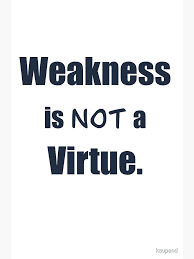
Coddled to Death—How the West Made Weakness a Virtue

Standard

My son complains that he doesn’t get paid enough for household chores.  He feels he is somehow entitled to everything that we’re giving him and more.  It is a struggle trying to explain why we won’t simply hand him all that he wants.  We have plenty, in his eyes, and can just share our wealth with him.  But the reason we hold back isn’t our greed or that we don’t want him to have the best life has to offer.  No, quite the contrary, in fact, it is because we want him to do well life that we resist the urge to coddle him.

What is coddling?

On the surface it is being overprotective and indulgent.  It stems from distrust of another other person’s ability to deal with normal life situations and emotions on their own.  And, while it may appear to be motivated by love or compassion, it only ever empowers those who keep the other confined to the bubble wrapped world.  It is the devouring mother, the one who uses their nurture as a tool of control.  They only care about the target of their efforts so far as it feeds their ego or feelings of self-importance.  It is a virtue signal and degrades those coddled.

Bigotry of Low-expectations

Along with thoughts about parenting and the goal, some of the inspiration for writing this came from the governor of the state of New York, Kathleen Hochul, who declared:

Young black kids growing up in the Bronx, who don’t even know what the word a computer is, they don’t know. They don’t know these things. And I want the world open up to all of them, because when you have their diverse voices, innovating solutions through technology, then you’re really addressing societies broader challenges.

Other than to call this statement what it is: Bigotry (or racism) of low expectations and patronization.  I’ll not pile on.

Many, like Hochul, are isolated.  They have not spent much time in urban communities nor met the people who live there.  From my own first hand experience her claim (which she now claims was misspoken) is absurd, none of the black I met were unfamiliar with or incapable of using computers.  Many of my acquaintances there could afford to go to college and more credentialed than I am, so where does this notion come from that they’re hapless ignorant people in desperate need of government assistance?

The answer, in this case at least, is that it is hard to maintain a bloated state budget (let alone greedily expand it) without somehow justifying it and what better way to do that convince people that they need you to get somewhere in life?

Condescending political elites are not moral paradigms and minority voters are not stupid.  I believe those pandered to know it is insincere and coming from someone who sees them as dumb.  But they also understand it works to their advantage and don’t say no to it.  We naturally take the path of least resistance and rationalize why we are deserving of the help.  By playing up the consequences of slavery and impacts of racial prejudice, a little wealth redistribution (looting or theft) can be redeemed as social justice.

Unfortunately, low expectations produces what it is supposed to remedy, it gives an excuse to wait around for a handout and kills initiative.  This contributes to racism in that it creates the impression that the only way some can compete is by lowering the bar or a double standard.  It diminishes the accomplishments of those who knew what a computer is without the help of those in the the benevolent class.  Now, because of politicians meddling, there is the question, did they earn it by being the best candidate or are they a diversity hire?

Woke is Weak

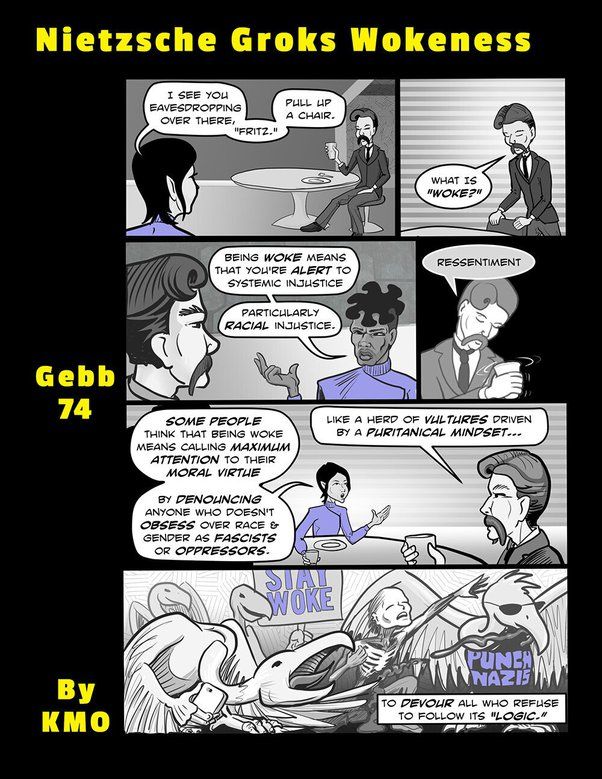
My conservative friends wouldn’t likely see the link between Christianity and wokism, but it is definitely there.  The woke glorify the victim and reframe accomplishment as unearned privilege.  For those who started a business, “You didn’t build that” they reason, and nullify the hard work and the sacrifice of those who followed the entrepreneurial spirit to success.  Likewise, in church we’re encouraged to tithe generously and be charitable since it is giving back a portion of all that is given to us by God.  The difference being that the woke want us to give to the government, the religious their own organizations.

And there’s nothing wrong with our helping those in need.  I provide for my son and my wife as well.  However, when I give I give to empower rather make them dependent and weaker.  My hope is for my son to grow his strength and ability so that in time he does not need me to survive.  And the same thing is true of my wife, she is my partner not my patron, we both contribute different things to the whole and neither of us is entitled to what the other gives to the relationship.  It is how a real community works, we give and take as necessary, and we do it for the good of the common project.

Wokism, by contrast, is motivated by envy and pity, it encourages fragility by marking off space spaces and enforcement of strict language codes.  Again, this strict regulation has a parallel in religious fundamentalism.  Home schooling parents are terrified of the influence of the ‘world’ on their children.  They, like the woke, overemphasize the role of the environment in the formation of the individual.  The one exempts swaths of the population from the normal civil expectation (while increasing the burden on others) and the other thinks salvation of poor little Johnny depends on them.  Bad behavior always blamed on an external influence rather than a lack of will to do better on the part of their designated eternal victims.

This is what Friedrich Nietzsche critiqued as being a hatred for life.  When we remove temptation rather than ever teach children to resist it—when we are constantly vilifying strength rather than encourage it—when we follow after reasoning or rationality instead of developing our instincts, we are promoting the weakness of our society and degeneration. 

Woke is weak.  It attempts to foster spirits of ressentiment and forms an identity around a person’s fear of being disenfranchised for things completely out of their control.  And in the end it destroys the incentive to find a way to overcome by our own means.

The Meek Shall Inherit 

Neitzsche could be accused of painting with too broad a brush for the dismissal of the Christian ethic as slave morality and an opposition to the powerful.

The message of Jesus and his Apostles was, in part, freedom from those human laws of “Do not handle! Do not taste! Do not touch!” (Colossians 2:21) and very nearly could be the “will to power” that the German philosopher championed once unpacked.  Hedonism wasn’t the goal of the departure from “slave-morality,” the aim was instead for people to exercise will-power and resolve.  In the same manner Jesus and St Paul preached freedom from the law that brought only bondage and death:

But now, by dying to what once bound us, we have been released from the law so that we serve in the new way of the Spirit, and not in the old way of the written code.

(Romans 7:6 NIV)

This is not to suggest that there is any kind of compatibility between the Spirit-led and the Übermensch.  Nevertheless, both would have us abandon a lower morality based on restrictions for a pursuit of our own ultimate form.  To St. Paul the Gospel means we are free from “the flesh” or the unbridled urges, while Nietzsche thinks we’re instinctively at our best, and both men are not opposed to impulse control.  The big difference is that the Apostle’s answer is spiritual whereas the philosopher says that additional layer is not needed and morality a hindrance.  Both would disagree devaluing the attitudes and culture that lead to success.  Being master of ourselves requires strength and never allows for excuses.  

Furthermore, the Jesus of the Bible wasn’t weak, he spoke with authority and we are told that he had power over all things, but he chose a meek posture rather than wield this power destructively.  Now it is a matter of faith if you accept this or not.  I could say that I could strangle Mike Tyson yet choose not to.  Talk is cheap.  But meekness is the ability to restrain ourselves.  Having the power to impose our will is always desirable, nobody wants to be at the mercy of the elements or other people.  However, sacrifice for sake of the next generation is better, to parent is to live beyond ourselves, that is why this is an instinct for those who have children, and it is the role of the Father.

When I wrestle with my son I don’t use all of my strength.  I would hurt him if I employed full power.  My goal is not to destroy him, he is not my enemy or threat to obliterate, but it is to train and strengthen him.  I restrain to protect him currently and also challenge to protect him in the future.  That is the real Biblical kind of meekness, it submission to the greater role we can serve as protectors and builders of civilization.  It is the having all things in balance, which Nietzsche might agree, and using our strength to take on the burden of creating the future.  We do not retreat from life.  Faith requires the we go headlong into the fight rather than hide or be ruled by resentment.

Late-stage Protestantism

I can understand the campaign Nietzsche waged against morality in light of wokeism and virtue signaling nonsense.  Apparently he was very well-versed in theology and did not find answers there.  Which is correct, it is not intellect that brings us life, study for sake of study is vanity, and truth is more in the practical telos than in some theoretical construct.  Nietzsche attacks rationality and reason as an end and those things do implode upon themselves when no longer grounded in a higher life-serving purpose.

The current ideological push for wokeism, and the mindless promotion of diversity, equity and inclusion at the expense of standards, merit or competency, is simply another step down the path of trying to eliminate all suffering and in the process destroying excellence.  I want my son to face some hardship, even if it is only artificial, because his striving will build strength.  It is the thought behind Proverbs 13:24: 

Whoever spares the rod hates their children, but the one who loves their children is careful to discipline them.

Or, as Nietzsche postulates in Beyond Good and Evil:

The discipline of suffering, of great suffering – do you not know that only this discipline has created all enhancements of man so far? 

In the same vein, in The Will to Power, he wrote:

To those human beings who are of any concern to me I wish suffering, desolation, sickness, ill-treatment, indignities – I wish that they should not remain unfamiliar with profound self-contempt, the torture of self-mistrust, the wretchedness of the vanquished: I have no pity for them, because I wish them the only thing that can prove today whether one is worth anything or not – that one endures.

No, I don’t want my son to be last picked for his dark skin.  And yet I also don’t want him to live in a world so sanitized that he’ll need to invent offenses (in the same way that an autoimmune disorder is the body attacking itself) then expects me to always step in on his behalf rather than face it.  Success in life requires some voluntary submission or suffering for sake of our goals.  Coddling and bigotry of low expectations does not serve the long-term benefit of children or civilization.

We need to discard this ugly paradigm of late-stage Protestantism.  There are great men, powerful and worthy of our respect, then there are those in desperate need of improvement.  We don’t help the latter by going soft and changing the requirements to make everything easier.  There is nothing radical or reforming about the direction the church in the West has gone.  This “have it our way” drive has led to a fracturing of the church, a consumerist mentality in worship and a new religion without obligation to the fathers or their commands.

Woke is simply the latest development in the direction.  It is the child with imperfect parents now thinking they know better and don’t need the silly disciplines of their parents to thrive.  Whether Anglican or Anabaptist, it is always about rejection of authority and the hierarchies established by the early church and originating with Christ.  We think we can do better, that the home is better if there is equal with no patenting or need for development of conscience.  In the end we get the complete agnosticism which goes further and to destroy everything the generations of faithful built for our good. 

Attainment and success doesn’t need to be made more accessible.  My son may think he deserves everything without effort, that we’re hoarding a kind of wealth just given to us and undeserved.  But that’s his ignorance.  There are no shortcuts to heaven and you can only keep the benefits of civilization if you continue to maintain the very foundation it is built upon.  We think that we will be saved by technology and the vague notions of progress of those who think power comes from the stroke of a pen—but that’s not how we got here nor is it a path to a better future.

God, Suffering and Salvation

Standard

I have complete sympathy for atheists and agnostics.  I’ve wrestled with questions my entire life and whether or not there is a God is always one of them.  But the one thing that I can’t understand is being angry about human suffering, from a rational basis, if God does not exist.  If there is no ultimate good, no greater purpose or meaning to life, on what basis do we make a moral judgment about suffering?

Okay, let’s back up a second.  I’m here at my local establishment drinking another Long Island, one of many since the death of Uriah, and it hasn’t given me an answer as to why he would die of cancer at twenty-four.  The medical diagnosis is simple enough.  He had cancer.  The aggressive kind.  It started with the lump on his ankle during boot camp.  I still have the picture on my phone taken out of morbid curiosity and never dreaming it was a death sentence.

Uriah and I, despite our difference in age, got along in a way that only cousins do.  He was like me.  We didn’t simply accept those easy cliché answers.  He was someone who was both determined and also full of doubts.  He was also the six-foot tall and better version of everything I ever was.  The best part was that I could claim some of his success for myself given that I had encouraged him to continue his college education, telling him that it was better to keep going than to live a life of regrets.

Watching Uriah sacrifice a leg only to have the cancer be found in his lungs a year later. It was a gut punch.  I think I stopped praying, at some point, because I just knew what the prognosis was.  

The hardest part, however, is that Uriah was not the first of his family that I had to carry out of the church on a cold winter day.  His parents had already lost one of their children to a seizure disorder.  His two other siblings are severely disabled and will need constant care.  Judy, his mom, is an incredible woman and has extraordinary faith.  Ed too has great strength of character.  And neither of them wastes any time feeling sorry for themselves despite losing the one healthy child they had to this terrible disease.

Where was God?

When my little Saniyah died, unexpectedly, it was a really big struggle for me.  It took me years to get my feet back under me again, spiritually and emotionally speaking, and I had both doubted my own faith along with the existence of a loving God.  The death of Uriah, along with my disappointments with those whom I put my trust in, and my long wait for Charlotte, have really tested me the past few years.  But, I have those who need me to be strong this time around and, for this reason, have had to push back against falling into despair again.

Nevertheless, I totally get why someone who has encountered suffering in a personal way is angry and denies the existence of God on this basis.  I mean why would this kind of pain and loss be allowed if there is an all-powerful good in the universe, right?  Why would God not intervene and stop this all rather than let us go through such terrible experiences?  It doesn’t make much sense, does it, that we should be left so lonely and struggling if God is good.

However, if we eliminate totally God from the equation, then we dismiss religious morality and must acknowledge that there is nothing written in the fabric of the universe that says our existence entitles us to good feelings.  I mean, as far as evolution goes, pain is more or less a survival tool, a feedback system to tell us what to avoid.  Feeling sad about the death of a friend or family member is, by this logic, a malfunction. 

In this harsh environment, where everything is out to kill us, why would we ever expect anything more than suffering?

The moral reasoning that makes this bad, if you are truly an atheist, is nothing other than a construct.  In terms of pure biology, it is good that fire hurts or we might burn our arms off.  That is pain for a very practical and utilitarian purpose.  Undeniably good if there is such a thing.  But what reasonable good is there in mourning those already dead?  No point in crying over spilled milk, right?  A totally rational being would simply move on to the next social resource and not be so attached or sentimental.

Being upset over suffering and death, if there is no God, is irrational.  And, if there is a God, like that of Christianity, then suffering and death are exactly what we’re promised in this life.  Sheesh.  Did you read the story of Jesus and how he was betrayed, beaten, and then unjustly killed in the most brutal fashion all as part of a redemptive plan?  If you actually believe in eternity then why be angry about a few years living out this rich narrative we call life? 

At the very least, how can we judge anything, especially a fictional character, on the basis of a moral standard that doesn’t exist? 

If there is no God, then there is no basis for morality either.  That too, including the idea that suffering is bad or pleasure is good, is entirely a construct.  Pain is good in some circumstances, it protects us from injury and causes us to change behavior in ways that are beneficial.  In other words, without the discomfort of hunger or thirst, we would not correctly prioritize our life.  Pleasure can be bad when it makes us eat too many donuts and become diabetic.  So how does one truly know that their own interpretation of these signals is the correct one?

From what I’ve observed in myself and in others, unbelief stems from disappointment when things do not go as expected.  It is about who is in control.  We can cling, in our own arrogance, to this notion that the universe should bend to our will.  Or realize that our own perceptions, based on senses which are not very reliable and a brain prone to making mistakes in judgment, are not infallible or ever actual truth.

The thing is we only ever know if suffering is good or bad if it is properly contextualized if we understand the end.  For example, feeling the burn of exercise is good pain because it is what accompanies muscle development and so we embrace this.  So what is the real context of our life?  To what end, or for what reason, did we become conscious?  What is behind this ‘accident’ if it is one? 

How do we contextualize our existence enough to judge what is good or bad?

If there is such a thing as an eternal reward, that would change the calculus, right?  It would mean that all pain can be gain, and all suffering can draw us closer as much as it drives us away because defining the moral character of any experience depends on the end.  I am willing to subject myself to many hardships if the reward is big enough.  No, this doesn’t take away the question of why we must go through here to get there.  But seeing past our immediate feelings is pretty much the only way to make progress.

Angry is a feeling, not a guide for life…

I was at this time living, like so many Atheists or Antitheists, in a whirl of contradictions. I maintained that God did not exist. I was also very angry with God for not existing. I was equally angry with Him for creating a world.

C.S. Lewis

People don’t walk away from Christianity for rational or scientific reasons.  Sure, they may guard their emotion-based unbelief behind a wall of post hoc justification.  But the reality is that they’re upset about something.  They had expectations and are now disappointed and acting as wounded people do.  It’s just strange that anyone at all Biblically literate would suddenly lose faith over our suffering when that’s literally the only we’re promised in this life.

What really doesn’t make any sense is why anyone would rather suffer with no hope at all of eternity.  If God is dead, then nihilism is the logical next stop and that life has no real meaning or purpose.  But the suffering does not go away simply because we’re angry at the giver of life.  No, it will only intensify and become a spiral of despair.  Our salvation is in our understanding that, smart as we may think we are, we’re truly quite ignorant and even our most ‘concrete’ reality is not real:

The first gulp from the glass of natural sciences will turn you into an atheist, but at the bottom of the glass God is waiting for you. 

Werner Heisenberg

For those who don’t know who that is, Mr. Heisenberg was awarded the Nobel Prize in Physics, in 1932, for the creation of quantum mechanics.  Materialism, despite the zombie corpse of this thing staggering on, died with the discovery of things in defiance of this entirely too simplistic conception.  Sure, this kind of physics is well-beyond most, but it does support a notion of reality that requires a Universal Perceiver (as described in this article) and we could call that God.

So, if you’re actually serious about science, then the hard science of physics is the place to start and, with its mathematical origin and proofs, is much less likely to be clouded by emotion one way or another.  We can’t run from God.  But we may need to leave behind the baggage of our own misconceptions and learn the value of true repentance.  Maybe Uriah died, and went to his reward, so some of us would have our flawed thinking broken and seek our salvation in Him?

Maybe some of us are just too stubborn, or too needing of control being in our own hands, to admit we can’t save ourselves?

I’ll tell you this.  The universe, without God, is an infinitely dark and lonely place.  It is that starring abyss of which Friedrich Nietzsche warned, the existential horror H.P. Lovecraft describes.  Highly intelligent men, both of them, and understood the implications that come with true unbelief in God.  You will not escape your suffering simply by denying that the Divine all-powerful good exists.  No, rather you will just remain in that hell of your own creation.

Postscript: Questions Remain

I still grieve Uriah, as I do Saniyah, uncle Roland, and others that seem to have been taken before their time. I’ve long struggled against sources of trauma much more basic, the lack of unconditional love in the church that could make up for my shortcomings, and much of that is unresolved. At the time of my writing, the impossibility is something yet to be fulfilled. I do not have answers for any of this nor do I expect to. I’m not the arrogant kid who argued with his high school biology teacher, not a Bible-thumping fundamentalist at all, and yet must believe.

Let the Seed Fall!

Standard

Some might wonder why I have such a visceral reaction to wokeism.  I have written a few no holds barred blogs trying to warn people of what this is and where it invariably leads.  But each time I write it feels as if my concern is not well-explained.  I mean, I know some probably read and ask, “why is Joel attacking these well-intentioned people?”

However, I’m having a moment of clarity and therefore will try to expound on why it is absolutely necessary to shock people out of their stupor.  The reality is that wokeism (or grievance culture) and religious purity culture are two branches off of the same tree.  Both patriarchal conservative men and those angry pink-haired feminists are trying to create a world without suffering.  Both, tragically, create more problems than they solve.

First, what is purity culture?  

As I experienced it, in the conservative Mennonite context, it was a branch of Biblical fundamentalism (Protestantism) that had been grafted in to the Anabaptist tree.  It was a legalistic perspective.  The pure life was to avoid vice (no drinking, dancing, going to movies, etc) and remain completely a virgin until marriage.  It is not that the aim is entirely bad, but there was also a lack of grace accompanying this perspective.

In other words, there was no room for failure.  It a hellscape of unchecked perfectionist tendencies.  People who should be diagnosed as having obsessive compulsive disorder (OCD), along with other mental illness, viewed as being virtuous.  And the rest of us struggling to meet an unreasonable standard without the actual spiritual help we needed.  

For example, girls who thought they were ‘defiled’ for simply talking to a guy that they didn’t intend to marry.  And heaven forbid you did date and break-up.  Then you were damaged goods.  Cursed to walk the earth, like Cain, a stigma tattooed to your chest, a scarlet letter.  

To those steeped in this religious purity culture it was about saving the next generation.  It was a reaction to a world of promiscuity and failed commitments have produced far-reaching consequences.  And yet, while it does work for some, those who check all the right boxes, it permanently marginalize others and gives them no real road to redemption.  Divorced and remarried?  Tough luck, you’ll need to break up that successful loving family to become a Mennonite.

That’s the purity culture I know all too well and, for reasons I’ll get to later, have fully rejected as being unChrist-like and spiritually void.

Wokeism, despite the vast difference in appearance to what I’ve described above, is another subset of purity culture.  It is a reaction to the ‘privilege’ of those who better represent the cultural ideal.  It is another form of utopian idealism.  

Whereas the latter religious variety of purity culture believes that if their children only kiss one person, never experience the pain or disappointment of a break-up, then heaven will come to earth—the ‘woke, by contrast, believe that if everyone was forced to tolerate their ugliness and embrace their toxic grievance; if they could live free of further offense, then they would be fulfilled.  

Both forms of purity culture are offshoots of Western values.  They both see suffering as a flaw in the system and try to eradicate it through their own means.  And they do have their valid points.  No, the girl, the victim of sexual abuse, who (because of her loss of self-worth) goes from one guy to the next, should not be called a slut.  But, that said, nor should her unhealthy coping behavior be normalized.  Instead, we should stop seeing people as damaged goods because they failed to reach some sort of phony cultural ideal.

The truth is, the woke, as much as they attack whiteness.  Or the feminist who acts aggressively and looks to a career as being freedom.  The patriarchal father, as much as he claims to be protecting.  Are all the thing that they despise most.  Religious purity culture, sadly, is hypersexual in focus and produces conflicted men like Bill Gothard, Doug Philips and Josh Duggar.  Feminism amounts to a form of female self-loathing that unwittingly idealizes the male role.  And so-called social justice is simply a means to manipulate and enslave another group of people.

All of them assume that if a person could simply avoid pain and bad experience they would find their completeness.  All seek a kind of perfection outside of Christ and very quickly, despite their wonderful intentions, turn into a dystopian hell.  

What is wrong is this idea that pain us is less for our good than pleasure.  The religious, ignoring the lesson of Job, neglecting what Jesus said about the tower tower of Siloam or the man blind from birth, see suffering as a sign of God’s displeasure and a punishment.  Likewise, the woke want to be embraced without repentance, if they would simply be called clean then they could finally escape their terrible anguish, right?

The truth is, bad experience is part of life and as beneficial as the good.  Growing up in a single parent home can be an excuse or a motivation to do better.

This is what makes the story of Jesus so compelling.  Unlike us, he was completely innocent, his intentions were pure and should have been loved by all.  But, instead of embrace him, his own people saw him as a threat, he would undermine their system and perspective, show them for what they were, thus had to be eliminated.  That he was executed with criminals would seem like a humiliating defeat.  He suffered and died for what?

The tree of life.

However, it was in this suffering that salvation came.  Sure, the burden of the cross comes with anguish.  We would rather seek pleasure and avoid pain.  However, in Jesus, the cross is transformed from being a brutal instrument of death into a well of eternal life.  How?  It is in the same way that a seed falls to the ground, is buried and leads to new life.  

Why would we cling to the seed or refuse to let it be buried and prevent the tree?

The overprotectiveness of religious purity culture, the refusal to acknowledge our brokenness and need of transformation of wokeism, both try to find salvation by human means.  One seeks to impress God, like the rich young ruler or proud Pharisee, whereas the other (like Cain) demands that God accept their unworthy sacrifice and then murders their righteous brothers.  Both need Jesus.

The wonderful cross

In conclusion. We’re all damaged goods and can be made more beautiful than ever through repentance. Jesus can make our pain as much a joy as our pleasure.

Ken Metzler — A Tribute to the Unsung Heroes

Standard

In the world of sports there are the stars and then there are the role players.  The stars get the attention, the glory, while the role players work quietly behind the scenes, and yet would Michael Jordan be famous without his supporting cast?

This past week one of those supporting cast men died after becoming infected by Covid-19, having succumbed on Tuesday of this past week, on the same day as another regular during my growing up days, Lenore Miller, 89, who loved to use testimony time at church to sing, and passed after becoming ill of the same disease.

John Kenneth Metzler, 82, better known as just “Ken,” had been in poor health for the past decade and really seemed to be living on borrowed time as it was.  He was born in 1938, February 15, in Lancaster County, the faithful husband to his wife of 60 years, Arlene, and proceeded in death by his daughter Brenda.

I almost didn’t write anything about Ken.  I mean, the Mennonite denomination is my past and Ken was simply Ken.  A deacon in the church.  But an awkward and common man.   He ran a muffler shop for years, lived in a little ranch house beside it, drove a Chrysler minivan for years (completely practical like him) and spoke with his totally unsophisticated dutchified drawl.

Not really the kind who gets invited to speak in front of the crowds nor mentioned as someone noteworthy, and yet someone always willing to serve.

I’ll admit, as a teenage punk, who knew nothing and prioritized ‘coolness’ over substance of character, Ken was annoying for his self-effacing style.  He would literally apologize for himself while sharing a devotional, for his lack of education and many shortcomings. 

He also held some odd views, like the time he confessed to enjoying the comics page and acted as if it was some sort of terrible transgression.  He would also, while teaching youth Sunday school, ask questions that would be more suitable for kindergarten students, which would leave everyone confused thinking he was asking rhetorically and him frustrated (or “fuss-trated” in his persistent Lancaster dialect) thinking we weren’t paying attention.

But in the end? 

Ken was a man with a golden heart, who became more and more endearing as I matured and, despite his slightly stooped posture, had all the true qualities of a hero.

There are plenty of flashy Mennonites, big fish in their small ponds, who act as “missionaries” or “evangelists” and are roundly praised for their efforts.  Many of them have the perfect hair, the superior intelligence, the pedigree and popular families.  They travel to the exotic places, some have the academic credentials too, they have the wealth (or access to resources) and reputation for their wonderfulness.

Ken had none of that pomp and pizzazz.  He wouldn’t want it even if he were capable.  Instead he, slow and steady, like the persistent tortoise compared to the haire of children’s book fame, he worked mostly unrecognized for the good of others.  If it was to cut someone a break on a repair bill at his shop or consistently running the canned goods distribution, you would hardly have noticed his contribution. 

When crowns in heaven are distributed, I believe there will be many surprises.  But it will not be a surprise to me if Ken received a reward bigger than that of the known names.  No, he did not lead the church outreach, but he supported it wholeheartedly, and remained long after the charismatic movers and shakers chased after that next new and exciting project.  He stayed, stayed true to his commitments, and is a hero in a world full of vain and self-serving ‘good’ men.

Ken also died as he lived.  He could have, given his poor physical health, cowered in fear and never left his home. Nobody would have criticized him for doing this, he was clearly in that most at risk category and could not be faulted for hiding out the pandemic.  But then why miss out on life when you already know that your days are numbered?  He got out instead, remained a part of the community, and that is a choice that I respect—even recommend.

Ken’s death was not a big surprise to me.  My initial reaction when I heard he had been at church when a visiting chorus was there, basically a Covid super-spreader event, was to think, “oh, Ken,” and question the wisdom. 

But, on second thought, Ken made the right and heroic choice.  Ken knew that risk of death isn’t a reason to stop living.  He had been on death’s door before and made a deliberate choice. 

Ken, unlike many in this age, understood life is difficult and every day is a gift.  He may have lived a year or two more, possibly, but was not long for this world by any reasonable assessment.  Sure, he likely suffered, he spent his last days alone because of nonsense policies created by administrators, but he was a man who never had it easy and lived a life of faith and sacrifice.

Real heroes don’t wear capes or live in the pages of comic books, most of them do not die in some grand saving-the-world deed, many of them pass unnoticed. They quietly play their role, in the background, until it is time to go home.

No, Your Faith Will Not Spare You…But God Is Still Good!

Standard

There are many things largely forgotten in history, one of them a horrendous tragedy that took place on June 15th, 1904, near “Hell’s Gates” on the East River, which would forever change one ethnic community in New York City, and that being the General Slocum ferry disaster.

What had started as an annual church excursion of German-Americans, mostly women and children, from their community in the city’s East Village to Long Island, ended with terror and over 1000 deaths. The poorly maintained boat caught fire, while underway, fire fighting equipment failed and the wooden craft quickly became an inferno.

Helpless mothers, unable to swim themselves, especially not in the heavy clothing of the time, put life preservers on their children only to see them sink like rocks into the river as the cork in the flotation devices had degraded. The Captain, likely trying to avoid causing a more devastating fire on shore, decided to head for some islands, into the wind, which only made the wooden ferry into a blow torch before it fell apart.

The result of this hell on earth was the eventual dissolution of the German-American community in New York City and one can only imagine the personal torment this left for the survivors and the fathers and husbands left behind.

My worst nightmare is not being able to help those whom I love. I had, in casual conversation with a psychiatrist, been told that I showed symptoms of PTSD after the unexpected death of Saniyah and judging from my current awful feelings and tears right now, from writing this, I would guess that they were right in their analysis.

If only seeing someone I loved deeply wail the loss of their daughter could rip the fabric of my being to such an extent, I can’t even begin to imagine what seeing them roasted alive would do. Lord have mercy!

My Covid-19 Mini-Crisis

Being raised in an American culture that too often confuses health and prosperity with God’s favor, the idea that someone that I love could be felled by a virus seems obscene. But, faith, right? Shouldn’t faith prevent my family members and loved ones from dying prematurely from a virus?

But it seems that the truly Orthodox have no such delusion. True, Fr. Seraphim expressed his belief that one cannot become sick through their participation in the body of Christ. However, even still, that does not preclude the possibility of our becoming sick during the fellowship and interactions afterward, does it?

It was in the contemplation of father’s words that I ran across the story of early Christians who, unlike their pagan neighbors who fled, deliberately went into harm’s way to attend to their plague suffering neighbors. They attended to the sick, taking the illness upon themselves in many cases and succumbing in as much agony as anyone else.

How could this be?

Did their faith mean anything at all?

My own thoughts continued an ongoing internal discussion about the evidence (or lack thereof) for a God that actually cares. In my American-tinted perspective, they should have been protected from disease to prove God’s sovereignty over all of creation and show the truth of their Christian testimony, that’s only logical, right?

I can’t claim to understand. All I know is that many of them died, yet the stories of their extraordinary faith spread throughout the Roman world and you can still read of their testimony even in Foreign Policy articles published in our time. They died and yet they also demonstrated an example of love that has lived on to this very day and have defied my own logic in that.

We have but one life to live, all people die eventually, yet it is said that all people have two deaths: The first death being their physical death, when their body is put into the grave. Then a second ‘death’ at some point in the future when their name is said for the last time. And, I would argue that, in that light, those who, in faith, sacrificed their lives for their neighbor’s sake have actually outlived those who fled in fear.

It turns out that the Christ of Christianity only ever promised a life of suffering for others to those who would follow him. The ‘faith’ of those seeking health and wealth is shallow and will fall apart in times of crisis. But true faith lives for the good of others, despite uncertainty and fear, the proof is not in their own health so much as their faithful and lasting impact on the world.

No, your faith will not spare you, but if you live in love you will find God waiting on the other side of your suffering.

Crisis averted.

How I Have Seen God At Work

This may be a strange way to make an announcement of sorts, but I’ve never professed to be anything other than strange. I mean, I’ve tried to act normal, yet it never seems to work out for me. And so I guess I work with what I’m given, right?

Anyhow, I mentioned a bhest in past blogs, including my last blog, and haven’t really explained what bhest really means.

Right now, on the opposite side of the world from where I am currently writing, lives a beautiful flower, her name is Charlotte. I found her in a moment of great faith, when my life remained consumed in my Mennonite identity and struggle with the father of a young woman, and had agreed to participate in her life as only an encouragement. She had moved to Taiwan, from her mountain home in the Philippines, as a means to support her son and secure an annulment from the father of her son.

Given her marital situation (along with my Mennonite and purity culture priorities) and my continued faithful pursuit of the impossibility, I told her that our relationship would have to remain platonic (which is something she allowed without any protest) and offered to be her encouragement. My commitment was to show her that someone still cared about her life, despite her being separated from family and not having anyone else to turn to at the time. At the time I was also on the road, away from home, so I understood the loneliness that comes with separation from family and friends.

There was a bit of a pattern that developed. I would be her faithful wake up call, to wish her a wonderful day, but later (with the stress of a high-pressure work environment and conflicts with coworkers) she would come back online with the crying puppy emoticon, which was my signal to get to work, and I would make it my mission to cheer her up again. Soon, by whatever miracle, I would have her laughing and smiling again.

At some point, pretty early on, she asked me if it was okay if she would call me “Bhest” and (after a momentary hesitation to consider the potential damage of letting her use a term of endearment in our context) I decided to give her permission. It is a term that I had no idea what it meant really then and still am not entirely sure. But, eventually, it felt dumb to let her be alone in using that term, there was no term and thus she too became my Bhest.

Bhest, according to Charlotte, meant this: “the very best best person, who is my friend, who is always beside me, to pray for me, advise me, cheer me up and who really shows care for me.”

Bhest, best explained, is a word mystical in meaning, has become a sort of joint identity and not something my words can easily explain. But I do know that it stands for a commitment to care. And, when my own road reached an end in the Mennonite church, like hitting a brick wall, it was the hand of my bhest reaching through, telling me in a moment of suicidal darkness, “if you go, take me with you,” and demonstrated a level of commitment to me even greater than my mother. It was then that I decided to stay to serve this lost sheep that I had found and if only for her good.

Charlotte’s happiness, I decided, was worth my suffering through another day of this life. The seed of faith that I gave to her months before, in my pure concern for her, grew into a limb that I could hold onto until my own feet again. She was the one who told me to “be strong for her” and gave me the courage to walk through the doors of Holy Cross, in Williamsport, on the road to my Orthodox conversion. And it was Charlotte who finally gave me that reason to no longer be “thirty years old living in Milton” (as the faithless alternative explained) and compelled me, months later, to board a Boeing 747 headed for the other side of the world.

Bringing This to the Present

There is so much I could say about Charlotte and her son. So many moments, from profound moments of sadness together (after the murder of her uncle Roland) to those of our greatest joy and many others somewhere in between. Her family has embraced me, reposed uncle Roland especially, welcomed me with open arms, and made me feel right at home twelve timezones from my current residence. I honestly felt like I had experienced a taste of heaven in Baguio City and in our various excursions.

Now that country, like my own, is experiencing the same Covid-19 lockdown (albeit stricter than my own) and our hopes for the future are overshadowed with even greater uncertainty than before. But at least Charlotte is stranded, for once, with her son Ydran, whom she loves deeply despite being separated from him for years. He’s a real handful, a biter when I met him (who learned quickly that, unlike his grandma and aunts, I bite back), and has since matured to a bright (while still completely energetic) eight-year-old. His wide smile always welcomed me and I’ve missed him since our first meeting.

More recently, due to his history of illness, and a recent bout with pneumonia (he’s still coughing), along with the spread of Covid-19 worldwide, along with my own struggles due to some history of my own mentioned earlier, it has been exceedingly difficult for me to rest easy and trust God in this moment of chaos.

In one of my silly, more romantic moments, after Charlotte watched one of my favorite movie classics, “The Last of the Mohicans,” I recited to her the words of Hawkeye, “You be strong, you survive! You stay alive, no matter what occurs, I will find you! No matter how long it takes, no matter how far, I will find you!” Which was a promise said with a little smile and laughter, nevertheless pretty accurately represents the commitment that I’ve made to her. I’ve nearly had to make real on that once when she called me after almost being abducted by two men, while in Taiwan, and our current situation has left me wondering what extreme measures might be necessary to bring her here to my side, with her son, our son, Ydran?

As of today, upon the request of Ydran (a shortened version of his full name, pronounced Eee-drun) himself, that I will begin to call Ydran my son. I had worried a few months ago whether or not a young Igorot boy, with his own biological father, would ever accept this goofy overwrought religious refugee American. But we hardly even speak the same language yet (although he was actually using sign language today and will likely learn English far quicker than I learn Tagalog and his tribal tongue) and yet he has asked me if I could be his father. *gulp* I really didn’t know how to express all my excitement, he had completely preempted all of my preparations for the future where I would need to explain this, where I would have to walk gingerly to avoid undermining the man that is his biological father, and now I do not have to worry about that.

Prayer answered.

And, speaking of prayer, unprompted, Ydran, after all that, requested that I lead the prayers before he went to bed. So, being as Orthodox Christian as I know to be, I gathered myself and my phone, we went to the prayer corner of my house and led in the Lord’s prayer before praying for our future together, that it may come quickly and that he can remain healthy until then.

Dreams and Prayers

I have big dreams of what to do as a father with his son. But I also have a fear that hangs over me. My own life has been full of hopes ripped away from me right at the time when I thought things were in the clear. Now, before I can have my happy and simple life, with a little broken and repaired family, there is this monster called Covid-19 lurking in the darkness. I have full awareness of the terrible tragedies that have cut down the faithful and heathen alike, sometimes on a bright sunny day, like that day those German-Americans boarded General Slocum before their final hellish terror.

However, come hell or high water, I am determined, as determined as I am to pursue impossibility in faith, to not live my life in fear. I believe that God exists and that God is good because I have not alternative. I believe in God because without God there is no good. Logic and reason cannot explain away the feelings I have for my precious Bhest and her livewire son. Even if we are cruelly kept apart for many more years, due to legal nonsense or plague, I know we will be together again and someday soon.

May God have mercy on us!

Only will tell if my dreams for this life will ever come true. It is easier for me to predict a global pandemic than to know if my next few days, weeks, or years on this planet will be happy or harrowing. Maybe my battered faith will finally meet its match, in something awful yet to come, and my hopes finally drown in a sea of despair. Nevertheless, as long as I’m alive, let my hymn be this: “Let Thy mercy, O Lord, be upon us, as we have set our hope in Thee.” And, in the perilous days ahead, may I cling all the more to the words of St Paul:

“Who shall separate us from the love of Christ? Shall trouble or hardship or persecution or famine or nakedness or danger or sword? As it is written: “For your sake we face death all day long; we are considered as sheep to be slaughtered.” No, in all these things we are more than conquerors through him who loved us. For I am convinced that neither death nor life, neither angels nor demons, neither the present nor the future, nor any powers, neither height nor depth, nor anything else in all creation, will be able to separate us from the love of God that is in Christ Jesus our Lord.” (Romans 8:35‭-‬39 NIV)

P.s., Y-dran, like his father, is also a fan of Dunkin donuts, which they do have in the Philippines, so the apple really doesn’t fall far from the tree!

Struggle, Meaning of Life and Suicide

Standard

In the early hours of a Sunday morning, I was lying in bed, engaged in a conversation with an old classmate, now living in New Zealand, about the drug overdose death of someone familiar to both of us and what it says about the times we live in.

The dialogue itself, scattered about my morning routine, was an example of the unique pressure of modern life. Our discourse continued, in fragmented text message form, one of us going to bed soon and the other starting their day, past my short nap, beyond my morning shower, on the way to church and ended only as I entered the sanctuary for worship.

My “smartphone” allowed me a level of connection to someone on the opposite side of the world that was impossible a generation ago. And I am glad to be able to maintain this relationship despite the distance and for the electronic tool in my hand that allowed me to do this once unimaginable feat with ease. But this device also deprived me of some extra sleep, it often interrupts my most private moments, distracts me while driving, and does not allow me to be singularly focused. It comes along to work, to the gym, while I’m out dining, and visiting friends, and is almost impossible to control.

My grandpa had morning chores—mundane physical tasks like feeding animals, milking a few cows or shoveling manure. And grandma too—she would, in the wee hours of the day, go about making breakfast for her working man and the family clan. But they likely did not (at least not frequently) get a surprise visit from a former debate partner (geared up for a discussion of weighty matters) while they were in bed and still seeing double.

So, what did we discuss?

The rate of drug overdoses and number of suicides have risen dramatically over the past few decades and for poor middle-aged white men in particular. Several of my former classmates have now become part of this statistical category and, sadly, their stories are being repeated over and over again across the United States and especially in rural areas. The suicide rate for African American men has actually decreased over the same time period, which has led to some speculation as to why this is the case.

My left-leaning friend speculated this is a product of eroding “white male privilege” and yet all the cases that I am familiar with involved men who were, since childhood, as disenfranchised as anyone by the current system. There was never an erosion for them because they never had this imagined privileged status, they grew up in predominately white communities, from working-class homes, they didn’t go to college, they couldn’t seem to get out of their rut of low-paying jobs, relationship drama or financial woes, struggled against addiction and depression.

No, while true that white men are not a protected class and some do endure a significant amount of bullying and are just expected to take it, I do not see this as the real issue. Men in prior generations went into mines, labored hard under the sun, endured the terror of war, worked long-shifts on the assembly line and all without the help of a psychiatrist to tell them how to feel. They were just supposed to suck it up and keep going, against the odds, for the good of their communities and families—which is exactly what they did.

What has changed?

A more likely explanation for the increase in suicide and drug abuse is a combination of factors rather than one—the evaporation of economic opportunity and dissolution of the family unit and communities, along with the hectic pace of modern life, playing primary roles in the epidemic. A couple of decades ago decent paying manufacturing jobs were plentiful, the community was strong (usually with a local church as the nucleus) and the world’s problems were not constantly being shoved in our faces in a 24-7 on cable news, social media, etc. There have been big changes in rural America and some are impacted more than others.

The media deluge…

In the 1990s Ted Turner’s CNN was a novelty, the breathless reporting of alleged atrocities used to sell the American public on the Persian Gulf War, and only a foreshadowing of the media deluge to come. Two decades later there is almost no escape, there is no time anymore to process the information assaulting us from all angles, and the coverage is by and large negative.

Then there is the explosion of social media. It is a world where we primarily see the highlights of the lives of our friends and skews towards a positive presentation—because nobody wants to be that person.

This alone doesn’t drive anyone into depression and despair. But it certainly can help to feed feelings of isolation, it can never replace in-the-flesh social interaction, and could leave a person feeling overwhelmed. I mean, how can we not be influenced by this endless stream of information? It is a far cry from the time of our grandparents when yesterday’s news arrived in print form and the only scandal that really mattered was that juicy bit of gossip overheard on the party line.

Could it be that we aren’t built to take in the world all at once?

Could it be that we are reaching our capacity to handle and that the most vulnerable are first to fall down under this load?

We should consider the increase in suicides and drug overdoses as the “canary in a coal mine” and an indication of something very wrong in the air of our current culture. Where some have been overcome by the noxious fumes there are probably many more who are gasping for breath or in the beginning stages of hypoxia and need to be guided back to fresh air or they will soon also perish. An overdose of bad news and fear-mongering propaganda won’t take a strong person down, but it might be enough to push the vulnerable over the edge.

Working more for less…

Twenty years ago, in the towns around where I grew up in (prior to the NAFTA disaster) the wheels of industry were still turning and a blue-collar worker could easily make $20/hour or more working a factory shift. Yes, the cracks of outsourcing where beginning to show before this, the domestic steel and auto industry collapsed against cheap foreign imports before then, but it was mostly big urban areas like Detroit and Baltimore that felt the pain. We still proudly produced furniture, paper, bread, cable assemblies, and various other products before these businesses were shuttered.

However, since then we have felt the full brunt of trade policies that primarily have benefitted globalist elites. Since the 1990s, dozens of factory doors have closed in my own immediate area and nothing came to replace them. Well, nothing besides more low paying retail jobs—shopping centers springing up in the same lots, literally, where many men and women once made a wage where they had a chance of economic advancement. The idea that everyone could simply get some additional education and become a computer programmer or a professional with a bachelor’s degree has become the out-of-touch “let them eat cake” statement of the modern era.

Wages have stagnated in a time when costs in housing, healthcare, education, and housing have skyrocketed. The cost of college, for example, has gone up at eight times the pace of wages, in 2016, home prices increased at twice the rate of inflation, and we now spend thirty times what we did for healthcare a few decades ago. And again, this is a change the predominantly white working-class men who, unlike many others in the economy, have no control of their wages and, in addition, are often in direct competition with illegal immigrants for the same jobs. There is no professional licensing to protect the jobs of the yard guy or the drywaller—thus they are forced to work more for less.

Only the wealthy elites and beneficiaries of the welfare system have come out on top. For those taught that their value is in their ability to provide for their own, who are unable to compete in the academic or intellectual realm, prospects can indeed be very bleak and especially when coupled with other factors like failed relationships, lack of community and loss of purpose. It is no surprise that in this environment more are turning to the various means of escape available to them—with suicide being the ultimate expression of their deep despair.

Life without purpose…

The one place where rates of suicide are higher is amongst those who are part of the Native American population. This, coupled with substance abuse, has been a tragic outgrowth of the reservation system for many years and underscores the problem of a purposeless existence. There is not much to do on a reservation. The land is rural and very sparsely populated, the opportunities for gainful employment are extremely limited, basic needs are often subsidized by the government, many succumb to feelings of boredom and/or isolation and decide to end what seems (from their perspective) to be a purposeless life.

I believe the circumstances leading to higher suicides on reservations are very similar to that of many non-Natives living in rural areas. We all have an idea of what we are supposed to be, we have religious and cultural expectations to live up to, but not all are able to overcome the obstacles between themselves and these higher aspirations. Perhaps they were born into a dysfunctional home, sexually abused, are less naturally gifted than their peers, born in a time of declining wages and are unable to compete in the market or attain their life goals? Failure early on can lead a person into self-defeating cycles, especially when there is nobody intervening to help overcome them, and the result is depression, substance abuse, etc.

Men, at least in rural America, are expected to be the “breadwinner” for their families. Those who do not provide are disparaged as “deadbeat dads,” he cannot simply abort his bad decisions, and will be on the hook financially long after his fifteen minutes of fun is up. It is a matter of Christian conscience, the Bible says that a man who does not provide for his own “is worse than an infidel” (1 Tim. 5:8 KJV), and is a standard that is embedded in our laws. And, truth be told, most men don’t need to be told that their children are their own responsibly either. So, naturally, it is no small thing for men conditioned this way to underperform or fail at their duties.

Men unable to provide adequately (according to cultural norms) for themselves or their families will struggle to find great purpose anywhere else. And while there is the “welfare queen” pejorative to describe a woman who fraudulently games the system, women were traditionally dependent on men to provide financially and there is not nearly the same stigma for a woman who is unable provided financially for her own needs. Things may have changed elsewhere, but in rural America, a man who doesn’t pay child support, even for children he is rarely (if ever) allowed to see is considered to be worthless and a bum.

Relationships are less stable than they were when marital commitment meant something and yet, in a time of wage stagnation, men are still expected to carry the financial burden. The purpose religion once brought men (beyond their work and family) has been under withering assault for many years now, but the yoke of moral responsibility has not faded away and leaves many to struggle in the wilderness alone. So it comes as no surprise when men, surrounded by dysfunction, deprived of their purpose and absent of any real help, could see death by their own hands as something honorable.

From an article about veterans returning to ‘normal’ civilian life:

Now one was looking for work in Wisconsin, one had killed himself, and several had returned to Afghanistan to get back into the fight. Most of them wanted to be back there, in their own ways. Like so many vets, they missed the camaraderie. And as with so many vets, their lives at home were defined less by togetherness than by isolation, which took on many forms. Dodd was in Kansas City making aerospace bolts and smoking weed on his breaks to stave off the stress of “dumb-ass civilian questions.” Simpson was working the phones at a call center for the Department of Veterans Affairs, talking to vets who wanted counseling or benefits or sometimes nothing at all, other than to talk with another combat veteran.

Men would rather be in a literal war than alone and stuck in a purposeless life.

Lack of community…

The collapse of community is one thing my left-leaning friend did seem to strongly agree on as a possible explanation for the epidemic of drug use and despair. His definition of community tended towards civic engagement and mine went in the direction of religious involvement, but we both agreed that this is something essential. And that community, real life “in the flesh” community, has been on a precipitous decline and especially in rural America.

This is the trend even in the conservative Mennonite culture I was born into and spent many years of my life. Guilt-driven church attendance may be holding steady, there is certainly more involvement there than in some other segments of society, but there has definitely been a big change in my lifetime. Sunday evening visits became far less frequent, more parents choose to homeschool their children rather than risk other schooling options and the church community has more or less devolved into a conglomeration of cliques. Of the dozens who called me “brother” over the years, as part of religious ritual, only a couple (primarily one family) have checked in to see how I’ve been doing.

A community is one of those underrated privileges. It is a place where you are missed when you’re gone, where a person can live with far less material wealth and still be happy having their place in the social fabric. Even a slightly dysfunctional community offers protections, a social support network, for those that are a part of it and the individual members are all stronger as a result. Communities take many different forms and can center around many different things. It can be as simple as a group of friends who care about each other and do things together. It can be a military unit that is compelled to do drills together, who eat, sleep and live as a group, and where comradery is encouraged.

In rural America, in the past, the church was often a center of a community, a place where people got together for worship, to make perogies together and share each others’ burdens. Church attendance has been in steady decline, “nones” now constitute the largest religious group affiliation, and with this, there has been a parallel decline in mental health.

And organized religion isn’t the only dwindling expression of rural community, volunteer fire departments are having difficulty filling their ranks—people are too busy with their other obligations and do not have the time.

People also have fewer close friends than they once did according to a recent study, in the time between 1985 and 2004 Americans have gone from an average of three close friends to only two, and this implies a shrinking support network.

The increase in social isolation cannot be good for those already vulnerable.

A profile of a vulnerable person…

When I saw a friend request from “Adam Bartlett” it was a name that I recognized immediately and accepted without hesitation.

Adam was a grade below mine in school. He was one of those anonymous in a crowd people, average height, not particularly athletic or anything, friendly enough, and not too different from me other than my being Mennonite. We both went out for football the same year, he quit the team early (which, in my teenage mind, made me think of him as a quitter) and that is pretty much all I knew about him—there was a gap of twenty years before I heard from him again.

It was not too long after connecting on Facebook that I received a message from Adam. We chatted briefly about a mutual acquaintance, my being off work because of an ACL tear, a shared interest in firearms, how he wanted to reconnect with “old friends” because he had few friends anymore, I offered the next weekend might be a possibility and left it at that—we never did get together the next weekend despite my offer and his interest.

However, a month after that he messaged me about his financial woes. He was upside down in his car payments and was hoping that I could help him out with that. I felt bad about his situation. But, I was not in a position to purchase the vehicle and was not very interested even if I did have the extra cash. It was in the course of that discussion where we ventured a little into his relationship problems, he told me his wife stopped paying bills without telling him and things would soon go from bad to worse.

In our next exchange, he asked me for a place to sleep. His wife had moved back with her parents and he told me he was not welcome to stay there. Of course, being that we had just got reconnected, and also considering that I was on the road all week in the truck, I was leery of having him live in my house alone. Still, he definitely needed help. I decided, rather than have him move in, to pay his security deposit and the first month of rent instead.

He accepted this solution. We met a few days later in the Big Lots parking lot where I handed him a check for his rent.

Then, on the spur of the moment, I asked if we could pray together, he said we could. So I put my hand on his shoulder, prayed that he could get his life turned around and hoped my small contribution would make a difference.

Later on, in many different private conversations online, he complained about the hypocrisy of Christians (including his significant other) and would ask me many questions. Why couldn’t these different denominations agree on anything in the Bible? Which denomination was right? How could his wife be so dogmatic about things like Creationism and then cheat on him over and over again?

Adam had basically given up on religion.

He was rightly skeptical too.

However, it seemed that the prayer had helped. He never did use the check that I gave him, he eventually would start to attend church services again, his social media posts seemed more positive, and last I had known he was back with his wife and daughters.

There were still problems at work and at home. Our last conversation, that he initiated, was on the topic of his drinking habits. He told me that alcohol made him honest, even more spiritual, but was frustrated because his wife disapproved. Perhaps I could have called him out a bit more or been a little more forceful with my opinion, because he definitely sounded like an alcoholic excusing his bad habit—but I figured I would not win an argument and, rather than say too much, simply encouraged him to honor his wife.

A year so after our alcohol discussion, I asked, “How have things been going for you?”

He never did answer.

Adam had confided many things and, both for the sake of those struggling and for those who wish to do something to help, I’ve decided to share his story more openly than I would otherwise. His dysfunctional home life was only made worse by the fact that he had been exploited, as a child, by a sexual predator (a college professor) who was only very recently prosecuted for his serial abuses and given a light prison sentence. He had no real friends in the world, he seemed to try to bury his pain using substance, and this coping strategy, evidently, failed him in the end.

In August, less than a year ago, Adam gunned down a man who had emerged from the apartment where his wife had moved and then, using the same handgun, took his own life.

Mary and Restored Womanhood

Standard

A great sign appeared in heaven: a woman clothed with the sun, with the moon under her feet and a crown of twelve stars on her head. She was pregnant and cried out in pain as she was about to give birth. Its tail swept a third of the stars out of the sky and flung them to the earth. The dragon stood in front of the woman who was about to give birth, so that it might devour her child the moment he was born. She gave birth to a son, a male child, who “will rule all the nations with an iron scepter. (Revelation 12:1‭-‬2‭, ‬4‭-‬5a NIV)

Mary is described in splendid terms in the account above. She is wearing a crown with twelve stars symbolizing the tribes of Israel, clothed with divinity and standing above creation. As she gives birth the dragon stands ready to “devour her child the moment he was born,” an allusion to Herod who ordered male children to be killed after Jesus was born to prevent a potential challenge to his throne, yet she prevails. It takes a queen to give birth to a king and Mary is described in precisely those terms.

Growing up in a Protestant fundamentalist church the role of Mary was almost always dismissed or downplayed. While nobody in these churches would argue against the significance of Abraham, Elijah, King David, John the Baptist or the Apostle Paul, many do brush off the significance of Mary in the Biblical narrative and, despite claiming that Jesus is their king, would scoff at the idea that Mary should be regarded as Queen Mother. In this view, Mary is basically interchangeable with any other woman and nobody special or worthy of the veneration given to faithful men.

The disregard for the example of womanhood that Mary embodies is not without consequence. In fact, it is a disrespect that I would argue leads to male abuses, abuses that lead to female reactions and greater dysfunction. In other words, feminism is a response to traditional female roles being dismissed and downplayed in the same way that Mary’s role is disregarded. Many women feel that the only way they can be recognized is by thriving in what has historically been a male domain and it is no wonder that they do. Why pursue womanhood when only male roles are worth celebrating?

Mary, the answer to Eve…

One Biblical character Protestant fundamentalists have no problem talking about is Eve. They have no problem talking about how Eve was the one first deceived or quoting verses about male authority over women. I know many men who spend an awful lot of time discussing bad female characters, like Jezebel, or any woman who would dare challenge their authority, and continually attempting to blame women for their own failures.

For example, I recall a morbidly obese man who faulted his wife’s cooking for his condition and I know many more men who try to use female immodesty as a means to offload responsibility for their own lusts and abuses. And so it goes. These men are imposters rather than Christian leaders. They want to claim authority for themselves and yet, at every turn, blame women for their failures. They resemble Adam who blamed Eve more than Jesus who took up the cross despite being blameless.

To solve this age-old problem we should go back to the beginning and right after the fall of mankind:

I will put enmity between you and the woman, and between your offspring and hers; he will crush your head, and you will strike his heel. (Genesis 3:15 NIV)

This was what God told the serpent who deceived Eve. It is a prophecy about “the woman” and also specifically a woman. This woman would produce a child that would crush the head of this serpent and this is exactly what we read happened in the book of Revelation:

The great dragon was hurled down—that ancient serpent called the devil, or Satan, who leads the whole world astray. He was hurled to the earth, and his angels with him. (Revelation 12: 9 NIV)

The woman with “enmity” towards the serpent triumphed over the dragon through her offspring and that woman is the answer to those still deceived and stuck with Eve. The parallels between Eve and Mary, the antidote, are too great to ignore and were well-understood by the faithful in the early church:

As Eve was seduced by the word of an angel and so fled from God after disobeying his word, Mary in her turn was given the good news by the word of an angel, and bore God in obedience to his word. As Eve was seduced into disobedience to God, so Mary was persuaded into obedience to God; thus the Virgin Mary became the advocate of the virgin Eve. (St Irenaeus of Lyons, “Against Heresies” [A.D. 175-185])

This is the logical extension of what St Paul’s exposition in his letter to the Galatians about slavery under the law and freedom in the Spirit:

His son by the slave woman was born according to the flesh, but his son by the free woman was born as the result of a divine promise. (Galatians 4:23 NIV)

The comparison above is between Abraham’s two sons, one born by human effort to the slave woman and another by divine origin to his wife Sarah, but the greater context Paul speaks of is of our own divine sonship and salvation. The sons of Eve lives in bondage, they are subject to the law and perpetually trying to escape the condemnation of the law through their own efforts. But he writes of another son “born of a woman” who provides an opportunity for us to be an heir of God and a son of the free woman.

Jesus is understood to be the new Adam. Or the Adam who brought the “life-giving spirit” rather than death like his predecessor (1 Corinthians 5:45) and salvation from sin. And, his mother, in the same way, is understood to be the woman whose obedience overcame the curse of Eve’s disobedience and undoes the curse upon women. It is through the man Jesus, born of a woman, Mary, that we are saved. But it was not any woman, it was not a woman under the bondage of sin—it was a free woman.

“Behold your mother!”

There are those who use references to brothers and sisters of Jesus as proof that Mary, after giving birth to Jesus, conceived to Joseph and didn’t remain a virgin. This is another subtle way to belittle her and the significance of her role in the story of our salvation. It is also something routinely used by men to undermine the authority of the church. The perpetual virginity of Mary, for that reason, is important as a theological point and a misunderstanding of Scripture that is easily cleared up.

First of all, because it was not uncommon for older men to marry younger women in Biblical times, Ruth and Boaz for example, and it is widely accepted that there was an age differential between Mary and Joseph. It is quite possible, even probable, that Joseph was an older widower and had other children to another woman. So, in other words, the references to the “brothers” and “sisters” of Jesus could be step-brothers and step-sisters rather than other sons and daughters of Mary his mother.

Second, it is possible that we are misunderstanding the words used. Indeed, the same words translated as “brothers” and “sisters” could denote a close relative as Aramaic, the language being spoken, didn’t distinguish between brother or sister and a cousin. It seems similar to how Filipinos use the word “Tito” (literally uncle) and “Tita” (literally aunt) to also refer to a cousin or respected elder. So we may be dealing with a language translation issue.

Whatever the case, it is definitely not advisable to take our cues from those who were in doubt of Jesus, who identified him as “the carpenter’s son” and didn’t accept him as God’s son:

Isn’t this the carpenter’s son? Isn’t his mother’s name Mary, and aren’t his brothers James, Joseph, Simon and Judas? Aren’t all his sisters with us? Where then did this man get all these things?” And they took offense at him. (Matthew 13:55-57 NIV)

Note, the passage does not say that Mary is the mother of the other “brothers” and “sisters” mentioned.

If we should not be offended when Jesus claims to be God’s son rather than that of Joseph, then we should not be apt to resist the idea that his brothers and sisters could be from another woman and the real possibility Mary remained a virgin. This is the view of early church writers:

The Book [the Protoevangelium] of James [records] that the brethren of Jesus were sons of Joseph by a former wife, whom he married before Mary. Now those who say so wish to preserve the honor of Mary in virginity to the end, so that body of hers which was appointed to minister to the Word […] might not know intercourse with a man after the Holy Spirit came into her and the power from on high overshadowed her. And I think it in harmony with reason that Jesus was the firstfruit among men of the purity which consists in [perpetual] chastity, and Mary was among women. For it were not pious to ascribe to any other than to her the firstfruit of virginity. (Origen, “Commentary on Matthew 2:17” [A.D. 248]).

And the doubt of this answered emphatically by St Jerome:

[Helvidius] produces Tertullian as a witness [to his view] and quotes Victorinus, bishop of Petavium. Of Tertullian, I say no more than that he did not belong to the Church. But as regards Victorinus, I assert what has already been proven from the gospel—that he [Victorinus] spoke of the brethren of the Lord not as being sons of Mary but brethren in the sense I have explained, that is to say, brethren in point of kinship, not by nature. [By discussing such things we] are […] following the tiny streams of opinion. Might I not array against you the whole series of ancient writers? Ignatius, Polycarp, Irenaeus, Justin Martyr, and many other apostolic and eloquent men, who against [the heretics] Ebion, Theodotus of Byzantium, and Valentinus, held these same views and wrote volumes replete with wisdom. If you had ever read what they wrote, you would be a wiser man. (Jerome, Against Helvidius: The Perpetual Virginity of Mary 19 [A.D. 383]).

We believe that God was born of a virgin, because we read it. We do not believe that Mary was married after she brought forth her Son, because we do not read it. […] You [Helvidius] say that Mary did not remain a virgin. As for myself, I claim that Joseph himself was a virgin, through Mary, so that a virgin Son might be born of a virginal wedlock. (ibid., 21).

If that isn’t enough to clear up the issue, the emphasis that even Joseph became purified through Mary’s virginity (similar to what Paul says about believing spouse “sanctifying” their unbelieving partner and children in 1 Corinthians 7:14), then we should consider again what Jesus did on the cross:

Now there stood by the cross of Jesus His mother, and His mother’s sister, Mary the wife of Clopas, and Mary Magdalene. When Jesus therefore saw His mother, and the disciple whom He loved standing by, He said to His mother, “Woman, behold your son!” Then He said to the disciple, “Behold your mother!” And from that hour that disciple took her to his own home. (John 19:25-29 NIV)

Jesus, in agony on the cross, soon to say “it is finished” and give up his spirit, and his concern is who would care for his mother. Not only does this highlight how important Mary is to Jesus, but it would also be completely unnecessary for Jesus to assign someone to care for his mother if she had other sons and daughters. What we do know is that Jesus had to assign someone to care for his mother, to a disciple, and that would be odd if she actually had many children.

But there’s a twist…

Mary, in the same way, we have become sons of Abraham through faith (Galatians 3:29) and similar to how Jesus became a son of Joseph through adoption, has also become our mother. If we are coheirs of Christ, sharing in his divinity through our adoption, then we are, likewise, are sons and daughters of Mary his mother. So, rejoice, our inheritance through Eve (sin and death) has been overcome through the Blessed Virgin and by her Son!

“From now on all generations will call me blessed…”

And Mary said: “My soul glorifies the Lord and my spirit rejoices in God my Savior, for he has been mindful of the humble state of his servant. From now on all generations will call me blessed, for the Mighty One has done great things for me—holy is his name. His mercy extends to those who fear him, from generation to generation. He has performed mighty deeds with his arm; he has scattered those who are proud in their inmost thoughts. He has brought down rulers from their thrones but has lifted up the humble. He has filled the hungry with good things but has sent the rich away empty. He has helped his servant Israel, remembering to be merciful to Abraham and his descendants forever, just as he promised our ancestors.” (Luke 1:46-55 NIV)

It is sad that those words above do not carry much weight in some quarters who claim a ‘literal’ understanding of Scripture. I suppose they may think that Mary, a young woman, should not be taken seriously and her words are merely the product of unchecked female exuberance?

In that case, these doubters should look at a declaration made by Elizabeth, full of the Spirit, in the verses right before Mary’s exclamation:

When Elizabeth heard Mary’s greeting, the baby leaped in her womb, and Elizabeth was filled with the Holy Spirit. In a loud voice she exclaimed: “Blessed are you among women, and blessed is the child you will bear! But why am I so favored, that the mother of my Lord should come to me? (Luke 1:41-43 NIV)

If the witness of two women and the Spirit isn’t enough, what will be?

Mary is most certainly blessed among women. If we should believe anything else said in Luke, then we must accept this is the reality, that it is something spoken through Elizabeth by the Spirit, and should join the generations of the faithful who call Mary blessed.

Mary is the Ark of the New Covenant!

Mary is blessed because she, set apart by her parents, allowed herself to be a vessel. Mary is referred to as the “Ark of the New Covenant” and that is because of the direct parallels in Scripture made between her and the holiest of vessels in Israel…

Mary is overshadowed and filled:

The angel answered, “The Holy Spirit will come on you, and the power of the Most High will overshadow you. So the holy one to be born will be called b the Son of God. (Luke 1:35)

As the ark of the Lord (in the tabernacle) was overshadowed and filled:

Then the cloud covered the tent of meeting, and the glory of the Lord filled the tabernacle. Moses could not enter the tent of meeting because the cloud had settled on it, and the glory of the Lord filled the tabernacle. (Exodus 40:34,35 NIV)

***

David, a man after God’s own heart, revered the ark:

David was afraid of the Lord that day and said, “How can the ark of the Lord ever come to me? (2 Samuel 6:9)

Likewise, righteous Elizabeth says the same thing about Mary:

But why am I so favored, that the mother of my Lord should come to me? (Luke 1:43)

***

David, to the scorn of his wife, celebrated the ark of the Lord:

Wearing a linen ephod, David was dancing before the Lord with all his might, while he and all Israel were bringing up the ark of the Lord with shouts and the sound of trumpets. (2 Samuel 6:14,15)

Likewise, unborn John the Baptist, in defiance of those who do not honor the mother of our Lord, also leaped at the sound of Mary’s voice:

As soon as the sound of your greeting reached my ears, the baby in my womb leaped for joy. (Luke 1:44)

***

Finally, the ark of the Lord took a detour:

He was not willing to take the ark of the Lord to be with him in the City of David. Instead, he took it to the house of Obed-Edom the Gittite. The ark of the Lord remained in the house of Obed-Edom the Gittite for three months, and the Lord blessed him and his entire household. (2 Samuel 6:10,11 NIV)

And that parallels this:

At that time Mary got ready and hurried to a town in the hill country of Judea, […] Mary stayed with Elizabeth for about three months and then returned home. (Luke 1:39,56 NIV)

So, given these clear parallels, it is only right Mary is called the “Ark of the New Covenant” and Theotokis (“Bearer of God”) and to say otherwise is to be ignorant of Scripture.

And, yes, all those filled with the Spirit do, in a way, parallel Mary in this regard. Christians are told, by St Paul, that they are the “temple of the Holy Spirit” and to “glorify God in your body” by remaining free of sexual immorality (1 Corinthians 19:18-20) and this is following the example of Mary in being a vessel. However, Mary literally carried our Lord and Savior in her womb, we are told she is blessed among women and for that she is worthy of our honor and veneration—in the same way as the Ark of the Covenant.

Mary, like that Ark, is also set apart as holy and not to be touched.

“Do whatever he tells you.”

Mary was also an example of motherhood. She did not keep her son for herself by refusing to let him go or holding him back and enabled him to fulfill his purpose instead.

I’ve never thought much about this before listening to Dr. Jordan Peterson a few months ago and the contrast he makes between Mary and the devouring (or Oedipal) mother or mother who over-protects her child, attempts to keep them for herself and is a hindrance rather than a help to healthy development.

Peterson says Mary is the archetype of a good mother for offering her son to the service of God and as a sacrifice to the world. That is what good mothers do, rather than hoard (or, heaven forbid, destroy) the blessings of their womanhood, they give their children for sake of the world.

Anyhow, let’s take a look at the events leading up to the first miracle attributed to Jesus in Scripture:

On the third day a wedding took place at Cana in Galilee. Jesus’ mother was there, and Jesus and his disciples had also been invited to the wedding. When the wine was gone, Jesus’ mother said to him, “They have no more wine.” “Woman, why do you involve me?” Jesus replied. “My hour has not yet come.” His mother said to the servants, “Do whatever he tells you.” (John 2:1‭-‬5 NIV)

Some Protestant commentators take the inflection of the English translation (when Jesus says “woman, why do you involve me?” in response to Mary) as evidence that Jesus didn’t have any special regard for his mother. This is to suggest that Jesus would blatantly disregard the commandment to “honor your father and mother” (Exodus 20:1–21, Deuteronomy 5:1–23) and go against his own words rebuking those who defied God’s command (Matthew 15:3-9) and basically make him a hypocrite.

This word “woman,” according to what I’ve read, is more to the effect of “madam” than the English translation suggests and is also the same word used to denote a man’s wife elsewhere in Scripture. There is no reason to suspect that Jesus would be disrespectful of his mother and those who suggest that this is the case should probably consider the actions that accompanied his words.

We know what Jesus did immediately thereafter. He, like a good son, does and honors his mother by doing what she requests of him. Mary, for her part, does what a good mother does, she prompts her son to action and encourages others to give her son the respect he is due. We should not forget that Mary, in the same way as God the Father (yet as a human mother), also willingly gave her only son.

More on sons and their mothers…

Mary, mother of the King?

When Bathsheba went to King Solomon to speak to him for Adonijah, the king stood up to meet her, bowed down to her and sat down on his throne. He had a throne brought for the king’s mother, and she sat down at his right hand. “I have one small request to make of you,” she said. “Do not refuse me.” The king replied, “Make it, my mother; I will not refuse you.” (1 Kings 2:19‭-‬20 NIV)

It is interesting how good mothers intercede and especially on behalf of their sons. We see how Bathsheba (treated with reverence by Solomon) brought a petition to him and his response. There are also many stories of faithful mothers who prayed, with tears, every day for their wayward sons and I do believe that God hears their prayers. We also see this in the story of a mother who made a request to Jesus on behalf of her sons:

Then the mother of Zebedee’s sons came to Jesus with her sons and, kneeling down, asked a favor of him. “What is it you want?” he asked. She said, “Grant that one of these two sons of mine may sit at your right and the other at your left in your kingdom.” (Matthew 20:20‭-‬21 NIV)

This account is told differently in Mark 10, where the sons of Zebedee, James, and John, to the indignation of the other disciples, make this request themselves rather than through their mother. I’m not sure how to reconcile the two accounts, but I do see the role of mothers as significant. Let’s not forget that it was Bathsheba who prompted King David to name her son, Solomon, as his successor:

Then Nathan asked Bathsheba, Solomon’s mother, “Have you not heard that Adonijah, the son of Haggith, has become king, and our Lord David knows nothing about it? Now then, let me advise you how you can save your own life and the life of your son Solomon. Go in to King David and say to him, ‘My Lord the king, did you not swear to me your servant: “Surely Solomon your son shall be king after me, and he will sit on my throne”? Why then has Adonijah become king?’ (1 Kings 1:11‭-‬13 NIV)

Now, clearly the prophet Nathan could’ve gone directly to the king himself and made this request on behalf of Solomon. But it seems Nathan, as a man of God, knew a little about the persuasive power that a woman has over a man and therefore makes his request to Bathsheba instead. Good men, like good Kings who listen to their Queen Mother, listen to women, especially their wives and even more especially their own mothers.

Honor goes to the humble…

Going back to the question of who sits at the right and left hand of Jesus. We read the answer Jesus gave:

“You don’t know what you are asking,” Jesus said to them. “Can you drink the cup I am going to drink?” “We can,” they answered. Jesus said to them, “You will indeed drink from my cup, but to sit at my right or left is not for me to grant. These places belong to those for whom they have been prepared by my Father.” (Matthew 20:22‭-‬23 NIV)

Unlike worldly leaders who privilege themselves, in God’s kingdom “the last will be first, and the first will be last” (Matthew 20:16) or, in other words, those who have suffered most in this life will hold the highest places of honor in the kingdom.

My own thought is that there is one person who fits this description of suffering more than any other and that being the mother forced to watch her precious child, literally the perfect son, be falsely accused, brutally tortured, viciously ridiculed, and murdered in the most horrible method.

Can you imagine how Mary, a mother, would’ve felt as Jesus hung there dying?

I’ve heard that women, due to their giving birth, have a higher threshold for physical pain than men. Since pain is subjective, I’m not sure if that is true. But I do know, from personal experience, the sound of a mother’s wail upon the loss of her only and most beloved child. It was something that cut me to my soul.
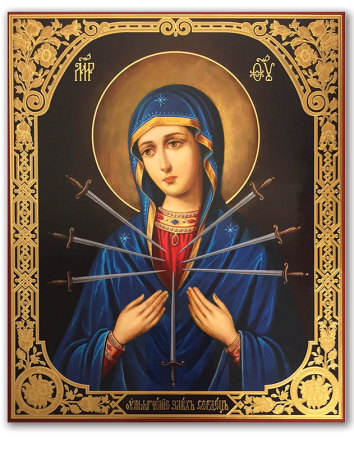
It would be quite ironic, given that men argued for the honor to bestowed upon them, if the humble mother of our Lord and Savior was given that seat of honor beside her son. We can recall Peter boldly saying to Jesus, “Even if I have to die with you, I will never disown you,” (Mark 14:31) and how the other disciples quickly agreed. But this male bravado quickly faded away as Jesus was taken away to be killed. It was Mary, not Peter, who remained beside Jesus until the end.

Can you think of anyone more worthy of sitting at the right hand of Jesus than his mother?

Anyhow, regardless of where Mary sits in the minds of some, she is the Queen Mother and worthy of our honor or Jesus is not King. Because if we deny this we are basically joining those who used “king of the Jews” as a mocking description. But, if Jesus is Lord, and the lineage to David coming through his mother, then we ought to show due respect to the queenship of his mother. And, given that Jesus listens to his mother and since we already do ask others to pray for is all the time, it doesn’t like a bad thing to follow the lead of Nathan.

Mary, the prayerful mother

Had anyone a few years ago asked me about the importance of Mary I would’ve probably said she was a good woman and shrugged. I would not have understood why Orthodox Christians venerate her (with all the saints) and would say that all we need is Jesus.

However, I was ignorant. Of course, Jesus is the center of our faith, he is our Lord and Savior, we worship only the Father, Son, and Holy Spirit. But that doesn’t mean the other examples in Scripture (and in the history of the church) are worth nothing for us. No, their unique stories of faith are there for our benefit, to encourage us, and as examples that we can emulate.

Mary stands out as one of these faithful examples. Her contemplation, how she “treasured” things and “pondered them in her heart” (Luke 2:19,2:51), and her strength in remaining with her son, her willing response to the angel (“I am the Lord’s servant” Luke 1:38), the proper honor she is given by the faithful, provides a restored vision for womanhood.

Certainly, there are many good women. Many have even seen their children martyred for the sake of the Gospel. But Mary was the mother of our Lord and Savior, the vessel God chose for his son, and (like Eve) not just any woman. She should be honored, her true feminine strength should be praised, and it is through her womb that salvation came to the world.