How Orthodox Christianity Triumphs Against the Odds

Standard

Christianity was systematically opposed and oppressed in the Soviet Union. The Russian Orthodox church, said to have been founded by the Apostle Andrew, was heavily persecuted under Marxist rule. Atheism was promoted in government schools, speaking against it outlawed, and it seemed that Orthodox Christianity did not stand a chance against this irreligious secular state.

During that dark period, thousands of church leaders were killed. Many more were imprisoned, tortured, sent to mental hospitals or the “gulags” to do forced labor. From 1917 to 1935, 130,000 Russian Orthodox priests were arrested and 95,000 of them were executed by firing squad. Later, from 1937 to 1938, in another anti-religious purge campaign, 168,000 Orthodox clergymen were arrested and, of them, 100,000 shot. Religion was ridiculed in the public sphere, believers were harassed and deprived of parental rights, church properties were seized by the state and buildings, including the beautiful Cathedral of Christ the Savior in Moscow, were destroyed:
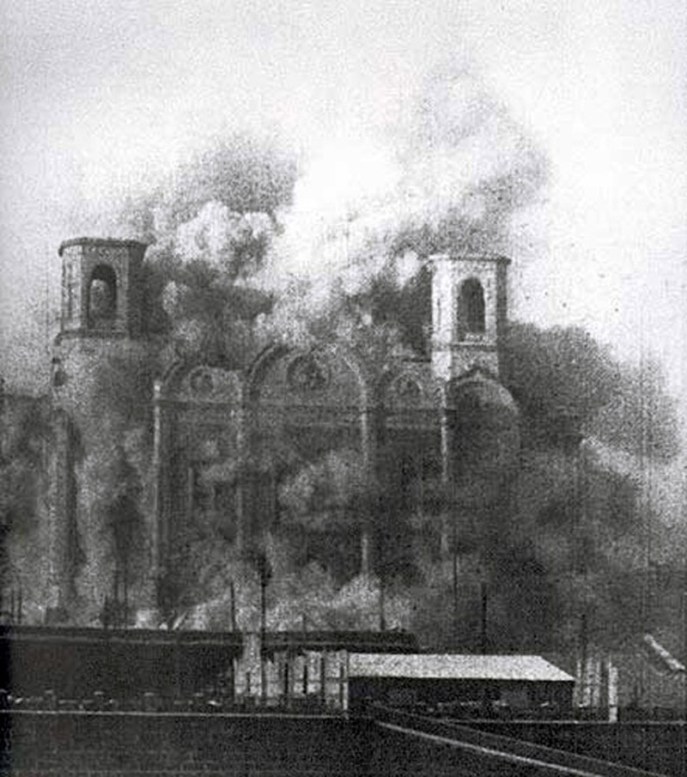
Cathedral_of_Christ_the_Saviour_(destruction,_1931)

The Russian Orthodox church, that extended into the Americas (where they didn’t kill the Native populations like their Western counterparts) and had an estimated 54,000 parishes in Russia before WW1, was reduced to only 500 parishes in the 1940’s under the Communist dictatorship. The Bolshevik Revolution of 1917 left Russian Orthodox churches in Japan, United States, Manchuria, and elsewhere effectively orphaned and without support. Patriarch Tikhon, in 1920, issued a decree for these churches to operate independently until normalcy could be restored and, as a result, many of these churches (because of financial hardship and/or need of pastoral care and governance) were turned over to the Orthodox churches of their national homelands—which is why there is the current disorganized mix of Greek, Antiochian, ROCOR and OCA parishes in America.

However, Orthodoxy has since triumphed over Marxism in Russia. An average of three churches a day are being opened by the Orthodox faithful in Russia, there are currently 40,000 churches and, at the current pace, that number may double in the next decades. In addition, there are now 900 active monasteries (down from 1000 pre-revolution) and this is an expansion based on demand. This resilience against the odds, against the world’s only other superpower besides the United States, is a testament to the strength of Orthodox religious tradition. Orthodoxy in Russia could not be driven into extinction by one of the most powerful and brutal regimes in human history and is as strong today as ever.

The divided (and dying) church of America

America has traditionally divided up according to ethnicity or race. Churches (Protestant, Roman Catholic or otherwise) are not exceptional in this regard. Many churches, including Mennonites and Amish, came as a result of immigrants taking their religion with them rather than as a missionary endeavor. It is not a surprise that traditionally German churches, like the Lutherans, are mostly populated by white people nor is it unexpected that people go to churches that are reflective of their own cultures or where their own language is spoken. People tend to gravitate to other people who look like them.

But this “homogeneity principle” also extends beyond skin color as well. A church that is racially or ethnically diverse is probably homogeneous in other ways (things like level of education, political affiliations, etc) and thus not truly diverse. For example, American Mennonites, from the most progressive or liberal to the most ultra-conservative and traditional Old Order end of the denomination. are (with the exception of a few adoptions and inner-city outreaches) ethnically homogenous. But, as centuries of divisions have proven, that shared genetic ancestry and skin color certainly does not make us the same. And so it is with Protestantism in general. A multi-ethnic church probably has very little diversity in terms of educational level, ideological bent, or income and this is because we prefer to be with people who share something in common with us.

The end result is that everyone claims that they are loyal to Christ and his love. Yet, in reality, there are hidden loyalties that are actually taking precedence. We are divided by our loyalties to our race, our religious/cultural heritage, national/political identities, denominational affiliations, personal preferences, and feelings or any combination of the preceding items. In other words, our pet issues and petty differences are what truly matters to us despite what we profess. And this doesn’t get better for those who are non-denominational or believe they are independently guided by the Spirit and are truly only loyal to themselves. Saint Paul, the Apostle, said that the Spirit brings unity to the body (Ephesians 4:1-6) and spoke out against disunity brought about by their misplaced loyalties:

I appeal to you, brothers and sisters, a in the name of our Lord Jesus Christ, that all of you agree with one another in what you say and that there be no divisions among you, but that you be perfectly united in mind and thought. My brothers and sisters, some from Chloe’s household have informed me that there are quarrels among you. What I mean is this: One of you says, “I follow Paul”; another, “I follow Apollos”; another, “I follow Cephas”; still another, “I follow Christ.” Is Christ divided? Was Paul crucified for you? Were you baptized in the name of Paul? I thank God that I did not baptize any of you except Crispus and Gaius, so no one can say that you were baptized in my name. (1 Corinthians 1:10-15)

Note, Paul calls out even those who claim “I follow Christ” in his rebuke and that is not because Christ is not the head of the church either. No, it is because loyalty to Christ means loyalty to his church, to true believers past and present (and future) who together represent his body, and who we are to seek Communion with rather than chase after our own personal ideals. True Christianity is about forbearance, forgiveness, and humility, realizing our own fallibility and showing mercy to others as we have been shown mercy by God. It is little wonder that many are confused about Christianity in America and increasing numbers are checking-out of their denominational and ever-dividing churches. It is because many professing Christians say one thing and do another. They say they love as Christ loves, even call someone a “brother,” but are completely unwilling to sacrifice anything of true consequence to themselves in love for the body of Christ.

Is Orthodoxy any different from this?

Yes and no.

At the time I am writing this there is a break in Communion between the Moscow Patriarchate and Patriarchate of Constantinople over a Ukrainian schism. In 1992, following the breakup of the Soviet Union, some Ukrainian Orthodox wanted their independence from Moscow (understandably so given regional politics) and, unfortunately, went ahead without having appropriate permission. Making matters worse than they already were, Archbishop Bartholomew, the Ecumenical Patriarch of Constantinople, decided to recognize the schismatics and over the protests of Moscow. This, of course, is not acceptable, important church decisions have been always made by a council or through the correct channels, rather than independently, and this is reminiscent of the unilateral decision-making that divided the Roman Catholics from Orthodox in the Great Schism.

The explanation above probably comes off as Greek to those outside of Orthodoxy and took some time me to wrap my own head around. However, it is also a good way to illustrate a key difference between Orthodox, Protestant and Catholic perspectives of authority in the church. In Roman Catholicism, the Pope, as “Vicar of Christ” and supreme by his own decree, rules the roost. Protestants, by contrast, essentially believe that every man (and his Bible) is their own Pope and need not be accountable to anyone besides themselves. Orthodox Christians, on the other hand, do not see even their highest-ranked individual as being infallible or outside need to be accountable and rather (like the early church) build upon consensus and through councils—which means even Peter, the first amongst equals, can be set right as need be.

(On an aside, Anabaptists, in that they believed in individual submission to the group, were traditionally sort of a half-step between Orthodoxy and Protestantism in this regard. The difference being that Anabaptists are only accountable to the local church (and what they cherry-pick from Scripture or early church writings) rather than the universal church and an ordination faithfully passed down, generation to generation, from the time of the Apostles. This unique Anabaptist perspective, while still preserved by the Amish and other Old Order groups, has been largely supplanted by Biblical fundamentalism in “conservative” Mennonite churches and secular/progressive group-think in the “liberal” side—both sides with zero real accountability to the historic church including even their own Anabaptist forebears.)

The Ukrainian schism, while a black mark on the testimony of the those who caused it if left unresolved, is actually proof the triumph of Orthodoxy over the spirit of division or unity formed around the wrong loyalties. The consensus across the Patriarchates seeming to be that the Ecumenical Patriarch went outside the bounds by recognizing the Ukrainian schismatics. The unity of the church is not mere unity for the sake of unity, but a unity of Spirit that doesn’t neglect sound doctrine or the traditions (“whether by word of mouth or by letter,” 2 Thessalonians 2:15) passed down by the church. In other words, the established Orthodoxy has more authority than any one person or group within the church. Orthodoxy is something that transcends all individuals in the church and protects against both abusive patriarchs and also the divisions over personal opinions. The Spirit of truth, the foundation of Orthodox tradition, is what preserved correct doctrines against heresy and false teachers.

Orthodoxy is what delivered the Biblical canon. The same Biblical canon that many Protestant fundamentalists and other separatists idolize as an infallible object equal to God while simultaneously not recognizing the authority of the church that wrote, authenticated, and compiled it for them. It is strange that a council was only good for that one thing, creating a collection of books that can’t be changed, and not anything else before or after, isn’t it?

But, I do digress…

Yes, Orthodoxy is messy because, as with the church of Acts, there is still a difference of opinion, politics, legalism, favoritism, and imperfection. We can’t get away from conflict, not even in the church founded by Christ himself and that is disheartening to us idealistic types. But that was also the case from the earliest days of Christianity and that is why there was a need of the Jerusalem Council recorded in the book of Acts. The church had councils to establish who was right or wrong and how to correctly interpret Scripture.

Orthodoxy (that is to say “right opinion”) is something worthwhile and should be the goal of every Christian. It is that sincere desire to find and hold to what is true that is leading many from the ranks of the most divided and disillusioned branches of Christendom and to the “ancient faith” of the Orthodox Christians.

The triumph of Orthodoxy…

Like King Josiah hearing the Scripture read for the first time, many are discovering the elegant theology and awe-inspiring, aesthetic appeal, and ancient beauty of Orthodox worship. Divine liturgy carries depth, history and meaning unrivaled in an age of flashing lights, cheap gimmicks, and consumerism. This is why people from all denominational backgrounds are finding a home in Orthodoxy today. The majority of those in my parish is not “cradle Orthodox” in that they were born in the Orthodox church and this seems to be the trend. In fact, nearly half of the million Orthodox Christians in the United States are converts and I am just one of the many who did.

It is very exciting to see the interest of those who have read this blog and want to know more. Several are either now attending services, have visited or are planning to visit when they have a chance. There is one, in particular, a single lady born into a conservative Mennonite church, never baptized and made a member, who left the church disillusioned by the pettiness, abusive leadership and message of condemnation, describes the Antiochian parish she is currently attending as “St Philips is beauty for the mind and spirit. A haven, a calm, a refuge,” adding that it is the “truest example of Jesus words put into my own, ‘Come just as you are.'” I have also had the pleasure of conversing with several who are converts from Anabaptist background, including a man who is my cousin through marriage, and have had the same hard-to-put-into-words experience I have had.

To be clear, the Orthodox church, like other churches, did come over with ethnic communities from Greece, Russia, Syria, Africa, Egypt and other parts of the world. Many Orthodox churches in America did often start as a part of an ethnic community and a decade ago may have been compromised mostly of people from one ethnic background. However, as that immigrant population declines it is being replaced by those who come from all sorts of Christian backgrounds. In my own parish, there is everything from non-denominational to Baptist, Episcopalian, Methodist, and Roman Catholic. Many of these converts were, like me, at the end of their ropes with religion as it had been presented to them, some agnostics, who were drawn to Orthodoxy through various means and have been forever changed by the experience. The most recent converts at my parish: Two women, one of them a Mennonite pastor, who were Chrismated and welcomed home a few weeks ago.

There is a great documentary on religious “nones” called “Becoming Truly Human,” that describes the journey of various people who have left the version of Christianity they were raised in and have simply stopped attending any religious services. There is clearly a need for an answer, people long for a connection to the historic church, worship that transcends current fads and trends, something real and authentic, and Orthodox Christianity provides this. Orthodoxy, made “perfect through suffering” (Hebrews 2:10), has withstood the persecution of the past century like it did in the first century and is a bastion for the faithful. Orthodoxy, the church that Jesus promised the “gates of hell would not prevail against” (Matthew 16:18), has and will continue to triumph against the odds.

217361.p

I Prefer Representatives, Sound Doctrine and the Holy Spirit Over False Choices

Standard

I was speaking with a friend a week or two ago (a conservative Mennonite searching for his place in the church) and he shared this quote:

“Doctrine is dead as a doorknob without the presence of the Holy Spirit in an individual’s life.” (Paul Washer)

That quote drop of a Calvinist commentator was annoying to me. It was annoying because it was shared in the context of a conversation about Orthodox worship and prayers. The clear implication being that established doctrine is somehow in conflict with spiritual life.

So, without hesitation, I asked my friend: “How do you know Washer’s doctrines (like the one you just quoted) are inspired by the Holy Spirit?”

My question was based on my own experience as one who had put his full confidence in the Holy Spirit and has since learned (the hard way) the need to be grounded in sound doctrine as well. In fact, it was my desire to follow the Spirit without compromise which had led to my pursuit of the impossibility, which led to my eventual disillusionment with the Mennonite denomination, which led me to the ancient faith of Orthodoxy and new spiritual life.

So, getting back to Washer’s quote, he presents a false choice between doctrine and the Holy Spirit. He, like many Protestant commentators, seems to equate established religious dogma with spiritual deadness. His quote suggests that we devalue church traditions (those pertaining to worship and prayer in the case of my friend) based in an assumption that what is new or spontaneous is somehow more authentic and real than something that has been passed down through many generations.

But is that truly the case?

Do we ever need to choose between established doctrine and authentic faith?

From what I can tell, church doctrine and real spiritual life originate from the same source (that source being the Holy Spirit) and thus we should not ever have to choose between the two. The traditions passed down by the church (including the canon of Scripture) and the Holy Spirit are never at odds. To deny the importance of church doctrines and tradition is basically to speak against the authority of Scripture:

“For the time will come when people will not put up with sound doctrine. Instead, to suit their own desires, they will gather around them a great number of teachers to say what their itching ears want to hear. They will turn their ears away from the truth and turn aside to myths.” (2 Timothy 4:3‭-‬4 NIV)

Nowhere in Scripture do I see sound doctrine being presented in contrast with living according to the Holy Spirit. However, I do see James tells us “faith without works is dead” (James 2:14-26) and also know, according to the Gospel (Matthew 7:22-24), that there will be those who have professed faith in Jesus, even worked miracles in his name, whom he will tell to depart because he never knew them and therefore authenticity of faith is about more than making a claim.

Thus I do question the basis for this commentator’s opinion and the many others out there of those who speak with a similar confidence about spiritual matters. By what authority do they speak? How do we know that they, along with their devoted followings, are not deceived? I mean these ‘spiritual’ commentators are often at complete odds with one another. Don’t believe me? Do a Google search “Paul Washer false teacher” and you’ll find dozens of articles denouncing him and his teachings.

So who is right? Who is wrong? How do we know?

My contempt for commentators…

My reaction to the Washer quote isn’t something unusual for me. I have a near-universal contempt for commentators and especially those who can’t at least ground their statements directly to something found in Scripture. And perhaps that strong aversion is because I have enough strong opinions of my own, more than my fill, and therefore seek something a little more grounded than mere opinions?

Not to be misunderstood, that’s not to say that I find no value in reading commentators. I do believe we can gain many valuable insights from listening to various men and women sharing their personal perspectives on spiritual issues.

But, that said, not all commentators are equal and anyone can say anything and our feelings (one way or another) about what someone says doesn’t make it any more or less true. There are likely false teachings that would resonate with any one of us and we should guard against being closed off to truth based on our emotions. We should remember that all religious groups are able to justify their own understanding of spiritual matters, many of them live morally upright lives, and can be very convincing to those who don’t know any different.

And, to be clear, I’m not just talking about those commentators who say “the Holy Spirit tells me thus and such” without offering any corroborating evidence from church history or Scripture. Being a Bible scholar or well-educated and intelligent does not make a person less susceptible to confirmation bias. No, if anything, being well-studied and smart brings a danger of pride and pride can prevent us from seeing our own biases and the many things we have missed in our studies.

Proof-texting, when a person soundbites Biblical texts at the cost of context, is a real problem for any commentator. That is why we have a multitude of denominations all claiming their authority comes from Scripture and, yet, can’t agree on some very basic issues. It isn’t that one side is more ignorant of the book than another nor that one side is less sincere about their profession of faith than another either—the problem is a lack of accountability to anything more than what feels right to us.

My own commentary on spiritual life…

Going back to Washer’s quote, I believe we can all agree that there is no life in the church or elsewhere without the Holy Spirit.

As the Orthodox pray on a regular basis:

“O Heavenly King, the Comforter, the Spirit of Truth, Who art everywhere and fillest all things; Treasury of Blessings, and Giver of Life – come and abide in us, and cleanse us from every impurity, and save our souls, O Good One.”

We know, from the creation narrative, that “the Spirit of God was hovering over the waters” (Genesis 1:2) and is also the “breath of life” (Genesis 2:7) that entered Adam. Life, both physical and spiritual, comes from the Holy Spirit, and we see this pattern throughout Scripture and even at the end of the Gospel when Jesus empowered the disciples to continue his ministry of forgiveness:

And with that he breathed on them and said, “Receive the Holy Spirit. If you forgive anyone’s sins, their sins are forgiven; if you do not forgive them, they are not forgiven.” (John 20:22‭-‬23 NIV)

Note how that parallels with the Genesis account where God breathes life into Adam. Note also that this being “breathed on” comes after the resurrection, after Jesus spent years teaching these men, and is what enabled them to fully understand what he had taught:

Then he opened their minds so they could understand the Scriptures. He told them, “This is what is written: The Messiah will suffer and rise from the dead on the third day, and repentance for the forgiveness of sins will be preached in his name to all nations, beginning at Jerusalem. You are witnesses of these things. I am going to send you what my Father has promised; but stay in the city until you have been clothed with power from on high. (Luke 24:45‭-‬49 NIV)

The disciples being “clothed with power from on high” (a step that should happen before we go out on our own commission) is something that happened in the book of Acts, on the day of Pentecost, when they received an outpouring of the Spirit and many came to believe in Jerusalem.

Truth, according to Paul’s commentary, in 1 Corinthians 2:6-16, is something revealed by the Holy Spirit. That is something that mirrors what Jesus said in his promise of a “Comforter” that would “guide you (his disciples) into all the truth” (John 16:13), and there is no way around it. All the Bible study and religious knowledge in the world cannot breath spiritual life into anyone.

All that said, sound doctrine and spiritual life are never at odds with each other. That it took a special outpouring of the Spirit before the disciples could understand what Jesus taught doesn’t make his prior effort useless. His teachings, if anything, provided substance, like the dust God formed up into a man in Genesis, and his breath the catalyst.

Furthermore, those waiting on the right feelings, or teachings that resonate with them and their own prior experience, will likely be like the rich young ruler who left disappointed after asking what he must do to be saved. Faith demands we go outside of our own comfort zone, that we go beyond our own understanding, preferences or calculations, and begin to walk before we have our eyes opened. In fact, the Spirit is something promised only to those who those who love Jesus and keep his commandments:

“If you love me, keep my commands. And I will ask the Father, and he will give you another advocate to help you and be with you forever—the Spirit of truth. […] “Anyone who loves me will obey my teaching. My Father will love them, and we will come to them and make our home with them. (John 14:15‭-‬17a‭, ‬23 NIV)

So, what comes first, belief and obedience to Jesus or is it the revelation of truth via the Holy Spirit that enables us to understand what we read?

That is a paradox and something that has always made me uncomfortable. Jesus appears to make obedience a prerequisite to spiritual revelation, which ran counter to my own intuition, and why I had always stressed the second half of the teaching rather than the first part. How could I know what is sound doctrine (as in the correct understanding of what Jesus taught enabling my obedience) without the Holy Spirit coming first?

My understanding was clouded by an individualistic filter…

One would think that I, as one raised in a church with Anabaptist heritage, would understand that interpretation of Scripture and establishing doctrine is something we do together, empowered by the Holy Spirit, as a church.

But somewhere along the line (somewhere between urban myths being shared from the pulpit and men like Bill Gothard being given a platform), I had lost trust in the ‘ordained’ leadership and other members to discern truth. And, as a result, I began to look beyond my religious peers for answers. Eventually, after an epiphany about faith, I began to find answers in Biblical passages that had once confounded me and became more confident in my own individual discernment through the Spirit.

However, that paradigm of understanding was incomplete and all came crashing down when my own individual ability to discern spiritual truth came into serious question.

It is easy to claim the Holy Spirit is leading you while you remain safe within the boat of religion. But true faith requires going beyond our own established range of possibilities, to let go of our own human logic and reason, and step out of the boat. I did that. I stepped out. I took a few steps across the waves and then was promptly overwhelmed by doubts—doubts that were, in part, a product of running headlong into the plans, prejudices and cynical calculations of those in the church whom I had still counted on to mirror my faith.

I had questions that I could not answer nor could be answered in the Mennonite context. I had lost faith in my Mennonite identity and Anabaptist heritage to provide reliable guidance. I felt I had been fooled, once again, misled by the desire to find meaning in my struggles and a delusional faith that the impossible would be made possible. I had nothing, besides an obligation to continue to fight for the hopes of my bhest, and needed answers.

Fortunately, I ran into a man, a fatherly figure, who did have answers that I needed and set me right again.

Fr. Anthony, an Orthodox priest, arrived in my life as if by divine appointment. He had the right attitude, asked the right questions, never said a disrespectful word about my Mennonite identity (offering praise for our “peace witness” instead) and could speak with an authority that was missing where I was coming from. There was no pressure. However, he always seemed to show up at the right time and was always able to explain things in a way that made sense to me.

The timing was right for me in the same way it was for the man St. Philip encountered on the road:

The Spirit told Philip, “Go to that chariot and stay near it.” Then Philip ran up to the chariot and heard the man reading Isaiah the prophet. “Do you understand what you are reading?” Philip asked. “How can I,” he said, “unless someone explains it to me?” So he invited Philip to come up and sit with him. (Acts 8:29‭-‬31 NIV)

In an individualistic understanding, this man (the eunuch) should’ve had all he needed to find salvation—I mean, according to what many Biblical fundamentalist commentators put forward, Scripture is basically self-explanatory and all we need to do is believe what we read, right?

But clearly, that is not the case.

The Bible itself tells us that somethings in it are difficult to understand (2 Peter 3:16) and this eunuch, an important and likely very intelligent person, could not discern for himself what was written in Isaiah.

The Holy Spirit did provide him with an interpretation, yet that interpretation came through a man named Philip. Philip did not speak his own “private interpretation” (2 Peter 1:20) as a mere commentator offering an opinion. He was a representative. He was a man both directed by the Spirit and also commissioned by the church in the book of Acts:

In those days when the number of disciples was increasing, the Hellenistic Jews among them complained against the Hebraic Jews because their widows were being overlooked in the daily distribution of food. So the Twelve gathered all the disciples together and said, “It would not be right for us to neglect the ministry of the word of God in order to wait on tables. Brothers and sisters, choose seven men from among you who are known to be full of the Spirit and wisdom. We will turn this responsibility over to them and will give our attention to prayer and the ministry of the word.”

This proposal pleased the whole group. They chose Stephen, a man full of faith and of the Holy Spirit; also Philip, Procorus, Nicanor, Timon, Parmenas, and Nicolas from Antioch, a convert to Judaism. They presented these men to the apostles, who prayed and laid their hands on them. (Acts 6:1-6)

Philip was chosen and ordained to be a representative of the apostles, the apostles who themselves were representatives of Christ. His authority to interpret Scripture went beyond being merely a product of his own religious studies. He was not simply a religious commentator spouting his own opinions. No, rather, he was ordained as a representative, as one judged to be “full of the Spirit and wisdom” by the church, and therefore had an authority greater than a mere commentator with an opinion.

My individualistic filter was wrong, I could not understand everything on my own, we still need those representatives who are sent:

How, then, can they call on the one they have not believed in? And how can they believe in the one of whom they have not heard? And how can they hear without someone preaching to them? And how can anyone preach unless they are sent? As it is written: “How beautiful are the feet of those who bring good news!” (Romans 10:14-15 NIV)

Why I prefer representatives…

Anyone can offer commentary, we hear ‘expert’ commentators tell us their opinions of sports, politics and the economy all the time. Some people prefer Paul Krugman, others Rush Limbaugh, and typically we choose those who confirm our existing biases to those who would challenge them. That is also true of Biblical commentators as well. We like those men whom we choose based on our own feelings, on what resonates with us or provide our itching ears with what we wish to hear. Unfortunately, commentators are not accountable to anything besides their own understanding and too often play to the prejudices of their particular audience.

A representative, by contrast, does not speak on their own authority and is ultimately accountable to the authority that sent, commisioned or ordained them.

For example, in a Republic, like the United States, we elect Representatives to speak on our behalf and represent our interests. There are also representatives of a corporation authorized to act on behalf of the collective group and must also answer to the other representatives of the group.

Jesus, likewise, came as a representative of the Father who sent him, on several occasions he tells his audience that he speaks on behalf of the Father and not by his own authority:

Not until halfway through the festival did Jesus go up to the temple courts and begin to teach. The Jews there were amazed and asked, “How did this man get such learning without having been taught?”

Jesus answered, “My teaching is not my own. It comes from the one who sent me. Anyone who chooses to do the will of God will find out whether my teaching comes from God or whether I speak on my own. Whoever speaks on their own does so to gain personal glory, but he who seeks the glory of the one who sent him is a man of truth; there is nothing false about him. (John 7:14-18 NIV)

Jesus is imploring his audience to test his credentials. He is saying that those who choose to do the will of God, by following his teachings, will find out if his words are true or not. In other words, his teachings are a testable hypothesis, established directly on the authority of the Father, and not just his opinions that can’t be verified one way or another. Jesus is not a commentator speaking by his own authority, but a representative, commissioned by the Holy Spirit (confirmed with a voice from heaven and dove descending upon him at his baptism) and spoke with the authority of the Father rather than his own.

The difference between a commentator and a representative is accountable to an authority beyond their own. If a representative goes beyond their commissioning they can be voted out or brought before a council and condemned. A commentator, on the other hand, only needs to be accountable to their own understanding and the whims of their particular audience—their authority rests on their own credentials rather than on a true commissioning by an authority already established.

Doesn’t the Holy Spirit make us representatives as well?

My answer to this question, with my shift in paradigm, has changed.

The answer is both yes and no.

Yes, in that we do, as individuals, receive authority from the Holy Spirit.

But, no, as far that authority giving us license to be free from accountability and operate apart from what has been established by Christ and his church.

The Holy Spirit, the true spiritual guide sent by the Father rather than a counterfeit spirit, should lead us into unity together rather than to divisions. The early church was full of commentators, some who claimed to have the authority of the Spirit or Scripture on their side, but the book of Acts shows us that not all commentators were equal and some had to be rebuked:

Then some of the believers who belonged to the party of the Pharisees stood up and said, “The Gentiles must be circumcised and required to keep the law of Moses.” The apostles and elders met to consider this question. After much discussion, Peter got up and addressed them: “Brothers, you know that some time ago God made a choice among you that the Gentiles might hear from my lips the message of the gospel and believe. God, who knows the heart, showed that he accepted them by giving the Holy Spirit to them, just as he did to us.

[…]

They chose Judas (called Barsabbas) and Silas, men who were leaders among the believers. With them they sent the following letter: The apostles and elders, your brothers, To the Gentile believers in Antioch, Syria and Cilicia: Greetings. We have heard that some went out from us without our authorization and disturbed you, troubling your minds by what they said… (Acts 15:5‭-‬8,22‭-‬24 NIV)

Heretical teachings in the church have always been sorted out by council and consensus.

Even St. Peter and St. Paul were accountable to the body of believers represented in this coming together of apostles and elders.

It is by this process we were even provided with a canon of Scripture: Councils, representatives of the church, decided what books belong in the Bible and which ones (while possibly still useful) did not meet the criteria of Orthodox teachings. Not every book, not every person, is equally authorized to speak on behalf of Christ and his church. The Holy Spirit does work in the life of the individual, but the Holy Spirit also speaks through the church and especially through those sent, ordained or commissioned by Christ and is church:

But we ought always to thank God for you, brothers and sisters loved by the Lord, because God chose you as firstfruits to be saved through the sanctifying work of the Spirit and through belief in the truth. He called you to this through our gospel, that you might share in the glory of our Lord Jesus Christ. So then, brothers and sisters, stand firm and hold fast to the teachings we passed on to you, whether by word of mouth or by letter. (2 Thessalonians 2:13‭-‬15 NIV)

We are told the church, empowered by the Holy Spirit, is “the pillar and foundation of the truth” (1 Timothy 3:15) and that is to say that the church does have authority over the individual as a representative of Christ. We really do need that—we really do need to be accountable to something more than our own ideas and/or interpretations—and should seek to hold fast to the teachings that have been passed by “word of mouth or by letter” of those who, through Christ and his church, have more authority than their own personal opinion.

Good commentary must be rooted in sound doctrine…

Anyone can claim to have the Holy Spirit, but not all who do are true representatives of Christ or his church, and we must use discernment. There have many heresies throughout the ages of those who felt they individually could discern truth without being accountable to anything besides their own religious knowledge and feelings of spiritual superiority to others. We need to be on the guard against their false teachings and also against being deceived by ourselves.

We are all very fortunate, we do not need to choose between the Holy Spirit and sound doctrine. This is a case where we can both have our cake and eat it. The church has preserved the teachings of Jesus, in traditions both written and spoken, as the basis for sound doctrine and that “breath of life” comes in our Communion together. We are not called to be “Lone Rangers” finding our own way, serving our own preferences, etc. We are called to be a part of the body of the church, representatives of the church past, present and future, this church:

And I tell you that you are Peter, and on this rock I will build my church, and the gates of Hades will not overcome it. I will give you the keys of the kingdom of heaven; whatever you bind on earth will be bound in heaven, and whatever you loose on earth will be loosed in heaven.” (Matthew 16:18‭-‬19 NIV)

The Two Types of Truth-tellers

Standard

There is a story about two con artists who convince a vain emperor that they’ve made a garment for him so fine that it is only visible to the smartest and most competent people. The emperor, more concerned with what other people think that what is own eyes tell him, plays along with the tricksters as not to appear unfit and stupid.

The emperor pretends to put on the imaginary new clothes. His ministers, also fearful of appearing unfit for their positions, ignore the emperor’s true nakedness, go along with the charade and allow him to parade through town in his make-believe garment. The townsfolk, while uncomfortable, do not dare offend the emperor and keep up the pretense.

The collective self-delusion comes crashing down when a young child, lacking social awareness, blurts out the truth: “But he hasn’t got anything on!” His father first tries to hush him, but the word is whispered through the crowd and, eventually, the townsfolk erupt into laughter. The emperor suspects they are right and yet he with his ministers continues on the ridiculous procession.

This ironic story about willful blindness to reality is an accurate description of how social pressure works. It is extremely relevant in our age of political correctness. Today, like in that fictional account, scientific evidence is ignored in favor of popular narratives and many smart people lack the courage to face down the social elites.

But there are truth-tellers…

1) Those too socially unaware to know the ‘correct’ answers. These are people, who like the child who blurts out the truth, are those of lower social status and a little stupid. They are unable to rationalize their way around the obvious reality like smart people do, they do not know (or care about) the socially “right” answer and simply blurt out the truth. They are easily ridiculed, they are often unsophisticated in their use of language and uncouth, they might not be morally upstanding individuals or always truth-tellers, but they are often brutally honest in ways that the polite people are not because they lack a filter their thoughts. They, in their lowly position, do not care about what the elites think of them and might even be empowered by offending their superiors.

2) Those unwilling to ignore the consequences of living a lie. These are the rarest of people. They are socially aware, they are able to see through the propaganda and brave enough to speak out against the popular narrative. They are able to see beyond what the socially smart people do, they are too principled to play along with the delusion and yet also understanding of the consequences of speaking an unpopular truth. Still, because it is dangerous to have social leadership that is divorced from the truth, conscience compels them to speak out. So they do, albeit carefully and using their intelligence, by telling stories about naked emperors in the hopes that others will read then awake to the lies that have ensnared them.

What part do you play in the story?

Most people, at least those intelligent, like to think that they are the ones who see reality as it is and are above delusion. Unfortunately, that is the first lie that blinds a person to the truth. Even the brightest minds are not entirely rational. We all suffer from a problem called “confirmation bias” where we select or ignore evidence-based in our established beliefs.

Many people eventually lose their sight because of fear, social pressure or indoctrination. They see themselves as smart and savvy for their ability to give the socially correct answers, but they are really only parrots of popular opinion and puppets to the status quo.

There are many taboo topics in the public discourse. There are many whom we are supposed to shield from certain truths lest they become outraged when their nakedness is exposed. They may call you “hateful” or many other nasty names if you dare to challenge their protected status. They attempt to use social pressure rather than logic and reason to defeat counterarguments.

The emperor’s new clothes story is only inaccurate in that it doesn’t depict what often happens to truth-tellers when they humiliate the emperor. In reality, speaking unpopular truth often leads to social alienation and sometimes to persecution. Speak out against patriarchal abuses in a fundamentalist church, for example, and you might be unfairly labeled a “Jezebel” or feminist agitator.

There are many social domains—religious, denominational, secular or otherwise. Our keen awareness in one domain doesn’t make us immune from being deceived and deluded in other domains. Our only defense is humility and understanding the limits of our own ability to see beyond ourselves. We must first realize that we are ourselves not above being fooled individually or as part of the collective group.

The first step to being a real truth-teller is to be humble and see your own moral blindness. Once you understand the limits of your own vision you will be able to help others overcome their blindness. And, at very least, don’t walk around naked because you are too vain to admit that a ‘truth’ you were convinced of is a lie.  Being a truth-teller means first being brutally honest about your own vulnerability.

Will the Real Anabaptists Please Stand Up…

Audio

We are all familiar with that guy—the high water mark of his life being his senior year of high school—who is always looking back on that one moment when he was actually relevant and longing for those glory days to return, right?

It is the tendency of some to romanticize the past and something very easy to do when things aren’t going as well as we’d like in the present.  Occasionally this sentimentalism about the past is useful reflection, but oftentimes it is no more than our fear of a future that seems uncertain and keeps us from the greater fulfillment of our potential as an individual or together as a group.

We read about those who rejected what would have brought them into the promised land who “in their hearts turned back to Egypt” and “worship the symbols of their former greatness rather than understand” (Acts 7:39) in Scripture.  Because of this idolatrous preference for things past-tense a generation of Israelites escaped the bondage of Egypt only to wander aimlessly in the wilderness because they did not trust God to overcome the giants of their time.

It is fashionable nowadays in some conservative Mennonite or somehow otherwise related circles to use the word “Anabaptist” as a means to distinguish themselves.  This resurrection of Anabaptist identity seems to both be a response to a perceived lukewarmness in the established tradition and also a rejection of what is often labeled Evangelicalism.  But what it often amounts to is no more than a change of window dressing and nothing more.

In many cases it seems these new Anabaptists are simply another hybrid/remix version of conservative Mennonite standards with Biblical fundamentalism, Revivalism, Pietism, along with many other more recent innovations and influences.  These self-proclaimed Anabaptists may actually be more at odds with their ancestors than their Old Order cousins whom they consider to be their spiritual inferiors.  There is no new life, only rewarmed leftovers of yesterday’s meals and a new distraction.

Early Anabaptists did not spend their days in obsessive omphaloskepsis or in preserving a religious cultural identity.  They were men emboldened by the Spirit to question the authority of their own human teachers and break from tradition passed to them.  They were rebels, branded as troublemakers and thought to be dangerous heretics. 

If your primary goal in life is raising your quiverful and maintaining a respectable image in church or society in general, then you, my friend, are no George Blaurock.

Are modern day Anabaptist wannabes doomed to wander a spiritual wilderness?

The short answer is, no.  

We all have choices to make in the present that will shape our future and the choice is still in front of us all. 

Here’s your choice: Will you be like those who stubbornly clung to the past for security and missed out on the promised land because of their lack of faith?  Or, will you this day choose to stop burying your talents in fear, invest fully in trust of God’s grace and rest completely in the Spirit’s ability to lead you as it did Jesus? 

Jesus, when his authority was questioned, pointed to John’s Baptism (Mathew 21:23-27, Mark 11:27-33, Luke 20:1-8) and a moment of special spiritual anointing recorded in all of the Gospels. 

We are told the sky was “torn open” (Mark 1:9-11) then the Spirit of God descended upon him “in bodily form like a dove” (Luke 3:21-23) “and alighted on him” (Matthew 3:13-17) and immediately after this: “Jesus, full of the Holy Spirit, left the Jordan and was led by the Spirit into the wilderness…” (Luke 4:1)  I believe those writers wanted us to know what gave Jesus authority and direction—what say you?

This is what I read: Jesus appealed to an authority greater than the experts on Scripture and theology back then could duplicate.  He points to something spiritually significant that accompanied his physical water Baptism.  An anointing by God that immediately leads him to the wilderness where he is tempted and then emerges to read from Isaiah “the Spirit of God is upon me” claiming it to be fulfilled that day in him to a stunned and incredulous audience.

But, besides that, there is another Biblical accounting of the Baptism of Jesus with an added detail of great importance, the testimony of John:

“I saw the Spirit come down from heaven as a dove and remain on him. And I myself did not know him, but the one who sent me to baptize with water told me, ‘The man on whom you see the Spirit come down and remain is the one who will baptize with the Holy Spirit.’ I have seen and I testify that this is Godʼs Chosen One.” (John 1:32-34)

Jesus did not only live as an example and die as a sacrifice for our sins.  No, according to the passage above, he came to deliver on a promise.  That promise was a spiritual anointing like his available to all who believe. 

That promise being “the Spirit of truth” that the world (including many who falsely claim to believe Jesus) cannot accept as real (John 14-17) and is only known to those who have been anointed or “clothed with power from on high” (Luke 24:49) and is what was experienced on the day of Pentecost in an event Peter claims was foretold by the prophet Joel before preaching a message of repentance:

“Repent and be baptized, every one of you, in the name of Jesus Christ for the forgiveness of your sins. And you will receive the gift of the Holy Spirit. The promise is for you and your children and for all who are far off—for all whom the Lord our God will call.” (Acts 2:38-39)

What is the first step out of the wilderness?

#1) “Repent, for the kingdom of heaven has come near.” (Matthew 3:2, 4:17, Mark 1:15) Which means turning away from our sinful attitudes and behaviors—be Baptized, then live in obedience to the teachings of Jesus as we know them.  The Baptism of repentance is something we do as both a symbolic gesture and also as part of sincere effort to put to practice the self-sacrificial love of Jesus.

This is the most difficult step for those raised in a Christian religious tradition.  We know how to follow the rules or behave ourselves and act right.  However, this is often a commitment without sacrifice and an occasion to stumble over our own pride.  We become like the prodigal son who never left home yet was far from repentance.

Keep repenting as need be.

#2) “Ye must be born again.” (John 3:1-21) This was something perplexing to Nicodemus and still mysterious to us.  Jesus says “no one can enter the kingdom of God unless they are born of water and the Spirit” then adds that only the Spirit gives birth to the spirit.  As surely as you didn’t give birth to yourself the first time you will not give birth to yourself spiritually.  For man this is impossible, but with God all things are possible.

There are many spiritual infants in the church today or those who rely on their own human reasoning and not the power of God.  There was recently a man, ordained in the Mennonite church, who confessed to his not being spiritually born when he started as a preacher.  We send missionaries out full of themselves or a religious indoctrination and youthful ambition rather than tell them to wait on the fullness of Spirit to come to them as Jesus urged his disciples.

#3) “But you have an anointing from the Holy One, and all of you know the truth.” (1 John 2:20)  Do you have that confidence?  Or are you like those Paul encountered who were Baptized in water of repentance and yet…

“While Apollos was at Corinth, Paul took the road through the interior and arrived at Ephesus. There he found some disciples and asked them, ‘Did you receive the Holy Spirit when you believed?’ They answered, ‘No, we have not even heard that there is a Holy Spirit.’ So Paul asked, ‘Then what baptism did you receive?’ ‘Johnʼs baptism,’ they replied.  Paul said, ‘Johnʼs baptism was a baptism of repentance. He told the people to believe in the one coming after him, that is, in Jesus.’ On hearing this, they were baptized in the name of the Lord Jesus. When Paul placed his hands on them, the Holy Spirit came on them, and they spoke in tongues and prophesied.” (Acts 19:1-6)

There are many who have been Baptized with water of repentance who are still not quickened in Spirit.  There are two Baptisms, one physical and the other spiritual, one is to show our repentance and another is of God clothing us.  I pray God sends the willing of this generation to lay hands on those who are Baptized yet still spiritual powerless and that through prayer they are anointed in the name of the Lord Jesus.

#4) “Where there is no revelation, people cast off restraint…” (Proverbs 29:18)  The word revelation (also translated as vision) is about spiritual foresight and leadership.  When there is no spiritual vision people cast off restraint, run wild, perish, etc.

Vision is not about looking backwards for answers.  This is not medieval Switzerland, you are not George Blaurock, I am not Conrad Grebel, and we can’t recreate the 1500’s today nor should we want to.  Tent meetings, Sunday schools, VBS (or any of the other innovations of a prior era) do not need to be preserved ad infinitum either.  We have work to do, work God has given us to do in this present moment using the advantages we are given.

Yes, the witness of faithfulness past-tense should not be forgotten and is a great encouragement.  Take these translated words of “Gott, dich will ich loben” (God, You I Will Praise) a hymn written by Blaurock before his martyrs death have great value:

“Lord God, how do I praise Thee
From hence and evermore,
That Thou real faith didst give me
By which I Thee may know.
Forget me not, O Father,
Be near me evermore;
Thy Spirit shield and teach me,
That in afflictions great
Thy comfort I may ever prove,
And valiantly may obtain
The victory in this fight.”

But putting those words to actual practice does not mean we should be consummate historians, full of knowledge of the past and light on vision for the future.  We should not be like those obsessed with their former glory, trying to be great again by looking backwards, rather we should be full of the Spirit and a vision for today.

The real Anabaptist is the one who does as they did and recklessly pursues the truth regardless of personal cost.  We need a radical faith, one that uses the technological means and media of today, that reaches the world with authentic self-sacrificial love.   We have tools at our disposal that give of us capabilities that our ancestors could hardly even imagine.

Ultimately, however, for any of our tools, technology and historical knowledge to be useful, we need a spiritual awakening.  Real Christian vision is not a product of human ability or effort, it comes from the Spirit of God—For any of our advantages to matter we must be born again.

Those who walk in the Spirit look forward with a positive vision and a great hope for the future.

Truth: A Concept Bigger Than Words

Standard

A couple Sundays ago I was riding along with some church friends on our way to a hymn sing (something us conservative Mennonites do) and we came upon a hitchhiker.

The hitchhiker, a young man, was strumming some sort of ukulele.  He had a sign asking for a ride west.  We were going west.  We conferred quickly, decided to make use of our extra seat and soon were on our way with one more passenger.

The young man, a friendly nineteen-year-old from Raleigh, North Carolina, has spent nearly two years on the road and told us of his nomadic lifestyle.  He relies on the hospitality of others, often sleeps under the stars, and is on his way to California.

Being that we are religious and on our way to a church service, the conversation turned to religion.  He explained that he is uncomfortable with the “Christian” label.  He described himself as “a follower of Jesus” and later that evening mentioned the influence of Taoism.

We invited him to church.  He accepted the invitation and soon he was amongst us Mennonites as we sang acapella music.  To my ears, we sounded pretty good.  He stayed until the end of the service and soon enough was being introduced by me to others in attendance.

One of those introduced, after some friendly chat (the usual Mennonite game banter and assessment of pedigree) ended by quoting John 14:6 at the young man, “Jesus is the way and the truth and the life” and emphatically stating this is the only way…

As we paused with this sort of non-sequitur concluding statement, presented in such a religiously cliché way, I almost asked this ordained Mennonite man if he knew what it meant.  But, fearing he would try to answer if I asked, I restrained the impulse and smiled.

I have no idea what my guest was thinking, he was courteous and didn’t seem too uncomfortable in our midst.  And so the evening went some polite conversation and some awkwardly presented evangelical dogma, me holding my tongue with slightly annoyed amusement and answering his questions.

Incidentally, nobody offered this young man shelter for the night (one of those asked apparently making excuse for himself because of his wife) and so we took him a few miles further west to ‘civilization’ where he would have more options.  We prayed with him, gave him some cash and bid him farewell before returning east again.

What is truth?

The incident above, especially the quotation of Scripture, seemed like a good basis for a blog and reason to consider the meaning of truth.  Truth, in this case, the idea of truth (alétheia) found in the passage, the truth of Jesus, that was partially quoted at my young hitchhiker friend.

The words “I am the way and the truth and the life” are cherry-picked from the Gospel of John.  It is a part of a discussion Jesus was having with his disciples about imminent events.  The disciples, as usual, were bewildered and asking questions:

“Thomas said to him, ‘Lord, we don’t know where you are going, so how can we know the way?’

Jesus answered, ‘I am the way and the truth and the life. No one comes to the Father except through me.  If you really know me, you will know my Father as well. From now on, you do know him and have seen him.'” (John 14:6-7)

Philip was still confused.  He goes on to ask Jesus to reveal the Father to them.

Jesus responds to explain in further detail, stating that he is one with the Father, that his words are spoken by the authority of the Father and telling them that the Father will be revealed to them through obedience to his teaching and by the Holy Spirit.

The truth of Jesus is more than book knowledge.

It is interesting to note that Jesus did not tell his followers to diligently study Scripture.

Instead, Jesus told them to obey what they knew and that more would be revealed by the Spirit after their obedience.  It might seem backward, but faith without works is dead (James 2:14-26) and salvation is a gift from God:

“For it is by grace you have been saved, through faith—and this is not from yourselves, it is the gift of God—not by works, so that no one can boast. For we are God’s handiwork, created in Christ Jesus to do good works, which God prepared in advance for us to do.” (Ephesians 2:8-10)

That is not to say that the Scripture is unprofitable, it most certainly is profitable to a believer.  It is “through faith in Jesus Christ” (Hebrews 2:3-15) that Scripture is able to make us “wise for salvation” and only through this truth of faith can we ever understand.

Book knowledge is not the same as correct understanding and those who opposed Jesus most vehemently had a great knowledge of Scripture.  In fact, it was because of their own understanding of Scripture (and dogmatic literalism) that they rejected Jesus.

The truth of Jesus is something more than mere book knowledge, it is more than religious devotion to the study of a text or a theological proposition.  The truth of Jesus is something more profound and powerful than words on a page.  It is a spiritual reality that goes far deeper than fallible human knowledge or our finite ability to understand.

The truth of Jesus is something beyond description in words.

Truth is a word, but truth itself is not a word.

We use words to paint pictures in the minds of our audience.  Words are symbols used to describe ideas, they are things we use to describe other things and yet words are not themselves the thing being described.  Words are not truth of themselves any more than a portrait in acrylic color on canvas is the actual person being portrayed.

Words depend on the ability of our audience to understand them.  One could tell their cat to “take out the garbage” and the poor critter would stare at them blankly.  Language—like beauty is in the eye of the beholder—depends on the interpreter to correctly understand the word usage  Communication is an interactive affair requiring both parties to be on the same metaphorical page.

Furthermore, talk is cheap, words can also be used to construct a false image of reality and deceive.  Jesus warns of false teachers, people who profess with their mouths to be faithful, who present themselves as sheep and yet are inwardly wolves—We are told we can know people by their good or bad fruit. (Matthew 7:15-23)

So truth is more than words.  Truth is an abstraction, it is something greater than the sum total of words and language used to describe it.  Truth is something bigger than us and beyond our own concept of reality.  Truth is transcendent and, still, it is something that can be fleshed out and represented.

The truth of Jesus is God’s word and a living testimony about a greater reality.

Jesus was brought before Pontius Pilate, a Roman civil authority, to be judged.  The Gospels give slightly different versions of the events.  In summary, the religious leaders accuse Jesus, they say he claims to be their king (a crime amounting to sedition against the established state) and insist that he is evil.

Here’s one account of the beleaguered governor questioning Jesus and trying to get the bottom of the issue:

“Pilate then went back inside the palace, summoned Jesus and asked him, ‘Are you the king of the Jews?’

‘Is that your own idea,’ Jesus asked, ‘or did others talk to you about me?’

‘Am I a Jew?’ Pilate replied. ‘Your own people and chief priests handed you over to me. What is it you have done?’

Jesus said, ‘My kingdom is not of this world. If it were, my servants would fight to prevent my arrest by the Jewish leaders. But now my kingdom is from another place.’

‘You are a king, then!’ said Pilate.

Jesus answered, ‘You say that I am a king. In fact, the reason I was born and came into the world is to testify to the truth. Everyone on the side of truth listens to me.’

‘What is truth?’ retorted Pilate. With this he went out again to the Jews gathered there and said, ‘I find no basis for a charge against him.'” (John 18:33-38)

This conversation is interesting and especially when Jesus claims to have come to “testify to the truth” and says those on the side of truth listen to him.  It is reminiscent of when he told the religious dogmatists that his sheep hear his voice and makes an incredible claim:

“The Jews who were there gathered around him, saying, ‘How long will you keep us in suspense? If you are the Messiah, tell us plainly.’

Jesus answered, ‘I did tell you, but you do not believe. The works I do in my Father’s name testify about me,  but you do not believe because you are not my sheep.  My sheep listen to my voice; I know them, and they follow me.  I give them eternal life, and they shall never perish; no one will snatch them out of my hand.  My Father, who has given them to me, is greater than all; no one can snatch them out of my Father’s hand.  I and the Father are one.'” (John 10:24-30)

For this Jesus is accused of blasphemy.  But to that charge, he replies by quoting their Scripture to them.  He quotes from Psalms 82:6, where it says “I have said you are ‘gods’,” and uses that to argue against their idea that his claim of divine sonship was blasphemy.

Pilate seems agnostic about truth and exasperated by Jesus.  He is dealing with a contradiction, he sees an innocent man not worthy of punishment and the religious crowd sees a man guilty of blasphemy against God who deserves death.

Pilate ultimately bends to political pressure and, while washing his own hands, complies with the demands of the crowd.  However, both Pilate and Herod (who’s part is described in Luke 23:8-12) seem to see Jesus as a curiosity rather than as a direct threat to the state.

The truth of Jesus is found in our following his example and being a self-sacrificial testimony of God’s grace.

The truth of Jesus is not a reasonable or rational proposition by worldly human standards.  It is only understood through spiritual means, through having the “mind of Christ” (1 Corinthians 2) and a process that starts in the heart (2 Corinthians 3) rather than through outward means.

It is transformative, as Paul explains:

“Therefore, I urge you, brothers and sisters, in view of God’s mercy, to offer your bodies as a living sacrifice, holy and pleasing to God—this is your true and proper worship. Do not conform to the pattern of this world, but be transformed by the renewing of your mind. Then you will be able to test and approve what God’s will is—his good, pleasing and perfect will.” (Romans 12:1-2)

The Orthodox Christian tradition would call this theosis or divination.  Unfortunately, my own Anabaptist tradition has picked to focus on the other negative end (the “be not conformed” part) and the result is an idea of “non-conformity” that usually amounts to a reactionary worldly effort to control outward appearance.

The truth of Jesus is about more than our ability to conform to a man-made list of requirements.  It is a truth that transcends all worldly means and is expressed in our unrelenting, unapologetic and uncompromising pursuit of the divine.  The truth is a positive vision.  The truth is God’s grace made manifest in us.

The truth of Jesus is a path we walk that leads us to greater life and the perfection of divine love.

The words “the way” (hodos) refer to a journey.  It is a path to walk and live out.  The trail was blazed by Jesus who died for our sins, but it is lived also by those who truly believe and wish to be disciples.  As Jesus said:

“Then he said to them all: ‘Whoever wants to be my disciple must deny themselves and take up their cross daily and follow me.  For whoever wants to save their life will lose it, but whoever loses their life for me will save it.'” (Like 9:23-24)

Jesus is using the cross as a metaphor.  A cross, in human terms, represented suffering and shame.  However, in following after Jesus, for a believer this is not useless suffering, it is not pain for the sake of pain or self-flagellation, it is suffering for the good of others or making a path to something greater.

Jesus promises a more abundant life (John 10:10) to those who follow him.  In this he is not promising material or worldly wealth.  But he does say that we should use our worldly wealth to gain friends and gain true riches (Luke 16) which is to prioritize God through our loving people:

“Whoever claims to love God yet hates a brother or sister is a liar. For whoever does not love their brother and sister, whom they have seen, cannot love God, whom they have not seen. And he has given us this command: Anyone who loves God must also love their brother and sister.” (1 John 4:20-21)

Jesus said we can know the truth of a person’s profession of faith by their fruit (Matthew 7:15-23) and that the fruit of the Spirit is described by Paul “love, joy, peace, forbearance, kindness, goodness, faithfulness, gentleness and self-control.” (Galatians 5:22-23)  Our truth must be more than words.

So what does ‘I am the way and the truth and the life’ mean?

To understand this we need to understand the context.  The context is the last supper, it is during the Passover feast, the night Jesus is betrayed and an intimate moment.  In these passages of Scripture (John 13 and 14) the implications are clear.

Jesus explains that his disciples will be known by their love for each other, he says he must go so they may know the truth more intimately (promising the Spirit to those who obey his instructions and example) and then goes on to demonstrate a truth of love worth dying for.

The truth of Jesus is not a theological proposition, not a religious profession or book knowledge. His truth is not a product of human reasoning and founded on scientific research or evidence. The truth of Jesus is something found in our walking in the Spirit, it is demonstrated in our love for others and bringing the dead to life.

Truth is living a reality greater than our reality, something that transcends worldly knowledge and human understanding. Truth is both known and still yet to be known, it is a reality that goes beyond the currently available evidence and is something that can only be experienced through a true walk of faith.

The truth of Jesus transcends religion and is a walk of faith.

In some respects, it seems my hitchhiking friend may have a better grasp of faith than his religiously indoctrinated counterparts.  He is more literally taking no thought for tomorrow (Matthew 6:34) and depending on God to provide.  By contrast, we too often rely on our own understanding, planning, and abilities.

I wish my traveling friend well on his journey and pray that the truth of God’s word (Jesus) is made manifest in him.  May God’s truth of self-sacrificial love and spiritual life be found in us who claim to know Jesus.

False And True Knowledge

Standard

I am dismayed when fellow Christians (especially those claiming to speak for the church) make definitive statements that are unsupported in the evidence.  There are many who take a dogmatic black and white stand on ideas not supported logically, scientifically or in appropriate understanding of Scripture.

I am dismayed because we stand to hurt our credibility when we make our stand on things we do not actually know and with reasoning that falls apart under closer scrutiny.  It is too often the case that those who think they are defending the Gospel truth are actually destroying it in their stubborn obstinacy and inability to see past their own presuppositions about the evidence.

This is a problem in the fundamentalist circles I am most familiar with.  Instead of simply taking a stand on faith or sticking to the text of the Bible as they claim, many add their own assumptions.  They go another step off the firm ground of what is truly known and onto the quicksand of over-interpretation, unsupported inference and baseless speculation.  It is sad because it is unnecessary, it too often is the bathwater that conceals the true baby of Christianity, and drives critical thinking people away.

Two examples (often given in opposition to Evolution theory) is the idea that there is a clean break between living and non-living things.  The other is a misuse of the Second Law of Thermodynamics and the word “entropy” to mean something that it does not.  Both of these ideas originate in extrapolation from Biblical language, but neither one of them is actually as definitive in the Scriptural record as some might assume.

Postulate #1) Life cannot originate from non-life.

It seems obvious enough at first glance, doesn’t it?  I mean, have you ever seen mud materialize into human form, then suddenly become animated, walk and talk as a human would?  I have not.  We do not typically see dead organisms come back to life without a miracle.

And yet, under the microscope, it is interesting that the line between life and non-life is actually blurrier than one might imagine.  Viruses are considered dead because they do not have the ability to reproduce without a host cell and do not replicate themselves in the typical way of cell-division.  However, a virus can reanimate a dead cell, take control of it and use it to replicate.

Cells themselves are not ‘living’ in their individual components any more than a car is alive when you start it.  Yes, in one sense there is life, but it is the ‘life’ of chemical reaction (albeit in a complex system) and in physical processes not considered as living taken independent of each other. 

Think about it: The sun (due to gravity and other forces) is orderly, it takes hydrogen and, through a process of fusion, creates light energy and heavier elements.  Cells likewise, take one form of matter and through chemical process convert it to something else.  The difference between the sun and a cell, when we cut past the descriptive language to the actual material substance, is one of complexity and size rather than living or dead.

Our physical body is basically a complex machine comprised of individual self-replicating cells that work in concert with other different cells to produce organs, tissues and a body.  At the smallest level it is all chemical reaction and a sort of mechanical process that usually considered non-living.  But, at some point, taken together, these dead parts become something considered a living organism.  It is bit of a both/and paradox rather than an either/or dichotomy.

The difference between life and non-life seems to be a continuum more than a black and white line.  We do not consider a bacteria as equal to a plant or an animal equal to ourselves and the difference is probably the amount of ‘life’ each organism represents.  Likewise, I do not know if we can consider an animated universe something ‘dead’ with all the creative processes at work.  All, to me, are expressions of a creative and living God.

Postulate #2) Entropy is corruptive and not a good thing.

Lay people often misunderstand the Second Law of Thermodynamics (the state of entropy of the entire universe, as an isolated system, will always increase over time) as some kind of moral statement.  This misunderstanding is understandable.  Entropy is associated with decay and the universe is (by appearances, because of entropy) like a wind up clock that will finally someday be exhausted.

However, the increase of disorder or entropy in the universe is not an entirely bad thing.  In fact, entropy is how we get the energy and substance we need to survive.  When a man enters an ‘orderly’ forest, cuts a swath out to build a cabin and cultivates the space created, he has increased entropy.  Our favorite star (aka: the sun) taking ‘orderly’ hydrogen and turning it into a mix of heavier elements and light is increasing entropy.  Entropy is what makes the universe work and allows something as complicated as biological life exist.

Another way to understand entropy is to see it as an increase in complexity.  A stack of lumber is an orderly arrangement and has a relatively low state of entropy.  Hire a carpenter and turn the orderly stack into a house and, with addition of work to cut the lumber to different lengths, along with the contamination of nails, drywall, windows, doors, plumbing, and other building materials, you have increased entropy.

A pile of rocks is at a relatively low state of entropy.  People, one the other hand, represent a very high level of entropy.  We are arguably the pinnacle of disorder in the universe with our complexity and creative abilities.  Our turning orderly raw materials into complex creations, the process we use involving the dispersal of energy, is creating a higher level of entropy.  A 747 is a product of entropy as much as human engineering.

Entropy is like the sun or rain.  The same sun that produces the energy we need to survive can also cause skin cancer and kill us.  The rain cycle that we depend on for fresh water is also capable of producing floods and destruction.  Entropy is not exclusively creative or destructive, it is not something moral or immoral, it just is, and it is necessary for life to exist as we know it.

If life is an emergent property of physical complexity or entropy, then what?

The idea of life being an emergent quality of complex physical processes is unsettling to some.  There are serious philosophical questions and potentially big theological implications.  Nevertheless, if honest use of terms is our concern, we must be fearless and follow the evidence where it leads.

One idea at stake is our human exceptionalism.  In the book of Genesis we read an exceptional account describing the creation of man.  In it we both see humanity as being “in the image of God” and also that God ‘breathed’ the “breath of life” directly into man.  This is directness in the creation of humankind is unique in the Genesis narrative, but what does it really mean? 

We are not exceptional to animals in our physical body.  A human heart can be patched with a valve from a pig.  Human insulin can be created with bacteria and our genetic code is not too significantly different from other animals of our level of complexity.  It would appear that other animals also have consciousness at some level.

So clearly, for the Genesis account to be true, we are somehow special, touched uniquely by God, yet not in a physical sense.  When defining the terms used in Scripture, it is good to compare different accounts and see how similar language is used elsewhere.  In the case of breathing we are not without another reference for sake of comparison.

Genesis is not the only time in the Biblical canon that the divine breathed on men and gave them life:

“Again Jesus said, ‘Peace be with you! As the Father has sent me, I am sending you.’  And with that he breathed on them and said, ‘Receive the Holy Spirit.'”  (John 20:21-22)

The disciples of Jesus were clearly already physically alive.  But they were not yet ‘born of the Spirit’ and therefore could not understand the things of God.  Read John 6, Jesus talks about the “living bread” he represents and understand that he is not speaking about physical bread nor about physical life. There are many cases in Scripture like this one where a completely ‘literal’ (physical reality) interpretation is incorrect.

So, perhaps what many have been taught and think they know about the book of Genesis is wrong?  Perhaps the book is less about physical reality and more about a greater spiritual truth?  I believe that is possible, even probable, and leads to less conflict with what is known through scientific inquiry.

Knowing what we need to know…

I believe many Biblical fundamentalists confuse the bathwater of their own established interpretation, traditions and dogmas with the baby.  The baby or fundamental truth of Christianity is not found in historical documents nor proved with scientific evidence.  The truth of Christianity is found in knowing what Paul knew:

“For I resolved to know nothing while I was with you except Jesus Christ and him crucified. I came to you in weakness with great fear and trembling. My message and my preaching were not with wise and persuasive words, but with a demonstration of the Spirit’s power, so that your faith might not rest on human wisdom, but on God’s power.” (1 Corinthians 2:2-5)

The truth of Christianity is Jesus.  And, by Jesus, I do not mean the historical figure who’s words we read in a book and the religious traditions that borrowed his name.  I mean the Jesus that we live out daily and our having the mind of Christ today. The church must represent Jesus to the world presently, the power of the Spirit must be our reality now or our religious words only perpetuate a fraud.  Jesus must be experienced in our lives today and his will expressed through us or the truth is not in us.

When we find our answers in Jesus (rather than Genesis) and should have spiritual experience in our lives.  What makes us unique is the emergent quality of faith and the breath of God’s own Spirit in us.  We are in the image of the divine because we have the mind of Christ.  These are things revealed by faith and not products of mere human knowledge.

We need not know more than the way of Jesus.  If we live that out our lives will reveal the truth of Christianity without our need of superfluous or false knowledge to bolster our case.  Let the proof of faith be in the truth of our actions and the image of God found in our divine love.

Biblical Faith vs. Bible-based Religion

Standard

Two different religious traditions use the same Scripture.  One tradition says the text points to a man named Jesus who preached in Roman occupied Judea a little over two millennia ago and was God’s only begotten son came to save people from themselves.  The other tradition rejected these claims and still waits on Elijah to return as a prelude to the arrival of the Messiah.

“See, I will send the prophet Elijah to you before that great and dreadful day of the Lord comes.  He will turn the hearts of the parents to their children, and the hearts of the children to their parents; or else I will come and strike the land with total destruction.” (Malachi 4:5-6)

Note the choices in the passage above.  There’s option a) repentance and changed hearts, or option b) face total destruction.  And, depending on perspective, there might be an option c) both. 

We know that Judaism was split in two because of Jesus (some believing him, others rejecting him) and also that Jerusalem was destroyed in the year 70CE.  The glorious temple, the very center of Jewish worship, was completely dismantled as Jesus had foretold and has never been rebuilt.

Temple #1: Symbolic, representation of truth, built out of stone and sweat of men, located in Jerusalem:

“As Jesus was leaving the temple, one of his disciples said to him, ‘Look, Teacher!  What massive stones! What magnificent buildings!’  ‘Do you see all these great buildings?’ replied Jesus. ‘Not one stone here will be left on another; every one will be thrown down.'” (Mark 13:1-2)

Clearly Jesus is referring to the destruction of buildings that the disciples were admiring and that destruction literally happened.

But, there’s more…

Temple #2: Figurative, fleshed out truth, the life work and example of Jesus, located in history:

“The Jews then responded to him, ‘What sign can you show us to prove your authority to do all this?’ Jesus answered them, ‘Destroy this temple, and I will raise it again in three days.’  They replied, ‘It has taken forty-six years to build this temple, and you are going to raise it in three days?’  But the temple he had spoken of was his body. After he was raised from the dead, his disciples recalled what he had said. Then they believed the scripture and the words that Jesus had spoken.” (John 2:18-22)

Jesus also used the temple as a metaphor for himself, predicts his own death and promises to resurrect his body.

Then at the trial of Jesus…

“Many testified falsely against him, but their statements did not agree.  Then some stood up and gave this false testimony against him: ‘We heard him say, ‘I will destroy this temple made with human hands and in three days will build another, not made with hands.'” (Mark 14:56-58)

Note, in the third passage, we are told that the witnesses at the trial of Jesus spoke falsely.  However, we see in the prior two Gospel accounts quoted above that the words they spoke were half-true—It is indeed true that Jesus spoke about the destruction of the temple and probably said something about a new temple not built with hands—The false part is where they claim he would do it by his own hand.

Jesus foretold his own death using a metaphor of himself or his body being the temple.  But he was also prophesying about the literal building of stone in Jerusalem.  His words a double entendre, one meaning of the word “temple” was figurative about his own death and resurrection and a second concrete meaning about the literal destruction of the temple built of stone.  However, there is a third use of temple and not the temple of the body of Jesus or the temple in Jerusalem built of stone.

Temple #3: Spiritual, a truth experienced, lived practically and today, located in the heart of believers:

“Don’t you know that you yourselves are God’s temple and that God’s Spirit dwells in your midst? If anyone destroys God’s temple, God will destroy that person; for God’s temple is sacred, and you together are that temple.” (1 Corinthians 3:16)

“Jesus replied, ‘Anyone who loves me will obey my teaching. My Father will love them, and we will come to them and make our home with them.'” (John 14:23)

“Now you are the body of Christ, and each one of you is a part of it.” (1 Corinthians 12:27)

That is a radical message.  It takes us from a man-made building of stone and religion.  It takes us to the man named Jesus “the stone the builders rejected” (Psalm 118:22, Matthew 21:42, Acts 4:11) and then finishes with us being the place where God dwells and being Jesus.  It is the message that got Stephen killed:

“After receiving the tabernacle, our ancestors under Joshua brought it with them when they took the land from the nations God drove out before them. It remained in the land until the time of David, who enjoyed God’s favor and asked that he might provide a dwelling place for the God of Jacob.  But it was Solomon who built a house for him.  However, the Most High does not live in houses made by human hands.  As the prophet says: ‘Heaven is my throne, and the earth is my footstool. What kind of house will you build for me? says the Lord. Or where will my resting place be?  Has not my hand made all these things?‘  You stiff-necked people! Your hearts and ears are still uncircumcised. You are just like your ancestors: You always resist the Holy Spirit!” (Acts 7:45-51)

I can imagine why that was insulting.  Stephen basically just invalidated the entire religion of his audience using their own Scripture. 

The destruction of the temple in Jerusalem marked the end of a religious system.  The life, death and resurrection of Jesus was the beginning of something very different: A chance to be a dwelling place for God, and an opportunity to be a true child (adopted, not begotten) of God.

Jesus, talking to a woman who asked about the proper place to worship, said:

“Yet a time is coming and has now come when the true worshipers will worship the Father in the Spirit and in truth, for they are the kind of worshipers the Father seeks.  God is spirit, and his worshipers must worship in the Spirit and in truth.” (John 4:23-24)

Oddly enough, many professing Christians today are waiting on a literal temple of stone and a literal bodily second coming of Jesus.  They seem to me like those who wait on a literal Elijah, who did not recognize John the Baptist as the spiritual Elijah, and rejected the Gospel of Jesus Christ.  They have a Bible-based religion, they diligently study Scripture, yet they seem to be missing something as far as understanding and faith.

Bible-centered religion and regulation is false security.  Jesus never told anyone that Scripture would replace him as teacher.  Jesus did, however, promise that the Spirit would “teach you all things” (John 14:26) and will come to all who believe.  I believe many have been deceived and believe their ‘Biblical fundamentalism’ will save them.  What they actually have is fundamental misunderstanding, they are relying on their own human religious traditions.  They have a Biblical religion only and not the true faith described therein.

“The person without the Spirit does not accept the things that come from the Spirit of God but considers them foolishness, and cannot understand them because they are discerned only through the Spirit. The person with the Spirit makes judgments about all things, but such a person is not subject to merely human judgments, for, ‘Who has known the mind of the Lord so as to instruct him?’  But we have the mind of Christ.” (1 Corinthians 2:14-16)

It is the Spirit that makes the Bible discernable.  Those who place their security in the Bible itself (or their fundamentalist book-based religion) are not fully submitted to the Spirit and cannot fully understand the things of faith that are described in Scripture.  They bind themselves up in “false humility,” create “regulations” that have “appearance of wisdom,” (Colossians 2) yet they are false and—like those who “study the Scripture diligently” (John 5:36-40) that Jesus rebuked—they do not have the word of God to discern truth from it.

“Even to this day when Moses is read, a veil covers their hearts. But whenever anyone turns to the Lord, the veil is taken away. Now the Lord is the Spirit, and where the Spirit of the Lord is, there is freedom. And we all, who with unveiled faces contemplate the Lord’s glory, are being transformed into his image with ever-increasing glory, which comes from the Lord, who is the Spirit.” (2 Corinthians 3:15-18)

The truth that brings freedom is of the Spirit.  Religions give adherents false security, but true faith that originates from the indwelling Spirit gives freedom and ability to experience God first hand.  Bible-based religion leads men to talk about Jesus.  Spirit-led faith allows men to *be* Jesus and bring salvation to a lost and hurting world. 

Religion relies on rituals, one size fits all prescriptions and manipulation through fear.  Faith is dynamic, applies grace as liberally as necessary and motivates by being an example of a love that transcends.  Religion hides behind a veil of human inadequacy and attempts to legislate morality into existence without ever changing hearts.  Faith overcomes fear and produces fruit out of passion that comes from true unity with God.

The Bible is a book that can only be understood properly by those with the “mind of Christ” and Spirit.  Knowing when the language of Scripture is figurative, metaphorical, spiritual, concrete, literal (or some ‘all of the above’ combination) requires the indwelling of the word.  Discernment through any other means but a mind renewed in Christ (be it be an old tradition or a new commentary) is incomplete.

“…without faith it is impossible to please God, because anyone who comes to him must believe that he exists and that he rewards those who earnestly seek him.” (Hebrews 11:6)

No amount of religion finagling or diligent study can replace the indwelling word.  Jesus made it possible to remove the veil of religion and experience the full presence of God.  Seek after Spirit-led faith, not Bible-based religion.

Have you experienced the promise and freedom of faith?

Or, are you still waiting on Elijah to return?

Truth and Hypocrisy

Standard

In the midst of this age of information overload is it any surprise that deep thinking people give up on the idea of discernable truth?

Competive and contradictory claims assail us from all angles. Advocates on all sides are seemingly equally convinced that they see more clearly than those who of a different perspective. 

We would be persuaded, they say, if we just opened our minds, examined the facts fairly and were honest with ourselves.  But, despite their confidence, to me often all sides seem to lack a clear perspective and bring a bias that is only obvious to those on the other side.

Hypocrisy in Action

How is it the same people who want to string up leaders as war criminals are the same who demand only compassion and understanding for a woman who aborts a life because pregnancy is inconvenient?

How is it that gun owners and passionate pro-lifers are some of the same saying that we should judge all Syrian refugees as a potential terrorist and protest to keep them out rather than value them as individuals as they demand for themselves?

Everyone is convinced in their own minds.  Everyone believes that they think rationally and most can give reasons for what they believe.  But somehow everyone, including some very smart people on both sides, cannot agree on everything and oftentimes we vehemently disagree.

Even those who claim the same religious texts as their guidebook to life arrive at vastly different conclusions about what it says—often with perspective each claiming they are authentic and the others are the imposters.  Both come with carefully crafted theologies and neither side shaken from the moorings of base assumptions that lurk somewhere outside the realm of their conscious thought.

Muslims see terrorism as the result of western intervention.  They can point to the fact that terrorist organizations like Islamic State and al-Qaeda were nurtured to life or a direct consequence of foreign policy decisions of the United States of America.  Many Americans, by contrast, see radicalization as a genetic flaw of Islamic faith and downplay their own responsibility.

We tend to see only the noble intentions of those who share our own particular ideological alignment.  The same people who demand absolute accountability for others are often the most creative at manipulating the evidence in order to absolve themselves of even shared guilt.

Meanwhile, with a smug satisfaction (that I cannot know is genuine or facetious) I sit here thinking I know something and maybe I do?

Could it be that none of us can claim to have a complete picture of the truth and that all of us share some in creating this flawed reality?

I know it is more comfortable to assume our perspective is infallible and the we ourselves have no major fault.  It is easy to outsource blame for the problems of the world, wash our own hands of responsibility, and pretend it is moral to distance ourselves sanctimoniously.  However, isn’t that exactly what is wrong with the other side?

I say we all resolve all the more to clean our own side of the street.  Lead the world by making no excuses and being an example.  If you wish for people to be open to your own perspective try to see theirs.  If you do not wish to be judged wholesale by the actions of a few bad actors then do not judge others that way.

Truth in Action

I believe there is truth to be found, but it is not something we profess so much as what we practice.  The truth is the love that we live and not a proposition that is only possible when others do our bidding.  Truth is our walk in consistent love not our words in hypocritical judgment.

“Do not judge, or you too will be judged.  For in the same way you judge others, you will be judged, and with the measure you use, it will be measured to you.  Why do you look at the speck of sawdust in your brother’s eye and pay no attention to the plank in your own eye?  How can you say to your brother, ‘Let me take the speck out of your eye,’ when all the time there is a plank in your own eye?  You hypocrite, first take the plank out of your own eye, and then you will see clearly to remove the speck from your brother’s eye.”  (Matthew 7:1-5)

Do we give up on describing truth?  No.  I believe that there is some value in trying to put truth into words and arguing for what we believe is right and good.  However, we must always speak in humility and be as brutal to ourselves as we are to those who see things differently.

Gothard: Messenger or Manipulator?

Standard

I was walking across the mall with no time to waste.  Up ahead was one of those Dead Sea salt kiosks staffed by Israelis trained to intercept passing Gentiles. 

My intentions were to stride on by, keep my eyes focused ahead and totally avoid the high pressure sales tactics that make men of less mental fortitude into suckers.  I am not a sucker.

But as I passed I failed.  She spoke sweetly with an irresistible accent.  I was too nice to not answer a friendly greeting.  Sales people are human after all.  I let a reply slip.  “Thank you,” I said, “but, I’m in a hurry…” 

She was ready with an answer before I had even opened my mouth, my forward progress had somehow stopped, and she was rubbing lotion on my hand before I could think to protest.  My higher cognitive functions suddenly neutralized by the sensory input filling that primal need of physical touch.

I still was determined to resist.  I refused to make a purchase.  I am a consummate saver, a responsible spender, only buy things I need, and have no need of lotion, deep cleansers or any of that overpriced slime.  And, no, not for my mother, nor my sister, and what girlfriend, right?

“You’re really good at your job.”  I said, as I as I paid penance to the wiles of a soothing seductress, and contemplated male stupidity, and wondered what I would do with all the clutter she left in my hands, as if I had an obligation to spare her embarrassment of failure to sell. 

She never gave me the satisfaction of being right about her insincerity. 

What is manipulation?

To manipulate is to bend, form or move something and make it conform to your will.  We use a hammer as a persuasion device to manipulate steel or to pound a nail into a block of wood.  We try to manipulate our environment to make it more suitable to our own desired ends.

There are also people who manipulate other people, like my temporary friend at the mall kiosk, and try to control people through false means or fear.  This goes beyond simple persuasion.  Psychological manipulation, according to Wikipedia,“is a type of social influence that aims to change the perception or behavior of others through underhanded, deceptive, or abusive tactics.”

In the political sphere there is fear-mongering, demagoguery and pandering as manipulative tactics.  The manipulator plays on the emotions of the target audience.  He set himself up as an authority or in the know and trustworthy.  She poses as a concerned friend, a common person standing up against the bad people, or a heroic altruist.  But beneath the rhetoric is often a cynical calculated effort to buy votes and control people.

This is also an unfortunate aspect of religion.  Jesus warned of those who “tie up heavy, cumbersome loads and put them on other people’s shoulders,” and yet, “they themselves are not willing to lift a finger to move them.” (Matthew 23) These people, he goes on to say, are “hypocrites,” who “strain out a gnat but swallow a camel.”  He’s speaking of the religious experts, the “teachers of the law” and Pharisees.

The Pharisees were outwardly righteous, they followed many rules trying to please God, they would continually ask, “what must I do to inherit eternal life?”  But, despite their “diligent” study of the Scripture, we are told, “the Father who sent me has himself testified concerning me. You have never heard his voice nor seen his form, nor does his word dwell in you, for you do not believe the one he sent.” (John 5)  They missed the answer standing literally (literally) in front of them.

They were deceived, self-decieved, and destroyed the very people they ‘won’ over by their dedicated missional efforts, making them “twice as much a child of hell” as they are according to Matthew’s account.  They posed as gate keepers to the “kingdom of heaven” and, unfortunately, did not enter themselves.  They are “blind guides” who neglected more important matters of actual spiritual weight.  These were men full of themselves and not the Spirit of God. 

Who is Bill Gothard?

Bill Gothard, PhD is a teacher popular in some Biblical fundamentalist communities.  He is known for his seminars which give “principles” loosely based on the Bible.  He is an elderly man now, he was never married (although he does give marriage and child rearing advice) and founder of Institute in Basic Life Principles.  He recently resigned from his organization amid sexual harassment allegations.

image

(Read the “about me” on his website: http://billgothard.com/about )

I was asked for my thoughts about Gothard after my last blog post.  I had made a passing mention of him as one who rationalizes sexual abuse as a product of female immodesty or rebellion (kind of like earthquakes in Nepal) and I was also criticized for jumping on the bandwagon against him.  The link I provided was written from a “victim’s perspective” and apparently (in the critic’s opinion) the only right response for those who suffer abuse is forgiveness.

Well, I am not a victim of Mr. Gothard.  I have never met him in person.  I will leave it for God and others to judge Gothard’s personal life.  But, as one committed to “rightly dividing the word of truth,” (2 Timothy 2:15) I feel I must examine his teachings against Scripture.  I am familiar with his teachings. My church has hosted his seminars. I have had questions about his ideas and long before the Duggar family sexual molestation controversy put Gothard’s Advanced Training Institute in the spotlight.

My primary concern in this essay is with Gothard’s Scriptural hermeneutic and his theology, not his person.  There is some obvious overlap between the influence of his teachings, his behavior as a person and what he believes.  However, I prefer to stick as much to what is verifiable.  I do, as always, recommend looking for yourself rather than just take my word for it.  So I will give my perspective as an invitation to study for yourself and find the truth.

Gothard‘s teaching manipulates Scripture.

There are many different perspectives on Scripture and many opportunities to be wrong about what the Bible says.  I’ve made my share of mistakes when it comes to correctly understanding written texts.  I cannot fault a person for an occasional error in their interpretation and application of the Bible.  The Bible is a complex book and difficult to understand according to what is written in it:

“Bear in mind that our Lord’s patience means salvation, just as our dear brother Paul also wrote you with the wisdom that God gave him. He writes the same way in all his letters, speaking in them of these matters. His letters contain some things that are hard to understand, which ignorant and unstable people distort, as they do the other Scriptures, to their own destruction. (2 Peter 3:15-16 NIV)

Gothard’s teaching goes beyond just a simple misinterpretation of Scripture.  He makes fundamental and systematic errors in his Biblical exegesis.  He reads his own presuppositions into the text of the Bible and in ways that go directly against the actual explanations supplied within the text itself.  His understanding of Scripture seems to revolve around his own established ‘principles’ rather than go the other way around.  He neglects important concepts of faith while emphasizing his own prescriptions at the expense of whole truth.

This is not a perspective of Gothard’s work unique to me.  In a paper, “Issues of Concern—Bill Gothard and the Bible: A Report,” published May 30, 1984, Ronald B. Allen, ThD expressed the following evaluation:

“Gothard’s approach is not that of the careful exegete who wishes to determine the meaning of the text, but of the engineer who wishes to use the material in his own programmatic approach which is mechanical and not personal, mechanistic and not dynamic. Gothard does not really teach the Scripture; he really uses the Scripture to fit into his own categories.”

Gothard seemingly throws out the baby (what the Bible explains) to keep the bathwater of his own preconceived notions and prescriptive formulas.  His analysis of the book of Job is a glaring example of his editorial manipulation of a text.  Gothard actually comes out on the side of those who are rebuked by God for their false attribution of reasons for Job’s suffering, as Allen explains:

“The clear teaching of the Book of Job is that a mechanistic, cause-and-effect, approach to life may be way off base! Is it any wonder that Gothard tries to evade the clear teaching of the Bible that Job was a righteous man (the only reading on which the book works!), and finds many sins and character flaws in him (overwork in Christian causes, neglect of his family, embittered sons, estranged from family, wrong attitudes toward the workers). In this way the book is turned inside out and by this strange alchemy Job supports Gothard’s lists.

There is nothing in the Biblical text to suggest Job brought his suffering upon himself for something wrong he did.  In fact it was the righteousness of Job that was the theme of the book. At the end of the book God vindicated Job and rebuked his persecuting comforters:

“After the Lord had said these things to Job, he said to Eliphaz the Temanite, “I am angry with you and your two friends, because you have not spoken the truth about me, as my servant Job has… My servant Job will pray for you, and I will accept his prayer and not deal with you according to your folly. You have not spoken the truth about me, as my servant Job has.”  (Job 42:7-8)

Gothard is repeating the folly of Job’s falsely accusing friends and does so despite having the end of the book where God sets them straight.  So, why would Gothard take the Job story and turn it upside down?  Well, perhaps it is because he over-applies an idea of sowing and reaping (or cause and effect) to every circumstance?  It becomes quite evident in Gothard’s teaching that every bad thing that happens to a person is a result of their own sin.

This erroneous idea is nothing new or unique to Job’s friends or Bill Gothard, the disciples of Jesus made the same mistake when they encountered a blind man in this Biblical account:

“As he went along, he saw a man blind from birth. His disciples asked him, “Rabbi, who sinned, this man or his parents, that he was born blind?”  “Neither this man nor his parents sinned,” said Jesus, “but this happened so that the works of God might be displayed in him.”  (John 9:1-3)

Sometimes bad things are the result of nobody’s sin.  Jesus made a similar point as why we should show grace to all people when he reminded that God“causes his sun to rise on the evil and the good, and sends rain on the righteous and the unrighteous.”  (Matthew 5:45)  In other words, sometimes (or even most times) a rainstorm is just a rainstorm and not judgment or a reward for behavior from God.  Not every good thing that happens to a person is a reward, not every bad thing that happens is a punishment.

Gothard’s teaching manipulates people.

One of the responses to my last blog came from a woman molested by her own father at age nine.  She did not invite that upon herself by something she did.  Sexual abuse victims often feel a sense of guilt or shame and need to be freed from that to be able to move on.  But, if she goes to Gothard, this may be the tenor of the advice she gets:

image

Note the fourth point, “Why did God let it happen?”  In that there is “Result of defrauding by” and that followed by a list of four subpoints: Immodest dress; Indecent exposure; Being out from the protection of our parents; Being with evil friends?

I spoke at greater length about what the Bible actually says about modesty in my last post and there is absolutely nothing in the Bible that says sexual molestation or rape is a result of female immodesty.  That woman molested at nine years old did not dress to draw her own father’s attention, she was in her own home, she was molested by a parent and, again, in her own home!  So that is quite the exception to the logic of “defrauding” laid out by Gothard’s counseling literature.  There should be a big exception clause at very least.

But Gothardism doesn’t allow for exceptions to his own rules.  In Gothard’s view, as with his mistreatment of Job’s suffering as somehow self-inflicted, if a young woman is raped then she must’ve done something to deserve it.  In his “character sketches” he twists the Biblical account of Dinah by attributing wrongful attitudes to her that cannot be found anywhere in the text.  Gothard makes Dinah out to be a rebellious daughter and thus responsible for what happened to her.  Then he turns the opposite direction and is critical of Tamar for actually obeying her father’s request.  Gothard’s logic is self-contradictory and contradicts the Bible.  Worse, it shames sexual assault victims by implicating them and it adds a weight of guilt undeserved.

The Bible doesn’t support the false dichotomies and overly simplistic principles of Gothard’s teachings.  But, rather than admit his thinking is flawed and repent, Gothard attempts to manipulate the Bible to fit his own preconceived ideas.  That is to elevate his own opinions above the very explanations given in Scripture.  Gothard manipulates Biblical evidence in the same way Satan twisted God’s words to deceive Eve and in the same way Satan later misused Scripture to tempt Jesus.

Gothardism attempts to manipulate God

It also appears Gothard thinks of God like a vending machine: You insert devotion to a list of basic principles, you turn a few levers, pull a few knobs and out pops a blessing.  This is a mechanical view of God.  Another blogger critiquing Gothard put it this way:

Perhaps the most disturbing aspect of Gothard’s heterodoxy is what it does to God. Not only does God plays little or no part in a believer’s life through omission, but Gothard actually teaches that God’s grace is bound to the limitations of our own abilities. It is not simply that God helps those who help themselves, but that God will not and cannot help anyone who is not already practicing the right principles.”

It is an underestimate of God that essentially makes us our own savior and that is antithetical to the Gospel of Jesus Christ.  Sure, I see many good things in what Gothard teaches, his textbook contains many interesting anecdotes and observations about human nature, but it is missing something.  It reminds me of when Jesus said to the Pharisees, “go and learn what this means: ‘I desire mercy, not sacrifice.’” (Matthew 9:13)

The quote Jesus used was from the sixth chapter of the book of Hosea.  At the time there was a complex ritual of sacrificial devotion to God and in that chapter the people, treating God like a vending machine, give a superficial repentance.   But God is not impressed.  God answers with “I desire mercy, not sacrifice” and doesn’t accept their religious devotion.

Gothard seems intent on trying to please God by his devotion to a set of life principles.  Unfortunately, in that he seems to have gotten off track and is so concerned about tithing spices of his own system that he neglects the weightier matters of spiritual life (Matthew 23) and that being genuine relationship with God.  God is not a machine.  Faith is not mere religious devotion to a set of principles.

What is missing from Gothard’s teaching?

Grace is the wild card in a black and white world of determinism’s cause-and-effect dictates.  The Gospel without grace is like a car without wheels.  Over and over again in the critique of Gothard’s work is mention of a lack of his proper understanding of grace.  Yes, there is mention of grace in Gothard’s work, but there seems to be a difference between what he means by grace and what is spelled out in Scripture.  Grace is not a mechanical process of our careful application of correct principles, it is a mysterious paradox of God’s love:

“But because of his great love for us, God, who is rich in mercy, made us alive with Christ even when we were dead in transgressions—it is by grace you have been saved. And God raised us up with Christ and seated us with him in the heavenly realms in Christ Jesus, in order that in the coming ages he might show the incomparable riches of his grace, expressed in his kindness to us in Christ Jesus. For it is by grace you have been saved, through faith—and this is not from yourselves, it is the gift of God—not by works, so that no one can boast. For we are God’s handiwork, created in Christ Jesus to do good works, which God prepared in advance for us to do.”  (Ephesians 2:4-10)

This is the work of religion…

“Do not let anyone who delights in false humility and the worship of angels disqualify you.  Such a person also goes into great detail about what they have seen; they are puffed up with idle notions by their unspiritual mind.  They have lost connection with the head, from whom the whole body, supported and held together by its ligaments and sinews, grows as God causes it to grow.  Since you died with Christ to the elemental spiritual forces of this world, why, as though you still belonged to the world, do you submit to its rules: “Do not handle! Do not taste! Do not touch!”? These rules, which have to do with things that are all destined to perish with use, are based on merely human commands and teachings. Such regulations indeed have an appearance of wisdom, with their self-imposed worship, their false humility and their harsh treatment of the body, but they lack any value in restraining sensual indulgence.  (Colosians 2:18-20)

This is the work of faith…

“What good is it, my brothers and sisters, if someone claims to have faith but has no deeds?  Can such faith save them? Suppose a brother or a sister is without clothes and daily food.  If one of you says to them, “Go in peace; keep warm and well fed,” but does nothing about their physical needs, what good is it?  In the same way, faith by itself, if it is not accompanied by action, is dead.  But someone will say, “You have faith; I have deeds.” Show me your faith without deeds, and I will show you my faith by my deeds. You believe that there is one God. Good!  Even the demons believe that—and shudder.  You foolish person, do you want evidence that faith without deeds is useless?”  (James 2:14-20)

Christianity, authentic Christian faith, is about love and not manipulation.  Jesus told his disciples:

“A new command I give you: Love one another. As I have loved you, so you must love one another.  By this everyone will know that you are my disciples, if you love one another.”  (John 13:34-35)

Is Gothard a false teacher?

I wish matters like this were as simple as the Dead Sea salt kiosk where it was quite obvious I was being manipulated.  My initial reaction is that Bill Gothard is a false teacher.  It is not because he does not have some good insights or points either.  I was reminded of the time when Jesus rebuked Peter, saying “get behind me, Satan!” (Matthew 16:23)  Peter went on to be a powerful example of God’s grace.

I worry about the tendency of fundamentalist’s to ‘circle the wagons’ when it comes to someone who claims to uphold ‘Biblical principles’ and conservative values.  The same people who repost scary internet memes about “Charlie Charlie” will welcome a man like Gothard into their church or home without stopping to consider that he could be a false teacher and potential traitor to the Gospel.

“For the traitor appears not a traitor; he speaks in accents familiar to his victims, and he wears their face and their arguments, he appeals to the baseness that lies deep in the hearts of all men.”

That above is part of the warning Marcus Tullius Cicero gave in Roman times.  He was speaking about threats to nations or governments from within them, but his words could also easily apply to the church today.  We need to be aware of the enemy within the gates.  Satan was described as subtle, are we looking for the subtle deception or only the obvious threat?

As far as Gothard, I have stepped back from my initial reaction.  I am content to let God judge him and his teachings.  However, for myself I will go to another source of authority rather than him, I believe there is a primary source greater than even the best of commentators and it is that wisdom I seek.  For you who teach, I leave this:

“Not many of you should become teachers, my fellow believers, because you know that we who teach will be judged more strictly.”  (James 3:1)

Be careful teachers what you teach!