Oxygen Masks and Civilizational Math: Empathy’s Breaking Point

Standard

Anyone who has flown commercial knows the safety rundown before take-off.  You’re instructed on where to find lifejackets and how to put on the oxygen masks.  And one thing they emphasize is before taking care of anyone else, including children, they need to secure their own oxygen first.  This does not mean that a passenger shouldn’t care at all about anyone else.  What it means is that caring for ourselves first can make us more able to help others.

I came across a post of Facebook about the vandalism and terror campaign against Elon Musk’s Tesla brand.  In the comments I saw a left-wing activist justifying their violence by using a paraphrase of Musk, “empathy is a weakness.”  So I looked into the claim and found a quote of Musk during a Joe Rogan Experience podcast:

There’s a guy who posts on X who’s great, Gad Saad? … Yeah, he’s awesome, and he talks about, you know, basically suicidal empathy. Like, there’s so much empathy that you actually suicide yourself. So, we’ve got civilizational suicidal empathy going on. And it’s like, I believe in empathy, like, I think you should care about other people, but you need to have empathy for, for civilization as a whole, and not commit to a civilizational suicide. … The fundamental weakness of Western civilization is empathy, the empathy exploit. They’re exploiting a bug in Western civilization, which is the empathy response.

I’m not sure where “empathy is a weakness” can be found there.  What it seems Musk is saying is to keep everything in balance and not go to self-destructive extremes.  I would call it rational pragmatism rather than use a weird sounding “suicidal empathy” and yet it is a poignant point.  We can understand and share the feelings of others (empathy) while not destroying civilization in the process.  It is sort of how I always listen to my son, but don’t always give him stuff that he wants—because the soda and sweets could lead to tooth decay and diabetes.

This is the Gad Saad quote referenced by Musk in the interview:

Imagine an entire civilization that is taken over by an emotional parasite called suicidal empathy that trumps every other instinct that is within your adaptive repertoire. You are willing to sacrifice everything at the Altar of Suicidal Empathy. Nothing is more important than that.

What he’s taking on is the ideologies that demand we recognize, accept and finance every kind of bizarre behavior.  Money being sent for transgender operas when we have crumbling infrastructure, for example, this is what suicidal empathy looks like.  Or letting a confused men destroy women’s sports—there is an opportunity cost to these special accomodations and, with limited resources, it means many will suffer for the whims of a few demanding empathy in the form of their own exemptions and privileges.

My son may want me to taking him fishing every day.  To him I have limitless time and resources.  He says it would only take me a few minutes to drive him across town to his favorite spot.  But what he doesn’t really get is how doing this is difficult given I can’t just leave baby at home and it also cuts into my time to do the chores he neglects.  To him it seems simple and he reacts with disgust as if he is entitled to transportation and a life of leisure at the expense of everyone else in the house—yet the adults know better.

Performative Empathy vs. True Compassion

Nobody at DOGE is saying we should beat or bully transgender people or forbid people from donating to foreign causes.  What they have advocated is for efficient and effective use of public funds.  Yes, it could be called “tough love” and yet it is really essentially to the thriving—even surviving—of the country that we don’t bleed resources for minimal or no real return.  Government is not a charity, it relies on coercion to attain funds, for that reason it should only be used for things the majority of people support.

Those burning Tesla supercharger stations, smashing out dealership windows, or even attacking vehicles owned by individuals not named Elon may claim to represent the side of empathy, but their’s is only performative empathy and part of their partisan political agenda that is all about maintaining their own power and control over others.  Those same people forcing mandates, in the name of climate change, have now spun a 180 to creating unnecessary pollution.  They never cared about the planet—it is always about their belief they have the right to rule us.

That is what toxic empathy is about.  It is a manipulation game, a virtue signal, and like the jealous boyfriend’s love.  Sure, they say they love, and yet would murder before they would ever let their significant other go their own way or be apart from them.  This is, of course, symptomatic of leftism.  They want complete control over your life and yet call a billionaire greedy for being allowed to keep the wealth they’ve amassed.  And that’s the real culprit here: Envy.  It’s not that those on the left care so much about people, it is that they are looking for a moral justification for their rage against successful people.

Leftist ’empathy’ strikes again.

Elon Musk is many things.  He’s extremely motivated.  A problem solver.  A billionaire.  A bit of an online troll.  A father of fourteen children.  Efficiency expert.  And also has Asberger’s syndrome.  It is that last item on the list that puts him at odds with normies who prefer lawyerspeak to bluntness.  Musk doesn’t coat anything in syrup, he analyzes, identifies the problem, and states it plainly rather than beat around the bush.  Contrast to the left, he puts logic and reasoning first—feelings second.

As an aside, CEOs and political leaders have a higher likelihood of being psychopaths.  It is what makes them good at their jobs.  You can’t make good decisions for a corporation or a country when you’re too zeroed in and obsessing over impacts to individuals.  That is going to lead to analysis paralysis and no necessary corrections being made.  Instead they think on the macro scale.  This is not to say they don’t care about the parts, but the good of the whole is what matters to them and they distribute concern according to the overall picture.  Sure it may seem cold and calculated—but serves the common good much better than empathy run amok.

As much as those on the left like to crow—as if their great empathy stretches across the globe—the reality is their typically very focused on their own feelings.

Their ’empathy’ is unsustainable.

Myopic.

Blind.

Christian compassion, in contrast, balances judgment and mercy. You do unto others as you want them to do to you, but also speak the truth in love—even when it gets you killed by an angry mob that doesn’t want to hear it. The tension or fusion of love and accountability keeps it grounded; it’s not a free-for-all where every whim gets a blank check. Unlike leftist empathy, which often bends toward appeasement or control, Christian compassion holds a line—help the widow and orphan, yes, but don’t burn down the house to warm them. It’s personal, not performative, and it doesn’t bankrupt the future for the sake of today’s applause.

Breathing Room for Civilization

In the end, the clash isn’t about empathy versus apathy—it’s about who gets to breathe first when the masks drop. Musk and Saad aren’t wrong to call out the self-inflicted wounds of suicidal empathy; they’re just pointing to the scoreboard: civilizations that forget their own oxygen don’t survive to help anyone. Leftist empathy, with its envy-fueled ‘virtue’ and reckless spending, dresses up as love but flirts with collapse—torching Teslas while preaching care, funding operas while bridges crumble. Christian compassion, for all its flaws, at least remembers the whole plane matters, not just the loudest sob story. We don’t need more performative tears or smashed windows—we need a hard reset on what keeps us aloft. Secure your mask, folks; the turbulence is just beginning.

Never Meet Your Heros

Standard

I have lost all of my heroes. The expression, “Never meet your heroes, because they’re sure to disappoint you,” describes the painful realization that those great people you imagined are not as special as you believed they were.  It could be the letdown a friend had when he heard Matt Walsh speak.  It could be a family that learned their eldest brother was cheating on his wife for many years and was not some image of virtue.  For me it was a process and a very long grinding away of faith in these figures.

I was never one for human idols.  I never put posters of celebrity faces on my bedroom wall and would never be as impressed with figures like Ravi Zacharias as some of my friends.  It wasn’t a religious thing nor something just to be ornery.  I simply didn’t have a feeling of awe about these personalities that were mid.  The people I most admired tended to be local—my blue collar dad, my missionary cousin, or that perfect girl I would marry some day.  But time has removed all from the pedestals.

Those women of my youth would end up as the cheating wife or more interested in status than my sincerity.  My dad no longer looks like that man I remember who could carry me on his shoulders (with me hanging on for death life) up a silo ladder, and that zealousness of the ‘compassionate’ types tends to morph into a noxious ideological alignment that is really anything but they profess.  They say that they want the Kingdom, but have replaced faith in God with fraudulent human institutions.

And I’m not just talking about the apologists for CAM in the wake of the Jeriah Mast and years of coverup aftermath.  “Oh, but this is an organization that does such good!”  What I’m talking about is something fully revealed since the DOGE ax has fallen on USAID.  I grew up believing in the strict separation of church and state—that a colonial expansion of Christianity was tainted and this at completely odds with the teachings of Jesus about His kingdom not being of this world.  

My views have certainly evolved—having left my religious cloister—but I’m still appalled by the thoughtlessness of people who I had once thought were smart and uncompromised.

Banality of Evil: When Ends Justify the Means 

The Anabaptists, after the disaster of Münster, had committed to a quiet life of separation.  It is why those in Old Order groups have refused participation in Social Security and other kinds of government benefits.  Mutual aid should be voluntary and Christian charity is not obtained through coercion.  Sure, the power of the state is alluring, that temptation (driven by our ego) to rule over others because we know what is best or they are undeserving of the resources they have—I have had many of those “if I were king” moments—but there is no stopping point when you fail to resist the siren song.

Left-wing politics always clothe themselves in a kind of compassion.  Surely you will not oppose helping these children, right?  And I am pragmatic to the extent I’m glad starving children are fed by any means.  But opening the Pandora’s box of leftist means is always a slippery-slope to more use of state power and, inevitably, to leftist utopian cost-benefit analysis where everyone who opposes us is a literal Nazi and, therefore, we’re justified to stop them with violence.  When coercion is allowed as a means of obtaining the ends we desire there is no stopping point.

The worst form of evil has good intentions.  It is that of those who imagine themselves as the hero of their own narrative and thus allowed to bend the rules.  This explains the extreme narcissism of Luigi Mangione who saw himself as a worthy judge of a father of two and a husband to a practicing physical therapist.  There was no need for this leftist murderer to look inward, he had completely externalized evil and turned other men into caricature representatives of truly complex multi-faceted problems.  When the ends can justify the means we’ll justify any means.

Pastor Jim Jones preaches his counterfeit Gospel before being abandoned by the US government and having to free his cult from bondage with some poison laced Kool-aid.

Seeing someone I thought was a Christian missionary lament how the United States had “abandoned” them was a reminder of how the great have fallen.  There was not a shred of gratitude expressed towards the American taxpayers who financed them nor acknowledgement of the misappropriation of funds that has wearied voters to foreign aid.  But more stunning to me was unholy alliance between this person of faith and agencies of US imperialism.  Since when has the love of Jesus become an extension of the US regime abroad?  Are they of the kingdom, as they proclaim, or agents of empire?

USAID, despite the name, is certainly not a charitable organization and was formed in 1961, at the height of the Cold War, with an aim of promoting the interests of the US political regime.  That’s fine.  But it has long ago gone off the rails even as far as what it was originally imagined.  The Soviet Union had fallen and the Federal agency created to oppose it morphed from something most would support into a beacon of wokeness—pushing transgenderism and abortion.

Break the Yoke of Fraudulence 

The reason why USAID is being dismantled is because we can’t sort the legitimate from illegitimate function of the agency.  Sure, it may help people in need, but funding it also is enabling of evil and maintained through a system of coercion we call taxes.  Anything good that it did can be done through other means.  This functional fixedness of those who depend of government, especially on the part of those professing Christ, makes me wonder where their faith lies and what their actual mission is.

The merger of a Christian charitable cause with government doesn’t purify government—it taints the witness:

Do not be yoked together with unbelievers. For what do righteousness and wickedness have in common? Or what fellowship can light have with darkness?  What harmony is there between Christ and Belial?  Or what does a believer have in common with an unbeliever?  What agreement is there between the temple of God and idols? For we are the temple of the living God. As God has said: “I will live with them and walk among them, and I will be their God, and they will be my people.” Therefore, “Come out from them and be separate, says the Lord. Touch no unclean thing, and I will receive you.” (2 Corinthians 6:14-17 NIV)

The accusations of “Christian nationalism” against those who want a government that performs basic functions were always just a smear by those in alliance with imperialism and Godless globalism.  While I’m not a fan of God and country, at least the flag waving religious patriot knows there is a difference between their Christian mission and secular state.  The left, by contrast, confuses these categories and would have social program replace true charity and community aid.  In one case you have those who may tend to overreverence nation, but in the other there are those who truly represent empire and yet tell us they their only  citizenship is the kingdom of heaven.

The truth is that the ‘Christian’ left is simply the left merely wearing the words of Christ as a disguise for ideological agenda.  Those decrying the reduction of empire and return to responsible governance never said thank you to those funding their do-gooderism.  It was, for them, all about holding those “chief seats in the synagogue” and their own glory as humanitarians.  They may speak against Trump, but then have never uttered a word against the waste, fraud and abuse that has made these broad sweeping cuts popular with common people.

The true Christian spirit is that of a Federal employee who told me about the enormous amount of inefficiency and waste in his own agency and—while making no profession of faith—supports the effort of DOGE knowing it may impact his employment.  That, to me, is someone who understands self-sacrifial love more than someone feeding the poor on another person’s dime and then going to social media to complain when their funds are cut.  They’re grandstanding.  While my Federal employee friend is a truly humble public servant who is grateful and not biting the hand that feeds him.

None of this to say this “abandoned” former hero of mine is a bad person.  They clearly are using their abilities to help other people in desperate need.  I applaud that.  And yet their public statement betrays.  There is an attitude or spirit there that is different from Christ.  I would much rather they just be a secular humanist—subscribed to partisan leftist politics—and own it.  They should just admit that they’ve abandoned faith in Jesus and are looking for a worldly system.  Judas Iscariot is the patron saint of faithless social justice, guilt trips and envy—when you betray your calling just own it.

JD Vance’s Theological Take: Directionally Right, Semantically Shaky

Standard

Great theology is not something I expect out of our politicians.  Or at least not in the manner of a Western theologian.  Theology, in the Protestant West, where Christianity is more about the mental exercise than about practical application.  Unfortunately there are many great moral thinkers who are not good people.  For example, John Howard Yoder, once the go-to Anabaptist pacifism explainer later disgraced by the many credible allegations of sexual abuse.  Our theology is what we practice, not what we preach.

Needless to say, we won’t be reviewing “The Politics of Jesus” any time soon (although it may be fun at some point) and what we will do instead is parse a curious statement that was made by Vice-president JD Vance:

There is a Christian concept that you love your family and then you love your neighbour, and then you love your community, and then you love your fellow citizens, and then after that, prioritise the rest of the world.

My first impression is mixed.  Vance should probably stick to politics rather than delving into theology.  I’m not sure he has a perfect understanding of what “neighbor” actually means in the Gospel sense.  But his point that love starts local has merit.  It is also important to note that the context of this is a moment of history where the second term of Trump administration, his America-first doctrine, and the dismantling of USAID and other arms of US imperialism.

Rather than disagree or agree with Vance, it is my intention to go through his statement line by line and, after that determine if he’s directionally right even if a bit wrong about semantic details.  Where does Christianity (or the Gospel) teach us to love first?

“There is a Christian concept that you love your family…”

Objection, your honor!  Jesus specifically taught us to hate our family (Luke 14:26) and, therefore, this JD Vance guy is just another Christian nationalist.  Crucify him, crucify him!  Oh, wait, you mean Jesus, on the cross no less, was assigning care for his mother (John 19:25-29) and had bashed the religious elites who neglected their own parents (Mark 7:11-12) claiming that their money was being set aside for God?

If there is any uncertainty left, the Epistle makes clear:

Anyone who does not provide for their relatives, and especially for their own household, has denied the faith and is worse than an unbeliever. (1 Timothy 5:8 NIV)

Care for our families is a first and foremost priority and should be.  What Vance did not make clear is what my high school coaches summarized better, in regards to priorities as, “Faith, family and then football.”  Jesus, in saying to “hate” our family was employing a bit of hyperbole, his point was that we first follow him and after that put everything else in our lives.  It is not one or the other, but it is getting the correct order.

“…and then you love your neighbour…”

This probably is the weakest part, in terms of rhetoric, that the Vice-president said and it is because of how Jesus so radically had reframed the Jewish discussion of his day and broadened the term “neighbor” to pretty much mean anyone we cross paths with.  I am talking about his story which involved a good Samaritan and an immediate need.

When asked by a religious law expert, “And who is my neighbor?” Jesus, sensing the man was trying to justify himself (or his lack of compassion for those outside the Jewish tradition) changes the question.  Instead of asking who to love, Jesus reframed to make it about how to love.  The punch of using a Samaritan as the good guy of the account would be similar to telling a story, in Israel today, about a good Palestinian or going to the DNC and using an example of a good MAGA hat wearing redneck.

Vance appears to be using “neighbor” in the more conventional sense.  He’s not talking about the stranger, in need of help, that we meet along the road.  Nor how to be a good neighbor, as Jesus did in response to a man trying to justify his own narrow exclusionary take on who is a neighbor, which is actually reflective of the Jewish law:

“‘Do not hate a fellow Israelite in your heart. Rebuke your neighbor frankly so you will not share in their guilt. “ ‘Do not seek revenge or bear a grudge against anyone among your people, but love your neighbor as yourself. I am the Lord. (Leviticus 19:17-18 NIV)

Neighbor is clearly qualified, by context, as a “fellow Israelite” or “your people” and not the broader use.  Nevertheless, what Jesus does is turn the question around on the one asking for sake of an exemption.  The true message is that we correct our own heart and fix our attitude towards those we hold in low regard.  Americans should learn to love their neighbors no matter who they’ve voted for last election.  Love starts local, it isn’t about ethnicity, race or politics, and is all about what we personally are doing for those whom we meet along the way.

“…and then you love your community…”

Community, in the Biblical sense, would be the community of believers.  A Christian is supposed to be devoted to fellowship (Acts 2:42, 1 John 1:7) carry each other’s burdens (Gal 6:2), maintain unity (Eph 4:3) and love one another so that the world knows that you follow after Christ (John 13:5), which is local and also not ahead of obligation to our own families.  Charity is a provision for both Godly widows and orphans.  It doesn’t make mention of free condoms for foreigners nor giving to those outside the Church:

Give proper recognition to those widows who are really in need. But if a widow has children or grandchildren, these should learn first of all to put their religion into practice by caring for their own family and so repaying their parents and grandparents, for this is pleasing to God.

[…]

No widow may be put on the list of widows unless she is over sixty, has been faithful to her husband, and is well known for her good deeds, such as bringing up children, showing hospitality, washing the feet of the Lord’s people, helping those in trouble and devoting herself to all kinds of good deeds. (1 Timothy 5:3-4;9-10 NIV)

As we see above, Christian community aid is conditional.  No, this does not mean we cannot extend compassion to the broader community beyond the Church—only that it is an obligation within the body of believers first—starts with our brothers and sisters in Christ (James 2:15-16) before it goes out to the community beyond.  As St Paul told the church in Galatia, we should “do good for all people,” but “especially to those who belong to the family of believers.” (Gal 6:10)

So, God, family, church community, and then…

“…and then you love your fellow citizens…”

This is probably the concept that is most difficult to find.  On one hand the Church did send missionaries from Judea throughout the Roman Empire.  But, probably drawing on my Anabaptist roots (where there is this tendency to over-literalize everything but the body and blood of Christ), we are told we’re “citizens of heaven” and so loving citizens is not necessarily about the country, state or nation.  However, we are told to submit to our human authorities and institutions:

Submit yourselves for the Lord’s sake to every human authority: whether to the emperor, as the supreme authority, or to governors, who are sent by him to punish those who do wrong and to commend those who do right. For it is God’s will that by doing good you should silence the ignorant talk of foolish people. Live as free people, but do not use your freedom as a cover-up for evil; live as God’s slaves. Show proper respect to everyone, love the family of believers, fear God, honor the emperor. (1 Peter 2:13-17 NIV)

Where many from my religious background go wrong is by putting worldly government and citizenship at odds with the heavenly kingdom.  This is wrong.  No early Christian renounced their citizenship.  St Paul did not and there are many places where they tell us to respect even secular government as being ordained by God.  A Christian should not opposed to the punishment of evil (Rom 13:17) and should be a model citizen.

So it does make sense that this expanding bubble of love, from God to family to church to community would continue to growing to also include our fellow citizens.  No, nation should never come before obedience to our moral conscience.  But it is important that we respect institutions and the people they represent.  It is appropriate to show a little respect to the flag, to remember those who died to fighting for an ideal, and to love the people of our own nation—like Jesus who spent his entire ministry amongst his own people that he loved first and foremost.

…and then after that, prioritise the rest of the world.”

So now we’ve come to the final part of the expanding arc Vance described.  Once we have fulfilled our commitment to our other priorities, then we should go beyond these borders to save the world.

The Great Commission is probably better described as the great omission the way it is used by those who fail to read carefully and miss the “wait, then” at heart of this—they rush forward, so full of answers, full of themselves and feelings of being superior to their peers.  They can be Evangelicals or they can be young Marxists, but they have been indoctrinated and do not realize what they’ve missed while running out to prove their phony virtue has no bounds.

On one occasion, while he was eating with them, he gave them this command: “Do not leave Jerusalem, but wait for the gift my Father promised, which you have heard me speak about. 

[…]

But you will receive power when the Holy Spirit comes on you; and you will be my witnesses in Jerusalem, and in all Judea and Samaria, and to the ends of the earth.” (Acts 1:4-8 NIV)

First in Jerusalem, their own city or people, then to Judea their state and neighbors—then on to Samaria, a region inhabitated by their enemies and then, finally they were to go to the whole world.  That order is not a mistake.  And those who ignore it are going on their own power, their own authority, and often contribute to hell more than they ever do salvation.  Grandiose visions are so nice, such a comfort for the delusional, we want to believe we are better for our having more stamps on our passports and these global ambitions.  

So, maybe Vance didn’t articulate it well or use terms in the same exact manner of as a doctor of theology, but lets not nitpick him or play semantic games, his concept of our help starting local (the need along our path or a Lazarus lying literally at our front gate), before going out from there, has very solid basis in Biblical texts.  That is the pattern we see in the disciples Jesus taught.  They didn’t travel the world trying to find greater needs—they started with their own people and worked out from there.  

Jesus, the ultimate Christian example, never went beyond Judea, Samaria and Galilee. 

Telescopic Philanthropy and Liberal Elites

Charles Dickens describes a phenomenon of globally-minded do-gooders who missed the needs right in front of their noses.  This is a way the modern elites try to distinguish themselves from common people.  And the same thing that religious elites did and was rebuked very severely by Jesus (Matt 23) as hypocrisy.  Running an NGO certainly gets more attention than helping your neighbor across the street, but the latter better fits with a “do not let your left hand know what your right hand is doing” (Matt 6:3) ethic of the Gospel.  Telescopic philanthropy is the opposite of what a Christian does.

Rory Stewart, attacking Vance’s perspective as being tribal pagan, decrying a million in additional funding being cut off from his wife’s NGO is a prime example of disconnect between the globalist elites and those forced to support their efforts.  They’re good people, in their own minds, for using piles of our tax dollars to teach modern art to Afghani villagers.  To them Vance is a rube.  But I seriously doubt their massive virtue-signals are of much or any practical long-term value.  Charity does not take from one to give to another.  It truly makes no sense that British socialites get a dime of our money for their pet projects.  It makes even less sense that any professing Christians would defend USAID.

Not a theologian.

JD Vance’s commentary, for all its semantic stumbles, offers a grounded counterpoint to this telescopic philanthropy. His emphasis on starting with family, neighbors, and citizens before tackling the world’s woes challenges the elite obsession with grand, distant causes that often serve more as status symbols than solutions. While the globalist set may scoff at his provincial framing, they’d do well to heed the Gospel’s call to tend first to the needs at hand—quietly, humbly, and without fanfare. Vance may not be a theologian, but his instinct to root love in the local cuts through the hypocrisy of those who’d rather save the world on someone else’s dime than lift a finger for the suffering next door. In a culture dazzled by far-off heroics, his words remind us that genuine charity begins where our feet are planted.

And Jesus Had Compassion…

Standard

I’ve frequently been appalled and dismayed by the things I see coming from my former religious peers.  It is very well-meaning, but so horribly misguided.  And recently I saw a post like that, and imagined an incredulous Jesus: “You are Israel’s teacher, and do you not understand these things?”

*sigh*

What I’m talking about is the intellectuals of the conservative Mennonite cloister, those who teach the Gospel of Niceness and side with Judas and Social Justice who confuse Jesus with a political figure who is seeking to install a Marxist regime.  They ride on the leftist bandwagon, believing it makes them countercultural—when they’re simply going along with the powerful elites of our time.  Hypocritical elites who have mandates for us and exceptions for themselves.

The offending post was one of such glaring false equivalency that I can hardly fathom a thinking person would come up with it.  The misleading commentary is that Elon Musk resharing a meme in support of his efforts to remove waste, fraud, and abuse from the government is the same as Hillary Clinton applying a nasty label to those who dared to vote against her.  This is the statement:

Clinton called millions of ordinary Americans a “basket of deplorables.” 

Musk called millions of ordinary Americans “the Parasite Class.” 

When Jesus saw the crowds, he had compassion for them, because they were harassed and helpless, like sheep without a shepherd. (Matthew 9:36)

First of all, the first part is true, Clinton did indeed call ordinary Americans a “basket of deplorables” saying that half of those who were voting against her were “racist, sexist, homophobic, xenophobic, Islamophobic.”  It is to say that over thirty-one million people who got tired of the glib “We came, we saw, he died” imperial-lib establishment that she represents are just horrible people.  

Not only is she punching down, attacking a bunch of ordinary people for voting against her, but the reason she is demonizing then is to terrify vulnerable people.  It is a cynical divide and conquer strategy, purely for sake of securing political power for herself, and part of a campaign to turn Trump’s simple effective “Make America Great Again” into something divisive and scary rather than an inclusive unifying message.

Elon Musk, by contrast, merely reshared a post.  He did not say half of the Democrat party support is parasites.  What he did say is “90% of America loves @DOGE.”  In other words, he is speaking for the crowd rather than against it.  Furthermore, the meme is not about legitimate social programs and those who benefit.  Nobody in the Trump administration is calling for slashing the rightful entitlements of Social Security or Medicare and Medicaid.

Name calling!  Accusing elites of exploitation!  Jesus would never do that, right?

What DOGE has taken aim at is the totally ridiculous and absurd, obviously fraudulent use of public funds, which 90% of America (if properly informed) supports.  The ‘crowd’ would be fully on Musk’s side if they weren’t being lied to or blinded by partisan bias.  It is compassion for those truly “harassed and helpless” that is drives the effort to increase government efficiency—and the social elites who willfully take advantage of taxpayers should be called out.

To those doing apologetics for waste, fraud and abuse, who are pushing this dishonesty take and misrepresentation: I would find it so much more tolerable if it was a forthright endorsement of sending money for far-left causes.  Just come out with it and say that you want money funnelled through USAID to pay for global promotion of transgenderism and pro-imperialist propaganda—you want this, be honest.

Compassion for the Brood of Vipers?

“You snakes! You brood of vipers! How will you escape being condemned to hell?” (Matthew 23:33 NIV)

Jesus had compassion for the crowds, but he spoke very condemningly of social elites who used their positions of influence to put heavy burdens on the shoulders of others—while not offering a finger to help.  

Jesus pretty much describes the telescopic philanthropy, the virtue-signaling and pearl-clutching of modern social justice.  

Jesus did not show compassion for these moralizing frauds.

Nice Jesus is upset about mean Tweets calling out social elites.  Real Jesus was killed because he wouldn’t stop insulting the people who thought they were above the ‘deplorable’ unwashed crowds.  Nice Jesus only would affirm and accepts everyone without ever requiring a change.  Real Jesus once compelled a tax collector (and cheat) to give back his ill-gotten gains—he greeted the promise of restoration by pronouncing salvation had come to this house.

If Jesus walked the streets of Manhattan today he would be accused of being very meanspirited, labeled as hateful, and likely cancelled by the woke elites.  They would whip up the crowd by taking things he said out of context, by calling him a homophobe, sexist or racist.  After all, he used the word “dog” to describe a foreign woman.  That is what the critics of Jesus did, he called them out and they false accused him.  He would most certainly be diagnosed as being a cult leader and narcissist for his claims.

Not saying a pair of trolling billionaires are the same as Jesus.  But they certainly do take after the character of that man who was overturning the tables of the money changers and chasing out of the temple.  Lest we forget, the money changers were those who took advantage of the poor who were obligated to pay the tax.  This money was supposed to go to the upkeep of the temple and yet teams of grifters, offering a service, were being parasites:

Jesus entered the temple courts and drove out all who were buying and selling there. He overturned the tables of the money changers and the benches of those selling doves. “It is written,” he said to them, “ ‘My house will be called a house of prayer,’ but you are making it ‘a den of robbers.’” (Matthew 21:12-13 NIV)

The Gospels contain differing accounts of this event, some scholars believe it may be about two separate times when Jesus went charging in on a little ‘insurrection’ rampage, but interestingly his explanation of authority to do this cleansing was later misconstrued and used at his trial.  

Sounds familiar, doesn’t it?

The corporate media has taken fabricated tales and normal diplomacy with a foreign power—and they spun it into an incredible “Russian collusion” narrative.  Trump talked about the “very fine people” on both sides of the Charlottesville statue controversy, and he took great pains to qualify his statement—by very specifically condemning the white nationalists and Nazis in the crowd.  But it didn’t stop the media from running the story “Trump Calls Nazis ‘Fine People'” and Joe Biden, along with many other Democrat partisans, have continued to repeat this lie.

Where Trump, and MAGA, clearly delineate between legal and illegal immigration, their detractors muddy the waters.  The left takes Trump’s desire to keep America safe from the flow of Fentanyl and of unvetted foreign nationals and twists it into xenophobia and a threat to legal immigration.  It is deliberate deception.  The far-left wants to keep brown and black people terrified that’s how they’ve always won—by fear-mongering the crowd, they deceive the sheep and, when that does not work, they will imprison or assassinate their opponents.

Remember ‘kindness is everything’ my leftist friends, right?

Evil doesn’t like to have a light shown on it and when you see all of the screeching in response to DOGE taking a look behind the walls of bureaucracy you do really start to wonder why.  Why are they treating Musk as if he’s just some Nigerian scammer trying to get our information?  Is it because he’s from Africa?  It is totally ridiculous.  Lawmakers circle the wagons and tell us we have no right to know how our money is spent!  It’s time to drive out those who have used us to enrich themselves.

There is always a spy versus spy aspect to this where accusation is met with a recrimination.  Both Jesus and those elites questioning his authority claimed that their counterpart was demon possessed or of the Devil.  It would require some wisdom and discernment to know which of the two sides to believe.  But the religious frauds of our day still side with the elites against the crowd.  They defend the status quo and the corrupted established system.  It is always the beneficiaries of fraud that fight against the reform.

Trump: Business, Not Bombs

Standard

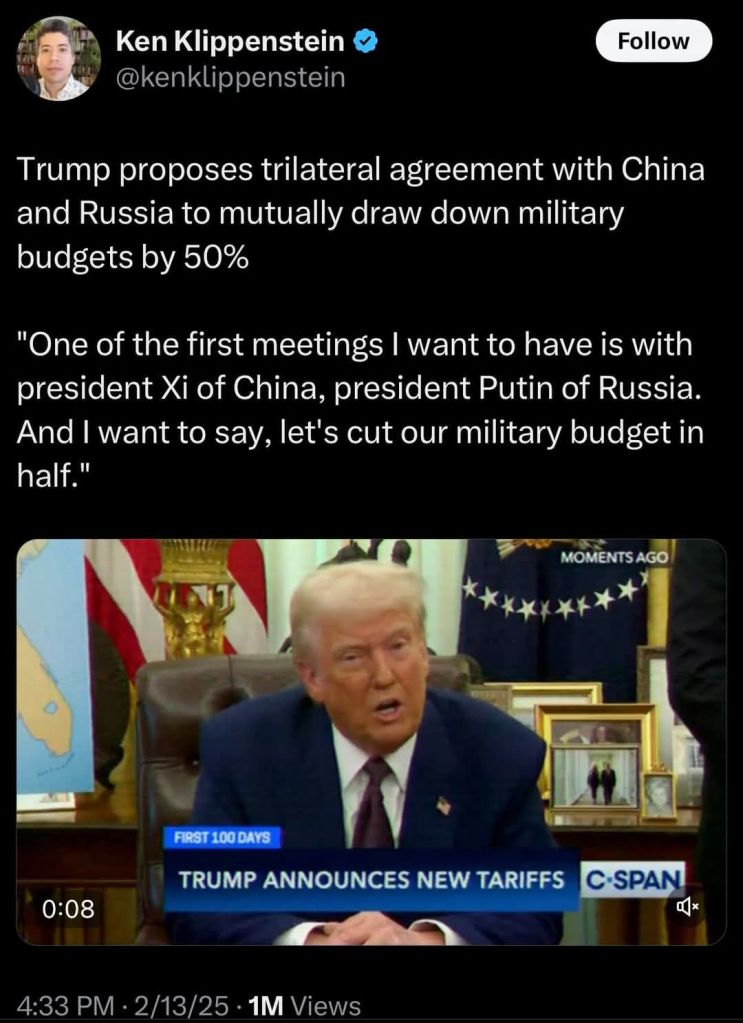
Trump has been full of surprises in the first few weeks of his delayed second term, but this latest proposal was the least expected and one even the professional fault-finders won’t be able to oppose.  He has just made a proposal that could change the world for a generation to come: A trilateral agreement between Russia, China and the US to reduce military spending by 50% and decrease our nuclear stockpiles.

But this isn’t out of character for Trump.  He got started then before he officially entered the office.  According to the Israelis, Trump, who told Netanyahu that the war must end, deserves full credit for the Gaza ceasefire deal.  And this is just a pattern.  Trump has no interest in wars.  He is about business, not bombs, and it goes all the way back to his youth when he, rather the be beholden to phony patriotism, stayed out of Vietnam.

Avoiding War By Any Means

Back in 2016, when Trump was running for President against Hillary Clinton, there was a hearsay report that the MAGA candidate had avoided military service in Vietnam by using a diagnosis of a foot injury.  There is yet to be documentation to prove this.  But it has led to some ridiculing him as “Captain Bone Spurs” and alleging his cowardice.  

To me, knowing what I do about Vietnam, I can’t see how avoiding that meat grinder is a reflection of poor character.  

No, the war was an absolutely horrendous waste of life and resources, a quagmire, in defense of a dying colonial order.  What the US government did to that country and it’s people is beyond the pale.  

Over one million people died, bombed with napalm in their villages—scores of young American boys killed in the process—and nothing was gained besides an ecological disaster.  Our veterans were left scarred and many of them (like the father of a friend of mine) suffering from debilitating illness—which is likely due to the widespread use of chemical defoliant agents.  

It is easy to see the vanity now.  In the end Vietnam did become a Communist nation.  And yet this did not lead those dominoes falling across Southeast Asia, as ‘experts’ predicted (like they do now claiming Putin has ambition to take all of Europe) and we should be celebrating that anyone avoided this pointless conflict.

Trump may have avoided the Vietnam War for selfish reasons, nevertheless the moral reasoning was correct: Why kill thousands of Asians, at risk of your own life, when you can just do business instead and everyone wins?

Trump Angers Neo-cons

In his first term Trump did something even Obama didn’t do and despite being given a Nobel Peace Prize.  Both Obama and Trump would continue the war in Afghanistan, but it was Obama who bombed Libya in pursuit of “regime change” and turned that country into the hellhole it is today.  Trump, on the other hand, avoided war and even started negotiations for peace with a country we’ve been at odds with since 1953.

I recall being told by a die-hard Democrat friend that Trump, the terrible loose cannon and narcissist he was, would start WW3.  It is quite interesting, to see how that this dire prediction compares to actual reality where the last administration had pushed us to the brink of a nuclear Armageddon.  But in four years of Trump’s presidency, despite all the insane fear-mongering rhetoric from his opponents—nothing close to this happened.  

Instead, what happened under Trump, but not Biden, was a slight thaw of relationship with North Korea.  Yes, Trump engaged in a little rocket size comparison, but eventually would walk across the DMZ to shake hands and get some pictures with Kim Jong Un his counterpart.  That is unprecedented.  And is a legitimate reason to award a peace prize, but nobody recognized that moment and it has faded as Biden returned us to a status quo of use of threats and the proliferation of arms deals, rather than diplomacy, in an attempt to dictate terms.

No, Trump is not a peacenik or even a nice guy (depending on who you ask), but he did avoid a dangerous escalation with Iran over a down surveillance drone.  With neo-cons salivating and only ten minutes from strikes, Trump—learning that 150 Iranians may die—called it off.  This is likely why John Bolton turned on him.  The warmongers wanted a violent confrontation, dead bodies, whereas Trump valued human life.

And maybe it was all just a cynical ploy and part of deal making strategy?

Nevertheless, those Iranian men got to go home to their families rather than die so a President could look like a tough guy.  And, when all lives matter peace is possible.  A President that is even doing a little bit of lip-service in concern for enemies will be even less likely to put US service members into harms way.  Yes, he would retaliate against Qassem Soleimani, the Iranian General who was responsible for the deaths of American people, which shows Trump prefers to hold decision-makers accountable rather than subordinates.

Business, Not Bombs

What makes Trump unique, as a President, is his willingness to entertain different ideas in the open.  Our tireless defenders of the status quo claim it is unpresidential, that he suggests alternatives, but this is how a true innovator works.  Why not float a thought or start a conversation?

A prime example is his proposal for Gaza.  I mean, certainly, the Palestinians have truly got the short end of the stick.  They, being Semitic people themselves, get labeled as being anti-Semites, for fighting for their own deeded land, by the most powerful lobby in the world.  Theirs is a legitimate grievance, if there is any, they were chased off of their land by a campaign of violence and terror—are now portrayed as the villains.

So when Trump proposed they walk away it seemed grotesque. Israel is the one country in the world that didn’t see their foreign aid disrupted by Trump’s America-first doctrine and clearly Netanyahu is in agreement with the plan or they would not be doing a joint press conference.  Palestinians had nobody to represent them in this.  How do you make a deal with only one party present?

However, upon some further thought, this could be the best deal Palestinian people can ever can expect to get.  What really is the alternative?

They are in a war they can’t win.  October 7th caught the IDF off guard and yet it was never a serious threat to the Isreali state nor a reason for the Israeli government to come to the negotiating table.  Hamas may have hoped for a hostage exchange in order to get their own captives back.  But hardliners, like Netanyahu, saw it as an opportunity and used it.  Sure, many in the world do protest indiscriminate bombing that kills far more non-combatants and children than it does members of Hamas, but holding a sign or occupying buildings won’t stop this ethnic cleansing campaign.  

Enter, “Riviera of the Middle East”

Trump reframed the conversation from one of fighting for soil, that has led to decades of suffering and death, to what is truly best for me and my children.  Sure, Hamas may disagree, but many Palestinians will likely take a buy-out deal.  Why stay in Gaza if you have a choice to relocate?  There is no new real estate, the Saudis have a lot of money to invest, so why not redevelop Gaza into a modern vibrant city, like Dubai?

The reality is Palestinians aren’t only being kept walled in by the Israelis.  They are truly caught between the two stubborn sides of a regional conflict, like Ukraine, and they (with their children) are paying the full price.  The nations of this region have not forget about colonialism and obviously consider a nation of expansion-minded European settlers to be a thorn in their side.  Add to this that the official policy of Israel is to destabilize their neighbors and you have a breeding ground of resentment.  Palestinians are their way to return the favor—used as a tool to provoke and prove the evil of the Jewish state.

So, for my liberal friends, is this land really so important that we should, for perpetuity, continue to sacrifice more children.  Or do we find a new and creative way to break the deadlock?  And, for my conservative friends, is it better that we send Israel bombs, at the expense of taxpayers, when we could help to broker some kind of buy-out instead?  It is time for a business deal, to give those in Gaza—who just want to live normal lives—a chance.  

So, Trump, I realize this is at your “ridiculous first offer” stage, but I’m listening.  

Tell me more.

The Status Quo Alternative 

The political establishment has only known old divisions and escalation.  It is one big area of bipartisan agreement.  Republicans and Democrats in Congress may disagree on details, but nearly all support an endless war with Russia and China, through proxies or even direct threats.  The goal is always to box their rivals in militarily or back then into a corner economically—as if this is the only way forward.  

Diplomacy took a back seat.  Instead of the slightest acknowledgement of Russian and Chinese security concerns, our government has made regime change the goal with even near-peers with a nuclear deterrence.  And it is this attitude that led to the bloody conflict in Ukraine that has cost countless lives and billions upon billions of US taxpayer money, all after the US had orchestrated a coup on Russia’s doorstep, leading to a civil war in that country and—after eight years of Kiev’s regime lobbing shells at civilians—a direct intervention by Russia.

The problem is a combination of Cold War ideology and institutions.  Endless war is where the big money is.  Many, in the West, profit off conflict and chaos.  That and they are old.  They’ve become functionally fixed, see only one solution (to further humiliate or defeat those who stand in their way) and lack imagination or even the will to come up with win-win resolutions.

Truly, the only way to win any war is not to fight it.  Wars cost both sides.

Trump, for better or worse, is disruptive of the status quo.

As for his proposal, I would consider 50% to be the “ridiculous first offer” stage of negotiations and do not expect China or Russia will go along with it.  For them that would leave the US on top of the balance of power—given our tremendous head start in comparison—and this maintaining our advantage over them leaves their interests vulnerable.  They will probably come back with an alternative proposal and the horse-trading will begin.

Nevertheless, it sure beats a strategy of endless escalation—that eventually ends in a nuclear war or our bankruptcy.  Even a 10% reduction in defense spending would go a long way to slowing down inflation and give hardworking Americans more bang for their buck.  Our sons not dying in Europe or in the East China Sea the biggest benefit of avoiding confrontation.

Lead, Follow, or Get Out of the Way

Like him, love him, or loath him, Trump is the President of the United States and has resolve to make his second term historic in ways nobody imagined.

Even if we disagree on some policies or we have a different understanding of his drive for government efficiency, we should agree with this aim to convince the great powers to beat their swords into plowshares. 

There is just too much to lose (and also too much to gain) by this to not jump on this unique opportunity to challenge existing order and build a better one. 

Business (and buy-outs) rather than bombs—that’s the Trump way of doing geopolitics.

Even his idea of buying Greenland, as part of a containment strategy for Russia and China, is far better than the alternative we see playing out in the steppes of Ukraine.  There is no way to bomb and kill our way to world peace or at least not a kind of peace where humanity survives and thrives.  We need to find a different approach, we need to dissolve the Cold War organizations and agencies that encourage military solutions or regime change.  We need to double down on diplomacy and fair-trade agreements.

It is time to give peace a chance.  We need to be disruptive, to change the conversation, and work with those who are willing to work towards a better future together.  If Trump is a partner in this, then we should embrace this as his role and not hinder this with old partisan battle lines.  Maybe he’s not pure or perfect, but at least he’s oriented right as far as war and avoiding the costs.