The Church Brotherhood Lie

Standard

I once had a conversation with a Mennonite man who idolizes his wife and children.

I told him he was unloving towards me, and, as one careful to meet his religious duties, he was perplexed—what more could he do?

He remarked that he can’t love me with a romantic love (I never suggested to him that I wanted a card on Valentine’s Day) and then asked me how I wanted to be loved by him. 

So I asked him for brotherly love and quoted an example from Scripture:

I grieve for you, Jonathan my brother; you were very dear to me. Your love for me was wonderful, more wonderful than that of women. (2 Samuel 1:26)

He thought that was preposterous.

He loves his wife very much, he has made his own biological offspring his main mission in life, and for him to love me more would be impossible.

He did not truly love me as a brother and could not because he lacked authentic faith.

Why do Mennonites fail to deliver true brotherhood?

Mennonites take pride in their greater commitment to each other and the concept of a brotherhood of believers.  The comparison they like to make is between themselves and those whom they dismiss as being nominal Christians.

The assumption seems to be that church attendance equates to brotherhood.  And, since we compare favorably to those who only attend church on Christmas and Easter, we are doing well.  Besides that, we continue to go through the motions of servanthood (with a ceremonial foot-washing) and even do it twice a year.

But honestly, that is pathetic.

People only compare themselves to those downstream from them because they are making an excuse to be pathetic.

If you want to be more than pathetic you compare yourself to the perfect example and pursue that.  Mennonites fail to deliver on true brotherhood because their own pride blinds them from the possibility that they are falling short and could actually do better.

They lack the faith to break with their religious status quo and shoot for the impossible.

What is true brotherhood?

It is a shame conservative Mennonites shun competitive sports.  If they had learned to commit to others like high school athletes must dedicate themselves to a team then they might know something of the potential for brotherhood.

I have a cousin who just returned from his years of active duty in the military.  He says that while the challenges were tough, he will miss the comradery and brotherhood.

In practical terms, this means falling on a grenade to save your buddies (or just something as mundane as taking the time to run a lunch out to a brother in arms who forgot his) because in the military the good of the individual is sacrificed for the good of the team.  The individual dies when they enter the brotherhood.

The church I’ve been a part of for decades is a disappointment.  Many of the so-called leaders are apologists for complacency and promote faithless religious devotion.  Instead of being advocates for others (like Paul was for Onesimus) and helping them to carry their burdens as is Christian, these frauds teach that more Bible reading is the answer.

I’m sorry, but vacant promises to pray for each other twice a year while splashing water on each other’s feet is not brotherhood.  Telling me that a book is some kind of magic elixir cure for all needs is spiritual ignorance.  And the book that these phonies claim to revere says this is not the case very clearly.

What Christian brotherhood should be according to Jesus.

It does not take a high level of reading comprehension to find the central point of the New Testament.  The point is to have the kind of faith to live out the self-sacrificial example of Jesus.  What this means is following the command to love each other so the world can see clearly that we are his disciples:

A new command I give you: Love one another. As I have loved you, so you must love one another.  By this everyone will know that you are my disciples, if you love one another. (John 13:34‭-‬35)

Jesus defines this command to love further:

My command is this: Love each other as I have loved you.  Greater love has no one than this: to lay down one’s life for one’s friends.  You are my friends if you do what I command.  I no longer call you servants, because a servant does not know his master’s business. Instead, I have called you friends, for everything that I learned from my Father I have made known to you.  You did not choose me, but I chose you and appointed you so that you might go and bear fruit—fruit that will last—and so that whatever you ask in my name the Father will give you.  This is my command: Love each other. (John 15:12‭-‬17)

The idea of dying to self that is expressed in the teachings of Paul is often taught as if it is some kind of religious devotion devoid of a practical end.  As if we prove our love for God through emptying ourselves of any and all desire.

But the self-sacrificial love of Jesus is not aimless or vague, it is being “devoted to one another in love” to honor others above ourselves (Romans 12:10) and practicing brotherhood.

Be real or I’m not interested in your words.

The reason the church falls short is because it has compromised love for the brotherhood and made it secondary to family, business, or other personal ambition.  But Jesus did not teach individualism.  He did not promote patriarchalism either, and instead taught us to be a brotherhood.

The relationship of David and Jonathan is a picture of true brotherly love:

After David had finished talking with Saul, Jonathan became one in spirit with David, and he loved him as himself. From that day Saul kept David with him and did not let him return home to his family. And Jonathan made a covenant with David because he loved him as himself. Jonathan took off the robe he was wearing and gave it to David, along with his tunic, and even his sword, his bow and his belt. (1 Samuel 18:1‭-‬4)

Our devotion to brotherly love should not come second.  Unfortunately there are many in the church who are not willing to come to the aid of another the same as they would their own family.  There are many who put their religious agenda and protecting their own biological progeny above all else.

That is the case with the man I had the conversation with.  He is regarded by many as a model citizen; his children do all the ‘right’ Mennonite things and are treated with favoritism, but his family is a bunch of religious self-seekers—like their dad.

The language of brotherhood should not be used lightly.  Don’t call me a brother or sister unless you are actually willing to treat me as one.  I don’t like being lied to.

Truth: A Concept Bigger Than Words

Standard

A couple Sundays ago I was riding along with some church friends on our way to a hymn sing (something us conservative Mennonites do) and we came upon a hitchhiker.

The hitchhiker, a young man, was strumming some sort of ukulele.  He had a sign asking for a ride west.  We were going west.  We conferred quickly, decided to make use of our extra seat and soon were on our way with one more passenger.

The young man, a friendly nineteen-year-old from Raleigh, North Carolina, has spent nearly two years on the road and told us of his nomadic lifestyle.  He relies on the hospitality of others, often sleeps under the stars, and is on his way to California.

Being that we are religious and on our way to a church service, the conversation turned to religion.  He explained that he is uncomfortable with the “Christian” label.  He described himself as “a follower of Jesus” and later that evening mentioned the influence of Taoism.

We invited him to church.  He accepted the invitation and soon he was amongst us Mennonites as we sang acapella music.  To my ears, we sounded pretty good.  He stayed until the end of the service and soon enough was being introduced by me to others in attendance.

One of those introduced, after some friendly chat (the usual Mennonite game banter and assessment of pedigree) ended by quoting John 14:6 at the young man, “Jesus is the way and the truth and the life” and emphatically stating this is the only way…

As we paused with this sort of non-sequitur concluding statement, presented in such a religiously cliché way, I almost asked this ordained Mennonite man if he knew what it meant.  But, fearing he would try to answer if I asked, I restrained the impulse and smiled.

I have no idea what my guest was thinking, he was courteous and didn’t seem too uncomfortable in our midst.  And so the evening went some polite conversation and some awkwardly presented evangelical dogma, me holding my tongue with slightly annoyed amusement and answering his questions.

Incidentally, nobody offered this young man shelter for the night (one of those asked apparently making excuse for himself because of his wife) and so we took him a few miles further west to ‘civilization’ where he would have more options.  We prayed with him, gave him some cash and bid him farewell before returning east again.

What is truth?

The incident above, especially the quotation of Scripture, seemed like a good basis for a blog and reason to consider the meaning of truth.  Truth, in this case, the idea of truth (alétheia) found in the passage, the truth of Jesus, that was partially quoted at my young hitchhiker friend.

The words “I am the way and the truth and the life” are cherry-picked from the Gospel of John.  It is a part of a discussion Jesus was having with his disciples about imminent events.  The disciples, as usual, were bewildered and asking questions:

“Thomas said to him, ‘Lord, we don’t know where you are going, so how can we know the way?’

Jesus answered, ‘I am the way and the truth and the life. No one comes to the Father except through me.  If you really know me, you will know my Father as well. From now on, you do know him and have seen him.'” (John 14:6-7)

Philip was still confused.  He goes on to ask Jesus to reveal the Father to them.

Jesus responds to explain in further detail, stating that he is one with the Father, that his words are spoken by the authority of the Father and telling them that the Father will be revealed to them through obedience to his teaching and by the Holy Spirit.

The truth of Jesus is more than book knowledge.

It is interesting to note that Jesus did not tell his followers to diligently study Scripture.

Instead, Jesus told them to obey what they knew and that more would be revealed by the Spirit after their obedience.  It might seem backward, but faith without works is dead (James 2:14-26) and salvation is a gift from God:

“For it is by grace you have been saved, through faith—and this is not from yourselves, it is the gift of God—not by works, so that no one can boast. For we are God’s handiwork, created in Christ Jesus to do good works, which God prepared in advance for us to do.” (Ephesians 2:8-10)

That is not to say that the Scripture is unprofitable, it most certainly is profitable to a believer.  It is “through faith in Jesus Christ” (Hebrews 2:3-15) that Scripture is able to make us “wise for salvation” and only through this truth of faith can we ever understand.

Book knowledge is not the same as correct understanding and those who opposed Jesus most vehemently had a great knowledge of Scripture.  In fact, it was because of their own understanding of Scripture (and dogmatic literalism) that they rejected Jesus.

The truth of Jesus is something more than mere book knowledge, it is more than religious devotion to the study of a text or a theological proposition.  The truth of Jesus is something more profound and powerful than words on a page.  It is a spiritual reality that goes far deeper than fallible human knowledge or our finite ability to understand.

The truth of Jesus is something beyond description in words.

Truth is a word, but truth itself is not a word.

We use words to paint pictures in the minds of our audience.  Words are symbols used to describe ideas, they are things we use to describe other things and yet words are not themselves the thing being described.  Words are not truth of themselves any more than a portrait in acrylic color on canvas is the actual person being portrayed.

Words depend on the ability of our audience to understand them.  One could tell their cat to “take out the garbage” and the poor critter would stare at them blankly.  Language—like beauty is in the eye of the beholder—depends on the interpreter to correctly understand the word usage  Communication is an interactive affair requiring both parties to be on the same metaphorical page.

Furthermore, talk is cheap, words can also be used to construct a false image of reality and deceive.  Jesus warns of false teachers, people who profess with their mouths to be faithful, who present themselves as sheep and yet are inwardly wolves—We are told we can know people by their good or bad fruit. (Matthew 7:15-23)

So truth is more than words.  Truth is an abstraction, it is something greater than the sum total of words and language used to describe it.  Truth is something bigger than us and beyond our own concept of reality.  Truth is transcendent and, still, it is something that can be fleshed out and represented.

The truth of Jesus is God’s word and a living testimony about a greater reality.

Jesus was brought before Pontius Pilate, a Roman civil authority, to be judged.  The Gospels give slightly different versions of the events.  In summary, the religious leaders accuse Jesus, they say he claims to be their king (a crime amounting to sedition against the established state) and insist that he is evil.

Here’s one account of the beleaguered governor questioning Jesus and trying to get the bottom of the issue:

“Pilate then went back inside the palace, summoned Jesus and asked him, ‘Are you the king of the Jews?’

‘Is that your own idea,’ Jesus asked, ‘or did others talk to you about me?’

‘Am I a Jew?’ Pilate replied. ‘Your own people and chief priests handed you over to me. What is it you have done?’

Jesus said, ‘My kingdom is not of this world. If it were, my servants would fight to prevent my arrest by the Jewish leaders. But now my kingdom is from another place.’

‘You are a king, then!’ said Pilate.

Jesus answered, ‘You say that I am a king. In fact, the reason I was born and came into the world is to testify to the truth. Everyone on the side of truth listens to me.’

‘What is truth?’ retorted Pilate. With this he went out again to the Jews gathered there and said, ‘I find no basis for a charge against him.'” (John 18:33-38)

This conversation is interesting and especially when Jesus claims to have come to “testify to the truth” and says those on the side of truth listen to him.  It is reminiscent of when he told the religious dogmatists that his sheep hear his voice and makes an incredible claim:

“The Jews who were there gathered around him, saying, ‘How long will you keep us in suspense? If you are the Messiah, tell us plainly.’

Jesus answered, ‘I did tell you, but you do not believe. The works I do in my Father’s name testify about me,  but you do not believe because you are not my sheep.  My sheep listen to my voice; I know them, and they follow me.  I give them eternal life, and they shall never perish; no one will snatch them out of my hand.  My Father, who has given them to me, is greater than all; no one can snatch them out of my Father’s hand.  I and the Father are one.'” (John 10:24-30)

For this Jesus is accused of blasphemy.  But to that charge, he replies by quoting their Scripture to them.  He quotes from Psalms 82:6, where it says “I have said you are ‘gods’,” and uses that to argue against their idea that his claim of divine sonship was blasphemy.

Pilate seems agnostic about truth and exasperated by Jesus.  He is dealing with a contradiction, he sees an innocent man not worthy of punishment and the religious crowd sees a man guilty of blasphemy against God who deserves death.

Pilate ultimately bends to political pressure and, while washing his own hands, complies with the demands of the crowd.  However, both Pilate and Herod (who’s part is described in Luke 23:8-12) seem to see Jesus as a curiosity rather than as a direct threat to the state.

The truth of Jesus is found in our following his example and being a self-sacrificial testimony of God’s grace.

The truth of Jesus is not a reasonable or rational proposition by worldly human standards.  It is only understood through spiritual means, through having the “mind of Christ” (1 Corinthians 2) and a process that starts in the heart (2 Corinthians 3) rather than through outward means.

It is transformative, as Paul explains:

“Therefore, I urge you, brothers and sisters, in view of God’s mercy, to offer your bodies as a living sacrifice, holy and pleasing to God—this is your true and proper worship. Do not conform to the pattern of this world, but be transformed by the renewing of your mind. Then you will be able to test and approve what God’s will is—his good, pleasing and perfect will.” (Romans 12:1-2)

The Orthodox Christian tradition would call this theosis or divination.  Unfortunately, my own Anabaptist tradition has picked to focus on the other negative end (the “be not conformed” part) and the result is an idea of “non-conformity” that usually amounts to a reactionary worldly effort to control outward appearance.

The truth of Jesus is about more than our ability to conform to a man-made list of requirements.  It is a truth that transcends all worldly means and is expressed in our unrelenting, unapologetic and uncompromising pursuit of the divine.  The truth is a positive vision.  The truth is God’s grace made manifest in us.

The truth of Jesus is a path we walk that leads us to greater life and the perfection of divine love.

The words “the way” (hodos) refer to a journey.  It is a path to walk and live out.  The trail was blazed by Jesus who died for our sins, but it is lived also by those who truly believe and wish to be disciples.  As Jesus said:

“Then he said to them all: ‘Whoever wants to be my disciple must deny themselves and take up their cross daily and follow me.  For whoever wants to save their life will lose it, but whoever loses their life for me will save it.'” (Like 9:23-24)

Jesus is using the cross as a metaphor.  A cross, in human terms, represented suffering and shame.  However, in following after Jesus, for a believer this is not useless suffering, it is not pain for the sake of pain or self-flagellation, it is suffering for the good of others or making a path to something greater.

Jesus promises a more abundant life (John 10:10) to those who follow him.  In this he is not promising material or worldly wealth.  But he does say that we should use our worldly wealth to gain friends and gain true riches (Luke 16) which is to prioritize God through our loving people:

“Whoever claims to love God yet hates a brother or sister is a liar. For whoever does not love their brother and sister, whom they have seen, cannot love God, whom they have not seen. And he has given us this command: Anyone who loves God must also love their brother and sister.” (1 John 4:20-21)

Jesus said we can know the truth of a person’s profession of faith by their fruit (Matthew 7:15-23) and that the fruit of the Spirit is described by Paul “love, joy, peace, forbearance, kindness, goodness, faithfulness, gentleness and self-control.” (Galatians 5:22-23)  Our truth must be more than words.

So what does ‘I am the way and the truth and the life’ mean?

To understand this we need to understand the context.  The context is the last supper, it is during the Passover feast, the night Jesus is betrayed and an intimate moment.  In these passages of Scripture (John 13 and 14) the implications are clear.

Jesus explains that his disciples will be known by their love for each other, he says he must go so they may know the truth more intimately (promising the Spirit to those who obey his instructions and example) and then goes on to demonstrate a truth of love worth dying for.

The truth of Jesus is not a theological proposition, not a religious profession or book knowledge. His truth is not a product of human reasoning and founded on scientific research or evidence. The truth of Jesus is something found in our walking in the Spirit, it is demonstrated in our love for others and bringing the dead to life.

Truth is living a reality greater than our reality, something that transcends worldly knowledge and human understanding. Truth is both known and still yet to be known, it is a reality that goes beyond the currently available evidence and is something that can only be experienced through a true walk of faith.

The truth of Jesus transcends religion and is a walk of faith.

In some respects, it seems my hitchhiking friend may have a better grasp of faith than his religiously indoctrinated counterparts.  He is more literally taking no thought for tomorrow (Matthew 6:34) and depending on God to provide.  By contrast, we too often rely on our own understanding, planning, and abilities.

I wish my traveling friend well on his journey and pray that the truth of God’s word (Jesus) is made manifest in him.  May God’s truth of self-sacrificial love and spiritual life be found in us who claim to know Jesus.

Performance Anxieties and Worship

Standard

The Mennonite culture I am a part of has had a tradition of music that spans a few generations.  The tradition is acapella congregational singing (typically in four parts: soprano, alto, tenor, bass) and hymn music.  It is my preference, it is what I am accustomed to and comfortable singing in a church worship service, but some conservatives would have it as the only right way.

The other night, as is not uncommon, we had a choral program at my church. A group of a few talented individuals (dressed with matching outfits and practiced) sang together in front of an audience of family and friends.  Their selection of music had meaningful lyrics focused on distinctly Christian themes and the Christmas season.  It was a beautiful presentation.

Afterwards, the pastor (asked to give the benedictory prayer) went to pains to explain that the presentation that preceded was not a “performance” or “entertainment” and was worship.  I understood what he meant.  However, is it actually truthful to say that a presentation to an audience is not a performance?  Are concepts of worship and performance mutually exclusive?

Mennonite Tradition, Progressive Evolution and Lingering Guilt…

Mennonites have historically avoided elevation of some in the group.  Leaders were expected to be servants to all rather than a privileged hierarchy.  In fact, even raised pulpits were a controversial topic because of the potential for pride and spiritual inequality they represented.  Traditionally there was a table for those who preached to put their Bibles on and no pulpit.  Preaching was not to be done flamboyantly or in a way that drew special attention to the presenter.

Music in worship was ordered likewise.  There were no solo instruments or vocals in worship services because it was believed that would draw too much attention to the individual(s) performing.  In the church service singing was strictly congregational and in unison rather than divided into parts.  Four part singing only became part of Mennonite practice in the late 1800’s and special singing groups likely followed some time after as Mennonites adopted more mainline practice.

But it is an uncomfortable position to the conservative Mennonite mind.  There is still an urge to distinguish between performance for entertainment and worship of God.  In my own congregation we allow solos and special singing groups.  However, we are also dutifully reminded that the point is the worship God rather than recognize those presenting and (except for a few occasional outbursts by rebels) we do not offer any applause.

It is this careful avoidance of applause and tendency towards the over-wrought explanation that makes me wonder what is truly amiss—It seems too anxious.  If nobody else but God is getting the attention, shouldn’t that just be self-evident, why the need for an explanation? Why the contrast and comparison?

Our Worship *IS* Imperfect, Be Honest…

I believe the reality is that a special group singing before an audience is obviously a performance and for entertainment.  No, this does not nullify the reality it is intended as worship for God either.  What we do for others is an expression of our worship for God and that can certainly include wholesome entertainment.  Our performance for the good of others is ultimately what brings God honor and glory, is it not?

Furthermore, we aim to be perfect expressions, but we are not and might as well be honest about it.  Of course there is potential for pride in performance.  Did anyone on the stage not want to please the audience they sang to?  It would be utterly absurd to claim otherwise and with that the danger of self-aggrandizement. 

Yet, denial of that potential for self-centered worship doesn’t get us any closer to perfection of worship either.  If anything it is the same fatal error of Ananias and Sapphira who were judged instantaneously for dishonesty in their claiming to give all while secretly withholding some for themselves. Their deception, likely rooted in their wanting to maintain appearances of perfection or religious pride, was their downfall.

We are imperfect even at our best. Yes, even in our worship we can have mixed motives. We enjoy being talented, we often keep some of the praise for ourselves, and that’s okay if we are honest about it.  We are saved by God’s grace and not by our own perfect efforts.  It is this admission of our own imperfection that leads us to be more gracious towards others and a more true expression of the worship Jesus described.

“Truly I tell you, whatever you did for one of the least of these brothers and sisters of mine, you did for me.” (Matthew 25:40)

In conclusion, we should do as Jesus instructed and learn what it means in Hosea 6:6 where it says God desires mercy not sacrifice.  This is a reference back to the religious sacrificial rituals observed as worship in the Old Testament.  Sacrifice is an impractical expression of worship whereas mercy is not. 

Our better worship is not having the right mode or music style as much as it is in our expressed in our genuine love for each other. 

Truth and Hypocrisy

Standard

In the midst of this age of information overload is it any surprise that deep thinking people give up on the idea of discernable truth?

Competive and contradictory claims assail us from all angles. Advocates on all sides are seemingly equally convinced that they see more clearly than those who of a different perspective. 

We would be persuaded, they say, if we just opened our minds, examined the facts fairly and were honest with ourselves.  But, despite their confidence, to me often all sides seem to lack a clear perspective and bring a bias that is only obvious to those on the other side.

Hypocrisy in Action

How is it the same people who want to string up leaders as war criminals are the same who demand only compassion and understanding for a woman who aborts a life because pregnancy is inconvenient?

How is it that gun owners and passionate pro-lifers are some of the same saying that we should judge all Syrian refugees as a potential terrorist and protest to keep them out rather than value them as individuals as they demand for themselves?

Everyone is convinced in their own minds.  Everyone believes that they think rationally and most can give reasons for what they believe.  But somehow everyone, including some very smart people on both sides, cannot agree on everything and oftentimes we vehemently disagree.

Even those who claim the same religious texts as their guidebook to life arrive at vastly different conclusions about what it says—often with perspective each claiming they are authentic and the others are the imposters.  Both come with carefully crafted theologies and neither side shaken from the moorings of base assumptions that lurk somewhere outside the realm of their conscious thought.

Muslims see terrorism as the result of western intervention.  They can point to the fact that terrorist organizations like Islamic State and al-Qaeda were nurtured to life or a direct consequence of foreign policy decisions of the United States of America.  Many Americans, by contrast, see radicalization as a genetic flaw of Islamic faith and downplay their own responsibility.

We tend to see only the noble intentions of those who share our own particular ideological alignment.  The same people who demand absolute accountability for others are often the most creative at manipulating the evidence in order to absolve themselves of even shared guilt.

Meanwhile, with a smug satisfaction (that I cannot know is genuine or facetious) I sit here thinking I know something and maybe I do?

Could it be that none of us can claim to have a complete picture of the truth and that all of us share some in creating this flawed reality?

I know it is more comfortable to assume our perspective is infallible and the we ourselves have no major fault.  It is easy to outsource blame for the problems of the world, wash our own hands of responsibility, and pretend it is moral to distance ourselves sanctimoniously.  However, isn’t that exactly what is wrong with the other side?

I say we all resolve all the more to clean our own side of the street.  Lead the world by making no excuses and being an example.  If you wish for people to be open to your own perspective try to see theirs.  If you do not wish to be judged wholesale by the actions of a few bad actors then do not judge others that way.

Truth in Action

I believe there is truth to be found, but it is not something we profess so much as what we practice.  The truth is the love that we live and not a proposition that is only possible when others do our bidding.  Truth is our walk in consistent love not our words in hypocritical judgment.

“Do not judge, or you too will be judged.  For in the same way you judge others, you will be judged, and with the measure you use, it will be measured to you.  Why do you look at the speck of sawdust in your brother’s eye and pay no attention to the plank in your own eye?  How can you say to your brother, ‘Let me take the speck out of your eye,’ when all the time there is a plank in your own eye?  You hypocrite, first take the plank out of your own eye, and then you will see clearly to remove the speck from your brother’s eye.”  (Matthew 7:1-5)

Do we give up on describing truth?  No.  I believe that there is some value in trying to put truth into words and arguing for what we believe is right and good.  However, we must always speak in humility and be as brutal to ourselves as we are to those who see things differently.

A Community Perspective of Mass Murder

Standard

Another well-armed angry young man goes on a murderous spree and again political ambulance chasers jockey to take advantage to win points for their pet projects.

President Obama used the recent massacre at an Oregon college as an opportunity to campaign for gun control measures that would not have prevented it.  Militant 2nd Amendment gun rights advocates responded with the tired ‘good guys with guns’ arguments and arming teachers as the solution.  Others ranted about correlations between pharmaceuticals and deranged minds.  (Well, duh?) 

Those using the issue for their various (political) causes seem to be vastly misunderstanding the actual issue.  Their response is a knee-jerk reaction rather than a careful analysis of fact and their canned solutions show the functional fixedness in their thinking.  There are too many assumptions that steer the current conversation and could be distracting us from addressing the real problem.

Many seem to assume that killers are simply incurable killers and we simply need to better secure ourselves (with more guns or gun control laws) against this inevitability of angry men.  But could a killer be stopped before they stockpile weapons and act out their violent fantasies against those who they blame for their unhappiness? 

Perhaps more guns, curbs of liberty and drugs (more or less) are not the solution to the real problem?

The root issue is that a young man made a choice to act violently.  He had reasons, rational or irrational, for the choice that should be understood.  (Note, I am not saying that the choice was justified, I believe murder is always immoral and a sin.)  We should acknowledge the choice as a choice and at least explore the possibility we can help those who are tempted by violence to choose rightly.

#1) Understand the Problem is a Person

I think often there is an urge to sanctimoniously distance ourselves from the bad actors of society.  Simply labelling the perpetrator of violence as a “thug” or “monster” or “animal” allows us to build emotional wall of separation between ourselves and evil deeds.  If we were to acknowledge the humanity of the person doing the evil act we would be tying our own humanity to the evil and in a sense making ourselves responsible.

image

Fundamental attribution error or correspondence bias is an assumption that another person’s behavior is all a product of their defective character.  (And, again, I do absolutely believe in personal accountability and responsibility for choices.)  But then, what it comes to our own bad choices we always have an external excuse or justification and blame circumstance for our choices.

Killers do what we do.  Killers often feel justified in what they do like we do because they were cheated or mistreated.  They take out their jealous rage against those who they blame for their unhappiness.  It is actually their humanity, the fact that they have emotions or just desire for significance—like we all do—that they act.  The difference is that they choose to turn to acts of violence rather than grace.

The answer to the perceived offenses we endure is not hate or vengeance and love for our enemies needs to be encouraged.  We need to fight against our own urge to be consumed totally by securing our own rights and love others as we would like to be loved.  We should distance ourselves from using their evil choices to justify our own.  We must love the hurting person behind the choice before they make it.

#2) Recognizing that Social Needs are Real

The elephant in the room is the vast changes in American culture and lifestyle that correlate with the trend of mass murder.  We are linked with more and more technology, but are actually less connected (in flesh) than generations prior.  Community has been replaced with increasing individualism and isolation.  It is not a change without consequence.

image

People are not good in isolation, people have social needs and can be damaged by lack of adequate human interaction.  Just a bit of research into solitary confinement or extreme cases of child neglect quickly show the psychological consequences are profound when social needs are not fully met for extended periods.

Perhaps the ideal of suburbia is not so ideal after all?  Suburban life is not extreme isolation.  But, in many cases, it is an environment deficient of social interaction—and especially in the case of single child homes.  A child without brothers or sisters and separated from regular intimate interaction with other people is probably going to feel a deficit.

The problem is exacerbated for those who are socially awkward or shy.  Some people are able to make friends everywhere, they are outgoing, easily put others at ease and popular.  Other people struggle getting past that initial barrier of first contact, they watch frustrated as others interact with ease and feel ignored.  Nobody wants to be marginalized.

We need to start recognizing that society and lifestyle do have a part to play in the choices of individuals.  We need fewer fenced in yards, fewer spiritually empty McMansions and more opportunity for inclusion for those who would otherwise be marginalized by their natural dispositions or disabilities.  We need less individualism and more community spirit.

#3 Bringing Outliers into our Community

There are some people who are probably gone beyond hope unreachable.  There are some who have a defect that makes them almost impossible to relate to and interact positively with. 

However, I do not believe that is the case in all cases or even most cases and we could do better at finding a place for those who need a place to belong.  There is no amount of entertainment or material wealth that can fill the void of purpose caused by social isolation.  We should not underestimate the role of community in shaping individual attitudes and mental health.

I see a solution in intentional community.  A friend recently posted a story about a preschool in a nursing home.  It was a beautiful example of the social needs of elderly being met by their inclusion with children.  That is the type of mindset that could be applied more broadly. 

image

But intentional community doesn’t need to start with a collective managed structural change like melding elderly and child care.  It can start with how we as individuals interact with the outliers among us.  It starts with our being aware that there are those who are marginalized and suffering from social isolation.  If we look for it we can be a help.

It takes a change in perspective.  Perhaps the weirdo is weird only because they have no friends to help them assimilate?  Are you willing to be that weird person’s friend and bring them into your circle of friends?  Forget mass killers even, what if we could prevent one suicide by being more proactive and inclusive?  What if we could make one person’s day better?

#4 Know the Individual Power You Wield

I believe many of us underestimate our own influence.  We turn to solutions like guns and laws because we feel too small to fight the demons of our culture without them.  We look for ‘silver bullet’ solutions (pardon the expression) and forget that people are complex social creatures.  One-size-fits-all solutions are not the best answer.

We need to fight back against evil, but not with superior firepower which is often misused or increased enablement of governments that often ends in abuse.  We need to overcome evil with good.  We need to fight isolation with inclusion, beat social awkwardness with understanding and prevent the seeds that lead to violence from ever taking root.

It takes a community of willing individuals to solve community problems.  Violence against the community is intended as an attack on the community and must therefore be addressed as a community.  But the community is not those we elect to represent us, the community is us and the problems of community require us as individuals to take part in being the solution.

Stop looking side to side or over your shoulder waiting for someone else to save society from its own destruction.  Instead use your own unique talents and abilities, search out the needs in your own community and fill them.  As the saying goes, an ounce of prevention is worth a pound of cure, and maybe even just a hug or smile can make a life changing difference.

#5 The Example of a Social Physician

Jesus was an advocate for unpopular people.  The religious people of his day criticized him for what they perceived as his lack of judgment for his inappropriate mingling with women and men who they saw as inferior.  Jesus turned the tables, he condemned the socially powerful and popular, he spoke for those marginalized by society.

There are many Gospel accounts like this…

“While Jesus was having dinner at Matthew’s house, many tax collectors and sinners came and ate with him and his disciples.  When the Pharisees saw this, they asked his disciples, “Why does your teacher eat with tax collectors and sinners?”  On hearing this, Jesus said, “It is not the healthy who need a doctor, but the sick.  But go and learn what this means: ‘I desire mercy, not sacrifice.’  For I have not come to call the righteous, but sinners.”  (Matthew 9:10-13)

We don’t like the IRS today, but tax collectors in Jesus day were traitors who had sided with the Roman occupation of Palestine and were hated by the Jews.  In the eyes of his accusers he was guilty by association.  How could a great man find company with traitors, prostitutes and other sinners?  But what is greatness without mercy to those who need it most? 

Jesus was greater because he was merciful to all people, even the least of society and we should follow the lead he offers.  We should be doctors of social ailments.  We do not excuse or offer justification for sin anymore than a doctor is an advocate for disease.  No, we, like a doctor, need to diagnose the true problem and provide the right cure.

We can exercise the same power to heal as Jesus did.  We have a choice to create a better society.  We can choose to respond to problems with love and not fear.  We need to be the solution in the same way as Jesus, by overcoming prejudice through self-sacrificial love and love for the enemies we face every day.

God bless.  Be strong.  Be a solution not a spectator.

Would the real bigots please stand up!

Standard

Politicians aren’t supposed to say what’s really on their mind.  People are annoyed by the carefully worded statements of career politicians. Many claim they want something more genuine and real. Yet, if we have no grace for honesty that we disagree with, can we blame politicians for their lawyer language?

I like honesty. No, not that of a nasty, intentionally inflammatory or unnecessarily disrespectful kind either. I like honesty that doesn’t take into account political expediency.  Honesty like when Ben Carson said he “would not advocate” for a hypothetical Muslim candidate that did not support the US Constitution and whose faith was inconsistent with American values.

Of course this became an opportunity to label Carson as a bigot and Islamophobe.  Both Republican and Democrat competitors alike condemned his honesty and some (ironically) think this disqualifies him to run for President.  Carson’s political adversaries delight in taking his comments out of context and yet many should agree with him if they were honest.

As another blogger has pointed out already, many moderate Muslims would not vote (or advocate for) a Muslim candidate who supported the brutal application of Shari’a law.  I am doubtful, very doubtful, that most of those lambasting the conservative physician would advocate for the oppression of women or death penalty for homosexuality.

In fairness to my Muslim friends, interpretations of the Qur’an do vary and the brand of Islam fueling terrorism represents them about as much as Westboro Baptist represents the mainstream of Christianity.  It would’ve been helpful had Carson been more specific about what kind of Muslim he would not advocate for rather than leave that to interpretation.

However, if it is not bigoted or Christo-phobic to tell Kim Davis to step down or advocate against candidates who want Creationism taught, why is what Carson actually said so inexcusably wrong?

I, as a Christian, would not advocate for a Christian who believes that the law of Moses should be enforced by the government.  There are some Bible-believing people who are convinced that both the Old and New Testament should be considered equally, their theological perspective is called Theonomy, and I would not advocate for their political ambitions.  Am I an anti-religious bigot?

Do I need to advocate for the Pope to escape an accusation of being an anti-Catholic bigot? 

Is hate for Mormons the reason some refused to vote for Mitt Romney’s conservative (religiously influenced) values?

Is it wrong that an atheist believer in gun control to say they would not support a Christian NRA member?

No, no, and no, who we advocate for or against is our own choice, we are free to our own opinions and there’s nothing wrong with being honest about what we believe.  Sure, it might not be the smart political move to say everything we think out loud.  But, for all you who complain about dishonest politicians, maybe we should stop punishing the decent and honest ones?

This outrage over Carson’s comments seems more than a little bit disingenuous and is logically inconsistent at very least.  He didn’t say Muslims should not be permitted to run for political office.  He didn’t say they should be stopped from voting their conscience.  What he said is he would not advocate for a Muslim of a particular interpretation of that religion.

In conclusion, I would take Ben Carson over a man or woman who lies and says what people want to hear.  I don’t agree with him in all areas, yet I do know where he stands and that’s refreshing.  I am doubtful that many Americans (including Muslims) disagree with his actual stance.

Trump: The Man and the Myth

Standard

A fellow Christian (and conservative) friend asked me to list the problems I had with Donald Trump as a Republican candidate. The hard part is knowing where to start.

Trump claims to be conservative. He is definitely saying things that resonate with those who are concerned about jobs, border security and immigration. But, I believe proven character and integrity is far more important than what a person claims about themselves.

Trump supporters are convinced he is genuine simply because he says things they want to hear. Yet seem to forget that the art of demagoguery is to say what plays well with a particular crowd. Trump is shrewd enough to make a sale, but is he honest?

Myth #1—Trump ‘says it how it is’ and is honest.

Trump’s claim to fame is not personal integrity or conservatism. He is known for salesmanship and a bestselling book, “The Art of a Deal,” where he talks about creating a big impression. In other words, try to create an appearance of success and dazzle.

image

Trump parroting popular prejudice doesn’t make a him honest anymore than me moonwalking makes me Michael Jackson. There’s a strong possibility he may just be saying what some want to hear in order to make the sale. Those saying that Trump ‘says it how it is’ might want to consider who they are dealing with.

Trump, like the used car salesman who sold you that clunker, is trying to make a deal with you.

image

Sure, he might not be saying what ‘they’ want to hear, just as a used car salesman might also act like he’s at odds with the management because the deal he is making with you is going to cost ‘them’ too much. But that doesn’t mean you take the salesman at their word on it!

From a Christian perspective, there is even more need to be discerning and skeptical of claims that sound good to us:

“For the time will come when people will not put up with sound doctrine. Instead, to suit their own desires, they will gather around them a great number of teachers to say what their itching ears want to hear. They will turn their ears away from the truth and turn aside to myths.” (2 Timothy 4:3-5)

Trump has claimed a mythological net worth of near nine billion dollars, but Trump’s actual net worth is half of what he claims according to Forbes. So is Trump clueless about his own business holdings? Or does he know that the attention span of the average person is short and that he can dazzle people with a huge number that they’ll never check?

Even Trump’s business prowess seems as grossly exaggerated. Yes, he’s extremely wealthy, but he also had a huge head start and his daddy’s fortune to build from. It is said that the first million is the hardest and there’s some truth to that. You are far ahead when you can reinvest rather than spend your income on necessities. Trump had that advantage.

The real way to measure Trump is to put his accomplishments in perspective of his own peers:

image

Reality check: Trump’s success really is not as impressive when put in proper context. Trump is trying to make a sale, he is out to make a big impression with his target audience and willing to deceive.

Myth #2—Trump is rich and therefore he cannot be bought.

John D. Rockefeller, the world’s wealthiest man, was once asked: “How much money is enough money?”. His reply: “Just a little bit more.”

Rockefeller’s answer should be the end of this myth that the rich man cannot be bought or bribed. G.K. Chesterton took it a step further and said:

“You will hear everlastingly that the rich man cannot be bribed. The fact is, of course, that the rich man is bribed; he has been bribed already. That is why he is a rich man.”

I could understand how a secular person could be fooled into believing that wealth is a virtue. But a Christian has absolutely no excuse, Jesus makes mention of the “deceitfulness of riches” (Mark 4:19) and may well have been paraphrasing the book of Habakkuk:

“Wealth is deceitful. Greedy people are proud and restless—like death itself they are never satisfied.”

Could it be that Trump is rich because he has already been bought?

The wealth of a man does not prove anything positive about his character or integrity. There are good wealthy people, but there are also many wealthy people who would steal from their own grandmother and wouldn’t think twice about scamming you.

Is every wealthy person a crook? No, certainly not! I disagree with those who automatically equate wealth and greed. However, in many cases great wealth can be a sign of moral bankruptcy.

One of Trump’s holdings could say a bit about his philosophy in business and in life. That is that he’s in the Casino business. Sure, this is a perfectly legal enterprise, gambling is an activity many people enjoy, but it is also a game stacked against the participant, the house always wins, and the people who can least afford it are often the losers.

Reality check: Trump’s wealth may be legally acquired, but that doesn’t mean it was acquired through morally upright and non-exploitative means.

Myth #3—Trump is a political outsider and not an ‘establishment’ candidate.

During the debate Trump was asked:

“You’ve also supported a host of other liberal policies, you’ve also donated to several Democratic candidates, Hillary Clinton included, Nancy Pelosi. You explained away those donations saying you did that to get business related favors. And you said recently, quote, “when you give, they do whatever the hell you want them to do.”

Trump answered:

“You better believe it… I will tell you that our system is broken. I gave to many people. Before this, before two months ago, I was a businessman. I give to everybody. When they call, I give. And you know what? When I need something from them, two years later, three years later, I call them. They are there for me. And that’s a broken system.”

Now some may say such a brazen admission is a ‘breath of fresh air’ and refreshing honesty. I suppose a serial killer bragging about how he outwitted investigators could also be considered the same. But I’m not sure a shameless corruption is an improvement over the run of the mill variety.

If Trump were a poor person gaming the welfare system to his own advantage and bragging about it, would we applaud his shameless corruption or condemn it?

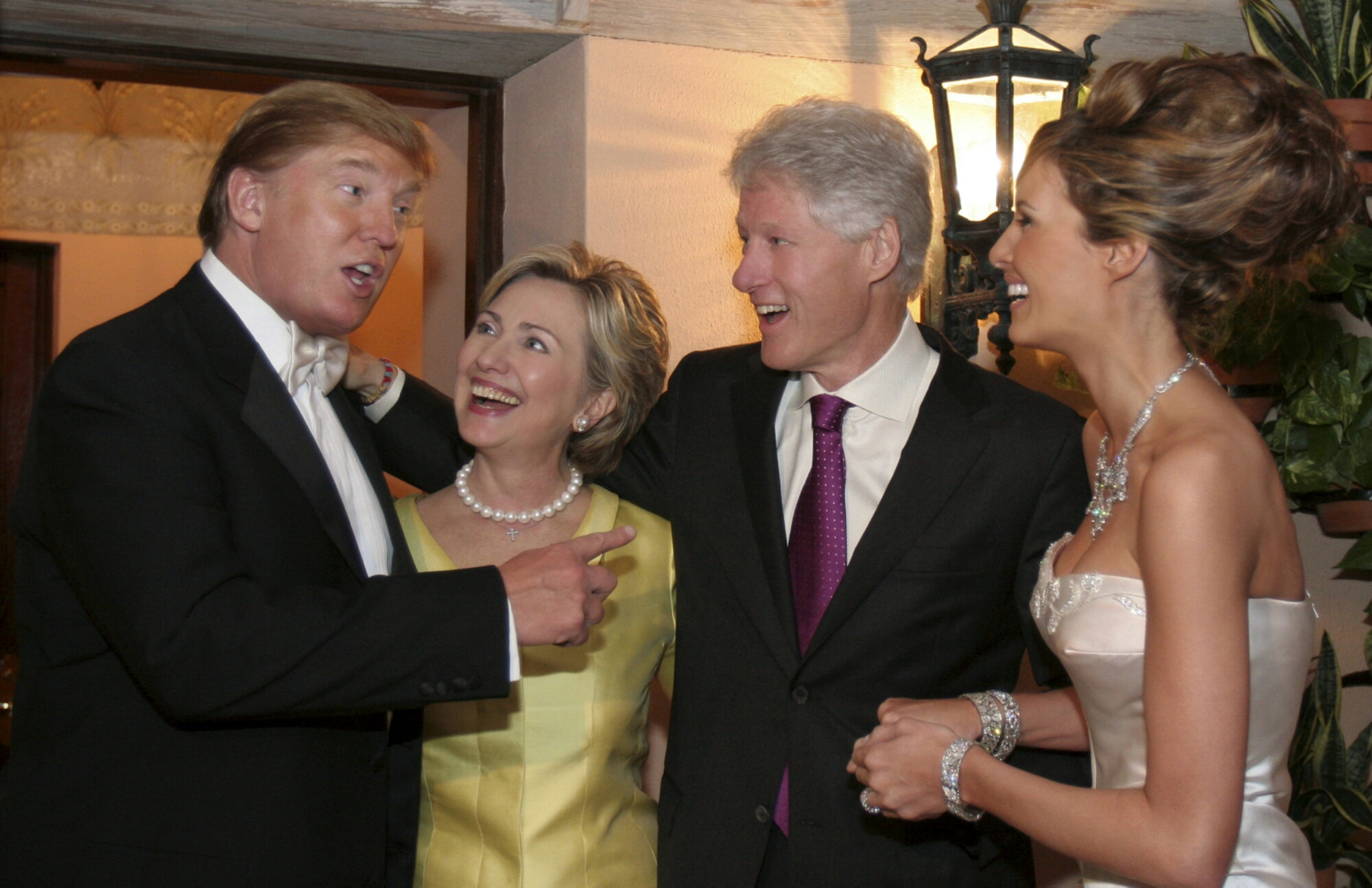
If Trump were a politician, would an ‘everyone else is doing it’ rationale and a witty response about the Clinton’s attending his wedding absolve him of guilt for being complicit in corruption?

Then there’s the matter of Trump’s attempts to use eminent domain for personal gain. As a National Review editorial puts it:

“Donald Trump’s covetous nature is not in dispute, but what many may forget is that he’s no great respecter of the admonition not to steal, either: The man has a track record of using the government as a hired thug to take other people’s property.”

Trump tried to use government power to force a widow from her property and was struck down in court. That is the modern day equivalent of king Ahab seizing Naboth’s vineyard (1 Kings 21) and is the kind of crony capitalism that is the problem.

There are two sides of the political establishment. One side is the politicians and the other side is men like Trump who work tirelessly to corrupt politicians. Men with money, like Trump, who exploit the system for personal gain, are just as much the problem as crooked politicians who take their money.

image

Trump is as much a part of the political establishment as a Bush or a Clinton. He is not an ‘outsider’ by any stretch of the imagination. So, it is time to see past the sales pitch, do not be dazzled by a man who has never proven himself loyal to anything besides his own self-interest.

Reality check: Trump shows no sign of having embraced Christian ethics. Trump’s confessions of his own corruption come without any sign of remorse and repentance.

Myth #4—Trump will govern differently than he does business.

If we have not learned by now maybe we will never learn. But every manipulator on the planet claims that they will change if only you give them what they want.

Trump shows no sign of remorse or repentance for exploiting the system for personal gain, yet we are supposed to believe he would never abuse government power for personal gain if he secures the White House?

If you believe that, I have a bridge I am selling…

I prefer open racism…

Standard

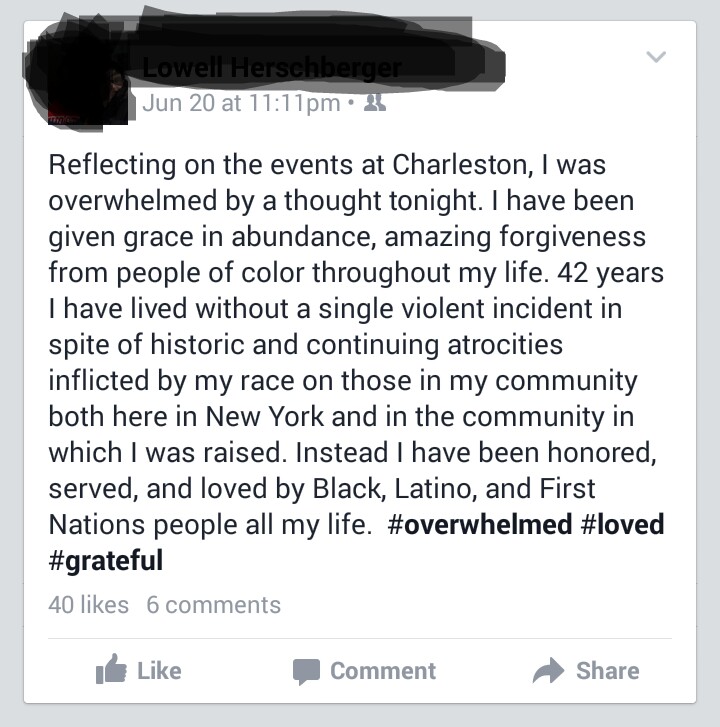
I shook my head as I read a social media post from a well-meaning white friend thanking various “people of color” for not doing him harm because of historical and current injustices.

Many of his friends liked the post—a vast majority of the affirmation, despite his diverse mix of friends, came from his white friends. On the surface his post is contrite or considerate and praise-worthy.  What could be wrong about a man owning up to the sins of his own kind?

But under the surface of his post lurks something insidious.  It uncovers a secret expectation that “people of color” should be irrationally violent and thus are deserving of his praise when they are not.  It is a demeaning and belittling message cloaked in empathy.  It actually reinforces an awful stereotype.

Think about it: Would it be praise to thank a white man for being civilized or would it be patronization and a backhanded insult?

What is more disturbing is this persistent idea that a whole race should be held accountable for the sins of one of their own.  Apparently I should be judged by the depraved acts of Dylann Roof (and every white man in history) because I share his skin color and gender.  But isn’t that exactly the logic of every racist in history and the way of thinking we are trying to escape? 

I believe ‘white guilt’ is a symptom of racist thinking rather than a solution.  When we thank “people of color” for not harming us as white people we are perpetuating the idea that people should be judged as a race rather than as unique individuals.  It is a tribalist suggestion that violence against a whole race is justified therefore we need forgiven as individual members of a racial tribe.

But this thinking is racist to the core.  It keeps “people of color” as something separate from us.  It treats them as something to be pandered to in a way that we would never do to another white man.  (My thanking a white man for not killing me today would be taken as foolishness or sarcasm.)  It is also saying that we expect irrationality and violence from them—which is exactly the same reasoning of a racist killer.

We cannot help but see people as white or black.  We should not be ignorant of historical injustice or continuing racism either.  But we can stop believing that people are fundamentally different because of their skin color.  Part of that is not apologizing in a grandstanding fashion for our own skin color.  Part of that is not treating “people of color” as inferior by thanking them for things we would not even thank a small child for.

We recognize calling a black man “boy” may be insulting.  We also see the battle flag of the Confederacy (the “rebel flag”) as symbolic of racism.  However, do we see subtle racism of those who’s words betray an expectation that black people should be irrational and violent?

I myself prefer those who display their true colors openly, because then we know what we are dealing with and don’t need to dig through the layers of carefully hidden prejudices to find the truth.

Sharia Law: I read it on the internet…, part 3

Standard

I have quite a number of friends who like or repost stories with shouting headlines and containing claims apparently designed to feed fears.  What amounts to fear-mongering propaganda is wrapped in the trappings of legitimate “conservative” news sources.  Unfortunately, most of it, while at some level based in a true story, is so badly blown out of proportion and hyperbolic that it is a dishonest representation.

Now, these purveyors of hysterics and half-truths may or may not be intentionally distorting the reality.  But I suspect there could be a bit of an ‘ends justify the means’ mentality and an idea that their twisted versions of a story represent a greater truth or reality.  I think every journalist does pick and choose what facts are relevant and how they present a story does reveal their personal bias.  However, to me,  there is a level of this that is unintentional or within reason and a level that is inexcusable.

Woman Has Opinion; Sparks Controversy

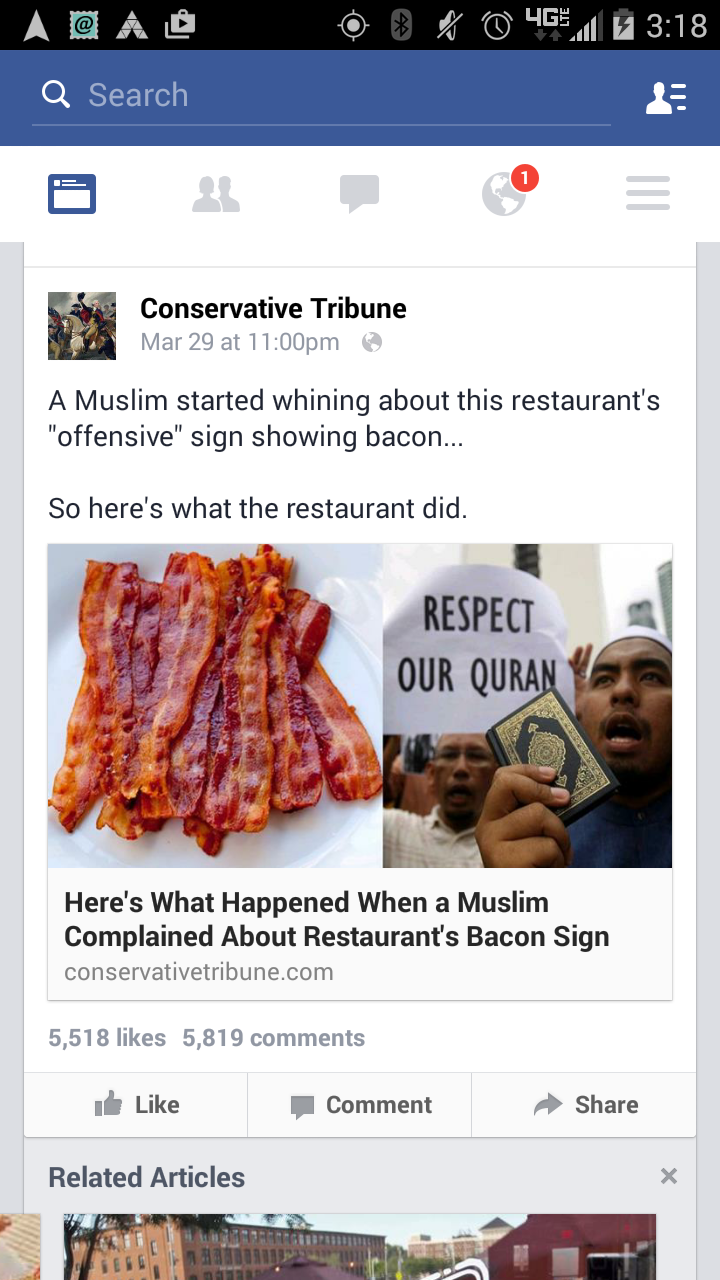
One of these specters repeatedly raised is that of Sharia law and the suggestion it will be imposed on Americans.  A particular story about a sign advertising bacon in a Vermont town caught my eye today after a friend commented.  Here is the screenshot of my news feed:

image

As one could imagine, the response in comments was one of the outrage of thousands of freedom (and bacon) loving Americans who don’t want religion imposed on them.  I realize there is reason to be aware of religious extremism, but what is the reason for this particular furor and do the actual facts support such a dramatic response?  According to the conservativetribune.com story this is the issue:

“Should a restaurant that serves bacon be allowed to display signs and/or advertisements that mention bacon? The U.S. Constitution says that it should, but Muslims in Vermont apparently disagree.”

From that opening paragraph one could assume there is a direct threat to freedom of speech posed by a group of people.  The article goes on to discuss a solitary example of a business owner who took down a sign because “an outraged Muslim woman” complained about it.  There are no further examples given and no evidence that this woman speaks for a plurality of Muslims.

The complaint of one woman does not seem to match the “Muslims in Vermont” description above it and that is quite an over-statement.  What’s the problem?  Well, if one woman can speak for “Muslims in Vermont,” then I suppose Westboro Baptist speaks for Christians in Kansas, right?

Concern for Safety or Fear of Violence?

Anyhow, there’s an article on the Washington Post website that takes a more detailed look and provides the full text of the woman’s complaint.  She describes herself as “a vegan and a member of a Muslim household” then goes on to say the sign is both insensitive to those who don’t eat pork and this:

“Second, it clutters an already dangerous crosswalk. This signage for a business’ food distracts from the purpose of that area: for pedestrians to safely cross and for drivers to safely enter the circle. What is the additive safety factor of this sign being there? I fail to see what benefit it affords people in that intersection and why the city put it up. The only appropriate signage would be standardized official road signs pertaining to the crosswalk and circle.”

I would guess that is why the restaurant owner mentions safety in his response.  However that apparently isn’t as obvious to everyone as it seems to me and leads to this speculation in the conservativetribune.com article about the owners response:

“Notice how he mentioned “safety” concerns. This made it sound as if he feared the Muslims in Winooski would have taken violent action had he not removed the sign”

I cannot fathom how one could make that leap based in the known facts.  It doesn’t “make it sound” as if he feared violence from Muslims to me.  No, it makes it sound as if the restaurant owner read the woman’s letter and was responding to the excerpt of her letter I posted above.  The concern for safety she mentioned was having a business sign creating a distraction.

Right to Free Speech and Threats Thereof

So basically we have a woman with an opinion and a business owner willing to accommodate her preferences.  It hardly seems like a crisis of Constitutional freedom when a woman exercises that her right to express a controversial opinion.  But it does seem a case of journalistic malpractice to make one woman into a representative of Muslims or categorize her as an “acolyte of Shariah law” because she expressed a concern. 

The real threat to liberty is those who abuse it.  I am more concerned over reckless surmises and the feeding of irrational fears than I am of one woman exercising her freedom of speech.  Her opinion, while I disagreed with it, was reasonably explained and it is her right to express it.  The response was a distortion at best, slanderous at worse and one of many similar stories.

Unfortunately I cannot respond to every internet hoax or propaganda piece and even if I did the chances of my words reaching through the mess and changing minds already made up seems slim.  Still I do try to make a difference.

Amish Lies: I read it on the internet…, part 2

Standard

I was not planning to do a blog about immunization and autism.  However, an article posted by a social media friend, along with comments from US Senator Rand Paul made recently, prompted my response.  The article makes two claims about Amish, immunization and autism (presented in questions) in the title; and both claims turn out to be false. 

Claim: Amish Do Not Vaccinate

It seemed plausible at first brush, especially given that this small Christian sect mandates an austere lifestyle and rejects many modern conveniences, that they would also not vaccinate.  However, I have an advantage in that I know some Amish people.  But, more significantly, I have a sister (Dr. Olivia K. Wenger, MD) who led a study on Amish and their attitudes towards vaccinations. 

The research of Dr. Wenger and her colleagues, although addressing primarily the opinions of Amish parents about vaccinations and not vaccination rates, is sufficient to disprove the idea that Amish do not vaccinate.  This is some of what they found:

“Among 359 respondents, most (68%) stated that all of their children had received at least one vaccine, and 14% of those surveyed said their children had received no vaccines.”

Amish, in fact most who responded in the study cited above, do vaccinate.  So the idea that Amish do not vaccinate is a myth and lie.  That false claim alone is enough reason to dismiss any other claim found in the article, but in case you are unconvinced, I will address the other claim in the title as well.

Claim: Amish Do Not ‘Get’ Autism

The anti-vaccination article claims there are only three known cases of autism amongst Amish people.  Again, I could’ve accepted this as valid, but mostly because there’s a strong possibility of autism being undiagnosed in this community that is as insular and closed as the Amish community.

However, this too was easily refutable despite no studies directly addressing the topic.  I found research, by Dr. D. Holmes Morton, MD and others, that triples the number of cases of Amish children with autism symptoms:

“In March 2006, Drs. Kevin
Strauss, Holmes Morton and others documented 9 autistic Amish children, which could raise the autism rate of Lancaster Amish community Olmstead supposedly investigated to almost 1/5,000 all by themselves.”

So, both claims are untrue based in readily available evidence.  Unfortunately stories like this are posted as true over and over again by those who are anti-vaccination or sympathetic.  It is soaked up as proof of a link between autism and vaccines, yet it is demonstrably false information.

If your primary cause is truth, then carefully vet your sources!

As a believer in individual freedom, religious liberty and one who is respectful of conscience, I am doubly offended by articles like this.  Quite frankly I am embarrassed to see these types of spurious claims circulated by those associated with my political leanings and religious faith.

Yes, opposition to vaccinations crosses political and religious lines, but is often a topic of conversation amongst my Libertarian and Christian peers.  That some of them regularly repeat this sort of thing as legitimate or present it without question is a source of serious frustration for me.  It does a disservice to even good questions about vaccinations.

Nothing is gained by linking falsehoods to what is true.  If anything, people who are not ignorant of science will ‘throw the baby out with the bathwater’ and reject all that is associated with the falsehood.  In a world awash with information, why should they waste time on a source that lied to them once and/or doesn’t carefully vet their sources?

“Do not spread false reports.”  (Exodus 23:1a)

I realize not everyone is a scientific or critical thinker.  I myself struggle with the discipline required for serious research and that is part of the reason I would not make a career of it.  That said, we do need to take responsibility for the information we disseminate online and owe others our due diligence verifying claims with reliable sources before repeating it.

Sadly, anonymous articles with sensational headlines garner more attention than these unsung heroes who are actively creating solutions for sick Amish children.  There are sources far more reliable than an article that does not even include the name of the author.  Professionals like Dr. Morton and Dr. Wenger have dedicated their careers to studying Amish genetics and medical disorders. 

Footnote: I cite secondary sources for the research of Dr. Wenger and Dr Morton, but if you want to read the original studies, the links are below:

Underimmunization in Ohio’s Amish: Parental Fears Are a Greater Obstacle Than Access to Care

Recessive symptomatic focal epilepsy and mutant contactin-associated protein-like 2.