Biblical Reversionism

Standard

I’m dismayed by the number of people who profess Christ as their Lord and Savior yet fall for the most brazen of heresies.  The one which is the topic of this post turns the Bible on its head.  It diverts attention from what is important and undermines the Gospel Jesus preached first to the Jews, for their salvation, before it was spread throughout the world by way of his disciples.  Biblical reversionist heresy elevates the Old Covenant to be equal with the fulfillment of these promises in Christ. It is, in the end, a rejection and mockery of Christ.

The Resurrection of Old Defies the New…

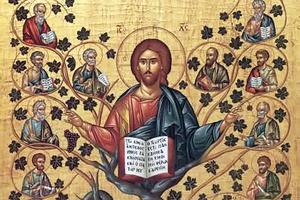
The reversionist believes that, despite Jesus coming to save both Jews and Gentiles, according to Romans 1:16, the Old Covenant continues in parallel for those who have rejected Christ. It is ignorant of the fact that the New Testament talks about both those who are cut off from the vine (which is Christ) and those who are grafted in:

If some of the branches have been broken off, and you, though a wild olive shoot, have been grafted in among the others and now share in the nourishing sap from the olive root, do not consider yourself to be superior to those other branches. If you do, consider this: You do not support the root, but the root supports you.  You will say then, “Branches were broken off so that I could be grafted in.” Granted. But they were broken off because of unbelief, and you stand by faith. Do not be arrogant, but tremble.  For if God did not spare the natural branches, he will not spare you either.

(Romans 11:17-21 NIV)
The Old Covenant law does not save:

For what the law was powerless to do because it was weakened by the flesh, God did by sending his own Son in the likeness of sinful flesh to be a sin offering. And so he condemned sin in the flesh, in order that the righteous requirement of the law might be fully met in us, who do not live according to the flesh but according to the Spirit.

(Romans 8:3-4 NIV)

It was only ever a shadow:

The law is only a shadow of the good things that are coming—not the realities themselves. For this reason it can never, by the same sacrifices repeated endlessly year after year, make perfect those who draw near to worship. Otherwise, would they not have stopped being offered? For the worshipers would have been cleansed once for all, and would no longer have felt guilty for their sins. But those sacrifices are an annual reminder of sins. It is impossible for the blood of bulls and goats to take away sins.

(Hebrews 10:1-4 NIV)

Which is made obsolete, in Christ:

But in fact the ministry Jesus has received is as superior to theirs as the covenant of which he is mediator is superior to the old one, since the new covenant is established on better promises. For if there had been nothing wrong with that first covenant, no place would have been sought for another. But God found fault with the people and said:

“The days are coming, declares the Lord, when I will make a new covenant with the people of Israel and with the people of Judah. It will not be like the covenant I made with their ancestors when I took them by the hand to lead them out of Egypt, because they did not remain faithful to my covenant, and I turned away from them, declares the Lord. This is the covenant I will establish with the people of Israel after that time, declares the Lord. I will put my laws in their minds and write them on their hearts. I will be their God, and they will be my people. No longer will they teach their neighbor, or say to one another, ‘Know the Lord,’ because they will all know me, from the least of them to the greatest. For I will forgive their wickedness and will remember their sins no more.”

By calling this covenant “new,” he has made the first one obsolete; and what is obsolete and outdated will soon disappear.

(Hebrews 8:6‭-‬13 NIV)

The outdated covenant *did* disappear with the destruction of the Temple.

From John the Baptist:

But when he saw many of the Pharisees and Sadducees coming to where he was baptizing, he said to them: “You brood of vipers! Who warned you to flee from the coming wrath? Produce fruit in keeping with repentance. And do not think you can say to yourselves, ‘We have Abraham as our father.’ I tell you that out of these stones God can raise up children for Abraham. The ax is already at the root of the trees, and every tree that does not produce good fruit will be cut down and thrown into the fire.

(John 8:7-10 NIV)

At no point does Jesus say that there will be multiple paths to salvation or that there will be a tree of salvation that stems only from being biologically linked to Abraham. There is one true vine, that is Jesus, some are cut off and destroyed, others are grafted in and saved. There is nowhere where it is said that the Old Covenant will be resurrected to provide another way for those who have rejected and continue to reject Christ. To preach that is heresy, it is reversionism, and replaces the true Israel (that is to say those who believed or the church) with a secular nation borrowing the name.

The New Covenant is not about an ethnostate or the Haaretz of Israel. No, it is about the heavenly kingdom, a kingdom where there is no Jew or Gentile, that is defined by faith rather than biological pedigrees. Our blessing, eternal life, comes through Christ Jesus alone.

Blessings of the Anti-Christ?

The reversionists base their entire interpretation on a misuse of this blessing given to Abram:

“I will make you into a great nation,
    and I will bless you;
I will make your name great,
    and you will be a blessing.
I will bless those who bless you,
    and whoever curses you I will curse;
and all peoples on earth
    will be blessed through you.”

(Genesis 12:2,3 NIV)

They ignore everything St Paul said to explain the seed of Abraham as being singular (Christ) in his rebuke of the foolish Galatians trying to revert back to the Old Covenant. Over and over again Scripture tells us of the failure of those who try to do things through means of the flesh and yet here we are again.

But even the passage itself is spoken specifically about Abram (later Abraham) and those who bless or curse him. It doesn’t say anything about those who bless or curse this “great nation” promised nor does it seem to be talking about nations period. It is a promise to Abraham specifically and then ends by saying that “all people on earth will be blessed through you” which is to say him or his seed, which again is Christ—who didn’t require blind allegiance to a worldly nation.

Furthermore, the modern state of Israel, with a powerful military and foreign backing, does fit the criteria of the nation God said must be fully dependent on Him. Israel is a progressive state, ranked 7th in the world for gay happiness, and one of the least religious countries in the world, and God’s Covenant with the nation of Israel was always conditional. Both Leviticus and Deuteronomy make this quite clear: If they obey God will bless them and if they do not they will be destroyed. Zionism, the Jewish version, makes the Jews themselves the saviors of the world and totally replaces Christ.

This being our own Christ and denying the true Christ is exactly what is being referred to when New Testament writers use the phrase anti-Christ:

Who is the liar? It is whoever denies that Jesus is the Christ. Such a person is the antichrist—denying the Father and the Son. No one who denies the Son has the Father; whoever acknowledges the Son has the Father also.

(1 John 22-23 NIV)

If there is a temple rebuilt, it will be the seat of the anti-Christ:

Don’t let anyone deceive you in any way, for that day will not come until the rebellion occurs and the man of lawlessness is revealed, the man doomed to destruction.  He will oppose and will exalt himself over everything that is called God or is worshiped, so that he sets himself up in God’s temple, proclaiming himself to be God. […] The coming of the lawless one will be in accordance with how Satan works. He will use all sorts of displays of power through signs and wonders that serve the lie, and all the ways that wickedness deceives those who are perishing. They perish because they refused to love the truth and so be saved.  For this reason God sends them a powerful delusion so that they will believe the lie and so that all will be condemned who have not believed the truth but have delighted in wickedness.

(2 Thessalonians 2:3,4,9-12 NIV)

And what a powerful delusion some believe, that puts the Church established by Christ behind the nation that rejected Him, this we’re told:

Dear children, this is the last hour; and as you have heard that the antichrist is coming, even now many antichrists have come. This is how we know it is the last hour.  They went out from us, but they did not really belong to us. For if they had belonged to us, they would have remained with us; but their going showed that none of them belonged to us.

(1 John 2:18-19 NIV)

Ultimately, choose whatever Israel you want. But you can’t have both. You can’t have your worldy Israel, that is rejected even by observant Jews who call it fraudlent, and then claim to be a part of the kingdom of Christ Jesus. Reversionism is in no way a Covenant with the God of Abraham. It is only a counterfiet of the original promise and one that draws many away from their only means of salvation. Don’t be one who is decieved by this new version of the same old heresy, don’t be like Judas looking for his worldly fulfilment. There is only one Israel where Christ is king and that’s His Church.

The saddest part about reversionism (or ‘Christian’ Zionism) is that it muddies the waters and sends mixed messages to those who need salvation. So many professing Christ and then supporting the brutal reality of what it takes to create a Jewish state on land that was inhabited is a slanderous and degrading witness of Christ who would have had no problem establishing a worldly kingdom through use of violence over two millenia ago. So many are like Gehazi, servant of Elisha, dishonoring the example of their master and inheriting the disease that was healed: “For what shall it profit a man, if he shall gain the whole world, and lose his own soul?”




I Don’t Care What You Call It

Standard

I feel the need to preface this once again with a trigger warning for those who won’t read through and will miss my point. No, I’m not saying what Hamas did was justified. Nor am I saying that Israel should not respond. But I am trying to confront a bias, motivated by a misuse of Scripture, that is leading our side to look the other way at what amounts to dumping white phosphorous on innocent children and then pretending this is a just response to the death of Israelis. I am addressing what clouds the moral judgment here and not saying that one side or the other should just take the abuse.

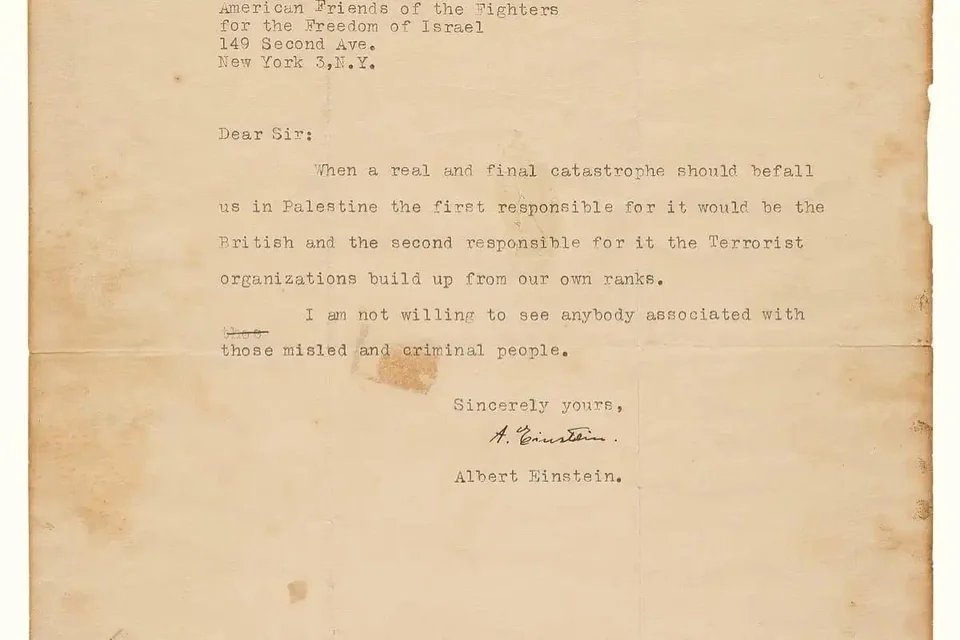
I’m addressing the false dichotomy exposed in this letter from Albert Einstein (Jewish) in his opposition to the terrorism that was taking place. He wrote this right after a massacre carried out by Zionist extremists and warning of what would eventually become the horrendous reality of the Nakba and why Palestinians today are reluctant to leave their homes today. They know the history even if you’re ignorant. Read what Einstein wrote and then study what happened next…

To be clear, Einstein was not against a Jewish homeland. He was simply against the violent means being employed that have led to the current hatred. Had more followed his advice then we wouldn’t be facing yet another bloody war today. When will we learn?

Framing Issues

Had the British managed to put down the bloodthirsty terrorists who fought to “water the tree of liberty” by violently taking over their American colonies, does that mean they never existed? No, they (along with their weird pagan offshoot religion that required regular human sacrifice to keep their tree nourished) did exist and they existed as a distinct entity the moment that they declared themselves to be independent. And to say otherwise would be dumb.

One of the stupidest arguments ever made is “tHeRe Is nO PaLeStINe” as if the millions of people pushed into Gaza and West Bank simply do not exist. By that sort of semantic and legal argument, there was never a state of Israel prior to May 14, 1948. Sure, there were a people called the children of Israel and a kingdom of David, but never a STATE by that name, and certainly not one that was a Western-style democracy, prior to a bunch of Europeans moving to British-controlled Mandatory Palestine (which is what it was called) and most certainly a nation with the world’s strongest standing army is not the same one as found in the Scriptures. No, that doesn’t mean they should be run into the sea or not recognized as a legitimate nation (although many do not) and yet we must deal with the reality that the land was occupied before European settlers arrived to claim it. Historical claims may make a nice romantic script, for those with no skin in the game, but telling people that their grievance of being displaced doesn’t exist because you don’t like the name is asinine. It is reasoning that may get you likes in your echo chamber but suggests you are silly and should not be taken seriously by those with a modicum of intelligence. It’s not like the Palestinians are going to stop their fight against those who took their deeded land because you claim they don’t exist.  

Furthermore, legal recognition does not change what something is. By now we all should know this. The governments of the world can call black white or white black and it doesn’t change the nature of color. Calling a man a woman or your affinity for your pet a marriage doesn’t make it true. We have the absolute right to question legal precedent or to hold to whatever existed in our minds prior to their changes. Maybe your modern definitions are simply ignorant of the original meaning and the other side is right. You might eventually be blotted off from the face of the Earth and forgotten. But it doesn’t mean you or the perspectives you held don’t exist. A person’s perspective still exists even if opposed by the powerful who have better propaganda and denying it exists is plain dumb.

Palestinians exist even if they are erased from the land or never officially recognized by many in the United States. That’s not a statement that will suit many from my fundamentalist religious background. But they’re simply not dealing with reality, it is denial, and ridiculous. Einstein called it Palestine. It was Palestine. The modern-day Israeli state came after.

Who were the Samaritans?

They were people deemed illegitimate by the pure-blooded religious elites.  They made a counterclaim to what the other descendants of Abraham Jesus mingled with saw as their own exclusive property.  The Samaritans had their own priests (apparently descendants of Aaron directly) and, contrary to the belief of their Jewish rivals, also continuously occupied the land like their Semitic cousins.

This is what makes how Jesus recognized these people so significant.  We learn, in his conversation with a Samaritan woman, that true worship wasn’t about location, including Jerusalem, but about Spirit and truth.  If this wasn’t clear enough, the parable of the good Samaritan was a slap in the face of those whom Jesus addressed.  A Samaritan more righteous than their own best?  Jesus was intentionally antagonizing. He intended to offend and insult them.

The point, however, remains that salvation is not a birthright.  It is not about your claim to be or ethnic inheritance.  The Christian truth is about what we do, and how we love, and never a matter of our worship ritual or genetics.  The measure of Christian pedigree is faith, pure and simple, like that of Abraham—which is what makes a person a son or daughter of Abraham.

Jesus didn’t mince words when addressing those who believed they would be saved by their ethnicity or Abrahamic bloodline:

Abraham is our father,” they answered. “If you were Abraham’s children,” said Jesus, “then you would do what Abraham did. As it is, you are looking for a way to kill me, a man who has told you the truth that I heard from God. Abraham did not do such things. You are doing the works of your own father.” “We are not illegitimate children,” they protested. “The only Father we have is God himself.” Jesus said to them, “If God were your Father, you would love me, for I have come here from God. I have not come on my own; God sent me. Why is my language not clear to you? Because you are unable to hear what I say. You belong to your father, the devil, and you want to carry out your father’s desires. He was a murderer from the beginning, not holding to the truth, for there is no truth in him. When he lies, he speaks his native language, for he is a liar and the father of lies.

(John 8:39‭-‬44 NIV)

There are not multiple paths, according to Jesus, but only one way, truth, and life for all to come to the Father.  Galatians makes it clear that Abraham’s seed is fulfilled fully in Christ and all who believe in Him:

The promises were spoken to Abraham and to his seed. Scripture does not say “and to seeds,” meaning many people, but “and to your seed,” meaning one person, who is Christ. […] So in Christ Jesus you are all children of God through faith, for all of you who were baptized into Christ have clothed yourselves with Christ. There is neither Jew nor Gentile, neither slave nor free, nor is there male and female, for you are all one in Christ Jesus.

(Galatians 3:16‭, ‬26‭-‬28 NIV)

Romans affirms what St Paul said above in Galatians:

So too, at the present time there is a remnant chosen by grace. […] What then? What the people of Israel sought so earnestly they did not obtain. The elect among them did, but the others were hardened

(Romans 11:5‭, ‬7 NIV)

The “remnant” is those who believed in Jesus.  While the “hardened” are those who rejected Him and, in their unbelief and ignorance, crucified the one who was called their King.  And, for those who contort and turn the Gospels inside out trying to revert to a Covenant that passed away, Hebrews 8:13, I despise your bastardization of truth.  Those who would replace His Kingdom “not of this world” with a modern secular state are not legitimate scholars or Christians.

I reject your ignorant religion.

I reject your indifferent religion.

I reject your false religion.

The true Christ isn’t an ethno-nationalist or waiting on yet another stone temple to be built.  And I don’t really care what your Scofield reference or some random guy on YouTube says.  Christian Zionism is a contradiction of terms.  I’m perfectly fine with European Jews finding a homeland and defending it.  But it should never be confused with the fulfillment of anything more than that.  We should instead be looking for the new Jerusalem.  So stone me like Stephen for repeating what he said: “The Most High does not live in houses made by human hands.”

Count me with the Samaritans.

A blessing or a curse?

Since the 1950s, no other nation has shown more perfect loyalty or full allegiance to the state of Israel than the United States.  The Biden administration is no exception and doubling down on what Trump started.  For this have accumulated a mountain of debt, a decay of our institutions, and sharp moral decline as more and more Americans fall away from faith.  Sure, we are materially wealthy, for now, but churches are empty and those that remain are temples to consumerism rather than self-sacrificial love.  If support for this country is a blessing then I guess we’ll need to redefine that word like we have been with everything else lately.  Or maybe consider we’ve gotten things wrong?

The direction of the US doesn’t look good right now and maybe that is because we’re like the Jeruselum condemned by Ezekiel:

“‘Now this was the sin of your sister Sodom: She and her daughters were arrogant, overfed and unconcerned; they did not help the poor and needy. They were haughty and did detestable things before me. Therefore I did away with them as you have seen. Samaria did not commit half the sins you did. You have done more detestable things than they, and have made your sisters seem righteous by all these things you have done. Bear your disgrace, for you have furnished some justification for your sisters. Because your sins were more vile than theirs, they appear more righteous than you. So then, be ashamed and bear your disgrace, for you have made your sisters appear righteous.

(Ezekiel 16:49-52 NIV)

Maybe it is time to stop focusing on the sins of Samaria and consider our own. Sure, maybe IsRaEl hAs ThE rIgHt To DeFeND iTsElF, but then so do the other Semitic people in that region. Consider that we are Haman, from the book of Esther, unwittingly building our own gallows as we justify our unjust vengeance against undeserving people. We’re not a righteous judge. The children of Gaza did not attack Israel. It is not anti-Semitic to stand with Einstein or recognize the unjust suffering of the Semitic people in Gaza. It is not our allegiance to the state of Israel that will bring us blessings, only allegiance to the king of the true Israel can do that and we must all repent of our delusions otherwise.

But We Don’t Chant Death To Gaza!

Standard

“The propagandist’s purpose is to make one set of people forget that certain other sets of people are human.”

Aldous Huxley

Most on one side of this issue likely will not even get this far into reading this.  For daring to question the narrative they’ve swallowed I’ll probably be quickly dismissed by some as a “terror apologist” or worse.  Nevertheless, for those who know that I don’t take positions lightly or without due diligence, this post will help explain my position on the ongoing conflict between Israel and the Palestinians.  But more important than that this blog is aimed at addressing the brazen dishonesty of the fundamentalist cheerleaders.

First of all, for anyone conservative who has come through the past few years and is still lacking skepticism about what the political establishment is saying really deserves to be exploited.  Now that Hamas has attacked we can now trust the same media that saw riots as “mostly peaceful protests” and then calls MAGA supporters “insurrectionists” for their questioning the election results???  Are you really that dumb?!?  Why don’t you at least consider that the same people who distort the truth here, who seize upon the parts of the evidence that support their own agenda on domestic issues, might also do the same thing there?

Second, okay, so you never heard ‘our side’ chanting “death to Gazans” and yet let’s not be cute about this.  Both sides are dedicated to the destruction of the other. Israel slowly but surely takes all of Palestine. Hamas is fully committed to ending Israel.  How genocidal that would end up being is anyone’s guess—but these stories from a couple Israeli Defense Force veterans can give us some idea, they burned people alive and shot school children—watch them talk about it and then moralize to me about how only one side is barbaric or evil.

No, this horrendous history of atrocities on both sides certainly does not justify anything that Hamas did in the past week.  But what should we expect to happen when that boy crying when an air strike killed his entire family grows up?  Is it a surprise when he’s angry and blames the nation that dropped the bomb?  Are we just going to gloss over the fact that the Israeli prime minister, Benjamin “Bibi” Netanyahu, is in a leaked video saying to make it painful for the Palestinians and that basically anything is a military target?  What does that mean?  Are we going to play ignorant?

This is why I can’t take seriously people who only condemn one side and never the other, this selective moral outrage is not about true care for children.  Those who quickly share unverified accounts of beheaded babies and then never even acknowledge those thousands of innocent Palestinians who have died in the indiscriminate and brutal bombing campaigns are being dishonest.  No, not saying that there must be complete equivalency or proportionality in a war. but let’s not pretend that only one side is a victim of terrorism.  It just looks really disingenuous to only care about the children of one side.

Getting this out of the way…

My point is not to convert you from one side to the other. My point is that the common presentation of this conflict is a false dichotomy and we have the option of choosing none of the above. We can stand with the true victims, those innocent people caught in the crossfire, and oppose all of the militant parties. That is where I stand. Furthermore, I will mostly address the propaganda and war crimes of one side. Why? It is because my typical audience is completely biased toward the West’s narrative and certainly not because I am unaware of what the other side has done. We don’t need to be partisans.

The big lie is that this conflict is not about ethnic cleansing on both sides.  Israel has systematically, since May 14, 1948, pushed the native inhabitants out of their land and then played the role of victim when their militarily weaker opponents employed asymmetrical warfare tactics against the occupation.  Israel has turned Gaza into an open-air prison, but we only care when Hamas strikes back.  American Evangeli-cons believe every claim without skepticism when it is made by Israel (burned babies) as if a party in the conflict has reason to be truthful—why are we such fools?

It Is Okay To Bomb Nazi Children!

Maybe you do not know what Jewish neo-con Ben Shapiro (as well as Isreal’s Prime Minister) meant when he pronounced the people of Gaza to be Amalek?

But I do: 

This is what the Lord Almighty says: ‘I will punish the Amalekites for what they did to Israel when they waylaid them as they came up from Egypt. Now go, attack the Amalekites and totally destroy all that belongs to them. Do not spare them; put to death men and women, children and infants, cattle and sheep, camels and donkeys.’

(1 Samuel 15:2‭-‬3 NIV)

We call that genocide. 

Sure, maybe Shapiro is emotional, he has a right, but these chants of “kill the Arab” or about Gaza becoming “a cemetery” with no school children left alive didn’t start last week.  And maybe that’s what US Senator Lindsay Graham wants when he says this is a religious war and he suggests the solution “level the place,” while also braying for a confrontation with Iran?  Apparently, it is okay when Israel ‘defends itself’ by wiping out men, women, children, and infants of any who resist their claim to the land.  I guess it is the privilege of being a chosen people, right?

Like an Israeli official said we shouldn’t care about Palestinian civilian deaths because they’re all Nazis.  Much of this is based on unverified accounts of partisans repeated as fact, even embellished by Joe Biden who claimed, with great sincerity, that he had seen the pictures of beheaded babies himself only to have the claim retracted.  So now we’re collectively punishing people, looking the other way at inhumane things done by the military, using the circular ‘punch a Nazi’s logic of the far-left and misuse of religious texts.  Are we better than them?

So let’s just be honest about it!  Let’s not say that this is about human rights or preventing ethnic cleansing when it is all about clearing the place for a Jewish ethnic state.  Stop being a coward, and say that you’re okay with babies being killed (as long as it is their babies) and with millions of people who are being displaced from their land—all because you have stupidly embraced an errant eschatology that replaces the Church, which was established by Christ, with reemergent nation of those who have fully rejected Him.  

Or you could just join me in agreement with St Paul: 

Understand, then, that those who have faith are children of Abraham. Scripture foresaw that God would justify the Gentiles by faith, and announced the gospel in advance to Abraham: “All nations will be blessed through you.” So those who rely on faith are blessed along with Abraham, the man of faith. […] The promises were spoken to Abraham and to his seed. Scripture does not say “and to seeds,” meaning many people, but “and to your seed,” meaning one person, who is Christ.

(Galatians 3:7‭-‬9‭, ‬16 NIV)

Understand yet?

Support for a modern ethno-nationalist state has no connection to the promises given to Abraham.  Sure, many have been made into useful idiots for this cause, by the twisting of Scripture, but Jesus didn’t promise a patch of land along the Mediterranean coast and the Jews do not share Christian values any more than Muslims do.  Both sides of the Israeli-Palestinian conflict have chanted for the death of the other. One sees us as being Infidels and the other calls us Goyim.  When has Israel, a country declared ‘our greatest ally’ according to many of our greasy-haired politicians, ever defended our borders?  The blessing is they get a ton of US aid and send propaganda pictures of their most attractive women in uniform in return.

There’s no denying the tragedy of what has been unfolding over the past few days.  We have seen the pictures and videos, very real, of terrified young people.  One moment they were enjoying a music festival, the next they were being mercilessly gunned down.  And yet I did not see the same level of concern from fundamentalists for the victims of the Pulse nightclub attack.  These same people overwhelmed with concern about Israel do not think twice about collective punishment and forcing Gazans into the desert before there is provision for them—this isn’t about protecting innocents or looking out for the most vulnerable, it is about wiping Gazans off the map by wherever means available at this time.

Christian compassion is that none should perish and all will be saved.  It isn’t about a political entity called Israel or any kingdom of this world.  Our battle, if we were indeed servants of Christ as we claim, should not be against flesh and blood.  Jesus commanded us to love our enemies and do good to those who mistreat us.  That’s coming from a man who was tortured, unjustly nailed to a cross, and killed by an occupying power.  So why again do we support the death of Palestinian children simply for living in the wrong place at the wrong time? 

Shouldn’t we love these little ones as much as their other more fortunate Semitic cousins?

Seeing Behind The Veil

Standard

In storytelling, there is a plot device called a MacGuffin.  This is an object, character, or event used to push the narrative forward and yet isn’t all that important in and of itself.  In other words, a thing that creates motivation and yet never even needs to be revealed to the audience.  We are supposed to believe this is something significant or valuable and that’s all we need to be told.

The contents of the briefcase are left a mystery despite being pivotal in motivating the characters.

While reading through the Old Testament and pondering how temple worship worked, it is hard not to see the Ark of the Covenant as a sort of MacGuffin.  Sure, their God was not a thing.  And yet this sacred object, we’re told, contained something of God’s presence and would even strike dead those who innocently mishandled it.  Of course, most people may never have seen it, it was kept behind a veil in the temple where few had access, but all would be told of the sacredness.

“Then spake Solomon, The LORD said that he would dwell in the thick darkness. I have surely built thee an house to dwell in, a settled place for thee to abide in for ever.”

(1 Kings 8:12‭-‬13 KJV)

In fact, it was made sacred as much by this treatment as much as what actually dwelled within it.  The mythology surrounding it, as in the cultural or religious significance that was given to it, was extremely powerful.  Starting a special priestly class, Tabernacle and ritual practice, later the impressive structure of the Temple, there was a huge investment in this sacred object.  And yet, for all the attention it got, the Ark itself was usually kept hidden in darkness, guarded, within the Holy of Holies and behind a veil.

Holy Of Holies 

There are other things hidden behind a veil with significant motivational power.  One of them being the marriage MacGuffin.  For me this was a pursuit of something sacred, the church does consider the marriage bed to be sacred, and there is a whole mythology that is constructed around marriage.

This is what made it so jarring when, during my pursuit of the impossibly, a psychiatrist would classify it as “sexual attraction.”  They had just heard me describe a pure and faith-driven quest only to reframe it in such crass terms.  How dare they!  I was after love, not sex!  It really did offend me at the time.  With their clinical roughness, they had penetrated the veil of my marriage delusion.  It was an act of sacrilege.  

My childhood innocence is beyond recovery at this point.  For whatever reason, those of us born into a fundamentalist purity culture believe that we must be in denial of our own sexual urges that lead to marriage.  This is strange given how blunt St. Paul is on the topic, in 1 Corinthians 7:9, advising those who “burn with passion” to get married and basically get a room.  Why the veil of secrecy, these many euphemistic expressions to cover and mystify the bumping of uglies?

Speaking of erotic euphemism:

“Awake, O north wind; And come, thou south; Blow upon my garden, That the spices thereof may flow out. Let my beloved come into his garden, And eat his pleasant fruits.”

(Song of Solomon 4:16 KJV)

Why blush, be embarrassed or ashamed by this?

Could it be that without dressing this whole affair up with great ceremony, white bridal veils, teary-eyed parents, and such, we would have to face the reality of being creatures as hormone-driven as two ducks on a pond?  I mean, why aren’t we as honest as Solomon was in his poetry: “Roses are red, violets are blue, you have large breasts, that’s why I love you!”  Without white lies or half-truths, would our version of romance even survive?

So what is underneath the veil?

All of those things that I’ve discovered in the intervening years, that’s what…

To the extent I was in deep denial of my own sexuality, I was doubly in denial of the sexual nature of my female counterparts within the conservative Anabaptist culture.  The young lady who first propositioned, then made it all awkward and worried about somehow being ‘defiled’ if she got coffee with me has long since dropped the veil.  She has joined the others whom I had held in such high regard, revealed now as not being nearly as prudish or pure as I had once imagined.  That’s not a criticism or judgment either.  It is just the reality of the situation.

So, when the impossibly told me “I cannot not love that you the way that you wanted to be loved” what she was really saying the same thing as those Tinder girls with “must be 6′ or over to ride” in their profiles.  She wanted a guy who got her juices flowing, certainly someone a bit more rugged and traditionally masculine than me.  And, I mean, why not?  Why hide it?  Marriage is not only (or even primarily) about the high ideal that is advertised.  It is also about our scratching the itch.  Which is to say getting down and dirty with someone who meets the correct physical qualifications.

Also, perhaps it is that the fantasy is more satisfying than the act itself?  We read how Amnon, King David’s eldest son, had such an infatuation with his half-sister Tamar.  It tells us after having his way with her he despised her.  Or consider the disgust of Victorian-era art critic John Ruskin when, in marriage, he discovered that women aren’t like porcelain dolls.  You’ll have to forgive him, they put skirts over piano legs back then to keep the eyes of men safe from the unveiled feminine form.  Maybe there are some things that are better chased than caught?  If we find what we went looking for we might be shocked at what we found.

Sacred Fertility & Symbolism 

The final stop on this exploration of sacred and taboo has to do with something that I can’t unsee now that I’ve seen it.  I’m bound to lose half of my final two readers for going here. 

Nevertheless, I’m not here to please the pearl-clutching crowd. 

For me, this is not about toppling sacred cows or making people uncomfortable, it is about being honest enough to see reality for what it is and correcting our own perspectives of the cultural baggage we’ve inherited.

First, what drives much of the Old Testament Biblical narrative?  We know Abraham’s story, how he wanted an heir, and yet how Sarai, his wife, was unable to produce.  In this Genesis account we see various cases where wombs are opened or closed.  And the punishment of Michal, for rebuking her dancing husband, was that she had no child until the day of her death.  Being fruitful and multiplying was a high priority, as well as having sons to carry on the family line.

As an aside, we live in a very sterile world in comparison to our ancestors, we’ve become sheltered and sensitive to the point many do not eat meat or want their children exposed to death.  This wasn’t an option at the time when Scripture was written.  There is a kind of earthiness to their world and perspective, something more primal or real, a brutality of life difficult to stomach.  It is with this reality in mind, that we also have different sexual taboos and could be more prudish than they were about such things.

Second, I was sitting in church and taking a look at the colorful streams of light pouring through a stained glass image of Jesus pulling Adam and Eve from the grave.  My moment of appreciation for this beauty was interrupted by my noticing part of the symbolism.  Jesus is shown to be emerging from an oval shape, at the bottom of which are the covers of their opened tombs.  Requiring very little, if any, imagination, it bears striking resemblance to one Christian symbol even an iconoclastic Protestant would likely recognize, and that being a vertically arranged “Jesus fish” or Ichthys.

Light and life shining down…

However, concurrent to this, and a cause of some momentary shame, was the thought “That’s a vulva!”  I mean, how inappropriate to think that any part of the female anatomy, let alone those private nether regions, be put on prominent display or be associated with Christ!  

But is it really?

A mother, Mary, is necessary for the birth of Jesus.  Without her, and her womb that is miraculously made made more spacious than the heavens, there is no salvation for mankind.  It didn’t matter if God could have used any other way, all we know is that he used this young woman and all of the faithful since have followed the lead of Elizabeth, who full of the Holy Spirit loudly proclaimed:

“Blessed are you among women, and blessed is the child you will bear! But why am I so favored, that the mother of my Lord should come to me?”

(Luke 1:42‭-‬43 NIV)

As far as the symbolism, I would find that indeed my observation had basis in reality as the Ichthys is a version of Vesica Piscis (literally “fishes bladder” in Latin) or, in sacred geometry, the oval that two intersecting circles create an oval and said to be the place where spiritual and physical worlds interface. According to Syriac Press, in ancient Mesopotamia, it was used as a symbol of the combination of masculine and feminine energies that create a Divine Child.  Any pagan coincidence, like those with baptism, only serves to reinforce the power of the symbolism.

In a time when many settle for ‘fur babies’ over producing human offspring and the unique female contribution to the world is dismissed by feminists seeking male roles— when real women are mocked by men who pretend to menstruate—we need to start doubling down on our celebration of this reproductive role of women.  Phrases like “saved through childbearing” did not come into the Bible by accident.  The world was saved by the one who came out of Mary’s fertile womb and we ought not to downplay or be embarrassed by this.

Empty Vessel—Dying Corpse

Solomon’s Temple was destroyed in 586 BC, by the Babylonians, and the fate of the Ark within it is unknown.  This loss of sacred relics did not stop the Jewish faithful from rebuilding the temple, in 515 BC, but does make one wonder how much the contents mattered.  So long as the people were kept in awe that’s all that really seemed to be the point whether the edifice truly contained anything of real value or not.  With nothing behind the veil, the people still did the ritual and sacrifice. 

Why?

It seems sort of analogous to the US Dollar, a currency once backed by actual gold and now only by faith people continue to hold in the economic system it represents.  The harsh reality is that it has become merely a means to exploit. It is a way for a few elites to rob the value of the savings of other people by printing more money for themselves.  Those money changers Jesus chased out of the Temple were the amateurs. The real professionals never get caught.  The carefully maintained veil of secrecy around the Federal Reserve ensures that this particular scam continues for a long long time.

But, I digress.  

G. K. Chesterton once wrote, “a corpse crawling with worms has an increased vitality,” and that “a dead man may look like a sleeping man a moment after he is dead,” trying to describe the subtle yet significant difference between truly sacred tradition and a cheap gimmick version of this religion that was intended to replace it.  Perhaps this is what has me disillusioned?  With so many things, once the veil is lifted (which few ever dare to do) so much of the enticing mystery and popular mythology which propelled us forward falls apart.  And in this way some of the life I had felt early on feels more like decomposition.

Perhaps this is what is left when you’re the dog who has finally caught the car?  Nothing left to do but pee on the tire and continue on your way again.  The anticipation leading up to the day of revelation may be more exciting than the moment the veil is lifted and when all is seen.  Ruskin may have spent the rest of his life waxing eloquently about his female love interest.  Or maybe—just maybe—that MacGuffin which led us to the point we’re at today was merely a plot device to move the story forward and the only truly sacred part of the encounter is the fruit produced?

Sexual pleasure is fleeting.  We’re lured there by our imaginations, by our desire for what is beyond the veil of marriage, but it can all be a bit anti-climactic and even repulsive once you consider it after it is finally unwrapped from the flowery speech and those flawless air-brushed mental pictures.  But fatherhood, by contrast, seeing the great potential of my son, tending to his needs, pruning as needed, is something extremely fulfilling.  It is what has emerged from the womb that brings us renewed life and hope.  Pity the barren, the dying corpse who has lifted the veil and only saw the emptiness of their pursuits.

Making Impossible Possible

Standard

It was impossible for me to find romantic success in the religious community that I had been born into and I would most definitely have remained single if I refused to adapt. My only regret is not having realized this (along with many of the many other fatal flaws in this system) much earlier.

The most excruciating part of this ordeal was that it always seemed that victory over this adversary was right at my fingertips. But, as the expression goes, to miss by an inch is to miss by a mile. And it seems that both friends and church leaders were never that serious about help. None were willing to lift a finger to relieve this burden of so many in their churches.

It was a systemic problem that required a systemic change that would not come. Women were ruined by their own idealistic purity culture standards and not taking the opportunities available, and men by being rejected every time they tried and were reduced to simps—rendered themselves completely unattractive for their doting ‘desperate’ attention to females.

What makes me curious is what truly was so different about my own experience in a fundamentalist sect and that of those in an old-order setting where pairing up does happen. Surely young people in those settings have ideals as well and yet they appear more willing to risk relationships than my former peers. It is as if they are programmed to be more realistic or unafraid.

The thing is, the next generation probably isn’t experiencing what I did. It was just a perfect storm of frauds, like Bill Gothard or Joshua Harris, that fed female fears of being ‘defiled’ for merely having a real conversation with a male member of their group. Mixed with the already existing cultural reserve and perfectionism. A moment of hesitation is very costly, approach anxiety increased tenfold with the raised stakes, and thus failure resulted.

If only there were more fathers and responsible adult figures saying “Relax, talk to each other, and take some risks, it isn’t like you need to marry after the first date.” If only there were some pushback to this notion that independence (having things our way, going out to see the world, and the postponement of marriage) is an indication of a greater commitment to Christ. Being picky doesn’t make you St Paul or Florence Nightingale.

Instead, the trends within the conservative Mennonite churches very closely align with general cultural trends where traditional courtship has fallen out of favor. Sure, in this version the attractive men get their sexual gratification. However, women never get the kind of commitment from these men suitable for raising children, and often choose careers and European vacations instead. More average men, who would be devoted, are simply shut out and ignored for not meeting the impossible female criteria.

I’m happy to have found my ‘hack’ and finally was able to get around the broken system that put my life on indefinite hold. I would’ve done things much differently if I had a chance to do it all over again. Firstly, I would’ve been less sensitive, more assertive, and never got mired in doubt of my own value. Second, I would not be concerned in the least about pleasing a standard that didn’t actually matter.

The successful never followed the onerous rules of those moral busybodies. A man should not ask permission, he simply needs to take the initiative and get what he wants. Too many times my own indecision on what was the ‘right way’ kept me from ever taking the opportunities as they were presented. Luckily, for me, because of my failure, I have found something much better than I could ever have found in the midst of the entitled mentality and demanding confines of my past life.

The wonderful woman I have found would’ve been impossible to marry when I was still bound to their standards. I could never have had a relationship with someone as intelligent and ambitious, let alone beautiful in appearance, had I remained. The impossibility remains impossible. But the impossible has been made possible by my willingness to change the rules of the game.

The Evangeli-con—Gospel or a Get-Rich Scheme?

Standard

Typically we do not let customers past the front counter.  We prefer to work off of complete drawings and do most of our business over the phone or by email.  However, a few years ago, we got a call from a potential new customer, apparently a building contractor or developer, and he wanted to have a sit-down meeting to discuss this project.  So we decided to make an exception.

His name rang a bell.  And given his antics to this point, I decided to do a little online search and found out rather quickly that he had been convicted of both forgery and fraud.  From what I could gather in the news reports, he had collected hundreds of thousands of dollars from investors, but spent the money elsewhere and never actually finished the projects.  

So when this brash middle-aged man showed up at our office, I already had him sized up and advised my employer to collect upfront if he ever did actually order.  The meeting wasn’t all that beneficial.  I already had the overview of the condo project he was proposing.  What I really needed was a completed set of architectural plans.  But, for whatever reason, getting critical dimensions was a fiasco.  He was the draftsman, using his rudimentary AutoCAD skills, and did not seem to understand why we need to know exactly where the bearing walls were.

But what did come out of the meeting is that he had been incarcerated, something which he played off as being political persecution, and during his time behind bars he found inspiration for a new ministry.  They have a website.  I won’t name this man or the ministry for multiple reasons.  However, this site does have a donate button and also lists a board of directors, with bios, and includes a couple of members who share his surname.

Anyhow, despite his grandiose plans, on paper, we have yet to sell anything to him.  He has gotten updates on the quotes about once a year since then and more recently has given plans, similarly half-baked, for another large development project.  We’re not holding our breath on any of these grand ideas ever breaking ground. 

Still, there is something about this man’s essential character that has intrigued me and it seems to parallel a particular brand of Protestant religion that could be summed up this way:

They have an unhealthy interest in controversies and quarrels about words that result in envy, strife, malicious talk, evil suspicions and constant friction between people of corrupt mind, who have been robbed of the truth and who think that godliness is a means to financial gain. 

(1 Timothy 4a-6 NIV) 

Forgive Me, I’m Grandiose!

The one thing that jumped out to me about this particular man is that his ministry is focused on forgiveness.  In his testimony, there is lots of talk about his personal growth, and the sins of the other incarcerated men he met, but no admission of guilt or expression of repentance.  Now, that said, he does seem to be sincere enough, and I don’t want to extrapolate too much from that omission.  And yet, that is where the Gospel of Jesus Christ actually begins, with our humility and making restitution if we can.

What it looks like to me is that this is a guy out to impress.  A product of health and wealth evangelicalism.  I mean, it isn’t just enough for him to keep having Bible studies with those he met.  No, he needs to build a ministry empire, a huge complex complete with a basketball court the he drew up, with himself being the center of it all.

This is a good time to look at how the passage quoted above continues:

But godliness with contentment is great gain.  For we brought nothing into the world, and we can take nothing out of it.  But if we have food and clothing, we will be content with that.  Those who want to get rich fall into temptation and a trap and into many foolish and harmful desires that plunge people into ruin and destruction.  For the love of money is a root of all kinds of evil. Some people, eager for money, have wandered from the faith and pierced themselves with many griefs.

(1 Timothy 7-10 NIV)

So many in America seem to be obsessed with size and comfort.  Bigger is better.  And give me heated seats with leather too!  People flock to mega-churches, like Joel Osteen’s, looking for some of that low-commitment high reward religion.

But for every one of the televangelist salesmen who made it, there are a hundred other Evangeli-cons with ‘ministries’ writing books or seeking donations for their vision and never quite getting there.

You would think that the Christian life was more about having a campus and private jet, with flashy seminars, like Bill Gothard in the 1980s, and not about following a guy who gave up the power of God’s throne, who even transferred his ministry to his disciples rather than stick around:

But very truly I tell you, it is for your good that I am going away. Unless I go away, the Advocate will not come to you; but if I go, I will send him to you.

(John 16:7 NIV)

There is something to be said for starting something and then getting out of the way.  Or at least being happy to just do what is within your reach already rather than keep dreaming about bigger.  If Jesus was willing to exit stage left and step out of the picture so the disciples would be able to do “greater things” (John 14:12 NIV) who are we to ever cling to our own ‘ministry’ ambitions?

Whether they start out being good or not, many of these parachurch organizations lack appropriate oversight, exacerbate the flaws of the founders, and end up hurting people or embroiled in scandal.  Perhaps more should heed the warning of James:“Not many of you should become teachers, my fellow believers, because you know that we who teach will be judged more strictly.”  Perhaps more, taking this to heart, would bridle their tongues rather than appoint themselves as the big cheese out to teach or impose their perspective on the masses?

I know the rush that comes from having an audience.  When a couple of my blogs went viral I had thoughts that it may be the launching pad to something even greater.  But, fortunately, that blew over and I’m really not in need of that kind of pressure.  My goal, right now, is to be the best husband and father I can be and any ministry besides that will need to come from God.  As grandiose as I can be, the thought of thousands of people following after my lead is absolutely terrifying, and thus I’m glad to be a bit player—I don’t think I could be saved from myself if I were too popular or powerful.

It seems many, raised under Biblical preaching, fall easy prey to get-rich-quick scams and religious frauds.  Instead of heeding St Paul and being content with food and shelter, they chase wealth and notoriety or position for themselves.  Despite the rebukes of Matthew 13, they clamor for titles important to their peers, like missionary or pastor, they’re self-important people, creating a new parachurch organization rather than falling under an established body that may require them to be accountable to more than their fawning yes men or adoring fans.

There are many who will have had their reward, their name being known here and not in heaven.  Many more are led astray by these ‘spiritual’ guru con-artists who exploit their itching ears and insatiable appetites.

God of the Paradox

Naturally, we’re drawn to the awesome. A spectacular sunset or sunrise, powerful war machines, the massive pyramids or majestic mountains. God too is frequently put in terms of his boundless attributes or those events like destructive floods, miraculous parting of a sea, and even the creation of the universe.

Why would God, obsessed with size and power, be interested in man?

The answer is that God is as much God of the still and small as the feats beyond human comprehension:

The Lord said, “Go out and stand on the mountain in the presence of the Lord, for the Lord is about to pass by.”  Then a great and powerful wind tore the mountains apart and shattered the rocks before the Lord, but the Lord was not in the wind. After the wind there was an earthquake, but the Lord was not in the earthquake.  After the earthquake came a fire, but the Lord was not in the fire. And after the fire came a gentle whisper.  When Elijah heard it, he pulled his cloak over his face and went out and stood at the mouth of the cave. 

Then a voice said to him, “What are you doing here, Elijah?”

(1 Kings 19:11-13 NIV)

Elijah had just witnessed something incredible prior to this, fire from heaven, and one would think may cement his faith. But he still fled into the wilderness, terrified of a wicked queen and wanting to die.

We may think that God is like us, loving to intimate with shock and awe. And yet God is as present in the still and small as anywhere else.

You can’t have a relationship with a powerful wind, an earthquake or fire.

So maybe rather than the performance with a light show or having a following of thousands, we should seek to be like the One who wants to be personal and intimate with us? Indeed, it is not the charismatic preacher, aloof in those designer jeans, raking in six figures nor those who parachute in for a charity project before returning home to their comforts, who make the most difference. Rather it is those who have integrity, who admit their faults, and who live at the same level as those whom they love.

This is the true Gospel:

In your relationships with one another, have the same mindset as Christ Jesus: Who, being in very nature God, did not consider equality with God something to be used to his own advantage; rather, he made himself nothing by taking the very nature of a servant, being made in human likeness. And being found in appearance as a man, he humbled himself by becoming obedient to death— even death on a cross!

(Philippians 2:5‭-‬8 NIV)

This is why wealth and power too easily stand in the way of following Christ. Sure, we can always say that if we had more resources we could do more. But, in reality, being rich in resources often comes at the expense of the mission of introducing others to Jesus. How can we ever claim to represent God who became man when we need a private jet, fancy literature or sponsors back home, to follow Him?

Dare I say that those many who most confidently claim to be the representatives of Jesus are, in truth, the most full of themselves?

Satan was obsessed with glory for himself and Judas loved money at the expense of mercy for others. We should take this into consideration before seeking the spotlight for ourselves. It is better to remain humble.

The way of Christ is suffering for the sake of others—not to build a ministry empire that seems to be suspiciously about us. It is about those visiting those imprisoned for their righteousness—not about demanding others spare us the consequences of our own sins. 

Lust, Modesty and False Dichotomies

Standard

Of the many issues that are defined by false dichotomies one of them is most glaring and that is who bears responsibility for lust.  It is very clear that Jesus makes us responsible for our own wandering eyes:

“You have heard that it was said, ‘You shall not commit adultery.’ But I tell you that anyone who looks at a woman lustfully has already committed adultery with her in his heart. If your right eye causes you to stumble, gouge it out and throw it away. It is better for you to lose one part of your body than for your whole body to be thrown into hell. And if your right hand causes you to stumble, cut it off and throw it away. It is better for you to lose one part of your body than for your whole body to go into hell.

(Matthew 5:27‭-‬30 NIV)

This is the ultimate case for taking personal responsibility and why I don’t buy it when men try to blame women for their lust or claim immodesty caused sexual assault.  If poverty is not an excuse for looting or theft from those with something desirable, why would a victim of rape be considered even partly responsible for what was done to them?

If people can blame-shift for one behavior they can for all. 

There’s always an excuse for aggression and yet Jesus says that we are responsible for even managing our temptations.

Is she responsible for male lust?

It makes sense.  In a world full of advertising telling us to consume, moderation depends on our learning self-control.  McDonald’s did not make you fat.  No, your choice to bend to the urge to grab yet another Big Mac, on the way home, did that.  Ultimately, A truly moral person learns how to avoid stumbling blocks and would sooner remove their own eyes than make excuses.

So where is the false dichotomy?

Well, while we can’t blame fast food restaurants for obesity, we have recognized that advertising does influence decisions. Marketing would not be an industry worth hundreds of billions of dollars if this were not the case. For this reason it is worth being aware and acknowledging reality, it is our responsibility not to lust and it is also just smart to recognize the power our physical bodies have over others.

The Two-way Street…

People love to display their bodies for the attention and recognition it brings.  We have body building competitions and beauty pageants for this reason.  Our bodies are beautiful, like great art, and especially attractive to our sexual opposites.

But then it seems only young women complain loudly when that “creeper” takes notice of them in a cleavage baring skin tight outfit, as if they aren’t posting pictures of themselves in the same outfit for the world to see on social media, and that’s just plain meanspirited.  So maybe they are just seeking more attention by bashing older and physically unattractive men? I mean, come on, do they really not know that their exposed bodies are not a magnet for the male gaze?

Some want to have it both ways: They want the positive attention that their bodies bring them and then become angry about being objectified by men.  It is as dumb as a sugar daddy being upset about the “gold diggers” when he was the one flaunting his wealth as a way of gaining access to women.  If you truly want other people to value you for your personality then make that the centerpiece by being modest about your other ‘assets’ and also seeking others on the same basis rather than being superficial.

The response to overbearing purity culture, where women are wrongly blamed for male struggle, is to deny biological reality and that being sexual attraction.  That is to say this ridiculous notion that a person can wear the most revealing and provocative clothing then be upset when they’re objectified.  It would be like me claiming that I can walk into a gay bar, wearing hot pants and a tank top, then claim I wasn’t inviting attention.

Modesty is not about preventing others from lusting so much as it is about not advertising what we’re not willing to give to all.  If I don’t want anyone to stare or appreciate my Shelby GT-350, I’ll keep it under a cover in the garage and never take it out on the street. Our bodies are an object, they are the most wonderful of physical things, and to appreciate this is not a matter of lust or sin. We should not be offended when people take notice of what we have very publicly displayed.

Finding the Balance…

Jesus said what he did about responsibility for lust as an instruction to those who are trying to be moral. 

What he did not do is contradict what others in Scripture told us about being modest nor did he recommend making a big display of our various valuable assets for all to see. 

While it is not my fault if my car gets stolen and, indeed, it could happen anywhere—I still understand that the streets of some Baltimore slums are not the place to park my new car with the keys in the ignition.

Don’t park your C8 Corvette in Detroit

What this does not mean is that immodesty is an excuse for sexual assault. 

Without exception, all cases of lustfulness and sexual abuse are wholly the responsibility of those who are commiting the immoral act.  But we should understand that 1) our bodies (albeit sacred) are a desirable object and 2) there are many evil and immoral people willing to take advantage of the unwise.  Being an adult means understanding that the world does not always live up to our own ideal we must therefore take reasonable precautions.

Sure, we can curse gravity when we get stumble-down-the-stairs-drunk yet it makes more sense to acknowledge the reality and avoid known risks.  For example, wearing a skirt that only leaves the last little bit to the imagination, then going to a frat house party and getting totally wasted, is obviously risky behavior.  By denying contributing factors we are, at some point, the enablers of negative outcomes.  We should teach our children to protect themselves by being aware of enter-at-your-own-risk situations.

It is why my wife has warned me against talking too openly about my many fanciful dreams in her home country: Although my ambitions are far bigger than my wallet. Some people hearing may misunderstand—think that I’m incredibly wealthy—and this would potentially make me or my family a target for crime.  I could complain about this, claim that I should be free to express myself as I please, but that won’t save me from a kidnapping or being murdered.

To be clear, many (if not most) cases of rape and sexual assault have absolutely nothing to do with what the victim wore or where they were.  It was a relative or someone they knew who took advantage of their trust and they really could not have done anything better.  And, again, even if the victim was ‘immodesty’ dressed, they did not cause the aggression inflicted upon them.  If we don’t tell people who were carjacked that they should have left their car in the garage, why would we ever tell a girl that her exposed legs caused an assault?

My point is simply that bad people do exist and aren’t deterred by a lecture about respecting other people or their property and bodies. We know not to put our valuables on display in a seedy neighborhood—it’s just unwise.

Appreciate the Good…

Many who rejected patriarchalism are more the embodiment of the very toxic attitudes that they claim to oppose than those whom they accuse.

As the saying goes, “When you point a finger, there are three fingers pointing back at you,” we should be careful in our zealousness for a cause not to fall into our own delusion.

 Or as Jesus taught:

“Why do you look at the speck of sawdust in your brother’s eye and pay no attention to the plank in your own eye? How can you say to your brother, ‘Let me take the speck out of your eye,’ when all the time there is a plank in your own eye? You hypocrite, first take the plank out of your own eye, and then you will see clearly to remove the speck from your brother’s eye.”

(Matthew 7:3‭-‬5 NIV)

Browbeating moral men about “rape culture” is no better than religious fundamentalists who constantly guilt-trip conscientious and modest women about male lusts.

Good men don’t…is this a controversy?

The vast majority of men are not rapists nor is someone a “rape apologist” for stating the truth about sexual attraction and additional risks for women.  The fact is that there are bad people in the world, willing to exploit the vulnerable if allowed, and that is why we put locks on our doors.  Clothing is just one of many layers of defense and also a way to keep the focus on something other than our bodies.

We take for granted the religious laws against rape, theft or murder, as if such things are written into the substrate of the universe, but the reality is that this is order built upon moral men who use their strength to protect rather than exploit.  It is truly only under the protective umbrella of civilization that a person can expect to walk around (without the direct protection of their clan) and not be immediately set upon by predators. 

We should, therefore, appreciate the good self-controlled men and distinguish between them and the bad.

Seeing the Truth — Who Are the Real Christians?

Standard

There was a 1980s cult film about a man who finds a pair of sunglasses which allows him to see subliminal messages in mass media.  In this science fiction movie, “They Live,” the protagonist learns that world is run by aliens, along with human collaborators, who use billboards and television to control the population.  The protagonist, now that he is awakened to this truth, goes on a mission to free people.

I’m not sure that I’ve ever watched the entire movie.  It was before my time.  But, from the bits and pieces that I’ve seen, it is basically a commentary on our mind-numbing American consumerism and political propaganda.  It is trying to show how mass media is used by social elites to manipulate and manage people.  

Anyhow, for a moment, yesterday, I thought somehow I had landed in that movie and posted the following on social media to describe the experience:

“Was out on the road today and saw a billboard with the word “Obey” in large print.  I thought, for a moment, that I was in the 1980s movie, “They Live,” in which the protagonist finds special glasses that allow him to see what really is.  In the film the world is controlled by aliens who manipulate people to conform.  As it turns out this was not my new vision that could see through the propaganda, but was a Christian Aid Ministries (Mennonite) evangelism effort aimed at professing Christians that do not live to their standards.”

Now, given that much of my friends list is still conservative Mennonite, who live mostly in their own religious cloister, I knew the risk of some missing the meaning and intended humor of the cultural reference.  However, what I had not expected was the personal attacks against me and bizarre accusations of bashing CAM for stating the plain truth.  What led to this severe reaction?  Apparently, that last sentence, that this message was “aimed at professing Christians that do not live their standards,” which offended.

Standards are a sore subject for conservative Mennonites and most especially for the neo-Anabaptist types.  Perhaps, had I used the word “doctrines” the howls of protest may have been more muted.  Why?  Well, the word “standards” is often associated with that multitude of extra-Biblical rules that some argue aren’t a matter of salvation and yet, despite this claim, are somehow important enough to be the cause of their countless church splits.  But the bizarre part is that I didn’t say anything about their extra-Biblical standards and that’s what made the boisterous denials so interesting.

What does “Real Christians” actually mean?

The billboard proclaimed “Real Christians OBEY Jesus’ teachings,” citing Luke 6:46 as a reference.  At face value that is the goal of all Christians, to obey Jesus, right?  But it is this qualifying word “real” that indicates this is a loaded statement and more than just a reminder to be good Christians.  The writer doesn’t want you to just be any kind of Christian.  No, they want you to be a “real Christians” and quite obviously, unless this writer is at odds with themselves, it means to be like them.

There’s nothing wrong with that sentiment, St. Paul urged, “follow me as I follow Christ,” (1 Corinthians 11:1) and that would certainly mean to be a part of the same church body as him.  It shouldn’t be a big controversy, when a Mennonite puts up a sign saying to be a “real Christian” they mean to be more like them, an Anabaptist.  This would not even be a question if a billboard, with a similar message, were put up by a Mormon or Jehovah’s Witness organization.  So it is beyond disingenuous to insist that this use of “real Christian” has nothing to do with being more like Mennonites.

As someone who has spent decades of their own life amongst conservative Mennonites and other Anabaptist types, this notion that “we’re the real Christian” oozes out.  And, more precisely, when they say “obey Jesus” what this ultimately means is agreeing with their Mennonite ‘doctrines’ of “non-conformity” and “non-resistance.”  To them, this is just Biblical teaching, the clear extension of the commands of Jesus and, therefore, the most essential part of what it means to be real Christians.  

So why deny it?

Why do some get up in arms over someone speaking this truth?

Why not be Mennonite and own it?

The real issue goes deeper.  Mennonites, for various reasons, do not like to be identified as Mennonites.  The term turns them into an ethnic tribe or mere subculture rather than the purer form.  Whereas they would rather see themselves as simply being the only genuine Christians.  The Holdeman Mennonites, calling themselves the Church of God in Christ, were more forthright in this regard and believed themselves to be the only true church.  Other Mennonites aren’t as bold as to outright say that they’re the remnant church, but also do not fully embrace their common denominational label either.

The worst of the deniers try to discard the word “Mennonite” completely, despite this being their religious, cultural, and ethnic heritage.  Modify the veil a little, ditch the capedress for another style of conservative dress, change the language, and suddenly they’re now the more authentic ‘Anabaptist’ who arrived at this particular emphasis by their own study of Scripture.  This faux conversion is something born of insecurity from knowing that their own religious form is inherited. And yet, despite this, holding to a dogma of “Believer’s baptism” that causes cognitive dissonance if their being Mennonite isn’t completely a choice.

There’s also another possible reason why someone might deny their religious heritage and that is to fool their potential converts. In other words, a bait-and-switch tactic: 1) Tell inquirers that the group is all about following the example of Jesus, 2) shower them with attention and get them invested in the local fellowship, then 3) slowly shoulder them with those expectations that aren’t explicitly stated and yet required to be in Communion with them.  This way they can use the established emotional connection as a tool for manipulation to later bring the new person into full compliance.

Let’s talk about those Mennonite doctrines…

What was most striking, and absolutely disturbing, about this recent encounter on social media, was how completely willing some were to question my faith and even to bear false witness to my face.  For my infraction of saying that Mennonites are what they are, that they generally promote keeping their standards as being the definition of what it means to be a true Christian—for being an ex-Mennonite—one of their number went as far as to question if I was even a brother in Christ.

This, of course, is the grandest of ironies and starkly illustrates the disconnect between what adherents claim versus the reality of the practice. 

First, they (two or more) wrongly interpreted my post as bashing CAM. But, instead of show love or turning the other cheek (as would be truly obeying what Jesus, right?), they attacked me personally and lied.  Rather than address me directly and honestly, they would attempt to knock down strawman versions of what I said and pigeonhole me.  Which is another reason why I don’t buy into the Mennonite ‘doctrine’ of non-resistant.  It seems almost entirely about avoiding military service, giving them something to hold over other believers, and not all that practical or sincere.

In response to this empty non-resistance, it would be better to be the Roman Centurion that Jesus commended for his “great faith” than be the person who is a “conscientious objector” as a matter of cultural inheritance or convenience.  It is noteworthy that Jesus, in the “Sermon on the Mount,” says not a word about wars between nations or about police doing their work, the examples given are what amount to insults and it seems to be about how we respond to our own personal enemies.  So how this gets reversed, as part of Mennonite ‘doctrine,’ is strange.

And, so far as “non-conformity,” taken from St Paul’s “be not conformed to the world,” (Romans 12) the rest of the context does not at all support the most common ‘Anabaptist’ interpretation or application.  In that context, there is no mention of clothing or style, but rather what this means is summed up in the second half of the verse where he says “but be ye transformed by the renewing of your mind.”  He goes on in the chapter to define this further, describing what this looks like in practice.  It is about looking intentionally different or in-your-face billboards.

The Truth sets free!

The fictional “They Live” speaks of the reality that is hidden beneath political messaging and commercial advertising.  It is almost routine now that the name of a new piece of legislation or branch of government is nearly the opposite of what it does.  For example, the Defense Department leads the absolutely most aggressive military in the world.  The Inflation Reduction Act has nothing to do with reducing inflation and will likely only increase costs as all subsidies tend to do.  The ‘right’ words are always manipulation and cover their agenda.

But the reality is, most of us, and especially those brought up in a religious home and community, have great difficulty telling the truth.  No, it is not that we set out to lie or mislead people, rather it is we have difficulty fully comprehending how corrupted our own hearts can be.  We tend to see ourselves as being righteous and forget that even our Sunday best is filthy rags by comparison to true Holiness.  We do not realize how much we are bound to our own confirmation bias and prejudices.  This could be why Jesus said we leave behind even our families to follow Him:

“If anyone comes to me and does not hate father and mother, wife and children, brothers and sisters—yes, even their own life—such a person cannot be my disciple." (Luke 14:26 NIV)

Taken literally this would be a contradiction with the many admonitions to love found in Scripture and the Gospels.  I’m pretty sure the “hate” means to not be encumbered by or unable to see beyond our own heritage and most familiar to us.  This means accepting that we may ourselves have an incorrect understanding of the Biblical texts.  When Jesus spoke of those who cry “Lord Lord,” he isn’t speaking to those other “nominal Christians,” but to those who are sure that they represent His truth and do not.

Jesus said, in John 8:32, “the truth will set you free.”  And, for this reason, it would be far better that Mennonite-borns embrace, rather than deny, the influence of their culture and tradition so far as the Christ that they are able to see.  In doing this, in our understanding that what we received in doctrine or practice is not plain unadulterated Christianity, there is a far greater possibility of discovering our own blindspots and growing in faith.  It is more comfortable to assume that we’re the real Christians.  It is much harder to deal with our pride and repent.

The Truth in Substance

Standard

As abstract minded as I am, always living in my own head, the only evidence of the Gospel narrative that works for me is that which is experienced or practical.  I know the apologetics and intellectual arguments, but none are able to bridge the gap or overcome the reasonable doubts.  

This idea that we can find God by climbing a tower of human knowledge is very appealing and especially for those of us in this age of information.  It is a feature of Protestantism, where the soteriology is centered around the text, an individual’s ability to comprehend and then accepting certain propositions, which ends up being very Gnostic.

The blog, a few weeks ago, that questions resurrection apologetics, left things hanging as far as an alternative.  If we can’t prove, beyond a shadow of a doubt, that Jesus died and rose again, as an actual historical event, how can we believe anything in the Gospel?  Of course, we can’t prove the resurrection or any past event, how could we?

But is truth really about the past tense or some kind of intellectual theorem?  Or is it something we relate to personally, that we must experience for ourselves?

Truth in Narrative

The most compelling evidence for the Gospel is the truth of the narrative itself and by that I mean how the older I get the more I realize that people behave exactly as those in the parables Jesus told and the accounts of his ministry.  No, it doesn’t absolutely prove the extraordinary claims, but the Bible as a window into human psychology and sociology is quite fascinating.

Jesus started his ministry with a broad appeal, people wanted change and he quickly developed a following.  It is very easy to gather a crowd by proclaiming to be the source of hope and change.  But, as his teaching progressed, and it became clearer that his kingdom was not about the political power the masses wanted, and he started to say some weird stuff as he got to what would be required, the crowd thinned.

People don’t want the truth, they want their truth, to be validated for what they already believe.  But Jesus taught the way to truth was by partaking of his body and blood, to make the sacrifice play, relying on faith and God for their sustenance rather than their own human reasoning.  That’s why it was impossible for the Rich Young Ruler to attain eternal life—he was relying on his own goodness to save him.

Truth in Symbolism

It is interesting what freaked out the crowd in Jesus day also is a bridge too far with many who profess to be Christian:

Then Jesus declared, “I am the bread of life. Whoever comes to me will never go hungry, and whoever believes in me will never be thirsty.

(John 6:35 NIV)

And he doubles down when the audience begins to grumble:

Jesus said to them, “Very truly I tell you, unless you eat the flesh of the Son of Man and drink his blood, you have no life in you. Whoever eats my flesh and drinks my blood has eternal life, and I will raise them up at the last day. For my flesh is real food and my blood is real drink. Whoever eats my flesh and drinks my blood remains in me, and I in them.

(John 6:53‭-‬56 NIV)

This is what followed:

On hearing it, many of his disciples said, “This is a hard teaching. Who can accept it?” Aware that his disciples were grumbling about this, Jesus said to them, “Does this offend you? Then what if you see the Son of Man ascend to where he was before! The Spirit gives life; the flesh counts for nothing. The words I have spoken to you—they are full of the Spirit and life. Yet there are some of you who do not believe.” For Jesus had known from the beginning which of them did not believe and who would betray him. He went on to say, “This is why I told you that no one can come to me unless the Father has enabled them.” From this time many of his disciples turned back and no longer followed him.

(John 6:60‭-‬66 NIV)

This was a rejection of materialism.  He was pointing to something mystical, something that transcended their understanding of reality, their version of the universe and thus they fled from him.  It is also very interesting that the coming betrayal of one of the twelve is mentioned by Jesus in this context, that perhaps this is where Judas Iscariot became disillusioned?

My own Anabaptist religious roots, given the Zwinglian influence, is very agnostic as far as the Mystical Supper.  While being strict fundamentalists otherwise, like insistence on a ‘literal’ interpretation of the Creation narrative, in the book of Genesis, they will deny the substance of the words that Jesus said (above) that caused so many to fall away from Him.  To them being a “follower of Jesus” takes a very practical turn and too practical in that it ignores the mystical in favor of the rational.

But, if one believes that Jesus actually walked on water or really turned water into wine, why would they ever question (or try to reinterpret) when he says “this is my body” and claim it means something other than what he said?

The thing is, yes, there is a practical, even a humanist, component to Christianity and yet it all must be in this context of Communion with God or it is only human effort.  And, to go a step further, no, it is not all about barn raising practicality either, it is about truth in worship.  We don’t do what we do in a spirit of utopian idealism, we do it because we believe their is a substance of bread, a bread of heaven, greater than what we can sense with our taste buds.

Truth in Action

There are many who are into the pageantry of religion, wearing the ‘right’ colors or cut according to their tradition, yet not willing to live out the actual substance of faith and Communion.  Yes, the Orthodox understand that Christianity centers on the mystical, that there is no spiritual life outside of partaking of the body and blood of Christ.  Still, it is a denial of Christ, and not true mysticism, when the rituals are not a reflection of real love of our family:

What good is it, my brothers and sisters, if someone claims to have faith but has no deeds? Can such faith save them? Suppose a brother or a sister is without clothes and daily food. If one of you says to them, “Go in peace; keep warm and well fed,” but does nothing about their physical needs, what good is it? In the same way, faith by itself, if it is not accompanied by action, is dead.

(James 2:14‭-‬17 NIV)

The book of James was inconvenient for Martin Luther and also for all of those who would rather keep their religion between them, their own understanding of a book, and God.

But the truth is not about our own personal knowledge or judgment.  Judas could quote the words of Jesus as good as any of the other disciples.  And yet it takes more than our understanding a set of propositions or a mental exercise.  As Jesus said, “where two or three gather in my name, there am I with them.”  That is where the truth is, in our coming together, in our loving each other as Christ first loved us:

Dear friends, let us love one another, for love comes from God. Everyone who loves has been born of God and knows God. Whoever does not love does not know God, because God is love. This is how God showed his love among us: He sent his one and only Son into the world that we might live through him. This is love: not that we loved God, but that he loved us and sent his Son as an atoning sacrifice for our sins. Dear friends, since God so loved us, we also ought to love one another. No one has ever seen God; but if we love one another, God lives in us and his love is made complete in us.

(1 John 4:7‭-‬12 NIV)

In the parables Jesus told, in the accounts of the ministry of Jesus, there is truth.  Also, in our partaking in the mysteries of the Church, in our Communion together as the body of believers, there is truth.  But the truth that us most significant, and the only real Christian apologetic there is, is the truth of our love for each other.  That is the truth of Christ Jesus, who came in the flesh to demonstrate the love of God.

Unapologetic — What Is the Real Proof of Resurrection?

Standard

True or false: The truth of the entire Gospel message depends on the bodily resurrection of Jesus.

I’m pretty certain that this is something that both Christians and non-Christians alike, after reading the Gospel accounts, would agree on.  If Jesus remained in the grave, a dead man, then doesn’t that make the entire account of these books a lie?

Recently I was invited to watch a lecture by Gary Habermas, a professor, historian Christian apologist, and author of various books about Jesus.  This after I had expressed a thought on how difficult this central claim of the Gospel would be to accept for a true skeptic.  Presumably, this recommendation was to help me bridge the gap between the claims and reasons to doubt them.

It seems reasonable that Habermas, an expert who believes, would come out with his best argument.  I mean, why waste an opportunity by holding the most solid proof of resurrection for a later date, right?

So, after watching, and taking notes, this is the outline of the arguments made along with my own counterpoints:

1) Most Contemporary Scholars Agree

Habermas spends considerable time talking about the changes in perspectives in the last 30-40 years in academic circles.  Apparently, most theologians are conservative now and he cites a skeptic who has warmed to even the claims that the disciples saw Jesus after his death on the cross.

However, the first thing I see, when someone uses “experts agree,” is an appeal to authority, which can be a logical fallacy if being used as evidence of a claim.  The fact that a majority of doctors had once believed that bloodletting was good therapy does not actually prove anything as far as the reliability of the practice.

So, to a critical thinker, this is a red flag.  He is starting with an appeal that is not a true argument for his further claims or at least not any more than “a consensus of scientists believe” disproves the outliers who disagree with their conclusions.

Everyone else is here, can’t be the wrong place…

But, more than that, the devil is always in the details and there is a bit of a bait and switch in his presentation.  The acceptance of any empty tomb is not the same thing as the real issue at hand which is resurrection.  It is possible that something else could explain the disappearance.  An empty tomb is not itself proof of the miraculous.

So what about this shift in thinking?  

Well, it is no secret that the Western world is falling into unbelief, Christianity is losing influence, and to the point that the ‘liberals’ may have long left the room.  In other words, it could be polarization, where nobody in the moderate middle ground survived, and thus only ‘conservatives’ see theology as being a worthwhile pursuit.

When something falls out of popular favor, like eugenics or white supremacy, then it is not really a big surprise when the hardliners are all that remains.

As a young person, I remember an Evolution versus Creation debate at a local university campus.  Such an event would not even be hosted by such an institution.  The 2014 Ken Ham vs Bill Nye rhetorical battle was held at the Creation Museum for a reason.  And it is not because either of these men are taken seriously or viewed as credible by the mainstream.

The point is most people may simply have moved on and the plurality of those remaining, the current theologians, are the fundamentalists.  There is much talk about the collapse of the center and this change Habermas mentions could be a product of that rather than anything related to the evidence.  

We also have a resurgence of flat earth theories (and the rise of Socialism on the other) which is certainly not an argument for those beliefs.  I guarantee more than 350 pages have been written in defense of Marxism and yet that does not convince me in any way, shape, or form that this ideology is the right way forward.  No, this does not prove or disprove anything as far as the resurrection, but why waste time on this kind of appeal if there’s better evidence?

2) Paul Is Generally Accepted, Even By Skeptics

Of all the writings in the New Testament those of Paul, the Apostle, are the most compelling and probably because this man (despite his own claims to the contrary) is so eloquent in his presentation.  I do find his focus on spiritual transformation to be more inviting than Mathew, Mark, or Luke.  And also his ability to be the odd one out as far as important matters of the faith.

He was a controversial figure, even in the early church, and often put on the defensive by those fighting to preserve the Jewish tradition from Gentile converts.  The account of his Damascus road encounter obviously convinced the right people of his change of heart.  And this acceptance is significant, it is at least an answer to those modern-day Pauline skeptics, namely feminists and contemporary Judaizers, who would have us believe he was in conflict with Jesus.

That said, both Joseph Smith, the founder of Mormonism, and Muhammad claimed to have had dramatic encounters.  Both were committed to these revelations they had received and able to convince a large body of people of these claims.  It is always amazing to me how even a fundamentalist Christian can scoff at claims of angels delivering inerrant teachings or laugh off the flight to Medina on the Burāq, all the while accepting Biblical claims.

An undeniably beautiful image, right?

In short, I absolutely believe that Joseph Smith and Muhammad existed as real people.  I also have no reason to doubt that they did not believe what they claim to believe or even that they had some sort of trip and conversion experience.  But the truth of their existence and conviction does not mean their most extraordinary claims are actually reliable.  It does not matter how many people recorded their lives or believed what they said.

So, of course, a man named Paul existed, and perhaps he did have an encounter with an apparition.  I will accept that he was brought into the church.  There is no reason to take issue with any of this.  And I’m sure, if he was indeed out there killing Christians, this was a very welcomed development.  And yet there are also those raised Christian who become Muslims or atheists.  A conversion experience does not prove the extraordinary claims of a particular religion.

3) More Sources Than Alexander the Great

Habermas spends significant time in his lecture discussing the typical criteria for accepting a source.  There is more proof of Jesus, according to what is acceptable by normal academic standards, than there is of Alexander the Great.  Which is no surprise given that Jesus arrived on the scene later and spawned a religious movement through his teaching.

And yet while most everyone agrees that George Washington was a real person, that he crossed the Delaware river, this doesn’t mean that they must accept his ideological perspective or believe the mythology about the cherry tree.  Historic texts, like reporting of events in our own time, can be almost entirely fact, yet also be embellished or just incorrect on details.  

The biggest lies are always laced with facts.  It is how so many people are snookered.  A charlatan will make many credible claims to establish themselves.  They may have credentials and compelling stories.  The New York Times reporter, Walter Duranty, won a Pulitzer Prize for his glowing coverage of the Soviet Union.  That he included many verified facts in his accounts does not mean his writing was not deceptive.

The reality is that extraordinary claims require extraordinary evidence.  If I were to list off my activities for the day, that I went to Dunkin for coffee, to the gym after that, and then broke Usain Bolt’s 100 meter sprint time, would finding independent verification of the first two claims bolster the last claim that I’m now the fastest man alive?

Most of the Bible being reliable does not mean every claim being made is true.  Being correct on a million mundane facts does not prove any of the most extraordinary claims contained.  No, it does not even suggest we should be less skeptical.  Maybe this makes some of us uncomfortable, but this is a normal burden of proof that we place on those who are outside of our own belief system, why not use the same standard for ourselves?

The big difference between Jesus and other historical figures is that nobody is telling me to devote my life to Alexander the Great.  It is one thing to believe that Abraham Lincoln existed as a real person and a significant figure, and quite another to say that he resurrected from the dead and ought to be worshipped as God.

4) We Can Trace the Narrative Back

Most of the New Testament was written down long after the events took place, this is something generally agreed on by all sides, and Habermas does have an interesting response for those who would use this as a basis for skepticism.  This, I believe, is where a general consensus is good enough.  It is silly to argue that Jesus did not exist or that the narrative was entirely fabricated well after the fact.

Close is not the same as complete. Not even close.

And yet, again, this tracing narrative back, using catchy phrases to suggest that these things had been established early and then were passed along made me think of modern memes or protest chants that are created in response to real events.

Michael Brown, for example, was shot by a police officer in Ferguson, Missouri.  Soon a phase, “hands up, don’t shoot,” became the rallying cry and is a short version of this idea that Brown was gunned down while simply trying to surrender.  However, both a St Louis County grand jury and a US Department of Justice investigation cleared the officer of wrongdoing, the actual evidence points to the teen being in a physical altercation with the officer, and the catchy chants, therefore, are not an accurate representation no matter how popular.

The thing is, if we can’t get things right even days after the actual event, does gap or no gap matter? 

It really does not.

5) Why Die For A Lie?

Joan of Arc was an extraordinary young woman.  She managed to inspire her people to fight and is a wonderful icon of faith and courage.  But eventually, she fell into the hands of the English, who had every reason to hate her guts, and they put her on trial for ‘heretical’ exploits.  There is every indication that she was cooperative to the point that there was no justification for her execution and had likely been forced to violate the terms so they could kill her.

The martyrdom of the disciples of Jesus is something many Christian apologists tout as being hard evidence of the resurrection.  As in who would die for something that they know is a lie?  And this is indeed is proof of the commitment that these men had made to the Gospel message.

But let’s consider what happened to the Millerite movement when their prophecies about the Second Coming proved to be false.  Did they give up their delusion or even entirely reject the teachers that had misled them?  Some did.  But, as with Harold Camping, who spiritualized the prediction post hoc rather than admit being wrong, this is what is now the Seventh-day Adventist denomination.

So why do people remain committed to something despite overwhelming evidence to the contrary from an outsider’s perspective?  

It is this little thing called confirmation bias, we become emotionally attached to the things we believe and to the point of being blind to the obvious.  As the saying goes, “A man convinced against his will is of the same opinion still.”  And people who have had their belief system falsified will simply modify as much as necessary and then move on as if nothing happened.  Why?  Well maybe because it is too hard to start from square one, to admit being wrong, or perhaps because the community and values feel too important to give up?

So, since I have my skeptic hat on, and we already know that the disciples had been looking for a literal earthly kingdom, what is to say they did not pick up and run with an alternative rather than return to the lives they had before.  I mean, even most agnostics will claim that Jesus was a good teacher, so this could be justification for building a mythology to sell this better way.  For radicals the ends often justify the means, lying is not forbidden if for a righteous cause in Judaism.

Anyhow, if backed in a corner, if you’re likely killed even if you do recant, why not refuse to go along with what your persecutors want?  I doubt Joseph Smith would have given his tormentors the satisfaction of admitting that he never had his angelic encounter.  That doesn’t make Mormonism true.  No, this is just how we are.  Pathological liars are so convincing because they believe their own lies.  What Jesus taught was revolutionary, people die for less all of the time.

Is That Really the Best We Have?

I know that I’m not going to win many fans amongst my Christian audience by giving an honest answer to the apologetics they offer.  I’m sorry, it may work for many who already buy-in, it may be enough to convert a few, but I simply cannot be impressed.

That said, I do appreciate Habermas for his admitting that the Gospels do not always agree perfectly, and also admire those who can engage in the long form of argument too tedious for my own tastes.  

Still, all said and done, these sorts of arguments can never span the gap between the extraordinary claims and the most capable skeptics.  It is nibbling around the edges of proof and really only ever evidence that is convincing to those who come in with the right presuppositions—like those claims of the miraculous as an explanation to things not yet explainable.

In his questions and answers follow-up, Habermas mentions how many do not believe for emotional (rather than rational) reasons.  He points to C.S. Lewis as someone who fell away from faith over the death of his mom before his eventual rise as a Christian thinker.  However, the same is also true for why people believe.  We want a world with purpose and meaning, and the Gospel narrative provides this.  It is harder to give up a comprehensive belief system, even if it makes no truly testable claims.

It just feels like apologetics always relies on strawman versions of skepticism.  Even if I fell totally into unbelief, I could never dismiss all of Scripture.  But I also have seen, first hand, how incapable people are at getting the facts right, how they see what they want to see and delude themselves.  I know because I’ve made the error of pursuing something, in sincere faith, that could be falsifiable and was forced to swallow the hard reality of my self-deception.

Most who profess belief in Jesus will never be so bold as to risk it all on something that can be disproven.  They believe things that are written in a book, they attribute their good fortune to God’s goodness or try to accept the bad as being loving discipline, without ever putting it to the test as they would if they had actual faith.  It is as if they hope if they never question then maybe the dream of eternal reward will come true and thus run from any chance of encountering a serious refutation.

The thing is if the resurrected Jesus needed to appear to Peter, James and Paul before they would believe, then why not appear to us all? 

Is there an answer to this that doesn’t come off like an excuse?

It isn’t like the creator of the universe lacked the budget.  And that the most important decision in our lives would come down to believing the eyewitness testimony of a handful of first-century men, this seems rather odd.  Don’t get me wrong either, the Biblical narrative is quite fascinating, the miracles, angelic visits, and promise of life after death to those who believe, it is wonderful. The teachings of Jesus have led to a more compassionate era. Still, the claims like the virgin birth, walking on water, and raising the dead aren’t exactly things a rational person would accept without seeing these miraculous events for themselves.

The biggest problem with the apologetics of Habermas is that it relies on a false dichotomy.  A reader doesn’t need to be able to accept that a source is perfectly reliable to believe some of it is true.  There is a multitude of possibilities as to why the disciples would go with the resurrection narrative.  First, it is much easier than saying they wasted their last few years.  Second, it sells the teachings of Jesus better than anything else.  And third, it can’t be falsified, how does anyone disprove what they claim to have seen?

The possibilities are endless.

This is not to say that the disciples were delusional or lying either.  My point is that it is too easy to see an argument as being stronger than it is.  It is annoying, perhaps, that we can’t rely on apologetics to do the heavy lifting of the Gospel, nevertheless, the only resurrection of Jesus many people will see is that which is embodied in us.  What that means is self-sacrifice and bridging the gap of unbelief with the substance of love. 

Talk is easy, actually taking up the cross is not…