Fairytales and Football Gossip

Standard

We all know a story about a little girl going to her grandma’s house and is confronted by a talking wolf who convinces her to go astray.  But this written account is predated by tales with similar characters, and yet not exactly the same.  In the end, no matter the version, we read it as being a fairytale and understand that it should not be taken as being a historically accurate record of an event.  Why?  Well, animals don’t talk and we were told it is an old fable.

I had to think of this while seeing so many fundamentalist friends share a false claim that Travis Kelce threatened to quit the Kansas City Chiefs if they did not cut the currently embattled franchise kicker.  This part of the hysteria (both in response and in reaction to the response) over the conservative kicker’s commencement address that promotes traditional Catholicism.  Normally it would be customary for these Protestant friends to bash those who believe in Jesus in the same manner as Harrison Butker.  But, in politics, I guess the enemy of my enemy is my friend—suddenly those who give special honor to Mary are now acceptable?

The problem with this Kelce claim is that it is as fictional as Little Red Riding Hood and being spread as fact.  I mean, I would think that credibility is important to Evangelicals, being that their mission in life is to convince others a man literally walked on water and then rose from the dead because they read about it in a book.  But nope, they share the most urban legends of any demographic on my friends list.  For those who say that they know the Truth, personally, this should be a huge embarrassment—except it never is.

Those who have no ability to detect fakes or frauds, who spread blatant lies, really aren’t in a place to preach their values.

As much as I support Butker’s freedom of speech and think the cancel culture outrage over his comments is ridiculous, I really do not find a home amongst those who accept any claim that confirms their ‘Biblical’ views on social media.  All it takes is a satire site say that there has been evidence of the Red Sea crossing has been found or that a solar eclipse is passing over seven towns in the US named Nineveh and they will spread these blatant falsehoods to the ends of the Earth because they can’t be bothered to verify the claim before posting it.

If the religious adherents truly occupied the high ground of truth why would they dare to risk their credibility?

Whether it is fake news or just exaggerated tales, that believers are gullible or in people in denial in the manner of a sports fan who can only see what promotes their team as good, the cost is credibility.  A consensus of idiots is meaningless.  I have no reason to think that prior generations were any better at sorting out the facts from the fictional BS.  It is just disheartening, for someone who had hope of a marked difference between the faithful and the frauds.

The truth is that Travis Kelce (and his brother Jason) have come out in support of Butker.  So maybe it is time for some professing ‘Christians’ caught spreading this malicious gossip to do what their religion requires, humble themselves, and repent?

Wolves will likely talk before these reactionaries reconsider anything…

The First Anabaptist Identity Conference

Standard

Over the past couple of decades the liberal end of the conservative Mennonites and a few others get together to navel gaze about what it means to be them.  This “Anabaptist Identity Conference” (an annual event which some of us have dubbed the identity crisis) is truly a product of this time where nobody is sure of who they are as they once were.  There is a strong urge to seek out others, like us, as to bolster our shaking foundations. 

In this year’s event there is a line up of many meme worthy topics, like “The Anabaptists: Continuation of the Ancient Faith,” where ol’ David Bercot, a man who truly knows where his meal ticket comes from, will try to make the case that Anabaptism (as they define it) is somehow a direct lineage to the Apostle’s church.  This connecting the dots to make it fit narrative, of course, will play right into the confirmation bias of his audience who fawn over an educated outsider.  Maybe this year he’ll have pictures of whoopie pies painted in the catacombs?

Anyhow, some may believe that the first Anabaptist Identity Conference was held in 2007, in the Amish vacation Mecca called Sarasota, but there was one before this way back in 1536.  It occurred in the aftermath of an event that left Anabaptists then trying to find a path forward.  This is the Bocholt meeting that brought together survivors of the Münster rebellion and other factions in the Anabaptist movement:

In August 1536, the leaders of Anabaptist groups influenced by Melchior Hoffman met in Bocholt in an attempt to maintain unity. The meeting included followers of Batenburg, survivors of Münster, David Joris and his sympathisers, and the nonresistant Anabaptists.[4] At this meeting, the major areas of dispute between the sects were polygamous marriage and the use of force against non-believers. Joris proposed compromise by declaring the time had not yet come to fight against the authorities, and that it would be unwise to kill any non-Anabaptists. The gathered Anabaptists agreed to the compromise of no more force,[5] but the meeting did not prevent the fragmentation of Anabaptism.

No discussion of Anabaptism is complete without a little discussion about this crazy polygamous uprising.  Sure, the revisionist historians of the denomination may tell you otherwise, but the association is definitely there and the Wikipedia summary is accurate.  Menno Simons, in his 1539 Foundation Book, called the Münsterites “dear brethren” rather than claim they weren’t truly Anabaptists.  So are we really in a better position today to decide who is truly representative of the Anabaptist identity?  No, we’re not.

What is the Anabaptist identity?

In America it is mostly an ethnic group with a similar religious lineage.  Some within this category have openly lesbian pastors while others cling to traditional dress and buggies for transportation.  Unlike in the first 1536 identity conference, when their big debate was over use of violence, now the surviving Anabaptist groups agree on that and really not a whole lot other than that.  Even those who organize and attend the conference in the current year only represent a subset of the conservative Anabaptist groups.  The ‘spiritual’ lineage, while all claim it as their own, is too vague to put a finger on.

Men like Bercot and their ilk may want to declare the boundary lines even stricter than the early Anabaptists did, but that is just adding delusion upon a delusion.  No, I am not saying they aren’t Christians, that’s not my purveiw, but for one to claim they’re some kind of special remnant of the remnant is just plain grandiose.  And what comes to mind, at this juncture, is the “Stop It, Get Some Help” meme. 

Newsflash: You’re not even representative of the early Anabaptist —let alone the ancient church. 

This conference can’t speak for the plurality of the groups today who trace their roots the so-called “radical reformation” and do not have a voice in this identity rumination project.  What is hard to miss, for those outside looking in, is that this is an effort to preserve their distinction and not to seek the the unity in Christ that St Paul commanded (1 Corinthians 3) when some in the early church were busy commending themselves for their special identities.

I don’t have a problem with having an ethnic identity that is cherished.  I’m German, still Mennonite in many regards, and absolutely adore Old Order people.  I have no problem with having our own culture or celebrating our heritage.  It is why I encourage my son to keep his Igorot language and ways rather than have it all be erased in the American monoculture.  But there’s a vast difference between that and those basically arguing that they’re saved through heritage. 

Saying that Anabaptists are a “continuation of ancient faith” is only a half step away from being as crazy as the Schizophrenic who thinks they’re the second coming of Jesus.  The denominational ground you’re standing on is not sacred simply because you currently stand on it.  It is spiritually equivalent those Anabaptists in Münster declaring their own project to be the New Jerusalem.  We should know better than to live in that kind of self-delusion.  We should not condone or encourage it.

WhY dOn’T tHeY jUsT…?!?

Standard

It is 2064 and refugees from Spanish-speaking countries nearly match the native-born American population in border states.  The United States, after fighting war after war and finally collapsing economically, is a shadow of the globe-spanning power it once was.  A militant ethno-nationalist contingent within this group of new arrivals, armed with their own understanding of history, believes that the American West rightfully belongs to them.  And using a campaign of terror and intimidation, after a few skirmishes, have driven even many native Texans out of their most notable cities. 

La Raza (or ‘the race’) is not satisfied to only have parts of the historically Spanish parts of the continental US.  However, the new UN based in Dubai, while agreeing that the Spanish had a better claim, determined that a two-state solution was best and drew the map for a partition plan.  Of course, neither side is truly satisfied with this and both are merely buying time.  A coalition of sympathetic American states formed to help the Texas Rangers, which is now a paramilitary organization of mostly fundamentalist Christians, but the partisans of the Partido Nacional de La Raza Unida strike first.  Many Texans flee as cartels and Chinese-backed militants start a campaign to push them out.

Decades pass and the Spanish state increases its zone of control.  The Texans continue to fight asymmetrically but have lost control of their resources and are also politically destabilized by their better-funded rivals.  MTGA, or Make Texas Great Again, an extremist group that states a goal of removing all non-Americans from Texas, is secretly aided by La Raza who seeks to undermine the more representative and moderate Texas Rangers.  Why?  Well, with their end goal of taking all of what was Spanish territory, they really did not want a successful state of Texas, they wanted exploitable chaos and opportunities to seize more land using self-defense as an excuse.

After a small success, where the MTGA ‘terrorists’ managed to break through the formidable La Raza borders (ironic, given that generations of Americans were told that borders are racist), the enraged Spanish demand that Texan civilians evacuate and begin to bomb the Texas panhandle camps where the remaining resistance fighters base their operations.  Across the Spanish world their own language media, sympathetic to the Spanish cause, ask many questions.  Why do the Texans not overthrow the terrorists?  Why don’t they simply move to other US states and give the land back to the rightful owners from the South?  Why do the border states oppose the relocation of Texans so much when they’re all Americans?

Of course, the scenario above, for the time being, remains fictional, but it is also an analogy to introduce this post which deals with similar questions as to why Gazans do not overthrow Hamas or leave for other Arab lands.  I realize some, even if they don’t admit it, see the people of Gaza as being subhuman, a race marked for destruction or “Amelek” (as Israeli right-wingers call them), and won’t even attempt to understand their perspective.  The propagandists have done their job well, once again, and convinced the masses that the side they are told to oppose is a bunch of savages who can’t be reasoned with and whose blood—including their own children—is on their own hands.

WhY DoN’t ThEy JuSt OvEr-ThRoW hAmAs?!?

Many do not draw a distinction between Hamas and Palestinians.  This is what those who want a blank check to do whatever they want to Gaza want.  If you can make all in this small territory collectively guilty, then you don’t need to deal with the moral dilemma of whether it is okay to kill innocents as a response to innocents being killed.  If all Palestinians are terrorists then you can just treat them like a termite infestation.  It isn’t genocide, it is just pest control!  No, they won’t come out and say that.  However, be honest here, when you drop bombs on a populated city that is exactly what is happening, it is collective punishment and a war crime.

Anyhow, what they don’t tell you is that only a fraction of Palestinians voted for Hamas.  In fact, in no single district of Gaza did Hamas win the majority of votes.  For all of you who want a third-party ballot choice, there’s your warning.  And once you give power to a group like Hamas don’t expect to ever get it back without a fight.  

Propaganda Parrot: “Bu-but, what about all those Gazans out cheering when Hamas attacked Israel?!?”

Me: “What about it???”

Thousands of Americans took to the streets to chant “Not my President!” when Trump won.   And thousands of Americans participated in the Jan 6th ‘insurrection’ as well.  In neither case did the protestors in the crowd, even if millions of them, represent the plurality of Americans.  Furthermore, being in the crowd doesn’t make you a supporter of whatever others have attributed to your cause.  If you are pro-MAGA, contrary to what the Democrat-controlled media says, you aren’t sympathetic to a coup for being upset about the election and subsequent prosecutions.  No, you’re rejecting their framing of the event and beholden to an entirely different narrative.

The same is true of Gazans.  Maybe they don’t support the means of Hamas.  But they certainly understand the grievance and see Israel as an oppressor of their people.  Many Americans would be happy to see Moscow or Tehran leveled.  Does that make them one and the same as those giving the order or carrying it out?

But more significant than that, half of the population of Gaza is children.  They didn’t get a vote nor do they have the ability to go toe to toe with a group currently giving the IDF a run for their money.  Why don’t the Gazans overthrow Hamas?  Maybe for the same reason that those of us who disagree with the waste of our tax dollars and endless wars don’t overthrow the US government:  We want to live our lives.  We don’t want to be killed or end up locked up.  People do not rise up even against a regime that abuses them simply because they don’t want to die.  I mean, come on, do you really expect civilian Palestinian mothers and fathers to take down Israel’s enemy for them?  Do you expect children to overthrow armed men?

Are you really that dull?

Okay then…

WhY dOn’T tHeY jUsT LeAve GaZa?!?

Wow, you’re smart!  Why don’t a million people just follow the IDF command to leave everything behind so that their homes and communities can be leveled without concern for civilian casualties?  I mean, we would all do that at the snap of a finger, right?

This is the biggest bullshit line of all of them.  

State War Crime Apologist: “We gave them an opportunity to leave…”

As if this makes them not responsible for the bloodbath that follows.  I mean, by that reasoning, if they had an opportunity to leave, then the atrocities that followed during the Pogroms are on those who didn’t immediately flee, right?

This is just not a realistic expectation and most especially given the very recent history of the Palestinian people.  First, many who live in the Gaza Strip are already refugees living in camps.  Why?  Well, they were forcibly expelled by Zionists in events like the Nakba of 1948 and many others, these massacres to push them out may have been forgotten by us, but what if that was your grandparents who still remember the olive groves they tended and the good life that they had prior?  Now you have a place, even if it isn’t the greatest, you have friends and neighbors around you, are you going to just march into the desert again so that more of your ancestral land can be annexed?

This is stupider than expecting Texans to up and leave for Canada if they don’t like the current border situation.

If Palestinians leave who will ensure that they are allowed to return?

The UN?!?

Of all people, white Americans who decry foreigners entering their country, and threatening their culture, should understand this.  If we can’t even tolerate sharing our land and so fear losing our national identity, imagine if we had been backed in a corner for decades and are now being told we must evacuate to a new place so that our rivals can do their mop up of the American resistance.  

No, Palestinians don’t leave for the same reason we wouldn’t leave and the same reason why Israelis don’t simply move to friendlier Western nations.  I mean, it would be much easier for Israelis, many of whom are wealthier and have dual citizenship, to make the move to safer places.  Why not just move completely out of range of Hamas rockets and incursions?

You don’t have to be sympathetic to the Palestinian cause to see this as an injustice, you just need to be human.

As ignorant is this idea that Arab nations should simply absorb the people displaced by Israel as if that would solve the problem.  I mean, it isn’t like hard-core Zionists don’t also think that Lebanon belongs to them.  Unlike many Americans, Arab leaders aren’t dumb.  They know that in politics when you give an inch they’ll take a mile.  Their own rule is fragile enough.  They understand that a stream of refugees will potentially undermine their stability and, again, we should understand this by looking at what is happening in Europe or the US where refugees are welcomed.  And, sure, the US certainly could’ve moved all from the British Isles across the Atlantic to avoid confrontation with Hitler, but why would we?

Why should Gazans leave?  Why should Arab leaders facilitate the whims of Israel?

Blame-shifting Is Evil

Abusers always make the victim guilty.  The little girl he assaulted should’ve been wearing that dress.  This is how they wash their own hands, so they aren’t the bad guys in the narrative they create for themselves.  In their mind, they’re not a bad person, they were just presented with an irresistible temptation, and it was a failure somewhere else that caused them to fall.  Sexual predators do say things like “why did her parents leave her with me” or “he didn’t put up enough resistance” as a justification.  It is evil when they do it and it is evil when others do it in murkier circumstances.

The blood of Gazans, who are killed by the IDF, is completely on the hands of the Israeli leadership who are ordering the invasion.  It is no different from Hamas being to blame for those who were shot by their militants.  Gazans are not collectively guilty of what Hamas does and, likewise, innocent Israelis have no blame to bear for what their government does.  If an enemy uses “human shields” that doesn’t give a military permission to gun down or bomb the civilians between them and their enemies.  If a military invasion is not possible under those conditions, then find another solution.

Israel doesn’t need to invade Gaza to neutralize Hamas.  Even Israelis see the incursion as a failure of their government.  And doing more to defuse the legitimate grievance of the Palestinians, who are having their land systemically taken by religious extremists who cite texts thousands of years old, would go a long way to helping them move on.  Turning enemies into unthinking inhuman monsters is exactly what has enabled genocidal purges in the past and is what is most concerning about the rhetoric coming out of the mouths of Zionists.  It is not Christian.  It is not excusable.

The propagandist’s job isn’t to placate critical thinkers. No, it is to feed the confirmation bias of those who have already picked a side or keep those on the sidelines indifferent. One way this is done is by answering legitimate concerns with plausible, yet spurious, excuses for why normal human compassion need not apply to this situation. It is basic blame-shifting, where you make the victims of abuse guilty for what others are doing to them. And, as gullible and eager as they are, it really doesn’t take much to keep a ‘Christian’ Zionist spouting talking points.

We need to think long and hard about the precedents set by Gaza given our own diminishing influence.  Islamic no-go zones in Europe have expanded to include large swaths of urban centers.  Refugees from destabilized regions of Africa and the Middle East have flowed in, unabated, while native populations have dwindled.  Will we go quietly when it is our turn to be displaced?  Will we like it when our own ethics are turned against us?  Hopefully whoever will rule after us has more compassion and mercy than we do.  Pray that they do not dismiss our cries for justice or brand us as terrorists to be destroyed for opposing their unjust edicts.

It is disheartening that so many in the West have an understanding of the problem less sophisticated than a French aristocrat musing, in response to the starving people saying they don’t have enough bread, “Let them eat cake!” It’s out of touch. It is cruel and indifferent. It will come back to bite us when the world starts to hold us responsible for the abuses of those who claim to act on our behalf and have slaughtered millions. Who will stand to defend us?

Unapologetic — What Is the Real Proof of Resurrection?

Standard

True or false: The truth of the entire Gospel message depends on the bodily resurrection of Jesus.

I’m pretty certain that this is something that both Christians and non-Christians alike, after reading the Gospel accounts, would agree on.  If Jesus remained in the grave, a dead man, then doesn’t that make the entire account of these books a lie?

Recently I was invited to watch a lecture by Gary Habermas, a professor, historian Christian apologist, and author of various books about Jesus.  This after I had expressed a thought on how difficult this central claim of the Gospel would be to accept for a true skeptic.  Presumably, this recommendation was to help me bridge the gap between the claims and reasons to doubt them.

It seems reasonable that Habermas, an expert who believes, would come out with his best argument.  I mean, why waste an opportunity by holding the most solid proof of resurrection for a later date, right?

So, after watching, and taking notes, this is the outline of the arguments made along with my own counterpoints:

1) Most Contemporary Scholars Agree

Habermas spends considerable time talking about the changes in perspectives in the last 30-40 years in academic circles.  Apparently, most theologians are conservative now and he cites a skeptic who has warmed to even the claims that the disciples saw Jesus after his death on the cross.

However, the first thing I see, when someone uses “experts agree,” is an appeal to authority, which can be a logical fallacy if being used as evidence of a claim.  The fact that a majority of doctors had once believed that bloodletting was good therapy does not actually prove anything as far as the reliability of the practice.

So, to a critical thinker, this is a red flag.  He is starting with an appeal that is not a true argument for his further claims or at least not any more than “a consensus of scientists believe” disproves the outliers who disagree with their conclusions.

Everyone else is here, can’t be the wrong place…

But, more than that, the devil is always in the details and there is a bit of a bait and switch in his presentation.  The acceptance of any empty tomb is not the same thing as the real issue at hand which is resurrection.  It is possible that something else could explain the disappearance.  An empty tomb is not itself proof of the miraculous.

So what about this shift in thinking?  

Well, it is no secret that the Western world is falling into unbelief, Christianity is losing influence, and to the point that the ‘liberals’ may have long left the room.  In other words, it could be polarization, where nobody in the moderate middle ground survived, and thus only ‘conservatives’ see theology as being a worthwhile pursuit.

When something falls out of popular favor, like eugenics or white supremacy, then it is not really a big surprise when the hardliners are all that remains.

As a young person, I remember an Evolution versus Creation debate at a local university campus.  Such an event would not even be hosted by such an institution.  The 2014 Ken Ham vs Bill Nye rhetorical battle was held at the Creation Museum for a reason.  And it is not because either of these men are taken seriously or viewed as credible by the mainstream.

The point is most people may simply have moved on and the plurality of those remaining, the current theologians, are the fundamentalists.  There is much talk about the collapse of the center and this change Habermas mentions could be a product of that rather than anything related to the evidence.  

We also have a resurgence of flat earth theories (and the rise of Socialism on the other) which is certainly not an argument for those beliefs.  I guarantee more than 350 pages have been written in defense of Marxism and yet that does not convince me in any way, shape, or form that this ideology is the right way forward.  No, this does not prove or disprove anything as far as the resurrection, but why waste time on this kind of appeal if there’s better evidence?

2) Paul Is Generally Accepted, Even By Skeptics

Of all the writings in the New Testament those of Paul, the Apostle, are the most compelling and probably because this man (despite his own claims to the contrary) is so eloquent in his presentation.  I do find his focus on spiritual transformation to be more inviting than Mathew, Mark, or Luke.  And also his ability to be the odd one out as far as important matters of the faith.

He was a controversial figure, even in the early church, and often put on the defensive by those fighting to preserve the Jewish tradition from Gentile converts.  The account of his Damascus road encounter obviously convinced the right people of his change of heart.  And this acceptance is significant, it is at least an answer to those modern-day Pauline skeptics, namely feminists and contemporary Judaizers, who would have us believe he was in conflict with Jesus.

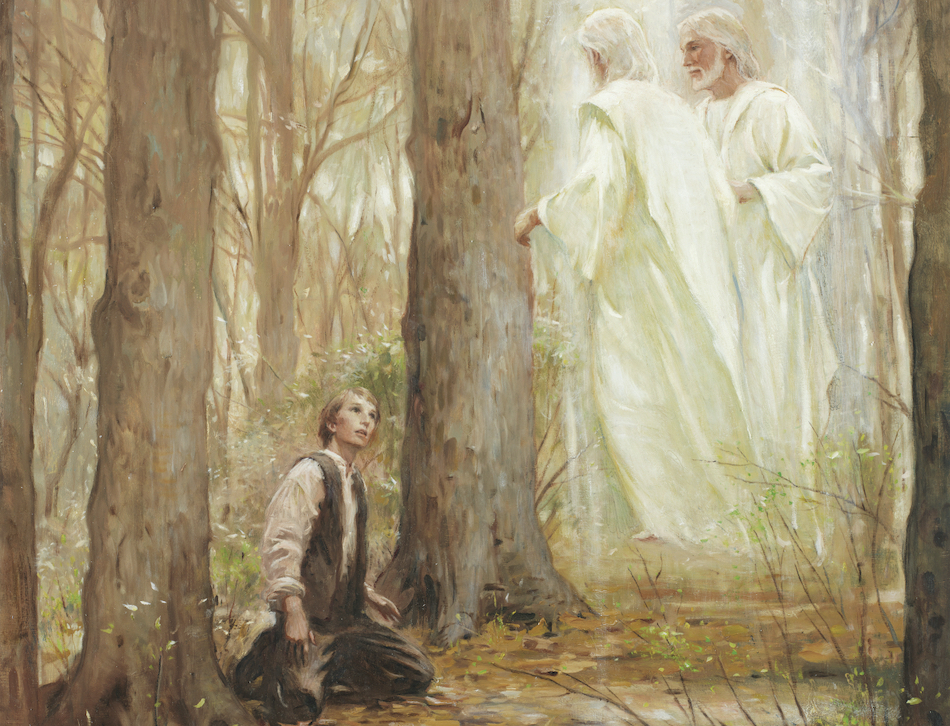
That said, both Joseph Smith, the founder of Mormonism, and Muhammad claimed to have had dramatic encounters.  Both were committed to these revelations they had received and able to convince a large body of people of these claims.  It is always amazing to me how even a fundamentalist Christian can scoff at claims of angels delivering inerrant teachings or laugh off the flight to Medina on the Burāq, all the while accepting Biblical claims.

An undeniably beautiful image, right?

In short, I absolutely believe that Joseph Smith and Muhammad existed as real people.  I also have no reason to doubt that they did not believe what they claim to believe or even that they had some sort of trip and conversion experience.  But the truth of their existence and conviction does not mean their most extraordinary claims are actually reliable.  It does not matter how many people recorded their lives or believed what they said.

So, of course, a man named Paul existed, and perhaps he did have an encounter with an apparition.  I will accept that he was brought into the church.  There is no reason to take issue with any of this.  And I’m sure, if he was indeed out there killing Christians, this was a very welcomed development.  And yet there are also those raised Christian who become Muslims or atheists.  A conversion experience does not prove the extraordinary claims of a particular religion.

3) More Sources Than Alexander the Great

Habermas spends significant time in his lecture discussing the typical criteria for accepting a source.  There is more proof of Jesus, according to what is acceptable by normal academic standards, than there is of Alexander the Great.  Which is no surprise given that Jesus arrived on the scene later and spawned a religious movement through his teaching.

And yet while most everyone agrees that George Washington was a real person, that he crossed the Delaware river, this doesn’t mean that they must accept his ideological perspective or believe the mythology about the cherry tree.  Historic texts, like reporting of events in our own time, can be almost entirely fact, yet also be embellished or just incorrect on details.  

The biggest lies are always laced with facts.  It is how so many people are snookered.  A charlatan will make many credible claims to establish themselves.  They may have credentials and compelling stories.  The New York Times reporter, Walter Duranty, won a Pulitzer Prize for his glowing coverage of the Soviet Union.  That he included many verified facts in his accounts does not mean his writing was not deceptive.

The reality is that extraordinary claims require extraordinary evidence.  If I were to list off my activities for the day, that I went to Dunkin for coffee, to the gym after that, and then broke Usain Bolt’s 100 meter sprint time, would finding independent verification of the first two claims bolster the last claim that I’m now the fastest man alive?

Most of the Bible being reliable does not mean every claim being made is true.  Being correct on a million mundane facts does not prove any of the most extraordinary claims contained.  No, it does not even suggest we should be less skeptical.  Maybe this makes some of us uncomfortable, but this is a normal burden of proof that we place on those who are outside of our own belief system, why not use the same standard for ourselves?

The big difference between Jesus and other historical figures is that nobody is telling me to devote my life to Alexander the Great.  It is one thing to believe that Abraham Lincoln existed as a real person and a significant figure, and quite another to say that he resurrected from the dead and ought to be worshipped as God.

4) We Can Trace the Narrative Back

Most of the New Testament was written down long after the events took place, this is something generally agreed on by all sides, and Habermas does have an interesting response for those who would use this as a basis for skepticism.  This, I believe, is where a general consensus is good enough.  It is silly to argue that Jesus did not exist or that the narrative was entirely fabricated well after the fact.

Close is not the same as complete. Not even close.

And yet, again, this tracing narrative back, using catchy phrases to suggest that these things had been established early and then were passed along made me think of modern memes or protest chants that are created in response to real events.

Michael Brown, for example, was shot by a police officer in Ferguson, Missouri.  Soon a phase, “hands up, don’t shoot,” became the rallying cry and is a short version of this idea that Brown was gunned down while simply trying to surrender.  However, both a St Louis County grand jury and a US Department of Justice investigation cleared the officer of wrongdoing, the actual evidence points to the teen being in a physical altercation with the officer, and the catchy chants, therefore, are not an accurate representation no matter how popular.

The thing is, if we can’t get things right even days after the actual event, does gap or no gap matter? 

It really does not.

5) Why Die For A Lie?

Joan of Arc was an extraordinary young woman.  She managed to inspire her people to fight and is a wonderful icon of faith and courage.  But eventually, she fell into the hands of the English, who had every reason to hate her guts, and they put her on trial for ‘heretical’ exploits.  There is every indication that she was cooperative to the point that there was no justification for her execution and had likely been forced to violate the terms so they could kill her.

The martyrdom of the disciples of Jesus is something many Christian apologists tout as being hard evidence of the resurrection.  As in who would die for something that they know is a lie?  And this is indeed is proof of the commitment that these men had made to the Gospel message.

But let’s consider what happened to the Millerite movement when their prophecies about the Second Coming proved to be false.  Did they give up their delusion or even entirely reject the teachers that had misled them?  Some did.  But, as with Harold Camping, who spiritualized the prediction post hoc rather than admit being wrong, this is what is now the Seventh-day Adventist denomination.

So why do people remain committed to something despite overwhelming evidence to the contrary from an outsider’s perspective?  

It is this little thing called confirmation bias, we become emotionally attached to the things we believe and to the point of being blind to the obvious.  As the saying goes, “A man convinced against his will is of the same opinion still.”  And people who have had their belief system falsified will simply modify as much as necessary and then move on as if nothing happened.  Why?  Well maybe because it is too hard to start from square one, to admit being wrong, or perhaps because the community and values feel too important to give up?

So, since I have my skeptic hat on, and we already know that the disciples had been looking for a literal earthly kingdom, what is to say they did not pick up and run with an alternative rather than return to the lives they had before.  I mean, even most agnostics will claim that Jesus was a good teacher, so this could be justification for building a mythology to sell this better way.  For radicals the ends often justify the means, lying is not forbidden if for a righteous cause in Judaism.

Anyhow, if backed in a corner, if you’re likely killed even if you do recant, why not refuse to go along with what your persecutors want?  I doubt Joseph Smith would have given his tormentors the satisfaction of admitting that he never had his angelic encounter.  That doesn’t make Mormonism true.  No, this is just how we are.  Pathological liars are so convincing because they believe their own lies.  What Jesus taught was revolutionary, people die for less all of the time.

Is That Really the Best We Have?

I know that I’m not going to win many fans amongst my Christian audience by giving an honest answer to the apologetics they offer.  I’m sorry, it may work for many who already buy-in, it may be enough to convert a few, but I simply cannot be impressed.

That said, I do appreciate Habermas for his admitting that the Gospels do not always agree perfectly, and also admire those who can engage in the long form of argument too tedious for my own tastes.  

Still, all said and done, these sorts of arguments can never span the gap between the extraordinary claims and the most capable skeptics.  It is nibbling around the edges of proof and really only ever evidence that is convincing to those who come in with the right presuppositions—like those claims of the miraculous as an explanation to things not yet explainable.

In his questions and answers follow-up, Habermas mentions how many do not believe for emotional (rather than rational) reasons.  He points to C.S. Lewis as someone who fell away from faith over the death of his mom before his eventual rise as a Christian thinker.  However, the same is also true for why people believe.  We want a world with purpose and meaning, and the Gospel narrative provides this.  It is harder to give up a comprehensive belief system, even if it makes no truly testable claims.

It just feels like apologetics always relies on strawman versions of skepticism.  Even if I fell totally into unbelief, I could never dismiss all of Scripture.  But I also have seen, first hand, how incapable people are at getting the facts right, how they see what they want to see and delude themselves.  I know because I’ve made the error of pursuing something, in sincere faith, that could be falsifiable and was forced to swallow the hard reality of my self-deception.

Most who profess belief in Jesus will never be so bold as to risk it all on something that can be disproven.  They believe things that are written in a book, they attribute their good fortune to God’s goodness or try to accept the bad as being loving discipline, without ever putting it to the test as they would if they had actual faith.  It is as if they hope if they never question then maybe the dream of eternal reward will come true and thus run from any chance of encountering a serious refutation.

The thing is if the resurrected Jesus needed to appear to Peter, James and Paul before they would believe, then why not appear to us all? 

Is there an answer to this that doesn’t come off like an excuse?

It isn’t like the creator of the universe lacked the budget.  And that the most important decision in our lives would come down to believing the eyewitness testimony of a handful of first-century men, this seems rather odd.  Don’t get me wrong either, the Biblical narrative is quite fascinating, the miracles, angelic visits, and promise of life after death to those who believe, it is wonderful. The teachings of Jesus have led to a more compassionate era. Still, the claims like the virgin birth, walking on water, and raising the dead aren’t exactly things a rational person would accept without seeing these miraculous events for themselves.

The biggest problem with the apologetics of Habermas is that it relies on a false dichotomy.  A reader doesn’t need to be able to accept that a source is perfectly reliable to believe some of it is true.  There is a multitude of possibilities as to why the disciples would go with the resurrection narrative.  First, it is much easier than saying they wasted their last few years.  Second, it sells the teachings of Jesus better than anything else.  And third, it can’t be falsified, how does anyone disprove what they claim to have seen?

The possibilities are endless.

This is not to say that the disciples were delusional or lying either.  My point is that it is too easy to see an argument as being stronger than it is.  It is annoying, perhaps, that we can’t rely on apologetics to do the heavy lifting of the Gospel, nevertheless, the only resurrection of Jesus many people will see is that which is embodied in us.  What that means is self-sacrifice and bridging the gap of unbelief with the substance of love. 

Talk is easy, actually taking up the cross is not…

[Don’t] Trust The Narrative

Standard

The truth of a story is not proportional to our investment in it.  The Marvel Cinematic Universe, for example, is a movie franchise worth nearly 23 billion dollars and has no basis reality other than locations.  And still, despite being complete fiction, people are obsessed.  We treat the characters as if they’re real, repeat their lines, cosplay to participate in the fantasy, and it does seem that many would rather be lost in this exciting world of make-believe than live their actual lives.

It is really interesting how outside observers of religions (other than their own) have no difficulty dismissing the beliefs and practices.  The claims of L. Ron Hubbard, or Joseph Smith, or Muhammad ibn Abdullah aren’t all that compelling to non-adherents.  I mean, come on, riding through the sky on a horse with a woman’s head and the tail of a peacock sounds more like a crazy acid trip than something to take seriously, right?  But for this raised in an Islamic country, this makes more sense than Trinity or resurrection.

I’m quite certain that the Biblical narrative, whether Genesis or the Gospels, would have been far less believable had I not been indoctrinated as a child.  I mean, it made sense to me then.  My parents and every other respectable adult that I knew held to this belief system.  It would actually be rather strange had I rejected this outright.  It was only later that the vast differences between even various Mennonite sects, and facing challenges to my assumptions, that I even knew how to question.

Of course, this doesn’t make those raised outside of organized religion any more rational.  Secular ideas, like Evolution and Global Warming, have taken on their own narrative framework, similar to religion, that far exceeds the actual evidence.  Not all of the gaps can be explained by Natural Selection.  And climate apocalypticism has strange similarities to the “end times” prophecies common with many caught up in Evangelicalism.  Al Gore is basically Harold Camping with corporate sponsorship.

Most of these narratives can’t be entirely falsified.  The decades and decades of dire predictions from climate alarmists haven’t come true, yet they keep moving the goal posts, even making claims in contradiction to those prior, and the next generation of conscientious young people are none the wiser.  Likewise, the doctrines and practices of traditional religions evolve and get twisted every which way, to the point that you can’t get people raised in the same denomination to agree.  

The strangest thing is how these various movements never die even when their claims are falsified.  For example, the Seventh-day Adventists arose from the false Millerite prophecy that Jesus would return on October 22, 1844.  The date came and went without event.  But, despite this Great Disappointment, some who saw their central claim proven false still regrouped and continued on their way again.  Perhaps the investment made was too much to simply give it up?  

It’s sort of like I don’t expect the “believe science” midwits to ever comprehend how many times the experts get it wrong or reconsider.  They’ll probably go on praising Dr. Fauci as a saint even after the puppy experimentation scandal, even after the NIH now admits to funding of gain-of-function research, and probably because it would cause too much discomfort to consider that their trust may have been misplaced.

It takes a boatload of evidence to overturn these narratives we have built up in our minds.  Bad ideas, like Marxism, even if they fail miserably in one place, are often recycled and reintroduced.  At the same time, credit for plain luck is given to whatever a person wants to have credit.  A boom economy, with the President you voted for, and it is obviously a product of wise leadership, right?  The sun came up right after you prayed?  Must be the grace of God.

All religion, all political ideologies, the trust we have in certain institutions or people, is part of our embracing narratives.  Whether you believe vaccines cause autism or ended Polio depends more on who (or what) you accept as an authority than the actual evidence.  Past narratives might seem irrational to you, like the idea that autism was caused by “refrigerator moms,” yet made complete sense to many influential and intelligent ‘scientific’ people at one time.  Those who go against the currently popular ‘expert’ consensus can expect persecution.

All this to say that we aren’t as good at discerning truth as we imagine.  In many cases what we believe is nearly as much fiction as Captain America fighting against Hydra.  It isn’t just the conspiracy theorist kooks buying into narratives despite evidence to the contrary, we all do, we all believe a blend of religious propaganda, political indoctrination, and out-of-context or unqualified facts stitched together, and much of it as absurd as the narratives we reject.

My Suspicions Confirmed

Standard

I’ll have to concede, I was wrong about face masks.  Early in the pandemic, in January of 2020 while the corporate media ‘experts’ were saying that we should be more concerned about the seasonal flu.  I was worried about this mystery virus in Wuhan and decided to get a box of N95 masks in case my fears were confirmed.  I was ridiculed, at the time, for my warnings and telling people to be prepared.

Months later, as the “no human-to-human transmission” claim of WHO became too obviously false to ignore and the glib urgings of politicians for their constituents to visit China were replaced with terror, that confirmed my warnings.  But now, with mask mandates and recommendations rolling out, many friends began to resist the idea.  They weren’t going to wear a “face diaper” and ridiculed the idea that a bit of cloth would be effective against a virus.

Of course, they were a little right, cloth masks aren’t at all effective against stopping the spread of the virus and now the corporate media is finally conceding this.  But still, based on laboratory experiments and filtration level, I believed my N95 masks were effective.  However, laboratory conditions are not the real world and, eventually, even that became a question mark for me.  Many countries also require facemasks with the masks because the masks are not adequate.

A few weeks ago, I may have overstated, I said that masks were completely ineffective at stopping the spread.  Technically correct since the virus spread as much (or even more) in states with strict requirements and yet I’ve also ran into some convincing data that suggests the good masks, the N95’s with a decent seal, may make an 10% difference overall.  So on this basis I’ll admit there could be marginal benefit.

The Wishy-washy Way To Truth

Many people, once they’ve made up their minds, never reconsider their stance.  If they believe masks are stupid then they will use every excuse in the book not to wear one.  I’ve heard them all.  The fear about being dehumanized.  That breathing carbon dioxide is dangerous.  But then they’ll contradict by calling people who disagree “sheeple” and claiming that something that can stop carbon dioxide from leaving can’t stop a virus from entering, hmm?

This is called confirmation bias.  People are emotionally invested in their ideas.  It is not easy to admit being wrong after making strong statements one way or another. So, rather than be on an unbending quest for the truth, most people (including your’s truly) will seek out the information that ‘confirms’ an established position and ignore what does not.  It takes much more effort to take an honest (and critical) look at the evidence and go wherever it leads.  Few actually do.

Confirmation (or my side) bias is powerful because it is hidden under layers of fact and explanation that sounds rational.  The position being guarded seems completely reasonable to the holder of the opinion, in their eyes they own the moral high ground, and those who disagree are simply ignorant, selfish or otherwise deficiencient.  It is often this moral stake in the ground that makes it so hard to back off from an established opinion, we would rather continue in the righteous delusion than deal with the possibility the other side was right.

As the saying goes, “a man convinced against his will is of the same opinion still.”  Even a mountain of evidence cannot uproot an established position.  It is the same as a fortification on a hill that can hold off waves of an assault with few defenders.  That hill being our ego, the banner flying our identity, and we cling to this ground because to lose it would cause us to question ourselves, ask the hard questions of if we are truly virtuous and good, if we are actually intelligent or fooled by our own desire to be right?

It is far easier to remain in the comfort of our own righteous delusion than to consider that the very foundation of our citadel of reason could be sand.  We fear changing our perspective will mean we’re wishy-washy or, worse, might require us to examine the underpinnings of other long held beliefs and leave us with no bedrock to build on.  Most of all, we fear the ridicule and abuse of our ideological enemies, we can’t let them win!

Powerful Propaganda to Innoculate the Masses

The point of propaganda is to build confirmation bias.  The propagandist tries to encourage an emotional bond to an idea, often through appeals to popular prejudice, and yet not overtly or in a way that the targets know they’re being used.  Almost every war is fought for the financial benefit of a few and yet sold as some righteous common cause.

For example, both sides of the American Civil War felt they were fighting for civil rights.  Both sides used labor that was either property outright or treated like a rented mule.  The Northern elites, for all their moralizing abolitionist hubris, depended on an industrial machine that exploited poor European immigrants, taking them right off the boat to send into dark mines, dangerous factory conditions or conscript them into the meat grinder of Lincoln’s war.  The South, obviously, was fighting for the privilege of the slaveholding elites and yet convinced they were depending themselves from Northern tyranny and aggression.

Propaganda is about framing an issue in terms favorable to a particular side without ever appearing to be biased to the target audience.  It is subversive by design, aims to overwhelm the true complexity of debatable mathers with simple sloganeering, refrains meant to be picked up by the midwits in media and then spread by the unsuspecting masses.  The point is to convince the enforcers of the order, the common folk, that they are doing God’s work, being patriots, on the side of irrefutable science or what have you, when in reality they’re serving some undisclosed agenda.

Hitler did not rise to power by being the caricature of evil that we see him as on the other side of the conflict.  No, rather, he had convinced enough of the German people that he was on the side of progress, that he would remove the causes of disease and suffering, then build their country back better than ever.  The Nazis dressed up in a magnificent authoritarian style, it might look bad in retrospect, knowing where it was leading, yet was hope for a nation emerging from years of crisis.

The Safe and Effective Deception

As part of the propaganda campaign, to convince people to inject the controversial new vaccines, news articles repeated the “safe and effective” mantra over and over again.  Both of those words are, of course, subjective.  However, they are assuring and have a sort of sophisticated ring.  Surely this sort of confident declaration is the result of rigorous science and more or less an unquestionable truth, right?

Those in support of vaccine mandates completely ignore the known risks, Big Tech monopolies literally removing groups of people who had encountered adverse effects, and seem to have no awareness of the great potential of unknown risks that come with any new technology hastily introduced.  I mean, somehow the 737 Max got through the approval process, was essentially declared safe and effective, despite a serious defect.  So, in short, we can’t possibly know that there are no long-term health consequences of these experimental vaccines and are only now starting to study that potential.  

But the thing most egregious propaganda is not the downplaying and dismissal of the documented deaths or reasonable concerns of those who have studied history enough to know how quickly narratives change.  They are simultaneously attacking treatment options, like Ivermectin, that are truly effective, cheap and present less of a risk than Tylenol.  It is actually this that makes me distrust them as far as the vaccines.  Why are they so adamantly against things that are actually safer than the vaccines and with a proven record?

Even as the new vaccines have proven to be ineffective as far as stopping the spread and preventing infection, despite the natural immunity of those who had the disease being up to thirteen times stronger than the vaccines, the current propaganda narrative continues that it is the unvaccinated are the real cause of the suffering.  Nevermind that Pfizer, Moderna and Johnson & Johnson all have financial ties to big media and make a windfall off of this new product.


Far Should Our Trust Go?

The real question is why should we trust the same political and media establishment that lied about where the virus originated, initially downplayed it as less a threat than the seasonal flu, parroted the Chinese regime that was no human-to-human transmission, and even had the audacity to encourage people to visit the crowded streets of Chinatown?

At what point do we start to question their bold declarations?

Can we really trust the same people who, in a complete panic after being wrong, first said “two weeks to stop the spread” and then somehow transitioned this into months of lockdowns?  Can we trust the people who, months ago, laughed off the concerns about vaccine cards being turned into a sort of passport and are now pushing for that very thing?  What can be for a President who is on record, before the election, saying he would not mandate vaccines and is now trying to impose that very policy?  

Supposedly they’re completely trustworthy this time around?

Anyhow, each day I hear stories, that man a friend knew who faithfully wore a mask, had two shots, and then died after becoming sick from the Covid virus.  We have the trickle of stories about vaccine related health complications, contaminated injections resulting in deaths and recalls of millions of doses, warnings from the very inventors of the mRNA technology, and yet told that we’re a conspiracy theorist to question.  Those blinded by confirmation bias will never see.

Let the Idiot Speak!

Standard

This morning I came across an article reporting Facebook’s sudden about face on the matter of whether Covid-19 came from a lab in Wuhan.  The established narrative was that this debunked, a wild conspiracy theory, and thus the social media giant took it upon themselves to protect us from this misinformation. 

Had you posted some speculation about the possible man-made origin of the pandemic prior to this it is likely it would be demoted by Facebook’s algorithms or removed entirely from the platform.  This, like questions about the election results or the Biden laptop scandal, deemed to be fake news by Big Tech monopolies, present a prime examples of why I oppose all censorship.

Their supposedly independent fact-checkers, who somehow never found the time to flag some false claims (including the Russian collusion narrative, that ‘kids in cages’ started with the last administration, and the myth that Trump praised white supremacists), somehow instantly debunked the New York Post’s big scoop in the weeks prior to the election.

Of course, the Twitter CEO, Jack Dorsey, did issue an apology for this “total mistake” and yet long after it could impact the election.

All this to say that, no matter your politics or perspectives, these Silicon Valley elites did a rather poor job of playing impartial arbiters of truth and really can’t be trusted to police the national conversation.  Sure, maybe it was an honest effort, confirmation bias can make a fool of the best of us, they were relying on the experts, yada yada, but clearly they can be wrong and can be wrong again.

Wisdom of the Crowds

A few months back I had planned to write a blog on an interesting phenomenon called wisdom of the crowds.  

In an experiment, Sir Francis Galton, a statistician, had the visitors to a country fair guess the weight of a dressed ox.  He also had some experts independently assess the weight.  Many of the non-expert guesses were wild and yet, when taken collectively, as a mean average, do you know who came out on top?

That’s right!  

The crowd beat the experts and actually came within 1% of the true weight of the slaughtered animal.

Now this wisdom, when manipulated, say by someone claiming to know the weight, is no longer accurate.  And this is not to be dismissive of expertise.  There is certainly a place for doctors, lawyers and engineers, professionals, those who have spent years in careful study or ‘know the math’ so to speak.

Still, maybe just maybe we should rethink this idea that some kind of central body, especially in matters of partisan politics, should have complete control over what information is or is not fit for public consumption.  I mean, do you really believe that smart people are immune to things like group think, that there’s no echo chamber or chance that they miss something in their ‘expert’ analysis?

It is absolutely fact that well-educated people can get things wrong.  Remember that deadly collapse of a bridge under construction in Florida, someone in the FAA approved the 737 Max to fly before it was grounded after two plunged killing all board, surgeons sometimes remove the wrong leg and there’s a good reason malpractice insurance exists. 

Even the best of us make mistakes.  Add political agenda to the mix and there can be tremendous blindspots.  

A friend of mine suffers from a rare genetic disorder.  But it had gone misdiagnosed for years.  A local hospital even refusing to consider the possibility of a genetic cause by running tests.  Well, it turns out, a relative of his, a layperson, reading in publication about someone with the same disorder, put two and two together, my friend finally demanded the tests and that is likely the only reason he’s alive.

So why, again, should we blindly trust a small team of experts when we can open it up to the entire crowd?

Let the Idiots Speak!

One of the things that bugs me most about the whole censorship regime is that truth can come from complete idiots.  Yes, I get tired of crackpot conspiracy theories, critical thinking often seems to be in very short supply, and yet I would rather have the open conversation than to arrogantly assume that the unwashed masses have nothing of value to contribute.

First of all, as previously discussed, the established ‘expert’ consensus can be wrong.  The problem with experts is that they often have a very narrow focus and rely on other experts rather than research everything for themselves.  So, in other words, incorrect knowledge can be repeated over and over again, taken as fact, because everyone trusts their colleagues too much and sometimes, even after peer review uncovers the error, the myth persists.

For example, the Lancet, a renown medical journal, was forced to retract a study they published that came out against use of hydroxychloroquine as a Covid-19 treatment option.  How this got past their editors is anyone’s guess, but this shows the danger of relying too heavily on a few experts.

Second, idiots, being less knowledgeable, can be at an advantage as far as telling the truth as they see it.  Confirmation bias, as it turns out, is something that plagues the intelligent or those who are more able to rationalize their way around the problems with their perspective.  It is far less likely that an idiot will come up with wrong (yet plausible sounding) explanation which sways public policy in the wrong direction—like a PhD college professor could.

Third, children, who are idiots due to their lack of education, are less prone to functional fixedness, they often speak in an unfiltered way and have a fresh perspective that should be heard.  The story of the Emperor’s New Clothes describes this well, the child in the tale didn’t know what they weren’t supposed to say and blurted out the truth that the socially pressured adults refused to see.

So, in conclusion, the established ‘truth’ can be wrong, the child (or unsophisticated mind) can sometimes see through the knowledge others have, and therefore we should allow all to speak no matter how stupid they sound to us.  No, that doesn’t mean we should let the idiots lead or ignore the experts, but there is great danger in shutting even their incorrect and sometimes offensive ideas out of the conversation.

At the very least, nobody is safe when the tyrant king murders the court jester.  When the idiots can be silenced it won’t be very long before the powerful begin to use the label “idiot” for anyone challenging their authority, including you, and who will dare to speak up for you after that?

Breaking Down Identities

Standard

The other day I was filling out a survey and came to the questions about my race and gender.  I paused for a second, “what am I today?”  And decided to select what applied to me in that moment, which is the answer that I would typically use when asked those questions, and yet continued to ponder this question of identities.

I understand why these categories exist, we do have tendencies and traits as a part of a demographic group.  Generalities and stereotypes certainly do have some basis in reality and I won’t deny that.  However, what makes me bristle a bit is what this grouping too often does to relationships across category lines.  It is divisive, it robs us our uniqueness as individuals and also puts us at odds with those deemed to be different from us.

It is too black and white.  Too simplistic and encourages a distorted picture of reality in emphasizing that one similarity we share in common (or one difference we have) over everything else.  The labels themselves are even dumb.  I’m not actually white.  My skin is a shade of brown.  Furthermore, I probably only ever started identifying as white because someone told me to fill in that box as a child and I mindlessly complied.  

The idea of “whiteness” is a social construct and has come to mean much more than it ever did before.  Now some claim that everything from work ethic and politeness to mathematics is somehow a part of being white.  Which is appalling ignorance, unexcusable, given the contributions of people of all skin shades and cultural backgrounds to civilization as we know it.  All people should be offended by that nonsense.

I had a classmate, a Jamaican immigrant, brilliant at math, well-spoken, very polite, the son of an engineer or university professor as I recall.  And, by the current color obsessed paradigm, he’s more ‘white’ than I am.  It is a backhanded insult to the many, like him, who have natural talents that don’t fit within the narrow categories or grievance culture narratives of the racially prejudiced left.

Which is the crux of the matter.  I hate these categories because they lie.  As Mark Twain quipped, “there are lies, damn lies, and statistics.”  Sure one color group may, collectively, produce more elite athletes, another more classical musicians, and another mathematicians.  But those group statistics tell you absolutely nothing about individuals nor why some individuals achieved these outcomes.

Much being attributed to color is actually culture.  In Europe, in Africa, in Asia, and America, there are as many cultures as their are shades of skin color.  Some European regions are known for their industriousness and superior engineering, others for their laid-back attitude and art.  The same is true of Asian cultures.  The same is true of African people.  So how do we know color has anything to do with these differences?

The two biggest lies of our time…

1) The myth that skin color is synonymous with culture.

2) The myth that group statistics determine individual outcomes. 

Yes, there may be some statistical correlations between certain behaviors and skin color categories.  But that doesn’t mean that what applies to one of a certain category applies to all.  For example, many women love pink, but that doesn’t mean the most or even many women are fond of that color.  My younger sister defies many of those sort of feminine associated things, she’s not afraid of any critter, has reptiles for pets, and that does not make her less of a woman than those who freak out at the sight of a spider.

Correlation is not equal to causation.  And the late George Floyd has more in common with me, as a working class schlub, than he does with the Harvard educated, son of a privileged WASP mother, who calls himself Barack Obama.  It’s true.  Look it up.  One half of Obama’s lineage is as Yankee as you can get, a great great […] grandfather being the first to build a gristmill in the State of New Jersey, back in the 1600s, later elected to the state Congress.

It is a complete farce that a coal cracker kid, raised in rural West Virginia, is advantaged over a college educated “person of color” working as a Wall Street broker.  Nah, I’ve been around, I know how the cultural elites sneer at ‘deplorables’ and work overtime to make sure that they know their place.  Class privilege is often misidentified as color privilege and misidentified by the very people who benefit most from spreading out the blame for their own sins.

The son or daughter of an immigrant wage-slave has more in common with the ‘black’ category than the trust fund babies of any color pointing the crooked finger.  This is what grates me the most.  In the real world blacks and whites work together.  Out on the road, hauling commodities for the man, I swung the sledgehammer as much as that ‘black’ fellow beside me.  

So do I really need my prissy, Che Guevara T-shirt wearing sociology professor cousin, son of a doctor, who could somehow afford to travel the world taking photos while I worked for $7.50 an hour, lecturing me on things that I don’t understand as a white male?

No, no I do not!

Those who associate certain outcomes or behaviors with certain colors of skin, who only ever see skin color in their analysis, are the true racists.  There is a stronger correlation between fatherless homes and negative outcomes than there is between skin color and negative outcomes.  In other words, things commonly categorized as a color privilege is more strongly correlated with family structure.  

Look into mass shooters.  

Not at all excusing their violence, but many of them were estranged from their fathers, struggled to fit in, and it is hard not to see this as being an insignificant factor in their outcomes.

Think about that when discussion of privilege comes up.

Unfortunately, there is not much to be gained as far as political power in a “the fatherless unite!” campaign.  Racial division, by contrast, is an easy sell.  Skin color, indeed, is the low hanging fruit of human difference.  Tribalism comes naturally, all you need to do is convince people that they are somehow fundamentally different because of something superficial and their confirmation bias will do the rest of the work for you.

Breaking the Bonds of Designated Identities

I’m not going to minimize the importance of life experience and family inheritance in shaping our identities.  I was born into a conservative Mennonite home and that identity was very important to me.  In public school it made me a religious minority, subjected me to many inquiries, what would now be called micro-aggressions, and some bullying later in life too.

The strange part is that, while being the Mennonite kid amongst my school peers, I never really felt like I fit in with my ethic church peers either.  After years of rejections, both in romantic endeavors and even as far as filling offices or missionary opportunities.  Finding my place, complete acceptance, within the Mennonite culture had eventually become an obsession.  I desperately wanted to be the good Mennonite for reasons that I can’t fully explain.

That pursuit came to an end with a young woman who declared, “I can’t love you the way that you want to be loved.”  

Mercifully, over the same time, a truly fatherly figure, Fr. Anthony, an Antiochian priest and college professor, took me under his wing to help me through this collapse of my Mennonite identity that had left me with a meaningless existence and suicidal.

I had to break from my ethnic and religious identity because I had no other choice.  It was not pleasant.  I loved, and still do love, many parts of the Mennonite culture.  My parents are wonderful.  My church was not one of those Pharisaical nightmares all too common in that denomination.  But, as Fr Anthony offered, maybe I had simply “outgrown” the tradition.

And, truly, in Christ, we are all called to a higher common identity:

So in Christ Jesus you are all children of God through faith, for all of you who were baptized into Christ have clothed yourselves with Christ. There is neither Jew nor Gentile, neither slave nor free, nor is there male and female, for you are all one in Christ Jesus. If you belong to Christ, then you are Abraham’s seed, and heirs according to the promise.

(Galatians 3:26‭-‬29 NIV)

St. Paul, in the context of the tumultuous days of the early church, spent much time addressing the many competing identities within the church.  He took on the religious elitists, bluntly telling them to castrate themselves in one letter, and spoke up for those being excluded on a class or ethnic basis.  That’s what he’s doing in the passage above, emphasizing that in Christ we can all be “children of God” and share one identity together.

The astounding part is that the church then, like the church now, still struggles on this point.  Even in the conservative Mennonite church, where we were basically all from the same ethic and cultural background, there were definitely tiers of acceptance.  Some simply check more of the ‘right’ boxes, are more popular, find the beautiful adoring wife, have all the opportunities, work their way up the ranks quickly and others not so much.  In short, the words to the Galatians are as relevant now as were then.

Christian Identity Makes Difference Beautiful

One of Mennonite cultural distinctives that I had rejected early on is that of uniformity as a part of Anabaptist non-conformity teaching.  My own church wasn’t nearly as strict as some.  But there is an undercurrent, undeniably, that if a girl talks more than average she’s a “flirt” or a motorhead guy with a nice car was somehow materialistic compared to a wealthy business owner with three farms.  Pity the artistic types in those churches more traditional than mine.

By contrast, an Orthodox Christian friend, gave this wonderful description:  The church is like a garden, full of different plants and plants, all watered by the same source.

That is the ideal.  

Unity in Christ is not about erasing all differences.  Galatians 3:28 is not turning us into an androgynous ‘multi-cultural’ blob of completely equal outcomes.  Jesus was not a Communist.  Having “all things in common” was not about forced wealth redistribution or reparations.  Certainly not about getting mine.  Rather it was about bringing our diversity of talents and abilities, bonded together as the body and blood of Christ, to the church.

Diversity can be a strength.  Not talking about superficial skin deep token ‘diversity’ achieved through quotas either.  Instead, what I love is those of many colors, many backgrounds and classes, working voluntarily towards a common goal, having found a shared identity that transcends all others and allows the entire group to reach full potential.  Competing identities keep us in conflict, but through Christ we could create the most beautiful harmonies.

In the end we must free ourselves from identities that keep us at war with each other.  However, that is not something we do ourselves. There are many misguided efforts.  Many are embracing divisive political ideologies, like critical race theory, that will only produce more hate and mistrust.  Condemning “whiteness” or heaping praise on “people of color” and otherwise playing favorites on those currently deemed to be victims is never going to do anything besides add to the confusion.  

Only in Christ, in repentance, in faith, can our differences in gender, culture, color or class be something beautiful. 

I Prefer Representatives, Sound Doctrine and the Holy Spirit Over False Choices

Standard

I was speaking with a friend a week or two ago (a conservative Mennonite searching for his place in the church) and he shared this quote:

“Doctrine is dead as a doorknob without the presence of the Holy Spirit in an individual’s life.” (Paul Washer)

That quote drop of a Calvinist commentator was annoying to me. It was annoying because it was shared in the context of a conversation about Orthodox worship and prayers. The clear implication being that established doctrine is somehow in conflict with spiritual life.

So, without hesitation, I asked my friend: “How do you know Washer’s doctrines (like the one you just quoted) are inspired by the Holy Spirit?”

My question was based on my own experience as one who had put his full confidence in the Holy Spirit and has since learned (the hard way) the need to be grounded in sound doctrine as well. In fact, it was my desire to follow the Spirit without compromise which had led to my pursuit of the impossibility, which led to my eventual disillusionment with the Mennonite denomination, which led me to the ancient faith of Orthodoxy and new spiritual life.

So, getting back to Washer’s quote, he presents a false choice between doctrine and the Holy Spirit. He, like many Protestant commentators, seems to equate established religious dogma with spiritual deadness. His quote suggests that we devalue church traditions (those pertaining to worship and prayer in the case of my friend) based in an assumption that what is new or spontaneous is somehow more authentic and real than something that has been passed down through many generations.

But is that truly the case?

Do we ever need to choose between established doctrine and authentic faith?

From what I can tell, church doctrine and real spiritual life originate from the same source (that source being the Holy Spirit) and thus we should not ever have to choose between the two. The traditions passed down by the church (including the canon of Scripture) and the Holy Spirit are never at odds. To deny the importance of church doctrines and tradition is basically to speak against the authority of Scripture:

“For the time will come when people will not put up with sound doctrine. Instead, to suit their own desires, they will gather around them a great number of teachers to say what their itching ears want to hear. They will turn their ears away from the truth and turn aside to myths.” (2 Timothy 4:3‭-‬4 NIV)

Nowhere in Scripture do I see sound doctrine being presented in contrast with living according to the Holy Spirit. However, I do see James tells us “faith without works is dead” (James 2:14-26) and also know, according to the Gospel (Matthew 7:22-24), that there will be those who have professed faith in Jesus, even worked miracles in his name, whom he will tell to depart because he never knew them and therefore authenticity of faith is about more than making a claim.

Thus I do question the basis for this commentator’s opinion and the many others out there of those who speak with a similar confidence about spiritual matters. By what authority do they speak? How do we know that they, along with their devoted followings, are not deceived? I mean these ‘spiritual’ commentators are often at complete odds with one another. Don’t believe me? Do a Google search “Paul Washer false teacher” and you’ll find dozens of articles denouncing him and his teachings.

So who is right? Who is wrong? How do we know?

My contempt for commentators…

My reaction to the Washer quote isn’t something unusual for me. I have a near-universal contempt for commentators and especially those who can’t at least ground their statements directly to something found in Scripture. And perhaps that strong aversion is because I have enough strong opinions of my own, more than my fill, and therefore seek something a little more grounded than mere opinions?

Not to be misunderstood, that’s not to say that I find no value in reading commentators. I do believe we can gain many valuable insights from listening to various men and women sharing their personal perspectives on spiritual issues.

But, that said, not all commentators are equal and anyone can say anything and our feelings (one way or another) about what someone says doesn’t make it any more or less true. There are likely false teachings that would resonate with any one of us and we should guard against being closed off to truth based on our emotions. We should remember that all religious groups are able to justify their own understanding of spiritual matters, many of them live morally upright lives, and can be very convincing to those who don’t know any different.

And, to be clear, I’m not just talking about those commentators who say “the Holy Spirit tells me thus and such” without offering any corroborating evidence from church history or Scripture. Being a Bible scholar or well-educated and intelligent does not make a person less susceptible to confirmation bias. No, if anything, being well-studied and smart brings a danger of pride and pride can prevent us from seeing our own biases and the many things we have missed in our studies.

Proof-texting, when a person soundbites Biblical texts at the cost of context, is a real problem for any commentator. That is why we have a multitude of denominations all claiming their authority comes from Scripture and, yet, can’t agree on some very basic issues. It isn’t that one side is more ignorant of the book than another nor that one side is less sincere about their profession of faith than another either—the problem is a lack of accountability to anything more than what feels right to us.

My own commentary on spiritual life…

Going back to Washer’s quote, I believe we can all agree that there is no life in the church or elsewhere without the Holy Spirit.

As the Orthodox pray on a regular basis:

“O Heavenly King, the Comforter, the Spirit of Truth, Who art everywhere and fillest all things; Treasury of Blessings, and Giver of Life – come and abide in us, and cleanse us from every impurity, and save our souls, O Good One.”

We know, from the creation narrative, that “the Spirit of God was hovering over the waters” (Genesis 1:2) and is also the “breath of life” (Genesis 2:7) that entered Adam. Life, both physical and spiritual, comes from the Holy Spirit, and we see this pattern throughout Scripture and even at the end of the Gospel when Jesus empowered the disciples to continue his ministry of forgiveness:

And with that he breathed on them and said, “Receive the Holy Spirit. If you forgive anyone’s sins, their sins are forgiven; if you do not forgive them, they are not forgiven.” (John 20:22‭-‬23 NIV)

Note how that parallels with the Genesis account where God breathes life into Adam. Note also that this being “breathed on” comes after the resurrection, after Jesus spent years teaching these men, and is what enabled them to fully understand what he had taught:

Then he opened their minds so they could understand the Scriptures. He told them, “This is what is written: The Messiah will suffer and rise from the dead on the third day, and repentance for the forgiveness of sins will be preached in his name to all nations, beginning at Jerusalem. You are witnesses of these things. I am going to send you what my Father has promised; but stay in the city until you have been clothed with power from on high. (Luke 24:45‭-‬49 NIV)

The disciples being “clothed with power from on high” (a step that should happen before we go out on our own commission) is something that happened in the book of Acts, on the day of Pentecost, when they received an outpouring of the Spirit and many came to believe in Jerusalem.

Truth, according to Paul’s commentary, in 1 Corinthians 2:6-16, is something revealed by the Holy Spirit. That is something that mirrors what Jesus said in his promise of a “Comforter” that would “guide you (his disciples) into all the truth” (John 16:13), and there is no way around it. All the Bible study and religious knowledge in the world cannot breath spiritual life into anyone.

All that said, sound doctrine and spiritual life are never at odds with each other. That it took a special outpouring of the Spirit before the disciples could understand what Jesus taught doesn’t make his prior effort useless. His teachings, if anything, provided substance, like the dust God formed up into a man in Genesis, and his breath the catalyst.

Furthermore, those waiting on the right feelings, or teachings that resonate with them and their own prior experience, will likely be like the rich young ruler who left disappointed after asking what he must do to be saved. Faith demands we go outside of our own comfort zone, that we go beyond our own understanding, preferences or calculations, and begin to walk before we have our eyes opened. In fact, the Spirit is something promised only to those who those who love Jesus and keep his commandments:

“If you love me, keep my commands. And I will ask the Father, and he will give you another advocate to help you and be with you forever—the Spirit of truth. […] “Anyone who loves me will obey my teaching. My Father will love them, and we will come to them and make our home with them. (John 14:15‭-‬17a‭, ‬23 NIV)

So, what comes first, belief and obedience to Jesus or is it the revelation of truth via the Holy Spirit that enables us to understand what we read?

That is a paradox and something that has always made me uncomfortable. Jesus appears to make obedience a prerequisite to spiritual revelation, which ran counter to my own intuition, and why I had always stressed the second half of the teaching rather than the first part. How could I know what is sound doctrine (as in the correct understanding of what Jesus taught enabling my obedience) without the Holy Spirit coming first?

My understanding was clouded by an individualistic filter…

One would think that I, as one raised in a church with Anabaptist heritage, would understand that interpretation of Scripture and establishing doctrine is something we do together, empowered by the Holy Spirit, as a church.

But somewhere along the line (somewhere between urban myths being shared from the pulpit and men like Bill Gothard being given a platform), I had lost trust in the ‘ordained’ leadership and other members to discern truth. And, as a result, I began to look beyond my religious peers for answers. Eventually, after an epiphany about faith, I began to find answers in Biblical passages that had once confounded me and became more confident in my own individual discernment through the Spirit.

However, that paradigm of understanding was incomplete and all came crashing down when my own individual ability to discern spiritual truth came into serious question.

It is easy to claim the Holy Spirit is leading you while you remain safe within the boat of religion. But true faith requires going beyond our own established range of possibilities, to let go of our own human logic and reason, and step out of the boat. I did that. I stepped out. I took a few steps across the waves and then was promptly overwhelmed by doubts—doubts that were, in part, a product of running headlong into the plans, prejudices and cynical calculations of those in the church whom I had still counted on to mirror my faith.

I had questions that I could not answer nor could be answered in the Mennonite context. I had lost faith in my Mennonite identity and Anabaptist heritage to provide reliable guidance. I felt I had been fooled, once again, misled by the desire to find meaning in my struggles and a delusional faith that the impossible would be made possible. I had nothing, besides an obligation to continue to fight for the hopes of my bhest, and needed answers.

Fortunately, I ran into a man, a fatherly figure, who did have answers that I needed and set me right again.

Fr. Anthony, an Orthodox priest, arrived in my life as if by divine appointment. He had the right attitude, asked the right questions, never said a disrespectful word about my Mennonite identity (offering praise for our “peace witness” instead) and could speak with an authority that was missing where I was coming from. There was no pressure. However, he always seemed to show up at the right time and was always able to explain things in a way that made sense to me.

The timing was right for me in the same way it was for the man St. Philip encountered on the road:

The Spirit told Philip, “Go to that chariot and stay near it.” Then Philip ran up to the chariot and heard the man reading Isaiah the prophet. “Do you understand what you are reading?” Philip asked. “How can I,” he said, “unless someone explains it to me?” So he invited Philip to come up and sit with him. (Acts 8:29‭-‬31 NIV)

In an individualistic understanding, this man (the eunuch) should’ve had all he needed to find salvation—I mean, according to what many Biblical fundamentalist commentators put forward, Scripture is basically self-explanatory and all we need to do is believe what we read, right?

But clearly, that is not the case.

The Bible itself tells us that somethings in it are difficult to understand (2 Peter 3:16) and this eunuch, an important and likely very intelligent person, could not discern for himself what was written in Isaiah.

The Holy Spirit did provide him with an interpretation, yet that interpretation came through a man named Philip. Philip did not speak his own “private interpretation” (2 Peter 1:20) as a mere commentator offering an opinion. He was a representative. He was a man both directed by the Spirit and also commissioned by the church in the book of Acts:

In those days when the number of disciples was increasing, the Hellenistic Jews among them complained against the Hebraic Jews because their widows were being overlooked in the daily distribution of food. So the Twelve gathered all the disciples together and said, “It would not be right for us to neglect the ministry of the word of God in order to wait on tables. Brothers and sisters, choose seven men from among you who are known to be full of the Spirit and wisdom. We will turn this responsibility over to them and will give our attention to prayer and the ministry of the word.”

This proposal pleased the whole group. They chose Stephen, a man full of faith and of the Holy Spirit; also Philip, Procorus, Nicanor, Timon, Parmenas, and Nicolas from Antioch, a convert to Judaism. They presented these men to the apostles, who prayed and laid their hands on them. (Acts 6:1-6)

Philip was chosen and ordained to be a representative of the apostles, the apostles who themselves were representatives of Christ. His authority to interpret Scripture went beyond being merely a product of his own religious studies. He was not simply a religious commentator spouting his own opinions. No, rather, he was ordained as a representative, as one judged to be “full of the Spirit and wisdom” by the church, and therefore had an authority greater than a mere commentator with an opinion.

My individualistic filter was wrong, I could not understand everything on my own, we still need those representatives who are sent:

How, then, can they call on the one they have not believed in? And how can they believe in the one of whom they have not heard? And how can they hear without someone preaching to them? And how can anyone preach unless they are sent? As it is written: “How beautiful are the feet of those who bring good news!” (Romans 10:14-15 NIV)

Why I prefer representatives…

Anyone can offer commentary, we hear ‘expert’ commentators tell us their opinions of sports, politics and the economy all the time. Some people prefer Paul Krugman, others Rush Limbaugh, and typically we choose those who confirm our existing biases to those who would challenge them. That is also true of Biblical commentators as well. We like those men whom we choose based on our own feelings, on what resonates with us or provide our itching ears with what we wish to hear. Unfortunately, commentators are not accountable to anything besides their own understanding and too often play to the prejudices of their particular audience.

A representative, by contrast, does not speak on their own authority and is ultimately accountable to the authority that sent, commisioned or ordained them.

For example, in a Republic, like the United States, we elect Representatives to speak on our behalf and represent our interests. There are also representatives of a corporation authorized to act on behalf of the collective group and must also answer to the other representatives of the group.

Jesus, likewise, came as a representative of the Father who sent him, on several occasions he tells his audience that he speaks on behalf of the Father and not by his own authority:

Not until halfway through the festival did Jesus go up to the temple courts and begin to teach. The Jews there were amazed and asked, “How did this man get such learning without having been taught?”

Jesus answered, “My teaching is not my own. It comes from the one who sent me. Anyone who chooses to do the will of God will find out whether my teaching comes from God or whether I speak on my own. Whoever speaks on their own does so to gain personal glory, but he who seeks the glory of the one who sent him is a man of truth; there is nothing false about him. (John 7:14-18 NIV)

Jesus is imploring his audience to test his credentials. He is saying that those who choose to do the will of God, by following his teachings, will find out if his words are true or not. In other words, his teachings are a testable hypothesis, established directly on the authority of the Father, and not just his opinions that can’t be verified one way or another. Jesus is not a commentator speaking by his own authority, but a representative, commissioned by the Holy Spirit (confirmed with a voice from heaven and dove descending upon him at his baptism) and spoke with the authority of the Father rather than his own.

The difference between a commentator and a representative is accountable to an authority beyond their own. If a representative goes beyond their commissioning they can be voted out or brought before a council and condemned. A commentator, on the other hand, only needs to be accountable to their own understanding and the whims of their particular audience—their authority rests on their own credentials rather than on a true commissioning by an authority already established.

Doesn’t the Holy Spirit make us representatives as well?

My answer to this question, with my shift in paradigm, has changed.

The answer is both yes and no.

Yes, in that we do, as individuals, receive authority from the Holy Spirit.

But, no, as far that authority giving us license to be free from accountability and operate apart from what has been established by Christ and his church.

The Holy Spirit, the true spiritual guide sent by the Father rather than a counterfeit spirit, should lead us into unity together rather than to divisions. The early church was full of commentators, some who claimed to have the authority of the Spirit or Scripture on their side, but the book of Acts shows us that not all commentators were equal and some had to be rebuked:

Then some of the believers who belonged to the party of the Pharisees stood up and said, “The Gentiles must be circumcised and required to keep the law of Moses.” The apostles and elders met to consider this question. After much discussion, Peter got up and addressed them: “Brothers, you know that some time ago God made a choice among you that the Gentiles might hear from my lips the message of the gospel and believe. God, who knows the heart, showed that he accepted them by giving the Holy Spirit to them, just as he did to us.

[…]

They chose Judas (called Barsabbas) and Silas, men who were leaders among the believers. With them they sent the following letter: The apostles and elders, your brothers, To the Gentile believers in Antioch, Syria and Cilicia: Greetings. We have heard that some went out from us without our authorization and disturbed you, troubling your minds by what they said… (Acts 15:5‭-‬8,22‭-‬24 NIV)

Heretical teachings in the church have always been sorted out by council and consensus.

Even St. Peter and St. Paul were accountable to the body of believers represented in this coming together of apostles and elders.

It is by this process we were even provided with a canon of Scripture: Councils, representatives of the church, decided what books belong in the Bible and which ones (while possibly still useful) did not meet the criteria of Orthodox teachings. Not every book, not every person, is equally authorized to speak on behalf of Christ and his church. The Holy Spirit does work in the life of the individual, but the Holy Spirit also speaks through the church and especially through those sent, ordained or commissioned by Christ and is church:

But we ought always to thank God for you, brothers and sisters loved by the Lord, because God chose you as firstfruits to be saved through the sanctifying work of the Spirit and through belief in the truth. He called you to this through our gospel, that you might share in the glory of our Lord Jesus Christ. So then, brothers and sisters, stand firm and hold fast to the teachings we passed on to you, whether by word of mouth or by letter. (2 Thessalonians 2:13‭-‬15 NIV)

We are told the church, empowered by the Holy Spirit, is “the pillar and foundation of the truth” (1 Timothy 3:15) and that is to say that the church does have authority over the individual as a representative of Christ. We really do need that—we really do need to be accountable to something more than our own ideas and/or interpretations—and should seek to hold fast to the teachings that have been passed by “word of mouth or by letter” of those who, through Christ and his church, have more authority than their own personal opinion.

Good commentary must be rooted in sound doctrine…

Anyone can claim to have the Holy Spirit, but not all who do are true representatives of Christ or his church, and we must use discernment. There have many heresies throughout the ages of those who felt they individually could discern truth without being accountable to anything besides their own religious knowledge and feelings of spiritual superiority to others. We need to be on the guard against their false teachings and also against being deceived by ourselves.

We are all very fortunate, we do not need to choose between the Holy Spirit and sound doctrine. This is a case where we can both have our cake and eat it. The church has preserved the teachings of Jesus, in traditions both written and spoken, as the basis for sound doctrine and that “breath of life” comes in our Communion together. We are not called to be “Lone Rangers” finding our own way, serving our own preferences, etc. We are called to be a part of the body of the church, representatives of the church past, present and future, this church:

And I tell you that you are Peter, and on this rock I will build my church, and the gates of Hades will not overcome it. I will give you the keys of the kingdom of heaven; whatever you bind on earth will be bound in heaven, and whatever you loose on earth will be loosed in heaven.” (Matthew 16:18‭-‬19 NIV)

Second Marriage: A Second Look At Early Christian Writers…

Standard

Early Christians, like their modern-day counterparts, had a wide variety of opinions and not all of their opinions are trustworthy or canonical. Still, their writings are often taken as 100% reliable and played like a trump card in debates over the correct interpretation of Scripture.

That is the case with some of my conservative Protestant friends when it comes to the topic of remarriage after divorce. If shown where Jesus addresses divorce as causing sin and qualifies his statement adding “except for sexual immorality” (Matt 5:32, 19:9), they will deny the implications of this clear exception and deflect to non-canonical early church writings.

It seems a fairly reasonable approach to a controversy over meaning at first glance. Why would we not trust early church writings as reliable indicators of original intent? What reason would they have to distort the true meaning of what Jesus taught? Shouldn’t we assume that they would know better than us?

However, that is not reasonable to assume. In fact, this idea that the early church was completely pure or free of heresies and false teachings goes completely contrary to Scripture. Indeed there were many errant ideas that circulated then and some very deep disagreements over practice. So, in other words, we should be testing their words against Scripture and not using their words in aid of our own confirmation bias.

Or, at very least, if you are going to quote Tertullian in a debate you should probably know a little about him before you do and also consider what else he believed.

Consider this early church writer…

Athenagoras (circa A.D. 177)

A person should either remain as he was born, or be content with one marriage; for a second marriage is only a specious adultery. “For whosoever puts away his wife,” says He, “and marries another, commits adultery”; not permitting a man to send her away whose virginity he has brought to an end, nor to many again. For he who deprives himself of his first wife, even though she be dead, is a cloaked adulterer, resisting the hand of God, because in the beginning God made one man and one woman, and dissolving the strictest union of flesh with flesh, formed for the intercourse of the race.

Did you catch that?

He just declared *all* second marriages, even those after the death of a spouse, to be “only a specious adultery” and forbidden.

Compare what he says to Saint Paul in the Romans 7:2-3:

For example, by law a married woman is bound to her husband as long as he is alive, but if her husband dies, she is released from the law that binds her to him. So then, if she has sexual relations with another man while her husband is still alive, she is called an adulteress. But if her husband dies, she is released from that law and is not an adulteress if she marries another man.

Athenagoras has clearly gone off the rails. He is in direct contradiction to the canonical teachings of the apostle Paul. Why? Well, the reason for this is that he subscribed to the heretical “New Prophecy” called Montanism.

Montanism arose from the teachings of a man named Montanus, a new Christian convert from paganism, who claimed to have a special new revelation from the Holy Spirit. They taught that their own revelations superseded those of Jesus and the apostle Paul. They ordained women as bishops and basically rejected the authority of Scripture and the established church tradition as well.

And you know who else was under the influence of Montanism and also wrote against *all* second marriages?

Tertullian.

Tertullian, a favorite of sophistical fundamentalist efforts to justify their existing positions, taught that *all* second marriages were forbidden. And by all I mean even second marriages in cases where the first spouse had died and a teaching that is certainly in direct contradiction to Scripture. That contradiction (if one truly believes that Scripture has an authority that supersedes personal revelation and not the other way around) disqualifies Tertullian as an authoritative source.

It is strange, while most Mennonites (and other Protestant fundamentalists) might denounce a modern version of Montanus as a false teacher and regard his adherents as deceived, many do accept old heretical teachings (when these old heresies argue their own established positions) and ideas that are not supported in Scripture.

All second marriages were forbidden by those misled by Montanus. However, according to Scripture, and not my own opinion, marriage can be dissolved for three reasons: Adultery, abandonment, and death of a spouse. In all three cases, a person is no longer bound to the first marriage and therefore is free to marry again.

1) The death of a spouse…

A woman is bound to her husband as long as he lives. But if her husband dies, she is free to marry anyone she wishes, but he must belong to the Lord. (1 Corinthians 7:39 NIV)

There is no allowance for a Christian to divorce their faithful husband or wife. Marriage is supposed to be one man and one woman till death do they part. However, we live in a fallen world and that means sometimes a young married person might lose their husband or wife. For that reason, the apostle Paul provides a provision for widows and, presumably, widowers as well.

2) The abandonment of a spouse…

But if the unbeliever leaves, let it be so. The brother or the sister is not bound in such circumstances; God has called us to live in peace. (1 Corinthians 7:15 NIV)

A Christian is never allowed to divorce a faithful spouse. But, there are times when a couple is “unequally yoked” where one is a believer and the other is not. Paul tells those with a faithful and unbelieving spouse to remain faithful. However, he also provides a provision for brothers and sisters who have been abandoned by their unbelieving spouse. He says they are “not bound” to the marriage in that case.

3) The unrepentant adultery of a spouse…

I tell you that anyone who divorces his wife, except for sexual immorality, and marries another woman commits adultery. (Matthew 19:9 NIV)

Jesus, in response to the Pharisees who asked if it is lawful to divorce for “any and every” reason, first took the opportunity to restate the ideal for marriage as a lifetime commitment, then explains that Moses only allowed divorce because of the hardness of their hearts, and lays down the gauntlet: There is no divorce for any and every reason.

Jesus does, however, give one exception and that is in the case of sexual immorality (or porneia) when the marriage has been broken by unfaithfulness. He significantly narrows the scope for divorce and remarriage. I do not believe he is ruling out forgiveness of the errant spouse either. But marriage can be broken and it is broken by unfaithfulness to the marriage vows.

Isn’t it better to be stricter than Scripture?

The church of my youth allowed remarriage after a spouse had died, yet not when a marriage had ended by other the other means described in Scripture and has turned away those remarried who refused to separate from their second spouse. This kind of hard-line, no exceptions besides death, stance seemed normal to me. I had simply accepted what I had been told.

It would seem like a good thing to exceed a Scriptural requirement. Mennonites do this all the time, they forbidding alcohol, mandate clothing styles and often have a whole list of standards. There seems to be an idea that exceeding the requirements of Scripture makes us safer and there is definitely a case for erring on the side of avoiding things that are questionable.

But, that said, when our own personal conscience (standards in addition to Scripture) is used as a basis to exclude others, then we have become as Diotrephes, the arrogant church leader condemned in 3 John for his refusing welcome other believers, and we will be held to account. It is one thing to have high personal standards, it is quite another to make them a test of membership and reason to slam the door in the face of those trying to enter.

Do not be like those who use their own conscience to overrule the teachings of Jesus and the apostle Paul. Montanism was heretical, a false teaching, and their kind of sophistry remains a stumbling block.