Last time around, I dismantled the myth of indestructible buildings—people dream of granite fortresses, their mental models blind to necessary trade-offs—meanwhile ballooning the cost of new construction and keeping more people are stuck in older less safe buildings. That same flawed thinking now fuels a frenzy over air disasters and my wife’s legitimate grumble over dental bills and paperwork that could choke a horse. Whether it’s planes plummeting or crowns now costing thousands, folks cling to busted models—piles of regulations, their wild conspiracies, or broken systems—that splinter when reality bites. In my truss design world, I double-check software because it’s half-baked; we should also scrutinize the narratives and red tape the same way, and not add more wreckage.
Air Disasters and the Partisan Haze
The wacky left, not to be outdone by the kook conspiracy right, keeps blaming air disasters on deregulation. Start with January 29, 2025: a Bombardier CRJ700, American Airlines Flight 5342, slammed into an Army Black Hawk over D.C.’s Potomac River, claiming 67 lives. Then a Canadian Dash 8 skidded off a snowy Quebec runway—no deaths, but headlines aplenty.
Now the April 10, 2025, Bell 206L-4 chopper crash in New York’s Hudson River, six gone, including Siemens exec Agustín Escobar and his family. X posts scream Trump’s crew gutted FAA rules. Never let truth get in the way of a partisan narrative, right? But the facts don’t bend. D.C. hit nine days into his second term—too soon for policy shifts to ripple. The Hudson chopper passed a March 1, 2025 inspection, clean as a new nail. NTSB points to D.C.’s air traffic staffing woes, Canada’s pilot error, New York’s likely mechanical failure—not slashed budgets.
Stats cut the haze. FAA data shows U.S. aviation incidents down since 2020, though Potomac’s toll spiked fatalities. Crashes in media hubs like D.C. or NYC feel like a deluge, but it’s perception, not reality. I’ve seen this hysteria before—folks panicked over food processing fires, but as someone who supplies building components we see many ‘fire jobs’ and not a surge. Fires due to hot bearings, bad wiring, heaters or dust are quite common and to be expected. The funny thing none of these food processing fire alarmists reported on the new feed mill near me—non-confirming news doesn’t go viral.
Then the tinfoil-hat crowd spins BlackRock plots because Escobar was aboard. What are the chances a Siemens exec’s on a chopper? Pretty high, honestly—they’re the ones dropping $500 a seat, not me touring the harbor for free, with my family, on the Staten Island Ferry. BlackRock’s got stakes everywhere; a link’s no bombshell. As far as the in-flight breakup of the Bell helicopter, my pilot brother snorted, “Never buy an air frame that does 30+ takeoffs and landings per day.” That is to say there’s a difference between a vehicle with highway miles and the one used as a weekend racer. Seized gearbox or stress fractures, not sabotage. The SEAL pilot’s fuel call was logistics, not a scream. Yet they weave a blockbuster rather than look at a shop log.
This echoes the indestructible building myth—deregulation won’t make planes drop tomorrow, nor do cabals rig bolts. More FAA rules don’t sharpen mechanics’ wrenches, just like overbuilt trusses don’t scoff at storms. That ELD mandate for trucks? It jacked costs, no safer roads. D.C.’s staffing gaps brewed for years; New York’s airspace is a madhouse, and always has been. Good design—trusses or aviation—leans on more clarity: sharpen skills, focused goals, while also acknowledging the risk baked in. Pilots should scan skies, not bury their heads in binders. But folks expect oceans to swallow us if one desk job’s cut, their models deaf to reality’s groan. Failures aren’t a secret plot nor will more rules prevent them all.
Healthcare’s Paperwork Quagmire
That same broken model—thinking more rules fix it all—bleeds us dry in healthcare, where compliance piles up and costs push higher. My Filipino wife got sticker shock: Over $2,000 for a crown! What??? Her gut said yank the tooth, but the doc—and me—aren’t keen on losing one of those original equipment food grinders. Before we hit the chair, she was annoyed by those butt-covering forms—shields for liabilities (“We asked about novacaine allergies!”) and traps to hunt you down if you don’t pay their yacht lease.
Earlier this year, my son’s middle school emailed another form, they’re playing dental cop to prove his exam. We lucked out—they took our word his Philippines checkup happened, sparing me need to send their paperwork to Baguio for my in-laws to wrangle. There, we’d stroll into a clinic, no appointment, $20 for a cleaning or filling. Ain’t swanky, but it’s sterile, does the job, and fits a $8/day wage world. Here, insurance bloats costs like student loans—dentists hike prices ‘cause the check’s guaranteed. The poor folks get Medicaid, rich get their implants—me: never had dental insurance in my life, other than my couple year subscription to a scam “discount” that did squat unless I was already shelling out.
Since the Affordable Care Act (ACA) was turned into law, healthcare costs per capita soared from $10,620 in 2010 to $14,570 in 2023—37.2% up, inflation-adjusted, per CMS. Life expectancy sagged, 78.7 to 77.5 years, says CDC, while costs kept climbing. Rather than keep your own doctor was the promise, choice is diminished. Big players like UnitedHealthcare—had controlled 15% market share, Statista—grew hungrier and doubled it. Locally, Evangelical Community Hospital is now under WellSpan, and Geisinger sold to Kaiser Permanente, a $95 billion beast, both 2023 deals. Less choice, more denials, like truss software spitting out only one overpriced and deficient design.
It is easy to forget the undemocratic way the ACA was formed. It was rushed to get around the results of a special election that would cost Democrats their filibuster-proof Senate. The Democrat Congress rammed through a trainwreck bill to circumvent their loss of Ted Kennedy’s seat. The last thing we needed, in healthcare, was another layer of management. Upset Americans—54% of the country wanting repeal—rose up in the mid-terms in opposition to this government takeover of their healthcare choice.
Unfortunately the oligarchy won and we were stuck with a deeply flawed bill, sold with lies, passed in the dark of night, that nobody wanted—results in more mergers while costs continue to explode.
Obama, getting creative to deal with the botched rollout of HealthCare.gov, created what was called United States Digital Service to fix the issues. This basically gave the Executive Branch a backdoor access to the newly minted government agency that was convenient for the Democrats at the time it was formed. And this, ironically, is now what gives DOGE the authority to do what they have been doing over the past few months. Whether you see DOGE as a phoenix rising from the ashes or a monster coming from the abyss—you have Obama to thank for it.
It’s like engineers, for compliance, ditching practical talks for nonsense specs that lead to an incoherent mess of conflicting interpretation—it produces more hassle for everyone downstream, not a sturdier roof or better structure. This compliance Kabuki—fancy waiting rooms, school nurse cops—doesn’t make better teeth or safer streets, it just bloats our bills and increases our taxes for nothing in return. Philippines clinics run lean on cash, keep it real. Here, we’re buried under a pile of paper.
Good design—trusses, planes, healthcare—cuts the fat, bets on need of good judgment over more forms. Models that preach more rules will save us or seeing secret plots are as off as thinking properly engineered roofs can never cave. The FAA didn’t fix Boeing’s focus on DEI over properly installed bolts in doors and the ACA only added to the cost of healthcare. We must quit chasing fixes that will only add more dead weight to an already strained structure—and ask: what’s propping this whole mess up? And why’s it heavy enough to crush a man’s soul?
A Different Blueprint: Stripping Away the Myths
Things on the periphery are tough to flesh out, like trying to find out what is happening beyond the event horizon of a black hole. We all live in this big bubble—a commonly shared safe space—where folks will bicker over set topics, blind to how both sides are tangled in a bigger myth. The structures we take for granted, holding us up, are just assumptions we gotta question. These bad models—rules to save planes, forms to fix teeth—are flawed assumptions like thinking buildings never fall. If we want to see reality clear, we’ve got to strip away these biases, prejudices, blind spots, layer by layer. That’s my design philosophy: ask silly questions, and then take ‘em seriously. I mean, why don’t banks handle healthcare instead of employers? Why can’t we get checkups at the local bar? No rule says payers have to be governments or bosses.
Most folks can’t see past their battle lines, let alone a third path. But if we look beyond the forms we know, we might find a better way. It’s about exploring our foundations—digging into the functional fixedness of old ideologies, dusty processes, and our creaky systems. In truss work, I don’t simply trust software math ‘til I test it; in life, and I don’t buy models ‘til I poke ‘em. We can do better by imagining something different—say, healthcare that’s cash-simple, like Baguio, or an aviation culture that trusts pilots over paper. Models preaching conspiracy plots or encouraging more red tape are as wrong as thinking roofs don’t cave.
In Japan, the electronic toll system on the Tomei Expressway and other routes crashed for 38 hours across Tokyo and six prefectures. The toll gates froze, smart interchanges shut, congestion piled up. And the operator, Central Nippon Expressway Company, had no fix in sight, so they threw open the gates, let drivers pass free, and simply asked them to pay later online. Most places, you’d expect folks to floor it and forget it. But over 24,000 drivers—some say 28,000—went online and paid up, no cops, no fines. An honor system.
The test of civilization?
That’s not just a country; that’s a different approach to problem solving. They didn’t lean on a coercion model—chasing violators or piling on rules. The culture is what made the difference. They could trust people to square up and people did. It’s a glimpse of what happens when you question our own status quo. Why are our systems so heavy, so distrustful, in the first place? Why does a Christian nation need government to solve all problems yet Japan does not? This may be a difference between our individualistic frontier mindset and their group harmony formed of rice cultivation. But it’s also the communal approach of Amish as well.
Mutual aid in Amish country is organic, not institutionalized, they don’t need bulky and wasteful organizations. They have built an identity together (like the Japanese have) and thus they voluntarily go along with the program. This may sound stifling, but is it really? Americans pay a boatload of taxes so that their bought off national leadership can bomb Gaza’s hospitals. Did we ever vote for that? No. The general public is just as indoctrinated and controlled by ideologies as a strict religious sect. The big difference is that Amish get their barn back days after a fire whereas the rest of us will spend the year sifting through insurance paperwork.
A sustainable future requires effective and efficient resource allocation that does not rely on costly bureaucracy or enforcement agencies. Governance is best internalized—something we do voluntarily as part of our collective identity or being part of a larger group. This will require discarding models and myths that aren’t beneficial. This idea that the world’s problems are either solved by some undefined ideal regulatory regime or are all caused by it’s evil twin of a secret world spanning scheme is simply fantasy that prevents reasonable discussions and pushes away from solutions that will better harness our human potential.
Cooperation doesn’t need to be top down or cumbersome and artificial. No, love for our own and self-sacrifice love is as coded into human DNA as conflict. And we should be taking a closer look at Japanese and Amish blueprint. Honor, a common code of ethics, shared cultural values, an internalized joint identity and being respectful to others can’t outsourced. Diversity is only strength when it harmonizes and follows the same tune. It is a combination of building a familial trust, deeper human relationships, and a societal mission that is worthy of fuller investment—not more programs, systems and rules.
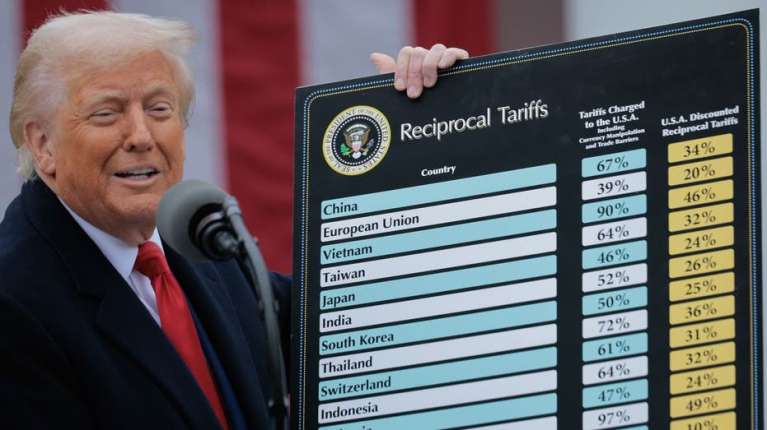
The point of Trump’s tariffs is to get rid of all tariffs. I can feel the blank stares of my ideological and indoctrinated friends who are hyperventilating about a blip in stock prices and loses for billionaires.
I get it, Libertarians, you really do not want the government to do anything and Thomas Sowell said stuff about tariffs being bad, so in unison you bleat: “Tariffs are taxes!”
But your sloganeering is not argumentation and—while I generally believe less is more in the case of government—I’m stuck here in the real world with Trump.
Economic theory has it’s place, as do ideals, and yet this isn’t a matter of Sowell said it, I believe it, that settles it.
Marxists also believe their man’s theory will work if properly applied. Ideological people can’t accept when their theory doesn’t work in reality, they will always insist “that wasn’t true [insert ideology here]” and continue on their merry way muttering that next time it will work—if they could just brainwash more children and eliminate more enemies of the revolution. There’s never a reevaluation in light of the actual evidence.
True X hasn’t been tried.
So, without further ado, let’s dive into where free trade fails and Thomas Sowell after we do that…
Can Hell Be Made Worse?
After the devastating earthquake of 2010, I joined a group of young people on a trip to Haiti. It was a Christian mission and hosted by a Haitian pastor. This grandfatherly man had, at one point, been in business and ran a factory manufacturing clothes.
While I’m not going to make a case against charity or giving, there is often a cost that is unseen and a greater dependency created in the end. The Haitian pastor was forced to shutter his operation and lay off all of his employees after the combination of cheap imports and donations made it impossible to compete in the marketplace.
But the even sadder story was in a place in the country called “little Africa” where rice farmers tried to make ends meet. No, they were never rich. However, they had scraped a living out of cultivation up until Bill Clinton started to dump subsidized American rice on the Haitian market. These people were desperate. They mobbed our delivery of a bit of relief and aid.
I know, I know, this isn’t real free trade. But it is the kind of situation we are in. Putting our favorite theories and fandom aside, and ideals that could possibly work if all abided by the same rules or assumptions, we don’t live in that fantasy land. In the real world, it is like Haiti where subsidized products are exported and some will disproportionately suffer consequences.
Yes, in theory, Haiti still benefits, as a whole, from importing cheap or free stuff. But we can also make the argument that this kind of unfair trade has undermined a situation that was already fragile. A government that would protect Haitian industries would not let subsidized products be dumped without something stabilizing in return.
Thomas Sowell vs Donald Trump
Sowell is a great economist and provides a good answer to ‘progressive’ theories. His being a guest on the Rush Limbaugh show has made him a favorite of conservatives—wanting validation for their free market and small government views.
As an academic, Sowell’s work dealt mostly with economic theory and to argue against all tariffs he uses abstraction “protectionism hurts market efficiency” and that they don’t solve issues like wealth gap, that they favor special interests, and retaliation against tariffs hurts exports, and they lead to long-term stagnation. And he may be right if we lived in a vacuum sealed petri dish.
Trump, by contrast, lives in the very messy world of politics and negotiations. He runs on instincts and intuition, not by intellectual exercises or writing papers or creating a set of principles. He comes in with the big ask, the threat or the bluff, trying to disrupt and even create a bit of anxiety in the other side, before eventually bringing this process to a resolution that makes all parties leave with a feeling like they’ve won.
This is how we got from the “fire and fury” rhetoric—with the political class and corporate media hyperventilating about this being a path to war—to Trump being the first US President to set foot in North Korea and then shaking hand of Kim Jong Un. It is just his method of changing the conversation or moving the Overton window. You can’t get from point A to point B without shaking up the old status quo a bit.
Trump isn’t ideological, like Sowell, or trying to live off a written in stone economic code of conduct. No, when he has leverage, or sees an opportunity, he uses it. There are many countries tariffing US goods. And our trade deficit is enormous. So why is it so out of line for our President to cry foul or use the threat of reciprocal tariffs in other to back these countries down and then get a better deal for his country?
Surely Sowell isn’t against pushing for the elimination of tariffs—which likely is the end game. And, furthermore, Trump’s brazen actions are far more likely to get results than the fine professor’s best lecture on economics. Already other countries are lining up to start talks about removing their unfair tariffs against the US. It is a game of musical chairs and you don’t want to be the last one looking for a seat.
Power, Principles, and Persuasion
Marxism is about the application of power, Libertarians are about strict adherence to a set of principles, but Trump is different. He is about persuasion.
Marxism is a hammer—raw power of the mob, trying to smashing the old order to hand control to the workers, or so it claims. In reality, it’s a machine for centralization: seize the levers, dictate terms, and dress it up as justice. Think Soviet bread lines or Mao’s famines—equality morphing into control. Libertarians, by contrast, wield a rulebook, not a fist. Their creed—liberty, markets, entirely hands off—is sacred, rigid as stone. Tariffs? Sacrilege. Sowell represents this. Marxism a power grab, and libertarianism a fortress of unattainable ideals—both are better to be left as theory rather than an approach to real world negotiations.
Marxism would’ve sparked a trade war, not talks; libertarianism would’ve let markets bleed out. Trump’s different—he’s making countries dance. China grumbles but hints at softening; the EU’s haggling too. Stocks have dipped, and Sowell’s costs loom, but the moves are now undeniable: Vietnam’s concessions, India’s play, Japan’s hustle. It’s not a system winning—it’s Trump, raw and loud, proving persuasion trumps power or principle. He’s bending the world his way, one bluff at a time. He is about persuasion—messy, unscripted, a vibe that bends the room.
Tariffs are the threat, but trade that is truly free and fair is the actual goal. And Trump is further along in achieving this simply for his boldness alone. Maybe he’s not doing it the ‘right’ way or by conventional means, yet who says that we can’t try a new approach to get some better results than we’ve been getting? The people who have been leaving the American worker behind tot decades now? As my 13-year-old son would say: Let him cook!
I have lost all of my heroes. The expression, “Never meet your heroes, because they’re sure to disappoint you,” describes the painful realization that those great people you imagined are not as special as you believed they were. It could be the letdown a friend had when he heard Matt Walsh speak. It could be a family that learned their eldest brother was cheating on his wife for many years and was not some image of virtue. For me it was a process and a very long grinding away of faith in these figures.
I was never one for human idols. I never put posters of celebrity faces on my bedroom wall and would never be as impressed with figures like Ravi Zacharias as some of my friends. It wasn’t a religious thing nor something just to be ornery. I simply didn’t have a feeling of awe about these personalities that were mid. The people I most admired tended to be local—my blue collar dad, my missionary cousin, or that perfect girl I would marry some day. But time has removed all from the pedestals.
Those women of my youth would end up as the cheating wife or more interested in status than my sincerity. My dad no longer looks like that man I remember who could carry me on his shoulders (with me hanging on for death life) up a silo ladder, and that zealousness of the ‘compassionate’ types tends to morph into a noxious ideological alignment that is really anything but they profess. They say that they want the Kingdom, but have replaced faith in God with fraudulent human institutions.
And I’m not just talking about the apologists for CAM in the wake of the Jeriah Mast and years of coverup aftermath. “Oh, but this is an organization that does such good!” What I’m talking about is something fully revealed since the DOGE ax has fallen on USAID. I grew up believing in the strict separation of church and state—that a colonial expansion of Christianity was tainted and this at completely odds with the teachings of Jesus about His kingdom not being of this world.
My views have certainly evolved—having left my religious cloister—but I’m still appalled by the thoughtlessness of people who I had once thought were smart and uncompromised.
Banality of Evil: When Ends Justify the Means
The Anabaptists, after the disaster of Münster, had committed to a quiet life of separation. It is why those in Old Order groups have refused participation in Social Security and other kinds of government benefits. Mutual aid should be voluntary and Christian charity is not obtained through coercion. Sure, the power of the state is alluring, that temptation (driven by our ego) to rule over others because we know what is best or they are undeserving of the resources they have—I have had many of those “if I were king” moments—but there is no stopping point when you fail to resist the siren song.
Left-wing politics always clothe themselves in a kind of compassion. Surely you will not oppose helping these children, right? And I am pragmatic to the extent I’m glad starving children are fed by any means. But opening the Pandora’s box of leftist means is always a slippery-slope to more use of state power and, inevitably, to leftist utopian cost-benefit analysis where everyone who opposes us is a literal Nazi and, therefore, we’re justified to stop them with violence. When coercion is allowed as a means of obtaining the ends we desire there is no stopping point.
The worst form of evil has good intentions. It is that of those who imagine themselves as the hero of their own narrative and thus allowed to bend the rules. This explains the extreme narcissism of Luigi Mangione who saw himself as a worthy judge of a father of two and a husband to a practicing physical therapist. There was no need for this leftist murderer to look inward, he had completely externalized evil and turned other men into caricature representatives of truly complex multi-faceted problems. When the ends can justify the means we’ll justify any means.
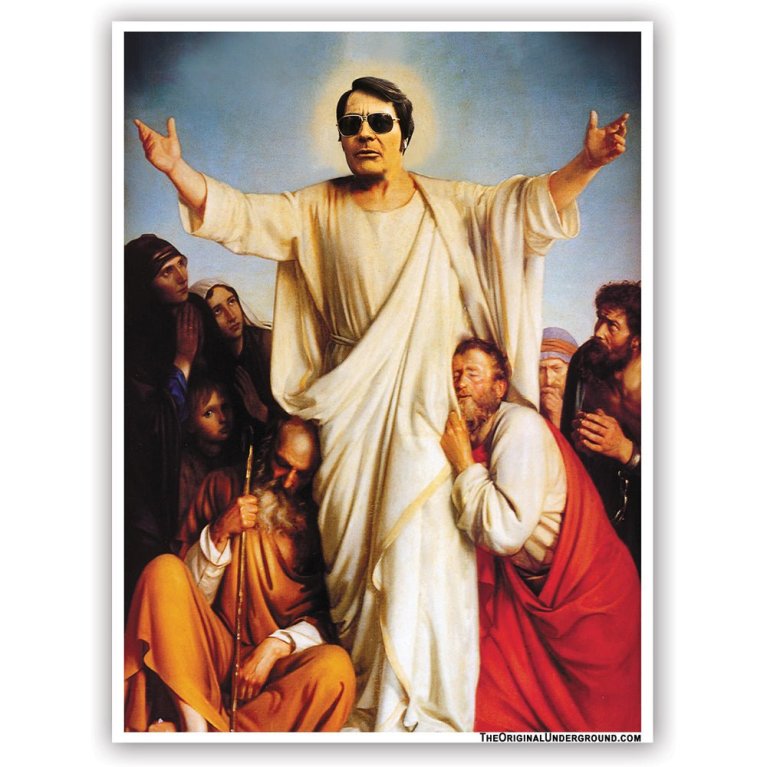
Pastor Jim Jones preaches his counterfeit Gospel before being abandoned by the US government and having to free his cult from bondage with some poison laced Kool-aid.
Seeing someone I thought was a Christian missionary lament how the United States had “abandoned” them was a reminder of how the great have fallen. There was not a shred of gratitude expressed towards the American taxpayers who financed them nor acknowledgement of the misappropriation of funds that has wearied voters to foreign aid. But more stunning to me was unholy alliance between this person of faith and agencies of US imperialism. Since when has the love of Jesus become an extension of the US regime abroad? Are they of the kingdom, as they proclaim, or agents of empire?
USAID, despite the name, is certainly not a charitable organization and was formed in 1961, at the height of the Cold War, with an aim of promoting the interests of the US political regime. That’s fine. But it has long ago gone off the rails even as far as what it was originally imagined. The Soviet Union had fallen and the Federal agency created to oppose it morphed from something most would support into a beacon of wokeness—pushing transgenderism and abortion.
Break the Yoke of Fraudulence
The reason why USAID is being dismantled is because we can’t sort the legitimate from illegitimate function of the agency. Sure, it may help people in need, but funding it also is enabling of evil and maintained through a system of coercion we call taxes. Anything good that it did can be done through other means. This functional fixedness of those who depend of government, especially on the part of those professing Christ, makes me wonder where their faith lies and what their actual mission is.
The merger of a Christian charitable cause with government doesn’t purify government—it taints the witness:
Do not be yoked together with unbelievers. For what do righteousness and wickedness have in common? Or what fellowship can light have with darkness? What harmony is there between Christ and Belial? Or what does a believer have in common with an unbeliever? What agreement is there between the temple of God and idols? For we are the temple of the living God. As God has said: “I will live with them and walk among them, and I will be their God, and they will be my people.” Therefore, “Come out from them and be separate, says the Lord. Touch no unclean thing, and I will receive you.” (2 Corinthians 6:14-17 NIV)
The accusations of “Christian nationalism” against those who want a government that performs basic functions were always just a smear by those in alliance with imperialism and Godless globalism. While I’m not a fan of God and country, at least the flag waving religious patriot knows there is a difference between their Christian mission and secular state. The left, by contrast, confuses these categories and would have social program replace true charity and community aid. In one case you have those who may tend to overreverence nation, but in the other there are those who truly represent empire and yet tell us they their only citizenship is the kingdom of heaven.
The truth is that the ‘Christian’ left is simply the left merely wearing the words of Christ as a disguise for ideological agenda. Those decrying the reduction of empire and return to responsible governance never said thank you to those funding their do-gooderism. It was, for them, all about holding those “chief seats in the synagogue” and their own glory as humanitarians. They may speak against Trump, but then have never uttered a word against the waste, fraud and abuse that has made these broad sweeping cuts popular with common people.
The true Christian spirit is that of a Federal employee who told me about the enormous amount of inefficiency and waste in his own agency and—while making no profession of faith—supports the effort of DOGE knowing it may impact his employment. That, to me, is someone who understands self-sacrifial love more than someone feeding the poor on another person’s dime and then going to social media to complain when their funds are cut. They’re grandstanding. While my Federal employee friend is a truly humble public servant who is grateful and not biting the hand that feeds him.
None of this to say this “abandoned” former hero of mine is a bad person. They clearly are using their abilities to help other people in desperate need. I applaud that. And yet their public statement betrays. There is an attitude or spirit there that is different from Christ. I would much rather they just be a secular humanist—subscribed to partisan leftist politics—and own it. They should just admit that they’ve abandoned faith in Jesus and are looking for a worldly system. Judas Iscariot is the patron saint of faithless social justice, guilt trips and envy—when you betray your calling just own it.
It’s been my thought for some time now and has become even more cemented in place over the past few years. People will believe anything, especially if it fills their desire for meaning and purpose, even if it is ridiculous at face value. But don’t mistake the for a shot at tradition. Karl Marx said that religion is “the opiate of the masses” and yet his alternative drug produces delusion, rage and violence. I’ll take Jesus and love over that any day of the week.
Sure, this quote could have some truth to it:
“Organized religion is a sham and a crutch for weak-minded people who need strength in numbers. It tells people to go out and stick their noses in other people’s business.”
E. J. Dionne Jr
But that same statement could be applied to almost every popular secular movement or established consensus. Certainly not all, not even many, who believe in various narratives or theories are qualified experts. Most have simply bought into a system and are riding the ideological bandwagon. Good science is religious and organized, scientism is a cult and a way of silencing critical thinkers who are outside of the political mainstream. I would certainly take Gospel tracts shoved in my face over social media censorship of my ‘wrongthink’ and higher taxes that won’t do anything to save the planet.
Call me a skeptic of everything, I just find it difficult subscribing to anything anymore, to me it is all easy-believism. I mean, does it seriously change anything about my day-to-day life to believe in climate change or go to church? Probably not. People might make a symbolic sacrifice here and there. However, for the most part the commitment doesn’t ever match the rhetoric. The faithful aren’t walking on water nor are those who loudly proclaim their extreme consternation about the climate giving up their private jets or beach homes.
But it is much more basic than this, go ask people about who is the best president ever (or worst) and you’ll get completely opposite answers. To some Trump was the guy who spoke to their own concerns and delivered, to others Biden is the guy who has restored the normalcy they craved. Both sides can support their own perspective if given the chance. Can they all be right? Okay, so it is subjective, an opinion which man is better or worse, and yet we don’t agree on what is objective either.
I love talking to the most sincere people, the true believers, because they are so confident about what they say and it is enviable. If you have had a bad experience with those who espouse their ideology, then that’s the rare exception, an anomaly, and is not the real version that is represented by them. I’m just not like them. I can’t help my skepticism of their beliefs. I’m not very easily sold on their the basis of their sureness and claims alone, show me the undeniable evidence. I do not fall for their conviction or consensus.
People do not seem to know where reality ends and their imagination begins. Basically every narrative we create is a sort of fiction we create for ourselves. We take the bits of data, very often distorted by our own flawed perception, and interpret it into a story that makes sense to us. Systemic heightism, for example, describes something very real, is even quantifiable, and yet is also an overlay that doesn’t truly describe the truly complex picture. What we accept or deny is often a product of our conditioning, social status and base desires.
The primitive communism that Marx used to fashion his ideas were as much a fabrication as any religious mythos. Idealistic children likely subscribe to his theories for the same reason they love Disney fairy tales or Marvel comic book heroes. Utopia ahead is a very strong motivator, in that we are very willing to make huge personal sacrifices when we believe that heaven awaits us. And yet, as much as see the ‘faithful’ fall for obvious con-men, it makes every testimony questionable.
The problem with my own unbelief is that I also believe this too. I trust myself enough to mistrust. Maybe my own ambivalence, and sometimes agnosticism, will make me miss the one truth in the sea of lies? Still, I’m convinced my only ability to be sure of anything will have to be direct revelation from God, because I know too well that I’m a blind man in a world of full of blindness. I’ll admit, this isn’t the most comforting or easy answer, but people believe many things that simply are not true.
What do I believe?
I believe what is most beneficial. Maybe all of religious narrative is a fabrication and yet the real question is it useful, will it produce results that make the world better?
The Christ I believe teaches me the value of delayed gratification. In other words, when we invest in others, in faith, there is a chance that we make a friend and split the dividend of our peace. In doing unto others, in love, there is a chance of solving our conflicts and ending hostilities. Christianity, unlike various popular political systems, makes no utopian promise in this life, and yet it does help to push behavior in the right direction.
All lies have an element of truth. In fact, a misleading narrative, in order to have any convincing power, must contain many true statements.
It is not the off-the-wall and totally unsubstantiated claim that is the most dangerous. No, it is the half-truths, the facts out of context, the misunderstood statistics, that are most deceptive. Effective lies employ facts, they work our emotions and attempt to frame even our own experiences into a deceptive narrative.
The biggest lie of our time is the so-called “anti-racism” of the far-left. Call it woke, call it social justice, Critical Race Theory, Equity committees, or anything else, it is all fundamentally the same thing and that common thing is to promote division over identities.
The sad part is that many will stop reading here and leave without understanding. They might see the statement above as attacking their good intentions, as being ignorant, and a lack of comprehension of what those things listed truly are.
First, discrimination is real.
People are discriminated against on the basis of height, body shape, ability, intelligence, credentials, wealth, political views, affiliation, having a disease, personal history, gender, and, of course, skin color. Any category of identity or appearance can be used as a reason to deny and mistreat people. Ultimately, we’re all a minority of one and most have faced some form of discrimination.
In this country, the United States, religious, racial, and ethnic minorities have faced a significant level of discrimination. Chinese weren’t allowed to hold certain jobs, Germans were forced to scrub away much of their cultural heritage and unique identity because of war propaganda, Japanese sent to internment camps, Mormons were lynched, as were Republicans, and of course the horrendous exploitation of African Americans as slaves and then the discriminatory Jim Crow laws that followed.
This legacy of discrimination, especially in the most severe cases, has undoubtedly left its mark on various communities.
Second, power dynamics change with context.
Be the wrong person to walk into a biker bar and the welcome will be anything but warm. Go to Philadelphia, get off the beaten path like my family did, and the McDonald’s may be a rather hostile environment where the staff servers others ahead of you and then make your tired little sister cry because they dumped a massive pile of salt on Happy Meal burger.
As a Northerner, in the rural South, I was a bit nervous about standing out too much for my accent, did the sons and daughters of the Confederacy hold a grudge?
I was definitely a fish out of the water getting off the bus stop in Compton!
I think we all feel a little uncomfortable out of our own context, away from our own cultural tribe. I know from traveling abroad, being surrounded by people who eat unfamiliar foods, speak a strange language, look, act and dress differently, this can feel a little threatening and unsafe. No, it is not because the people are unfriendly or show any signs of contempt for you, as a foreigner, it is just that you don’t know the risks, customs, or what to expect.
Stepping out of the airport terminal, into the steamy Manila heat, filled me with a mix of excitement and anxiety as I clung tightly to my bags and scanned for the face of that one person of millions that I hoped would not beat, rob, and leave me for dead.
It would be really easy, had I had the wrong encounter, to generalize and conclude that Americans were unwelcome. If on my own turf, if treated badly, I would assume it was a bad individual and not a reflection of all in the community or culture. But amongst those who are different in appearance, it is very easy to make broad generalizations based on a couple of bad experiences. Being in a room full of strangers, especially those who seem to know each other or have something in common, we feel vulnerable or powerless. And sometimes there is actual bullying and discrimination against the odd ones out in a given context.
As a Mennonite in a public school, I was always keenly aware of being different. I was asked questions, often containing assumptions and annoying, had nicknames based around my religious (and ethnic) identity, it is a behavior called “micro-aggression” according to the current paradigm. Being called “Jebediah” or hearing derogatory comments about Mennonites didn’t exactly leave me emotionally unaffected. There was always (and still is) a feeling of safety and security that comes from being with people of my own sub-culture.
Third, I’m completely opposed to racism.
I have long taken a stand against racism and discrimination based on appearance.
Even the concept of race itself does not actually make much sense.
Why is Barack Obama black when his mom was a privileged New England blue blood, white, and that lineage half of his genetics? What percentage of African blood does one need to be black? Why does skin color or a few unique physical features determine another race, but not hair color or height? Why aren’t redheads a separate race?
The definition of race, according to Merriam-Webster, is “any one of the groups that humans are often divided into based on physical traits regarded as common among people of shared ancestry” and could actually mean that Mennonites and Amish, with their unique genetic disorders, are a race. But the reality is that it is mostly an artificial barrier, something arbitrary, a category based on mostly superficial things, and not science-based.
This first step in eliminating racism is to reconsider the existence of race. Race is not real or at least no more than Mickey Mouse. It is simply lines that we have drawn, like the political and geographic boundaries between nations, and the bigger difference between people is actually culture, but don’t take my word for it:
Culture has enormous effects on social outcomes. The influence of culture on social outcomes is not just a hypothetical—there is a great deal of evidence that culture has a large effect on many of the unequal social outcomes that some would like to ascribe to biological differences between races or sexes. Those who urge us not to deny that biology contributes to human nature have a point, but they often short-change the significance of what really makes the human species exceptional—our culture.
There is a multitude of reasons why some like to emphasize racial differences and try to make culture synonymous with race. The first amongst them is political power. By convincing people that some others are inferior or a threat, based on some category of difference, you can harness their anxieties as a means to get votes. Blaming behavior on genetic predisposition is a license for color discrimination and also a ready excuse for bad behavior.
If we ever want to overcome racism we need to understand race is purely a social construct.
What is false about anti-racism?
Being raised in liberal America, post-Civil Rights era, meant being indoctrinated into the teaching of Martin Luther King. It was not colorblindness, as often framed, rather seeing the person first rather than judge on the basis of outward appearance. But this liberal order is currently under assault. Even reciting the passage out of the “I Have Dream” speech, about not being judged by the color of skin but by the content of their character,” will be met with the ire of the “anti-racist” left.
Why?
Well, strange as it is, the far-left push for ‘diversity’ and ‘inclusion’ is not about race at all. No, in their worldview and framing of experience, it is always about this supposed power struggle between the majority (within their culture) and those deemed to be marginalized and oppressed. In other words, if skin color were removed from the equation entirely it would not matter, this ideology seeks to find any difference in outcomes and call it an injustice.
The term “white privilege,” for example, is indicative of race. That is how it is defined, as the perceived advantage of those with lighter skin tone over those of darker complexion, and yet that’s not truly what it is about. That’s simply the bait. The term is a divisive tool and cover for an assault on religion, property rights, traditional marriage, and other existing beneficial structures of civilization that stand in the way of the far-left’s self-declared ‘revolutionary’ ideological goals.
For sake of analogy, think of the gag when you tap a person on the opposite shoulder to make it appear that someone else in the room did it. I mean, nothing but a harmless prank in that case. However, it could also be employed as a diversionary tactic, where you get two other people arguing so you can take advantage of the ensuing chaos to pursue the actual objective. It is misdirection.
Many, in taking on racially divisive terms like “white privilege” fall for the ruse, they respond by pointing out all of the advantages black Americans have. This, in turn, can easily be presented (out of context) as proof of racial prejudice and only fuels the fire of resentment across color lines. Many black Americans, for their part, are very aware and sensitive about their racial identity and not without cause either. Unfortunately, this also makes them vulnerable to political opportunists who seek to exploit this history and experience of prejudice. It very quickly escalates into an unsolvable tit-for-tat mess, nobody on either side realizing they’ve been played for fools.
The prime example is how the Kyle Rittenhouse shooting is framed as being white privilege, the riots in Kenosha supposedly an expression of anti-racism. The narrative pushed by the corporate media is that Rittenhouse was some kind of far-right nut job looking for trouble, a counterprotester, and gunned down protestors at random. In reality, Rittenhouse had family connections in the city, he was there protecting a minority-owned car dealership, he has actually expressed support for BLM, and his attackers were all white men. He wasn’t there to oppose justice for Jacob Blake. He was there because of the destruction the night before and to defend the innocent from harm.
The three white men who attacked Rittenhouse are protected from scrutiny, under the “white privilege” rubric, for being classified as oppressed. It is not in spite of, rather it is because of the violent criminal history of these three white men that they are considered victims by the left. The left assumes that people behave the way they do because of circumstances, they blame-shift responsibility for violence perpetrated by their own and use narrative as cover for ideological agenda rather than a means of transmitting truth. The left is not truly against discrimination or anti-racism, they are about gaining power over others by any means and this racial wedge is simply an effective tool.
The lie that color is culture
Underlying the Critical Race Theory (CRT) and any of the rebranding attempts used to “start the conversation” or sell this anti-liberal divisive ideology is an assumption that race and culture are inexorably linked. It is, not too ironically, the one thing that both the ‘woke’ and actual white supremacists agree on. They both teach and believe that skin color determines behavior.
This is why those pushing CRT reject the call of Martin Luther King to see past color and judge by the content of character instead. To them people behave the way that they do because of their race, that skin color basically determines culture and character, and therefore it is oppression for the majority to impose any kind of order or at least not when it goes against their own leftist political agenda. Any cultural standard, like the idea people should work for their own food, is classified as oppression and racism.
Both white supremacists and far-left theorists present differences in behavior and statistical outcomes, between racial categories, as being primarily driven by genetics. They, unlike liberals, who see a larger role of culture and assume that economic circumstances play a part in shaping outcomes, see race as being what determines culture. The only difference between the two is that white supremacists see this as a reason to subdue and subjugate some races, while the far-left sees it as a reason to subjectively excuse or accuse people along color lines. Both are equally abhorrent. Both reverse cause and effect and provoke hate.
The first problem is that even if genetics did determine outcomes, why stop with categories of race? We all know that Europeans all have their own unique cultural groups, as do Middle-Easterners, Africans, and Asians. It is the basis for stereotypes. We know Italians to be big talkers, Germans as industrious, Russians for drinking lots of Vodka, and the same thing could be done across any racial division. It is sort of like Native American tribes, they were not all the same, some were warlike and conquered their neighbors. Some were nomadic, others building massive cities. To lump them all together is plain ignorant, it is the heart of racial prejudice and poor analysis.
At this point, some, at least on the right, would be eager to get into statistics showing the correlation between race and criminality or IQ. To them, this is smoking-gun evidence of the superiority or inferiority of collective racial groups. They would use the athletic advantage of African Americans, given the domination of black people in professional sports, as undeniable proof of this overall thesis. And, certainly, we could get into a discussion of the structure of the Achilles tendon, Testosterone levels, and whatnot that would go on forever. However, all this obsession on physical racial differences ignores both the large overlap between groups on the standard Bell Curve and also the role that culture plays in shaping these outcomes.
The lie is that race predisposes culture. That some are genetically predisposed to violence or laziness and therefore should be exempted (or excluded) and granted special permissions. It completely ignores the reality that categories of white and black are far too narrow given the diversity of outcomes within those labels, that there are two many other influences on behavior to settle on only an inborn genetic nature. Yes, perhaps some of our personality is predetermined and travels along with skin color. But we cannot rule out that these behavioral predilections are not mostly a product of nurture or culture.
The left needs to have race determine culture in other to push forward a victim narrative and this idea of systemic racism. If culture (behavior) is genetic and not a choice, then some can’t be held accountable for their own poverty of criminal activities. This is a new variant of Marxism. The German philosopher, Karl Marx, saw us as products of class rather than independent moral agents, which was the basis for class warfare rhetoric and license for violence against those more successful. The left wants African Americans to believe that they can’t thrive in the broader American culture. That’s a lie.
Religion produces culture and shapes outcomes
One of the most wonderful things about being rejected by my own ethnic kind is the opportunity it gave me to learn how much people are truly the same. I’ve never dated an ethnic Mennonite, nor a white American-born woman, and not as something deliberate either. In other words, I was open to any race and simply had more luck with those different from me.
But each time, whether an immigrant, black, white, or the infinite shades in between, Hispanic, Algerian, Egyptian, Cantonese, Filipino, or Congolese, slightly better educated or more athletic, these women had much more in common with me than was actually different. In some regards, they remain more my kinfolk than the conservative Mennonites who could not love me the way that I wanted to be loved. And, here’s the truth, while racial and cultural differences are always an interesting conversation, it is similarities in religion that formed the bridge of our common bond.
My bhest, Charlotte, is an Asian woman. A Filipino to be more precise. And yet her ethnic heritage is actually Igorot. The Igorot tribes live in the Cordillera mountain region of Luzon. They are known as ferocious warriors and only a couple of generations removed from head hunting:
A tribal war usually starts after a tribesman takes the head of a member from another tribe. Head taking was a rite of passage into manhood. The offended tribe can demand retribution. If the one taking the head desires continued peace, influential tribal leaders are sent to the other tribe to negotiate. Compensation is paid and the accord is sealed with an exchange of articles. If no agreement is reach then a war challenge is issued by the offended party.
This cultural arrangement would make for a rather uncomfortable existence, at least when traveling alone on the edge of tribal boundaries, and resulted in plenty of bloodshed, no doubt. However, while still carrying on some of the tradition, the practice of headhunting is a curiosity of the past rather than a reason to be fearful of getting a haircut while visiting Baguio City, which is now a big tourist destination for other Filipino people and the hub of the Igorot world.
What changed?
Well, not the genetics.
Let me tell you the story of Charlotte’s family, the terrible tragedies they have (at the hands of wicked men) endured, what made the difference for them and how it is a path forward for us. The violent lifestyle of Igorot tribes changed with the conversion of many of their ethnic kind to Christianity and this has produced significant changes in outcomes.
An Igorot family that forgave
As a writer, as part of my trying to make sense of the world, I do not want the suffering of others to be for naught. But I know that this subject matter is personal and painful for Charlotte and her family, so understand that I share this with conflicted feelings. On one hand, I want to protect those whom I loved. On the other, I want to create a better world for our children by this very practical testimony of faith and sacrifice.
Charlotte’s grandpa converted to Christianity and even started a church in the village. He was a respected man, an elder in the village, and was called to settle a land dispute between two parties. However, the party he went against was evidently enraged. He hired an assassin. And Charlotte’s grandpa was murdered in the night, shot in his own bed, leaving the family without their beloved Patriarch and with a trauma that is visited upon generations.
Now, the traditional Igorot way of handling this would be to take matters into their own hands. However, rather than seek blood for blood, this first-generation Christian family chose to forgive. No, they would not have opposed justice for the killer. But civil authority is weak and overstressed in this region, this meant nobody would face legal penalties for this murder. A tough pill to swallow for sure.
And yet, that’s not even the most extraordinary part, they knew who the hired killer was. They knew who he was and would actually allow him to eat with them! Talk about heaping coals of fire! The only thing is, they did not forget nor did they let him off scot-free. There called him Judas. Referring to the Apostle who betrayed Jesus for money and his obsession with political power. Which is an apt description. So even with this forgiveness, there was still a bit of poetic justice and a not too subtle call for repentance.
One morning, several years ago, I was getting ready for work and received a call from Charlotte. I have never collapsed to the floor before in my life. But, I was immediately overcome with emotion, when I heard those words “they killed uncle Roland!”
My heart sank.
How could this be?
The man who so selflessly served his family, a wonderful father who would smother his children with love despite being exhausted from a long day of work, a provider, a leader in the community, and someone who would help anyone. The friend who welcomed me into his home, along with his lovely wife, aunt Geraldine, was murdered in a most brutal fashion, by thugs hired by a jealous business rival.
But, again, despite the identity of the killers (and who hired them) being known, despite the police lacking resources to investigate and prosecute, the family did not seek vengeance. I mean, for some time, I would fantasize about taking my own anger over what was done out on these wicked men. Still, in the end, what would that accomplish other than continue the cycle of violence common in tribal honor cultures the world over?
The wicked flee though no one pursues, but the righteous are as bold as a lion.
(Proverbs 28:1 NIV)
Now it is said that the man responsible for the murder, upon realizing what Igorot tribe uncle Roland came from and knowing their reputation for violent retribution, went into hiding and only goes out in disguise. Not sure if that is still true, nevertheless Jesus saved him even while he remains lost in his sin, and he should pray for God’s mercy on his soul.
Let’s talk about Haitian work ethic
A prejudice many sanctimonious Americans have against Haitians is that their poverty is the result of a lack of ambition or work ethic. A point of agreement between many on the ‘common sense’ right and ‘woke’ far-left. And yet, as one who has been there, who still has a deep respect for a particular Haitian family despite our estrangement (on social media) over political differences, I can say unequivocally that this generalization is a lie.
Looking at the county of Haiti, the poorest in our hemisphere, it would be easy to assume that this is entirely a reflection of the people. And, indeed, corruption does abound, there is something reflected of the character of a people in a nation and the fatalistic Voodoo religion likely does play a role. But what a lot of people do not realize is that there are a lot of good people stuck in a feedback loop and, once broken free of the cycles of poverty and violence, could be extremely successful.
First, I think of that Haitian man, in Port Au Prince, heaving a truck body on his back. That is many things, but it is not lazy or lack of work ethic. The amount of determination and strength this took, for such little compensation when he finally got it to the metal scrap yard at the port, required extraordinary motivation. I had to think about my own complaints, making tens of thousands out on the road, and how this man would be both able to do my job and probably be much more grateful as well.
Second, that young man who showed up outside the church us Mennonite ‘missionaries’ were painting as part of our well-meaning desire to serve others. This young Haitian man, thin and possibly malnourished, confirmed one of my fears prior to going on this youth group trip. He, with pleading eyes, begged, “I can paint!” We could have employed him and a crew of Haitians, with American supervisors if need be, for a year with the money that went towards our airline tickets. He was willing to work, but lacked opportunity due to circumstances completely out of his control.
Third, let’s talk about my Haitian immigrant friends. All of them have gone further with their education, have worked their tails off, and have proven themselves to be real go-getters. Beyond that, they have always been hospitable to me and I have many fond memories from the time with them in Brooklyn or elsewhere. Their agreement with divisive racial politics aside, I see them as people of great moral character and more than my equal in many regards.
You stick the child of a hard-working American in “little Africa” in Haiti and there’s a very high probability that they will not live a comfortable life in suburbia. In Haiti, there is a sort of systemic oppression. The elites in that country squandered opportunities for their people. The political gridlock and misguided charitable efforts produce poverty, and the culture as well. Yeah, duh, people in such a chaotic environment are likely to score lower on a standardized intelligence test or even give in to despair. Just like children from fatherless homes (white or black) are often disadvantaged. The differences in outcomes are a matter of culture or circumstances and not of race.
Furthermore, if you look at Appalachia or Coal Region, or any blue-collar town where the industry has left, the results are often no different. These “deplorables” are not privileged people and have more in common with inner-city minorities than the social elites who sneer at them. (I mean, take this UC Berkeley professor putting his anti-rural bigotry on full display.) The customs and costumes vary and yet the actual substance does not. Black or white matters less than frequently believed. No, work ethic has nothing to do with skin color, nor does faithfulness in romantic relationships nor propensity for violence.
There is little doubt that our genetics do have an impact on our outcomes. Being bigger and stronger, smarter or more attractive, is at least somewhat predetermined. It is not all nurture.
Still, race is a construct. People certainly are not predisposed to culture on the basis of the race category they are placed in. Behavior is a choice. No, we do not choose our cultural conditioning, the neighborhood we were both into, and a vast number of factors that help to shape outcomes. We are judged by our appearance. But this does not mean we should.
Lies can shape outcomes. If we are told, over and over again, that this one distinguishing characteristic is of primary importance, we start to believe it. My being 5′-8″ tall, for example. This is a definite disadvantage, there is prejudice against men of shorter stature, statistics show this clearly, but dwelling on this only compounds the problem. Things like short-man syndrome or insecurity only increase the disadvantage. Isn’t it better to tell people to be confident?
That is what is so troublesome about the racial narrative of the far-left. It encourages people to believe that race determines culture. This is part of their broader push to blame bad behavior on circumstances and undesirable outcomes on oppression. But the real crime is that they’re robbing individuals of their agency and saying that we cannot transcend or change our stripes. It is essentially anti-Christian and racist at the core. If a person is what they are because it skin color then prejudice and discrimination is justified. This is not the way forward.
Racism is the idea that we are fundamentally different because of skin color, that culture and behavior are determined by race. It is a framework, a lens, that discards any evidence to the contrary or, worse, attempts to delegitimize the people that go against the narrative. This happened in the segregationist South. It was almost worse for white people who stood against the racism there. But it is happening now, where racial minorities who stand up to the political far-left are the biggest targets of ridicule and hate.
If a ‘black’ person has a job and is a productive citizen, the racist left attacks this success as internalized racism. If a ‘white’ person enjoys other cultures, they are vilified for appropriation and accused of theft.
The ‘woke’ left must guard these color lines or their divisive political ‘theory’ falls apart.
The reality is that behavior is not inexorably tied to skin color. Culture is behavior and evolves. Loud and obnoxious or reserved and shy, it could be a result of social contagion and cultural conditioning more than something genetically preprogrammed. What is called ‘black’ culture today will change. The mainstream American culture has also dramatically been remade over and over again. We don’t have duels to settle ‘gentlemanly’ disputes, petticoats have long gone out of style, my German identity has largely been assimilated into the melting pot and my children will have values slightly different from my own. The same is true in Africa, Asia, South America, and elsewhere.
The reason why the left seeks to break cultural cohesion, with CRT indoctrination (or wherever it will be renamed now that it is being scrutinized) and conflating race with culture is that a coalition of minorities is more powerful than those who would represent the cultural norm. Think about it. Most of us think we are unique, most of us could frame our “lived experience” as being disadvantaged. Much of this, in actuality, is an illusion of our own knowing our own struggles and not knowing what others have faced. Oppression narrative frames this as being a matter of only some identities, not a shared human experience as it truly is. We’re all a minority of one that must negotiate within the broader social space. Culture can unite. It can bridge differences in racial or other identities.
The left wants morality to be subjective. There is no good or evil in their perspective. There’s only what is politically expedient to them, a means to obtain power and control for themselves or those like them. Every system designed to create equity will eventually only end up unfairly advantaging a different group of people. Allow pedophiles to follow their passions, like everyone else, and children will be exploited. They will destroy liberal institutions, in the name of helping those marginalized, and only ever make us all subject to their own dictatorial whims without solving any injustice in the end.
I have little doubt that many seeking “social justice” or “equity” are good and sincerely caring people. But they are participating in a divisive framing of things that will only lead to more injustice. The term “white privilege” promotes prejudice and anti-racism is truly hyper-racism. Their critique aimed at structures of civilization, like marriage, religion, property rights, will only result in more insecurity and hurt.
The Christian alternative to race obsession
The church, not an equity committee, is supposed to be the center of community and healing. We can’t solve a spiritual problem with a political solution. We can’t fix the world without addressing our own hearts first.
CRT is a cheap counterfeit for the Gospel. It encourages us to externalize blame rather than repent of our own sin and let God judge others. Rather than project our own guilt on others, or accuse, decide who has too much, is racist or whatever, this is the Christian ethic:
Brothers and sisters, do not slander one another. Anyone who speaks against a brother or sister or judges them speaks against the law and judges it. When you judge the law, you are not keeping it, but sitting in judgment on it. There is only one Lawgiver and Judge, the one who is able to save and destroy. But you—who are you to judge your neighbor?
(James 4:11-12 NIV)
Politics is a competitive affair. It is a constant battle for position. And one of the cheats to gain power is to rile people up and use them as pawns to take out those who stand in the way of their agenda. This is done through vicious accusations and evil surmises. It is the very opposite of what James instructs, which is to focus on our own behavior rather than judge others.
The Gospel is about creating a joint identity that overcomes our differences:
So in Christ Jesus you are all children of God through faith, for all of you who were baptized into Christ have clothed yourselves with Christ. There is neither Jew nor Gentile, neither slave nor free, nor is there male and female, for you are all one in Christ Jesus. If you belong to Christ, then you are Abraham’s seed, and heirs according to the promise.
(Galatians 3:26-29 NIV)
Christian culture is for all identities. The salvation Christ brings is free to all and thus can’t be appropriated.
There is no such thing as the “social justice” Gospel. Our ‘equity’ does not come from political action. It comes from Christ and loving those whom He loves. Unlike the political alternative, this is a positive focus, us using our love to build humbly rather than destroy with accusations:
You, my brothers and sisters, were called to be free. But do not use your freedom to indulge the flesh; rather, serve one another humbly in love. For the entire law is fulfilled in keeping this one command: “Love your neighbor as yourself.” If you bite and devour each other, watch out or you will be destroyed by each other.
(Galatians 5:13-15 NIV)
Proverbs 6 calls “a person who stirs up conflict in the community” detestable to God. It is because these contests are limiting our collective potential and destructive.
Orthodox Christianity is about looking inward rather than outward. It is about finding a common union in Christ rather than dwelling on differences. It promotes leadership through self-sacrificial love rather than by political power and change that comes through personal repentance rather than reforming systems, this is the way:
It is worth noticing that, after acquiring spiritual understanding, the defects and faults of one’s neighbor begin to seem very slight and insignificant, as redeemed by the Savior and easily cured by repentance—those very faults and defects which seemed to the carnal understanding so big and serious. Evidently the carnal mind, being itself a plank, gives them this huge significance. The carnal mind sees in others sins that are not there at all.
(St. Ignatius Brianchaninov, The Arena)
The other day, I had a ‘woke’ online acquaintance (presumably, someone who still goes to church) respond to something I wrote with a proclamation about racism existing. The weird part was that my post had nothing to do with race whatsoever and was simply me venting my frustrations with a multitude of things including the slow progress of Charlotte’s immigration. For whatever reason, he saw race and pounced on the opportunity to promote his racially divisive worldview. As in the quote, people obsessed with a particular narrative “see in others sins that are not there at all” and are truly only projecting their own sins.
We must first correct the beam in our own eyes before we can see clearly to help others with the splinters we perceive in their eyes. If we want spiritual transformation and social change we need to shed our own judgemental black and white thinking first. The path out of this sinful delusion of racism and divisive race obsession is repentance.











 Irregular Ideation