Jesus vs. the Narcissists: When Compassion For ‘Others’ is the Ultimate Offense

Standard

Q: How do you enrage a narcissist?

A: Tell them they’re not the most important person in the world.

There’s this mess of entitlement, of eternal victimhood, self-admiration and severe lack of empathy we call narcissism.  And it does seem to be everywhere, most especially in a situation where someone is able to escape normal pushback for their overinflated self-image and sense of importance.  But this is not something new or merely a product of modern life—it is as old as the Bible.

What Jesus confronted most severely in the religious elites of his day was a narcissistic attitude.  Indeed, he was not killed as threat to Rome.  The Roman authority, despite the facilitation of the mob, did not buy into their reasoning and declared him to be  innocent.  The real issue is that Jesus offended an ideological cult of ethno-supremacists, those who believed a book (or rather their own errant and self-serving interpretation of the text) made them a cut above all other people.  

They believed that they were God’s favorites and yet Jesus said even the rocks could accomplish the mission.  He did not need their permission to speak and insulted them at every turn.  How did he insult?  Well, mostly by reminding them that God loved all people and not just their own tribe.  In defiance of their narcissistic self-belief, he held up the good examples of Samaritans, Canaanites, Syrians and Romans—presenting the foreigner as a righteous contrast to them.  And they could not argue with him, he knew their Scripture better than they did, so they killed him.

Here’s six examples of where Jesus took on the ethno-nationalist pride and narcissism of religious peers: 

1. The Parable of the Good Samaritan (Luke 10:25-37)

In response to a lawyer asking about who is our neighbor, Jesus tells a parable where a Samaritan (despised as ethnic outsiders by Jews) acts heroically with mercy, while a Jewish priest and Levite ignore a wounded man. This framing of an answer intentionally swerves off the beaten path to offend his ethno-supremacist audience by portraying their loathed ‘enemy’ favorably and implying that true neighborliness is something that transcends ethnic boundaries:

In reply Jesus said: “A man was going down from Jerusalem to Jericho, when he was attacked by robbers. They stripped him of his clothes, beat him and went away, leaving him half dead. A priest happened to be going down the same road, and when he saw the man, he passed by on the other side. So too, a Levite, when he came to the place and saw him, passed by on the other side. But a Samaritan, as he traveled, came where the man was; and when he saw him, he took pity on him. […] “Which of these three do you think was a neighbor to the man who fell into the hands of robbers?” The expert in the law replied, “The one who had mercy on him.” Jesus told him, “Go and do likewise.”

Imagine that, this smug religious expert, who thought he was self-justified, getting shown up rhetorically by the outsider.

2. The Faith of the Roman Centurion (Matthew 8:5-13)

A Roman centurion (a Gentile military occupier) approaches Jesus to heal his servant. Jesus not only heals but praises the centurion’s faith as surpassing anything being found “in Israel,” and implicitly rebuking the Pharisees’ assumption of Jewish spiritual superiority. This favorable portrayal of this Gentile outsider was extremely offensive to these ethno-supremacists:

When Jesus had entered Capernaum, a centurion came to him, asking for help. “Lord,” he said, “my servant lies at home paralyzed, suffering terribly.” […] When Jesus heard this, he was amazed and said to those following him, “Truly I tell you, I have not found anyone in Israel with such great faith. I say to you that many will come from the east and west, and will take their places at the feast with Abraham, Isaac and Jacob in the kingdom of heaven. But the subjects of the kingdom will be thrown outside, into the darkness, where there will be weeping and gnashing of teeth.”

He’s stomping on their entitlement at the end, literally saying that they’ll be thrown out and then replaced by Gentiles in God’s kingdom!

3. The Faith of the Canaanite Woman (Matthew 15:21-28)

Jesus initially tests a Canaanite woman (a Gentile outsider) seeking healing for her daughter but he ultimately commends her persistent faith and grants the request. This interaction challenges Pharisaic purity laws and ethnocentrism by showing a non-Jew’s faith as exemplary, even using the language which highlights ethnic barriers only to overcome them:

A Canaanite woman from that vicinity came to him, crying out, “Lord, Son of David, have mercy on me! My daughter is demon-possessed and suffering terribly.” Jesus did not answer a word. So his disciples came to him and urged him, “Send her away, for she keeps crying out after us.” He answered, “I was sent only to the lost sheep of Israel.” The woman came and knelt before him. “Lord, help me!” she said. He replied, “It is not right to take the children’s bread and toss it to the dogs.” “Yes it is, Lord,” she said. “Even the dogs eat the crumbs that fall from their master’s table.” Then Jesus said to her, “Woman, you have great faith! Your request is granted.” And her daughter was healed at that moment.

This passage illustrates the ethnic-supremacist attitudes of even the disciples of Jesus.  Whereas today, in the West, you can barely say people are different in ability without it being controversial, nobody cared that this woman was referred to as a dog in this audience.  But his actions of love and compassion spoke louder than his words and this woman’s lack of narcissism was a stark contrast to the prideful racist disciples  Her prayer was answered because she was humble.

4. The Healing of the Ten Lepers (Luke 17:11-19)

Jesus heals ten lepers, but only one—a Samaritan (an ethnic outsider)—returns to thank him. Jesus highlights this Samaritan’s faith, questioning where the other nine (presumably Jews) are, thus favoring the outsider and critiquing ingratitude among insiders:

As he was going into a village, ten men who had leprosy met him. They stood at a distance and called out in a loud voice, “Jesus, Master, have pity on us!” […] One of them, when he saw he was healed, came back, praising God in a loud voice. He threw himself at Jesus’ feet and thanked him—and he was a Samaritan. Jesus asked, “Were not all ten cleansed? Where are the other nine? Has no one returned to give praise to God except this foreigner?” Then he said to him, “Rise and go; your faith has made you well.”

The entitled can’t show gratitude.  Perhaps, as the self-declared chosen, the others who never came back felt they deserved this healing—that it was their birth right?  But Jesus was unimpressed by them and highlighted the foreigner who was thankful instead.

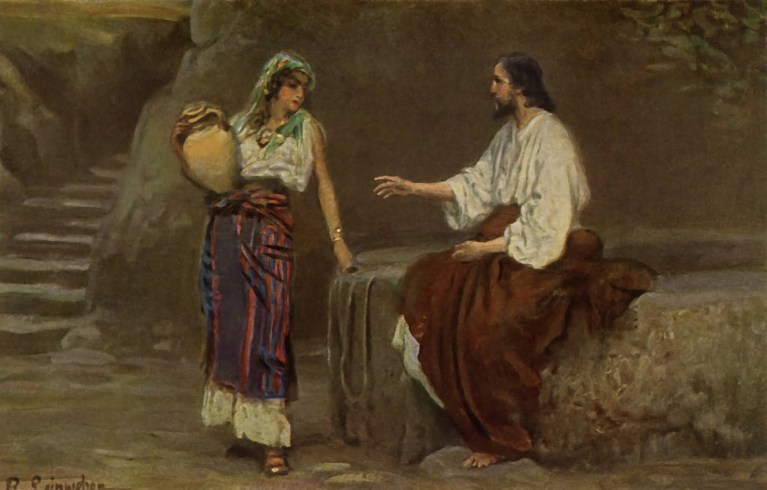
5. The Samaritan Woman at the Well (John 4:1-42)

Below Jesus initiates a conversation with a lowly Samaritan woman (an outcast on multiple fronts: Samaritan and female), he reveals himself as the Messiah, and leads to many Samaritans believing in him. This breaches ethnic and social barriers, totally offending Pharisaic norms of separation, as the Jews typically avoided Samaritans:

When a Samaritan woman came to draw water, Jesus said to her, “Will you give me a drink?” […] The Samaritan woman said to him, “You are a Jew and I am a Samaritan woman. How can you ask me for a drink?” (For Jews do not associate with Samaritans.) […]  Many of the Samaritans from that town believed in him because of the woman’s testimony, “He told me everything I ever did.”  So when the Samaritans came to him, they urged him to stay with them, and he stayed two days. And because of his words many more became believers.

This was Jesus deliberately breaking down a barrier.  The Jews of this time weren’t just racist, but sexist as well, and would see this entire encounter as an egregious violation.  Here Jesus was humanizing the Samaritan enemy and—even more scandalously—he was talking directly to a woman!  While rebuking his own ethnic and religious tribe he hung out with the impure!

He’s practically as evil as Tucker Carlson…

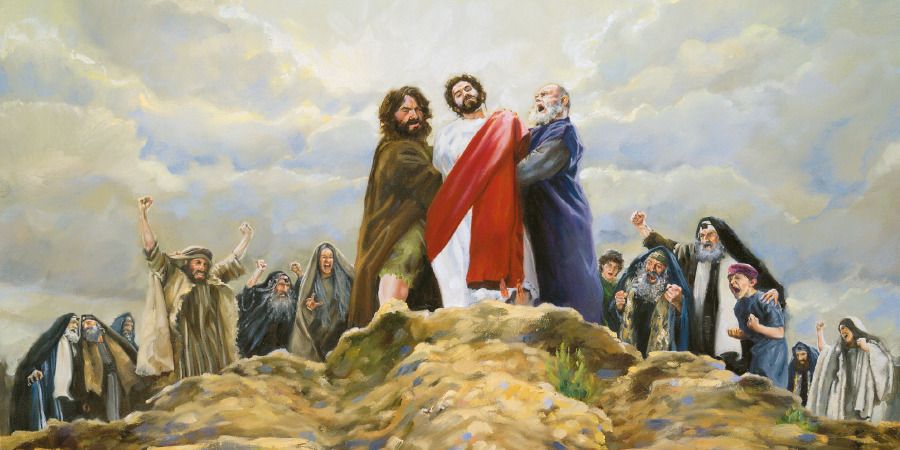
6. Jesus’ Sermon in Nazareth (Luke 4:16-30)

In his hometown synagogue, Jesus reads from Isaiah and then references the Old Testament prophets helping Gentiles (a widow in Sidon and Naaman the Syrian) instead of Israelites during times of need. This enrages the crowd, who try to kill him right there and then, as it directly challenges their ethno-supremacist expectations that God’s favor is exclusive to Jews:

“Truly I tell you,” he continued, “no prophet is accepted in his hometown. I assure you that there were many widows in Israel in Elijah’s time, when the sky was shut for three and a half years and there was a severe famine throughout the land.  Yet Elijah was not sent to any of them, but to a widow in Zarephath in the region of Sidon. And there were many in Israel with leprosy in the time of Elisha the prophet, yet not one of them was cleansed—only Naaman the Syrian.”  All the people in the synagogue were furious when they heard this.  They got up, drove him out of the town, and took him to the brow of the hill on which the town was built, in order to throw him off the cliff.  But he walked right through the crowd and went on his way.

The passages all illustrate Jesus’ pattern of associating with and elevating of outsiders, which offended the Pharisees’ ethnocentric pride and their self-righteous “we’re chosen people” claims by his stubborn inclusion of sinners, tax collectors, and Gentiles.  

Had it not been for a miracle Jesus may be remembered as being thrown off a cliff for praising the foreigners in front of a Jewish audience.  He was hitting them directly in their Hindenburg sized egos.  They had the most severe case our own [excrement] don’t stink that’s possible.

Ms. Rachel is an ‘anti-Semite’ for loving all children?

 A Zionist organization, StopAntisemitism, has named Rachel Griffin Accurso, a very popular children’s content creator, a finalist for their “Antisemite of the Year” and for a very specific offense: Ms. Rachel dared to treat the suffering of Palestinian children as equal to that of Jewish people!  How dare she humanize the child of an enemy!  Those in this Zionist cult love themselves only and make a strict dichotomy between their own and the dogs.  The spirit that Jesus rebuked is maintained in this perverse tradition.

I didn’t know much about Ms. Rachel prior to the birth of my daughter, but she’s not a Hamas apologist or sympathizer and has expressed similar sentiments about Israeli and African children.  Only the arrogant Zio-bots used her concern as a cause for their vicious accusations and vile labels.  They can be the only victims and treating Gaza’s children with the same love as their own is a terrible offense in their supremacist eyes—only their suffering can matter.  

He didn’t say Hamas.  He said Palestinians.

Ms Rachel committed their most grievous sin of believing children are not terrorists because of where they are born and now—as another enemy—she must be destroyed.

That is the narcissistic attitude of Zionism.  You must choose between them and others, they cannot share your concern with those who are inferior beings.  It’s an insult, as if they have been made equal to a dog, which is what they think of us Gentiles.  Listen to what they say, they believe that they should be treated like gods—in the words of Jewish supremacist and the former chief Rabbi of Israel, Ovadia-Yosef:

“Goyim (gentiles, non-Jews) were born only to serve us. Without that, they have no place in the world – only to serve the People of Israel,” he said, according to the Jerusalem Post. “Why are gentiles needed? They will work, they will plow, they will reap. We will sit like an effendi and eat. That is why gentiles were created.” 

Rabbi Ovadia-Yosef, in his own words

Treated as our lords.  That is the nature of Zionism.  It is about their narcissistic view that they deserve to be our masters and to do with us as they please—as they may an ox that plows their fields.  Which is what is so disturbing about an Israel-Firster, Ben Shapiro, proclaiming that retirement is stupid and that Americans should work until they drop.  Says a guy who sits around and talks as an occupation.  This, of course, does not represent all Jews or Israeli citizens, but it is written in the Talmud and lines up with the Likud party leadership of Israel.

Zionism does not represent all Jews.

Zionists don’t just want to rule over the current territory of Israel or the Holy Lands.  No, they want Jerusalem to be the hub of their Greater Israel and later one world government where their own version of a Messiah cleanses the world of all who defy them.  They rule because you’re too stupid to live free.

Judas wanted an Israel like this.  A worldly kingdom where he would be served.  Jesus, by sharp contrast, taught a kingdom not of this world—where the greatest would serve rather than be served.  He corrected heresy that made the blessing of Abraham only about a genetic inheritance rather than a matter of sharing the patriarch’s sincere and simple faith.  It was the very opposite of what they believed they were owed as the self-declared special people.  Jesus offended by telling them they weren’t special and calling the children of the Devil rather than of Abraham.  Ethnic supremacy and self-righteous pride is the basis of Zionism, Christianity heralds repentance as the foundation of true faith in God, as John the Baptist declared:

But when he saw many of the Pharisees and Sadducees coming to where he was baptizing, he said to them: “You brood of vipers! Who warned you to flee from the coming wrath? Produce fruit in keeping with repentance. And do not think you can say to yourselves, ‘We have Abraham as our father.’ I tell you that out of these stones God can raise up children for Abraham.  The ax is already at the root of the trees, and every tree that does not produce good fruit will be cut down and thrown into the fire. 

(Matthew 3:7-10 NIV)

Water is wet.  The sky is blue.  You can’t be a Christian and a Zionist too.  We must pick one or the other.  There is no union between light and darkness, no yoking of believer to unbeliever, we either believe what we’re told in the Gospel about a “synagogue of Satan” (Rev 3:9) and who Jesus himself declared to be children of their father the Devil (John 8:44) or we deny that Christ is King.  It’s just astounding to see so many who either never read the New Testament or had eyes glazed over in those sections where Jesus rebuked those who thought their Jewish supremacy and genetic ties to Abraham would save them.

The unrepentant narcissist will never enter the kingdom of heaven.  Pride was the sin of Satan who thought he could rival God and it is also the sin of those who rejected Jesus for his acceptance of all and not caring about their ethnic pedigree.  They hated him for exposing them as religious frauds.  And the campaign they waged against him was very similar to that being used currently to try to silence critics of Israel.  The role of a good Goy is to simply believe whatever they say and allow them to be the gods they believe they are—to kill or rape as they please.

Zionism: Dismantling the Cross, the Judeo-Christian Deception

Standard

There was an act of vandalism in Wales.  A Christian cross made of stones, which had been on a hill in the countryside for half a century, was torn apart by Jewish tourists who used the stones to create the ‘Star of David’ or hexagram shape.  This act goes beyond total disrespect and destruction of a Christian display, but it is also symbolic of what Zionism is and what it has been doing to Christianity in the West.  

Zionism isn’t Jewish.  Many Jews, even who live in the Holy Lands, are as fully opposed to the ethno-supremacist state called Israel as their Christian and Muslim neighbors.  It is not something allowed by their religion, they insist, and I’ll let Jewish people debate their theology for themselves.  But the vast majority of Zionists aren’t Jews nor do they live in Israel.  Most Zionists were American Protestants who have become ensnared in this political ideology that rearranges parts of the Bible to justify taking property from a population who have lived in the birthplace of Christ since his birth.

Christian Zionism is an oxymoron.  It takes two opposites, the kingdoms of the world offered to Jesus during his temptation that he rejected and acts like Gehazi, the servant of Elisha, who goes back deceptively to get the gifts Naaman tried to give to his master and was then struck down with leprosy by the curse of his master.  There are many in church pews today who have betrayed their master and have rearranged the timeline of Scripture to embrace an evil replacement of the way of Christ.  They dismantle the cross and support Zionism instead.

Schofield’s Coup: Dismantling the Cross

In 1909 a new Bible was published.  It used the same English translation of the popular King James version and yet added notes of commentary written by a man named Cyrus Ingerson Scofield.  Dispensationalism is a relatively new interpretation of Biblical texts that started in the early to mid 19th century, initially invented by John Nelson Darby and the Plymouth Brethren in Britain, but it took Scofield’s in text commentaries distributed widely to finally sell it.

We could get into questions of exactly who Scofield was, his character, that he was a Confederate soldier (deserter?); who was an alcoholic who abandoned his family; a man who had defrauded several prominent Republicans with a railroad scam; who was arrested and jailed in St Louis for forgery and embezzlement, then had a dramatic conversion to Christianity and yet this essay will stick to the work he was known for: His popularization of a novel theological stance dividing Israel and the church in Scripture.

In the Christian Bible there’s a fairly obvious shift in tone between the Old Testament (or Jewish Torah, prophets, etc) and teachings of Jesus in the Gospels.  The conventional Christian perspective is that Jesus came as fulfillment of the law and supercedes the covenant that was given to Abram who became Abraham.  But Scofield turns the clock back, he ignores what the Epistles tell us about correct understanding, and he adds an idea that there are essentially two paths to God—one going through Jesus and the cross, the other by the Old Covenant.

Christianity, according to the Apostles, is the faithful remnant.  Israel is now the Church and the Church is the true Israel.

Where this was just an amateur mistake or an intentional deception doesn’t matter.  It has resulted in a battle between those who basically claim that “one way, Jesus” is anti-Semitic statement and smear it as being “Replacement Theology” (ironic, given this was, is, and will remain the only orthodox Christian perspective) for saying that the New Covenant continuation of God’s plan and necessary for salvation.  It ignores the New Testament books where St Paul and others give a correct Christian perspective of the covenant given to Abraham.

Always Through Faith, Never Bloodlines…

Jesus answered, “I am the way and the truth and the life. No one comes to the Father except through me.

(John 14:6 NIV)

I’m not nearly as dogmatic as some when it comes to passages like John 14:6 (above) and yet do see it as foundational to correct application of Scripture from the Christian perspective.  Jesus was making a definitive statement about who he is and the absolute requirements for salvation.  

The promises were spoken to Abraham and to his seed. Scripture does not say “and to seeds,” meaning many people, but “and to your seed,” meaning one person, who is Christ.

 (Galatians 3:16 NIV)

1) The passage above makes it very clear that the seed of Abraham is singular: Christ Jesus.  St Paul is saying that Jesus is that promise given to Abraham, that the promise is what bestows grace and continues:

So in Christ Jesus you are all children of God through faith, for all of you who were baptized into Christ have clothed yourselves with Christ. There is neither Jew nor Gentile, neither slave nor free, nor is there male and female, for you are all one in Christ Jesus. If you belong to Christ, then you are Abraham’s seed, and heirs according to the promise.

(Galatians 3:26-29 NIV)

2) We all become Abraham’s seed though faith in Christ and there is no distinction by religion (keeping the law) or race.  In other words, Jews and Gentiles are both saved in the exact same way and the old distinctions become moot in fulfillment of the promise:

It was not through the law that Abraham and his offspring received the promise that he would be heir of the world, but through the righteousness that comes by faith.  For if those who depend on the law are heirs, faith means nothing and the promise is worthless, because the law brings wrath. And where there is no law there is no transgression.  Therefore, the promise comes by faith, so that it may be by grace and may be guaranteed to all Abraham’s offspring—not only to those who are of the law but also to those who have the faith of Abraham. He is the father of us all.  As it is written: “I have made you a father of many nations.” He is our father in the sight of God, in whom he believed—the God who gives life to the dead and calls into being things that were not. 

(Romans 4:13-17 NIV)

3) Faith in Christ, nothing else, saves.

The Church and true Israel are the same, it is a group that is defined by faith both when those the Jews looked forward towards the promise and also in the Gospel fulfillment of the promise in the seed of Abraham that is Jesus.

Scofield, however, to justify Zionism, tries to drive a wedge between Christ and being the full fulfillment of promise or the seed of Abraham.  His footnotes take a passage like Genesis 12:3, addressed specifically to Abraham, about blessing those who bless him and cursing those who curse and then just hallucinate that it is speaking about all who ever have descended (but only through Isaac) from Abraham—no matter if they are faithful or not.  But this is in direct and total contradiction to the passages quoted above and simply meaning inserted into the text by a man fooled himself or just a fraud.

The Judeo-Christian Deception 

Do not be yoked together with unbelievers. For what do righteousness and wickedness have in common? Or what fellowship can light have with darkness? What harmony is there between Christ and Belial? Or what does a believer have in common with an unbeliever? 

(2 Corinthians 6:14-15 NIV)

Judeo-Christian is a term originally coined to describe a Jewish convert to Christianity, a Jewish Christian, but the usage has since evolved to become an oxymoronic coupling of religious traditions that formed up in full opposition to each other.  There is overlap, certainly, both started as religions rooted in the Hebrew Bible.  But one of the sides has rejected Christ, and is anti-Christ, while the other believes that the Torah can truly only be understood through the lens of Christ.  If your values start with something other than Christ then they’re not the same values as a Christian.

Starting with Jesus instructing his followers to let their ‘yes’ be ‘yes’ and ‘no’ be ‘no’ (Matt 5:37) or to use simple honest language.  So much dishonesty comes in from of a subtle twist of words.  For example, calling majorly invasive surgeries and hormone treatments “gender-affirming care” is just not the plain reality of what is being done.  Semantics is all about describing reality, but can also be about distorting the perspective and an art of deception.  There is no similar rule about using honest speech in Talmudic or Zionist Judiasm.  Mossad, the intelligence agency of Israel, used “By way of deception, thou shall do war.

Stratagem is part of war theory and tactics.  But it is not part of Christianity.  St Paul tells us:

For our struggle is not against flesh and blood, but against the rulers, against the authorities, against the powers of this dark world and against the spiritual forces of evil in the heavenly realms. 

(Ephesians 6:12 NIV)

The Christian doesn’t overcome the ‘enemy’ with deception.  They overcome them with good, with honesty and love, this is to reject the methods and means of those who see those outside their religio-political group as being terrorists to be destroyed or resource to exploited.  We are not required to reason with animals, we herd them, slaughter them, shoot them for sport, and impose our will—and is exactly what the Zionists do to those who get in their way.  There is no command to love enemies or good to those who those who hate you as there is in Christianity:

But to you who are listening I say: Love your enemies, do good to those who hate you, bless those who curse you, pray for those who mistreat you. If someone slaps you on one cheek, turn to them the other also. If someone takes your coat, do not withhold your shirt from them. Give to everyone who asks you, and if anyone takes what belongs to you, do not demand it back. Do to others as you would have them do to you. 

(Luke 6:27-31 NIV)

Interestingly enough, Islam has a similar teaching, but we would never call this area of confluence Islamo-Christian values.  So why do we attempt to add the leaven of the Pharisees through this linguistic maneuver that marries us to a religion that has values completely different despite a similar origin point?  The “Synagogue of Satan” (Rev 2:9, 3:9) has never stopped hating Christ or His followers, they have simply committed to a long-game strategy of subversion or using the naive to do their bidding.  This isn’t even a value judgment, I’m not saying you should not be Jewish if that is what you believe is, but you can’t be a Judeo-Christian because it is a contradiction of terms.

If a suggestion of “Islamo-Christian values” causes you to erupt in riotous laughter, then the combo of the way of Jesus with that of Zionism is doubly as ridiculous.  

Philosophically there is zero compatibility in these perspectives.  It is impossible to love and bomb your enemies.  You cannot claim to follow Jesus, who rejected worldly power, and then support the violence being done in the name of Israeli statehood.  Zionism is a “blood and soil” nationalist movement, and is all about land, all about ethnicity, whereas the kingdom of heaven is about repentance, self-sacrifice and meekness.  The only thing that is sacrificed in ‘Christian’ Zionism is the Gospel of Jesus Christ and the credibility of our collective witness—so our partners can slather themselves in misguided pride for being the chosen race.

Not good, especially when one is pulling the other backwards…

The real purpose of a term “Judeo-Christian values” is political and propaganda.  It is to throw a yoke on the neck of Christians and force them to work together.  It is simply a way to control one side and normalize the other.  There is no backward compatibility, a believer in Christ does not share values with those who reject him, with those who cling to national pride rather than the cross, and subjugate rather than serve.  Jesus opened his arms to children—Zionists justify killing children by starvation, by denying them care or even by burning them alive and gunning them down.

Origen, who is considered to be a church Father, may have toyed with universalism—an idea that all would be saved in the end.  But there is no parallel path that is given for anyone according to Jesus or the Apostles, most especially not for those who are far removed from Jesus as the Nazis—despite their claims to the contrary.  We cannot let the cross of Christ be rearranged into the symbol of a worldly kingdom.  Having some things in common with those who rejected Christ doesn’t make us the same.

Never Meet Your Heros

Standard

I have lost all of my heroes. The expression, “Never meet your heroes, because they’re sure to disappoint you,” describes the painful realization that those great people you imagined are not as special as you believed they were.  It could be the letdown a friend had when he heard Matt Walsh speak.  It could be a family that learned their eldest brother was cheating on his wife for many years and was not some image of virtue.  For me it was a process and a very long grinding away of faith in these figures.

I was never one for human idols.  I never put posters of celebrity faces on my bedroom wall and would never be as impressed with figures like Ravi Zacharias as some of my friends.  It wasn’t a religious thing nor something just to be ornery.  I simply didn’t have a feeling of awe about these personalities that were mid.  The people I most admired tended to be local—my blue collar dad, my missionary cousin, or that perfect girl I would marry some day.  But time has removed all from the pedestals.

Those women of my youth would end up as the cheating wife or more interested in status than my sincerity.  My dad no longer looks like that man I remember who could carry me on his shoulders (with me hanging on for death life) up a silo ladder, and that zealousness of the ‘compassionate’ types tends to morph into a noxious ideological alignment that is really anything but they profess.  They say that they want the Kingdom, but have replaced faith in God with fraudulent human institutions.

And I’m not just talking about the apologists for CAM in the wake of the Jeriah Mast and years of coverup aftermath.  “Oh, but this is an organization that does such good!”  What I’m talking about is something fully revealed since the DOGE ax has fallen on USAID.  I grew up believing in the strict separation of church and state—that a colonial expansion of Christianity was tainted and this at completely odds with the teachings of Jesus about His kingdom not being of this world.  

My views have certainly evolved—having left my religious cloister—but I’m still appalled by the thoughtlessness of people who I had once thought were smart and uncompromised.

Banality of Evil: When Ends Justify the Means 

The Anabaptists, after the disaster of Münster, had committed to a quiet life of separation.  It is why those in Old Order groups have refused participation in Social Security and other kinds of government benefits.  Mutual aid should be voluntary and Christian charity is not obtained through coercion.  Sure, the power of the state is alluring, that temptation (driven by our ego) to rule over others because we know what is best or they are undeserving of the resources they have—I have had many of those “if I were king” moments—but there is no stopping point when you fail to resist the siren song.

Left-wing politics always clothe themselves in a kind of compassion.  Surely you will not oppose helping these children, right?  And I am pragmatic to the extent I’m glad starving children are fed by any means.  But opening the Pandora’s box of leftist means is always a slippery-slope to more use of state power and, inevitably, to leftist utopian cost-benefit analysis where everyone who opposes us is a literal Nazi and, therefore, we’re justified to stop them with violence.  When coercion is allowed as a means of obtaining the ends we desire there is no stopping point.

The worst form of evil has good intentions.  It is that of those who imagine themselves as the hero of their own narrative and thus allowed to bend the rules.  This explains the extreme narcissism of Luigi Mangione who saw himself as a worthy judge of a father of two and a husband to a practicing physical therapist.  There was no need for this leftist murderer to look inward, he had completely externalized evil and turned other men into caricature representatives of truly complex multi-faceted problems.  When the ends can justify the means we’ll justify any means.

Pastor Jim Jones preaches his counterfeit Gospel before being abandoned by the US government and having to free his cult from bondage with some poison laced Kool-aid.

Seeing someone I thought was a Christian missionary lament how the United States had “abandoned” them was a reminder of how the great have fallen.  There was not a shred of gratitude expressed towards the American taxpayers who financed them nor acknowledgement of the misappropriation of funds that has wearied voters to foreign aid.  But more stunning to me was unholy alliance between this person of faith and agencies of US imperialism.  Since when has the love of Jesus become an extension of the US regime abroad?  Are they of the kingdom, as they proclaim, or agents of empire?

USAID, despite the name, is certainly not a charitable organization and was formed in 1961, at the height of the Cold War, with an aim of promoting the interests of the US political regime.  That’s fine.  But it has long ago gone off the rails even as far as what it was originally imagined.  The Soviet Union had fallen and the Federal agency created to oppose it morphed from something most would support into a beacon of wokeness—pushing transgenderism and abortion.

Break the Yoke of Fraudulence 

The reason why USAID is being dismantled is because we can’t sort the legitimate from illegitimate function of the agency.  Sure, it may help people in need, but funding it also is enabling of evil and maintained through a system of coercion we call taxes.  Anything good that it did can be done through other means.  This functional fixedness of those who depend of government, especially on the part of those professing Christ, makes me wonder where their faith lies and what their actual mission is.

The merger of a Christian charitable cause with government doesn’t purify government—it taints the witness:

Do not be yoked together with unbelievers. For what do righteousness and wickedness have in common? Or what fellowship can light have with darkness?  What harmony is there between Christ and Belial?  Or what does a believer have in common with an unbeliever?  What agreement is there between the temple of God and idols? For we are the temple of the living God. As God has said: “I will live with them and walk among them, and I will be their God, and they will be my people.” Therefore, “Come out from them and be separate, says the Lord. Touch no unclean thing, and I will receive you.” (2 Corinthians 6:14-17 NIV)

The accusations of “Christian nationalism” against those who want a government that performs basic functions were always just a smear by those in alliance with imperialism and Godless globalism.  While I’m not a fan of God and country, at least the flag waving religious patriot knows there is a difference between their Christian mission and secular state.  The left, by contrast, confuses these categories and would have social program replace true charity and community aid.  In one case you have those who may tend to overreverence nation, but in the other there are those who truly represent empire and yet tell us they their only  citizenship is the kingdom of heaven.

The truth is that the ‘Christian’ left is simply the left merely wearing the words of Christ as a disguise for ideological agenda.  Those decrying the reduction of empire and return to responsible governance never said thank you to those funding their do-gooderism.  It was, for them, all about holding those “chief seats in the synagogue” and their own glory as humanitarians.  They may speak against Trump, but then have never uttered a word against the waste, fraud and abuse that has made these broad sweeping cuts popular with common people.

The true Christian spirit is that of a Federal employee who told me about the enormous amount of inefficiency and waste in his own agency and—while making no profession of faith—supports the effort of DOGE knowing it may impact his employment.  That, to me, is someone who understands self-sacrifial love more than someone feeding the poor on another person’s dime and then going to social media to complain when their funds are cut.  They’re grandstanding.  While my Federal employee friend is a truly humble public servant who is grateful and not biting the hand that feeds him.

None of this to say this “abandoned” former hero of mine is a bad person.  They clearly are using their abilities to help other people in desperate need.  I applaud that.  And yet their public statement betrays.  There is an attitude or spirit there that is different from Christ.  I would much rather they just be a secular humanist—subscribed to partisan leftist politics—and own it.  They should just admit that they’ve abandoned faith in Jesus and are looking for a worldly system.  Judas Iscariot is the patron saint of faithless social justice, guilt trips and envy—when you betray your calling just own it.

Your Own Personal Jesus

Standard

The title of this blog is a repeated line from a popular song, “Personal Jesus,” covered by Johnny Cash.  According to the writer, this song is “about being a Jesus for someone else” and more specifically the mentoring role Elvis Presley had played in the life of his wife Priscilla.  The power of these words is how they change meaning depending on the artist who sings them.  When it was covered by Marilyn Manson they came off as being mocking and derisive.

My own thoughts, hearing the song, always brings me to the popular Evangelical phrase “accept Jesus as your personal Lord and Savior” and the theological implications.  Unintentionally, it is a commentary on how the Christian religion has been reinvented in this consumerist and individualistic age.  It is all about you.  Jesus is now personal, like a boyfriend, and pretty much whatever you want him to be.  There is no obligation to others, no real need for self-sacrificial love, or becoming part of the body of believers, only to hold a kind of positive sentiment in your heart.

And this is what I encountered in the church of my youth.  Except for those few symbolic expressions of community and caring, carry-overs from those radical Anabaptist roots, it was pretty much everyone for themselves—which is how most of us preferred it to be.  I mean, sure, we would tell the other guy we would be praying for him after ritual foot washing, some would still call you brother as if simply saying it made it true, but that was generally the extent of it.  We all had our own families if there was ever a real need, the church projects were generally for the elderly and those few favorites.

Saved Together 

Orthodoxy has a more robust view of Holy Communion and could, in theory, answer the overly independent view of salvation.  At the very least, with our partaking of the body and blood together central to worship, this puts to rest this idea that the internet preacher is enough.  Life in Christ is about His body and His physical presence, not only something we hold in our minds as true.  It is not only our knowledge of Christ and mental assent but is also about making His example the basis of our actions—being an incarnation.

Faith is not about what we claim to believe, it is about how we act:

Carry each other’s burdens, and in this way you will fulfill the law of Christ. […] Do not be deceived: God cannot be mocked. A man reaps what he sows. Whoever sows to please their flesh, from the flesh will reap destruction; whoever sows to please the Spirit, from the Spirit will reap eternal life. Let us not become weary in doing good, for at the proper time we will reap a harvest if we do not give up. Therefore, as we have opportunity, let us do good to all people, especially to those who belong to the family of believers.

(Galatians 6:2‭, ‬7‭-‬10 NIV)

Carrying of burdens is about more than mere “thoughts and prayers” or those mostly empty expressions.  No, it is all about providing real relief to others, being that ‘neighbor’ like the good Samaritan or the true advocate like St. Paul was for Onesimus.  It is not enough to only say “Go in peace; keep warm and well fed,” without ever helping others with their actual needs as we read in James 2:16.  It is our job to be our brother’s keeper, that is to look after their needs like we would our own or that of a family member.  This is what a community of faith is supposed to be about and also key to our salvation.

“If anyone falls, he falls alone. But nobody is saved alone.”

—Alexei Khomiakov

For some, their salvation comes from the hand we offer.  For others, their salvation comes from offering that hand.  The early church had this saying, “unus Christianus, nullus Christianus.”  That is to say that one Christian is no Christian.  This is what it means to follow Christ, this is what being in Communion is really about.  Sure the ritual and religious practice matters.  But the true substance in the blood and the flesh we are to consume is in how we become the hands and feet of Jesus.  To do otherwise, to only partake without acting in genuine love is to drink unworthily and bring damnation upon ourselves:

In the first place, I hear that when you come together as a church, there are divisions among you, and to some extent I believe it. No doubt there have to be differences among you to show which of you have God’s approval. So then, when you come together, it is not the Lord’s Supper you eat, for when you are eating, some of you go ahead with your own private suppers. As a result, one person remains hungry and another gets drunk. […] So then, whoever eats the bread or drinks the cup of the Lord in an unworthy manner will be guilty of sinning against the body and blood of the Lord.

(1 Corinthians 11:18‭-‬21‭, ‬27 NIV)

Stay In Your Lane

Sadly, within Orthodoxy, for some, it is about lighting a candle, making a sign of the cross, paying their membership dues (tithes), and regular church attendance.  In other words, all about going through the motions.  They don’t want to be bothered by real relationships or overcoming differences—let alone be concerned with the salvation of their fellow parishioners.  

Sheesh, let the priest do his job!  Mind your own business!  Don’t you have enough sins of your own to attend to?  

I’ve even heard clergy give advice like “stay in your lane” as if there’s no difference between confrontation of lingering issues and petty fault-finding…

I’ll back up a second and agree fully that we should be “work[ing] out [our] salvation with fear and trembling” (Phil 2:13), which does imply some introspection and that we start first with the beam in our own eye.  But, that said, even this admonition is addressed to “my dear friends” or the church body and not as a personal note.  So even this could be used to further the view of salvation that is about collective effort and not some sort of personal experience we have while sitting in the pew deliberately not noticing elephants in the room as our penance.

There are some who do not seem to realize that their mother’s scold, “If you don’t have anything nice to say don’t say anything at all,” isn’t written in Scripture, but this is:

“‘Do not do anything that endangers your neighbor’s life. I am the Lord.“ ‘Do not hate a fellow Israelite in your heart. Rebuke your neighbor frankly so you will not share in their guilt. “ ‘Do not seek revenge or bear a grudge against anyone among your people, but love your neighbor as yourself. I am the Lord.

(Leviticus 19:16b‭-‬18 NIV)

Speaking the truth is not always pleasant to the ears of those hearing it and yet it is part of what love does.  It is not that we should never confront, rather it is the SPIRIT of how we approach these sins or shortcomings of others.  So, sure, staying in our lane is good, but that doesn’t mean we should never alert someone driving with their headlights off at night since we have also done the same in the past.  It may feel like ‘keeping the peace’ to sweep everything under the rug or let the ‘problem’ go away by ignoring it—but it’s also an unloving attitude.

“Church is not a social club…”

I’ve now encountered it in two very different religious traditions.  When that cry is made for real brotherhood, deeper connections or genuine relationships are met with the strong suggestion that you’re not spiritual enough and a reminder that church is for worshipping God and superficial interactions.  If you expect a little more then you’re turning it into a social club.  This is an inversion.  It is a psychological projection and a garbage excuse.  It’s telling a person seeking medical care that hospitals are about the awe of the building and reverence for the institution, that they should go to the dance club if they so desperately want to be touched by someone.  

These phony physicians only add insult to injury, they are exactly the type of religious authorities that Jesus rebuked: 

“The teachers of the law and the Pharisees sit in Moses’ seat. So you must be careful to do everything they tell you. But do not do what they do, for they do not practice what they preach. They tie up heavy, cumbersome loads and put them on other people’s shoulders, but they themselves are not willing to lift a finger to move them. 

(Matthew 23:2‭-‬4 NIV)

For them, it is all about the right image, the dress standards, and keeping their perfect attendance record.  Basically, they check all of the right boxes.  Performative religion.  And who knows?  Maybe their Bible study and prayers, ten hours a day, really does it for them?  Who am I to say that their mission to Uganda was entirely a self-indulgent display of privilege and a waste of resources?  But I’ll also say that those who travel the world while doing the bare minimum for those whom God put right at their own doorstep are condemned as hypocrites by Jesus.

The church is established by the same God who told us that it is not good for man to be alone.  Good for you if you need nobody in your life.  Jesus is your homeboy?  But most of us need those meaningful and sometimes messy interactions with other humans.  That is what family is.  That’s what hospitals are built to facilitate.  And that is what a church is literally supposed to be.  If you don’t need a doctor maybe you are the doctor and your salvation requires you to show up to attend to those sick and suffering?  Why call would we call each other brothers and sisters in Christ if this weren’t the case?  If the church isn’t at all about social interactions—why do we waste the gas?

Those who say that church isn’t a social club are right.  It is also not an art museum where pretentious people go to engage politely and then share a light snack.  It should be much more than that.  It should be a refuge we can flee, the juniper tree where God sends angels to comfort and attend to the physical needs of Elijah, a garden of Gethsemane where the disciples are not sleeping in hours of need, it should be intimate and practical, a hospital or home.  A place to be ministered to and minister to each other.  It’s both where we share our moments of happiness and also mourn with those who mourn.

Church is a family or it is just fake.  

Post Script: Those who personalize Jesus tend to depersonalize their religion. Protestant or Orthodox, it doesn’t matter, they want to claim their great devotion with their embrace of abstraction and their own prescribed practices, but seem to forget that pure religion is about the human touch (James 1:27) and what they do materially for others is how to show their love for Jesus. Our salvation does not come apart from the body of Christ. Communion isn’t only what we partake of on a Sunday morning, it is what we participate in as far as loving others and, in particular, the community of believers. You cannot stay in your lane, avoiding people in a pretense of righteousness, and also love God.

Who Are Our Kin?

Standard

The book of Ruth is a nice little oasis in the midst of dry and tedious reading.  Up to this point the Bible isn’t all that relatable.  It has some highlights, interesting characters, but is stories of ethnic cleansing, description of weird sacrificial rites, polygamous patriarchs and stonings for picking up sticks, violence and laws, it is cumbersome.  

And then you get this:

But Ruth replied, “Don’t urge me to leave you or to turn back from you. Where you go I will go, and where you stay I will stay. Your people will be my people and your God my God. Where you die I will die, and there I will be buried. May the Lord deal with me, be it ever so severely, if even death separates you and me.” When Naomi realized that Ruth was determined to go with her, she stopped urging her. So the two women went on until they came to Bethlehem. When they arrived in Bethlehem, the whole town was stirred because of them, and the women exclaimed, “Can this be Naomi?”

Ruth 1:16‭-‬19 NIV

What a contrast to the storytelling prior, all of the resistance to racial mixing as well, here a Moabite woman would rather remain with her Israelite mother-in-law than stay with her own people.  It’s personal.  And the romance that follows, while very foreign and featuring many practices which are weird to our own ears, shows a more compassionate side of the legal system instituted by Moses.  Boaz acted both out of love and duty as guardian-redeemer.  Starting with his genuine concern for her safety:

So Boaz said to Ruth, “My daughter, listen to me. Don’t go and glean in another field and don’t go away from here. Stay here with the women who work for me. Watch the field where the men are harvesting, and follow along after the women. I have told the men not to lay a hand on you. And whenever you are thirsty, go and get a drink from the water jars the men have filled.”

Ruth 2:8‭-‬9 NIV

This paternalistic care a sharp contrast to an episode in the book of Judges when a Levite and his host offered their innocent women to please the perverse desires of the men in the local community:

While they were enjoying themselves, some of the wicked men of the city surrounded the house. Pounding on the door, they shouted to the old man who owned the house, “Bring out the man who came to your house so we can have sex with him.” The owner of the house went outside and said to them, “No, my friends, don’t be so vile. Since this man is my guest, don’t do this outrageous thing. Look, here is my virgin daughter, and his concubine. I will bring them out to you now, and you can use them and do to them whatever you wish. But as for this man, don’t do such an outrageous thing.” But the men would not listen to him. So the man took his concubine and sent her outside to them, and they raped her and abused her throughout the night, and at dawn they let her go. At daybreak the woman went back to the house where her master was staying, fell down at the door and lay there until daylight. When her master got up in the morning and opened the door of the house and stepped out to continue on his way, there lay his concubine, fallen in the doorway of the house, with her hands on the threshold. He said to her, “Get up; let’s go.” But there was no answer. Then the man put her on his donkey and set out for home.

Judges 19:22‭-‬28 NIV

While the brutal rape and murder of this poor concubine was later avenged, it is quite clear that the two men were more concerned with saving their own skin than protecting those whom were entrusted to them.  Not saying it would be easy to know what to do in those circumstances.  It isn’t like there was 911 to call or semiautomatic weapons to hold back the lascivious mob.  Still, Boaz stood ready to protect Ruth, a foreign woman, from the other men who would very likely have taken advantage.  How easily we can take our own law and order for granted.

Where the men made the woman vulnerable for exploitation in the book of Judges and in other parts of the Bible, like Abraham claiming his wife was his sister or Jacob putting his family in the front, in Ruth it is the women putting themselves in a vulnerable place to capture the attention of the good man:

One day Ruth’s mother-in-law Naomi said to her, “My daughter, I must find a home for you, where you will be well provided for. Now Boaz, with whose women you have worked, is a relative of ours. Tonight he will be winnowing barley on the threshing floor. Wash, put on perfume, and get dressed in your best clothes. Then go down to the threshing floor, but don’t let him know you are there until he has finished eating and drinking. When he lies down, note the place where he is lying. Then go and uncover his feet and lie down. He will tell you what to do.”

Ruth 3:1‭-‬4 NIV

I’m not sure if the description of Ruth acting out on her mother-in-law’s bold plan to lay at the feet of Boaz is euphemistic language.  Seems risky to be that intimate with a man who was drinking and “in good spirits” as the text tells us.  But, that said, whatever transpired that night, we know that he took responsibility for Ruth and also the welfare of Naomi.  And, in this regard, the guardian-redeemer system worked as designed.  But mostly because of Boaz having genuine care in his heart.  Ruth, for her part, was his equal in that she was loyal to her mother-in-law to the point of leaving her own homeland.

This is a story exceptional in a good way and likely part of the Biblical canon so far as has to do with the lineage of King David.  It also brings us to Bethlehem, where Jesus (of the line of David via his mother) was born.  That both Ruth and Boaz stand out as characters for their abiding love is significant.  In a time when woman were treated as if property or merely objects for male pleasure, we have honorable and caring men.  Boaz took Ruth under his wing in the same way his grandson longed to love his people:

“Jerusalem, Jerusalem, you who kill the prophets and stone those sent to you, how often I have longed to gather your children together, as a hen gathers her chicks under her wings, and you were not willing.

Matthew 23:37 NIV

In this account there is a clear precedent for a family relationship that goes beyond only our biological relatives.  The law of the kinsman or guardian-redeemer, through Naomi, was also applied to Ruth.  And, likewise, through adoption we become sons and daughters of Abraham by our faith (Galatians 3:6-14) and true children unlike those blood relatives of the Patriarch who rejected their Salvation.  Our real kin are those who fulfill the role they have and love in the manner of Boaz or Ruth.

Fundamentalist Anti-fragility Training

Standard

Years ago my mom decided to stop in at the local public elementary school.  Impressed, after talking to the staff, my parents sent my older sister there and soon I would follow—along with the rest of my siblings.

This might not seem strange to most.  But, for a conservative Mennonite child this was highly unusual—or at least in the past few decades.  It bucked the trend of religious parents, afraid of secular influence, pulling their children out.  Private schools and home schooling becoming the preferred ‘safe’ options.

Anyhow, maybe as a result of my positive experience, or from inheriting my mom’s genetics, I have always thought differently than my peers.  That is to say, for better or worse, I stood apart from both my public school and Mennonite peers, basically a third culture kid or non-conformed in both settings.  So, when I had to consider where to send my own children, public school was not something I feared.

This post is not saying that everyone should follow in my footsteps nor suggesting that every child should go to public schools.  No other situation is exactly the same as mine, some schools are better or worse and every student different.  My intent in this blog is simply to give an explanation of what is now unthinkable to most fundamentalist Christians.

A Stranger in a Strange Land

Public school did not mean assimilation for me.  My religious identity was always visible enough for me to be given nicknames like “Micro Mennonite” or basically any Amish sounding name my classmates could come up with.  The small things, like wearing pants in the hot weather or the side part of my hair were enough for some to take notice.

I was sometimes subjected to what could be called microaggressions.  As in I had one or two classmates who would inform me what I should or should not do, as a Mennonite, and this often included the idea that we did not pay taxes or the assumption that we needed a horse and buggy for transportation.  This kind of banter was mostly benign, or at least taken that way, but still served as a continual reminder of my outsider status.

The end result is that I seemed to have a stronger Mennonite identity than many of my religious peers.  I learned, at a young age, that I was different and it was okay to be my own person.  I was never ashamed to be Mennonite nor stopped from following my own conscience so far as things like pledge of allegiance (I always stood respectfully) or abstaining from other activities that went against my cultural standards.  

A child private or homeschooled does not truly know, first hand, the alternative to their own community and home.  It is easier for them to believe that the grass is greener on the other side of the fence and many of my religious peers did jettison the indoctrination they received in a pursuit of the prevailing culture.  But, being the witness of single parent homes, the chaos of the world and consequences suffered, it made me more thankful for what I had.

Exposure made my home more desirable, it also made the failures of parents my community feature less prominently in my mind.  There were many who, raised in the  religious cloister, became disillusioned with Christianity as a result of their overbearing dad or as the result of school administrators showing extreme favoritism.  Had the same thing happened to them in public school, had they been bullied or abused there instead, at least it would not come in direct conflict with their walk of faith.

No, certainly we don’t want to put children in a harsh environment so that our own home or community contrasts favorably, but some healthy perspective is good.  Not taking for granted the food or shelter over our heads by being a little exposed and feeling some hunger pains for home is not a bad thing at all.  A big benefit of my public schooling was appreciation for my heritage and a strong desire to preserve the Mennonite culture.  I could not afford to be myopic or ignorant, throwing out tradition recklessly because it didn’t suit me.

I had to weigh things more carefully rather than react and throw the baby out with the bathwater.  Many of my religious peers have this feeling of having missed out and some had to learn the hard way from their own experiences.  

Walk In Faith, Not Fragility!

Conservatives love to laugh about the ‘woke’ and their safe spaces.  They are very quick to ridicule those families still wearing face masks and call people snowflakes for their sensitivity.  The great irony is that many of these same people withdrew their children from public schools, decades ago, because they “took God out of the schools” by ending prayer led by state employees.  The reality is that it isn’t just the fringe far-left that tries to hide themselves and their children from all contrary opinions.

You may work where your employer doesn’t lead prayer, can you handle it?

The problem is that without challenge there is no growth.  Yes, part of the job of a parent is to protect and yet it is equally important to prepare a child for the real world.  I know, I know, someone out there is saying right now, “he’s saying to throw my precious darling to the wolves!”  And then we wonder why, with that kind of attitude, when we assume all of our neighbors are dangerous predators, we are not more successful reaching them with the Gospel?

Jesus, our Lord and Savior, and example to follow, had no problem detouring into the Samaritan lands nor with standing on his own two feet with elders as a child.  And I, likewise, had no difficulty standing toe to toe with my high school biology teacher or with seeing through leftist propaganda even back in elementary school.  I remember scoffing, even then, at the blatant manipulation on Earth day or that faulty “haves vs have nots” construction of my fresh out of university social studies teacher.

Hint to the homeschoolers: Your neighbors aren’t demons and your children aren’t little saints either.  In fact, many of my younger home or privately schooled religious cousins were doing drugs, drinking hard and partying, even sleeping around, long before I had so much as a sip of alcohol.  As Jesus said to a prior generation of contamination obsessed religious people, according to Mark 7:14–23:

"Nothing outside a person can defile them by going into them. Rather, it is what comes out of a person that defiles them."  

We can’t save our children by sheltering them.

I know, but what about the “groomers’ and the brainwashing?  No, I’m not going to say it is all hysteria.  Indeed, the far-left is targeting children, they’re making no secret of their agenda and it is cause for concern.  We see all of those sensational headlines of abuse and it is easy to be full of anxiety and fear about this.  But, for perspective, there are over 3,800,000 teachers in the United States and the vast majority are simply doing their job.  Some extreme example, from an urban hellhole or California, is not representative of the whole.  Yes, your child going to a public school will be exposed to other perspectives and yet why would they choose lies over the truth?

It is no coincidence that the greatest Biblical examples of faith are those, who as children, faced pagan influence.  Moses, trained as an Egyptian, was bolder than his other Israelites and faced down Pharaoh.  Daniel refused to bend to social pressure, a Jewish child in the Babylonian court, and stands as an example of faith.  And who can forget that trial by fire of three young men, Shadrach, Meshach, and Abednego, who would not bow to the statue of the powerful Nebuchadnezzar II?

It is so strange that fundamentalists can read these stories to their children in their Sunday school classes and then be terrified by the thought little Johnny being away from them for a few hours a day.  It makes me wonder if they truly believe these stories are true.  Maybe they do not think that the God who called Samuel as a child or emboldened young David to slay a giant is still capable of the same today?  Apparently they think God is getting weak in old age and only they are able to save their children from the world? 

In the World, Not of the World

Part of the problem with the fundamentalist “purity culture” mindset is that they believe that Holiness is achieved through means of physical separation.  Many parents think that they will keep their children safe from harm by keeping them in their protective enclave and away from all other influence.  But, the truth is, if Adam and Eve could fall even in the garden of Eden, why would we believe that the serpent can’t find it’s way into our own homes and communities?

For as much as my religious peers would try to keep evil out, pulling their children out of even the church school to guard them from the influence of other Mennonite children, it is no defense from the most dangerous sin of all which is pride and this accompanying idea that we can be fully righteous by our own efforts.  But, in the economy of Jesus, it is better to be the woman caught in adultery or thief on the cross who repents than the rich young ruler who kept the law perfectly yet isn’t able to live in faith.

They say more is caught than taught.  We can say we believe “greater is He that is in me than He that is in the world” (1 John 4:4) and that God is our strength, but our actions betray us.  The conservative Christian retreat from the public sphere is pretending that if they ignore the deterioration somehow the problem will go away.  They are training their children to be cowards, afraid to effectively confront the culture or fully contend with the reality that they’re losing ground.

It is true, a Christian is not to be of this world and yet this is all about the spirit in which we are approaching life.  The exact phrase “in the world but not of it” is not in Scripture, but we also see where Jesus didn’t avoid people simply because they were Samaritans, tax collectors or others that his religious peers carefully avoided.  Unlike the parachute in ‘missionary’ compassion of today, he spent his time amongst his own people, rubbing shoulders with the unwashed masses and even being touched by a woman made into an outcast for her illness.

If we go out in strength, trusting that God is still able to protect us and our children from the teeth of lions, we would possibly see the change of culture that will make the world a place liveable for a Christian.  But right now we’re teaching our children to be weak and, when the world finally does come to snatch them from the safety of their homes, many will be fragile and unprepared to stand.  This is why so many get caught in the false social justice Gospel, they weren’t properly trained to identify the counterfeit.

“Train up a child in the way he should go, and when he is old he will not depart from it.”

(Proverbs 22:6 KJV)

Why would I send my son into the lion’s den?

Because Daniel continued to pray, despite the risk of severe punishment, and precisely as a result of his childhood faith and learning to resist peer pressure at a young age. 

Contrast that with the religious experts who had rejected Jesus for the unclean who he mingled with. Or with Israelites who prospered in their own promised land, absent of persecution, and only went through the religious motions of faith in God. They voluntarily brought idols into their homes and folded before their enemies. 

Complacency is a bigger threat to a Christian’s child than lions. 

We should not teach our children to run from the giants of our time or they’ll become king Saul.

Instead we should be helping them polish those giant slaying stones and trust God.

Empowerment: When One Plus One Can Equal Three

Standard

The pro-choice versus pro-life argument is only one manifestation of a bigger divide in worldviews.  For some it may be as simple as dichotomy between Patriarchalism and Feminism, the latest iteration of the gender wars, or an oppressed versus oppressor narrative, but the truth of the matter is a bit more complicated in that the dividing line is not where the two competing ideological extremes put it.  

Rather than Patriarchalism versus Feminism, there are actually three distinct hierarchies, two that are openly male-led (and are often lumped together) and one that is covertly male-led in that it both minimizes the most unique female strengths and is almost entirely defined by masculine pursuits of power.

The first is what is what is most commonly referred to as Patriarchalism and refers to a male dominated social structure, it is where the stereotype of men that keep women barefoot and pregnant originates, it is what motivates Feminists everywhere.  The second is that of the secular world, the American mainstream, where the focus is career, success is about earning more money, climbing the corporate or political ladder and sacrificing anything that stands in the way of these ambitions.  In these first two hierarchies the leadership role is about imposing our own will through brute force or coercion.  The third, which I will get to later, is vastly different than these two and inverts the power structure.

The Rejected Patriarchalism 

It is no big secret that traditional hierarchy, in the West, has been on the decline since the Protestants pulled out from under the Papal authority and rejected their kings.  There is certainly a case to made against Rome and their abuse of power over the centuries.  But that hasn’t stopped their wayward children from following in their footsteps.  

Like Father, like son, right?  

The misuse of authority did not end or begin with the Pontiff and the Patriarchalism of the most defiant fringes of American Biblical fundamentalism is clear evidence.  You won’t ever tell these men what to do, but they sure like invoking God’s will to make their wife and children submit to them.  The far extreme of this small minority, if they could ever agree on anything, may even resemble the fiction of Handmaid’s Tale if given power.

However, there’s about as much chance of this type of hierarchy gaining prominences as there is of Joseph Smith resurrecting himself from the dead.  This is the strata of internet trolls who post memes and enjoy calling women whores for prudently avoiding men like them.  And, this, incidentally, is what feminists happily use as a stereotype and strawman version of all men on the religious right.  Misogyny is a good term, as these are men threatened by strong women and see their rule as entitlement rather than a respect that is earned.  These men *do* stifle women because it is the only way they can feel strong or significant.

Opposition to abortion isn’t really isn’t about the babies, for the loud mouths of this particular patriarchy, rather it is about the competition and gaining back the social position they think they deserve.  In their cult groups women play the role of enabler, they must smile sweetly as their dear husband speaks of his superior role.  The great irony is that this is the kind of narcissistic man who creates his own mortal enemy, the angry ‘liberated’ woman, because he’s the embodiment of unqualified, irresponsible and just plain bad leadership.  No intelligent woman wants to be his baby making machine.

The problem with this hierarchial structure is that it is all about male dominance without male accountability, it is entirely populated by morally (or otherwise) deficient men and abnormally weak women.  It always spawns rebellion.  It is precisely what has led to the alternative, which has risen up in reaction to abuses, and is the ultimate expression of an American ideal gone off the rails.

The Dominant American/Western Order 

Industrialization has changed the world.  The United States was once envisioned as an agrarian society, of small communities, but the rapid technological advancements of the past two centuries have rewritten the vision.  The American dream of upward mobility and greater economic independence has now inspired generations in the working class.  This ideal of more more more has given birth to our age of consumerism.  But the thing is, this has not lived up to the promise, those who do achieve find their success to be a hollow victory and those who do not will always be chasing the next fad.

Many believe more money and increased independence will make them happier.  It started with men, the bread winner, leaving the home in the wee hours, with lunch pail in hand, working in the factories or mines, but since WW2 it has ‘progressed’ to include women.  I mean, Rosie the Riveter, who started her life as cynical war propaganda tool, has taken root as women have both increase labor supply (driving down wages) and have also provided a generally more compliant workforce for our powerful corporate overlords.  

The sad reality is that the rapid changes have not provided additional security for women.  Women told that their significance can only come from following masculine pursuits are not any more empowered than their grandmothers a couple generations ago.  Indeed, this idea that happiness comes earning more money or that empowerment comes from women filling traditionally male roles is the greatest myth of our time.  

Worse, unlike husbands or children that have a real emotional connection to their wives or mothers, these corporate and government bosses only see women as ‘human resource’ to exploit.  Sure, they might promote this idea and image of the emancipated woman, claim to care about rights, but it’s all a lie to keep women enslaved.  We are made to think fulfillment comes from our next paycheck, but it’s all a ruse.  The working class is benefitting less and less from their long hours, big corporations make record profits at our expense.

It is no big surprise that corporations are offering to pay for abortion and even the travel expenses.  The bottom line is that they can’t make their huge profits without docile and compliant employees.  It is simply much cheaper for them to end a pregnancy than it is for them to pay maternity leave benefits and potentially lose the services of a female employee forever.  It is never actually about her well-being or the future of the nation, it is always about the parasitic self-serving elites and their political or financial interests.

The whole system is structured to downplay the most uniquely feminine contribution to our future and that being childbearing.  Men cannot do this.  Sadly, many women, due to corrupted patriarchy and various narratives designed to subdue her potential (climate change, overpopulation, etc.), have been convinced that their most wonderful asset, the ability to bring new life into the world, is a liability and that they should work for ‘the man’ rather than invest in the only ones who would ever truly love them.  

Abortion is truly a result of female despair and not empowerment.  It is a ‘choice’ that is brought about by insecurity, a fear of being alone raising a child or their own inadequacy, and stifles the real strength of women.  The most insidious thing about this patriarchy is that it is sold as Feminism and freedom, but it is truly as denigrating of female achievement as the widely rejected traditional version of patriarchy.  In this new order women are simply the lower cost, lower maintenance, rented mules to replace the poor immigrant men of a prior generation.

Unfortunately, many will realize too late that they’ve been fooled into giving up their youth to the soulless industrial machine.  Women, in particular, with their narrower reproductive window, will carry regret as their only lasting reward for their academic excellence and being the employee of the month.  No, not at all saying that we should not have a career, or that money is unimportant, it is nice to have financial freedom, but who will care for this current generation as they age?Communities and social structures, like marriage, things that provide stability, have faded.  The patriarchy of corporate boards and government bureaucracies is only truly concerned with expanding their power or profits.  Even if the intent isn’t explicitly to subjugate, this regime run by controlling men and women attempts to monopolize our choices.  To corporate bosses even the competition of a baby is too much for them to handle, that’s why they promote and pay for abortion.

The Faithful/Healthy Patriarchy 

Patriarchy gets a bad name because most people see the first two manifestations and not the ideal.  There are patriarchs just like there are matriarchs, some are very good while others are very bad and, therefore, we must approach the topic with appropriate nuance to sort the better examples from the worse.  

The ideal role of the patriarch is to use their male strength as a means to provide and protect.  He is not a tyrant nor a pushover, he is never in competition with or threatened by a strong woman.  Instead, he lifts everyone around him up, is the model of submission to authority and willing to sacrifice himself fully for the good of others.  He is, like the Centurion commended for his faith, “a man under authority,” and a stark contrast to the abusive Patriarchalism of small men.  This is an authority that comes through actions and example rather than through his physical stature, his feelings of entitlement or bellicose demands.

It is the way of Jesus, who both spoke with an authority not matched by the religious elites of his day and yet was also gentle to those of lower social status.  In saying, “the last will be first, and first will be last,” (Matthew 20:16 NIV) Jesus points to an inverse hierarchial structure—one that is led by humility and repentance, defined love and faithfulness, rather the power to dominate others through brute force or disparaging comments:

Jesus called them together and said, “You know that those who are regarded as rulers of the Gentiles Lord it over them, and their high officials exercise authority over them. Not so with you. Instead, whoever wants to become great among you must be your servant, and whoever wants to be first must be slave of all. For even the Son of Man did not come to be served, but to serve, and to give his life as a ransom for many.”

(Mark 10:42‭-‬45 NIV)

Men who do not lead by the self-sacrificial example of Jesus, who as a man equal to God still fully submitted to the will of the Father, are not worthy of their position and make a mockery of the leadership role.  We live in an era where there are flamboyant displays of gender stereotypes, but none is more ridiculous or absurd than these grown little boys who try to dress themselves up as men and yet have nothing to offer the world besides shit posting on social media.  

Some need the male genitalia dangling from their loud smoke spewing vehicles to try to prove what would otherwise be open to question, they call women whores for being single moms or sexually active (in a way that excludes them) and yet seem to forget for every sexual encounter there is another party involved.  Women certainly do not impregnate themselves.  And most women would not seek to terminate the life inside their womb if they were in a relationship with an emotionally secure and Godly man.

No, the alternative of soft and sanctimonious men is not better. The enablers of the current political establishment, who appease women in a desperate bid to gain sexual access, are just as much an embarrassment to masculinity as their fake tough guy ‘conservative’ counterparts.

Women could be fully actualized as women if men were adequately filling their role.  No, this is not to say that women are incapable of sinning, of being power hungry or evil, but only to say that good men will be like Jesus and even take responsibility for sins that are not their own as a means to bring salvation to the most damaged individuals and lost sheep of this world.  Sure, laws to protect the innocent and vulnerable are important, but they themselves cannot hold back the rising tide of self-centered abusive men and angry reactionary women.

True empowerment is about giving life, not in taking life.  It is about creating, not controlling others.  It is found in the soldier’s sacrifice and also in the woman who bravely and courageously carries her pregnancy to term in an uncertain world.  Salvation came through Mary’s womb and was finished by the life-bearing Cross of Christ. Two plus two can become three when men and women both contribute to the whole, by selfless participation in the transcendent space of loving relationship. It is when two are brought together in spiritual union with the Divine that a new generation can find a good home.

Let the Seed Fall!

Standard

Some might wonder why I have such a visceral reaction to wokeism.  I have written a few no holds barred blogs trying to warn people of what this is and where it invariably leads.  But each time I write it feels as if my concern is not well-explained.  I mean, I know some probably read and ask, “why is Joel attacking these well-intentioned people?”

However, I’m having a moment of clarity and therefore will try to expound on why it is absolutely necessary to shock people out of their stupor.  The reality is that wokeism (or grievance culture) and religious purity culture are two branches off of the same tree.  Both patriarchal conservative men and those angry pink-haired feminists are trying to create a world without suffering.  Both, tragically, create more problems than they solve.

First, what is purity culture?  

As I experienced it, in the conservative Mennonite context, it was a branch of Biblical fundamentalism (Protestantism) that had been grafted in to the Anabaptist tree.  It was a legalistic perspective.  The pure life was to avoid vice (no drinking, dancing, going to movies, etc) and remain completely a virgin until marriage.  It is not that the aim is entirely bad, but there was also a lack of grace accompanying this perspective.

In other words, there was no room for failure.  It a hellscape of unchecked perfectionist tendencies.  People who should be diagnosed as having obsessive compulsive disorder (OCD), along with other mental illness, viewed as being virtuous.  And the rest of us struggling to meet an unreasonable standard without the actual spiritual help we needed.  

For example, girls who thought they were ‘defiled’ for simply talking to a guy that they didn’t intend to marry.  And heaven forbid you did date and break-up.  Then you were damaged goods.  Cursed to walk the earth, like Cain, a stigma tattooed to your chest, a scarlet letter.  

To those steeped in this religious purity culture it was about saving the next generation.  It was a reaction to a world of promiscuity and failed commitments have produced far-reaching consequences.  And yet, while it does work for some, those who check all the right boxes, it permanently marginalize others and gives them no real road to redemption.  Divorced and remarried?  Tough luck, you’ll need to break up that successful loving family to become a Mennonite.

That’s the purity culture I know all too well and, for reasons I’ll get to later, have fully rejected as being unChrist-like and spiritually void.

Wokeism, despite the vast difference in appearance to what I’ve described above, is another subset of purity culture.  It is a reaction to the ‘privilege’ of those who better represent the cultural ideal.  It is another form of utopian idealism.  

Whereas the latter religious variety of purity culture believes that if their children only kiss one person, never experience the pain or disappointment of a break-up, then heaven will come to earth—the ‘woke, by contrast, believe that if everyone was forced to tolerate their ugliness and embrace their toxic grievance; if they could live free of further offense, then they would be fulfilled.  

Both forms of purity culture are offshoots of Western values.  They both see suffering as a flaw in the system and try to eradicate it through their own means.  And they do have their valid points.  No, the girl, the victim of sexual abuse, who (because of her loss of self-worth) goes from one guy to the next, should not be called a slut.  But, that said, nor should her unhealthy coping behavior be normalized.  Instead, we should stop seeing people as damaged goods because they failed to reach some sort of phony cultural ideal.

The truth is, the woke, as much as they attack whiteness.  Or the feminist who acts aggressively and looks to a career as being freedom.  The patriarchal father, as much as he claims to be protecting.  Are all the thing that they despise most.  Religious purity culture, sadly, is hypersexual in focus and produces conflicted men like Bill Gothard, Doug Philips and Josh Duggar.  Feminism amounts to a form of female self-loathing that unwittingly idealizes the male role.  And so-called social justice is simply a means to manipulate and enslave another group of people.

All of them assume that if a person could simply avoid pain and bad experience they would find their completeness.  All seek a kind of perfection outside of Christ and very quickly, despite their wonderful intentions, turn into a dystopian hell.  

What is wrong is this idea that pain us is less for our good than pleasure.  The religious, ignoring the lesson of Job, neglecting what Jesus said about the tower tower of Siloam or the man blind from birth, see suffering as a sign of God’s displeasure and a punishment.  Likewise, the woke want to be embraced without repentance, if they would simply be called clean then they could finally escape their terrible anguish, right?

The truth is, bad experience is part of life and as beneficial as the good.  Growing up in a single parent home can be an excuse or a motivation to do better.

This is what makes the story of Jesus so compelling.  Unlike us, he was completely innocent, his intentions were pure and should have been loved by all.  But, instead of embrace him, his own people saw him as a threat, he would undermine their system and perspective, show them for what they were, thus had to be eliminated.  That he was executed with criminals would seem like a humiliating defeat.  He suffered and died for what?

The tree of life.

However, it was in this suffering that salvation came.  Sure, the burden of the cross comes with anguish.  We would rather seek pleasure and avoid pain.  However, in Jesus, the cross is transformed from being a brutal instrument of death into a well of eternal life.  How?  It is in the same way that a seed falls to the ground, is buried and leads to new life.  

Why would we cling to the seed or refuse to let it be buried and prevent the tree?

The overprotectiveness of religious purity culture, the refusal to acknowledge our brokenness and need of transformation of wokeism, both try to find salvation by human means.  One seeks to impress God, like the rich young ruler or proud Pharisee, whereas the other (like Cain) demands that God accept their unworthy sacrifice and then murders their righteous brothers.  Both need Jesus.

The wonderful cross

In conclusion. We’re all damaged goods and can be made more beautiful than ever through repentance. Jesus can make our pain as much a joy as our pleasure.

Broken Records: The Choice To Be Healed

Standard

Adam is a friend of mine.  We have gone out to eat on multiple occasions since being introduced.  He’s a bit eccentric, he carries a notebook everywhere, has humor that doesn’t quite hit the mark, spiritual rather than religious, dresses a little like an old-school hippie and is sort of alt-right conspiracy-minded. 

Adam is also depressed and a broken record.  Time and time again he goes back to his relationship with his father and wants some sort of validation that he never does receive.  His father, his opposite politically, left when he was a child, seems to have some mental issues of his own and can be very degrading when things don’t go his way.  It is quite evident that the sins of the father have visited upon the son.

I have urged Adam to move on, told him that his biological father will never give him what he so desperately wants, and have suggested that he do as I have done when let down.  Namely, I have told him to come to Holy Cross.  The Orthodox have fatherly figures who represent the Heavenly Father for the fatherless. 

Unfortunately, Adam, despite his desperation, is stuck on doing things his own way.  From the first time we met until now there is a wall of resistance that goes up against Christian religion and even what seems like an inability to understand simple explanations.  For example, I used the illustration of Naaman having to dip in the river Jordan to be healed, thought I had explained well, and got nothing but a blank look of his being genuinely perplexed.

There’s truly not much hope for Adam until he is able to let go of his disappointments and hope of some sort of resolution on his own terms.  And, quite frankly, even if his dad would miraculously transform into the father he envisions as ideal, that would not fix what broken in Adam.  He will try drugs, he asks for my “fellowship” with him, but absolutely refuses to dip in those healing waters of the Church.

It’s sad because his repeatedly going back to this makes me feel as if I’m wasting time on a lost cause.  I mean, it’s hard not to do that inner “here we go again” eye roll when there seems to be no progress.  And it does certainly work on my patience too.  But there’s one big reason why I do not write him off entirely.  What is that reason?  Well, maybe because I’m not all that different from him.
 
My Own Skipping Record

In the days of vinyl records there was nothing more annoying than the skip.  It was what happened when the record had been mishandled and the surface grooves scratched.  The needle would travel down the groove, reach the scratched area, and jump back into the prior groove.  The result is that the music abruptly stops and makes an unpleasant transition over and over again.

Being stuck in a rut is not fun.  Ending up in the same place no matter how hard you try will exhaust the strongest person.  Worse, when others try to help pull a mired soul out, and the stuck person goes sideways rather than forward, many will leave concluding that they do not want to be helped.  And sometimes that is indeed the case.  Some do enjoy the pity party attention and are simply a drain of resources that could be used for those who truly want out.

Those who have read my blogs over the past few years have probably started (long ago) to wonder if any progress has been truly made.  And, believe me, some days I do wonder myself as I give a slightly different angle on the same themes over and over again.  I mean, you get it.  I had some really big expectations and ended up really disappointed at the end.  So move on already, right?

And the truth is, I have in many regards.  I’m not the same person as I was a year ago.  I have gained confidence, continue to attend to my responsibilities, and the feelings of loss grow less intense with each repeat cycle.  That said, the recent setbacks, the physical pain, along with the unresolved situation with Charlotte, can very quickly lead to that spiral back into those past hurts.  There was no real resolution or closure there, to survive I simply pivoted to new hopes.   

Completing the transition, out of the wilderness of broken glass to my new promised land, means seeing a fulfilment of the impossibly.  That means Charlotte being here.  Until that moment when we meet in the airport terminal, her safely on US soil, there will be that cloud of uncertainty hanging over me.  It does cause me to skip at times, to go back to those feelings of helplessness and worries that my hopes are still entirely delusion.

I choose to believe. But not because it is easy to believe.

As the man with the sick son who came to Jesus, “I believe; help my unbelief!”

Do You Want To Be Healed?

A year or two ago, this was the text for the Homily one Sunday morning:

One who was there had been an invalid for thirty-eight years. When Jesus saw him lying there and learned that he had been in this condition for a long time, he asked him, “Do you want to get well?” “Sir,” the invalid replied, “I have no one to help me into the pool when the water is stirred. While I am trying to get in, someone else goes down ahead of me.” Then Jesus said to him, “Get up! Pick up your mat and walk.”

(John 5:5‭-‬8 NIV)

It really struck me, more than ever before while hearing this passage, that Jesus asks the man if he wants to be healed.  Imagine that, a man, waiting for nearly forty years, nobody helping this unfortunate man into this healing pool.  He, like Adam, like myself before the pursuit of the impossibly, had been waiting on rescue by the means that he could understand.  His days must’ve passed an increasing nightmare of his own paralysis and being surrounded by other hurting people more concerned with their own needs.

Jesus asks, almost as if knowing the man’s will to be healed is permission.  And the incredible part?  After hearing the man’s complaint about no help, simply commands him “get up” and the man does.  His faith set him free.

That in contrast with this:

Jesus left there and went to his hometown, accompanied by his disciples. When the Sabbath came, he began to teach in the synagogue, and many who heard him were amazed. “Where did this man get these things?” they asked. “What’s this wisdom that has been given him? What are these remarkable miracles he is performing? Isn’t this the carpenter? Isn’t this Mary’s son and the brother of James, Joseph, Judas and Simon? Aren’t his sisters here with us?” And they took offense at him. Jesus said to them, “A prophet is not without honor except in his own town, among his relatives and in his own home.” He could not do any miracles there, except lay his hands on a few sick people and heal them.

(Mark 6:1‭-‬5 NIV)

The disbelief of those who knew Jesus as merely a man, the carpenters son, limited what he was able to do.  Spiritual healing is, and has always been, a matter of our own choice.  So many of us insist on doing things our own way, we refuse to dip in our muddy Jordan rivers because of pride, we wait on rescue believing that our salvation comes from other people, yet all we need is to look up in faith and then healing is possible.

No, this does not mean we will be spared physical ailment or live forever in our current form.  Even Lazarus, raised from the dead, passed from this life.  But we can be made spiritually whole.  That is why I keep writing, maybe I sound like a broken record, maybe this is too much for many people who stopped reading this blog long ago, still I write so that my most faithful friends may someday also share in my joy having known of my sorrows.

When Christ Takes the Back Seat to Civic Religion and Politics

Standard

The God-and-country religious belief system is the low-hanging fruit of compromised Christian types.  These types, a branch off of Protestant fundamentalism, are easily identified and frequently lampooned by the cultural elites in this era of deconstruction and ‘woke’ self-loathing.  It is highlighted, aptly, in this picture and the accompanying caption:

Sadly, many of us have an “uncle or aunt” in our lives who non-ironically post things like this on social media… thinking they are doing something good by obliviously spewing compromised civil religion thinking—that it is anywhere close to authentic Christianity.

This, of course, is correct.  Jesus was not an American and civic religion is not the Christianity of the New Testament.  Those of this category are pretty much putting Uncle Sam in equal standing with the son of God or, at the very least, blending two very different things in a way that only lowers the more significant of the two.  It would sort of be like saying “I love my wife, and chocolate chip cookies!”

These are people similar to Peter in this passage and elsewhere:

From that time on Jesus began to explain to his disciples that he must go to Jerusalem and suffer many things at the hands of the elders, the chief priests and the teachers of the law, and that he must be killed and on the third day be raised to life. Peter took him aside and began to rebuke him. “Never, Lord!” he said. “This shall never happen to you!” Jesus turned and said to Peter, “Get behind me, Satan! You are a stumbling block to me; you do not have in mind the concerns of God, but merely human concerns.” Then Jesus said to his disciples, “Whoever wants to be my disciple must deny themselves and take up their cross and follow me.”

(Matthew 16:21‭-‬24 NIV)

Peter, like all of the true disciples, had been oriented towards a worldly kingdom led by Christ.  This is why he swung his sword to defend Jesus from being arrested by the corrupt religious authorities.  He was misguided, yes, but also sincere and truly loyal to Christ despite his vastly incorrect understanding of the Gospel.  Eventually he became the example of self-sacrificial love and led the church before his death as a martyr—crucified upside down on a Roman cross.

It is not my place to question the salvation of anyone.  However, I will say that if anyone puts their faith in their nation for salvation they will be sorely disappointed in the end and many are learning this hard lesson as institutions fail them.  As Scripture says, “put not your faith in princess or mortal men in whom there is no salvation.”  Great leaders come and go, nations rise and fall, but there is one Lord and Savior of all who reigns supreme from everlasting to everlasting.  Amen.

The More Sinister Betrayal of Christ

However, now that we covered the easily ridiculed simpletons, let’s move on to the more sophisticated.  There are many critical of this latter type, who also profess to be Christian, and yet themselves are tools for a form of nationalism.  Indeed, the rulers of our time are not those embarrassing older relatives called out on social media.  No, it is those who reject all religion—Christianity most especially—or at least do until it is useful for manipulation.

Unlike the God-and-country religious types, who wear their cartoonish devotion to consumer Jesus on their sleeves, the subscribers to ‘woke’ nationalism position themselves in opposition to traditional American iconography, recast the stars and stripes as a symbol of oppression, and present love for country as being some form of fascist.  The church of “social justice” being merely a branch of this popular political movement.

The irony being that they themselves, the ‘woke’ nationalist, are more in alignment with corporations and machinery of the national politics than those whom they most frequently condemn.  Nine out of ten times, those using the word “Christian nationalism” act in alignment with the most violent (and excused by elites) elements in our time, have worked for the government in some capacity, and then, with prissy indignation, blast their working poor “blue collar” neighbors.

This ‘woke’ nationalism is the current civil religion of the Democrat party elites and establishment Republicans alike.  The evangelists being the supposedly edgy late night hosts and corporate media.  Their dogmas enforced via Big Tech monopolies with doctrines reinforced by their paid shill fact-checkers.  Those at the top of this hierarchy mock Christianity and find more in common with Karl Marx than they do Jesus Christ.  But they are happy for the help of the religious useful idiots.

Indeed, like Zionism takes eyes off of Christ to the nation-state of Israel, this woke nationalism also takes the eyes off Jesus and places it on those designated victims of oppression.  Sure, they can claim that this as part of their obligation to the Kingdom of God—a fulfillment of the Christian mission prophesied by Isaiah 61:1: “He has sent me to bind up the brokenhearted, to proclaim freedom for the captives and release from darkness for the prisoners.”  Unfortunately it is anything but that.

Posted, and apparently unironically, in the Socialism subReddit

No, woke nationalism, along with most of neo-Anabaptism, is the modern-day equivalent of Judas throwing the words of Jesus in his face.  Under the facade of correct language and noble sounding intent, these are a scornful and nasty people who attack those who are actually most vulnerable in this present time.  They, like Judas, use the words of Jesus as a means to attack even the good-faith efforts of others:

Then Mary took about a pint of pure nard, an expensive perfume; she poured it on Jesus’ feet and wiped his feet with her hair. And the house was filled with the fragrance of the perfume. But one of his disciples, Judas Iscariot, who was later to betray him, objected, “Why wasn’t this perfume sold and the money given to the poor? It was worth a year’s wages.” He did not say this because he cared about the poor but because he was a thief; as keeper of the money bag, he used to help himself to what was put into it. “Leave her alone,” Jesus replied. “It was intended that she should save this perfume for the day of my burial. You will always have the poor among you, but you will not always have me.”

(John 12:3‭-‬8 NIV)

Judas pitted the words of Jesus against him.  Unlike Peter, who once unwisely rebuked Jesus, the betrayer spoke in arrogance.  He, like Satan twisting Scripture to tempt Jesus, was malicious and a hypocrite (stealing from the collective pursue) under his phony virtue-signaling about the poor.  Sure, Peter was also oriented towards a worldly kingdom, and yet Judas seemingly had a lust for power that he thought would be fulfilled in Jesus.

Who does this today?  

How about the kind who attack those using the expression “thoughts and prayers” in response to tragedy?

Or maybe those who made their wealth at taxpayer expense writing Tweets targeting the projects and achievements of others couching this in concern for the poor?

The word of God is powerful and I believe that there is good reason why we have the detailed account of Judas attacking the worshipful act of this woman.  It is to highlight the toxic mentality of those who can quote the words of Jesus when it is politically (or otherwise useful) and yet have a heart far from God.  We are told that the Pharisees diligently studied Scripture.  But they did it for personal advantage over others and to attain rank in their social or religious circle.

The reason that I have spent far more time trying to expose woke nationalism, as opposed to other forms of civic religion, is because it is both the more dominant force right now and also the most blatantly anti-Christian.  Despite the clever packaging as being opposition to racism or concern for the poor, woke nationalism is all about political power and having absolute control over others.  

These are people who can’t love their own literal neighbors and somehow delude themselves to thinking themselves saviors of the oppressed.  They don’t merely misunderstand and mischaracterize Christ as the God-and-country religious types.  No, they believe that they are essentially His equal and twist His words to their political ends while imagining themselves to be better than everyone else.

They are out saving the world and can’t even save themselves.