Snow Woke—Disney’s Female Empowerment Fairytale

Standard

Apparently the Snow White remake bombed at the box office. We could just go with the standard “get woke, go broke” traditionalist assessment. Rachel Zegler comes off as the female equivalent of Andrew Tate—as being angry, entitled, selfish and toxic—which isn’t appealing to a broad audience.

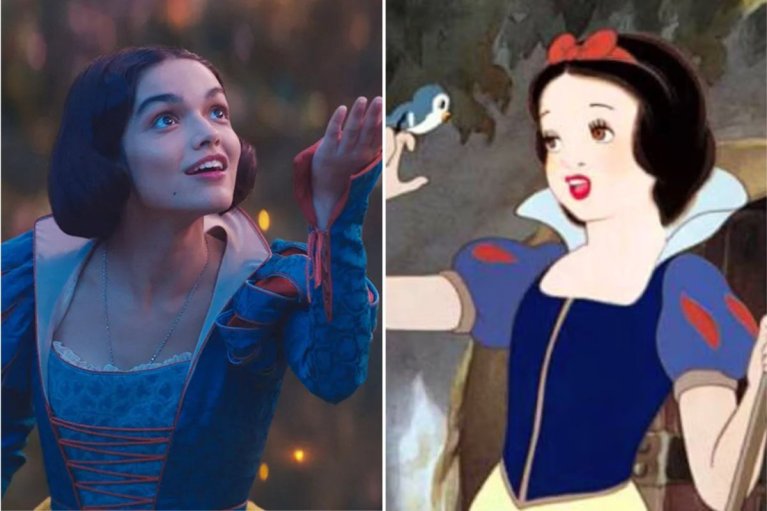
But, before we get into the remake, let’s talk a bit about the original Disney animation of the fairytale. The character deviates quite a bit from the Grimm version. For a start, the fair-skinned protagonist is half the age (7 rather than 14) and there’s no “true love’s kiss” in this original version. Furthermore, she’s a sort of blank slate archetype—not some ideal 1930s homemaker mothering a bunch of dwarfs. In short, the adaptation then was not completely true to the source material and created an image of feminity relevant to that time.

The Grimm version was darker in tone and featured a prince weirdly obsessed with a dead girl in a glass coffin. The dwarfs did not have distinct personalities. And Snow White awakened when the poisoned apple is dislodged from her throat when a servant carrying her coffin stumbles. And it was at this point the prince professes his love and proposes marriage—which she accepts.

The latest Disney live-action takes liberties in a very different direction. It is even less true to the original (other than elimination of the Disney romance) and reimagines Snow White being a sort of feminist militia leader who leads a bloodless insurrection against the usurping queen. But the “mirror mirror on the wall” remains and a poisoned apple—despite the heavy edit of the script where an empowered woman replaces the worn damsel in distress trope.

Why People Don’t Like Snow Woke

People enjoy new takes on old genres, like Shrek or Furiosa and also powerful female characters such as Ellen Ripley in Aliens, Sarah Connor in Terminator or even Katniss Everdeen in the Hunger Games.  They were relatable, we saw them develop, circumstances made them tough to survive, and audiences loved them.  What they don’t like is preachy dialogue or lack of any real character development. A Mary Sue, a hero with no weaknesses, is unrelatable. It is the problem with Superman and with the many woke adaptations of stories.

We like the image of a woman against the machine.

Christian movies have a tendency to be bad for the same reasons. They can come off a little campy or forced. Sure, it may work for drawing your ideological camp, but it isn’t a compelling story for the unindoctrinated or the broader audience. Which is not to say that movies about Christianity can’t be great for entertainment.  I love gritty true stories like that of Hacksaw Ridge or profound, like Silence, will have anyone at the edge of their seats—the key being relatable characters.

Zegler is a bit much. Totally insufferable in the eyes of some. And she plays a part that is equally annoying. The departure from the source material is just too rude. Sure, there is room for an update, but you would never reinvent Rambo as well adjusted pacifist in a mission to avoid too much sun exposure. Disney dumped the essence of the original and replaced it with another tired ’empowered woman’ cliché. You wonder if Zegler herself wrote the script with lines like, “I’m not waiting for anyone to save me” or groaner, “The fairest isn’t about beauty—it’s about justice!”
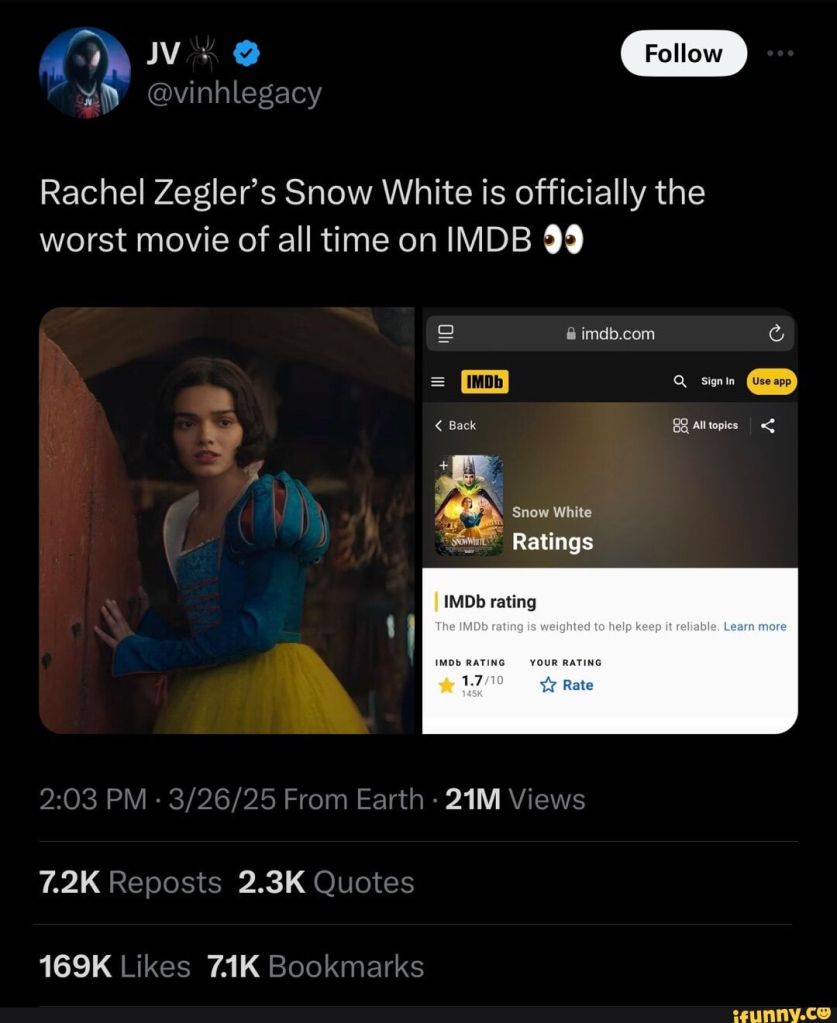
Ouch.

Oh well, at least even apologists for woke seem to understand that it is just bad. They did not even bother accusing the audience of being racist or misogynistic this time around.

Smash the Symbolism!

What is truly lost is the symbolic depth of the original tale. Snow White was beauty and purity contrasted with the vanity and evil of the obsessed queen. They gutted what made the Grimm tale a significant message about the triumph of innocence over the destructive power of pride. This, obviously, is too nuanced for a superficial sexual organ obsessed militant far-leftist to understand. The producers of the new film replaced purity of motive against cunning with a banal competition for power.

It’s not even moral inversion. They totally lost the point. It makes me think they lack any layers to their being. It’s all about their grievance and getting back at those they’ve scapegoated for their own misery. Like the evil queen, with all the power, they envy the beauty and peace of others and attempt to kill it with their poisoned apple. Snow Woke is the toxic fruit. Zegler is an icon of their privileged ‘diverse’ female with an entitled chip on her shoulder and not the slightest bit of appreciation for all the good men who made her ignorance possible.

This is not to say those who are fixated on the literal whiteness of the actress are any better. Grimm was not writing about racial supremacy anymore than woke supremecy, if anything the original story was about our transcending politics and Zegler would be perfectly suited for the role if she were able to embody that spirit. But our culture, in a desperate need of critique, it dichotomizes everything—divides the world into friend or foe, as if life is a zero-sum game and there is never anything to gain through fusion of opposites.

Zegler is as Puritanical (and Pharisaical) as a religious fundamentalist. She reframes a rescuing prince as a stalker and romance as weird. More rigid than a patriarch, more domineering than the system she is taught to loath. A preacher rather than an actual protagonist. Basically, a young idealist who wields her moral certainty with a convert’s passion, and yet stumbling into hypocrisy under scrutiny—reaping benefits of every institution she claims to reject.

The Female Power of Beauty, Gentleness and Grace

A few years ago, I was in the checkout line and suddenly noticed the cashier. She was beautiful, pale or ashen-faced, with hair that was jet black, pleasant smile and yet there was something uncanny valleyish about her appearance. I could not quite put my finger on it. But then she spoke. This would send a shiver through me. Never before did I have that sort of feeling simply by hearing someone talk. There was a certain quality to her voice that was almost child-like, soft, pure, and really threw me for a loop. And it occurred to me that this young woman was a real life Snow White.  I had not thought this would actually be attractive in person, but it had me momentarily smitten.

As it would turn out, in a later conversation, I learned she was mixed race, Filipino mom and dad of some kind of European descent, which is likely what gave her this stunningly feminine appearance. Now, no doubt this gentle exterior was cover over a tough and capable individual. She drove an old pickup truck and lived apart from her family with a sister, and may well have been a teenager or in her early twenties. In many ways she is like Zegler (who is herself a mix of Colombian and Polish heritage), but this real-life Snow White wielded her beauty, gentleness, and grace as a quiet strength that captivated without preaching, Zegler’s strident zeal turns a timeless tale into a soapbox, losing the feminine power of subtlety for a hollow shout of self-righteousness.

This is what outspoken angry feminists fail to grasp, forcefulness isn’t the only kind of power. My petite wife could never command me to do anything. I’m 50% bigger than her and have twice the upper body strength, I would shrug it off. But she does not need to force me to do anything. She overpowers me by other means. For example, early on, before we were married, she convinced me to stop drinking so much soda, she told me water is a symbol of her love “pure and clean” and when I drink it I could feel her love. I didn’t need to be told twice.

When I look at my baby daughter I would do anything for her. She’s so vulnerable—there is a strong desire to protect and defend her—I’m drawn, not compelled.

So what does female empowerment really mean?

Is it empowering to a fish to be out of the water?
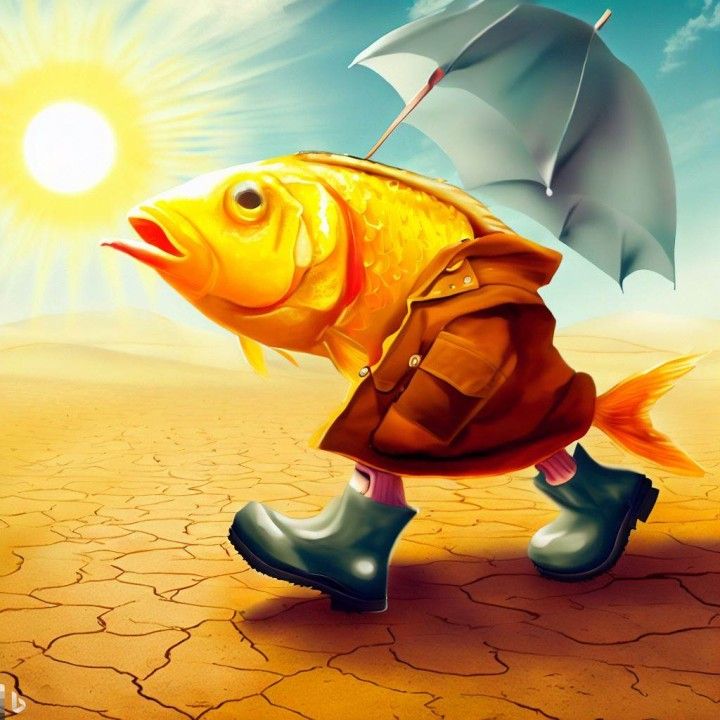
A visual representation of society telling individuals they need to be something else to be happy.

Humans are wired for their base biological and physical functions. Reproduction is a big part of this. It becomes clear after you see process through from courtship to baby in a carriage. Early in the pregnancy, given our financial goals, my wife had considered sending the yet to be both child to be raised by her mother. But as soon as the bundle of cuteness arrived, along with the appropriate hormones, it was never a question. Family is empowerment. My sacrifice, as a father, is more rewarding than the toys I could buy for myself as an independent bachelor.

We’re relational, not rational.

Therefore, the things we think will make us happy do not give us long-term fulfillment—the woke Zegler types are privileged, given preference as women or minorities, and yet always unhappy and looking at what others have and they do not. They are a paradox, enjoying female privilege—then miserable and wanting what men have.

It is toxic, it is their impurity of spirit, and it destroys their natural beauty and potential for true empowerment.

In all honesty, I don’t really have a problem with Zegler’s passion or outspokenness.  I guess I tend to prefer women with a real personality and feel she is right on the Gaza issue.  But what is wrong is that she’s not the right character to play what is supposed to be an embodiment of purity and the power of innocence against evil.  Snow White isn’t supposed to be Mockingjay or a story where physical force met with force—but of a different kind of power.

Ultimately, the 2025 Snow White stumbles not just as a film but as a misguided anthem, with Rachel Zegler’s shrill militancy drowning out the subtle power the Grimm tale once whispered. The original’s purity and even Disney’s 1937 grace knew strength isn’t loud—it’s captivating, like the cashier whose soft voice and uncanny beauty stopped me cold, a real-life Snow White wielding gentleness over force. My wife, too, overpowers me not with commands but with a love pure as water, turning a stubborn man into a willing protector, and just as our daughter’s vulnerability stirs my soul to shield her. Zegler’s remake, obsessed with preaching justice over enchantment, misses this: true feminine empowerment doesn’t need a megaphone or a militia—it’s the quiet, relational magic that binds us, a truth the poisoned apple of ‘Snow Woke’ chokes out, leaving a hollow echo where a fairytale’s heart once beat.


The Feminist Plot Twist

Standard

My grandma, a firstborn (and her mother as well), I’ll always remember her as my fierce defender, giving grandpa a sharp rebuke after I came in crying having crossed gardening implements with him while defending an unauthorized dam project. She wielded her matriarchal authority well, always able to stand up to grandpa as need be and yet never in a demeaning or inappropriate way.

My mother, also a firstborn in her family, was always willing and able to plot her own course. She sent us to public school, after stopping in at a local Elementary school and feeling comfortable with the staff there, which is unusual in conservative Mennonite circles where everyone else was fleeing to the safe spaces of parochial and home school alternatives. She taught us to think and now, as a grandma, has helped to start a medical clinic, which she currently manages.

My eldest sister, a firstborn, was a trailblazer. To pursue her childhood dream of being a medical doctor, faced a strong headwind of conservative Mennonite cultural ideas as to the appropriate role of women. She was always an overachiever, set the bar impossibly high for me, she was all-state violin, she finished in the top tier of her class and did this as the child of two high school dropouts. Her academic success continued throughout her university years and into medical school. She now runs a pediatric clinic for Amish children with genetic disorders.

My little sister continues to impress. She has always been her own person, able to hold her own with three older siblings, and has also progressed with her own education. She’s a registered nurse and, more recently, a certified midwife. Petite and pretty, as she is, she is quite capable of speaking her mind and has always kept me honest in any kind of intellectual discussion. She is both sensitive and practical, feminine and fearless or at least she’s not afraid of snakes like I am.

The point is, I have always been surrounded by strong and independent women. Sure, my grandma, my mother, and both sisters (at least through their time in school) all dressed according to conservative Mennonite religious/cultural tradition. But this outward appearance did not mean they were oppressed, the women in my life would never allow it, and that’s how it should be.

Women Should Be Given Special Protection

One of the results of feminist backlash against patriarchal abuse is the idea that the differences between men and women are entirely a social construct rather than something of nature. Of course, this is in defiance of science and things that are easily observed. Men and women are physically different, that’s how we make the distinction at birth, and also slightly different in our natural programming.

Sure, not every woman wants a pink ribbon in her hair. We’re all unique individuals. And, absolutely, women can do the same mental and basic physical tasks as men. Women can be engineers, men can be hairdressers, and there’s nothing at all wrong with those who go against gender stereotypes. But, generally, when women are allowed to be women, and men are allowed to be men, there are distinct tendencies that emerge.

There is social conditioning or expectations pertaining to gender and yet it isn’t all a construct. Consider the fact that female athletes suffer more injuries, like ACL tears, due to their physiology or hormonal differences. Men do tend to be physically bigger. Women are also capable of doing something that a man can’t do. Women are generally better at some things and men are better at other things. It’s just our biology at work.

For this reason, absolute equality is not ideal. Female athletes may complain about unequal pay and yet none would want to compete on an equal field against men. Men would completely dominate female sports. There is no woman out there that would be able to beat the most elite men for their positions in professional or even collegiate sports. Take the UPenn swimmer who now identifies as a woman, allowed to compete in the NCAA women’s competition despite being born with male genitalia and competing as a man only a few years ago, who is now crushing women’s records.

Even on hormones, male genetics is an unfair advantage.

And that’s exactly why we have separate leagues for men and women.

I haven’t heard anyone say that the very existence of the WNBA is patriarchal and should be abolished in the name of equality, have you?

Women should be given special accommodations. They do have to contend with a different set of circumstances from men and thus should therefore be privileged in some situations. That’s why we have separate sports leagues, restroom facilities, among other things, to allow fairer competition, greater safety, and simply more opportunity for women. Protecting women is a matter of survival for the species.

The ‘Birkenhead Drill’ (otherwise known as “women and children first“) refers back to a tragic incident in 1852. The H.M.S. Birkenhead, a Royal Navy troopship, was sailing around the horn of Africa with 634 souls on board and collided with uncharted rocks. It began to take on water and was doomed to sink. In the chaos, where it was discovered that many of the lifeboats on the ship were unusable, the seven women and thirteen children were loaded onto the few functional emergency craft and lowered into the sea.

Originally the idea would have been to allow the men to jump overboard. However, anticipating that this might imperil the boats in the water, the commanding officer ordered his troops to “stand fast” rather than jump in, which they did—as the ship split in two and went under the waves they stood like good soldiers. This act of self-sacrificial courage does not make sense in an economy where all are equal. Why should these men have been expected to give their own lives for sake of women and children?

But the answer is quite simple. Both the womb and youthfulness represent the greater potential for our species. It is simply for sake of our collective survival, so that there is a next-generation to follow, that in these dire circumstances men instinctively know who is most valuable (usually of their own clan) and act accordingly. And thus, when there is no other way, a handful of women and children do indeed become worth the lives of hundreds of men. It’s a privilege of being a woman.

Statistical Disparities and Oversimplification

I have a new coworker. Other than experience, his qualifications are similar to my own and we perform many of the same tasks. I’m not actually sure what he gets paid, although I do know that it is probably different from the compensation that I receive. It could be more, could be less.

If it would turn out that this new colleague gets paid more than I do could we assume the reason?

Is it because he is taller than me?

Statistics do show that taller men, amongst the many privileges they have, do earn more on average than shorter men. This would make my pay deficit seem like an open and shut case of height discrimination, right? Except, it is not. There is a multitude of reasons why one employee could receive better compensation than another. Maybe he put more hours in? Perhaps he is better at negotiating in the hiring process? I mean, his height could help, who knows? But it is not a certainty and we would have to look into more variables before drawing our conclusions.

Unfortunately, when it comes to similar disparities elsewhere, like the differences in outcomes between genders, many will neglect multi-variant analysis and lock onto the most simplistic explanation. Relevant to this blog, if there aren’t as many female scientists, or there appears to be a pay gap between men and women, then this must be some sort of systemic bias against women, right? I mean, what else could it possibly be?

Of course, the possibilities are endless. No two jobs or people are alike. Assuming gender discrimination also neglects the possibility that most women may (for a variety of good reasons) choose to work fewer hours, be less assertive, or interested in promotion on average, than men with the same titles. I mean, perhaps there is more to their life than earning a paycheck? And, for the same reason, the lifestyle, most men wouldn’t truly want to be a CEO. A more demanding higher paying job simply is not desirable to most people.

Besides, there are other ways to gain wealth that doesn’t involve punching a time card. We often hear how women earn less. And yet somehow, despite this, women also make more consumer decisions and spend more than men. How are both of these things possible? Well, simply, there are other ways of obtaining resources other than going to the office. The wives of Jeff Bezos and Bill Gates, for example, did not become wealthy by their own market innovations or CEO-level workaholism.

Statistics show that women earn more college degrees, is that a result of systemic anti-male discrimination?

Equal Opportunity, Not Outcomes

A woman who wants a career should not be hindered. I believe that all people should be free to pursue what they see as best for them. There are women who are brilliant mathematicians, engineers, and scientists, they should be allowed to pursue an education and compete for employment like a man. That’s truly equal opportunity and fair.

What’s not fair is when institutions begin lowering standards to meet diversity quotas. Not only does that cheat those who are actually qualified and had to meet the higher requirements, but it will also produce a stigma that disqualifies the achievement of even for those who truly did earn their positions. The sad irony of a “diversity hire” (when someone gets the job because of their genitalia, skin color, or anything else not actually related to the work needing to be done) is that it only reinforces the negative stereotypes.

Not everyone is cut out to be an Olympic gymnast. It would make no sense to replace Simone Biles with a slightly overweight middle-aged male and, for the same reason, it is absolutely absurd to lower physical standards for sake of opening spots for women who would not qualify otherwise. It is not fair to individuals nor beneficial to the collective society to give some a free pass. Equality of effort and qualifications is as important as equality of opportunity, but equality of outcomes is impossible. I’m never going to land a triple-twisting double somersault. Ever. And that’s not because the system is stacked against me.

Differences in ability should not be thought of as being less valuable. Some can dance, others can carry a rucksack for twelve miles, I’m pretty sure I’m not up to either task at the moment, but I am a good friend and decent writer. None of those things are worth much in terms of monetary wealth and yet all things fulfilling in their own way. So who decides what is or is not valuable again? And is money truly the measure of value?

Money and Masculine Qualities Are Overvalued

One of the biggest lies of our time is that value is something that is measured in dollars and cents. I mean, sure, we need money to buy stuff and therefore the ability to obtain this resource is important. And yet there are many extremely wealthy and completely unhappy people. A big bank account does not provide the security, nor the sense of purpose in this world, that many seem to believe it will.

For that reason, it is sad to me to see so many people, women in particular, who seem to think that the rat race is what life is truly about. Modern parents seem to have decided the things they can provide are more important than their time together and shunt their children to daycare. It is unnatural, dare I say unhealthy (in that it robs children of a safe space) to outsource the next generation to low-wage workers. How did we get to this point where we would rather put our best efforts in for corporations, and those who would replace us in a second, over our own future?

Somehow we have become convinced that masculine interests and abilities are superior. The one thing that women can do, that is carry a child in their womb, is treated as something unimportant or second-rate rather than as the most wonderful of things. Our forebears were wiser, they understood what “the hand that rocks the cradle is the hand the rules the world” and the incredible power of the nurturing mother. But, now, instead of men and women complementing each other, working to their own strengths, and being valued for unique their roles, we have them competing for the same spot.

Who sold us this bill of goods and why?

Without a doubt, women have faced patriarchal abuse and discrimination. But is the answer really to this really to measure success in terms of career and raw income earning potential? Is it really empowering women to tell them that their own unique abilities, as women, do not matter and political power is everything? I mean, it’s a lie. I have no deep love for any politician out there, not even those I’ve voted for, but have endless appreciation for my mother and would die for Charlotte. This idea that somehow money and political power are everything is cancer.

The Feminist Plot Twist

Feminism is a term invented by a man, Charles Fourier, trying to enlist women to his utopian socialist political cause. To use people politically, one divides them up into competing identity groups, feeds their discontentment, tells them they would be better-if [insert simplistic political solution to complex issue] and then can pretty much steer the resulting angry mob where ever they need it to be.

The problem with political ideologies is that they externalize responsibility for our happiness. In other words, it is an idea that if only an external obstacle, like the patriarchy, were removed (through political action) then we would finally have that wonderful life we hoped for. This is not empowering. Perpetual victimhood or continual discontentment due to external circumstances is the most debilitating of human conditions.

Women are less happy today than they were in the ‘patriarchal’ past.

Furthermore, it is always false hope, intentionally so, because the ‘revolution’ must always be ongoing, the war against “toxic masculinity” or whatever scary new Boogeyman they come up with can’t end. Your happiness is always in the future and completely depends on the leaders of the movement. The solution will always be out there. It is a promise to keep you pulling the ideological cart they’ve concocted and never leads to your true empowerment.

There will always be things unfair or outside of our control. I’m not a woman, I’ll never be a woman, but I do know that all my complaints about height discrimination and the invisible barrier to my own success never got me anywhere. And truly, once disappointment festered and self-pity took root, I could’ve had all the opportunity, all the money or power imaginable, everything that I had ever craved thinking it would bring fulfillment and still not found a source of happiness.

Contentment is an inner state, a spiritual manifestation, and not a matter of external circumstances. The problem with feminism is the problem with any political ideology and that is that it will never bring fulfillment or happiness. Women have gained voting rights, a higher percentage of women graduated college than men, and yet are more unhappy than ever despite this century of feminist progress.

Could it be that a truly empowered person (male or female) is one that doesn’t measure their own success by how they compare to others?

Could it be that fulfillment comes from losing ourselves, our competing identities, in the service of others, and something greater than our gender?

Contentment is strength, giving is empowered

The feminist plot twist is that the ideology serves those who don’t truly want strong women and merely use discontentment for their own political gain. Women are simply another pawn to thrown at their ideological enemies and only appreciated when they’re useful to their socialist masters. It is worse than patriarchalism because it has convinced many women that their unique abilities are worthless and being more like a man will bring happiness. It has not and will never empower women.

The Confidence Conundrum

Standard

“Be confident!”  

Two words and some of the most unhelpful advice ever given.

Telling someone to be confident is like telling a depressed person to be happy or a short person to be tall.  A person who lacks in confidence does not know how to be confident or else they would already be confident.  Building confidence takes more effort than making a bold pronouncement upon someone.

People do not simply choose to be shy, unsure, uncertain, doubtful, confused, hesitant, timid, anxious or fearful.  No, those things are a product of life experiences and emotions that are all very real.  A confident person making a perfunctory statement does nothing to change the reality of a person who lacks confidence.

That said, confidence is desirable and something to be shared.  

Unfortunately, people who are confident often do not have reason to be introspective about it.  When you feel good about life there is not much need to know why or question it, there is only reason to be what you already are and enjoy the benefits.

Confidence is both a natural disposition and also something gained through positive experience.  Parents instill confidence in children through example or by helping them to overcome their fears and learn from failures rather than dwell in them.  Confident and successful parents seem to produce confident and successful children.

Confidence goes hand in hand with success, it frees a person to take the plunge rather than waste time in needless deliberation and makes them more attractive.  But, there is a sort of causality dilemma, in that confidence often leads to success while success builds confidence and without one the other becomes more difficult to maintain.

When confidence doesn’t produce success, it leads an intelligent person to doubt.  And with doubt comes less desire to risk effort and that results in even less opportunity for success, which often leads to even less success and even less confidence.  Pretty soon things can spiral downward into the pit of despair without a clear way out.

So, how do we help someone who lacks confidence gain it?

If you want a person to be confident then you must give them reason to be confident and good enough reason to overcome whatever reasons they have to lack confidence. To be helpful one must directly address root causes and not dismiss the realities that created the condition as silly or irrelevant.

What people need is T.IM.E.

Help must be practical.  Encouraging words don’t cut it.  Words, no matter how confident you are in saying them, are only words and do nothing to counteract the real life experience or emotional baggage of someone who has only known failure.  What is helpful, perhaps the only thing that does help in some cases, is meaningful long-term investment in the other person.

Loss of confidence happens over a lifetime, it comes as a result of traumatic experience or neglectful treatment, thus expecting a person to “snap out of it” because you say so is delusional at best and an excuse to be indifferent at worse.  There is more to be done than simple encouragement and that means an investment of time.

Here are three simple steps…

1) Take time to listen.  Confidence goes hand in hand with success, but success can lead to arrogance and unwillingness to hear first.  Many people want to “fix” another person without taking time to actually listen and assess the need.  This could mean many months or only a moment depending on the need.  It takes relating to the other person at their own level, earning their trust, without being in a rush or speaking in judgment of their situation.  Half the problem could be the lack of someone who will actually hear them out and care.  So listen empathically and try to identify with the other person emotionally.  Weep with them, laugh with them, eat with them and imagine with them.

2) IMagine a solution.  Without confidence, our ability to envision a better future dwindles and dies.  A successful person can easily take their ability to see a bright future for granted and yet a person who has continually failed does not share their rosy vision.  The first step towards any solution, therefore, is to think about it, to break the problem down into steps and help the other person mentally develop their path towards success.  After that comes execution of the plan.

3) Empower them.  This is where the rubber meets the road and is probably what is most lacking in our age of dog-eat-dog individualism.  Sure, there are many willing to spew their unhelpful advice and unasked-for judgments, but there are very few willing to partner in the success of another person and by this I mean make a substantive investment.  No, this does not mean a handout done in pity or religious obligation either, but an investment that physically and materially shows our confidence in the person who needs it.  Your willingness to partner together with them in a solution will, by itself, help build their confidence.

Anyhow, some final notes…

This is not a method or formula.  Each person and every situation is different.  Sometimes all that is needed is encouragement (more than saying “be confident”) which could mean something as little as a phone call.  While other times a lifelong commitment may be required.  It will likely require creativity, facilitating the right connections, and making recommendations.  

The goal is to get the person what they need to get on their feet and going in the right direction.  It also means getting out of the way and not being controlling or expecting anything in return besides enjoying their success with them.

Nobody is self-made.  If you are confident and successful, there are reasons why that go beyond your own abilities.  We did not pick our own home, communities, height, intelligence, personalities or luck.  We cannot take full credit for anything we have accomplished in our life.  This is reason to be humble and helpful.

If you are confident then share what you have been given with those who have little or less than you do.  Show your hope in their future with truth of action and not only your confidently spoken (but empty) words, be their heart…