The Supreme Court has finally ruled against the practice of blatant racial discrimination in university admissions. This, after Harvard and other schools, in pursuit of filling quotas, would find means to select against qualified Asians to meet an ideal for diversity based on skin color.
The Affirmation Fairy…
African Americans, at least as a collective whole, have suffered disproportionately and this is a historical injustice that is not easily solved. Much of our success later in life has to do with the homes and communities that we were born into. The values we receive via our culture make a huge difference so far as outcomes.
I remember a viral video, a few years back, that lines up a bunch of young people on a grassy field. The announcer asked various questions, such as “Take two steps forward if both of your parents are still married,” and those who could answer yes advanced. The results of this survey were framed as ‘white privilege’ and yet none of the statements had anything to do with race.
Social inequality is certainly not a black-and-white issue, many children of European and Asian ancestry lacked a father in the home, worried about fitting in, did not feel safe at night in their neighborhood, worried about having enough to eat, and lacked access to private education or tutors. I once begged my mother to take me out of public school after a rough patch. I changed my hairstyle as a response to classmates who made note of my ‘Mennonite’ side part. I decided to quit college rather than go deep into debt.
Am I underprivileged?
Exactly how much am I disadvantaged as a learning-disabled child of two high school dropouts, with a father who had to be away all week to support our family?
There problem with all “affirmative action” is that it is a vast oversimplification of a very complex and multi-layered problem that may be more about culture than color. We simply cannot account for every factor or rate every single subcategory of ethnicity and culture for statistical disadvantage. For example, do we know the college graduation rates of Americans of German ancestry or Irish and Italian? Are a proportional amount of these ethnic groups represented?
Furthermore, our own disadvantages can be advantages, in that they can provide u much-needed motivation. Sure, having money may mean a trip to Harvard and a certain level of success. However, the same is true of those who are tall and athletic. Jeff Bezos, at 5′-7″ tall, may have benefitted from having some ‘short man syndrome’ or that extreme desire some have to compensate for the discrimination they faced for physical characteristics that were beyond their control.
Affirmative action is wrong in that there is no way to rank hardships. It is wrong because it isn’t addressing the root causes of social inequalities, even as defined by the privilege police, in that we’re not talking about things like fatherless homes or inner-city violence and cultural forces that discourage the behaviors that aid in academic achievement. You can’t wait until a person is eighteen, then wave a wand of university education and credentials as a solution to these underlying issues.
Asterisk Graduates…
The true underlying message of affirmative action was that minorities, specifically those of African descent, couldn’t be successful without the help of the government. As liberal arts universities continue to seek to fulfill a narrow color-obsessed definition of diversity, using quotas rather than qualifications, they unintentionally degrade all of their minority graduates—even those equal in merit to the non-minority graduates.
The idea of a “diversity hire” or a person not equally qualified to others who applied and yet are given preference only because of their special category of race or gender, is a direct consequence of discriminatory affirmative action programs. People know how to read between the lines (albeit often unfairly) and will diminish accomplishments that weren’t actually earned or can be perceived as being unearned. It is why we do not see the work of those ‘born into wealth’ as being equal to that of those who are self-made.
A classic example of the patronizing white saviorism that is lurking behind divisive equity campaigns.
Just as a university degree would lose value if everyone were simply given a diploma for breathing, admitting some primarily on the basis of skin color devalues the effort even in the eyes of those who benefit. It only serves to feed an idea of black inferiority, that they need a ‘white savior‘ to swoop in and rescue them from their plight, and is grossly unfair to all who were truly qualified on the basis of merit—but will still deal with the asterisk due to systemic compensatory color preferences or racially discriminatory quotas.
The hate crimes against Asians, like the murder of Yao Pan Ma, rarely receive coverage as other racially involved crimes.
Two-tiered or lower standards for some will never achieve the goal of equal outcomes.
Favouritism Forbidden…
We’re living in a time of moral inversion, a time when those who lived a life of crime and abuse are treated as victims simply on the basis of their outward appearance. It is as wrong as the favoritism of preferring the wealthy over the poor for the potential benefits:
Do not pervert justice; do not show partiality to the poor or favoritism to the great, but judge your neighbor fairly.
Leviticus 19:15 NIV
The problem was favoritism, preferring one party based on who they are (what they can provide for us) rather than the actual merit of the case. Fairness of judgment, not equality of outcome, is the goal.
Christians were told not to judge by a person’s outward appearance:
My brothers and sisters, believers in our glorious Lord Jesus Christ must not show favoritism. Suppose a man comes into your meeting wearing a gold ring and fine clothes, and a poor man in filthy old clothes also comes in. If you show special attention to the man wearing fine clothes and say, “Here’s a good seat for you,” but say to the poor man, “You stand there” or “Sit on the floor by my feet,” have you not discriminated among yourselves and become judges with evil thoughts?
James 2:2-4 NIV
Many, trying to make a show of their own righteousness, take a Scripture like that above and turn it into a call for social justice or a special preference for the poor or otherwise disenfranchised. However, this kind of reverse favoritism totally misses the point. Trading one kind of perverse judgment for another is not a virtue. No, it is a virtue signal and something people do for the social benefit of merely appearing to be an advocate for those recognized as being disadvantaged. Even if sincere, this is a misguided approach that goes against the instruction not to show favoritism.
Affirmative action, in the end, is just a new form of white supremacy that is expressed as patronization. It frames differences in outcomes solely in terms of identity groups while neglecting to correct the factors causing the inequal results or truly helping people to cross over these unhelpful, artificial, and arbitrary divisions. Jesus taught more of a gracious meritocracy, where our behavior did matter and we would ultimately be judged on how we treat other people irrespective of their deserving or appearance. In this regard, our equality comes only in repentance and our obedience to the law of Christ—not by force of courts or legislation.
We do not save the world by trying to force others into compliance or control outcomes. Rather we change ourselves and become an example of impartiality and love to all people. Honest and fair equal opportunity is having the same requirements for all and not preferences tailored to some at the expense of others. You cannot rob Peter to pay Paul. We shouldn’t love bomb some, even to make them feel better about themselves, by removing opportunities for those who truly have earned their place.
The book of Ruth is a nice little oasis in the midst of dry and tedious reading. Up to this point the Bible isn’t all that relatable. It has some highlights, interesting characters, but is stories of ethnic cleansing, description of weird sacrificial rites, polygamous patriarchs and stonings for picking up sticks, violence and laws, it is cumbersome.
And then you get this:
But Ruth replied, “Don’t urge me to leave you or to turn back from you. Where you go I will go, and where you stay I will stay. Your people will be my people and your God my God. Where you die I will die, and there I will be buried. May the Lord deal with me, be it ever so severely, if even death separates you and me.” When Naomi realized that Ruth was determined to go with her, she stopped urging her. So the two women went on until they came to Bethlehem. When they arrived in Bethlehem, the whole town was stirred because of them, and the women exclaimed, “Can this be Naomi?”
Ruth 1:16-19 NIV
What a contrast to the storytelling prior, all of the resistance to racial mixing as well, here a Moabite woman would rather remain with her Israelite mother-in-law than stay with her own people. It’s personal. And the romance that follows, while very foreign and featuring many practices which are weird to our own ears, shows a more compassionate side of the legal system instituted by Moses. Boaz acted both out of love and duty as guardian-redeemer. Starting with his genuine concern for her safety:
So Boaz said to Ruth, “My daughter, listen to me. Don’t go and glean in another field and don’t go away from here. Stay here with the women who work for me. Watch the field where the men are harvesting, and follow along after the women. I have told the men not to lay a hand on you. And whenever you are thirsty, go and get a drink from the water jars the men have filled.”
Ruth 2:8-9 NIV
This paternalistic care a sharp contrast to an episode in the book of Judges when a Levite and his host offered their innocent women to please the perverse desires of the men in the local community:
While they were enjoying themselves, some of the wicked men of the city surrounded the house. Pounding on the door, they shouted to the old man who owned the house, “Bring out the man who came to your house so we can have sex with him.” The owner of the house went outside and said to them, “No, my friends, don’t be so vile. Since this man is my guest, don’t do this outrageous thing. Look, here is my virgin daughter, and his concubine. I will bring them out to you now, and you can use them and do to them whatever you wish. But as for this man, don’t do such an outrageous thing.” But the men would not listen to him. So the man took his concubine and sent her outside to them, and they raped her and abused her throughout the night, and at dawn they let her go. At daybreak the woman went back to the house where her master was staying, fell down at the door and lay there until daylight. When her master got up in the morning and opened the door of the house and stepped out to continue on his way, there lay his concubine, fallen in the doorway of the house, with her hands on the threshold. He said to her, “Get up; let’s go.” But there was no answer. Then the man put her on his donkey and set out for home.
Judges 19:22-28 NIV
While the brutal rape and murder of this poor concubine was later avenged, it is quite clear that the two men were more concerned with saving their own skin than protecting those whom were entrusted to them. Not saying it would be easy to know what to do in those circumstances. It isn’t like there was 911 to call or semiautomatic weapons to hold back the lascivious mob. Still, Boaz stood ready to protect Ruth, a foreign woman, from the other men who would very likely have taken advantage. How easily we can take our own law and order for granted.
Where the men made the woman vulnerable for exploitation in the book of Judges and in other parts of the Bible, like Abraham claiming his wife was his sister or Jacob putting his family in the front, in Ruth it is the women putting themselves in a vulnerable place to capture the attention of the good man:
One day Ruth’s mother-in-law Naomi said to her, “My daughter, I must find a home for you, where you will be well provided for. Now Boaz, with whose women you have worked, is a relative of ours. Tonight he will be winnowing barley on the threshing floor. Wash, put on perfume, and get dressed in your best clothes. Then go down to the threshing floor, but don’t let him know you are there until he has finished eating and drinking. When he lies down, note the place where he is lying. Then go and uncover his feet and lie down. He will tell you what to do.”
Ruth 3:1-4 NIV
I’m not sure if the description of Ruth acting out on her mother-in-law’s bold plan to lay at the feet of Boaz is euphemistic language. Seems risky to be that intimate with a man who was drinking and “in good spirits” as the text tells us. But, that said, whatever transpired that night, we know that he took responsibility for Ruth and also the welfare of Naomi. And, in this regard, the guardian-redeemer system worked as designed. But mostly because of Boaz having genuine care in his heart. Ruth, for her part, was his equal in that she was loyal to her mother-in-law to the point of leaving her own homeland.
This is a story exceptional in a good way and likely part of the Biblical canon so far as has to do with the lineage of King David. It also brings us to Bethlehem, where Jesus (of the line of David via his mother) was born. That both Ruth and Boaz stand out as characters for their abiding love is significant. In a time when woman were treated as if property or merely objects for male pleasure, we have honorable and caring men. Boaz took Ruth under his wing in the same way his grandson longed to love his people:
“Jerusalem, Jerusalem, you who kill the prophets and stone those sent to you, how often I have longed to gather your children together, as a hen gathers her chicks under her wings, and you were not willing.
Matthew 23:37 NIV
In this account there is a clear precedent for a family relationship that goes beyond only our biological relatives. The law of the kinsman or guardian-redeemer, through Naomi, was also applied to Ruth. And, likewise, through adoption we become sons and daughters of Abraham by our faith (Galatians 3:6-14) and true children unlike those blood relatives of the Patriarch who rejected their Salvation. Our real kin are those who fulfill the role they have and love in the manner of Boaz or Ruth.
There was a time when I could simply say “I’m Mennonite.” That is what I was. It was my religion, culture and ethnicity wrapped up into one tidy package. It was as real to me as my gender and first name. But now, having left the denomination of my youth behind, it is really difficult to buy-in to a new identity or at least not to the extent of feeling a significant attachment to the distinguishing title.
We live in a great identity crisis. We might celebrate more identities than ever, and yet somehow along the way, we have lost the very meaning of the words that we use to define these identity categories.
What is an identity?
An identity is a word used to distinguish one from another. Or a statement of what we are in comparison to the whole group. Are you Catholic or Protestant? Black or white? A Republican, Democrat or Independent? And whether it is identity or not has much to do with the emotional weight that we place on these categories and terms. In other words, blue-eyed is certainly a category that some of us belong to, but is not currently an true identity marker.
There are also various kinds of identity, there are those inborn or assumed—Charlotte, due to her inherited genetics, is Kankanaey, and would be no matter what she believed about herself or if she prefers that another term be used. Then there are those types of identities that are less about our immutable being and more about what we are doing. By contrast, trucker or truck driver is an identity, and even comes with a license to prove it, but it is not something that is actually written in a CDL holder’s DNA.
Trump ‘identifies’ as a trucker…
Identity is never something we can select for ourselves. I can claim to be a Dill Pickle and even legally require the moniker be used in reference to me. But this is never going to change what other people will perceive me to be. Identity is something that others construct, with us, and not only a thing that we independently choose for ourselves. Put another way, a rose by any other name is still a rose and even if we paint it blue. And blue does not become yellow because we switch the color identity labels either.
Our “I am” identity…
I’m sexually attracted to the female form and this has dictated my priorities and activities throughout the years. But, as important as it is to me, I don’t tout my ‘straight’ preference as being my identity. I am many things, but my sexuality is not something to hang my sense of who I am on. There are no hetero pride parades for this reason and no need to fly a special banner in front of my house to announce my preferences either. Sexuality is not who we really are.
So, when someone says “I am gay,” my mind always must go to the question, “you are a sexuality?” The reality is that this identity is about far more than what they do in bed. It is about the community or lifestyle and an identity built around being their status as an exception. Being “gay” is just as much about the social aspect as the orientation. It is not just something you only do in private. No, it requires a public display and solidarity with others like you. If it were simply about sex there would be no parades or neverending need to be legitimized by others. Identity is bigger than the individual.
And trans is simply the next level. Those calling themselves “trans” may (in direct contradiction with their biological gender assignment) self-identify as a man or a woman. But those who are truly male or female simply are and there is no need for hormones, reconstruction of genitals or to exaggerate gender stereotypes with weird provocative displays. On the other hand, no matter how much surgery is performed on the body of a ‘trans’ person they will always be trans. The more trans people try to force others to recognize them (despite our own eyes) the more they will stand out as being different. Which is truly the point.
Identity is about our distinguishing ourselves from the larger group. It is also about what is the most important thing to us. If a person were ask who I am I would probably start with my given name. That is where I am oriented in society, as a product of my parents, and also gives others a shorthand to address my person. Then I might mention my role as a husband and father as those things are currently the most meaningful parts of my life. Of course, also in the mix is my religious affiliation and occupation. Sexuality, while very important, wouldn’t even make the top of the list.
Furthermore, there is no need for anyone to defy their own eyes or be forced to recognize anything about me against their will. Identity is not only about what I declare. A large part of real identity is what others recognize with no coercion. If I had to demand that my son call me daddy or that my wife appreciate my bad cooking the same as she did the work of a master chef, would their bending to my will really make me any more legitimately those things? No, it would certainly not! It would make me a bully and look very insecure.
The Identity Gambit…
Special identity is a way to gain advantage over others. In the past it was about having the right privileging title or family pedigree. Now it has become a no holds barred fight between various victim categories. But in both cases it was about unearned respect, about people who did not do anything noteworthy enough in their lives to be recognized and thus invent illegitimate reasons why others must genuflect to them. These frauds are enabled by those who have twisted morality and a corrupted political system.
Stop. I look like a police officer!
People can lie about their identity for many reasons. Impersonation of a police officer, for example, gives a person false authority and ability to manipulate the unsuspecting. Or stolen valor, in the case of those who, for attention, dress like and pretend to be a military veteran. Sure, the act is usually off, since these posers don’t have the requisite qualifications, but it fools enough people that they get the payoff of the true identity—or at least until caught. Then again, prancing around and pathologically pretending to be a girl is now extremely lucrative for some men.
Pretending to be a doctor or airline pilot is something children do innocently and yet it would be silly to legally recognize this as not to make them feel bad. True identity is not an act or a costume we put on.
Shedding identity…
Identity is powerful. For example, a person calling themselves a “gangsta” or “thug” is declaring a whole package of behaviors and dress styles. It is a choice as well as a habit, they could change and yet their momentum is in a particular direction. They have been conditioned, for years and years, by culture and peers, to assume this posture towards the world.
There is some truth to the statement, “you can take the boy out of the country, but you can’t take the country out of the boy.” We have many things instilled in us, accents to tastes, but this is not written into our DNA and doesn’t mean it is an “I am what I am” excuse. We will send children to speech therapy if they have an impediment rather than let them be their true selves. We can and should modify things that an identity is built from. This notion of a genuine self that can’t be changed is ridiculous.
Right now there is a Ukrainian vs. Russian war. The narrative we’re being sold is that there is a vast difference between the two sides—that this is a fight between freedom and democracy or authoritarian rule. We are told the Russians are barbaric and cruel, the Ukrainian’s heroic and capable. But both are from the same Kievan Rus origins, speak a dialect of the same language, and truly have much more in common with each other than they do with us. Furthermore, the regime in Kiev is hopelessly corrupt, and had been shelling those trying to escape this rule for years prior to the Russian invasion—it isn’t a distinction worth dying over.
Ukraine vs. Russia is more like the US Civil War than WW2.
The reality is we are not bound to identity, especially not to those that are more about what we are currently doing rather than our actual being. We choose our divisions as much as we are born with them. Sure, we can’t help what side of a border we are born on nor if our personality traits are judged as being masculine or feminine. But we can decide what is most important to us. And, more importantly, we can pick identities that are greater than sexuality or gender. We must reject this idea that we can’t change or improve while also accepting what we are and were born to be.
Many people get off from being contrarian and offending others, they especially enjoy being able to force others to go along with their language games. But, in the end, their ‘preferred pronoun’ is a distinction without a difference. We will remain what we are no matter how we dress it up or how much we compel others to go along with the delusion and falsehoods we peddle. It is only in our spiritual transformation, in finding a bigger purpose, that we can be free from needing the approval and attention of others.
More and more I have no identity to cling to outside of being who I am. I am what I am and don’t need to hide behind a special label or find my place in the world. While many in my religious past hold conference in search of their identity and as many converts in the tradition in which I currently participate tout the Orthodox adjective in the manner some do they/them pronouns, I have little interest in joining them in this inane competition. St Paul, in Galatians 2:38, would have us shed our divisive identities for a joint identity in Christ.
Years ago I had a nemesis. My counterpart positioned himself as a white knight type of character and was basically there to harass anyone too fond of the religious tribe I was born into. He knew the group, he had been a convert and was now an ex-member, who classified us as “an ethnic church” dismissing what we said about our conversion experience.
Now that I’ve left the group there is no reason to continue to guard the ideas left behind and that includes the notion that my own participation had been completely a choice. There are doctrinal reasons for this denial of the obvious. I mean, if you believe that conversion is a personal choice, a rational and unbiased conclusion, then it really gets under your skin when someone says that you’re more or less a product of a religious culture.
We were, in our own eyes, a sort of remnant church. And then also had to deal with the awkward reality that many, like us, were so inbred that they had distinct genetic disorders. And, unlike our radical forbearers, we had no cultural relevance besides being the quaint old fashioned people who dressed like it was the 1800s and called this non-conformity to the world. So, obviously, the fact that everyone who shared our views happened to be genetically related was the source of cognitive dissonance.
It is for this reason that converts, the more exotic the better, were clung to and even given special treatment. We would say it was out of Christian love and yet some of this had to do with our own insecurities. They were our validation. They were the proof that we were more than just an ethnic cloister, more than a bunch of cousins of a particular European heritage claiming that our own brand of religion represented something universal and relevant to the times.
Those who come into this group, visibly from the outside, are often treated both with mistrust and also with a special adoration as well. They can never be fully accepted, they’re always both more and less than equal, coddled or spared normal rebuke from some to keep them from leaving, and yet also can sense that they’re just the tokens being used to prove a point rather than being treated as people. Sure, they may form real friendships with some, but they themselves are often misfits from whence they came and still remain stuck in no man’s land.
Now that I’m in a church that both spans continents and is mostly converts locally, I don’t have as strong an urge to collect tokens or evidence that I’m not just a product of my ethnocultural roots. I mean, sure, I still want to be right. But the pressure to bring the Gospel to all people is off my shoulders. The Church didn’t take long to spread into Asia or Africa, early Christians didn’t dress like Europeans from a generation ago either, there may be some times to chase down Ethiopian eunuchs in their chariots, and yet there’s also a time to acknowledge that the fullness of the faith has never left Africa.
Evangelicals, of all stripes, have this desperation for relevance. They think that they will win more converts by being more cosmopolitan, and by painting a picture of superficial diversity and inclusion, but Jesus said that his message would make the world hate us and even divide families. If we have the truth, if we know the truth, we are no longer bound to ethnic quotas and, instead, simply love people, especially of the household of faith, as we are commanded. Jesus preached to his own tribe first, his converts were mostly other Jews, like him, and that was perfectly fine.
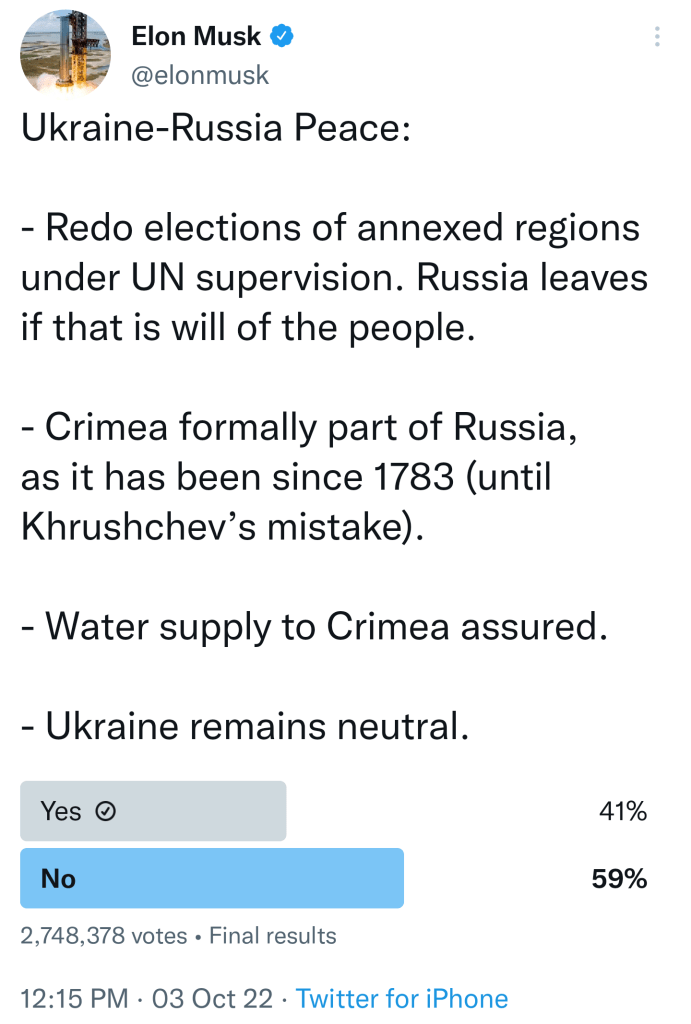
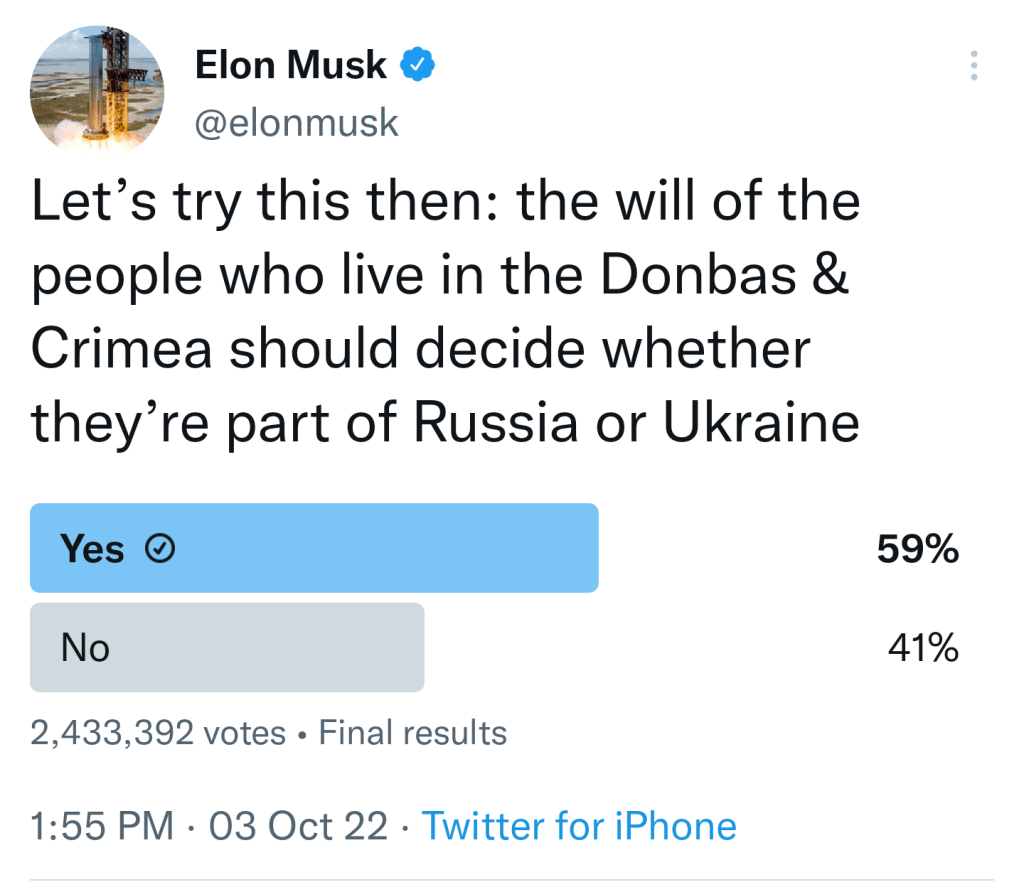
Elon Musk did what he does best and that is he disrupted the status quo. This time he took on the conventional argument that the war over Donbas must be fought to the very last Ukrainian.
His Tweets:
If you thought Trump was a mean Tweeter, you should see some of the nastiness in response to these polls.
Of course, social media midwits everywhere, full of sanctimony and rage, took to their usual easy explanation of any perspective that challenges their own: Musk is an idiot or Putin’s puppet and certainly doesn’t have the credentials to comment on geopolitics!
And yet Musk’s own call for resolution very closely mirrors that of Henry Kissinger from months ago who called for the government of Ukraine to come to the negotiating table and be willing to cede territory for sake of peace.
This is from an editorial written back in 2014:
The West must understand that, to Russia, Ukraine can never be just a foreign country. Russian history began in what was called Kievan-Rus. The Russian religion spread from there. Ukraine has been part of Russia for centuries, and their histories were intertwined before then. Some of the most important battles for Russian freedom, starting with the Battle of Poltava in 1709, were fought on Ukrainian soil.
Kissinger, a diplomat of diplomats, former Secretary of State, and a renowned foreign policy expert, is no slouch when it comes to geopolitics, and that his sage advice was so quickly dismissed says more about the true lack of understanding and blind fanaticism of the hardliners.
It seems that some are plain vengeance driven and would rather punish Russia than find a way to peace that would end the destruction and save countless lives.
The Boomer warmongers, the hawks like neocon Lindsey Graham or imperial-lib Joe Biden, are still very much stuck in the Cold War and would not think twice about sacrificing your sons or daughters for their latest power trip.
The United States has meddled in all parts of the world, both in form of covert CIA destabilization efforts to the too numerous to list overt brutal military invasions and occupations. The political establishment and military leaders of the West have never thought twice about bombing those who do not submit back to the Stone Age:
The racial dehumanization of the Vietnamese found its classic expression in the words of General Curtis LeMay, head of the Strategic Air Command, who said that America’s aim must be to “bomb the Vietnamese back to the stone age.” And Washington tried to do just that: From 1965 to 1969, the U.S. military dropped 70 tons of bombs for every square mile of North and South Vietnam — or 500 pounds for each man, woman, and child.
Of course, this was done in the name of “democracy” and “freedom,” which justifies all violence, right?
Anything said about Putin is a projection. The war in Ukraine is not completely unprovoked, as our own propaganda says. No, it is the direct result of the US and NATO interfering in Ukrainian’s domestic politics. Back in 2014, the late Senator John “bomb bomb Iran” McCain, along with our current Under Secretary of State, Victoria Nuland, planned who would replace Ukraine’s President *before* he was overthrown in a coup.
The US only like democracy so much as the votes are counted our way and freedom so long as it benefits our current political establishment or their sponsoring banks and big corporations—that’s just the truth.
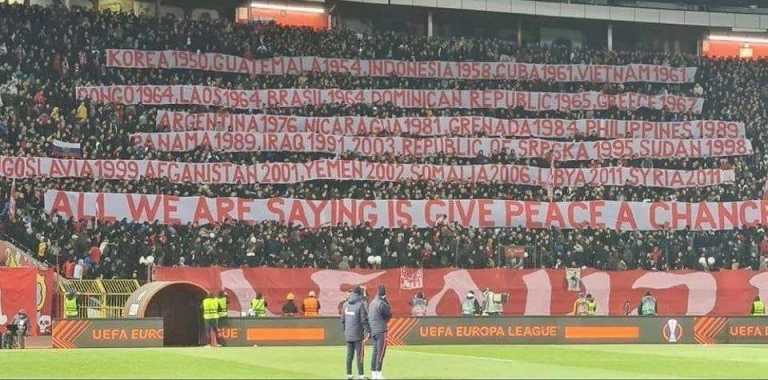
Like the jeering of our American hypocrisy by Serbian soccer fans—who saw their own country partitioned after NATO took the other side of the conflict, that of the separatists—holding a banner listing the dozens of places the US has attacked, invaded and occupied since the 1950s: “All we’re saying is give peace a chance.“
Composite materials are stronger than their component parts. When two or more materials of unique strengths are blended together the result can be a composite that has the ideal characteristics of all the parts. This is what makes concrete and rebar a formidable pair. The combination gives both the compressive strength of concrete and also the tensile strength of the steel. It is inarguable that diversity is not strength or at least when it comes to material science.
However, as all topics go, it does not end there. Boeing, like all builders of commercial airliners, has two primary goals (besides safety) in their designs: Lightweight and reducing costs. One of their innovations is the use of carbon fiber in their aircraft. The problem with carbon fiber is that it reacts with or is corrosive of aluminum. For this reason, they must use a separating layer of expensive titanium as the solution to this bad material pairing. It works in this case, but diversity is also a source of conflict and potential systemic failure.
Diversity: Good and Bad
First, the good. We’re all unique. I go to work with a group of people with slightly different abilities and backgrounds from my own. It is what allows us to specialize and thus be stronger as a team than if we tried to do it all by ourselves. I would rather Patty do the bookwork, the members of our sales team talk to our customers and stick to my role of designing trusses. This is where diversity is a great strength.
Furthermore, men and women are different, both physically and otherwise, which can make them an ideal pair. Only a male and female can produce offspring together. We can argue over the particulars or against sexist generalities, but there is something special about any diversity of characteristics that can lead to the creation of new life. It is ideal in other ways as well. One of this special partnership can provide and protect from outside threats, the other can nurture their children and organize their shared space. It can be the best of human arrangements.
Unfortunately, with the good comes the bad, and what can be the best of things can also be the worst. The gender wars, that endless battle for control between abusive men and their feminist counterparts, is how the most wonderful kind of diversity can go very badly and be anything but strength. Diversity is, therefore, also a source of deep division and strife. What can make a strong composite can also lead to corrosive interactions and unwanted drama. Sparks flying.
Homogeneity is our strength?
While the West, the ‘woke’ Anglosphere in particular, is obsessed with “diversity and inclusion” as the highest order of priority, not all in the world do.
Japan, for example, is very happy to remain Japanese and feels no need to host foreign refugees on their own ancestral lands. This homogeneity of their culture and ethnicity does seem to help to reduce the friction in their society. Crime is extremely low. During the disaster at Fukushima older engineers were willing to sacrifice themselves for sake of their younger kinfolk. And there’s just a sort of harmony that exists with everyone pulling in basically the same direction.
This has never really been the case in the United States There were wars between the natives and new arrivals. With every new immigrant wave arriving there was mistrust and contempt between these groups. It is what led to sentiments like this:
Only a damn fool can expect the people of one tradition to feel at ease when their country is flooded with hordes of foreigners who — whether equal, superior, or inferior biologically — are so antipodal in physical, emotional, and intellectual makeup that harmonious coalescence is virtually impossible. Such an immigration is death to all endurable existence and pollution and decay to all art and culture. To permit or encourage it is suicide.
H.P. Lovecraft
It is notable that Lovecraft, the famed atheist writer of existential horror, had his strong opinions about various races, including Italians and Jews. His racism, xenophobia, disgust over the intermixing of people or fear of contamination, has the markings of an obsessive-compulsive disorder. And yet he was not entirely wrong about the “melting pot” being chaotic and creating a place that’s lacking social cohesion.
It is no big surprise that after a decades long assault on policing and national symbols that, with the ‘woke’ takeover, military and law enforcement recruitment is falling off a cliff. Nobody, in their right mind, would ever sacrifice themselves for a country or cause that doesn’t represent them and their own values. Participation requires buying into the common vision and is not possible when there’s competition for that spot. Nobody wants to die for those who lack appreciation or are completely divorced from what matters to them.
Unequally Yoked: Understanding Biblical Warnings
There is a sort of distain, even amongst professing Christians, towards the Old Testament law. The various cleansing rituals, dietary prohibitions and other restrictions can seem to be quiet arbitrary our modern ears. Why does it matter if we mix several materials in our clothing, plant diverse seeds or crossbreed different animals?
First, I believe this was more about teaching a concept of Holiness or being set apart for good.
Second, it is a completely practical point about our greater potential when being of the same mind or spirit:
Can two walk together, except they be agreed?
(Amos 3:3 KJV)
Third, this principal didn’t end in the Old Testament:
Be ye not unequally yoked together with unbelievers: for what fellowship hath righteousness with unrighteousness? and what communion hath light with darkness? And what concord hath Christ with Belial? or what part hath he that believeth with an infidel? And what agreement hath the temple of God with idols? for ye are the temple of the living God; as God hath said, I will dwell in them, and walk in them; and I will be their God, and they shall be my people.
(2 Corinthians 6:14-16 KJV)
The whole point of Old Testament law was to reinforce the things that St Paul explains above, we cannot expect good results when we are paired with those who are pulling in a completely different direction. It’s simply reality, we need to have a boundary between ourselves and those who have nothing in common and want to destroy us.
Is Diversity Our Strength?
It depends.
I don’t think complete segregation of sexes or making all people androgynous is a good solution to gender difference. Nor should we erase subcultures in the name of unity either. We want diversity, we want people of different strengths. But there needs to be some kind of common identity or bonding agent, otherwise we end up with a bunch of competing identities and a fight for the supreme position. It takes a powerful adhesive to make composites work and this can mean a national identity that overrides all others.
Christ: The Ultimate Bonding Agent
All composite materials rely on some kind of bonding agent to work. And early Christians, likewise, were also trying to bridge some vast cultural differences. In fact, much of the struggle, in the early church, came down to the difference between the Jewish born and Gentile coverts. Should those newly converted, from non-Jewish background, be required to follow same requirements of faith or be exempted?
Therefore, remember that formerly you who are Gentiles by birth and called “uncircumcised” by those who call themselves “the circumcision” (which is done in the body by human hands)— remember that at that time you were separate from Christ, excluded from citizenship in Israel and foreigners to the covenants of the promise, without hope and without God in the world. But now in Christ Jesus you who once were far away have been brought near by the blood of Christ. For he himself is our peace, who has made the two groups one and has destroyed the barrier, the dividing wall of hostility, by setting aside in his flesh the law with its commands and regulations. His purpose was to create in himself one new humanity out of the two, thus making peace, and in one body to reconcile both of them to God through the cross, by which he put to death their hostility. He came and preached peace to you who were far away and peace to those who were near. For through him we both have access to the Father by one Spirit.
(Ephesians 2:11-18 NIV)
It is Christ who eliminates old social barriers:
So in Christ Jesus you are all children of God through faith, for all of you who were baptized into Christ have clothed yourselves with Christ. There is neither Jew nor Gentile, neither slave nor free, nor is there male and female, for you are all one in Christ Jesus. If you belong to Christ, then you are Abraham’s seed, and heirs according to the promise.
(Galatians 3:26-29 NIV)
So, diversity, if bonded in Christian love, can be an amazing strength. But, when lacking any kind of joint identity it is a horror show, it is corrosive. It leads to a bloody and violent competition for supremacy between rival groups. Without Christ it becomes man versus woman, black versus white, class versus class, and there is no strength in this kind of arrangement. The ‘strength’ of diversity is only possible when all, despite differences, are seeking after the exact same overall goal.
It is okay to have our own separate identities, even to celebrate our own cultural or ethnic heritage. But, when are being black or white, male or female, rich or poor, puts us at enmity with each other, when it is corrosive and causes is to react with hostility to those of a different perspective, then it must be brought under the Lordship of Jesus Christ and repented of rather than to be a source of pride. This is the higher order priority: “Let us therefore make every effort to do what leads to peace and to mutual edification.” (Romans 14:19 NIV) And, “over all these virtues put on love, which binds them all together in perfect unity.” (Colossians 3:14 NIV)
The following is intended both as serious and satire. The serious part is that the statistics are real, shortness is practically a crime. The satire is how little those who typically decry such things care about forms of discrimination not as popularized and yet as established in fact as any other.
Systemic heightism is everywhere. This discrimination against people on the basis of shorter than average stature is something that is deeply embedded into culture and our institutions. For men, in particular, it means a lifetime of being denied opportunities for some and height privilege for others.
Shortness and Statistics
In terms of available statistics, and actually proven discrimination, short men are most disadvantaged of any group of people both in history and modern times.
There is a distinct wage gap driven by height:
“…researchers estimate that each additional centimeter of height is associated with a 1.30% increase in annual income. In other words, a person who is 5 feet 6 inches making $50,000 per year would expect to make about $2,000 more if they were 5 feet 7 inches, and $4,000 more if they were 5 feet 8 inches.”
It isn’t only a matter of income either, but status: 90% of CEOs are of above average height. Try playing college sports, let alone get an athletic scholarship, if you’re below average height. Even in the Bible a man named Saul was made king simply for being taller than average. Meanwhile, David, a short man, was ridiculed, and had to literally kill a giant to prove his worth.
Many short men are never given the chance to prove themselves and this is especially true in the realm of romance. Women on dating sites openly, and rudely, dismiss short men writing in their profiles things like “must be 5′-10″ or over to ride.” Of course, most women are more covert in their height discrimination and simply ignore potential suitors who who don’t meet their requirements.
Some women say what others conceal, but the preference is proven in the numbers.
A 2006 study, by the University of Chicago, found that a man who is 5’6” needs an additional $175,000 to be as desirable as a man who is approximately 6′ tall and only makes $62,500 a year. Talk about an uphill battle. Not only do short men get paid less, on average, but they also need more money in order to get an equal opportunity to be considered desirable to women.
Deniers of systemic heightism try to explain away the discrimination by victim blaming. They will often claim that lack of confidence that is the real issue. However, this is adding insult to injury. A short man can’t even be confident without risking an attempt to diminish him on the basis of his height. An assertive tall man is considered to be confident, to have leadership potential, while a short man with similar qualities will often be accused of “small man syndrome” or having a Napoleon complex.
Napoleon was often pictured with his tall elite soldiers and not actually unusually short.
Even in language, terms like “great stature” indicate something good, while phrases like “short tempered” are indicative of a flaw in character. And not to forget those many common expressions, like “getting the short end of the stick” or “coming up short” that associate shortness with inadequacy or misfortune. There is even implicit heightism expressed in the statues of famous people being enormous in size. It is inescapable, ‘bigger’ is typically paired with ‘better’ and nobody cares about the harm done.
Over the course of a lifetime a short man will have endured being last picked in gym class despite his tenacity, friend-zoned by women who admire his character and yet are not at all romantically interested. He’ll literally be overlooked by his employers and routinely denied promotions. It will cost him years of his life. But there will never be reparations, never even be a bit of sympathy, because nobody sees shortness the same way that they do gender or skin color.
The Long and Short
We’ll never have social media campaigns to affirm shortness because it would just seem too silly, plus even short men (already self-conscious) would reject the effort. I mean who really wants to be praised, falsely, for a characteristic that makes less attractive than others? It is better to just deal with it, use the disadvantage as motivation, prove that a guy can be short of stature and still a bigger man than most. That is the best and truly the only way to overcome adversity, to show the world who you are.
Johnny Depp with bodyguards
Maybe this is why the most powerful and influential men are actually on the shorter end of the scale? Many actors and a significant number of billionaires are of average or below average height. Maybe it is because they knew that they would be overlooked without going 110% in everything they do? The long and short is that we can forever wallow in our disadvantage or we can turn it into a strength. No, it does not make it fair, nothing ever is fair, still nobody will ever come to the rescue of short men.
The worst thing we can do to anyone is pity them and make them dependent on our help to be actualized. It is the true racist, and the real sexist, who assumes that some need their help or uses their ‘sensitivity’ to such things for their own socal advancement, a person dealing honestly will value character above all else and not allow themselves to be biased one way or another, favorably or unfavorably, on the basis of outward appearance.
Elliott Rogers is a poster child of grievance culture and where he was the real problem.
In the end, hurting people come in all shapes and sizes. It is impossible to quantify and rank such things and completely a fool’s errand to try to compensate people for every disadvantage they face in life. Furthermore, in trying, we make the problem worse in that we actually reinforce the feelings and the perception of inferiority in those we’re trying to help. It also leaves those not receiving this special treatment, and as disadvantaged or more, feeling even more neglected.
Sure, absolutely, a little awareness of the unique difficulties some encounter can go a long way to helping. And yet grievance is often a tool used by toxic and controlling people so they can have their way without putting forth the required effort for success themselves. There’s a vast difference between pity dating a short guy and giving him a chance despite his lack of statute. We should help people because they are people, not because they tall or short, black or white, male or female.
Short men, by dwelling on their grievance, will only exasperate their disadvantage. It may be cathartic to whiny and complain, but it doesn’t bring a person closer to feeling accepted. Having ‘pride’ events, marches declaring we matter, even months where members are extolled, can never actually produce the legitimacy that those snared in their grievances crave. It is only in finding our identity in something else that we’re free.
I try not to get too political here. However, it is sometimes unavoidable, like those times when a prominent politician misuses the words of Jesus to justify spending 40 billion dollars so Ukraine has enough bombs. The verse used, Mathew 25:35, “when I was hungry you fed me,” out of the mouth of a multi-millionaire, comes off as slimy. It very closely resembles how Judas used words about caring for the poor as part of his scheme to line his own pockets. And, make no mistake about it, phony compassion is the favorite tool of the most shameless exploiters of our time. They are wolves in sheep’s clothing and love power more than truth.
True or false: The truth of the entire Gospel message depends on the bodily resurrection of Jesus.
I’m pretty certain that this is something that both Christians and non-Christians alike, after reading the Gospel accounts, would agree on. If Jesus remained in the grave, a dead man, then doesn’t that make the entire account of these books a lie?
Recently I was invited to watch a lecture by Gary Habermas, a professor, historian Christian apologist, and author of various books about Jesus. This after I had expressed a thought on how difficult this central claim of the Gospel would be to accept for a true skeptic. Presumably, this recommendation was to help me bridge the gap between the claims and reasons to doubt them.
It seems reasonable that Habermas, an expert who believes, would come out with his best argument. I mean, why waste an opportunity by holding the most solid proof of resurrection for a later date, right?
So, after watching, and taking notes, this is the outline of the arguments made along with my own counterpoints:
1) Most Contemporary Scholars Agree
Habermas spends considerable time talking about the changes in perspectives in the last 30-40 years in academic circles. Apparently, most theologians are conservative now and he cites a skeptic who has warmed to even the claims that the disciples saw Jesus after his death on the cross.
However, the first thing I see, when someone uses “experts agree,” is an appeal to authority, which can be a logical fallacy if being used as evidence of a claim. The fact that a majority of doctors had once believed that bloodletting was good therapy does not actually prove anything as far as the reliability of the practice.
So, to a critical thinker, this is a red flag. He is starting with an appeal that is not a true argument for his further claims or at least not any more than “a consensus of scientists believe” disproves the outliers who disagree with their conclusions.
Everyone else is here, can’t be the wrong place…
But, more than that, the devil is always in the details and there is a bit of a bait and switch in his presentation. The acceptance of any empty tomb is not the same thing as the real issue at hand which is resurrection. It is possible that something else could explain the disappearance. An empty tomb is not itself proof of the miraculous.
So what about this shift in thinking?
Well, it is no secret that the Western world is falling into unbelief, Christianity is losing influence, and to the point that the ‘liberals’ may have long left the room. In other words, it could be polarization, where nobody in the moderate middle ground survived, and thus only ‘conservatives’ see theology as being a worthwhile pursuit.
When something falls out of popular favor, like eugenics or white supremacy, then it is not really a big surprise when the hardliners are all that remains.
As a young person, I remember an Evolution versus Creation debate at a local university campus. Such an event would not even be hosted by such an institution. The 2014 Ken Ham vs Bill Nye rhetorical battle was held at the Creation Museum for a reason. And it is not because either of these men are taken seriously or viewed as credible by the mainstream.
The point is most people may simply have moved on and the plurality of those remaining, the current theologians, are the fundamentalists. There is much talk about the collapse of the center and this change Habermas mentions could be a product of that rather than anything related to the evidence.
We also have a resurgence of flat earth theories (and the rise of Socialism on the other) which is certainly not an argument for those beliefs. I guarantee more than 350 pages have been written in defense of Marxism and yet that does not convince me in any way, shape, or form that this ideology is the right way forward. No, this does not prove or disprove anything as far as the resurrection, but why waste time on this kind of appeal if there’s better evidence?
2) Paul Is Generally Accepted, Even By Skeptics
Of all the writings in the New Testament those of Paul, the Apostle, are the most compelling and probably because this man (despite his own claims to the contrary) is so eloquent in his presentation. I do find his focus on spiritual transformation to be more inviting than Mathew, Mark, or Luke. And also his ability to be the odd one out as far as important matters of the faith.
He was a controversial figure, even in the early church, and often put on the defensive by those fighting to preserve the Jewish tradition from Gentile converts. The account of his Damascus road encounter obviously convinced the right people of his change of heart. And this acceptance is significant, it is at least an answer to those modern-day Pauline skeptics, namely feminists and contemporary Judaizers, who would have us believe he was in conflict with Jesus.
That said, both Joseph Smith, the founder of Mormonism, and Muhammad claimed to have had dramatic encounters. Both were committed to these revelations they had received and able to convince a large body of people of these claims. It is always amazing to me how even a fundamentalist Christian can scoff at claims of angels delivering inerrant teachings or laugh off the flight to Medina on the Burāq, all the while accepting Biblical claims.
An undeniably beautiful image, right?
In short, I absolutely believe that Joseph Smith and Muhammad existed as real people. I also have no reason to doubt that they did not believe what they claim to believe or even that they had some sort of trip and conversion experience. But the truth of their existence and conviction does not mean their most extraordinary claims are actually reliable. It does not matter how many people recorded their lives or believed what they said.
So, of course, a man named Paul existed, and perhaps he did have an encounter with an apparition. I will accept that he was brought into the church. There is no reason to take issue with any of this. And I’m sure, if he was indeed out there killing Christians, this was a very welcomed development. And yet there are also those raised Christian who become Muslims or atheists. A conversion experience does not prove the extraordinary claims of a particular religion.
3) More Sources Than Alexander the Great
Habermas spends significant time in his lecture discussing the typical criteria for accepting a source. There is more proof of Jesus, according to what is acceptable by normal academic standards, than there is of Alexander the Great. Which is no surprise given that Jesus arrived on the scene later and spawned a religious movement through his teaching.
And yet while most everyone agrees that George Washington was a real person, that he crossed the Delaware river, this doesn’t mean that they must accept his ideological perspective or believe the mythology about the cherry tree. Historic texts, like reporting of events in our own time, can be almost entirely fact, yet also be embellished or just incorrect on details.
The biggest lies are always laced with facts. It is how so many people are snookered. A charlatan will make many credible claims to establish themselves. They may have credentials and compelling stories. The New York Times reporter, Walter Duranty, won a Pulitzer Prize for his glowing coverage of the Soviet Union. That he included many verified facts in his accounts does not mean his writing was not deceptive.
The reality is that extraordinary claims require extraordinary evidence. If I were to list off my activities for the day, that I went to Dunkin for coffee, to the gym after that, and then broke Usain Bolt’s 100 meter sprint time, would finding independent verification of the first two claims bolster the last claim that I’m now the fastest man alive?
Most of the Bible being reliable does not mean every claim being made is true. Being correct on a million mundane facts does not prove any of the most extraordinary claims contained. No, it does not even suggest we should be less skeptical. Maybe this makes some of us uncomfortable, but this is a normal burden of proof that we place on those who are outside of our own belief system, why not use the same standard for ourselves?
The big difference between Jesus and other historical figures is that nobody is telling me to devote my life to Alexander the Great. It is one thing to believe that Abraham Lincoln existed as a real person and a significant figure, and quite another to say that he resurrected from the dead and ought to be worshipped as God.
4) We Can Trace the Narrative Back
Most of the New Testament was written down long after the events took place, this is something generally agreed on by all sides, and Habermas does have an interesting response for those who would use this as a basis for skepticism. This, I believe, is where a general consensus is good enough. It is silly to argue that Jesus did not exist or that the narrative was entirely fabricated well after the fact.
Close is not the same as complete. Not even close.
And yet, again, this tracing narrative back, using catchy phrases to suggest that these things had been established early and then were passed along made me think of modern memes or protest chants that are created in response to real events.
Michael Brown, for example, was shot by a police officer in Ferguson, Missouri. Soon a phase, “hands up, don’t shoot,” became the rallying cry and is a short version of this idea that Brown was gunned down while simply trying to surrender. However, both a St Louis County grand jury and a US Department of Justice investigation cleared the officer of wrongdoing, the actual evidence points to the teen being in a physical altercation with the officer, and the catchy chants, therefore, are not an accurate representation no matter how popular.
The thing is, if we can’t get things right even days after the actual event, does gap or no gap matter?
It really does not.
5) Why Die For A Lie?
Joan of Arc was an extraordinary young woman. She managed to inspire her people to fight and is a wonderful icon of faith and courage. But eventually, she fell into the hands of the English, who had every reason to hate her guts, and they put her on trial for ‘heretical’ exploits. There is every indication that she was cooperative to the point that there was no justification for her execution and had likely been forced to violate the terms so they could kill her.
The martyrdom of the disciples of Jesus is something many Christian apologists tout as being hard evidence of the resurrection. As in who would die for something that they know is a lie? And this is indeed is proof of the commitment that these men had made to the Gospel message.
But let’s consider what happened to the Millerite movement when their prophecies about the Second Coming proved to be false. Did they give up their delusion or even entirely reject the teachers that had misled them? Some did. But, as with Harold Camping, who spiritualized the prediction post hoc rather than admit being wrong, this is what is now the Seventh-day Adventist denomination.
So why do people remain committed to something despite overwhelming evidence to the contrary from an outsider’s perspective?
It is this little thing called confirmation bias, we become emotionally attached to the things we believe and to the point of being blind to the obvious. As the saying goes, “A man convinced against his will is of the same opinion still.” And people who have had their belief system falsified will simply modify as much as necessary and then move on as if nothing happened. Why? Well maybe because it is too hard to start from square one, to admit being wrong, or perhaps because the community and values feel too important to give up?
So, since I have my skeptic hat on, and we already know that the disciples had been looking for a literal earthly kingdom, what is to say they did not pick up and run with an alternative rather than return to the lives they had before. I mean, even most agnostics will claim that Jesus was a good teacher, so this could be justification for building a mythology to sell this better way. For radicals the ends often justify the means, lying is not forbidden if for a righteous cause in Judaism.
Anyhow, if backed in a corner, if you’re likely killed even if you do recant, why not refuse to go along with what your persecutors want? I doubt Joseph Smith would have given his tormentors the satisfaction of admitting that he never had his angelic encounter. That doesn’t make Mormonism true. No, this is just how we are. Pathological liars are so convincing because they believe their own lies. What Jesus taught was revolutionary, people die for less all of the time.
Is That Really the Best We Have?
I know that I’m not going to win many fans amongst my Christian audience by giving an honest answer to the apologetics they offer. I’m sorry, it may work for many who already buy-in, it may be enough to convert a few, but I simply cannot be impressed.
That said, I do appreciate Habermas for his admitting that the Gospels do not always agree perfectly, and also admire those who can engage in the long form of argument too tedious for my own tastes.
Still, all said and done, these sorts of arguments can never span the gap between the extraordinary claims and the most capable skeptics. It is nibbling around the edges of proof and really only ever evidence that is convincing to those who come in with the right presuppositions—like those claims of the miraculous as an explanation to things not yet explainable.
In his questions and answers follow-up, Habermas mentions how many do not believe for emotional (rather than rational) reasons. He points to C.S. Lewis as someone who fell away from faith over the death of his mom before his eventual rise as a Christian thinker. However, the same is also true for why people believe. We want a world with purpose and meaning, and the Gospel narrative provides this. It is harder to give up a comprehensive belief system, even if it makes no truly testable claims.
It just feels like apologetics always relies on strawman versions of skepticism. Even if I fell totally into unbelief, I could never dismiss all of Scripture. But I also have seen, first hand, how incapable people are at getting the facts right, how they see what they want to see and delude themselves. I know because I’ve made the error of pursuing something, in sincere faith, that could be falsifiable and was forced to swallow the hard reality of my self-deception.
Most who profess belief in Jesus will never be so bold as to risk it all on something that can be disproven. They believe things that are written in a book, they attribute their good fortune to God’s goodness or try to accept the bad as being loving discipline, without ever putting it to the test as they would if they had actual faith. It is as if they hope if they never question then maybe the dream of eternal reward will come true and thus run from any chance of encountering a serious refutation.
The thing is if the resurrected Jesus needed to appear to Peter, James and Paul before they would believe, then why not appear to us all?
Is there an answer to this that doesn’t come off like an excuse?
It isn’t like the creator of the universe lacked the budget. And that the most important decision in our lives would come down to believing the eyewitness testimony of a handful of first-century men, this seems rather odd. Don’t get me wrong either, the Biblical narrative is quite fascinating, the miracles, angelic visits, and promise of life after death to those who believe, it is wonderful. The teachings of Jesus have led to a more compassionate era. Still, the claims like the virgin birth, walking on water, and raising the dead aren’t exactly things a rational person would accept without seeing these miraculous events for themselves.
The biggest problem with the apologetics of Habermas is that it relies on a false dichotomy. A reader doesn’t need to be able to accept that a source is perfectly reliable to believe some of it is true. There is a multitude of possibilities as to why the disciples would go with the resurrection narrative. First, it is much easier than saying they wasted their last few years. Second, it sells the teachings of Jesus better than anything else. And third, it can’t be falsified, how does anyone disprove what they claim to have seen?
The possibilities are endless.
This is not to say that the disciples were delusional or lying either. My point is that it is too easy to see an argument as being stronger than it is. It is annoying, perhaps, that we can’t rely on apologetics to do the heavy lifting of the Gospel, nevertheless, the only resurrection of Jesus many people will see is that which is embodied in us. What that means is self-sacrifice and bridging the gap of unbelief with the substance of love.
Talk is easy, actually taking up the cross is not…
When a convoy of trucks descended upon Ottawa to protest the imposition of mandates, Justin Trudeau, the ever so prim and polished Canadian Prime Minister took to the screen to disparage the effort as a “small fringe minority” with “unacceptable views.”
If that sounds like a school teacher scolding a class of 8th graders, that is because teaching was Trudeau’s former occupation before being elected to office on the basis of his good looks, smooth speech, and all-around nice guy appearance. There is a certain demographic that swooned after this young charismatic figure, despite his far-left disposition.
Of course, what works in the classroom doesn’t necessarily make the best approach for leading a diverse nation. A teacher is an authoritarian, they rule over the children either buy their superior knowledge or simply by the hierarchical structure needed to keep order in a school. But that’s not how a liberal democracy with elected representatives is supposed to work.
It is not Trudeau’s job to decide what views are and are not acceptable. And that is the very tone that is starting to provoke a response. People are getting tired of politicians, with no moral authority (see: Trudeau in blackface) or real expertise forcing them to comply and lecturing them about what views are or are not acceptable.
It is fitting that a chaotic sea of truck drivers has risen up to challenge this would-be dictator. Ironically, 90% of the drivers are already in compliance according to Newsweek, and yet they are standing up for their rights as Canadians and saying “enough is enough” after two years of being pushed around by those who have long ago overstepped their mandate to govern.
What Makes A Truck Driver Special?
There is some truth to the idea that truckers are on the fringe. The word “fringe” carries a negative connotation when used in a political context, but is defined generally as “the border or outer edges of an area or group.”
Truckers are strong and independent people who face brutal extremes so that those within the borders of their effort are protected.
Like feminine traits (like compassion and nurturing) are ideal for careers like nursing or teaching, it takes a rugged masculine individual to go out and brave all weather and conditions. Truckers occupy that space between order and disorder. They deal with mud, freezing cold and ice, long hours. They can be out weeks at a time, sleeping in a box behind the cab, living in a solitary space so that everyone else can have their comfortable lives.
It doesn’t matter how you feel when there is work to be done. A trucker’s life is pass or fail. Either you clear the snow off the dump trailer tarp and get loaded or you don’t get home. There is no one to hold your hand, nobody out on the edge in this wilderness cares that you’re offended. You’re on your own, buddy, and better be able to deal with loneliness, make your own decisions, overcome the disorder, and find a way to get moving again.
At the same time, a trucker, a real trucker, is not just a dumb brute holding a steering wheel. They need to understand the machinery that they operate, how to properly secure and balance their loads, how to predict their trip and make their appointment times, many are small business owners and need to keep up with the onerous compliance regime imposed upon them.
Professional truckers are some of the most meticulous and detailed people when it comes to their work and their vehicles. Many spend their free time shining the rims, their weekends doing maintenance work, and are extremely skilled.
One skill truckers have is the ability to think for themselves. They form their own opinions and aren’t going to be pushed around by the popular narratives and certainly not by some coward who will not face them while still collecting a check at taxpayers’ expense.
Meanwhile, truckers go out on the road every week to keep the economy going and support their families, facing adversity on the open road and now in front of the parlament, it is costing them a great amount of money to stand up for freedom.
Which is the true form of a truck driver: They are self-sacrificial.
The Contrast Of Fringe Minorities
Political elites and truck drivers occupy opposite sides of society and only one of them is essential. Truckers could survive, on their own, without Trudeau to lead them and may actually do better without the expense of bloated governments bearing down on their shoulders. The elites, on the other hand, would not be able to live their lifestyle without the workers.
For years, especially the past two, the privileged elites, with their access to political power and ability to broadcast their opinions, have encroached more and more on the freedoms of their fellow citizens. Even before the outbreak of disease they always had a ready excuse why their influence and control should be expanded. They will have us believe that they “follow the science” and represent the expert opinions, that they are more qualified.
And yet, these people at the topmost fringe of the social hierarchy often are far removed from the practical implications of their policies. They may say things like “we’re in this together” and pretend to be one of the people when that is convenient to their ends, yet they never do suffer to the extent that those at the bottom do. In fact, there are many pictures of politicians, who issued strict restrictions, not following their own rules.
It would be one thing if they had faithfully led by example, refused to travel and go out themselves, or at least did not hypocritically attack leaders who allowed freedom while they indulged themselves, but it was always “rules for thee and not for me.” They scared and coerced everyone else into compliance, economically ruinous policies for small businesses while being totally exempted from the pain they inflicted.
The truckers, by contrast, simply did their job, rain or shine, deadly virus or not, delivering the goods that are necessary for civilization to exist. And for this, they are mocked, falsely (and bizarrely) characterized as being racist or sexist for standing up to the rich powerful corporate and state actors. I mean, maybe the media thinks that we don’t see the Sikhs or Native people cheering on and joining their fellow Canadians?
How anyone continues to see these fusspot fakes as being credible is beyond me. But then many are divorced from the harsh realities beyond the safe spaces that others provide for them. Unlike truckers, they are controlled by fear, suffer from a kind of Stockholm syndrome where they believe that those exploiting them (for political or other gains) are their protectors.
The elites are the fringe in Canada. The majority of their countrymen want the restrictions to end and thus, spiritually, are on the side of the truckers rather than Trudeau. Sure, many have been misled by corporate media and mischaracterizations of the trucker convoy by those trying to cast this protest in a negative light. But more are starting to see through the blinders of partisanship and propaganda, they should go meet the friendly truckers.
Do Not Muzzle The Ox
St. Paul, on several occasions, makes reference to Deuteronomy 25:4, the law of Moses: “Do not muzzle an ox while it is treading out the grain.” He uses it in the context of being allowed to work for pay and applies it as a general principle. So much for strict literalism and lawyerly application, right?
The ox treading out the grain is used as an analogy of a worker. It is wrong to deny the ox some of the fruit of their labor and it is also wrong to deny a person their fair wages. It makes sense, we should treat those working for our benefit with appreciation and respect.
Sure, a draft animal might not be the smartest creature. But it does deserve what it is due.
And, speaking of muzzles being removed and speaking out against unjust beating, remember the comical story of Balaam’s donkey, where self-important Balaam has a conflict with his transportation. The donkey, seeing an angel with a sword in hand unseen to Balaam, refused to continue down the path and for this suffers abuse. This happens three times before God finally allows the ‘dumb’ animal to speak:
Then the Lord opened the donkey’s mouth, and it said to Balaam, “What have I done to you to make you beat me these three times?
”Balaam answered the donkey, “You have made a fool of me! If only I had a sword in my hand, I would kill you right now.”
The donkey said to Balaam, “Am I not your own donkey, which you have always ridden, to this day? Have I been in the habit of doing this to you?”
“No,” he said.
Then the Lord opened Balaam’s eyes, and he saw the angel of the Lord standing in the road with his sword drawn. So he bowed low and fell facedown.
(Numbers 22:28-31 NIV)
The hilarious part is that the donkey starts to talk back against the abuse and yet that’s not enough for arrogant Balaam to stop and reconsider.
The donkey, like our trucker friends, reminds his rider that he has been completely reliable up until that point, never complained or caused problems, and was refusing to continue for reasons that his master could not see.
Balaam had spiritual blindness, too caught up in his own dignity, assuming his own superiority to the animal, and was very fortunate to not be killed. The Bible is full of stories about tyrants who refused to listen to the people under their rule and suffered severe consequences.
In a time of mask mandates and slanderous lies against the working class ‘deplorables’ it seems fitting that those of spiritual vision stand up together with the Canadian truck drivers.