We had one of the best running backs in the state and had successfully run many toss sweeps during the year—probably a dozen times every game.
It was the first round of the playoffs, and up against a rival that we had beaten handily earlier in the season. The O-line dropped into their stance, the quarterback took the snap as our star took his step right, and—oh no!
A linebacker, who had timed the cadence, anticipated the toss, plucks the ball out of the air, and a few seconds later turned this defensive prowess into six points. And we never recovered. We lost.
This is where the expression, “going to the well one too many times,” comes from. A play can work hundreds of times, it can be the go-to option—until that one time when it becomes too predictable and the other team takes advantage.
Click here for a very similar play, not my own team, but close enough to trigger the bad memories.
Yes, Poles Can Shift
One of the big misunderstandings of current trends there is that they will go on forever. If one is part of the cult of progress, change is seen as a march forward. To the traditional there are endless cycles and seasons, the sun goes up and down. To the cynical, humanity is on a downward trajectory, this slippery slope of social decay and spiral to the collapse of civilization.
In almost every case people expect that the current rules (or roles) can’t be flipped. The winners today will keep on winning or what worked yesterday will keep on working as it always did—ad infinitum.
But long-term trajectories do change, cycles can be broken, powerful empires faded away into nothing and there have also been those massive breakthrough-type events that have completely changed expectations. North is North, the compass is true as it always has been, and yet there is evidence that even this magnetic reference can flip.
Things can go one way for a long time and feel very predictable and unchangeable. But in one moment some threshold is crossed that upends the well-worn expectations. The end of the epoch. A critical mass is reached, the dam is finally breached, and the established paradigm blows up, and is washed away, like the linebacker running with the ball after picking off the toss.
Of course, in retrospect, we all claim to have seen it coming, that the signs were there, but few actually do. If we did we would have invested better, acted differently, and taken full advantage.
Please Capitulate, Charlie!
In the Peanuts cartoon, there is the infamous football gag. Lucy tells Charlie that she’ll hold the ball for him to kick and, despite her having tricked him many times before—by pulling the ball away right as he is wound up to kick, he is always fooled again.
Retail investors capitulating to short sellers.
This is how institutions have treated retail investors in the stock market. In the past, when the market would downturn, the ‘smart money’ would short popular stocks, then spread FUD through hired shills to scare their ignorant counterparts who would then sell at a loss and move on. When this retail capitulation would finally happen the market would finally be ready for the next cycle.
But now, in the meme stock era, the ‘Apes’ or those who learned from the 2008 crash, now hold, buy the dip, and refuse to sell. This is not what the hedge funds and big banks had planned when they started to short AMC and GameStop. They had planned to drive these companies into bankruptcy, and collect on their bets. Instead, after over a year and a half of price manipulation (FTDs, dark pool abuse, naked shorts) and bashing, the selling has not happened. This means they need to continue to pay the interest to maintain their short positions.
He’s hoping to wish this into reality…
It is a battle of wills, one retail rallying call being “I can be retarded longer than they can remain solvent,” and retail does control all of the exits in some heavily shorted stocks. If retail does not throw in the towel, eventually the institutions will run out of new ways to kick the can down the road, they will get margin called and will have to cover.
At this point, retail investors have figured out the game. They know how bashers are paid to scare them, they know how the price is manipulated, and they’re angry and not going to do what they’re ‘supposed’ to do. Apes are not leaving. And, at this point, this is a movement to expose the corruption in the market rather than simply an investment in a company we like.
If you want to be part of this history AMC and the new preferred equity called APE are trading for mere dollars. You can even get free stocks by opening an account following this link. This blog is not financial advice and investment is a risk, but we would love to have you as part of the Ape fam.
Maybe the pole shift won’t happen. Maybe Lucy has another trick up her sleeve. The future can’t be predicted. But we can be certain that trends almost always come to an end. Retail investors are no longer as easily fooled. This time Charlie Brown isn’t playing the game as expected.
I’ve had so many people tell me that I’m a great writer and should be getting paid to do it. But, thus far, I’ve had no real ideas how to monetize this talent and it can be frustrating at times. Anyhow, right now, due to some medical bills, it would be nice to be able to earn some extra income and that’s why I’m making this request to share this post. If enough people do, maybe the right person will find this blog and give me an idea of where to put my abilities to use. Note, most of what I do here is completely unedited and written on my phone in my spare time. If I was doing this as a professional I would do more to get the grammar right. My interests are history, current events, politics, theology, psychology and any practical application of such things. Maybe I could be someone’s speech writer or do a column?
Your suggestions are welcomed! I would really love to hear the personal experiences of writers who get paid.
And, of course, likes and reshares are certainly appreciated!
It is very common for the the very wealthy and politicians to start foundations for a charity or cause. This is both a publicity coup and also an opportunity to raise cash under the auspices of a greater good. But very often it is more cynical than sincere and probably for the tax breaks or as a money laundering scheme more than anything else, in some cases these organizations spend all of their donations on administrative salaries and not the stated mission.
Virtue signaling is a social phenomenon where a person, with a very small actual personal investment or self-sacrifice, can gain a great benefit or standing amongst their peers. This can include social media activism, yard signs declaring virtue, and any other low effort high reward way that people try to distinguish themselves as better than their neighbors. It is more often token giving or symbolic compassion, lacking substance, and is something that Jesus encountered and condemned.
Good Samaritan and Poor Widow Versus the Rich Boastful Givers
Most of us are a mixed bag of motivation, we can intend good and yet too often our self-interests corrupt the effort. The greater problem being that we’re not even ourselves fully aware of our hidden ambitions. We can easily and do often delude ourselves about our own righteousness compared to others, especially our ideological enemies and truly be more exploitative than those who we would condemn. The teachings of Jesus are an opportunity for self-reflection, a chance to grow in self-awareness and learn about how true compassion compares to the phony variety and counterfeit virtue.
First, consider the example of a boastful virtue signaler:
“Be careful not to practice your righteousness in front of others to be seen by them. If you do, you will have no reward from your Father in heaven. “So when you give to the needy, do not announce it with trumpets, as the hypocrites do in the synagogues and on the streets, to be honored by others. Truly I tell you, they have received their reward in full. But when you give to the needy, do not let your left hand know what your right hand is doing, so that your giving may be in secret. Then your Father, who sees what is done in secret, will reward you.
(Matthew 6:1-4 NIV)
It is fairly obvious, in this extreme to make the point, that this hypocritical giver is in it for themselves. They want the attention and good publicity, they desire the honor of their peers, and it isn’t truly about the needy who are receiving the help.
Here’s the genuine article:
Jesus sat down opposite the place where the offerings were put and watched the crowd putting their money into the temple treasury. Many rich people threw in large amounts. But a poor widow came and put in two very small copper coins, worth only a few cents. Calling his disciples to him, Jesus said, “Truly I tell you, this poor widow has put more into the treasury than all the others. They all gave out of their wealth; but she, out of her poverty, put in everything—all she had to live on.”
(Mark 12:41-44 NIV)
It is nothing for a billionaire to write a million dollar check. It is nothing for a politician to promise billions from the public treasury as a ‘sacrifice’ for a supposedly just cause. But, in both cases there is often a big political or social reward for this ‘charitable’ act, it can mean reelection or personal access to even more resources. But, in this example above, this poor widow put in 100% and got nothing in return—at least not in the short-term. Her sacrifice is more condemnable and true than those dumping a fraction of their excess.
And then there is the classic case of the good Samaritan:
On one occasion an expert in the law stood up to test Jesus. “Teacher,” he asked, “what must I do to inherit eternal life?” “What is written in the Law?” he replied. “How do you read it?” He answered, “ ‘Love the Lord your God with all your heart and with all your soul and with all your strength and with all your mind’; and, ‘Love your neighbor as yourself.’” “You have answered correctly,” Jesus replied. “Do this and you will live.” But he wanted to justify himself, so he asked Jesus, “And who is my neighbor?” In reply Jesus said: “A man was going down from Jerusalem to Jericho, when he was attacked by robbers. They stripped him of his clothes, beat him and went away, leaving him half dead. A priest happened to be going down the same road, and when he saw the man, he passed by on the other side. So too, a Levite, when he came to the place and saw him, passed by on the other side. But a Samaritan, as he traveled, came where the man was; and when he saw him, he took pity on him. He went to him and bandaged his wounds, pouring on oil and wine. Then he put the man on his own donkey, brought him to an inn and took care of him. The next day he took out two denarii and gave them to the innkeeper. ‘Look after him,’ he said, ‘and when I return, I will reimburse you for any extra expense you may have.’ “Which of these three do you think was a neighbor to the man who fell into the hands of robbers?” The expert in the law replied, “The one who had mercy on him.” Jesus told him, “Go and do likewise.”
(Luke 10:25-37 NIV)
Not only was this a great answer to a trap question, but the Samaritans were the low class and looked down ‘deplorables’ of their day who lacked the right pedigree to be the social elites. The priest and Levite, on the other hand, were the important and looked up to. They would be the religious bloggers of their day, preaching about the equivalent to social justice or other popular ‘righteous’ things, but made excuses for themselves and looked the other way when their love was tested.
The good Samaritan’s love was genuine. It was not announced to the world. It was not only a gesture or incomplete aid. And, more importantly, he gave completely of his own resources. There was no GoFundMe or calls for others to see the need and help him to distribute the cost. Nope. He saw the need, he dug into his own meager resources, and finished the job without any need of the help, attention or affirmation of others. Only this poor beaten man knew of his goodness.
The teachings of Jesus are always always about changing us, as individuals, and not the systems of the world. The priest and Levite, like the unnamed rich man of Luke 16 (who stepped over a poor very sick man on his doorstep, named Lazarus), all had their important things to do. They were the social elites and responsible people. In their own minds they had justified their response to the need directly in their paths.
Giving Self-sacrificially Is Christian Love, Forcing Others Give Is Not
Modern Western ‘democracy’ is full of virtue signaling and a favorite thing to do is decry the ‘racism’ of denying entry to the unvetted masses driven to our borders. It is the one issue where those who call out the “Christian nationalism” of their neighbors suddenly will find Jesus—albeit only to distort and use His words to bludgeon others, like Judas.
Now, before I get too far in, I do believe there are many who do have genuine compassion and care for refugees. Indeed, it is Christian duty to welcome the stranger and even invite them into our homes. My grandma was one of these open-handed people. No, they did not have that much themselves and yet her table was always open to those who needed a warm meal. This is the charity Jesus was talking about, not a social program.
Politicians will routinely make a display of the vulnerable as a cynical ploy to promote agenda. It is not out of love, it is simply a way to exploit our pity and silence objections to what is often a cover for a power grab. It is always “think of the children” when they are the true beneficiaries. They call for the “rich” to “pay their fair share” while having an abundance themselves. They may want to change the world and yet should start by changing themselves.
Again, I’m not saying that social activists are not well-intentioned. And yet I will say that they might not comprehend the costs that they incur on others (some who have less than them) nor fully consider the complexity and consequences. It is one thing to want to fix climate change or have a world free of borders, but quite another to pay the price for these ambitions. Many want to ride the compassion bandwagon, few want to be in the mud pushing this load of crocodile tear crying virtue signaling fools.
We have an inversion of Christian morality in the West where now the ‘first’ are demanding the ‘last’ pay for their virtuous acts. It is our most powerful, wealthy and privileged, who hold the money bag like Judas, demanding that common folk sell all to give to the poor while they keep their private jets, mansions and lavish lifestyle. The poor now subsidize the ‘compassion’ of the rich and many seem not to see how perverse this really is.
It is bad enough to give only for the attention of others. But, to guilt, shame or force those with less to subsidize your own altruism and compassion? That is a whole new level of self-serving, psychopathic and evil. It was always those confronting Jesus, and His followers, tithing even their spices, going to these extremes impress and try to establish a themselves as better than. Today it is the same, it is those who proudly preen their love and tolerance who are oftentimes most selfish and cruel under their costumes of righteous.
The Cruelty and Compassion of Martha’s Vineyard
Border states are being overwhelmed by the flow of unvetted migrants. But, for the most part, this growing humanitarian crisis has been ignored. Out of sight is out of mind for most people and this has been the case on our Southern border. I’m not a big fan of political stunts and yet sometimes to make others aware of an issue does require a little creativity or some coloring outside of the lines to illustrate the point to those in denial or oblivious.
And there was outrage, wild accusations of cruelty, even human trafficking, when Florida governor, Ron DeSantis, provided free airfare for fifty migrants from a nasty red state to a very blue Martha’s Vineyard.
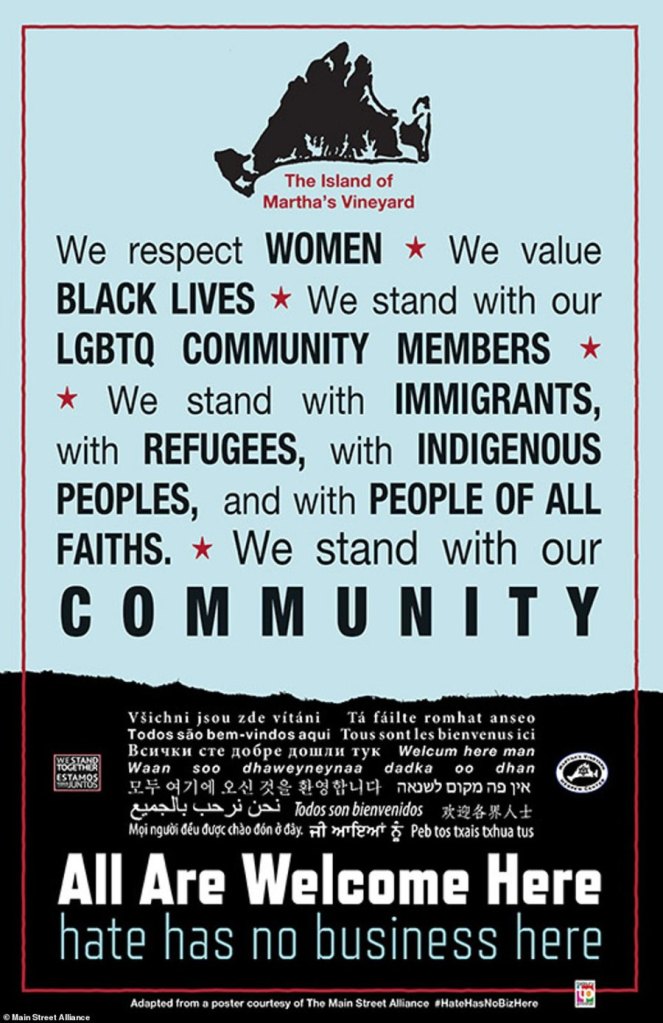
For those who do not know, Martha’s Vineyard is a popular hangout for the very wealthy and most privileged—an exclusive enclave where these social elites have their summer homes. And, yes, ironically, while most of us could only ever get on there real estate as the help, they do have those virtue screaming “all are welcomed” signs. How this free ride to this liberal “sanctuary city” is cruelty, I’ll never know, but how quickly the new arrivals were deported tells a bit of the true depth of the compassion under their righteous bluster.
Interestingly, the Biden administration has also sent new arrivals to interior cities, less resource rich, and never had been accused of human trafficking or cruelty for this. But apparently, when you send these people to one of the wealthiest and most privileged enclaves in America, that claims to be a sanctuary city and welcoming of all, it is a terrible crime. Or, in the eloquent parlance of a “founding member” of an organization to help refugees, this is throwing your “trash” in someone else’s neighborhood:
Cognitive dissonance anyone?
I mean this blurb takes the cake. The lack of self-awareness to say, let alone publish, such a statement is astounding. The media has glowed at how these resource rich people fed these asylum seekers for a day, but has yet to speak of the cruelty of these new arrivals being deported from the exclusive island within 24-hours. Apparently nobody had room in their mansion or second home to provide long-term shelter?
But the whole ordeal is a classic example of what virtue signaling is and how it is vastly different from true compassion. A virtue signal is all about a person trying to glean the social benefits of holding the correct beliefs or the good deed and requires very little actual sacrifice. While the cameras rolled, the hot food trays came out and the picture looked very virtuous. And yet, rather than keep on caring, they literally called up the National Guard and almost immediately offloaded the expense to the taxpayers.
The people who could afford to build brand new houses for all fifty sent, who could have easily created a place for them in their own community and made real on the “all are welcomed” sign, only had a minor day long inconvenience. They’ll probably spend more on litigation, against the state of Florida, than they did on this fortunate handful of the thousands pouring into this country every day and overwhelming the resources of border states. So the compassion is fake, they claim the moral high ground while others shoulder the costs.
Compassion Claimed, Costs Diffused
Costs don’t matter to the privileged and social elites. They have never had to pay for anything themselves. As trust-fund babies or politically connected, they could always snap their fingers and someone else would clean up the mess behind them. So, yes, of course they will support open borders for us, proclaiming the virtue, and the Levites (story of the good Samaritan) will simply follow their example. Others bear the cost.
What are the costs?
Wage suppression. Old Socialists, in contrast to the wealthy factory owners and industrialists, always wanted strict border controls. Why? Well, because a never ending flow of low skill labor takes the feet out from under those trying to bargain for better compensation. And this is a real problem in the South. Why hire from the local population, with the legitimate process paperwork, when you could pay half the money to an illegal immigrant, under the table, and they dare not complain?
Another cost is to the local government resources. A flow of unvetted immigrants, even if most are very good people, is a huge burden and much more than some catered trays brought out for the eyes of the media in New England. There’s the need for ESL teachers and more classrooms, additional policing, the welfare benefits, and the tab for this is not distributed evenly despite some Federal aid. And that’s not to even mention the quality of life issues. No, immigrants aren’t trash and yet they do bring problems with them. The states in the South are overwhelmed.
But the real cruelty and inhumanity of all this is how much work it is for some to enter this country while others can just jump line and be treated as victims. While political elites talked about family separations, a necessary precaution to establish the identities of the adults and prevent human trafficking, I could not even travel to be with the child who calls me “daddy” and my love. As one of those going through this expensive and completely frustrating process, with the trash websites, poor communication and the many tons of requirements, I know.
If you do not have equal love for the MAGA hat wearing ‘deplorable’ that American, living in the rust belt, having to bear the cost of your ideal, then maybe your love isn’t all that real. True love shoulders the entire cost, it never tells others to make a sacrifice for sake of our own compassion. We should welcome the stranger, yes, but we must also love our actual neighbors and give our all before asking anything of others. It is not love to virtue signal, it is just another form of ignorance.
We hear it all of the time, from the political far-left, that Jesus was a Socialist. While I believe it is mostly a schoolyard taunt, from those who are basically irreligious, the claim itself is worthy to be examined. Was Jesus, through his focus on the poor, downtrodden and marginalized, basically in agreement with the politics of Karl Marx and the Socialist far-left?
Was Jesus a Socialist?
There is a valid critique of American love of money and consumerism. This obsession with material gain is repackaged as the false “health and wealth” Gospel, that is preached by some who could be classified as being Evangelicals, and should be rebuked. It is also very disturbing when those who profess Christ seem to care more about the bottom line than the welfare of those whom they employ. All of this goes against the true Gospel of Jesus Christ.
So, in seeing the sins of those who enjoy the prosperity of Capitalism and how there is a lack of care for the poor, as is clearly a part of what Jesus taught, some see Socialism as the solution. Socialism, using the most basic definition, is redistribution of wealth and could sound a lot like Christian charity to those who only have a few Biblical proof-texts or nominal understanding of the Gospel.
But there are key differences that make it impossible to reconcile true Christianity and Socialism. Yes, some of the practical ends may be similar, but the means and driving philosophy are entirely opposed. Here’s an outline of some of the differences:
1) Jesus Yields Power, Socialists Demand It
Jesus, during his temptation, was offered the kingdoms of the world. He could have taken over all world governments and then installed a redistributive regime, so all the poor had their needs provided and there would finally be justice. And yet He rejected the offer, and instead Jesus picked the way of the cross and lived the example of self-sacrificial love. This is a very stark contrast to Socialism, where promoters of this leftist ideology feel entitled to power and will take to the streets to protest and demand what they think they should have.
Jesus was meek, and this is what He told his followers about those seeking to control others:
Jesus called them together and said, “You know that the rulers of the Gentiles Lord it over them, and their high officials exercise authority over them. Not so with you. Instead, whoever wants to become great among you must be your servant, and whoever wants to be first must be your slave— just as the Son of Man did not come to be served, but to serve, and to give his life as a ransom for many.”
(Matthew 20:25-28 NIV)
Socialists seek political power, and the ability to bend others to their will, but Jesus taught that empowerment comes by giving up our rights and serving others.
2) Jesus Taught Personal Responsibility, Not Collective Action
Every verse quoted in support of Socialism is directed at the individual. In other words, when Jesus said “sell all and give to the poor” he was speaking to specific individuals and not endorsing a collective movement to take from others to provide for the poor. His words are not about creating a system or using state power to compel others. Socialism, by contrast, is all about coercion and using the power of the collective to force others into compliance.
Everything Jesus taught is for his followers to do personally, for our own salvation, not so we can go around Lording over and guilt-tripping others:
“Then the King will say to those on his right, ‘Come, you who are blessed by my Father; take your inheritance, the kingdom prepared for you since the creation of the world. For I was hungry and you gave me something to eat, I was thirsty and you gave me something to drink, I was a stranger and you invited me in, I needed clothes and you clothed me, I was sick and you looked after me, I was in prison and you came to visit me.’ “Then the righteous will answer him, ‘Lord, when did we see you hungry and feed you, or thirsty and give you something to drink? When did we see you a stranger and invite you in, or needing clothes and clothe you? When did we see you sick or in prison and go to visit you?’ “The King will reply, ‘Truly I tell you, whatever you did for one of the least of these brothers and sisters of mine, you did for me.’
(Matthew 25:34-40 NIV)
In the passage above there is no mention of what is done on our behalf, instead, it is all about who we invited in, and who we personally provided for and visited. In Socialism, these tasks are delegated, turned into systems or state programs, and established by force of law. But in Christianity giving to others is always for us to do voluntarily, as willing individuals, and coordinated by the Church never the secular state.
3) Christianity Is About Community, Not Mandates
Christianity is Communal, a community of faith. Socialism is about forcing people to give of themselves through taxation and threats. A community is voluntary, never forced, and the Christian community is centered on the Church rather than the government. Yes, early Christians gave to help each other, some even had “all things in common,” as we read in Acts. But this was never a requirement. The real point is not about money either. No, according to Jesus, are supposed to leave everything behind in pursuit of Him:
And everyone who has left houses or brothers or sisters or father or mother or wife or children or fields for my sake will receive a hundred times as much and will inherit eternal life. But many who are first will be last, and many who are last will be first.
(Matthew 19:29-30 NIV)
Christianity means giving up everything, not just our wealth, to follow after Christ and build His kingdom. Christianity is about a family of faith, a community centered on Christ. The welfare state, by contrast, has destroyed families and made many dependent rather than free. As with the passage above, Christianity is about being ready for eternity, whereas Socialism is all about what we can gain for ourselves in the here and now.
4) Kingdom Focus, Not Utopian Idealism
The first to distort the point of the Gospel message were the disciples themselves, they had pictured a Messiah that would overthrow their Roman rulers and give them power over their abusers. They wanted a worldly kingdom and thought they would soon rule over their enemies. But Jesus subverted all of these national socialist ambitions. He wasn’t there to eliminate poverty, or to challenge the political and economic regime, but rather there to point people toward true worship:
While Jesus was in Bethany in the home of Simon the Leper, a woman came to him with an alabaster jar of very expensive perfume, which she poured on his head as he was reclining at the table. When the disciples [led by Judas according to the Gospel of John] saw this, they were indignant. “Why this waste?” they asked. “This perfume could have been sold at a high price and the money given to the poor.” Aware of this, Jesus said to them, “Why are you bothering this woman? She has done a beautiful thing to me. The poor you will always have with you, but you will not always have me. When she poured this perfume on my body, she did it to prepare me for burial. Truly I tell you, wherever this gospel is preached throughout the world, what she has done will also be told, in memory of her.”
(Matthew 26:6-13 NIV)
Socialism is humanist. It is motivated by this desire to create a perfect world through the use of political power. But Jesus said that poverty can’t be eliminated and he rejected the utilitarian impulses of the disciples (led by the thief named Judas) who had twisted the teachings of Jesus about giving to the poor. Jesus answered their indignation over waste by recentering on worship. Our giving is to point people to God. Socialists, on the other hand, worship the state.
5) Socialism Is Motivated by Envy, Christianity by Love
The most valid claim against Capitalism is that it is all about money and greed. People present Socialism as being an alternative and yet it really is only a different form of the same thing. Socialism is about power and envy, as much as Capitalism is about self-interest. But, unlike Capitalism, where the means of production are attained by work or negotiation, Socialism is always maintained through the use of coercion and force. So, although the rich Capitalist may be guilty of many sins, it is a corruption of the free market to take from others by deception or fraud, whereas you can’t have Socialism without manipulations and violence.
A person can own Capital and be Christian, but they can’t be full of jealousy, envy, or judgment towards others:
The acts of the flesh are obvious: sexual immorality, impurity and debauchery; idolatry and witchcraft; hatred, discord, jealousy, fits of rage, selfish ambition, dissensions, factions and envy; drunkenness, orgies, and the like. I warn you, as I did before, that those who live like this will not inherit the kingdom of God.
(Galatians 5:19-21 NIV)
Sure, like Judas who hid his true motivation under concern for the poor, Socialists are very skilled at selling their own desire for the things others have as a virtue. But the reality is that it is not our job to decide who else is greedy or has too much, as St Paul asks his readers, “who are we to judge another man’s servant?” Judgment is for God. Which is what was so terribly wrong with how Judas had used the words of Jesus as a way to condemn and he used them to condemn a woman more righteous than he was.
Capitalism isn’t Christian. However, property rights are, as is workers keeping the wages they’ve earned and this protection of private wealth is what the commandment against theft is about. Sure, it is the job of a Christian to give to the poor and needy, but profit for labor is not greed nor is it a sin for one person to have more than others do. Socialism, on the other hand, is incompatible. Yes, a Christian can live as a slave to the secular state, but it is not Christian to use government power to compel people to give their property to you to redistribute.
The Difference Is Direction
The left confuses Christian compassion for the poor with a political system. This could be cynical, simply to persuade the nominal Christians to their side or it could be entirely genuine. Either way, despite this similar starting point as Christianity, Socialism is headed in a completely opposite direction and is all about worldly power rather than the love of Jesus that transcends.
Jesus was not Capitalist or Socialist, he was none of the above, apolitical, and all about building a kingdom that is not of this world. Trying to pigeonhole Jesus as a Socialist entirely misses the point of the Gospel. Jesus, while tempted to overthrow the oppressor, did not choose to do this. He picked love instead, to love even the Romans, and this was to reject the Zealots, like Judas, who were motivated by the dream of having political power in their own hands.
It is the direction or orientation of Socialism that is wrong. Christianity teaches us to care for the poor, yes, but Jesus also said we must love our enemies and pray for those who persecute us. That is revolutionary, but in a completely different way from the divisive power and social order-obsessed philosophy of Marx and Engles. Christianity is about bridging gaps through voluntary self-sacrifice and forgiveness, Socialism widens gaps and always stirs conflict for the gain of some over others.
Christianity is about pointing people to a heavenly kingdom, where money and power don’t matter anymore, therefore we give voluntarily to show people this alternative. Socialism is completely focused on this world only and fighting over who should rule who. But Christianity is about laying down our lives and investing in something greater than politics, power, or privilege. One is heading towards the lowest common denominator, taking what we can, while the other is giving all and aiming to transcend all.
Thinking, as I’m sipping my coffee at Dunkin, a Saturday habit, we build civilization as part of the urge to reduce variables and the effort of living. The thought started during my pre-waking slumber: We work, build shelters and store resources, create complex networks, to try to decrease unpredictability and the end result is that I don’t need to worry about my source of caffeine.
This orderly environment we create is ideal for raising children. It is a nest. Or at least at some levels. Where we, like birds, weave a structure out of chaos in order to keep our offspring safe from predators and ourselves protected a world that can be unkind to the unprepared. Squirrels scurry around, in the fall, gathering up things to keep for food over the hard winter months. Our own species, likewise, is as instinctively forward thinking and creates systems to ease the strain.
The human endeavor, towards these ends of producing stability and abundance, has been so successful that many can go their entire lives not appreciating it.
We’re so well-off, in the developed world, that our impoverished are obese rather than hungry and many now think that healthcare (a service provided by others) is a right. we live in such unprecedented luxury and ease, even the poor can afford a lifestyle that many ancient kings would envy and yet feel so entitled to everything that we will shoot up the McDonald’s drive thru if we can’t get our bacon:
Evidently, being in civilization doesn’t make someone civilized.
Anyhow, other than entitlement and lack of appreciation, another product of civilization is boredom and fat. In the absence of wars we created sport and without hard work, to keep from physical deterioration, we go to the gym. It is truly bizarre, when you think about it, that we go out and seek the very anxieties that our ancestors built civilization to escape. We are adrenaline junkies, doing intentionally dangerous things for the fix, we want to have unpredictable outcomes.
All of this really does make everything about our existence a weird paradox. As soon we achieve a little bit of stability and peace we become restless. That’s what convinces me that we are as much nature, made for the world we are in, as we are not. That feeling that we somehow do not belong in this place with death and sorrow is what has motivated our progress. It is less about our own being otherworldly and more what has enabled us to survive this universe that would kill us the moment we grew complacent.
This, incidentally, is the one thing that many people do not grasp about entropy, we tend to see decay and deterioration as being only a bad thing. I mean, we fight it. If someone walks into the house with muddy boots it is upsetting and spurs action. But, without this tendency to disorder, without this repeated need to clean up on aisle five, would we even have a reason to live? As much as we hate disorder, it is this continual struggle against it that gives us meaning and purpose.
Pursuing the used car section, I happened upon an ad for an AMG Mercedes for a very good price. “This would be worth checking into,” I send a message and end up arranging the meet up.
So I travel two hours and, sure enough, there it is black and beautiful, the three pointed star on the hood. I’m excited. The interior is immaculate, leather, that perfect German fit and finish. It was loaded, with all of those features one would expect from a modern luxury vehicle.
“Okay, let’s take it for a spin,” I exclaim, anxious to see how this beast performs on the road. “Oh, you want to actually drive it?” My host asks. I wasn’t sure if he was going to throw me the keys or perplexed. So I answer, “Yeah, I want to see how it runs, could we go around the block?”
“This is a Mercedes Benz C-class sedan,” the response comes, “you either accept what it is or stop wasting my time.” At this point I’m a little stunned, taking a test drive isn’t that unreasonable. “I’m serious about this,” I respond, “could we at least start it up, hear how it runs?”
At this point the seller seems to be a little confused. “The battery is strong,” he says, as reaches for the radio knob, “surround sound,” turning up the volume. “Oh, that’s great!” Still trying to maintain my positive demeanor despite my increasing uncertainty, “could I look under the hood?”
“I don’t understand why you’re asking that,” the owner of the car retorts, “are you saying that you’re not satisfied with the heated seats and navigation system?”
“Well, I’m looking for reliable transportation,” I pause, “you know, to get from point A to point B.” And then add, “the door locks and other doodads certainly matter to me, but I really want to make sure that the drivetrain is solid before I commit to anything. That’s why I want to see how it drives or at least hear how it runs and look under the hood, can we do that?”
“The body on this car is immaculate, no dents or scratches. There is not an AMG this pristine, for this price, anywhere. So are you interested or not?”
“Okay, so here’s what I’m looking for,” I say, becoming more forceful, “I want a fully functional vehicle, something with a solid drivetrain.” I stop, then add, “I can pay cash, I I just need to be sure that the engine runs well enough and the car can move.”
Now getting red in the face, my counterpart responds angrily, “Oh, I see what this is really about, you’re jealous, you are on the attack against my Mercedes-Benz out of your own feelings of inadequacy, because you couldn’t handle the payments for a car like this! You make it about the engine and the driveability of the car as an excuse for being unwilling to pay the price for a luxury sedan!”
I laugh, a bit nervously, assuming this man must be joking as bizarre as the rant is and yet not entirely sure that given his serious expression. “I guess I just thought it was normal,” pausing to think, “to take a test drive and see under the hood.” And adding, “No offense, but most people are going to want to know this before making a commitment, is there a reason why you’re being so cagey about this?”
“How dare you judge me!” Comes the retort, and he continues, “Fine, it has no engine, but you’re being so negative! It’s obvious that you are unable to appreciate the bells and whistles, too completely obsessed with only one small component of what makes a great vehicle, so entirely unsophisticated!”
At this point, being unable to take the man seriously anymore, I hurry to make my exit without further drama, “Thanks for letting me look, so I’ll let you know if I’m interested.” As I turn to get in my vehicle and leave he mutters “go to hell.”
There was a 1980s cult film about a man who finds a pair of sunglasses which allows him to see subliminal messages in mass media. In this science fiction movie, “They Live,” the protagonist learns that world is run by aliens, along with human collaborators, who use billboards and television to control the population. The protagonist, now that he is awakened to this truth, goes on a mission to free people.
I’m not sure that I’ve ever watched the entire movie. It was before my time. But, from the bits and pieces that I’ve seen, it is basically a commentary on our mind-numbing American consumerism and political propaganda. It is trying to show how mass media is used by social elites to manipulate and manage people.
Anyhow, for a moment, yesterday, I thought somehow I had landed in that movie and posted the following on social media to describe the experience:
“Was out on the road today and saw a billboard with the word “Obey” in large print. I thought, for a moment, that I was in the 1980s movie, “They Live,” in which the protagonist finds special glasses that allow him to see what really is. In the film the world is controlled by aliens who manipulate people to conform. As it turns out this was not my new vision that could see through the propaganda, but was a Christian Aid Ministries (Mennonite) evangelism effort aimed at professing Christians that do not live to their standards.”
Now, given that much of my friends list is still conservative Mennonite, who live mostly in their own religious cloister, I knew the risk of some missing the meaning and intended humor of the cultural reference. However, what I had not expected was the personal attacks against me and bizarre accusations of bashing CAM for stating the plain truth. What led to this severe reaction? Apparently, that last sentence, that this message was “aimed at professing Christians that do not live their standards,” which offended.
Standards are a sore subject for conservative Mennonites and most especially for the neo-Anabaptist types. Perhaps, had I used the word “doctrines” the howls of protest may have been more muted. Why? Well, the word “standards” is often associated with that multitude of extra-Biblical rules that some argue aren’t a matter of salvation and yet, despite this claim, are somehow important enough to be the cause of their countless church splits. But the bizarre part is that I didn’t say anything about their extra-Biblical standards and that’s what made the boisterous denials so interesting.
What does “Real Christians” actually mean?
The billboard proclaimed “Real Christians OBEY Jesus’ teachings,” citing Luke 6:46 as a reference. At face value that is the goal of all Christians, to obey Jesus, right? But it is this qualifying word “real” that indicates this is a loaded statement and more than just a reminder to be good Christians. The writer doesn’t want you to just be any kind of Christian. No, they want you to be a “real Christians” and quite obviously, unless this writer is at odds with themselves, it means to be like them.
There’s nothing wrong with that sentiment, St. Paul urged, “follow me as I follow Christ,” (1 Corinthians 11:1) and that would certainly mean to be a part of the same church body as him. It shouldn’t be a big controversy, when a Mennonite puts up a sign saying to be a “real Christian” they mean to be more like them, an Anabaptist. This would not even be a question if a billboard, with a similar message, were put up by a Mormon or Jehovah’s Witness organization. So it is beyond disingenuous to insist that this use of “real Christian” has nothing to do with being more like Mennonites.
As someone who has spent decades of their own life amongst conservative Mennonites and other Anabaptist types, this notion that “we’re the real Christian” oozes out. And, more precisely, when they say “obey Jesus” what this ultimately means is agreeing with their Mennonite ‘doctrines’ of “non-conformity” and “non-resistance.” To them, this is just Biblical teaching, the clear extension of the commands of Jesus and, therefore, the most essential part of what it means to be real Christians.
So why deny it?
Why do some get up in arms over someone speaking this truth?
Why not be Mennonite and own it?
The real issue goes deeper. Mennonites, for various reasons, do not like to be identified as Mennonites. The term turns them into an ethnic tribe or mere subculture rather than the purer form. Whereas they would rather see themselves as simply being the only genuine Christians. The Holdeman Mennonites, calling themselves the Church of God in Christ, were more forthright in this regard and believed themselves to be the only true church. Other Mennonites aren’t as bold as to outright say that they’re the remnant church, but also do not fully embrace their common denominational label either.
The worst of the deniers try to discard the word “Mennonite” completely, despite this being their religious, cultural, and ethnic heritage. Modify the veil a little, ditch the capedress for another style of conservative dress, change the language, and suddenly they’re now the more authentic ‘Anabaptist’ who arrived at this particular emphasis by their own study of Scripture. This faux conversion is something born of insecurity from knowing that their own religious form is inherited. And yet, despite this, holding to a dogma of “Believer’s baptism” that causes cognitive dissonance if their being Mennonite isn’t completely a choice.
There’s also another possible reason why someone might deny their religious heritage and that is to fool their potential converts. In other words, a bait-and-switch tactic: 1) Tell inquirers that the group is all about following the example of Jesus, 2) shower them with attention and get them invested in the local fellowship, then 3) slowly shoulder them with those expectations that aren’t explicitly stated and yet required to be in Communion with them. This way they can use the established emotional connection as a tool for manipulation to later bring the new person into full compliance.
Let’s talk about those Mennonite doctrines…
What was most striking, and absolutely disturbing, about this recent encounter on social media, was how completely willing some were to question my faith and even to bear false witness to my face. For my infraction of saying that Mennonites are what they are, that they generally promote keeping their standards as being the definition of what it means to be a true Christian—for being an ex-Mennonite—one of their number went as far as to question if I was even a brother in Christ.
This, of course, is the grandest of ironies and starkly illustrates the disconnect between what adherents claim versus the reality of the practice.
First, they (two or more) wrongly interpreted my post as bashing CAM. But, instead of show love or turning the other cheek (as would be truly obeying what Jesus, right?), they attacked me personally and lied. Rather than address me directly and honestly, they would attempt to knock down strawman versions of what I said and pigeonhole me. Which is another reason why I don’t buy into the Mennonite ‘doctrine’ of non-resistant. It seems almost entirely about avoiding military service, giving them something to hold over other believers, and not all that practical or sincere.
In response to this empty non-resistance, it would be better to be the Roman Centurion that Jesus commended for his “great faith” than be the person who is a “conscientious objector” as a matter of cultural inheritance or convenience. It is noteworthy that Jesus, in the “Sermon on the Mount,” says not a word about wars between nations or about police doing their work, the examples given are what amount to insults and it seems to be about how we respond to our own personal enemies. So how this gets reversed, as part of Mennonite ‘doctrine,’ is strange.
And, so far as “non-conformity,” taken from St Paul’s “be not conformed to the world,” (Romans 12) the rest of the context does not at all support the most common ‘Anabaptist’ interpretation or application. In that context, there is no mention of clothing or style, but rather what this means is summed up in the second half of the verse where he says “but be ye transformed by the renewing of your mind.” He goes on in the chapter to define this further, describing what this looks like in practice. It is about looking intentionally different or in-your-face billboards.
The Truth sets free!
The fictional “They Live” speaks of the reality that is hidden beneath political messaging and commercial advertising. It is almost routine now that the name of a new piece of legislation or branch of government is nearly the opposite of what it does. For example, the Defense Department leads the absolutely most aggressive military in the world. The Inflation Reduction Act has nothing to do with reducing inflation and will likely only increase costs as all subsidies tend to do. The ‘right’ words are always manipulation and cover their agenda.
But the reality is, most of us, and especially those brought up in a religious home and community, have great difficulty telling the truth. No, it is not that we set out to lie or mislead people, rather it is we have difficulty fully comprehending how corrupted our own hearts can be. We tend to see ourselves as being righteous and forget that even our Sunday best is filthy rags by comparison to true Holiness. We do not realize how much we are bound to our own confirmation bias and prejudices. This could be why Jesus said we leave behind even our families to follow Him:
“If anyone comes to me and does not hate father and mother, wife and children, brothers and sisters—yes, even their own life—such a person cannot be my disciple." (Luke 14:26 NIV)
Taken literally this would be a contradiction with the many admonitions to love found in Scripture and the Gospels. I’m pretty sure the “hate” means to not be encumbered by or unable to see beyond our own heritage and most familiar to us. This means accepting that we may ourselves have an incorrect understanding of the Biblical texts. When Jesus spoke of those who cry “Lord Lord,” he isn’t speaking to those other “nominal Christians,” but to those who are sure that they represent His truth and do not.
Jesus said, in John 8:32, “the truth will set you free.” And, for this reason, it would be far better that Mennonite-borns embrace, rather than deny, the influence of their culture and tradition so far as the Christ that they are able to see. In doing this, in our understanding that what we received in doctrine or practice is not plain unadulterated Christianity, there is a far greater possibility of discovering our own blindspots and growing in faith. It is more comfortable to assume that we’re the real Christians. It is much harder to deal with our pride and repent.
Want to say “does not respond well to authority” without saying it? Just post a meme proclaiming yourself as a lion and decrying others as sheeple. Of course, the popular origin of this lion meme was a Trump retweet of the quote, “It is better to live a day as a lion than 100 years as a sheep.” The irony being that these ‘lions’ who have used the phrase since are still following someone’s lead.
The reality is, even in this current age of individualism, we are social creatures and are more often responding to the pressure of the crowd than thinking for ourselves. The ideas that motivate us, the narratives and interpretive overlays that we embrace, these aren’t things that we created in our own minds. But rather we have inherited many base assumptions from our homes or communities and will continue to be influenced our entire life.
And, speaking of influence, there was a review of Downfall, a movie about the last days of Adolf Hitler, that got me thinking about leadership. For obvious reasons, this is viewed from a negative light in regard to the Nazi dictator. The faith of the German people in their government is what enabled the atrocities of the regime. Viewing a flawed human being (or any collection of human authorities) as God is something very dangerous.
I’ve written frequently warning against the mob spirit and peer pressure. We should learn how to think for ourselves, make our own decisions, or we may be swept up in the latest propaganda campaign and used for immoral ends.
However, I also had to think that this unique ability of humans to organize around one charismatic personality is also the strength of our species and has given us a great competitive advantage over the strongest individuals. Our hunter-gather ancestors were only able to take down larger animals for food or to protect the themselves from deadly predators by working together. This took leadership, it required someone to be the point man of the group or coordinator of the collective effort.
So, sure, as the video says, “those full of doubts are desperate to follow those who are sure of themselves,” and “view them as shortcuts to prosperity,” yet this urge to fall in behind the Alpha is not always such a bad thing and is actually key to our success in building civilizations. A great leader can empower and get more from the group than the sum of the individual parts. I see this in John, the co-owner and true boss man at my company, without his infectious ambition and decisive confidence I can’t see us being near where we are.
The truth is that there are extraordinary men, there are those who do better embody the collective hopes of their people and thus are granted a right to rule. One only needs to consider the story of David, a lowly shepherd boy, who faced down the giant Goliath and through his courage inspired the armies of Israel to defeat the Philistines. Of course, this is not only a role for men either, the confidence of Deborah (Judges 4) or faithful example of Joan of Arc is what led to the decisive victories of their people over occupiers and oppressors.
People Need Leadership, Not Lords
We can talk about the ideal and imagine a world where everyone is completely able to take initiative, where order is always 100% voluntary and there is no need of authority or a leadership position. That is the design of the Israelite tribes before they demanded a king to rule over them. But even then, in that sort of anarchist system, there were judges that were appointed by Moses to arbitrate disputes and Moses, for his Divine call and standing up to Pharaoh, was the defacto leader of his people.
Every human is flawed. Moses fled into the wilderness after killing an Egyptian and, despite hearing from God, needed Aaron to speak for him. King David, the great warrior leader he was, had a loyal companion, Uriah sent to die in battle in order to cover for his adultery with Bathsheba. The temptation of every person given power over other people is to use it to their own personal advantage rather than for the good of the group. That is why the children of Israel were given this stern warning before appointing a ruler:
Samuel told all the words of the Lord to the people who were asking him for a king. He said, “This is what the king who will reign over you will claim as his rights: He will take your sons and make them serve with his chariots and horses, and they will run in front of his chariots. Some he will assign to be commanders of thousands and commanders of fifties, and others to plow his ground and reap his harvest, and still others to make weapons of war and equipment for his chariots. He will take your daughters to be perfumers and cooks and bakers. He will take the best of your fields and vineyards and olive groves and give them to his attendants. He will take a tenth of your grain and of your vintage and give it to his officials and attendants. Your male and female servants and the best of your cattle and donkeys he will take for his own use. He will take a tenth of your flocks, and you yourselves will become his slaves. When that day comes, you will cry out for relief from the king you have chosen, but the Lord will not answer you in that day.” But the people refused to listen to Samuel. “No!” they said. “We want a king over us. Then we will be like all the other nations, with a king to lead us and to go out before us and fight our battles.”
(1 Samuel 8:10-20 NIV)
Sounds familiar, doesn’t it?
We don’t have kings today, but we do have an all-powerful political class, that is mostly exempted from the laws they apply to us, who never met a new tax they do not like, and always willing to send our children to die to defend their own bloated ego or for the financial gain of the ruling class. Sure, call it ‘democracy’ as you vote for Tweedledee or Tweedledumb, but neither team red nor team blue actually represent you. We’re ruled not even by these visibly elected, but by special interests and those behind the scenes who pull the purse strings.
And therein lies the difference between the good leaders and the bad. The shepherd leader fills the role for the good of the flock, even willing to sacrifice themselves for the life of their sheep. The corrupt leader uses their power and authority as a means to dominate those who are under them. A good leader serves as an example, they encourage and try to get the best out of those looking to them for guidance. The evil politician, on the other hand, delights in creating dependency and keeping others subject to their whims.
In the end, no man is actually worthy to lead of their own authority and it is only through understanding our own place before God, that we ourselves are not God, that we can ever fill the role. Self-belief and narcissism, with a little psychopathy, is often what will get a person to the top spot. But humility and faith, valuing all individuals enough to go find the one lost sheep, that is the mark of a Godly leader. The only person fit to lead is one who is willing to submit to those who have authority over them.
The delusion of the Protestant independent spirit is that every man (or woman) and their Bible becomes their own king. This “you’re not the boss of me” attitude, in response to flawed leadership or simply as rebellion, is precisely why the church is becoming increasingly impotent. The Church, at least the one that Christ founded, had those given the authority to bind and loose, a council to decide important matters and those who acted as fathers. This hierarchy was never comprised of those faultless. No, what made them worthy, and the only thing that makes any of us worthy, is being clothed in the righteousness of the one Great Shepherd.
We need sheep who know they are sheep and shepherds, appointed to feed the flocks, like Peter:
When they had finished eating, Jesus said to Simon Peter, “Simon son of John, do you love me more than these?” “Yes, Lord,” he said, “you know that I love you.” Jesus said, “Feed my lambs.” Again Jesus said, “Simon son of John, do you love me?” He answered, “Yes, Lord, you know that I love you.” Jesus said, “Take care of my sheep.” The third time he said to him, “Simon son of John, do you love me?” Peter was hurt because Jesus asked him the third time, “Do you love me?” He said, “Lord, you know all things; you know that I love you.” Jesus said, “Feed my sheep.
(John 21:15-17 NIV)
In my own spiritual journey, after my own Bible-based authority failed me, God provided me with a man who would end his emails with the phrase “your unworthy priest” and is truly that. Fr Anthony is a very well-educated man, a college professor, and one who could easily flaunt his credentials as a means to humiliate some like me. But what has given him true authority, in my eyes, is how he humbly serves as a true example of Christian leadership.
He is a shepherd and the Church really needs more who are like him.
What happens when working-class investors combine forces to take on the Wall Street elites? Well, the collapse of Melvin Capital, as a start, and much more to come if retail ‘Apes’ have their way. It’s amazing, for as much as we hear that AMC stock is a losing bet, retail investors buying (and HODLing) shares are sure upsetting many in the corporate media who claim we’re somehow ruining the market.
The burnishers of our financial institutions, the smart and privileged people that they are, love to look down their noses at the common people. This article, “Planet of the AMC Apes: Biggest Market Enemy Isn’t Citadel,” highlights an attitude and contempt, using words like “cult” and”mania” and “conspiracy theory” to describe the Ape movement. We’re the “dumb money” who are mindless following the crowd, governed wholly by our emotions, unlike them.
And there’s an extent to which this is a valid criticism. Many who see the markets as a get-rich scheme, that they will become instant millionaires for buying the latest digital token, will be sorely disappointed. It takes patience and conviction, the ability to overcome our fears when the price drops, as well as good due diligence, to make money in the market. Those who have YOLO’d their life savings into Luna are feeling some real pain as the price of that cryptocurrency fell through the floor.
But this idea that only some are fit to make important decisions, or that the elites are not distorting things for their own personal gain, is laughable. The whole idea of hedge funds being allowed to short a stock into oblivion just seems wrong and especially when they are out trying to manipulate retail investors with bearish valuations, FUD articles—deploying bots to shill or bash. This is not to mention the dark pool abuse. You can smell the fraud, yet we’re bad for calling it out as what it is?
The thing is, most retail investors, like me, entered the market thinking that it was free and fair. We didn’t understand how short selling worked or how much happened behind the scenes at the behest of the so-called market makers. We’re just finally now aware of what they do to distort. We rebelled by taking an opposite position to their own in companies they were trying to bankrupt. And now they’re angry for being bested in their own game.
Who knew my just liking a stock could be such an awful thing?
The true reality is that it is not about the money anymore for those who are buying meme stocks. Of course, yes, we would all be happy to see a huge profit for our efforts. But the real goal is to take on the lack of transparency and ability of the hedge funds to rob millions through cynical means. It is not a free or fair market when some are allowed to use algorithms to manipulate or withhold orders to set the price where it benefits them. It is also evident that there is naked shorting—that is to say they ‘create’ fake shares to sell and artificially drop the price to scare retail get out at a loss or illegal dilution.
The average Joe is tired of taking a beating by elites who sold them out over and over again. From outsourcing, globalism, open borders, and the resultant stagnant wages, to “too big to fail” and bank bailouts at the taxpayer’s expense, they don’t actually care about pension funds, and we’re just fed up with a rigged game and corruption. Fighting this status quo is something that is worth risking my hard-earned cash for. Money comes and goes, but bringing some justice into the system is worthwhile.
As far as Apes being stupid. Sure, there are dumb individuals and, absolutely, we need the meme silliness to keep us focused on the goal and laughing rather than worried. And yet, to counter what the wealthy elites have at their disposal, there is the wisdom of the crowds and a sort of collective intelligence that is greater than the sum total of the parts. This is not Tulip mania, this is a short squeeze play and together we’re simply Wall Street’s biggest Whale investor doing what they would do.
In the end, as a final thought, there are many things more important than money in the world and I try to remain mindful of this:
But godliness with contentment is great gain. For we brought nothing into the world, and we can take nothing out of it. But if we have food and clothing, we will be content with that. Those who want to get rich fall into temptation and a trap and into many foolish and harmful desires that plunge people into ruin and destruction. For the love of money is a root of all kinds of evil. Some people, eager for money, have wandered from the faith and pierced themselves with many griefs.
I try not to get too political here. However, it is sometimes unavoidable, like those times when a prominent politician misuses the words of Jesus to justify spending 40 billion dollars so Ukraine has enough bombs. The verse used, Mathew 25:35, “when I was hungry you fed me,” out of the mouth of a multi-millionaire, comes off as slimy. It very closely resembles how Judas used words about caring for the poor as part of his scheme to line his own pockets. And, make no mistake about it, phony compassion is the favorite tool of the most shameless exploiters of our time. They are wolves in sheep’s clothing and love power more than truth.